
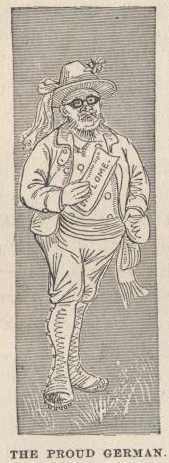
I tried to buy a diploma for an invalid friend at home who had never
traveled, and whose desire all his life has been to ascend Mont Blanc, but
the Guide-in-Chief rather insolently refused to sell me one. I was very
much offended. I said I did not propose to be discriminated against on the
account of my nationality; that he had just sold a diploma to this German
gentleman, and my money was a good as his; I would see to it that he
couldn’t keep his shop for Germans and deny his produce to
Americans; I would have his license taken away from him at the dropping of
a handkerchief; if France refused to break him, I would make an
international matter of it and bring on a war; the soil should be drenched
with blood; and not only that, but I would set up an opposition show and
sell diplomas at half price.
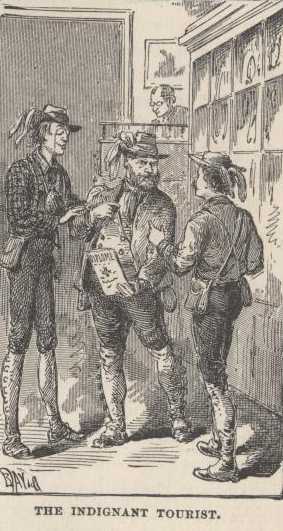
For two cents I would have done these things, too; but nobody offered me two cents. I tried to move that German’s feelings, but it could not be done; he would not give me his diploma, neither would he sell it to me. I told him my friend was sick and could not come himself, but he said he did not care a verdammtes pfennig, he wanted his diploma for himself—did I suppose he was going to risk his neck for that thing and then give it to a sick stranger? Indeed he wouldn’t, so he wouldn’t. I resolved, then, that I would do all I could to injure Mont Blanc.
In the record-book was a list of all the fatal accidents which happened on the mountain. It began with the one in 1820 when the Russian Dr. Hamel’s three guides were lost in a crevice of the glacier, and it recorded the delivery of the remains in the valley by the slow-moving glacier forty-one years later. The latest catastrophe bore the date 1877.
We stepped out and roved about the village awhile. In front of the little church was a monument to the memory of the bold guide Jacques Balmat, the first man who ever stood upon the summit of Mont Blanc. He made that wild trip solitary and alone. He accomplished the ascent a number of times afterward. A stretch of nearly half a century lay between his first ascent and his last one. At the ripe old age of seventy-two he was climbing around a corner of a lofty precipice of the Pic du Midi—nobody with him—when he slipped and fell. So he died in the harness.
He had grown very avaricious in his old age, and used to go off stealthily to hunt for non-existent and impossible gold among those perilous peaks and precipices. He was on a quest of that kind when he lost his life. There was a statue to him, and another to De Saussure, in the hall of our hotel, and a metal plate on the door of a room upstairs bore an inscription to the effect that that room had been occupied by Albert Smith. Balmat and De Saussure discovered Mont Blanc—so to speak—but it was Smith who made it a paying property. His articles in Blackwood and his lectures on Mont Blanc in London advertised it and made people as anxious to see it as if it owed them money.
As we strolled along the road we looked up and saw a red signal-light glowing in the darkness of the mountainside. It seemed but a trifling way up—perhaps a hundred yards, a climb of ten minutes. It was a lucky piece of sagacity in us that we concluded to stop a man whom we met and get a light for our pipes from him instead of continuing the climb to that lantern to get a light, as had been our purpose. The man said that that lantern was on the Grands Mulets, some sixty-five hundred feet above the valley! I know by our Riffelberg experience, that it would have taken us a good part of a week to go up there. I would sooner not smoke at all, than take all that trouble for a light.
Even in the daytime the foreshadowing effect of this mountain’s close proximity creates curious deceptions. For instance, one sees with the naked eye a cabin up there beside the glacier, and a little above and beyond he sees the spot where that red light was located; he thinks he could throw a stone from the one place to the other. But he couldn’t, for the difference between the two altitudes is more than three thousand feet. It looks impossible, from below, that this can be true, but it is true, nevertheless.
While strolling around, we kept the run of the moon all the time, and we still kept an eye on her after we got back to the hotel portico. I had a theory that the gravitation of refraction, being subsidiary to atmospheric compensation, the refrangibility of the earth’s surface would emphasize this effect in regions where great mountain ranges occur, and possibly so even-handed impact the odic and idyllic forces together, the one upon the other, as to prevent the moon from rising higher than 12,200 feet above sea-level. This daring theory had been received with frantic scorn by some of my fellow-scientists, and with an eager silence by others. Among the former I may mention Prof. H——y; and among the latter Prof. T——l. Such is professional jealousy; a scientist will never show any kindness for a theory which he did not start himself. There is no feeling of brotherhood among these people. Indeed, they always resent it when I call them brother. To show how far their ungenerosity can carry them, I will state that I offered to let Prof. H——y publish my great theory as his own discovery; I even begged him to do it; I even proposed to print it myself as his theory. Instead of thanking me, he said that if I tried to fasten that theory on him he would sue me for slander. I was going to offer it to Mr. Darwin, whom I understood to be a man without prejudices, but it occurred to me that perhaps he would not be interested in it since it did not concern heraldry.
But I am glad now, that I was forced to father my intrepid theory myself, for, on the night of which I am writing, it was triumphantly justified and established. Mont Blanc is nearly sixteen thousand feet high; he hid the moon utterly; near him is a peak which is 12,216 feet high; the moon slid along behind the pinnacles, and when she approached that one I watched her with intense interest, for my reputation as a scientist must stand or fall by its decision. I cannot describe the emotions which surged like tidal waves through my breast when I saw the moon glide behind that lofty needle and pass it by without exposing more than two feet four inches of her upper rim above it; I was secure, then. I knew she could rise no higher, and I was right. She sailed behind all the peaks and never succeeded in hoisting her disk above a single one of them.
While the moon was behind one of those sharp fingers, its shadow was flung athwart the vacant heavens—a long, slanting, clean-cut, dark ray—with a streaming and energetic suggestion of force about it, such as the ascending jet of water from a powerful fire-engine affords. It was curious to see a good strong shadow of an earthly object cast upon so intangible a field as the atmosphere.
We went to bed, at last, and went quickly to sleep, but I woke up, after
about three hours, with throbbing temples, and a head which was physically
sore, outside and in. I was dazed, dreamy, wretched, seedy, unrefreshed. I
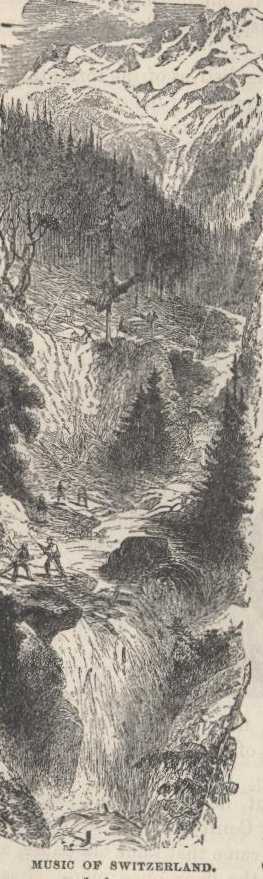
recognized the occasion of all this: it was that torrent. In the mountain
villages of Switzerland, and along the roads, one has always the roar of
the torrent in his ears. He imagines it is music, and he thinks poetic
things about it; he lies in his comfortable bed and is lulled to sleep by
it. But by and by he begins to notice that his head is very sore—he
cannot account for it; in solitudes where the profoundest silence reigns,
he notices a sullen, distant, continuous roar in his ears, which is like
what he would experience if he had sea-shells pressed against them—he
cannot account for it; he is drowsy and absent-minded; there is no
tenacity to his mind, he cannot keep hold of a thought and follow it out;
if he sits down to write, his vocabulary is empty, no suitable words will
come, he forgets what he started to do, and remains there, pen in hand,
head tilted up, eyes closed, listening painfully to the muffled roar of a
distant train in his ears; in his soundest sleep the strain continues, he
goes on listening, always listening intently, anxiously, and wakes at
last, harassed, irritable, unrefreshed. He cannot manage to account for
these things.
Day after day he feels as if he had spent his nights in a sleeping-car. It
actually takes him weeks to find out that it is those persecuting torrents
that have been making all the mischief. It is time for him to get out of
Switzerland, then, for as soon as he has discovered the cause, the misery
is magnified several fold. The roar of the torrent is maddening, then, for
his imagination is assisting; the physical pain it inflicts is exquisite.
When he finds he is approaching one of those streams, his dread is so
lively that he is disposed to fly the track and avoid the implacable foe.
Eight or nine months after the distress of the torrents had departed from
me, the roar and thunder of the streets of Paris brought it all back
again. I moved to the sixth story of the hotel to hunt for peace. About
midnight the noises dulled away, and I was sinking to sleep, when I heard
a new and curious sound; I listened: evidently some joyous lunatic was
softly dancing a “double shuffle” in the room over my head. I
had to wait for him to get through, of course. Five long, long minutes he
smoothly shuffled away—a pause followed, then something fell with a
thump on the floor. I said to myself “There—he is pulling off
his boots—thank heavens he is done.” Another slight pause—he
went to shuffling again! I said to myself, “Is he trying to see what
he can do with only one boot on?” Presently came another pause and
another thump on the floor. I said “Good, he has pulled off his
other boot—now he is done.” But he wasn’t. The
next moment he was shuffling again. I said, “Confound him, he is at
it in his slippers!” After a little came that same old pause, and
right after it that thump on the floor once more. I said, “Hang him,
he had on two pair of boots!” For an hour that magician went
on shuffling and pulling off boots till he had shed as many as twenty-five
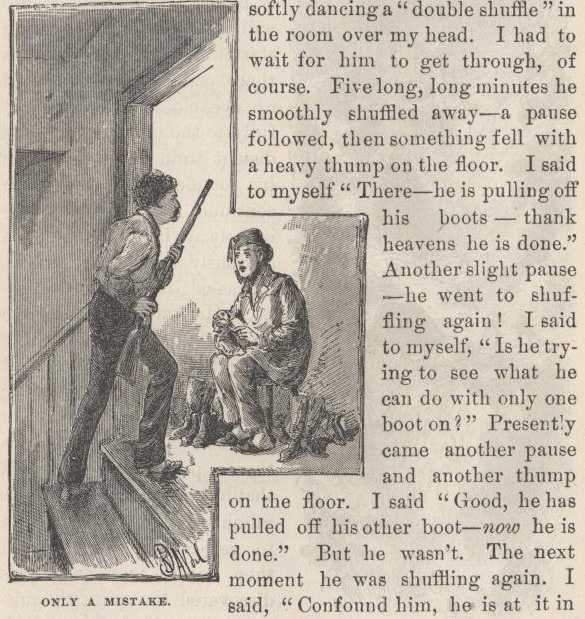
pair, and I was hovering on the verge of lunacy. I got my gun and stole up
there. The fellow was in the midst of an acre of sprawling boots, and he
had a boot in his hand, shuffling it—no, I mean polishing it.
The mystery was explained. He hadn’t been dancing. He was the
“Boots” of the hotel, and was attending to business.
CHAPTER XLIX
[I Scale Mont Blanc—by Telescope]
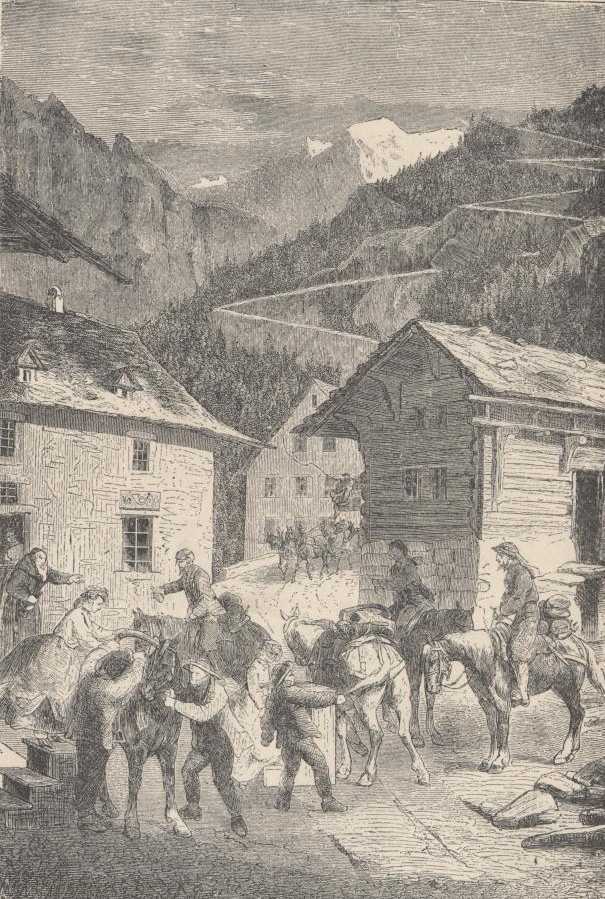
After breakfast, that next morning in Chamonix, we went out in the yard and watched the gangs of excursioning tourists arriving and departing with their mules and guides and porters; then we took a look through the telescope at the snowy hump of Mont Blanc. It was brilliant with sunshine, and the vast smooth bulge seemed hardly five hundred yards away. With the naked eye we could dimly make out the house at the Pierre Pointue, which is located by the side of the great glacier, and is more than three thousand feet above the level of the valley; but with the telescope we could see all its details. While I looked, a woman rode by the house on a mule, and I saw her with sharp distinctness; I could have described her dress. I saw her nod to the people of the house, and rein up her mule, and put her hand up to shield her eyes from the sun. I was not used to telescopes; in fact, I had never looked through a good one before; it seemed incredible to me that this woman could be so far away. I was satisfied that I could see all these details with my naked eye; but when I tried it, that mule and those vivid people had wholly vanished, and the house itself was become small and vague. I tried the telescope again, and again everything was vivid. The strong black shadows of the mule and the woman were flung against the side of the house, and I saw the mule’s silhouette wave its ears.
The telescopulist—or the telescopulariat—I do not know which
is right—said a party were making a grand ascent, and would come in
sight on the remote upper heights, presently; so we waited to observe this
performance. Presently I had a superb idea. I wanted to stand with a party
on the summit of Mont Blanc, merely to be able to say I had done it, and I
believed the telescope could set me within seven feet of the uppermost
man. The telescoper assured me that it could. I then asked him how much I
owed him for as far as I had got? He said, one franc. I asked him how much
it would cost to make the entire ascent? Three francs. I at once
determined to make the entire ascent. But first I inquired if there was
any danger? He said no—not by telescope; said he had taken a great
many parties to the summit, and never lost a man. I asked what he would
charge to let my agent go with me, together with such guides and porters
as might be necessary. He said he would let Harris go for two francs; and
that unless we were unusually timid, he should consider guides and porters
unnecessary; it was not customary to take them, when going by telescope,
for they were rather an encumbrance than a help. He said that the party
now on the mountain were approaching the most difficult part, and if we
hurried we should overtake them within ten minutes, and could then join
them and have the benefit of their guides and porters without their
knowledge, and without expense to us.
I then said we would start immediately. I believe I said it calmly, though I was conscious of a shudder and of a paling cheek, in view of the nature of the exploit I was so unreflectingly engaged in. But the old daredevil spirit was upon me, and I said that as I had committed myself I would not back down; I would ascend Mont Blanc if it cost me my life. I told the man to slant his machine in the proper direction and let us be off.
Harris was afraid and did not want to go, but I heartened him up and said I would hold his hand all the way; so he gave his consent, though he trembled a little at first. I took a last pathetic look upon the pleasant summer scene about me, then boldly put my eye to the glass and prepared to mount among the grim glaciers and the everlasting snows.
We took our way carefully and cautiously across the great Glacier des Bossons, over yawning and terrific crevices and among imposing crags and buttresses of ice which were fringed with icicles of gigantic proportions. The desert of ice that stretched far and wide about us was wild and desolate beyond description, and the perils which beset us were so great that at times I was minded to turn back. But I pulled my pluck together and pushed on.
We passed the glacier safely and began to mount the steeps beyond, with
great alacrity. When we were seven minutes out from the starting-point, we
reached an altitude where the scene took a new aspect; an apparently
limitless continent of gleaming snow was tilted heavenward before our
faces. As my eye followed that awful acclivity far away up into the remote
skies, it seemed to me that all I had ever seen before of sublimity and
magnitude was small and insignificant compared to this.
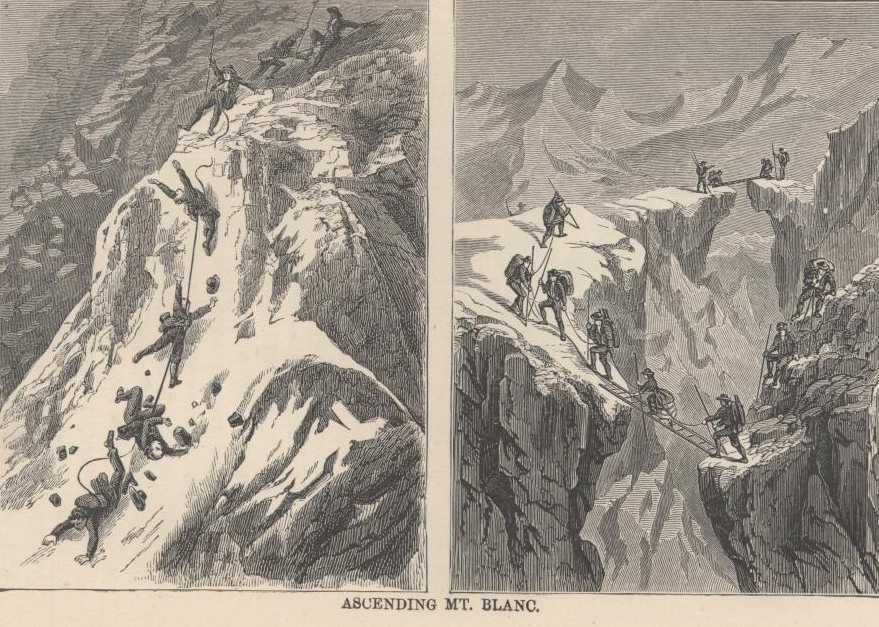
We rested a moment, and then began to mount with speed. Within three minutes we caught sight of the party ahead of us, and stopped to observe them. They were toiling up a long, slanting ridge of snow—twelve persons, roped together some fifteen feet apart, marching in single file, and strongly marked against the clear blue sky. One was a woman. We could see them lift their feet and put them down; we saw them swing their alpenstocks forward in unison, like so many pendulums, and then bear their weight upon them; we saw the lady wave her handkerchief. They dragged themselves upward in a worn and weary way, for they had been climbing steadily from the Grand Mulets, on the Glacier des Bossons, since three in the morning, and it was eleven, now. We saw them sink down in the snow and rest, and drink something from a bottle. After a while they moved on, and as they approached the final short dash of the home-stretch we closed up on them and joined them.
Presently we all stood together on the summit! What a view was spread out below! Away off under the northwestern horizon rolled the silent billows of the Farnese Oberland, their snowy crests glinting softly in the subdued lights of distance; in the north rose the giant form of the Wobblehorn, draped from peak to shoulder in sable thunder-clouds; beyond him, to the right, stretched the grand processional summits of the Cisalpine Cordillera, drowned in a sensuous haze; to the east loomed the colossal masses of the Yodelhorn, the Fuddelhorn, and the Dinnerhorn, their cloudless summits flashing white and cold in the sun; beyond them shimmered the faint far line of the Ghauts of Jubbelpore and the Aiguilles des Alleghenies; in the south towered the smoking peak of Popocatapetl and the unapproachable altitudes of the peerless Scrabblehorn; in the west-south the stately range of the Himalayas lay dreaming in a purple gloom; and thence all around the curving horizon the eye roved over a troubled sea of sun-kissed Alps, and noted, here and there, the noble proportions and the soaring domes of the Bottlehorn, and the Saddlehorn, and the Shovelhorn, and the Powderhorn, all bathed in the glory of noon and mottled with softly gliding blots, the shadows flung from drifting clouds.
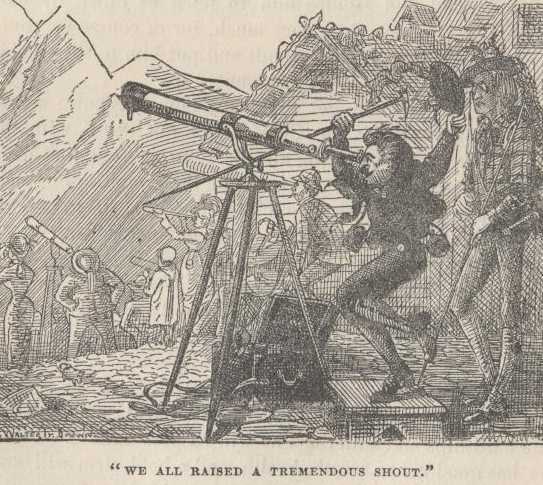
Overcome by the scene, we all raised a triumphant, tremendous shout, in unison. A startled man at my elbow said:
“Confound you, what do you yell like that for, right here in the
street?"
That brought me down to Chamonix, like a flirt. I gave that man some spiritual advice and disposed of him, and then paid the telescope man his full fee, and said that we were charmed with the trip and would remain down, and not reascend and require him to fetch us down by telescope. This pleased him very much, for of course we could have stepped back to the summit and put him to the trouble of bringing us home if we wanted to.
I judged we could get diplomas, now, anyhow; so we went after them, but the Chief Guide put us off, with one pretext or another, during all the time we stayed in Chamonix, and we ended by never getting them at all. So much for his prejudice against people’s nationality. However, we worried him enough to make him remember us and our ascent for some time. He even said, once, that he wished there was a lunatic asylum in Chamonix. This shows that he really had fears that we were going to drive him mad. It was what we intended to do, but lack of time defeated it.
I cannot venture to advise the reader one way or the other, as to ascending Mont Blanc. I say only this: if he is at all timid, the enjoyments of the trip will hardly make up for the hardships and sufferings he will have to endure. But, if he has good nerve, youth, health, and a bold, firm will, and could leave his family comfortably provided for in case the worst happened, he would find the ascent a wonderful experience, and the view from the top a vision to dream about, and tell about, and recall with exultation all the days of his life.
While I do not advise such a person to attempt the ascent, I do not advise him against it. But if he elects to attempt it, let him be warily careful of two things: chose a calm, clear day; and do not pay the telescope man in advance. There are dark stories of his getting advance payers on the summit and then leaving them there to rot.
A frightful tragedy was once witnessed through the Chamonix telescopes. Think of questions and answers like these, on an inquest:
CORONER. You saw deceased lose his life?
WITNESS. I did.
C. Where was he, at the time?
W. Close to the summit of Mont Blanc.
C. Where were you?
W. In the main street of Chamonix.
C. What was the distance between you?
W. A little over five miles, as the bird flies.
This accident occurred in 1866, a year and a month after the disaster on the Matterhorn. Three adventurous English gentlemen, [1] of great experience in mountain-climbing, made up their minds to ascend Mont Blanc without guides or porters. All endeavors to dissuade them from their project failed. Powerful telescopes are numerous in Chamonix. These huge brass tubes, mounted on their scaffoldings and pointed skyward from every choice vantage-ground, have the formidable look of artillery, and give the town the general aspect of getting ready to repel a charge of angels. The reader may easily believe that the telescopes had plenty of custom on that August morning in 1866, for everybody knew of the dangerous undertaking which was on foot, and all had fears that misfortune would result. All the morning the tubes remained directed toward the mountain heights, each with its anxious group around it; but the white deserts were vacant.
1. Sir George Young and his brothers James and Albert.
At last, toward eleven o’clock, the people who were looking through the telescopes cried out “There they are!”—and sure enough, far up, on the loftiest terraces of the Grand Plateau, the three pygmies appeared, climbing with remarkable vigor and spirit. They disappeared in the “Corridor,” and were lost to sight during an hour. Then they reappeared, and were presently seen standing together upon the extreme summit of Mont Blanc. So, all was well. They remained a few minutes on that highest point of land in Europe, a target for all the telescopes, and were then seen to begin descent. Suddenly all three vanished. An instant after, they appeared again, two thousand feet below!
Evidently, they had tripped and been shot down an almost perpendicular slope of ice to a point where it joined the border of the upper glacier. Naturally, the distant witness supposed they were now looking upon three corpses; so they could hardly believe their eyes when they presently saw two of the men rise to their feet and bend over the third. During two hours and a half they watched the two busying themselves over the extended form of their brother, who seemed entirely inert. Chamonix’s affairs stood still; everybody was in the street, all interest was centered upon what was going on upon that lofty and isolated stage five miles away. Finally the two—one of them walking with great difficulty—were seen to begin descent, abandoning the third, who was no doubt lifeless. Their movements were followed, step by step, until they reached the “Corridor” and disappeared behind its ridge. Before they had had time to traverse the “Corridor” and reappear, twilight was come, and the power of the telescope was at an end.
The survivors had a most perilous journey before them in the gathering
darkness, for they must get down to the Grands Mulets before they would
find a safe stopping-place—a long and tedious descent, and perilous
enough even in good daylight. The oldest guides expressed the opinion that
they could not succeed; that all the chances were that they would lose
their lives.
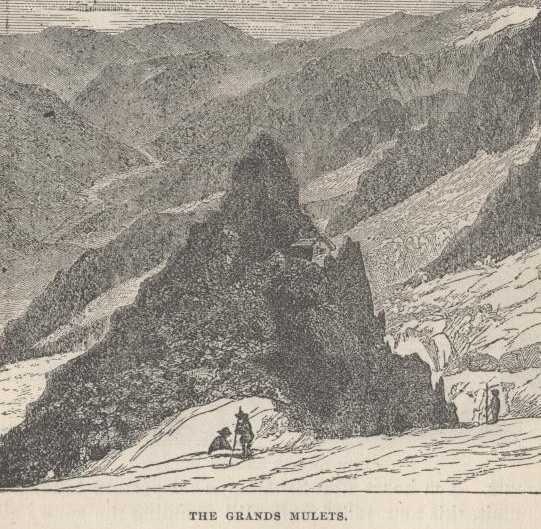
Yet those brave men did succeed. They reached the Grands Mulets in safety. Even the fearful shock which their nerves had sustained was not sufficient to overcome their coolness and courage. It would appear from the official account that they were threading their way down through those dangers from the closing in of twilight until two o’clock in the morning, or later, because the rescuing party from Chamonix reached the Grand Mulets about three in the morning and moved thence toward the scene of the disaster under the leadership of Sir George Young, “who had only just arrived.”
After having been on his feet twenty-four hours, in the exhausting work of mountain-climbing, Sir George began the reascent at the head of the relief party of six guides, to recover the corpse of his brother. This was considered a new imprudence, as the number was too few for the service required. Another relief party presently arrived at the cabin on the Grands Mulets and quartered themselves there to await events. Ten hours after Sir George’s departure toward the summit, this new relief were still scanning the snowy altitudes above them from their own high perch among the ice deserts ten thousand feet above the level of the sea, but the whole forenoon had passed without a glimpse of any living thing appearing up there.
This was alarming. Half a dozen of their number set out, then early in the afternoon, to seek and succor Sir George and his guides. The persons remaining at the cabin saw these disappear, and then ensued another distressing wait. Four hours passed, without tidings. Then at five o’clock another relief, consisting of three guides, set forward from the cabin. They carried food and cordials for the refreshment of their predecessors; they took lanterns with them, too; night was coming on, and to make matters worse, a fine, cold rain had begun to fall.
At the same hour that these three began their dangerous ascent, the
official Guide-in-Chief of the Mont Blanc region undertook the dangerous
descent to Chamonix, all alone, to get reinforcements. However, a couple
of hours later, at 7 P.M., the anxious solicitude came to an end, and
happily. A bugle note was heard, and a cluster of black specks was
distinguishable against the snows of the upper heights. The watchers
counted these specks eagerly—fourteen—nobody was missing. An
hour and a half later they were all safe under the roof of the cabin. They
had brought the corpse with them. Sir George Young tarried there but a few
minutes, and then began the long and troublesome descent from the cabin to
Chamonix. He probably reached there about two or three o’clock in
the morning, after having been afoot among the rocks and glaciers during
two days and two nights. His endurance was equal to his daring.
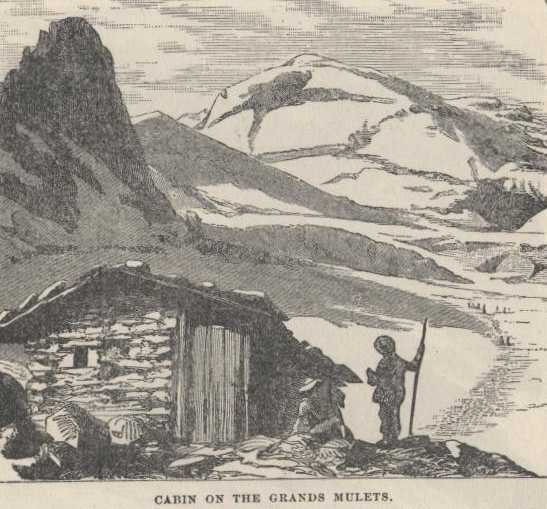
The cause of the unaccountable delay of Sir George and the relief parties among the heights where the disaster had happened was a thick fog—or, partly that and partly the slow and difficult work of conveying the dead body down the perilous steeps.
The corpse, upon being viewed at the inquest, showed no bruises, and it was some time before the surgeons discovered that the neck was broken. One of the surviving brothers had sustained some unimportant injuries, but the other had suffered no hurt at all. How these men could fall two thousand feet, almost perpendicularly, and live afterward, is a most strange and unaccountable thing.
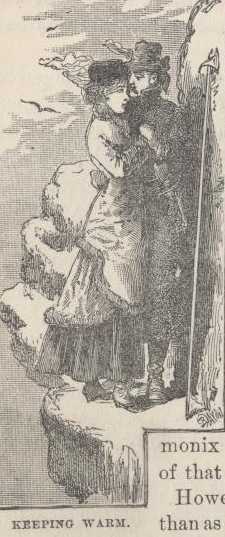
A great many women have made the ascent of Mont Blanc. An English girl,
Miss Stratton, conceived the daring idea, two or three years ago, of
attempting the ascent in the middle of winter. She tried it—and she
succeeded. Moreover, she froze two of her fingers on the way up, she fell
in love with her guide on the summit, and she married him when she got to
the bottom again. There is nothing in romance, in the way of a striking
“situation,” which can beat this love scene in midheaven on an
isolated ice-crest with the thermometer at zero and an Artic gale blowing.
The first woman who ascended Mont Blanc was a girl aged twenty-two—Mlle. Maria Paradis—1809. Nobody was with her but her sweetheart, and he was not a guide. The sex then took a rest for about thirty years, when a Mlle. d’Angeville made the ascent—1838. In Chamonix I picked up a rude old lithograph of that day which pictured her “in the act.”
However, I value it less as a work of art than as a fashion-plate. Miss d’Angeville put on a pair of men’s pantaloons to climb it, which was wise; but she cramped their utility by adding her petticoat, which was idiotic.
One of the mournfulest calamities which men’s disposition to climb
dangerous mountains has resulted in, happened on Mont Blanc in September
1870. M. D’Arve tells the story briefly in his Histoire Du Mont
Blanc. In the next chapter I will copy its chief features.
CHAPTER XLV
A Catastrophe Which Cost Eleven Lives
On the 5th of September, 1870, a caravan of eleven persons departed from Chamonix to make the ascent of Mont Blanc. Three of the party were tourists; Messrs. Randall and Bean, Americans, and Mr. George Corkindale, a Scotch gentleman; there were three guides and five porters. The cabin on the Grands Mulets was reached that day; the ascent was resumed early the next morning, September 6th. The day was fine and clear, and the movements of the party were observed through the telescopes of Chamonix; at two o’clock in the afternoon they were seen to reach the summit. A few minutes later they were seen making the first steps of the descent; then a cloud closed around them and hid them from view.
Eight hours passed, the cloud still remained, night came, no one had returned to the Grands Mulets. Sylvain Couttet, keeper of the cabin there, suspected a misfortune, and sent down to the valley for help. A detachment of guides went up, but by the time they had made the tedious trip and reached the cabin, a raging storm had set in. They had to wait; nothing could be attempted in such a tempest.
The wild storm lasted more than a week, without ceasing; but on the 17th, Couttet, with several guides, left the cabin and succeeded in making the ascent. In the snowy wastes near the summit they came upon five bodies, lying upon their sides in a reposeful attitude which suggested that possibly they had fallen asleep there, while exhausted with fatigue and hunger and benumbed with cold, and never knew when death stole upon them. Couttet moved a few steps further and discovered five more bodies. The eleventh corpse—that of a porter—was not found, although diligent search was made for it.
In the pocket of Mr. Bean, one of the Americans, was found a note-book in which had been penciled some sentences which admit us, in flesh and spirit, as it were, to the presence of these men during their last hours of life, and to the grisly horrors which their fading vision looked upon and their failing consciousness took cognizance of:
TUESDAY, SEPT. 6. I have made the ascent of Mont Blanc, with ten persons—eight guides, and Mr. Corkindale and Mr. Randall. We reached the summit at half past 2. Immediately after quitting it, we were enveloped in clouds of snow. We passed the night in a grotto hollowed in the snow, which afforded us but poor shelter, and I was ill all night.
SEPT. 7—MORNING. The cold is excessive. The snow falls heavily and without interruption. The guides take no rest.
EVENING. My Dear Hessie, we have been two days on Mont Blanc, in the midst of a terrible hurricane of snow, we have lost our way, and are in a hole scooped in the snow, at an altitude of 15,000 feet. I have no longer any hope of descending.
They had wandered around, and around, in the blinding snow-storm, hopelessly lost, in a space only a hundred yards square; and when cold and fatigue vanquished them at last, they scooped their cave and lay down there to die by inches, unaware that five steps more would have brought them into the true path. They were so near to life and safety as that, and did not suspect it. The thought of this gives the sharpest pang that the tragic story conveys.
The author of the Histoire Du Mont Blanc introduced the closing sentences of Mr. Bean’s pathetic record thus:
“Here the characters are large and unsteady; the hand which traces them is become chilled and torpid; but the spirit survives, and the faith and resignation of the dying man are expressed with a sublime simplicity.”
Perhaps this note-book will be found and sent to you. We have nothing to eat, my feet are already frozen, and I am exhausted; I have strength to write only a few words more. I have left means for C’s education; I know you will employ them wisely. I die with faith in God, and with loving thoughts of you. Farewell to all. We shall meet again, in Heaven. ... I think of you always.
It is the way of the Alps to deliver death to their victims with a
merciful swiftness, but here the rule failed. These men suffered the
bitterest death that has been recorded in the history of those mountains,
freighted as that history is with grisly tragedies.
CHAPTER XLVI
[Meeting a Hog on a Precipice]
Mr. Harris and I took some guides and porters and ascended to the Hotel des Pyramides, which is perched on the high moraine which borders the Glacier des Bossons. The road led sharply uphill, all the way, through grass and flowers and woods, and was a pleasant walk, barring the fatigue of the climb.
From the hotel we could view the huge glacier at very close range. After a rest we followed down a path which had been made in the steep inner frontage of the moraine, and stepped upon the glacier itself. One of the shows of the place was a tunnel-like cavern, which had been hewn in the glacier. The proprietor of this tunnel took candles and conducted us into it. It was three or four feet wide and about six feet high. Its walls of pure and solid ice emitted a soft and rich blue light that produced a lovely effect, and suggested enchanted caves, and that sort of thing. When we had proceeded some yards and were entering darkness, we turned about and had a dainty sunlit picture of distant woods and heights framed in the strong arch of the tunnel and seen through the tender blue radiance of the tunnel’s atmosphere.
The cavern was nearly a hundred yards long, and when we reached its inner limit the proprietor stepped into a branch tunnel with his candles and left us buried in the bowels of the glacier, and in pitch-darkness. We judged his purpose was murder and robbery; so we got out our matches and prepared to sell our lives as dearly as possible by setting the glacier on fire if the worst came to the worst—but we soon perceived that this man had changed his mind; he began to sing, in a deep, melodious voice, and woke some curious and pleasing echoes. By and by he came back and pretended that that was what he had gone behind there for. We believed as much of that as we wanted to.
Thus our lives had been once more in imminent peril, but by the exercise
of the swift sagacity and cool courage which had saved us so often, we had
added another escape to the long list. The tourist should visit that
ice-cavern, by all means, for it is well worth the trouble; but I would
advise him to go only with a strong and well-armed force. I do not
consider artillery necessary, yet it would not be unadvisable to take it
along, if convenient. The journey, going and coming, is about three miles
and a half, three of which are on level ground. We made it in less than a
day, but I would counsel the unpracticed—if not pressed for time—to
allow themselves two. Nothing is gained in the Alps by over-exertion;
nothing is gained by crowding two days’ work into one for the poor
sake of being able to boast of the exploit afterward. It will be found
much better, in the long run, to do the thing in two days, and then
subtract one of them from the narrative. This saves fatigue, and does not
injure the narrative. All the more thoughtful among the Alpine tourists do
this.
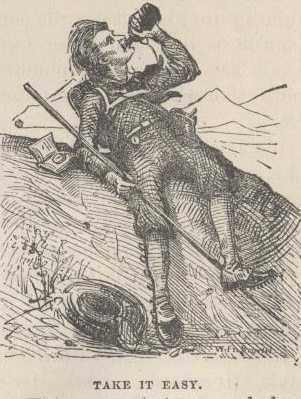
We now called upon the Guide-in-Chief, and asked for a squadron of guides and porters for the ascent of the Montanvert. This idiot glared at us, and said:
“You don’t need guides and porters to go to the Montanvert.”
“What do we need, then?”
“Such as you?—an ambulance!”
I was so stung by this brutal remark that I took my custom elsewhere.
Betimes, next morning, we had reached an altitude of five thousand feet above the level of the sea. Here we camped and breakfasted. There was a cabin there—the spot is called the Caillet—and a spring of ice-cold water. On the door of the cabin was a sign, in French, to the effect that “One may here see a living chamois for fifty centimes.” We did not invest; what we wanted was to see a dead one.
A little after noon we ended the ascent and arrived at the new hotel on
the Montanvert, and had a view of six miles, right up the great glacier,
the famous Mer de Glace. At this point it is like a sea whose deep swales
and long, rolling swells have been caught in mid-movement and frozen
solid; but further up it is broken up into wildly tossing billows of ice.
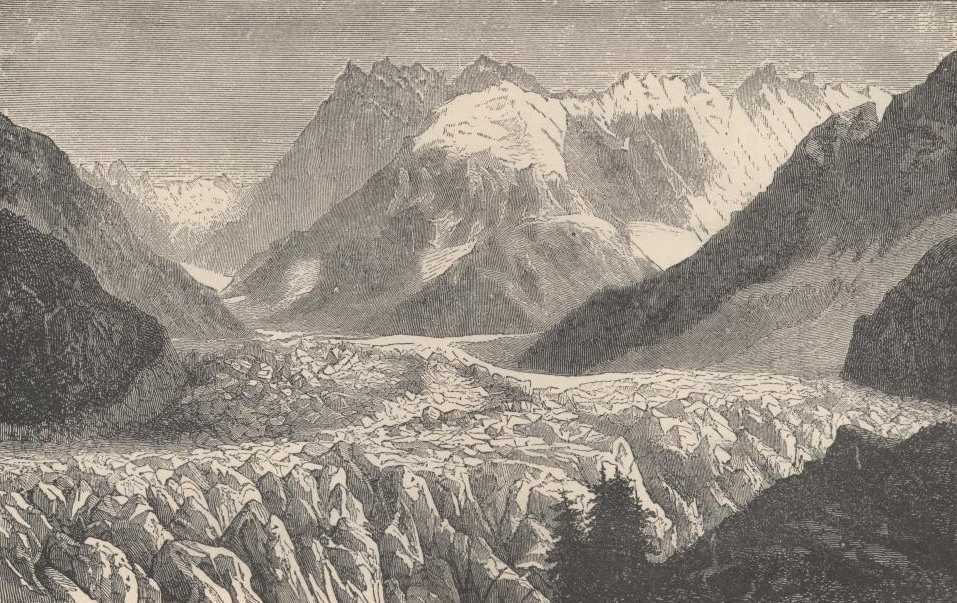
We descended a ticklish path in the steep side of the moraine, and invaded the glacier. There were tourists of both sexes scattered far and wide over it, everywhere, and it had the festive look of a skating-rink.
The Empress Josephine came this far, once. She ascended the Montanvert in 1810—but not alone; a small army of men preceded her to clear the path—and carpet it, perhaps—and she followed, under the protection of sixty-eight guides.
Her successor visited Chamonix later, but in far different style.
It was seven weeks after the first fall of the Empire, and poor Marie Louise, ex-Empress was a fugitive. She came at night, and in a storm, with only two attendants, and stood before a peasant’s hut, tired, bedraggled, soaked with rain, “the red print of her lost crown still girdling her brow,” and implored admittance—and was refused! A few days before, the adulations and applauses of a nation were sounding in her ears, and now she was come to this!
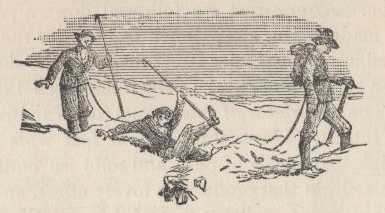
We crossed the Mer de Glace in safety, but we had misgivings. The crevices in the ice yawned deep and blue and mysterious, and it made one nervous to traverse them. The huge round waves of ice were slippery and difficult to climb, and the chances of tripping and sliding down them and darting into a crevice were too many to be comfortable.
In the bottom of a deep swale between two of the biggest of the ice-waves,
we found a fraud who pretended to be cutting steps to insure the safety of
tourists. He was “soldiering” when we came upon him, but he
hopped up and chipped out a couple of steps about big enough for a cat,
and charged us a franc or two for it. Then he sat down again, to doze till
the next party should come along.