
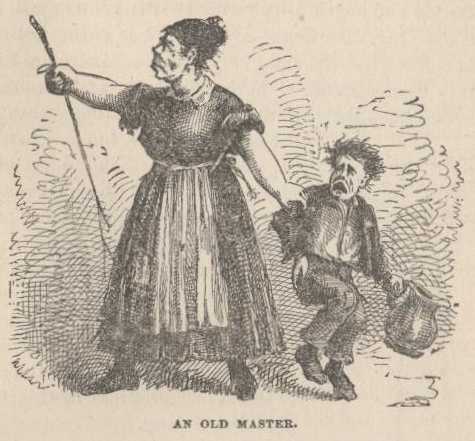
I found more pleasure in contemplating the Old Masters this time than I did when I was in Europe in former years, but still it was a calm pleasure; there was nothing overheated about it. When I was in Venice before, I think I found no picture which stirred me much, but this time there were two which enticed me to the Doge’s palace day after day, and kept me there hours at a time. One of these was Tintoretto’s three-acre picture in the Great Council Chamber. When I saw it twelve years ago I was not strongly attracted to it—the guide told me it was an insurrection in heaven—but this was an error.
The movement of this great work is very fine. There are ten thousand
figures, and they are all doing something. There is a wonderful “go”
to the whole composition. Some of the figures are driving headlong
downward, with clasped hands, others are swimming through the cloud-shoals—some
on their faces, some on their backs—great processions of bishops,
martyrs, and angels are pouring swiftly centerward from various outlying
directions—everywhere is enthusiastic joy, there is rushing movement
everywhere. There are fifteen or twenty figures scattered here and there,
with books, but they cannot keep their attention on their reading—they
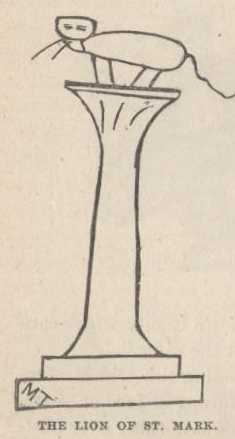
offer the books to others, but no one wishes to read, now. The Lion of St.
Mark is there with his book; St. Mark is there with his pen uplifted; he
and the Lion are looking each other earnestly in the face, disputing about
the way to spell a word—the Lion looks up in rapt admiration while
St. Mark spells. This is wonderfully interpreted by the artist. It is the
master-stroke of this imcomparable painting.
I visited the place daily, and never grew tired of looking at that grand
picture. As I have intimated, the movement is almost unimaginably
vigorous; the figures are singing, hosannahing, and many are blowing
trumpets. So vividly is noise suggested, that spectators who become
absorbed in the picture almost always fall to shouting comments in each
other’s ears, making ear-trumpets of their curved hands, fearing
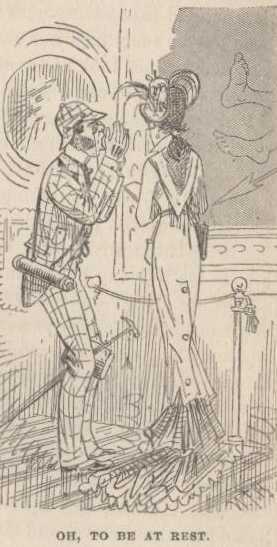
they may not otherwise be heard. One often sees a tourist, with the
eloquent tears pouring down his cheeks, funnel his hands at his wife’s
ear, and hears him roar through them, “Oh, to be there and at
rest!”
None but the supremely great in art can produce effects like these with the silent brush.
Twelve years ago I could not have appreciated this picture. One year ago I could not have appreciated it. My study of Art in Heidelberg has been a noble education to me. All that I am today in Art, I owe to that.
The other great work which fascinated me was Bassano’s immortal Hair Trunk. This is in the Chamber of the Council of Ten. It is in one of the three forty-foot pictures which decorate the walls of the room. The composition of this picture is beyond praise. The Hair Trunk is not hurled at the stranger’s head—so to speak—as the chief feature of an immortal work so often is; no, it is carefully guarded from prominence, it is subordinated, it is restrained, it is most deftly and cleverly held in reserve, it is most cautiously and ingeniously led up to, by the master, and consequently when the spectator reaches it at last, he is taken unawares, he is unprepared, and it bursts upon him with a stupefying surprise.
One is lost in wonder at all the thought and care which this elaborate planning must have cost. A general glance at the picture could never suggest that there was a hair trunk in it; the Hair Trunk is not mentioned in the title even—which is, “Pope Alexander III. and the Doge Ziani, the Conqueror of the Emperor Frederick Barbarossa”; you see, the title is actually utilized to help divert attention from the Trunk; thus, as I say, nothing suggests the presence of the Trunk, by any hint, yet everything studiedly leads up to it, step by step. Let us examine into this, and observe the exquisitely artful artlessness of the plan.
At the extreme left end of the picture are a couple of women, one of them
with a child looking over her shoulder at a wounded man sitting with
bandaged head on the ground. These people seem needless, but no, they are
there for a purpose; one cannot look at them without seeing the gorgeous
procession of grandees, bishops, halberdiers, and banner-bearers which is
passing along behind them; one cannot see the procession without feeling
the curiosity to follow it and learn whither it is going; it leads him to
the Pope, in the center of the picture, who is talking with the bonnetless
Doge—talking tranquilly, too, although within twelve feet of them a
man is beating a drum, and not far from the drummer two persons are
blowing horns, and many horsemen are plunging and rioting about—indeed,
twenty-two feet of this great work is all a deep and happy holiday
serenity and Sunday-school procession, and then we come suddenly upon
eleven and one-half feet of turmoil and racket and insubordination. This
latter state of things is not an accident, it has its purpose. But for it,
one would linger upon the Pope and the Doge, thinking them to be the
motive and supreme feature of the picture; whereas one is drawn along,
almost unconsciously, to see what the trouble is about. Now at the very end
of this riot, within four feet of the end of the picture, and full
thirty-six feet from the beginning of it, the Hair Trunk bursts with an
electrifying suddenness upon the spectator, in all its matchless
perfection, and the great master’s triumph is sweeping and complete.
From that moment no other thing in those forty feet of canvas has any
charm; one sees the Hair Trunk, and the Hair Trunk only—and to see
it is to worship it. Bassano even placed objects in the immediate vicinity
of the Supreme Feature whose pretended purpose was to divert attention
from it yet a little longer and thus delay and augment the surprise; for
instance, to the right of it he has placed a stooping man with a cap so
red that it is sure to hold the eye for a moment—to the left of it,
some six feet away, he has placed a red-coated man on an inflated horse,
and that coat plucks your eye to that locality the next moment—then,
between the Trunk and the red horseman he has intruded a man, naked to his
waist, who is carrying a fancy flour-sack on the middle of his back
instead of on his shoulder—this admirable feat interests you, of
course—keeps you at bay a little longer, like a sock or a jacket
thrown to the pursuing wolf—but at last, in spite of all
distractions and detentions, the eye of even the most dull and heedless
spectator is sure to fall upon the World’s Masterpiece, and in that
moment he totters to his chair or leans upon his guide for support.
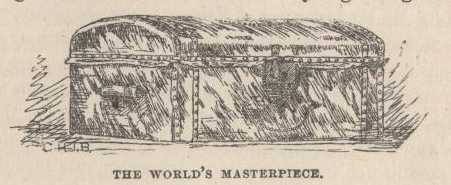
Descriptions of such a work as this must necessarily be imperfect, yet they are of value. The top of the Trunk is arched; the arch is a perfect half-circle, in the Roman style of architecture, for in the then rapid decadence of Greek art, the rising influence of Rome was already beginning to be felt in the art of the Republic. The Trunk is bound or bordered with leather all around where the lid joins the main body. Many critics consider this leather too cold in tone; but I consider this its highest merit, since it was evidently made so to emphasize by contrast the impassioned fervor of the hasp. The highlights in this part of the work are cleverly managed, the motif is admirably subordinated to the ground tints, and the technique is very fine. The brass nail-heads are in the purest style of the early Renaissance. The strokes, here, are very firm and bold—every nail-head is a portrait. The handle on the end of the Trunk has evidently been retouched—I think, with a piece of chalk—but one can still see the inspiration of the Old Master in the tranquil, almost too tranquil, hang of it. The hair of this Trunk is real hair—so to speak—white in patches, brown in patches. The details are finely worked out; the repose proper to hair in a recumbent and inactive attitude is charmingly expressed. There is a feeling about this part of the work which lifts it to the highest altitudes of art; the sense of sordid realism vanishes away—one recognizes that there is soul here.
View this Trunk as you will, it is a gem, it is a marvel, it is a miracle. Some of the effects are very daring, approaching even to the boldest flights of the rococo, the sirocco, and the Byzantine schools—yet the master’s hand never falters—it moves on, calm, majestic, confident—and, with that art which conceals art, it finally casts over the tout ensemble, by mysterious methods of its own, a subtle something which refines, subdues, etherealizes the arid components and endures them with the deep charm and gracious witchery of poesy.
Among the art-treasures of Europe there are pictures which approach the
Hair Trunk—there are two which may be said to equal it, possibly—but
there is none that surpasses it. So perfect is the Hair Trunk that it
moves even persons who ordinarily have no feeling for art. When an Erie
baggagemaster saw it two years ago, he could hardly keep from checking it;
and once when a customs inspector was brought into its presence, he gazed
upon it in silent rapture for some moments, then slowly and unconsciously
placed one hand behind him with the palm uppermost, and got out his chalk
with the other. These facts speak for themselves.
CHAPTER XLIX
[Hanged with a Golden Rope]
One lingers about the Cathedral a good deal, in Venice. There is a strong fascination about it—partly because it is so old, and partly because it is so ugly. Too many of the world’s famous buildings fail of one chief virtue—harmony; they are made up of a methodless mixture of the ugly and the beautiful; this is bad; it is confusing, it is unrestful. One has a sense of uneasiness, of distress, without knowing why. But one is calm before St. Mark’s, one is calm within it, one would be calm on top of it, calm in the cellar; for its details are masterfully ugly, no misplaced and impertinent beauties are intruded anywhere; and the consequent result is a grand harmonious whole, of soothing, entrancing, tranquilizing, soul-satisfying ugliness. One’s admiration of a perfect thing always grows, never declines; and this is the surest evidence to him that it is perfect. St. Mark’s is perfect. To me it soon grew to be so nobly, so augustly ugly, that it was difficult to stay away from it, even for a little while. Every time its squat domes disappeared from my view, I had a despondent feeling; whenever they reappeared, I felt an honest rapture—I have not known any happier hours than those I daily spent in front of Florian’s, looking across the Great Square at it. Propped on its long row of low thick-legged columns, its back knobbed with domes, it seemed like a vast warty bug taking a meditative walk.
St. Mark’s is not the oldest building in the world, of course, but it seems the oldest, and looks the oldest—especially inside.
When the ancient mosaics in its walls become damaged, they are repaired but not altered; the grotesque old pattern is preserved. Antiquity has a charm of its own, and to smarten it up would only damage it. One day I was sitting on a red marble bench in the vestibule looking up at an ancient piece of apprentice-work, in mosaic, illustrative of the command to “multiply and replenish the earth.” The Cathedral itself had seemed very old; but this picture was illustrating a period in history which made the building seem young by comparison. But I presently found an antique which was older than either the battered Cathedral or the date assigned to the piece of history; it was a spiral-shaped fossil as large as the crown of a hat; it was embedded in the marble bench, and had been sat upon by tourists until it was worn smooth. Contrasted with the inconceivable antiquity of this modest fossil, those other things were flippantly modern—jejune—mere matters of day-before-yesterday. The sense of the oldness of the Cathedral vanished away under the influence of this truly venerable presence.
St. Mark’s is monumental; it is an imperishable remembrancer of the profound and simple piety of the Middle Ages. Whoever could ravish a column from a pagan temple, did it and contributed his swag to this Christian one. So this fane is upheld by several hundred acquisitions procured in that peculiar way. In our day it would be immoral to go on the highway to get bricks for a church, but it was no sin in the old times. St. Mark’s was itself the victim of a curious robbery once. The thing is set down in the history of Venice, but it might be smuggled into the Arabian Nights and not seem out of place there:
Nearly four hundred and fifty years ago, a Candian named Stammato, in the
suite of a prince of the house of Este, was allowed to view the riches of
St. Mark’s. His sinful eye was dazzled and he hid himself behind an
altar, with an evil purpose in his heart, but a priest discovered him and
turned him out. Afterward he got in again—by false keys, this time.
He went there, night after night, and worked hard and patiently, all
alone, overcoming difficulty after difficulty with his toil, and at last
succeeded in removing a great brick of the marble paneling which walled
the lower part of the treasury; this block he fixed so that he could take
it out and put it in at will. After that, for weeks, he spent all his
midnights in his magnificent mine, inspecting it in security, gloating
over its marvels at his leisure, and always slipping back to his obscure
lodgings before dawn, with a duke’s ransom under his cloak. He did
not need to grab, haphazard, and run—there was no hurry. He could
make deliberate and well-considered selections; he could consult his
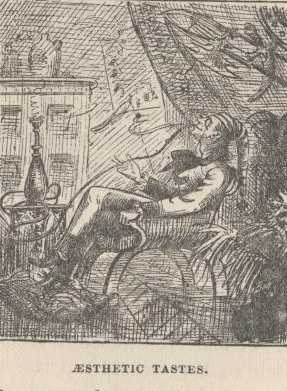
esthetic tastes. One comprehends how undisturbed he was, and how safe from
any danger of interruption, when it is stated that he even carried off a
unicorn’s horn—a mere curiosity—which would not pass
through the egress entire, but had to be sawn in two—a bit of work
which cost him hours of tedious labor. He continued to store up his
treasures at home until his occupation lost the charm of novelty and
became monotonous; then he ceased from it, contented. Well he might be;
for his collection, raised to modern values, represented nearly fifty
million dollars!
He could have gone home much the richest citizen of his country, and it might have been years before the plunder was missed; but he was human—he could not enjoy his delight alone, he must have somebody to talk about it with. So he exacted a solemn oath from a Candian noble named Crioni, then led him to his lodgings and nearly took his breath away with a sight of his glittering hoard. He detected a look in his friend’s face which excited his suspicion, and was about to slip a stiletto into him when Crioni saved himself by explaining that that look was only an expression of supreme and happy astonishment. Stammato made Crioni a present of one of the state’s principal jewels—a huge carbuncle, which afterward figured in the Ducal cap of state—and the pair parted. Crioni went at once to the palace, denounced the criminal, and handed over the carbuncle as evidence. Stammato was arrested, tried, and condemned, with the old-time Venetian promptness. He was hanged between the two great columns in the Piazza—with a gilded rope, out of compliment to his love of gold, perhaps. He got no good of his booty at all—it was all recovered.
In Venice we had a luxury which very seldom fell to our lot on the continent—a home dinner with a private family. If one could always stop with private families, when traveling, Europe would have a charm which it now lacks. As it is, one must live in the hotels, of course, and that is a sorrowful business. A man accustomed to American food and American domestic cookery would not starve to death suddenly in Europe; but I think he would gradually waste away, and eventually die.
He would have to do without his accustomed morning meal. That is too formidable a change altogether; he would necessarily suffer from it. He could get the shadow, the sham, the base counterfeit of that meal; but it would do him no good, and money could not buy the reality.
To particularize: the average American’s simplest and commonest form
of breakfast consists of coffee and beefsteak; well, in Europe, coffee is
an unknown beverage. You can get what the European hotel-keeper thinks is
coffee, but it resembles the real thing as hypocrisy resembles holiness.
It is a feeble, characterless, uninspiring sort of stuff, and almost as
undrinkable as if it had been made in an American hotel. The milk used for
it is what the French call “Christian” milk—milk which
has been baptized.
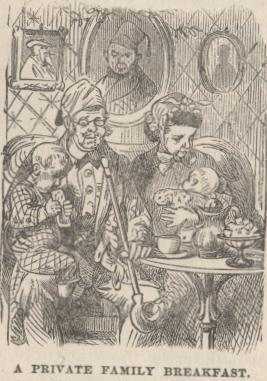
After a few months’ acquaintance with European “coffee,” one’s mind weakens, and his faith with it, and he begins to wonder if the rich beverage of home, with its clotted layer of yellow cream on top of it, is not a mere dream, after all, and a thing which never existed.
Next comes the European bread—fair enough, good enough, after a fashion, but cold; cold and tough, and unsympathetic; and never any change, never any variety—always the same tiresome thing.
Next, the butter—the sham and tasteless butter; no salt in it, and made of goodness knows what.
Then there is the beefsteak. They have it in Europe, but they don’t know how to cook it. Neither will they cut it right. It comes on the table in a small, round pewter platter. It lies in the center of this platter, in a bordering bed of grease-soaked potatoes; it is the size, shape, and thickness of a man’s hand with the thumb and fingers cut off. It is a little overdone, is rather dry, it tastes pretty insipidly, it rouses no enthusiasm.
Imagine a poor exile contemplating that inert thing; and imagine an angel suddenly sweeping down out of a better land and setting before him a mighty porterhouse steak an inch and a half thick, hot and sputtering from the griddle; dusted with a fragrant pepper; enriched with little melting bits of butter of the most unimpeachable freshness and genuineness; the precious juices of the meat trickling out and joining the gravy, archipelagoed with mushrooms; a township or two of tender, yellowish fat gracing an outlying district of this ample county of beefsteak; the long white bone which divides the sirloin from the tenderloin still in its place; and imagine that the angel also adds a great cup of American home-made coffee, with a cream a-froth on top, some real butter, firm and yellow and fresh, some smoking hot-biscuits, a plate of hot buckwheat cakes, with transparent syrup—could words describe the gratitude of this exile?
The European dinner is better than the European breakfast, but it has its faults and inferiorities; it does not satisfy. He comes to the table eager and hungry; he swallows his soup—there is an undefinable lack about it somewhere; thinks the fish is going to be the thing he wants—eats it and isn’t sure; thinks the next dish is perhaps the one that will hit the hungry place—tries it, and is conscious that there was a something wanting about it, also. And thus he goes on, from dish to dish, like a boy after a butterfly which just misses getting caught every time it alights, but somehow doesn’t get caught after all; and at the end the exile and the boy have fared about alike; the one is full, but grievously unsatisfied, the other has had plenty of exercise, plenty of interest, and a fine lot of hopes, but he hasn’t got any butterfly. There is here and there an American who will say he can remember rising from a European table d’hôte perfectly satisfied; but we must not overlook the fact that there is also here and there an American who will lie.
The number of dishes is sufficient; but then it is such a monotonous
variety of unstriking dishes. It is an inane dead-level of “fair-to-middling.”
There is nothing to accent it. Perhaps if the roast of mutton or of
beef—a big, generous one—were brought on the table and carved
in full view of the client, that might give the right sense of earnestness
and reality to the thing; but they don’t do that, they pass the
sliced meat around on a dish, and so you are perfectly calm, it does not
stir you in the least. Now a vast roast turkey, stretched on the broad of
his back, with his heels in the air and the rich juices oozing from his
fat sides ... but I may as well stop there, for they would not know how to
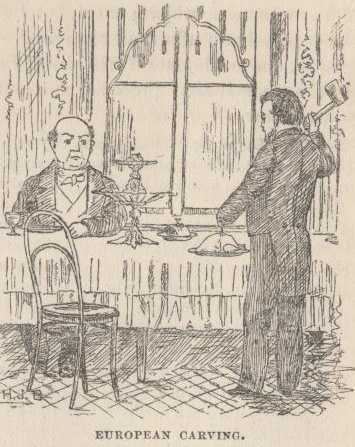
cook him. They can’t even cook a chicken respectably; and as for
carving it, they do that with a hatchet.
This is about the customary table d’hôte bill in summer:
Soup (characterless).
Fish—sole, salmon, or whiting—usually tolerably good.
Roast—mutton or beef—tasteless—and some last year’s potatoes.
A pate, or some other made dish—usually good—“considering.”
One vegetable—brought on in state, and all alone—usually insipid lentils, or string-beans, or indifferent asparagus.
Roast chicken, as tasteless as paper.
Lettuce-salad—tolerably good.
Decayed strawberries or cherries.
Sometimes the apricots and figs are fresh, but this is no advantage, as these fruits are of no account anyway.
The grapes are generally good, and sometimes there is a tolerably good peach, by mistake.
The variations of the above bill are trifling. After a fortnight one discovers that the variations are only apparent, not real; in the third week you get what you had the first, and in the fourth the week you get what you had the second. Three or four months of this weary sameness will kill the robustest appetite.
It has now been many months, at the present writing, since I have had a nourishing meal, but I shall soon have one—a modest, private affair, all to myself. I have selected a few dishes, and made out a little bill of fare, which will go home in the steamer that precedes me, and be hot when I arrive—as follows:
Radishes. Baked apples, with cream
Fried oysters; stewed oysters. Frogs.
American coffee, with real cream.
American butter.
Fried chicken, Southern style.
Porter-house steak.
Saratoga potatoes.
Broiled chicken, American style.
Hot biscuits, Southern style.
Hot wheat-bread, Southern style.
Hot buckwheat cakes.
American toast. Clear maple syrup.
Virginia bacon, broiled.
Blue points, on the half shell.
Cherry-stone clams.
San Francisco mussels, steamed.
Oyster soup. Clam Soup.
Philadelphia Terapin soup.
Oysters roasted in shell-Northern style.
Soft-shell crabs. Connecticut shad.
Baltimore perch.
Brook trout, from Sierra Nevadas.
Lake trout, from Tahoe.
Sheep-head and croakers, from New Orleans.
Black bass from the Mississippi.
American roast beef.
Roast turkey, Thanksgiving style.
Cranberry sauce. Celery.
Roast wild turkey. Woodcock.
Canvas-back-duck, from Baltimore.
Prairie liens, from Illinois.
Missouri partridges, broiled.
’Possum. Coon.
Boston bacon and beans.
Bacon and greens, Southern style.
Hominy. Boiled onions. Turnips.
Pumpkin. Squash. Asparagus.
Butter beans. Sweet potatoes.
Lettuce. Succotash. String beans.
Mashed potatoes. Catsup.
Boiled potatoes, in their skins.
New potatoes, minus the skins.
Early rose potatoes, roasted in the ashes, Southern style, served hot.
Sliced tomatoes, with sugar or vinegar. Stewed tomatoes.
Green corn, cut from the ear and served with butter and pepper.
Green corn, on the ear.
Hot corn-pone, with chitlings, Southern style.
Hot hoe-cake, Southern style.
Hot egg-bread, Southern style.
Hot light-bread, Southern style.
Buttermilk. Iced sweet milk.
Apple dumplings, with real cream.
Apple pie. Apple fritters.
Apple puffs, Southern style.
Peach cobbler, Southern style
Peach pie. American mince pie.
Pumpkin pie. Squash pie.
All sorts of American pastry.
Fresh American fruits of all sorts, including strawberries which are not to be doled out as if they were jewelry, but in a more liberal way. Ice-water—not prepared in the ineffectual goblet, but in the sincere and capable refrigerator.
Americans intending to spend a year or so in European hotels will do well to copy this bill and carry it along. They will find it an excellent thing to get up an appetite with, in the dispiriting presence of the squalid table d’hôte.
Foreigners cannot enjoy our food, I suppose, any more than we can enjoy theirs. It is not strange; for tastes are made, not born. I might glorify my bill of fare until I was tired; but after all, the Scotchman would shake his head and say, “Where’s your haggis?” and the Fijian would sigh and say, “Where’s your missionary?”
I have a neat talent in matters pertaining to nourishment. This has met with professional recognition. I have often furnished recipes for cook-books. Here are some designs for pies and things, which I recently prepared for a friend’s projected cook-book, but as I forgot to furnish diagrams and perspectives, they had to be left out, of course.
RECIPE FOR AN ASH-CAKE
Take a lot of water and add to it a lot of coarse Indian-meal and about a quarter of a lot of salt. Mix well together, knead into the form of a “pone,” and let the pone stand awhile—not on its edge, but the other way. Rake away a place among the embers, lay it there, and cover it an inch deep with hot ashes. When it is done, remove it; blow off all the ashes but one layer; butter that one and eat.
N.B.—No household should ever be without this talisman. It has been noticed that tramps never return for another ash-cake.
—————
RECIPE FOR NEW ENGLISH PIE
To make this excellent breakfast dish, proceed as follows: Take a sufficiency of water and a sufficiency of flour, and construct a bullet-proof dough. Work this into the form of a disk, with the edges turned up some three-fourths of an inch. Toughen and kiln-dry in a couple days in a mild but unvarying temperature. Construct a cover for this redoubt in the same way and of the same material. Fill with stewed dried apples; aggravate with cloves, lemon-peel, and slabs of citron; add two portions of New Orleans sugars, then solder on the lid and set in a safe place till it petrifies. Serve cold at breakfast and invite your enemy.
—————
RECIPE FOR GERMAN COFFEE
Take a barrel of water and bring it to a boil; rub a chicory berry against
a coffee berry, then convey the former into the water. Continue the
boiling and evaporation until the intensity of the flavor and aroma of the
coffee and chicory has been diminished to a proper degree; then set aside
to cool. Now unharness the remains of a once cow from the plow, insert
them in a hydraulic press, and when you shall have acquired a teaspoon of
that pale-blue juice which a German superstition regards as milk, modify
the malignity of its strength in a bucket of tepid water and ring up the
breakfast. Mix the beverage in a cold cup, partake with moderation, and
keep a wet rag around your head to guard against over-excitement.
TO CARVE FOWLS IN THE GERMAN FASHION
Use a club, and avoid the joints.
CHAPTER L
[Titian Bad and Titian Good]
I wonder why some things are? For instance, Art is allowed as much indecent license today as in earlier times—but the privileges of Literature in this respect have been sharply curtailed within the past eighty or ninety years. Fielding and Smollett could portray the beastliness of their day in the beastliest language; we have plenty of foul subjects to deal with in our day, but we are not allowed to approach them very near, even with nice and guarded forms of speech. But not so with Art. The brush may still deal freely with any subject, however revolting or indelicate. It makes a body ooze sarcasm at every pore, to go about Rome and Florence and see what this last generation has been doing with the statues. These works, which had stood in innocent nakedness for ages, are all fig-leaved now. Yes, every one of them. Nobody noticed their nakedness before, perhaps; nobody can help noticing it now, the fig-leaf makes it so conspicuous. But the comical thing about it all, is, that the fig-leaf is confined to cold and pallid marble, which would be still cold and unsuggestive without this sham and ostentatious symbol of modesty, whereas warm-blood paintings which do really need it have in no case been furnished with it.
At the door of the Uffizzi, in Florence, one is confronted by statues of a man and a woman, noseless, battered, black with accumulated grime—they hardly suggest human beings—yet these ridiculous creatures have been thoughtfully and conscientiously fig-leaved by this fastidious generation. You enter, and proceed to that most-visited little gallery that exists in the world—the Tribune—and there, against the wall, without obstructing rag or leaf, you may look your fill upon the foulest, the vilest, the obscenest picture the world possesses—Titian’s Venus. It isn’t that she is naked and stretched out on a bed—no, it is the attitude of one of her arms and hand. If I ventured to describe that attitude, there would be a fine howl—but there the Venus lies, for anybody to gloat over that wants to—and there she has a right to lie, for she is a work of art, and Art has its privileges. I saw young girls stealing furtive glances at her; I saw young men gaze long and absorbedly at her; I saw aged, infirm men hang upon her charms with a pathetic interest. How I should like to describe her—just to see what a holy indignation I could stir up in the world—just to hear the unreflecting average man deliver himself about my grossness and coarseness, and all that. The world says that no worded description of a moving spectacle is a hundredth part as moving as the same spectacle seen with one’s own eyes—yet the world is willing to let its son and its daughter and itself look at Titian’s beast, but won’t stand a description of it in words. Which shows that the world is not as consistent as it might be.
There are pictures of nude women which suggest no impure thought—I am well aware of that. I am not railing at such. What I am trying to emphasize is the fact that Titian’s Venus is very far from being one of that sort. Without any question it was painted for a bagnio and it was probably refused because it was a trifle too strong. In truth, it is too strong for any place but a public Art Gallery. Titian has two Venuses in the Tribune; persons who have seen them will easily remember which one I am referring to.
In every gallery in Europe there are hideous pictures of blood, carnage, oozing brains, putrefaction—pictures portraying intolerable suffering—pictures alive with every conceivable horror, wrought out in dreadful detail—and similar pictures are being put on the canvas every day and publicly exhibited—without a growl from anybody—for they are innocent, they are inoffensive, being works of art. But suppose a literary artist ventured to go into a painstaking and elaborate description of one of these grisly things—the critics would skin him alive. Well, let it go, it cannot be helped; Art retains her privileges, Literature has lost hers. Somebody else may cipher out the whys and the wherefores and the consistencies of it—I haven’t got time.
Titian’s Venus defiles and disgraces the Tribune, there is no softening that fact, but his “Moses” glorifies it. The simple truthfulness of its noble work wins the heart and the applause of every visitor, be he learned or ignorant. After wearying one’s self with the acres of stuffy, sappy, expressionless babies that populate the canvases of the Old Masters of Italy, it is refreshing to stand before this peerless child and feel that thrill which tells you you are at last in the presence of the real thing. This is a human child, this is genuine. You have seen him a thousand times—you have seen him just as he is here—and you confess, without reserve, that Titian was a Master. The doll-faces of other painted babes may mean one thing, they may mean another, but with the “Moses” the case is different. The most famous of all the art-critics has said, “There is no room for doubt, here—plainly this child is in trouble.”
I consider that the “Moses” has no equal among the works of
the Old Masters, except it be the divine Hair Trunk of Bassano. I feel
sure that if all the other Old Masters were lost and only these two
preserved, the world would be the gainer by it.
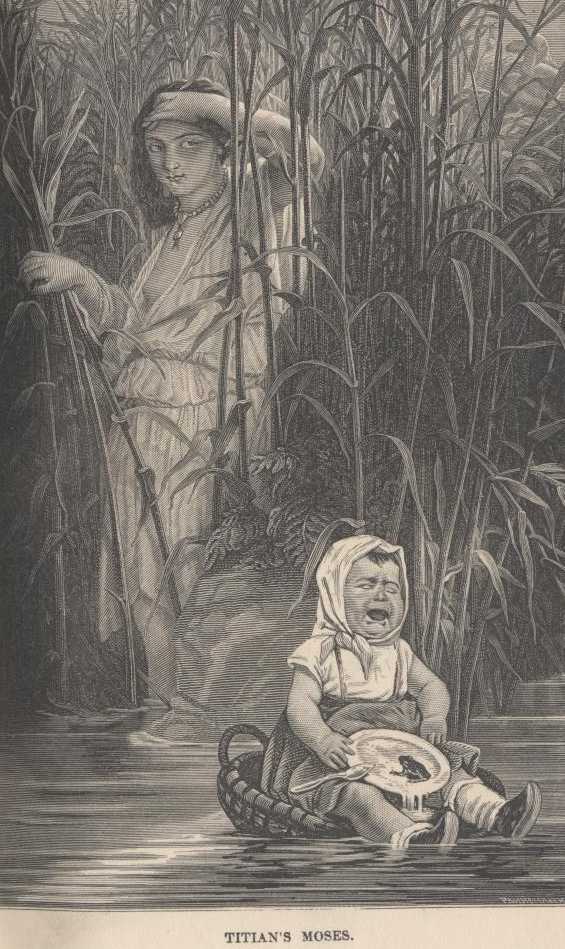
My sole purpose in going to Florence was to see this immortal “Moses,” and by good fortune I was just in time, for they were already preparing to remove it to a more private and better-protected place because a fashion of robbing the great galleries was prevailing in Europe at the time.
I got a capable artist to copy the picture; Pannemaker, the engraver of Doré's books, engraved it for me, and I have the pleasure of laying it before the reader in this volume.
We took a turn to Rome and some other Italian cities—then to Munich, and thence to Paris—partly for exercise, but mainly because these things were in our projected program, and it was only right that we should be faithful to it.
From Paris I branched out and walked through Holland and Belgium, procuring an occasional lift by rail or canal when tired, and I had a tolerably good time of it “by and large.” I worked Spain and other regions through agents to save time and shoe-leather.
We crossed to England, and then made the homeward passage in the Cunarder Gallia, a very fine ship. I was glad to get home—immeasurably glad; so glad, in fact, that it did not seem possible that anything could ever get me out of the country again. I had not enjoyed a pleasure abroad which seemed to me to compare with the pleasure I felt in seeing New York harbor again. Europe has many advantages which we have not, but they do not compensate for a good many still more valuable ones which exist nowhere but in our own country. Then we are such a homeless lot when we are over there! So are Europeans themselves, for that matter. They live in dark and chilly vast tombs—costly enough, maybe, but without conveniences. To be condemned to live as the average European family lives would make life a pretty heavy burden to the average American family.
On the whole, I think that short visits to Europe are better for us than
long ones. The former preserve us from becoming Europeanized; they keep
our pride of country intact, and at the same time they intensify our
affection for our country and our people; whereas long visits have the
effect of dulling those feelings—at least in the majority of cases.
I think that one who mixes much with Americans long resident abroad must
arrive at this conclusion.
APPENDIX
Nothing gives such weight and dignity to a book as an Appendix. HERODOTUS
APPENDIX A.
The Portier
Omar Khay’am, the poet-prophet of Persia, writing more than eight hundred years ago, has said:
“In the four parts of the earth are many that are able to write learned books, many that are able to lead armies, and many also that are able to govern kingdoms and empires; but few there be that can keep a hotel.”
A word about the European hotel Portier. He is a most admirable invention, a most valuable convenience. He always wears a conspicuous uniform; he can always be found when he is wanted, for he sticks closely to his post at the front door; he is as polite as a duke; he speaks from four to ten languages; he is your surest help and refuge in time of trouble or perplexity. He is not the clerk, he is not the landlord; he ranks above the clerk, and represents the landlord, who is seldom seen. Instead of going to the clerk for information, as we do at home, you go to the portier. It is the pride of our average hotel clerk to know nothing whatever; it is the pride of the portier to know everything. You ask the portier at what hours the trains leave—he tells you instantly; or you ask him who is the best physician in town; or what is the hack tariff; or how many children the mayor has; or what days the galleries are open, and whether a permit is required, and where you are to get it, and what you must pay for it; or when the theaters open and close, what the plays are to be, and the price of seats; or what is the newest thing in hats; or how the bills of mortality average; or “who struck Billy Patterson.” It does not matter what you ask him: in nine cases out of ten he knows, and in the tenth case he will find out for you before you can turn around three times. There is nothing he will not put his hand to. Suppose you tell him you wish to go from Hamburg to Peking by the way of Jericho, and are ignorant of routes and prices—the next morning he will hand you a piece of paper with the whole thing worked out on it to the last detail. Before you have been long on European soil, you find yourself still saying you are relying on Providence, but when you come to look closer you will see that in reality you are relying on the portier. He discovers what is puzzling you, or what is troubling you, or what your need is, before you can get the half of it out, and he promptly says, “Leave that to me.” Consequently, you easily drift into the habit of leaving everything to him. There is a certain embarrassment about applying to the average American hotel clerk, a certain hesitancy, a sense of insecurity against rebuff; but you feel no embarrassment in your intercourse with the portier; he receives your propositions with an enthusiasm which cheers, and plunges into their accomplishment with an alacrity which almost inebriates. The more requirements you can pile upon him, the better he likes it. Of course the result is that you cease from doing anything for yourself. He calls a hack when you want one; puts you into it; tells the driver whither to take you; receives you like a long-lost child when you return; sends you about your business, does all the quarreling with the hackman himself, and pays him his money out of his own pocket. He sends for your theater tickets, and pays for them; he sends for any possible article you can require, be it a doctor, an elephant, or a postage stamp; and when you leave, at last, you will find a subordinate seated with the cab-driver who will put you in your railway compartment, buy your tickets, have your baggage weighed, bring you the printed tags, and tell you everything is in your bill and paid for. At home you get such elaborate, excellent, and willing service as this only in the best hotels of our large cities; but in Europe you get it in the mere back country-towns just as well.
What is the secret of the portier’s devotion? It is very simple: he gets fees, and no salary. His fee is pretty closely regulated, too. If you stay a week, you give him five marks—a dollar and a quarter, or about eighteen cents a day. If you stay a month, you reduce this average somewhat. If you stay two or three months or longer, you cut it down half, or even more than half. If you stay only one day, you give the portier a mark.
The head waiter’s fee is a shade less than the portier’s; the Boots, who not only blacks your boots and brushes your clothes, but is usually the porter and handles your baggage, gets a somewhat smaller fee than the head waiter; the chambermaid’s fee ranks below that of the Boots. You fee only these four, and no one else. A German gentleman told me that when he remained a week in a hotel, he gave the portier five marks, the head waiter four, the Boots three, and the chambermaid two; and if he stayed three months he divided ninety marks among them, in about the above proportions. Ninety marks make $22.50.
None of these fees are ever paid until you leave the hotel, though it be a year—except one of these four servants should go away in the mean time; in that case he will be sure to come and bid you good-by and give you the opportunity to pay him what is fairly coming to him. It is considered very bad policy to fee a servant while you are still to remain longer in the hotel, because if you gave him too little he might neglect you afterward, and if you gave him too much he might neglect somebody else to attend to you. It is considered best to keep his expectations “on a string” until your stay is concluded.
I do not know whether hotel servants in New York get any wages or not, but
I do know that in some of the hotels there the feeing system in vogue is a
heavy burden. The waiter expects a quarter at breakfast—and gets it.
You have a different waiter at luncheon, and so he gets a quarter. Your
waiter at dinner is another stranger—consequently he gets a quarter.
The boy who carries your satchel to your room and lights your gas fumbles
around and hangs around significantly, and you fee him to get rid of him.
Now you may ring for ice-water; and ten minutes later for a lemonade; and
ten minutes afterward, for a cigar; and by and by for a newspaper—and
what is the result? Why, a new boy has appeared every time and fooled and
fumbled around until you have paid him something. Suppose you boldly put
your foot down, and say it is the hotel’s business to pay its
servants? You will have to ring your bell ten or fifteen times before you
get a servant there; and when he goes off to fill your order you will grow
old and infirm before you see him again. You may struggle nobly for
twenty-four hours, maybe, if you are an adamantine sort of person, but in
the mean time you will have been so wretchedly served, and so insolently,
that you will haul down your colors, and go to impoverishing yourself with
fees.