
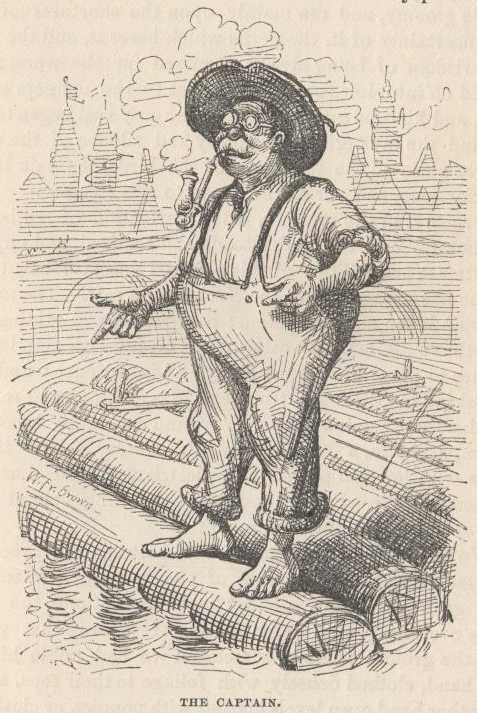
With a rattling song the starboard watch bent to their work and hove the cable short, then got the anchor home, and our bark moved off with a stately stride, and soon was bowling along at about two knots an hour.
Our party were grouped amidships. At first the talk was a little gloomy, and ran mainly upon the shortness of life, the uncertainty of it, the perils which beset it, and the need and wisdom of being always prepared for the worst; this shaded off into low-voiced references to the dangers of the deep, and kindred matters; but as the gray east began to redden and the mysterious solemnity and silence of the dawn to give place to the joy-songs of the birds, the talk took a cheerier tone, and our spirits began to rise steadily.
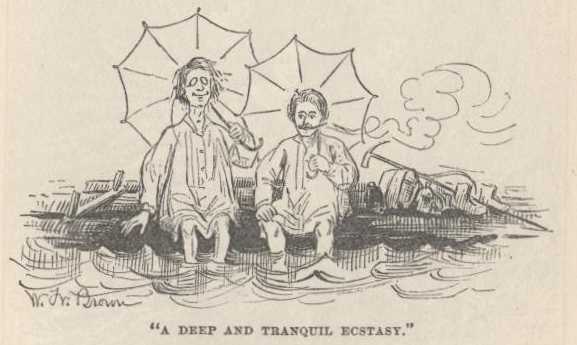
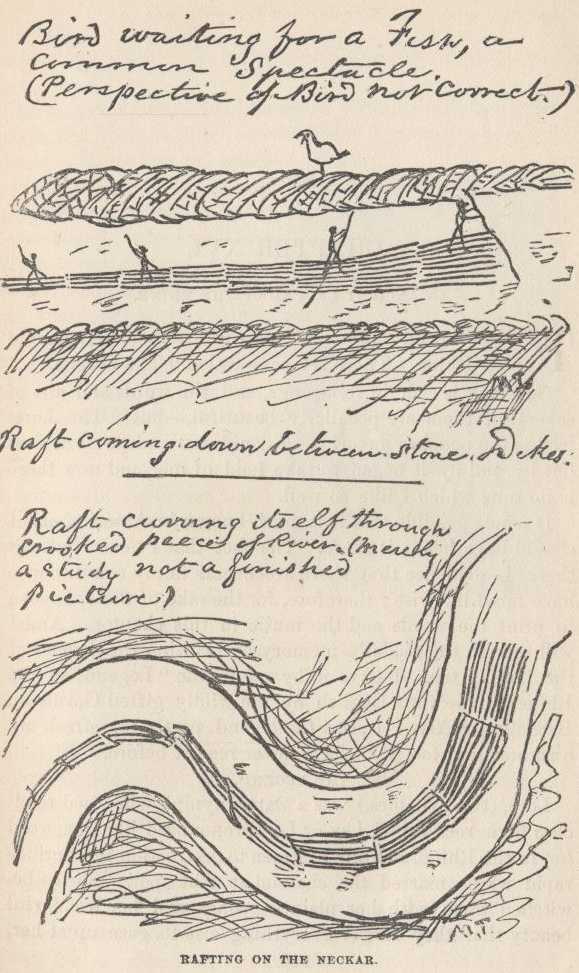
Germany, in the summer, is the perfection of the beautiful, but nobody has understood, and realized, and enjoyed the utmost possibilities of this soft and peaceful beauty unless he has voyaged down the Neckar on a raft. The motion of a raft is the needful motion; it is gentle, and gliding, and smooth, and noiseless; it calms down all feverish activities, it soothes to sleep all nervous hurry and impatience; under its restful influence all the troubles and vexations and sorrows that harass the mind vanish away, and existence becomes a dream, a charm, a deep and tranquil ecstasy. How it contrasts with hot and perspiring pedestrianism, and dusty and deafening railroad rush, and tedious jolting behind tired horses over blinding white roads!
We went slipping silently along, between the green and fragrant banks, with a sense of pleasure and contentment that grew, and grew, all the time. Sometimes the banks were overhung with thick masses of willows that wholly hid the ground behind; sometimes we had noble hills on one hand, clothed densely with foliage to their tops, and on the other hand open levels blazing with poppies, or clothed in the rich blue of the corn-flower; sometimes we drifted in the shadow of forests, and sometimes along the margin of long stretches of velvety grass, fresh and green and bright, a tireless charm to the eye. And the birds!—they were everywhere; they swept back and forth across the river constantly, and their jubilant music was never stilled.
It was a deep and satisfying pleasure to see the sun create the new
morning, and gradually, patiently, lovingly, clothe it on with splendor
after splendor, and glory after glory, till the miracle was complete. How
different is this marvel observed from a raft, from what it is when one
observes it through the dingy windows of a railway-station in some
wretched village while he munches a petrified sandwich and waits for the
train.
[Transcriber’s Note for edition 12: on the advice of two German-speaking volunteers, the German letters a, o, and u with umlauts have been rendered as ae, oe, and ue instead of as, variously, :a, a”, :o, o” and :u, u” as in previous editions.]
CHAPTER XV
[Charming Waterside Pictures]
Men and women and cattle were at work in the dewy fields by this time. The people often stepped aboard the raft, as we glided along the grassy shores, and gossiped with us and with the crew for a hundred yards or so, then stepped ashore again, refreshed by the ride.
Only the men did this; the women were too busy. The women do all kinds of work on the continent. They dig, they hoe, they reap, they sow, they bear monstrous burdens on their backs, they shove similar ones long distances on wheelbarrows, they drag the cart when there is no dog or lean cow to drag it—and when there is, they assist the dog or cow. Age is no matter—the older the woman the stronger she is, apparently. On the farm a woman’s duties are not defined—she does a little of everything; but in the towns it is different, there she only does certain things, the men do the rest. For instance, a hotel chambermaid has nothing to do but make beds and fires in fifty or sixty rooms, bring towels and candles, and fetch several tons of water up several flights of stairs, a hundred pounds at a time, in prodigious metal pitchers. She does not have to work more than eighteen or twenty hours a day, and she can always get down on her knees and scrub the floors of halls and closets when she is tired and needs a rest.
As the morning advanced and the weather grew hot, we took off our outside
clothing and sat in a row along the edge of the raft and enjoyed the
scenery, with our sun-umbrellas over our heads and our legs dangling in
the water.
Every now and then we plunged in and had a swim. Every projecting grassy
cape had its joyous group of naked children, the boys to themselves and
the girls to themselves, the latter usually in care of some motherly dame
who sat in the shade of a tree with her knitting. The little boys swam out
to us, sometimes, but the little maids stood knee-deep in the water and
stopped their splashing and frolicking to inspect the raft with their
innocent eyes as it drifted by. Once we turned a corner suddenly and
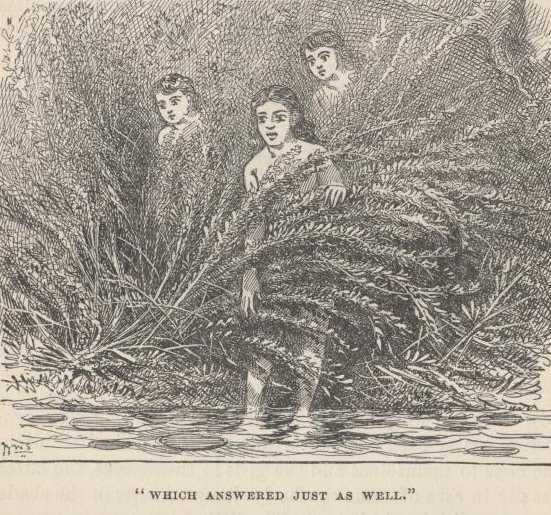
surprised a slender girl of twelve years or upward, just stepping into the
water. She had not time to run, but she did what answered just as well;
she promptly drew a lithe young willow bough athwart her white body with
one hand, and then contemplated us with a simple and untroubled interest.
Thus she stood while we glided by. She was a pretty creature, and she and
her willow bough made a very pretty picture, and one which could not
offend the modesty of the most fastidious spectator. Her white skin had a
low bank of fresh green willows for background and effective contrast—for
she stood against them—and above and out of them projected the eager
faces and white shoulders of two smaller girls.
Toward noon we heard the inspiriting cry,—
“Sail ho!”
“Where away?” shouted the captain.
“Three points off the weather bow!”
We ran forward to see the vessel. It proved to be a steamboat—for they had begun to run a steamer up the Neckar, for the first time in May. She was a tug, and one of a very peculiar build and aspect. I had often watched her from the hotel, and wondered how she propelled herself, for apparently she had no propeller or paddles. She came churning along, now, making a deal of noise of one kind or another, and aggravating it every now and then by blowing a hoarse whistle. She had nine keel-boats hitched on behind and following after her in a long, slender rank. We met her in a narrow place, between dikes, and there was hardly room for us both in the cramped passage. As she went grinding and groaning by, we perceived the secret of her moving impulse. She did not drive herself up the river with paddles or propeller, she pulled herself by hauling on a great chain. This chain is laid in the bed of the river and is only fastened at the two ends. It is seventy miles long. It comes in over the boat’s bow, passes around a drum, and is payed out astern. She pulls on that chain, and so drags herself up the river or down it. She has neither bow or stern, strictly speaking, for she has a long-bladed rudder on each end and she never turns around. She uses both rudders all the time, and they are powerful enough to enable her to turn to the right or the left and steer around curves, in spite of the strong resistance of the chain. I would not have believed that that impossible thing could be done; but I saw it done, and therefore I know that there is one impossible thing which can be done. What miracle will man attempt next?
We met many big keel-boats on their way up, using sails, mule power, and profanity—a tedious and laborious business. A wire rope led from the foretopmast to the file of mules on the tow-path a hundred yards ahead, and by dint of much banging and swearing and urging, the detachment of drivers managed to get a speed of two or three miles an hour out of the mules against the stiff current. The Neckar has always been used as a canal, and thus has given employment to a great many men and animals; but now that this steamboat is able, with a small crew and a bushel or so of coal, to take nine keel-boats farther up the river in one hour than thirty men and thirty mules can do it in two, it is believed that the old-fashioned towing industry is on its death-bed. A second steamboat began work in the Neckar three months after the first one was put in service. [Figure 4]
At noon we stepped ashore and bought some bottled beer and got some
chickens cooked, while the raft waited; then we immediately put to sea
again, and had our dinner while the beer was cold and the chickens hot.
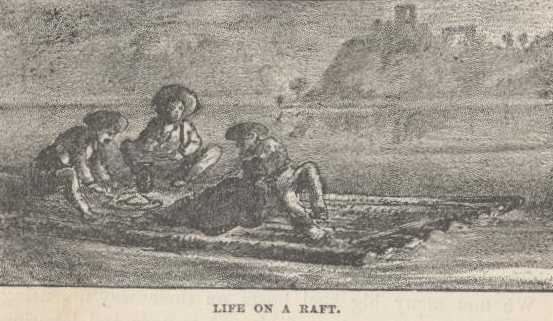
There is no pleasanter place for such a meal than a raft that is gliding
down the winding Neckar past green meadows and wooded hills, and
slumbering villages, and craggy heights graced with crumbling towers and
battlements.
In one place we saw a nicely dressed German gentleman without any spectacles. Before I could come to anchor he had got underway. It was a great pity. I so wanted to make a sketch of him. The captain comforted me for my loss, however, by saying that the man was without any doubt a fraud who had spectacles, but kept them in his pocket in order to make himself conspicuous.
Below Hassmersheim we passed Hornberg, Goetz von Berlichingen’s old castle. It stands on a bold elevation two hundred feet above the surface of the river; it has high vine-clad walls enclosing trees, and a peaked tower about seventy-five feet high. The steep hillside, from the castle clear down to the water’s edge, is terraced, and clothed thick with grape vines. This is like farming a mansard roof. All the steeps along that part of the river which furnish the proper exposure, are given up to the grape. That region is a great producer of Rhine wines. The Germans are exceedingly fond of Rhine wines; they are put up in tall, slender bottles, and are considered a pleasant beverage. One tells them from vinegar by the label.
The Hornberg hill is to be tunneled, and the new railway will pass under
the castle.
THE CAVE OF THE SPECTER
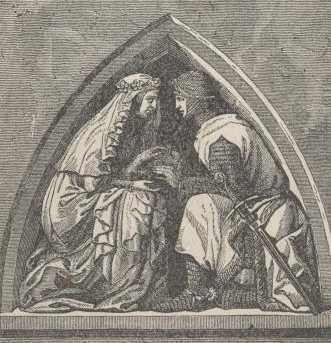
Two miles below Hornberg castle is a cave in a low cliff, which the
captain of the raft said had once been occupied by a beautiful heiress of
Hornberg—the Lady Gertrude—in the old times. It was seven
hundred years ago. She had a number of rich and noble lovers and one poor
and obscure one, Sir Wendel Lobenfeld. With the native chuckleheadedness
of the heroine of romance, she preferred the poor and obscure lover.
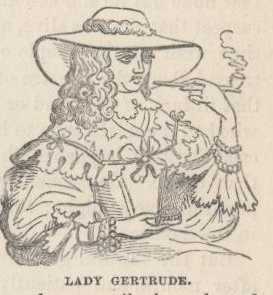
With the native sound judgment of the father of a heroine of romance, the von Berlichingen of that day shut his daughter up in his donjon keep, or his oubliette, or his culverin, or some such place, and resolved that she should stay there until she selected a husband from among her rich and noble lovers. The latter visited her and persecuted her with their supplications, but without effect, for her heart was true to her poor despised Crusader, who was fighting in the Holy Land. Finally, she resolved that she would endure the attentions of the rich lovers no longer; so one stormy night she escaped and went down the river and hid herself in the cave on the other side. Her father ransacked the country for her, but found not a trace of her. As the days went by, and still no tidings of her came, his conscience began to torture him, and he caused proclamation to be made that if she were yet living and would return, he would oppose her no longer, she might marry whom she would. The months dragged on, all hope forsook the old man, he ceased from his customary pursuits and pleasures, he devoted himself to pious works, and longed for the deliverance of death.
Now just at midnight, every night, the lost heiress stood in the mouth of
her cave, arrayed in white robes, and sang a little love ballad which her
Crusader had made for her. She judged that if he came home alive the
superstitious peasants would tell him about the ghost that sang in the
cave, and that as soon as they described the ballad he would know that
none but he and she knew that song, therefore he would suspect that she
was alive, and would come and find her. As time went on, the people of the
region became sorely distressed about the Specter of the Haunted Cave. It
was said that ill luck of one kind or another always overtook any one who
had the misfortune to hear that song. Eventually, every calamity that
happened thereabouts was laid at the door of that music. Consequently, no
boatmen would consent to pass the cave at night; the peasants shunned the
place, even in the daytime.
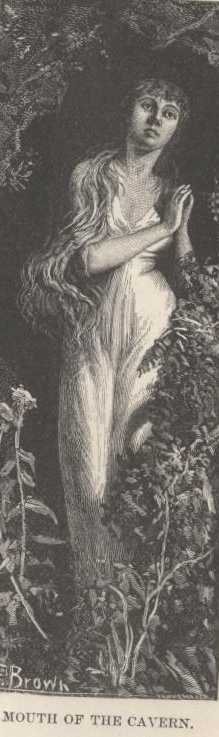
But the faithful girl sang on, night after night, month after month, and patiently waited; her reward must come at last. Five years dragged by, and still, every night at midnight, the plaintive tones floated out over the silent land, while the distant boatmen and peasants thrust their fingers into their ears and shuddered out a prayer.
And now came the Crusader home, bronzed and battle-scarred, but bringing a great and splendid fame to lay at the feet of his bride. The old lord of Hornberg received him as his son, and wanted him to stay by him and be the comfort and blessing of his age; but the tale of that young girl’s devotion to him and its pathetic consequences made a changed man of the knight. He could not enjoy his well-earned rest. He said his heart was broken, he would give the remnant of his life to high deeds in the cause of humanity, and so find a worthy death and a blessed reunion with the brave true heart whose love had more honored him than all his victories in war.
When the people heard this resolve of his, they came and told him there was a pitiless dragon in human disguise in the Haunted Cave, a dread creature which no knight had yet been bold enough to face, and begged him to rid the land of its desolating presence. He said he would do it. They told him about the song, and when he asked what song it was, they said the memory of it was gone, for nobody had been hardy enough to listen to it for the past four years and more.
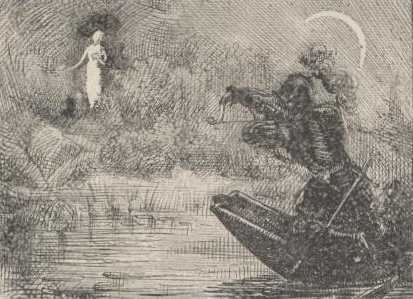
Toward midnight the Crusader came floating down the river in a boat, with
his trusty cross-bow in his hands. He drifted silently through the dim
reflections of the crags and trees, with his intent eyes fixed upon the
low cliff which he was approaching. As he drew nearer, he discerned the
black mouth of the cave. Now—is that a white figure? Yes. The
plaintive song begins to well forth and float away over meadow and river—the
cross-bow is slowly raised to position, a steady aim is taken, the bolt
flies straight to the mark—the figure sinks down, still singing, the
knight takes the wool out of his ears, and recognizes the old ballad—too
late! Ah, if he had only not put the wool in his ears!
The Crusader went away to the wars again, and presently fell in battle,
fighting for the Cross. Tradition says that during several centuries the
spirit of the unfortunate girl sang nightly from the cave at midnight, but
the music carried no curse with it; and although many listened for the
mysterious sounds, few were favored, since only those could hear them who
had never failed in a trust. It is believed that the singing still
continues, but it is known that nobody has heard it during the present
century.
CHAPTER XVI
An Ancient Legend of the Rhine [The Lorelei]
The last legend reminds one of the “Lorelei”—a legend of the Rhine. There is a song called “The Lorelei.”
Germany is rich in folk-songs, and the words and airs of several of them are peculiarly beautiful—but “The Lorelei” is the people’s favorite. I could not endure it at first, but by and by it began to take hold of me, and now there is no tune which I like so well.
It is not possible that it is much known in America, else I should have
heard it there. The fact that I never heard it there, is evidence that
there are others in my country who have fared likewise; therefore, for the
sake of these, I mean to print the words and music in this chapter. And I
will refresh the reader’s memory by printing the legend of the
Lorelei, too. I have it by me in the Legends of the Rhine, done
into English by the wildly gifted Garnham, Bachelor of Arts. I print the
legend partly to refresh my own memory, too, for I have never read it
before.
THE LEGEND
Lore (two syllables) was a water nymph who used to sit on a high rock called the Ley or Lei (pronounced like our word lie) in the Rhine, and lure boatmen to destruction in a furious rapid which marred the channel at that spot. She so bewitched them with her plaintive songs and her wonderful beauty that they forgot everything else to gaze up at her, and so they presently drifted among the broken reefs and were lost.
In those old, old times, the Count Bruno lived in a great castle near
there with his son, the Count Hermann, a youth of twenty. Hermann had
heard a great deal about the beautiful Lore, and had finally fallen very
deeply in love with her without having seen her. So he used to wander to
the neighborhood of the Lei, evenings, with his Zither and “Express
his Longing in low Singing,” as Garnham says. On one of these
occasions, “suddenly there hovered around the top of the rock a
brightness of unequaled clearness and color, which, in increasingly
smaller circles thickened, was the enchanting figure of the beautiful
Lore.
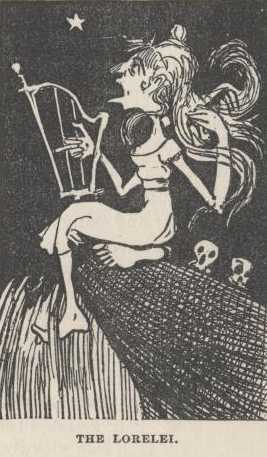
“An unintentional cry of Joy escaped the Youth, he let his Zither fall, and with extended arms he called out the name of the enigmatical Being, who seemed to stoop lovingly to him and beckon to him in a friendly manner; indeed, if his ear did not deceive him, she called his name with unutterable sweet Whispers, proper to love. Beside himself with delight the youth lost his Senses and sank senseless to the earth.”
After that he was a changed person. He went dreaming about, thinking only of his fairy and caring for naught else in the world. “The old count saw with affliction this changement in his son,” whose cause he could not divine, and tried to divert his mind into cheerful channels, but to no purpose. Then the old count used authority. He commanded the youth to betake himself to the camp. Obedience was promised. Garnham says:
“It was on the evening before his departure, as he wished still once to visit the Lei and offer to the Nymph of the Rhine his Sighs, the tones of his Zither, and his Songs. He went, in his boat, this time accompanied by a faithful squire, down the stream. The moon shed her silvery light over the whole country; the steep bank mountains appeared in the most fantastical shapes, and the high oaks on either side bowed their Branches on Hermann’s passing. As soon as he approached the Lei, and was aware of the surf-waves, his attendant was seized with an inexpressible Anxiety and he begged permission to land; but the Knight swept the strings of his Guitar and sang:
“Once I saw thee in dark night,
In supernatural Beauty bright;
Of Light-rays, was the Figure wove,
To share its light, locked-hair strove.
“Thy Garment color wave-dove
By thy hand the sign of love,
Thy eyes sweet enchantment,
Raying to me, oh! enchantment.
“O, wert thou but my sweetheart,
How willingly thy love to part!
With delight I should be bound
To thy rocky house in deep ground.”
That Hermann should have gone to that place at all, was not wise; that he should have gone with such a song as that in his mouth was a most serious mistake. The Lorelei did not “call his name in unutterable sweet Whispers” this time. No, that song naturally worked an instant and thorough “changement” in her; and not only that, but it stirred the bowels of the whole afflicted region around about there—for—
“Scarcely had these tones sounded, everywhere there began tumult and
sound, as if voices above and below the water. On the Lei rose flames, the
Fairy stood above, at that time, and beckoned with her right hand clearly
and urgently to the infatuated Knight, while with a staff in her left hand
she called the waves to her service. They began to mount heavenward; the
boat was upset, mocking every exertion; the waves rose to the gunwale, and
splitting on the hard stones, the Boat broke into Pieces. The youth sank
into the depths, but the squire was thrown on shore by a powerful wave."
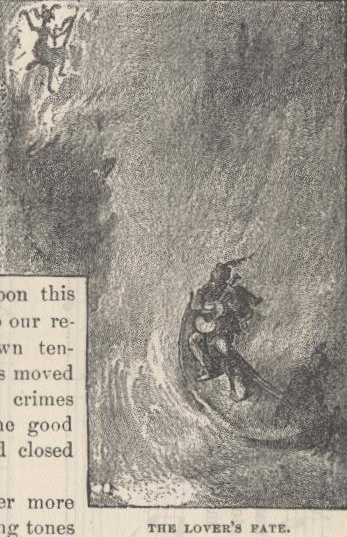
The bitterest things have been said about the Lorelei during many centuries, but surely her conduct upon this occasion entitles her to our respect. One feels drawn tenderly toward her and is moved to forget her many crimes and remember only the good deed that crowned and closed her career.
“The Fairy was never more seen; but her enchanting tones have often been heard. In the beautiful, refreshing, still nights of spring, when the moon pours her silver light over the Country, the listening shipper hears from the rushing of the waves, the echoing Clang of a wonderfully charming voice, which sings a song from the crystal castle, and with sorrow and fear he thinks on the young Count Hermann, seduced by the Nymph.”
Here is the music, and the German words by Heinrich Heine. This song has been a favorite in Germany for forty years, and will remain a favorite always, maybe.
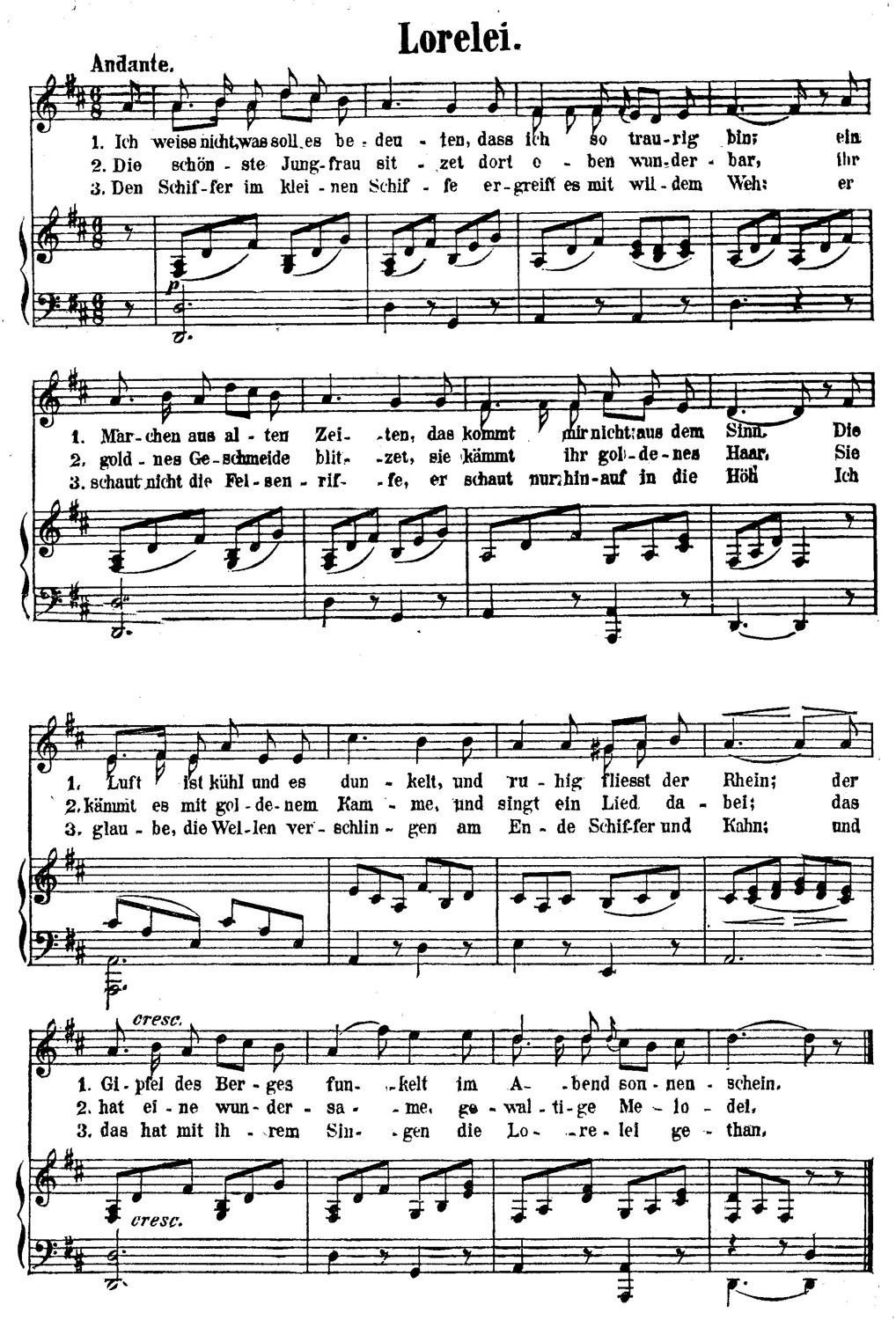
I have a prejudice against people who print things in a foreign language and add no translation. When I am the reader, and the author considers me able to do the translating myself, he pays me quite a nice compliment—but if he would do the translating for me I would try to get along without the compliment.
If I were at home, no doubt I could get a translation of this poem, but I am abroad and can’t; therefore I will make a translation myself. It may not be a good one, for poetry is out of my line, but it will serve my purpose—which is, to give the unGerman young girl a jingle of words to hang the tune on until she can get hold of a good version, made by some one who is a poet and knows how to convey a poetical thought from one language to another.
THE LORELEI
I cannot divine what it meaneth,
This haunting nameless pain:
A tale of the bygone ages
Keeps brooding through my brain:
The faint air cools in the glooming,
And peaceful flows the Rhine,
The thirsty summits are drinking
The sunset’s flooding wine;
The loveliest maiden is sitting
High-throned in yon blue air,
Her golden jewels are shining,
She combs her golden hair;
She combs with a comb that is golden,
And sings a weird refrain
That steeps in a deadly enchantment
The list’ner’s ravished brain:
The doomed in his drifting shallop,
Is tranced with the sad sweet tone,
He sees not the yawning breakers,
He sees but the maid alone:
The pitiless billows engulf him!—
So perish sailor and bark;
And this, with her baleful singing,
Is the Lorelei’s gruesome work.
I have a translation by Garnham, Bachelor of Arts, in the Legends of the Rhine, but it would not answer the purpose I mentioned above, because the measure is too nobly irregular; it don’t fit the tune snugly enough; in places it hangs over at the ends too far, and in other places one runs out of words before he gets to the end of a bar. Still, Garnham’s translation has high merits, and I am not dreaming of leaving it out of my book. I believe this poet is wholly unknown in America and England; I take peculiar pleasure in bringing him forward because I consider that I discovered him:
THE LORELEI
Translated by L. W. Garnham, B.A.
I do not know what it signifies.
That I am so sorrowful?
A fable of old Times so terrifies,
Leaves my heart so thoughtful.
The air is cool and it darkens,
And calmly flows the Rhine;
The summit of the mountain hearkens
In evening sunshine line.
The most beautiful Maiden entrances
Above wonderfully there,
Her beautiful golden attire glances,
She combs her golden hair.
With golden comb so lustrous,
And thereby a song sings,
It has a tone so wondrous,
That powerful melody rings.
The shipper in the little ship
It effects with woe sad might;
He does not see the rocky slip,
He only regards dreaded height.
I believe the turbulent waves
Swallow the last shipper and boat;
She with her singing craves
All to visit hermagic moat.
No translation could be closer. He has got in all the facts; and in their regular order, too. There is not a statistic wanting. It is as succinct as an invoice. That is what a translation ought to be; it should exactly reflect the thought of the original. You can’t sing “Above wonderfully there,” because it simply won’t go to the tune, without damaging the singer; but it is a most clingingly exact translation of Dort Oben Wunderbar—fits it like a blister. Mr. Garnham’s reproduction has other merits—a hundred of them—but it is not necessary to point them out. They will be detected.
No one with a specialty can hope to have a monopoly of it. Even Garnham has a rival. Mr. X had a small pamphlet with him which he had bought while on a visit to Munich. It was entitled A Catalogue of Pictures in the Old Pinacotek, and was written in a peculiar kind of English. Here are a few extracts:
“It is not permitted to make use of the work in question to a publication of the same contents as well as to the pirated edition of it.”
“An evening landscape. In the foreground near a pond and a group of white beeches is leading a footpath animated by travelers.”
“A learned man in a cynical and torn dress holding an open book in his hand.”
“St. Bartholomew and the Executioner with the knife to fulfil the martyr.”
“Portrait of a young man. A long while this picture was thought to be Bindi Altoviti’s portrait; now somebody will again have it to be the self-portrait of Raphael.”
“Susan bathing, surprised by the two old man. In the background the lapidation of the condemned.”
(“Lapidation” is good; it is much more elegant than “stoning.”)
“St. Rochus sitting in a landscape with an angel who looks at his plague-sore, whilst the dog the bread in his mouth attents him.”
“Spring. The Goddess Flora, sitting. Behind her a fertile valley perfused by a river.”
“A beautiful bouquet animated by May-bugs, etc.”
“A warrior in armor with a gypseous pipe in his hand leans against a table and blows the smoke far away of himself.”
“A Dutch landscape along a navigable river which perfuses it till to the background.”
“Some peasants singing in a cottage. A woman lets drink a child out of a cup.”
“St. John’s head as a boy—painted in fresco on a brick.” (Meaning a tile.)
“A young man of the Riccio family, his hair cut off right at the end, dressed in black with the same cap. Attributed to Raphael, but the signation is false.”
“The Virgin holding the Infant. It is very painted in the manner of Sassoferrato.”
“A Larder with greens and dead game animated by a cook-maid and two kitchen-boys.”
However, the English of this catalogue is at least as happy as that which distinguishes an inscription upon a certain picture in Rome—to wit:
“Revelations-View. St. John in Patterson’s Island.”
But meanwhile the raft is moving on.
CHAPTER XVII
[Why Germans Wear Spectacles]
A mile or two above Eberbach we saw a peculiar ruin projecting above the foliage which clothed the peak of a high and very steep hill. This ruin consisted of merely a couple of crumbling masses of masonry which bore a rude resemblance to human faces; they leaned forward and touched foreheads, and had the look of being absorbed in conversation. This ruin had nothing very imposing or picturesque about it, and there was no great deal of it, yet it was called the “Spectacular Ruin.”
LEGEND OF THE “SPECTACULAR RUIN”
The captain of the raft, who was as full of history as he could stick, said that in the Middle Ages a most prodigious fire-breathing dragon used to live in that region, and made more trouble than a tax-collector. He was as long as a railway-train, and had the customary impenetrable green scales all over him. His breath bred pestilence and conflagration, and his appetite bred famine. He ate men and cattle impartially, and was exceedingly unpopular. The German emperor of that day made the usual offer: he would grant to the destroyer of the dragon, any one solitary thing he might ask for; for he had a surplusage of daughters, and it was customary for dragon-killers to take a daughter for pay.
So the most renowned knights came from the four corners of the earth and retired down the dragon’s throat one after the other. A panic arose and spread. Heroes grew cautious. The procession ceased. The dragon became more destructive than ever. The people lost all hope of succor, and fled to the mountains for refuge.
At last Sir Wissenschaft, a poor and obscure knight, out of a far country,
arrived to do battle with the monster. A pitiable object he was, with his
armor hanging in rags about him, and his strange-shaped knapsack strapped
upon his back. Everybody turned up their noses at him, and some openly
jeered him. But he was calm. He simply inquired if the emperor’s
offer was still in force. The emperor said it was—but charitably
advised him to go and hunt hares and not endanger so precious a life as
his in an attempt which had brought death to so many of the world’s
most illustrious heroes.
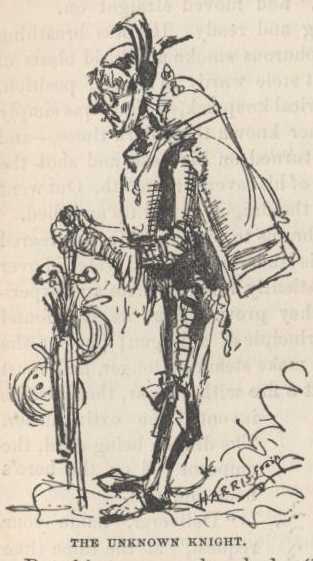
But this tramp only asked—“Were any of these heroes men of science?” This raised a laugh, of course, for science was despised in those days. But the tramp was not in the least ruffled. He said he might be a little in advance of his age, but no matter—science would come to be honored, some time or other. He said he would march against the dragon in the morning. Out of compassion, then, a decent spear was offered him, but he declined, and said, “spears were useless to men of science.” They allowed him to sup in the servants’ hall, and gave him a bed in the stables.
When he started forth in the morning, thousands were gathered to see. The emperor said:
“Do not be rash, take a spear, and leave off your knapsack.”
But the tramp said:
“It is not a knapsack,” and moved straight on.
The dragon was waiting and ready. He was breathing forth vast volumes of
sulphurous smoke and lurid blasts of flame. The ragged knight stole warily
to a good position, then he unslung his cylindrical knapsack—which
was simply the common fire-extinguisher known to modern times—and
the first chance he got he turned on his hose and shot the dragon square
in the center of his cavernous mouth. Out went the fires in an instant,
and the dragon curled up and died.
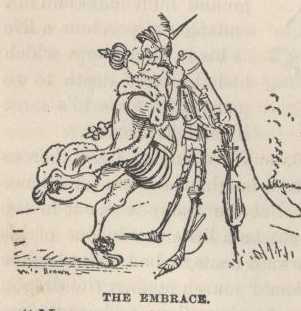
This man had brought brains to his aid. He had reared dragons from the egg, in his laboratory, he had watched over them like a mother, and patiently studied them and experimented upon them while they grew. Thus he had found out that fire was the life principle of a dragon; put out the dragon’s fires and it could make steam no longer, and must die. He could not put out a fire with a spear, therefore he invented the extinguisher. The dragon being dead, the emperor fell on the hero’s neck and said:
“Deliverer, name your request,” at the same time beckoning out behind with his heel for a detachment of his daughters to form and advance. But the tramp gave them no observance. He simply said:
“My request is, that upon me be conferred the monopoly of the manufacture and sale of spectacles in Germany.”
The emperor sprang aside and exclaimed:
“This transcends all the impudence I ever heard! A modest demand, by my halidome! Why didn’t you ask for the imperial revenues at once, and be done with it?”
But the monarch had given his word, and he kept it. To everybody’s surprise, the unselfish monopolist immediately reduced the price of spectacles to such a degree that a great and crushing burden was removed from the nation. The emperor, to commemorate this generous act, and to testify his appreciation of it, issued a decree commanding everybody to buy this benefactor’s spectacles and wear them, whether they needed them or not.
So originated the wide-spread custom of wearing spectacles in Germany; and as a custom once established in these old lands is imperishable, this one remains universal in the empire to this day. Such is the legend of the monopolist’s once stately and sumptuous castle, now called the “Spectacular Ruin.”
On the right bank, two or three miles below the Spectacular Ruin, we passed by a noble pile of castellated buildings overlooking the water from the crest of a lofty elevation. A stretch of two hundred yards of the high front wall was heavily draped with ivy, and out of the mass of buildings within rose three picturesque old towers. The place was in fine order, and was inhabited by a family of princely rank. This castle had its legend, too, but I should not feel justified in repeating it because I doubted the truth of some of its minor details.
Along in this region a multitude of Italian laborers were blasting away the frontage of the hills to make room for the new railway. They were fifty or a hundred feet above the river. As we turned a sharp corner they began to wave signals and shout warnings to us to look out for the explosions. It was all very well to warn us, but what could we do? You can’t back a raft upstream, you can’t hurry it downstream, you can’t scatter out to one side when you haven’t any room to speak of, you won’t take to the perpendicular cliffs on the other shore when they appear to be blasting there, too. Your resources are limited, you see. There is simply nothing for it but to watch and pray.
For some hours we had been making three and a half or four miles an hour
and we were still making that. We had been dancing right along until those
men began to shout; then for the next ten minutes it seemed to me that I
had never seen a raft go so slowly. When the first blast went off we
raised our sun-umbrellas and waited for the result. No harm done; none of
the stones fell in the water. Another blast followed, and another and
another. Some of the rubbish fell in the water just astern of us.
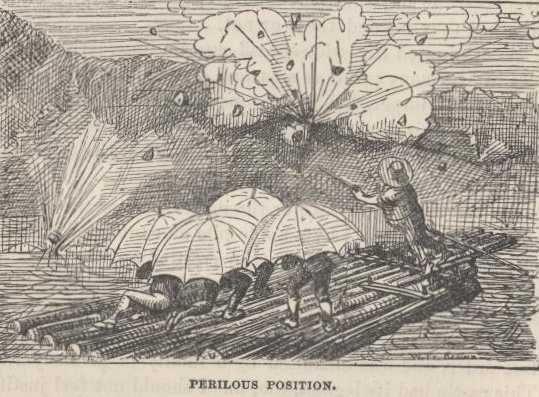
We ran that whole battery of nine blasts in a row, and it was certainly one of the most exciting and uncomfortable weeks I ever spent, either aship or ashore. Of course we frequently manned the poles and shoved earnestly for a second or so, but every time one of those spurts of dust and debris shot aloft every man dropped his pole and looked up to get the bearings of his share of it. It was very busy times along there for a while. It appeared certain that we must perish, but even that was not the bitterest thought; no, the abjectly unheroic nature of the death—that was the sting—that and the bizarre wording of the resulting obituary: “Shot with a rock, on a raft.” There would be no poetry written about it. None could be written about it. Example:
Not by war’s shock, or war’s shaft,—shot, with a rock, on a raft.
No poet who valued his reputation would touch such a theme as that. I should be distinguished as the only “distinguished dead” who went down to the grave unsonneted, in 1878.
But we escaped, and I have never regretted it. The last blast was a peculiarly strong one, and after the small rubbish was done raining around us and we were just going to shake hands over our deliverance, a later and larger stone came down amongst our little group of pedestrians and wrecked an umbrella. It did no other harm, but we took to the water just the same.
It seems that the heavy work in the quarries and the new railway gradings is done mainly by Italians. That was a revelation. We have the notion in our country that Italians never do heavy work at all, but confine themselves to the lighter arts, like organ-grinding, operatic singing, and assassination. We have blundered, that is plain.
All along the river, near every village, we saw little station-houses for the future railway. They were finished and waiting for the rails and business. They were as trim and snug and pretty as they could be. They were always of brick or stone; they were of graceful shape, they had vines and flowers about them already, and around them the grass was bright and green, and showed that it was carefully looked after. They were a decoration to the beautiful landscape, not an offense. Wherever one saw a pile of gravel or a pile of broken stone, it was always heaped as trimly and exactly as a new grave or a stack of cannon-balls; nothing about those stations or along the railroad or the wagon-road was allowed to look shabby or be unornamental. The keeping a country in such beautiful order as Germany exhibits, has a wise practical side to it, too, for it keeps thousands of people in work and bread who would otherwise be idle and mischievous.
As the night shut down, the captain wanted to tie up, but I thought maybe we might make Hirschhorn, so we went on. Presently the sky became overcast, and the captain came aft looking uneasy. He cast his eye aloft, then shook his head, and said it was coming on to blow. My party wanted to land at once—therefore I wanted to go on. The captain said we ought to shorten sail anyway, out of common prudence. Consequently, the larboard watch was ordered to lay in his pole. It grew quite dark, now, and the wind began to rise. It wailed through the swaying branches of the trees, and swept our decks in fitful gusts. Things were taking on an ugly look. The captain shouted to the steersman on the forward log:
“How’s she landing?”
The answer came faint and hoarse from far forward:
“Nor’-east-and-by-nor’—east-by-east, half-east, sir.”
“Let her go off a point!”
“Aye-aye, sir!”
“What water have you got?”
“Shoal, sir. Two foot large, on the stabboard, two and a half scant on the labboard!”
“Let her go off another point!”
“Aye-aye, sir!”
“Forward, men, all of you! Lively, now! Stand by to crowd her round the weather corner!”
“Aye-aye, sir!”