
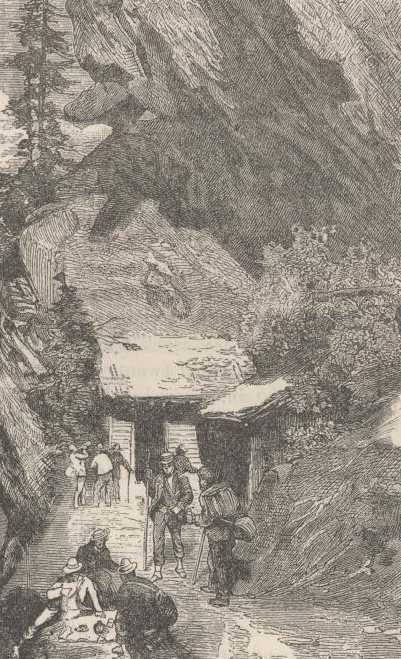
We had a fine view, from here, of the energetic Visp, as it makes its first plunge into the world from under a huge arch of solid ice, worn through the foot-wall of the great Gorner Glacier; and we could also see the Furggenbach, which is the outlet of the Furggen Glacier.
The mule-road to the summit of the Riffelberg passed right in front of the chalet, a circumstance which we almost immediately noticed, because a procession of tourists was filing along it pretty much all the time.
“Pretty much” may not be elegant English, but it is high time it was. There is no elegant word or phrase which means just what it means.—M.T.
The chaleteer’s business consisted in furnishing refreshments to tourists. My blast had interrupted this trade for a few minutes, by breaking all the bottles on the place; but I gave the man a lot of whiskey to sell for Alpine champagne, and a lot of vinegar which would answer for Rhine wine, consequently trade was soon as brisk as ever.
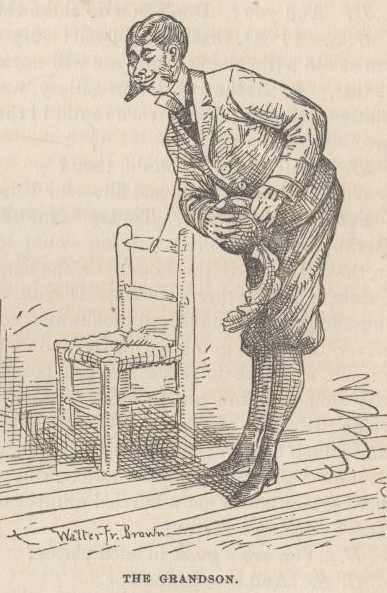
Leaving the Expedition outside to rest, I quartered myself in the chalet, with Harris, proposing to correct my journals and scientific observations before continuing the ascent. I had hardly begun my work when a tall, slender, vigorous American youth of about twenty-three, who was on his way down the mountain, entered and came toward me with that breezy self-complacency which is the adolescent’s idea of the well-bred ease of the man of the world. His hair was short and parted accurately in the middle, and he had all the look of an American person who would be likely to begin his signature with an initial, and spell his middle name out. He introduced himself, smiling a smirky smile borrowed from the courtiers of the stage, extended a fair-skinned talon, and while he gripped my hand in it he bent his body forward three times at the hips, as the stage courtier does, and said in the airiest and most condescending and patronizing way—I quite remember his exact language:
“Very glad to make your acquaintance, ’m sure; very glad indeed, assure you. I’ve read all your little efforts and greatly admired them, and when I heard you were here, I ...”
I indicated a chair, and he sat down. This grandee was the grandson of an
American of considerable note in his day, and not wholly forgotten yet—a
man who came so near being a great man that he was quite generally
accounted one while he lived.
I slowly paced the floor, pondering scientific problems, and heard this conversation:
GRANDSON. First visit to Europe?
HARRIS. Mine? Yes.
G.S. (With a soft reminiscent sigh suggestive of bygone joys that may be tasted in their freshness but once.) Ah, I know what it is to you. A first visit!—ah, the romance of it! I wish I could feel it again.
H. Yes, I find it exceeds all my dreams. It is enchantment. I go...
G.S. (With a dainty gesture of the hand signifying “Spare me your callow enthusiasms, good friend.”) Yes, _I_ know, I know; you go to cathedrals, and exclaim; and you drag through league-long picture-galleries and exclaim; and you stand here, and there, and yonder, upon historic ground, and continue to exclaim; and you are permeated with your first crude conceptions of Art, and are proud and happy. Ah, yes, proud and happy—that expresses it. Yes-yes, enjoy it—it is right—it is an innocent revel.
H. And you? Don’t you do these things now?
G.S. I! Oh, that is very good! My dear sir, when you are as old a traveler as I am, you will not ask such a question as that. _I_ visit the regulation gallery, moon around the regulation cathedral, do the worn round of the regulation sights, yet?—Excuse me!
H. Well, what do you do, then?
G.S. Do? I flit—and flit—for I am ever on the wing—but I avoid the herd. Today I am in Paris, tomorrow in Berlin, anon in Rome; but you would look for me in vain in the galleries of the Louvre or the common resorts of the gazers in those other capitals. If you would find me, you must look in the unvisited nooks and corners where others never think of going. One day you will find me making myself at home in some obscure peasant’s cabin, another day you will find me in some forgotten castle worshiping some little gem or art which the careless eye has overlooked and which the unexperienced would despise; again you will find me as guest in the inner sanctuaries of palaces while the herd is content to get a hurried glimpse of the unused chambers by feeing a servant.
H. You are a guest in such places?
G.S. And a welcoming one.
H. It is surprising. How does it come?
G.S. My grandfather’s name is a passport to all the courts in Europe. I have only to utter that name and every door is open to me. I flit from court to court at my own free will and pleasure, and am always welcome. I am as much at home in the palaces of Europe as you are among your relatives. I know every titled person in Europe, I think. I have my pockets full of invitations all the time. I am under promise to go to Italy, where I am to be the guest of a succession of the noblest houses in the land. In Berlin my life is a continued round of gaiety in the imperial palace. It is the same, wherever I go.
H. It must be very pleasant. But it must make Boston seem a little slow when you are at home.
G.S. Yes, of course it does. But I don’t go home much. There’s no life there—little to feed a man’s higher nature. Boston’s very narrow, you know. She doesn’t know it, and you couldn’t convince her of it—so I say nothing when I’m there: where’s the use? Yes, Boston is very narrow, but she has such a good opinion of herself that she can’t see it. A man who has traveled as much as I have, and seen as much of the world, sees it plain enough, but he can’t cure it, you know, so the best is to leave it and seek a sphere which is more in harmony with his tastes and culture. I run across there, once a year, perhaps, when I have nothing important on hand, but I’m very soon back again. I spend my time in Europe.
H. I see. You map out your plans and ...
G.S. No, excuse me. I don’t map out any plans. I simply follow the inclination of the day. I am limited by no ties, no requirements, I am not bound in any way. I am too old a traveler to hamper myself with deliberate purposes. I am simply a traveler—an inveterate traveler—a man of the world, in a word—I can call myself by no other name. I do not say, “I am going here, or I am going there”—I say nothing at all, I only act. For instance, next week you may find me the guest of a grandee of Spain, or you may find me off for Venice, or flitting toward Dresden. I shall probably go to Egypt presently; friends will say to friends, “He is at the Nile cataracts”—and at that very moment they will be surprised to learn that I’m away off yonder in India somewhere. I am a constant surprise to people. They are always saying, “Yes, he was in Jerusalem when we heard of him last, but goodness knows where he is now.”
Presently the Grandson rose to leave—discovered he had an appointment with some Emperor, perhaps. He did his graces over again: gripped me with one talon, at arm’s-length, pressed his hat against his stomach with the other, bent his body in the middle three times, murmuring:
“Pleasure, ’m sure; great pleasure, ’m sure. Wish you much success.”
Then he removed his gracious presence. It is a great and solemn thing to have a grandfather.
I have not purposed to misrepresent this boy in any way, for what little
indignation he excited in me soon passed and left nothing behind it but
compassion. One cannot keep up a grudge against a vacuum. I have tried to
repeat this lad’s very words; if I have failed anywhere I have at
least not failed to reproduce the marrow and meaning of what he said. He
and the innocent chatterbox whom I met on the Swiss lake are the most
unique and interesting specimens of Young America I came across during my
foreign tramping. I have made honest portraits of them, not caricatures.
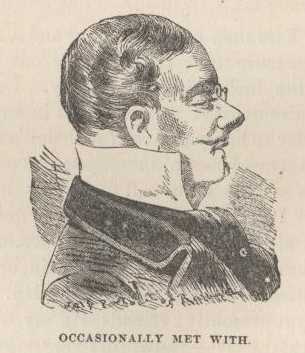
The Grandson of twenty-three referred to himself five or six times as an “old traveler,” and as many as three times (with a serene complacency which was maddening) as a “man of the world.” There was something very delicious about his leaving Boston to her “narrowness,” unreproved and uninstructed.
I formed the caravan in marching order, presently, and after riding down the line to see that it was properly roped together, gave the command to proceed. In a little while the road carried us to open, grassy land. We were above the troublesome forest, now, and had an uninterrupted view, straight before us, of our summit—the summit of the Riffelberg.
We followed the mule-road, a zigzag course, now to the right, now to the left, but always up, and always crowded and incommoded by going and coming files of reckless tourists who were never, in a single instance, tied together. I was obliged to exert the utmost care and caution, for in many places the road was not two yards wide, and often the lower side of it sloped away in slanting precipices eight and even nine feet deep. I had to encourage the men constantly, to keep them from giving way to their unmanly fears.
We might have made the summit before night, but for a delay caused by the loss of an umbrella. I was allowing the umbrella to remain lost, but the men murmured, and with reason, for in this exposed region we stood in peculiar need of protection against avalanches; so I went into camp and detached a strong party to go after the missing article.
The difficulties of the next morning were severe, but our courage was high, for our goal was near. At noon we conquered the last impediment—we stood at last upon the summit, and without the loss of a single man except the mule that ate the glycerin. Our great achievement was achieved—the possibility of the impossible was demonstrated, and Harris and I walked proudly into the great dining-room of the Riffelberg Hotel and stood our alpenstocks up in the corner.
Yes, I had made the grand ascent; but it was a mistake to do it in evening
dress. The plug hats were battered, the swallow-tails were fluttering
rags, mud added no grace, the general effect was unpleasant and even
disreputable.
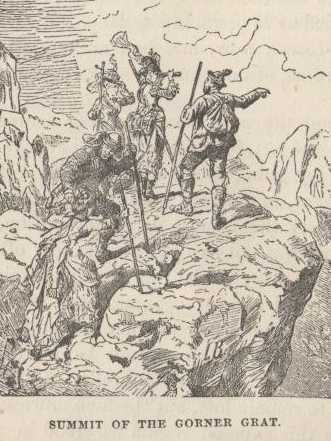
There were about seventy-five tourists at the hotel—mainly ladies and little children—and they gave us an admiring welcome which paid us for all our privations and sufferings. The ascent had been made, and the names and dates now stand recorded on a stone monument there to prove it to all future tourists.
I boiled a thermometer and took an altitude, with a most curious result:
the summit was not as high as the point on the mountainside where i had
taken the first altitude. Suspecting that I had made an important
discovery, I prepared to verify it. There happened to be a still higher
summit (called the Gorner Grat), above the hotel, and notwithstanding the
fact that it overlooks a glacier from a dizzy height, and that the ascent
is difficult and dangerous, I resolved to venture up there and boil a
thermometer. So I sent a strong party, with some borrowed hoes, in charge
of two chiefs of service, to dig a stairway in the soil all the way up,
and this I ascended, roped to the guides. This breezy height was the
summit proper—so I accomplished even more than I had originally
purposed to do. This foolhardy exploit is recorded on another stone
monument.
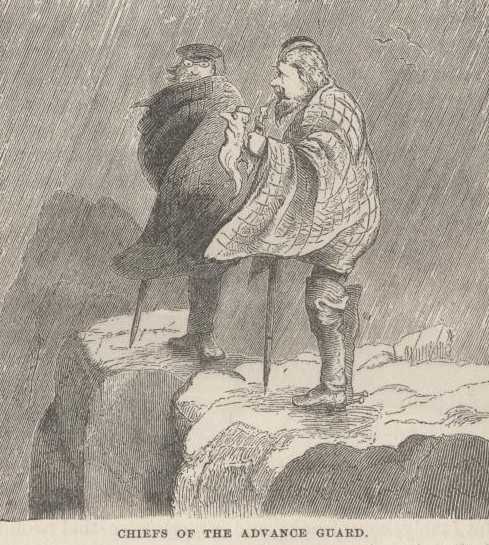
I boiled my thermometer, and sure enough, this spot, which purported to be two thousand feet higher than the locality of the hotel, turned out to be nine thousand feet lower. Thus the fact was clearly demonstrated that, above a certain point, the higher a point seems to be, the lower it actually is. Our ascent itself was a great achievement, but this contribution to science was an inconceivably greater matter.
Cavilers object that water boils at a lower and lower temperature the higher and higher you go, and hence the apparent anomaly. I answer that I do not base my theory upon what the boiling water does, but upon what a boiled thermometer says. You can’t go behind the thermometer.
I had a magnificent view of Monte Rosa, and apparently all the rest of the
Alpine world, from that high place. All the circling horizon was piled
high with a mighty tumult of snowy crests. One might have imagined he saw
before him the tented camps of a beleaguering host of Brobdingnagians.
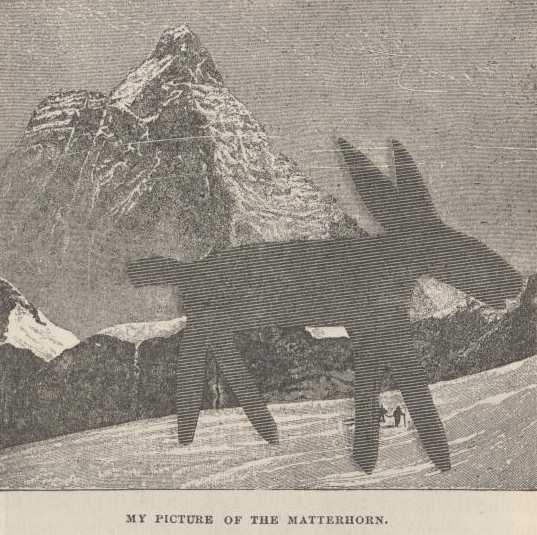
NOTE.—I had the very unusual luck to catch one little momentary glimpse of the Matterhorn wholly unencumbered by clouds. I leveled my photographic apparatus at it without the loss of an instant, and should have got an elegant picture if my donkey had not interfered. It was my purpose to draw this photograph all by myself for my book, but was obliged to put the mountain part of it into the hands of the professional artist because I found I could not do landscape well.
But lonely, conspicuous, and superb, rose that wonderful upright wedge, the Matterhorn. Its precipitous sides were powdered over with snow, and the upper half hidden in thick clouds which now and then dissolved to cobweb films and gave brief glimpses of the imposing tower as through a veil. A little later the Matterhorn took to himself the semblance of a volcano; he was stripped naked to his apex—around this circled vast wreaths of white cloud which strung slowly out and streamed away slantwise toward the sun, a twenty-mile stretch of rolling and tumbling vapor, and looking just as if it were pouring out of a crater. Later again, one of the mountain’s sides was clean and clear, and another side densely clothed from base to summit in thick smokelike cloud which feathered off and flew around the shaft’s sharp edge like the smoke around the corners of a burning building. The Matterhorn is always experimenting, and always gets up fine effects, too. In the sunset, when all the lower world is palled in gloom, it points toward heaven out of the pervading blackness like a finger of fire. In the sunrise—well, they say it is very fine in the sunrise.
Authorities agree that there is no such tremendous “layout” of snowy Alpine magnitude, grandeur, and sublimity to be seen from any other accessible point as the tourist may see from the summit of the Riffelberg. Therefore, let the tourist rope himself up and go there; for I have shown that with nerve, caution, and judgment, the thing can be done.
I wish to add one remark, here—in parentheses, so to speak—suggested
by the word “snowy,” which I have just used. We have all seen
hills and mountains and levels with snow on them, and so we think we know
all the aspects and effects produced by snow. But indeed we do not until
we have seen the Alps. Possibly mass and distance add something—at
any rate, something is added. Among other noticeable things, there
is a dazzling, intense whiteness about the distant Alpine snow, when the
sun is on it, which one recognizes as peculiar, and not familiar to the
eye. The snow which one is accustomed to has a tint to it—painters
usually give it a bluish cast—but there is no perceptible tint to
the distant Alpine snow when it is trying to look its whitest. As to the
unimaginable splendor of it when the sun is blazing down on it—well,
it simply is unimaginable.
CHAPTER XXXIX
[We Travel by Glacier]
A guide-book is a queer thing. The reader has just seen what a man who undertakes the great ascent from Zermatt to the Riffelberg Hotel must experience. Yet Baedeker makes these strange statements concerning this matter:
1. Distance—3 hours.
2. The road cannot be mistaken.
3. Guide unnecessary.
4. Distance from Riffelberg Hotel to the Gorner Grat, one hour and a half.
5. Ascent simple and easy. Guide unnecessary.
6. Elevation of Zermatt above sea-level, 5,315 feet.
7. Elevation of Riffelberg Hotel above sea-level, 8,429 feet.
8. Elevation of the Gorner Grat above sea-level, 10,289 feet.
I have pretty effectually throttled these errors by sending him the following demonstrated facts:
1. Distance from Zermatt to Riffelberg Hotel, 7 days.
2. The road can be mistaken. If I am the first that did it, I want the credit of it, too.
3. Guides are necessary, for none but a native can read those finger-boards.
4. The estimate of the elevation of the several localities above sea-level is pretty correct—for Baedeker. He only misses it about a hundred and eighty or ninety thousand feet.
I found my arnica invaluable. My men were suffering excruciatingly, from the friction of sitting down so much. During two or three days, not one of them was able to do more than lie down or walk about; yet so effective was the arnica, that on the fourth all were able to sit up. I consider that, more than to anything else, I owe the success of our great undertaking to arnica and paregoric.
My men are being restored to health and strength, my main perplexity, now, was how to get them down the mountain again. I was not willing to expose the brave fellows to the perils, fatigues, and hardships of that fearful route again if it could be helped. First I thought of balloons; but, of course, I had to give that idea up, for balloons were not procurable. I thought of several other expedients, but upon consideration discarded them, for cause. But at last I hit it. I was aware that the movement of glaciers is an established fact, for I had read it in Baedeker; so I resolved to take passage for Zermatt on the great Gorner Glacier.
Very good. The next thing was, how to get down the glacier comfortably—for the mule-road to it was long, and winding, and wearisome. I set my mind at work, and soon thought out a plan. One looks straight down upon the vast frozen river called the Gorner Glacier, from the Gorner Grat, a sheer precipice twelve hundred feet high. We had one hundred and fifty-four umbrellas—and what is an umbrella but a parachute?
I mentioned this noble idea to Harris, with enthusiasm, and was about to order the Expedition to form on the Gorner Grat, with their umbrellas, and prepare for flight by platoons, each platoon in command of a guide, when Harris stopped me and urged me not to be too hasty. He asked me if this method of descending the Alps had ever been tried before. I said no, I had not heard of an instance. Then, in his opinion, it was a matter of considerable gravity; in his opinion it would not be well to send the whole command over the cliff at once; a better way would be to send down a single individual, first, and see how he fared.
I saw the wisdom in this idea instantly. I said as much, and thanked my agent cordially, and told him to take his umbrella and try the thing right away, and wave his hat when he got down, if he struck in a soft place, and then I would ship the rest right along.
Harris was greatly touched with this mark of confidence, and said so, in a voice that had a perceptible tremble in it; but at the same time he said he did not feel himself worthy of so conspicuous a favor; that it might cause jealousy in the command, for there were plenty who would not hesitate to say he had used underhanded means to get the appointment, whereas his conscience would bear him witness that he had not sought it at all, nor even, in his secret heart, desired it.
I said these words did him extreme credit, but that he must not throw away the imperishable distinction of being the first man to descend an Alp per parachute, simply to save the feelings of some envious underlings. No, I said, he must accept the appointment—it was no longer an invitation, it was a command.
He thanked me with effusion, and said that putting the thing in this form removed every objection. He retired, and soon returned with his umbrella, his eye flaming with gratitude and his cheeks pallid with joy. Just then the head guide passed along. Harris’s expression changed to one of infinite tenderness, and he said:
“That man did me a cruel injury four days ago, and I said in my heart he should live to perceive and confess that the only noble revenge a man can take upon his enemy is to return good for evil. I resign in his favor. Appoint him.”
I threw my arms around the generous fellow and said:
“Harris, you are the noblest soul that lives. You shall not regret this sublime act, neither shall the world fail to know of it. You shall have opportunity far transcending this one, too, if I live—remember that.”
I called the head guide to me and appointed him on the spot. But the thing aroused no enthusiasm in him. He did not take to the idea at all.
He said:
“Tie myself to an umbrella and jump over the Gorner Grat! Excuse me,
there are a great many pleasanter roads to the devil than that."
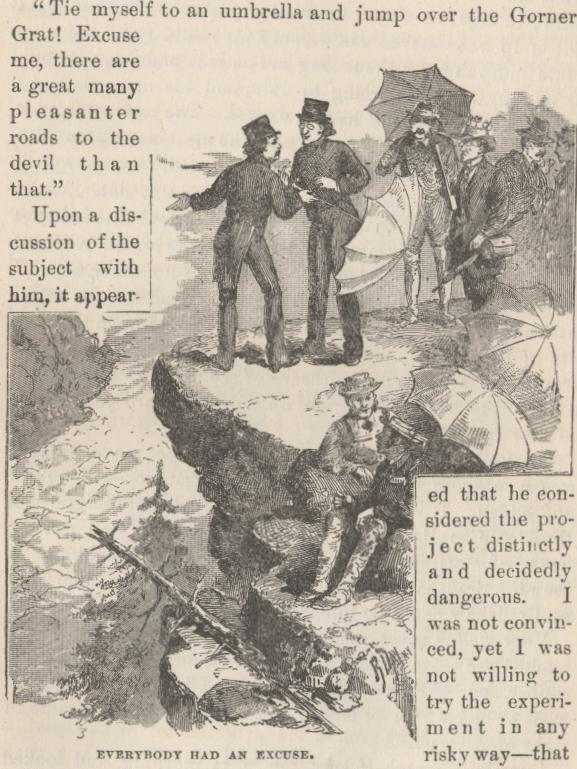
Upon a discussion of the subject with him, it appeared that he considered the project distinctly and decidedly dangerous. I was not convinced, yet I was not willing to try the experiment in any risky way—that is, in a way that might cripple the strength and efficiency of the Expedition. I was about at my wits’ end when it occurred to me to try it on the Latinist.
He was called in. But he declined, on the plea of inexperience, diffidence in public, lack of curiosity, and I didn’t know what all. Another man declined on account of a cold in the head; thought he ought to avoid exposure. Another could not jump well—never could jump well—did not believe he could jump so far without long and patient practice. Another was afraid it was going to rain, and his umbrella had a hole in it. Everybody had an excuse. The result was what the reader has by this time guessed: the most magnificent idea that was ever conceived had to be abandoned, from sheer lack of a person with enterprise enough to carry it out. Yes, I actually had to give that thing up—while doubtless I should live to see somebody use it and take all the credit from me.
Well, I had to go overland—there was no other way. I marched the Expedition down the steep and tedious mule-path and took up as good a position as I could upon the middle of the glacier—because Baedeker said the middle part travels the fastest. As a measure of economy, however, I put some of the heavier baggage on the shoreward parts, to go as slow freight.
I waited and waited, but the glacier did not move. Night was coming on, the darkness began to gather—still we did not budge. It occurred to me then, that there might be a time-table in Baedeker; it would be well to find out the hours of starting. I called for the book—it could not be found. Bradshaw would certainly contain a time-table; but no Bradshaw could be found.
Very well, I must make the best of the situation. So I pitched the tents, picketed the animals, milked the cows, had supper, paregoricked the men, established the watch, and went to bed—with orders to call me as soon as we came in sight of Zermatt.
I awoke about half past ten next morning, and looked around. We hadn’t
budged a peg! At first I could not understand it; then it occurred to me
that the old thing must be aground. So I cut down some trees and rigged a
spar on the starboard and another on the port side, and fooled away upward
of three hours trying to spar her off. But it was no use. She was half a
mile wide and fifteen or twenty miles long, and there was no telling just
whereabouts she was aground. The men began to show uneasiness, too,
and presently they came flying to me with ashy faces, saying she had
sprung a leak.
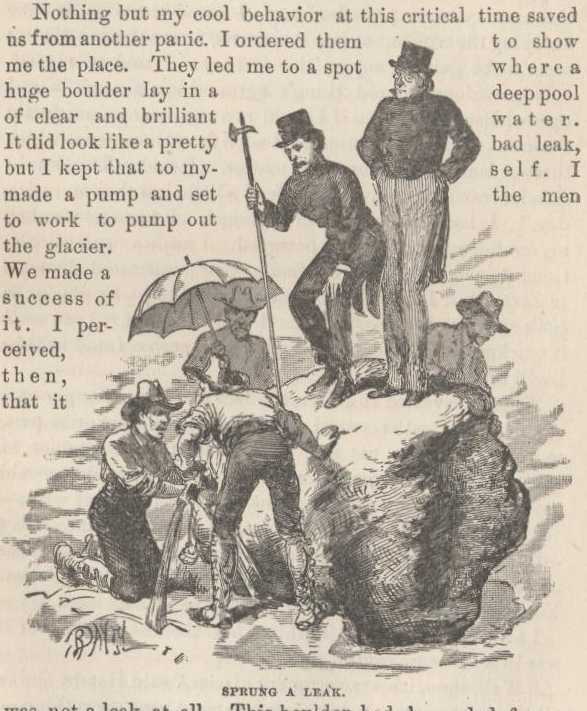
Nothing but my cool behavior at this critical time saved us from another panic. I ordered them to show me the place. They led me to a spot where a huge boulder lay in a deep pool of clear and brilliant water. It did look like a pretty bad leak, but I kept that to myself. I made a pump and set the men to work to pump out the glacier. We made a success of it. I perceived, then, that it was not a leak at all. This boulder had descended from a precipice and stopped on the ice in the middle of the glacier, and the sun had warmed it up, every day, and consequently it had melted its way deeper and deeper into the ice, until at last it reposed, as we had found it, in a deep pool of the clearest and coldest water.
Presently Baedeker was found again, and I hunted eagerly for the time-table. There was none. The book simply said the glacier was moving all the time. This was satisfactory, so I shut up the book and chose a good position to view the scenery as we passed along. I stood there some time enjoying the trip, but at last it occurred to me that we did not seem to be gaining any on the scenery. I said to myself, “This confounded old thing’s aground again, sure,”—and opened Baedeker to see if I could run across any remedy for these annoying interruptions. I soon found a sentence which threw a dazzling light upon the matter. It said, “The Gorner Glacier travels at an average rate of a little less than an inch a day.” I have seldom felt so outraged. I have seldom had my confidence so wantonly betrayed. I made a small calculation: One inch a day, say thirty feet a year; estimated distance to Zermatt, three and one-eighteenth miles. Time required to go by glacier, a little over five hundred years! I said to myself, “I can walk it quicker—and before I will patronize such a fraud as this, I will do it.”
When I revealed to Harris the fact that the passenger part of this glacier—the central part—the lightning-express part, so to speak—was not due in Zermatt till the summer of 2378, and that the baggage, coming along the slow edge, would not arrive until some generations later, he burst out with:
“That is European management, all over! An inch a day—think of that! Five hundred years to go a trifle over three miles! But I am not a bit surprised. It’s a Catholic glacier. You can tell by the look of it. And the management.”
I said, no, I believed nothing but the extreme end of it was in a Catholic canton.
“Well, then, it’s a government glacier,” said Harris. “It’s all the same. Over here the government runs everything—so everything’s slow; slow, and ill-managed. But with us, everything’s done by private enterprise—and then there ain’t much lolling around, you can depend on it. I wish Tom Scott could get his hands on this torpid old slab once—you’d see it take a different gait from this.”
I said I was sure he would increase the speed, if there was trade enough to justify it.
“He’d make trade,” said Harris. “That’s the difference between governments and individuals. Governments don’t care, individuals do. Tom Scott would take all the trade; in two years Gorner stock would go to two hundred, and inside of two more you would see all the other glaciers under the hammer for taxes.” After a reflective pause, Harris added, “A little less than an inch a day; a little less than an inch, mind you. Well, I’m losing my reverence for glaciers.”
I was feeling much the same way myself. I have traveled by canal-boat, ox-wagon, raft, and by the Ephesus and Smyrna railway; but when it comes down to good solid honest slow motion, I bet my money on the glacier. As a means of passenger transportation, I consider the glacier a failure; but as a vehicle of slow freight, I think she fills the bill. In the matter of putting the fine shades on that line of business, I judge she could teach the Germans something.
I ordered the men to break camp and prepare for the land journey to
Zermatt. At this moment a most interesting find was made; a dark object,
bedded in the glacial ice, was cut out with the ice-axes, and it proved to
be a piece of the undressed skin of some animal—a hair trunk,
perhaps; but a close inspection disabled the hair-trunk theory, and
further discussion and examination exploded it entirely—that is, in
the opinion of all the scientists except the one who had advanced it. This
one clung to his theory with affectionate fidelity characteristic of
originators of scientific theories, and afterward won many of the first
scientists of the age to his view, by a very able pamphlet which he wrote,
entitled, “Evidences going to show that the hair trunk, in a wild
state, belonged to the early glacial period, and roamed the wastes of
chaos in the company with the cave-bear, primeval man, and the other
Ooelitics of the Old Silurian family."
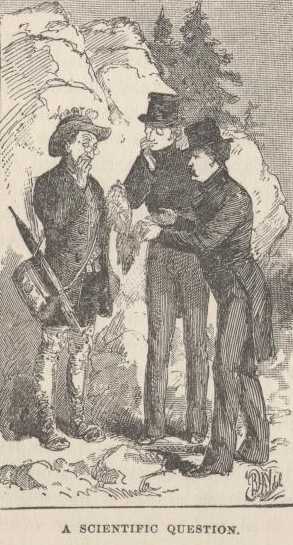
Each of our scientists had a theory of his own, and put forward an animal of his own as a candidate for the skin. I sided with the geologist of the Expedition in the belief that this patch of skin had once helped to cover a Siberian elephant, in some old forgotten age—but we divided there, the geologist believing that this discovery proved that Siberia had formerly been located where Switzerland is now, whereas I held the opinion that it merely proved that the primeval Swiss was not the dull savage he is represented to have been, but was a being of high intellectual development, who liked to go to the menagerie.
We arrived that evening, after many hardships and adventures, in some
fields close to the great ice-arch where the mad Visp boils and surges out
from under the foot of the great Gorner Glacier, and here we camped, our
perils over and our magnificent undertaking successfully completed. We
marched into Zermatt the next day, and were received with the most lavish
honors and applause. A document, signed and sealed by the authorities, was
given to me which established and endorsed the fact that I had made the
ascent of the Riffelberg. This I wear around my neck, and it will be
buried with me when I am no more.
CHAPTER XL
[Piteous Relics at Chamonix]
I am not so ignorant about glacial movement, now, as I was when I took passage on the Gorner Glacier. I have “read up” since. I am aware that these vast bodies of ice do not travel at the same rate of speed; while the Gorner Glacier makes less than an inch a day, the Unter-Aar Glacier makes as much as eight; and still other glaciers are said to go twelve, sixteen, and even twenty inches a day. One writer says that the slowest glacier travels twenty-five feet a year, and the fastest four hundred.
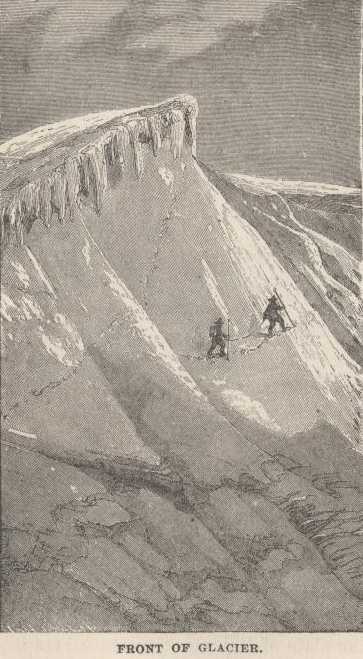
What is a glacier? It is easy to say it looks like a frozen river which occupies the bed of a winding gorge or gully between mountains. But that gives no notion of its vastness. For it is sometimes six hundred feet thick, and we are not accustomed to rivers six hundred feet deep; no, our rivers are six feet, twenty feet, and sometimes fifty feet deep; we are not quite able to grasp so large a fact as an ice-river six hundred feet deep.
The glacier’s surface is not smooth and level, but has deep swales and swelling elevations, and sometimes has the look of a tossing sea whose turbulent billows were frozen hard in the instant of their most violent motion; the glacier’s surface is not a flawless mass, but is a river with cracks or crevices, some narrow, some gaping wide. Many a man, the victim of a slip or a misstep, has plunged down one of these and met his death. Men have been fished out of them alive; but it was when they did not go to a great depth; the cold of the great depths would quickly stupefy a man, whether he was hurt or unhurt. These cracks do not go straight down; one can seldom see more than twenty to forty feet down them; consequently men who have disappeared in them have been sought for, in the hope that they had stopped within helping distance, whereas their case, in most instances, had really been hopeless from the beginning.
In 1864 a party of tourists was descending Mont Blanc, and while picking their way over one of the mighty glaciers of that lofty region, roped together, as was proper, a young porter disengaged himself from the line and started across an ice-bridge which spanned a crevice. It broke under him with a crash, and he disappeared. The others could not see how deep he had gone, so it might be worthwhile to try and rescue him. A brave young guide named Michel Payot volunteered.
Two ropes were made fast to his leather belt and he bore the end of a third one in his hand to tie to the victim in case he found him. He was lowered into the crevice, he descended deeper and deeper between the clear blue walls of solid ice, he approached a bend in the crack and disappeared under it. Down, and still down, he went, into this profound grave; when he had reached a depth of eighty feet he passed under another bend in the crack, and thence descended eighty feet lower, as between perpendicular precipices. Arrived at this stage of one hundred and sixty feet below the surface of the glacier, he peered through the twilight dimness and perceived that the chasm took another turn and stretched away at a steep slant to unknown deeps, for its course was lost in darkness. What a place that was to be in—especially if that leather belt should break! The compression of the belt threatened to suffocate the intrepid fellow; he called to his friends to draw him up, but could not make them hear. They still lowered him, deeper and deeper. Then he jerked his third cord as vigorously as he could; his friends understood, and dragged him out of those icy jaws of death.
Then they attached a bottle to a cord and sent it down two hundred feet, but it found no bottom. It came up covered with congelations—evidence enough that even if the poor porter reached the bottom with unbroken bones, a swift death from cold was sure, anyway.
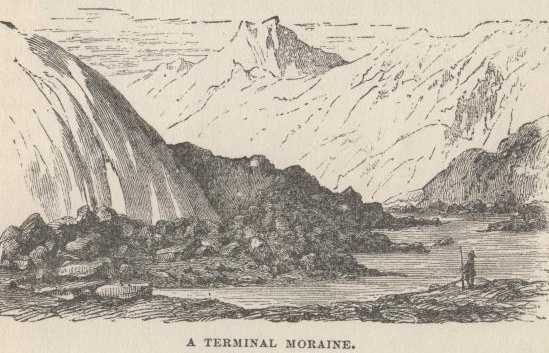
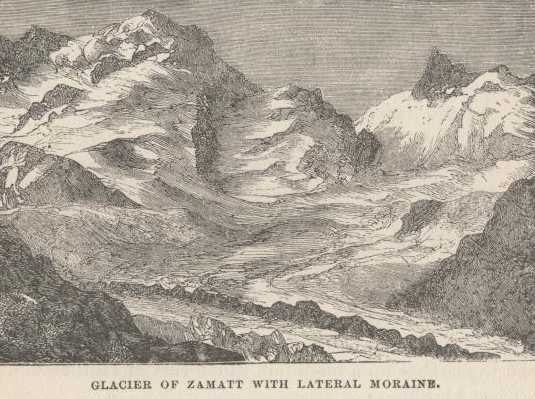
A glacier is a stupendous, ever-progressing, resistless plow. It pushes
ahead of it masses of boulders which are packed together, and they stretch
across the gorge, right in front of it, like a long grave or a long, sharp
roof. This is called a moraine. It also shoves out a moraine along each
side of its course.
Imposing as the modern glaciers are, they are not so huge as were some that once existed. For instance, Mr. Whymper says:
“At some very remote period the Valley of Aosta was occupied by a
vast glacier, which flowed down its entire length from Mont Blanc to the
plain of Piedmont, remained stationary, or nearly so, at its mouth for
many centuries, and deposited there enormous masses of debris. The length
of this glacier exceeded eighty miles, and it drained a basin
twenty-five to thirty-five miles across, bounded by the highest mountains
in the Alps.
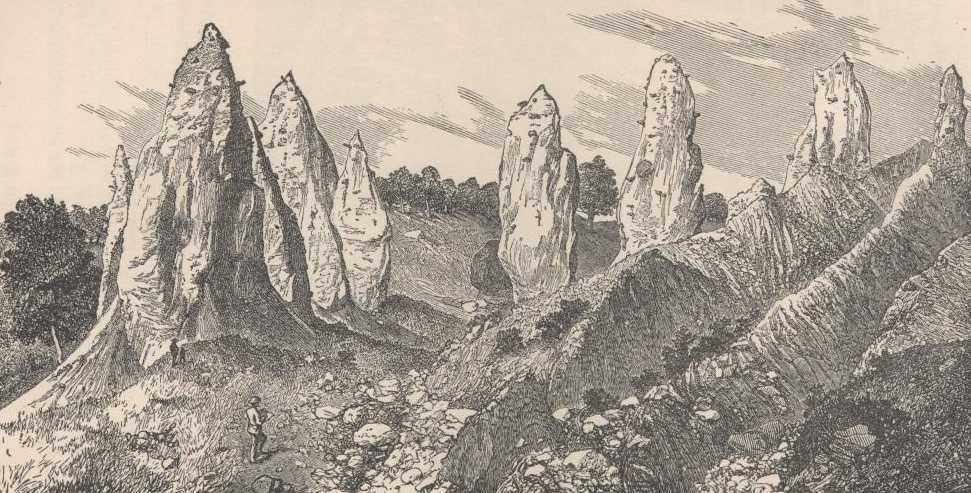
“The great peaks rose several thousand feet above the glaciers, and then, as now, shattered by sun and frost, poured down their showers of rocks and stones, in witness of which there are the immense piles of angular fragments that constitute the moraines of Ivrea.
“The moraines around Ivrea are of extraordinary dimensions. That
which was on the left bank of the glacier is about thirteen miles
long, and in some places rises to a height of two thousand one hundred
and thirty feet above the floor of the valley! The terminal moraines
(those which are pushed in front of the glaciers) cover something like
twenty square miles of country. At the mouth of the Valley of Aosta, the
thickness of the glacier must have been at least two thousand feet,
and its width, at that part, five miles and a quarter.”
It is not easy to get at a comprehension of a mass of ice like that. If one could cleave off the butt end of such a glacier—an oblong block two or three miles wide by five and a quarter long and two thousand feet thick—he could completely hide the city of New York under it, and Trinity steeple would only stick up into it relatively as far as a shingle-nail would stick up into the bottom of a Saratoga trunk.
“The boulders from Mont Blanc, upon the plain below Ivrea, assure us
that the glacier which transported them existed for a prodigious length of
time. Their present distance from the cliffs from which they were derived
is about 420,000 feet, and if we assume that they traveled at the rate of
400 feet per annum, their journey must have occupied them no less than
1,055 years! In all probability they did not travel so fast."
Glaciers are sometimes hurried out of their characteristic snail-pace. A marvelous spectacle is presented then. Mr. Whymper refers to a case which occurred in Iceland in 1721:
“It seems that in the neighborhood of the mountain Kotlugja, large bodies of water formed underneath, or within the glaciers (either on account of the interior heat of the earth, or from other causes), and at length acquired irresistible power, tore the glaciers from their mooring on the land, and swept them over every obstacle into the sea. Prodigious masses of ice were thus borne for a distance of about ten miles over land in the space of a few hours; and their bulk was so enormous that they covered the sea for seven miles from the shore, and remained aground in six hundred feet of water! The denudation of the land was upon a grand scale. All superficial accumulations were swept away, and the bedrock was exposed. It was described, in graphic language, how all irregularities and depressions were obliterated, and a smooth surface of several miles’ area laid bare, and that this area had the appearance of having been planed by a plane.”
The account translated from the Icelandic says that the mountainlike ruins of this majestic glacier so covered the sea that as far as the eye could reach no open water was discoverable, even from the highest peaks. A monster wall or barrier of ice was built across a considerable stretch of land, too, by this strange irruption:
“One can form some idea of the altitude of this barrier of ice when it is mentioned that from Hofdabrekka farm, which lies high up on a fjeld, one could not see Hjorleifshofdi opposite, which is a fell six hundred and forty feet in height; but in order to do so had to clamber up a mountain slope east of Hofdabrekka twelve hundred feet high.”
These things will help the reader to understand why it is that a man who keeps company with glaciers comes to feel tolerably insignificant by and by. The Alps and the glaciers together are able to take every bit of conceit out of a man and reduce his self-importance to zero if he will only remain within the influence of their sublime presence long enough to give it a fair and reasonable chance to do its work.
The Alpine glaciers move—that is granted, now, by everybody. But there was a time when people scoffed at the idea; they said you might as well expect leagues of solid rock to crawl along the ground as expect leagues of ice to do it. But proof after proof was furnished, and the finally the world had to believe.
The wise men not only said the glacier moved, but they timed its movement. They ciphered out a glacier’s gait, and then said confidently that it would travel just so far in so many years. There is record of a striking and curious example of the accuracy which may be attained in these reckonings.
In 1820 the ascent of Mont Blanc was attempted by a Russian and two Englishmen, with seven guides. They had reached a prodigious altitude, and were approaching the summit, when an avalanche swept several of the party down a sharp slope of two hundred feet and hurled five of them (all guides) into one of the crevices of a glacier. The life of one of the five was saved by a long barometer which was strapped to his back—it bridged the crevice and suspended him until help came. The alpenstock or baton of another saved its owner in a similar way. Three men were lost—Pierre Balmat, Pierre Carrier, and Auguste Tairraz. They had been hurled down into the fathomless great deeps of the crevice.
Dr. Forbes, the English geologist, had made frequent visits to the Mont Blanc region, and had given much attention to the disputed question of the movement of glaciers. During one of these visits he completed his estimates of the rate of movement of the glacier which had swallowed up the three guides, and uttered the prediction that the glacier would deliver up its dead at the foot of the mountain thirty-five years from the time of the accident, or possibly forty.
A dull, slow journey—a movement imperceptible to any eye—but it was proceeding, nevertheless, and without cessation. It was a journey which a rolling stone would make in a few seconds—the lofty point of departure was visible from the village below in the valley.
The prediction cut curiously close to the truth; forty-one years after the catastrophe, the remains were cast forth at the foot of the glacier.
I find an interesting account of the matter in the Histoire Du Mont Blanc, by Stephen d’Arve. I will condense this account, as follows:
On the 12th of August, 1861, at the hour of the close of mass, a guide arrived out of breath at the mairie of Chamonix, and bearing on his shoulders a very lugubrious burden. It was a sack filled with human remains which he had gathered from the orifice of a crevice in the Glacier des Bossons. He conjectured that these were remains of the victims of the catastrophe of 1820, and a minute inquest, immediately instituted by the local authorities, soon demonstrated the correctness of his supposition. The contents of the sack were spread upon a long table, and officially inventoried, as follows:
Portions of three human skulls. Several tufts of black and blonde hair. A human jaw, furnished with fine white teeth. A forearm and hand, all the fingers of the latter intact. The flesh was white and fresh, and both the arm and hand preserved a degree of flexibility in the articulations.
The ring-finger had suffered a slight abrasion, and the stain of the blood was still visible and unchanged after forty-one years. A left foot, the flesh white and fresh.
Along with these fragments were portions of waistcoats, hats, hobnailed shoes, and other clothing; a wing of a pigeon, with black feathers; a fragment of an alpenstock; a tin lantern; and lastly, a boiled leg of mutton, the only flesh among all the remains that exhaled an unpleasant odor. The guide said that the mutton had no odor when he took it from the glacier; an hour’s exposure to the sun had already begun the work of decomposition upon it.
Persons were called for, to identify these poor pathetic relics, and a touching scene ensued. Two men were still living who had witnessed the grim catastrophe of nearly half a century before—Marie Couttet (saved by his baton) and Julien Davouassoux (saved by the barometer). These aged men entered and approached the table. Davouassoux, more than eighty years old, contemplated the mournful remains mutely and with a vacant eye, for his intelligence and his memory were torpid with age; but Couttet’s faculties were still perfect at seventy-two, and he exhibited strong emotion. He said:
“Pierre Balmat was fair; he wore a straw hat. This bit of skull,
with the tuft of blond hair, was his; this is his hat. Pierre Carrier was
very dark; this skull was his, and this felt hat. This is Balmat’s
hand, I remember it so well!” and the old man bent down and kissed
it reverently, then closed his fingers upon it in an affectionate grasp,
crying out, “I could never have dared to believe that before
quitting this world it would be granted me to press once more the hand of
one of those brave comrades, the hand of my good friend Balmat."