
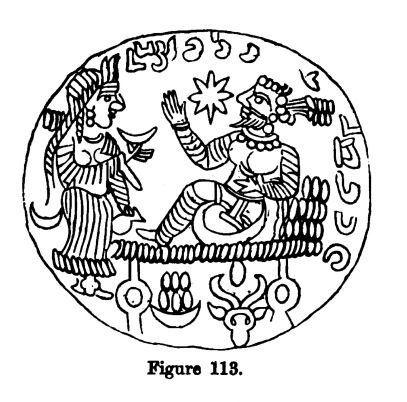
Figure 118 is copied from Lajard, Sur le Culte de Venus, plate xix., fig. 6, and represents the male and female as the sun and moon, thus identifying the symbolic sex of those luminaries. The legend in the Pehlevi characters has not been interpreted.
Figure 114 is taken from a mediæval woodcut, lent to me by my friend, Mr. John Newton, to whom I am indebted for the sight of, and the privilege to copy, many other figures. In it the virgin Mary is seen as the Queen of Heaven, nursing her infant, and identified with the crescent moon, the emblem of virginity. Being before the sun, she almost eclipses its light. Than this, nothing could more completely identify the Christian mother and child with Isis and Horus, Ishtar, Venus, Juno, and a host of other pagan goddesses, who have been called 'Queen of Heaven,' 'Queen of the Universe' 'Mother of God,' 'Spouse of God,' the 'Celestial Virgin,' the 'Heavenly Peace Maker,' etc.
Figures 115, 116, are common devices in papal churches and pagan symbolism. They are intended to indicate the sun and moon in conjunction, the union of the triad with the unit. I may notice, in passing, that Mr. Newton has showed to me some mediæval woodcuts, in which the young unmarried women in a mixed assemblage were indicated by wearing upon their foreheads a crescent moon.
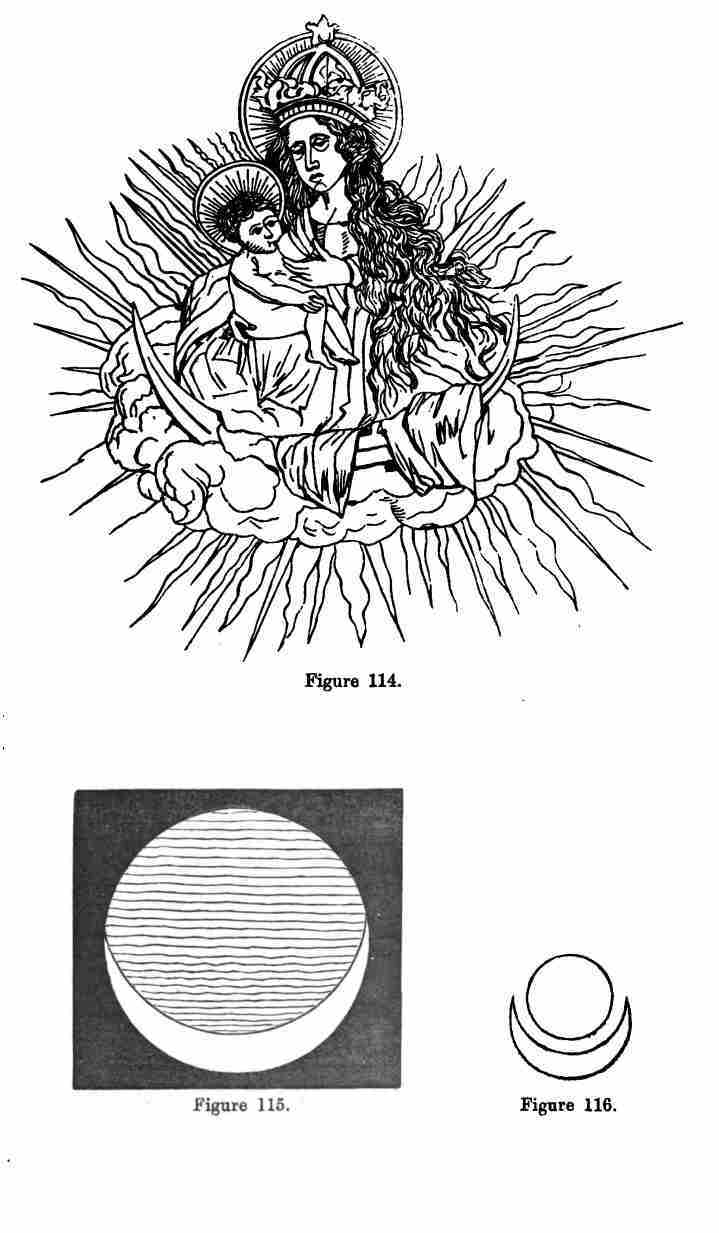
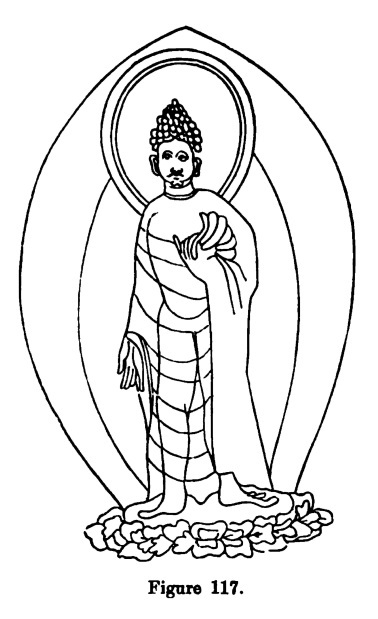
Figure 117 is a Buddhist symbol, or rather a copy of Maityna Bodhisatwa, from the monastery of Gopach, in the valley of Nepaul.
It is taken from Journal of Royal Asiatic Society, vol. xviii., p. 894. The horse-shoe, like the vesica piscis of the Roman church, indicates the yoni; the last, taken from some cow, mare, or donkey, being used in eastern parts where we now use their shoes, to keep off the evil eye. It is remarkable that some nations should use the female organ, or an effigy thereof, as a charm against ill luck, whilst others adopt the male symbol. In Ireland, as we have previously remarked, a female shamelessly exhibiting herself, and called Shelah-na-gig, was to be seen in stone over the door of certain churches, within the last century.
From the resemblance in the shape of the horse-shoe to the "grove" of the Assyrian worshippers, and from the man standing within it as the symbolic pine tree stands in the Mesopotamian, "Asherah," I think we may fairly conclude that the Indian, like the Shemitic emblem, typifies the union of the sexes—the androgyne creator.
That some Buddhists have mingled sexuality with their ideas of religion, may be seen in plate ii. of Emil Schlagintweit's Atlas of Buddhism in Tibet, wherein Vajarsattva, "The God above all," is represented as a male and female conjoined. Rays, as of the sun, pass from the group; and all are enclosed in an ornate oval, or horse-shoe, like that in this figure. Few, however, but the initiated would recognise the nature of the group at first sight.
I may also notice, in passing, that the goddess Doljang (a.d. 617-98) has the stigmata in her hands and feet, like those assigned to Jesus of Nazareth and Francis of Assisi.
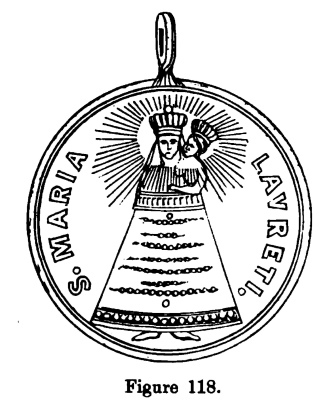
Figure 118 is a copy of the medal issued to pilgrims at the shrine of the virgin at Loretto. It was lent to me by Mr. Newton, but the engraver has omitted to make the face of the mother and child black, as the most ancient and renowned ones usually are.
Instead of the explanation given in Ancient Faiths, Vol. ii., p. 262, of the adoption of a black skin for Mary and her son, D'Harcanville suggests that it represents night, the period during which the feminine creator is most propitious or attentive to her duties. It is unnecessary to contest the point, for almost every symbol has more interpretations given to it than one. I have sought in vain for even a plausible reason for the blackness of sacred virgins and children, in certain papal shrines, which is compatible with decency and Christianity. It is clear that the matter will not bear the light.
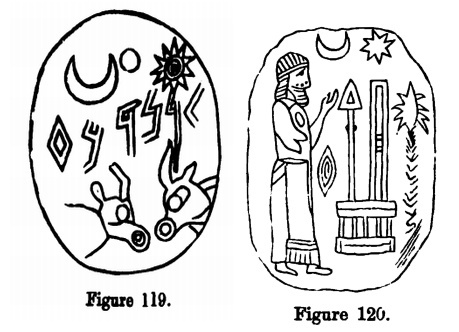
Figure 119 is from Lajard, Op. Cit., plate iii., fig. 8. It represents the sun, moon, and a star, probably Venus.
The legend is in Phoenician, and may be read LNBRB. Levy, in Siegel und Gemmen, Breslau, 1869, reads the legend [———], LKBRBO, but does not attempt to explain it.
Figure 120 is also from Lajard, plate i., fig. 8. It represents an act of worship before the symbols of the male and female creators, arranged in three pairs. Above are the heavenly symbols of the sun and moon. Below are the male palm tree, and the barred [———], identical in meaning with the sistrum, i. e., virgo intacta. Next come the male emblem, the cone, and the female symbol, the lozenge or yoni.
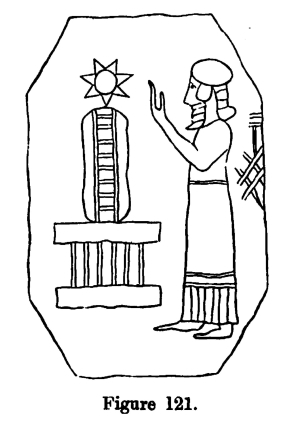
Figure 121 represents also a worshipper before the barred female symbol, surmounted by the seven-rayed star, emblem of the male potency, and of the sun or the heavens. It will be noticed—and the matter is significant—that the hand which is raised in adoration is exactly opposite the conjunction of the two. Compare this with Fig. 95, where the female alone is the object of reverence.
Lajard and others state that homage, such as is here depicted, is actually paid in some parts of Palestine and India to the living symbol; the worshipper on bended knees offering to it, la bouche inférieure, with or without a silent prayer, his food before he eats it. A corresponding homage is paid by female devotees to the masculine emblem of any very peculiarly holy fakir, one of whose peculiarities is, that no amount of excitement stimulates the organ into what may be called creative energy. It has long been a problem how such a state of apathy is brought about, but modern observation has proved that it is by the habitual use of weights. Such homage is depicted in Picart's Religious Ceremonies of all the People in the World, original French edition, plate 71.
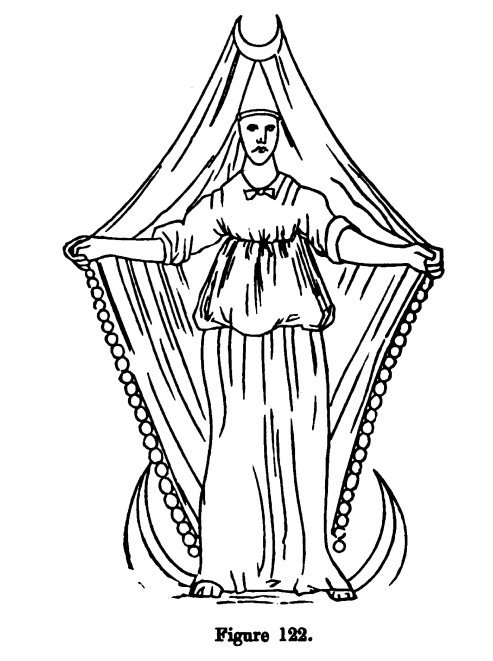
Figure 122 is copied from Bryant's Ancient Mythology, third edition, vol. iii., p. 193. That author states that he copied it from Spanheim, but gives no other reference. It is apparently from a Greek medal, and has the word CAMIÛN as an inscription. It is said to represent Juno, Sami, or Selenitis, with the sacred peplum. The figure is remarkable for showing the identity of the moon, the lozenge, and the female. It is doubtful whether the attitude of the goddess is intended to represent the cross.
As in religious Symbolism every detail has a signification, we naturally speculate upon the meaning of the beads which fringe the lower part of the diamond-shaped garment. We have noticed in a previous article that the Linga when worshipped was sometimes adorned with beads, which were the fruit of a tree sacred to Mahadeva; in the original of fig. 4, plate xi. supra, the four arms of the cross have a series of beads depending from them. On a very ancient coin of Citium, a rosary of beads, with a cross, has been found arranged round a horse-shoe form; and beads are common ornaments on Hindoo Divinities. They may only be used for decoration and without religious signification; if they have the last, I have not been able to discover it.
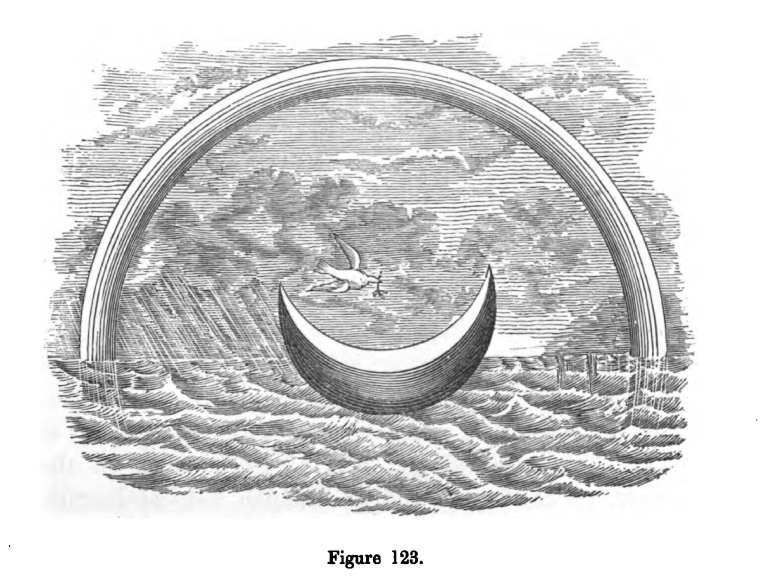
Figure 128 is a composition taken from Bryant, vol. iv., p. 286. The rock, the water, the crescent moon as an ark, and the dove hovering over it, are all symbolical; but though the author of it is right in his grouping, it is clear that he is not aware of its full signification. The reader will readily gather their true meaning from our articles upon the Ark and Water, and from our remarks upon the Dove in Ancient Faiths, second edition.
Figure 124 is copied from Maffei's Gemme Antiche Figurate, vol. 8, plate xl. In the original, the figure upon the pillar is very conspicuously phallic, and the whole composition indicates what was associated with the worship of Priapus.
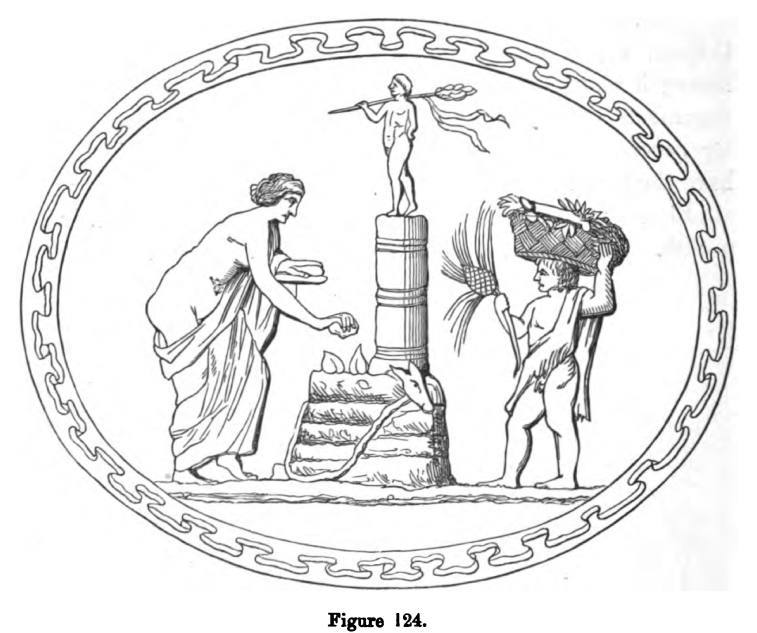
This so-called god was regarded much in the same light as 'St. Cosmo and St. Damian were at Iseraia, and St. Foutin in Christian France. And it is not at all surprising that a church, which has deified or made saints of a spear and cloak, under the names Longinus and Amphibolus, should also adopt the "god of the gardens," and consecrate him as an object for Christian worship, and give him an appropriate name and emblem. But the patron saint of Lampsacus was not really a deity, only a sort of saint, whose business it was to attend to certain parts. The idea of guardian angels was once common, see Matt, xviii. 10, where we read, that each child has a guardian in heaven, who looks after his infantile charge. As the pagan Hymen and Lucina attended upon weddings and parturitions, so the Christian Cosmo and Damian attended to spouses, and assisted in making them fruitful. To the last two were offered, by sterile wives, wax effigies of the part left out from the nude figure in our plate. To the heathen saint, we see a female votary offer quince leaves, equivalent to la feuille de sage, egg-shaped bread, apparently a cake; also an ass's head; whilst her attendant offers a pine cone. This amongst the Greeks was sacred to Cybele, as it was in Assyria to Astarte or Ishtar, the name given there to 'the mother of all saints.' The basket contains apples and phalli, which may have been made of pastry. See Martial's Epigrams, b. xiv. 69. This gem is valuable, inasmuch as it assists us to understand the signification of the pine cone offered to the 'grove,' the equivalent of le Verger de Cypris. The pillar and its base are curiously significant, and demonstrate how completely an artist can appear innocent, whilst to the initiated he unveils a mystery.
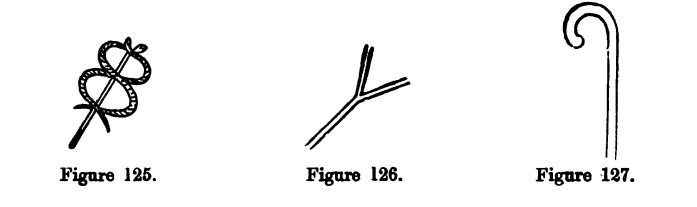
Figures 125, 126, 127, are various contrivances for indicating decently that which it was generally thought religious to conceal, la bequile, au les instrumens.
Figure 128 represents the same subject; the cuts are grouped iso as to show how the knobbed stick, le bâton, becomes converted either into a bent rod, la verge, or a priestly crook, le bâton pastoral. There is no doubt that the episcopal crozier is a presentable effigy of a very private and once highly venerated portion of the human frame, which was used in long by-gone days by Etruscan augurs, when they mapped out the sky, prior to noticing the flight of birds. Perhaps we ought to be grateful to Popery for having consecrated to Christ what was so long used in that which divines call the service of the devil.
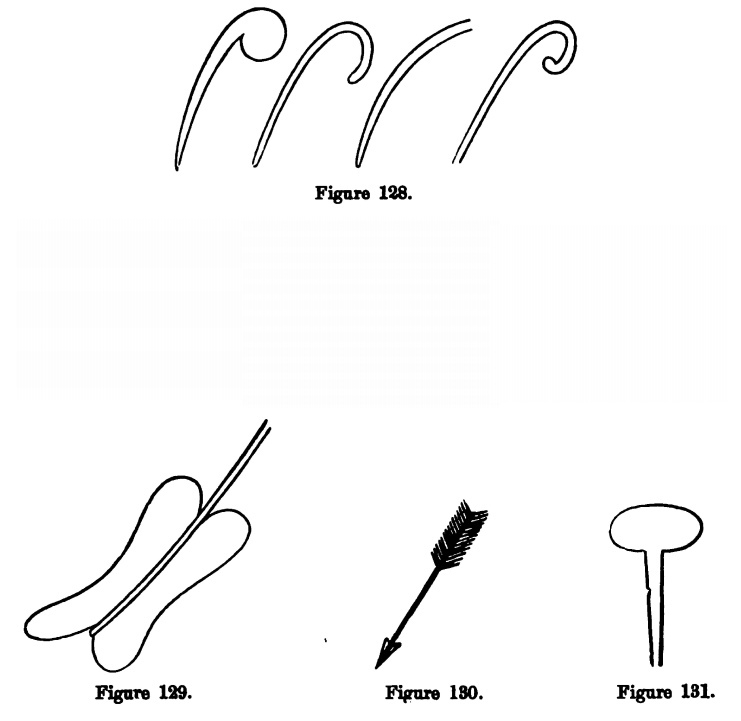
Figures 129, 130, 131, are, like the preceding four, copied from various antique gems; Fig. 129 represents a steering oar, le timon, and is usually held in the hand of good fortune, or as moderns would say "Saint Luck," or bonnes fortunes; Fig. 180 is emblematic of Cupid, or Saint Desire; it is synonymous with le dard, or la pique; Fig. 131 is a form less common in gems; it represents the hammer, le marteau qui frappe l'enclume et forge les enfans. The ancients had as many pictorial euphemisms as ourselves, and when these are understood they enable us to comprehend many a legend otherwise dim; e. g., when Fortuna, or luck, always depicted as a woman, has for her characteristic le timon, and for her motto the proverb, "Fortune favours the bold." we readily understand the double entente. The steering oar indicates power, knowledge, skill, and bravery in him who wields it; without such a guide, few boats would attain a prosperous haven.
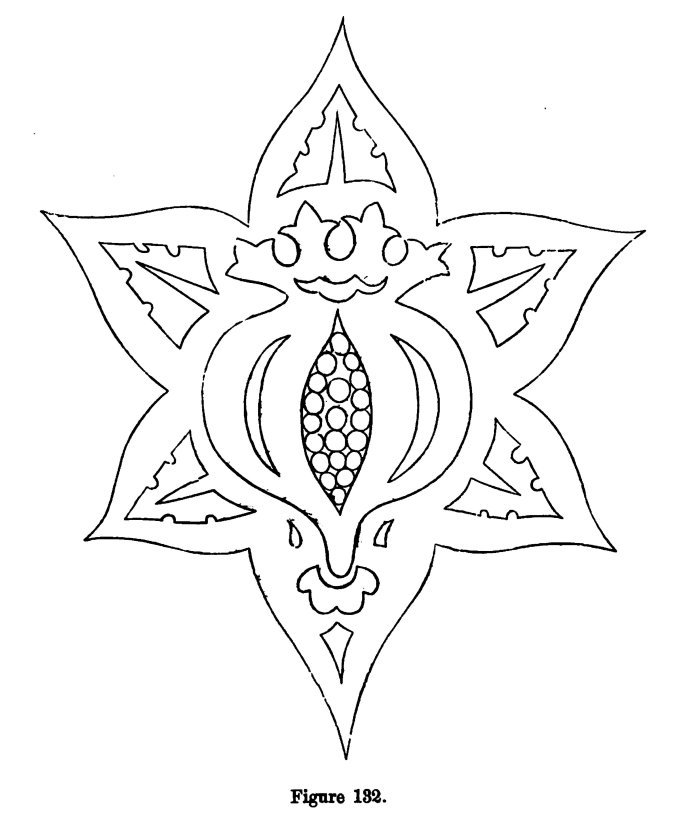
Figure 132 is copied from plate xxix. of Pugin's Glossary of Ecclesiastical Ornament (Lond., 1868). The plate represents "a pattern for diapering," and is, I presume, thoroughly orthodox. It consists of the double triangle, see Figures 20, 80, 81, 82, pp. 82, 88, the emblems of Siva and Parvati, the male and female; of Rimmon the pomegranate, the emblem of the womb, which is seen to be full of seed through the "vesica piscis," la fente, or la porte de la vie. There are also two new moons, emblems of Venus, or la nature, introduced. The crown above the pomegranate represents the triad, and the number four; whilst in the original the group which we copy is surrounded by various forms of the triad, all of which are as characteristic of man as Rimmon is of woman. There are also circles enclosing the triad, analogous to other symbols common in Hindostan.
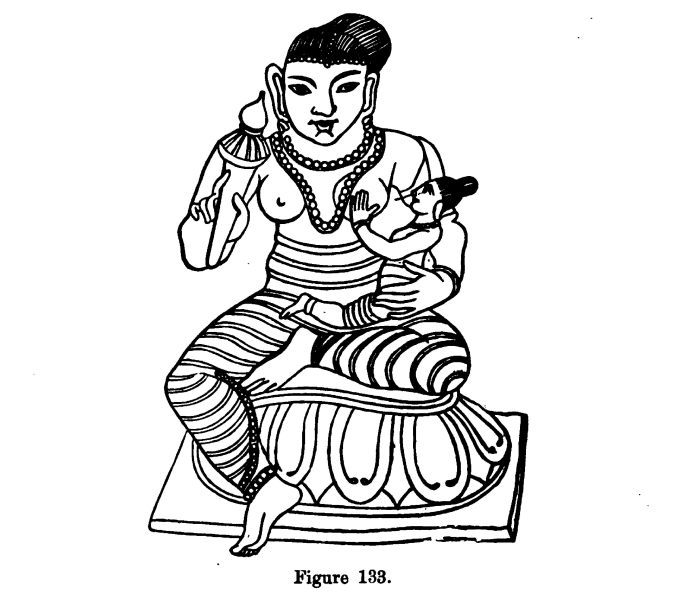
Figure 133 is copied from Moor's Hindu, Pantheon, pi. ix., fig. 8. It represents Bhavhani, Maia, Devi, Lakshmi, or Kamala, one of the many forms given to female nature. She bears in one hand the lotus, emblem of self-fructification,—in other similar figures an effigy of the phallus is placed,—whilst in the other she holds her infant Krishna, Crishna, or Vishnu. Such groups are as common in India as in Italy, in pagan temples as in Christian churches. The idea of the mother and child is pictured in every ancient country of whose art any remains exist.
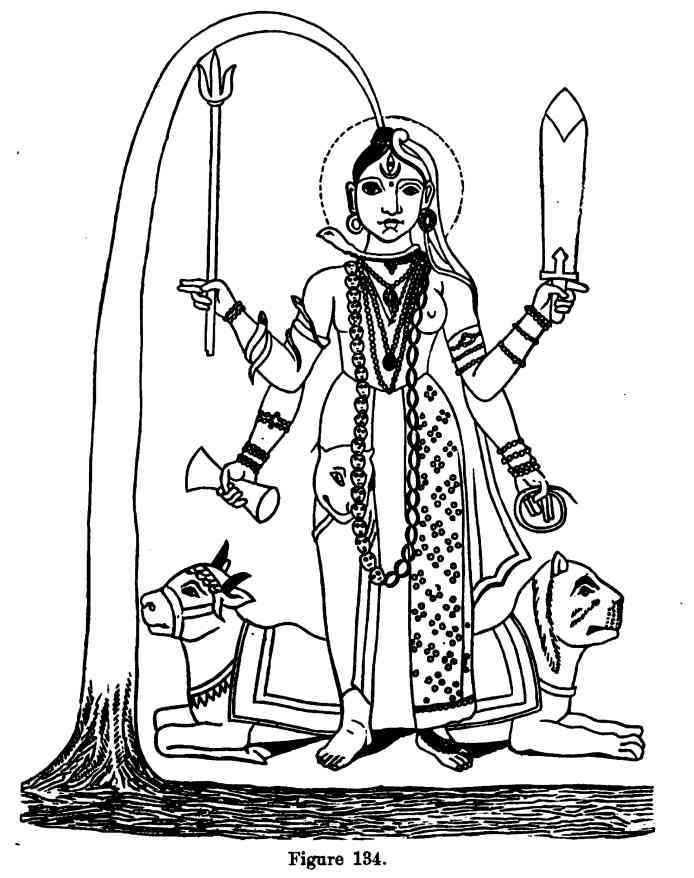
Figure 184 is taken from plate xxiv., fig. 1, of Moor's Hindu Pantheon. It represents a subject often depicted by the Hindoos and the Greeks, viz., androgynism, the union of the male and female creators. The technical word is Arddha-Nari. The male on the right side bears the emblems of Siva or Mahadeva, the female on the left those of Parvati or Sacti. The bull and lioness are emblematic of the masculine and feminine powers. The mark on the temple indicates the union of the two; an aureole is seen around the head, as in modern pictures of saints. In this drawing the Ganges rises from the male, the idea being that the stream from Mahadeva is as copious and fertilising as that mighty river. The metaphor here depicted is common in the East, and is precisely the same as that quoted in Num. xxiv. 7, and also from some lost Hebrew book in John vii. 38. It will be noticed, that the Hindoos express androgyneity quite as conspicuously, but generally much less indelicately, than the Grecian artists.
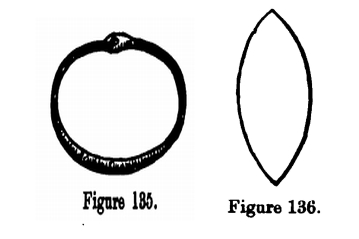
Figure 135 is a common Egyptian emblem, said to signify eternity, but in truth it has another meaning. The serpent and the ring indicate l' andouille and l' anneau. The tail of the animal, which the mouth appears to swallow, is la queue dans la bouche. The symbol resembles the crux ansata in its signification, and imports that life upon the earth is rendered perpetual by means of the union of the sexes. A ring, or circle, is one of the symbols of Venus, who carries indifferently this, or the triad emblem of the male. See Maffei's Gemme, vol. iii., page 1, plate viii.
Figure 136 is the vesica piscis, or fish's bladder; the emblem of woman and of the virgin, as may be seen in the two following woodcuts.
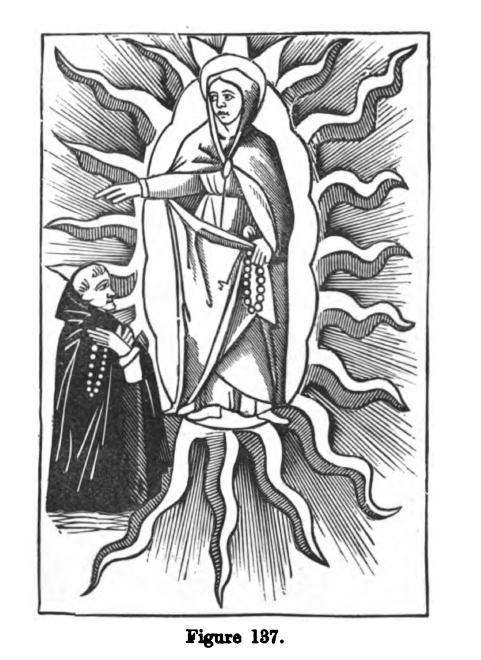
Figures 137, 138, are copied from an ancient Rosary of the Blessed Virgin Mary, printed at Venice, 1524, with a license from the Inquisition; the book being lent to me by my friend, Mr. Newton. The first represents the same part as the Assyrian "grove." It may appropriately be called the Holy Yoni. The book in question contains numerous figures, all resembling closely the Mesopotamian emblem of Ishtar. The presence of the woman therein identifies the two as symbolic of Isis, or la nature; and a man bowing down in adoration thereof shows the same idea as is depicted in Assyrian sculptures, where males offer to the goddess symbols of themselves. Compare Figs. 68, 64, 65, 66, pp. 48 seq.
If I had been able to search through the once celebrated Alexandrian library, it is doubtful whether I could have found any pictorial representation more illustrative of the relationship of certain symbolic forms to each other than is Figure 138. A circle of angelic heads, forming a sort of sun, having luminous rays outside, and a dove, the emblem of Venus, dart a spear (la pique) down upon the earth (la terré), or the virgin. This being received, fertility follows.
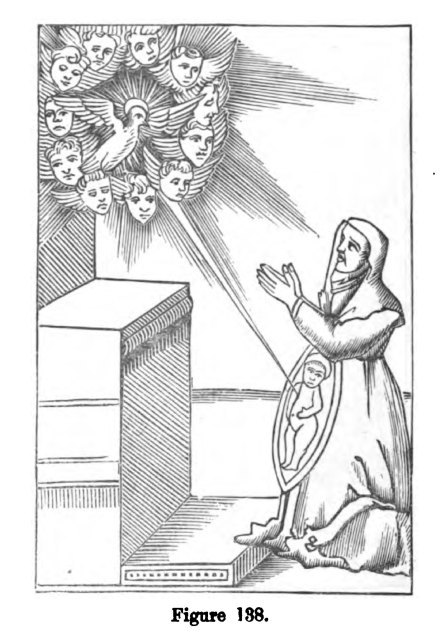
In Grecian story, Ouranos and Ge, or heaven and earth, were the parents of creation; and Jupiter came from heaven to impregnate Alcmena. The same mythos prevailed throughout all civilised nations. Christianity adopted the idea, merely altering the names of the respective parents, and attributed the regeneration of the world to "holy breath" and Mary. Every individual, indeed, extraordinarily conspicuous for wisdom, power, goodness, etc., is said to have been begotten on a woman by a celestial father. Within the vesica piscis, artists usually represent the virgin herself, with or without the child; in the figure before us the child takes her place. It is difficult to believe that the ecclesiastics who sanctioned the publication of such a print could have been as ignorant as modern ritualists. It is equally difficult to believe that the latter, if they knew the real meaning of the symbols commonly used by the Roman church, would adopt them.
The last two figures, symbolic of adoration before divine sexual emblems, afford me the opportunity to give a description of a similar worship existent in Hindostan at the present time. My authority is H. H. Wilson, in Essays on the Religion of the Hindoos, Trübner and Co., London. "The worshippers," he remarks, vol. i., p. 240, "of the Sakti, the power or energy of the divine nature in action, are exceedingly numerous amongst all classes of Hindoos—about three-fourths are of this sect, while only a fifth are Vaishnavas and a sixteenth Saivas. This active energy is personified, and the form with which it is invested depends upon the bias of the individuals. The most favourite form is that of Parvati, Bhavani, or Durga, the wife of Siva, or Mahadeva."
"The worship of the female principle, as distinct from the divinity, appears to have originated in the literal interpretation of the metaphorical language of the Vedas, in which the will or purpose to create the universe is represented as originating from the creator, and consistent with him as his bride." "The Samaveda for example, says, the creator felt not delight being alone; he wished another, and caused his own self to fall in twain, and thus became husband and wife. He approached her, and thus were human beings produced." A sentiment or statement which we may notice in passing is very similar to that propounded in Genesis, ch. i. 27, and v. 1, 2, respecting Elohim—viz., that he created man and woman in his own image, i.e., as male and female, bisexual but united—an androgyne.
"This female principle goes by innumerable cognomens, inasmuch as every goddess, every nymph, and all women are identified with it. She—the principle personified—is the mother of all, as Mahadeva, the male principle, is the father of all."
"The homage rendered to the Sakti may be done before an image of any goddess—Prakriti, Lakshmi, Bhavani, Durga, Maya, Parvati, or Devi—just in the same way as Romanists may pray to a local Mary, or any other. But in accordance with the weakness of human nature, there are many who consider it right to pay their devotions to the thing itself rather than to an abstraction. In this form of worship six elements are required, flesh, fish, wine, women, gesticulations and mantras which consist of various unmeaning monosyllabic combinations of letters of great imaginary efficacy."
"The ceremonies are mostly gone through in a mixed society, the Sakti being personified by a naked female, to whom meat and wine are offered and then distributed amongst the company. These eat and drink alternately with gesticulations and mantras—and when the religious part of the business is over, the males and females rush together and indulge in a wild orgy. This ceremony is entitled the Sri Chakra or Purnabhisheka, the Ring or Full Initiation."
In a note apparently by the editor, Dr. Rost, a full account is given in Sanscrit of the Sakti Sodhana, as they are prescribed in the Devi Rahasya, a section of the Rudra Yâmala, so as to prove to his readers that the Sri Chakra is performed under a religious prescription.
We learn that the woman should be an actress, dancing girl, a courtesan, washerwoman, barber's wife, flower-girl, milk-maid, or a female devotee. The ceremony is to take place at midnight with eight, nine, or eleven couples. At first there are sundry mantras said, then the female is disrobed, but richly ornamented, and is placed on the left of a circle (Chakra) described for the purpose, and after sundry gesticulations, mantras, and formulas she is purified by being sprinkled over with wine. If a novice, the girl has the radical mantra whispered thrice in her ear. Feasting then follows, lest Venus should languish in the absence of Ceres and Bacchus, and now, when the veins are full of rich blood, the actors are urged to do what desire dictates, but never to be so carried away by their zeal as to neglect the holy mantras appropriate to every act and to every stage thereof.*
from his and his Editor's account. In the original the
observations extend over eighteen pages, and are too long to
be given in their entirety: the parts omitted are of no
consequence.
It is natural that such a religion should be popular, especially amongst the young of both sexes.
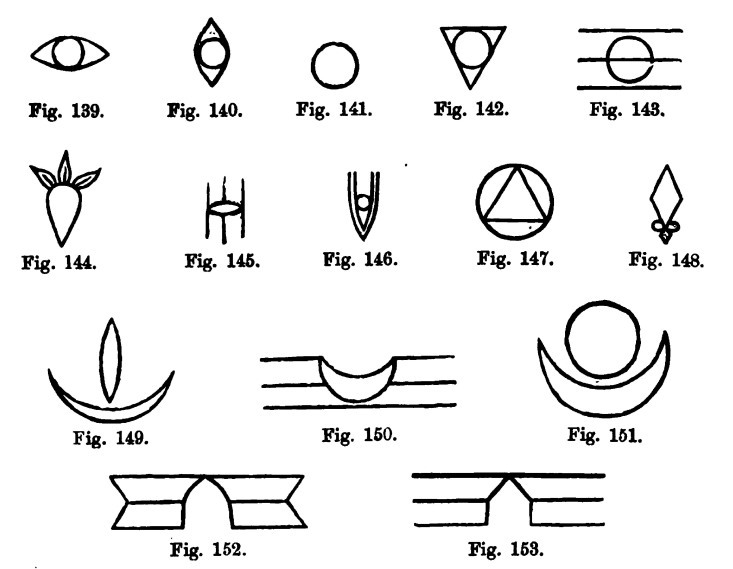
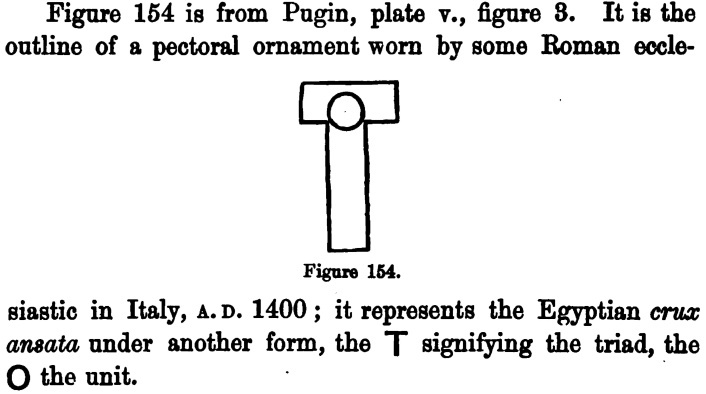
Figures 139 to 158 are copied from Moor's Hindu Pantheon; they are sectarial marks in India, and are usually traced on the forehead. Many resemble what are known as "mason's marks," i. e., designs found on tooled stones, in various ancient edifices, like our own, "trade marks." They are introduced here to illustrate the various designs employed to indicate the union of the "trinity" with the "unity," and the numerous forms representative of "la nature" A priori, it appears absurd to suppose that the eye could ever have been symbolical of anything but sight; but the mythos of Indra, given in Ancient Faiths, second edition, Vol. n., p. 649, and p. 7 supra, proves that it has another and a hidden meaning. These figures are alike emblematic of the "trinity," "the virgin," and the "four." Figure 154 is from Pugin, plate v., figure 3. It is the outline of a pectoral ornament worn by some Roman ecclesiastic in Italy, a. d. 1400; it represents the Egyptian crux ansata under another form, the T signifying the triad.
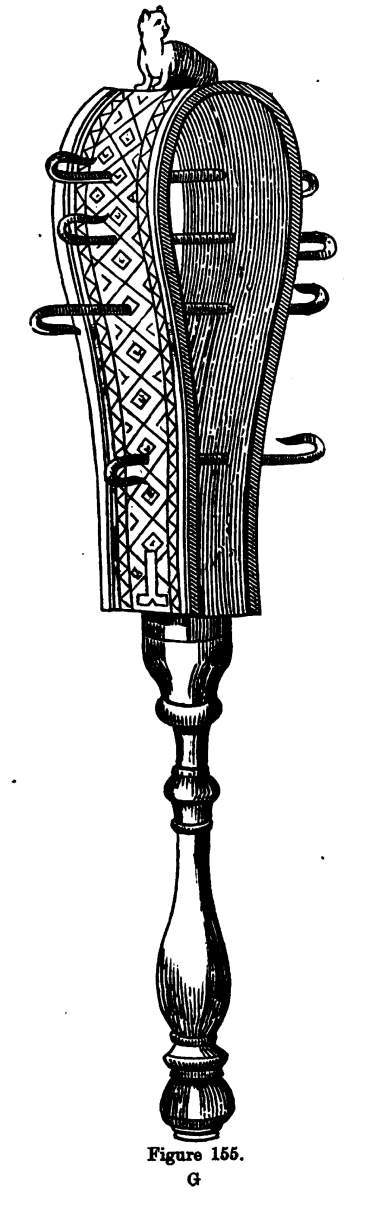
Figures 155, 156, are different forms of the sistrum, one of the emblems of Isis. In the latter, the triple bars have one signification, which will readily suggest itself to those who know the meaning of the triad. In the former, the emblem of the trinity, which we have been obliged to conventionalise, is shown in a distinct manner. The cross bars indicate that Isis is a virgin. The cat at the top of the instrument indicates "desire," Cupid, or Eros. Fig. 155 is copied from plate ix., R. P. Knight's Worship of Priapus.
Figure 157 represents the cup and wafer, to be found in the hands of many effigies of papal bishops; they are alike symbolic of the sun and moon, and of the elements in the Eucharist. See Pugin, plate iv., figs. 5, 6, represents a temple in a conventional form; whilst below, Ceres appears seated within a horse-shoe shaped ornament.
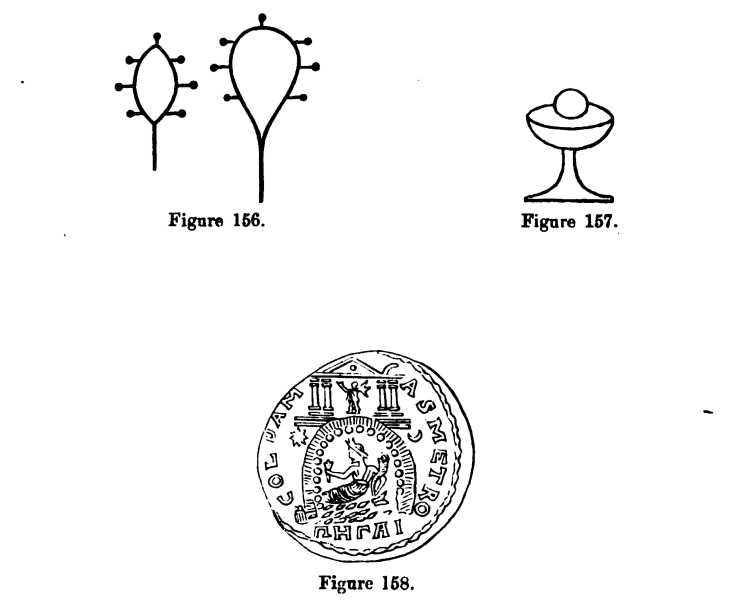
This, amongst other symbols, tends to show what we have so frequently before observed, that the female in creation is characterised by a great variety of designs, of which the succeeding woodcuts give us additional evidence.
Figure 159 represents the various forms symbolic of Juno, Isis, Parvati, Ishtar, Mary, or woman, or the virgin.
Figures 160, 161, 162, are copied from Audsley's Christian Symbolism (London, 1868). They are ornaments worn by the Virgin Mary, and represent her as the crescent moon, conjoined with the cross (in Fig. 160), with the collar of Isis (in Fig. 161), and with the double triangle (in Fig. 162).
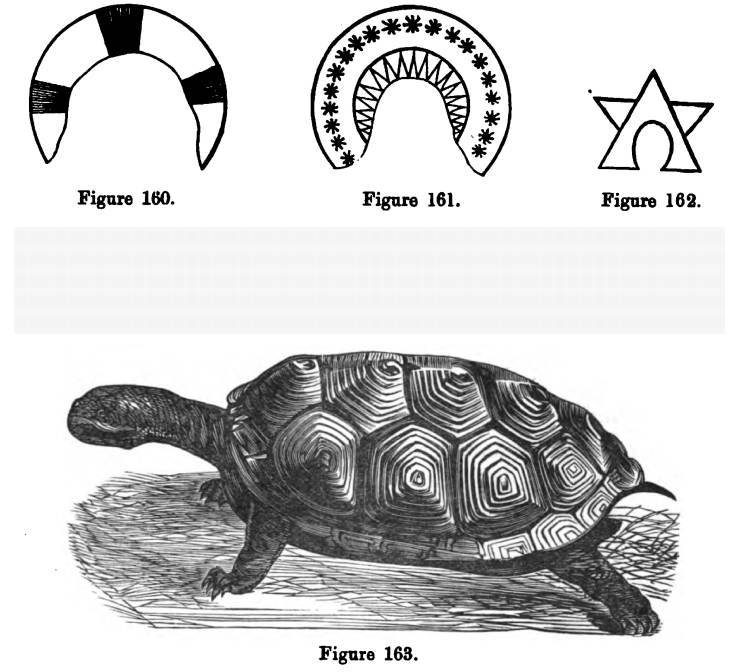
Figure 163 represents a tortoise. When one sees a resemblance between this creature's head and neck and the linga, one can understand why both in India and in Greece the animal should be regarded as sacred to the goddess personifying the female creator, and why in Hindoo myths it is said to support the world.
In the British Museum there are three Assyrian obeliscs, all of which represent, in the most conspicuous way, the phallus, one of which has been apparently circumcised. The body is occupied with an inscription recording the sale of land, and also a figure of the reigning king, whilst upon the part known as the glans penis are a number of symbols, which are intended apparently to designate the generative powers in creation. The male is indicated by a serpent, a spear head, a hare, a tiara, a cock, and a tortoise. The female appears under precisely the same form as is seen on the head of the Egyptian Isis, Fig. 28. The tortoise is to this day a masculine emblem in Japan. See Figs. 174, 175.
But there is no necessity for the animal itself always to be depicted, inasmuch as I have discovered that both in Assyrian and Greek art the tortoise is pourtrayed under the figure which resembles somewhat the markings upon the segments into which the shell is divided. In symbolism it is a very common thing for a part to stand for the whole; thus an egg is made to do duty for the triad; and a man is sometimes represented by a spade. A woman is in like manner represented by a comb, or a mirror; and a golden fleece typifies in the first place the "grove," which it overshadows, and the female who possesses both.

It has been stated on page 19 supra, that Pausanias mentions having seen at some place in Greece one figure of Venus standing on a tortoise, and another upon a ram, but he leaves to the ingenious to discover why the association takes place.
It was this intimation which led me to identify the tortoise as a male symbol. Any person who has ever watched this creature in repose, and seen the action of the head and neck when the quadruped is excited, will recognise why the animal is dear to the goddess of amorous delight, and that which it may remind her of. In like manner, those who are familiar with the ram will know that it is remarkable for persistent and excessive vigour. Like the cat, whose salacity caused it to be honoured in Egypt, the ram was in that country also sacred, as the bull was in Assyria and Hindostan.
In fact, everything which in shape, habits, or sound could remind mankind of the creators and of the first part of creation was regarded with reverence. Thus tall stones or natural pinnacles of rock, the palm, pine, and oak trees, the fig tree and the ivy, with their tripliform leaves, the mandrake, with its strange human form, the thumb and finger, symbolised Bel, Baal, Asher, or Mahadeva. In like manner a hole in the ground, a crevice in a rock, a deep cave, the myrtle from the shape of its leaf, the fish from its scent, the dolphin and the mullet from their names, the dove from its note, and any umbrageous retreat surrounded with thick bushes, were symbolic of woman.
So also the sword and sheath, the arrow and target, the spear and shield, the plough and furrow, the spade and trench, the pillar by a well, the thumb thrust between the two fore-fingers or grasped by the hand, and a host of other things were typical of the union which brings about the formation of a new being.
I cannot help regarding the sexual element as the key which opens almost every lock of symbolism, and however much we may dislike the idea that modern religionists have adopted emblems of an obscene worship, we cannot deny the fact that it is so, and we may hope that with a knowledge of their impurity we shall cease to have a faith based upon a trinity and virgin—a lingam and a yoni. Some may cling still to such a doctrine, but to me it is simply horrible—blasphemous and heathenish.
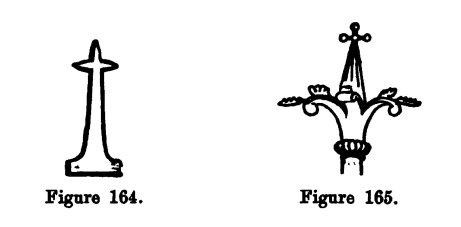
Figures 164, 165, represent a pagan and Christian cross and trinity. The first is copied from B. P. Knight (plate x., fig. 1), and represents a figure found on an ancient coin of Apollonia. The second may be seen in any of our churches to-day.
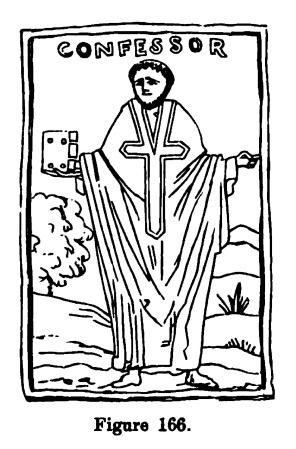
Figure 166 is from an old papal book lent to me by Mr. Newton, Missale Romanum, illustrated by a monk (Venice, 1509). It represents a confessor of the Roman church, who wears the crux ansata, the Egyptian symbol of life, the emblem of the four creators, in the place of the usual pallium.
It is remarkable that a Christian church should have adopted so many pagan symbols as Rome has done. Figure 167 is copied from a small bronze figure in the Mayer collection in the Free Museum, Liverpool. It represents the feminine creator holding a well marked lingam in her hand, and is this emblematic of the four, or the trinity and the virgin.
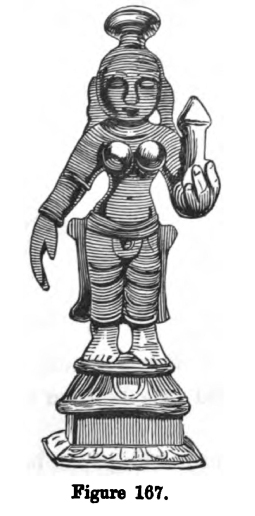
Figure 168 represents two Egyptian deities in worship before an emblem of the male, which closely resembles an Irish round tower.
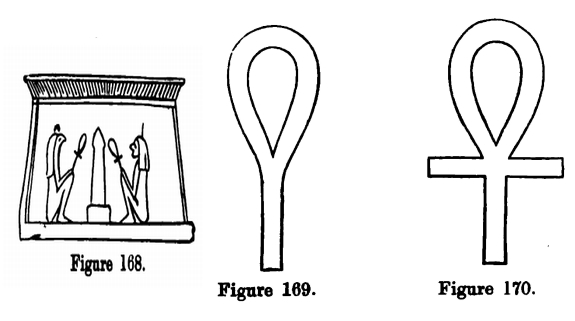
Figure 169 represents the modern pallium worn by Roman priests. It represents the ancient sistrum of Isis, and the yoni of the Hindoos. It is symbolic of the celestial virgin, and the unit in the creative four. When donned by a Christian priest, he resembles the pagan male worshippers, who wore a female dress when they ministered before the altar or shrine of a goddess. Possibly the Hebrew ephod was of this form and nature.
Figure 170 is a copy of an ancient pallium, worn by papal ecclesiastics three or four centuries ago.. It is the old Egyptian symbol described above. Its common name is crux ansata, or the cross with a handle.
Figure 171 is the albe worn by Roman and other ecclesiastics when officiating at mass, etc. It is simply a copy of the chemise ordinarily worn by women as an under garment.
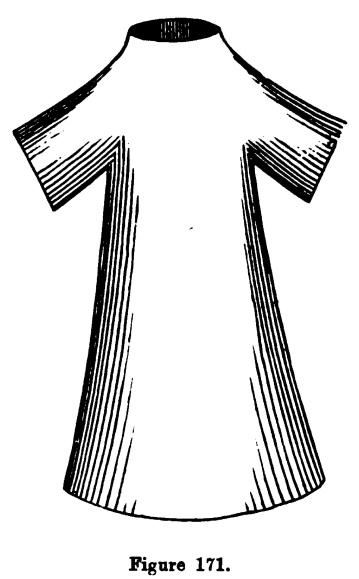
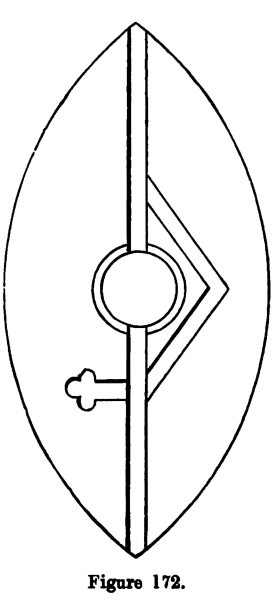
Figure 172 represents the chamble worn by papal hierarchs. It is copied from Pugin's Glossary, etc. Its form is that of the vesica piscis, one of the most common emblems of the yoni. It is adorned by the triad. When worn by the priest, he forms the male element, and with the chasuble completes the sacred four. When worshipping the ancient goddesses, whom Mary has displaced, the officiating ministers clothed themselves in feminine attire. Hence the use of the chemise, etc. Even the tonsured head, adopted from the priests of the Egyptian Isis, represents "l' anneau;" so that on head, shoulders, breast and body, we may see on Christian priests the relics of the worship of Venus, and the adoration of woman! How horrible all this would sound if, instead of using veiled language, we had employed vulgar words. The idea of a man adorning himself, when ministering before God and the people, with the effigies of those parts which nature as well as civilisation teaches us to conceal, would be simply disgusting, but when all is said to be mysterious and connected with hidden signification, almost everybody tolerates and many eulogise or admire it!
APPENDIX: THE ASSYRIAN "GROVE" AND OTHER EMBLEMS
By John Newton, M.R.C.S.
The study of sacred symbols is as yet in its infancy. It has hitherto been almost ignored by sacerdotal historians; and thus a rich mine of knowledge on the most interesting of all subjects—the history of the Religious Idea in man—remains comparatively unexplored. The topic has a two-fold interest, for it equally applies to the present and the past. As nothing on earth is more conservative than religion, we have still a world of symbolism existing amongst us which is far older than our sects and books, our creeds and articles, a relic of a forgotten, pre-historic past. Untold ages before writing was invented, it is believed that men attempted to express their ideas in visible forms. Yet how can a savage, who is unable to count his fingers up to five, and has no idea of abstract number, apart from things, whose habits and thoughts are of the earth, earthy, form a conception of the high and holy One who inhabiteth eternity? Even under the highest forms of ancient civilisation, abundant proofs exist that the imagination of men, brooding over the idea of the Unseen and the Infinite, were bounded by the things which were presented in their daily experience, and which most moved their passions, hopes and fears. Through these, then, they attempted to embody such religious ideas as they felt. They could not teach others without visible symbols to assist their conceptions; and emblems were rather crutches for the halting than wings to help the healthy to soar. Mankind in all ages has clung to the visible and tangible. The people care little for the abstract and unseen. The Israelites preferred a calf of gold to the invisible Jehovah; and sensuous forms of worship still fascinate the multitude.
Whilst studying a collection of symbols, gathered from many climes and ages, such as this volume presents, I feel sure that every intelligent student will have asked himself more than once—Is there not some key which unlocks these enigmas, some grand idea which runs through them all, connecting them like a string of beads? I believe that there is, and that it is not far to seek. What do men desire and long for most? Life. "Skin for skin; all that a man hath will he give for his life," is a saying as true now as in the days of Job. "Give me back my youth, and I will give you all I possess," was said by the aged Voltaire to his physician. And our poet laureate has sung,
O life, not death, for which we pant;
More life, and fuller, that I want.
But we must add, as necessarily contained in the idea of Life in its highest sense, those things which make Life desirable.
This fulness of life has been the summum bonum, the highest good, which mankind has sighed for in every age and clime. For this the alchemists toiled, not to advance chemistry, but to discover the Elixir of Life and the Philosopher's Stone. But what nature refused to science, the gods, it was believed, would surely give to the pious! and the glorious prize referred to has been promised by every religion. "I am come that they might have Life, and that they might have it more abundantly." Life is the reward which has been promised under every system, including that of the founder of Christianity. A Tree of Life stood in the midst of that Paradise which is described in the book of Genesis; and when the first human couple disobeyed their Maker's command, they were punished by being cut off from the perennial fount of vitality, lest they should eat its fruit and thus live for ever; and in a second Paradise, which is promised to the blessed by the author of the book of Revelation, a tree of life shall stand once more "for the healing of the nations." To the good man is promised, in the Hebrew Scriptures, long life, prosperity, and a numerous offspring. "Thy youth is renewed like the eagle's."* Ps. ciii. 5.
In the wondrous theology of Ancient Egypt, which at length is open to us, the "Ritual of the Dead" celebrates the mystical reconstruction of the body of the deceased, whose parts are to be reunited, as those of Osiris were by Isis; the trials are recorded through which the deceased passes, and by which all remaining stains of corruption are wiped away; and the record ends when the defunct is born again glorious, like that Sun which typified the Egyptian resurrection.**
ten commandments is a promise added. And what is the
promise? "That thy days may be long." (Exod. xx. 12.) See
also Psalm cxxxiii. 3, "the blessing, even life for
evermore."
** Apuleius, who had been initiated into the mysteries of
Isis, informs us that long life was the reward promised to
her votaries. (Metam. cap. xi.)
In the ancient mythology of India, it is recounted that of old the gods in council united together to procure, by one supreme effort, the Amrita cup of immortality, which, after the success of their scheme, they partake of with their worshippers. Even for the Buddhist, his cold, atheistical creed promises a Nirvana, an escape from the horrors of metempsychosis, a haven of eternal calm, where "there shall be no more death, neither sorrow nor crying, neither shall there be any more pain, for the former things are passed away;" "there the weary be at rest." Rev. xxi. 4, Job iii. 17.
This idea of tranquillity is in striking contrast to the heaven promised by the religion of the north of Europe, which was the one most congenial to a people whose delight was in conquest and battle. Those who had led a life of heroism, or perished bravely in fight, ascended to Valhalla; and the eternal manhood which awaited them there was to be passed in scenes that were rapture to the imagination of a Dane or a Saxon. Every day in that abode of bliss was to be spent in furious conflict, in the struggle of armies and the cleaving of shields; but at evening the conflict was to cease; every wound to be suddenly healed. Then the contending warriors were to sit down to a banquet, where, attended by lovely maidens, they could feast on the exhaustless flesh of the boar Sæhrimnir, and drink huge draughts of mead from the skulls of those enemies who had not attained to the glories of Valhalla.
The paradise promised to the faithful by Mahomet is full of sensuous delights. The Arabian prophet dwells with rapture on its gardens and palaces, its rivers and bowers. Seventy-two houris, or black-eyed girls, rejoicing in beauty and ever-blooming youth, will be created for the use of the meanest believer; a moment of pleasure will be prolonged to a thousand years, and his powers will be increased a hundred-fold to render him worthy of his felicity.
Thus we see that in all these great historical faiths the prize held out to the true believer has this in common, viz., Life, overflowing, ever-renewed, with the addition of those things which make life desirable for men; whether they are sensuous pleasures, or those which, under the loftier ideal of Christianity, are summed up in Life, both temporal and eternal, in the light of God.
Such being the case, we might anticipate that the symbols of every religion would reproduce, in some shape or other, the ideal which is common to all. The earliest and rudest faiths were content with gross and simple emblems of life. In the later and more refined forms of worship, the ruder types were highly conventionalised, and replaced by a more intricate and less obvious symbolism.
We proceed now to investigate the more primitive emblems. The origin of life is, even to us, with all our lights, as great a mystery as it was to the ancients. To the primitive races of mankind the formation of a new being appeared to be a constant miracle, and men very naturally used as tokens of life, and even worshipped, those objects or organs by which the miracle appeared to be wrought. Thus, the glorious sun, that "god of this world," the source of life and light to our earth, was early adored, and an effigy thereof used as a symbol. Mankind watched with rapture its rays gain strength daily in the Spring, until the golden glories of Midsummer had arrived, when the earth was bathed during the longest days in his beams, which ripened the fruits that his returning course had started into life. When the sun once more began its course downwards to the Winter solstice, his votaries sorrowed, for he seemed to sicken and grow paler at the advent of December, when his rays scarcely reached the earth, and all nature, benumbed and cold, sunk into a death-like sleep. Hence feasts and fasts were instituted to mark the commencement of the various phases of the solar year, which have continued from the earliest known period, under various names, to our own times.
The daily disappearance and the subsequent rise of the sun, appeared to many of the ancients as a true resurrection; thus, while the east came to be regarded as the source of light and warmth, happiness and glory, the west was associated with darkness and chill, decay and death. This led to the common custom of burying the dead so as to face the east when they rose again, and of building temples and shrines with an opening towards the east. To effect this, Vitruvius, two thousand years ago, gave precise rules, which are still followed by Christian architects.
Sun-worship was spread all over the ancient world. It mingled with other faiths and assumed many forms.* Of the elements, fire was naturally chosen as its earthly symbol. A sacred fire, at first miraculously kindled, and subsequently kept up by the sedulous care of priests or priestesses, formed an important part of the religions of Judea, Babylonia, Persia, Greece and Rome, and the superstition lingers amongst us still.