
Lithuania's Efforts Toward Autonomy
By A. M. Martus
In the press of the United States on May 4, 1918, there appeared a notice that President Wilson had given audience to the Lithuanian delegation, recognizing the Lithuanians as a distinctively separate race having rights of self-determination.
At the time of the upheavals in Russia, during the Russo-Japanese war in 1905, Lithuanians, irrespective of political affiliations, held a convention in their capital, Vilna, over 2,000 delegates participating, where they unanimously asserted their right of self-government; also expressing a strong desire to form one political body with their half-brothers, the Letts.
Again in October, 1917, a convention was held in Vilna with about 250 delegates from those parts of Lithuania occupied by German forces, to press their claim of independence for Lithuania. In January, 1918, representative Lithuanians assembled in the same city proclaimed independent Lithuania. Another convention of Lithuanian representatives from Russia and from Lithuanian communities in the United States, England, and Argentina, held in the same month in Stockholm, Sweden, approved the act of their countrymen under German domination. On March 13 and 14 American Lithuanians held a convention in New York City, giving their unanimous approval to the proclaiming of an Independent Lithuanian Republic; here a unanimous resolution was passed protesting against any Polish aspirations or claims to Lithuania, and demanding the inclusion of the Lithuanian part of East Prussia, with the old Lithuanian city of Karaliauchus (Königsberg,) in the Lithuanian Republic.
Lithuanians claim those parts of the neighboring provinces where their language is spoken and where the inhabitants consider themselves Lithuanians. They claim the eastern part of East Prussia—about 13,500 square miles, with 700,000 or 800,000 inhabitants—and parts of the provinces of Minsk and Vitebsk; thus the Lithuanian-Lettish Republic would stretch over 131,000 square miles and have a population of over 11,500,000, inhabiting five centres—Karaliauchus, (Königsberg,) Klaipeda, (Memel,) Libau, Windau, and Riga.
The country is very rich for agriculture, though it contains much undeveloped land, with many rivers, lakes, and large forests. Along the River Nieman in Druskeniki, Government of Goodns, and in Birchtany, Government of Vilna, there are salt springs of high healing qualities, but on account of a corrupt Russian Government they remain undeveloped and unexploited. The seabeach around Palanga, a little distance above Germany's border on the Baltic, could be turned into another Atlantic City, according to the opinion of experts, but the place remains neglected. Lithuania's soil is very rich in aluminium and in material for manufacturing glass. During my last visit to Lithuania, in 1914, the discovery of radium was reported in the vicinity of the mineral springs at Birchtany, but the war came on very soon and nothing further was heard of it.
BRITISH LEADERS ON LAND AND SEA
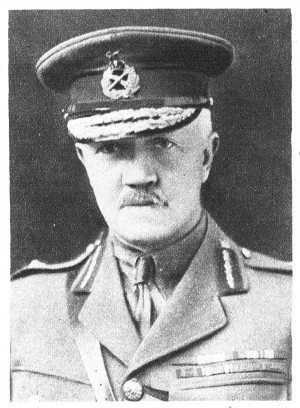
Gen. F. B. Maurice Formerly Director of Operations at the British War Office, now holding a high position abroad (Press Illustrating Service)
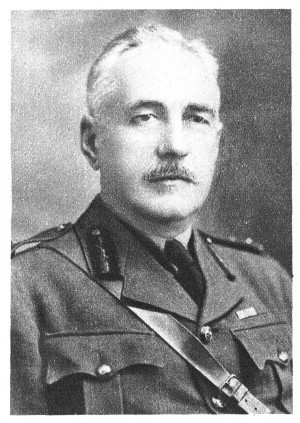
Maj. Gen. S. C. Mewburn, Canadian Minister of Militia and Defense (Press Illustrating Service)
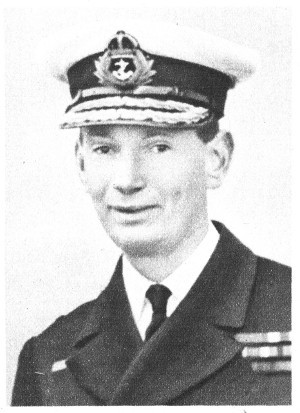
Vice Admiral Roger Keyes Who directed the British attack on Zeebrugge (Central News)
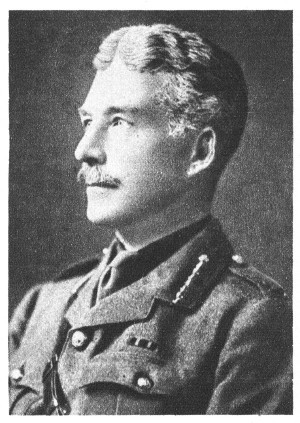
Brig. Gen. Sandeman Carey, Who stopped the gap in the British line before Amiens (© Underwood)
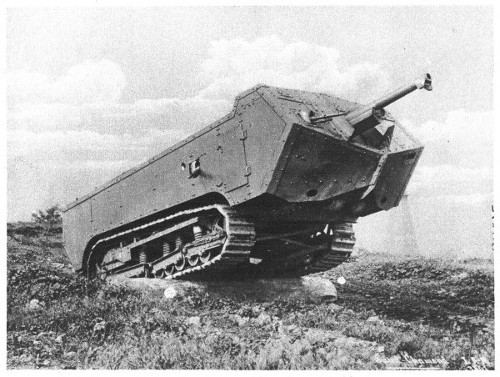
A new type of tank made for the French Army (© Underwood)
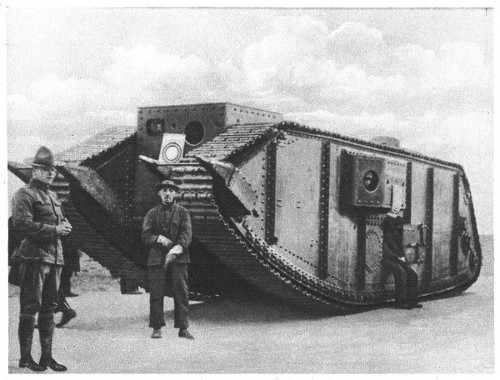
First American tank just completed at Boston (Paul Thompson)
In March, 1918, Lithuanians demanded that Germany recognize their Provisional Government. The Tevyne of New York, official organ of the Lithuanian Alliance of America, received the following from its correspondent in Russia, relayed from Yokohama, March 26:
In Lithuania there has been formed a Provisional Government consisting of the following: A. Smetona, Premier; P. Dovydailis, Minister of Education; J. Shaulys, Minister of Foreign Affairs; M. Smilgevichus, Minister of Finances; M. Birzhishka, Minister of Justice; J. Vileishis, Minister of Public Works; D. Malinauskas, Minister of Public Safety. Dr. J. Shlupas, well known among American Lithuanians, has been appointed Envoy Plenipotentiary to the United States; J. Aukshtuolis, President of the Lithuanian Committee in Stockholm, is made Ambassador to the Scandinavian countries; M. Ychas, member of the last Russian Duma, Ambassador to England and France; J. Gabrys, manager of the Lithuanian Information Bureau in Switzerland, Ambassador to the Central Powers. A national army is being organized. Lithuania's absolute neutrality was proclaimed. Drafted a political and economic treaty with Sweden.
Lithuanians fought in the Russian Army against the Germans, and now large numbers of them are joining the military and naval forces of the United States to fight the common foe; some are already in the English Army. Lithuania has suffered not for her own faults, but because she was situated between two belligerents. In the Government of Suvalki the German and Russian Armies chased each other nine times backward and forward; one may imagine how much is left there. Nothing but excavations, trenches, heaps of ruins, crumbling chimneys indicate where previously were large and prosperous villages. The world is yet to hear more about German requisitions, German devastations, and German rapine in Lithuania. Not only forests were denuded, but even fruit trees on the farms were cut down and shipped to Germany. The remaining inhabitants are forced to raise crops for the invaders, and for their various products they must accept, under penalty, specially printed money for local use—money that Germans themselves would not accept.
Notwithstanding reports to the contrary, the Lithuanians were with the Allies all the time, and will stand by them to the end. They have faith that the Allies, when the proper time comes, will recognize their just claims.
Germany to Impose "War Burdens" on Lithuania
Emperor William on May 12, 1918, issued the following proclamation regarding Lithuania:
We, Wilhelm, by God's grace German Emperor, King of Prussia, &c., hereby make known that, whereas the Lithuanian Landsrat, as the recognized representative of the Lithuanian people, on Dec. 12 announced the restoration of Lithuania as an independent State allied to the German Empire by an eternal, steadfast alliance, and by conventions chiefly regarding military matters, traffic, customs, and coinage, and solicited the help of the German Empire; and,
Whereas, further, Previous political connections in Lithuania are dissolved, we command our Imperial Chancellor to declare Lithuania on the basis of the aforementioned declarations of the Lithuanian Landsrat, in the name of the German Empire, as a free and independent State, and we are prepared to accord the Lithuanian State the solicited help and assistance in its restoration.
We assume that the conventions to be concluded will take the interests of the German Empire into account equally with those of Lithuania, and that Lithuania will participate in the war burdens of Germany, which secured her liberation.
The Lithuanian National Council, with headquarters at Washington, replied to the foregoing proclamation on May 14 as follows:
The assumption that Lithuania "will participate in the war burdens of Germany" means a contribution of three things: Money, munitions, and men. The first we have not, as Germany has already impoverished us; the second, we have no means of supplying, because we lack the first. Therefore, Germany can have reference only to men. Men from a self-declared democracy to fight in the ranks of autocracy? Unthinkable. Lithuania would not consent. Are her citizens to be dragooned into the ranks of the Kaiser? This would be an abridgment of the sovereignty which Germany has already recognized, for Chancellor von Hertling's reply stated, "We hereby recognize Lithuania as free and independent."
Germany knows that ultimate defeat is unavoidable, but she would compensate losses in the west with gains in the east, among which Lithuania is gambled on as an asset. No recognition of Lithuanian independence can be sincere when coupled with the von Hertling terms, but if this sop will add to Prussian man power it may postpone somewhat the inevitable day of reckoning and give her more time to Germanize in the east with a view of confederating the new republics under Junker rule.
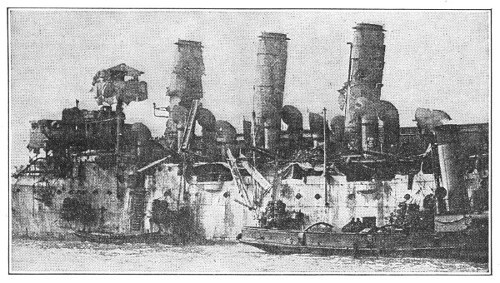
THE BRITISH CRUISER VINDICTIVE AS IT LOOKED AFTER THE FIGHT AT ZEEBRUGGE; LATER IT WAS SUNK IN THE HARBOR AT OSTEND TO BLOCK THE CHANNEL
The Raid on Zeebrugge and Ostend
British Naval Exploit That Damaged Two German U-Boat Bases on the North Sea Coast
The little Belgian port of Zeebrugge fell into German hands in the Autumn of 1914, and, with the neighboring port of Ostend, became a thorn in the side of the Entente by reason of its increasing use as a base for enemy destroyers, submarines, and aircraft. The Germans, having seized the shipbuilding plants at Antwerp, began building submarines and small war craft, which could be sent by way of Bruges down the canals that connect the latter city with Zeebrugge and Ostend. Especially useful to them was the maritime canal whose mouth at Zeebrugge was protected by a crescent-shaped mole, thirty feet high, inclosing the harbor.
On the night of April 22-23, 1918, a British naval expedition under Vice Admiral Sir Roger Keyes, commanding at Dover, aided by French destroyers, undertook to wreck the stone mole at Zeebrugge and to block the entrances to the canals both at Zeebrugge and at Ostend by sinking the hulks of old ships in the channels. The episode, marked as it was by heroic fighting, proved to be one of the most thrilling and picturesque in the naval operations of the war. To Americans it recalled Hobson's exploit with the Merrimac at Santiago, while to Englishmen it brought back memories of Sir Francis Drake and his fireships in the Harbor of Cadiz.
Though the fighting at Zeebrugge lasted only an hour, the British lost 588 men, officially reported as follows: Officers—Killed, 16; died of wounds, 3; missing, 2; wounded, 29. Men—Killed, 144; died of wounds, 25; missing, 14; wounded, 355.
Six obsolete British cruisers took part in the attack. They were the Brilliant, Iphigenia, Sirius, Intrepid, Thetis, and Vindictive. The first five of these were filled with concrete and were to be sunk in the entrances of the two ports. The Vindictive, working with the two Mersey ferryboats Daffodil and Iris, carried storming and demolition parties to the Zeebrugge mole. The object was to attack the enemy forces and guns on the mole, along with the destroyer and submarine depots and the large seaplane base upon it, and thus to divert the enemy's attention from the work of the block ships. As the attack on the mole accomplished this, the main object of the operation was successful.
The attacking forces were composed of bluejackets and Royal Marines picked from the Grand Fleet and from naval and marine depots. Sir Eric Geddes stated in Parliament the next morning that light forces belonging to the Dover command and Harwich forces under Admiral Tyrwhitte covered the operation from the south. A large force of monitors, together with many motor launches and small, fast craft took part. One of the essentials of success was the creation of a heavy veil of artificial fog or smoke. The officer who developed this phase of the attack was killed in action. The general plan was to attack the guns and works on the Zeebrugge mole with storming parties, while the concrete-laden cruisers were being sunk in the channel. Two old and valueless submarines filled with explosives were to be blown up against the viaduct connecting the mole with the shore.
STORY OF THE FIGHTING
A detailed narrative of the affair was issued by the British Admiralty on the 25th, the essential passages of which are as follows:
The night was overcast and there was a drifting haze. Down the coast a great searchlight swung its beam to and fro in the small wind and short sea. From the Vindictive's bridge, as she headed in toward the mole, with the faithful ferryboats at her heels, there was scarcely a glimmer of light to be seen shoreward. Ahead, as she drove through the water, rolled the smoke screen, her cloak of invisibility, wrapped about her by small craft. This was the device of Wing Commander Brock, without which, acknowledges the Admiral in command, the operation could not have been conducted.
A northeast wind moved the volume of it shoreward ahead of the ships. Beyond it was the distant town, its defenders unsuspicious. It was not until the Vindictive, with bluejackets and marines standing ready for landing, was close upon the mole that the wind lulled and came away again from the southeast, sweeping back the smoke screen and laying her bare to eyes that looked seaward.
There was a moment immediately afterward when it seemed to those on the ships as if the dim, coast-hidden harbor exploded into light. A star shell soared aloft, then a score of star shells. The wavering beams of the searchlights swung around and settled into a glare. A wild fire of gun flashes leaped against the sky, strings of luminous green beads shot aloft, hung and sank. The darkness of the night was supplemented by a nightmare daylight of battle-fired guns and machine guns along the mole. The batteries ashore awoke to life.
Landing on the Mole
It was in a gale of shelling that the Vindictive laid her nose against the thirty-foot high concrete side of the mole, let go her anchor and signaled to the Daffodil to shove her stern in.
The Iris went ahead and endeavored to get alongside likewise. The fire was intense, while the ships plunged and rolled beside the mole in the seas, the Vindictive with her greater draught jarring against the foundations of the mole with every lunge. They were swept diagonally by machine-gun fire from both ends of the mole and by the heavy batteries on shore.
Commander (now Captain) Carpenter conned the Vindictive from the open bridge until her stern was laid in, when he took up his position in the flame thrower hut on the port side. It is marvelous that any occupant should have survived a minute in this hut, so riddled and shattered is it.
The officers of the Iris, which was in trouble ahead of the Vindictive, describe Captain Carpenter as handling her like a picket boat. The Vindictive was fitted along her port side with a high false deck, from which ran eighteen brows or gangways by which the storming and demolition parties were to land.
The men gathered in readiness on the main lower decks, while Colonel Elliott, who was to lead the marines, waited on the false deck just abaft the bridge. Captain Halahan, who commanded the bluejackets, was amidships. The gangways were lowered, and they scraped and rebounded upon the high parapet of the mole as the Vindictive rolled in the sea-way.
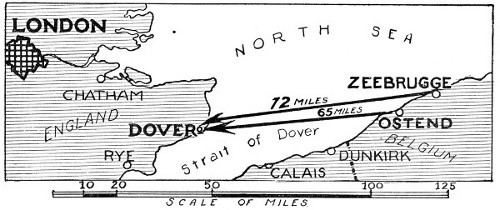
MAP SHOWING RELATION OF ZEEBRUGGE AND OSTEND TO THE ENGLISH COAST
The word for the assault had not yet been given when both leaders were killed, Colonel Elliott by a shell and Captain Halahan by machine-gun fire which swept the decks. The same shell that killed Colonel Elliott also did fearful execution in the forward Stokes mortar battery. The men were magnificent; every officer bears the same testimony.
The mere landing on the mole was a perilous business. It involved a passage across the crashing and splintering gangways, a drop over the parapet into the field of fire of the German machine guns which swept its length, and a further drop of some sixteen feet to the surface of the mole itself. Many were killed and more wounded as they crowded up the gangways, but nothing hindered the orderly and speedy landing by every gangway.
Lieutenant H. T. C. Walker had his arm shot away by shell on the upper deck, and lay in darkness while the storming parties trod him under. He was recognized and dragged aside by the commander. He raised his remaining arm in greetings. "Good luck to you," he called as the rest of the stormers hastened by. "Good luck."
The lower deck was a shambles as the commander made the rounds of the ship, yet those wounded and dying raised themselves to cheer as he made his tour. * * *
Heroic Work on the Iris
The Iris had troubles of her own. Her first attempts to make fast to the mole ahead of the Vindictive failed, as her grapnels were not large enough to span the parapet. Two officers, Lieut. Commander Bradford and Lieutenant Hawkins, climbed ashore and sat astride the parapet trying to make the grapnels fast till each was killed and fell down between the ship and the wall. Commander Valentine Gibbs had both legs shot away and died next morning. Lieutenant Spencer, though wounded, took command and refused to be relieved.
The Iris was obliged at last to change her position and fall in astern of the Vindictive, and suffered very heavily from fire. A single big shell plunged through the upper deck and burst below at a point where fifty-six marines were waiting for the order to go to the gangways. Forty-nine were killed. The remaining seven were wounded. Another shell in the ward-room, which was serving as a sick bay, killed four officers and twenty-six men. Her total casualties were eight officers and sixty-nine men killed and three officers and 103 men wounded.
Storming and demolition parties upon the mole met with no resistance from the Germans other than intense and unremitting fire. One after another buildings burst into flame or split and crumbled as dynamite went off. A bombing party working up toward the mole extension in search of the enemy destroyed several machine-gun emplacements, but not a single prisoner rewarded them. It appears that upon the approach of the ships and with the opening of fire the enemy simply retired and contented themselves with bringing machine guns to the short end of the mole.
BLOCKING THE CANAL
Describing operations of the three block ships, the official narrative says:
The Thetis came first, steaming into a tornado of shells from great batteries ashore. All her crew, save a remnant who remained to steam her in and sink her, already had been taken off her by a ubiquitous motor launch, but the remnant spared hands enough to keep her four guns going. It was hers to show the road to the Intrepid and the Iphigenia, which followed. She cleared a string of armed barges which defends the channel from the tip of the mole, but had the ill-fortune to foul one of her propellers upon a net defense which flanks it on the shore side.
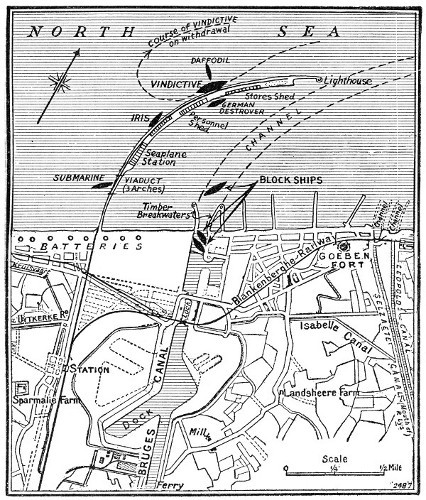
PLAN ILLUSTRATING THE FIGHT AT THE ZEEBRUGGE MOLE, THE BLOCKING OF THE BRUGES CANAL, AND THE LOCATION OF SUNKEN SHIPS
The propeller gathered in the net, and it rendered her practically unmanageable. Shore batteries found her and pounded her unremittingly. She bumped into the bank, edged off, and found herself in the channel again still some hundreds of yards from the mouth of the canal in practically a sinking condition. As she lay she signaled invaluable directions to others, and her commander, R. S. Sneyd, also accordingly blew charges and sank her. Motor launches under Lieutenant H. Littleton raced alongside and took off her crew. Her losses were five killed and five wounded.
The Intrepid, smoking like a volcano and with all her guns blazing, followed. Her motor launch had failed to get alongside outside the harbor, and she had men enough for anything. Straight into the canal she steered, her smoke blowing back from her into the Iphigenia's eyes, so that the latter was blinded, and, going a little wild, rammed a dredger, with her barge moored beside it, which lay at the western arm of the canal. She was not clear, though, and entered the canal pushing the barge before her. It was then that a shell hit the steam connections of her whistle, and the escape of steam which followed drove off some of the smoke and let her see what she was doing.
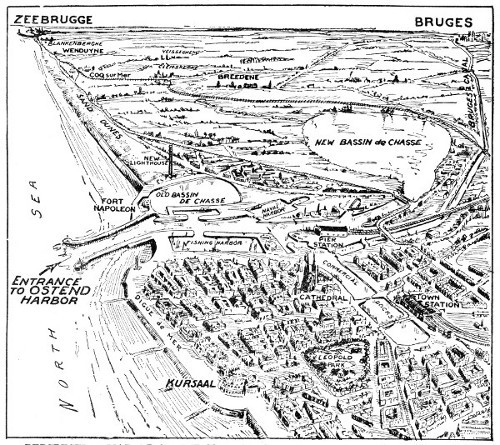
PERSPECTIVE MAP OF OSTEND HARBOR, WITH ZEEBRUGGE IN THE DISTANCE
Main Object Attained
Lieutenant Stuart Bonham Carter, commanding the Intrepid, placed the nose of his ship neatly on the mud of the western bank, ordered his crew away, and blew up his ship by switches in the chart room. Four dull bumps were all that could be heard, and immediately afterward there arrived on deck the engineer, who had been in the engine room during the explosion, and reported that all was as it should be.
Lieutenant E. W. Bullyard Leake, commanding the Iphigenia, beached her according to arrangement on the eastern side, blew her up, saw her drop nicely across the canal, and left her with her engines still going, to hold her in position till she should have bedded well down on the bottom. According to the latest reports from air observation, two old ships, with their holds full of concrete, are lying across the canal in a V position, and it is probable that the work they set out to do has been accomplished and that the canal is effectively blocked. A motor launch, under Lieutenant P. T. Deane, had followed them in to bring away the crews and waited further up the canal toward the mouth against the western bank.
Lieutenant Bonham Carter, having sent away his boats, was reduced to a Carley float, an apparatus like an exaggerated lifebuoy with the floor of a grating. Upon contact with the water it ignited a calcium flare and he was adrift in the uncanny illumination with a German machine gun a few hundred yards away giving him its undivided attention. What saved him was possibly the fact that the defunct Intrepid still was emitting huge clouds of smoke which it had been worth nobody's while to turn. He managed to catch a rope, as the motor launch started, and was towed for awhile till he was observed and taken on board.
THE VINDICTIVE'S STORY
Commander Alfred F. B. Carpenter, who commanded the Vindictive and who was made Captain for his successful work, gave an Associated Press correspondent an interesting description of the episode. During the attack he was at the end of the bridge in a small steel box or cabin which had been specially constructed to house a flame thrower. The Captain, with his arm in a sling, standing on the shell-battered deck of the Vindictive, said:
Exactly according to plan we ran alongside the mole, approached it on the port side, where we were equipped with specially built buffers of wood two feet wide. As there was nothing for us to tie up to, we merely dropped anchor there, while the Daffodil kept us against the mole with her nose against the opposite side of our ship. In the fairly heavy sea two of our three gangways were smashed, but the third held, and 500 men swarmed up this on to the mole. This gangway was two feet wide and thirty feet long. The men who went up it included 300 marines and 150 storming seamen from the Vindictive, and fifty or so from the Daffodil. They swarmed up the steel gangway, carrying hand grenades and Lewis guns. No Germans succeeded in approaching the gangway, but a hard hand-to-hand fight took place about 200 yards up the mole toward the shore.
The Vindictive's bow was pointed toward the shore, so the bridge got the full effect of enemy fire from the shore batteries. One shell exploded against the pilot house, killing nearly all its ten occupants. Another burst in the fighting top, killing a Lieutenant and eight men, who were doing excellent work with two pompoms and four machine guns.
The battery of eleven-inch guns at the end of the mole was only 300 yards away, and it kept trying to reach us. The shore batteries also were diligent. Only a few German shells hit our hull, because it was well protected by the wall of the mole, but the upper structure, mast, stacks, and ventilators showed above the wall and were riddled. A considerable proportion of our casualties were caused by splinters from these upper works.
Meanwhile the Daffodil continued to push us against the wall as if no battle was on, and if she had failed to do this none of the members of the landing party would have been able to return to the ship.
Twenty-five minutes after the Vindictive had reached the wall the first block ship passed in and headed for the canal. Two others followed in leisurely fashion while we kept up the fight on the mole. One of the block ships stranded outside of the canal, but the two others got two or three hundred yards inside, where they were successfully sunk across the entrance.
Fifteen minutes after the Vindictive arrived alongside the mole our submarine exploded under the viaduct connecting the mole with the mainland. The Germans had sent a considerable force to this viaduct as soon as the submarine arrived, and these men were gathered on the viaduct, attacking our submersible with machine guns. When the explosion occurred the viaduct and Germans were blown up together. The crew of the submarine, consisting of six men, escaped on board a dinghy to a motor launch.
Early in the fighting a German shell knocked out our howitzer, which had been getting in some good shots on a big German seaplane station on the mole half a mile away. This is the largest seaplane station in Belgium. Unfortunately, our other guns could not be brought to bear effectively upon it. The shell which disabled the howitzer killed all the members of the gun crew. Many men were also killed by a German shell which hit the mole close to our ship and scattered fragments of steel and stone among the marines assembling on the deck around the gangway.
Half an hour after the block ships went in, we received the signal to withdraw. The Vindictive's siren was blown, and the men returned from all parts of the mole and thronged down the gangway. We put off after having lain alongside just about an hour. The Germans made no effort to interfere with our getaway other than to continue their heavy firing.
RESCUE FROM BLOCK SHIPS
One of the most thrilling incidents was the rescue by two American-built motor launches of nearly 200 members of the crews of two block ships sunk at the entrance to the Bruges Canal. The feat was accomplished under a heavy fire and the actual transfer was made in less than five minutes. One launch delivered ninety-nine men to the destroyer.
The dead and wounded could not all be brought away, but the loss of personnel in this way was declared to be remarkably small.
Stoker Bendall of the submarine which blew up the Zeebrugge mole said:
It was silent and heavy business. We were going full tilt when we hit the viaduct. It was a good jolt, and we ran right into the middle of the viaduct and stuck there, as we intended to do. I don't think anybody said anything except, "Well, we are here all right."
We lowered a skiff and stood by while the commander touched off the fuse and then tumbled into the skiff and pushed off. By bad luck the propeller fouled the exhaust pipe and left us with only two oars and two minutes to get away. The enemy lights were on us, and the machine guns were firing from the shore.
Before we made 200 yards the submarine went up, and there was a tremendous flash and roar, and lots of concrete from the mole fell around us. Luckily, we were not struck.
Photographs taken from an airplane a few days later showed that the effort to block the canal entrance had been successful. The Intrepid and Iphigenia had reached the precise positions in which they were intended to be sunk, while the exploded submarine had blown a gap of sixty to a hundred feet in the shore end of the mole. The Frankfurter Zeitung, in commenting on the affair, said: "It would be foolish to deny that the British fleet scored a great success through a fantastically audacious stroke in penetrating into one of the most important strongholds over which the German flag floats."
ATTACKS AT OSTEND
At Ostend the operations on the same night were unsuccessful, largely owing to a shift of wind. Small craft with smoke apparatus ran in according to program, set up a screen, and lit two large flares to mark the entrance to the harbor for the two concrete-laden cruisers that were to be sunk in the channel. Before the cruisers could arrive, however, the wind shifted and blew away the smoke screen, after which the German gunfire quickly destroyed the flares. The cruisers tried to proceed by guesswork under heavy fire, but their efforts were in vain. One of the block ships was sunk, but not in a position to obstruct the channel.
A second attempt to close the Ostend harbor was made on the night of May 9-10, when the battered old Vindictive, which had borne the brunt of the shellfire at the Zeebrugge mole, was sunk in the channel with her inside full of concrete. A member of the expedition gave this account:
As the Vindictive neared Ostend it became apparent that the Germans had got wind of our presence, for suddenly there was a regular pyrotechnic display of star shells. The effect was brilliant, but quite undesirable from our point of view. Immediately guns of all sizes opened fire on us, and there was a terrific din.
The Vindictive and one or two other vessels received hits, and a few casualties were caused by this gunfire. The firing was heavily returned by our ships. Most of the crew of the Vindictive were taken off when the ship was at a little distance from the Ostend piers, only a few officers and men being left to navigate her between the piers and sink her there. A motor launch which was assisting in picking up the crew was hit several times by shellfire, and was in a sinking condition when it came alongside the Admiral's vessel, the destroyer Warwick, to which they were transferred. The motor launch had extensive damage in the fore part, and by order of the Admiral was sunk, as it was apparent that it could not get back to Dover. There was a heavy explosion when the Vindictive sank between the piers.
The casualties in the second Ostend raid were forty-seven, of whom eighteen were killed or missing, the rest wounded.
The British Admiralty, in its official report of the second Ostend action, issued May 14, stated that the Vindictive was "lying at an angle of about 40 degrees to the pier, and seemed to be hard fast." Commander Godsal, who was on deck during the critical moments, was missing and was believed to have been killed; Lieutenant Crutchley blew up the auxiliary charges in the forward 6-inch magazine from the conning tower. Lieut. Commander William A. Bury, who blew up the main charges by a switch installed aft, was severely wounded. The Admiralty reported that the sunken ship would make the harbor impracticable for any but small craft and difficult for dredging operations.
German U-Boat Claims
Address by Admiral von Capelle
German Naval Secretary
Admiral Von Capelle, the German Secretary of the Navy, delivered an address before the Reichstag, April 17, 1918, in which he asserted that the submarine warfare of Germany was a success. In the course of his speech he said:
"The main question is, What do the western powers need for the carrying on of the war and the supply of their homelands, and what amount of tonnage is still at their disposal for that purpose? All statistical calculations regarding tonnage are today almost superfluous, as the visible successes of the U-boat war speak clearly enough. The robbery of Dutch tonnage, by which the Anglo-Saxons have incurred odium of the worst kind for decades to come, is the best proof of how far the shipping shortage has already been felt by our opponents. In addition to the sinkings there must be added a great amount of wear and tear of ships and an enormous increase of marine accidents, which Sir J. Ellerman, speaking in the Chamber of Shipping recently, calculated at three times the peace losses. Will the position of the western powers improve or deteriorate? That depends upon their military achievements and the replacing of sunken ships by new construction."
Dealing briefly with Sir Eric Geddes's recent speech on the occasion of the debate on the naval estimates, Admiral von Capelle declared:
"The assertion of the First Lord of the Admiralty that an unwillingness to put to sea prevailed among the German U-boat crews is a base calumny."
LOSSES AND CONSTRUCTION
As regards the assertions of British statesmen concerning the extraordinarily great losses of U-boats, Admiral von Capelle said:
"The statements in the foreign press are very greatly exaggerated. Now, as before, our new construction surpasses our losses. The number of U-boats, both from the point of view of quality and quantity, is constantly rising. We can also continue absolutely to reckon on our military achievements hitherto attained. Whether Lloyd George can continue the naval war with prospects of success depends, not upon his will but upon the position of the U-boats as against shipbuilding. According to Lloyd's Register, something over 22,000,000 gross register tons were built in the last ten years before the war in the whole world—that is, inclusive of the construction of ourselves, our allies, and foreign countries. The entire output today can in no case be more, for difficulties of all kinds and the shortage of workmen and material have grown during the war. In the last ten years—that is, in peace time—800,000 gross register tons of the world's shipping was destroyed annually by natural causes. Now in wartime the losses, as already mentioned, are considerably greater. Thus, 1,400,000 gross register tons was the annual net increase for the entire world. That gives, at any rate, a standard for the present position. America's and Japan's new construction is to a certain extent destined for the necessities of these countries.
"In the main, therefore, only the figures of British shipbuilding come into question. About the middle of 1917 there was talk of 3,000,000 tons in official quarters in Great Britain. Then Lloyd George dropped to 2,000,000, and now, according to Bonar Law's statement, the output is 1,160,000 tons. As against, therefore, about 100,000 tons monthly put into service there are sinkings amounting to 600,000 tons, or six times as much. In brief, if the figures given are regarded as too favorable and new construction at the rate of 150,000 tons monthly—that is, 50 per cent. higher—be assumed, and the sinkings be reduced to 450,000 tons, then the sinkings are still three times as large as the amount of new construction.
THE COMING MONTHS
"One other thing must especially be taken into consideration for the coming months. Today every ship sunk strikes at the vital nerve of our opponents. Today, when only the absolutely necessary cargoes of foodstuffs and war necessities can still be transported, the sinking of even one small ship has quite a different significance as compared with the beginning of the U-boat war. Moreover, the loss of one ship means a falling out of four to five cargoes. In these circumstances even the greatest pessimist must say that the position of our opponents is deteriorating in a considerably increasing extent and with rapid strides, and that any doubt regarding the final success of the U-boat war is unjustified."
Replying to a question of the reporter, Admiral von Capelle said:
"Our opponents have been busily endeavoring to strengthen their anti-submarine measures by all the means at their disposal, and, naturally, they have attained a certain success. But they have at no time had any decisive influence on the U-boat war, and, according to human reckoning, they will not do so in the future. The American submarine destroyers which have been so much talked about have failed. The convoy system, which, it is true, offers ships a certain measure of protection, has, on the other hand, also the great disadvantage of reducing their transport capabilities. The statements oscillate from 25 to 60 per cent.
"For the rest, our commanders are specially trained for attacks on convoys, and no day goes by when one or more ships are not struck out of convoys. Experienced commanders manage to sink three to four ships in succession belonging to the same convoy."
THE STEEL QUESTION
Admiral von Capelle then dealt with the steel question as regards shipbuilding, which, he said, "is practically the determinative factor for shipbuilding." He continued:
"Great Britain's steel imports in 1916 amounted to 763,000 tons, and in 1917 only amounted to 497,000 tons. That means that already a reduction of 37 per cent. has been effected, a reduction which will presumably be further considerably increased during 1918. Restriction of imports of ore from other countries, such as America, caused by the U-boat war will also have a hampering effect on shipbuilding in Great Britain. It is true that Sir Eric Geddes denied that there was a lack of material, but expert circles in England give the scarcity of steel as the main reason for the small shipbuilding output.
"American help in men and airplanes and American participation in the war are comparatively small. If later on America wants to maintain 500,000 troops in France, shipping to the amount of about 2,000,000 tons would be permanently needed. This shipping would have to be withdrawn from the supply service of the Allies.
"Moreover, according to statements made in the United States and Great Britain, the intervention in the present campaign of such a big army no longer comes into consideration. After America's entry into the war material help for the Entente has not only not increased, but has even decreased considerably. President Wilson's gigantic armament program has brought about such economic difficulties that America, the export country, must now begin to ration instead of, as it was hoped, increasingly to help the Entente. To sum up, it can be stated that the economic difficulties of our enemies have been increased by America's entry into the war."
"ENGLAND'S DANGER POINT"
Later in the debate Admiral von Capelle said: "The salient point of the discussion is the economic internal and political results of the U-boat war during the coming months. The danger point for England has already been reached, and the situation of the western powers grows worse from day to day."
Admiral von Capelle then briefly dealt with that calculation of the world tonnage made by a Deputy which received some attention in the Summer of last year. "This calculation," he said, "shows a difference of 9,000,000 tons from the calculation of the Admiralty Staff. In my opinion, the calculation of the Admiralty Staff is correct. Whence otherwise comes the Entente's lack of tonnage, which, in view of the facts, cannot be argued away? The Admiralty Staff in its calculation adapted itself to the fluctuating situation of the world shipping. At first each of the enemy States looked after itself. Later, under Great Britain's leadership, common control of tonnage was established."
Admiral von Capelle quoted the calculation of the American Shipping Department, according to which the world tonnage in the Autumn of 1917 amounted to 32,000,000, of which 21,000,000 were given as transoceanic. He insisted, however, that so much attention must not be paid to all these calculations, but exhorted the people rather to dwell on the joyful fact that the danger point for the western powers had been reached.
At the close of the sitting Admiral von Capelle stated that all orders for the construction of U-boats had been given independently by the Naval Department and that the Naval Administration had never been instructed to give orders for more U-boats by the Chancellor or the Supreme Army Command. Every possible means, he said, for the development of U-boat warfare had been done by the Naval Department.
Admiral von Capelle in a supplemental statement before the Reichstag, May 11, in discussing the naval estimates, said:
The reports for April are favorable. Naturally, losses occur, but the main thing is that the increase in submarines exceeds the losses. Our naval offensive is stronger today than at the beginning of unrestricted submarine warfare. That gives us an assured prospect of final success.
The submarine war is developing more and more into a struggle between U-boat action and new construction of ships. Thus far the monthly figures of destruction have continued to be several times as large as those of new construction. Even the British Ministry and the entire British press admit that.
The latest appeal to British shipyard workers appears to be especially significant. For the present the appeal does not appear to have had great success. According to the latest statements British shipbuilding fell from 192,000 tons in March to 112,000 in April; or, reckoned in ships, from 32 to 22. That means a decline of 80,000 tons, or about 40 per cent. [The British Admiralty stated that the April new tonnage was reduced on account of the vast amount of repairing to merchantmen.—Editor.]
America thus far has built little, and has fallen far below expectations. Even if an increase is to be reckoned with in the future, it will be used up completely by America herself.
In addition to the sinkings by U-boats, there is a large decline in cargo space owing to marine losses and to ships becoming unserviceable. One of the best-known big British ship owners declared at a meeting of shipping men that the losses of the British merchant fleet through marine accidents, owing to conditions created by the war, were three times as large as in peace.
The Admiral's Statements Attacked
The British authorities asserted that Admiral von Capelle's figures were misleading and untrue. The losses published in the White Paper include marine risk and all losses by enemy action. They include all losses, and not merely the losses of food ships, as suggested in the German wireless message dated April 16. Even in the figures of the world's output of shipbuilding von Capelle seems to have been misled. He states that "something over 2,000,000 gross tons were built annually in the last ten years, including allied and enemy countries." The actual figures are 2,530,351 gross tons. He further states that the entire output today can in no case be more, owing to difficulties in regard to labor and material. The actual world's output, as shown in the Parliamentary White Paper, excluding enemy countries, amounted to 2,703,000 gross tons, and the output is rapidly rising. Von Capelle tried to raise confusion with regard to the figures 3,000,000 and 2,000,000 tons and the actual output for 1917. The Admiralty says no forecast was ever given that 3,000,000 tons, or even 2,000,000 tons, would be completed in that year. Three million tons is the ultimate rate of production, which, as the First Lord stated in the House of Commons, is well within the present and prospective capacity of United Kingdom shipyards and marine engineering works. The exaggerated figures of losses are still relied on by the enemy. The average loss per month of British ships during 1917, including marine risk, was 333,000 gross tons, whereas Secretary von Capelle in his statement bases his argument on an average loss from submarine attacks alone of 600,000 tons per month. The figures for the quarter ended March 31, 1918, showed British losses to be 687,576 tons, and for the month of March 216,003 tons, the lowest during any month, with one exception, since January, 1917. With regard to steel, the First Lord has already assured the House of Commons that arrangements have been made for the supply of steel to give the output aimed at, and at the present time the shipyards are in every case fully supplied with the material.
The American production of new tonnage reached its stride in May, and the estimate of over 4,000,000 tons per annum was regarded as conservative. It was estimated that the total British and American new tonnage in the year ending May, 1919, would exceed 6,000,000, as against total U-boat sinkings, based on the record of the first quarter of 1918, of 4,500,000.
OFFICIAL RETURNS OF LOSSES
The following was the official report of losses of British, allied, and neutral merchant tonnage due to enemy action and marine risk:
| Period. | British. | Allied and Neutral. |
Total. |
| 1917. | Month. | Month. | Month. |
| January | 193,045 | 216,787 | 409,832 |
| February | 343,486 | 231,370 | 574,856 |
| March | 375,309 | 259,376 | 634,685 |
| ———— | ———— | ————— | |
| Quarter | 911,840 | 707,533 | 1,619,373 |
| April | 555,056 | 338,821 | 893,877 |
| May | 374,419 | 255,917 | 630,336 |
| June | 432,395 | 280,326 | 712,721 |
| ———— | ———— | ————— | |
| Quarter | 1,361,870 | 875,064 | 2,236,934 |
| July | 383,430 | 192,519 | 575,949 |
| August | 360,296 | 189,067 | 519,363 |
| September | 209,212 | 159,949 | 369,161 |
| ———— | ———— | ———— | |
| Quarter | 952,938 | 541,535 | 1,494,473 |
| October | 289,973 | 197,364 | 487,337 |
| November | 196,560 | 136,883 | 333,443 |
| December | 296,356 | 155,707 | 452,063 |
| ———— | ———— | ———— | |
| Quarter | 782,889 | 489,954 | 1,272,843 |
| 1918. | |||
| January | 217,270 | 136,187 | 353,457 |
| February | 254,303 | 134,119 | 388,422 |
| March | 216,003 | 165,628 | 381,631 |
| ———— | ———— | ———— | |
| Quarter | 687,576 | 435,934 | 1,123,510 |
The Secretary of the Ministry of Shipping stated that the tonnage of steamships of 500 gross tons and over entering and clearing United Kingdom ports from and to ports overseas was as under:
| Period. | |
| 1917. | Gross Tons. |
| October | 6,908,189 |
| November | 6,818,564 |
| December | 6,665,413 |
| Period. | |
| 1918. | Gross Tons. |
| January | 6,336,663 |
| February | 6,326,965 |
| March | 7,295,620 |
This statement embraces all United Kingdom seaborne traffic other than coastwise and cross Channel.
The Month's Submarine Record
The British Admiralty, in April, 1918, discontinued its weekly report of merchant ships destroyed by submarines or mines, and announced that it would publish a monthly report in terms of tonnage. These figures are shown in the table above. The last weekly report was for the period ended April 14, and showed that eleven merchantmen over 1,600 tons, four under 1,600 tons, and one fishing vessel had been sunk.
In regard to the sinkings in April, French official figures showed that the total losses of allied and neutral ships, including those from accidents at sea during the month, aggregated 381,631 tons.
Norway's losses from the beginning of the war to the end of April, 1918, amounted to 755 vessels, aggregating 1,115,519 tons, and the lives of 1,006 seamen, in addition to about 700 men on fifty-three vessels missing, two-thirds of which were declared to be war losses.
The American steamship Lake Moor, manned by naval reserves, was sunk by a German submarine in European waters about midnight on April 11, with a loss of five officers and thirty-nine men. Five officers and twelve enlisted men were landed at an English port. Eleven men, including five navy gunners, were lost when the Old Dominion liner Tyler was sunk off the French coast on May 3. The Canadian Pacific Company's steamer Medora also was sunk off the French coast. The Florence H. was wrecked in a French port by an internal explosion on the night of April 17. Out of the crew of fifty-six men, twenty-nine were listed as dead or missing, twelve were sent to hospital badly burned, two were slightly injured, and only thirteen escaped injury. Of the twenty-three men of the naval guard only six were reported as survivors.
Six officers and thirteen men were reported missing as the result of two naval disasters reported on May 1 by the British Admiralty. They formed part of the crews of the sloop Cowslip, which was torpedoed and sunk on April 25, and of Torpedo Boat 90, which foundered.
According to Archibald Hurd, a British authority on naval matters, the area in the North Sea which was proclaimed by the British Government as dangerous to shipping and therefore prohibited after May 15 is the greatest mine field ever laid for the special purpose of foiling submarines. It embraces 121,782 square miles, the base forming a line between Norway and Scotland, and the peak extending northward into the Arctic Circle.
A Secret Chapter of U-Boat History
How Ruthless Policy Was Adopted
The causes that led to Germany's adoption of the policy of unrestricted submarine warfare on Feb. 1, 1917, were revealed a year later by the Handelsblad, an Amsterdam newspaper, whose correspondent had secured secret access to "a number of highly interesting and important documents" long enough to read them and make notes of their contents. The Dutch paper vouched for the accuracy of the following information:
At the close of the year 1915 the German Admiralty Staff prepared a semi-official memorandum to prove that an unrestricted submarine campaign would compel Great Britain to sue for peace "in six months at the most." The character of the argument conveys the impression that the chiefs of the German Admiralty Staff had already made up their minds to adopt the most drastic measures in regard to submarine warfare, but that they wished to convince the Kaiser, the Imperial Chancellor, and the German diplomatists of the certainty of good results on economic and general, rather than merely military, grounds. To this end the memorandum based its arguments on statistics of food prices, freight, and insurance rates in Great Britain. It pointed out that the effects on the prices of essential commodities, on the balance of trade, and, above all, on the morale of the chief enemy, had been such, even with the restricted submarine campaign of 1915, that, if an unrestricted submarine war were decided upon, England could not possibly hold out for more than a short period.
The memorandum was submitted to the Imperial Chancellor, who passed it on to Dr. Helfferich, the Secretary of State for Finance. He, however, rejected the document on the ground that, in the absence of authentic estimates of stocks, it was impossible to set a time-limit to England's staying power, and also that he was exceedingly doubtful as to what line would be taken by neutrals, especially the United States. Dr. Helfferich maintained that so desperate a remedy should only be employed as a last resource. The authors of the memorandum then sent a reply, in which they developed their former arguments, and pointed to the gravity of the internal situation in Germany. They emphasized the importance of using the nearest and sharpest weapons of offense if a national collapse was to be avoided. They reinforced their argument by adducing the evidence of ten experts, representing finance, commerce, the mining industry, and agriculture. They were Herr Waldemar Müller, the President of the Dresdner Bank; Dr. Salomonsohn of the Disconto Gesellschaft; Dr. Paul Reusch of Oberhausen, Royal Prussian Councilor of Commerce; Dr. Springorum of Dortmund, Chancellor of Commerce, member of the Prussian Upper House, (Herren Haus,) General Director of Railways and Tramways at Hoesch, an ironmaster, and a great expert in railways; Herr Max Schinkel of Hamburg, President of the Norddeutsche Bank in Hamburg and of the Disconto Gesellschaft in Berlin; Herr Zuckschwerdt of Madgeburg, Councilor of Commerce, late member of the Prussian Upper House; Herr Wilhelm von Finck of Munich, Privy Councilor, chief of the banking house of Merck, Finck & Co., Munich; Councilor of Economics R. Schmidt of Platzhof, member of the Württemberg Upper Chamber and of the German Agricultural Council; Herr Engelhard of Mannheim, Councilor of Commerce, President of the Chamber of Commerce and member of the Baden Upper Chamber.
These experts were invited to send answers in writing to the three following questions: (1) What would be the effect on England of unrestricted submarine warfare? (2) What would be its effect on Germany's relations with the United States and other neutrals? (3) To what extent does the internal situation in Germany demand the use of this drastic weapon?
The reader will do well to remember that the replies were written in February, 1916—nearly two years ago. All agreed on the first point—the effect on Great Britain. The effect of unrestricted submarine warfare on England would be that she would have to sue for peace in six months at the most. Herr Müller, who seemed to be in a position to confirm the statistics given in the memorandum, pointed out that the supply of indispensable foodstuffs was, at the time of writing, less than the normal supply in peace time. He held that the submarine war, if relentlessly and vigorously pursued, would accomplish its purpose in less time than calculated in the memorandum—in fact, three months should do it. Dr. Salomonsohn also thought that six months was an excessive estimate, and that less time would suffice.
On the question of the effect on neutrals the experts were divided. Dr. Reusch suggested that the neutrals despised the restricted submarine warfare of 1915, and held that every ship in British waters, whether enemy or neutral, should be torpedoed without warning. According to him, the world only respects those who, in a great crisis, know how to make the most unscrupulous use of their power.
Herr Müller predicted that ruthless submarine war would cause a wholesale flight of neutrals from the war zone. Their newspapers might abuse Germany at first, but they would soon get tired. The danger was from the United States, but that would become less in proportion as Germany operated more decisively and ruthlessly. Dr. Salomonsohn adopted the same attitude. He recognized the possibility of war with the United States, but was loath to throw away so desirable a weapon on that account.
As to the third point, all the experts agreed that the internal situation in Germany demanded that the most drastic methods of submarine warfare should be employed. Herr Zuckschwerdt urged the advisability of the most drastic measures owing to the feeling of the nation. The nation would stand by the Government, but not if it yielded to threats from America. Such weakness would lead to serious consequences. Herr Schmidt admitted the possibility of Germany not being able to hold out, and emphasized the importance of taking drastic steps before disorder and unrest arose in the agricultural districts.
Sea-Raider Wolf and Its Victims
Story of Its Operations
A third chapter of sea-raider history similar to those of the Möwe and Seeadler was revealed when the Spanish steamship Igotz Mendi, navigated by a German prize crew, ran aground on the Danish coast, Feb. 24, 1918, while trying to reach the Kiel Canal with a cargo of prisoners and booty. The next day the German Government announced that the sea-raider Wolf, which had captured the Igotz Mendi and ten other merchant vessels, with 400 prisoners, had successfully returned after fifteen months in the Atlantic, Indian, and Pacific Oceans. The story of the Wolf's operations, as gleaned by Danish and English correspondents from the narratives of released prisoners, is told below. Some of the most interesting passages were furnished by Australian medical officers who had been captured on the British steamer Matunga:
The Wolf, a vessel of about 6,000 gross tonnage, armed with several guns and torpedo tubes, carried a seaplane, known as the Wolfchen, which was frequently used in the operations of the sea raider. On some days the seaplane made as many as three flights. The Wolf, apparently, proceeded from Germany to the Indian Ocean, laying minefields off the Cape, Bombay, and Colombo. Early in February, 1917, she captured the British steamship Turritella, taking off all the officers and putting on board a prize crew which worked the vessel with her own men. In every case of capture, when the vessel was not sunk at once, this procedure was adopted.
The Wolf transferred a number of mines to the Turritella, with instructions that they should be laid off Aden. A few days later the Turritella encountered a British warship, whereupon the prize crew, numbering twenty-seven, sank the Turritella, and were themselves taken prisoner.
Three weeks later the Wolf overhauled the British steamer Jumna. The Wolf thought that the British vessel was about to ram her, and the port after-gun was fired before it was properly trained, killing five of the raider's crew and wounding about twenty-three others. The Jumna remained with the Wolf for several days, after which her coal and stores were transferred to the raider, and she was sunk with bombs. The next vessels to be captured and sunk were the British steamships Wordsworth and Dee.
Early in June the Wolf, while at anchor under the lee of an island in the Pacific, sighted the British steamship Wairuna, bound from Auckland, N. Z., to San Francisco with coal, Kauri gum, pelts, and copra. The Wolf sent over the seaplane which, flying low, dropped a canvas bag on the Wairuna's deck, containing the message, "Stop immediately; take orders from German cruiser. Do not use your wireless or I will bomb you." The Wairuna eased down, but did not stop until the seaplane dropped a bomb just ahead of her. By this time the Wolf had weighed anchor and proceeded to head off the Wairuna. A prize crew was put on board with orders to bring the ship under the lee of the island and anchor. All the officers, except the master, were sent on board the Wolf. The following day possibly a thousand tons of cargo were transferred.
CAPTURE OF THE MATUNGA
While the two vessels were anchored, the chief officer and second engineer of the Turritella let themselves over the side of the Wolf with the intention of swimming ashore. Later, the Wairuna was taken out and sunk by gunfire, the bombs which had been placed on board having failed to accomplish their purpose. The next captures were the American vessels, Winslow, Beluga, and Encore, which were either burned or sunk.
For nearly a week following this the Wolf hove to, sending the seaplane up several times each day for scouting purposes. Apparently she had picked up some information by her wireless apparatus and was on the lookout for a vessel. On the third day the Wolfchen went up three times, and, on returning from its last flight, dropped lights. Early the next morning none of the prisoners was allowed on deck. A gun was fired by the Wolf, and it was afterward found that it was to stop the British steamer Matunga, with general cargo and passengers, including a number of military officers and men.
BETRAYED BY WIRELESS
It was on the morning of Aug. 5, when the Matunga was nearing the coast of the territory formerly known as German New Guinea, that she fell in with the Wolf, which was mistaken for an ordinary tramp steamer, as the two vessels ran parallel to each other for about two miles. Then the Wolf suddenly revealed her true character by running up the German flag, dropping a portion of her forward bulwarks, exposing the muzzles of her guns, and firing a shot across the bows of the Matunga. At the same time the Wolf sent a seaplane to circle over the Matunga at a low altitude for the obvious purpose of ascertaining whether the latter was armed. Apparently satisfied with the seaplane's report, the German Captain sent a prize crew, armed with bayonets and pistols, to take possession of the British ship. Before their arrival, however, all the Matunga's code books, log books, and other papers were thrown overboard. During the time the prize crew, all of whom spoke English well, were overhauling the Matunga, it was learned that the Germans had been lying in wait for her for five days, as they had somehow learned that she was carrying 500 tons of coal, which they needed badly, and that the German wireless operator had been following her course from the time of her departure from Sydney toward the end of July.
The two ships, now both under German command, proceeded together to a very secluded natural harbor on the north coast of Dutch New Guinea, the entrance to which was watched by two German guard boats, while a wireless plant was set up on a neighboring hill and the Wolf's seaplane patrolled the sea around for about 100 miles on the lookout for any threatened danger. The two ships remained in the Dutch harbor for nearly a fortnight, during which time the Wolf was careened and her hull scraped of barnacles and weeds in the most thorough and methodical manner, after which the coal was transferred from the Matunga's bunkers. The latter vessel was then taken ten miles out to sea, where everything lying loose was thrown into the hold and the hatches battened down to obviate the possibility of any floating wreckage remaining after she was sunk. Bombs were then placed on board and exploded, and the Matunga went down in five or six minutes without leaving a trace.
Before the Matunga was sunk all her crew and passengers were transferred to the Wolf, which then pursued a zigzag course across the Pacific Ocean and through the China Sea to the vicinity of Singapore, where she sowed her last remaining mines. According to stories told by the crew, they had sown most of their mines off Cape Town, Bombay, Colombo, the Australian coast, and in the Tasman Sea, between Australia and New Zealand. They also boasted that on one occasion, when off the coast of New South Wales, their seaplane made an early morning expedition over Sydney Harbor (the headquarters of the British Navy in the Pacific) and noted the disposition of the shipping in that port. They also claimed that the seaplane was the means of saving the Wolf from capture off the Australian coast on one occasion, when she was successful in sighting a warship in sufficient time to enable the Wolf to make good her escape.
A week or more was spent by the Wolf in the China Sea and off Singapore, whence she worked her way to the Indian Ocean for the supposed purpose of picking up wireless instructions from Berlin and Constantinople.