
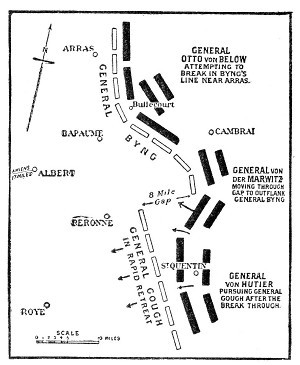
DIAGRAM SHOWING 8-MILE GAP, MARCH 23, WHICH WAS FILLED BY CAREY'S "SCRATCH DIVISION," WHO HELD THE BREACH FOR SIX DAYS
From statements made before the Reichstag Main Committee, but more especially from letters and diaries found on captured German officers, it appears that both Carey and Fayolle stopped an armed mob, utterly incapable of taking advantage of the situation it had created as a disciplined force. Regiments thrown together, officers separated from their commands, detachments without control, all due to the impetuous rush forward, could not recover in time to prevent Carey and Fayolle from completing their work.
But Ludendorff's major plan, having failed in the first month of his offensive, could not be repeated in the second. Since April 30 there has been no French, British, Belgian, Portuguese, or American front in Flanders or Picardy—only the front of the Allies, with the troops of their several nations used wherever needed by the supreme commander, Foch.
During the first month of the offensive two angles had been developed by Ludendorff: The first, the great one, in the south, from a base of sixty miles with a forty-mile perpendicular and its vertex near the Somme; the second in the north, from a base of twenty miles with a fifteen-mile perpendicular and its vertex on the edge of the Forest of Nieppe. Between these two angles the original front of Lens, from Bailleul north to Givenchy, still held, fifteen miles in length. There had been voluntary or forced changes made by the Allies east of Ypres and east of Arras.
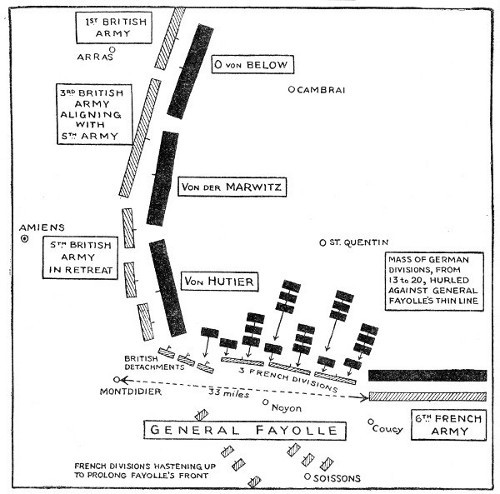
DIAGRAM OF CRITICAL SITUATION, MARCH 24, 1918, WHERE GENERAL FAYOLLE SAVED THE DAY BY THROWING HIS DIVISIONS INTO THE THIRTY-MILE GAP LEFT BY RETIREMENT OF BRITISH 5TH ARMY
The corollary in Flanders, unless it could be demonstrated, would be as great a failure as the main proposition in Picardy. And the still possible successful issue of the latter depended absolutely, as we shall see, on a complete demonstration of the former. Both have been so far handicapped by the augmenting mobility of the Allies, their growing numbers, their centralized command, and their successful insistence to control the air.
Such was the situation in Flanders and Picardy which confronted Ludendorff at the dawn of the second month of the German offensive. The whole problem to be solved was just as apparent to the Allies as it was to him—to gain the barriers which threatened his angles of penetration, in order again to utilize his preponderant forces of men and guns on a broad front. To attempt to extend the vertices without broadening the sides would mean to court danger, even destruction, at their weakest points.
His frontal attacks upon Ypres and Arras, respectively from the Passchendaele Ridge and against the Vimy Ridge, having failed, it became necessary to attempt to flank the Allies by the occupation of their defensive ridges. This explains his successful assaults upon Mont Kemmel, 325 feet high, and his desire to envelop Mont Rouge, 423 feet high, and his persistent attacks along the La Bassée Canal against the heights of Béthune, 141 feet, all preceded by diversions between the Somme and Avre, with concentrations at Villers-Bretonneux, Hangard, and elsewhere.
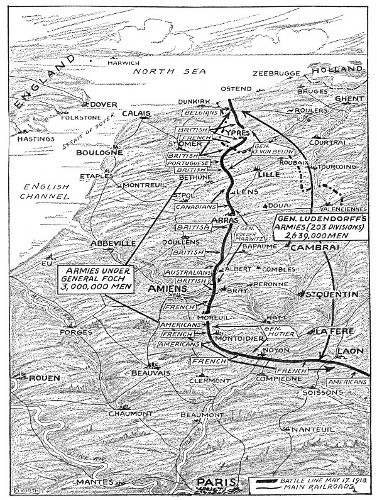
PERSPECTIVE MAP SHOWING LOCATION OF OPPOSING FORCES IN PICARDY AND FLANDERS. THE BLACK ARROW LINE ON THE RIGHT SHOULD NOT BE MISTAKEN FOR THE OLD BATTLELINE, WHICH IS NOT INDICATED AT ALL. GENERAL SIXT VON ARNIM'S FORCE, EAST OF YPRES, WAS INADVERTENTLY OMITTED
On April 18 the French made a feint on both banks of the Avre River south of Hangard, drove in a mile, and picked up some prisoners; simultaneously the Germans, with a force of 137,000, made a heavy assault upon the allied front lying across the La Bassée Canal, with a diversion on the Lys River near St. Venant.
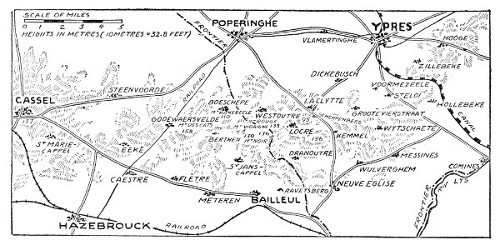
SCENE OF THE MONTH'S HEAVIEST FIGHTING IN FLANDERS, ESPECIALLY ABOUT MOUNT KEMMEL
Before the day was done they had switched their attack to the Kemmel sector. In all three places the Germans suffered repulse, with the loss of a few hundred prisoners. Four days later the British advanced their lines on the Lys, just as the French had on the Avre. Then on the 24th came the great enemy diversion at Villers-Bretonneux, nine miles southeast of Amiens. Here the Germans used tanks for the first time. The village, lost to the British on the first day, was recovered on the second, when just to the south the French and American troops were hotly contesting with the Germans the possession of Hangard. The sharp salient at this place made it difficult for the Allies to hold, while its retention, except as a site from which losses could be inflicted on the Germans, was unnecessary. Consequently it was evacuated, after the attacking detachment of the Prussian Guards had been annihilated.
BATTLE FOR MONT KEMMEL
Meanwhile the Germans had been preparing for a decisive assault against Mont Kemmel with ever-augmenting artillery fire and with the concentration of vast numbers of troops on the sidings of the railroad between the villages of Messines and Wytschaete. These troops numbered nine divisions, or about 120,000 men. From the 24th till the 27th they incessantly swung around Mont Kemmel in massed front and flank attacks, until the French and British were forced to give up the height, together with the village of the same name and the village of Dranoutre, retiring on La Clytte and Scherpenberg.
The occupation of Mont Kemmel, however, did not, as Ludendorff had anticipated, force the British out of the Ypres salient, for their voluntary retirement from part of the Passchendaele Ridge on April 17-19 had strengthened the salient, which could hold as long as the line of hills west of Kemmel held—Mont Rouge, Mont Diviagne, Mont des Cats, &c.
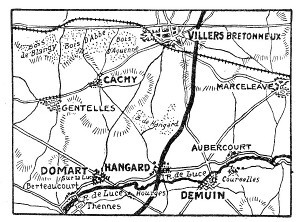
REGION OF HANGARD AND VILLERS-BRETONNEUX, WHERE GERMANS USED TANKS FOR THE FIRST TIME
The Berlin publicity bureau advertised the fact that a direct thrust at Ypres had brought the Germans to within three miles of the town—an achievement of no particular military value—while it quite ignored the capture of Mont Kemmel, for the simple reason that its value was now discovered to repose in their ability to carry their occupation throughout the entire range.
This they have since been vainly, except for local advances, trying to do, often employing great forces of men in mass for two or three days at a time—striving vainly to broaden the salient in three places: between Dickebusch and Voormezeele, due south from Ypres; by an envelopment of Mont Rouge to the southwest; on the south by an advance in the direction of Béthune.
VON ARNIM'S EFFORTS
In the northern part of the salient the attacks reached their climax on Monday, April 29, when General Sixt von Arnim's army was hurled in wave after wave between Voormezeele and Scherpenberg and on the latter and Mont Rouge, only to end in a repulse, which, on account of the number of men believed to have been lost by the enemy, may be considered a disastrous defeat. All this time a heavy bombardment had been going on in the Béthune region in preparation for an infantry attack there; yet on account of the defeat further north, it could not be delivered.
Henceforth, until May 16, von Arnim was obviously placed on the defensive, whereas the Allies were locally on the offensive, either recovering lost strategic points or consolidating their lines. On May 5, between Locre and Dranoutre, the Franco-British forces advanced on a 1,000-yard front to the depth of 500 yards. On the 8th the Germans made a half-hearted attack on the sector south of Dickebusch Lake and entered British trenches, only to be repulsed with heavy loss. A similar attack the next day between La Clytte and Voormezeele not only met with a similar repulse, but was followed up by a strong British counterattack which won considerable ground. On the 12th the French captured Hill 44 on the north flank of Kemmel, between La Clytte and Vierstraat.
On May 13 renewed enemy artillery activity on the lines back of Béthune seemed to presage that an infantry attack was intended there. Nothing of this nature ensued, however. On the 15th the Germans made a sudden attack against Hill 44 but were hurled back by the French. On the 16th-17th they maintained a concentrated fire north of Kemmel.
GERMAN ATTACKS ON THE LYS
All these operations on the German northern salient, which is gradually coming to be called the Lys salient, have shown no indication of being intended to pave the way for a renewal of the general offensive in Flanders. Their success might, and probably would, have forced the evacuation of Ypres and affected the Picardy salient with its vertex near Amiens, forcing the evacuation of Arras. But, as we have seen, the operations on the Lys salient, meeting with an overwhelming obstruction on April 29, did not achieve these results. Throughout the next three weeks the manoeuvres of the enemy in Picardy afforded excellent opportunities for counterattacks on the part of the Allies, whose object here has been to punish the enemy as much as possible and to consolidate every strategic position on a broad front in anticipation of a renewal of Germany's original scheme to isolate the allied armies north of the Somme by a dash to the mouth of that river via Amiens.
In these circumstances, the enemy on April 30 launched heavy attacks on the French lines in the region of Hangard and Noyon. These fell down, and on May 2 the French made distinct gains in Hangard Wood and near Mailly-Raineval. The next day the French advanced their lines between Hailles and Castel, south of the Avre, and captured Hill 82. On the 6th the British advanced their lines between the Somme and the Ancre, southwest of Morlancourt, and in the neighborhood of Locon and the Lawe River, taking prisoners in both places. On the 11th skirmishes southwest of Mailly-Raineval, between Hangard and Montdidier, developed into a pitched battle, in which the French at first lost ground and then recovered it. On May 14 the Germans, after an intense local bombardment, delivered a spirited attack on a mile front of the British southwest of Morlancourt, gaining a footing in their first trenches. Instantly some Australian troops counterattacked and completely re-established the British positions. On the 16th and 17th the enemy showed impressive and portentous artillery activity along the Avre and at Rollott, on the Abbéville road, south of Montdidier, similar in character to that observed north of Kemmel, on the Lys salient.
There are now believed to be over half a million American rifles on the western front, either at definite places or available as reserves. On April 20 a battalion of Germans made a raid on our eight-mile sector south of the Woeuvre, and succeeded in reaching the front-line trenches and taking the village of Seicheprey. Our losses were between 200 and 300; 300 German dead were counted. A detachment of our army, principally artillery, holds a sector of five miles with the French infantry east of Montdidier, on the Picardy front, protecting the Beauvais-Amiens road. Here their fire is principally employed in breaking up German concentrations and transport in and around Montdidier.
THE ZEEBRUGGE RAID
The German submarine bases at Zeebrugge and Ostend on the Belgian coast have been repeatedly bombed from the sea and shelled by British monitors with indifferent results. With the adding of super-U-boats to the German submarine fleet and the increased transatlantic traffic of the Allies the necessity for effectually sealing these bases has long been apparent. Theoretically the nature of the entrance to the harbors of both places, resembling the neck of a bottle, about 250 feet wide, made such a task easy by the sinking of block ships. Practically it was most difficult, on account of both sea obstructions and the shore batteries.
On the night of April 22-23 British naval forces, commanded by Vice Admiral Keyes, with the co-operation of French destroyers, and hidden by a newly devised smoke-screen, invented and here employed by Wing-Commander Brock, attempted to seal up the harbors. At Zeebrugge the enterprise was entirely successful. The Intrepid and Iphigenia were sunk well within and across the narrow channel, the Thetis at the entrance. All three were loaded with cement, which became solid concrete after contact with the water and can be removed only by submarine blasting. A detachment of troops was also landed on the mole from the Vindictive and engaged the crews of the German machine gun batteries stationed there. An old submarine was placed under the bridge of the mole and detonated. A German destroyer and some small craft were sunk. Before the blockships were placed a torpedo had been driven against the lock gates which lead from the channel into the inner harbors. The expedition retired with the loss of fifty officers and 538 men, of whom sixteen officers and 144 men had been killed.
At Ostend, the entrance to whose harbor is protected by no mole, the block ships Sirius and Brilliant were not effectively placed. Against this port the experiment was, therefore, repeated on the night of May 9-10. The Vindictive, with a cargo of concrete, was planted and sunk at the entrance to the channel, but not entirely blocking it.
ITALIAN RAID AT POLA
Another naval exploit of the month worthy of record was the sinking in the Austrian Harbor of Pola of a dreadnought of the Viribus Unitis class (20,000 tons) by Italian naval forces, in the morning of May 15. The achievement was similar to that performed by the Italians on the night of Dec. 9-10, when a destroyer sawed her way through the steel net protecting the Harbor of Trieste and torpedoed the predreadnoughts Wien and Monarch, (5,000 tons each,) sinking the former. The Harbor of Pola, however, is much more difficult to penetrate. It is three miles deep and entered by a two-mile channel, at certain places less than half a mile wide, and protected along its entire course by strong defenses. A mole covers its mouth, making the channel here less than 1,000 yards wide. Forts Cristo and Musil guard the entrance.
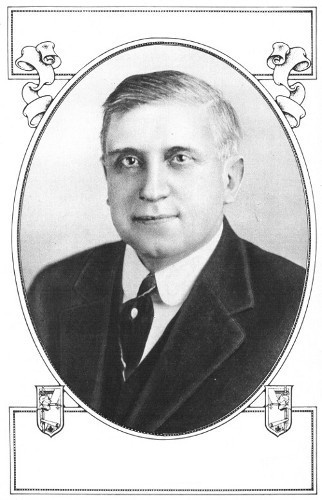
CHARLES M. SCHWAB
Head of the Bethlehem Steel Works, who has been appointed Director
General of the Emergency Fleet Corporation to carry out the Government's
shipbuilding program
(© Harris &
Ewing)
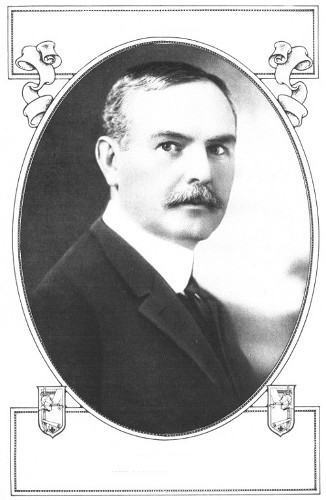
JOHN D. RYAN
President of the Anaconda Copper Company, who has been appointed Director of Aircraft Production for the United States Army
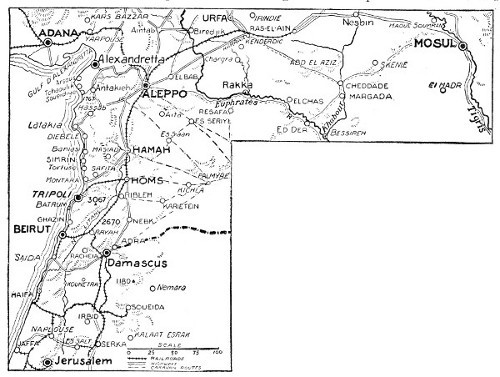
MAP OF PALESTINE AND MESOPOTAMIA, WHERE TWO BRITISH ARMIES ARE AIMING AT BAGDAD RAILWAY
TEUTONIZING THE BLACK SEA
Save for the reports which have come to hand denoting the steady progress of the British forces in Palestine and Mesopotamia, little of importance has occurred in the Near East. Still the Teutonizing of the Black Sea goes steadily on. On May 2 it was announced that a German force had occupied the great Russian fortress of Sebastopol, famous for its protracted siege by the British and French in 1855, and until then considered impregnable. On May 12 part of the Russian Black Sea fleet was taken possession of by the Germans at that place, while the remainder escaped to Novorossysk. Among the captured vessels only the battleship Volga and the protected cruiser Pamiat Merkuria were in serviceable condition. At Odessa a new dreadnought and two protected cruisers had already been seized by the Germans as they lay in their slips.
In Macedonia the huge allied forces under the French General, Guillaumat, are still waiting on events. The Greek Army is still in process of reconstruction under the Venizelos Administration. The month, however, has not been barren of engagements on this battleline. On April 28 the Serbians beat back attempts of the Bulgars to capture fortified positions in the Vetrenik region; the French and British did the same in regard to German attacks aimed at points west of Makovo and south of Lake Doiran. So it has been all the month, the monotony only varied on April 27, when there was intense artillery fire by the allied guns in the neighborhood of Monastir, on the Cerna, and, in the Vetrenik region, a Serbian assault annihilated a Bulgar section.
IN THE NEAR EAST
There has been no serious attempt on the part of the Turks during the month to oppose the expansion of General Allenby's front beyond Jerusalem or the triumphant march of General Marshall up the Euphrates and the Tigris—on the latter river now sixty miles below Mosul, Marshall's obvious objective. The objective of Allenby is Aleppo, where there is said to be a single division of German troops in addition to the Turks, who have been forced north from Jerusalem. Allenby and Marshall are advancing along parallel lines with a desert space of about 400 miles between. The Turks and their ally still have possession of the caravan trail and the partly built and entirely surveyed Bagdad Railway, which intersect the prospective parallel paths of Allenby and Marshall, whose lines of communication already reach hundreds of miles to the rear. But while Allenby has a lateral sea communication with Syrian ports, no such advantage is enjoyed by Marshall, who must get all his supplies from the head of the Persian Gulf, 450 miles to the south. Whatever be the force at the disposition of the enemy, it is evident that he will continue to possess a predominating tactical and strategic advantage until he has been decisively defeated at both Aleppo and Mosul or a junction has been established between Allenby and Marshall, or both.
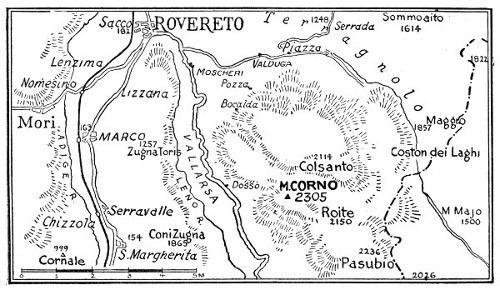
SCENE OF LATEST ITALIAN FIGHTING IN THE ALPS
The former's line, which is a sixty-mile front, extending from Arsuf el Haram on the Mediterranean east to the Jordan, took Es-Salt with thirty-three German and 317 Turkish prisoners on May 1—twenty miles north of Jerusalem—which was first occupied by Allenby early in December.
Marshall's advance has been much more rapid. In the week of May 1 his cavalry, in pursuit of the fleeing Turks, advanced twenty miles and captured 1,000 prisoners. On May 7 he was 80 miles from Mosul; on May 10 he was within 60 miles. Allenby is 300 miles from Aleppo and 110 miles from Damascus.
ON THE ITALIAN FRONT
Without any large movements of troops taking place, several things have occurred since April 18 to invite attention to the Italian front, and much speculation by military men has been indulged in as to whether the resumption of the Teutonic offensive would be from the Piave or south from the Astico-Piave line lying across the Sette Comuni and the Brenta, or from the west of the Adige and the Lago di Garda, in an attempt to reach Brescia and the metallurgic centre of Italy.
And most of the things in question which have occurred have served to restore and augment the confidence of the Italians in their position. A new 2d Army has taken the place of the old, annihilated in the Capporetto campaign. All the lost guns have been replaced and new heavies added. Revolution is, at any moment, expected to break out in Austria-Hungary, while the Congress of Jugoslavs in Rome on April 9-11 has secured the adhesion to the Allies of the subjects of the Hapsburgs and enabled the Italian Government to make use of them as a fighting force. There are now believed to be no German divisions on the Italian front, where the entire enemy strength, not measurably increased since the snows have disappeared in the north, consists of 800 Austro-Hungarian battalions, or less than 1,000,000 men.
But what has promoted most satisfaction in the Italian Government and people was the decree issued by the Interallied Supreme Council of War at Abbéville on May 3, giving General Foch authority to include the Italian front under his supreme command, that front thereby becoming the right wing of the allied battle line in Europe—now "one army, one front, and one supreme command."
That is the way Bonaparte fought his victorious battles in the days of the First Republic, alternately on the Rhine and the Adige. Moreau could not win without Bonaparte, nor Bonaparte without Moreau, while Carnot, in the centre, was the vehicle of transit.
Before the snows made manoeuvres impossible the Italians had closed two gates which threatened the plains of Veneto from the north—one at the junction of the front with the Piave, one at the angle of the Frenzela Torrent and the Brenta River.
Gunfire had been steadily augmenting on the front when, on May 10, they closed another, and on May 15 still another. The first of these was the capture of Monte Corno, which commanded the part up the Vallarsa, the second was a partial recovery of Monte Asolone, between the Brenta and the Piave, sufficient to cover the path up the Val San Lorenzo. Both mountains are really plateaus of about two square miles area each, whose irregular summits the enemy had strongly fortified in order to clear the valleys below. In both places subsequent Austrian counterattacks were broken up.
Meanwhile, Italian aircraft dominate from above. On May 14 the enemy lost eleven airplanes with no losses to the Italians and the British, who were assisting them.
Premier Lloyd George on German Autocracy
Premier Lloyd George wrote the following preface for a volume containing extracts from speeches he delivered during the war:
I have never believed that the war would be a short war, or that in some mysterious way, by negotiation or compromise, we would free Europe from the malignant military autocracy which is endeavoring to trample it into submission and moral death. I have always believed that the machine which has established its despotic control over the minds and the bodies of its victims and then organized and driven them to slaughter in order to extend that control over the rest of the world, would only be destroyed if the free peoples proved themselves strong and steadfast enough to defeat its attempt in arms. The events of the last few weeks must have made it plain to every thinking man that there is no longer room for compromise between the ideals for which we and our enemies stood. Democracy and autocracy have come to death grips. One or the other will fasten its hold on mankind. It is a clear realization of this issue which will be our strength in the trials to come. I have no doubt that freedom will triumph. But whether it will triumph soon or late, after a final supreme effort in the next few months or a long-drawn agony, depends on the vigor and self-sacrifice with which the children of liberty, and especially those behind the lines, dedicate themselves to the struggle. There is no time for ease or delay or debate. The call is imperative. The choice is clear. It is for each free citizen to do his part.
The Greatest Battle of the War
Second Month of the Desperate Fighting in Flanders and Picardy
By Philip Gibbs
Special Correspondent With the British Armies [Copyrighted in United States of America]
The May issue of Current History Magazine contained Philip Gibbs's story of the great German offensive up to April 18, 1918. At that time the Germans were seeking to break the British lines in front of Ypres, as part of their drive for Amiens and the British Channel ports, generally known as the battle of Picardy. The pages here presented are a continuation of his eyewitness narrative of the most sanguinary battle in history.
April 18.—The arrival of French troops on our northern front is the most important act that has happened during the last three or four days, and it was with deep satisfaction that we met these troops on the roads and knew that at last our poor, tired men would get support and help against their overwhelming odds.
Beside the khaki army of the British has grown very quickly an army in blue, the cornflower blue of the French poilus. They are splendid men, hard and solid fellows, who have been war-worn and weather-worn during these three and a half years past, and look the great fighting men who have gone many times into battle and know all that war can teach them in endurance and cunning and quick attack.
As they came marching up the roads to the front they were like a streaming river of blue—blue helmets and coats and blue carts and blue lorries, all blending into one tone through these April mists as they went winding over the countryside and through French market towns, where their own people waved to them, and then through the villages on the edge of the Flanders battlefields, where they waited to go into action under shell-broken walls or under hedges above which British shellfire traveled, or in fields where they made their bivouacs, and fragrant steams arose to one's nostrils as cuistots lifted the lids of stewpans and hungry men gathered around after a long march.
The attack this morning from Robecq, below St. Venant, down to Givenchy, is a serious effort to gain La Bassée Canal and form a strong defensive flank for the enemy while he proceeds with his battles further north and also to get more elbow room from the salient in which he is narrowly wedged below Merville.
For this purpose he brought up several more divisions, including the 239th, which was in the Somme fighting of March, but not heavily engaged. This one attacked the British at Robecq and was repulsed with heavy losses. It was at a place called La Bacquerolles Farm, near Robecq, where after heavy shelling last night the enemy rushed one of the outposts at 10 o'clock. In order to facilitate the attack this morning of German divisions north and south at 4 o'clock the German guns began a heavy bombardment of the British lines as far down as Givenchy and maintained it for five hours, using large numbers of gas shells, on account of the east wind, which was in their favor.
His guns shelled the bridges across the canal in the hope of preventing the British supports going up. Then his troops came forward in waves on a wide front. They were in immense numbers as usual, with many mixed battalions. One of the British units today took prisoners from ten different regiments. There were some ten German divisions facing four British ones north of Béthune, and all along the line the troops were much outnumbered; nevertheless, the enemy was repulsed at all but a few points of attack and beaten back bloodily.
THE GHASTLY LOSSES
In this battle one regiment of the 42d German Division has lost over 50 per cent. of its strength, and other losses are on a similar scale. These ghastly casualties have been piling up along this line between Merville and Béthune since the 13th of this month, when the Germans made a series of small attacks as a prelude to today's battle, owing, it seems, to battalion officers taking the initiative without orders from the High Command, in order to push forward and break the British lines if they could find weakness there.
On the 13th and 14th some of the South Country troops were attacked by strong forces repeatedly, and on the second day for five hours at a stretch the enemy endeavored to come across from houses and inclosures west of Merville toward St. Venant. For those five hours the South Country lads fired with rifles, Lewis guns, and machine guns into solid bodies of Germans, and their field guns tore gaps in the enemy's formations and broke up their assemblies before the attacks could proceed. One advance in five waves was mown down before it could make any progress, and others were dealt with in the same way.
Mr. Gibbs describes the German repulse between Robecq and Givenchy as a "black day for the enemy," and continues:
April 19.—At the end of the day all the enemy's efforts ended in bloody failure, in spite of the daring and courage of his troops, who sacrificed themselves under the British fire, but were only able to gain a few bits of trench work and one or two outposts below the fortified works at Givenchy, which are quite useless to them for immediate or future use.
It was a big attack, for which they had prepared in a formidable way. After the shock of their repulse by the Lancashire men of the 55th Division they increased their strength of heavy artillery by three times bringing up large numbers of howitzers, including eleven-inch monsters. They were massed in divisions in front of us and determined to smash through in the wake of a tremendous bombardment.
BRITISH UNDER FIRE
For five hours, as I said, this storm went on with high explosives and gas, and the devoted British had to suffer this infernal thing, the worst ordeal human beings may be called upon to bear, this standing to while all the earth upheaved and the air was thick with shell splinters.
But when the bombardment had passed and the German infantry came forward the British received them with blasts of machine-gun fire, incessant volleys of rifle fire, and a trench mortar bombardment that burst with the deadliest effect among the attacking troops.
This trench mortar barrage of the British was one of the most awful means of slaughter yesterday, especially when the enemy tried to cross La Bassée Canal further north, and in that sector the infantry and gunner officers say more Germans were killed yesterday along the canal bank than on any other day since the fighting in this neighborhood. One battery of trench mortars did most deadly execution until their pits were surrounded, and only two of their crews were able to escape.
The machine gunners fought out in the open after some of their positions had been wiped out by gunfire, caught the enemy waves at fifty yards' range, and mowed them down; but the enemy was not checked for a long time, despite his losses, and when one body fell another came up to fill its place and press on into any gap that had been made by their artillery or their own machine-gun sections.
There was one such momentary gap between a body of the Black Watch, who had been weakened by shellfire, and some of their comrades further north, and into this the enemy tried to force a way. Other Scottish troops were in reserve, and when it became clear that a portion of the line was endangered by this turning movement they came forward with grim intent, and by a fierce counterattack swept through the gap and flung back the enemy, so that the position was restored.
Further north some Gloucesters were fighting the enemy both ways, as once before in history, when they fought back to back, thereby winning the honor of wearing their cap badge back and front, which they do to this day. The Germans had worked behind them as well as in front of them, and they were in a tight corner, but did not yield, and finally, after hard fighting, cleared the ground about them.
Meanwhile further south some Lancashire troops on the canal lost some parts of their front line under an intense bombardment, but still fought on in the open, repulsing every effort to drive them back and smashing the enemy out of their positions, so that only remnants of the German outposts clung on until late last night, up to which time there was savage strife on both sides.
FIGHTING FOR THE CANAL
Extraordinary scenes took place on the canal bank when the enemy tried to cross. In the twilight of early dawn a party came out of a wood and tried to get across the water, but was seen by the British machine gunners and shot down.
Then another body of men advanced and carried with them a floating bridge, but when those who were not hit reached the water's edge they found the bridge as fixed did not reach to the other side. Some of them walked on it, expecting perhaps to jump the gap, but were shot off, and other men on the bank also were caught under British fire.
A Corporal went down to the canal edge and flung hand grenades at the Germans still struggling to fix the bridge, and then a Lieutenant and a few men rushed down and pulled the bridge on to their side of the bank.
Later this young officer saw one of the British pontoons drifting down and swam to it and made it fast beyond the enemy's reach, but in a position so that some of his men ran across and caught the enemy under their fire on his side of the canal.
At 7 o'clock yesterday morning, while a handkerchief was hoisted by the enemy, three hundred of them made signs of surrender. Some of them changed their minds at the last moment and ran away, but 150 gave themselves up, and some of them swam the canal in order to reach our side for this purpose. They were shivering in their wet clothes and in the northeast wind, which lashed over the battle lines yesterday, and they were very miserable men.
THE BELGIAN VICTORY
Mr. Gibbs declares that had the Germans been able to pass Givenchy or cross the canal north of Béthune on the 18th and 19th the result would have proved disastrous. He gives credit for the repulse to the British and French combined lines. He thus describes the achievement of the Belgians on April 17:
The Germans on the 17th pressed the attack in force against the Belgians. Besides three regiments of the 1st Landwehr Division usually holding this sector, between the Ypres-Staden railway and Kippe, they brought up from Dixmude—poor Dixmude, into whose flaming ruins I went when it was first bombarded in October, 1914—two regiments of the 6th Bavarian Division, and from the coast the 5th Matrosen Regiment of the 2d Naval Division, with a regiment of the 58th Saxons. It was a heavy force, and they hoped to surprise and annihilate the Belgian resistance by their weight and quickness of attack.
The Belgians were waiting for them, standing, too, in those swampy fields which they have held against the enemy for three and a half years, always shelled, always paying daily a toll of life and limb, not getting much glory or recognition because of the great battles elsewhere, but patient and enduring as when I knew them on the Yser in the first dreadful Winter of the war, and their little regular army fought to a finish.
Even before the battle the German marines, Saxon troops, and Landwehr suffered misery and lost many men. They lay out in the flat, wet fields two nights previously, and were very cold, and scared by the Belgian gunfire which burst among them. They had no great artillery behind them, and the Saxons and German sailors now prisoners of the Belgians curse bitterly because they were expected to get through easily in spite of this.
Germans Cut Off
The enemy's intention was to take Bixschoote and advance across the Yser Canal, driving south to Poperinghe. What they did by their massed attacks was to penetrate to a point near Hoekske, southeast of Merckem, the main weight of their pressure being directed along the Bixschoote road. The Belgians delivered a quick counterattack, with wonderful enthusiasm among officers and men. They had perfect knowledge of the country, and used this fully by striking up from a place called Luyghem in such a way that the enemy was driven toward the swamp, where any who went in sank up to his neck in the ice-cold water.
The Germans were cut off from their own lines and trapped. Seven hundred of them surrendered, men of all the regiments I have mentioned, and they seemed to think themselves lucky at getting off so cheaply, though they quailed when they were brought back through the towns behind the lines, and the Belgian women, remembering many things, raised a cry as these men passed. It was not a pleasant sound. I heard it once in France when a German officer passed through with an escort. It was a cry which made my blood run cold. But there is gladness among the Belgian troops, for they had long waited for their chance of striking, and made good.
Heroism of the Doctors
As heroic a story as anything in all this history of the last four weeks is that of the medical officers, nurses, orderlies, and ambulance men belonging to these casualty clearing stations, who were not far behind the fighting lines when the battle began on March 21.
And then in a few hours they were on the very edge of the enemy's advancing tide, so that they were almost caught by it and had to make brave efforts to rescue the wounded, save their equipment, and get away to a place where for a little while again they could go on with their noble work until the red edge of war swept up with its fire again and they had to retreat still further.
I used to pass very often the outer ring of those casualty clearing stations on the right of the British line beyond Bapaume, in the Cambrai salient, and away toward St. Quentin.
They were almost caught on that day of March 21 when the infernal bombardment was flung over a wide belt of the British lines, and the enemy stormed the defenses and the British fought back in heroic rearguard actions. It became a question of only a few hours, sometimes of the last quarter of an hour, when these brave medical officers with the nurses and orderlies could get away.
It is always the rule of patients first, and at Ham there were 1,200 wounded, and many others in other places. The railways were choked with military transport or destroyed by shellfire. On the roads refugees were mixed up with the transport and guns and troops. It was a frightful problem, but the medical staffs did not lose their nerve, and set about the business of removal with fine skill and discipline.
Caring for the Wounded
What wounded could walk were gathered together and sent on to the roads to make their way back as far as their strength would carry them. The badly wounded were packed into all the available ambulances and sent away. The equipment had sometimes to be put on any train, regardless of its destination. It was gathered in afterward from whatever place it went to.
A casualty clearing station of 1,000 beds needs 100 lorries to move it, but nine lorries take a full kit for 200 beds, and always nine lorries moved off first after the wounded to take up a new station further back and carry on. The medical officers looked after the surgical instruments and trundled them along the roads on wheeled stretchers. One officer went twenty-five miles this way and another seventeen miles. The sisters, after the wounded had left, were put on any vehicle going back from the battleline.
During these days I saw them squeezed between drivers and men on motor lorries, sitting among the Tommies in transport wagons, one at least on a gun limber, and others perched on top of forage, still merry and bright in spite of all the tragedy about them, because that is their training and their faith.
In this retreat one poor sister was killed and another wounded. Many of them, with the medical officers, lost their kits. At Achiet le Grand, on March 21, a shell killed eight orderlies and blew out the back of the operating theatre, and at another village on a second night, three ambulances were smashed up by bombs. Two drivers, with some of their patients, were killed, but all the wounded were brought away from the outer ring of casualty clearing stations safely, and then from the second ring through Roye and Marincourt, Dernacourt, and Aveluy.
At Roye there was no time to spare, owing to the enemy's rapid advance, and seventy patients remained with a medical officer and twelve orderlies until they could be rescued, if there was any possible chance. There seemed at first no chance, but on the way back to Villers-Bretonneux the medical officer in command of the first convoy met some motor ambulances and begged the drivers to go into Roye and rescue those who had been left behind. They went bravely and brought away all the wounded and the staff, and had no time to spare, because the last ambulance came under the German rifle fire.
It is a strange and wonderful thing that the patients do not seem to be harmed in any way by this excitement and fatigue, and one of the chiefs who made a tour of inspection of all his clearing stations at this time tells us he found all the wounded in good condition and apparently no worse for their experience.
Fall of Villers-Bretonneux
On April 24 the Germans attacked the important village of Villers-Bretonneux, near Amiens; it is on a hill above the Somme, and was used as a corps headquarters and administrative office by the British. The attack was in great force, including tanks, the first time they had been used by the Germans.
The initial assault was a success and the Germans took the village and advanced nearly a mile beyond—but let Mr. Gibbs tell the rest:
During the night they were driven out by Australian troops, who, by a most skillful and daring piece of generalship, were sent forward in the darkness without preliminary artillery preparation, and, relying absolutely on the weapons they carried to regain this important portion, which gave the enemy full observation of the British positions on both sides of the Somme Valley beyond Amiens.
The splendid courage of the Australian troops, the cunning of their machine gunners, and the fine leadership of their officers achieved success, and, in conjunction with English battalions, they spent the night clearing out the enemy from the village, where he made a desperate resistance, and brought back altogether something like 700 or 800 prisoners.
It was a complete reversal of fortune for the enemy, and in this twenty-four hours of fighting he has lost great numbers of men, whose bodies lie in heaps between Villers-Bretonneux and Warfusee and all about the ruins and fields in that neighborhood.
First German Tanks
The attack on Villers-Bretonneux was made by four divisions. They were the 4th Guards, the 77th, quite new to this phase of the war, the 228th, and the 243d. They were in the full strength of divisions, twelve regiments in each, and a great weight of men on such a narrow front against one British division, whose men had already been under frightful fire and had been living in clouds of poison gas with masks on.
An officer of the Middlesex was in a bit of a trench when the first German tank attacked his men on the east side of the village, and it went right over him as he lay crouched, and traveled on, accompanied by bodies of troops.
The Middlesex and West Yorks put up a great fight but had to give ground to superior numbers. The East Lancashires, who were the garrison of Villers-Bretonneux, were also attacked with great odds, and after a brave resistance fell back with the general line, which took up a position toward the end of this first phase of the battle west of Villers-Bretonneux and in the edge of Bois Abbé to the left of it. Into this wood in the course of the day a German patrol of one officer and forty men made their way and stayed there out of touch with their own men, and were taken prisoners last night.
The Night Battle
The attack by the Australians was made after 10 o'clock at night. It was difficult to attack suddenly like this. There was no artillery preparation. There should have been a moon, but by bad luck it was veiled in a thick, wet mist.
It was decided by the Australian General that his men should go straight into the attack with bayonet and machine gun, not waiting for artillery protection which would tell the enemy what was coming.
The plan of attack was to push forward in two bodies and to encircle Villers-Bretonneux, while some Northamptons and others were in the centre with the order to fight through the village from the north. This manoeuvre was carried out owing to the magnificent courage of each Australian soldier and the gallantry of the officers.
The Germans fought desperately when they found themselves in danger of being trapped. They had nests of machine guns along the railway embankment below the village, and these fired fiercely, sweeping the attackers who tried to advance upon them.
Those who worked around north and east of the village also came under a burst of machine-gun fire from weapons hidden among the ruins and trenches, but they rounded up the enemy and fought him from one bit of ruin to another in streets which used to be filled with civilian life only a few weeks ago and crowded with staff officers and staff cars, but now were littered with dead bodies and raked by bullets.
The Australians captured two light field guns, which the enemy had brought up in the morning, according to his present habit of advancing guns behind his third wave of men, and several minenwerfer and many machine guns.
Great Piles of Dead
During the night they and the English troops seized over 500 men as prisoners and sent them back, and several hundred seem to have been routed out. Today, [the 25th,] judging from these I saw myself, the living were not so many as the dead.
It was fierce fighting in Villers-Bretonneux and around it last night and this morning the enemy fought until put out by bayonet, rifle bullet, or machine gun. The Australian officers say that they have never seen such piles of dead, not even outside of Bullecourt or Lagnicourt last year, as those who lie about this village of frightful strife.
The German tanks, which were first seen in this battle, though heavier than the British, with bigger guns, have now beaten a retreat, leaving one of their type in No Man's Land. The tank has a high turret and thick armor plates, and is steered and worked on a different system from the British. One of them was "killed" by a tank of the old British class, and then the British put in some of the newer, faster, and smaller types, which can steer almost as easily as a motor car, as I know, because I have traveled in one at great pace over rough ground.
These set out to attack bodies of German infantry of the 77th Division forming up near Cachy. It was a terrible encounter, and when they returned this morning their flanks were red with blood. They slew Germans not by dozens nor by scores, but by platoons and companies. They got right among the masses of men and swept them with fire, and those they did not kill with their guns they crushed beneath them, manoeuvring about and trampling them down as they fell. It seems to have been as bloody a slaughter as anything in this war.
Battle for Kemmel Hill
The furious battle for the possession of Kemmel Hill, an eminence of strategic importance in the Ypres region, occurred April 25, 26, and 27, and was as sanguinary as any in Flanders. Although the Germans won the hill, their victory involved such colossal sacrifices that this deadly thrust ended their serious offensive for the time. Mr. Gibbs's description of this battle in part follows:
After several attempts against Kemmel had been frustrated the enemy all went out, April 25, to capture this position. Four divisions at least, including the Alpine Corps, the 11th Bavarians, and the 5th, 6th, and 107th, were moved against Kemmel in the early morning fog after a tremendous bombardment of the Franco-British positions. It was a bombardment that begun before the first glimmer of dawn, like one of those which the British used to arrange in the days of their great Flanders battles last year. It came down swamping Kemmel Hill so that it was like a volcano, and stretched away on to the British lines on the left of the French by Maedelstede Farm and Grand Bois down to Vierstraat.
Then the German infantry attacked in depth, battalion behind battalion, division behind division, and their mountain troops of Alpine Corps and Jägers and Bavarians came on first in the assault of Kemmel Hill, which was not much more than a hillock, though it looms large in Flanders, and in this war. The French had suffered a terrible ordeal of fire, and the main thrust of the German strength was against them.
Foe Strikes in Two Directions
The enemy struck in two directions to encircle the hill and village of Kemmel, one arrowhead striking to Dranoutre and the other at the point of junction between the French and British northward.
In each case they were favored by fog and the effect of their gunfire. They were able to drive in a wedge which they pushed forward until they had caused gaps. The French on Kemmel Hill became isolated and there was a gulf between the British and the French and between the French left and right.
On the hill the French garrison fought with splendid heroism. These men, when quite surrounded, would not yield, but served their machine guns and rifles for many hours, determined to hold their positions at all costs, and to the death. Small parties of them on the west of the hill held out until midday or beyond, according to the reports of the airmen, who flew low over them, but by 9 o'clock this morning, owing to the gaps made by the enemy, the French main line was compelled to draw back from Kemmel.
They inflicted severe losses on the enemy as they fell back and thwarted his efforts to break their line on the new defensive positions. Meanwhile a body of Scottish troops were seriously involved. Some of their officers whom I saw today tell me the fog was so thick, as on March 21, that after a terrific bombardment the first thing known at some points a little way behind the line was when the Germans were all around them.
Germans Under Von Arnim
The German army of assault upon Kemmel and the surrounding country was under command of General Sixt von Arnim, who was the leading opponent of the Allies in the long struggle of the first Somme battles, and whose clear and ruthless intelligence was revealed in the famous document summing up the first phase of that fighting, when he frankly confessed to many failures of organization and supply, but with acute criticism which was not that of a weak or indecisive man.
Under his command as corps commanders were Generals Seiger and von Eberhardt, and they had picked troops, including the Alpine Corps and strong Bavarian and Prussian divisions specially trained for assault in such country as that of Kemmel. Their plan of attack to strike at the points of junction between the French and British east of Kemmel, and also at the French troops south of it, near Dranoutre, proved for the time successful, and by driving in wedges they were able to make the Allies fall back on the flanks and encircle Kemmel Hill after furious and heroic fighting by the French and British troops.
The British now were in weak numbers compared with the strength brought against them. Their withdrawal to the new lines of defense by Vierstraat and the furious attacks across the Ypres-Comines Canal gave the enemy some ground in the region of St. Eloi and the bluff and the spoil bank of the canal itself. It is villainous ground there, foul with wreckage of the old fighting.
British troops and Canadian troops were put to the supreme test of courage to take and hold these places. The glorious old 3d Division, commanded in those days of 1915 and 1916 by General Haldane, fought from St. Eloi to the bluff, month in and month out, and lost many gallant officers and men there after acts of courage which belong to history.
German storm troops made three violent attacks on Locre, which were flung back by the French, with heavy casualties among the enemy, and it was only at the fourth attempt with fresh reserves that they were able to enter the ruins of the village, from which the French then fell back in order to reorganize for a counterattack. This they launched today at an early hour, and now Locre is in their hands after close fighting, in which they slew numbers of the enemy.
After their success on April 25, when they captured Kemmel, the Germans have made little progress, and, though there was fierce fighting all day yesterday, they failed to gain their objectives, and were raked by fire hour after hour, so that large numbers of their dead lie on the field of battle. At 4 in the afternoon they engaged in fresh assaults upon the positions near Ridge Wood, to which the line had fallen back, but English and Scottish troops repulsed them and scattered their waves. It was a bad day for them because of their great losses. The British have broken the fighting quality of some of the enemy's most renowned regiments.
The Country Devastated
All the roads and camps around Ypres are under a heavy, harassing fire once more, Ypres itself being savagely bombarded by high-explosive and gas shells, so that after some months of respite those poor ruins are again under that black spell which makes them the most sinister place in the world. Suicide Corner has come into its own again, and the old unhealthy plague spots up by the canal are under fire.
The enemy's guns are reaching out to fields and villages hitherto untouched by fire, and these harassing shots, intended, perhaps, to catch traffic on the roads or soldiers' camps, often serve the enemy no more than by the death of innocent women and children. A day or two ago a monstrous shell fell just outside a little Flemish cottage tucked away in an angle of a road which I often pass. It scooped out a deep pit in the garden without even scarring the cottage walls, but two children were playing in the garden and were laid dead beside a flower bed.
Yesterday a small boy I know went grubbing about this plot of earth and brought back a great chunk of shell bigger than his head. Those are the games children play in this merry century of ours. They are astoundingly indifferent to the perils about them, and sleep o' nights to the thunder of gunfire not very far away, or slip their heads under the bedclothes when bombs fall near.
But older folk find this gradual creeping up of the war a nervous strain and a mental agony which keeps them on the rack. It is pitiful to watch their doubts and perplexities and their clinging on to their homes and property. Shells smash outlying cottages to dust with their people inside them, but still the people in the village itself stay on, hoping against hope that the Germans' guns have reached their furthest range.
"I shall not go till the first shell falls in the middle of the square," said a girl.
Another woman said:
"If I go I lose all I have in life, so I will risk another day."
They take extraordinary risks, and our officers and men find some of them on the very battlefields and in farmyards where they unlimber their guns.
Heavy German Losses
The enemy's losses in this continual fighting have been severe. We have been able to get actual figures of some of their casualties, which are typical of the more general effect of the British fire. Of one company of the 7th German Division which fought at St. Eloi on Friday only 40 men remained out of its full strength of 120.
The 4th Ersatz Division lost most heavily, and a prisoner of the 279th Pioneer Company, which relieved the 360th Regiment of that division, says the average company strength was fifteen men.
The entire regimental staff was killed by a direct hit of a British shell on their headquarters dugout near Cantieux. The same thing happened to the battalion headquarters of the 223d Regiment, which is now in a state of low morale, having been fearfully cut up.
The 1st Guards Reserve Regiment of the 1st Guards Division, which was much weakened in the fighting on the Somme and afterward was sent to La Bassée, lost thirty-six officers, including a regimental commander and one battalion commander. These losses are affecting inevitably the outlook of the German troops on the prospects of their continued offensive.
Prisoners from divisions which suffered most confess they have no further enthusiasm for fighting, and that their regiments can only be made to attack by stern discipline and the knowledge that they must fight on or be shot for desertion.
On the other hand, the best German troops, especially those now attacking in Flanders, like the Alpine Corps and 11th Bavarian Division, are elated and full of warlike spirit.
Even their prisoners profess to believe they are winning the war and will have a German peace before the year is out.
Desperate Fighting for Ypres
The Germans vainly launched desperate attacks of unexampled fury against the British and French lines in the Ypres region on April 29. Mr. Gibbs in his cable dispatch of that date thus refers to these assaults:
It becomes clearer every hour that the enemy suffered a disastrous defeat today. Attack after attack was smashed up by the British artillery and infantry, and he has not made a foot of ground on the British front.
The Border Regiment this morning repulsed four heavy assaults on the Kemmel-La Clytte road, where there was extremely hard fighting, and destroyed the enemy each time.
One of the enemy's main thrusts was between Scherpenberg and Mont Rouge, where they made a wedge for a time and captured the crossroads, and it was here that a gallant French counterattack swept them back.
The British had no more than a post or two in Voormezeele this morning, and the enemy was there in greater strength, and sent his storm troops through this place, but was never able to advance against the fire of the British battalions.
His losses began yesterday, when his troops were seen massing on the road between Zillebeke and Ypres in a dense fog, through which he attempted to make a surprise attack. This was observed by low-flying planes, and his assembly was shattered by gunfire. After a fierce shelling all night, so tremendous along the whole northern front that the countryside was shaken by its tumult, German troops again assembled in the early morning mist, but were caught once more in the British bombardment.
At 3 o'clock a tremendous barrage was flung down by the German gunners from Ypres to Bailleul, and later they began the battle by launching first an attack between Zillebeke Lake and Meteren. South of Ypres they crossed the Yser Canal by Lock 8, near Voormezeele, which was their direction of attack against the British, while they tried to drive up past Locre against the French on the three hills.
The successful defense has made the day most bloody for many German regiments.
Enemy's Attacks Futile
In order to turn them if frontal attacks failed against the French, German storm troops—they are now called grosskampf, or great offensive troops—were to break the British lines on the French left between Locre and Voormezeele and on the French right near Merris and Meteren. That obviously was the intention of the German High Command this morning, judging from their direction of assault.
So far they have failed utterly. They failed to break or bend the British wings on the French centre, and they failed to capture the hills, or any one of them, defended by the French divisions.
They have attacked again and again since this morning's dawn, heavy forces of German infantry being sent forward after their first waves against Scherpenberg and Voormezeele, which lies to the east of Dickebusch Lake, but these men have been slaughtered by the French and British fire and made no important progress at any point.
For a time the situation seemed critical at one or two points, and it was reported that the Germans had been storming the slopes of Mont Rouge and Mont Noir, but one of the British airmen flew over these hills at 200 feet above their crests, and could see no German infantry near them.
Round about Voormezeele, North Country and other English battalions had to sustain determined and furious efforts of Alpine and Bavarian troops to drive through them by weight of numbers, after hours of intense bombardment, but the men held their ground and inflicted severe punishment upon the enemy.
All through the day the German losses have been heavy under field-gun and machine-gun fire, and the British batteries, alongside the French seventy-fives, swept down the enemy's advancing waves and his masses assembled in support at short range.
There is no doubt that the French guarding the three hills have fought with extreme valor and skill. For a brief period the Germans apparently were able to draw near and take some of the ground near Locre, but an immediate counterattack was organized by the French General, and the line of French troops swung forward and swept the enemy back. Further attacks by the Germans north of Ypres and on the Belgian front were repulsed easily, and again the enemy lost many men.
French and British Valor
On April 30 Mr. Gibbs confirmed the details of the disastrous German defeats on the two preceding days and gave these further particulars:
It was the valor of Frenchmen as well as Englishmen which yesterday inflicted defeat upon many German divisions, and the Allies fought side by side, and their batteries fired from the same fields and their wounded came back along the same roads, and the khaki and blue lay out upon the same brown earth.
I have already given an outline of yesterday's battle, how, after a colossal bombardment, the German attack early in the morning from north of Ypres to south of Voormezeele, where English battalions held the lines, and from La Clytte past the three hills of Scherpenberg, Mont Rouge, and Mont Noir, which French troops held to the north of Meteren, where the English joined them; again, how the English Tommies held firm against desperate assaults until late in the evening; how the enemy made a great thrust against the French, driving in for a time between Scherpenberg and Mont Noir until they were flung back by a French counterattack.
In the night the French, who had now regained all the ground that had been temporarily in the enemy's hands, made a general counterattack and succeeded in advancing their line to a depth of about fifteen hundred yards beyond the line of the three hills, which thereby was made more secure against future assaults.
Deadly Machine-Gun Work
Meanwhile throughout the day the English battalions had been sustaining heavy assaults, breaking the enemy against their front. The Leicesters, especially, had fierce fighting about Voormezeele, where, as I told yesterday, the enemy was in the centre of the village. German storm troops advanced against our men here and along other parts of the line with fixed bayonets, but in most places, except Voormezeele, where there was close fighting, they were mowed down by Lewis-gun fire before they could get near. Line after line of them came on, but lost heavily and fell back.
Over the ground east of Dickebusch Lake some Yorkshire troops saw these groups of field gray men advancing upon them, and the glint of their bayonets, wet in the morning mist, and swept them with bullets from the Lewis guns and rifles until heaps of bodies were lying out there on the mud flats in the old Ypres salient. The most determined assaults were concentrated upon the 25th Division, but it held firm and would not budge, though the men had been under fearful fire in the night bombardment, and their machine gunners kept their triggers pressed, and bullets played upon the advancing Germans like a stream from a garden hose.
The troops in the whole division yielded no yard of ground and they hold that they killed as many Germans as any battalion in this battle. It was a black day for Germany. More than ten German divisions, probably thirteen, seem to have been engaged in this attempt to smash our lines and encircle the three hills. They included some of the enemy's finest divisions, so they lost quality as well as quantity in this futile sacrifice of man-power—man-power which seems to mean nothing in flesh and blood and heart and soul to men like Ludendorff, but is treated as a material force like guns and ammunition and used as cannon fodder.