
"You shall have the story now!" I said, "and they have had the scarlet fever, but are doing very well. Hear that angry Wind outside! how he howls, and shakes the window-frame. He knows that I am going to tell you about his misdeeds. Howl away, my friend; you can do us no harm. So then I told the mice the following story. First, however, I showed them a picture of Marie, which I happened to have in my pocket. They thought she was a very pretty little girl. What do you think?"
THE STORY OF THE WIND.
The great Tree stood out in the green meadow, all alone. No other trees dared to come near him, he was so strong, and tall, and grand; but for all that, he was kind and gentle, and never would hurt anything. One morning the great Tree awoke from his long winter sleep, and found the snow all gone, and the sun shining bright and warm as if it were June instead of the first of April. On his branches were sitting a flock of little birds, and it was their chirping and twittering that had waked him. "Chippity-wippity pip pip, cheepy peepy weep wee-e-e!" they said; and that meant "Wake up, old Tree! Spring has sent us to call you. She is coming directly, and she wants you to get your leaves out as soon as possible, as she has forgotten her parasol, and wants some shade for her pretty head."
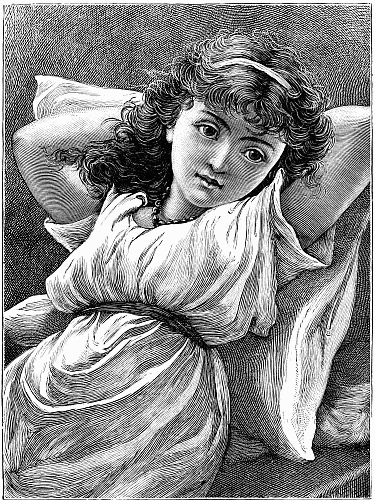 MARIE.
The great Tree nodded his head, and said, "Tell my lady Spring that I will be ready." And then he shook his branches, and called out, "Little leaves, little children, open your buds and come out! come out!" And one by one the little buds with which the branches were covered opened, and out popped the little leaves. At first they shivered, and wished themselves back in their warm little houses; but the old Tree spoke kindly to them, and then the sunbeams came and kissed them, so that they felt quite happy, and even began to dance about a little on the branches. And they said to each other, "How foolish we were, to think of shutting ourselves up again in those close houses. Here we shall be free and happy, and we will dance all day and all night."
Just then they heard a soft voice whispering, "Little leaves, lovely leaves, will you not dance with me?" And the little leaves said, "Who are you, that whispers so softly?" And the voice answered, "I am the Wind, and I have come to be your playfellow. I can sing, too, and sweetly, and we shall all be happy together." So the Wind sang them a low, sweet song; and then he danced with them, and kissed them gently, and played with them; and they all said, "Oh, dear, gentle Wind, how charming you are! will you not play with us every day, and make us happy?"
But after the Wind had flown away, the old Tree called to them and said, "My children, beware of the Wind, for he is not to be trusted. Soft and gentle he is to-day, but to-morrow he may be fierce and terrible. Play with him and dance with him, but be always on your guard." And the little leaves nodded their little heads, and answered, "Yes, good father, we will be careful."
Well, for many days the Wind came to play with the leaves, and every day they thought him more delightful. Such wonderful stories as he told them! of all the strange countries he had seen in his wanderings; the beautiful tropical islands, where he slept all day in the palm-tree tops, just waking in the evening to fan the cheeks of the dark-eyed southern ladies for an hour, and then sinking to sleep again under the shining stars; and the terrible northern seas, with their fleets of icebergs, whose pilot he loved to be, guiding them hither and thither, tossing the waves about, and sporting with the seals and walruses on the flat ice-cakes. "And some day, little leaves," he said, "you shall go with me to see these wonders; not to the arctic seas, for you are too tender and delicate to bear the cold; but away to the south, to the coral islands and the orange-groves. There you will see all the beauty of the world, and will laugh at the thought of having been content in this dull meadow, with its stupid daisies and buttercups, and its paltry little brook. Also you will find many cousins there, leaves such as you never dreamed of, wonderful in size and shape and color. Say, then, little playmates, will you come with me, and see all these beautiful things, and many more?"
But the leaves shook their little heads, and said, "No, dear Wind! we love you, and it would be delightful to go with you, but we cannot leave our father Tree, who is so kind to us, and loves us so dearly."
At first the Wind seemed angry, but soon he smiled and said, "Never mind! some day you will come,—some day!" and away he flew. But oh! the next time he came, what a different Wind he was! no longer gentle, playful, caressing, but fierce, and rough, and stormy. He rushed at the great Tree, howling furiously. He seized the little leaves, and whirled and dashed them about, trying to tear them from the branches; and flung himself against the Tree, as if he would even loose his rooted hold on the ground. But the leaves clung closer and closer, trembling and shivering; and the great Tree braced himself, and met the fierce blast bravely, never losing an inch of his foothold, and giving back blow for blow with his long powerful arms. At last the Wind was tired and flew away, howling and moaning with anger and disappointment. The little leaves were sadly frightened, but their father Tree comforted them, and said, "Courage, my children! I have fought many a battle with the Wind, and he has never beaten me yet. Only be brave and faithful, and he cannot overcome you."
At first the leaves thought they never wanted to see or hear the Wind again; but a few days after, to their great surprise, he came again, soft and gentle, as he had used to be, and he kissed them and sang to them, and begged them to forgive his wicked temper, and play with him once more. He was so charming that they soon forgave him, and soon forgot all about the storm. And they danced and frolicked about gayly, and listened again to the marvelous tales of far-off countries, of palm-groves and coral islands.
So the time went on and on. The Lady Spring had gathered her green robes about her and passed on, and her children, the wildwood blossoms, had followed her; and now Lady Summer, who had come in her stead, with her arms full of peaches and pears, and her gown covered with lovely garden flowers, was almost ready to depart, and stayed lingering, calling and beckoning to her brother Autumn, who was following very slowly. The leaves on the great Tree had been very happy during Lady Summer's reign. Many a time, it is true, the Wind had been angry with them, because they refused to go away with him, and again and again he had raged and stormed, and tried to tear them away from their happy home. But he was always very sorry after these fits of passion, and they always forgave him readily, for they loved him dearly.
One night, one clear, lovely night, when all things were sleeping in the moonlight, the Wind came and whispered to the leaves. So softly he came, and so softly he spoke, that they did not wake at first, and he had to kiss them all before he could rouse them from their sleep. "Hush, darlings!" he said. "You must not wake the old Tree, for I have a secret to tell you which he must not hear. Something very wonderful is going to happen, and I have come to tell you about it." "What is it, dear Wind? oh, what is it?" whispered the little leaves. And they clustered together and listened. "Well, my darlings," said the Wind, "a very great personage is going to pass through this part of the country to-morrow night. No less a personage than the celebrated Frost, the court painter of the great King Winter. He is one of the most famous painters in the world, but he is also a great friend of mine; and though he is in a hurry to join his royal master, who has now left his Arctic kingdom, and is traveling southward, he has kindly consented to do a great favor for you, my darlings, because I have told him how dearly I love you."
"What is it, dear Wind? oh, what is it?" asked the little leaves again.
"Well," said the Wind, "I know you must be very tired of these dull green dresses. They were well enough in the spring, when they were new and fresh, but now you have been wearing them all summer, and they are dirty and soiled. So I have persuaded my friend Frost to stop here on his way through the meadow, and to paint you all over, with fresh, new, beautiful colors. Only think of it, darlings! think how lovely you will look, all shining in crimson and gold! Now, am I not a good friend? and will you not all give me kisses for this?"
"Oh yes! yes indeed, you good Wind!" cried the leaves. "We will give you as many kisses as you want, and we will thank you till you are tired of being thanked. Oh! how delightful it will be!" and they danced about and about, and they kissed the Wind, and he kissed them.
"And now, good-night!" he said. "Remember, not a word of this to the old Tree, for it would be a pity to rob him of the pleasure of such a charming surprise."
He flew away, but the leaves were too happy to go to sleep again. They whispered and chattered all night about their new dresses. This one would have yellow, and that one would have pink, and that one scarlet, while some of the older ones preferred a rich golden russet. And when morning came, they were still whispering and chattering, and could think of nothing else all day.
At last the wished-for night came; and a beautiful night it was, very cool, but perfectly still, and brilliant with moonlight and starlight. The little leaves waited and waited, till they were, oh! so sleepy! but no one came. At length, when their eyes were closing in spite of themselves, they felt a sudden cold strike them, a cold so intense that it almost took away their breath. They looked up, and saw advancing over the meadow towards them, a strange figure which they knew in a moment must be that of the great Frost. He was very tall and thin, and very pale; and his long robe, and his hair, and his long curling moustaches, looked exactly like silver. Indeed, there was a silvery glitter all about and around him, and as he passed lightly over the grass, it too seemed to them to silver under his feet. He came straight on, came to the tree. Then, without speaking a word, he drew out a long silver brush which had been hidden beneath his robe, and a palette covered with brilliant colors, and began to paint the leaves. But oh! what a deadly chill struck through them when the silver brush touched them. Cold, cold, cold! and a kind of numbness, and a heavy drowsiness, began to creep over them. But when they saw the gorgeous beauty of their new dresses, they were very proud, and tried to hold themselves up, and not to give way to this strange weakness and faintness. And at last, oh! at last, the final touch was given, and with one cold farewell glance from his bright, sharp eyes, the court painter of the great King Winter passed on over the meadow.
Soon morning broke, and the leaves, waking from their brief and uneasy slumber, looked around to see the splendor in which they were arrayed. How the sun stared at them, when he rose. He sent down a special sunbeam to give them his compliments and to say that he had never seen them look so charming. Oh! very proud were the little leaves, and very happy, they thought; but somehow they did not feel at all well. The day was bright and warm, and yet they were so cold, so cold! and the numbness and weakness still seemed creeping over them, and would not now be shaken off. And now the great Tree awoke, (for he was apt to sleep late, being very old.) But instead of being pleased, as his children thought he would be, when he saw their fine appearance, he sighed and wept.
"Ah, my children!" he said; "my poor unhappy children! I see what has happened. You have listened to the Wind, and the Frost has been with you; and now you will leave me, and I shall be alone again, as I have been so many, many years."
"Oh, no! no! Father Tree," cried the leaves, "we will stay with you always."
But the old Tree shook his head, and said, "No, my children! it is too late. You cannot choose now whether you will go or stay, and soon, soon I shall be left alone."
The little leaves did not understand this, and they tried to forget the sad words, and to be happy with their fine new dresses. But still they were so cold, so cold! and still the drowsy numbness kept creeping, creeping over them, and each day they became weaker and weaker. And one day, oh! one fearful day, the Wind came. Fiercely and furiously he flew across the meadow, savagely he rushed at the great Tree. "Now," he howled, "now, little leaves, will you come with me? ha! ha! now will you come?" he clutched the leaves, and they shivered and moaned, and clung to the branches. But alas! their strength was gone, they could no longer resist the blast: and in a moment they were whirled away and away, borne hither and thither on the wings of the mighty Wind, and at last dashed down on the earth, to shiver and die in the cold.
And once more the great Tree stood alone in the meadow.
CHAPTER IX.
A PICNIC.
One bright morning, at about eleven o'clock, I tipped my glass in the direction of the Mouse-trap. It had been tipped in a very different direction, for I had been watching a buffalo-hunt on the prairies. That is an exciting sport, and one that I should like to join in, if I were a few thousand years younger. Here at the Mouse-trap, however, there was an excitement of quite another sort. All the five mice were hurrying about, evidently very busy. The carriage stood at the door, and Uncle Jack was packing all sorts of things into it. Nibble brought one big basket, and Puff brought another, and both were stowed away under the seat. Brighteyes came down the steps very carefully carrying something in a pitcher, with a napkin tied over the top, and that too was stowed away. As for Fluff and Downy, they were running round and round the house as fast as they could, shouting: "Picnic! picnic! going to a picnic! oh! Jollykaloo! Jollykaloo!"
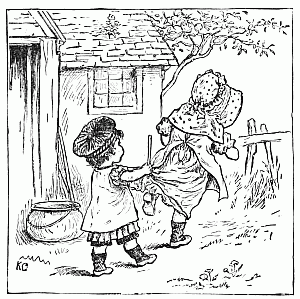
"Aha!" I said to my dog, "the mice are going to have a picnic. Let us watch now, and see where they go: and then we shall have all the fun of it, and none of the trouble." So we watched, and saw them all get into the carriage except Nibble, who stood on the steps with his hands in his pockets, evidently waiting for something. The something soon proved to be José, the brown donkey, whom Thomas now led up the path, looking very gay with his Mexican saddle and scarlet tassels. Nibble mounted him nimbly, and took the reins and the whip. "Thank you, Tomty!" he said. "And good-bye! I wish you were going to the picnic, Tomty!" "Thank you kindly, sir!" replied Tomty. "The hens and me will be having a picnic in the barn-yard, Master Nibble, I'm thinking."
"Now, Uncle Jack, I am ready!" cried the young horseman. "I will lead the way, and you can follow!"
"Thank you!" said Uncle Jack, who was holding in the spirited horses with some difficulty, "you are extremely kind, I am sure!"
"Get up, José!" cried Nibble, "Hi! go on, sir!" But José was not inclined to go on. He shook his head, and pointed his long ears backward and forward, but not a step would he stir, for entreaties, threats, or blows. Then Tomty slyly took a sharp-pointed stake, and poked Master José from behind. Ah, that was another matter! up went his heels in the air, and off he went at full gallop, while all the occupants of the carriage shouted with laughter, as they saw donkey and rider dash along the avenue, and finally vanish in a cloud of dust.
"Come, Pollux! come, Castor!" said Uncle Jack, "it would never do for the donkey to get to the Glen before us."
Castor and Pollux thought so too, for they tossed their heads, and quickened their pace to a fast trot, though they were far too well behaved to think of breaking into a gallop.
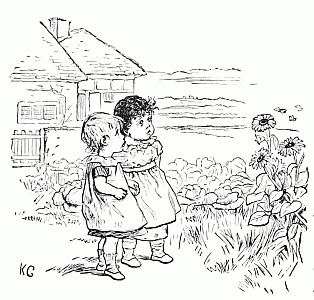
"Oh! isn't it nice to go so fastly?" exclaimed Fluffy, giving Downy a hug. "Just like queens in their chariots. See those two little tiny children, Downy! They are smaller as you, and perhaps they think we are queens, only we haven't any crowns; but we might have left our crowns at home for fear of robbers."
"Yef, wobbers!" said Downy, with a knowing nod.
"No I don't think we will be queens," said Brighteyes. "Let us be wild beasts in a caravan, going to the menagerie, and then we can sing the menagerie song." "Oh! yes! yes!" cried all the others. And then they sang the following song, each singing a verse in turn, and then imitating the voice of the creature she represented while the other verses were sung. It was a lively game, you may believe.
He lives in jungles of the East,
On bad little boys he loves to feast:
Oh! fiddledy, diddledy, dido!
The Lion he doth rage and roar;
And when he hits you with his paw,
You never are troubled with nothing no more,
Oh! fiddledy, diddledy, dido!
The Buffalo doth proudly prance,
Whenever the hunters will give him a chance,
And over the prairies he leads them a dance,
Oh! fiddledy, diddledy, dido!
The Crocodile doth open his jaws,
Like great big ugly tusky doors,
And gobbles you up without a pause,
Oh! fiddledy, diddledy, dido!
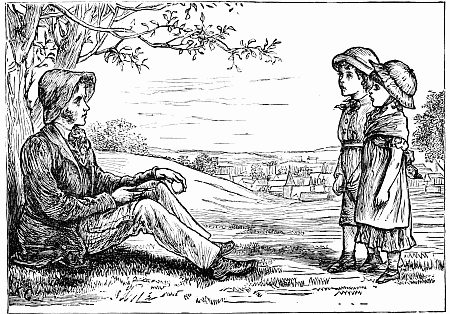
 "THEY STOOD LOOKING AT THE MICE."
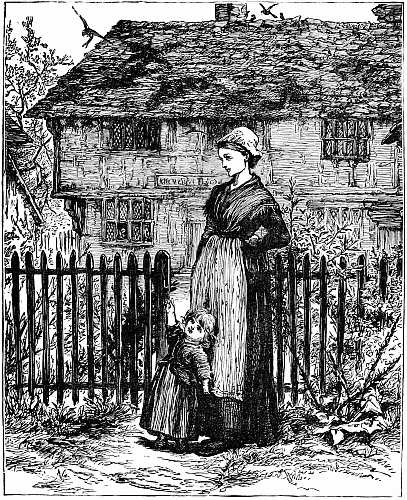
By the time the last verse was finished the four mice were howling and roaring in a manner frightful to hear, and Uncle Jack's patience finally gave way. "Children," he said, turning round, "I cannot possibly endure this. Be quiet at once, or I will drive you to the Lunatic Asylum and leave you there! See, the people are all coming out of their houses to stare at you!" So indeed they were, and one little girl, who stood with her mother at a cottage gate, staring with might and main, cried: "Them's all mad, be'nt them, mother?" "No, little girl!" said Puff, with great dignity. "We are wild beasts going to a menagerie!" And the carriage whirled away leaving the child not much the wiser.
Now they turned into a lovely wood road, when the trees bent down over the carriage, and whispered in the mice's ears. But the mice did not understand, as usual; they only rubbed their ears and said the leaves tickled them. Uncle Jack stopped the horses, and told the mice to tumble out, which they did speedily.
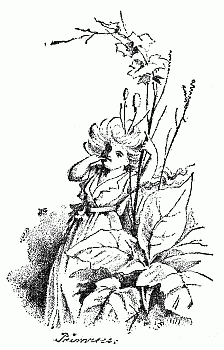
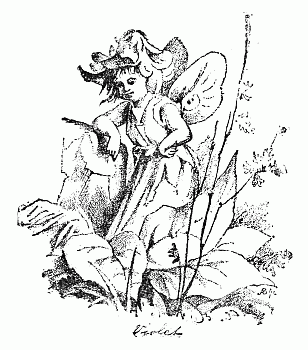
One took a basket, and another a bottle, and all went trotting down the mossy path that led to the lovely glen, while Uncle Jack stayed to unharness the horses, and then followed with the "biggy-wiggy basket," as Downy called it. Indeed, it was a pretty sight to see those little creatures, playing about like so many fairies in that lovely green place. You should have seen the little flower-spirits start up to look at them, as they frisked about among the trees. Little Primrose threw kisses to them, and Violet offered them a dew-drop in her deepest purple cup; but the merry mice thought nothing of the flower spirits and neither saw nor heard them.
"Oh! the brook! the lovely brook!" cried Brighteyes. "We must take off our shoes and stockings and wade in it. Mayn't we, Uncle Jack?" Uncle Jack nodded, and off went four pairs of shoes, and four pairs of scarlet stockings. Oh? the little white feet! how pretty they looked, shining through the clear water, that looked so brown in the still pools, and sparkled so white over the rocks and the tiny rapids.
That was fine sport, certainly. Fluff fell in, of course, but nobody seemed to mind it much, and Fluff herself least of all, for it was a very warm day, and Mrs. Posset was not there to lament the "ruination" of her white frock.
Suddenly Brighteyes exclaimed: "But where is Nibble?" Sure enough, where was that famous horseman? nobody had seen him since he had galloped away up the avenue. "Oh, dear!" sighed Fluff, "perhaps he played wild beast, and somebody took him and put him in the Lunatic Asylum! Do you think anybody did, Uncle Jack?"
"I don't think he would be likely to play wild beast all alone. My fear is that José may have been playing, and——but see!" he added, looking back towards the path by which they had entered the glen, "here comes the young man himself, so now we shall know all about it."
Nibble came down the path slowly, looking very serious. His clothes were covered with dust, his hat was battered out of all shape, and he carried his whip under his arm, instead of snapping it gayly as he had done when he started. José was not to be seen.
"Well, Nibble, my boy, what has happened?" asked Uncle Jack, cheerily. "Has José been rolling with you again?" "Yes, Uncle!" answered Nibble, as he drew near, and threw himself on the mossy bank where his uncle was seated, "he is the worst donkey I ever saw! he wanted some thistles in the hedge, and I wouldn't let him eat them, of course. So then he kicked and reared, but he couldn't get me off that way, and I whipped him a good bit. But then he lay down and rolled, and then I couldn't stay on you see!" "I see!" said Uncle Jack. "You were certainly justified in getting off. And then José went home, I suppose?" "Well, yes, I suppose he did," said Nibble, reluctantly, "and I have walked a long way, Uncle, and I want my dinner." "Bless me!" cried Uncle Jack, "dinner already? Well, come out of the water, you little Nixies, and let us see about our grand feast!"
Patter, patter, came all the little white feet, over the mossy stones, and over the green turf, and I could not tell whether they looked prettier in the water or out of it. There was a rush for the baskets, and their contents were tumbled out pell-mell on the grass. Forks, spoons, tarts, sandwiches, lemons, followed each other in rapid succession.
"Now this will never do!" said Uncle Jack. "Too many cooks spoil the broth, as we know, and we must not spoil our feast. Nibble, do you go and gather brush and make a fire. Hap and Hazard shall pick some flowers to make wreaths and posies, and Brighteyes shall help me to set the table." "And what fell I do?" asked little Downy, piteously; "I muf do fomefing!" "So you shall, Downy," said Uncle Jack; "you shall chase all the butterflies away, so that they will not eat up the tarts."
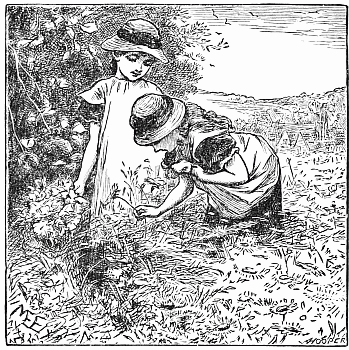
Now every one was happy and busy. The twinnies wandered off into the meadow near by, filling their aprons with posies, and chattering merrily, with little snatches of song mingling with their pretty talk. It was pleasant to hear their sweet voices singing:
And Daisy is my heart's delight!
I'll twine you now in my true-love's hair,
And tell me who is the fairest fair!
Violet blue and Violet true,
And Violet filled with diamond dew!
I'll give you now to my true love here,
And tell me who is the dearest dear!
Meanwhile great things were accomplished in the glen. A snowy cloth was spread on the emerald turf, and on it were arrayed all the good things, in dishes and plates, which had been lately hanging on the great sycamore-tree under which the feast was spread.
"Nothing like leaves for picnic-plates!" said Uncle Jack. "Now then, Brighteyes, hand out that chicken pie! So! now for the strawberries and the sponge cake! ha! this certainly does make one hungry." Indeed it did, as I felt the pangs of hunger merely from seeing all the good things in my mirror. "Go, good dog," I said to my faithful companion, "and bring me some ice-cream from Mt. Vanilla. And dip the ladle into that syllabub cloud that is drifting by, for it will make a pleasant addition."
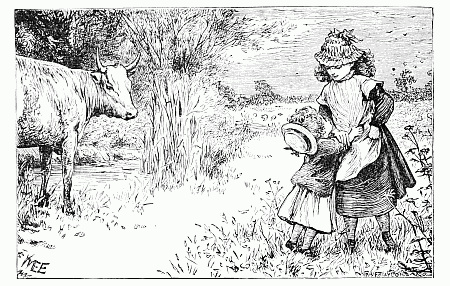
Bmfkgth departed on his errand, and I turned again to watch the picnic. The kettle was boiling by this time over Nibble's brush fire, and he was calling for the coffee-pot, when suddenly a shrill scream was heard from the meadow, and Downy's voice cried, "Fomebody come! oh! oh! I'm killed!" Brighteyes ran to the rescue, and found the little man gazing in terror at a very innocent-looking white cow, who was quietly grazing in the meadow. He ran to his sister, and clung to her, crying, "Dat cow looked at me! I'm killed!" Brighteyes took his hand and ran back laughing. "Here is a boy who has been killed by a cow's looking at him," she said, "and he wants a sandwich."
All was ready now. The twins were called, and came back laden with flowers; Nibble came with his coffee-pot, and the grand feast began in earnest. Dear! dear! how good everything looked! chicken pie and smoked tongue and sandwiches, and chocolate custard in a pitcher, and everything else that you can think of. I never have chicken pie up here, because there are no chickens, but I think it must be very nice, and it was very evident that the mice thought so. Uncle Jack carved and helped, and everybody ate and drank and chattered merrily. My brother Sun smiled at them, and sent millions of sunbeams, twinkling and sparkling over the grass and dancing on the ripples of the brook; and when they were too warm, hosts of merry Winds came flying, and fanned them and kissed them. Among them were the seven little fellows who had blown Nibble and Brighteyes to China, and they whispered, "Dear little Heavy-Ones; will you take another flying-trip with us?" but the children did not hear nor heed them, so nothing further was said.
When the feast was over, there was a grand washing of spoons and forks, and a putting away of what was good and throwing away of what was bad. Then came blind-man's-buff, and hide-and-seek, and all manner of games; and then more paddling and tumbling in the brook, splashing and dashing, "for all the world like the forty little ducklings!" Uncle Jack said. "Oh! tell us about the little ducklings!" cried all the mice. And they climbed up the bank and sat down in a circle round their uncle, holding up their wet feet to dry in the sun. "About the ducklings, eh?" said Uncle Jack, "well, let me see if I can remember."
They said unto each other, "oh! the day is very warm!"
They said unto each other, "oh! the river's very cool!
The duck who did not seek it now would surely be a fool!"
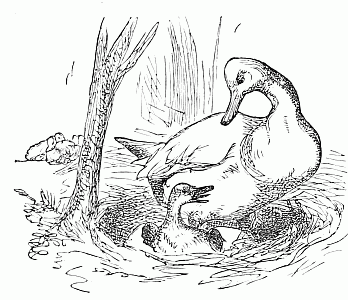
The forty little ducklings they started down the road,
And waddle, waddle, waddle, was the gait at which they goed,
The same it is not grammar, you may change it if you choose!
But one cannot stop for trifles when inspired by the Muse.
They waddled and they waddled, and they waddled on and on,
Till one remarked, "oh! deary me, where is the river gone?
We asked the Ancient Gander, and he said 'twas very near,
He must have been deceiving us, or else himself, I fear."
They waddled and they waddled, till no further they could go,
Then down upon a mossy bank they sat them in a row.
They took their little handkerchiefs and wept a little weep,
And then they put away their heads, and then they went to sleep.
There came along a farmer, with a basket on his arm,
And all those little ducklings he took back to the farm,
He put them in their little beds and wished them sweet repose,
And fastened mustard plasters on their little webby toes.
Next day those little ducklings were very, very ill,
Their mother sent for Dr. Quack, who gave them each a pill,
But soon as they recovered, the first thing that they did
Was to peck the Ancient Gander, till he ran away and hid.
"There!" said Uncle Jack, "weren't they funny ducklings?" "Yes!" said Puff; "is it true, Uncle?" "Part of it is," replied Uncle Jack. "It is true about the ducklings running away, and about the farmer's finding them. I know the farmer. His name is Mr. Thomas Burnham, and a very good farmer he is. But I did not see him put the mustard plasters on their feet, so I cannot tell about that." "Then tell us something else, please!" cried Brighteyes. "No! no!" said Uncle Jack; "it is six o'clock, you bad children! Once upon a time there were five little mice, and it was time for them to go home. That is the only story I can tell you now."
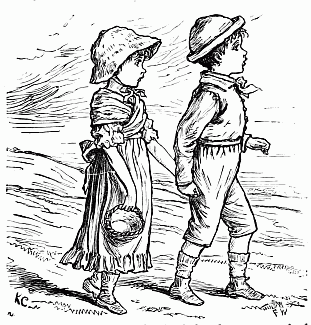
Well, to be sure, it did seem a shame to go home, just when everything was so lovely. But Downy was beginning to rub his eyes as if my friend the Sand-man had been blowing into them, and the shadows were lengthening, and Brother Sun was beginning to call his beams home. So the mice bade farewell to the lovely glen, and the merry brook, and trotted up the mossy path as cheerfully, if not as quickly as they had trotted down it. Harum-scarum and flyaway my mice certainly are, but they are almost always cheerful and obedient, and that is a great thing. Primrose and Violet and the rest looked after them, and said, "God bless their merry hearts!" then they curled down under their leaves and went to sleep, for it was high time. The brook sang its sweetest good-bye song, as it hurried away toward the sea, to tell the gossipping waves what a delightful afternoon it had passed; and as if in answer to the song, I heard Puff and Fluff singing merrily, as the carriage rolled away:
"Rosebud fine and Rosebud mine,
And Rosebud red as the ruby wine,
I'll lay you now at my true-love's feet,
And tell me who is the sweetest sweet!"
CHAPTER X.
THE CARRIAGE CLOUD.
"Good evening to you all!" I said, as I stepped in at the nursery window. "This is a night for a journey, if you please. All the rough and unruly Winds are out of the way, for there is to be a match to-night between the North-east wind and a Southern tornado, to see which can blow the harder, and all their relations have gone to look on. But our seven little friends have no liking for such rough bear-play, and they are waiting outside, with a carriage-cloud which will hold you all. So jump up, and call Nibble and Brighteyes. But first, I must know why my Fluff has been crying. You must have cried yourself to sleep, my mouse, and that will never do. Tell your old Moonman what has happened, for I have been watching a battle in Zululand all day, and have seen neither mice nor mouse-trap."
"We have had a very melancholy day, Mr. Moonman!" replied Fluff, "Vashti Ann has been hanged, and it is a terrible thing to hang your own child, even if Nibble does it for you." "Vashti Ann hanged!" I exclaimed. "Dear! dear! how very distressing! what had she done, pray, and how did it all happen?" "We don't think she meant to do it," said Puff gravely; "but Nibble said she ought to be hanged all the same. You see, we had just dressed the baby"—"and she was Vashti Ann's own child!" Fluff broke in impressively.
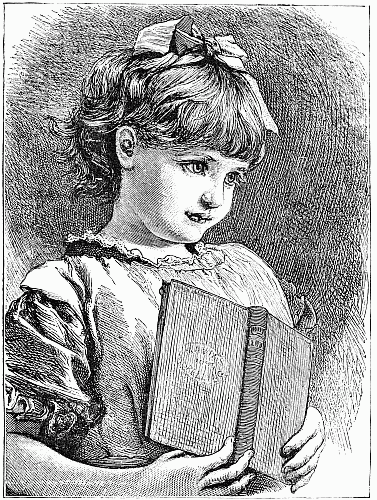 FLUFF.
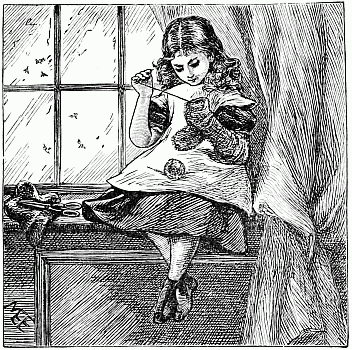
"Please do not interrupt me, Fluffy!" said Puffy with dignity. "And we set her down in front of her mother, and told her to say her lesson like a good baby, only she can't really say it, you know, but we play she does. So then Fluffy went for a walk with the other dolls, but I had to darn a hole in my stocking. Mrs. Posset is teaching me to darn, and it is my duty, but I don't like my duty. So I was sitting by the window, and nobody was doing anything at all, when suddenly Vashti Ann fell right down on the baby's head and"—"and killed her!" cried Fluff, bursting into tears. "Killed her all dead into little pieces!" "How very, very shocking!" I said. "And was the wretched mother hurt herself?" "No!" answered Puff. "Her head was china, Mr. Moonman, and the baby's was wax, you see." "I see!" said I. "The brass pot and the earthen one!" "If you had ever seen Vashti Ann, Mr. Moonman," said Fluff through her tears, "you would not call her such names as a brass pot. Her hair was gossy as the raven's wing, like the lady in the ballad that Uncle Jack read to us last night; and I never wanted to call her Vashti Ann, but I wanted to call her Isidora Vienna, but Uncle Jack said her name was Vashti Ann when he buyed her, so I couldn't help it." And Fluff dried her eyes with the end of the pillow-case, and looked very mournful. "Well! well!" I said. "This is certainly very painful. So then you hanged Vashti Ann?" "No, Nibble hanged her," said Fluff, "with a clothesline, and it was a terribul scene, Uncle Jack said it was. And then we buried them both together under a rose bush. We are going to have a monument over them, but Nibble wants to put 'the Murdered and the Murderess' on it, and I won't have it." "I certainly would not!" said I. "But now you must call Nibble, and Brighteyes too, for the little Winds are growing impatient, and we must be off. Dry your eyes, little one, and think what a fine ride you are going to have!"
Nibble and Brighteyes were summoned; and in a few minutes all the five mice were sitting comfortably in the very softest, fattest, whitest cloud that the whole sky could produce. How it curled up round their shoulders, and wrapped itself about them! and how they did enjoy the luxurious softness! then the seven Winds puffed at it, and away it went like a ball of thistledown through the air! "Where shall we go, my pets?" I asked, as I rode along, beside them. "You have the wide world to choose from, und shall go just where you please." "I want to go to the North Pole, Mr. Moonman!" cried Nibble. "You promised us to take us there, you remember, the last time you came. I want to see the icebergs, and the white bears, and all the wonderful things there are there!" "To the North Pole it is, then!" I replied. "It is just the night for it, as all the savage Winds are away."
So we flew northward, far and far away, over cities and hamlets, over vast plains and shaggy forests. By the margin of a pond that we passed a tall night-heron was standing on one leg. He looked up at us, and was so much astonished that he toppled over and fell into the water with a loud splash. How all the mice laughed, and the merry Winds with them! all, that is, except my little Fluff, who looked sad, and was still thinking of Vashti Ann. "Fluffy," I said, "I must see you smile again. Shall I sing you a song that I heard to-day?" "Yes, if you please, Mr. Moonman!" said Fluff meekly. "It is a funny little song," I said. "I heard an Irish mother singing it to her baby. She was sitting by the door of her cottage with the baby in her lap, and she was paring potatoes, and all the parings fell into the baby's face, but he did not seem to mind it at all, so I suppose it was all right."
Eight little gurrls wid their aprons on, Wint out to get some wather, But niver a dhrop could be found at ahl, By any mother's daughter. "Now well-a-day!" said the eight little gurrls, "If we git no wather we shall die!" "Oh! the very best way," said the eight little gurrls; "Will be for us ahl to cry!" |
And they cried and they cried all day,
And when evening came, there was wather enough
For to fill up the salt, salt say!
Fluff laughed a little; and presently she said shyly, "I can sing a song too, Mr. Moonman, if you would like to hear it. It is a song about some dogs, and perhaps if you would learn it, you could sing it to your dog when you get home." "Let us have the song, by all means," I said. "My dog is very fond of music, and has himself a powerful voice."
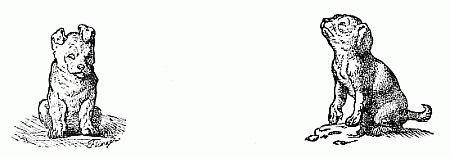
So Fluffy sang her little song; and in case any of you children should like to sing it for yourselves, I will write down the music as well as the words.
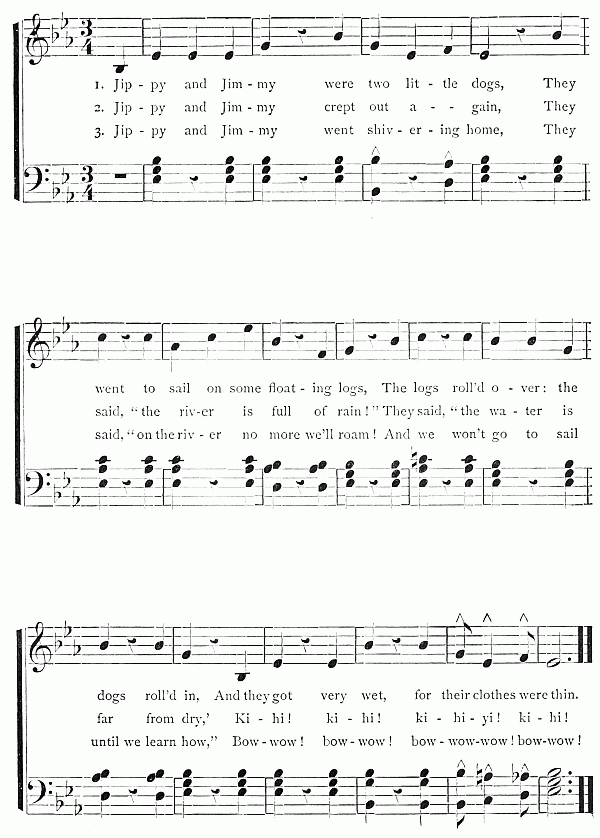
"Bravo! Fluff," I said. "That is a good song, and they were sensible little dogs. It is well to be sure about understanding a thing before one attempts it, as Master Nibble would find out, if he were once mounted on this frisky moonbeam, at which he is casting such longing eyes." "It does look so delightful!" sighed Nibble. "But after all, the cloud is delightful too, and I suppose I should be cold if I were not wrapped up in it. How far north are we now, Mr. Moonman?" "Somewhere near the coast of Labrador," I replied. "Little Winds, lower the cloud a bit, that the mice may see the fishing fleet. The fishermen are all asleep, but the boats are a pretty sight, when they can be seen through the fog."
Lightly and softly the cloud floated downward, and as they descended, the merry Winds blew the wreaths of fog away, so that we could see the bare brown coast, and the hundreds of fishing-smacks lying at anchor. Lights gleamed at bow and stern. They danced about, as the little vessels rocked gently on the waves, which seemed to be half asleep, singing soft lullabies to each other.
"Ripple blue and ripple green,
Foaming crest and silver sheen,
Sleep beneath the moon!
Till the daylight comes again,
Waking us to restless pain
All too soon."
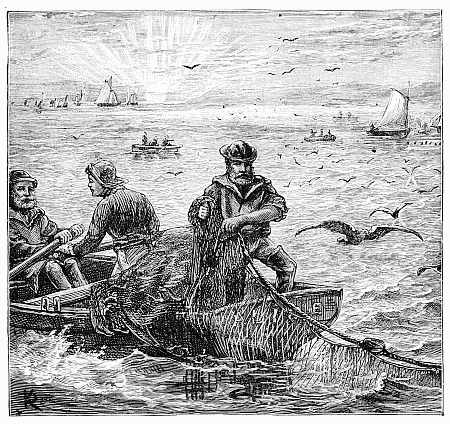
"Yes," I said, "this is a holiday-time for the waves, and still more for the fish. All day long the poor creatures have a hard time of it, for hundreds and hundreds of skilful and eager fishermen are on the look-out for them. But at night their only enemies are those who live in the water, and I have heard that the whale and the swordfish go to bed at ten o'clock regularly, and never stir from their trundle-beds till six o'clock in the morning. I do not state that as a fact, however, because I am not positively sure about it." "Dear me!" said Brighteyes. "Just fancy a whale in a trundle-bed! how very queer he would look!" "Does he spout when he's asleep?" inquired Fluff anxiously. "Because the bedclothes would get wet, you know, and he would take cold!"
Here, I am sorry to say, the other mice laughed, and Fluffy does not like to be laughed at, so she was silent. Then said one of the seven Winds, "I never saw any of them in bed, but I have seen their races, and very funny they are. They have hurdle-races every Tuesday afternoon, jumping over the fragments of wrecks which are strewn all over the bottom of the sea. They lead a merry life, those whales; what with hurdle-races and fish hunts and spouting matches. If one could not live in the air, the next best thing would be to live in the water, I think. Hi! yonder is a fleet of icebergs. Look, little Heavyones! that is a sight worth seeing."