
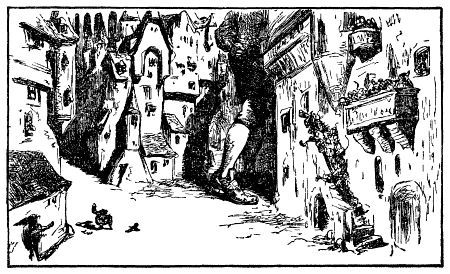
I desired the secretary to present my humble duty to the emperor, and to let him know that I thought it would not become me, who was a foreigner, to interfere with parties; but I was ready, with the hazard of my life, to defend his person and state against all invaders.
CHAPTER V.
THE AUTHOR, BY AN EXTRAORDINARY STRATAGEM, PREVENTS AN INVASION. A HIGH TITLE OF HONOR IS CONFERRED UPON HIM. AMBASSADORS ARRIVE FROM THE EMPEROR OF BLEFUSCU, AND SUE FOR PEACE. THE EMPRESS'S APARTMENT ON FIRE, BY ACCIDENT; THE AUTHOR INSTRUMENTAL IN SAVING THE REST OF THE PALACE.
The empire of Blefuscu is an island, situate to the north northeast of Lilliput, from whence it is parted only by a channel of eight hundred yards wide. I had not yet seen it; and upon this notice of an intended invasion, I avoided appearing on that side of the coast, for fear of being discovered by some of the enemy's ships, who had received no intelligence of me, all intercourse between the two empires having been strictly forbidden during the war, upon the pain of death, and an embargo[26] laid by our emperor upon all vessels whatsoever.
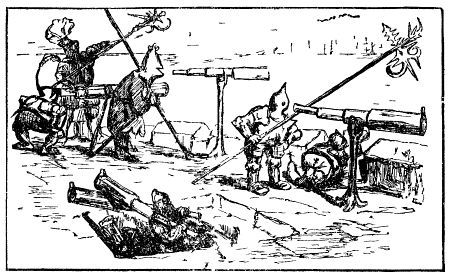
I communicated to his majesty a project I had formed, of seizing the enemy's whole fleet; which, as our scouts assured us, lay at anchor in the harbor, ready to sail with the first fair wind. I consulted the most experienced seamen upon the depth of the channel, which they had often plumbed; who told me, that in the middle, at high water, it was seventy glumgluffs deep, which is about six feet of European measure; and the rest of it fifty glumgluffs at most. I walked towards the northeast coast, over against Blefuscu; where, lying down behind a hillock, I took out my small perspective glass, and viewed the enemy's fleet at anchor, consisting of about fifty men-of-war, and a great number of transports; I then came back to my house, and gave orders (for which I had a warrant) for a great quantity of the strongest cable and bars of iron. The cable was about as thick as packthread, and the bars of the length and size of a knitting needle. I trebled the cable, to make it stronger; and, for the same reason, I twisted three of the iron bars together, bending the extremities into a hook.
Having thus fixed fifty hooks to as many cables, I went back to the northeast coast, and putting off my coat, shoes, and stockings, walked into the sea in my leathern jerkin, about half an hour before high-water. I waded with what haste I could, and swam in the middle about thirty yards, till I felt ground; I arrived at the fleet in less than half an hour. The enemy were so frightened, when they saw me, that they leaped out of their ships, and swam to shore, where there could not be fewer than thirty thousand souls: I then took my tackling, and fastening a hook to the hole at the prow of each, I tied all the cords together at the end.
While I was thus employed, the enemy discharged several thousand arrows, many of which stuck in my hands and face; and, besides the excessive smart, gave me much disturbance in my work. My greatest apprehension was for mine eyes, which I should have infallibly lost, if I had not suddenly thought of an expedient. I kept, among other little necessaries, a pair of spectacles, in a private pocket, which, as I observed before, had escaped the emperor's searchers. These I took out, and fastened as strongly as I could upon my nose, and thus armed, went on boldly with my work, in spite of the enemy's arrows, many of which struck against the glasses of my spectacles, but without any other effect, farther than a little to discompose them.[27] I had now fastened all the hooks, and, taking the knot in my hand, began to pull: but not a ship would stir, for they were all too fast held by their anchors; so that the boldest part of my enterprise remained. I therefore let go the cord, and, leaving the hooks fixed to the ships, I resolutely cut with my knife the cables that fastened the anchors, receiving above two hundred shots in my face and hands; then I took up the knotted end of the cables, to which my hooks were tied, and, with great ease, drew fifty of the enemy's largest men-of-war after me.
The Blefuscudians, who had not the least imagination of what I intended, were at first confounded with astonishment. They had seen me cut the cables, and thought my design was only to let the ships run adrift, or fall foul on each other: but when they perceived the whole fleet moving in order, and saw me pulling at the end, they set up such a scream of grief and despair as it is almost impossible to describe or conceive. When I had got out of danger, I stopped awhile to pick out the arrows that stuck in my hands and face: and rubbed on some of the same ointment that was given me at my first arrival, as I have formerly mentioned. I then took off my spectacles, and waiting about an hour, till the tide was a little fallen, I waded through the middle with my cargo, and arrived safe at the royal port of Lilliput.
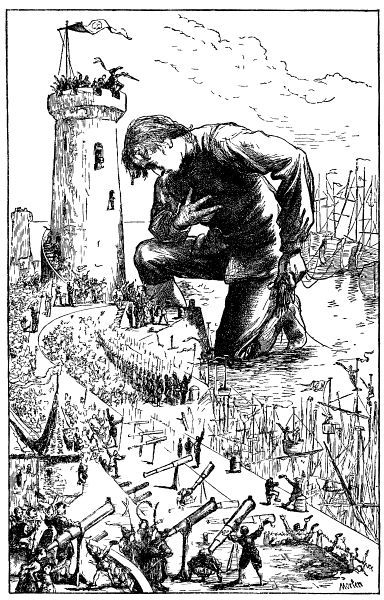
The emperor and his whole court stood on the shore, expecting the issue of this great adventure. They saw the ships move forward in a large half-moon, but could not discern me, who was up to my breast in water. When I advanced to the middle of the channel, they were yet more in pain, because I was under water to my neck. The emperor concluded me to be drowned, and that the enemy's fleet was approaching in an hostile manner: but he was soon eased of his fears; for the channel growing shallower every step I made, I came in a short time within hearing; and holding up the end of the cable, by which the fleet was fastened, I cried in a loud voice, Long live the most puissant[28] emperor of Lilliput! This great prince received me at my landing, with all possible encomiums, and created me a nardac upon the spot, which is the highest title of honor among them.
His majesty desired I would take some other opportunity of bringing all the rest of his enemy's ships into his ports. And so immeasurable is the ambition of princes, that he seemed to think of nothing less than reducing the whole empire of Blefuscu into a province, and governing it by viceroy; of destroying the Big-endian exiles, and compelling that people to break the smaller end of their eggs, by which he would remain the sole monarch of the whole world. But I endeavored to divert him from this design, by many arguments, drawn from the topics of policy, as well as justice. And I plainly protested, that I would never be an instrument of bringing a free and brave people into slavery. And when the matter was debated in council, the wisest part of the ministry were of my opinion.
This open, bold declaration of mine was so opposite to the schemes and politics of his imperial majesty, that he could never forgive me; he mentioned it, in a very artful manner, at council, where, I was told, that some of the wisest appeared, at least by their silence, to be of my opinion; but others, who were my secret enemies, could not forbear some expressions, which by a side-wind reflected on me. And, from this time began an intrigue between his majesty and a junto[29] of ministers maliciously bent against me, which broke out in less than two months, and had like to have ended in my utter destruction. Of so little weight are the greatest services to princes, when put into the balance with a refusal to gratify their passions.
About three weeks after this exploit, there arrived a solemn embassy from Blefuscu, with humble offers of peace; which was soon concluded, upon conditions very advantageous to our emperor, wherewith I shall not trouble the reader. There were six ambassadors, with a train of about five hundred persons; and their entry was very magnificent, suitable to the grandeur of their master, and the importance of their business. When their treaty was finished, wherein I did them several good offices, by the credit I now had, or at least appeared to have at court, their excellencies, who were privately told how much I had been their friend, made me a visit in form. They began with many compliments upon my valor and generosity, invited me to that kingdom, in the emperor their master's name, and desired me to show some proofs of my prodigious strength, of which they had heard so many wonders; wherein I readily obliged them, but shall not trouble the reader with the particulars.
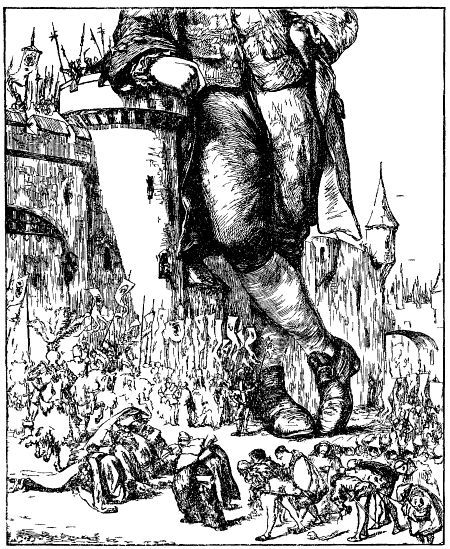
When I had for some time entertained their Excellencies, to their infinite satisfaction and surprise, I desired they would do me the honor to present my most humble respects to the emperor their master, the renown of whose virtues had so justly filled the whole world with admiration, and whose royal person I resolved to attend, before I returned to my own country. Accordingly, the next time I had the honor to see our emperor, I desired his general license to wait on the Blefuscudian monarch, which he was pleased to grant me, as I could plainly perceive, in a very cold manner; but could not guess the reason, till I had a whisper from a certain person, that Flimnap and Bolgolam had represented my intercourse with those ambassadors as a mark of disaffection, from which, I am sure, my heart was wholly free. And this was the first time I began to conceive some imperfect idea of courts and ministers.
It is to be observed, that these ambassadors spoke to me by an interpreter, the languages of both empires differing as much from each other as any two in Europe, and each nation priding itself upon the antiquity, beauty, and energy of its own tongue, with an avowed contempt for that of its neighbor; yet our emperor, standing upon the advantage he had got by the seizure of their fleet, obliged them to deliver their credentials, and make their speech in the Lilliputian tongue.
And it must be confessed, that, from the great intercourse of trade and commerce between both realms; from the continual reception of exiles, which is mutual among them; and from the custom in each empire, to send their young nobility, and richer gentry, to the other, in order to polish themselves, by seeing the world, and understanding men and manners; there are few persons of distinction, or merchants, or, seamen, who dwell in the maritime parts, but what can hold conversation in both tongues, as I found some weeks after, when I went to pay my respects to the Emperor of Blefuscu, which, in the midst of great misfortunes, through the malice of my enemies, proved a very happy adventure to me, as I shall relate in its proper place.
The reader may remember, that when I signed those articles, upon which I recovered my liberty, there were some which I disliked, upon account of their being too servile; neither could anything but an extreme necessity have forced me to submit. But, being now a nardac of the highest rank in that empire, such offices were looked upon as below my dignity, and the emperor, to do him justice, never once mentioned them to me. However, it was not long before I had an opportunity of doing his majesty, at least as I then thought, a most signal service. I was alarmed at midnight with the cries of many hundred people at my door, by which, being suddenly awaked, I was in some kind of terror. I heard the word burglum repeated incessantly.
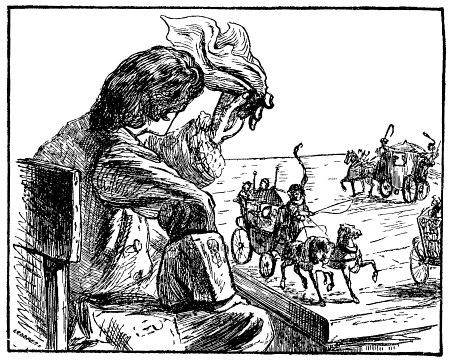
Several of the emperor's court, making their way through the crowd, entreated me to come immediately to the palace, where her imperial majesty's apartment was on fire, by the carelessness of a maid of honor, who fell asleep while she was reading a romance. I got up in an instant; and orders being given to clear the way before me, and it being likewise a moonshine night, I made a shift to get to the palace, without trampling on any of the people. I found they had already applied ladders to the walls of the apartment, and were well provided with buckets, but the water was at some distance. These buckets were about the size of a large thimble, and the poor people supplied me with them as fast as they could; but the flame was so violent that they did little good. I might easily have stifled it with my coat, which I unfortunately left behind me for haste, and came away only in my leathern jerkin. The case seemed wholly desperate and deplorable, and this magnificent palace would have infallibly been burnt down to the ground, if, by a presence of mind unusual to me, I had not suddenly thought of an expedient by which in three minutes the fire was wholly extinguished, and the rest of that noble pile, which had cost so many ages in erecting, preserved from destruction.
It was now daylight, and I returned to my house, without waiting to congratulate with the emperor; because, although I had done a very eminent piece of service, yet I could not tell how his majesty might resent the manner by which I had performed it: for, by the fundamental laws of the realm, it is capital in any man, of what quality soever, to even touch the empress or the royal princesses without invitation. But I was a little comforted by a message from his majesty, that he would give orders to the grand justiciary for passing my pardon in form, which, however, I could not obtain. And I was privately assured that the empress, conceiving the greatest abhorrence of me, and, in the presence of her chief confidants, could not forbear vowing revenge.
CHAPTER VI.
OF THE INHABITANTS OF LILLIPUT; THEIR LEARNING, LAWS, AND CUSTOMS; THE MANNER OF EDUCATING THEIR CHILDREN. THE AUTHOR'S WAY OF LIVING IN THAT COUNTRY.
Although I intend to leave the description of this empire to a particular treatise, yet, in the meantime, I am content to gratify the curious reader with some general ideas. As the common size of the natives is somewhat under six inches high, so there is an exact proportion in all other animals, as well as plants and trees: for instance, the tallest horses and oxen are between four and five inches in height, the sheep an inch and a half, more or less; their geese about the bigness of a sparrow, and so the several gradations downwards, till you come to the smallest, which, to my sight, were almost invisible; but nature hath adapted the eyes of the Lilliputians to all objects proper for their view; they see with great exactness, but at no great distance. And, to show the sharpness of their sight, towards objects that are near, I have been much pleased with observing a cook pulling[30] a lark, which was not so large as a common fly; and a young girl threading an invisible needle with invisible silk.
Their tallest trees are about seven feet high; I mean some of those in the great royal park, the tops whereof I could but just reach with my fist clenched. The other vegetables are in the same proportion; but this I leave to the reader's imagination.
I shall say but little at present of their learning, which, for many ages, hath flourished in all its branches among them: but their manner of writing is very peculiar, being neither from the left to the right like the Europeans; nor from the right to the left, like the Arabians; nor from up to down, like the Chinese, but aslant, from one corner of the paper to the other, like ladies in England.
They bury their dead with their heads directly downwards, because they hold an opinion, that in eleven thousand moons they are all to rise again, in which period the earth (which they conceive to be flat) will turn upside down, and by this means they shall, at the resurrection, be found ready, standing on their feet. The learned among them confess the absurdity of this doctrine, but the practice still continues, in compliance to the vulgar.
There are some laws and customs in this empire very peculiar; and, if they were not so directly contrary to those of my own dear country, I should be tempted to say a little in their justification. It is only to be wished they were as well executed. The first I shall mention relates to informers. All crimes against the state are punished here with the utmost severity; but, if the person accused maketh his innocence plainly to appear upon his trial, the accuser is immediately put to an ignominious death; and, out of his goods, or lands, the innocent person is quadruply recompensed for the loss of his time, for the danger he underwent, for the hardship of his imprisonment, and for all the charges he hath been at in making his defence, or, it that fund be deficient, it is largely supplied by the crown. The emperor also confers on him some public mark of his favor, and proclamation is made of his innocence through the whole city.
They look upon fraud as a greater crime than theft, and therefore seldom fail to punish it with death; for they allege, that care and vigilance, with a very common understanding, may preserve a man's goods from thieves, but honesty has no fence against superior cunning; and, since it is necessary that there should be a perpetual intercourse of buying and selling, and dealing upon credit, where fraud is permitted and connived at, or hath no law to punish it, the honest dealer is always undone, and the knave gets the advantage. I remember, when I was once interceding with the king for a criminal, who had wronged his master of a great sum of money, which he had received by order, and run away with, and happening to tell his majesty, by way of extenuation, that it was only a breach of trust, the emperor thought it monstrous in me, to offer as a defence the greatest aggravation of the crime; and, truly, I had little to say in return, farther than the common answer, that different nations had different customs; for, I confess, I was heartily ashamed.
Although we usually call reward and punishment the two hinges upon which all government turns, yet I could never observe this maxim to be put in practice by any nation except that of Lilliput. Whoever can there bring sufficient proof that he hath strictly observed the laws of his country for seventy-three moons, hath a claim to certain privileges, according to his quality and condition of life, with a proportionable sum of out of a fund appropriated for that use; he likewise acquires the title of snillpall, or legal, which is added to his name, but doth not descend to his posterity. And these people thought it a prodigious defect of policy among us, when I told them that our laws were enforced only by penalties, without any mention of reward. It is upon this account that the image of Justice, in their courts of judicature, is formed with six eyes, two before, as many behind, and on each side one, to signify circumspection, with a bag of gold open in her right hand, and a sword sheath in her left, to show she was more disposed to reward than to punish.
In choosing persons for all employments, they have more regard to good morals than to great abilities; for, since government is necessary to mankind, they believe that the common size of human understanding is fitted to some station or other, and that Providence never intended to make the management of public affairs a mystery, to be comprehended only by a few persons of sublime genius, of which there seldom are three born in an age; but they suppose truth, justice, temperance, and the like, to be in every man's power, the practice of which virtues, assisted by experience, and a good intention, would qualify any man for the service of his country, except where a course of study is required. But they thought the want of moral virtues was so far from being supplied by superior endowments of the mind, that employments could never be put into such dangerous hands as those of persons so qualified; and at least, that the mistakes committed by ignorance, in a virtuous disposition, would never be of such fatal consequences to the public weal as the practices of a man whose inclinations led him to be corrupt, and who had great abilities to manage, to multiply, and defend his corruptions.
In like manner, the disbelief of a Divine Providence renders a man incapable of holding any public station; for, since kings avow themselves to be the deputies of Providence, the Lilliputians think nothing can be more absurd than for a prince to employ such men as disown the authority under which he acts.
In relating these and the following laws, I would only be understood to mean the original institutions, and not the most scandalous corruptions into which these people are fallen, by the degenerate nature of man. For, as to that infamous practice of acquiring great employments by dancing on the ropes, or badges of favor and distinction by leaping over sticks, and creeping under them, the reader is to observe, that they were first introduced by the grandfather of the emperor, now reigning, and grew to the present height by the gradual increase of party and faction.
Ingratitude is, among them, a capital crime, as we read it to have been in some other countries; for they reason thus, that whoever makes ill returns to his benefactor, must needs be a common enemy to the rest of mankind, from whom he hath received no obligation, and therefore such a man is not fit to live.
Their notions relating to the duties of parents and children differ extremely from ours. Their opinion is, that parents are the last of all others to be trusted with the education of their own children; and, therefore, they have, in every town, public nurseries, where all parents, except cottagers and laborers, are obliged to send their infants of both sexes to be reared and educated, when they come to the age of twenty moons, at which time they are supposed to have some rudiments of docility. These schools are of several kinds, suited to different qualities, and to both sexes. They have certain professors, well skilled in preparing children for such a condition of life as befits the rank of their parents, and their own capacities as well as inclinations. I shall first say something of the male nurseries, and then of the female.
The nurseries for males of noble or eminent birth are provided with grave and learned professors, and their several deputies. The clothes and food of the children are plain and simple. They are bred up in the principles of honor, justice, courage, modesty, clemency, religion, and love of their country; they are always employed in some business, except in the times of eating and sleeping, which are very short, and two hours for diversions, consisting of bodily exercises. They are dressed by men till four years of age, and then are obliged to dress themselves, although their quality be ever so great; and the women attendants, who are aged proportionably to ours at fifty, perform only the most menial offices. They are never suffered to converse with servants, but go together in smaller or greater numbers to take their diversions, and always in the presence of a professor, or one of his deputies; whereby they avoid those early bad impressions of folly and vice, to which our children are subject. Their parents are suffered to see them only twice a year; the visit to last but an hour; they are allowed to kiss the child at meeting and parting; but a professor, who always stands by on those occasions, will not suffer them to whisper, or use any fondling expressions, or bring any presents of toys, sweetmeats, and the like.
The pension from each family, for the education and entertainment of a child, upon failure of due payment, is levied by the emperor's officers.
The nurseries for children of ordinary gentlemen, merchants, traders, and handicrafts, are managed proportionally after the same manner; only those designed for trades are put out apprentices at eleven years old, whereas those persons of quality continue in their exercises till fifteen, which answers to twenty-one with us; but the confinement is gradually lessened for the last three years.
In the female nurseries, the young girls of quality are educated much like the males, only they are dressed by orderly servants of their own sex; but always in the presence of a professor or deputy, till they come to dress themselves, which is at five years old. And if it be found that these nurses ever presume to entertain the girls with frightful or foolish stories, or the common follies practised by the chambermaids among us, they are publicly whipped thrice about the city, imprisoned for a year, and banished for life to the most desolate part of the country. Thus, the young ladies there are as much ashamed of being cowards and fools as the men, and despise all personal ornaments beyond decency and cleanliness: neither did I perceive any difference in their education, made by their difference of sex, only that the exercises of the women were not altogether so robust, and that some rules were given them relating to domestic life, and a smaller compass of learning was enjoined them: for their maxim is that, among people of quality, a wife should be always a reasonable and agreeable companion, because she cannot always be young. When the girls are twelve years old, which among them is the marriageable age, their parents or guardians take them home, with great expressions of gratitude to the professors, and seldom without tears of the young lady and her companions.
In the nurseries of females of the meaner sort, the children are instructed in all kinds of works proper for their sex and their several degrees; those intended for apprentices are dismissed at seven years old, the rest are kept to eleven.
The meaner[31] families who have children at these nurseries are obliged, besides their annual pension, which is as low as possible, to return to the steward of the nursery a small monthly share of their gettings, to be a portion[32] for the child; and, therefore, all parents are limited in their expenses by the law. For the Lilliputians think nothing can be more unjust than for people to leave the burden of supporting their children on the public. As to persons of quality, they give security to appropriate a certain sum for each child, suitable to their condition; and these funds are always managed with good husbandry and the most exact justice.
The cottagers and laborers keep their children at home, their business being only to till and cultivate the earth, and therefore their education is of little consequence to the public; but the old and diseased among them are supported by hospitals; for begging is a trade unknown in this empire.
And here it may perhaps divert the curious reader to give some account of my domestic,[33] and my manner of living in this country, during a residence of nine months and thirteen days. Having a head for mechanics, and being likewise forced by necessity, I had made for myself a table and chair, convenient enough, out of the largest trees in the royal park. Two hundred sempstresses were employed to make me shirts, and linen for my bed and table, all of the strongest and coarsest kind they could get; which, however, they were forced to quilt together in several folds, for the thickest was some degrees finer than lawn. Their linen is usually three inches wide, and three feet make a piece.
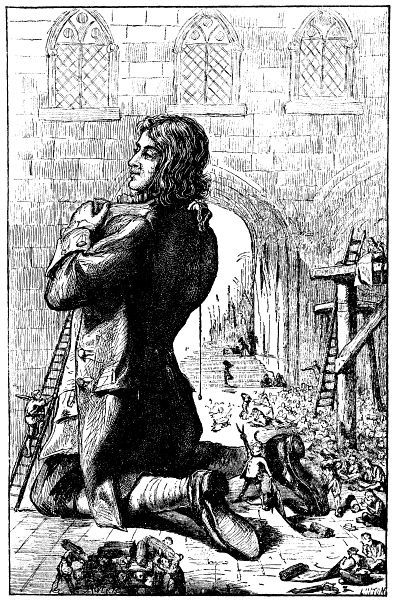
The sempstresses took my measure as I lay on the ground, one standing at my neck, and another at my mid-leg, with a strong cord extended that each held by the end, while a third measured the length of the cord with a rule of an inch long. Then they measured my right thumb, and desired no more; for, by a mathematical computation, that twice round the thumb is once round the wrist, and so on to the neck and the waist, and by the help of my old shirt, which I displayed on the ground before them for a pattern, they fitted me exactly. Three hundred tailors were employed in the same manner to make me clothes; but they had another contrivance for taking my measure. I kneeled down, and they raised a ladder from the ground to my neck; upon this ladder one of them mounted, and let fall a plumb-line from my collar to the floor, which just answered the length of my coat; but my waist and arms I measured myself. When my clothes were finished, which was done in my house (for the largest of theirs would not have been able to hold them), they looked like the patchwork made by the ladies in England, only that mine were all of a color.
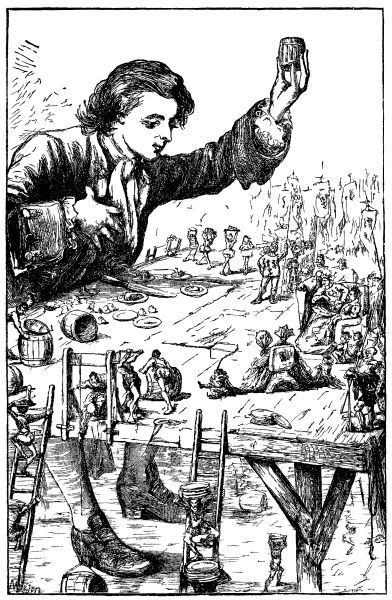
I had three hundred cooks to dress my victuals, in little convenient huts built about my house, where they and their families lived, and prepared me two dishes a-piece. I took up twenty waiters in my hand, and placed them on the table; an hundred more attended below on the ground, some with dishes of meat, and some with barrels of wine and other liquors, flung on their shoulders; all of which the waiters above drew up, as I wanted, in a very ingenious manner, by certain cords, as we draw the bucket up a well in Europe. A dish of their meat was a good mouthful, and a barrel of their liquor a reasonable draught. Their mutton yields to ours, but their beef is excellent, I have had a sirloin so large that I have been forced to make three bites of it; but this is rare. My servants were astonished to see me eat it, bones and all, as in our country we do the leg of a lark. Their geese and turkeys I usually eat at a mouthful, and I must confess they far exceed ours. Of their smaller fowl, I could take up twenty or thirty at the end of my knife.
One day his imperial majesty, being informed of my way of living, desired that himself and his royal consort, with the young princes of the blood of both sexes, might have the happiness, as he was pleased to call it, of dining with me. They came accordingly, and I placed them in chairs of state upon my table, just over against me, with their guards about them. Flimnap, the lord high treasurer, attended there likewise, with his white staff; and I observed he often looked on me with a sour countenance, which I would not seem to regard, but eat more than usual, in honor to my dear country, as well as to fill the court with admiration. I have some private reasons to believe that this visit from his majesty gave Flimnap an opportunity of doing me ill offices to his master. That minister had always been my secret enemy, though he outwardly caressed me more than was usual to the moroseness of his nature. He represented to the emperor the low condition of his treasury; that he was forced to take up money at a great discount; that exchequer bills[34] would not circulate under nine per cent, below par; that I had cost his majesty above a million and a half of sprugs (their greatest gold coin, about the bigness of a spangle); and, upon the whole, that it would be advisable in the emperor to take the first fair occasion of dismissing me.
CHAPTER VII.
THE AUTHOR, BEING INFORMED OF A DESIGN TO ACCUSE HIM OF HIGH TREASON, MAKES HIS ESCAPE TO BLEFUSCU. HIS RECEPTION THERE.
Before I proceed to give an account of my leaving this kingdom, it may be proper to inform the reader of a private intrigue which had been for two months forming against me.
I had been hitherto all my life a stranger to courts, for which I was unqualified by the meanness of my condition. I had indeed heard and read enough of the dispositions of great princes and ministers, but never expected to have found such terrible effects of them in so remote a country, governed, as I thought, by very different maxims from those in Europe.
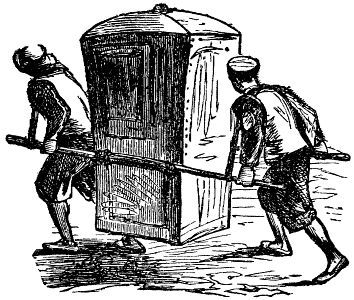
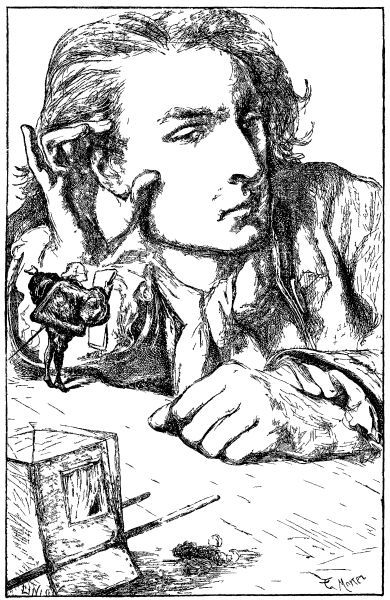
When I was just preparing to pay my attendance on the emperor of Blefuscu, a considerable person at court (to whom I had been very serviceable, at a time when he lay under the highest displeasure of his imperial majesty) came to my house very privately at night, in a close chair,[35] and without sending his name, desired admittance. The chairmen were dismissed; I put the chair, with his lordship in it, into my coat-pocket; and, giving orders to a trusty servant to say I was indisposed and gone to sleep, I fastened the door of my house, placed the chair on the table, according to my usual custom, and sat down by it. After the common salutations were over, observing his lordship's countenance full of concern, and inquiring into the reason, he desired I would hear him with patience, in a matter that highly concerned my honor and my life. His speech was to the following effect, for I took notes of it as soon as he left me:—
You are to know, said he, that several committees of council have been lately called in the most private manner on your account; and it is but two days since his majesty came to a full resolution.
You are very sensible that Skyrris Bolgolam (galbet or high-admiral) hath been your mortal enemy almost ever since your arrival: his original reasons I know not; but his hatred is increased since your great success against Blefuscu, by which his glory, as admiral, is much obscured. This lord, in conjunction with Flimnap the high treasurer, whose enmity against you is notorious, Limtoc the general, Lalcon the chamberlain, and Balmuff the grand justiciary, have prepared articles of impeachment against you, for treason, and other capital crimes.
This preface made me so impatient, being conscious of my own merits and innocence, that I was going to interrupt; when he entreated me to be silent, and thus proceeded.
Out of gratitude for the favors you have done for me, I procured information of the whole proceedings, and a copy of the articles; wherein I venture my head for your service.
ARTICLES OF IMPEACHMENT AGAINST QUINBUS FLESTRIN, THE MAN-MOUNTAIN.
ARTICLE I.
Whereas, by a statute made in the reign of his Imperial Majesty Calin Deffar Plune, it is enacted, That whoever shall lay hands upon the empress, or upon any of the royal children, shall be liable to the pains and penalties of high treason. Notwithstanding, the said Quinbus Flestrin, in open breach of the said law, under color of extinguishing the fire kindled in the apartment of his Majesty's most dear imperial consort, did maliciously, and traitorously, pull her by the arms, and lift her high in the air in both his hands, against the statute in that case provided, &c., against the duty, &c.
ARTICLE II.
That the said Quinbus Flestrin, having brought the imperial fleet of Blefuscu into the royal port, and being afterwards commanded by his imperial majesty to seize all the other ships of the said empire of Blefuscu, and reduce that empire to a province, to be governed by a viceroy from hence, and to destroy and put to death, not only all the Big-endian exiles, but likewise all the people of that empire who would not immediately forsake the Big-endian heresy. He, the said Flestrin, like a false traitor against his most auspicious, serene, imperial majesty, did petition to be excused from the said service, upon pretence of unwillingness to force the consciences or destroy the liberties and lives of an innocent people.
ARTICLE III.
That, whereas certain ambassadors arrived from the court of Blefuscu, to sue for peace in his majesty's court; he, the said Flestrin, did, like a false traitor, aid, abet, comfort, and divert the said ambassadors, although he knew them to be servants to a prince who was lately an open enemy to his imperial majesty, and in open war against his said majesty.
ARTICLE IV.
That the said Quinbus Flestrin, contrary to the duty of a faithful subject, is now preparing to make a voyage to the court and empire of Blefuscu, for which he hath received only verbal license from his imperial majesty; and under color of the said license, doth falsely and traitorously intend to take the said voyage, and thereby to aid, comfort, and abet the emperor of Blefuscu, so late an enemy, and in open war with his imperial majesty aforesaid.
There are some other articles, but these are the most important, of which I have read you an abstract.
In the several debates upon this impeachment, it must be confessed that his majesty gave many marks of his great lenity, often urging the services you had done him, and endeavoring to extenuate your crimes. The treasurer and admiral insisted that you should be put to the most painful and ignominious death, by setting fire on your house at night; and the general was to attend, with twenty thousand men armed with poisoned arrows, to shoot you on the face and hands. Some of your servants were to have private orders to strew a poisonous juice on your shirts and sheets, which would soon make you tear your own flesh, and die in the utmost torture. The general came into the same opinion; so that for a long time there was a majority against you: but his majesty resolving, if possible, to spare your life, at last brought off the chamberlain.
Upon this incident, Reldresal, principal secretary for private affairs, who always approved himself your true friend, was commanded by the emperor to deliver his opinion, which he accordingly did; and therein justified the good thoughts you have of him. He allowed your crimes to be great, but that still there was room for mercy, the most commendable virtue in a prince, and for which his majesty was so justly celebrated. He said, the friendship between you and him was so well known to the world, that perhaps the most honorable board might think him partial; however, in obedience to the command he had received, he would freely offer his sentiments; that if his majesty, in consideration of your services, and pursuant to his own merciful disposition, would please to spare your life, and only give orders to put out both your eyes, he humbly conceived that, by this expedient, justice might in some measure be satisfied, and all the world would applaud the lenity of the emperor, as well as the fair and generous proceedings of those who have the honor to be his counsellors: that the loss of your eyes would be no impediment to your bodily strength, by which you might still be useful to his majesty: that blindness is an addition to courage, by concealing dangers from us: that the fear you had for your eyes was the greatest difficulty in bringing over the enemy's fleet: and it would be sufficient for you to see by the eyes of the ministers, since the greatest princes do no more.
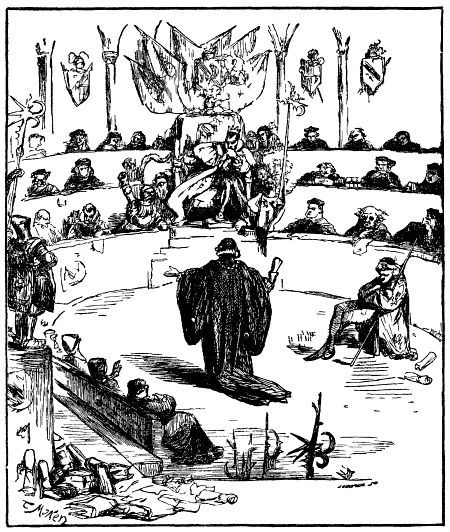
This proposal was received with the utmost disapprobation by the whole board. Bolgolam, the admiral, could not preserve his temper, but rising up in fury, said he wondered how the secretary durst presume to give his opinion for preserving the life of a traitor: that the services you had performed were, by all true reasons of state, the great aggravation of your crimes: that you, who extinguished the fire in that unprincipled manner, might at another time inundate and drown the whole palace; and the same strength, which enabled you to bring over the enemy's fleet, might serve, upon the first discontent, to carry it back: that he had good reasons to think you were a Big-endian in your heart; and, as treason begins in the heart, before it appears in overt acts, so he accused you as a traitor on that account, and therefore insisted you should be put to death.
The treasurer was of the same opinion. He showed to what straits his majesty's revenue was reduced, by the charge of maintaining you, which would soon grow insupportable. That the secretary's expedient of putting out your eyes was so far from being a remedy against this evil, that it would probably increase it, as is manifest from the common practice of blinding some sort of fowls, after which they fed the faster, and grew sooner fat. That his sacred majesty, and the council, who are your judges, were to their own consciences fully convinced of your guilt, which was a sufficient argument to condemn you to death without the formal proofs required by the strict letter of the law.
But his imperial majesty, fully determined against capital punishment, was graciously pleaded to say, that since the council thought the loss of your eyes too easy a censure, some other might be inflicted hereafter. And your friend, the secretary, humbly desiring to be heard again, in answer to what the treasurer had objected concerning the great charge his majesty was at in maintaining you, said that his excellency, who had the sole disposal of the emperor's revenue, might easily provide against that evil, by gradually lessening your establishment; by which, for want of sufficient food, you would grow weak and faint, and lose your appetite, and consume in a few months; neither would the stench of your carcase be then so dangerous when it should become more than half diminished; and, immediately upon your death, five or six thousand of his majesty's subjects might in two or three days cut your flesh from your bones, take it away by cart-loads, and bury it in distant parts, to prevent infection, leaving the skeleton as a monument of admiration to posterity.
Thus, by the great friendship of the secretary, the whole affair was compromised. It was strictly enjoined that the project of starving you by degrees should be kept a secret, but the sentence of putting out your eyes was entered on the books, none dissenting except Bolgolam, the admiral, who, being a creature of the empress, was perpetually instigated by her majesty to insist upon your death, she having borne perpetual malice against you, on account of that illegal method you took to remove her and her children the night of the fire.
In three days, your friend the secretary will be directed to come to your house and read before you the articles of impeachment; and then to signify the great lenity and favor of his majesty and council, whereby you are only condemned to the loss of your eyes, which his majesty doth not question you will gratefully and humbly submit to; and twenty of his majesty's surgeons will attend, in order to see the operation well performed, by discharging very sharp-pointed arrows into the balls of your eyes as you lie on the ground.
I leave to your prudence what measures you will take; and, to avoid suspicion, I must immediately return, in as private a manner as I came.
His lordship did so, and I remained alone, under many doubts and perplexities of mind.
It was a custom, introduced by this prince and his ministry (very different, as I have been assured, from the practices of former times), that after the court had decreed any cruel execution either to gratify the monarch's resentment or the malice of a favorite, the emperor always made a speech to his whole council, expressing his great lenity and tenderness, as qualities known and confessed by all the world. This speech was immediately published through the kingdom; nor did anything terrify the people so much as those encomiums on his majesty's mercy; because it was observed that, the more these praises were enlarged and insisted on, the more inhuman was the punishment, and the sufferer more innocent. Yet, as to myself, I must confess, having never been designed for a courtier, either by my birth or education, I was so ill a judge of things that I could not discover the lenity and favor of this sentence, but conceived it (perhaps erroneously) rather to be rigorous than gentle, I sometimes thought of standing my trial; for although I could not deny the facts alleged in the several articles, yet I hoped they would admit of some extenuation. But having in my life perused many state-trials, which I ever observed to terminate as the judges thought fit to direct, I durst not rely on so dangerous a decision, in so critical a juncture, and against such powerful enemies. Once I was strongly bent upon resistance, for, while I had liberty, the whole strength of that empire could hardly subdue me, and I might easily with stones pelt the metropolis to pieces; but I soon rejected that project with horror, by remembering the oath I had made to the emperor, the favors I received from him, and the high title of nardac he conferred upon me. Neither had I so soon learned the gratitude of courtiers as to persuade myself that his majesty's present seventies acquitted me of all past obligations.
At last I fixed upon a resolution, for which it is probable I may incur some censure, and not unjustly; for I confess I owe the preserving mine eyes, and consequently my liberty, to my own great rashness and want of experience; because if I had then known the nature of princes and ministers, which I have since observed in many other courts, and their methods of treating criminals less obnoxious than myself, I should with great alacrity and readiness have submitted to so easy a punishment. But, hurried on by the precipitancy of youth, and having his imperial majesty's license to pay my attendance upon the emperor of Blefuscu, I took this opportunity, before the three days were elapsed, to send a letter to my friend the secretary, signifying my resolution of setting out that morning for Blefuscu pursuant to the leave I had got; and, without waiting for an answer, I went to that side of the island where our fleet lay. I seized a large man-of-war, tied a cable to the prow, and lifting up the anchors, I stript myself, put my clothes (together with my coverlet, which I carried under my arm) into the vessel, and drawing it after me, between wading and swimming arrived at the royal port of Blefuscu, where the people had long expected me; they lent me two guides to direct me to the capital city, which is of the same name. I held them in my hands until I came within two hundred yards of the gate, and desired them to signify my arrival to one of the secretaries, and let him know I there waited his majesty's command. I had an answer in about an hour, that his majesty, attended by the royal family and great officers of the court, was coming out to receive me. I advanced a hundred yards. The emperor and his train alighted from their horses, the empress and ladies from their coaches, and I did not perceive they were in any fright or concern. I lay on the ground to kiss his majesty's and the empress's hand.