
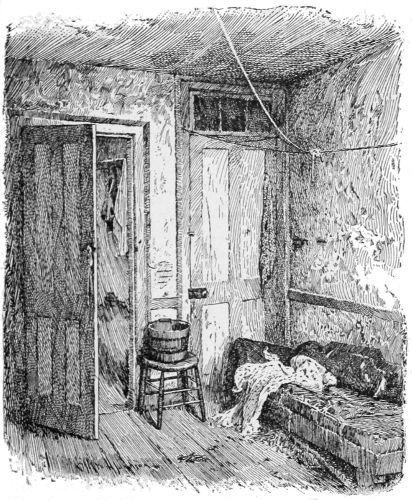
The 135,595 families inhabited no fewer than 31,000 different tenements. I say tenements advisedly, though the society calls them buildings, because at least ninety-nine per cent. were found in the big barracks, the rest in shanties scattered here and there, and now and then a fraud or an exceptional case of distress in a dwelling-house of better class. Here, undoubtedly, allowance must be made for the constant moving about of those who live on charity, which enables one active beggar to blacklist a dozen houses in the year. Still the great mass of the tenements are shown to be harboring alms-seekers. They might almost as safely harbor the small-pox. That scourge is not more contagious than the alms-seeker’s complaint. There are houses that have been corrupted through and through by this pestilence, until their very atmosphere breathes beggary. More than a hundred and twenty pauper families have been reported from time to time as living in one such tenement.
The truth is that pauperism grows in the tenements as naturally as weeds in a garden lot. A moral distemper, like crime, it finds there its most fertile soil. All the surroundings of tenement-house life favor its growth, and where once it has taken root it is harder to dislodge than the most virulent of physical diseases. The thief is infinitely easier to deal with than the pauper, because the very fact of his being a thief presupposes some bottom to the man. Granted that it is bad, there is still something, a possible handle by which to catch him. To the pauper there is none. He is as hopeless as his own poverty. I speak of the pauper, not of the honestly poor. There is a sharp line between the two; but athwart it stands the tenement, all the time blurring and blotting it out. “It all comes down to character in the end,” was the verdict of a philanthropist whose life has been spent wrestling with this weary problem. And so it comes down to the tenement, the destroyer of individuality and character everywhere. “In nine years,” said a wise and charitable physician, sadly, to me, “I have known of but a single case of permanent improvement in a poor tenement family.” I have known of some, whose experience, extending over an even longer stretch, was little better.
The beggar follows the “tough’s” rule of life that the world owes him a living, but his scheme of collecting it stops short of violence. He has not the pluck to rob even a drunken man. His highest flights take in at most an unguarded clothes-line, or a little child sent to buy bread or beer with the pennies he clutches tightly as he skips along. Even then he prefers to attain his end by stratagem rather than by force, though occasionally, when the coast is clear, he rises to the height of the bully. The ways he finds of “collecting” under the cloak of undeserved poverty are numberless, and often reflect credit on the man’s ingenuity, if not on the man himself. I remember the shock with which my first experience with his kind—her kind, rather, in this case: the beggar was a woman—came home to me. On my way to and from the office I had been giving charity regularly, as I fondly believed, to an old woman who sat in Chatham Square with a baby done up in a bundle of rags, moaning piteously in sunshine and rain, “Please, help the poor.” It was the baby I pitied and thought I was doing my little to help, until one night I was just in time to rescue it from rolling out of her lap, and found the bundle I had been wasting my pennies upon just rags and nothing more, and the old hag dead drunk. Since then I have encountered bogus babies, borrowed babies, and drugged babies in the streets, and fought shy of them all. Most of them, I am glad to say, have been banished from the street since; but they are still occasionally to be found. It was only last winter that the officers of the Society for the Prevention of Cruelty to Children arrested an Italian woman who was begging along Madison Avenue with a poor little wreck of a girl, whose rags and pinched face were calculated to tug hard at the purse-strings of a miser. Over five dollars in nickles and pennies were taken from the woman’s pockets, and when her story of poverty and hunger was investigated at the family’s home in a Baxter Street tenement, bank-books turned up that showed the Masonis to be regular pauper capitalists, able to draw their check for three thousand dollars, had they been so disposed. The woman was fined $250, a worse punishment undoubtedly than to have sent her to prison for the rest of her natural life. Her class has, unhappily, representatives in New York that have not yet been brought to grief.
Nothing short of making street begging a crime has availed to clear our city of this pest to an appreciable extent. By how much of an effort this result has been accomplished may be gleaned from the fact that the Charity Organization Society alone, in five years, caused the taking up of 2,594 street beggars, and the arrest and conviction of 1,474 persistent offenders. Last year it dealt with 612 perambulating mendicants. The police report only 19 arrests for begging during the year 1889, but the real facts of the case are found under the heading “vagrancy.” In all, 2,633 persons were charged with this offence, 947 of them women. A goodly proportion of these latter came from the low groggeries of the Tenth Ward, where a peculiar variety of the female tramp-beggar is at home, the “scrub.” The scrub is one degree perhaps above the average pauper in this, that she is willing to work at least one day in the week, generally the Jewish Sabbath. The orthodox Jew can do no work of any sort from Friday evening till sunset on Saturday, and this interim the scrub fills out in Ludlow Street. The pittance she receives for this vicarious sacrifice of herself upon the altar of the ancient faith buys her rum for at least two days of the week at one of the neighborhood “morgues.” She lives through the other four by begging. There are distilleries in Jewtown, or just across its borders, that depend almost wholly on her custom. Recently, when one in Hester Street was raided because the neighbors had complained of the boisterous hilarity of the hags over their beer, thirty two aged “scrubs” were marched off to the station-house.
It is curious to find preconceived notions quite upset in a review of the nationalities that go to make up this squad of street beggars. The Irish head the list with fifteen per cent., and the native American is only a little way behind with twelve per cent., while the Italian, who in his own country turns beggary into a fine art, has less than two per cent. Eight per cent. were Germans. The relative prevalence of the races in our population does not account for this showing. Various causes operate, no doubt, to produce it. Chief among them is, I think, the tenement itself. It has no power to corrupt the Italian, who comes here in almost every instance to work—no beggar would ever emigrate from anywhere unless forced to do so. He is distinctly on its lowest level from the start. With the Irishman the case is different. The tenement, especially its lowest type, appears to possess a peculiar affinity for the worse nature of the Celt, to whose best and strongest instincts it does violence, and soonest and most thoroughly corrupts him. The “native” twelve per cent. represent the result of this process, the hereditary beggar of the second or third generation in the slums.
The blind beggar alone is winked at in New York’s streets, because the authorities do not know what else to do with him. There is no provision for him anywhere after he is old enough to strike out for himself. The annual pittance of thirty or forty dollars which he receives from the city serves to keep his landlord in good humor; for the rest his misfortune and his thin disguise of selling pencils on the street corners must provide. Until the city affords him some systematic way of earning his living by work (as Philadelphia has done, for instance) to banish him from the street would be tantamount to sentencing him to death by starvation. So he possesses it in peace, that is, if he is blind in good earnest, and begs without “encumbrance.” Professional mendicancy does not hesitate to make use of the greatest of human afflictions as a pretence for enlisting the sympathy upon which it thrives. Many New Yorkers will remember the French school-master who was “blinded by a shell at the siege of Paris,” but miraculously recovered his sight when arrested and deprived of his children by the officers of Mr. Gerry’s society. When last heard of he kept a “museum” in Hartford, and acted the overseer with financial success. His sign with its pitiful tale, that was a familiar sight in our streets for years and earned for him the capital upon which he started his business, might have found a place among the curiosities exhibited there, had it not been kept in a different sort of museum here as a memento of his rascality. There was another of his tribe, a woman, who begged for years with a deformed child in her arms, which she was found to have hired at an almshouse in Genoa for fifteen francs a month. It was a good investment, for she proved to be possessed of a comfortable fortune. Some time before that, the Society for the Prevention of Cruelty to Children, that found her out, had broken up the dreadful padrone system, a real slave trade in Italian children, who were bought of poor parents across the sea and made to beg their way on foot through France to the port whence they were shipped to this city, to be beaten and starved here by their cruel masters and sent out to beg, often after merciless mutilation to make them “take” better with a pitying public.
But, after all, the tenement offers a better chance of fraud on impulsive but thoughtless charity, than all the wretchedness of the street, and with fewer risks. To the tender-hearted and unwary it is, in itself, the strongest plea for help. When such a cry goes up as was heard recently from a Mott Street den, where the family of a “sick” husband, a despairing mother, and half a dozen children in rags and dirt were destitute of the “first necessities of life,” it is not to be wondered at that a stream of gold comes pouring in to relieve. It happens too often, as in that case, that a little critical inquiry or reference to the “black list” of the Charity Organization Society, justly dreaded only by the frauds, discovers the “sickness” to stand for laziness, and the destitution to be the family’s stock in trade; and the community receives a shock that for once is downright wholesome, if it imposes a check on an undiscriminating charity that is worse than none at all.
The case referred to furnished an apt illustration of how thoroughly corrupting pauperism is in such a setting. The tenement woke up early to the gold mine that was being worked under its roof, and before the day was three hours old the stream of callers who responded to the newspaper appeal found the alley blocked by a couple of “toughs,” who exacted toll of a silver quarter from each tearful sympathizer with the misery in the attic.
A volume might be written about the tricks of the professional beggar, and the uses to which he turns the tenement in his trade. The Boston “widow” whose husband turned up alive and well after she had buried him seventeen times with tears and lamentation, and made the public pay for the weekly funerals, is not without representatives in New York. The “gentleman tramp” is a familiar type from our streets, and the “once respectable Methodist” who patronized all the revivals in town with his profitable story of repentance, only to fall from grace into the saloon door nearest the church after the service was over, merely transferred the scene of his operations from the tenement to the church as the proper setting for his specialty. There is enough of real suffering in the homes of the poor to make one wish that there were some effective way of enforcing Paul’s plan of starving the drones into the paths of self-support: no work, nothing to eat.
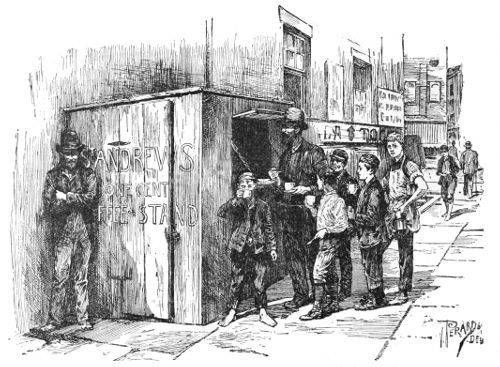
The message came from one of the Health Department’s summer doctors, last July, to the King’s Daughters’ Tenement-house Committee, that a family with a sick child was absolutely famishing in an uptown tenement. The address was not given. The doctor had forgotten to write it down, and before he could be found and a visitor sent to the house the baby was dead, and the mother had gone mad. The nurse found the father, who was an honest laborer long out of work, packing the little corpse in an orange-box partly filled with straw, that he might take it to the Morgue for pauper burial. There was absolutely not a crust to eat in the house, and the other children were crying for food. The great immediate need in that case, as in more than half of all according to the record, was work and living wages. Alms do not meet the emergency at all. They frequently aggravate it, degrading and pauperizing where true help should aim at raising the sufferer to self-respect and self-dependence. The experience of the Charity Organization Society in raising, in eight years, 4,500 families out of the rut of pauperism into proud, if modest, independence, without alms, but by a system of “friendly visitation,” and the work of the Society for Improving the Condition of the Poor and kindred organizations along the same line, shows what can be done by well-directed effort. It is estimated that New York spends in public and private charity every year a round $8,000,000. A small part of this sum intelligently invested in a great labor bureau, that would bring the seeker of work and the one with work to give together under auspices offering some degree of mutual security, would certainly repay the amount of the investment in the saving of much capital now worse than wasted, and would be prolific of the best results. The ultimate and greatest need, however, the real remedy, is to remove the cause—the tenement that was built for “a class of whom nothing was expected,” and which has come fully up to the expectation. Tenement-house reform holds the key to the problem of pauperism in the city. We can never get rid of either the tenement or the pauper. The two will always exist together in New York. But by reforming the one, we can do more toward exterminating the other than can be done by all other means together that have yet been invented, or ever will be.
CHAPTER XXII.
THE WRECKS AND THE WASTE.
Pauperdom is to blame for the unjust yoking of poverty with punishment, “charities” with “correction,” in our municipal ministering to the needs of the Nether Half. The shadow of the workhouse points like a scornful finger toward its neighbor, the almshouse, when the sun sets behind the teeming city across the East River, as if, could its stones speak, it would say before night drops its black curtain between them: “You and I are brothers. I am not more bankrupt in moral purpose than you. A common parent begat us. Twin breasts, the tenement and the saloon, nourished us. Vice and unthrift go hand in hand. Pauper, behold thy brother!” And the almshouse owns the bitter relationship in silence.
Over on the islands that lie strung along the river and far up the Sound the Nether Half hides its deformity, except on show-days, when distinguished visitors have to be entertained and the sore is uncovered by the authorities with due municipal pride in the exhibit. I shall spare the reader the sight. The aim of these pages has been to lay bare its source. But a brief glance at our proscribed population is needed to give background and tone to the picture. The review begins with the Charity Hospital with its thousand helpless human wrecks; takes in the penitentiary, where the “tough” from Battle Row and Poverty Gap is made to earn behind stone walls the living the world owes him; a thoughtless, jolly convict-band with opportunity at last “to think” behind the iron bars, but little desire to improve it; governed like unruly boys, which in fact most of them are. Three of them were taken from the dinner-table while I was there one day, for sticking pins into each other, and were set with their faces to the wall in sight of six hundred of their comrades for punishment. Pleading incessantly for tobacco, when the keeper’s back is turned, as the next best thing to the whiskey they cannot get, though they can plainly make out the saloon-signs across the stream where they robbed or “slugged” their way to prison. Every once in a while the longing gets the best of some prisoner from the penitentiary or the workhouse, and he risks his life in the swift currents to reach the goal that tantilizes him with the promise of “just one more drunk.” The chances are at least even of his being run down by some passing steamer and drowned, even if he is not overtaken by the armed guards who patrol the shore in boats, or his strength does not give out.
This workhouse comes next, with the broken-down hordes from the dives, the lodging-houses, and the tramps’ nests, the “hell-box”[22] rather than the repair-shop of the city. In 1889 the registry at the workhouse footed up 22,477, of whom some had been there as many as twenty times before. It is the popular summer resort of the slums, but business is brisk at this stand the year round. Not a few of its patrons drift back periodically without the formality of a commitment, to take their chances on the island when there is no escape from the alternative of work in the city. Work, but not too much work, is the motto of the establishment. The “workhouse step” is an institution that must be observed on the island, in order to draw any comparison between it and the snail’s pace that shall do justice to the snail. Nature and man’s art have made these islands beautiful; but weeds grow luxuriantly in their gardens, and spiders spin their cobwebs unmolested in the borders of sweet-smelling box. The work which two score of hired men could do well is too much for these thousands.
Rows of old women, some smoking stumpy, black clay-pipes, others knitting or idling, all grumbling, sit or stand under the trees that hedge in the almshouse, or limp about in the sunshine, leaning on crutches or bean-pole staffs. They are a “growler-gang” of another sort than may be seen in session on the rocks of the opposite shore at that very moment. They grumble and growl from sunrise to sunset, at the weather, the breakfast, the dinner, the supper; at pork and beans as at corned beef and cabbage; at their Thanksgiving dinner as at the half rations of the sick ward; at the past that had no joy, at the present whose comfort they deny, and at the future without promise. The crusty old men in the next building are not a circumstance to them. The warden, who was in charge of the almshouse for many years, had become so snappish and profane by constant association with a thousand cross old women that I approached him with some misgivings, to request his permission to “take” a group of a hundred or so who were within shot of my camera. He misunderstood me.
“Take them?” he yelled. “Take the thousand of them and be welcome. They will never be still, by ——, till they are sent up on Hart’s Island in a box, and I’ll be blamed if I don’t think they will growl then at the style of the funeral.”
And he threw his arms around me in an outburst of enthusiasm over the wondrous good luck that had sent a friend indeed to his door. I felt it to be a painful duty to undeceive him. When I told him that I simply wanted the old women’s picture, he turned away in speechless disgust, and to his dying day, I have no doubt, remembered my call as the day of the champion fool’s visit to the island.
When it is known that many of these old people have been sent to the almshouse to die by their heartless children, for whom they had worked faithfully as long as they were able, their growling and discontent is not hard to understand. Bitter poverty threw them all “on the county,” often on the wrong county at that. Very many of them are old-country poor, sent, there is reason to believe, to America by the authorities to get rid of the obligation to support them. “The almshouse,” wrote a good missionary, “affords a sad illustration of St. Paul’s description of the ‘last days.’ The class from which comes our poorhouse population is to a large extent ‘without natural affection.’” I was reminded by his words of what my friend, the doctor, had said to me a little while before: “Many a mother has told me at her child’s death-bed, ‘I cannot afford to lose it. It costs too much to bury it.’ And when the little one did die there was no time for the mother’s grief. The question crowded on at once, ‘where shall the money come from?’ Natural feelings and affections are smothered in the tenements.” The doctor’s experience furnished a sadly appropriate text for the priest’s sermon.
Pitiful as these are, sights and sounds infinitely more saddening await us beyond the gate that shuts this world of woe off from one whence the light of hope and reason have gone out together. The shuffling of many feet on the macadamized roads heralds the approach of a host of women, hundreds upon hundreds—beyond the turn in the road they still keep coming, marching with the faltering step, the unseeing look and the incessant, senseless chatter that betrays the darkened mind. The lunatic women of the Blackwell’s Island Asylum are taking their afternoon walk. Beyond, on the wide lawn, moves another still stranger procession, a file of women in the asylum dress of dull gray, hitched to a queer little wagon that, with its gaudy adornments, suggests a cross between a baby-carriage and a circus-chariot. One crazy woman is strapped in the seat; forty tug at the rope to which they are securely bound. This is the “chain-gang,” so called once in scoffing ignorance of the humane purpose the contrivance serves. These are the patients afflicted with suicidal mania, who cannot be trusted at large for a moment with the river in sight, yet must have their daily walk as a necessary part of their treatment. So this wagon was invented by a clever doctor to afford them at once exercise and amusement. A merry-go-round in the grounds suggests a variation of this scheme. Ghastly suggestion of mirth, with that stricken host advancing on its aimless journey! As we stop to see it pass, the plaintive strains of a familiar song float through a barred window in the gray stone building. The voice is sweet, but inexpressibly sad: “Oh, how my heart grows weary, far from——” The song breaks off suddenly in a low, troubled laugh. She has forgotten, forgotten——. A woman in the ranks, whose head has been turned toward the window, throws up her hands with a scream. The rest stir uneasily. The nurse is by her side in an instant with words half soothing, half stern. A messenger comes in haste from the asylum to ask us not to stop. Strangers may not linger where the patients pass. It is apt to excite them. As we go in with him the human file is passing yet, quiet restored. The troubled voice of the unseen singer still gropes vainly among the lost memories of the past for the missing key: “Oh! how my heart grows weary, far from——”
“Who is she, doctor?”
“Hopeless case. She will never see home again.”
An average of seventeen hundred women this asylum harbors; the asylum for men up on Ward’s Island even more. Altogether 1,419 patients were admitted to the city asylums for the insane in 1889, and at the end of the year 4,913 remained in them. There is a constant ominous increase in this class of helpless unfortunates that are thrown on the city’s charity. Quite two hundred are added year by year, and the asylums were long since so overcrowded that a great “farm” had to be established on Long Island to receive the surplus. The strain of our hurried, over-worked life has something to do with this. Poverty has more. For these are all of the poor. It is the harvest of sixty and a hundred-fold, the “fearful rolling up and rolling down from generation to generation, through all the ages, of the weakness, vice, and moral darkness of the past.”[23] The curse of the island haunts all that come once within its reach. “No man or woman,” says Dr. Louis L. Seaman, who speaks from many years’ experience in a position that gave him full opportunity to observe the facts, “who is ‘sent up’ to these colonies ever returns to the city scot-free. There is a lien, visible or hidden, upon his or her present or future, which too often proves stronger than the best purposes and fairest opportunities of social rehabilitation. The under world holds in rigorous bondage every unfortunate or miscreant who has once ‘served time.’ There is often tragic interest in the struggles of the ensnared wretches to break away from the meshes spun about them. But the maelstrom has no bowels of mercy; and the would-be fugitives are flung back again and again into the devouring whirlpool of crime and poverty, until the end is reached on the dissecting-table, or in the Potter’s Field. What can the moralist or scientist do by way of resuscitation? Very little at best. The flotsam and jetsam are mere shreds and fragments of wasted lives. Such a ministry must begin at the sources—is necessarily prophylactic, nutritive, educational. On these islands there are no flexible twigs, only gnarled, blasted, blighted trunks, insensible to moral or social influences.”
Sad words, but true. The commonest keeper soon learns to pick out almost at sight the “cases” that will leave the penitentiary, the workhouse, the almshouse, only to return again and again, each time more hopeless, to spend their wasted lives in the bondage of the island.
The alcoholic cells in Bellevue Hospital are a way-station for a goodly share of them on their journeys back and forth across the East River. Last year they held altogether 3,694 prisoners, considerably more than one-fourth of the whole number of 13,813 patients that went in through the hospital gates. The daily average of “cases” in this, the hospital of the poor, is over six hundred. The average daily census of all the prisons, hospitals, workhouses, and asylums in the charge of the Department of Charities and Correction last year was about 14,000, and about one employee was required for every ten of this army to keep its machinery running smoothly. The total number admitted in 1889 to all the jails and institutions in the city and on the islands was 138,332. To the almshouse alone 38,600 were admitted; 9,765 were there to start the new year with, and 553 were born with the dark shadow of the poorhouse overhanging their lives, making a total of 48,918. In the care of all their wards the commissioners expended $2,343,372. The appropriation for the police force in 1889 was $4,409,550.94, and for the criminal courts and their machinery $403,190. Thus the first cost of maintaining our standing army of paupers, criminals, and sick poor, by direct taxation, was last year $7,156,112.94.
CHAPTER XXIII.
THE MAN WITH THE KNIFE.
A man stood at the corner of Fifth Avenue and Fourteenth Street the other day, looking gloomily at the carriages that rolled by, carrying the wealth and fashion of the avenues to and from the big stores down town. He was poor, and hungry, and ragged. This thought was in his mind: “They behind their well-fed teams have no thought for the morrow; they know hunger only by name, and ride down to spend in an hour’s shopping what would keep me and my little ones from want a whole year.” There rose up before him the picture of those little ones crying for bread around the cold and cheerless hearth—then he sprang into the throng and slashed about him with a knife, blindly seeking to kill, to revenge.
The man was arrested, of course, and locked up. To-day he is probably in a mad-house, forgotten. And the carriages roll by to and from the big stores with their gay throng of shoppers. The world forgets easily, too easily, what it does not like to remember.
Nevertheless the man and his knife had a mission. They spoke in their ignorant, impatient way the warning one of the most conservative, dispassionate of public bodies had sounded only a little while before: “Our only fear is that reform may come in a burst of public indignation destructive to property and to good morals.”[24] They represented, one solution of the problem of ignorant poverty versus ignorant wealth that has come down to us unsolved, the danger-cry of which we have lately heard in the shout that never should have been raised on American soil—the shout of “the masses against the classes”—the solution of violence.
There is another solution, that of justice. The choice is between the two. Which shall it be?
“Well!” say some well-meaning people; “we don’t see the need of putting it in that way. We have been down among the tenements, looked them over. There are a good many people there; they are not comfortable, perhaps. What would you have? They are poor. And their houses are not such hovels as we have seen and read of in the slums of the Old World. They are decent in comparison. Why, some of them have brown-stone fronts. You will own at least that they make a decent show.”
Yes! that is true. The worst tenements in New York do not, as a rule, look bad. Neither Hell’s Kitchen, nor Murderers’ Row bears its true character stamped on the front. They are not quite old enough, perhaps. The same is true of their tenants. The New York tough may be ready to kill where his London brother would do little more than scowl; yet, as a general thing he is less repulsively brutal in looks. Here again the reason may be the same: the breed is not so old. A few generations more in the slums, and all that will be changed. To get at the pregnant facts of tenement-house life one must look beneath the surface. Many an apple has a fair skin and a rotten core. There is a much better argument for the tenements in the assurance of the Registrar of Vital Statistics that the death-rate of these houses has of late been brought below the general death-rate of the city, and that it is lowest in the biggest houses. This means two things: one, that the almost exclusive attention given to the tenements by the sanitary authorities in twenty years has borne some fruit, and that the newer tenements are better than the old—there is some hope in that; the other, that the whole strain of tenement-house dwellers has been bred down to the conditions under which it exists, that the struggle with corruption has begotten the power to resist it. This is a familiar law of nature, necessary to its first and strongest impulse of self-preservation. To a certain extent, we are all creatures of the conditions that surround us, physically and morally. But is the knowledge reassuring? In the light of what we have seen, does not the question arise: what sort of creature, then, this of the tenement? I tried to draw his likeness from observation in telling the story of the “tough.” Has it nothing to suggest the man with the knife?
I will go further. I am not willing even to admit it to be an unqualified advantage that our New York tenements have less of the slum look than those of older cities. It helps to delay the recognition of their true character on the part of the well-meaning, but uninstructed, who are always in the majority.
The “dangerous classes” of New York long ago compelled recognition. They are dangerous less because of their own crimes than because of the criminal ignorance of those who are not of their kind. The danger to society comes not from the poverty of the tenements, but from the ill-spent wealth that reared them, that it might earn a usurious interest from a class from which “nothing else was expected.” That was the broad foundation laid down, and the edifice built upon it corresponds to the groundwork. That this is well understood on the “unsafe” side of the line that separates the rich from the poor, much better than by those who have all the advantages of discriminating education, is good cause for disquietude. In it a keen foresight may again dimly discern the shadow of the man with the knife.
Two years ago a great meeting was held at Chickering Hall—I have spoken of it before—a meeting that discussed for days and nights the question how to banish this spectre; how to lay hold with good influences of this enormous mass of more than a million people, who were drifting away faster and faster from the safe moorings of the old faith. Clergymen and laymen from all the Protestant denominations took part in the discussion; nor was a good word forgotten for the brethren of the other great Christian fold who labor among the poor. Much was said that was good and true, and ways were found of reaching the spiritual needs of the tenement population that promise success. But at no time throughout the conference was the real key-note of the situation so boldly struck as has been done by a few far-seeing business men, who had listened to the cry of that Christian builder: “How shall the love of God be understood by those who have been nurtured in sight only of the greed of man?” Their practical programme of “Philanthropy and five per cent.” has set examples in tenement building that show, though they are yet few and scattered, what may in time be accomplished even with such poor, opportunities as New York offers to-day of undoing the old wrong. This is the gospel of justice, the solution that must be sought as the one alternative to the man with the knife.
“Are you not looking too much to the material condition of these people,” said a good minister to me after a lecture in a Harlem church last winter, “and forgetting the inner man?” I told him, “No! for you cannot expect to find an inner man to appeal to in the worst tenement-house surroundings. You must first put the man where he can respect himself. To reverse the argument of the apple: you cannot expect to find a sound core in a rotten fruit.”
CHAPTER XXIV.
WHAT HAS BEEN DONE.
In twenty years what has been done in New York to solve the tenement-house problem?
The law has done what it could. That was not always a great deal, seldom more than barely sufficient for the moment. An aroused municipal conscience endowed the Health Department with almost autocratic powers in dealing with this subject, but the desire to educate rather than force the community into a better way dictated their exercise with a slow conservatism that did not always seem wise to the impatient reformer. New York has its St. Antoine, and it has often sadly missed a Napoleon III. to clean up and make light in the dark corners. The obstacles, too, have been many and great. Nevertheless the authorities have not been idle, though it is a grave question whether all the improvements made under the sanitary regulations of recent years deserve the name. Tenements quite as bad as the worst are too numerous yet; but one tremendous factor for evil in the lives of the poor has been taken by the throat, and something has unquestionably been done, where that was possible, to lift those lives out of the rut where they were equally beyond the reach of hope and of ambition. It is no longer lawful to construct barracks to cover the whole of a lot. Air and sunlight have a legal claim, and the day of rear tenements is past. Two years ago a hundred thousand people burrowed in these inhuman dens; but some have been torn down since. Their number will decrease steadily until they shall have become a bad tradition of a heedless past. The dark, unventilated bedroom is going with them, and the open sewer. The day is at hand when the greatest of all evils that now curse life in the tenements—the dearth of water in the hot summer days—will also have been remedied, and a long step taken toward the moral and physical redemption of their tenants.
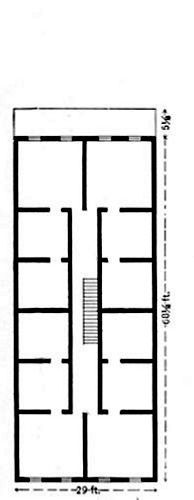
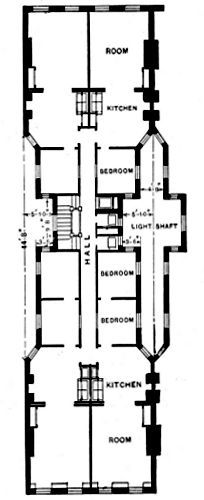
Public sentiment has done something also, but very far from enough. As a rule, it has slumbered peacefully until some flagrant outrage on decency and the health of the community aroused it to noisy but ephemeral indignation, or until a dreaded epidemic knocked at our door. It is this unsteadiness of purpose that has been to a large extent responsible for the apparent lagging of the authorities in cases not involving immediate danger to the general health. The law needs a much stronger and readier backing of a thoroughly enlightened public sentiment to make it as effective as it might be made. It is to be remembered that the health officers, in dealing with this subject of dangerous houses, are constantly trenching upon what each landlord considers his private rights, for which he is ready and bound to fight to the last. Nothing short of the strongest pressure will avail to convince him that these individual rights are to be surrendered for the clear benefit of the whole. It is easy enough to convince a man that he ought not to harbor the thief who steals people’s property; but to make him see that he has no right to slowly kill his neighbors, or his tenants, by making a death-trap of his house, seems to be the hardest of all tasks. It is apparently the slowness of the process that obscures his mental sight. The man who will fight an order to repair the plumbing in his house through every court he can reach, would suffer tortures rather than shed the blood of a fellow-man by actual violence. Clearly, it is a matter of education on the part of the landlord no less than the tenant.
In spite of this, the landlord has done his share; chiefly perhaps by yielding—not always gracefully—when it was no longer of any use to fight. There have been exceptions, however: men and women who have mended and built with an eye to the real welfare of their tenants as well as to their own pockets. Let it be well understood that the two are inseparable, if any good is to come of it. The business of housing the poor, if it is to amount to anything, must be business, as it was business with our fathers to put them where they are. As charity, pastime, or fad, it will miserably fail, always and everywhere. This is an inexorable rule, now thoroughly well understood in England and continental Europe, and by all who have given the matter serious thought here. Call it poetic justice, or divine justice, or anything else, it is a hard fact, not to be gotten over. Upon any other plan than the assumption that the workman has a just claim to a decent home, and the right to demand it, any scheme for his relief fails. It must be a fair exchange of the man’s money for what he can afford to buy at a reasonable price. Any charity scheme merely turns him into a pauper, however it may be disguised, and drowns him hopelessly in the mire out of which it proposed to pull him. And this principle must pervade the whole plan. Expert management of model tenements succeeds where amateur management, with the best intentions, gives up the task, discouraged, as a flat failure. Some of the best-conceived enterprises, backed by abundant capital and good-will, have been wrecked on this rock. Sentiment, having prompted the effort, forgot to stand aside and let business make it.
Business, in a wider sense, has done more than all other agencies together to wipe out the worst tenements. It has been New York’s real Napoleon III., from whose decree there was no appeal. In ten years I have seen plague-spots disappear before its onward march, with which health officers, police, and sanitary science had struggled vainly since such struggling began as a serious business. And the process goes on still. Unfortunately, the crowding in some of the most densely packed quarters down town has made the property there so valuable, that relief from this source is less confidently to be expected, at all events in the near future. Still, their time may come also. It comes so quickly sometimes as to fairly take one’s breath away. More than once I have returned, after a few brief weeks, to some specimen rookery in which I was interested, to find it gone and an army of workmen delving twenty feet underground to lay the foundation of a mighty warehouse. That was the case with the “Big Flat” in Mott Street. I had not had occasion to visit it for several months last winter, and when I went there, entirely unprepared for a change, I could not find it. It had always been conspicuous enough in the landscape before, and I marvelled much at my own stupidity until, by examining the number of the house, I found out that I had gone right. It was the “flat” that had disappeared. In its place towered a six-story carriage factory with business going on on every floor, as if it had been there for years and years.
This same “Big Flat” furnished a good illustration of why some well-meant efforts in tenement building have failed. Like Gotham Court, it was originally built as a model tenement, but speedily came to rival the Court in foulness. It became a regular hot-bed of thieves and peace-breakers, and made no end of trouble for the police. The immediate reason, outside of the lack of proper supervision, was that it had open access to two streets in a neighborhood where thieves and “toughs” abounded. These took advantage of an arrangement that had been supposed by the builders to be a real advantage as a means of ventilation, and their occupancy drove honest folk away. Murderers’ Alley, of which I have spoken elsewhere, and the sanitary inspector’s experiment with building a brick wall athwart it to shut off travel through the block, is a parallel case.
The causes that operate to obstruct efforts to better the lot of the tenement population are, in our day, largely found among the tenants themselves. This is true particularly of the poorest. They are shiftless, destructive, and stupid; in a word, they are what the tenements have made them. It is a dreary old truth that those who would fight for the poor must fight the poor to do it. It must be confessed that there is little enough in their past experience to inspire confidence in the sincerity of the effort to help them. I recall the discomfiture of a certain well-known philanthropist, since deceased, whose heart beat responsive to other suffering than that of human kind. He was a large owner of tenement property, and once undertook to fit out his houses with stationary tubs, sanitary plumbing, wood-closets, and all the latest improvements. He introduced his rough tenants to all this magnificence without taking the precaution of providing a competent housekeeper, to see that the new acquaintances got on together. He felt that his tenants ought to be grateful for the interest he took in them. They were. They found the boards in the wood-closets fine kindling wood, while the pipes and faucets were as good as cash at the junk shop. In three months the owner had to remove what was left of his improvements. The pipes were cut and the houses running full of water, the stationary tubs were put to all sorts of uses except washing, and of the wood-closets not a trace was left. The philanthropist was ever after a firm believer in the total depravity of tenement-house people. Others have been led to like reasoning by as plausible arguments, without discovering that the shiftlessness and ignorance that offended them were the consistent crop of the tenement they were trying to reform, and had to be included in the effort. The owners of a block of model tenements uptown had got their tenants comfortably settled, and were indulging in high hopes of their redemption under proper management, when a contractor ran up a row of “skin” tenements, shaky but fair to look at, with brown-stone trimmings and gewgaws. The result was to tempt a lot of the well-housed tenants away. It was a very astonishing instance of perversity to the planners of the benevolent scheme; but, after all, there was nothing strange in it. It is all a matter of education, as I said about the landlord.
That the education comes slowly need excite no surprise. The forces on the other side are ever active. The faculty of the tenement for appropriating to itself every foul thing that comes within its reach, and piling up and intensifying its corruption until out of all proportion to the beginning, is something marvellous. Drop a case of scarlet fever, of measles, or of diphtheria into one of these barracks, and, unless it is caught at the very start and stamped out, the contagion of the one case will sweep block after block, and half people a graveyard. Let the police break up a vile dive, goaded by the angry protests of the neighborhood—forthwith the outcasts set in circulation by the raid betake themselves to the tenements, where in their hired rooms, safe from interference, they set up as many independent centres of contagion, infinitely more destructive, each and every one, than was the known dive before. I am not willing to affirm that this is the police reason for letting so many of the dives alone; but it might well be. They are perfectly familiar with the process, and entirely helpless to prevent it.
This faculty, as inherent in the problem itself—the prodigious increase of the tenement-house population that goes on without cessation, and its consequent greater crowding—is the chief obstacle to its solution. In 1869 there were 14,872 tenements in New York, with a population of 468,492 persons. In 1879 the number of the tenements was estimated at 21,000, and their tenants had passed the half-million mark. At the end of the year 1888, when a regular census was made for the first time since 1869, the showing was: 32,390 tenements, with a population of 1,093,701 souls. To-day we have 37,316 tenements, including 2,630 rear houses, and their population is over 1,250,000. A large share of this added population, especially of that which came to us from abroad, crowds in below Fourteenth Street, where the population is already packed beyond reason, and confounds all attempts to make matters better there. At the same time new slums are constantly growing up uptown, and have to be kept down with a firm hand. This drift of the population to the great cities has to be taken into account as a steady factor. It will probably increase rather than decrease for many years to come. At the beginning of the century the percentage of our population that lived in cities was as one in twenty-five. In 1880 it was one in four and one-half, and in 1890 the census will in all probability show it to be one in four. Against such tendencies, in the absence of suburban outlets for the crowding masses, all remedial measures must prove more or less ineffective. The “confident belief” expressed by the Board of Health in 1874, that rapid transit would solve the problem, is now known to have been a vain hope.
Workingmen, in New York at all events, will live near their work, no matter at what sacrifice of comfort—one might almost say at whatever cost, and the city will never be less crowded than it is. To distribute the crowds as evenly as possible is the effort of the authorities, where nothing better can be done. In the first six months of the present year 1,068 persons were turned out of not quite two hundred tenements below Houston Street by the sanitary police on their midnight inspections, and this covered only a very small part of that field. The uptown tenements were practically left to take care of themselves in this respect.
The quick change of economic conditions in the city that often out-paces all plans of relief, rendering useless to-day what met the demands of the situation well enough yesterday, is another cause of perplexity. A common obstacle also—I am inclined to think quite as common as in Ireland, though we hear less of it in the newspapers—is the absentee landlord. The home article, who fights for his rights, as he chooses to consider them, is bad enough; but the absentee landlord is responsible for no end of trouble. He was one of the first obstructions the sanitary reformers stumbled over, when the Health Department took hold. It reported in 1869 that many of the tenants were entirely uncared for, and that the only answer to their requests to have the houses put in order was an invitation to pay their rent or get out. “Inquiry often disclosed the fact that the owner of the property was a wealthy gentleman or lady, either living in an aristocratic part of the city, or in a neighboring city, or, as was occasionally found to be the case, in Europe. The property is usually managed entirely by an agent, whose instructions are simple but emphatic: Collect the rent in advance, or, failing, eject the occupants.” The Committee having the matter in charge proposed to compel owners of tenements with ten families or more to put a housekeeper in the house, who should be held responsible to the Health Department. Unluckily the powers of the Board gave out at that point, and the proposition was never acted upon. Could it have been, much trouble would have been spared the Health Board, and untold suffering the tenants in many houses. The tribe of absentee landlords is by no means extinct in New York. Not a few who fled from across the sea to avoid being crushed by his heel there have groaned under it here, scarcely profiting by the exchange. Sometimes—it can hardly be said in extenuation—the heel that crunches is applied in saddening ignorance. I recall the angry indignation of one of these absentee landlords, a worthy man who, living far away in the country, had inherited city property, when he saw the condition of his slum tenements. The man was shocked beyond expression, all the more because he did not know whom to blame except himself for the state of things that had aroused his wrath, and yet, conscious of the integrity of his intentions, felt that he should not justly be held responsible.
The experience of this landlord points directly to the remedy which the law failed to supply to the early reformers. It has since been fully demonstrated that a competent agent on the premises, a man of the best and the highest stamp, who knows how to instruct and guide with a firm hand, is a prerequisite to the success of any reform tenement scheme. This is a plain business proposition, that has been proved entirely sound in some notable instances of tenement building, of which more hereafter. Even among the poorer tenements, those are always the best in which the owner himself lives. It is a hopeful sign in any case. The difficulty of procuring such assistance without having to pay a ruinous price, is one of the obstructions that have vexed in this city efforts to solve the problem of housing the poor properly, because it presupposes that the effort must be made on a larger scale than has often been attempted.
The readiness with which the tenants respond to intelligent efforts in their behalf, when made under fair conditions, is as surprising as it is gratifying, and fully proves the claim that tenants are only satisfied in filthy and unwholesome surroundings because nothing better is offered. The moral effect is as great as the improvement of their physical health. It is clearly discernible in the better class of tenement dwellers to-day. The change in the character of the colored population in the few years since it began to move out of the wicked rookeries of the old “Africa” to the decent tenements in Yorkville, furnishes a notable illustration, and a still better one is found in the contrast between the model tenement in the Mulberry Street Bend and the barracks across the way, of which I spoke in the chapter devoted to the Italian. The Italian himself is the strongest argument of all. With his fatal contentment in the filthiest surroundings, he gives undoubted evidence of having in him the instinct of cleanliness that, properly cultivated, would work his rescue in a very little while. It is a queer contradiction, but the fact is patent to anyone who has observed the man in his home-life. And he is not alone in this. I came across an instance, this past summer, of how a refined, benevolent personality works like a leaven in even the roughest tenement-house crowd. This was no model tenement; far from it. It was a towering barrack in the Tenth Ward, sheltering more than twenty families. All the light and air that entered its interior came through an air-shaft two feet square, upon which two bedrooms and the hall gave in every story. In three years I had known of two domestic tragedies, prompted by poverty and justifiable disgust with life, occurring in the house, and had come to look upon it as a typically bad tenement, quite beyond the pale of possible improvement. What was my surprise, when chance led me to it once more after a while, to find the character of the occupants entirely changed. Some of the old ones were there still, but they did not seem to be the same people. I discovered the secret to be the new housekeeper, a tidy, mild-mannered, but exceedingly strict little body, who had a natural faculty of drawing her depraved surroundings within the beneficent sphere of her strong sympathy, and withal of exacting respect for her orders. The worst elements had been banished from the house in short order under her management, and for the rest a new era of self-respect had dawned. They were, as a body, as vastly superior to the general run of their class as they had before seemed below it. And this had been effected in the short space of a single year.
My observations on this point are more than confirmed by those of nearly all the practical tenement reformers I have known, who have patiently held to the course they had laid down. One of these, whose experience exceeds that of all of the rest together, and whose influence for good has been very great, said to me recently: “I hold that not ten per cent. of the people now living in tenements would refuse to avail themselves of the best improved conditions offered, and come fully up to the use of them, properly instructed; but they cannot get them. They are up to them now, fully, if the chances were only offered. They don’t have to come up. It is all a gigantic mistake on the part of the public, of which these poor people are the victims. I have built homes for more than five hundred families in fourteen years, and I have been getting daily more faith in human nature from my work among the poor tenants, though approaching that nature on a plane and under conditions that could scarcely promise better for disappointment.” It is true that my friend has built his houses in Brooklyn; but human nature does not differ greatly on the two shores of the East River. For those who think it does, it may be well to remember that only five years ago the Tenement House Commission summed up the situation in this city in the declaration that, “the condition of the tenants is in advance of the houses which they occupy,” quite the severest arraignment of the tenement that had yet been uttered.
The many philanthropic efforts that have been made in the last few years to render less intolerable the lot of the tenants in the homes where many of them must continue to live, have undoubtedly had their effect in creating a disposition to accept better things, that will make plainer sailing for future builders of model tenements. In many ways, as in the “College Settlement” of courageous girls, the Neighborhood Guilds, through the efforts of the King’s Daughters, and numerous other schemes of practical mission work, the poor and the well-to-do have been brought closer together, in an every-day companionship that cannot but be productive of the best results, to the one who gives no less than to the one who receives. And thus, as a good lady wrote to me once, though the problem stands yet unsolved, more perplexing than ever; though the bright spots in the dreary picture be too often bright only by comparison, and many of the expedients hit upon for relief sad makeshifts, we can dimly discern behind it all that good is somehow working out of even this slough of despond the while it is deepening and widening in our sight, and in His own good season, if we labor on with courage and patience, will bear fruit sixty and a hundred fold.
CHAPTER XXV.
HOW THE CASE STANDS.
What, then, are the bald facts with which we have to deal in New York?
I. That we have a tremendous, ever swelling crowd of wage-earners which it is our business to house decently.
II. That it is not housed decently.
III. That it must be so housed here for the present, and for a long time to come, all schemes of suburban relief being as yet utopian, impracticable.
IV. That it pays high enough rents to entitle it to be so housed, as a right.
V. That nothing but our own slothfulness is in the way of so housing it, since “the condition of the tenants is in advance of the condition of the houses which they occupy” (Report of Tenement-house Commission).
VI. That the security of the one no less than of the other half demands, on sanitary, moral, and economic grounds, that it be decently housed.
VII. That it will pay to do it. As an investment, I mean, and in hard cash. This I shall immediately proceed to prove.
VIII. That the tenement has come to stay, and must itself be the solution of the problem with which it confronts us.
This is the fact from which we cannot get away, however we may deplore it. Doubtless the best would be to get rid of it altogether; but as we cannot, all argument on that score may at this time be dismissed as idle. The practical question is what to do with the tenement. I watched a Mott Street landlord, the owner of a row of barracks that have made no end of trouble for the health authorities for twenty years, solve that question for himself the other day. His way was to give the wretched pile a coat of paint, and put a gorgeous tin cornice on with the year 1890 in letters a yard long. From where I stood watching the operation, I looked down upon the same dirty crowds camping on the roof, foremost among them an Italian mother with two stark-naked children who had apparently never made the acquaintance of a wash-tub. That was a landlord’s way, and will not get us out of the mire.
The “flat” is another way that does not solve the problem. Rather, it extends it. The flat is not a model, though it is a modern, tenement. It gets rid of some of the nuisances of the low tenement, and of the worst of them, the overcrowding—if it gets rid of them at all—at a cost that takes it at once out of the catalogue of “homes for the poor,” while imposing some of the evils from which they suffer upon those who ought to escape from them.
There are three effective ways of dealing with the tenements in New York:
I. By law.
II. By remodelling and making the most out of the old houses.
III. By building new, model tenements.
Private enterprise—conscience, to put it in the category of duties, where it belongs—must do the lion’s share under these last two heads. Of what the law has effected I have spoken already. The drastic measures adopted in Paris, in Glasgow, and in London are not practicable here on anything like as large a scale. Still it can, under strong pressure of public opinion, rid us of the worst plague-spots. The Mulberry Street Bend will go the way of the Five Points when all the red tape that binds the hands of municipal effort has been unwound. Prizes were offered in public competition, some years ago, for the best plans of modern tenement-houses. It may be that we shall see the day when the building of model tenements will be encouraged by subsidies in the way of a rebate of taxes. Meanwhile the arrest and summary punishment of landlords, or their agents, who persistently violate law and decency, will have a salutary effect. If a few of the wealthy absentee landlords, who are the worst offenders, could be got within the jurisdiction of the city, and by arrest be compelled to employ proper overseers, it would be a proud day for New York. To remedy the overcrowding, with which the night inspections of the sanitary police cannot keep step, tenements may eventually have to be licensed, as now the lodging-houses, to hold so many tenants, and no more; or the State may have to bring down the rents that cause the crowding, by assuming the right to regulate them as it regulates the fares on the elevated roads. I throw out the suggestion, knowing quite well that it is open to attack. It emanated originally from one of the brightest minds that have had to struggle officially with this tenement-house question in the last ten years. In any event, to succeed, reform by law must aim at making it unprofitable to own a bad tenement. At best, it is apt to travel at a snail’s pace, while the enemy it pursues is putting the best foot foremost.
In this matter of profit the law ought to have its strongest ally in the landlord himself, though the reverse is the case. This condition of things I believe to rest on a monstrous error. It cannot be that tenement property that is worth preserving at all can continue to yield larger returns, if allowed to run down, than if properly cared for and kept in good repair. The point must be reached, and soon, where the cost of repairs, necessary with a house full of the lowest, most ignorant tenants, must overbalance the saving of the first few years of neglect; for this class is everywhere the most destructive, as well as the poorest paying. I have the experience of owners, who have found this out to their cost, to back me up in the assertion, even if it were not the statement of a plain business fact that proves itself. I do not include tenement property that is deliberately allowed to fall into decay because at some future time the ground will be valuable for business or other purposes. There is unfortunately enough of that kind in New York, often leasehold property owned by wealthy estates or soul-less corporations that oppose all their great influence to the efforts of the law in behalf of their tenants.
There is abundant evidence, on the other hand, that it can be made to pay to improve and make the most of the worst tenement property, even in the most wretched locality. The example set by Miss Ellen Collins in her Water Street houses will always stand as a decisive answer to all doubts on this point. It is quite ten years since she bought three old tenements at the corner of Water and Roosevelt Streets, then as now one of the lowest localities in the city. Since then she has leased three more adjoining her purchase, and so much of Water Street has at all events been purified. Her first effort was to let in the light in the hallways, and with the darkness disappeared, as if by magic, the heaps of refuse that used to be piled up beside the sinks. A few of the most refractory tenants disappeared with them, but a very considerable proportion stayed, conforming readily to the new rules, and are there yet. It should here be stated that Miss Collins’s tenants are distinctly of the poorest. Her purpose was to experiment with this class, and her experiment has been more than satisfactory. Her plan was, as she puts it herself, fair play between tenant and landlord. To this end the rents were put as low as consistent with the idea of a business investment that must return a reasonable interest to be successful. The houses were thoroughly refitted with proper plumbing. A competent janitor was put in charge to see that the rules were observed by the tenants, when Miss Collins herself was not there. Of late years she has had to give very little time to personal superintendence, and the care-taker told me only the other day that very little was needed. The houses seemed to run themselves in the groove once laid down. Once the reputed haunt of thieves, they have become the most orderly in the neighborhood. Clothes are left hanging on the lines all night with impunity, and the pretty flower-beds in the yard where the children not only from the six houses, but of the whole block, play, skip, and swing, are undisturbed. The tenants, by the way, provide the flowers themselves in the spring, and take all the more pride in them because they are their own. The six houses contain forty-five families, and there “has never been any need of putting up a bill.” As to the income from the property, Miss Collins said to me last August: “I have had six and even six and three-quarters per cent. on the capital invested; on the whole, you may safely say five and a half per cent. This I regard as entirely satisfactory.” It should be added that she has persistently refused to let the corner-store, now occupied by a butcher, as a saloon; or her income from it might have been considerably increased.
Miss Collins’s experience is of value chiefly as showing what can be accomplished with the worst possible material, by the sort of personal interest in the poor that alone will meet their real needs. All the charity in the world, scattered with the most lavish hand, will not take its place. “Fair play” between landlord and tenant is the key, too long mislaid, that unlocks the door to success everywhere as it did for Miss Collins. She has not lacked imitators whose experience has been akin to her own. The case of Gotham Court has been already cited. On the other hand, instances are not wanting of landlords who have undertaken the task, but have tired of it or sold their property before it had been fully redeemed, with the result that it relapsed into its former bad condition faster than it had improved, and the tenants with it. I am inclined to think that such houses are liable to fall even below the average level. Backsliding in brick and mortar does not greatly differ from similar performances in flesh and blood.
Backed by a strong and steady sentiment, such as these pioneers have evinced, that would make it the personal business of wealthy owners with time to spare to look after their tenants, the law would be able in a very short time to work a salutary transformation in the worst quarters, to the lasting advantage, I am well persuaded, of the landlord no less than the tenant. Unfortunately, it is in this quality of personal effort that the sentiment of interest in the poor, upon which we have to depend, is too often lacking. People who are willing to give money feel that that ought to be enough. It is not. The money thus given is too apt to be wasted along with the sentiment that prompted the gift.
Even when it comes to the third of the ways I spoke of as effective in dealing with the tenement-house problem, the building of model structures, the personal interest in the matter must form a large share of the capital invested, if it is to yield full returns. Where that is the case, there is even less doubt about its paying, with ordinary business management, than in the case of reclaiming an old building, which is, like putting life into a defunct newspaper, pretty apt to be up-hill work. Model tenement building has not been attempted in New York on anything like as large a scale as in many other great cities, and it is perhaps owing to this, in a measure, that a belief prevails that it cannot succeed here. This is a wrong notion entirely. The various undertakings of that sort that have been made here under intelligent management have, as far as I know, all been successful.
From the managers of the two best-known experiments in model tenement building in the city, the Improved Dwellings Association and the Tenement-house Building Company, I have letters dated last August, declaring their enterprises eminently successful. There is no reason why their experience should not be conclusive. That the Philadelphia plan is not practicable in New York is not a good reason why our own plan, which is precisely the reverse of our neighbor’s, should not be. In fact it is an argument for its success. The very reason why we cannot house our working masses in cottages, as has been done in Philadelphia—viz., that they must live on Manhattan Island, where the land is too costly for small houses—is the best guarantee of the success of the model tenement house, properly located and managed. The drift in tenement building, as in everything else, is toward concentration, and helps smooth the way. Four families on the floor, twenty in the house, is the rule of to-day. As the crowds increase, the need of guiding this drift into safe channels becomes more urgent. The larger the scale upon which the model tenement is planned, the more certain the promise of success. The utmost ingenuity cannot build a house for sixteen or twenty families on a lot 25 × 100 feet in the middle of a block like it, that shall give them the amount of air and sunlight to be had by the erection of a dozen or twenty houses on a common plan around a central yard. This was the view of the committee that awarded the prizes for the best plan for the conventional tenement, ten years ago. It coupled its verdict with the emphatic declaration that, in its view, it was “impossible to secure the requirements of physical and moral health within these narrow and arbitrary limits.” Houses have been built since on better plans than any the committee saw, but its judgment stands unimpaired. A point, too, that is not to be overlooked, is the reduced cost of expert superintendence—the first condition of successful management—in the larger buildings.
The Improved Dwellings Association put up its block of thirteen houses in East Seventy-second Street nine years ago. Their cost, estimated at about $240,000 with the land, was increased to $285,000 by troubles with the contractor engaged to build them. Thus the Association’s task did not begin under the happiest auspices. Unexpected expenses came to deplete its treasury. The neighborhood was new and not crowded at the start. No expense was spared, and the benefit of all the best and most recent experience in tenement building was given to the tenants. The families were provided with from two to four rooms, all “outer” rooms, of course, at rents ranging from $14 per month for the four on the ground floor, to $6.25 for two rooms on the top floor. Coal lifts, ash-chutes, common laundries in the basement, and free baths, are features of these buildings that were then new enough to be looked upon with suspicion by the doubting Thomases who predicted disaster. There are rooms in the block for 218 families, and when I looked in recently all but nine of the apartments were let. One of the nine was rented while I was in the building. The superintendent told me that he had little trouble with disorderly tenants, though the buildings shelter all sorts of people. Mr. W. Bayard Cutting, the President of the Association, writes to me:
“By the terms of subscription to the stock before incorporation, dividends were limited to five per cent. on the stock of the Improved Dwellings Association. These dividends have been paid (two per cent. each six months) ever since the expiration of the first six months of the buildings operation. All surplus has been expended upon the buildings. New and expensive roofs have been put on for the comfort of such tenants as might choose to use them. The buildings have been completely painted inside and out in a manner not contemplated at the outset. An expensive set of fire-escapes has been put on at the command of the Fire Department, and a considerable number of other improvements made. I regard the experiment as eminently successful and satisfactory, particularly when it is considered that the buildings were the first erected in this city upon anything like a large scale, where it was proposed to meet the architectural difficulties that present themselves in the tenement-house problem. I have no doubt that the experiment could be tried to-day with the improved knowledge which has come with time, and a much larger return be shown upon the investment. The results referred to have been attained in spite of the provision which prevents the selling of liquor upon the Association’s premises. You are aware, of course, how much larger rent can be obtained for a liquor saloon than for an ordinary store. An investment at five per cent. net upon real estate security worth more than the principal sum, ought to be considered desirable.”
The Tenement House Building Company made its “experiment” in a much more difficult neighborhood, Cherry Street, some six years later. Its houses shelter many Russian Jews, and the difficulty of keeping them in order is correspondingly increased, particularly as there are no ash-chutes in the houses. It has been necessary even to shut the children out of the yards upon which the kitchen windows give, lest they be struck by something thrown out by the tenants, and killed. It is the Cherry Street style, not easily got rid of. Nevertheless, the houses are well kept. Of the one hundred and six “apartments,” only four were vacant in August. Professor Edwin R. A. Seligman, the secretary of the company, writes to me: “The tenements are now a decided success.” In the three years since they were built, they have returned an interest of from five to five and a half per cent. on the capital invested. The original intention of making the tenants profit-sharers on a plan of rent insurance, under which all earnings above four per cent. would be put to the credit of the tenants, has not yet been carried out.