CATALOGUE
HISHIKAWA MORONOBU
Moronobu, who
was born probably in 1625 and died in 1695, was the first
important Japanese artist to design prints. As a painter he is
highly renowned. He illustrated many books and made a
considerable number of single-sheet prints, which were all either
in plain black or coloured by hand. His works are now very
rare.6
LENT BY THE ESTATE OF FRANCIS LATHROP, DECEASED
| 1 |
Large
sumi-yé (ink print). Matsukaze-Murasame; a
nobleman and two ladies at the seashore watching two
women dipping salt water in buckets. |
| 2 |
Sumi-yé. A man and a
woman seated on the floor of a room. |
| 3 |
Sumi-yé. Woman reading
from a book to a man reclining on the floor by her side.
Near them a maid-servant and utensils containing
refreshments. |
LENT BY A COLLECTOR
| 4 |
Sumi-yé. Scene in the
Yoshiwara. |
TORII KIYONOBU
Founder of
the Torii line and one of the leading artists of the Ukiyoé
school. Inventor of the tan-yé, or prints coloured by hand with
red lead (Japanese tan). He was born in 1664 and
died on August 22, 1729. His style of drawing was characterized
by great boldness and vigour.
LENT BY THE ESTATE OF FRANCIS LATHROP, DECEASED
| 5 |
Large
tan-yé. The actor Dekijima Hanya as a woman
seated upon a sakura tree in bloom. |
| 6 |
Small
tan-yé. The actor Ikushima Daikichi as a
woman holding two small dogs. |
| 7 |
Small
tan-yé. The actor Kamimura Kichisaburo as a
dancing-girl. |
| 8 |
Large
hand-coloured print. The actor Ikushima
Daikichi as an oiran on parade, followed by OÌ
tani
Hiroji as a servant holding an umbrella over her. |
| 9 |
Tall
hand-coloured print. The actor Bando
Hikosaburo. |
LENT BY SAMUEL ISHAM.
| 10 |
Urushi-yé. Ichikawa
Monnosuke as a strolling player carrying a monkey on
his back. |
LENT BY HOWARD MANSFIELD.
| 11 |
Urushi-yé. The
elopement of Yaoya Hanbei and O-Chiya. |
LENT BY A COLLECTOR.
| 12 |
Urushi-yé. A
dancing-girl. |
TORII KIYOMASU
Eldest son of
Kiyonobu, whom he succeeded as the head of the Torii line. His
work closely resembles that of his father. He was born about 1685
and died on January 2, 1764.
LENT BY THE ESTATE OF FRANCIS LATHROP, DECEASED.
| 13 |
Large
sumi-yé. An actors' boating party on the
Sumidagawa. |
| 14 |
Large
tan-yé. The actors Yoshizawa Ayame and Kanto
Koroku. |
| 15 |
Large
tan-yé. The actors Kanto Koroku and Ikushima
Daikichi. |
| 16 |
Large
beni-yé. Ichikawa DanjuÌ
roÌ
as an enraged
warrior. |
| 17 |
Beni-yé. Onoe KikugoroÌ
in a female rôle. |
| 18 |
Beni-yé. Scene from a
drama. The actors Tomazawa SaijiroÌ
(on horseback),
OÌ
tani Hiroji, and Segawa KikunojoÌ
. The beni has
turned to a low-toned yellow. |
| 19 |
Urushi-yé. Scene from a
drama. OÌ
tani Oniji (on horseback) threatening Sannogawa
Ichimatsu in the rôle of a woman who has seized his
bridle rein. |
| 20 |
Beni-yé. Scene from a
drama. Sawamura SojuÌ
roÌ
as Sasaki no SaburoÌ
and
Nakamura TomijuÌ
roÌ
as Mago no Koroku. |
FURUYAMA MOROMASA
Pupil, and
perhaps the son, of Moronobu. He devoted himself chiefly to
painting, but designed a few prints, most of which are ukiyé, or
perspective pictures, in the style of Okumura Masanobu.
LENT BY THE ESTATE OF FRANCIS LATHROP, DECEASED
| 21 |
Large
hand-coloured ukiyé, or perspective print. A
game of ken in a room in a nobleman's house. |
OKUMURA MASANOBU
One of the
most eminent of the Ukiyoé artists. His drawings were greatly
admired for their rare combination of force and refinement, and
he exercised wide influence over his contemporaries and
successors to the end of the eighteenth century. He was the first
artist to use blocks from which prints were coloured in flat
tints. These were printed in the red known as beni, green, and
black, and were known as beni-yé. He was also the first artist to
make the tall, narrow pillar prints (ha-shira-yé), and was the
inventor of the perspective prints which he called ukiyé. His true name was Okumura
Genpachi, and he was commonly known as honya (bookseller)
Genpachi, from the fact that he was the proprietor of a wholesale
and retail book and print shop at the sign of the “red gourd” in Tori-shio choÌ
, Yedo.
LENT BY THE ESTATE OF FRANCIS LATHROP, DECEASED
| 22 |
Large
sumi-yé. Woman seated by a writing-table,
reading a book. |
| 23 |
Urushi-yé. Bando
Hikosaburo as a warrior resisting the opening of a castle
door. |
| 24 |
Tall
beni-yé. A geisha playing upon a
samisen. |
| 25 |
Large
sumi-yé. A woman with a pet cat watching a
man dip water from a chozubachi. |
LENT BY A COLLECTOR
| 26 |
Large
beni-yé. Segawa KikunojoÌ
as an oiran
lighting her pipe at a hibachi in the hands of her
kamuro, and Sannogawa Ichimatsu as a man holding an
umbrella over her. |
| 27 |
Undivided
beni-yé triptych. Street scene. A boy
kneeling to put on a woman's geta; a man playing upon a
shakuhachi; and another man carrying an umbrella. |
| 28 |
Undivided
triptych. Three women carrying
umbrellas. |
OKUMURA TOSHINOBU
Toshinobu, the
son of Masanobu, was an artist of decided talent who died young.
His known works, which resemble those of his father, are all
urushi-yé, and were designed about 1730-1736.
LENT BY A COLLECTOR
| 29 |
Ichimura Uzaemon as a
dancing-girl. |
| 30 |
Woman dressing. |
| 31 |
Sanjo KentaroÌ
in a female
rôle. |
TSUNEKAWA SHIGENOBU
An early
Ukiyoé artist of whom little is known. His prints are extremely
rare.
LENT BY A COLLECTOR
| 32 |
Urushi-yé. Arashi Wakano
in the rôle of Shida no KotaroÌ
. |
NISHIMURA SHIGENAGA
Son of
Shigenobu. Born in 1697 and died in 1756. An artist of ability
who exercised marked influence upon the development of the
school. His prints are very uneven in quality.
[pg 35]
LENT BY THE ESTATE OF FRANCIS LATHROP, DECEASED
| 33 |
Tall
hand-coloured print. The actor Sannogawa
Ichimatsu as a woman holding a folded letter. |
LENT BY A COLLECTOR
| 34 |
Urushi-yé. Segawa
Kikunojo as a woman holding a warrior's helmet. |
| 35 |
Beni-yé. Procession of
the Corean ambassadors. |
ISHIKAWA TOYONOBU
One of the
most important of the Ukiyoé masters. Born in 1711, died in 1785.
Pupil of Shigenaga, and probably of Masanobu whose style he
closely assimilated.
LENT BY THE ESTATE OF FRANCIS LATHROP, DECEASED
| 36 |
Large
beni-yé. The actors Segawa Kikunojo and
Sannogawa Ichimatsu. |
LENT BY SAMUEL ISHAM.
| 37 |
Wide
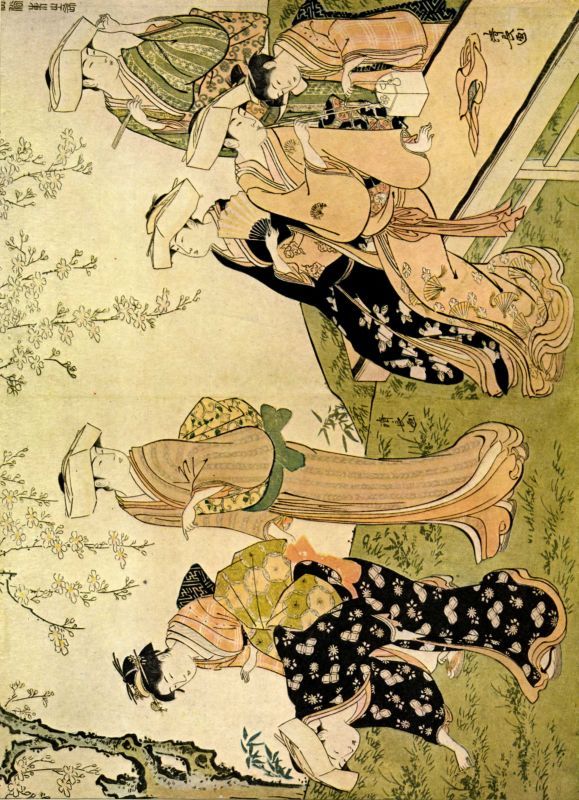
print from three colour-blocks. Women and
children at the seashore. |
LENT BY A COLLECTOR.
| 38 |
Tall
hand-coloured print. Segawa KikunojoÌ
as a
woman reading a letter. |
| 39 |
Two
sheets from a beni-yé triptych. Musume
carrying umbrellas. |
LENT BY HAMILTON EASTER FIELD.
| 40 |
Beni-yé. Mother and
son. |
| 41 |
Print
from three colour-blocks. Boys rolling a
large snowball. |
| 42 |
Print
from three colour-blocks. Man struggling with
a refractory umbrella; a woman looking on. |
[pg 36]
TORII KIYOHIRO
Pupil of
Kiyomasu. His known works are exclusively beni-yé, executed from
about 1745 to about 1755.
LENT BY HAMILTON EASTER FIELD.
| 43 |
Beni-yé. Nakamura
HatsugoroÌ
as Sakura no Suké. |
TORII SHIRO
Known as
Kiyonobu the second, all of his prints being signed Torii
Kiyonobu. He was the eldest son of Kiyomasu. Worked from about
1740 to about 1755, when it is probable that his death occurred.
Some of the most charming of the beni-yé prints are from his
hand.
LENT BY HOWARD MANSFIELD.
| 44 |
Beni-yé. Yamamoto
IwanojoÌ
as a woman dancing by a fox-trap in a rice
field under a blossoming cherry tree. |
TORII KIYOMITSU
Second son of
Kiyomasu, whom he succeeded as the head of the Torii line. An
artist of distinction. Was the first to add a third colour-block
to the original two. He was born in 1735 and died in 1785. After
1765 he designed only a few prints, and appears to have designed
none later than about 1768.
LENT BY THE ESTATE OF FRANCIS LATHROP, DECEASED
| 45 |
Wide
print from three colour-blocks. The NoÌ
performance of “Musume
DoÌ
joÌ
ji.” |
| 46 |
Wide
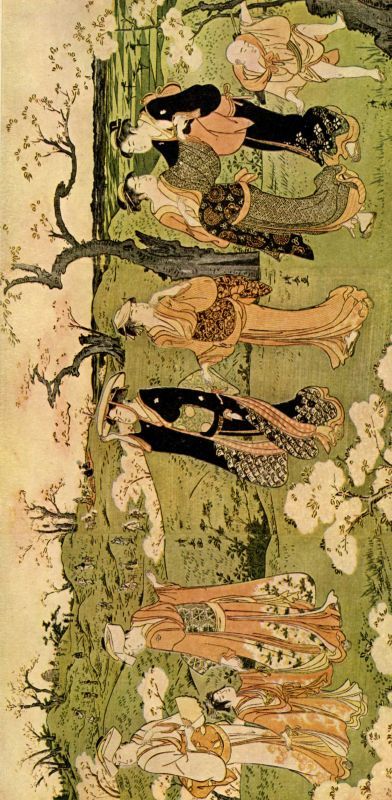
print from three colour-blocks. Daimyo
procession game by women and children. |
| 47 |
Print
from three colour-blocks. Iwai HanshiroÌ
as
a woman reading a letter while seated upon a
carabao. |
| 48 |
Beni-yé. Scene from a
drama. Ichimura KamezoÌ
(standing) as Wakemi GoroÌ
and
Nakamura TomijuÌ
roÌ
as Akoya. |
SUZUKI HARUNOBU
The central
figure in Ukiyoé and the eminent master under whose hand the art
of colour-printing was brought to perfection in the sixties of
the eighteenth century. He was a draughtsman of extreme elegance
and power, and his works have a charm that is peculiarly their
own. He died on July 7, 1770, when, says Shiba Kokan in his book
“Kokan Kokai-ki,” he “had hardly passed his fortieth year.”
LENT BY SAMUAL ISHAM.
| 49 |
Girl attendant in an archery
gallery gathering up arrows. One sheet of a diptych. |
| 50 |
A young woman showing a caged
bird to a young man seated before her, and
surreptitiously taking a love letter from him. |
| 51 |
A vendor of fan mounts stopping
to talk to a young woman standing in front of a
shop. |
| 52 |
Hashira-yé. Woman
writing a love letter. |
| 53 |
Hashira-yé. Woman
holding a pet dog. |
| 54 |
Burlesque scene. Girls carrying
Daikoku (the genius of wealth—one of the “Seven Fortune-beings”). |
LENT BY HOWARD MANSFIELD.
| 55 |
Girls carrying Daikoku. A later
impression with different colouring. |
| 56 |
An archer and two girls near a
screen. Calendar for 1765. |
| 57 |
Young woman before a torii,
carrying a hammer and nails with which to perform an
incantation. |
| 58 |
Two young women on their way to
the public bath-house through a storm of snow and
rain. |
| 59 |
Two girls on a terrace near a
torii, in the time of the cherry-blossoming. |
| 60 |
Two girls gathering mume flowers
from a tree overhanging a wall. |
| 61 |
Woman reading a letter by the
light of an andon (portable lamp with wind screen) which
another woman is trimming. |
| 62 |
Geisha and a young girl standing
on the bank near the rapids of the Tamagawa. |
| 63 |
Young woman seated in a window,
conversing with another young woman seated on the floor
and holding a picture-book. |
| 64 |
Young man removing snow from the
geta of a young woman. |
| 65 |
Woman lying upon the floor of a
room, reading a book, and another woman standing beside
her, holding a pipe. |
| 66 |
Young woman seated on a veranda
after her bath, having her back massaged by her
maid. |
| 67 |
Young man talking to a girl
through the bars of a window. |
| 68 |
A burlesque apparition of Fugen.
Instead of the Buddhist divinity, a young woman seated on
an elephant appears on a cloud before a priest kneeling
in prayer. |
| 69 |
Lovers walking in the snow under
an umbrella. One of Harunobu's most distinguished
prints. |
LENT BY THE ESTATE OF FRANCIS LATHROP, DECEASED.
| 70 |
The Sleeping Elder Sister. First
state. Early impression signed by the printer,
Kyosen. |
LENT BY HAMILTON EASTER FIELD.
| 71 |
The Sleeping Elder Sister.
Second state. Changes made in the blocks and
colouring. |
LENT BY A COLLECTOR.
| 72 |
The Sleeping Elder Sister. Still
later impression. Colouring changed again, and the number
of blocks increased from ten to thirteen. |
LENT BY HAMILTON EASTER FIELD.
| 73 |
The Hole in the Wall. |
| 74 |
Mother holding her infant
son. |
| 75 |
At the entrance gate. |
| 76 |
Mother taking her infant son
from another woman and handing her a letter. |
| 77 |
Lovers in a palace. |
LENT BY A COLLECTOR.
| 78 |
Musume walking up a flight of
steps leading to a temple. |
| 79 |
Lovers playing battledore and
shuttlecock; the young man climbing a ladder to disengage
the shuttlecock caught upon the branch of a mume
tree. |
| 80 |
Hashira-yé. Woman in
night attire standing by her bedside reading a
letter. |
SHIBA KOKAN
An artist who
is best known as a clever imitator of his master, Harunobu, whose
signature he forged upon a number of prints. He also used the
“goÌ
,” or studio name, Harushige
in signing prints in the Harunobu manner. In later years he
painted pictures in semi-European style, and made copper-plate
engravings which were coloured by hand. He was born in 1747 and
died in 1818.
LENT BY SAMUEL ISHAM.
| 81 |
The courtyard of a house in the
Yoshiwara. A woman reading a letter and a girl attendant
standing beside her holding a tray. Signed Harunobu. |
SHOSHOKEN
This is the
pseudonym of an artist of distinction whose identity has not been
determined. His known works are calendar prints for 1765.
LENT BY SAMUEL ISHAM.
| 82 |
Stout lady crossing a room in a
palace supported by two attendants. The use of gold leaf
is notable. |
[pg 40]
KITAO SHIGEMASA
One of the
noted artists of the school. Was famous for his skill as a
calligrapher, being reputed to have no superior in his day in
either of the “three capitals,”
Yedo, Kyoto, or Osaka. His prints, which are rare, are generally
of much distinction. He was born in 1740, and died in the second
month of Bunsei 3 (February or March, 1820).
LENT BY HOWARD MANSFIELD.
| 83 |
Children's puppet show. |
LENT BY THE ESTATE OF FRANCIS LATHROP, DECEASED.
| 84 |
Beni-yé. Segawa
KikunojoÌ
and Ichimura Uzaemon as Izumo no Okuni and
Nagoya Sanza, two komuso, playing upon shaku-hachi. |
ISODA KORYUSAI
The most
important pupil of Harunobu, whose style he followed closely in
his early works. Later he developed a manner of his own. As a
designer of pillar prints and of prints of birds, he was
especially successful. He was a samurai and associated with
samurai of the superior class. The director of the mint was one
of his most intimate friends and patrons. About 1781 he gave up
print-designing, devoted himself to painting, and was given the
honorary title of Hokyo. The dates of his birth and death are not
known.
LENT BY SAMUEL ISHAM.
| 86 |
Hashira-yé. Musume
leaping from the balcony of Kiyomidzu temple with an
umbrella as a parachute. |
| 87 |
Woman standing on the engawa of
a house, admiring snow-laden bamboo branches; back of
her, a girl and a young boy looking through a
window. |
| 88 |
A Yoshiwara beauty arranging
flowers; two girl attendants looking on. |
LENT BY A COLLECTOR.
| 89 |
Hashira-yé. Musume
carrying her infant brother. |
| 90 |
Hashira-yé. Young woman
poling a boat in a lily-pond. |
LENT BY THE ESTATE OF FRANCIS LATHROP, DECEASED.
| 91 |
A Yoshiwara beauty on parade,
attended by a girl and a boy. |
| 92 |
Hashira-yé. The bijin
JuroÌ
jin. A young woman is represented in place of the
long-life being whose attributes are a crane and a
tortoise. |
KATSUKAWA SHUNSHO
A contemporary
of Harunobu and one of the greatest of the Ukiyoé artists. He was
highly renowned in his day and had many pupils who became famous.
Most of his prints were portraits of actors in character. He was
born in 1726 and died on January 22, 1793.
LENT BY THE ESTATE OF FRANCIS LATHROP, DECEASED.
| 93 |
Segawa Kikunojo as a woman
holding a red fan. |
| 94 |
Two actors in character. The
seated figure is DanjuÌ
roÌ
, the leading “star” of the Yedo stage. |
LENT BY SAMUEL ISHAM.
| 95 |
Actor in a female rôle. |
LENT BY HOWARD MANSFIELD.
| 96 |
Iwai HanshiroÌ
as a woman
standing and holding a fan behind her. |
| 97 |
Yamashita Kinsaku in a female
rôle. |
| 98 |
Actor of the Ichikawa line in
the rôle of Shibaraku at the Ichimura theatre. |
| 99 |
OÌ
tani Hiroji as an Amazake
vendor. |
| 100 |
Hashira-yé. Nobleman
carrying a court lady on his back. Probably a parody upon
the suicide of Ohan and Choyaemon. |
| 101 |
Wide
hashira-yé. The Woman in Red. |