
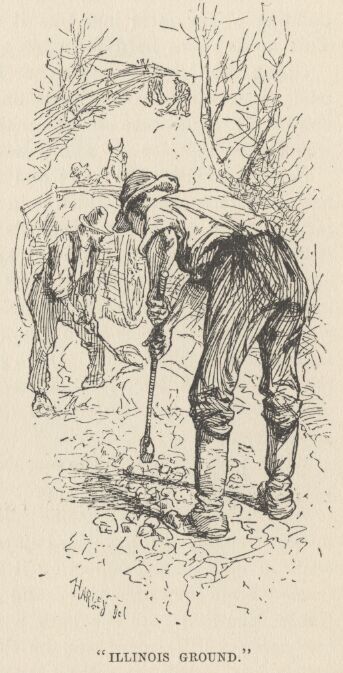
Near the mouth of the river several islands were missing—washed away. Cairo was still there—easily visible across the long, flat point upon whose further verge it stands; but we had to steam a long way around to get to it. Night fell as we were going out of the 'Upper River' and meeting the floods of the Ohio. We dashed along without anxiety; for the hidden rock which used to lie right in the way has moved up stream a long distance out of the channel; or rather, about one county has gone into the river from the Missouri point, and the Cairo point has 'made down' and added to its long tongue of territory correspondingly. The Mississippi is a just and equitable river; it never tumbles one man's farm overboard without building a new farm just like it for that man's neighbor. This keeps down hard feelings.
Going into Cairo, we came near killing a steamboat which paid no attention to our whistle and then tried to cross our bows. By doing some strong backing, we saved him; which was a great loss, for he would have made good literature.
Cairo is a brisk town now; and is substantially built, and has a city look about it which is in noticeable contrast to its former estate, as per Mr. Dickens's portrait of it. However, it was already building with bricks when I had seen it last—which was when Colonel (now General) Grant was drilling his first command there. Uncle Mumford says the libraries and Sunday-schools have done a good work in Cairo, as well as the brick masons. Cairo has a heavy railroad and river trade, and her situation at the junction of the two great rivers is so advantageous that she cannot well help prospering.
When I turned out, in the morning, we had passed Columbus, Kentucky, and were approaching Hickman, a pretty town, perched on a handsome hill. Hickman is in a rich tobacco region, and formerly enjoyed a great and lucrative trade in that staple, collecting it there in her warehouses from a large area of country and shipping it by boat; but Uncle Mumford says she built a railway to facilitate this commerce a little more, and he thinks it facilitated it the wrong way—took the bulk of the trade out of her hands by 'collaring it along the line without gathering it at her doors.'
Chapter 26
Under Fire
TALK began to run upon the war now, for we were getting down into the upper edge of the former battle-stretch by this time. Columbus was just behind us, so there was a good deal said about the famous battle of Belmont. Several of the boat's officers had seen active service in the Mississippi war-fleet. I gathered that they found themselves sadly out of their element in that kind of business at first, but afterward got accustomed to it, reconciled to it, and more or less at home in it. One of our pilots had his first war experience in the Belmont fight, as a pilot on a boat in the Confederate service. I had often had a curiosity to know how a green hand might feel, in his maiden battle, perched all solitary and alone on high in a pilot house, a target for Tom, Dick and Harry, and nobody at his elbow to shame him from showing the white feather when matters grew hot and perilous around him; so, to me his story was valuable—it filled a gap for me which all histories had left till that time empty.
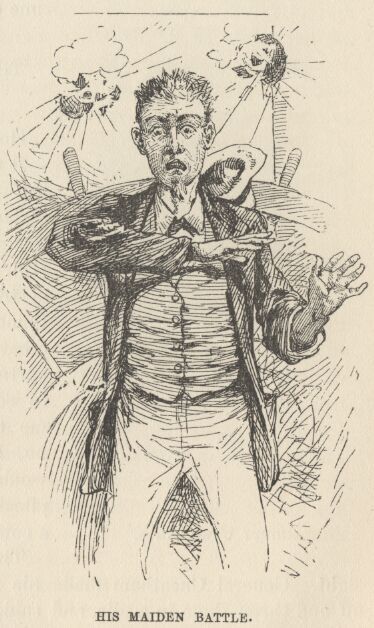
THE PILOT'S FIRST BATTLE
He said—
It was the 7th of November. The fight began at seven in the morning. I was on the 'R. H. W. Hill.' Took over a load of troops from Columbus. Came back, and took over a battery of artillery. My partner said he was going to see the fight; wanted me to go along. I said, no, I wasn't anxious, I would look at it from the pilot-house. He said I was a coward, and left.
That fight was an awful sight. General Cheatham made his men strip their coats off and throw them in a pile, and said, 'Now follow me to hell or victory!' I heard him say that from the pilot-house; and then he galloped in, at the head of his troops. Old General Pillow, with his white hair, mounted on a white horse, sailed in, too, leading his troops as lively as a boy. By and by the Federals chased the rebels back, and here they came! tearing along, everybody for himself and Devil take the hindmost! and down under the bank they scrambled, and took shelter. I was sitting with my legs hanging out of the pilot-house window. All at once I noticed a whizzing sound passing my ear. Judged it was a bullet. I didn't stop to think about anything, I just tilted over backwards and landed on the floor, and staid there. The balls came booming around. Three cannon-balls went through the chimney; one ball took off the corner of the pilot-house; shells were screaming and bursting all around. Mighty warm times—I wished I hadn't come.
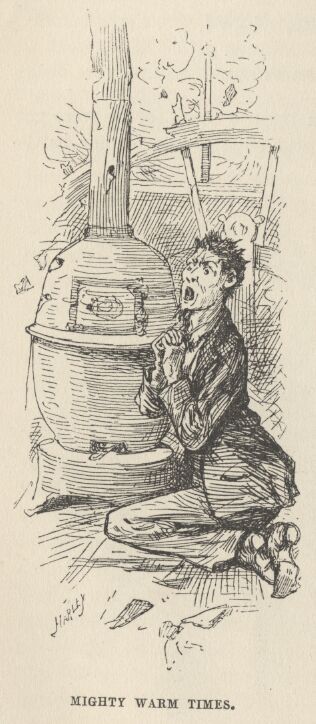
I lay there on the pilot-house floor, while the shots came faster and faster. I crept in behind the big stove, in the middle of the pilot-house. Presently a minie-ball came through the stove, and just grazed my head, and cut my hat. I judged it was time to go away from there. The captain was on the roof with a red-headed major from Memphis—a fine-looking man. I heard him say he wanted to leave here, but 'that pilot is killed.' I crept over to the starboard side to pull the bell to set her back; raised up and took a look, and I saw about fifteen shot holes through the window panes; had come so lively I hadn't noticed them. I glanced out on the water, and the spattering shot were like a hailstorm. I thought best to get out of that place. I went down the pilot-house guy, head first—not feet first but head first—slid down—before I struck the deck, the captain said we must leave there. So I climbed up the guy and got on the floor again. About that time, they collared my partner and were bringing him up to the pilot-house between two soldiers. Somebody had said I was killed. He put his head in and saw me on the floor reaching for the backing bells. He said, 'Oh, hell, he ain't shot,' and jerked away from the men who had him by the collar, and ran below. We were there until three o'clock in the afternoon, and then got away all right.
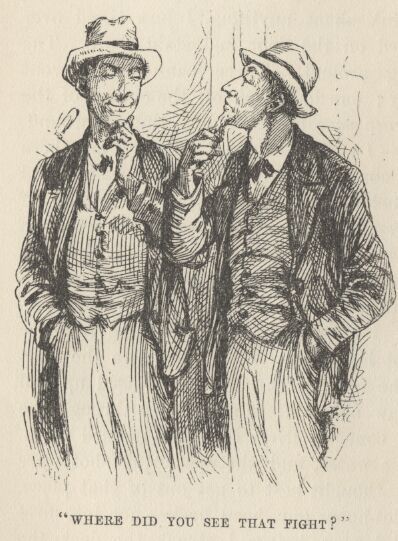
The next time I saw my partner, I said, 'Now, come out, be honest, and tell me the truth. Where did you go when you went to see that battle?' He says, 'I went down in the hold.'
All through that fight I was scared nearly to death. I hardly knew anything, I was so frightened; but you see, nobody knew that but me. Next day General Polk sent for me, and praised me for my bravery and gallant conduct. I never said anything, I let it go at that. I judged it wasn't so, but it was not for me to contradict a general officer.
Pretty soon after that I was sick, and used up, and had to go off to the Hot Springs. When there, I got a good many letters from commanders saying they wanted me to come back. I declined, because I wasn't well enough or strong enough; but I kept still, and kept the reputation I had made.
A plain story, straightforwardly told; but Mumford told me that that pilot had 'gilded that scare of his, in spots;' that his subsequent career in the war was proof of it.
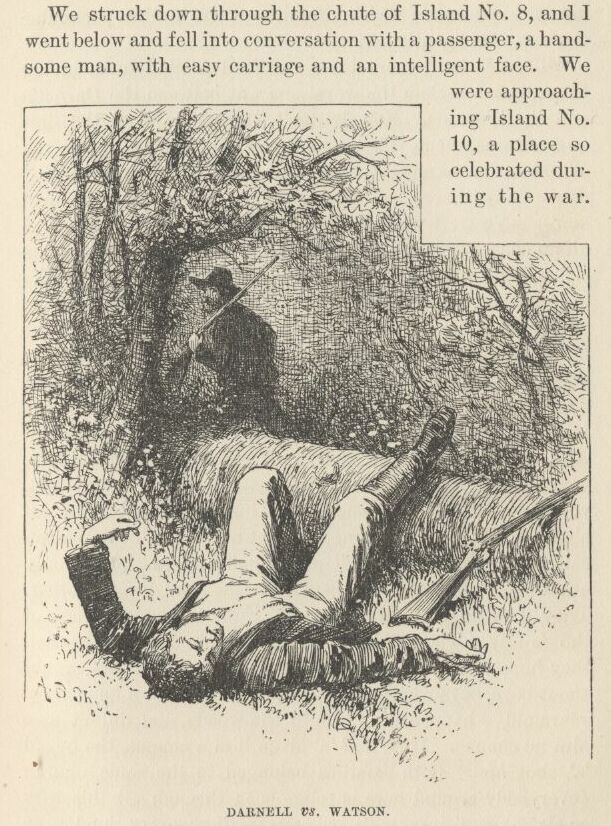
We struck down through the chute of Island No. 8, and I went below and fell into conversation with a passenger, a handsome man, with easy carriage and an intelligent face. We were approaching Island No. 10, a place so celebrated during the war. This gentleman's home was on the main shore in its neighborhood. I had some talk with him about the war times; but presently the discourse fell upon 'feuds,' for in no part of the South has the vendetta flourished more briskly, or held out longer between warring families, than in this particular region. This gentleman said—
'There's been more than one feud around here, in old times, but I reckon the worst one was between the Darnells and the Watsons. Nobody don't know now what the first quarrel was about, it's so long ago; the Darnells and the Watsons don't know, if there's any of them living, which I don't think there is. Some says it was about a horse or a cow—anyway, it was a little matter; the money in it wasn't of no consequence—none in the world—both families was rich. The thing could have been fixed up, easy enough; but no, that wouldn't do. Rough words had been passed; and so, nothing but blood could fix it up after that. That horse or cow, whichever it was, cost sixty years of killing and crippling! Every year or so somebody was shot, on one side or the other; and as fast as one generation was laid out, their sons took up the feud and kept it a-going. And it's just as I say; they went on shooting each other, year in and year out—making a kind of a religion of it, you see—till they'd done forgot, long ago, what it was all about. Wherever a Darnell caught a Watson, or a Watson caught a Darnell, one of 'em was going to get hurt—only question was, which of them got the drop on the other. They'd shoot one another down, right in the presence of the family. They didn't hunt for each other, but when they happened to meet, they puffed and begun. Men would shoot boys, boys would shoot men. A man shot a boy twelve years old—happened on him in the woods, and didn't give him no chance. If he had 'a' given him a chance, the boy'd 'a' shot him. Both families belonged to the same church (everybody around here is religious); through all this fifty or sixty years' fuss, both tribes was there every Sunday, to worship. They lived each side of the line, and the church was at a landing called Compromise. Half the church and half the aisle was in Kentucky, the other half in Tennessee. Sundays you'd see the families drive up, all in their Sunday clothes, men, women, and children, and file up the aisle, and set down, quiet and orderly, one lot on the Tennessee side of the church and the other on the Kentucky side; and the men and boys would lean their guns up against the wall, handy, and then all hands would join in with the prayer and praise; though they say the man next the aisle didn't kneel down, along with the rest of the family; kind of stood guard. I don't know; never was at that church in my life; but I remember that that's what used to be said.
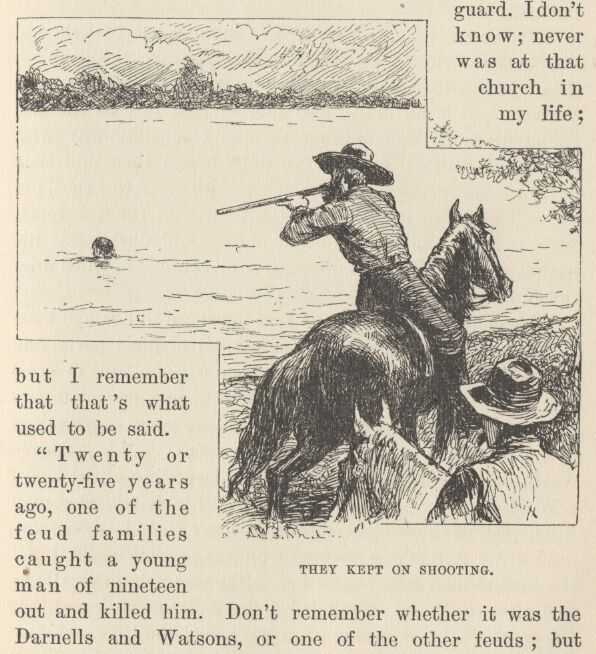
'Twenty or twenty-five years ago, one of the feud families caught a young man of nineteen out and killed him. Don't remember whether it was the Darnells and Watsons, or one of the other feuds; but anyway, this young man rode up—steamboat laying there at the time—and the first thing he saw was a whole gang of the enemy. He jumped down behind a wood-pile, but they rode around and begun on him, he firing back, and they galloping and cavorting and yelling and banging away with all their might. Think he wounded a couple of them; but they closed in on him and chased him into the river; and as he swum along down stream, they followed along the bank and kept on shooting at him; and when he struck shore he was dead. Windy Marshall told me about it. He saw it. He was captain of the boat.
'Years ago, the Darnells was so thinned out that the old man and his two sons concluded they'd leave the country. They started to take steamboat just above No. 10; but the Watsons got wind of it; and they arrived just as the two young Darnells was walking up the companion-way with their wives on their arms. The fight begun then, and they never got no further—both of them killed. After that, old Darnell got into trouble with the man that run the ferry, and the ferry-man got the worst of it—and died. But his friends shot old Darnell through and through—filled him full of bullets, and ended him.'
The country gentleman who told me these things had been reared in ease and comfort, was a man of good parts, and was college bred. His loose grammar was the fruit of careless habit, not ignorance. This habit among educated men in the West is not universal, but it is prevalent—prevalent in the towns, certainly, if not in the cities; and to a degree which one cannot help noticing, and marveling at. I heard a Westerner who would be accounted a highly educated man in any country, say 'never mind, it don't make no difference, anyway.' A life-long resident who was present heard it, but it made no impression upon her. She was able to recall the fact afterward, when reminded of it; but she confessed that the words had not grated upon her ear at the time—a confession which suggests that if educated people can hear such blasphemous grammar, from such a source, and be unconscious of the deed, the crime must be tolerably common—so common that the general ear has become dulled by familiarity with it, and is no longer alert, no longer sensitive to such affronts.
No one in the world speaks blemishless grammar; no one has ever written it—no one, either in the world or out of it (taking the Scriptures for evidence on the latter point); therefore it would not be fair to exact grammatical perfection from the peoples of the Valley; but they and all other peoples may justly be required to refrain from knowingly and purposely debauching their grammar.
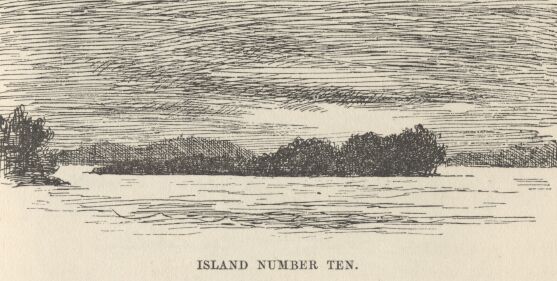
I found the river greatly changed at Island No. 10. The island which I remembered was some three miles long and a quarter of a mile wide, heavily timbered, and lay near the Kentucky shore—within two hundred yards of it, I should say. Now, however, one had to hunt for it with a spy-glass. Nothing was left of it but an insignificant little tuft, and this was no longer near the Kentucky shore; it was clear over against the opposite shore, a mile away. In war times the island had been an important place, for it commanded the situation; and, being heavily fortified, there was no getting by it. It lay between the upper and lower divisions of the Union forces, and kept them separate, until a junction was finally effected across the Missouri neck of land; but the island being itself joined to that neck now, the wide river is without obstruction.
In this region the river passes from Kentucky into Tennessee, back into Missouri, then back into Kentucky, and thence into Tennessee again. So a mile or two of Missouri sticks over into Tennessee.
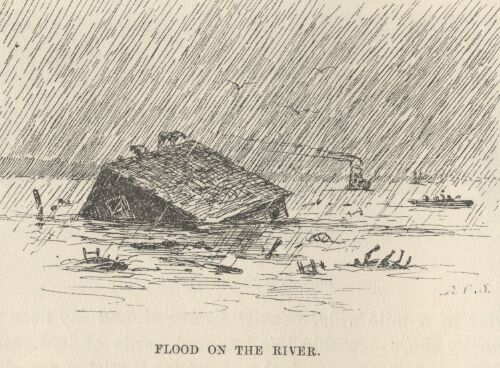
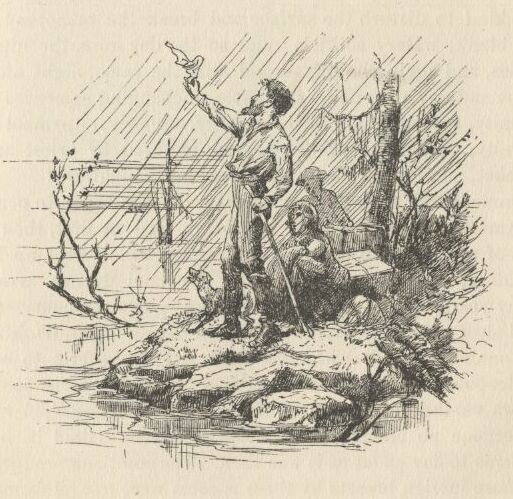
The town of New Madrid was looking very unwell; but otherwise unchanged from its former condition and aspect. Its blocks of frame-houses were still grouped in the same old flat plain, and environed by the same old forests. It was as tranquil as formerly, and apparently had neither grown nor diminished in size. It was said that the recent high water had invaded it and damaged its looks. This was surprising news; for in low water the river bank is very high there (fifty feet), and in my day an overflow had always been considered an impossibility. This present flood of 1882 Will doubtless be celebrated in the river's history for several generations before a deluge of like magnitude shall be seen. It put all the unprotected low lands under water, from Cairo to the mouth; it broke down the levees in a great many places, on both sides of the river; and in some regions south, when the flood was at its highest, the Mississippi was seventy miles wide! a number of lives were lost, and the destruction of property was fearful. The crops were destroyed, houses washed away, and shelterless men and cattle forced to take refuge on scattering elevations here and there in field and forest, and wait in peril and suffering until the boats put in commission by the national and local governments and by newspaper enterprise could come and rescue them. The properties of multitudes of people were under water for months, and the poorer ones must have starved by the hundred if succor had not been promptly afforded.{footnote [For a detailed and interesting description of the great flood, written on board of the New Orleans Times-Democrat's relief-boat, see Appendix A]} The water had been falling during a considerable time now, yet as a rule we found the banks still under water.
Chapter 27
Some Imported Articles
WE met two steamboats at New Madrid. Two steamboats in sight at once! an infrequent spectacle now in the lonesome Mississippi. The loneliness of this solemn, stupendous flood is impressive—and depressing. League after league, and still league after league, it pours its chocolate tide along, between its solid forest walls, its almost untenanted shores, with seldom a sail or a moving object of any kind to disturb the surface and break the monotony of the blank, watery solitude; and so the day goes, the night comes, and again the day—and still the same, night after night and day after day—majestic, unchanging sameness of serenity, repose, tranquillity, lethargy, vacancy—symbol of eternity, realization of the heaven pictured by priest and prophet, and longed for by the good and thoughtless!
Immediately after the war of 1812, tourists began to come to America, from England; scattering ones at first, then a sort of procession of them—a procession which kept up its plodding, patient march through the land during many, many years. Each tourist took notes, and went home and published a book—a book which was usually calm, truthful, reasonable, kind; but which seemed just the reverse to our tender-footed progenitors. A glance at these tourist-books shows us that in certain of its aspects the Mississippi has undergone no change since those strangers visited it, but remains to-day about as it was then. The emotions produced in those foreign breasts by these aspects were not all formed on one pattern, of course; they had to be various, along at first, because the earlier tourists were obliged to originate their emotions, whereas in older countries one can always borrow emotions from one's predecessors. And, mind you, emotions are among the toughest things in the world to manufacture out of whole cloth; it is easier to manufacture seven facts than one emotion. Captain Basil Hall. R.N., writing fifty-five years ago, says—
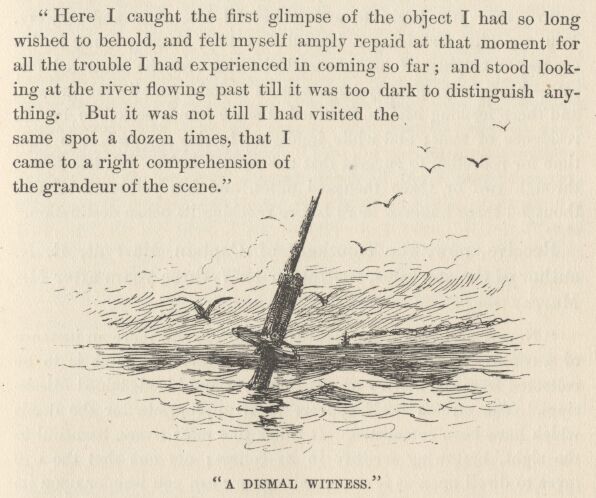
'Here I caught the first glimpse of the object I had so long wished to behold, and felt myself amply repaid at that moment for all the trouble I had experienced in coming so far; and stood looking at the river flowing past till it was too dark to distinguish anything. But it was not till I had visited the same spot a dozen times, that I came to a right comprehension of the grandeur of the scene.'
Following are Mrs. Trollope's emotions. She is writing a few months later in the same year, 1827, and is coming in at the mouth of the Mississippi—
'The first indication of our approach to land was the appearance of this mighty river pouring forth its muddy mass of waters, and mingling with the deep blue of the Mexican Gulf. I never beheld a scene so utterly desolate as this entrance of the Mississippi. Had Dante seen it, he might have drawn images of another Borgia from its horrors. One only object rears itself above the eddying waters; this is the mast of a vessel long since wrecked in attempting to cross the bar, and it still stands, a dismal witness of the destruction that has been, and a boding prophet of that which is to come.'
Emotions of Hon. Charles Augustus Murray (near St. Louis), seven years later—
'It is only when you ascend the mighty current for fifty or a hundred miles, and use the eye of imagination as well as that of nature, that you begin to understand all his might and majesty. You see him fertilizing a boundless valley, bearing along in his course the trophies of his thousand victories over the shattered forest—here carrying away large masses of soil with all their growth, and there forming islands, destined at some future period to be the residence of man; and while indulging in this prospect, it is then time for reflection to suggest that the current before you has flowed through two or three thousand miles, and has yet to travel one thousand three hundred more before reaching its ocean destination.'
Receive, now, the emotions of Captain Marryat, R.N. author of the sea tales, writing in 1837, three years after Mr. Murray—
'Never, perhaps, in the records of nations, was there an instance of a century of such unvarying and unmitigated crime as is to be collected from the history of the turbulent and blood-stained Mississippi. The stream itself appears as if appropriate for the deeds which have been committed. It is not like most rivers, beautiful to the sight, bestowing fertility in its course; not one that the eye loves to dwell upon as it sweeps along, nor can you wander upon its banks, or trust yourself without danger to its stream. It is a furious, rapid, desolating torrent, loaded with alluvial soil; and few of those who are received into its waters ever rise again, {footnote [There was a foolish superstition of some little prevalence in that day, that the Mississippi would neither buoy up a swimmer, nor permit a drowned person's body to rise to the surface.]} or can support themselves long upon its surface without assistance from some friendly log. It contains the coarsest and most uneatable of fish, such as the cat-fish and such genus, and as you descend, its banks are occupied with the fetid alligator, while the panther basks at its edge in the cane-brakes, almost impervious to man. Pouring its impetuous waters through wild tracks covered with trees of little value except for firewood, it sweeps down whole forests in its course, which disappear in tumultuous confusion, whirled away by the stream now loaded with the masses of soil which nourished their roots, often blocking up and changing for a time the channel of the river, which, as if in anger at its being opposed, inundates and devastates the whole country round; and as soon as it forces its way through its former channel, plants in every direction the uprooted monarchs of the forest (upon whose branches the bird will never again perch, or the raccoon, the opossum, or the squirrel climb) as traps to the adventurous navigators of its waters by steam, who, borne down upon these concealed dangers which pierce through the planks, very often have not time to steer for and gain the shore before they sink to the bottom. There are no pleasing associations connected with the great common sewer of the Western America, which pours out its mud into the Mexican Gulf, polluting the clear blue sea for many miles beyond its mouth. It is a river of desolation; and instead of reminding you, like other beautiful rivers, of an angel which has descended for the benefit of man, you imagine it a devil, whose energies have been only overcome by the wonderful power of steam.'
It is pretty crude literature for a man accustomed to handling a pen; still, as a panorama of the emotions sent weltering through this noted visitor's breast by the aspect and traditions of the 'great common sewer,' it has a value. A value, though marred in the matter of statistics by inaccuracies; for the catfish is a plenty good enough fish for anybody, and there are no panthers that are 'impervious to man.'
Later still comes Alexander Mackay, of the Middle Temple, Barrister at Law, with a better digestion, and no catfish dinner aboard, and feels as follows—
'The Mississippi! It was with indescribable emotions that I first felt myself afloat upon its waters. How often in my schoolboy dreams, and in my waking visions afterwards, had my imagination pictured to itself the lordly stream, rolling with tumultuous current through the boundless region to which it has given its name, and gathering into itself, in its course to the ocean, the tributary waters of almost every latitude in the temperate zone! Here it was then in its reality, and I, at length, steaming against its tide. I looked upon it with that reverence with which everyone must regard a great feature of external nature.'
So much for the emotions. The tourists, one and all, remark upon the deep, brooding loneliness and desolation of the vast river. Captain Basil Hall, who saw it at flood-stage, says—
'Sometimes we passed along distances of twenty or thirty miles without seeing a single habitation. An artist, in search of hints for a painting of the deluge, would here have found them in abundance.'
The first shall be last, etc. just two hundred years ago, the old original first and gallantest of all the foreign tourists, pioneer, head of the procession, ended his weary and tedious discovery-voyage down the solemn stretches of the great river—La Salle, whose name will last as long as the river itself shall last. We quote from Mr. Parkman—
'And now they neared their journey's end. On the sixth of April, the river divided itself into three broad channels. La Salle followed that of the west, and D'Autray that of the east; while Tonty took the middle passage. As he drifted down the turbid current, between the low and marshy shores, the brackish water changed to brine, and the breeze grew fresh with the salt breath of the sea. Then the broad bosom of the great Gulf opened on his sight, tossing its restless billows, limitless, voiceless, lonely as when born of chaos, without a sail, without a sign of life.'
Then, on a spot of solid ground, La Salle reared a column 'bearing the arms of France; the Frenchmen were mustered under arms; and while the New England Indians and their squaws looked on in wondering silence, they chanted the Te Deum, The Exaudiat, and the Domine Salvum Fac Regem.'
Then, whilst the musketry volleyed and rejoicing shouts burst forth, the victorious discoverer planted the column, and made proclamation in a loud voice, taking formal possession of the river and the vast countries watered by it, in the name of the King. The column bore this inscription—
LOUIS LE GRAND, ROY DE FRANCE ET DE NAVARRE, REGNE; LE NEUVIEME AVRIL, 1682.
New Orleans intended to fittingly celebrate, this present year, the bicentennial anniversary of this illustrious event; but when the time came, all her energies and surplus money were required in other directions, for the flood was upon the land then, making havoc and devastation everywhere.
Chapter 28
Uncle Mumford Unloads
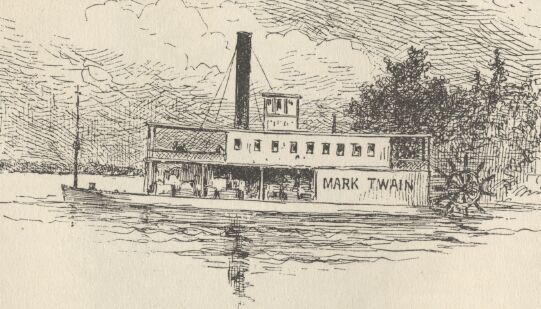
ALL day we swung along down the river, and had the stream almost wholly to ourselves. Formerly, at such a stage of the water, we should have passed acres of lumber rafts, and dozens of big coal barges; also occasional little trading-scows, peddling along from farm to farm, with the peddler's family on board; possibly, a random scow, bearing a humble Hamlet and Co. on an itinerant dramatic trip. But these were all absent. Far along in the day, we saw one steamboat; just one, and no more. She was lying at rest in the shade, within the wooded mouth of the Obion River. The spy-glass revealed the fact that she was named for me—or he was named for me, whichever you prefer. As this was the first time I had ever encountered this species of honor, it seems excusable to mention it, and at the same time call the attention of the authorities to the tardiness of my recognition of it.
Noted a big change in the river, at Island 21. It was a very large island, and used to be out toward mid-stream; but it is joined fast to the main shore now, and has retired from business as an island.
As we approached famous and formidable Plum Point, darkness fell, but that was nothing to shudder about—in these modern times. For now the national government has turned the Mississippi into a sort of two-thousand-mile torchlight procession. In the head of every crossing, and in the foot of every crossing, the government has set up a clear-burning lamp. You are never entirely in the dark, now; there is always a beacon in sight, either before you, or behind you, or abreast. One might almost say that lamps have been squandered there. Dozens of crossings are lighted which were not shoal when they were created, and have never been shoal since; crossings so plain, too, and also so straight, that a steamboat can take herself through them without any help, after she has been through once. Lamps in such places are of course not wasted; it is much more convenient and comfortable for a pilot to hold on them than on a spread of formless blackness that won't stay still; and money is saved to the boat, at the same time, for she can of course make more miles with her rudder amidships than she can with it squared across her stern and holding her back.

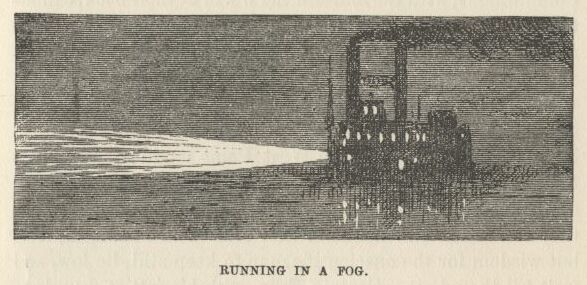
But this thing has knocked the romance out of piloting, to a large extent. It, and some other things together, have knocked all the romance out of it. For instance, the peril from snags is not now what it once was. The government's snag-boats go patrolling up and down, in these matter-of-fact days, pulling the river's teeth; they have rooted out all the old clusters which made many localities so formidable; and they allow no new ones to collect. Formerly, if your boat got away from you, on a black night, and broke for the woods, it was an anxious time with you; so was it also, when you were groping your way through solidified darkness in a narrow chute; but all that is changed now—you flash out your electric light, transform night into day in the twinkling of an eye, and your perils and anxieties are at an end. Horace Bixby and George Ritchie have charted the crossings and laid out the courses by compass; they have invented a lamp to go with the chart, and have patented the whole. With these helps, one may run in the fog now, with considerable security, and with a confidence unknown in the old days.
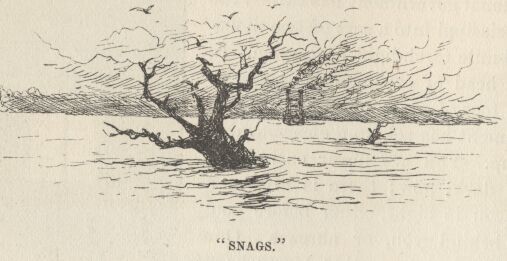
With these abundant beacons, the banishment of snags, plenty of daylight in a box and ready to be turned on whenever needed, and a chart and compass to fight the fog with, piloting, at a good stage of water, is now nearly as safe and simple as driving stage, and is hardly more than three times as romantic.
And now in these new days, these days of infinite change, the Anchor Line have raised the captain above the pilot by giving him the bigger wages of the two. This was going far, but they have not stopped there. They have decreed that the pilot shall remain at his post, and stand his watch clear through, whether the boat be under way or tied up to the shore. We, that were once the aristocrats of the river, can't go to bed now, as we used to do, and sleep while a hundred tons of freight are lugged aboard; no, we must sit in the pilot-house; and keep awake, too. Verily we are being treated like a parcel of mates and engineers. The Government has taken away the romance of our calling; the Company has taken away its state and dignity.
Plum Point looked as it had always looked by night, with the exception that now there were beacons to mark the crossings, and also a lot of other lights on the Point and along its shore; these latter glinting from the fleet of the United States River Commission, and from a village which the officials have built on the land for offices and for the employees of the service. The military engineers of the Commission have taken upon their shoulders the job of making the Mississippi over again—a job transcended in size by only the original job of creating it. They are building wing-dams here and there, to deflect the current; and dikes to confine it in narrower bounds; and other dikes to make it stay there; and for unnumbered miles along the Mississippi, they are felling the timber-front for fifty yards back, with the purpose of shaving the bank down to low-water mark with the slant of a house roof, and ballasting it with stones; and in many places they have protected the wasting shores with rows of piles. One who knows the Mississippi will promptly aver—not aloud, but to himself—that ten thousand River Commissions, with the mines of the world at their back, cannot tame that lawless stream, cannot curb it or confine it, cannot say to it, Go here, or Go there, and make it obey; cannot save a shore which it has sentenced; cannot bar its path with an obstruction which it will not tear down, dance over, and laugh at. But a discreet man will not put these things into spoken words; for the West Point engineers have not their superiors anywhere; they know all that can be known of their abstruse science; and so, since they conceive that they can fetter and handcuff that river and boss him, it is but wisdom for the unscientific man to keep still, lie low, and wait till they do it. Captain Eads, with his jetties, has done a work at the mouth of the Mississippi which seemed clearly impossible; so we do not feel full confidence now to prophesy against like impossibilities. Otherwise one would pipe out and say the Commission might as well bully the comets in their courses and undertake to make them behave, as try to bully the Mississippi into right and reasonable conduct.
I consulted Uncle Mumford concerning this and cognate matters; and I give here the result, stenographically reported, and therefore to be relied on as being full and correct; except that I have here and there left out remarks which were addressed to the men, such as 'where in blazes are you going with that barrel now?' and which seemed to me to break the flow of the written statement, without compensating by adding to its information or its clearness. Not that I have ventured to strike out all such interjections; I have removed only those which were obviously irrelevant; wherever one occurred which I felt any question about, I have judged it safest to let it remain.
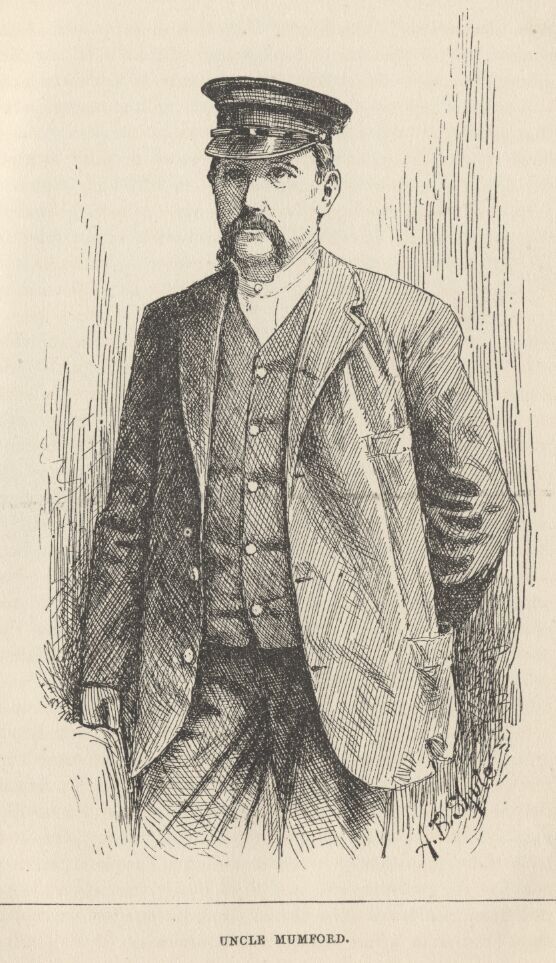
UNCLE MUMFORD'S IMPRESSIONS
Uncle Mumford said—
'As long as I have been mate of a steamboat—thirty years—I have watched this river and studied it. Maybe I could have learnt more about it at West Point, but if I believe it I wish I may be what are you sucking your fingers there for ?—collar that kag of nails! Four years at West Point, and plenty of books and schooling, will learn a man a good deal, I reckon, but it won't learn him the river. You turn one of those little European rivers over to this Commission, with its hard bottom and clear water, and it would just be a holiday job for them to wall it, and pile it, and dike it, and tame it down, and boss it around, and make it go wherever they wanted it to, and stay where they put it, and do just as they said, every time. But this ain't that kind of a river. They have started in here with big confidence, and the best intentions in the world; but they are going to get left. What does Ecclesiastes vii. 13 say? Says enough to knock their little game galley-west, don't it? Now you look at their methods once. There at Devil's Island, in the Upper River, they wanted the water to go one way, the water wanted to go another. So they put up a stone wall. But what does the river care for a stone wall? When it got ready, it just bulged through it. Maybe they can build another that will stay; that is, up there—but not down here they can't. Down here in the Lower River, they drive some pegs to turn the water away from the shore and stop it from slicing off the bank; very well, don't it go straight over and cut somebody else's bank? Certainly. Are they going to peg all the banks? Why, they could buy ground and build a new Mississippi cheaper. They are pegging Bulletin Tow-head now. It won't do any good. If the river has got a mortgage on that island, it will foreclose, sure, pegs or no pegs. Away down yonder, they have driven two rows of piles straight through the middle of a dry bar half a mile long, which is forty foot out of the water when the river is low. What do you reckon that is for? If I know, I wish I may land in—hump yourself, you son of an undertaker!—out with that coal-oil, now, lively, lively! And just look at what they are trying to do down there at Milliken's Bend. There's been a cut-off in that section, and Vicksburg is left out in the cold. It's a country town now. The river strikes in below it; and a boat can't go up to the town except in high water. Well, they are going to build wing-dams in the bend opposite the foot of 103, and throw the water over and cut off the foot of the island and plow down into an old ditch where the river used to be in ancient times; and they think they can persuade the water around that way, and get it to strike in above Vicksburg, as it used to do, and fetch the town back into the world again. That is, they are going to take this whole Mississippi, and twist it around and make it run several miles up stream. Well you've got to admire men that deal in ideas of that size and can tote them around without crutches; but you haven't got to believe they can do such miracles, have you! And yet you ain't absolutely obliged to believe they can't. I reckon the safe way, where a man can afford it, is to copper the operation, and at the same time buy enough property in Vicksburg to square you up in case they win. Government is doing a deal for the Mississippi, now—spending loads of money on her. When there used to be four thousand steamboats and ten thousand acres of coal-barges, and rafts and trading scows, there wasn't a lantern from St. Paul to New Orleans, and the snags were thicker than bristles on a hog's back; and now when there's three dozen steamboats and nary barge or raft, Government has snatched out all the snags, and lit up the shores like Broadway, and a boat's as safe on the river as she'd be in heaven. And I reckon that by the time there ain't any boats left at all, the Commission will have the old thing all reorganized, and dredged out, and fenced in, and tidied up, to a degree that will make navigation just simply perfect, and absolutely safe and profitable; and all the days will be Sundays, and all the mates will be Sunday-school su——what-in-the-nation-you-fooling-around-there-for, you sons of unrighteousness, heirs of perdition! going to be a year getting that hogshead ashore?'
During our trip to New Orleans and back, we had many conversations with river men, planters, journalists, and officers of the River Commission—with conflicting and confusing results. To wit:—
1. Some believed in the Commission's scheme to arbitrarily and permanently confine (and thus deepen) the channel, preserve threatened shores, etc.
2. Some believed that the Commission's money ought to be spent only on building and repairing the great system of levees.
3. Some believed that the higher you build your levee, the higher the river's bottom will rise; and that consequently the levee system is a mistake.
4. Some believed in the scheme to relieve the river, in flood-time, by turning its surplus waters off into Lake Borgne, etc.
5. Some believed in the scheme of northern lake-reservoirs to replenish the Mississippi in low-water seasons.