
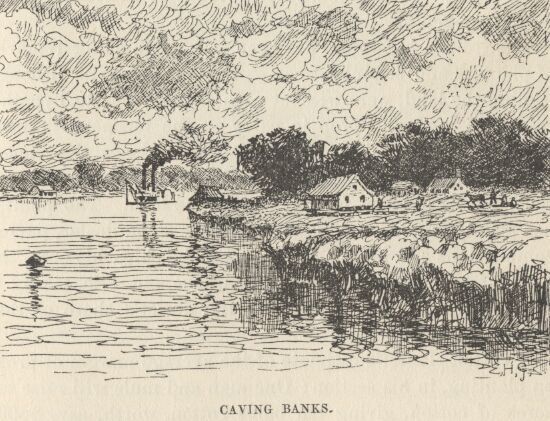
Napoleon had but small opinion of Greenville, Mississippi, in the old times; but behold, Napoleon is gone to the cat-fishes, and here is Greenville full of life and activity, and making a considerable flourish in the Valley; having three thousand inhabitants, it is said, and doing a gross trade of $2,500,000 annually. A growing town.
There was much talk on the boat about the Calhoun Land Company, an enterprise which is expected to work wholesome results. Colonel Calhoun, a grandson of the statesman, went to Boston and formed a syndicate which purchased a large tract of land on the river, in Chicot County, Arkansas—some ten thousand acres—for cotton-growing. The purpose is to work on a cash basis: buy at first hands, and handle their own product; supply their negro laborers with provisions and necessaries at a trifling profit, say 8 or 10 per cent.; furnish them comfortable quarters, etc., and encourage them to save money and remain on the place. If this proves a financial success, as seems quite certain, they propose to establish a banking-house in Greenville, and lend money at an unburdensome rate of interest—6 per cent. is spoken of.
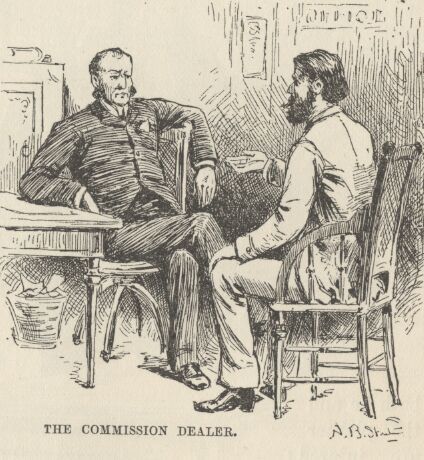
The trouble heretofore has been—I am quoting remarks of planters and steamboatmen—that the planters, although owning the land, were without cash capital; had to hypothecate both land and crop to carry on the business. Consequently, the commission dealer who furnishes the money takes some risk and demands big interest—usually 10 per cent., and 2{half} per cent. for negotiating the loan. The planter has also to buy his supplies through the same dealer, paying commissions and profits. Then when he ships his crop, the dealer adds his commissions, insurance, etc. So, taking it by and large, and first and last, the dealer's share of that crop is about 25 per cent.'{footnote ['But what can the State do where the people are under subjection to rates of interest ranging from 18 to 30 per cent., and are also under the necessity of purchasing their crops in advance even of planting, at these rates, for the privilege of purchasing all their supplies at 100 per cent. profit?'—Edward Atkinson.]}
A cotton-planter's estimate of the average margin of profit on planting, in his section: One man and mule will raise ten acres of cotton, giving ten bales cotton, worth, say, $500; cost of producing, say $350; net profit, $150, or $15 per acre. There is also a profit now from the cotton-seed, which formerly had little value—none where much transportation was necessary. In sixteen hundred pounds crude cotton four hundred are lint, worth, say, ten cents a pound; and twelve hundred pounds of seed, worth $12 or $13 per ton. Maybe in future even the stems will not be thrown away. Mr. Edward Atkinson says that for each bale of cotton there are fifteen hundred pounds of stems, and that these are very rich in phosphate of lime and potash; that when ground and mixed with ensilage or cotton-seed meal (which is too rich for use as fodder in large quantities), the stem mixture makes a superior food, rich in all the elements needed for the production of milk, meat, and bone. Heretofore the stems have been considered a nuisance.
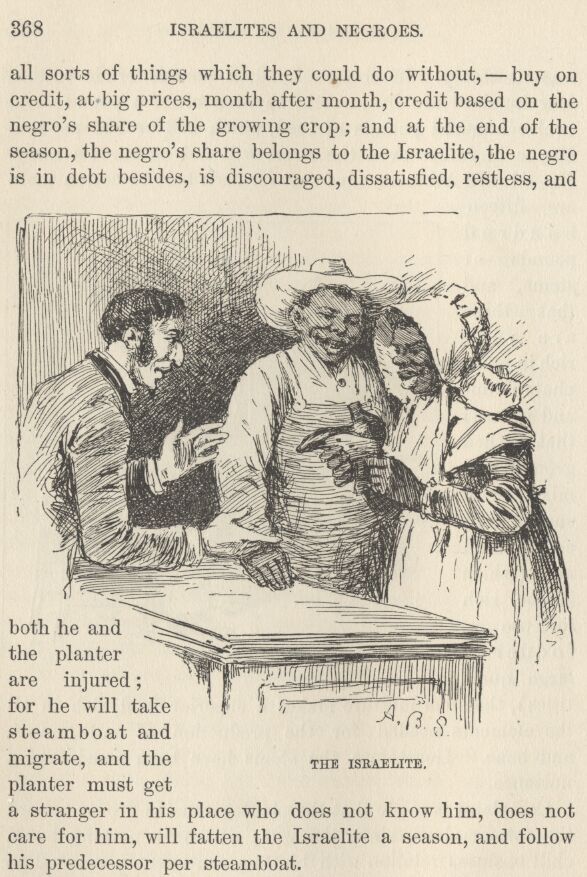
Complaint is made that the planter remains grouty toward the former slave, since the war; will have nothing but a chill business relation with him, no sentiment permitted to intrude, will not keep a 'store' himself, and supply the negro's wants and thus protect the negro's pocket and make him able and willing to stay on the place and an advantage to him to do it, but lets that privilege to some thrifty Israelite, who encourages the thoughtless negro and wife to buy all sorts of things which they could do without—buy on credit, at big prices, month after month, credit based on the negro's share of the growing crop; and at the end of the season, the negro's share belongs to the Israelite,' the negro is in debt besides, is discouraged, dissatisfied, restless, and both he and the planter are injured; for he will take steamboat and migrate, and the planter must get a stranger in his place who does not know him, does not care for him, will fatten the Israelite a season, and follow his predecessor per steamboat.
It is hoped that the Calhoun Company will show, by its humane and protective treatment of its laborers, that its method is the most profitable for both planter and negro; and it is believed that a general adoption of that method will then follow.
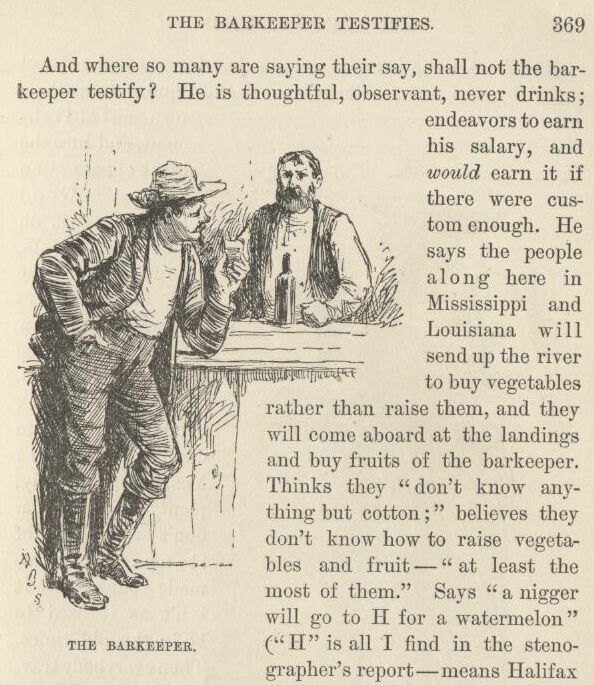
And where so many are saying their say, shall not the barkeeper testify? He is thoughtful, observant, never drinks; endeavors to earn his salary, and would earn it if there were custom enough. He says the people along here in Mississippi and Louisiana will send up the river to buy vegetables rather than raise them, and they will come aboard at the landings and buy fruits of the barkeeper. Thinks they 'don't know anything but cotton;' believes they don't know how to raise vegetables and fruit—'at least the most of them.' Says 'a nigger will go to H for a watermelon' ('H' is all I find in the stenographer's report—means Halifax probably, though that seems a good way to go for a watermelon). Barkeeper buys watermelons for five cents up the river, brings them down and sells them for fifty. 'Why does he mix such elaborate and picturesque drinks for the nigger hands on the boat?' Because they won't have any other. 'They want a big drink; don't make any difference what you make it of, they want the worth of their money. You give a nigger a plain gill of half-a-dollar brandy for five cents—will he touch it? No. Ain't size enough to it. But you put up a pint of all kinds of worthless rubbish, and heave in some red stuff to make it beautiful—red's the main thing—and he wouldn't put down that glass to go to a circus.'
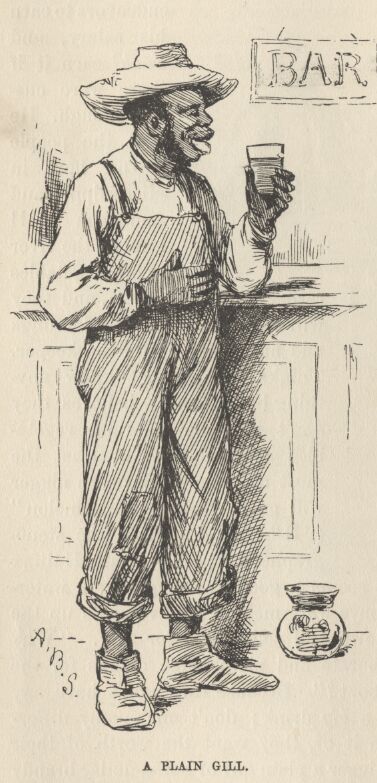
All the bars on this Anchor Line are rented and owned by one firm. They furnish the liquors from their own establishment, and hire the barkeepers 'on salary.' Good liquors? Yes, on some of the boats, where there are the kind of passengers that want it and can pay for it. On the other boats? No. Nobody but the deck hands and firemen to drink it. 'Brandy? Yes, I've got brandy, plenty of it; but you don't want any of it unless you've made your will.' It isn't as it used to be in the old times. Then everybody traveled by steamboat, everybody drank, and everybody treated everybody else. 'Now most everybody goes by railroad, and the rest don't drink.' In the old times the barkeeper owned the bar himself, 'and was gay and smarty and talky and all jeweled up, and was the toniest aristocrat on the boat; used to make $2,000 on a trip. A father who left his son a steamboat bar, left him a fortune. Now he leaves him board and lodging; yes, and washing, if a shirt a trip will do. Yes, indeedy, times are changed. Why, do you know, on the principal line of boats on the Upper Mississippi, they don't have any bar at all! Sounds like poetry, but it's the petrified truth.'
Chapter 34
Tough Yarns
STACK island. I remembered Stack Island; also Lake Providence, Louisiana—which is the first distinctly Southern-looking town you come to, downward-bound; lies level and low, shade-trees hung with venerable gray beards of Spanish moss; 'restful, pensive, Sunday aspect about the place,' comments Uncle Mumford, with feeling—also with truth.
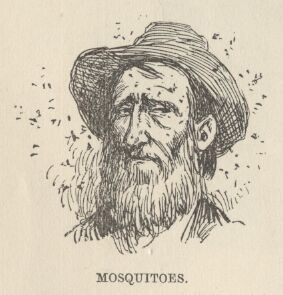
A Mr. H. furnished some minor details of fact concerning this region which I would have hesitated to believe if I had not known him to be a steamboat mate. He was a passenger of ours, a resident of Arkansas City, and bound to Vicksburg to join his boat, a little Sunflower packet. He was an austere man, and had the reputation of being singularly unworldly, for a river man. Among other things, he said that Arkansas had been injured and kept back by generations of exaggerations concerning the mosquitoes here. One may smile, said he, and turn the matter off as being a small thing; but when you come to look at the effects produced, in the way of discouragement of immigration, and diminished values of property, it was quite the opposite of a small thing, or thing in any wise to be coughed down or sneered at. These mosquitoes had been persistently represented as being formidable and lawless; whereas 'the truth is, they are feeble, insignificant in size, diffident to a fault, sensitive'—and so on, and so on; you would have supposed he was talking about his family. But if he was soft on the Arkansas mosquitoes, he was hard enough on the mosquitoes of Lake Providence to make up for it—'those Lake Providence colossi,' as he finely called them. He said that two of them could whip a dog, and that four of them could hold a man down; and except help come, they would kill him—'butcher him,' as he expressed it. Referred in a sort of casual way—and yet significant way—to 'the fact that the life policy in its simplest form is unknown in Lake Providence—they take out a mosquito policy besides.' He told many remarkable things about those lawless insects. Among others, said he had seen them try to vote. Noticing that this statement seemed to be a good deal of a strain on us, he modified it a little: said he might have been mistaken, as to that particular, but knew he had seen them around the polls 'canvassing.'
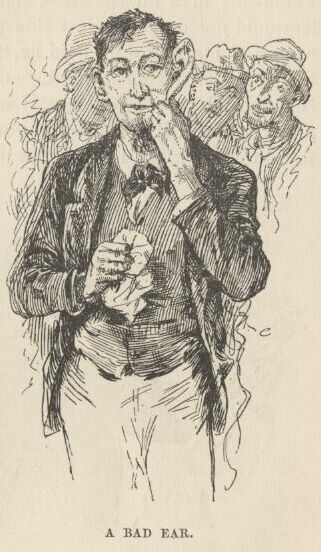
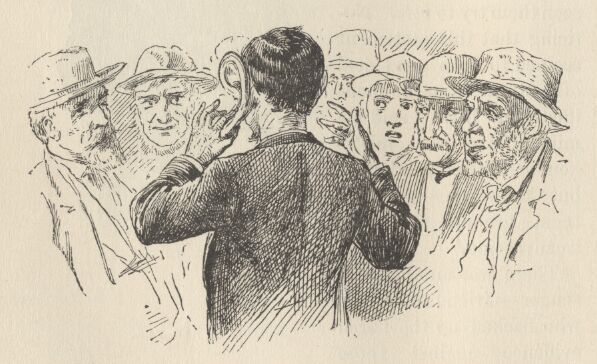
There was another passenger—friend of H.'s—who backed up the harsh evidence against those mosquitoes, and detailed some stirring adventures which he had had with them. The stories were pretty sizable, merely pretty sizable; yet Mr. H. was continually interrupting with a cold, inexorable 'Wait—knock off twenty-five per cent. of that; now go on;' or, 'Wait—you are getting that too strong; cut it down, cut it down—you get a leetle too much costumery on to your statements: always dress a fact in tights, never in an ulster;' or, 'Pardon, once more: if you are going to load anything more on to that statement, you want to get a couple of lighters and tow the rest, because it's drawing all the water there is in the river already; stick to facts—just stick to the cold facts; what these gentlemen want for a book is the frozen truth—ain't that so, gentlemen?' He explained privately that it was necessary to watch this man all the time, and keep him within bounds; it would not do to neglect this precaution, as he, Mr. H., 'knew to his sorrow.' Said he, 'I will not deceive you; he told me such a monstrous lie once, that it swelled my left ear up, and spread it so that I was actually not able to see out around it; it remained so for months, and people came miles to see me fan myself with it.'
Chapter 35
Vicksburg During the Trouble
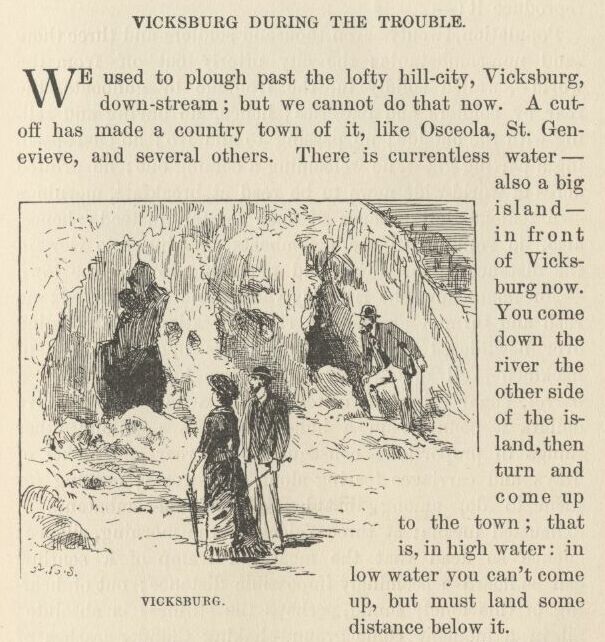
WE used to plow past the lofty hill-city, Vicksburg, down-stream; but we cannot do that now. A cut-off has made a country town of it, like Osceola, St. Genevieve, and several others. There is currentless water—also a big island—in front of Vicksburg now. You come down the river the other side of the island, then turn and come up to the town; that is, in high water: in low water you can't come up, but must land some distance below it.
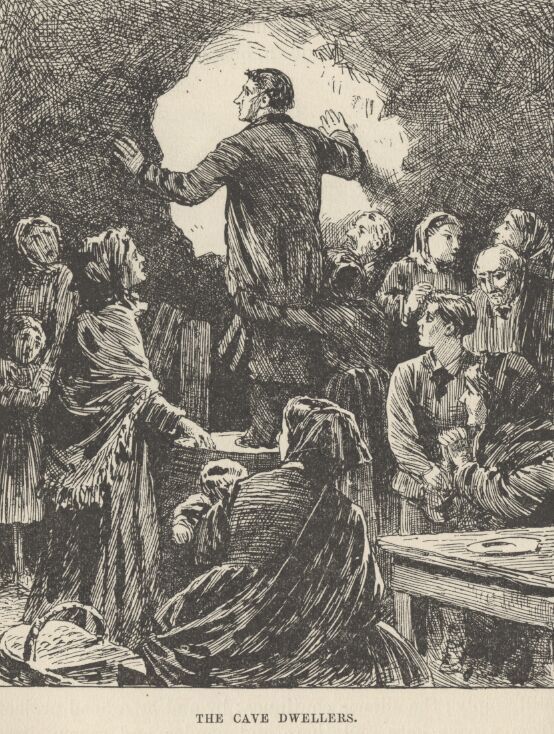
Signs and scars still remain, as reminders of Vicksburg's tremendous war experiences; earthworks, trees crippled by the cannon balls, cave-refuges in the clay precipices, etc. The caves did good service during the six weeks' bombardment of the city—May 8 to July 4, 1863. They were used by the non-combatants—mainly by the women and children; not to live in constantly, but to fly to for safety on occasion. They were mere holes, tunnels, driven into the perpendicular clay bank, then branched Y shape, within the hill. Life in Vicksburg, during the six weeks was perhaps—but wait; here are some materials out of which to reproduce it:—
Population, twenty-seven thousand soldiers and three thousand non-combatants; the city utterly cut off from the world—walled solidly in, the frontage by gunboats, the rear by soldiers and batteries; hence, no buying and selling with the outside; no passing to and fro; no God-speeding a parting guest, no welcoming a coming one; no printed acres of world-wide news to be read at breakfast, mornings—a tedious dull absence of such matter, instead; hence, also, no running to see steamboats smoking into view in the distance up or down, and plowing toward the town—for none came, the river lay vacant and undisturbed; no rush and turmoil around the railway station, no struggling over bewildered swarms of passengers by noisy mobs of hackmen—all quiet there; flour two hundred dollars a barrel, sugar thirty, corn ten dollars a bushel, bacon five dollars a pound, rum a hundred dollars a gallon; other things in proportion: consequently, no roar and racket of drays and carriages tearing along the streets; nothing for them to do, among that handful of non-combatants of exhausted means; at three o'clock in the morning, silence; silence so dead that the measured tramp of a sentinel can be heard a seemingly impossible distance; out of hearing of this lonely sound, perhaps the stillness is absolute: all in a moment come ground-shaking thunder-crashes of artillery, the sky is cobwebbed with the crisscrossing red lines streaming from soaring bomb-shells, and a rain of iron fragments descends upon the city; descends upon the empty streets: streets which are not empty a moment later, but mottled with dim figures of frantic women and children scurrying from home and bed toward the cave dungeons—encouraged by the humorous grim soldiery, who shout 'Rats, to your holes!' and laugh.
The cannon-thunder rages, shells scream and crash overhead, the iron rain pours down, one hour, two hours, three, possibly six, then stops; silence follows, but the streets are still empty; the silence continues; by-and-bye a head projects from a cave here and there and yonder, and reconnoitres, cautiously; the silence still continuing, bodies follow heads, and jaded, half smothered creatures group themselves about, stretch their cramped limbs, draw in deep draughts of the grateful fresh air, gossip with the neighbors from the next cave; maybe straggle off home presently, or take a lounge through the town, if the stillness continues; and will scurry to the holes again, by-and-bye, when the war-tempest breaks forth once more.
There being but three thousand of these cave-dwellers—merely the population of a village—would they not come to know each other, after a week or two, and familiarly; insomuch that the fortunate or unfortunate experiences of one would be of interest to all?
Those are the materials furnished by history. From them might not almost anybody reproduce for himself the life of that time in Vicksburg? Could you, who did not experience it, come nearer to reproducing it to the imagination of another non-participant than could a Vicksburger who did experience it? It seems impossible; and yet there are reasons why it might not really be. When one makes his first voyage in a ship, it is an experience which multitudinously bristles with striking novelties; novelties which are in such sharp contrast with all this person's former experiences that they take a seemingly deathless grip upon his imagination and memory. By tongue or pen he can make a landsman live that strange and stirring voyage over with him; make him see it all and feel it all. But if he wait? If he make ten voyages in succession—what then? Why, the thing has lost color, snap, surprise; and has become commonplace. The man would have nothing to tell that would quicken a landsman's pulse.
Years ago, I talked with a couple of the Vicksburg non-combatants—a man and his wife. Left to tell their story in their own way, those people told it without fire, almost without interest.
A week of their wonderful life there would have made their tongues eloquent for ever perhaps; but they had six weeks of it, and that wore the novelty all out; they got used to being bomb-shelled out of home and into the ground; the matter became commonplace. After that, the possibility of their ever being startlingly interesting in their talks about it was gone. What the man said was to this effect:—
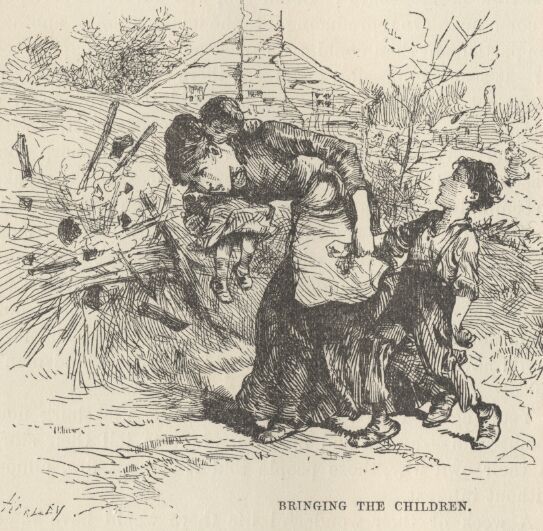
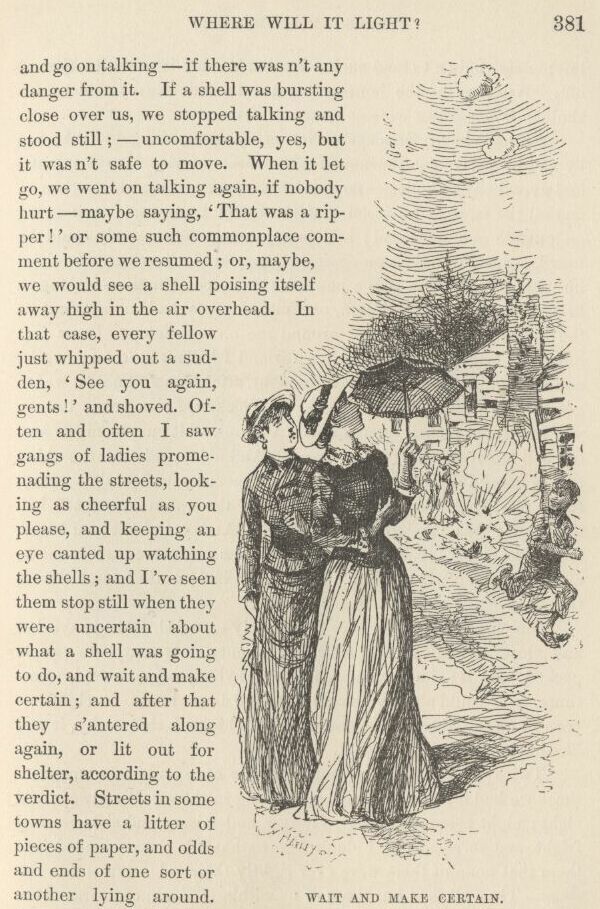
'It got to be Sunday all the time. Seven Sundays in the week—to us, anyway. We hadn't anything to do, and time hung heavy. Seven Sundays, and all of them broken up at one time or another, in the day or in the night, by a few hours of the awful storm of fire and thunder and iron. At first we used to shin for the holes a good deal faster than we did afterwards. The first time, I forgot the children, and Maria fetched them both along. When she was all safe in the cave she fainted. Two or three weeks afterwards, when she was running for the holes, one morning, through a shell-shower, a big shell burst near her, and covered her all over with dirt, and a piece of the iron carried away her game-bag of false hair from the back of her head. Well, she stopped to get that game-bag before she shoved along again! Was getting used to things already, you see. We all got so that we could tell a good deal about shells; and after that we didn't always go under shelter if it was a light shower. Us men would loaf around and talk; and a man would say, 'There she goes!' and name the kind of shell it was from the sound of it, and go on talking—if there wasn't any danger from it. If a shell was bursting close over us, we stopped talking and stood still;—uncomfortable, yes, but it wasn't safe to move. When it let go, we went on talking again, if nobody hurt—maybe saying, 'That was a ripper!' or some such commonplace comment before we resumed; or, maybe, we would see a shell poising itself away high in the air overhead. In that case, every fellow just whipped out a sudden, 'See you again, gents!' and shoved. Often and often I saw gangs of ladies promenading the streets, looking as cheerful as you please, and keeping an eye canted up watching the shells; and I've seen them stop still when they were uncertain about what a shell was going to do, and wait and make certain; and after that they sa'ntered along again, or lit out for shelter, according to the verdict. Streets in some towns have a litter of pieces of paper, and odds and ends of one sort or another lying around. Ours hadn't; they had iron litter. Sometimes a man would gather up all the iron fragments and unbursted shells in his neighborhood, and pile them into a kind of monument in his front yard—a ton of it, sometimes. No glass left; glass couldn't stand such a bombardment; it was all shivered out. Windows of the houses vacant—looked like eye-holes in a skull. Whole panes were as scarce as news.
'We had church Sundays. Not many there, along at first; but by-and-bye pretty good turnouts. I've seen service stop a minute, and everybody sit quiet—no voice heard, pretty funeral-like then—and all the more so on account of the awful boom and crash going on outside and overhead; and pretty soon, when a body could be heard, service would go on again. Organs and church-music mixed up with a bombardment is a powerful queer combination—along at first. Coming out of church, one morning, we had an accident—the only one that happened around me on a Sunday. I was just having a hearty handshake with a friend I hadn't seen for a while, and saying, 'Drop into our cave to-night, after bombardment; we've got hold of a pint of prime wh—.' Whiskey, I was going to say, you know, but a shell interrupted. A chunk of it cut the man's arm off, and left it dangling in my hand. And do you know the thing that is going to stick the longest in my memory, and outlast everything else, little and big, I reckon, is the mean thought I had then? It was 'the whiskey is saved.' And yet, don't you know, it was kind of excusable; because it was as scarce as diamonds, and we had only just that little; never had another taste during the siege.
'Sometimes the caves were desperately crowded, and always hot and close. Sometimes a cave had twenty or twenty-five people packed into it; no turning-room for anybody; air so foul, sometimes, you couldn't have made a candle burn in it. A child was born in one of those caves one night, Think of that; why, it was like having it born in a trunk.
'Twice we had sixteen people in our cave; and a number of times we had a dozen. Pretty suffocating in there. We always had eight; eight belonged there. Hunger and misery and sickness and fright and sorrow, and I don't know what all, got so loaded into them that none of them were ever rightly their old selves after the siege. They all died but three of us within a couple of years. One night a shell burst in front of the hole and caved it in and stopped it up. It was lively times, for a while, digging out. Some of us came near smothering. After that we made two openings—ought to have thought of it at first.
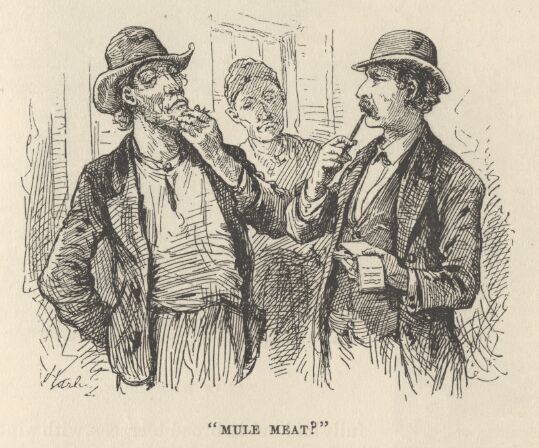
'Mule meat. No, we only got down to that the last day or two. Of course it was good; anything is good when you are starving.
This man had kept a diary during—six weeks? No, only the first six days. The first day, eight close pages; the second, five; the third, one—loosely written; the fourth, three or four lines; a line or two the fifth and sixth days; seventh day, diary abandoned; life in terrific Vicksburg having now become commonplace and matter of course.
The war history of Vicksburg has more about it to interest the general reader than that of any other of the river-towns. It is full of variety, full of incident, full of the picturesque. Vicksburg held out longer than any other important river-town, and saw warfare in all its phases, both land and water—the siege, the mine, the assault, the repulse, the bombardment, sickness, captivity, famine.
The most beautiful of all the national cemeteries is here. Over the great gateway is this inscription:—
“HERE REST IN PEACE 16,600 WHO DIED FOR THEIR COUNTRY IN THE YEARS 1861 TO 1865.”
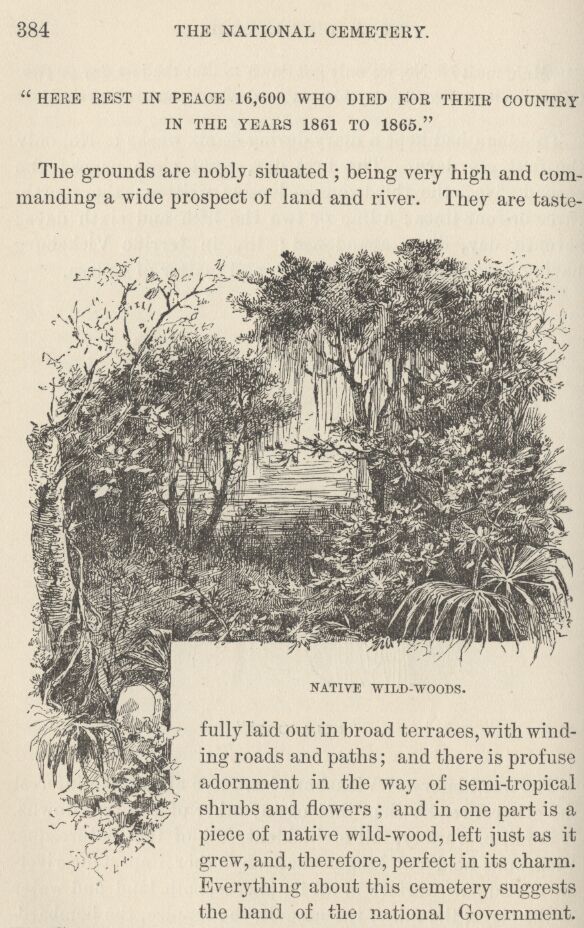
The grounds are nobly situated; being very high and commanding a wide prospect of land and river. They are tastefully laid out in broad terraces, with winding roads and paths; and there is profuse adornment in the way of semi-tropical shrubs and flowers,' and in one part is a piece of native wild-wood, left just as it grew, and, therefore, perfect in its charm. Everything about this cemetery suggests the hand of the national Government. The Government's work is always conspicuous for excellence, solidity, thoroughness, neatness. The Government does its work well in the first place, and then takes care of it.
By winding-roads—which were often cut to so great a depth between perpendicular walls that they were mere roofless tunnels—we drove out a mile or two and visited the monument which stands upon the scene of the surrender of Vicksburg to General Grant by General Pemberton. Its metal will preserve it from the hackings and chippings which so defaced its predecessor, which was of marble; but the brick foundations are crumbling, and it will tumble down by-and-bye. It overlooks a picturesque region of wooded hills and ravines; and is not unpicturesque itself, being well smothered in flowering weeds. The battered remnant of the marble monument has been removed to the National Cemetery.
On the road, a quarter of a mile townward, an aged colored man showed us, with pride, an unexploded bomb-shell which has lain in his yard since the day it fell there during the siege.
'I was a-stannin' heah, an' de dog was a-stannin' heah; de dog he went for de shell, gwine to pick a fuss wid it; but I didn't; I says, “Jes' make you'seff at home heah; lay still whah you is, or bust up de place, jes' as you's a mind to, but I's got business out in de woods, I has!”'
Vicksburg is a town of substantial business streets and pleasant residences; it commands the commerce of the Yazoo and Sunflower Rivers; is pushing railways in several directions, through rich agricultural regions, and has a promising future of prosperity and importance.
Apparently, nearly all the river towns, big and little, have made up their minds that they must look mainly to railroads for wealth and upbuilding, henceforth. They are acting upon this idea. The signs are, that the next twenty years will bring about some noteworthy changes in the Valley, in the direction of increased population and wealth, and in the intellectual advancement and the liberalizing of opinion which go naturally with these. And yet, if one may judge by the past, the river towns will manage to find and use a chance, here and there, to cripple and retard their progress. They kept themselves back in the days of steamboating supremacy, by a system of wharfage-dues so stupidly graded as to prohibit what may be called small retail traffic in freights and passengers. Boats were charged such heavy wharfage that they could not afford to land for one or two passengers or a light lot of freight. Instead of encouraging the bringing of trade to their doors, the towns diligently and effectively discouraged it. They could have had many boats and low rates; but their policy rendered few boats and high rates compulsory. It was a policy which extended—and extends—from New Orleans to St. Paul.
We had a strong desire to make a trip up the Yazoo and the Sunflower—an interesting region at any time, but additionally interesting at this time, because up there the great inundation was still to be seen in force—but we were nearly sure to have to wait a day or more for a New Orleans boat on our return; so we were obliged to give up the project.
Here is a story which I picked up on board the boat that night. I insert it in this place merely because it is a good story, not because it belongs here—for it doesn't. It was told by a passenger—a college professor—and was called to the surface in the course of a general conversation which began with talk about horses, drifted into talk about astronomy, then into talk about the lynching of the gamblers in Vicksburg half a century ago, then into talk about dreams and superstitions; and ended, after midnight, in a dispute over free trade and protection.
Chapter 36
The Professor's Yarn
IT was in the early days. I was not a college professor then. I was a humble-minded young land-surveyor, with the world before me—to survey, in case anybody wanted it done. I had a contract to survey a route for a great mining-ditch in California, and I was on my way thither, by sea—a three or four weeks' voyage. There were a good many passengers, but I had very little to say to them; reading and dreaming were my passions, and I avoided conversation in order to indulge these appetites. There were three professional gamblers on board—rough, repulsive fellows. I never had any talk with them, yet I could not help seeing them with some frequency, for they gambled in an upper-deck stateroom every day and night, and in my promenades I often had glimpses of them through their door, which stood a little ajar to let out the surplus tobacco smoke and profanity. They were an evil and hateful presence, but I had to put up with it, of course,
There was one other passenger who fell under my eye a good deal, for he seemed determined to be friendly with me, and I could not have gotten rid of him without running some chance of hurting his feelings, and I was far from wishing to do that. Besides, there was something engaging in his countrified simplicity and his beaming good-nature. The first time I saw this Mr. John Backus, I guessed, from his clothes and his looks, that he was a grazier or farmer from the backwoods of some western State—doubtless Ohio—and afterward when he dropped into his personal history and I discovered that he was a cattle-raiser from interior Ohio, I was so pleased with my own penetration that I warmed toward him for verifying my instinct.
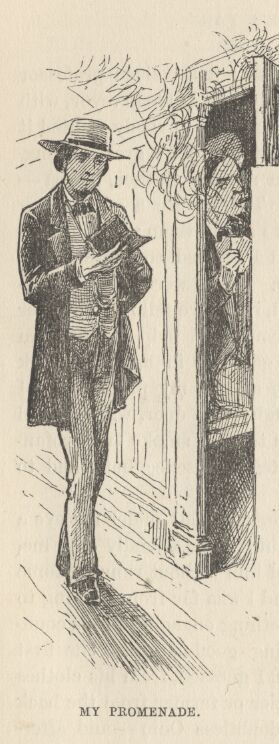
He got to dropping alongside me every day, after breakfast, to help me make my promenade; and so, in the course of time, his easy-working jaw had told me everything about his business, his prospects, his family, his relatives, his politics—in fact everything that concerned a Backus, living or dead. And meantime I think he had managed to get out of me everything I knew about my trade, my tribe, my purposes, my prospects, and myself. He was a gentle and persuasive genius, and this thing showed it; for I was not given to talking about my matters. I said something about triangulation, once; the stately word pleased his ear; he inquired what it meant; I explained; after that he quietly and inoffensively ignored my name, and always called me Triangle.
What an enthusiast he was in cattle! At the bare name of a bull or a cow, his eye would light and his eloquent tongue would turn itself loose. As long as I would walk and listen, he would walk and talk; he knew all breeds, he loved all breeds, he caressed them all with his affectionate tongue. I tramped along in voiceless misery whilst the cattle question was up; when I could endure it no longer, I used to deftly insert a scientific topic into the conversation; then my eye fired and his faded; my tongue fluttered, his stopped; life was a joy to me, and a sadness to him.
One day he said, a little hesitatingly, and with somewhat of diffidence—
'Triangle, would you mind coming down to my stateroom a minute, and have a little talk on a certain matter?'
I went with him at once. Arrived there, he put his head out, glanced up and down the saloon warily, then closed the door and locked it. He sat down on the sofa, and he said—
'I'm a-going to make a little proposition to you, and if it strikes you favorable, it'll be a middling good thing for both of us. You ain't a-going out to Californy for fun, nuther am I—it's business, ain't that so? Well, you can do me a good turn, and so can I you, if we see fit. I've raked and scraped and saved, a considerable many years, and I've got it all here.' He unlocked an old hair trunk, tumbled a chaos of shabby clothes aside, and drew a short stout bag into view for a moment, then buried it again and relocked the trunk. Dropping his voice to a cautious low tone, he continued, 'She's all there—a round ten thousand dollars in yellow-boys; now this is my little idea: What I don't know about raising cattle, ain't worth knowing. There's mints of money in it, in Californy. Well, I know, and you know, that all along a line that 's being surveyed, there 's little dabs of land that they call “gores,” that fall to the surveyor free gratis for nothing. All you've got to do, on your side, is to survey in such a way that the “gores” will fall on good fat land, then you turn 'em over to me, I stock 'em with cattle, in rolls the cash, I plank out your share of the dollars regular, right along, and—'
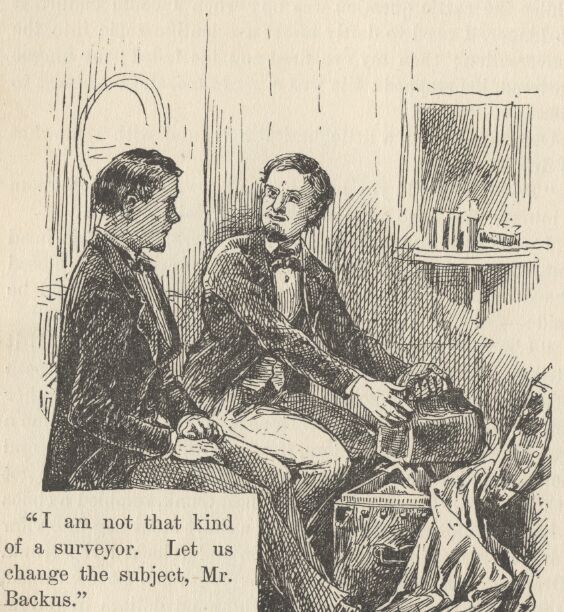
I was sorry to wither his blooming enthusiasm, but it could not be helped. I interrupted, and said severely—
'I am not that kind of a surveyor. Let us change the subject, Mr. Backus.'
It was pitiful to see his confusion and hear his awkward and shamefaced apologies. I was as much distressed as he was—especially as he seemed so far from having suspected that there was anything improper in his proposition. So I hastened to console him and lead him on to forget his mishap in a conversational orgy about cattle and butchery. We were lying at Acapulco; and, as we went on deck, it happened luckily that the crew were just beginning to hoist some beeves aboard in slings. Backus's melancholy vanished instantly, and with it the memory of his late mistake.
'Now only look at that!' cried he; 'My goodness, Triangle, what would they say to it in Ohio. Wouldn't their eyes bug out, to see 'em handled like that?—wouldn't they, though?'
All the passengers were on deck to look—even the gamblers—and Backus knew them all, and had afflicted them all with his pet topic. As I moved away, I saw one of the gamblers approach and accost him; then another of them; then the third. I halted; waited; watched; the conversation continued between the four men; it grew earnest; Backus drew gradually away; the gamblers followed, and kept at his elbow. I was uncomfortable. However, as they passed me presently, I heard Backus say, with a tone of persecuted annoyance—
'But it ain't any use, gentlemen; I tell you again, as I've told you a half a dozen times before, I warn't raised to it, and I ain't a-going to resk it.'
I felt relieved. 'His level head will be his sufficient protection,' I said to myself.
During the fortnight's run from Acapulco to San Francisco I several times saw the gamblers talking earnestly with Backus, and once I threw out a gentle warning to him. He chuckled comfortably and said—
'Oh, yes! they tag around after me considerable—want me to play a little, just for amusement, they say—but laws-a-me, if my folks have told me once to look out for that sort of live-stock, they've told me a thousand times, I reckon.'
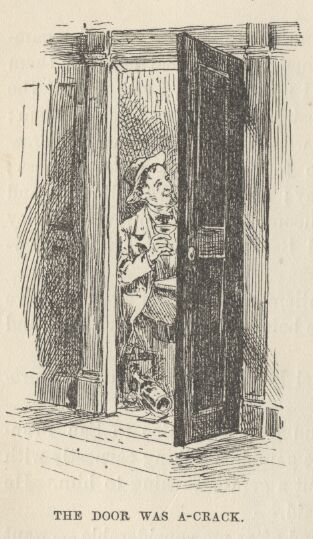
By-and-bye, in due course, we were approaching San Francisco. It was an ugly black night, with a strong wind blowing, but there was not much sea. I was on deck, alone. Toward ten I started below. A figure issued from the gamblers' den, and disappeared in the darkness. I experienced a shock, for I was sure it was Backus. I flew down the companion-way, looked about for him, could not find him, then returned to the deck just in time to catch a glimpse of him as he re-entered that confounded nest of rascality. Had he yielded at last? I feared it. What had he gone below for?—His bag of coin? Possibly. I drew near the door, full of bodings. It was a-crack, and I glanced in and saw a sight that made me bitterly wish I had given my attention to saving my poor cattle-friend, instead of reading and dreaming my foolish time away. He was gambling. Worse still, he was being plied with champagne, and was already showing some effect from it. He praised the 'cider,' as he called it, and said now that he had got a taste of it he almost believed he would drink it if it was spirits, it was so good and so ahead of anything he had ever run across before. Surreptitious smiles, at this, passed from one rascal to another, and they filled all the glasses, and whilst Backus honestly drained his to the bottom they pretended to do the same, but threw the wine over their shoulders.
I could not bear the scene, so I wandered forward and tried to interest myself in the sea and the voices of the wind. But no, my uneasy spirit kept dragging me back at quarter-hour intervals; and always I saw Backus drinking his wine—fairly and squarely, and the others throwing theirs away. It was the painfullest night I ever spent.
The only hope I had was that we might reach our anchorage with speed—that would break up the game. I helped the ship along all I could with my prayers. At last we went booming through the Golden Gate, and my pulses leaped for joy. I hurried back to that door and glanced in. Alas, there was small room for hope—Backus's eyes were heavy and bloodshot, his sweaty face was crimson, his speech maudlin and thick, his body sawed drunkenly about with the weaving motion of the ship. He drained another glass to the dregs, whilst the cards were being dealt.
He took his hand, glanced at it, and his dull eyes lit up for a moment. The gamblers observed it, and showed their gratification by hardly perceptible signs.
'How many cards?'
'None!' said Backus.
One villain—named Hank Wiley—discarded one card, the others three each. The betting began. Heretofore the bets had been trifling—a dollar or two; but Backus started off with an eagle now, Wiley hesitated a moment, then 'saw it' and 'went ten dollars better.' The other two threw up their hands.
Backus went twenty better. Wiley said—
'I see that, and go you a hundred better!' then smiled and reached for the money.
'Let it alone,' said Backus, with drunken gravity.
'What! you mean to say you're going to cover it?'
'Cover it? Well, I reckon I am—and lay another hundred on top of it, too.'
He reached down inside his overcoat and produced the required sum.
'Oh, that's your little game, is it? I see your raise, and raise it five hundred!' said Wiley.
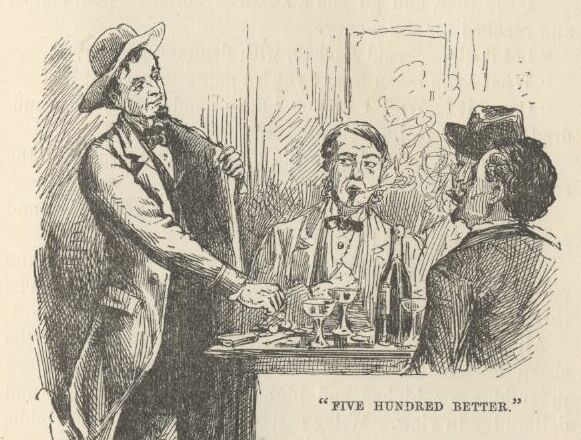
'Five hundred better.' said the foolish bull-driver, and pulled out the amount and showered it on the pile. The three conspirators hardly tried to conceal their exultation.
All diplomacy and pretense were dropped now, and the sharp exclamations came thick and fast, and the yellow pyramid grew higher and higher. At last ten thousand dollars lay in view. Wiley cast a bag of coin on the table, and said with mocking gentleness—
'Five thousand dollars better, my friend from the rural districts—what do you say now?'
'I call you!' said Backus, heaving his golden shot-bag on the pile. 'What have you got?'
'Four kings, you d—d fool!' and Wiley threw down his cards and surrounded the stakes with his arms.
'Four aces, you ass!' thundered Backus, covering his man with a cocked revolver. 'I'm a professional gambler myself, and i've been laying for you duffers all this voyage!'