
LIFE ON THE MISSISSIPPI
BY MARK TWAIN

TABLE OF CONTENTS
CHAPTER I.
The Mississippi is Well worth Reading
about.—It is Remarkable.—
Instead of Widening towards its
Mouth, it grows Narrower.—It Empties
four hundred and six
million Tons of Mud.—It was First Seen in 1542.
—It is
Older than some Pages in European History.—De Soto has
the
Pull.—Older than the Atlantic Coast.—Some Half-breeds chip
in.—La Salle Thinks he will Take a Hand.
CHAPTER II.
La Salle again Appears, and so does a
Cat-fish.—Buffaloes also.
—Some Indian Paintings are Seen
on the Rocks.—“The Father of
Waters “does not Flow into the
Pacific.—More History and Indians.
—Some Curious
Performances—not Early English.—Natchez, or
the Site of
it, is Approached.
CHAPTER III.
A little
History.—Early Commerce.—Coal Fleets and Timber Rafts.
—We start on a Voyage.—I seek Information.—Some Music.—The
Trouble begins.—Tall Talk.—The Child of Calamity.—Ground
and lofty Tumbling.—The Wash-up.—Business and
Statistics.—
Mysterious Band.—Thunder and Lightning.—The
Captain speaks.
—Allbright weeps.—The Mystery settled.—Chaff.—I
am Discovered.
—Some Art-work proposed.—I give an Account
of Myself.—Released.
CHAPTER IV.
The Boys' Ambition.—Village Scenes.—Steamboat Pictures.
—A Heavy Swell.—A Runaway.
CHAPTER V.
A Traveller.—A Lively Talker.—A Wild-cat Victim
CHAPTER VI.
Besieging the Pilot.—Taken along.—Spoiling
a Nap.—Fishing for a
Plantation.—“Points” on the River.—A
Gorgeous Pilot-house.
CHAPTER VII.
River
Inspectors.—Cottonwoods and Plum Point.—Hat-Island Crossing.
—Touch and Go.—It is a Go.—A Lightning Pilot
CHAPTER VIII.
A Heavy-loaded Big Gun.—Sharp
Sights in Darkness.—Abandoned to
his Fate.—Scraping the
Banks.—Learn him or Kill him.
CHAPTER IX.
Shake the Reef.—Reason Dethroned.—The Face of the Water.
—A Bewitching Scene.-Romance and Beauty.
CHAPTER
X.
Putting on Airs.—Taken down a bit.—Learn it as it
is.—The River
Rising.
CHAPTER XI.
In thg Tract Business.—Effects of the Rise.—Plantations gone.
—A Measureless Sea.—A Somnambulist Pilot.—Supernatural
Piloting.
—Nobody there.—All Saved.
CHAPTER XII.
Low Water.—Yawl sounding.—Buoys
and Lanterns.—Cubs and
Soundings.—The Boat Sunk.—Seeking
the Wrecked.
CHAPTER XIII.
A Pilot's
Memory.—Wages soaring.—A Universal Grasp.—Skill and
Nerve.—Testing a “Cub.”—“Back her for Life.”—A
Good Lesson.
CHAPTER XIV.
Pilots and
Captains.—High-priced Pilots.—Pilots in Demand.
—A
Whistler.—A cheap Trade.—Two-hundred-and-fifty-dollar Speed.
CHAPTER XV.
New Pilots undermining the Pilots'
Association.—Crutches and Wages.
—Putting on Airs.—The
Captains Weaken.—The Association Laughs.
—The Secret
Sign.—An Admirable System.—Rough on Outsiders.
—A
Tight Monopoly.—No Loophole.—The Railroads and the War.
CHAPTER XVI.
All Aboard.—A Glorious Start.—Loaded
to Win.—Bands and Bugles.
—Boats and Boats.—Racers
and Racing.
CHAPTER XVII.
Cut-offs.—Ditching
and Shooting.—Mississippi Changes.—A Wild
Night.—Swearing
and Guessing.—Stephen in Debt.—He Confuses
his
Creditors.—He makes a New Deal.—Will Pay them Alphabetically.
CHAPTER XVIII.
Sharp Schooling.—Shadows.—I
am Inspected.—Where did you get
them Shoes?—Pull her
Down.—I want to kill Brown.—I try to run
her.- I am
Complimented.
CHAPTER XIX.
A Question of
Veracity.—A Little Unpleasantness.—I have an
Audience
with the Captain.—Mr. Brown Retires.
CHAPTER
XX.
I become a Passenger.—We hear the News.—A
Thunderous Crash.
—They Stand to their Posts.—In the
Blazing Sun.—A Grewsome
Spectacle.—His Hour has Struck.
CHAPTER XXI.
I get my License.—The War
Begins.—I become a Jack-of-all-trades.
CHAPTER
XXII.
I try the Alias Business.—Region of Goatees—Boots
begin to Appear.
—The River Man is Missing.—The Young Man
is Discouraged.—
Specimen Water.—A Fine Quality of Smoke.—A
Supreme Mistake.
—We Inspect the Town.—Desolation
Way-traffic.—A Wood-yard.
CHAPTER XXIII.
Old French Settlements.—We start for Memphis.—Young Ladies and
Russia-leather Bags.
CHAPTER XXIV.
I receive some Information.—Alligator Boats.—Alligator Talk.
—She was a Rattler to go.—I am Found Out.
CHAPTER XXV.
The Devil's Oven and Table.—A
Bombshell falls.—No Whitewash.
—Thirty Years on the
River.-Mississippi Uniforms.—Accidents and
Casualties.—Two
hundred Wrecks.—A Loss to Literature.—Sunday-
Schools and
Brick Masons.
CHAPTER XXVI.
War Talk.—I
Tilt over Backwards.—Fifteen Shot-holes.—A Plain
Story.—Wars
and Feuds.—Darnell versus Watson.—A Gang and
a Woodpile.—Western
Grammar.—River Changes.—New Madrid.
—Floods and
Falls.
CHAPTER XXVII.
Tourists and their
Note-books.—Captain Hall.—Mrs. Trollope's
Emotions.—Hon.
Charles Augustus Murray's Sentiment.—Captain
Marryat's
Sensations.—Alexander Mackay's Feelings.
—Mr. Parkman
Reports
CHAPTER XXVIII.
Swinging down
the River.—Named for Me.—Plum Point again.
—Lights
and Snag Boats.—Infinite Changes.—A Lawless River.
—Changes and Jetties.—Uncle Mumford Testifies.—Pegging
the
River.—What the Government does.—The Commission.—Men
and
Theories.—“Had them Bad.”—Jews and Prices.
CHAPTER XXIX.
Murel's Gang.—A Consummate
Villain.—Getting Rid of Witnesses.
—Stewart turns
Traitor.—I Start a Rebellion.—I get a New Suit
of
Clothes.—We Cover our Tracks.—Pluck and Capacity.—A Good
Samaritan City.—The Old and the New.
CHAPTER
XXX.
A Melancholy Picture.—On the Move.—River Gossip.—She
Went By
a-Sparklin'.—Amenities of Life.—A World of
Misinformation.—
Eloquence of Silence.—Striking a Snag.—Photographically
Exact.
—Plank Side-walks.
CHAPTER
XXXI.
Mutinous Language.—The Dead-house.—Cast-iron
German and Flexible
English.—A Dying Man's Confession.—I
am Bound and Gagged.
—I get Myself Free.—I Begin my
Search.—The Man with one Thumb.
—Red Paint and White
Paper.—He Dropped on his Knees.—Fright
and Gratitude.—I
Fled through the Woods.—A Grisly Spectacle.
—Shout, Man,
Shout.—A look of Surprise and Triumph.—The Muffled
Gurgle
of a Mocking Laugh.—How strangely Things happen.
—The
Hidden Money.
CHAPTER XXXII.
Ritter's
Narrative.—A Question of Money.—Napoleon.—Somebody
is Serious.—Where the Prettiest Girl used to Live.
CHAPTER XXXIII.
A Question of Division.—A Place
where there was no License.—The
Calhoun Land Company.—A
Cotton-planter's Estimate.—Halifax
and Watermelons.—Jewelled-up
Bar-keepers.
CHAPTER XXXIV.
An Austere
Man.—A Mosquito Policy.—Facts dressed in Tights.
—A
swelled Left Ear.
CHAPTER XXXV.
Signs and Scars.—Cannon-thunder Rages.—Cave-dwellers.
—A Continual Sunday.—A ton of Iron and no Glass.—The
Ardent
is Saved.—Mule Meat—A National Cemetery.—A
Dog and a Shell.
—Railroads and Wealth.—Wharfage Economy.—Vicksburg
versus The
“Gold Dust.”—A Narrative in Anticipation.
CHAPTER XXXVI.
The Professor Spins a Yarn.—An
Enthusiast in Cattle.—He makes a
Proposition.—Loading
Beeves at Acapulco.—He was n't Raised to it.
—He is
Roped In.—His Dull Eyes Lit Up.—Four Aces, you Ass!
—He does n't Care for the Gores.
CHAPTER
XXXVII.
A Terrible Disaster.—The “Gold Dust” explodes her
Boilers.
—The End of a Good Man.
CHAPTER
XXXVIII.
Mr. Dickens has a Word.—Best Dwellings and their
Furniture.—Albums
and Music.—Pantelettes and
Conch-shells.—Sugar-candy Rabbits
and Photographs.—Horse-hair
Sofas and Snuffers.—Rag Carpets
and Bridal Chambers.
CHAPTER XXXIX.
Rowdies and Beauty.—Ice as
Jewelry.—Ice Manufacture.—More
Statistics.—Some
Drummers.—Oleomargarine versus Butter.
—Olive Oil versus
Cotton Seed.—The Answer was not Caught.
—A Terrific
Episode.—A Sulphurous Canopy.—The Demons of War.
—The
Terrible Gauntlet.
CHAPTER XL.
In
Flowers, like a Bride.—A White-washed Castle.—A Southern
Prospectus.—Pretty Pictures.—An Alligator's Meal.
CHAPTER XLI.
The Approaches to New Orleans.—A
Stirring Street.—Sanitary
Improvements.—Journalistic
Achievements.—Cisterns and Wells.
CHAPTER
XLII.
Beautiful Grave-yards.—Chameleons and Panaceas.—Inhumation
and
Infection.—Mortality and Epidemics.—The Cost of
Funerals.
CHAPTER XLIII.
I meet an
Acquaintance.—Coffins and Swell Houses.—Mrs. O'Flaherty
goes One Better.—Epidemics and Embamming.—Six hundred for a
Good Case.—Joyful High Spirits.
CHAPTER
XLIV.
French and Spanish Parts of the City.—Mr. Cable and
the Ancient
Quarter.—Cabbages and Bouquets.—Cows and
Children.—The Shell
Road. The West End.—A Good Square
Meal.—The Pompano.—The Broom-
Brigade.—Historical
Painting.—Southern Speech.—Lagniappe.
CHAPTER
XLV.
“Waw” Talk.—Cock-Fighting.—Too Much to Bear.—Fine
Writing.
—Mule Racing.
CHAPTER XLVI.
Mardi-Gras.—The Mystic Crewe.—Rex and Relics.—Sir Walter
Scott.
—A World Set Back.—Titles and Decorations.—A
Change.
CHAPTER XLVII.
Uncle Remus.—The
Children Disappointed.—We Read Aloud.
—Mr. Cable and Jean
au Poquelin.—Involuntary Trespass.—The Gilded
Age.—An
Impossible Combination.—The Owner Materializes and Protests.
CHAPTER XLVIII.
Tight Curls and Springy Steps.—Steam-plows.—“No.
I.” Sugar.
—A Frankenstein Laugh.—Spiritual Postage.—A
Place where there are
no Butchers or Plumbers.—Idiotic Spasms.
CHAPTER XLIX.
Pilot-Farmers.—Working on
Shares.—Consequences.—Men who Stick
to their Posts.—He
saw what he would do.—A Day after the Fair.
CHAPTER
L.
A Patriarch.—Leaves from a Diary.—A
Tongue-stopper.—The Ancient
Mariner.—Pilloried in Print.—Petrified
Truth.
CHAPTER LI.
A Fresh “Cub” at the
Wheel.—A Valley Storm.—Some Remarks on
Construction.—Sock
and Buskin.—The Man who never played
Hamlet.—I got
Thirsty.—Sunday Statistics.
CHAPTER LII.
I Collar an Idea.—A Graduate of Harvard.—A Penitent Thief.
—His Story in the Pulpit.—Something Symmetrical.—A
Literary Artist.
—A Model Epistle.—Pumps again Working.—The
“Nub” of the Note.
CHAPTER LIII.
A
Masterly Retreat.—A Town at Rest.—Boyhood's Pranks.—Friends
of my Youth.—The Refuge for Imbeciles.—I am Presented with
my Measure.
CHAPTER LIV.
A Special
Judgment.—Celestial Interest.—A Night of Agony.
—Another
Bad Attack.—I become Convalescent.—I address a
Sunday-school.—A Model Boy.
CHAPTER LV.
A second Generation.—A hundred thousand Tons of Saddles.—A
Dark
and Dreadful Secret.—A Large Family.—A Golden-haired
Darling.
—The Mysterious Cross.—My Idol is Broken.—A
Bad Season of
Chills and Fever.—An Interesting Cave.
CHAPTER LVI.
Perverted History—A Guilty
Conscience.—A Supposititious Case.
—A Habit to be
Cultivated.—I Drop my Burden.—Difference in Time.
CHAPTER LVII.
A Model Town.—A Town that Comes
up to Blow in the Summer.
—The Scare-crow Dean.—Spouting
Smoke and Flame.—An Atmosphere
that tastes good.—The
Sunset Land.
CHAPTER LVIII.
An
Independent Race.—Twenty-four-hour Towns.—Enchanting Scenery.
—The Home of the Plow.—Black Hawk.—Fluctuating
Securities.
—A Contrast.—Electric Lights.
CHAPTER LIX.
Indian Traditions and Rattlesnakes.—A
Three-ton Word.—Chimney
Rock.—The Panorama Man.—A
Good Jump.—The Undying Head.
—Peboan and Seegwun.
CHAPTER LX.
The Head of Navigation.—From
Roses to Snow.—Climatic Vaccination.
—A Long Ride.—Bones
of Poverty.—The Pioneer of Civilization.
—Jug of Empire.—Siamese
Twins.—The Sugar-bush.—He Wins his Bride.
—The
Mystery about the Blanket.—A City that is always a Novelty.
—Home again.
APPENDIX.
A
B
C
D
THE 'BODY OF THE NATION'
BUT the basin of the Mississippi is the Body of The Nation. All the other parts are but members, important in themselves, yet more important in their relations to this. Exclusive of the Lake basin and of 300,000 square miles in Texas and New Mexico, which in many aspects form a part of it, this basin contains about 1,250,000 square miles. In extent it is the second great valley of the world, being exceeded only by that of the Amazon. The valley of the frozen Obi approaches it in extent; that of La Plata comes next in space, and probably in habitable capacity, having about eight-ninths of its area; then comes that of the Yenisei, with about seven-ninths; the Lena, Amoor, Hoang-ho, Yang-tse-kiang, and Nile, five-ninths; the Ganges, less than one-half; the Indus, less than one-third; the Euphrates, one-fifth; the Rhine, one-fifteenth. It exceeds in extent the whole of Europe, exclusive of Russia, Norway, and Sweden. It would contain austria four times, germany or spain five times, france six times, the british islands or italy ten times. Conceptions formed from the river-basins of Western Europe are rudely shocked when we consider the extent of the valley of the Mississippi; nor are those formed from the sterile basins of the great rivers of Siberia, the lofty plateaus of Central Asia, or the mighty sweep of the swampy Amazon more adequate. Latitude, elevation, and rainfall all combine to render every part of the Mississippi Valley capable of supporting a dense population. As a dwelling-place for civilized man it is by far the first upon our globe.
EDITOR'S TABLE, HARPER'S MAGAZINE, FEBRUARY 1863
Chapter 1
The River and Its History
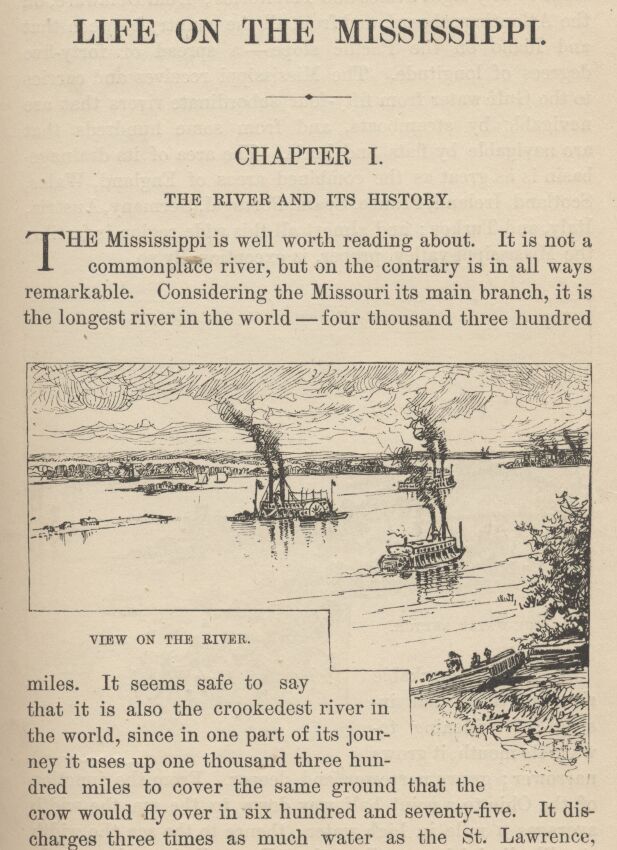
THE Mississippi is well worth reading about. It is not a commonplace river, but on the contrary is in all ways remarkable. Considering the Missouri its main branch, it is the longest river in the world—four thousand three hundred miles. It seems safe to say that it is also the crookedest river in the world, since in one part of its journey it uses up one thousand three hundred miles to cover the same ground that the crow would fly over in six hundred and seventy-five. It discharges three times as much water as the St. Lawrence, twenty-five times as much as the Rhine, and three hundred and thirty-eight times as much as the Thames. No other river has so vast a drainage-basin: it draws its water supply from twenty-eight States and Territories; from Delaware, on the Atlantic seaboard, and from all the country between that and Idaho on the Pacific slope—a spread of forty-five degrees of longitude. The Mississippi receives and carries to the Gulf water from fifty-four subordinate rivers that are navigable by steamboats, and from some hundreds that are navigable by flats and keels. The area of its drainage-basin is as great as the combined areas of England, Wales, Scotland, Ireland, France, Spain, Portugal, Germany, Austria, Italy, and Turkey; and almost all this wide region is fertile; the Mississippi valley, proper, is exceptionally so.
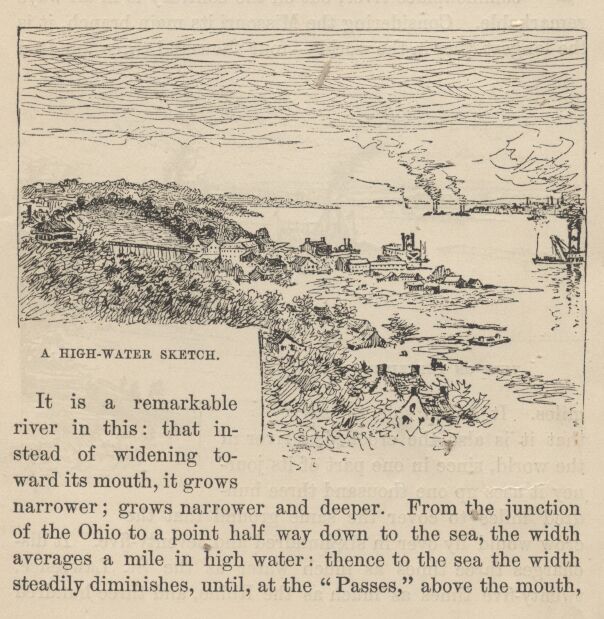
It is a remarkable river in this: that instead of widening toward its mouth, it grows narrower; grows narrower and deeper. From the junction of the Ohio to a point half way down to the sea, the width averages a mile in high water: thence to the sea the width steadily diminishes, until, at the 'Passes,' above the mouth, it is but little over half a mile. At the junction of the Ohio the Mississippi's depth is eighty-seven feet; the depth increases gradually, reaching one hundred and twenty-nine just above the mouth.
The difference in rise and fall is also remarkable—not in the upper, but in the lower river. The rise is tolerably uniform down to Natchez (three hundred and sixty miles above the mouth)—about fifty feet. But at Bayou La Fourche the river rises only twenty-four feet; at New Orleans only fifteen, and just above the mouth only two and one half.
An article in the New Orleans 'Times-Democrat,' based upon reports of able engineers, states that the river annually empties four hundred and six million tons of mud into the Gulf of Mexico—which brings to mind Captain Marryat's rude name for the Mississippi—'the Great Sewer.' This mud, solidified, would make a mass a mile square and two hundred and forty-one feet high.
The mud deposit gradually extends the land—but only gradually; it has extended it not quite a third of a mile in the two hundred years which have elapsed since the river took its place in history. The belief of the scientific people is, that the mouth used to be at Baton Rouge, where the hills cease, and that the two hundred miles of land between there and the Gulf was built by the river. This gives us the age of that piece of country, without any trouble at all—one hundred and twenty thousand years. Yet it is much the youthfullest batch of country that lies around there anywhere.
The Mississippi is remarkable in still another way—its disposition to make prodigious jumps by cutting through narrow necks of land, and thus straightening and shortening itself. More than once it has shortened itself thirty miles at a single jump! These cut-offs have had curious effects: they have thrown several river towns out into the rural districts, and built up sand bars and forests in front of them. The town of Delta used to be three miles below Vicksburg: a recent cutoff has radically changed the position, and Delta is now two miles above Vicksburg.
Both of these river towns have been retired to the country by that cut-off. A cut-off plays havoc with boundary lines and jurisdictions: for instance, a man is living in the State of Mississippi to-day, a cut-off occurs to-night, and to-morrow the man finds himself and his land over on the other side of the river, within the boundaries and subject to the laws of the State of Louisiana! Such a thing, happening in the upper river in the old times, could have transferred a slave from Missouri to Illinois and made a free man of him.
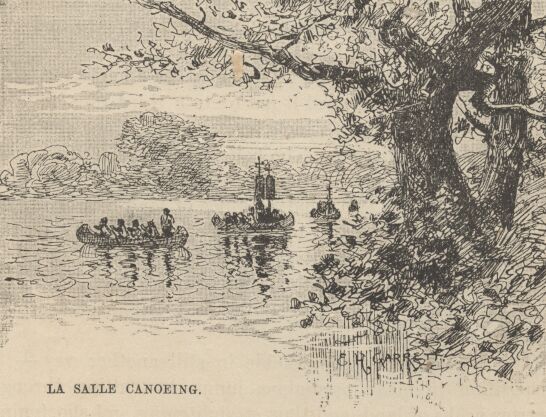
The Mississippi does not alter its locality by cut-offs alone: it is always changing its habitat bodily—is always moving bodily sidewise. At Hard Times, La., the river is two miles west of the region it used to occupy. As a result, the original site of that settlement is not now in Louisiana at all, but on the other side of the river, in the State of Mississippi. Nearly the whole of that one thousand three hundred miles of old mississippi river which la salle floated down in his canoes, two hundred years ago, is good solid dry ground now. The river lies to the right of it, in places, and to the left of it in other places.
Although the Mississippi's mud builds land but slowly, down at the mouth, where the Gulfs billows interfere with its work, it builds fast enough in better protected regions higher up: for instance, Prophet's Island contained one thousand five hundred acres of land thirty years ago; since then the river has added seven hundred acres to it.
But enough of these examples of the mighty stream's eccentricities for the present—I will give a few more of them further along in the book.
Let us drop the Mississippi's physical history, and say a word about its historical history—so to speak. We can glance briefly at its slumbrous first epoch in a couple of short chapters; at its second and wider-awake epoch in a couple more; at its flushest and widest-awake epoch in a good many succeeding chapters; and then talk about its comparatively tranquil present epoch in what shall be left of the book.
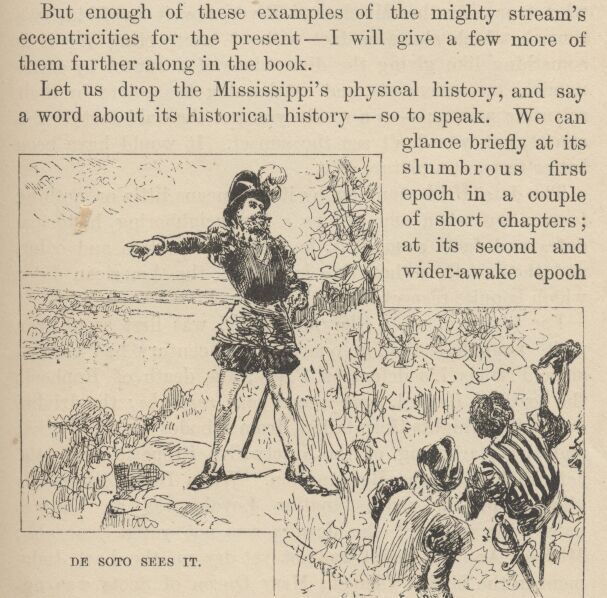
The world and the books are so accustomed to use, and over-use, the word 'new' in connection with our country, that we early get and permanently retain the impression that there is nothing old about it. We do of course know that there are several comparatively old dates in American history, but the mere figures convey to our minds no just idea, no distinct realization, of the stretch of time which they represent. To say that De Soto, the first white man who ever saw the Mississippi River, saw it in 1542, is a remark which states a fact without interpreting it: it is something like giving the dimensions of a sunset by astronomical measurements, and cataloguing the colors by their scientific names;—as a result, you get the bald fact of the sunset, but you don't see the sunset. It would have been better to paint a picture of it.
The date 1542, standing by itself, means little or nothing to us; but when one groups a few neighboring historical dates and facts around it, he adds perspective and color, and then realizes that this is one of the American dates which is quite respectable for age.
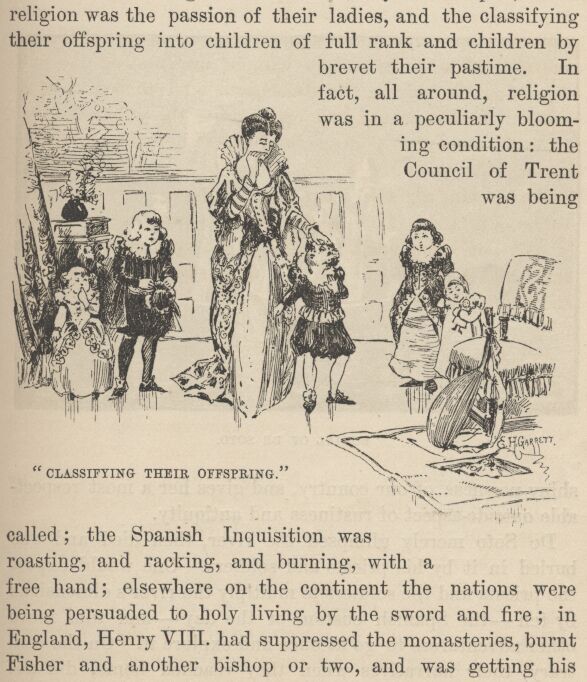
For instance, when the Mississippi was first seen by a white man, less than a quarter of a century had elapsed since Francis I.'s defeat at Pavia; the death of Raphael; the death of Bayard, Sans Peur Et Sans Reproche; the driving out of the Knights-Hospitallers from Rhodes by the Turks; and the placarding of the Ninety-Five Propositions,—the act which began the Reformation. When De Soto took his glimpse of the river, Ignatius Loyola was an obscure name; the order of the Jesuits was not yet a year old; Michael Angelo's paint was not yet dry on the Last Judgment in the Sistine Chapel; Mary Queen of Scots was not yet born, but would be before the year closed. Catherine de Medici was a child; Elizabeth of England was not yet in her teens; Calvin, Benvenuto Cellini, and the Emperor Charles V. were at the top of their fame, and each was manufacturing history after his own peculiar fashion; Margaret of Navarre was writing the 'Heptameron' and some religious books,—the first survives, the others are forgotten, wit and indelicacy being sometimes better literature preservers than holiness; lax court morals and the absurd chivalry business were in full feather, and the joust and the tournament were the frequent pastime of titled fine gentlemen who could fight better than they could spell, while religion was the passion of their ladies, and classifying their offspring into children of full rank and children by brevet their pastime.
In fact, all around, religion was in a peculiarly blooming condition: the Council of Trent was being called; the Spanish Inquisition was roasting, and racking, and burning, with a free hand; elsewhere on the continent the nations were being persuaded to holy living by the sword and fire; in England, Henry VIII. had suppressed the monasteries, burnt Fisher and another bishop or two, and was getting his English reformation and his harem effectively started. When De Soto stood on the banks of the Mississippi, it was still two years before Luther's death; eleven years before the burning of Servetus; thirty years before the St. Bartholomew slaughter; Rabelais was not yet published; 'Don Quixote' was not yet written; Shakespeare was not yet born; a hundred long years must still elapse before Englishmen would hear the name of Oliver Cromwell.
Unquestionably the discovery of the Mississippi is a datable fact which considerably mellows and modifies the shiny newness of our country, and gives her a most respectable outside-aspect of rustiness and antiquity.
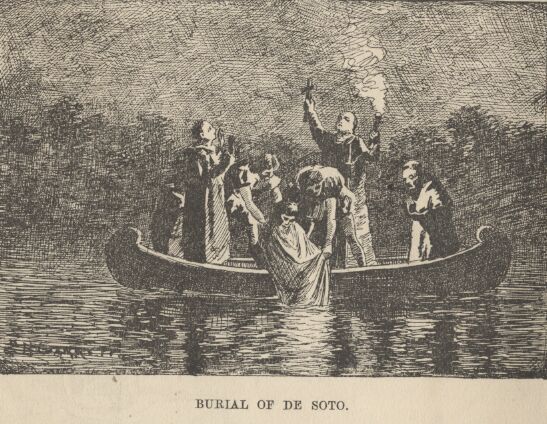
De Soto merely glimpsed the river, then died and was buried in it by his priests and soldiers. One would expect the priests and the soldiers to multiply the river's dimensions by ten—the Spanish custom of the day—and thus move other adventurers to go at once and explore it. On the contrary, their narratives when they reached home, did not excite that amount of curiosity. The Mississippi was left unvisited by whites during a term of years which seems incredible in our energetic days. One may 'sense' the interval to his mind, after a fashion, by dividing it up in this way: After De Soto glimpsed the river, a fraction short of a quarter of a century elapsed, and then Shakespeare was born; lived a trifle more than half a century, then died; and when he had been in his grave considerably more than half a century, the second white man saw the Mississippi. In our day we don't allow a hundred and thirty years to elapse between glimpses of a marvel. If somebody should discover a creek in the county next to the one that the North Pole is in, Europe and America would start fifteen costly expeditions thither: one to explore the creek, and the other fourteen to hunt for each other.
For more than a hundred and fifty years there had been white settlements on our Atlantic coasts. These people were in intimate communication with the Indians: in the south the Spaniards were robbing, slaughtering, enslaving and converting them; higher up, the English were trading beads and blankets to them for a consideration, and throwing in civilization and whiskey, 'for lagniappe;' and in Canada the French were schooling them in a rudimentary way, missionarying among them, and drawing whole populations of them at a time to Quebec, and later to Montreal, to buy furs of them. Necessarily, then, these various clusters of whites must have heard of the great river of the far west; and indeed, they did hear of it vaguely,—so vaguely and indefinitely, that its course, proportions, and locality were hardly even guessable. The mere mysteriousness of the matter ought to have fired curiosity and compelled exploration; but this did not occur. Apparently nobody happened to want such a river, nobody needed it, nobody was curious about it; so, for a century and a half the Mississippi remained out of the market and undisturbed. When De Soto found it, he was not hunting for a river, and had no present occasion for one; consequently he did not value it or even take any particular notice of it.
But at last La Salle the Frenchman conceived the idea of seeking out that river and exploring it. It always happens that when a man seizes upon a neglected and important idea, people inflamed with the same notion crop up all around. It happened so in this instance.
Naturally the question suggests itself, Why did these people want the river now when nobody had wanted it in the five preceding generations? Apparently it was because at this late day they thought they had discovered a way to make it useful; for it had come to be believed that the Mississippi emptied into the Gulf of California, and therefore afforded a short cut from Canada to China. Previously the supposition had been that it emptied into the Atlantic, or Sea of Virginia.
Chapter 2
The River and Its Explorers
LA SALLE himself sued for certain high privileges, and they were graciously accorded him by Louis XIV of inflated memory. Chief among them was the privilege to explore, far and wide, and build forts, and stake out continents, and hand the same over to the king, and pay the expenses himself; receiving, in return, some little advantages of one sort or another; among them the monopoly of buffalo hides. He spent several years and about all of his money, in making perilous and painful trips between Montreal and a fort which he had built on the Illinois, before he at last succeeded in getting his expedition in such a shape that he could strike for the Mississippi.
And meantime other parties had had better fortune. In 1673 Joliet the merchant, and Marquette the priest, crossed the country and reached the banks of the Mississippi. They went by way of the Great Lakes; and from Green Bay, in canoes, by way of Fox River and the Wisconsin. Marquette had solemnly contracted, on the feast of the Immaculate Conception, that if the Virgin would permit him to discover the great river, he would name it Conception, in her honor. He kept his word. In that day, all explorers traveled with an outfit of priests. De Soto had twenty-four with him. La Salle had several, also. The expeditions were often out of meat, and scant of clothes, but they always had the furniture and other requisites for the mass; they were always prepared, as one of the quaint chroniclers of the time phrased it, to 'explain hell to the savages.'
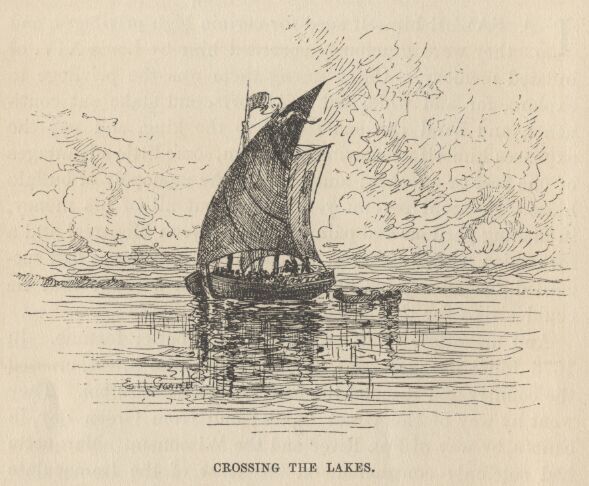
On the 17th of June, 1673, the canoes of Joliet and Marquette and their five subordinates reached the junction of the Wisconsin with the Mississippi. Mr. Parkman says: 'Before them a wide and rapid current coursed athwart their way, by the foot of lofty heights wrapped thick in forests.' He continues: 'Turning southward, they paddled down the stream, through a solitude unrelieved by the faintest trace of man.'
A big cat-fish collided with Marquette's canoe, and startled him; and reasonably enough, for he had been warned by the Indians that he was on a foolhardy journey, and even a fatal one, for the river contained a demon 'whose roar could be heard at a great distance, and who would engulf them in the abyss where he dwelt.' I have seen a Mississippi cat-fish that was more than six feet long, and weighed two hundred and fifty pounds; and if Marquette's fish was the fellow to that one, he had a fair right to think the river's roaring demon was come.
'At length the buffalo began to appear, grazing in herds on the great prairies which then bordered the river; and Marquette describes the fierce and stupid look of the old bulls as they stared at the intruders through the tangled mane which nearly blinded them.'
The voyagers moved cautiously: 'Landed at night and made a fire to cook their evening meal; then extinguished it, embarked again, paddled some way farther, and anchored in the stream, keeping a man on the watch till morning.'
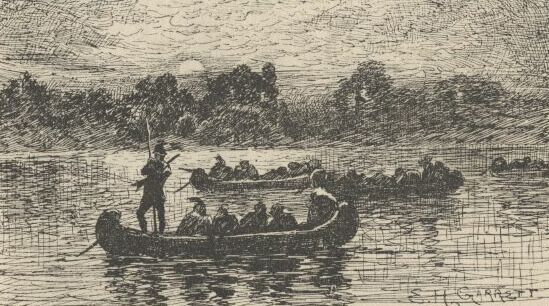
They did this day after day and night after night; and at the end of two weeks they had not seen a human being. The river was an awful solitude, then. And it is now, over most of its stretch.
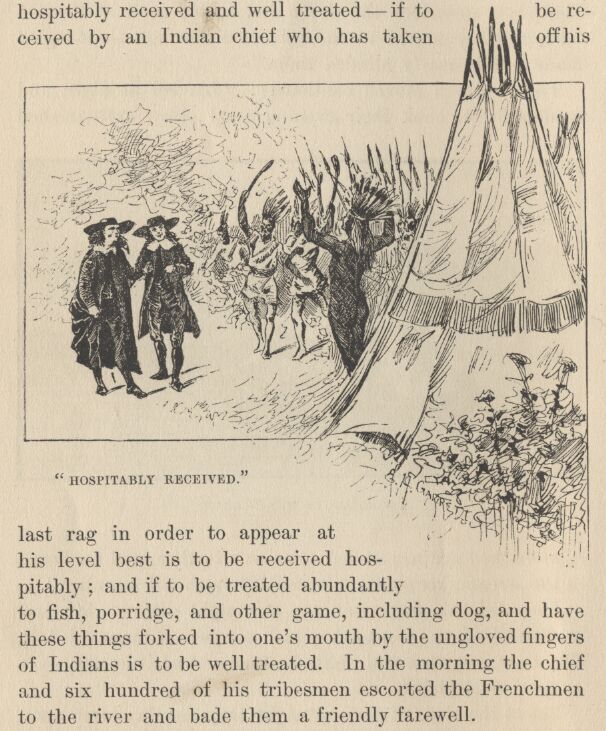
But at the close of the fortnight they one day came upon the footprints of men in the mud of the western bank—a Robinson Crusoe experience which carries an electric shiver with it yet, when one stumbles on it in print. They had been warned that the river Indians were as ferocious and pitiless as the river demon, and destroyed all comers without waiting for provocation; but no matter, Joliet and Marquette struck into the country to hunt up the proprietors of the tracks. They found them, by and by, and were hospitably received and well treated—if to be received by an Indian chief who has taken off his last rag in order to appear at his level best is to be received hospitably; and if to be treated abundantly to fish, porridge, and other game, including dog, and have these things forked into one's mouth by the ungloved fingers of Indians is to be well treated. In the morning the chief and six hundred of his tribesmen escorted the Frenchmen to the river and bade them a friendly farewell.
On the rocks above the present city of Alton they found some rude and fantastic Indian paintings, which they describe. A short distance below 'a torrent of yellow mud rushed furiously athwart the calm blue current of the Mississippi, boiling and surging and sweeping in its course logs, branches, and uprooted trees.' This was the mouth of the Missouri, 'that savage river,' which 'descending from its mad career through a vast unknown of barbarism, poured its turbid floods into the bosom of its gentle sister.'
By and by they passed the mouth of the Ohio; they passed cane-brakes; they fought mosquitoes; they floated along, day after day, through the deep silence and loneliness of the river, drowsing in the scant shade of makeshift awnings, and broiling with the heat; they encountered and exchanged civilities with another party of Indians; and at last they reached the mouth of the Arkansas (about a month out from their starting-point), where a tribe of war-whooping savages swarmed out to meet and murder them; but they appealed to the Virgin for help; so in place of a fight there was a feast, and plenty of pleasant palaver and fol-de-rol.
They had proved to their satisfaction, that the Mississippi did not empty into the Gulf of California, or into the Atlantic. They believed it emptied into the Gulf of Mexico. They turned back, now, and carried their great news to Canada.
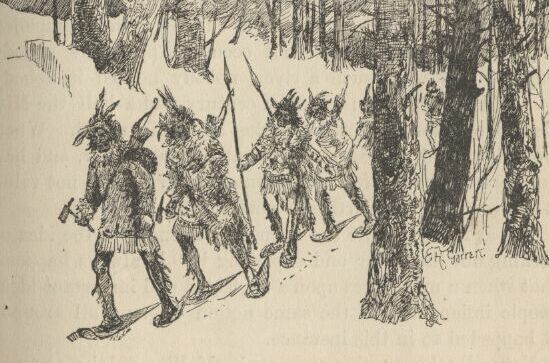
But belief is not proof. It was reserved for La Salle to furnish the proof. He was provokingly delayed, by one misfortune after another, but at last got his expedition under way at the end of the year 1681. In the dead of winter he and Henri de Tonty, son of Lorenzo Tonty, who invented the tontine, his lieutenant, started down the Illinois, with a following of eighteen Indians brought from New England, and twenty-three Frenchmen. They moved in procession down the surface of the frozen river, on foot, and dragging their canoes after them on sledges.