
The Great Fir Tree of Takasago
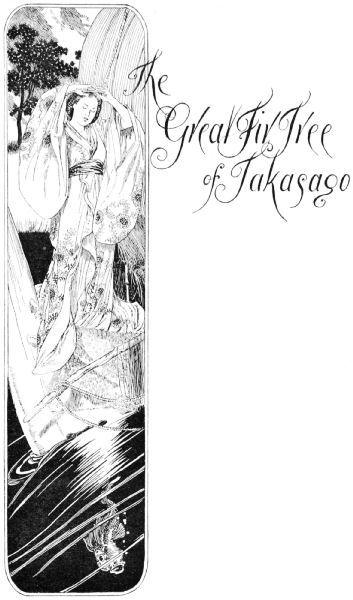
THE cherry tree has blossomed many times since O-Matsue lived with her father and mother on the sandy coast of the Inland Sea. The home at Takasago was sheltered by a tall fir tree of great age; a god had planted it as he passed that way. O-Matsue was beautiful, for her mother had taught her to love the sea, and the birds, the trees, and every living thing. Her eyes were like a clear deep ocean-pool on a summer day. Her smile was as the sunshine on the surface of Lake Biwa.
The fallen needles of the fir made a soft couch on which O-Matsue sat for hours at a time, plying her shuttle, weaving robes for the peasants around. Sometimes, she would go to sea with the fishers, and peer into the depths to try and catch a glimpse of the Palace of the Ocean Bed; the fishers would tell her the story of the poor jelly-fish who lost his shell, or of the Blessed Island of Eternal Youth, whose tree could at times be discerned from the coast.
The steep shore of Sumi-no-ye is many leagues distant from Takasago, but a youth who dwelt there took a long journey. Teoyo said, “I will see what lies beyond the mountains. I will see the country to which the heron wings his way across the plain.” He travelled through many provinces, and at last came to the land of Harima. One day he passed by Takasago. O-Matsue sat in the shade of the fir tree. She was weaving, and sang as she worked. These are the words of her song:—
Teoyo heard the sweet song, and said, “It is like the song of a spirit,—and how beautiful the maiden is!” For some time he watched her as she wove. Then her song ceased, he moved towards her, and spoke: “I have travelled far. I have seen many fair maidens, but not one so fair as you. Take me to your father and mother that I may speak with them.” Teoyo asked the peasants for the hand of their daughter, and they gave their consent.
There was great rejoicing. O-Matsue received many presents, and, as the wedding-day approached, a great feast was prepared. Bride and bridegroom drank thrice of three cups of saké which made them man and wife, and the feast went on.
Now Teoyo said, “This country of Harima is a good land. Let us stay here with your father and mother.” O-Matsue was glad. So they dwelt with the old people under the great fir tree. At last, the father and mother died. O-Matsue and Teoyo still lived beneath the shelter of the tree. They were very happy. Summer, autumn and winter passed over the land of Harima many times. Their love was always in its spring. The “waves of age” furrowed their brows, but their hearts remained young and tender, green as the needles of the pine. Even when their eyes had grown dim, they went to the shore to listen to the waters of the Inland Sea, or together they gathered, with rakes of bamboo, the fallen needles of the fir.
A crane came and built in the topmost branches of the tree, and for many years they watched the birds rear their young. A tortoise also dwelt beside them. O-Matsue said, “We are blessed with a fir tree, a crane, and a tortoise. The God of Long Life has taken us under his care.”
When, at last, at the same moment, Teoyo and O-Matsue died, their spirits withdrew into the tree which had for so long been the witness of their happiness. To this day the pine tree is called “The Pine of the Lovers.”
On moonbright nights, when the coast wind whispers in the branches of the tree, O-Matsue and Teoyo may sometimes be seen, with bamboo rakes in their hands, gathering together the needles of the fir.
Despite the storms of time, the old tree stands to this hour eternally green on the high shore of Takasago.