
The Island of Eternal Youth

FAR beyond the faint grey of the horizon, somewhere in the shadowy Unknown, lies the Island of Eternal Youth. The dwellers on the rocky coast of the East Sea of Japan relate that, at times, a wondrous tree can be discerned rising high above the waves. It is the tree which has stood for all ages on the loftiest peak of Fusan, the Mountain of Immortality. Men rejoice when they catch a glimpse of its branches, though the glimpse be fleeting as a vision at dawn. On the island is endless spring: the air is ever sweet and the sky blue. Celestial dews fall softly upon every tree and flower, and carry with them the secret of eternity. The delicate white bryony never loses its first-day freshness, the scarlet lily cannot fade. Ethereal pink blossoms enfold the branches of the sakuranoki; the pendulous fruit of the orange bears no trace of age. Irises, violet and yellow and blue, fringe the pool on whose surface float the heavenly-coloured lotus blooms. From day to day the birds sing of love and joy. Sorrow and pain are unknown, death comes not hither. The Spirit of this island it is who whispers to the sleeping Spring in every land, and bids her arise.
Many brave seafarers have sought Horaizan but have not reached its shores. Some have suffered shipwreck in the attempt, others have mistaken the heights of Fuji-yama for the blessed Fusan.
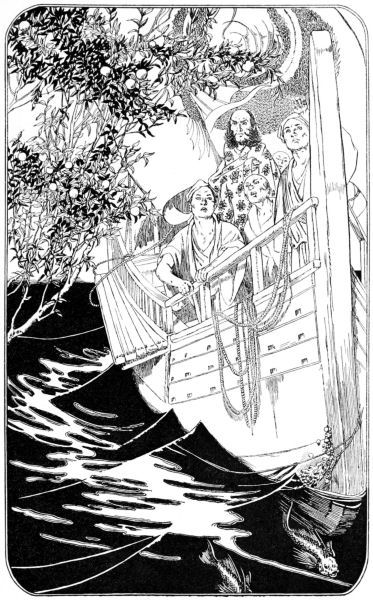
Now there once lived a cruel Emperor of China. So tyrannical was he that the life of his physician, Jofuku, was in constant danger. One day, Jofuku spoke to the Emperor, and said: “Give me a ship, and I will sail to the Island of Eternal Youth. There I will pluck the herb of immortality and bring it back to you, that you may rule over your kingdom for ever.” The despot heard the words with pleasure. Jofuku, fully equipped, set sail and came to Japan; thence he steered his course towards the magic tree. Days, months, and years passed. Jofuku seemed to be drifting on the ocean of heaven, for no land was visible. At last, far in the distance, rose the dim outline of a hill such as he had never seen before; and when he perceived a tree on its summit, Jofuku knew that he neared Horaizan. Soon he came to its shores, and landed as one in a dream. Every thought of the Emperor, whose days were to be prolonged by eating of the sacred herb, passed from his mind. Life upon the beautiful island was so glorious that he had no wish to return. His story is told by Wasobiowe, a wise man of Japan, who, alone among mortals, can relate the wonders of that strange land.
Wasobiowe dwelt in the neighbourhood of Nagasaki. He loved nothing better than to spend his days far out at sea, fishing from a little boat. Once, when the eighth full moon rose—which in Japan is called the “bean moon” and is the most beautiful of all—Wasobiowe started on a long voyage in order to be absent from Nagasaki during the festivals of the season. Leisurely he skirted the coast, and rejoiced in the bold outlines of the rocks seen by the light of the moon. But, without warning, black clouds gathered overhead. The storm burst, the rain poured down, and darkness fell. The waves were lashed into fury, and the little boat was driven swift as an arrow before the wind. For three days and nights the hurricane raged. As dawn broke on the fourth morning, the wind was stilled, the sea grew calm. Wasobiowe, who knew the course of the stars, saw that he was far from his home in Japan. He was at the mercy of the god of the tides. For months Wasobiowe ate the fish which he caught in his net, until his boat drifted into those black waters where no fish can live. He rowed and rowed; his strength was almost spent. Hope had left him, when, suddenly, a fragrant wind from the land played about his temples. He seized the oars, and soon his boat reached the coast of Horaizan. Even as he landed, all remembrance of the dangers and privations of the voyage vanished.
Everything spoke of joy and sunlight. The hum of the cicala, the whirr of the darting dragon-fly, the call of the bright-green tree-frog sounded in his ear. Sweet scents came from the pine-covered hills; everywhere was a flood of glowing colour.
Presently a man approached him. It was none other than Jofuku. He spoke to Wasobiowe, and told how the elect of the gods, who peopled those remote shores, filled their days with music and laughter and song.
Wasobiowe lived contentedly on the Island of Eternal Youth. He knew nothing of the flight of years, for where there is no birth, no death, time passes unheeded.
But, after many hundred years, the wise man of Nagasaki wearied of this blissful existence. He longed for death, but the dark river does not flow through Horaizan. He would wistfully follow the outward flight of the birds, till they became mere specks in the sky. One day he spoke to a pure white stork: “I know that the birds alone can leave this island. Carry me, I pray you, to my home in Japan. I would see it once more and die.” Then he mounted upon the outstretched wings of the stork, and was carried across the sea and through many strange lands, peopled by giants and dwarfs and men with white faces. When he had visited all the countries of the earth, he came to his beloved Japan. In his hand he bore a branch of the orange which he planted. The tree still flourishes in the Mikado’s Empire.