
The Sparrow’s Wedding
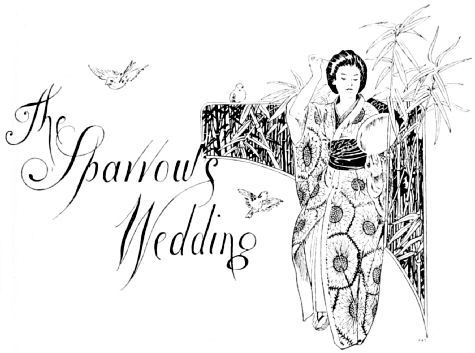
IN the heart of a forest of pine-trees that lay in a remote corner of the Land of the Dragon-Fly, dwelt Chiyotaro, a prosperous sparrow, who was honoured and beloved alike by his family and friends. He had many beautiful children, but not one with manners more distinguished, or heart more true, than Tschiotaro. He was the life of the little household; merry as the summer-day is long, and talkative as only a sparrow can be.
Tschiotaro would fly afar through the woods, and across the surrounding plains; indeed, at times, he would even come within sight of the towering peaks of the Matchless Mountain. With the first whisper of the approach of sundown, he would wing his way homeward, to delight the loved ones in the pine forest with the story of his day’s adventures. Laughter and sounds of glee echoed through the twilight, as the sparrow family listened to Tschiotaro’s chatter. Then came the hush of night, and there was silence in the depths of the wood.
One sunny morning Tschiotaro chirped his farewell, and flew off he knew not whither. At last, he alighted in the shadowy bamboo grove where Kosuzumi, the tongue-cut sparrow, dwelt. Truly the gods had favoured him in guiding his flight to this spot. Kosuzumi was beautiful, but her daughter Osuzu was even more lovely. She was blithe, warm-hearted, and winsome; simple, too, was the maiden whose days had been spent in the cool shade of the bamboo thicket. Tschiotaro had only to see her to love her. At first, it is true, he was a little shy, and hopped around the beautiful one with mute appeal in his tiny sparkling eyes; but when he saw that Osuzu smiled and peeped coyly at him, he grew bolder, and even ventured to address her. Little by little the talk became more animated: reserve vanished, and mutual confidences passed. Tschiotaro and Osuzu had, in truth, entered the Garden of Bliss, which is known in the feathered world of Japan as Okugi. Time sped apace, and the hour of parting came all too quickly. Tschiotaro assured Osuzu that he would soon return. As he travelled through the summer air, laden with the fragrance of myriad flowers, a deep joy filled his heart and added zest to his flight. Osuzu, happy in her new-found love, was rocked peacefully to sleep by the swaying of the bamboo branches in the soft breeze.
Tschiotaro lost no time in making known to his father his love for the beautiful daughter of Kosuzumi, and declared that she, and none other, should be his bride. The old one heard the news with surprise. Rich and respected as he was, he could not permit his son to marry the first maiden with whom he fell in love; but as Chiyotaro sat contentedly in a quiet nook of his rustling home, his love for his son, and the desire to see him happy, outweighed all other considerations. He said, “If Osuzu be good and true, I will not refuse to give my consent.” Even before he heard that Osuzu belonged to a family honoured far and wide, that her home was dainty, and that her mother was the famous tongue-cut sparrow, Chiyotaro had determined that nothing should cloud his son’s happiness.
After the lapse of a day or two, Tschiotaro’s glowing story was confirmed by the wise ones among the sparrows. Father and mother were content, and, according to old custom, an envoy was despatched to the parents of Osuzu with a formal offer of marriage. The family in the bamboo thicket, after due deliberation, consented to meet Chiyotaro. All went well. The wedding day was speedily fixed, and all manner of preparations were made for the auspicious event.
The home that was to shelter Tschiotaro and Osuzu was built with the greatest care in the upper branches of a beautiful cherry tree, whose pure white petals in blossom-time would lend fragrance and peace to the happy retreat. Many were the gifts which arrived to adorn, and add comfort to, the new abode. Sparrows from far and near vied with one another in the delicacy and variety of their offerings, until the dwelling was wondrously enticing.
Just before the wedding day, Osuzu rejoiced at the arrival of rare gifts from her beloved Tschiotaro. An obi of dewdrops, which held in them the secrets of the sun; a head-dress, fashioned of the slender petals of a mountain flower; and tiny moss sandals, so soft and exquisite that she donned them at once for very love and pride; these and many other gifts did Tschiotaro bestow. Nor were Osuzu’s parents unmindful of their duties. A grand robe of ceremony, woven of the pinky blossom of the peach, as well as saké and luscious fruit, were sent to Tschiotaro.
The morning of the marriage dawned. By the time the sun touched with glory the peak of Fusi-yama, the sparrow families were busy preparing for the day’s festivities. Long ere the purple shadows had lifted from the valleys, the wedding procession had assembled from copse, and hedgerow, and woodland. Never before had such a concourse of sparrows been seen. Tschiotaro was widely beloved, and the beauty of Osuzu had become noised abroad.
On arrival at their new home, the bride and bridegroom sipped thrice of the three cups of rice wine which consecrated their union, and afterwards the whole company drank freely to the health and well-being of the newly wedded pair. Sounds of revelry and rejoicing lasted until the late evening; and long after the sun had bade his daily farewell to the cherry grove the sparrows still chattered and twittered.
As the moon, with her attendant maidens, rose slowly in the heavens, the festal sounds died away and silence reigned.
Tschiotaro and Osuzu spent many happy years of wedded sparrowhood. They had children fair and graceful as themselves, and never had cause to regret their loving union.