
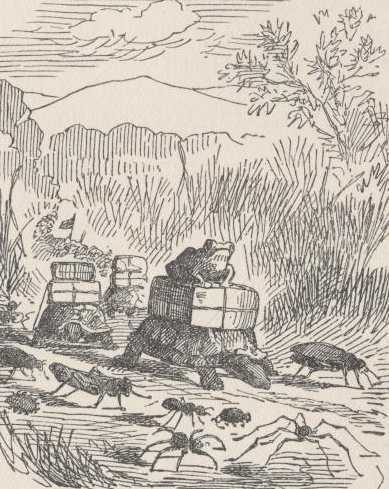
The growing rigor of the weather was now admonishing the scientists to close their labors for the present, so they made preparations to journey homeward. But even their last day among the Caverns bore fruit; for one of the scholars found in an out-of-the-way corner of the Museum or “Burial Place” a most strange and extraordinary thing. It was nothing less than a double Man-Bird lashed together breast to breast by a natural ligament, and labeled with the untranslatable words, “Siamese Twins.” The official report concerning this thing closed thus:
“Wherefore it appears that there were in old times two distinct species of this majestic fowl, the one being single and the other double. Nature has a reason for all things. It is plain to the eye of science that the Double-Man originally inhabited a region where dangers abounded; hence he was paired together to the end that while one part slept the other might watch; and likewise that, danger being discovered, there might always be a double instead of a single power to oppose it. All honor to the mystery-dispelling eye of godlike Science!”
And near the Double Man-Bird was found what was plainly an ancient record of his, marked upon numberless sheets of a thin white substance and bound together. Almost the first glance that Professor Woodlouse threw into it revealed this following sentence, which he instantly translated and laid before the scientists, in a tremble, and it uplifted every soul there with exultation and astonishment:
“In truth it is believed by many that the lower animals reason and talk together.”
When the great official report of the expedition appeared, the above sentence bore this comment:
“Then there are lower animals than Man! This remarkable passage can mean nothing else. Man himself is extinct, but they may still exist. What can they be? Where do they inhabit? One’s enthusiasm bursts all bounds in the contemplation of the brilliant field of discovery and investigation here thrown open to science. We close our labors with the humble prayer that your Majesty will immediately appoint a commission and command it to rest not nor spare expense until the search for this hitherto unsuspected race of the creatures of God shall be crowned with success.”
The expedition then journeyed homeward after its long absence and its faithful endeavors, and was received with a mighty ovation by the whole grateful country. There were vulgar, ignorant carpers, of course, as there always are and always will be; and naturally one of these was the obscene Tumble-Bug. He said that all he had learned by his travels was that science only needed a spoonful of supposition to build a mountain of demonstrated fact out of; and that for the future he meant to be content with the knowledge that nature had made free to all creatures and not go prying into the august secrets of the Deity.
MY LATE SENATORIAL SECRETARYSHIP
[written about 1867]
I am not a private secretary to a senator any more now. I held the berth two months in security and in great cheerfulness of spirit, but my bread began to return from over the waters then—that is to say, my works came back and revealed themselves. I judged it best to resign. The way of it was this. My employer sent for me one morning tolerably early, and, as soon as I had finished inserting some conundrums clandestinely into his last great speech upon finance, I entered the presence. There was something portentous in his appearance. His cravat was untied, his hair was in a state of disorder, and his countenance bore about it the signs of a suppressed storm. He held a package of letters in his tense grasp, and I knew that the dreaded Pacific mail was in. He said:
“I thought you were worthy of confidence.”
I said, “Yes, sir.”
He said, “I gave you a letter from certain of my constituents in the State of Nevada, asking the establishment of a post-office at Baldwin’s Ranch, and told you to answer it, as ingeniously as you could, with arguments which should persuade them that there was no real necessity for an office at that place.”
I felt easier. “Oh, if that is all, sir, I did do that.”
“Yes, you did. I will read your answer for your own humiliation:
‘WASHINGTON, Nov. 24
‘Messrs. Smith, Jones, and others.
‘GENTLEMEN: What the mischief do you suppose you want with a post-office at Baldwin’s Ranch? It would not do you any good. If any letters came there, you couldn’t read them, you know; and, besides, such letters as ought to pass through, with money in them, for other localities, would not be likely to get through, you must perceive at once; and that would make trouble for us all. No, don’t bother about a post-office in your camp. I have your best interests at heart, and feel that it would only be an ornamental folly. What you want is a nice jail, you know—a nice, substantial jail and a free school. These will be a lasting benefit to you. These will make you really contented and happy. I will move in the matter at once.
‘Very truly, etc.,
Mark Twain,
‘For James W. N———, U. S. Senator.’
“That is the way you answered that letter. Those people say they will hang me, if I ever enter that district again; and I am perfectly satisfied they will, too.”
“Well, sir, I did not know I was doing any harm. I only wanted to convince them.”
“Ah. Well, you did convince them, I make no manner of doubt. Now, here is another specimen. I gave you a petition from certain gentlemen of Nevada, praying that I would get a bill through Congress incorporating the Methodist Episcopal Church of the State of Nevada. I told you to say, in reply, that the creation of such a law came more properly within the province of the state legislature; and to endeavor to show them that, in the present feebleness of the religious element in that new commonwealth, the expediency of incorporating the church was questionable. What did you write?
“‘WASHINGTON, Nov. 24.
“‘Rev. John Halifax and others.
“‘GENTLEMEN: You will have to go to the state legislature about that speculation of yours—Congress don’t know anything about religion. But don’t you hurry to go there, either; because this thing you propose to do out in that new country isn’t expedient—in fact, it is ridiculous. Your religious people there are too feeble, in intellect, in morality, in piety in everything, pretty much. You had better drop this—you can’t make it work. You can’t issue stock on an incorporation like that—or if you could, it would only keep you in trouble all the time. The other denominations would abuse it, and “bear” it, and “sell it short,” and break it down. They would do with it just as they would with one of your silver-mines out there—they would try to make all the world believe it was “wildcat.” You ought not to do anything that is calculated to bring a sacred thing into disrepute. You ought to be ashamed of yourselves—that is what I think about it. You close your petition with the words: “And we will ever pray.” I think you had better—you need to do it.
“‘Very truly, etc.,
“‘MARK TWAIN,
“‘For James W. N——-, U. S. Senator.’
“That luminous epistle finishes me with the religious element among my constituents. But that my political murder might be made sure, some evil instinct prompted me to hand you this memorial from the grave company of elders composing the board of aldermen of the city of San Francisco, to try your hand upon—a memorial praying that the city’s right to the water-lots upon the city front might be established by law of Congress. I told you this was a dangerous matter to move in. I told you to write a non-committal letter to the aldermen—an ambiguous letter—a letter that should avoid, as far as possible, all real consideration and discussion of the water-lot question. If there is any feeling left in you—any shame—surely this letter you wrote, in obedience to that order, ought to evoke it, when its words fall upon your ears:
‘WASHINGTON, Nov. 27
‘The Honorable Board of Aldermen, etc.
‘GENTLEMEN: George Washington, the revered Father of his Country, is dead. His long and brilliant career is closed, alas! forever. He was greatly respected in this section of the country, and his untimely decease cast a gloom over the whole community. He died on the 14th day of December, 1799. He passed peacefully away from the scene of his honors and his great achievements, the most lamented hero and the best beloved that ever earth hath yielded unto Death. At such a time as this, you speak of water-lots! what a lot was his!
‘What is fame! Fame is an accident. Sir Isaac Newton discovered an apple falling to the ground—a trivial discovery, truly, and one which a million men had made before him—but his parents were influential, and so they tortured that small circumstance into something wonderful, and, lo! the simple world took up the shout and, in almost the twinkling of an eye, that man was famous. Treasure these thoughts.
‘Poesy, sweet poesy, who shall estimate what the world owes to thee!
“Mary had a little lamb, its fleece was white as
snow—And everywhere that Mary went, the lamb was sure to go."
“Jack and Gill went up the hill
To draw a pail of water;
Jack fell down and broke his crown,
And Gill came tumbling after.”
‘For simplicity, elegance of diction, and freedom from immoral tendencies, I regard those two poems in the light of gems. They are suited to all grades of intelligence, to every sphere of life —to the field, to the nursery, to the guild. Especially should no Board of Aldermen be without them.
‘Venerable fossils! write again. Nothing improves one so much as friendly correspondence. Write again—and if there is anything in this memorial of yours that refers to anything in particular, do not be backward about explaining it. We shall always be happy to hear you chirp.
‘Very truly, etc.,
“‘MARK TWAIN,
‘For James W. N——-, U. S. Senator.’
“That is an atrocious, a ruinous epistle! Distraction!”
“Well, sir, I am really sorry if there is anything wrong about it—but—but it appears to me to dodge the water-lot question.”
“Dodge the mischief! Oh!—but never mind. As long as destruction must come now, let it be complete. Let it be complete—let this last of your performances, which I am about to read, make a finality of it. I am a ruined man. I had my misgivings when I gave you the letter from Humboldt, asking that the post route from Indian Gulch to Shakespeare Gap and intermediate points be changed partly to the old Mormon trail. But I told you it was a delicate question, and warned you to deal with it deftly—to answer it dubiously, and leave them a little in the dark. And your fatal imbecility impelled you to make this disastrous reply. I should think you would stop your ears, if you are not dead to all shame:
“‘WASHINGTON, Nov. 30.
“‘Messers. Perkins, Wagner, et at.
“‘GENTLEMEN: It is a delicate question about this Indian trail, but, handled with proper deftness and dubiousness, I doubt not we shall succeed in some measure or otherwise, because the place where the route leaves the Lassen Meadows, over beyond where those two Shawnee chiefs, Dilapidated Vengeance and Biter-of-the-Clouds, were scalped last winter, this being the favorite direction to some, but others preferring something else in consequence of things, the Mormon trail leaving Mosby’s at three in the morning, and passing through Jawbone Flat to Blucher, and then down by Jug-Handle, the road passing to the right of it, and naturally leaving it on the right, too, and Dawson’s on the left of the trail where it passes to the left of said Dawson’s and onward thence to Tomahawk, thus making the route cheaper, easier of access to all who can get at it, and compassing all the desirable objects so considered by others, and, therefore, conferring the most good upon the greatest number, and, consequently, I am encouraged to hope we shall. However, I shall be ready, and happy, to afford you still further information upon the subject, from time to time, as you may desire it and the Post-office Department be enabled to furnish it to me.
“‘Very truly, etc.,
“‘MARK TWAIN,
“‘For James W. N——-, U. S. Senator.’
“There—now what do you think of that?”
“Well, I don’t know, sir. It—well, it appears to me—to be dubious enough.”
“Du—leave the house! I am a ruined man. Those Humboldt savages never will forgive me for tangling their brains up with this inhuman letter. I have lost the respect of the Methodist Church, the board of aldermen—”
“Well, I haven’t anything to say about that, because I may have missed it a little in their cases, but I was too many for the Baldwin’s Ranch people, General!”
“Leave the house! Leave it forever and forever, too.”
I regarded that as a sort of covert intimation that my service could be dispensed with, and so I resigned. I never will be a private secretary to a senator again. You can’t please that kind of people. They don’t know anything. They can’t appreciate a party’s efforts.
A FASHION ITEM
[written about 1867]
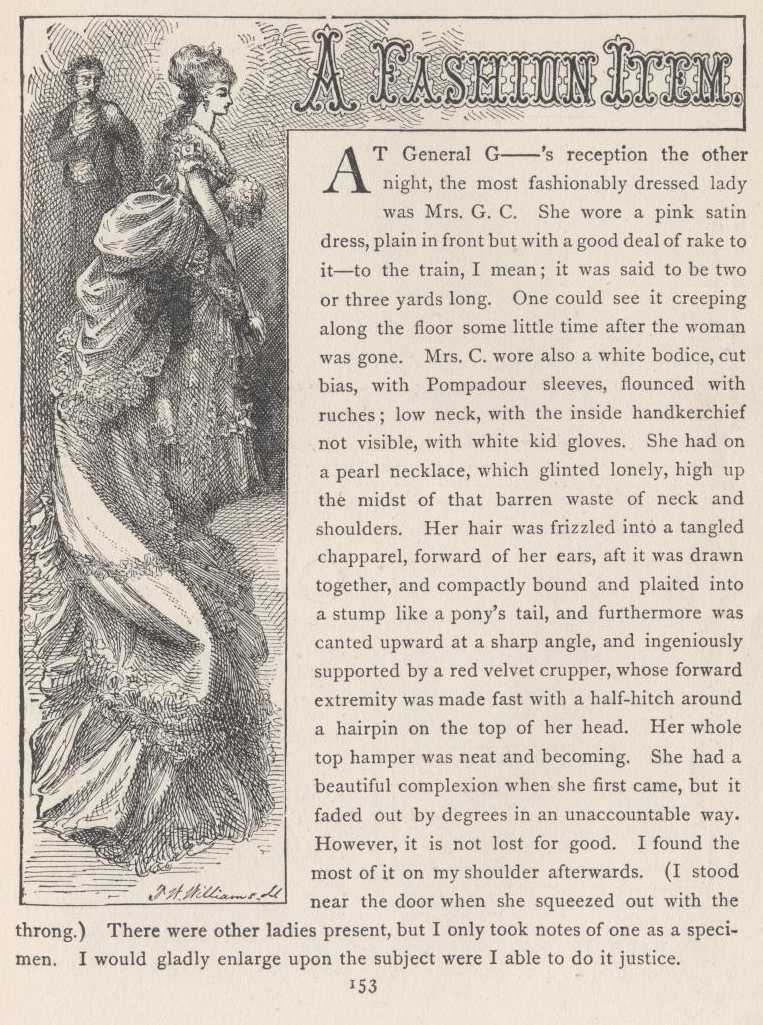
At General G——’s reception the other night, the most fashionably dressed lady was Mrs. G. C. She wore a pink satin dress, plain in front but with a good deal of rake to it—to the train, I mean; it was said to be two or three yards long. One could see it creeping along the floor some little time after the woman was gone. Mrs. C. wore also a white bodice, cut bias, with Pompadour sleeves, flounced with ruches; low neck, with the inside handkerchief not visible, with white kid gloves. She had on a pearl necklace, which glinted lonely, high up the midst of that barren waste of neck and shoulders. Her hair was frizzled into a tangled chaparral, forward of her ears, aft it was drawn together, and compactly bound and plaited into a stump like a pony’s tail, and furthermore was canted upward at a sharp angle, and ingeniously supported by a red velvet crupper, whose forward extremity was made fast with a half-hitch around a hairpin on the top of her head. Her whole top hamper was neat and becoming. She had a beautiful complexion when she first came, but it faded out by degrees in an unaccountable way. However, it is not lost for good. I found the most of it on my shoulder afterward. (I stood near the door when she squeezed out with the throng.) There were other ladies present, but I only took notes of one as a specimen. I would gladly enlarge upon the subject were I able to do it justice.
RILEY—NEWSPAPER CORRESPONDENT
One of the best men in Washington—or elsewhere—is RILEY, correspondent of one of the great San Francisco dailies.
Riley is full of humor, and has an unfailing vein of irony, which makes his conversation to the last degree entertaining (as long as the remarks are about somebody else). But notwithstanding the possession of these qualities, which should enable a man to write a happy and an appetizing letter, Riley’s newspaper letters often display a more than earthly solemnity, and likewise an unimaginative devotion to petrified facts, which surprise and distress all men who know him in his unofficial character. He explains this curious thing by saying that his employers sent him to Washington to write facts, not fancy, and that several times he has come near losing his situation by inserting humorous remarks which, not being looked for at headquarters, and consequently not understood, were thought to be dark and bloody speeches intended to convey signals and warnings to murderous secret societies, or something of that kind, and so were scratched out with a shiver and a prayer and cast into the stove. Riley says that sometimes he is so afflicted with a yearning to write a sparkling and absorbingly readable letter that he simply cannot resist it, and so he goes to his den and revels in the delight of untrammeled scribbling; and then, with suffering such as only a mother can know, he destroys the pretty children of his fancy and reduces his letter to the required dismal accuracy. Having seen Riley do this very thing more than once, I know whereof I speak. Often I have laughed with him over a happy passage, and grieved to see him plow his pen through it. He would say, “I had to write that or die; and I’ve got to scratch it out or starve. They wouldn’t stand it, you know.”
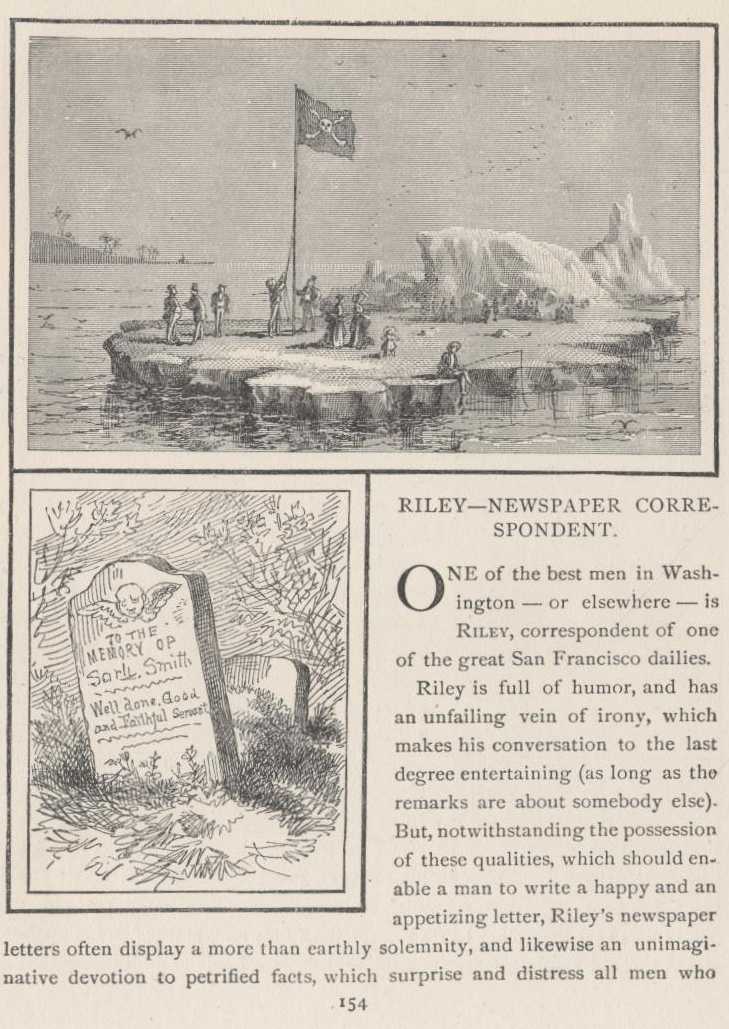
I think Riley is about the most entertaining company I ever saw. We lodged together in many places in Washington during the winter of ‘67-8, moving comfortably from place to place, and attracting attention by paying our board—a course which cannot fail to make a person conspicuous in Washington. Riley would tell all about his trip to California in the early days, by way of the Isthmus and the San Juan River; and about his baking bread in San Francisco to gain a living, and setting up tenpins, and practising law, and opening oysters, and delivering lectures, and teaching French, and tending bar, and reporting for the newspapers, and keeping dancing-schools, and interpreting Chinese in the courts—which latter was lucrative, and Riley was doing handsomely and laying up a little money when people began to find fault because his translations were too “free,” a thing for which Riley considered he ought not to be held responsible, since he did not know a word of the Chinese tongue, and only adopted interpreting as a means of gaining an honest livelihood. Through the machinations of enemies he was removed from the position of official interpreter, and a man put in his place who was familiar with the Chinese language, but did not know any English. And Riley used to tell about publishing a newspaper up in what is Alaska now, but was only an iceberg then, with a population composed of bears, walruses, Indians, and other animals; and how the iceberg got adrift at last, and left all his paying subscribers behind, and as soon as the commonwealth floated out of the jurisdiction of Russia the people rose and threw off their allegiance and ran up the English flag, calculating to hook on and become an English colony as they drifted along down the British Possessions; but a land breeze and a crooked current carried them by, and they ran up the Stars and Stripes and steered for California, missed the connection again and swore allegiance to Mexico, but it wasn’t any use; the anchors came home every time, and away they went with the northeast trades drifting off sideways toward the Sandwich Islands, whereupon they ran up the Cannibal flag and had a grand human barbecue in honor of it, in which it was noticed that the better a man liked a friend the better he enjoyed him; and as soon as they got fairly within the tropics the weather got so fearfully hot that the iceberg began to melt, and it got so sloppy under foot that it was almost impossible for ladies to get about at all; and at last, just as they came in sight of the islands, the melancholy remnant of the once majestic iceberg canted first to one side and then to the other, and then plunged under forever, carrying the national archives along with it—and not only the archives and the populace, but some eligible town lots which had increased in value as fast as they diminished in size in the tropics, and which Riley could have sold at thirty cents a pound and made himself rich if he could have kept the province afloat ten hours longer and got her into port.
Riley is very methodical, untiringly accommodating, never forgets anything that is to be attended to, is a good son, a stanch friend, and a permanent reliable enemy. He will put himself to any amount of trouble to oblige a body, and therefore always has his hands full of things to be done for the helpless and the shiftless. And he knows how to do nearly everything, too. He is a man whose native benevolence is a well-spring that never goes dry. He stands always ready to help whoever needs help, as far as he is able—and not simply with his money, for that is a cheap and common charity, but with hand and brain, and fatigue of limb and sacrifice of time. This sort of men is rare.
Riley has a ready wit, a quickness and aptness at selecting and applying quotations, and a countenance that is as solemn and as blank as the back side of a tombstone when he is delivering a particularly exasperating joke. One night a negro woman was burned to death in a house next door to us, and Riley said that our landlady would be oppressively emotional at breakfast, because she generally made use of such opportunities as offered, being of a morbidly sentimental turn, and so we should find it best to let her talk along and say nothing back—it was the only way to keep her tears out of the gravy. Riley said there never was a funeral in the neighborhood but that the gravy was watery for a week.
And, sure enough, at breakfast the landlady was down in the very sloughs of woe—entirely brokenhearted. Everything she looked at reminded her of that poor old negro woman, and so the buckwheat cakes made her sob, the coffee forced a groan, and when the beefsteak came on she fetched a wail that made our hair rise. Then she got to talking about deceased, and kept up a steady drizzle till both of us were soaked through and through. Presently she took a fresh breath and said, with a world of sobs:
“Ah, to think of it, only to think of it!—the poor old faithful creature. For she was so faithful. Would you believe it, she had been a servant in that selfsame house and that selfsame family for twenty seven years come Christmas, and never a cross word and never a lick! And, oh, to think she should meet such a death at last!—a-sitting over the red hot stove at three o’clock in the morning and went to sleep and fell on it and was actually roasted! Not just frizzled up a bit, but literally roasted to a crisp! Poor faithful creature, how she was cooked! I am but a poor woman, but even if I have to scrimp to do it, I will put up a tombstone over that lone sufferer’s grave—and Mr. Riley if you would have the goodness to think up a little epitaph to put on it which would sort of describe the awful way in which she met her—”
“Put it, ‘Well done, good and faithful servant,’” said Riley, and never smiled.
A FINE OLD MAN
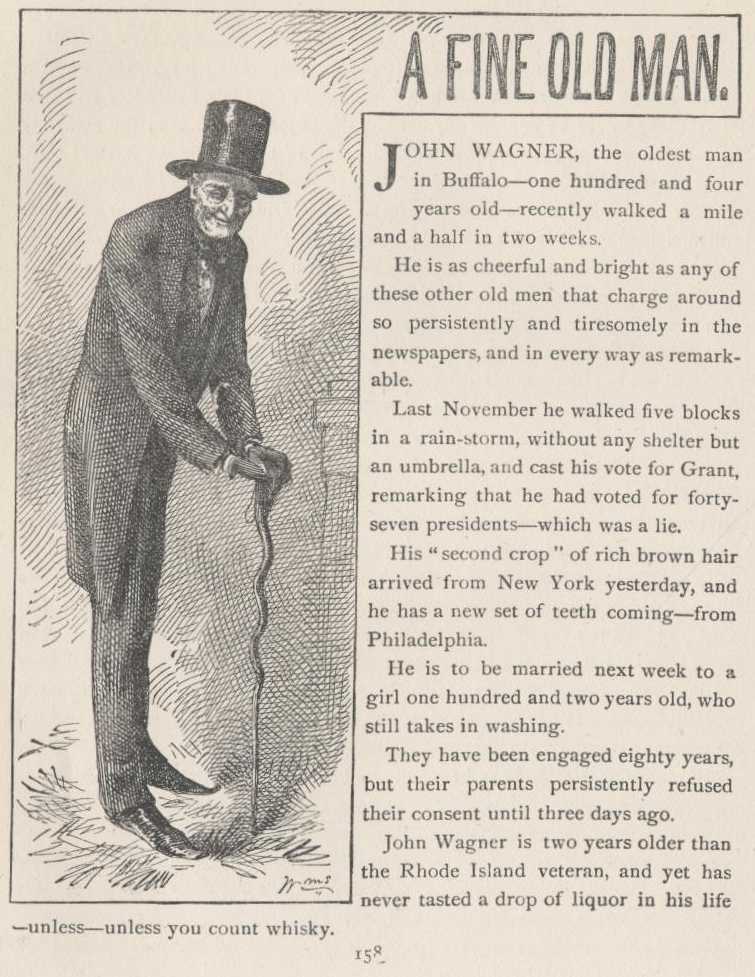
John Wagner, the oldest man in Buffalo—one hundred and four years old—recently walked a mile and a half in two weeks.
He is as cheerful and bright as any of these other old men that charge around so persistently and tiresomely in the newspapers, and in every way as remarkable.
Last November he walked five blocks in a rainstorm, without any shelter but an umbrella, and cast his vote for Grant, remarking that he had voted for forty-seven presidents—which was a lie.
His “second crop” of rich brown hair arrived from New York yesterday, and he has a new set of teeth coming from—Philadelphia.
He is to be married next week to a girl one hundred and two years old, who still takes in washing.
They have been engaged eighty years, but their parents persistently refused their consent until three days ago.
John Wagner is two years older than the Rhode Island veteran, and yet has never tasted a drop of liquor in his life—unless—unless you count whisky.
SCIENCE V.S. LUCK
[written about 1867]
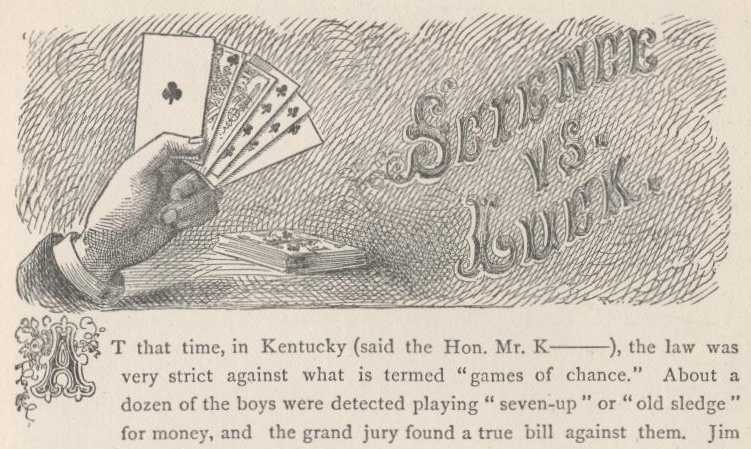
At that time, in Kentucky (said the Hon. Mr. K——-); the law was very strict against what is termed “games of chance.” About a dozen of the boys were detected playing “seven up” or “old sledge” for money, and the grand jury found a true bill against them. Jim Sturgis was retained to defend them when the case came up, of course. The more he studied over the matter, and looked into the evidence, the plainer it was that he must lose a case at last—there was no getting around that painful fact. Those boys had certainly been betting money on a game of chance. Even public sympathy was roused in behalf of Sturgis. People said it was a pity to see him mar his successful career with a big prominent case like this, which must go against him.
But after several restless nights an inspired idea flashed upon Sturgis, and he sprang out of bed delighted. He thought he saw his way through. The next day he whispered around a little among his clients and a few friends, and then when the case came up in court he acknowledged the seven-up and the betting, and, as his sole defense, had the astounding effrontery to put in the plea that old sledge was not a game of chance! There was the broadest sort of a smile all over the faces of that sophisticated audience. The judge smiled with the rest. But Sturgis maintained a countenance whose earnestness was even severe. The opposite counsel tried to ridicule him out of his position, and did not succeed. The judge jested in a ponderous judicial way about the thing, but did not move him. The matter was becoming grave. The judge lost a little of his patience, and said the joke had gone far enough. Jim Sturgis said he knew of no joke in the matter—his clients could not be punished for indulging in what some people chose to consider a game of chance until it was proven that it was a game of chance. Judge and counsel said that would be an easy matter, and forthwith called Deacons Job, Peters, Burke, and Johnson, and Dominies Wirt and Miggles, to testify; and they unanimously and with strong feeling put down the legal quibble of Sturgis by pronouncing that old sledge was a game of chance.
“What do you call it now?” said the judge.
“I call it a game of science!” retorted Sturgis; “and I’ll prove it, too!”
They saw his little game.
He brought in a cloud of witnesses, and produced an overwhelming mass of testimony, to show that old sledge was not a game of chance but a game of science.
Instead of being the simplest case in the world, it had somehow turned out to be an excessively knotty one. The judge scratched his head over it awhile, and said there was no way of coming to a determination, because just as many men could be brought into court who would testify on one side as could be found to testify on the other. But he said he was willing to do the fair thing by all parties, and would act upon any suggestion Mr. Sturgis would make for the solution of the difficulty.
Mr. Sturgis was on his feet in a second.
“Impanel a jury of six of each, Luck versus Science. Give them candles and a couple of decks of cards. Send them into the jury-room, and just abide by the result!”
There was no disputing the fairness of the proposition. The four deacons and the two dominies were sworn in as the “chance” jurymen, and six inveterate old seven-up professors were chosen to represent the “science” side of the issue. They retired to the jury-room.
In about two hours Deacon Peters sent into court to borrow three dollars from a friend. [Sensation.] In about two hours more Dominie Miggles sent into court to borrow a “stake” from a friend. [Sensation.] During the next three or four hours the other dominie and the other deacons sent into court for small loans. And still the packed audience waited, for it was a prodigious occasion in Bull’s Corners, and one in which every father of a family was necessarily interested.
The rest of the story can be told briefly. About daylight the jury came in, and Deacon Job, the foreman, read the following:
VERDICT:
We, the jury in the case of the Commonwealth of Kentucky vs. John Wheeler et al., have carefully considered the points of the case, and tested the merits of the several theories advanced, and do hereby unanimously decide that the game commonly known as old sledge or seven-up is eminently a game of science and not of chance. In demonstration whereof it is hereby and herein stated, iterated, reiterated, set forth, and made manifest that, during the entire night, the “chance” men never won a game or turned a jack, although both feats were common and frequent to the opposition; and furthermore, in support of this our verdict, we call attention to the significant fact that the “chance” men are all busted, and the “science” men have got the money. It is the deliberate opinion of this jury, that the “chance” theory concerning seven-up is a pernicious doctrine, and calculated to inflict untold suffering and pecuniary loss upon any community that takes stock in it.
“That is the way that seven-up came to be set apart and particularized in the statute-books of Kentucky as being a game not of chance but of science, and therefore not punishable under the law,” said Mr. K——-. “That verdict is of record, and holds good to this day.”
THE LATE BENJAMIN FRANKLIN
[written about 1870]
[“Never put off till to-morrow what you can do day after to-morrow just as well.”—B. F.]
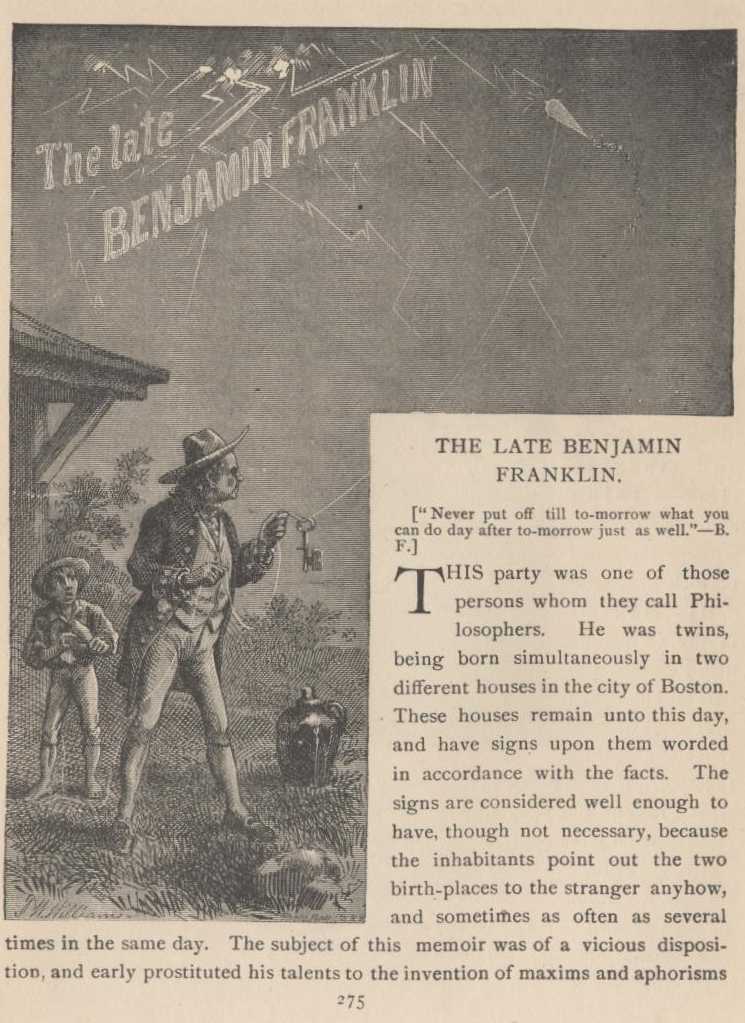
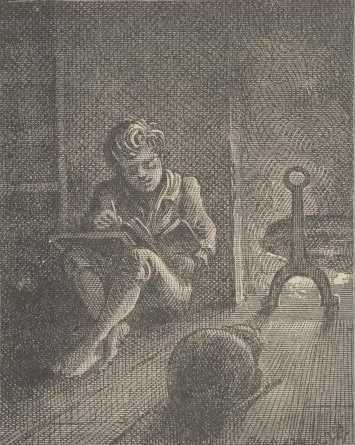
This party was one of those persons whom they call Philosophers. He was twins, being born simultaneously in two different houses in the city of Boston. These houses remain unto this day, and have signs upon them worded in accordance with the facts. The signs are considered well enough to have, though not necessary, because the inhabitants point out the two birthplaces to the stranger anyhow, and sometimes as often as several times in the same day. The subject of this memoir was of a vicious disposition, and early prostituted his talents to the invention of maxims and aphorisms calculated to inflict suffering upon the rising generation of all subsequent ages. His simplest acts, also, were contrived with a view to their being held up for the emulation of boys forever—boys who might otherwise have been happy. It was in this spirit that he became the son of a soap-boiler, and probably for no other reason than that the efforts of all future boys who tried to be anything might be looked upon with suspicion unless they were the sons of soap-boilers. With a malevolence which is without parallel in history, he would work all day, and then sit up nights, and let on to be studying algebra by the light of a smoldering fire, so that all other boys might have to do that also, or else have Benjamin Franklin thrown up to them.
Not satisfied with these proceedings, he had a fashion of living wholly on bread and water, and studying astronomy at meal-time—a thing which has brought affliction to millions of boys since, whose fathers had read Franklin’s pernicious biography.
His maxims were full of animosity toward boys. Nowadays a boy cannot follow out a single natural instinct without tumbling over some of those everlasting aphorisms and hearing from Franklin on the spot. If he buys two cents’ worth of peanuts, his father says, “Remember what Franklin has said, my son—‘A grout a day’s a penny a year”’; and the comfort is all gone out of those peanuts. If he wants to spin his top when he has done work, his father quotes, “Procrastination is the thief of time.” If he does a virtuous action, he never gets anything for it, because “Virtue is its own reward.” And that boy is hounded to death and robbed of his natural rest, because Franklin, said once, in one of his inspired flights of malignity:
Early to bed and early to rise
Makes a man healthy and wealthy and wise.
As if it were any object to a boy to be healthy and wealthy and wise on such terms. The sorrow that that maxim has cost me, through my parents, experimenting on me with it, tongue cannot tell. The legitimate result is my present state of general debility, indigence, and mental aberration. My parents used to have me up before nine o’clock in the morning sometimes when I was a boy. If they had let me take my natural rest where would I have been now? Keeping store, no doubt, and respected by all.
And what an adroit old adventurer the subject of this memoir was! In order to get a chance to fly his kite on Sunday he used to hang a key on the string and let on to be fishing for lightning. And a guileless public would go home chirping about the “wisdom” and the “genius” of the hoary Sabbath-breaker. If anybody caught him playing “mumblepeg” by himself, after the age of sixty, he would immediately appear to be ciphering out how the grass grew—as if it was any of his business. My grandfather knew him well, and he says Franklin was always fixed—always ready. If a body, during his old age, happened on him unexpectedly when he was catching flies, or making mud-pies, or sliding on a cellar door, he would immediately look wise, and rip out a maxim, and walk off with his nose in the air and his cap turned wrong side before, trying to appear absent-minded and eccentric. He was a hard lot.
He invented a stove that would smoke your head off in four hours by the clock. One can see the almost devilish satisfaction he took in it by his giving it his name.
He was always proud of telling how he entered Philadelphia for the first time, with nothing in the world but two shillings in his pocket and four rolls of bread under his arm. But really, when you come to examine it critically, it was nothing. Anybody could have done it.
To the subject of this memoir belongs the honor of recommending the army to go back to bows and arrows in place of bayonets and muskets. He observed, with his customary force, that the bayonet was very well under some circumstances, but that he doubted whether it could be used with accuracy at a long range.
Benjamin Franklin did a great many notable things for his country, and made her young name to be honored in many lands as the mother of such a son. It is not the idea of this memoir to ignore that or cover it up. No; the simple idea of it is to snub those pretentious maxims of his, which he worked up with a great show of originality out of truisms that had become wearisome platitudes as early as the dispersion from Babel; and also to snub his stove, and his military inspirations, his unseemly endeavor to make himself conspicuous when he entered Philadelphia, and his flying his kite and fooling away his time in all sorts of such ways when he ought to have been foraging for soap-fat, or constructing candles.
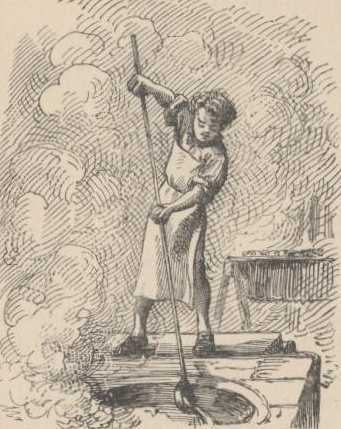
I merely desired to do away with somewhat of the prevalent calamitous idea among heads of families that Franklin acquired his great genius by working for nothing, studying by moonlight, and getting up in the night instead of waiting till morning like a Christian; and that this program, rigidly inflicted, will make a Franklin of every father’s fool. It is time these gentlemen were finding out that these execrable eccentricities of instinct and conduct are only the evidences of genius, not the creators of it. I wish I had been the father of my parents long enough to make them comprehend this truth, and thus prepare them to let their son have an easier time of it. When I was a child I had to boil soap, notwithstanding my father was wealthy, and I had to get up early and study geometry at breakfast, and peddle my own poetry, and do everything just as Franklin did, in the solemn hope that I would be a Franklin some day. And here I am.
MR. BLOKE’S ITEM
[written about 1865]
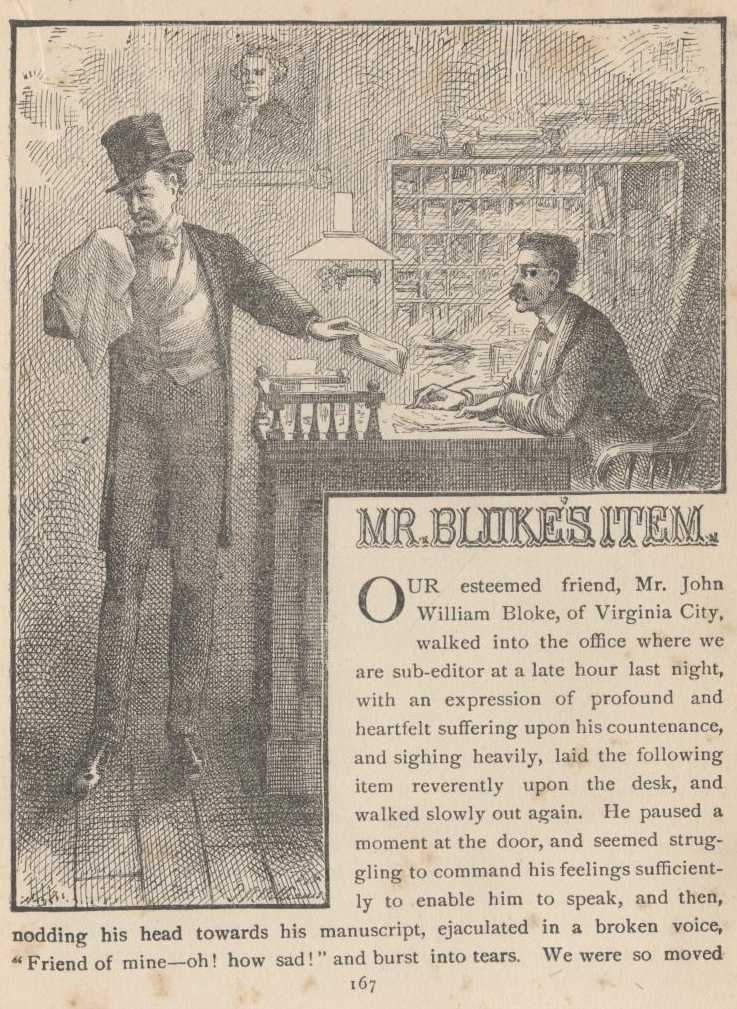
Our esteemed friend, Mr. John William Bloke, of Virginia City, walked into the office where we are sub-editor at a late hour last night, with an expression of profound and heartfelt suffering upon his countenance, and, sighing heavily, laid the following item reverently upon the desk, and walked slowly out again. He paused a moment at the door, and seemed struggling to command his feelings sufficiently to enable him to speak, and then, nodding his head toward his manuscript, ejaculated in a broken voice, “Friend of mine—oh! how sad!” and burst into tears. We were so moved at his distress that we did not think to call him back and endeavor to comfort him until he was gone, and it was too late. The paper had already gone to press, but knowing that our friend would consider the publication of this item important, and cherishing the hope that to print it would afford a melancholy satisfaction to his sorrowing heart, we stopped the press at once and inserted it in our columns:
DISTRESSING ACCIDENT.—Last evening, about six o’clock, as Mr. William Schuyler, an old and respectable citizen of South Park, was leaving his residence to go down-town, as has been his usual custom for many years with the exception only of a short interval in the spring of 1850, during which he was confined to his bed by injuries received in attempting to stop a runaway horse by thoughtlessly placing himself directly in its wake and throwing up his hands and shouting, which if he had done so even a single moment sooner, must inevitably have frightened the animal still more instead of checking its speed, although disastrous enough to himself as it was, and rendered more melancholy and distressing by reason of the presence of his wife’s mother, who was there and saw the sad occurrence notwithstanding it is at least likely, though not necessarily so, that she should be reconnoitering in another direction when incidents occur, not being vivacious and on the lookout, as a general thing, but even the reverse, as her own mother is said to have stated, who is no more, but died in the full hope of a glorious resurrection, upwards of three years ago; aged eighty-six, being a Christian woman and without guile, as it were, or property, in consequence of the fire of 1849, which destroyed every single thing she had in the world. But such is life. Let us all take warning by this solemn occurrence, and let us endeavor so to conduct ourselves that when we come to die we can do it. Let us place our hands upon our heart, and say with earnestness and sincerity that from this day forth we will beware of the intoxicating bowl.—‘First Edition of the Californian.’
The head editor has been in here raising the mischief, and tearing his hair and kicking the furniture about, and abusing me like a pickpocket. He says that every time he leaves me in charge of the paper for half an hour I get imposed upon by the first infant or the first idiot that comes along. And he says that that distressing item of Mr. Bloke’s is nothing but a lot of distressing bosh, and has no point to it, and no sense in it, and no information in it, and that there was no sort of necessity for stopping the press to publish it.
Now all this comes of being good-hearted. If I had been as unaccommodating and unsympathetic as some people, I would have told Mr. Bloke that I wouldn’t receive his communication at such a late hour; but no, his snuffling distress touched my heart, and I jumped at the chance of doing something to modify his misery. I never read his item to see whether there was anything wrong about it, but hastily wrote the few lines which preceded it, and sent it to the printers. And what has my kindness done for me? It has done nothing but bring down upon me a storm of abuse and ornamental blasphemy.
Now I will read that item myself, and see if there is any foundation for all this fuss. And if there is, the author of it shall hear from me.
I have read it, and I am bound to admit that it seems a little mixed at a first glance. However, I will peruse it once more.
I have read it again, and it does really seem a good deal more mixed than ever.