

CHAPTER XVII.
PLANS.
IT was difficult to turn from the remembrance of Christina's great sorrow, besides which Nellie had her own private distress and anxiety to bear up against and hide as well as she might. At last she managed to rally herself sufficiently to ask Christina further of her project, and how she thought of beginning it.
"Yes, and you must advise me," said Christina.
"I am afraid I do not know enough; mamma would help you so much better than I."
"But then, you see, she is not here."
"She is not very far," answered Nellie, smiling; "and, do you know, Christina, I should very much like my sister Ada to hear about it; that is if you do not mind; she is such a bright girl, and would be so interested, and might perhaps do something to help you."
"Do you think she could? What sort of help do you mean?"
"If you carry out your idea, you will want plenty of little clothes, for instance."
"Clothes! So I shall; I really think, Nellie, I had only thought about loving them and teaching them. Look here! Should you consider me dreadfully unpolite if we went up to consult your mamma after tea, instead of sitting here?"
"I should like it very much indeed; but your aunt?"
"She will not mind; and I do not wish to say anything till I have my ideas a little more in shape. Fancy my having forgotten clothes!"
Nellie laughed pleasantly; and as the maid entered at the moment with the tea, she turned her attention to Lion, who lay with his foot bound up, looking rather miserable.
"Poor Lion!" she said, stroking his head.
Lion did not condescend to accept her caress, but looked lazily towards his mistress, who was busy cutting the cake.
"Lion is quite a hero," said she; "he saved a man's life once."
"Did he indeed?"
"It was at Boulogne. There was a wreck, and a good many of the sailors had been picked up; but Lion saw one floating out to sea, and plunging in, swam towards him, and dragged him by his hair safely to land."
"How glad you must have been!"
Lion lay looking at them, wagging his tail. He knew he was being talked about, and had heard the story before.
"Glad? The joy was overpowering. I felt almost as glad as I did that day when little Tom told me he had come to Jesus."
"Yes," said Nellie earnestly; "it has been such a great blessing. Dear little Tom has been so different since."
"I felt sure he would."
"He is so much more patient, and bears his sad trial in quite a different way. He does not say much, you know, but his face looks altered."
"I have thought so too."
"Dear little Tom!" said Nellie. "You do not know how we all love him and pity him."
"Will he ever be strong again?" said Christina kindly. "I have not liked to ask your mamma."
"Papa does not think he will; he does not improve in health as we could wish; but I am sure mamma's greatest burden is relieved now."
Miss Arbuthnot and the teapot both came in at this moment, and the conversation turned to other subjects. After tea, Christina said she should walk home with Nellie.
"So early?" asked her aunt.
"Yes; I have a few things to speak to Mrs. Arundel about that I will explain to you, dear aunt, to-morrow; so we are going now."
When they entered the passage at the farm, Mrs. Arundel was just coming down from little Tom. She seemed surprised to see them, and noticed directly that Nellie looked pale and tired.
"Is anything the matter?" she asked.
"Nothing," said Christina cheerfully; "and you will wonder to see us; but we want to have a little talk with you. Is Ada in?"
"Yes; just sitting down to mend her stockings," said Mrs. Arundel, smiling slightly.
They found Ada seated in the bay window, looking rather sulky. She was watching Arthur, who, across in the orchard, was having a fine swing.
"How early you are!" she said, rather ungraciously. "I thought Arthur and I were to come and meet you?"
"So we intended; but we have something so interesting to tell you, that we came up instead," said Nellie.
Mrs. Arundel drew out her work, and Nellie fetched hers, and then they all sat down comfortably—except that Ada did not look comfortable, and turned her back upon them.
"Now, Christina," said Nellie, by way of prelude.
Christina coloured. "It seems very formidable to tell you straight out like this; and I am afraid too, that what Nellie and I have been looking at with rose-coloured spectacles may seem to you absurd and impossible," she faltered.
"Let me hear what it is," said Mrs. Arundel.
Still Christina hesitated. At last she said, looking down and speaking softly, "You know that I am alone in the world, and dreadfully want something to do. Nellie lent me a paper the other day, in which it spoke of women who are circumstanced as I am; and it advised them to fill their homes and their empty hearts with little sad and forlorn children; and then I felt as if that paragraph had been written specially to suit me. It seemed to give me hope and joy at once; to propose to me a work which I feel myself suited for, something I can do for my God."
"It would be very nice indeed; but have you thought over all the difficulties it involves?" asked Mrs. Arundel.
"I do not know about all; but I have thought of some of them. I think perhaps I could find a house somewhere with a garden, and there we would settle ourselves, my aunt and I, and gather round us two or three little ones at first. Then I should see how I got on before I sought any more."
"But supposing you got tired of it, dear Christina, or sickness came, or you changed your plans? I do not want to object; only to suggest the things that probably might arise."
"Oh, yes! Please do; it must not be hastily entered into. I have thought about it a great deal for the last few days, though I did forget the clothes."
"Clothes?" questioned Mrs. Arundel.
"I forgot they would wear out those they came in," said Christina with a little laugh; "but Nellie soon brought me up."
"I told her that we could help her in that, Ada," said Nellie, looking towards the window.
"If I have time," said Ada rather reluctantly.
Christina raised her eyes a little surprised; and Ada got up and hastily left the room. She flew to her bedroom, locked the door, and then threw herself across the bottom of her bed.
"How horrid I am with my wretched temper," she moaned. "Here they are talking over what I should delight to help in, and I must needs sit like a stone, and never give a word; and Christina will think I do not care about it at all."
Hot tears forced themselves down her cheeks, and fell heavily on the counterpane.
"I hate myself," she went on, angrily kicking her foot about; "but it was all those stockings. Mamma knows I hate mending above everything else; and do abominate to sit in all the evening doing horrid work. Certainly mamma did wish me to do them this afternoon; but I did not wish to, and so there it is. Now I want to go down; they will be talking all the nice things while I am away, and arranging everything, and my temper will have lost it all. I don't know how to get over my temper, I'm sure. It always overcomes me, and always will."
Then, as she lay still, somehow the thought came over her of that evening before they came to South Bay, and of Nellie's words as she sat so quietly reading her Bible:
"'I can do all things through Christ, which strengtheneth me.'"
Ada's eyes filled again with softer tears. "How patient Nellie was that day! Was that Christ's strength? It must have been. Perhaps, if I were to ask—"
She slipped on to her knees by her bedside, and after a minute or two she said, in a broken voice—
"Lord Jesus Christ, I am so weak and so wrong, and I do not know how to get on alone; but, oh, forgive me! Give me of Thy strength, and help me to overcome!"
It was Ada's first real prayer, and she rose from her knees a new creature. Yes, a new creature in Christ Jesus. It was very simple, so simple that she was astonished; but she had found out that she was a helpless sinner, and Jesus a mighty Saviour. There only wanted the link between these two truths, and that link was, that she was willing to take Him for her Saviour. And she did; she knew it distinctly; and, with a happiness never before experienced, after a few moments' silence, she unlocked her door and went downstairs. When she re-entered the dining room, Arthur had joined them, and was sitting with his arms on the table, looking very interested.
Ada went up to Christina and gave her a soft little kiss, saying humbly, "I should very much like to help you, if you would let me."
Christina glanced at her, pressed her hand, and said, "Thank you, dear Ada; there will be plenty to do."
"We were saying," said Nellie, "that it would be difficult to love the dirty, disagreeable children as well as the nice and clean ones."
"I suppose," said Arthur bluntly, "you will not leave them dirty, however disagreeable they may be."
"Of course not," said Christina; "I believe a bath is the first duty."
"And I think you will find," said Mrs. Arundel, "that when you have had them a little while, you will get to love them in spite of their being tiresome. Like I do mine," she said, smiling.
"Oh, that's different!" said Arthur.
"No, I do not suppose it is, very, if Christina has the motherly heart in her; and she would not have thought of this plan, if she had not."
"All right," said Arthur, "I give in."
"But who are you going to have?" asked Ada; then turning to her mamma quickly, "Do you think, mamma, that Mrs. Ross—"
"What, Alfy?" said her mother.
"Yes. Do you not remember how she said she was too old to mind him? And only yesterday I heard her say to Mary, 'I shall have to send him to school, a little plague, that I shall.'"
"It might be the very thing; what do you think, Christina?"
At this opportune moment the door opened, and the chubby little urchin himself trotted in.
"Where's 'dranny?" he asked, without further ceremony.
"I do not know, Alfy," answered Mrs. Arundel. "Come here, dear."
"I shan't! I want 'dranny. 'Dranny p'omised me a bit of sudar if I was dood; and me am dood, so where's the sudar?"
They all laughed, and Mrs. Arundel went to the cupboard and gave him a piece.
"Perhaps granny's busy," she said; "so stop here, Alfy."
"I'm doeing to!" said Alfy, putting the piece in all at once.
"What have you been doing to-day?" asked Christina, bending forward and holding out her hand.
"P'aying in 'darden. 'Dranny says I naughty 'cos I dirty my pinner!"
"Well, it is dirty, Alfy," said Nellie; "but granny won't mind, if you are obedient."
He stared at her. "Me doe now," he said, and was off to the door and out before they could persuade him further. After which they heard him shouting— "Dranny, me dood! Me want my sudar!"
"When you are established," said Arthur condescendingly, "I will come and visit you, and inspect your arrangements."
"Thank you," answered Christina, making a little bow to him; "I shall be very happy to see you."
"But now, seriously, Christina," said Mrs. Arundel, "supposing you have your little ones ill, shall you want to give it up directly?"
"I do not think so; I shall have to bear it, and nurse them. One cannot expect to go through life without illness and trouble."
"No; and when they come to us in our own family we do not exactly want to run from it; but I fancy it makes a difference if it seems a thing we have gone into, as it were, of our own accord."
Christina looked a little puzzled. "Perhaps," she said; "but, dear Mrs. Arundel, do tell me, am I presumptuous to undertake it at all? Do you think (and that, after all, is the whole question), do you think it is God's call to me, or is it all for my own satisfaction?"
There was a pause; Nellie looked up anxiously, and Ada and Arthur almost exclaimed.
At last Mrs. Arundel said very gently, "You should know yourself, dear Christina; what was your first thought of all about it?"
"The homeless workhouse children! Then that I might be able, like that lady, to give my life to them to bring them up for Jesus, instead of their growing up wicked. Yes; that was what I thought first."
"Then it was, 'Suffer the little children to come unto Me, and forbid them not: for of such is the kingdom of heaven?'"
"I think it was," said Christina humbly; "but since then, the thought has become so very delightful."
"Yes, indeed," said Mrs. Arundel; and there was a hearty ring in her voice that pleased the young, eager listeners very much.
"But you will not want any help that I can see," said Ada grudgingly.
"She will, indeed," said Mrs. Arundel; "more than she guesses now. Will your aunt agree, dear?"
"I have still to ask her; and if she should strongly object—" Christina paused, and then finished her sentence gravely: "I suppose I should have to give it up for the time, as my dear father wished me to make her a home for a few years."
"Oh, I hope she will not!" said Ada.
"I hope not either. What should you do, Mrs. Arundel, if she does object at first?"
"I should try to wait, and I should pray. If it really is the path your heavenly Father has marked out for you, He will bring it all to pass."
There was a pause. The room had grown dark, and they had long since put down their work.
"Yes," exclaimed Christina in joyful faith, "He will! If it is His path, He will bring it to pass. I will be content to wait."


CHAPTER XVIII.
SORE HEARTS.
WHEN Nellie shut herself into her room on the evening Christina's plans had been explained, she sat down on a chair, and rested her head on her hand. Ever since the afternoon, she had been trying her hardest to be outwardly calm, but the effort had been almost more than her gentle nature was able to bear. And now that the strain was removed, she sat as one stunned. A tap at the door made her start; but she did not move, and her mamma came in and stood by her. Nellie looked up with a white face, and her mamma bent down and kissed her tenderly.
"Darling," she said, "I guess it all! I wish I could have spared it to you and Walter; but I did not know till something she said to-day that his hopes would be in vain."
"How did you guess?" said Nellie, leaning her tired head against the loving shoulder.
"I have eyes," said her mamma, smiling.
"How shall I tell Walter?" said Nellie dolefully.
"Perhaps—" said Mrs. Arundel, and stopped.
"Yes, mamma?"
"If he waited."
Nellie shook her head sorrowfully. "I thought, mamma, I was disappointed enough about his going away for a few days; but this—I never, never thought it could end so."
"No, dear; it is indeed a grief for him, poor fellow; but I do think, Nellie, I should try to cheer him with hope; Christina is young."
"She said she should never marry."
"Well, dear, we shall see. We must ask God to help him to bear it, and to show us what to do in it. We must wait patiently, Nellie; God brings light out of darkness."
Nellie's heavy eyes could hardly look up. She nestled nearer her kind stepmother. "Thank you, dear mamma," she said lovingly, "you are so good to me."
"Now, darling, go to bed; you can do Walter no good by thinking about it to-night. Tell our Father in a few words how it is, and then leave the burden with Him. He loves Walter better than you do, Nellie."
"Oh, mamma! Mamma!" exclaimed Nellie, sobbing convulsively.
"My dear child, I do grieve; but let that thought comfort us both in all our trials. He loves our beloved ones better than we do; what can we ask more, Nellie?"
Kissing her tenderly, she left the room.
And Nellie did as she suggested, and told her Father all about it.
Then she got into bed, and, worn out with her trouble and excitement, fell asleep.
Half an hour afterwards, Mrs. Arundel came in again to peep at her child.
"Poor little thing," she said to herself, "it is almost her first sorrow. May they both win well through it."
When Nellie got a letter the next morning telling her that Walter hoped to arrive at eight o'clock that evening, she found it hard work to settle down to any employment. Her dread grew with each hour as it passed, and Mrs. Arundel was quite grieved to see what a hold this disappointment had taken on her.
She went to meet the train alone. No entreaties from her brother and sister could prevail to let them come too.
"I want to talk to him, dear Ada," she said at last.
"Well, we would keep half a mile off, and not hear a word," said Arthur.
"Don't tease her," answered Ada, who had noticed that Nellie's usually calm face had looked worried during the last day or two.
The uncommon occurrence of Ada's being unselfish, and of something in herself being noticeable, set Nellie thinking very deeply as she walked down alone to the station.
"Am I adorning the doctrine of God my Saviour?" she asked herself. "Why am I so cast down? Mamma said God loves him better than I do. Oh, I must try! How very unprepared I have been for such a trial. I thought I had only to guard myself from impatience with the children, or getting tired of endless little duties; but I never thought such a temptation as this could overtake me. It is harder than anything else could be. I suppose God sends it on purpose, just to show me how very weak I am, how sinful, how unable to stand alone. I do hope He will forgive me and strengthen me."
It did not take Nellie long to look up and turn this wish into a prayer. Long ago she had learned the habit from her stepmother of telling God everything the moment it happened; and she did so now. And before she reached the station, her extreme fear and depression had passed away.
Walter's bright face when he jumped out of the train gave her a pang; but she tried to remember her mamma's words, "God loves him," and taking his arm, they left the station.
But all Nellie's plans were frustrated; for just outside, they met Christina and her aunt, who had an inquiry to make at the station, and willingly consented to Walter's proposal to accompany them back to the Farm.
Thus it happened that he heard from Ada and Arthur all about what Christina hoped to do almost directly he arrived.
He did not say much to it, beyond a word or two of how nice it would be for the little children; but then Nellie knew that this project of itself would not be enough to give him a hint of the true state of the case.
"I do not think there will be any moon to-night, Nellie; but we will have our little walk," he said, "unless you are tired?"
"Not so tired as all that," answered Nellie, getting her hat.
He took the road leading upwards towards the country. "Well, Nellie?" he asked presently.
"Yes, dear Walter," she answered, faltering.
"Have you had a nice time, dear, while I have been away?"
"Pretty well, Walter; and now I do not know how to tell you something that will grieve you."
"What is it, Nellie? It will be no better for waiting. What has happened, dear?"
Nellie still hesitated; then she said slowly, "I do not think Christina will ever marry."
"Why?" asked Walter; "What makes you say so?"
His tone was light and easy, and suited ill with Nellie's highly-wrought feelings.
"Because she was to have been married once, and he died," she answered very low.
Walter did not answer. There was a long silence, broken only by the tread of their feet on the rough road, and by the beating of Nellie's heart, which to her sounded above everything else.
"How do you know?" at length he asked.
"She told me when we were discussing her scheme."
"An absurd scheme!" he exclaimed angrily. Then suddenly stopping short. "No; if it is as you say with her, it is a good, noble scheme, and she could not do better. Let us go home now, Nellie."
She turned with him, her heart aching at the suffering he was trying to hide. Then she remembered she had not said much about "hope," and she tried to think what would comfort him most.
"Dear Walter, it is a good while ago now, more than a year; perhaps some day—"
"Yes, dear," he said quietly.
"Mamma says, 'God loves you better than I do,'" said Nellie in a broken voice.
"So He does, dear; I do not doubt it."
The tone was very quiet; but Nellie felt there was a depth of disappointment which she could not fathom.
"Another day we will talk it over, Nellie; but not to-night, my dear. I must hear what my Heavenly Father has to say to me about it first."


CHAPTER XIX.
"SHE WAS SENT ME BY GOD."
"PUT away that work, child," said a clean-looking elderly woman, who was carrying a saucepan across a bright little kitchen.
She placed it on a very small fire, and turning round, faced a young woman in black, who was bending over some fine needlework in the window.
"Not till you are ready for me, mother," she returned, without raising her eyes.
"Take a run down the garden, child," still persisted the older woman; "you will not lose any time for it in the end."
Yielding to this second injunction, the young woman folded up her work quickly and carefully, and placing it in a little covered basket in the windowsill, she turned to the door which led straight from the kitchen into the garden.
Just in the doorway, looking very sweet and clean, but rather thin, sat a little girl of four years old.
"Why, Maggie," she said, "I did not know you were there. Come and have a run with mother."
"Oh, yes, mother, but Maggie wants her dinner!"
"And Maggie shall have it," said the young mother, bending her golden head down over the child with a fond embrace, "grandmother is getting it ready."
Thus assured, the child raced down the little garden, and her mother, not yet twenty-four years old, ran after her till she caught her.
Then they sat on a little bench under an apple-tree, and Maggie climbed up in her mother's lap, and laid her head on her bosom. It seemed a place well-known; and when the young woman softly began talking, the child did not seem surprised, but raised her eyes and listened.
"Long ago, Maggie, there was a poor woman. She was very poor indeed; but she had one thing that made her rich."
"Was it a shilling?" asked Maggie.
"No; it was something I have, something I love best in the world next to God."
"That's me!" said Maggie, nodding.
"Yes, you; and this poor widow had a boy, just only one."
"I'm glad she had," said Maggie, "'cause that would comfort her."
Her mother pressed her closely. "Well, they were very poor, so poor that at last they had only a little flour and a little oil left."
"What was oil for?"
"Like butter, to make it nice with."
"Oh!"
"Just as they were gathering some sticks to make a fire to bake their last little loaf, a man came up and asked the woman to fetch him some water.
"In the country where they lived, Maggie, people could not get water everywhere, and he had been a long journey, and was very thirsty. So she went directly to get him some; but he called her back, and said he was hungry too, would she give him some bread?"
Maggie's eyes looked sorrowful. "Poor woman, she had not much herself."
"No; and she explained this to the man; but he promised her in the name of the Lord God of Israel, whom he served, that if she would do as he asked, she should never want as long as the famine lasted."
"What is a famine?" asked Maggie.
"When people have eaten up all the bread there is, and there is no more, even in the shops."
"How dreadful!" exclaimed Maggie.
"Very," said her mother.
"But this poor woman believed that the Lord could do what He said, and every time she went to the barrel of flour, she found just as much in it as there was before; and so there was in the bottle of oil, it never wasted away."
"That was nice!" exclaimed Maggie.
"Yes; the Lord took care of them; and the prophet Elijah, for that was the man's name, and the widow, and her son, had enough to eat all the time."
"There is grandmother clapping her hands for us, mother."
"So she is; come along."
The child needed no second bidding, and they were soon seated round the table, on which stood one covered dish and three plates, and a salt-cellar.
The grandmother rose, and the others rose too, as was their custom. "Father," she said, "we thank Thee that Thou has kept Thy promise to us, and given us our daily bread; may we have contented hearts to serve Thee, for Jesus' sake. Amen."
Then the grandmother uncovered a large dish of steaming, floury potatoes, and helped them round. It was a simple meal; but it was cooked beautifully, and was served clean and hot. The colour came into the younger woman's cheeks as she ate.
"Nice potatoes, aren't they?" said her mother.
"Beautiful! You do boil them well, mother."
The moment the frugal dinner was over, the young woman took up her work and diligently went on with it; while the grandmother arrayed Maggie in a fresh pinafore, and sent her off to the village school; after which she washed up the few plates, and swept up the kitchen.
"I wish, child," said the woman, "you could get something to do that tried your eyes less, and that paid you better."
"So do I, mother," she answered, passing her hand over her eyes wearily; "but I do not hear of it."
"I am afraid this hard fare is injuring your health, Margaret; you have not been brought up to it, and it makes such a difference."
"I do not mind it, mother, so long as we can all keep together."
"But I do; what would our Jack say if he saw your thin checks?"
"He is not here to see," said the girl, lowering her head, while there was a sound of distress in her voice.
"No, my blossom; if he were here to see, he would soon alter it; but God has taken him from us. Still, child, we must be wise and do the best we can. You see you have been used to service all your life till you married my Jack, and I can't help thinking it would suit you better than this close needlework."
"But there's my Maggie!"
"True, I don't forget her; but you could earn good wages as a nurse, child. There's Mary at Mrs. Arundel's, how nice she gets on."
"But I should have to leave my Maggie," said Margaret, shaking her head; "I don't think I could do that, mother, even with you."
"I would take good care of the child, that you know. And my little bit of washing would keep the home over our heads; if only I could get more of it."
"Yes; there is nothing to be got in our village; but, mother, she was sent me by God, and while He gives me strength, I will try to bring her up for Him. No one must take my duty while He spares me."
"So be it, Margaret; then we must wait God's time. We have never really wanted yet."
That evening as they sat at tea, which was their favourite meal, the postman came up the garden. "Why here's a letter from Mary!" exclaimed the grandmother joyfully. "I didn't expect one to-day."
"So it is; and it is for me, mother."
"Well, to be sure; what does she say, child?"
The younger woman read—
"My dear Margaret,—Our young lady, Miss Nellie, came into my nursery
last night, and she says, 'Mary, have not you a sister-in-law, a widow,
with one little girl?'
"Of course I said, 'Yes.' And she asked a lot of questions about you
and Maggie; and then she says, 'Do you think she would be willing to
take a nurse's place, where there might be nine or ten little children?'
"I said you would not leave Maggie; and she says quickly, 'Oh, no!
I never meant her to; she would bring Maggie with her, and Maggie would
be brought up with the other children.'
"I suppose it is some sort of school; but Miss Nellie did not explain.
She said I might write and ask you; and if you were pleased at it, her
friend (that's Miss Arbuthnot, I fancy) would pay your fare to come and
see her.
"What do you think of it, dear sister-in-law? Please write and tell
me at once.
"Give my love to dear mother. We are going home in two or three days
now; but we are very happy, and all are well, as I hope this finds you.
"Your affectionate sister,
"MARY FENTON."
The grandmother sat during the reading of the letter with wide staring eyes.
"Praise the Lord!" she said. "Praise the Lord!"
Margaret's tears were falling fast and bright; and the letter was in danger of being obliterated.
"If it is all it looks, mother," she said, "it is like the barrel of meal and the cruse of oil."
"It is, my child. 'Praise the Lord; for His mercy endureth for ever.'"


CHAPTER XX.
THE HAY-LOFT.
"ONLY four days more, and here is a soaking wet one!" exclaimed Ada dolefully at breakfast one morning. "What shall we do with ourselves, Arthur?"
"I can't conceive," said Arthur; "what can you suggest, mamma?"
"Have you thought of the hay-loft?"
"Ah, capital!" exclaimed Arthur. "And Mrs. Ross said we might go there when we liked, but we have only been once."
"Well, mind, if you do, you shut down the trap-door safely; and I shall have to come and see the little ones safely up and down the ladder."
"I'll do that," said Walter; "when you are all ready to go up, I'll come."
They were soon assembled, with two balls and several books; and Walter helped them whisk across the dripping wet rick-yard, and helped them all carefully up the ladder.
"Now," he called, "if any of you get tired and want to come in, Arthur is to fetch Nellie or mamma; mind! I am going down to the reading room."
A grand romp was the first excitement in the hay-loft, and the enraptured children climbed up the hay, first up, one following another in clambering, and then sliding down the steepest place they could find—one after another, one after another, some feet first, some head first, some rolling and tumbling in wild frolic. Dolly soon got into the wars, and had to be comforted by Ada before they could go on playing; but when her tears ceased to flow, they set off again, and shouts and screams were all that could be heard.
At eleven o'clock, Nellie made her way across in the rain with a large jug of milk, and began calling at the foot of the ladder. Bump, bump, bump, went the feet overhead; shout, shout, shout, went the voices. It was of no use; she set down her jug and went back to the house.
"I can't get them to hear; you never heard such a commotion in your life, mamma; what shall I do?"
"Take the bell," suggested Mrs. Arundel.
So Nellie again set forth, and this time with more success. A tinkle of the bell was heard between the up and down rush, and Arthur hastened to the trap-door and looked down.
"Hurrah!" he shouted. "Here's lunch, I do declare, and dear Nell."
"Yes; here it is! And a nice dance you have led me," she answered good-naturedly. "Now is anybody tired, and wishing to come down?"
"Oh, no!" answered everyone. And several very flushed and rosy faces peeped cautiously through the trap-door.
"That's all right," said Nellie. "Now here is a stock of bread and butter, and plenty of milk; and it is of no use your wanting more, for you won't get it!"
With these words, she handed the jug to Arthur, who had descended a few steps to reach it, and then the bread and butter, and a mug, and nodding at them, she turned away, telling them to remember their rule.
Lunch was very acceptable, and the children found that they were both hungry and thirsty. They all sat down on various comfortable trusses of the sweet hay, and began to find out that they were also tired as well as hungry and thirsty.
"I shan't play any more," said Ada, when lunch was finished; "it's too hot; but we have had a jolly game."
"Lovely; but what can we do?" said Arthur.
"I'll read to you?" said Ada.
"No; tell us a story."
"Oh, Ada, do!" exclaimed the little ones.
"All right; then you must all lie down and be very still, and I'll shut my eyes and begin."
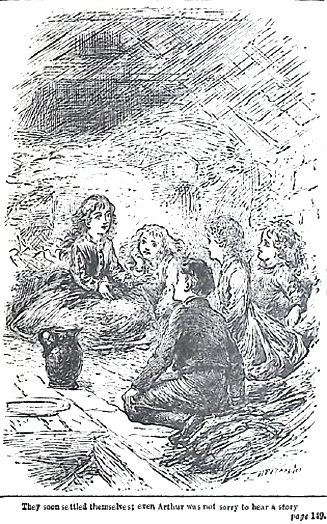
They soon settled themselves;
even Arthur was not sorry to hear a story.
They soon settled themselves; even Arthur was not sorry to hear a story, because, as he said, "he had read all their books through and through; but this was sure to be something quite fresh."
Ada's Story
"I saw in my dream a lovely valley. The mountains on either side were grand and picturesque. The rocks, ferns, and trees filled the eye with beauty and freshness. I heard the sound of splashing water, and turning round to see where it came from, I perceived a waterfall, and by the side of it a boy, stooping to drink of the clear stream.
"'This is an exquisite spot,' I said to him; and he raised his eyes and looked at me surprised.
"'Do you not like it?' I asked.
"'I do not care about it,' he said, sighing; and turning rather abruptly, he walked on.
"I noticed in my dream that he appeared not to be as straight and beautiful as I had first thought; for his back seemed misshapen, and I wondered if that was why he looked so sad.
"Just at this moment a little girl came in sight leading a baby-child. She was pulling it along roughly, and every now and then she gave it a little shake. 'What a plague you are,' she said angrily; 'I wish I could do anything else but lead you.'
"The child sobbed and moaned, and then began pushing away the hand that so rudely hurt it. 'I am tired,' it said wearily, 'and I can't get along. Why do you pull me so, sister?'
"The girl moved vexedly, and as she moved, I saw that she too seemed to have something on her shoulders under her dress.
"'What can it be?' I thought.
"A young woman now appeared, and besides the baby on her bosom, I saw she too had a burden to carry.
"A burden! Ah, that must be it! Poor things! Poor things!
"I was not near enough to ask them about it, so I still went on thinking. By-and-by two boys came up. They, were very disfigured by their burdens, and yet they seemed not to be troubled about it themselves, but were chatting gaily.
"'We will have a bath in this stream,' they said. So they cast aside their clothes; but, to my horror, I saw that each one carried his burden into the water with him—they could not take them off.
"My heart bled for them; so I drew nearer, and when they came out of the stream I said—
"'Have you no means of laying down those burdens, even for an instant?'
"They laughed carelessly. 'Burdens? Nonsense; we were born as we are, what need to change? We don't care; let us be happy while we can.' They hastened away, and I fell to musing deeply.
"Presently a lovely lady and a girl came in sight, and I noticed at once that the lady appeared to have no burden at all, while the child's was large and heavy.
"'Do not walk on the stones, my dear,' I heard the lovely lady say in a gentle voice, 'you will hurt your feet.'
"'I do not think I shall,' answered the girl, not altering her course.
"'I am sure you will, my dear,' answered her mother—for I took them to be mother and child.
"In a few moments the girl stumbled and fell; and her mother, full of tenderest pity, raised her, comforted her, and did what she could for her. But I noticed that somehow the burden always seemed in the way, and when the lady would have drawn the girl to rest on her bosom, the burden got between them, and the girl hastily pushed herself away. Then the mother went to the stream and fetched some clear water, and bathed her child's bruised foot, and by-and-by was so successful that the girl fell asleep with her head resting on a grassy mound. Then I ventured to speak.
"'You have no burden,' I said softly; 'how is it that all I see here have them?'
"She sighed deeply, and glanced at her child. 'They need not,' she said.
"'Is there a way to get rid of them, then?' I asked.
"'Certainly; did you not know?'
"'I am a stranger here.'
"'Yes, they can get rid of them,' she resumed, 'there is one way to do it.'
"'How is that?' I asked; 'and why do not all?'
"'It is very strange they do not. There is a stream not far from here; they have only to plunge in it, and the burden falls off, melts away. Only the way to it is narrow, and does not look inviting; but, oh, it is very different when you get to it!'
"'Really? And did you plunge in it?'
"'Yes, indeed. The King of this country has made it so. These burdens were fastened on at birth by His enemy, and as we grow they grow; and each year we carry them they get heavier and heavier, so that sometimes a very large burden has to be carried by a very weak person. No water that was in this land could cause these burdens to melt away; for it must be dyed with blood.'
"'With blood?' I asked.
"'Yes, with the blood of His own Son. But the King had pity; it was so sad to see the poor people living all their lives with these great burdens; and as the Son was willing to shed His life-blood, the King gave Him up.
"'So the stream I speak of is dyed with blood. Many shrink back for this very reason, and will have nothing to do with it; but when one thinks it is the only way to get rid of the burden, and that bathing in it gives an entrance to the King's palace at the end of the journey here, and that it is given to us at such a price—'
"'Of course, there is every reason to accept it; gratitude alone would be enough.'
"At this moment the girl woke. 'My foot hurts me,' she exclaimed, fretfully, 'and I cannot lie comfortably because of my burden. How I hate it!'
"'My dear,' said her mother soothingly, 'let us go to the stream; you could lose it there, if you would, in a moment.'
"The girl shook her head. 'I don't see how,' she said, 'and the stream looks so cold and dark. Let us go on our journey, mother.'
"So I saw that the mother could not put her in without her own consent; she could only lead her to it.
"When I next saw the travellers, it was in a different part of the King's country. Before me was a turning, narrow and steep, that led down to a dark water. 'This must be the blood-dyed river,' I thought.
"A voice said to me, 'You can follow them, and look.'
"This narrow way was very short, oh, very short indeed so near that no one could think the journey too hard, that the most weary feet could have no excuse. It was only one step, but still it was narrow.
"First the boy, who had drunk at the stream, got to the place, and he read, engraved on the rock at the entrance, 'Come unto me, all ye that are weary and heavy laden, and I will give you rest;' signed with the King's name. He looked at the words earnestly, then he shifted his burden upon his shoulders, and was just turning away, when he thought he would read them once more. He did so; they were very sweet, and he stepped into the narrow path and stood at the edge of the water. When there, he could not help hearing some words which a King's messenger kept on repeating over and over, 'He was wounded for our transgressions, and with His stripes we are healed.' So he plunged in, and, lo! The water which had looked so dark before seemed to be a silver stream, giving life, and health, and peace.
"Then he felt on his shoulders for the burden, and found it had melted all away.
"'I could stay here for ever!' he exclaimed joyfully.
"'Go and tell others,' said the messenger.
"The boy hastened to obey, and when he reached the valley, he soon met the girl and the child.
"'Go and bathe there,' he said, pointing; 'you will not be tired any more.'
"'Yes I shall, I expect,' said the girl; 'but come along faster, child, and let us see.'
"And she read the words; then she remembered the radiant look of the boy, and knew there must be something in it, and she turned down to the stream.
"'I want not to be tired,' said the weary little child; 'may I dip too?'
"'I suppose so,' said the girl; and with her aching heart, and her cross temper, and her heavy burden, she dipped, and came back relieved of all.
"The little child too stepped in—for it is never too deep, and never too shallow.
"'Who made the stream?' it asked.
"'The King,' answered the girl.
"'He is kind,' said the baby-child, plunging under the refreshing wave; 'I love Him!'
"My dream seemed to change here, and I could not see. When I opened my eyes again, I saw the young mother walking on, still with her babe and her burden: she had not been to the stream, alas!
"Soon the two boys came up. 'Who ever heard of such a thing?' they jeered. 'We do very well as we are!' And they passed on, and I saw them no more.
"At last I noticed the lady who had no burden come close to where I stood looking. Her daughter's was such a heavy one, she could hardly get along. She limped with her sore foot, and her burden had grown quite twice the size since I saw her last. She was pettish and cross; but she excused herself because her burden was so heavy, and made her more miserable than ever. She came near too, and read the words.
"'I am heavy laden,' she said; 'and now I have come again so close to the stream, I really must plunge in and lose my burden, for it is heavier than I can bear.'
"So she stepped into the narrow way. Her loving mother was close to her—so patient, so good! Her burden pressed hard; she heard the words of the messenger, and believed they were true; so she too plunged in. When she lifted her head from that wave of blood, her burden had slipped off for ever."
* * * * * *
Ada paused. The children were gazing on her face, for they saw her eyes were full of tears.
"Children," she said softly, "that girl was Ada Arundel. Her burden was Sin, and the blood of Jesus has taken it all away! Will you not plunge in the stream too?"
"I will!" said Netta, looking up earnestly.
"And so should I like to," said Isabel. "Can we, Ada?"
"Everyone can who has got a burden. Ah, do, dears; I wish I had sooner!"
Arthur got up from the hay, and walking straight over to Ada's side, laid his hand on her shoulder with unusual solemnity. "Ada," he said, "we will set out on the journey together. I did so hope and pray that you might as well as I, and now you have."