
Original
‘You’re a young traveller, my child,’ he said, laying his hand gently on her head. ‘Your grandchild, friend?’
‘Aye, Sir,’ cried the old man, ‘and the stay and comfort of my life.’
‘Come in,’ said the schoolmaster.
Without further preface he conducted them into his little school-room, which was parlour and kitchen likewise, and told them that they were welcome to remain under his roof till morning. Before they had done thanking him, he spread a coarse white cloth upon the table, with knives and platters; and bringing out some bread and cold meat and a jug of beer, besought them to eat and drink.
The child looked round the room as she took her seat. There were a couple of forms, notched and cut and inked all over; a small deal desk perched on four legs, at which no doubt the master sat; a few dog’s-eared books upon a high shelf; and beside them a motley collection of peg-tops, balls, kites, fishing-lines, marbles, half-eaten apples, and other confiscated property of idle urchins. Displayed on hooks upon the wall in all their terrors, were the cane and ruler; and near them, on a small shelf of its own, the dunce’s cap, made of old newspapers and decorated with glaring wafers of the largest size. But, the great ornaments of the walls were certain moral sentences fairly copied in good round text, and well-worked sums in simple addition and multiplication, evidently achieved by the same hand, which were plentifully pasted all round the room: for the double purpose, as it seemed, of bearing testimony to the excellence of the school, and kindling a worthy emulation in the bosoms of the scholars.
‘Yes,’ said the old schoolmaster, observing that her attention was caught by these latter specimens. ‘That’s beautiful writing, my dear.’
‘Very, Sir,’ replied the child modestly, ‘is it yours?’
‘Mine!’ he returned, taking out his spectacles and putting them on, to have a better view of the triumphs so dear to his heart. ‘I couldn’t write like that, now-a-days. No. They’re all done by one hand; a little hand it is, not so old as yours, but a very clever one.’
As the schoolmaster said this, he saw that a small blot of ink had been thrown on one of the copies, so he took a penknife from his pocket, and going up to the wall, carefully scraped it out. When he had finished, he walked slowly backward from the writing, admiring it as one might contemplate a beautiful picture, but with something of sadness in his voice and manner which quite touched the child, though she was unacquainted with its cause.
‘A little hand indeed,’ said the poor schoolmaster. ‘Far beyond all his companions, in his learning and his sports too, how did he ever come to be so fond of me! That I should love him is no wonder, but that he should love me—’ and there the schoolmaster stopped, and took off his spectacles to wipe them, as though they had grown dim.
‘I hope there is nothing the matter, sir,’ said Nell anxiously.
‘Not much, my dear,’ returned the schoolmaster. ‘I hoped to have seen him on the green to-night. He was always foremost among them. But he’ll be there to-morrow.’
‘Has he been ill?’ asked the child, with a child’s quick sympathy.
‘Not very. They said he was wandering in his head yesterday, dear boy, and so they said the day before. But that’s a part of that kind of disorder; it’s not a bad sign—not at all a bad sign.’
The child was silent. He walked to the door, and looked wistfully out. The shadows of night were gathering, and all was still.
‘If he could lean upon anybody’s arm, he would come to me, I know,’ he said, returning into the room. ‘He always came into the garden to say good night. But perhaps his illness has only just taken a favourable turn, and it’s too late for him to come out, for it’s very damp and there’s a heavy dew. It’s much better he shouldn’t come to-night.’
The schoolmaster lighted a candle, fastened the window-shutter, and closed the door. But after he had done this, and sat silent a little time, he took down his hat, and said he would go and satisfy himself, if Nell would sit up till he returned. The child readily complied, and he went out.
She sat there half-an-hour or more, feeling the place very strange and lonely, for she had prevailed upon the old man to go to bed, and there was nothing to be heard but the ticking of an old clock, and the whistling of the wind among the trees. When he returned, he took his seat in the chimney corner, but remained silent for a long time. At length he turned to her, and speaking very gently, hoped she would say a prayer that night for a sick child.
‘My favourite scholar!’ said the poor schoolmaster, smoking a pipe he had forgotten to light, and looking mournfully round upon the walls. ‘It is a little hand to have done all that, and waste away with sickness. It is a very, very little hand!’
CHAPTER 25
After a sound night’s rest in a chamber in the thatched roof, in which it seemed the sexton had for some years been a lodger, but which he had lately deserted for a wife and a cottage of his own, the child rose early in the morning and descended to the room where she had supped last night. As the schoolmaster had already left his bed and gone out, she bestirred herself to make it neat and comfortable, and had just finished its arrangement when the kind host returned.
He thanked her many times, and said that the old dame who usually did such offices for him had gone to nurse the little scholar whom he had told her of. The child asked how he was, and hoped he was better.
‘No,’ rejoined the schoolmaster shaking his head sorrowfully, ‘no better. They even say he is worse.’
‘I am very sorry for that, Sir,’ said the child.
The poor schoolmaster appeared to be gratified by her earnest manner, but yet rendered more uneasy by it, for he added hastily that anxious people often magnified an evil and thought it greater than it was; ‘for my part,’ he said, in his quiet, patient way, ‘I hope it’s not so. I don’t think he can be worse.’
The child asked his leave to prepare breakfast, and her grandfather coming down stairs, they all three partook of it together. While the meal was in progress, their host remarked that the old man seemed much fatigued, and evidently stood in need of rest.
‘If the journey you have before you is a long one,’ he said, ‘and don’t press you for one day, you’re very welcome to pass another night here. I should really be glad if you would, friend.’
He saw that the old man looked at Nell, uncertain whether to accept or decline his offer; and added,
‘I shall be glad to have your young companion with me for one day. If you can do a charity to a lone man, and rest yourself at the same time, do so. If you must proceed upon your journey, I wish you well through it, and will walk a little way with you before school begins.’
‘What are we to do, Nell?’ said the old man irresolutely, ‘say what we’re to do, dear.’
It required no great persuasion to induce the child to answer that they had better accept the invitation and remain. She was happy to show her gratitude to the kind schoolmaster by busying herself in the performance of such household duties as his little cottage stood in need of. When these were done, she took some needle-work from her basket, and sat herself down upon a stool beside the lattice, where the honeysuckle and woodbine entwined their tender stems, and stealing into the room filled it with their delicious breath. Her grandfather was basking in the sun outside, breathing the perfume of the flowers, and idly watching the clouds as they floated on before the light summer wind.
As the schoolmaster, after arranging the two forms in due order, took his seat behind his desk and made other preparations for school, the child was apprehensive that she might be in the way, and offered to withdraw to her little bedroom. But this he would not allow, and as he seemed pleased to have her there, she remained, busying herself with her work.
‘Have you many scholars, sir?’ she asked.
The poor schoolmaster shook his head, and said that they barely filled the two forms.
‘Are the others clever, sir?’ asked the child, glancing at the trophies on the wall.
‘Good boys,’ returned the schoolmaster, ‘good boys enough, my dear, but they’ll never do like that.’
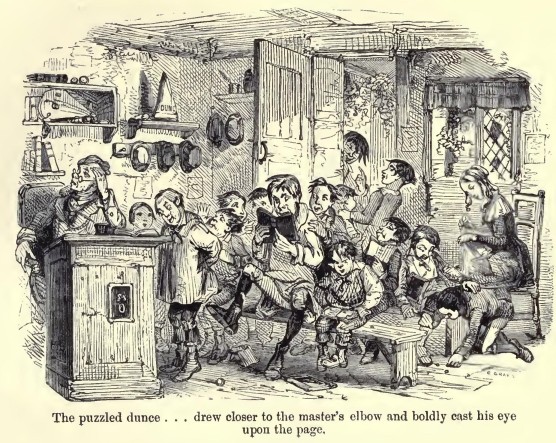
A small white-headed boy with a sunburnt face appeared at the door while he was speaking, and stopping there to make a rustic bow, came in and took his seat upon one of the forms. The white-headed boy then put an open book, astonishingly dog’s-eared upon his knees, and thrusting his hands into his pockets began counting the marbles with which they were filled; displaying in the expression of his face a remarkable capacity of totally abstracting his mind from the spelling on which his eyes were fixed. Soon afterwards another white-headed little boy came straggling in, and after him a red-headed lad, and after him two more with white heads, and then one with a flaxen poll, and so on until the forms were occupied by a dozen boys or thereabouts, with heads of every colour but grey, and ranging in their ages from four years old to fourteen years or more; for the legs of the youngest were a long way from the floor when he sat upon the form, and the eldest was a heavy good-tempered foolish fellow, about half a head taller than the schoolmaster.
At the top of the first form—the post of honour in the school—was the vacant place of the little sick scholar, and at the head of the row of pegs on which those who came in hats or caps were wont to hang them up, one was left empty. No boy attempted to violate the sanctity of seat or peg, but many a one looked from the empty spaces to the schoolmaster, and whispered his idle neighbour behind his hand.
Original
Then began the hum of conning over lessons and getting them by heart, the whispered jest and stealthy game, and all the noise and drawl of school; and in the midst of the din sat the poor schoolmaster, the very image of meekness and simplicity, vainly attempting to fix his mind upon the duties of the day, and to forget his little friend. But the tedium of his office reminded him more strongly of the willing scholar, and his thoughts were rambling from his pupils—it was plain.
None knew this better than the idlest boys, who, growing bolder with impunity, waxed louder and more daring; playing odd-or-even under the master’s eye, eating apples openly and without rebuke, pinching each other in sport or malice without the least reserve, and cutting their autographs in the very legs of his desk. The puzzled dunce, who stood beside it to say his lesson out of book, looked no longer at the ceiling for forgotten words, but drew closer to the master’s elbow and boldly cast his eye upon the page; the wag of the little troop squinted and made grimaces (at the smallest boy of course), holding no book before his face, and his approving audience knew no constraint in their delight. If the master did chance to rouse himself and seem alive to what was going on, the noise subsided for a moment and no eyes met his but wore a studious and a deeply humble look; but the instant he relapsed again, it broke out afresh, and ten times louder than before.
Oh! how some of those idle fellows longed to be outside, and how they looked at the open door and window, as if they half meditated rushing violently out, plunging into the woods, and being wild boys and savages from that time forth. What rebellious thoughts of the cool river, and some shady bathing-place beneath willow trees with branches dipping in the water, kept tempting and urging that sturdy boy, who, with his shirt-collar unbuttoned and flung back as far as it could go, sat fanning his flushed face with a spelling-book, wishing himself a whale, or a tittlebat, or a fly, or anything but a boy at school on that hot, broiling day! Heat! ask that other boy, whose seat being nearest to the door gave him opportunities of gliding out into the garden and driving his companions to madness by dipping his face into the bucket of the well and then rolling on the grass—ask him if there were ever such a day as that, when even the bees were diving deep down into the cups of flowers and stopping there, as if they had made up their minds to retire from business and be manufacturers of honey no more. The day was made for laziness, and lying on one’s back in green places, and staring at the sky till its brightness forced one to shut one’s eyes and go to sleep; and was this a time to be poring over musty books in a dark room, slighted by the very sun itself? Monstrous!
Nell sat by the window occupied with her work, but attentive still to all that passed, though sometimes rather timid of the boisterous boys. The lessons over, writing time began; and there being but one desk and that the master’s, each boy sat at it in turn and laboured at his crooked copy, while the master walked about. This was a quieter time; for he would come and look over the writer’s shoulder, and tell him mildly to observe how such a letter was turned in such a copy on the wall, praise such an up-stroke here and such a down-stroke there, and bid him take it for his model. Then he would stop and tell them what the sick child had said last night, and how he had longed to be among them once again; and such was the poor schoolmaster’s gentle and affectionate manner, that the boys seemed quite remorseful that they had worried him so much, and were absolutely quiet; eating no apples, cutting no names, inflicting no pinches, and making no grimaces, for full two minutes afterwards.
‘I think, boys,’ said the schoolmaster when the clock struck twelve, ‘that I shall give an extra half-holiday this afternoon.’
At this intelligence, the boys, led on and headed by the tall boy, raised a great shout, in the midst of which the master was seen to speak, but could not be heard. As he held up his hand, however, in token of his wish that they should be silent, they were considerate enough to leave off, as soon as the longest-winded among them were quite out of breath.
‘You must promise me first,’ said the schoolmaster, ‘that you’ll not be noisy, or at least, if you are, that you’ll go away and be so—away out of the village I mean. I’m sure you wouldn’t disturb your old playmate and companion.’
There was a general murmur (and perhaps a very sincere one, for they were but boys) in the negative; and the tall boy, perhaps as sincerely as any of them, called those about him to witness that he had only shouted in a whisper.
‘Then pray don’t forget, there’s my dear scholars,’ said the schoolmaster, ‘what I have asked you, and do it as a favour to me. Be as happy as you can, and don’t be unmindful that you are blessed with health. Good-bye all!’
‘Thank’ee, Sir,’ and ‘good-bye, Sir,’ were said a good many times in a variety of voices, and the boys went out very slowly and softly. But there was the sun shining and there were the birds singing, as the sun only shines and the birds only sing on holidays and half-holidays; there were the trees waving to all free boys to climb and nestle among their leafy branches; the hay, entreating them to come and scatter it to the pure air; the green corn, gently beckoning towards wood and stream; the smooth ground, rendered smoother still by blending lights and shadows, inviting to runs and leaps, and long walks God knows whither. It was more than boy could bear, and with a joyous whoop the whole cluster took to their heels and spread themselves about, shouting and laughing as they went.
‘It’s natural, thank Heaven!’ said the poor schoolmaster, looking after them. ‘I’m very glad they didn’t mind me!’
It is difficult, however, to please everybody, as most of us would have discovered, even without the fable which bears that moral, and in the course of the afternoon several mothers and aunts of pupils looked in to express their entire disapproval of the schoolmaster’s proceeding. A few confined themselves to hints, such as politely inquiring what red-letter day or saint’s day the almanack said it was; a few (these were the profound village politicians) argued that it was a slight to the throne and an affront to church and state, and savoured of revolutionary principles, to grant a half-holiday upon any lighter occasion than the birthday of the Monarch; but the majority expressed their displeasure on private grounds and in plain terms, arguing that to put the pupils on this short allowance of learning was nothing but an act of downright robbery and fraud: and one old lady, finding that she could not inflame or irritate the peaceable schoolmaster by talking to him, bounced out of his house and talked at him for half-an-hour outside his own window, to another old lady, saying that of course he would deduct this half-holiday from his weekly charge, or of course he would naturally expect to have an opposition started against him; there was no want of idle chaps in that neighbourhood (here the old lady raised her voice), and some chaps who were too idle even to be schoolmasters, might soon find that there were other chaps put over their heads, and so she would have them take care, and look pretty sharp about them. But all these taunts and vexations failed to elicit one word from the meek schoolmaster, who sat with the child by his side—a little more dejected perhaps, but quite silent and uncomplaining.
Towards night an old woman came tottering up the garden as speedily as she could, and meeting the schoolmaster at the door, said he was to go to Dame West’s directly, and had best run on before her. He and the child were on the point of going out together for a walk, and without relinquishing her hand, the schoolmaster hurried away, leaving the messenger to follow as she might.
They stopped at a cottage-door, and the schoolmaster knocked softly at it with his hand. It was opened without loss of time. They entered a room where a little group of women were gathered about one, older than the rest, who was crying very bitterly, and sat wringing her hands and rocking herself to and fro.
‘Oh, dame!’ said the schoolmaster, drawing near her chair, ‘is it so bad as this?’
‘He’s going fast,’ cried the old woman; ‘my grandson’s dying. It’s all along of you. You shouldn’t see him now, but for his being so earnest on it. This is what his learning has brought him to. Oh dear, dear, dear, what can I do!’
‘Do not say that I am in any fault,’ urged the gentle school-master. ‘I am not hurt, dame. No, no. You are in great distress of mind, and don’t mean what you say. I am sure you don’t.’
‘I do,’ returned the old woman. ‘I mean it all. If he hadn’t been poring over his books out of fear of you, he would have been well and merry now, I know he would.’
The schoolmaster looked round upon the other women as if to entreat some one among them to say a kind word for him, but they shook their heads, and murmured to each other that they never thought there was much good in learning, and that this convinced them. Without saying a word in reply, or giving them a look of reproach, he followed the old woman who had summoned him (and who had now rejoined them) into another room, where his infant friend, half-dressed, lay stretched upon a bed.
He was a very young boy; quite a little child. His hair still hung in curls about his face, and his eyes were very bright; but their light was of Heaven, not earth. The schoolmaster took a seat beside him, and stooping over the pillow, whispered his name. The boy sprung up, stroked his face with his hand, and threw his wasted arms round his neck, crying out that he was his dear kind friend.
‘I hope I always was. I meant to be, God knows,’ said the poor schoolmaster.
‘Who is that?’ said the boy, seeing Nell. ‘I am afraid to kiss her, lest I should make her ill. Ask her to shake hands with me.’
The sobbing child came closer up, and took the little languid hand in hers. Releasing his again after a time, the sick boy laid him gently down.
‘You remember the garden, Harry,’ whispered the schoolmaster, anxious to rouse him, for a dulness seemed gathering upon the child, ‘and how pleasant it used to be in the evening time? You must make haste to visit it again, for I think the very flowers have missed you, and are less gay than they used to be. You will come soon, my dear, very soon now—won’t you?’
The boy smiled faintly—so very, very faintly—and put his hand upon his friend’s grey head. He moved his lips too, but no voice came from them; no, not a sound.
In the silence that ensued, the hum of distant voices borne upon the evening air came floating through the open window. ‘What’s that?’ said the sick child, opening his eyes.
‘The boys at play upon the green.’
He took a handkerchief from his pillow, and tried to wave it above his head. But the feeble arm dropped powerless down.
‘Shall I do it?’ said the schoolmaster.
‘Please wave it at the window,’ was the faint reply. ‘Tie it to the lattice. Some of them may see it there. Perhaps they’ll think of me, and look this way.’
He raised his head, and glanced from the fluttering signal to his idle bat, that lay with slate and book and other boyish property upon a table in the room. And then he laid him softly down once more, and asked if the little girl were there, for he could not see her.
She stepped forward, and pressed the passive hand that lay upon the coverlet. The two old friends and companions—for such they were, though they were man and child—held each other in a long embrace, and then the little scholar turned his face towards the wall, and fell asleep.
The poor schoolmaster sat in the same place, holding the small cold hand in his, and chafing it. It was but the hand of a dead child. He felt that; and yet he chafed it still, and could not lay it down.
CHAPTER 26
Almost broken-hearted, Nell withdrew with the schoolmaster from the bedside and returned to his cottage. In the midst of her grief and tears she was yet careful to conceal their real cause from the old man, for the dead boy had been a grandchild, and left but one aged relative to mourn his premature decay.
She stole away to bed as quickly as she could, and when she was alone, gave free vent to the sorrow with which her breast was overcharged. But the sad scene she had witnessed, was not without its lesson of content and gratitude; of content with the lot which left her health and freedom; and gratitude that she was spared to the one relative and friend she loved, and to live and move in a beautiful world, when so many young creatures—as young and full of hope as she—were stricken down and gathered to their graves. How many of the mounds in that old churchyard where she had lately strayed, grew green above the graves of children! And though she thought as a child herself, and did not perhaps sufficiently consider to what a bright and happy existence those who die young are borne, and how in death they lose the pain of seeing others die around them, bearing to the tomb some strong affection of their hearts (which makes the old die many times in one long life), still she thought wisely enough, to draw a plain and easy moral from what she had seen that night, and to store it, deep in her mind.
Her dreams were of the little scholar: not coffined and covered up, but mingling with angels, and smiling happily. The sun darting his cheerful rays into the room, awoke her; and now there remained but to take leave of the poor schoolmaster and wander forth once more.
By the time they were ready to depart, school had begun. In the darkened room, the din of yesterday was going on again: a little sobered and softened down, perhaps, but only a very little, if at all. The schoolmaster rose from his desk and walked with them to the gate.
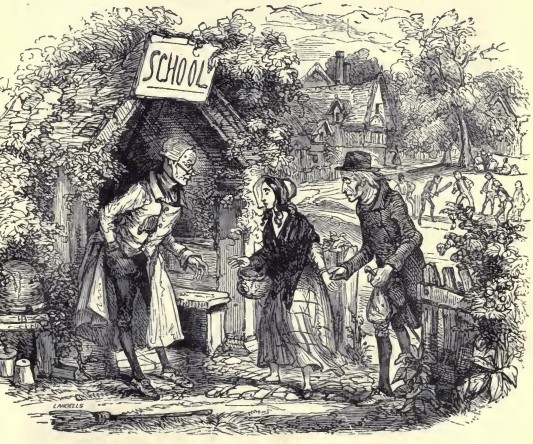
It was with a trembling and reluctant hand, that the child held out to him the money which the lady had given her at the races for her flowers: faltering in her thanks as she thought how small the sum was, and blushing as she offered it. But he bade her put it up, and stooping to kiss her cheek, turned back into his house.
They had not gone half-a-dozen paces when he was at the door again; the old man retraced his steps to shake hands, and the child did the same.
‘Good fortune and happiness go with you!’ said the poor schoolmaster. ‘I am quite a solitary man now. If you ever pass this way again, you’ll not forget the little village-school.’
‘We shall never forget it, sir,’ rejoined Nell; ‘nor ever forget to be grateful to you for your kindness to us.’
‘I have heard such words from the lips of children very often,’ said the schoolmaster, shaking his head, and smiling thoughtfully, ‘but they were soon forgotten. I had attached one young friend to me, the better friend for being young—but that’s over—God bless you!’
They bade him farewell very many times, and turned away, walking slowly and often looking back, until they could see him no more. At length they had left the village far behind, and even lost sight of the smoke among the trees. They trudged onward now, at a quicker pace, resolving to keep the main road, and go wherever it might lead them.
But main roads stretch a long, long way. With the exception of two or three inconsiderable clusters of cottages which they passed, without stopping, and one lonely road-side public-house where they had some bread and cheese, this highway had led them to nothing—late in the afternoon—and still lengthened out, far in the distance, the same dull, tedious, winding course, that they had been pursuing all day. As they had no resource, however, but to go forward, they still kept on, though at a much slower pace, being very weary and fatigued.
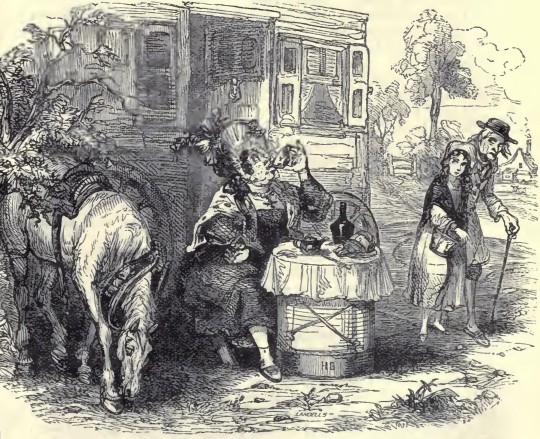
The afternoon had worn away into a beautiful evening, when they arrived at a point where the road made a sharp turn and struck across a common. On the border of this common, and close to the hedge which divided it from the cultivated fields, a caravan was drawn up to rest; upon which, by reason of its situation, they came so suddenly that they could not have avoided it if they would.
It was not a shabby, dingy, dusty cart, but a smart little house upon wheels, with white dimity curtains festooning the windows, and window-shutters of green picked out with panels of a staring red, in which happily-contrasted colours the whole concern shone brilliant. Neither was it a poor caravan drawn by a single donkey or emaciated horse, for a pair of horses in pretty good condition were released from the shafts and grazing on the frouzy grass. Neither was it a gipsy caravan, for at the open door (graced with a bright brass knocker) sat a Christian lady, stout and comfortable to look upon, who wore a large bonnet trembling with bows. And that it was not an unprovided or destitute caravan was clear from this lady’s occupation, which was the very pleasant and refreshing one of taking tea. The tea-things, including a bottle of rather suspicious character and a cold knuckle of ham, were set forth upon a drum, covered with a white napkin; and there, as if at the most convenient round-table in all the world, sat this roving lady, taking her tea and enjoying the prospect.
Original
It happened that at that moment the lady of the caravan had her cup (which, that everything about her might be of a stout and comfortable kind, was a breakfast cup) to her lips, and that having her eyes lifted to the sky in her enjoyment of the full flavour of the tea, not unmingled possibly with just the slightest dash or gleam of something out of the suspicious bottle—but this is mere speculation and not distinct matter of history—it happened that being thus agreeably engaged, she did not see the travellers when they first came up. It was not until she was in the act of getting down the cup, and drawing a long breath after the exertion of causing its contents to disappear, that the lady of the caravan beheld an old man and a young child walking slowly by, and glancing at her proceedings with eyes of modest but hungry admiration.
‘Hey!’ cried the lady of the caravan, scooping the crumbs out of her lap and swallowing the same before wiping her lips. ‘Yes, to be sure—Who won the Helter-Skelter Plate, child?’
‘Won what, ma’am?’ asked Nell.
‘The Helter-Skelter Plate at the races, child—the plate that was run for on the second day.’
‘On the second day, ma’am?’
‘Second day! Yes, second day,’ repeated the lady with an air of impatience. ‘Can’t you say who won the Helter-Skelter Plate when you’re asked the question civilly?’
‘I don’t know, ma’am.’
‘Don’t know!’ repeated the lady of the caravan; ‘why, you were there. I saw you with my own eyes.’
Nell was not a little alarmed to hear this, supposing that the lady might be intimately acquainted with the firm of Short and Codlin; but what followed tended to reassure her.
‘And very sorry I was,’ said the lady of the caravan, ‘to see you in company with a Punch; a low, practical, wulgar wretch, that people should scorn to look at.’
‘I was not there by choice,’ returned the child; ‘we didn’t know our way, and the two men were very kind to us, and let us travel with them. Do you—do you know them, ma’am?’
‘Know ‘em, child!’ cried the lady of the caravan in a sort of shriek. ‘Know them! But you’re young and inexperienced, and that’s your excuse for asking sich a question. Do I look as if I know’d ‘em, does the caravan look as if it know’d ‘em?’
‘No, ma’am, no,’ said the child, fearing she had committed some grievous fault. ‘I beg your pardon.’
It was granted immediately, though the lady still appeared much ruffled and discomposed by the degrading supposition. The child then explained that they had left the races on the first day, and were travelling to the next town on that road, where they purposed to spend the night. As the countenance of the stout lady began to clear up, she ventured to inquire how far it was. The reply—which the stout lady did not come to, until she had thoroughly explained that she went to the races on the first day in a gig, and as an expedition of pleasure, and that her presence there had no connexion with any matters of business or profit—was, that the town was eight miles off.
This discouraging information a little dashed the child, who could scarcely repress a tear as she glanced along the darkening road. Her grandfather made no complaint, but he sighed heavily as he leaned upon his staff, and vainly tried to pierce the dusty distance.
The lady of the caravan was in the act of gathering her tea equipage together preparatory to clearing the table, but noting the child’s anxious manner she hesitated and stopped. The child curtseyed, thanked her for her information, and giving her hand to the old man had already got some fifty yards or so away, when the lady of the caravan called to her to return.
‘Come nearer, nearer still,’ said she, beckoning to her to ascend the steps. ‘Are you hungry, child?’
‘Not very, but we are tired, and it’s—it is a long way.’
‘Well, hungry or not, you had better have some tea,’ rejoined her new acquaintance. ‘I suppose you are agreeable to that, old gentleman?’
The grandfather humbly pulled off his hat and thanked her. The lady of the caravan then bade him come up the steps likewise, but the drum proving an inconvenient table for two, they descended again, and sat upon the grass, where she handed down to them the tea-tray, the bread and butter, the knuckle of ham, and in short everything of which she had partaken herself, except the bottle which she had already embraced an opportunity of slipping into her pocket.
‘Set ‘em out near the hind wheels, child, that’s the best place,’ said their friend, superintending the arrangements from above. ‘Now hand up the teapot for a little more hot water, and a pinch of fresh tea, and then both of you eat and drink as much as you can, and don’t spare anything; that’s all I ask of you.’
They might perhaps have carried out the lady’s wish, if it had been less freely expressed, or even if it had not been expressed at all. But as this direction relieved them from any shadow of delicacy or uneasiness, they made a hearty meal and enjoyed it to the utmost.
While they were thus engaged, the lady of the caravan alighted on the earth, and with her hands clasped behind her, and her large bonnet trembling excessively, walked up and down in a measured tread and very stately manner, surveying the caravan from time to time with an air of calm delight, and deriving particular gratification from the red panels and the brass knocker. When she had taken this gentle exercise for some time, she sat down upon the steps and called ‘George’; whereupon a man in a carter’s frock, who had been so shrouded in a hedge up to this time as to see everything that passed without being seen himself, parted the twigs that concealed him, and appeared in a sitting attitude, supporting on his legs a baking-dish and a half-gallon stone bottle, and bearing in his right hand a knife, and in his left a fork.
‘Yes, Missus,’ said George.
‘How did you find the cold pie, George?’
‘It warn’t amiss, mum.’
‘And the beer,’ said the lady of the caravan, with an appearance of being more interested in this question than the last; ‘is it passable, George?’
‘It’s more flatterer than it might be,’ George returned, ‘but it an’t so bad for all that.’
To set the mind of his mistress at rest, he took a sip (amounting in quantity to a pint or thereabouts) from the stone bottle, and then smacked his lips, winked his eye, and nodded his head. No doubt with the same amiable desire, he immediately resumed his knife and fork, as a practical assurance that the beer had wrought no bad effect upon his appetite.
The lady of the caravan looked on approvingly for some time, and then said,
‘Have you nearly finished?’
‘Wery nigh, mum.’ And indeed, after scraping the dish all round with his knife and carrying the choice brown morsels to his mouth, and after taking such a scientific pull at the stone bottle that, by degrees almost imperceptible to the sight, his head went further and further back until he lay nearly at his full length upon the ground, this gentleman declared himself quite disengaged, and came forth from his retreat.
‘I hope I haven’t hurried you, George,’ said his mistress, who appeared to have a great sympathy with his late pursuit.
‘If you have,’ returned the follower, wisely reserving himself for any favourable contingency that might occur, ‘we must make up for it next time, that’s all.’
‘We are not a heavy load, George?’
‘That’s always what the ladies say,’ replied the man, looking a long way round, as if he were appealing to Nature in general against such monstrous propositions. ‘If you see a woman a driving, you’ll always perceive that she never will keep her whip still; the horse can’t go fast enough for her. If cattle have got their proper load, you never can persuade a woman that they’ll not bear something more. What is the cause of this here?’
‘Would these two travellers make much difference to the horses, if we took them with us?’ asked his mistress, offering no reply to the philosophical inquiry, and pointing to Nell and the old man, who were painfully preparing to resume their journey on foot.
‘They’d make a difference in course,’ said George doggedly.
‘Would they make much difference?’ repeated his mistress. ‘They can’t be very heavy.’
‘The weight o’ the pair, mum,’ said George, eyeing them with the look of a man who was calculating within half an ounce or so, ‘would be a trifle under that of Oliver Cromwell.’
Nell was very much surprised that the man should be so accurately acquainted with the weight of one whom she had read of in books as having lived considerably before their time, but speedily forgot the subject in the joy of hearing that they were to go forward in the caravan, for which she thanked its lady with unaffected earnestness. She helped with great readiness and alacrity to put away the tea-things and other matters that were lying about, and, the horses being by that time harnessed, mounted into the vehicle, followed by her delighted grandfather. Their patroness then shut the door and sat herself down by her drum at an open window; and, the steps being struck by George and stowed under the carriage, away they went, with a great noise of flapping and creaking and straining, and the bright brass knocker, which nobody ever knocked at, knocking one perpetual double knock of its own accord as they jolted heavily along.
CHAPTER 27
When they had travelled slowly forward for some short distance, Nell ventured to steal a look round the caravan and observe it more closely. One half of it—that moiety in which the comfortable proprietress was then seated—was carpeted, and so partitioned off at the further end as to accommodate a sleeping-place, constructed after the fashion of a berth on board ship, which was shaded, like the little windows, with fair white curtains, and looked comfortable enough, though by what kind of gymnastic exercise the lady of the caravan ever contrived to get into it, was an unfathomable mystery. The other half served for a kitchen, and was fitted up with a stove whose small chimney passed through the roof. It held also a closet or larder, several chests, a great pitcher of water, and a few cooking-utensils and articles of crockery. These latter necessaries hung upon the walls, which, in that portion of the establishment devoted to the lady of the caravan, were ornamented with such gayer and lighter decorations as a triangle and a couple of well-thumbed tambourines.
The lady of the caravan sat at one window in all the pride and poetry of the musical instruments, and little Nell and her grandfather sat at the other in all the humility of the kettle and saucepans, while the machine jogged on and shifted the darkening prospect very slowly. At first the two travellers spoke little, and only in whispers, but as they grew more familiar with the place they ventured to converse with greater freedom, and talked about the country through which they were passing, and the different objects that presented themselves, until the old man fell asleep; which the lady of the caravan observing, invited Nell to come and sit beside her.
‘Well, child,’ she said, ‘how do you like this way of travelling?’
Nell replied that she thought it was very pleasant indeed, to which the lady assented in the case of people who had their spirits. For herself, she said, she was troubled with a lowness in that respect which required a constant stimulant; though whether the aforesaid stimulant was derived from the suspicious bottle of which mention has been already made or from other sources, she did not say.
‘That’s the happiness of you young people,’ she continued. ‘You don’t know what it is to be low in your feelings. You always have your appetites too, and what a comfort that is.’
Nell thought that she could sometimes dispense with her own appetite very conveniently; and thought, moreover, that there was nothing either in the lady’s personal appearance or in her manner of taking tea, to lead to the conclusion that her natural relish for meat and drink had at all failed her. She silently assented, however, as in duty bound, to what the lady had said, and waited until she should speak again.
Instead of speaking, however, she sat looking at the child for a long time in silence, and then getting up, brought out from a corner a large roll of canvas about a yard in width, which she laid upon the floor and spread open with her foot until it nearly reached from one end of the caravan to the other.
‘There, child,’ she said, ‘read that.’
Nell walked down it, and read aloud, in enormous black letters, the inscription, ‘JARLEY’S WAX-WORK.’
‘Read it again,’ said the lady, complacently.
‘Jarley’s Wax-Work,’ repeated Nell.
‘That’s me,’ said the lady. ‘I am Mrs Jarley.’
Giving the child an encouraging look, intended to reassure her and let her know, that, although she stood in the presence of the original Jarley, she must not allow herself to be utterly overwhelmed and borne down, the lady of the caravan unfolded another scroll, whereon was the inscription, ‘One hundred figures the full size of life,’ and then another scroll, on which was written, ‘The only stupendous collection of real wax-work in the world,’ and then several smaller scrolls with such inscriptions as ‘Now exhibiting within’—‘The genuine and only Jarley’—‘Jarley’s unrivalled collection’—‘Jarley is the delight of the Nobility and Gentry’—‘The Royal Family are the patrons of Jarley.’ When she had exhibited these leviathans of public announcement to the astonished child, she brought forth specimens of the lesser fry in the shape of hand-bills, some of which were couched in the form of parodies on popular melodies, as ‘Believe me if all Jarley’s wax-work so rare’—‘I saw thy show in youthful prime’—‘Over the water to Jarley;’ while, to consult all tastes, others were composed with a view to the lighter and more facetious spirits, as a parody on the favourite air of ‘If I had a donkey,’ beginning,
If I know’d a donkey wot wouldn’t go
To see Mrs JARLEY’S wax-work show,
Do you think I’d acknowledge him? Oh no no!
Then run to Jarley’s—
—besides several compositions in prose, purporting to be dialogues between the Emperor of China and an oyster, or the Archbishop of Canterbury and a dissenter on the subject of church-rates, but all having the same moral, namely, that the reader must make haste to Jarley’s, and that children and servants were admitted at half-price. When she had brought all these testimonials of her important position in society to bear upon her young companion, Mrs Jarley rolled them up, and having put them carefully away, sat down again, and looked at the child in triumph.
‘Never go into the company of a filthy Punch any more,’ said Mrs Jarley, ‘after this.’
‘I never saw any wax-work, ma’am,’ said Nell. ‘Is it funnier than Punch?’
‘Funnier!’ said Mrs Jarley in a shrill voice. ‘It is not funny at all.’
‘Oh!’ said Nell, with all possible humility.
‘It isn’t funny at all,’ repeated Mrs Jarley. ‘It’s calm and—what’s that word again—critical?—no—classical, that’s it—it’s calm and classical. No low beatings and knockings about, no jokings and squeakings like your precious Punches, but always the same, with a constantly unchanging air of coldness and gentility; and so like life, that if wax-work only spoke and walked about, you’d hardly know the difference. I won’t go so far as to say, that, as it is, I’ve seen wax-work quite like life, but I’ve certainly seen some life that was exactly like wax-work.’
‘Is it here, ma’am?’ asked Nell, whose curiosity was awakened by this description.
‘Is what here, child?’
‘The wax-work, ma’am.’
‘Why, bless you, child, what are you thinking of? How could such a collection be here, where you see everything except the inside of one little cupboard and a few boxes? It’s gone on in the other wans to the assembly-rooms, and there it’ll be exhibited the day after to-morrow. You are going to the same town, and you’ll see it I dare say. It’s natural to expect that you’ll see it, and I’ve no doubt you will. I suppose you couldn’t stop away if you was to try ever so much.’
‘I shall not be in the town, I think, ma’am,’ said the child.
‘Not there!’ cried Mrs Jarley. ‘Then where will you be?’
‘I—I—don’t quite know. I am not certain.’
‘You don’t mean to say that you’re travelling about the country without knowing where you’re going to?’ said the lady of the caravan. ‘What curious people you are! What line are you in? You looked to me at the races, child, as if you were quite out of your element, and had got there by accident.’
‘We were there quite by accident,’ returned Nell, confused by this abrupt questioning. ‘We are poor people, ma’am, and are only wandering about. We have nothing to do;—I wish we had.’
‘You amaze me more and more,’ said Mrs Jarley, after remaining for some time as mute as one of her own figures. ‘Why, what do you call yourselves? Not beggars?’
‘Indeed, ma’am, I don’t know what else we are,’ returned the child.
‘Lord bless me,’ said the lady of the caravan. ‘I never heard of such a thing. Who’d have thought it!’
She remained so long silent after this exclamation, that Nell feared she felt her having been induced to bestow her protection and conversation upon one so poor, to be an outrage upon her dignity that nothing could repair. This persuasion was rather confirmed than otherwise by the tone in which she at length broke silence and said,
‘And yet you can read. And write too, I shouldn’t wonder?’
‘Yes, ma’am,’ said the child, fearful of giving new offence by the confession.
‘Well, and what a thing that is,’ returned Mrs Jarley. ‘I can’t!’
Nell said ‘indeed’ in a tone which might imply, either that she was reasonably surprised to find the genuine and only Jarley, who was the delight of the Nobility and Gentry and the peculiar pet of the Royal Family, destitute of these familiar arts; or that she presumed so great a lady could scarcely stand in need of such ordinary accomplishments. In whatever way Mrs Jarley received the response, it did not provoke her to further questioning, or tempt her into any more remarks at the time, for she relapsed into a thoughtful silence, and remained in that state so long that Nell withdrew to the other window and rejoined her grandfather, who was now awake.
At length the lady of the caravan shook off her fit of meditation, and, summoning the driver to come under the window at which she was seated, held a long conversation with him in a low tone of voice, as if she were asking his advice on an important point, and discussing the pros and cons of some very weighty matter. This conference at length concluded, she drew in her head again, and beckoned Nell to approach.
‘And the old gentleman too,’ said Mrs Jarley; ‘for I want to have a word with him. Do you want a good situation for your grand-daughter, master? If you do, I can put her in the way of getting one. What do you say?’
‘I can’t leave her,’ answered the old man. ‘We can’t separate. What would become of me without her?’
‘I should have thought you were old enough to take care of yourself, if you ever will be,’ retorted Mrs Jarley sharply.
‘But he never will be,’ said the child in an earnest whisper. ‘I fear he never will be again. Pray do not speak harshly to him. We are very thankful to you,’ she added aloud; ‘but neither of us could part from the other if all the wealth of the world were halved between us.’
Mrs Jarley was a little disconcerted by this reception of her proposal, and looked at the old man, who tenderly took Nell’s hand and detained it in his own, as if she could have very well dispensed with his company or even his earthly existence. After an awkward pause, she thrust her head out of the window again, and had another conference with the driver upon some point on which they did not seem to agree quite so readily as on their former topic of discussion; but they concluded at last, and she addressed the grandfather again.
‘If you’re really disposed to employ yourself,’ said Mrs Jarley, ‘there would be plenty for you to do in the way of helping to dust the figures, and take the checks, and so forth. What I want your grand-daughter for, is to point ‘em out to the company; they would be soon learnt, and she has a way with her that people wouldn’t think unpleasant, though she does come after me; for I’ve been always accustomed to go round with visitors myself, which I should keep on doing now, only that my spirits make a little ease absolutely necessary. It’s not a common offer, bear in mind,’ said the lady, rising into the tone and manner in which she was accustomed to address her audiences; ‘it’s Jarley’s wax-work, remember. The duty’s very light and genteel, the company particularly select, the exhibition takes place in assembly-rooms, town-halls, large rooms at inns, or auction galleries. There is none of your open-air wagrancy at Jarley’s, recollect; there is no tarpaulin and sawdust at Jarley’s, remember. Every expectation held out in the handbills is realised to the utmost, and the whole forms an effect of imposing brilliancy hitherto unrivalled in this kingdom. Remember that the price of admission is only sixpence, and that this is an opportunity which may never occur again!’
Descending from the sublime when she had reached this point, to the details of common life, Mrs Jarley remarked that with reference to salary she could pledge herself to no specific sum until she had sufficiently tested Nell’s abilities, and narrowly watched her in the performance of her duties. But board and lodging, both for her and her grandfather, she bound herself to provide, and she furthermore passed her word that the board should always be good in quality, and in quantity plentiful.
Nell and her grandfather consulted together, and while they were so engaged, Mrs Jarley with her hands behind her walked up and down the caravan, as she had walked after tea on the dull earth, with uncommon dignity and self-esteem. Nor will this appear so slight a circumstance as to be unworthy of mention, when it is remembered that the caravan was in uneasy motion all the time, and that none but a person of great natural stateliness and acquired grace could have forborne to stagger.
‘Now, child?’ cried Mrs Jarley, coming to a halt as Nell turned towards her.
‘We are very much obliged to you, ma’am,’ said Nell, ‘and thankfully accept your offer.’
‘And you’ll never be sorry for it,’ returned Mrs Jarley. ‘I’m pretty sure of that. So as that’s all settled, let us have a bit of supper.’
In the meanwhile, the caravan blundered on as if it too had been drinking strong beer and was drowsy, and came at last upon the paved streets of a town which were clear of passengers, and quiet, for it was by this time near midnight, and the townspeople were all abed. As it was too late an hour to repair to the exhibition room, they turned aside into a piece of waste ground that lay just within the old town-gate, and drew up there for the night, near to another caravan, which, notwithstanding that it bore on the lawful panel the great name of Jarley, and was employed besides in conveying from place to place the wax-work which was its country’s pride, was designated by a grovelling stamp-office as a ‘Common Stage Waggon,’ and numbered too—seven thousand odd hundred—as though its precious freight were mere flour or coals!
This ill-used machine being empty (for it had deposited its burden at the place of exhibition, and lingered here until its services were again required) was assigned to the old man as his sleeping-place for the night; and within its wooden walls, Nell made him up the best bed she could, from the materials at hand. For herself, she was to sleep in Mrs Jarley’s own travelling-carriage, as a signal mark of that lady’s favour and confidence.
She had taken leave of her grandfather and was returning to the other waggon, when she was tempted by the coolness of the night to linger for a little while in the air. The moon was shining down upon the old gateway of the town, leaving the low archway very black and dark; and with a mingled sensation of curiosity and fear, she slowly approached the gate, and stood still to look up at it, wondering to see how dark, and grim, and old, and cold, it looked.
There was an empty niche from which some old statue had fallen or been carried away hundreds of years ago, and she was thinking what strange people it must have looked down upon when it stood there, and how many hard struggles might have taken place, and how many murders might have been done, upon that silent spot, when there suddenly emerged from the black shade of the arch, a man. The instant he appeared, she recognised him—Who could have failed to recognise, in that instant, the ugly misshapen Quilp!
The street beyond was so narrow, and the shadow of the houses on one side of the way so deep, that he seemed to have risen out of the earth. But there he was. The child withdrew into a dark corner, and saw him pass close to her. He had a stick in his hand, and, when he had got clear of the shadow of the gateway, he leant upon it, looked back—directly, as it seemed, towards where she stood—and beckoned.
To her? oh no, thank God, not to her; for as she stood, in an extremity of fear, hesitating whether to scream for help, or come from her hiding-place and fly, before he should draw nearer, there issued slowly forth from the arch another figure—that of a boy—who carried on his back a trunk.
‘Faster, sirrah!’ cried Quilp, looking up at the old gateway, and showing in the moonlight like some monstrous image that had come down from its niche and was casting a backward glance at its old house, ‘faster!’