
Some families have fought, others have intrigued their way to world power; the Habsburgs married their way. Maximilian began his career with the inheritance of the Habsburgs, Austria, Styria, part of Alsace and other districts; he married—the lady’s name scarcely matters to us—the Netherlands and Burgundy. Most of Burgundy slipped from him after his first wife’s death, but the Netherlands he held. Then he tried unsuccessfully to marry Brittany. He became Emperor in succession to his father, Frederick III, in 1493, and married the duchy of Milan. Finally he married his son to the weak-minded daughter of Ferdinand and Isabella, the Ferdinand and Isabella of Columbus, who not only reigned over a freshly united Spain, and over Sardinia and the kingdom of the Two Sicilies, but by virtue of the papal gifts to Castile, over all America west of Brazil. So it was that Charles, his grandson, inherited most of the American continent and between a third and a half of what the Turks had left of Europe. The father of Charles died in 1506, and Maximilian did his best to secure his grandson’s election to the imperial throne.
Charles succeeded to the Netherlands in 1506; he became practically king of the Spanish dominions, his mother being imbecile, when his grandfather Ferdinand died in 1516; and his grandfather Maximilian dying in 1519, he was in 1520 elected Emperor at the still comparatively tender age of twenty.

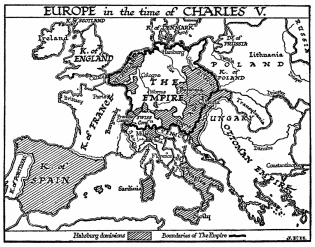
His election as Emperor was opposed by the young and brilliant French King, Francis I, who had succeeded to the French throne in 1515 at the age of twenty-one. The candidature of Francis was supported by Leo X (1513), who also requires from us the epithet brilliant. It was indeed an age of brilliant monarchs. It was the age of Baber in India (1526-1530) and Suleiman in Turkey (1520). Both Leo and Francis dreaded the concentration of so much power in the hands of one man as the election of Charles threatened. The only other monarch who seemed to matter in Europe was Henry VIII, who had become King of England in 1509 at the age of eighteen. He also offered himself as a candidate for the empire, and the imaginative English reader may amuse himself by working out the possible consequences of such an election. There was much scope for diplomacy in this triangle of kings. Charles on his way from Spain to Germany visited England and secured the support of Henry against Francis by bribing his minister, Cardinal Wolsey. Henry also made a great parade of friendship with Francis, there was feasting, tournaments, and suchlike antiquated gallantries in France, in a courtly picnic known to historians as the Field of the Cloth of Gold (1520). Knighthood was becoming a picturesque affectation in the sixteenth century. The Emperor Maximilian I is still called “the last of the knights”; by German historians.
The election of Charles was secured, it is to be noted, by a vast amount of bribery. He had as his chief supporters and creditors the great German business house of the Fuggers. That large treatment of money and credit which we call finance, which had gone out of European political life with the collapse of the Roman Empire, was now coming back to power. This appearance of the Fuggers, whose houses and palaces outshone those of the emperors, marks the upward movement of forces that had begun two or three centuries earlier in Cahors in France and in Florence and other Italian towns. Money, public debts, and social unrest and discontent, re-enter upon the miniature stage of this Outline. Charles V was not so much a Habsburg as a Fugger emperor.
For a time this fair, not very intelligent-looking young man with the thick upper lip and long, clumsy chin—features which still afflict his descendants—was largely a puppet in the hands of his ministers. Able servants after the order of Machiavelli guided him at first in the arts of kingship. Then in a slow but effectual way he began to assert himself. He was confronted at the very outset of his reign in Germany with the perplexing dissensions of Christendom. The revolt against the papal rule which had been going on since the days of Huss and Wycliffe had been recently exasperated by a new and unusually cynical selling of indulgences to raise money for the completion of St. Peter’s at Rome. A monk named Luther, who had been consecrated as a priest, who had taken to reading the Bible, and who, while visiting Rome on the business of his order, had been much shocked by the levity and worldly splendour of the Papacy, had come forward against these papal expedients at Wittenberg (1517), offering disputation and propounding certain theses. An important controversy ensued. At first Luther carried on this controversy in Latin, but presently took to German, and speedily had the people in a ferment. Charles found this dispute raging when he came from Spain to Germany. He summoned an assembly or “diet” of the empire at Worms on the Rhine. To this, Luther, who had been asked to recant his views by Pope Leo X, and who had refused to do so, was summoned. He came, and, entirely in the spirit of Huss, refused to recant unless he was convinced of his error by logical argument or the authority of Scripture. But his protectors among the princes were too powerful for him to suffer the fate of John Huss.
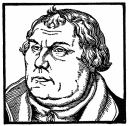
Luther
(after Cranach)
Here was a perplexing situation for the young Emperor. There is reason to suppose that he was inclined at first to support Luther against the Pope. Leo X had opposed the election of Charles, and was friendly with his rival, Francis I. But Charles V was not a good Machiavellian, and he had acquired in Spain a considerable religious sincerity. He decided against Luther. Many of the German princes, and especially the Elector of Saxony, sided with the reformer. Luther went into hiding under the protection of the Saxon Elector, and Charles found himself in the presence of the opening rift that was to split Christendom into two contending camps.
Close upon these disturbances, and probably connected with them, came a widespread peasants’ revolt throughout Germany. This outbreak frightened Luther very effectually. He was shocked by its excesses, and from that time forth the Reformation he advocated ceased to be a Reformation according to the people and became a Reformation according to the princes. He lost his confidence in that free judgment for which he had stood up so manfully.
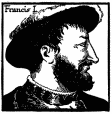
Francis I
Meanwhile Charles realized that his great empire was in very serious danger both from the west and from the east. On the west of him was his spirited rival, Francis I; to the east was the Turk in Hungary, in alliance with Francis and clamouring for certain arrears of tribute from the Austrian dominions. Charles had the money and army of Spain at his disposal, but it was extremely difficult to get any effective support in money from Germany. His grandfather had developed a German infantry on the Swiss model, very much upon the lines expounded in Machiavelli’s Art of War, but these troops had to be paid and his imperial subsidies had to be supplemented by unsecured borrowings, which were finally to bring his supporters, the Fuggers, to ruin.
On the whole, Charles, in alliance with Henry VIII, was successful against Francis I and the Turk. Their chief battlefield was north Italy; the generalship was dull on both sides; their advances and retreats depended chiefly on the arrival of reinforcements. The German army invaded France, failed to take Marseilles, fell back into Italy, lost Milan, and was besieged in Pavia. Francis I made a long and unsuccessful siege of Pavia, was caught by fresh German forces, defeated, wounded, and taken prisoner. He sent back a message to his queen that all was “lost but honour,” made a humiliating peace, and broke it as soon as he was liberated so that even the salvage of honour was but temporary. Henry VIII and the Pope, in obedience to the rules of Machiavellian strategy, now went over to the side of France in order to prevent Charles becoming too powerful. The German troops in Milan, under the Constable of Bourbon, being unpaid, forced rather than followed their commander into a raid upon Rome. They stormed the city and pillaged it (1527). The Pope took refuge in the Castle of St. Angelo while the looting and slaughter went on. He bought off the German troops at last by the payment of four hundred thousand ducats. Ten years of such stupid and confused fighting impoverished all Europe and left the Emperor in possession of Milan. In 1530 he was crowned by the Pope—he was the last German Emperor to be crowned by the Pope—at Bologna. One thinks of the rather dull-looking blonde face, with its long lip and chin, bearing the solemn expression of one who endures a doubtful though probably honourable ceremony.
Meanwhile the Turks were making great headway in Hungary. They had defeated and killed the King of Hungary in 1526, they held Buda-Pesth, and in 1529, as we have already noted, Suleiman the Magnificent very nearly took Vienna. The Emperor was greatly concerned by these advances, and did his utmost to drive back the Turks, but he found the greatest difficulty in getting the German princes to unite, even with this formidable enemy upon their very borders. Francis I remained implacable for a time, and there was a new French war; but in 1538 Charles won his rival over to a more friendly attitude by ravaging the south of France. Francis and Charles then formed an alliance against the Turk, but the Protestant princes, the German princes who were resolved to break away from Rome, had formed a league, the Schmalkaldic League (named after the little town of Schmalkalden in Hesse, at which its constitution was arranged), against the Emperor, and in the place of a great campaign to recover Hungary for Christendom Charles had to turn his mind to the gathering internal struggle in Germany. Of that struggle he saw only the opening war. It was a struggle, a sanguinary irrational bickering of princes for ascendancy, now flaming into war and destruction, now sinking back to intrigues and diplomacies; it was a snake’s sack of Machiavellian policies, that was to go on writhing incurably right into the nineteenth century, and to waste and desolate Central Europe again and again.
The Emperor never seems to have grasped the true forces at work in these gathering troubles. He was for his time and station an exceptionally worthy man, and he seems to have taken the religious dissensions that were tearing Europe into warring fragments as genuine theological differences. He gathered diets and councils in futile attempts at reconciliation. Formulæ and confessions were tried over. The student of German history must struggle with the details of the Religious Peace of Nuremberg, the settlement at the diet of Ratisbon, the Interim of Augsburg, and the like. Here we do but mention them as details in the worried life of this culminating emperor. As a matter of fact, hardly one of the multifarious princes and rulers in Europe seems to have been acting in good faith. The widespread religious trouble of the world, the desire of the common people for truth and social righteousness, the spreading knowledge of the time, all those things were merely counters in the imaginations of princely diplomacy. Henry VIII of England, who had begun his career with a book written against heresy, and who had been rewarded by the Pope with the title of “Defender of the Faith,” being anxious to divorce his first wife in favour of an animated young lady named Anne Boleyn,[401] and wishing also to turn against the Emperor in favour of Francis I and to loot the vast wealth of the church in England, joined the company of Protestant princes in 1530. Sweden, Denmark, and Norway had already gone over to the Protestant side.
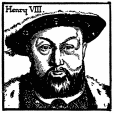
Henry VIII.
The German religious war began in 1546, a few months after the death of Martin Luther. We need not trouble about the incidents of the campaign. The Protestant Saxon army was badly beaten at Lochau. By something very like a breach of faith Philip of Hesse, the Emperor’s chief remaining antagonist, was caught and imprisoned, and the Turks were bought off by the payment of an annual tribute. In 1547, to the great relief of the Emperor, Francis I died. So by 1547 Charles got to a kind of settlement, and made his last efforts to effect peace where there was no peace. In 1552 all Germany was at war again, only a precipitate flight from Innsbruck saved Charles from capture, and in 1552, with the treaty of Passau, came another unstable equilibrium. Charles was now utterly weary of the cares and splendours of empire; he had never had a very sound constitution, he was naturally indolent, and he was suffering greatly from gout. He abdicated. He made over all his sovereign rights in Germany to his brother Ferdinand, and Spain and the Netherlands he resigned to his son Philip. He then retired to a monastery at Yuste, among the oak and chestnut forests in the hills to the north of the Tagus valley, and there he died in 1558.
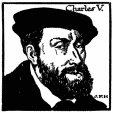
Charles V.
Much has been written in a sentimental vein of this retirement, this renunciation of the world by this tired majestic Titan, world-weary, seeking in an austere solitude his peace with God. But his retreat was neither solitary nor austere; he had with him nearly a hundred and fifty attendants; his establishment had all the indulgences without the fatigues of a court, and Philip II was a dutiful son to whom his father’s advice was a command. As for his austerities, let Prescott witness: “In the almost daily correspondence between Quixada, or Gaztelu, and the Secretary of State at Valladolid, there is scarcely a letter that does not turn more or less on the Emperor’s eating or his illness. The one seems naturally to follow, like a running commentary, on the other. It is rare that such topics have formed the burden of communications with the department of state. It must have been no easy matter for the secretary to preserve his gravity in the perusal of despatches in which politics and gastronomy were so strangely mixed together. The courier from Valladolid to Lisbon was ordered to make a detour, so as to take Jarandilla in his route, and bring supplies for the royal table. On Thursdays he was to bring fish to serve for the jour maigre that was to follow. The trout in the neighbourhood Charles thought too small; so others, of a larger size, were to be sent from Valladolid. Fish of every kind was to his taste, as, indeed, was anything that in its nature or habits at all approached to fish. Eels, frogs, oysters, occupied an important place in the royal bill of fare. Potted fish, especially anchovies, found great favour with him; and he regretted that he had not brought a better supply of these from the Low Countries. On an eel-pasty he particularly doted.”...[402]
In 1554 Charles had obtained a bull from Pope Julius III granting him a dispensation from fasting, and allowing him to break his fast early in the morning even when he was to take the sacrament.
“That Charles was not altogether unmindful of his wearing apparel in Yuste, may be inferred from the fact that his wardrobe contained no less than sixteen robes of silk and velvet, lined with ermine, or eider down, or the soft hair of the Barbary goat. As to the furniture and upholstery of his apartments, how little reliance is to be placed on the reports so carelessly circulated about these may be gathered from a single glance at the inventory of his effects, prepared by Quixada and Gaztelu soon after their master’s death. Among the items we find carpets from Turkey and Alcarez, canopies of velvet and other stuffs, hangings of fine black cloth, which since his mother’s death he had always chosen for his own bedroom; while the remaining apartments were provided with no less than twenty-five suits of tapestry, from the looms of Flanders, richly embroidered with figures of animals and with landscapes.... Among the different pieces of plate we find some of pure gold, and others especially noted for their curious workmanship; and as this was an age in which the art of working the precious metals was carried to the highest perfection, we cannot doubt that some of the finest specimens had come into the Emperor’s possession. The whole amount of plate was estimated at between twelve and thirteen thousand ounces in weight.”...[403]
Charles had never acquired the habit of reading, but he would be read aloud to at meals after the fashion of Charlemagne, and would make what one narrator describes as a “sweet and heavenly commentary.” He also amused himself with technical toys, by listening to music or sermons, and by attending to the imperial business that still came drifting in to him. The death of the Empress, to whom he was greatly attached, had turned his mind towards religion, which in his case took a punctilious and ceremonial form; every Friday in Lent he scourged himself with the rest of the monks with such good will as to draw blood. These exercises and the gout released a bigotry in Charles that had been hitherto restrained by considerations of policy. The appearance of Protestant teaching close at hand in Valladolid roused him to fury. “Tell the grand inquisitor and his council from me to be at their posts, and to lay the axe at the root of the evil before it spreads further.”... He expressed a doubt whether it would not be well, in so black an affair, to dispense with the ordinary course of justice, and to show no mercy; “lest the criminal, if pardoned, should have the opportunity of repeating his crime.” He recommended, as an example, his own mode of proceeding in the Netherlands, “where all who remained obstinate in their errors were burned alive, and those who were admitted to penitence were beheaded.”
Among the chief pleasures of the Catholic monarch between meals during this time of retirement were funeral services. He not only attended every actual funeral that was celebrated at Yuste, but he had services conducted for the absent dead, he held a funeral service in memory of his wife on the anniversary of her death, and finally he celebrated his own obsequies. “The chapel was hung with black, and the blaze of hundreds of wax-lights was scarcely sufficient to dispel the darkness. The brethren in their conventual dress, and all the Emperor’s household clad in deep mourning, gathered round a huge catafalque, shrouded also in black, which had been raised in the centre of the chapel. The service for the burial of the dead was then performed; and, amidst the dismal wail of the monks, the prayers ascended for the departed spirit, that it might be received into the mansions of the blessed. The sorrowful attendants were melted to tears, as the image of their master’s death was presented to their minds—or they were touched, it may be, with compassion by this pitiable display of weakness. Charles, muffled in a dark mantle, and bearing a lighted candle in his hand, mingled with his household, the spectator of his own obsequies; and the doleful ceremony was concluded by his placing the taper in the hands of the priest, in sign of his surrendering up his soul to the Almighty.”
Other accounts make Charles wear a shroud and lie in the coffin, remaining there alone until the last mourner had left the chapel.
Within two months of this masquerade he was dead. And the greatness of the Holy Roman Empire died with him. The Holy Roman Empire struggled on indeed to the days of Napoleon, but as an invalid and dying thing.
§ 11B
Ferdinand, the brother of Charles V, took over his abandoned work and met the German princes at the diet of Augsburg in 1555. Again there was an attempt to establish a religious peace. Nothing could better show the quality of that attempted settlement and the blindness of the princes and statesmen concerned in it, to the deeper and broader processes of the time, than the form that settlement took. The recognition of religious freedom was to apply to the states and not to individual citizens; cujus regio ejus religio, “the confession of the subject was to be dependent on that of the territorial lord.”
§ 11C
We have given as much attention as we have done to the writings of Machiavelli and to the personality of Charles V because they throw a flood of light upon the antagonisms of the next period in our history. This present chapter has told the story of a vast expansion of human horizons and of a great increase and distribution of knowledge; we have seen the conscience of common men awakening and intimations of a new and profounder social justice spreading throughout the general body of the Western civilization. But this process of light and thought was leaving courts and the political life of the world untouched. There is little in Machiavelli that might not have been written by some clever secretary in the court of Chosroes I or Shi-Hwang-ti—or even of Sargon I or Pepi. While the world in everything else was moving forward, in political ideas, in ideas about the relationship of state to state and of sovereign to citizen, it was standing still. Nay, it was falling back. For the great idea of the Catholic Church as the world city of God had been destroyed in men’s minds by the church itself, and the dream of a world imperialism had, in the person of Charles V, been carried in effigy through Europe to limbo. Politically the world seemed falling back towards personal monarchy of the Assyrian or Macedonian pattern.
It is not that the newly awakened intellectual energies of western European men were too absorbed in theological restatement, in scientific investigations, in exploration and mercantile development, to give a thought to the claims and responsibilities of rulers. Not only were common men drawing ideas of a theocratic or republican or communistic character from the now accessible Bible, but the renewed study of the Greek classics was bringing the creative and fertilizing spirit of Plato to bear upon the Western mind. In England Sir Thomas More produced a quaint imitation of Plato’s Republic in his Utopia, setting out a sort of autocratic communism. In Naples, a century later, a certain friar Campanella was equally bold in his City of the Sun. But such discussions were having no immediate effect upon political arrangements. Compared with the massiveness of the task, these books do indeed seem poetical and scholarly and flimsy. (Yet later on the Utopia was to bear fruit in the English Poor Laws.) The intellectual and moral development of the Western mind and this drift towards Machiavellian monarchy in Europe were for a time going on concurrently in the same world, but they were going on almost independently. The statesmen still schemed and manœuvred as if nothing grew but the power of wary and fortunate kings. It was only in the seventeenth and eighteenth centuries that these two streams of tendency, the stream of general ideas and the drift of traditional and egoistic monarchical diplomacy, interfered and came into conflict.
BOOK VIII
THE AGE OF THE GREAT POWERS
XXXVI
PRINCES, PARLIAMENTS, AND POWERS
§ 1. Princes and Foreign Policy. § 2. The English Republic. § 3. The Dutch Republic. § 4. The Break-up and Disorder of Germany. § 5. The Splendours of Grand Monarchy in Europe. § 6. The Growth of the Idea of Great Powers. § 7. The Crowned Republic of Poland and Its Fate. § 8. The First Scramble for Empire Overseas. § 9. Britain Dominates India. § 10. Russia’s Ride to the Pacific. §11. What Gibbon Thought of the World in 1780. § 12. The Social Truce Draws to an End.
§ 1
IN the preceding chapter we have traced the beginnings of a new civilization, the civilization of the “modern” type which becomes at the present time world-wide. It is still a vast unformed thing, still only in the opening phases of growth and development to-day. We have seen the mediæval ideas of the Holy Roman Empire and of the Roman Church, as forms of universal law and order, fade in its dawn. They fade out, as if it were necessary in order that these ideas of one law and one order for all men should be redrawn on world-wide lines. And while in nearly every other field of human interest there was advance, the effacement of these general political ideas of the Church and Empire led back for a time in things political towards merely personal monarchy and monarchist nationalism of the Macedonian type. There came an interregnum, as it were, in the consolidation of human affairs, a phase of the type the Chinese annalists would call an “Age of Confusion.” This interregnum has lasted as long as that between the fall of the Western Empire and the crowning of Charlemagne in Rome. We are living in it to-day. It may be drawing to its close; we cannot tell yet. The old leading ideas had broken down, a medley of new and untried projects and suggestions perplexed men’s minds and actions, and meanwhile the world at large had to fall back for leadership upon the ancient tradition of an individual prince. There was no new way clearly apparent for men to follow, and the prince was there.
All over the world the close of the sixteenth century saw monarchy prevailing and tending towards absolutism. Germany and Italy were patchworks of autocratic princely dominions, Spain was practically autocratic, the throne had never been so powerful in England, and as the seventeenth century drew on, the French monarchy gradually became the greatest and most consolidated power in Europe. The phases and fluctuations of its ascent we cannot record here.
At every court there were groups of ministers and secretaries who played a Machiavellian game against their foreign rivals. Foreign policy is the natural employment of courts and monarchies. Foreign offices are, so to speak, the leading characters in all the histories of the seventeenth and eighteenth centuries. They kept Europe in a fever of wars. And wars were becoming expensive. Armies were no longer untrained levies, no longer assemblies of feudal knights who brought their own horses and weapons and retainers with them; they needed more and more artillery; they consisted of paid troops who insisted on their pay; they were professional and slow and elaborate, conducting long sieges, necessitating elaborate fortifications. War expenditure increased everywhere and called for more and more taxation. And here it was that these monarchies of the sixteenth and seventeenth centuries came into conflict with new and shapeless forces of freedom in the community. In practice the princes found they were not masters of their subjects’ lives or property. They found an inconvenient resistance to the taxation that was necessary if their diplomatic aggressions and alliances were to continue. Finance became an unpleasant spectre in every council chamber. In theory the monarch owned his country. James I of England (1603) declared that “As it is atheism and blasphemy to dispute what God can do; so it is presumption and high contempt in a subject to dispute what a king can do, or say that a king cannot do this or that.” In practice, however, he found, and his son Charles I (1625) was to find still more effectually, that there were in his dominions a great number of landlords and merchants, substantial and intelligent persons, who set a very definite limit to the calls and occasions of the monarch and his ministers. They were prepared to tolerate his rule if they themselves might also be monarchs of their lands and businesses and trades and what not. But not otherwise.
Everywhere in Europe there was a parallel development. Beneath the kings and princes there were these lesser monarchs, the private owners, noblemen, wealthy citizens, and the like, who were now offering the sovereign prince much the same resistance that the kings and princes of Germany had offered the Emperor. They wanted to limit taxation so far as it pressed upon themselves, and to be free in their own houses and estates. And the spread of books and reading and inter-communication was enabling these smaller monarchs, these monarchs of ownership, to develop such a community of ideas and such a solidarity of resistance as had been possible at no previous stage in the world’s history. Everywhere they were disposed to resist the prince, but it was not everywhere that they found the same faculties for an organized resistance. The economic circumstances and the political traditions of the Netherlands and England made those countries the first to bring this antagonism of monarchy and private ownership to an issue.[404]
At first this seventeenth-century “public,” this public of property owners, cared very little for foreign policy. They did not perceive at first how it affected them. They did not want to be bothered with it; it was, they conceded, the affairs of kings and princes.[405] They made no attempts therefore to control foreign entanglements. But it was with the direct consequences of these entanglements that they quarrelled; they objected to heavy taxation, to interference with trade, to arbitrary imprisonment, and to the control of consciences by the monarch. It was upon these questions that they joined issue with the Crown.
§ 2
The open struggle of the private property owner against the aggressions of the “Prince” begins in England far back in the twelfth century.[406] The phase in this struggle that we have to study now is the phase that opened with the attempts of Henry VII and VIII and their successors, Edward VI, Mary and Elizabeth, to make the government of England a “personal monarchy” of the continental type. It became more acute when, by dynastic accidents, James, King of Scotland, became James I, King of both Scotland and England (1603), and began to talk in the manner we have already quoted of his “divine right” to do as he pleased. But never had the path of English monarchy been a smooth one. In all the monarchies of the Northmen and Germanic invaders of the empire there had been a tradition of a popular assembly of influential and representative men to preserve their general liberties, and in none was it more living than in England. France had her tradition of the assembly of the Three Estates, Spain her Cortes, but the English assembly was peculiar in two respects: that it had behind it a documentary declaration of certain elementary and universal rights, and that it contained elected “Knights of the Shire,” as well as elected burghers from the towns. The French and Spanish assemblies had the latter, but not the former element.
These two features gave the English Parliament a peculiar strength in its struggle with the Throne. The document in question was Magna Carta, the Great Charter, a declaration which was forced from King John (1199-1216), the brother and successor of Richard Cœur de Lion (1189-99) after a revolt of the Barons in 1215. It rehearsed a number of fundamental rights that made England a legal and not a regal state. It rejected the power of the king to control the personal property and liberty of every sort of citizen—save with the consent of that man’s equals.
The presence of the elected shire representatives in the English Parliament, the second peculiarity of the British situation, came about from very simple and apparently innocuous beginnings. From the shires, or county divisions, knights seem to have been summoned to the national council to testify to the taxable capacity of their districts. They were sent up by the minor gentry, freeholders and village elders of their districts as early as 1254, two knights from each shire. This idea inspired Simon de Montfort,[407] who was in rebellion against Henry III, the successor of John, to summon to the national council two knights from each shire and two citizens from each city or borough. Edward I, the successor to Henry III, continued this practice because it seemed a convenient way of getting into financial touch with the growing towns. At first there was considerable reluctance on the parts of the knights and townsmen to attend Parliament, but gradually the power they possessed of linking the redress of grievances with the granting of subsidies was realized. Quite early, if not from the first, these representatives of the general property owners in town and country, the Commons, sat and debated apart from the great Lords and Bishops. So there grew up in England a representative assembly, the Commons, beside an episcopal and patrician one, the Lords. There was no profound and fundamental difference between the personnel of the two assemblies; many of the knights of the shire were substantial men who might be as wealthy and influential as peers and also the sons and brothers of peers, but on the whole the Commons was the more plebeian assembly. From the first these two assemblies, and especially the Commons, displayed a disposition to claim the entire power of taxation in the land. Gradually they extended their purview of grievances to a criticism of all the affairs of the realm. We will not follow the fluctuations of the power and prestige of the English Parliament through the time of the Tudor monarchs (i.e., Henry VII and VIII, Edward VI, Mary, and Elizabeth), but it will be manifest from what has been said that when at last James Stuart made his open claim to autocracy, the English merchants, peers, and private gentlemen found themselves with a tried and honoured traditional means of resisting him such as no other people in Europe possessed.
Another peculiarity of the English political conflict was its comparative detachment from the great struggle between Catholic and Protestant that was now being waged all over Europe. There were, it is true, very distinct religious issues mixed up in the English struggle, but upon its main lines it was a political struggle of King against the Parliament embodying the class of private-property-owning citizens. Both Crown and people were formally reformed and Protestant. It is true that many people on the latter side were Protestants of a Bible-respecting, non-sacerdotal type, representing the reformation according to the peoples, and that the king was the nominal head of a special sacerdotal and sacramental church, the established Church of England, representing the reformation according to the princes, but this antagonism never completely obscured the essentials of the conflict.
The struggle of King and Parliament had already reached an acute phase before the death of James I (1625), but only in the reign of his son Charles I did it culminate in civil war. Charles did exactly what one might have expected a king to do in such a position, in view of the lack of Parliamentary control over foreign policy; he embroiled the country in a conflict with both Spain and France, and then came to the country for supplies in the hope that patriotic feeling would override the normal dislike to giving him money. When Parliament refused supplies, he demanded loans from various subjects, and attempted similar illegal exactions. This produced from Parliament in 1628 a very memorable document, the Petition of Right, citing the Great Charter and rehearsing the legal limitations upon the power of the English king, denying his right to levy charges upon, or to imprison, or punish anyone, or to quarter soldiers on the people, without due process of law. The Petition of Right stated the case of the English Parliament. The disposition to “state a case” has always been a very marked English characteristic. When President Wilson, during the Great War of 1914-18, prefaced each step in his policy by a “Note,” he was walking in the most respectable traditions of the English. Charles dealt with this Parliament with a high hand, he dismissed it in 1629, and for eleven years he summoned no Parliament. He levied money illegally, but not enough for his purpose; and realizing that the church could be used as an instrument of obedience, he made Laud, an aggressive high churchman, very much of a priest and a very strong believer in “divine right,” Archbishop of Canterbury, and so head of the Church of England.
In 1638 Charles tried to extend the half-Protestant, half-Catholic characteristics of the Church of England to his other kingdom of Scotland, where the secession from catholicism had been more complete, and where a non-sacerdotal, non-sacramental form of Christianity, Presbyterianism, had been established as the national church. The Scotch revolted, and the English levies Charles raised to fight them mutinied. Insolvency, at all tunes the natural result of a “spirited” foreign policy, was close at hand. Charles, without money or trustworthy troops, had to summon a Parliament at last in 1640. This Parliament, the Short Parliament, he dismissed in the same year; he tried a Council of Peers at York (1640), and then, in the November of that year, summoned his last Parliament.
This body, the Long Parliament, assembled in the mood for conflict. It seized Laud, the Archbishop of Canterbury, and charged him with treason. It published a “Grand Remonstrance,” which was a long and full statement of its case against Charles. It provided by a bill for a meeting of Parliament at least once in three years, whether the King summoned it or no. It prosecuted the King’s chief ministers who had helped him to reign for so long without Parliament, and in particular the Earl of Strafford. To save Strafford the King plotted for a sudden seizure of London by the army. This was discovered, and the Bill for Strafford’s condemnation was hurried on in the midst of a vast popular excitement. Charles I, who was probably one of the meanest and most treacherous occupants the English throne has ever known, was frightened by the London crowds. Before Strafford could die by due legal process, it was necessary for the King to give his assent. Charles gave it—and Strafford was beheaded. Meanwhile the King was plotting and looking for help in strange quarters—from the Catholic Irish, from treasonable Scotchmen. Finally he resorted to a forcible-feeble display of violence. He went down to the Houses of Parliament to arrest five of his most active opponents. He entered the House of Commons and took the Speaker’s chair. He was prepared with some bold speech about treason, but when he saw the places of his five antagonists vacant, he was baffled, confused, and spoke in broken sentences. He learnt that they had departed from his royal city of Westminster and taken refuge in the city of London (see chap. xxv, § 7). London defied him. A week later the Five Members were escorted back in triumph to the Parliament House in Westminster by the Trained Bands of London, and the King, to avoid the noise and hostility of the occasion, left Whitehall for Windsor.
Both parties then prepared openly for war.
The King was the traditional head of the army, and the habit of obedience in soldiers is to the King. The Parliament had the greater resources. The King set up his standard at Nottingham on the eve of a dark and stormy August day in 1642. There followed a long and obstinate civil war, the King holding Oxford, the Parliament, London. Success swayed from side to side but the King could never close on London nor Parliament take Oxford. Each antagonist was weakened by moderate adherents who “did not want to go too far.” There emerged among the Parliamentary commanders a certain Oliver Cromwell, who had raised a small troop of horse and who rose to the position of general. Lord Warwick, his contemporary, describes him as a plain man, in a cloth suit “made by an ill country tailor.” He was no mere fighting soldier, but a military organizer; he realized the inferior quality of many of the Parliamentary forces, and set himself to remedy it. The Cavaliers of the King had the picturesque tradition of chivalry and loyalty on their side; Parliament was something new and difficult—without any comparable traditions. “Your troops are most of them old decayed serving men and tapsters,” said Cromwell. “Do you think that the spirits of such base and mean fellows will ever be able to encounter gentlemen that have honour and courage and resolution in them?” But there is something better and stronger than picturesque chivalry in the world, religious enthusiasm. He set himself to get together a “godly” regiment. They were to be earnest, sober-living men. Above all, they were to be men of strong convictions. He disregarded all social traditions, and drew his officers from every class. “I had rather have a plain, russet-coated captain that knows what he fights for and loves what he knows, than what you call a gentleman and is nothing else.” England discovered a new force, the Ironsides, in its midst, in which footmen, draymen, and ships’ captains held high command, side by side with men of family. They became the type on which the Parliament sought to reconstruct its entire army. The Ironsides were the backbone of this “New Model.” From Marston Moor to Naseby these men swept the Cavaliers before them. The King was at last a captive in the hands of Parliament.
There were still attempts at settlement that would have left the King a sort of king, but Charles was a man doomed to tragic issues, incessantly scheming, “so false a man that he is not to be trusted.” The English were drifting towards a situation new in the world’s history, in which a monarch should be formally tried for treason to his people and condemned.
Most revolutions are precipitated, as this English one was, by the excesses of the ruler, and by attempts at strength and firmness beyond the compass of the law; and most revolutions swing by a kind of necessity towards an extremer conclusion than is warranted by the original quarrel. The English revolution was no exception. The English are by nature a compromising and even a vacillating people, and probably the great majority of them still wanted the King to be King and the people to be free, and all the lions and lambs to lie down together in peace and liberty. But the army of the New Model could not go back. There would have been scant mercy for these draymen and footmen who had ridden down the King’s gentlemen if the King came back. When Parliament began to treat again with this regal trickster, the New Model intervened; Colonel Pride turned out eighty members from the House of Commons who favoured the King, and the illegal residue, the Rump Parliament, then put the King on trial.
But indeed the King was already doomed. The House of Lords rejected the ordinance for the trial, and the Rump then proclaimed “that the People are under God, the original of all just power,” and that “the Commons of England ... have the supreme power in this nation,” and—assuming that it was itself the Commons—proceeded with the trial. The King was condemned as a “tyrant, traitor, murderer, and enemy of his country.” He was taken one January morning in 1649 to a scaffold erected outside the windows of his own banqueting-room at Whitehall. There he was beheaded. He died with piety and a certain noble self-pity—eight years after the execution of Strafford, and after six and a half years of a destructive civil war which had been caused almost entirely by his own lawlessness.
This was indeed a great and terrifying thing that Parliament had done. The like of it had never been heard of in the world before. Kings had killed each other times enough; parricide, fratricide, assassination, those are the privileged expedients of princes; but that a section of the people should rise up, try its king solemnly and deliberately for disloyalty, mischief, and treachery, and condemn and kill him, sent horror through every court in Europe. The Rump Parliament had gone beyond the ideas and conscience of its time. It was as if a committee of jungle deer had taken and killed a tiger—a crime against nature. The Tsar of Russia chased the English envoy from his court. France and Holland committed acts of open hostility. England, confused and conscience-stricken at her own sacrilege, stood isolated before the world.
But for a time the personal quality of Oliver Cromwell and the discipline and strength of the army he had created maintained England in the republican course she had taken. The Irish Catholics had made a massacre of the Protestant English in Ireland, and now Cromwell suppressed the Irish insurrection with great vigour. Except for certain friars at the storm of Drogheda, none but men with arms in their hands were killed by his troops; but the atrocities of the massacre were fresh in his mind, no quarter was given in battle, and so his memory still rankles in the minds of the Irish, who have a long memory for their own wrongs. After Ireland came Scotland, where Cromwell shattered a Royalist army at the Battle of Dunbar (1650). Then he turned his attention to Holland, which country had rashly seized upon the divisions among the English as an excuse for the injury of a trade rival. The Dutch were then the rulers of the sea, and the English fleet fought against odds; but after a series of obstinate sea fights the Dutch were driven from the British seas and the English took their place as the ascendant naval power. Dutch and French ships must dip their flags to them. An English fleet went into the Mediterranean—the first English naval force to enter those waters; it put right various grievances of the English shippers with Tuscany and Malta, and bombarded the pirate nest of Algiers and destroyed the pirate fleet—which in the lax days of Charles had been wont to come right up to the coast of Cornwall and Devon to intercept ships and carry off slaves to Africa. The strong arm of England also intervened to protect the Protestants in the south of France, who were being hunted to death by the Duke of Savoy. France, Sweden, Denmark, all found it wiser to overcome their first distaste for regicide and allied themselves with England. Came a war with Spain, and the great English Admiral Blake destroyed the Spanish Plate Fleet at Teneriffe in an action of almost incredible daring. He engaged land batteries. He was the first man “that brought ships to contemn castles on the shore.” (He died in 1657, and was buried in Westminster Abbey, but after the restoration of the monarchy his bones were dug out by the order of Charles II, and removed to St. Margaret’s, Westminster.) Such was the figure that England cut in the eyes of the world during her brief republican days.
On September 3rd, 1658, Cromwell died in the midst of a great storm that did not fail to impress the superstitious. Once his strong hand lay still, England fell away from this premature attempt to realize a righteous commonweal of free men. In 1660 Charles II, the son of Charles the “Martyr,” was welcomed back to England with all those manifestations of personal loyalty dear to the English heart, and the country relaxed from its military and naval efficiency as a sleeper might wake and stretch and yawn after too intense a dream. The Puritans were done with. “Merrie England” was herself again, and in 1667 the Dutch, once more masters of the sea, sailed up the Thames to Gravesend and burnt an English fleet in the Medway. “On the night when our ships were burnt by the Dutch,” says Pepys, in his diary, “the King did sup with my Lady Castelmaine, and there they were all mad, hunting a poor moth.” Charles, from the date of his return, 1660, took control of the foreign affairs of the state, and in 1670 concluded a secret treaty with Louis XIV of France by which he undertook to subordinate entirely English foreign policy to that of France for an annual pension of £100,000. Dunkirk, which Cromwell had taken, had already been sold back to France. The King was a great sportsman; he had the true English love for watching horse races, and the racing centre at Newmarket is perhaps his most characteristic monument.
While Charles lived, his easy humour enabled him to retain the British crown, but he did so by wariness and compromise, and when in 1685 he was succeeded by his brother James II, who was a devout Catholic, and too dull to recognize the hidden limitation of the monarchy in Britain, the old issue between Parliament and Crown became acute. James set himself to force his country into a religious reunion with Rome. In 1688 he was in flight to France. But this time the great lords and merchants and gentlemen were too circumspect to let this revolt against the King fling them into the hands of a second Pride or a second Cromwell. They had already called in another king, William, Prince of Orange, to replace James. The change was made rapidly. There was no civil war—except in Ireland—and no release of the deeper revolutionary forces of the country.
Of William’s claim to the throne, or rather of his wife Mary’s claim, we cannot tell here, its interest is purely technical, nor how William III and Mary ruled, nor how, after the widower William had reigned alone for a time, the throne passed on to Mary’s sister Anne (1702-14). Anne seems to have thought favourably of a restoration of the Stuart line, but the Lords and the Commons, who now dominated English affairs, preferred a less competent king. Some sort of claim could be made out for the Elector of Hanover, who became King of England as George I (1714-27). He was entirely German, he could speak no English, and he brought a swarm of German women and German attendants to the English court; a dullness, a tarnish, came over the intellectual life of the land with his coming, the poetry, painting, architecture, and imaginative literature of later eighteenth-century England is immeasurably below that of the seventeenth century,[408] but this isolation of the court from English life was his conclusive recommendation to the great landowners and the commercial interests who chiefly brought him over. England entered upon a phase which Lord Beaconsfield has called the “Venetian oligarchy” stage; the supreme power resided in Parliament, dominated now by the Lords, for the art of bribery and a study of the methods of working elections carried to a high pitch by Sir Robert Walpole had robbed the House of Commons of its original freedom and vigour. By ingenious devices the parliamentary vote was restricted to a shrinking number of electors, old towns with little or no population would return one or two members (old Sarum had one non-resident voter, no population, and two members), while newer populous centres had no representation at all. And by insisting upon a high property qualification for members, the chance of the Commons speaking in common accents of vulgar needs was still more restricted. George I was followed by the very similar George II (1727-60), and it was only at his death that England had again a king who had been born in England, and one who could speak English fairly well, his grandson George III. On this monarch’s attempt to recover some of the larger powers of monarchy we shall have something to say in a later section.
Such briefly is the story of the struggle in England during the seventeenth and eighteenth centuries between the three main factors in the problem of the “modern state”; between the crown, the private property owners, and that vague power, still blind and ignorant, the power of the quite common people. This latter factor appears as yet only at moments when the country is most deeply stirred; then it sinks back into the depths. But the end of the story, thus far, is a very complete triumph of the British private property owner over the dreams and schemes of Machiavellian absolutism. With the Hanoverian Dynasty England became—as the Times recently styled her—a “crowned republic.” She had worked out a new method of government, Parliamentary government, recalling in many ways the Senate and Popular Assembly of Rome, but more steadfast and efficient because of its use, however restricted, of the representative method. Her assembly at Westminster was to become the “Mother of Parliaments” throughout the world. Towards the crown the English Parliament has held and still holds much the relation of the mayor of the palace to the Merovingian kings. The king is conceived of as ceremonial and irresponsible, a living symbol of the royal and imperial system. But much power remains latent in the tradition and prestige of the crown, and the succession of the four Hanoverian Georges, William IV (1830), Victoria (1837), Edward VII (1901), and the present king, George V (1910), is of a quite different strain from the feeble and short-lived Merovingian monarchs. In the affairs of the church, the military and naval organizations, and the foreign office, these sovereigns have all in various degrees exercised an influence which is none the less important because it is indefinable.
§ 3
The breaking away of the Netherlands from absolutist monarchy was on the face of it much more of a religious and national affair and much less economic and social than the English parliamentary revolution. In the twelfth century all the lower Rhine country was divided up among a number of small rulers, and the population was a Low German one on a Keltic basis, mixed with subsequent Danish ingredients very similar to the English admixture. The southeastern fringe of it spoke French dialects; the bulk, Frisian, Dutch, and other Low German languages. The Netherlands figured largely in the crusades. Godfrey of Bouillon, who took Jerusalem (First Crusade), was a Belgian; and the founder of the so-called Latin Dynasty of emperors in Constantinople (Fourth Crusade) was Baldwin of Flanders. (They were called Latin emperors because they were on the side of the Latin church.) In the thirteenth and fourteenth centuries considerable towns grew up in the Netherlands: Ghent, Bruges, Ypres, Utrecht, Leyden, Haarlem, and so forth; and these towns developed quasi-independent municipal governments and a class of educated townsmen. We will not trouble the reader with the dynastic accidents that linked the affairs of the Netherlands with Burgundy (Eastern France), and which finally made their overlordship the inheritance of the Emperor Charles V.
It was under Charles that the Protestant doctrines that now prevailed in Germany spread into the Netherlands. Charles persecuted with some vigour, but in 1556, as we have told, he handed over the task to his son Philip (Philip II). Philip’s spirited foreign policy—he was carrying on a war with France—presently became a second source of trouble between himself and the Netherlandish noblemen and townsmen, because he had to come to them for supplies. The great nobles, led by William the Silent, Prince of Orange, and the Counts of Egmont and Horn, made themselves the heads of a popular resistance, in which it is now impossible to disentangle the objection to taxation from the objection to religious persecution. The great nobles were not at first Protestants. They became Protestants as the struggle grew in bitterness. The people were often bitterly Protestant.
Philip was resolved to rule both the property and consciences of his Netherlander. He sent picked Spanish troops into the country, and he made governor-general a nobleman named Alva, one of those ruthless “strong” men who wreck governments and monarchies. For a time he ruled the land with a hand of iron, but the hand of iron begets a soul of iron in the body it grips, and in 1567—about eighty years, that is, before the English civil war—the Netherlands were in open revolt. Alva murdered, sacked, and massacred—in vain. Counts Egmont and Horn were executed. William the Silent became the great leader of the Dutch, a king de facto. For a long time, and with many complications, the struggle for liberty continued, and through it all it is noteworthy that the rebels continued to cling to the plea that Philip II was their king—if only he would be a reasonable and limited king. But the idea of limited monarchy was distasteful to the crowned heads of Europe at that time, and at last Philip drove the United Provinces, for which we now use the name of Holland, to the republican form of government. Holland, be it noted—not all the Netherlands; the southern Netherlands, Belgium as we now call that country, remained at the end of the struggle a Spanish possession and Catholic.
The siege of Alkmaar (1573), as Motley[409] describes it, may be taken as a sample of that long and hideous conflict between the little Dutch people and the still vast resources of Catholic Imperialism.
“‘If I take Alkmaar,’ Alva wrote to Philip, ‘I am resolved not to leave a single creature alive; the knife shall be put to every throat.’ ...
“And now, with the dismantled and desolate Haarlem before their eyes, a prophetic phantom, perhaps, of their own imminent fate, did the handful of people shut up within Alkmaar prepare for the worst. Their main hope lay in the friendly sea. The vast sluices called the Zyp, through which the inundation of the whole northern province could be very soon effected, were but a few miles distant. By opening these gates, and by piercing a few dykes, the ocean might be made to fight for them. To obtain this result, however, the consent of the inhabitants was requisite, as the destruction of all the standing crops would be inevitable. The city was so closely invested, that it was a matter of life and death to venture forth, and it was difficult, therefore, to find an envoy for this hazardous mission. At last, a carpenter in the city, Peter Van der Mey by name, undertook the adventure....
“Affairs soon approached a crisis within the beleaguered city. Daily skirmishes, without decisive results, had taken place outside the walls. At last, on the 18th of September, after a steady cannonade of nearly twelve hours, Don Frederick, at three in the afternoon, ordered an assault. Notwithstanding his seven months’ experience at Haarlem, he still believed it certain that he should carry Alkmaar by storm. The attack took place at once upon the Frisian gate and upon the red tower on the opposite side. Two choice regiments, recently arrived from Lombardy, led the onset, rending the air with their shouts and confident of an easy victory. They were sustained by what seemed an overwhelming force of disciplined troops. Yet never, even in the recent history of Haarlem, had an attack been received by more dauntless breasts. Every living man was on the walls. The storming parties were assailed with cannon, with musketry, with pistols. Boiling water, pitch and oil, molten lead, and unslaked lime were poured upon them every moment. Hundreds of tarred and burning hoops were skilfully quoited around the necks of the soldiers, who struggled in vain to extricate themselves from these fiery ruffs, while as fast as any of the invaders planted foot upon the breach, they were confronted face to face with sword and dagger by the burghers, who hurled them headlong into the moat below.
“Thrice was the attack renewed with ever-increasing rage—thrice repulsed with unflinching fortitude. The storm continued four hours long. During all that period not one of the defenders left his post, till he dropped from it dead or wounded.... The trumpet of recall was sounded, and the Spaniards, utterly discomfited, retired from the walls, leaving at least one thousand dead in the trenches, while only thirteen burghers and twenty-four of the garrison lost their lives.... Ensign Solis, who had mounted the breach for an instant, and miraculously escaped with life, after having been hurled from the battlements, reported that he had seen ‘neither helmet nor harness’ as he looked down into the city: only some plain-looking people, generally dressed like fishermen. Yet these plain-looking fishermen had defeated the veterans of Alva....
“Meantime, as Governor Sonoy had opened many of the dykes, the land in the neighbourhood of the camp was becoming plashy, although as yet the threatened inundation had not taken place. The soldiers were already very uncomfortable and very refractory. The carpenter-envoy had not been idle....”
He returned with despatches for the city. By accident or contrivance he lost these despatches as he made his way into the town, so that they fell into Alva’s hands. They contained a definite promise from the Duke of Orange to flood the country so as to drown the whole Spanish army. Incidentally this would also have drowned most of the Dutch harvest and cattle. But Alva, when he had read these documents, did not wait for the opening of any more sluices. Presently the stout men of Alkmaar, cheering and jeering, watched the Spaniards breaking camp....
The form assumed by the government of Holland was a patrician republic under the headship of the house of Orange. The States-General was far less representative of the whole body of citizens than was the English Parliament even in its “Venetian” days. Though the worst of the struggle was over after Alkmaar, Holland was not effectively independent until 1609, and its independence was only fully and completely recognized by the treaty of Westphalia in 1648. We have given this account of the origin of free Holland after our account of the English revolution because it was less representative of the essential triangle of forces in the developing modern state, and because it was complicated by the merely patriotic element of insurrection against the Spanish foreigner. But though we have told of it later, the reader must remember it came to its climax in the time of Queen Elizabeth of England, half a century earlier than the English civil war. As Motley says, the Dutch, the English, and the American revolution, of which latter we have presently to tell, “form but a single chapter in the great volume of human fate.”
§ 4
Upon no part of Europe did the collapse of the idea of a unified Christendom bring more disastrous consequences than to Germany. Naturally one would have supposed that the Emperor, being by origin a German, both in the case of the earlier lines and in the case of the Habsburgs, would have developed into the national monarch of a united German-speaking state. It was the accidental misfortune of Germany that her Emperors never remained German. Frederick II, the last Hohenstaufen, was, as we have seen, a half-Orientalized Sicilian; the Habsburgs, by marriage and inclination, became in the person of Charles V, first Burgundian and then Spanish in spirit. After the death of Charles V, his brother Ferdinand took Austria and the empire, and his son Philip II took Spain, the Netherlands, and South Italy; but the Austrian line, obstinately Catholic, holding its patrimony mostly on the eastern frontiers, deeply entangled therefore with Hungarian affairs and paying tribute, as Ferdinand and his two successors did, to the Turk, retained no grip upon the north Germans with their disposition towards Protestantism, their Baltic and westward affinities, and their ignorance of or indifference to the Turkish danger.
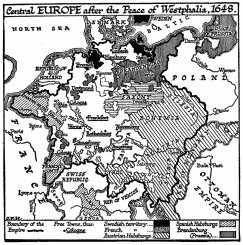
The sovereign princes, dukes, electors, prince bishops, and the like, whose domains cut up the map of the Germany of the Middle Ages into a crazy patchwork, were really not the equivalents of the kings of England and France. They were rather on the level of the great land-owning dukes and peers of France and England. Until 1701 none of them had the title of “King.” Many of their dominions were less both in size and value than the larger estates of the British nobility. The German Diet was like the States-General or like a parliament without the presence of elected representatives. So that the great civil war in Germany that presently broke out, the Thirty Years’ War (1618-48), was in its essential nature much more closely akin to the civil war in England (1643-49) and to the war of the Fronde (1648-53), the league of feudal nobles against the Crown in France, than appears upon the surface. In all these cases the Crown was either Catholic or disposed to become Catholic, and the recalcitrant nobles found their individualistic disposition tending to a Protestant formula. But while in England and Holland the Protestant nobles and rich merchants ultimately triumphed and in France the success of the Crown was even more complete, in Germany neither was the Emperor strong enough, nor had the Protestant princes a sufficient unity and organization among themselves to secure a conclusive triumph. It ended there in a torn-up Germany. Moreover, the German issue was complicated by the fact that various non-German peoples, the Protestant Bohemians and the Protestant Swedes (who had a new Protestant monarchy which had arisen under Gustava Vasa as a direct result of the Reformation) were entangled in the struggle. Finally, the French monarchy, triumphant now over its own nobles, although it was Catholic, came in on the Protestant side with the evident intention of taking the place of the Habsburgs as the imperial line.
The prolongation of the war, and the fact that it was not fought along a determined frontier, but all over an empire of patches, Protestant here, Catholic there, made it one of the most cruel and destructive that Europe had known since the days of the barbarian raids. Its peculiar mischief lay not in the fighting, but in the concomitants of the fighting. It came at a time when military tactics had developed to a point that rendered ordinary levies useless against trained professional infantry. Volley firing with muskets at a range of a few score yards had abolished the individualistic knight in armour, but the charge of disciplined masses of cavalry could still disperse any infantry that had not been drilled into a mechanical rigidity. The infantry with their muzzle-loading muskets could not keep up a steady enough fire to wither determined cavalry before it charged home. They had, therefore, to meet the shock standing or kneeling behind a bristling wall of pikes or bayonets. For this they needed great discipline and experience. Iron cannon were still of small size and not very abundant, and they did not play a decisive part as yet in warfare. They could “plough lanes” in infantry, but they could not easily smash and scatter it if it was sturdy and well drilled. War under these conditions was entirely in the hands of seasoned professional soldiers, and the question of their pay was as important a one to the generals of that time as the question of food or munitions. As the long struggle dragged on from phase to phase, and the financial distress of the land increased, the commanders of both sides were forced to fall back upon the looting of towns and villages, both for supply and to make up the arrears of their soldiers’ pay. The soldiers became, therefore, more and more mere brigands living on the country, and the Thirty Years’ War set up a tradition of looting as a legitimate operation in warfare and of outrage as a soldiers’ privilege that has tainted the good name of Germany right down to the Great War of 1914. The earlier chapters of Defoe’s Memoirs of a Cavalier, with its vivid description of the massacre and burning of Magdeburg, will give the reader a far better idea of the warfare of this time than any formal history. So harried was the land that the farmers ceased from cultivation, what snatch crops could be harvested were hidden away, and great crowds of starving women and children became camp followers of the armies, and supplied a thievish tail to the rougher plundering. At the close of the struggle all Germany was ruined and desolate. Central Europe did not fully recover from these robberies and devastations for a century.
Here we can but name Tilly and Wallenstein, the great plunder captains on the Habsburg side, and Gustavus Adolphus, the King of Sweden, the Lion of the North, the champion of the Protestants, whose dream was to make the Baltic Sea a “Swedish Lake.” Gustavus Adolphus was killed in his decisive victory over Wallenstein at Lützen (1632), and Wallenstein was murdered in 1634. In 1648 the princes and diplomatists gathered amidst the havoc they had made to patch up the affairs of Central Europe at the Peace of Westphalia. By that peace the power of the Emperor was reduced to a shadow, and the acquisition of Alsace brought France up to the Rhine. And one German prince, the Hohenzollern Elector of Brandenburg, acquired so much territory as to become the greatest German power next to the Emperor, a power that presently (1701) became the kingdom of Prussia. The Treaty also recognized two long accomplished facts, the separation from the empire and the complete independence of both Holland and Switzerland.
§ 5
We have opened this chapter with the stories of two countries. Britain and the Netherlands, in which the resistance of the private citizen to this new type of monarchy, the Machiavellian monarchy, that was arising out of the moral collapse of Christendom, succeeded. But in France, Russia, in many states of Germany and of Italy—Saxony and Tuscany e. g.—personal monarchy was not so restrained and overthrown; it established itself indeed as the ruling European system during the seventeenth and eighteenth centuries.
(In Poland conditions were peculiar, and they will be dealt with in a later section.)
In France there had been no Magna Carta, and there was no tradition of parliamentary rule. There was the same opposition of interests between the crown on the one hand and the landlords and merchants on the other, but the latter had no recognized and traditional gathering-place, and no dignified method of unity. They formed oppositions to the crown, they made leagues of resistance—such was the “Fronde,” which was struggling against the young King Louis XIV and his great minister Mazarin, while Charles I was fighting for his life in England—but ultimately (1652), after a civil war, they were conclusively defeated; and while in England after the establishment of the Hanoverians the House of Lords and their subservient Commons ruled the country, in France, after 1652, the court entirely dominated the aristocracy. Cardinal Mazarin was himself building upon a foundation that Cardinal Richelieu, the contemporary of King James I of England, had prepared for him. After the time of Mazarin we hear of no great French nobles unless they are at court as court servants and officials. They have been tamed—but at a price, the price of throwing the burthen of taxation upon the voiceless mass of the common people. From many taxes both the clergy and the nobility—everyone indeed who bore a title—were exempt. In the end this injustice became intolerable, but for a while the French monarchy flourished like the Psalmist’s green bay tree. By the opening of the eighteenth century English writers are already calling attention to the misery of the French lower classes and the comparative prosperity, at that time, of the English poor.