
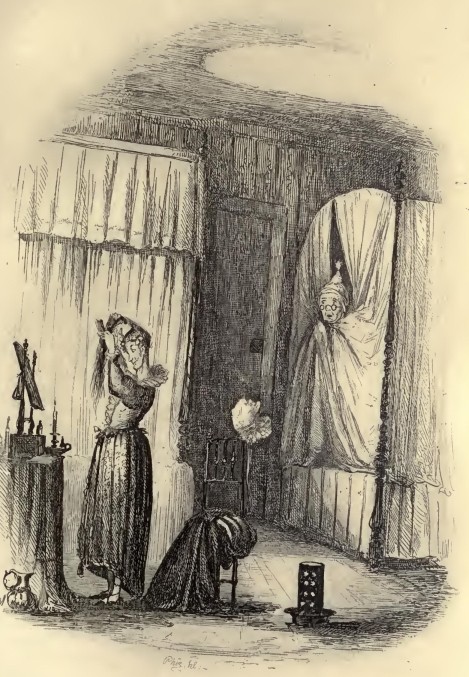

Mr. Pickwick almost fainted with horror and dismay. Standing before the dressing-glass was a middle-aged lady, in yellow curl-papers, busily engaged in brushing what ladies call their ‘back-hair.’ However the unconscious middle-aged lady came into that room, it was quite clear that she contemplated remaining there for the night; for she had brought a rushlight and shade with her, which, with praiseworthy precaution against fire, she had stationed in a basin on the floor, where it was glimmering away, like a gigantic lighthouse in a particularly small piece of water.
‘Bless my soul!’ thought Mr. Pickwick, ‘what a dreadful thing!’
‘Hem!’ said the lady; and in went Mr. Pickwick’s head with automaton-like rapidity.
‘I never met with anything so awful as this,’ thought poor Mr. Pickwick, the cold perspiration starting in drops upon his nightcap. ‘Never. This is fearful.’
It was quite impossible to resist the urgent desire to see what was going forward. So out went Mr. Pickwick’s head again. The prospect was worse than before. The middle-aged lady had finished arranging her hair; had carefully enveloped it in a muslin nightcap with a small plaited border; and was gazing pensively on the fire.
‘This matter is growing alarming,’ reasoned Mr. Pickwick with himself. ‘I can’t allow things to go on in this way. By the self-possession of that lady, it is clear to me that I must have come into the wrong room. If I call out she’ll alarm the house; but if I remain here the consequences will be still more frightful.’
Mr. Pickwick, it is quite unnecessary to say, was one of the most modest and delicate-minded of mortals. The very idea of exhibiting his nightcap to a lady overpowered him, but he had tied those confounded strings in a knot, and, do what he would, he couldn’t get it off. The disclosure must be made. There was only one other way of doing it. He shrunk behind the curtains, and called out very loudly—
‘Ha-hum!’
That the lady started at this unexpected sound was evident, by her falling up against the rushlight shade; that she persuaded herself it must have been the effect of imagination was equally clear, for when Mr. Pickwick, under the impression that she had fainted away stone-dead with fright, ventured to peep out again, she was gazing pensively on the fire as before.
‘Most extraordinary female this,’ thought Mr. Pickwick, popping in again. ‘Ha-hum!’
These last sounds, so like those in which, as legends inform us, the ferocious giant Blunderbore was in the habit of expressing his opinion that it was time to lay the cloth, were too distinctly audible to be again mistaken for the workings of fancy.
‘Gracious Heaven!’ said the middle-aged lady, ‘what’s that?’
‘It’s—it’s—only a gentleman, ma’am,’ said Mr. Pickwick, from behind the curtains.
‘A gentleman!’ said the lady, with a terrific scream.
‘It’s all over!’ thought Mr. Pickwick.
‘A strange man!’ shrieked the lady. Another instant and the house would be alarmed. Her garments rustled as she rushed towards the door.
‘Ma’am,’ said Mr. Pickwick, thrusting out his head in the extremity of his desperation, ‘ma’am!’
Now, although Mr. Pickwick was not actuated by any definite object in putting out his head, it was instantaneously productive of a good effect. The lady, as we have already stated, was near the door. She must pass it, to reach the staircase, and she would most undoubtedly have done so by this time, had not the sudden apparition of Mr. Pickwick’s nightcap driven her back into the remotest corner of the apartment, where she stood staring wildly at Mr. Pickwick, while Mr. Pickwick in his turn stared wildly at her.
‘Wretch,’ said the lady, covering her eyes with her hands, ‘what do you want here?’
‘Nothing, ma’am; nothing whatever, ma’am,’ said Mr. Pickwick earnestly.
‘Nothing!’ said the lady, looking up.
‘Nothing, ma’am, upon my honour,’ said Mr. Pickwick, nodding his head so energetically, that the tassel of his nightcap danced again. ‘I am almost ready to sink, ma’am, beneath the confusion of addressing a lady in my nightcap (here the lady hastily snatched off hers), but I can’t get it off, ma’am (here Mr. Pickwick gave it a tremendous tug, in proof of the statement). It is evident to me, ma’am, now, that I have mistaken this bedroom for my own. I had not been here five minutes, ma’am, when you suddenly entered it.’
‘If this improbable story be really true, Sir,’ said the lady, sobbing violently, ‘you will leave it instantly.’
‘I will, ma’am, with the greatest pleasure,’ replied Mr. Pickwick.
‘Instantly, sir,’ said the lady.
‘Certainly, ma’am,’ interposed Mr. Pickwick, very quickly. ‘Certainly, ma’am. I—I—am very sorry, ma’am,’ said Mr. Pickwick, making his appearance at the bottom of the bed, ‘to have been the innocent occasion of this alarm and emotion; deeply sorry, ma’am.’
The lady pointed to the door. One excellent quality of Mr. Pickwick’s character was beautifully displayed at this moment, under the most trying circumstances. Although he had hastily put on his hat over his nightcap, after the manner of the old patrol; although he carried his shoes and gaiters in his hand, and his coat and waistcoat over his arm; nothing could subdue his native politeness.
‘I am exceedingly sorry, ma’am,’ said Mr. Pickwick, bowing very low.
‘If you are, Sir, you will at once leave the room,’ said the lady.
‘Immediately, ma’am; this instant, ma’am,’ said Mr. Pickwick, opening the door, and dropping both his shoes with a crash in so doing.
‘I trust, ma’am,’ resumed Mr. Pickwick, gathering up his shoes, and turning round to bow again—‘I trust, ma’am, that my unblemished character, and the devoted respect I entertain for your sex, will plead as some slight excuse for this—’ But before Mr. Pickwick could conclude the sentence, the lady had thrust him into the passage, and locked and bolted the door behind him.
Whatever grounds of self-congratulation Mr. Pickwick might have for having escaped so quietly from his late awkward situation, his present position was by no means enviable. He was alone, in an open passage, in a strange house in the middle of the night, half dressed; it was not to be supposed that he could find his way in perfect darkness to a room which he had been wholly unable to discover with a light, and if he made the slightest noise in his fruitless attempts to do so, he stood every chance of being shot at, and perhaps killed, by some wakeful traveller. He had no resource but to remain where he was until daylight appeared. So after groping his way a few paces down the passage, and, to his infinite alarm, stumbling over several pairs of boots in so doing, Mr. Pickwick crouched into a little recess in the wall, to wait for morning, as philosophically as he might.
He was not destined, however, to undergo this additional trial of patience; for he had not been long ensconced in his present concealment when, to his unspeakable horror, a man, bearing a light, appeared at the end of the passage. His horror was suddenly converted into joy, however, when he recognised the form of his faithful attendant. It was indeed Mr. Samuel Weller, who after sitting up thus late, in conversation with the boots, who was sitting up for the mail, was now about to retire to rest.
‘Sam,’ said Mr. Pickwick, suddenly appearing before him, ‘where’s my bedroom?’
Mr. Weller stared at his master with the most emphatic surprise; and it was not until the question had been repeated three several times, that he turned round, and led the way to the long-sought apartment.
‘Sam,’ said Mr. Pickwick, as he got into bed, ‘I have made one of the most extraordinary mistakes to-night, that ever were heard of.’
‘Wery likely, Sir,’ replied Mr. Weller drily.
‘But of this I am determined, Sam,’ said Mr. Pickwick; ‘that if I were to stop in this house for six months, I would never trust myself about it, alone, again.’
‘That’s the wery prudentest resolution as you could come to, Sir,’ replied Mr. Weller. ‘You rayther want somebody to look arter you, Sir, when your judgment goes out a wisitin’.’
‘What do you mean by that, Sam?’ said Mr. Pickwick. He raised himself in bed, and extended his hand, as if he were about to say something more; but suddenly checking himself, turned round, and bade his valet ‘Good-night.’
‘Good-night, Sir,’ replied Mr. Weller. He paused when he got outside the door—shook his head—walked on—stopped—snuffed the candle—shook his head again—and finally proceeded slowly to his chamber, apparently buried in the profoundest meditation.
CHAPTER XXIII. IN WHICH MR. SAMUEL WELLER BEGINS TO DEVOTE HIS ENERGIES TO THE RETURN MATCH BETWEEN HIMSELF AND MR. TROTTER
In a small room in the vicinity of the stableyard, betimes in the morning, which was ushered in by Mr. Pickwick’s adventure with the middle—aged lady in the yellow curl-papers, sat Mr. Weller, senior, preparing himself for his journey to London. He was sitting in an excellent attitude for having his portrait taken; and here it is.
It is very possible that at some earlier period of his career, Mr. Weller’s profile might have presented a bold and determined outline. His face, however, had expanded under the influence of good living, and a disposition remarkable for resignation; and its bold, fleshy curves had so far extended beyond the limits originally assigned them, that unless you took a full view of his countenance in front, it was difficult to distinguish more than the extreme tip of a very rubicund nose. His chin, from the same cause, had acquired the grave and imposing form which is generally described by prefixing the word ‘double’ to that expressive feature; and his complexion exhibited that peculiarly mottled combination of colours which is only to be seen in gentlemen of his profession, and in underdone roast beef. Round his neck he wore a crimson travelling-shawl, which merged into his chin by such imperceptible gradations, that it was difficult to distinguish the folds of the one, from the folds of the other. Over this, he mounted a long waistcoat of a broad pink-striped pattern, and over that again, a wide-skirted green coat, ornamented with large brass buttons, whereof the two which garnished the waist, were so far apart, that no man had ever beheld them both at the same time. His hair, which was short, sleek, and black, was just visible beneath the capacious brim of a low-crowned brown hat. His legs were encased in knee-cord breeches, and painted top-boots; and a copper watch-chain, terminating in one seal, and a key of the same material, dangled loosely from his capacious waistband.
We have said that Mr. Weller was engaged in preparing for his journey to London—he was taking sustenance, in fact. On the table before him, stood a pot of ale, a cold round of beef, and a very respectable-looking loaf, to each of which he distributed his favours in turn, with the most rigid impartiality. He had just cut a mighty slice from the latter, when the footsteps of somebody entering the room, caused him to raise his head; and he beheld his son.
‘Mornin’, Sammy!’ said the father.
The son walked up to the pot of ale, and nodding significantly to his parent, took a long draught by way of reply.
‘Wery good power o’ suction, Sammy,’ said Mr. Weller the elder, looking into the pot, when his first-born had set it down half empty. ‘You’d ha’ made an uncommon fine oyster, Sammy, if you’d been born in that station o’ life.’
‘Yes, I des-say, I should ha’ managed to pick up a respectable livin’,’ replied Sam applying himself to the cold beef, with considerable vigour.
‘I’m wery sorry, Sammy,’ said the elder Mr. Weller, shaking up the ale, by describing small circles with the pot, preparatory to drinking. ‘I’m wery sorry, Sammy, to hear from your lips, as you let yourself be gammoned by that ‘ere mulberry man. I always thought, up to three days ago, that the names of Veller and gammon could never come into contract, Sammy, never.’
‘Always exceptin’ the case of a widder, of course,’ said Sam.
‘Widders, Sammy,’ replied Mr. Weller, slightly changing colour. ‘Widders are ‘ceptions to ev’ry rule. I have heerd how many ordinary women one widder’s equal to in pint o’ comin’ over you. I think it’s five-and-twenty, but I don’t rightly know vether it ain’t more.’
‘Well; that’s pretty well,’ said Sam.
‘Besides,’ continued Mr. Weller, not noticing the interruption, ‘that’s a wery different thing. You know what the counsel said, Sammy, as defended the gen’l’m’n as beat his wife with the poker, venever he got jolly. “And arter all, my Lord,” says he, “it’s a amiable weakness.” So I says respectin’ widders, Sammy, and so you’ll say, ven you gets as old as me.’
‘I ought to ha’ know’d better, I know,’ said Sam.
‘Ought to ha’ know’d better!’ repeated Mr. Weller, striking the table with his fist. ‘Ought to ha’ know’d better! why, I know a young ‘un as hasn’t had half nor quarter your eddication—as hasn’t slept about the markets, no, not six months—who’d ha’ scorned to be let in, in such a vay; scorned it, Sammy.’ In the excitement of feeling produced by this agonising reflection, Mr. Weller rang the bell, and ordered an additional pint of ale.
‘Well, it’s no use talking about it now,’ said Sam. ‘It’s over, and can’t be helped, and that’s one consolation, as they always says in Turkey, ven they cuts the wrong man’s head off. It’s my innings now, gov’nor, and as soon as I catches hold o’ this ‘ere Trotter, I’ll have a good ‘un.’
‘I hope you will, Sammy. I hope you will,’ returned Mr. Weller. ‘Here’s your health, Sammy, and may you speedily vipe off the disgrace as you’ve inflicted on the family name.’ In honour of this toast Mr. Weller imbibed at a draught, at least two-thirds of a newly-arrived pint, and handed it over to his son, to dispose of the remainder, which he instantaneously did.
‘And now, Sammy,’ said Mr. Weller, consulting a large double-faced silver watch that hung at the end of the copper chain. ‘Now it’s time I was up at the office to get my vay-bill and see the coach loaded; for coaches, Sammy, is like guns—they requires to be loaded with wery great care, afore they go off.’
At this parental and professional joke, Mr. Weller, junior, smiled a filial smile. His revered parent continued in a solemn tone—
‘I’m a-goin’ to leave you, Samivel, my boy, and there’s no telling ven I shall see you again. Your mother-in-law may ha’ been too much for me, or a thousand things may have happened by the time you next hears any news o’ the celebrated Mr. Veller o’ the Bell Savage. The family name depends wery much upon you, Samivel, and I hope you’ll do wot’s right by it. Upon all little pints o’ breedin’, I know I may trust you as vell as if it was my own self. So I’ve only this here one little bit of adwice to give you. If ever you gets to up’ards o’ fifty, and feels disposed to go a-marryin’ anybody—no matter who—jist you shut yourself up in your own room, if you’ve got one, and pison yourself off hand. Hangin’s wulgar, so don’t you have nothin’ to say to that. Pison yourself, Samivel, my boy, pison yourself, and you’ll be glad on it arterwards.’ With these affecting words, Mr. Weller looked steadfastly on his son, and turning slowly upon his heel, disappeared from his sight.
In the contemplative mood which these words had awakened, Mr. Samuel Weller walked forth from the Great White Horse when his father had left him; and bending his steps towards St. Clement’s Church, endeavoured to dissipate his melancholy, by strolling among its ancient precincts. He had loitered about, for some time, when he found himself in a retired spot—a kind of courtyard of venerable appearance—which he discovered had no other outlet than the turning by which he had entered. He was about retracing his steps, when he was suddenly transfixed to the spot by a sudden appearance; and the mode and manner of this appearance, we now proceed to relate.
Mr. Samuel Weller had been staring up at the old brick houses now and then, in his deep abstraction, bestowing a wink upon some healthy-looking servant girl as she drew up a blind, or threw open a bedroom window, when the green gate of a garden at the bottom of the yard opened, and a man having emerged therefrom, closed the green gate very carefully after him, and walked briskly towards the very spot where Mr. Weller was standing.
Now, taking this, as an isolated fact, unaccompanied by any attendant circumstances, there was nothing very extraordinary in it; because in many parts of the world men do come out of gardens, close green gates after them, and even walk briskly away, without attracting any particular share of public observation. It is clear, therefore, that there must have been something in the man, or in his manner, or both, to attract Mr. Weller’s particular notice. Whether there was, or not, we must leave the reader to determine, when we have faithfully recorded the behaviour of the individual in question.
When the man had shut the green gate after him, he walked, as we have said twice already, with a brisk pace up the courtyard; but he no sooner caught sight of Mr. Weller than he faltered, and stopped, as if uncertain, for the moment, what course to adopt. As the green gate was closed behind him, and there was no other outlet but the one in front, however, he was not long in perceiving that he must pass Mr. Samuel Weller to get away. He therefore resumed his brisk pace, and advanced, staring straight before him. The most extraordinary thing about the man was, that he was contorting his face into the most fearful and astonishing grimaces that ever were beheld. Nature’s handiwork never was disguised with such extraordinary artificial carving, as the man had overlaid his countenance with in one moment.
‘Well!’ said Mr. Weller to himself, as the man approached. ‘This is wery odd. I could ha’ swore it was him.’
Up came the man, and his face became more frightfully distorted than ever, as he drew nearer.
‘I could take my oath to that ‘ere black hair and mulberry suit,’ said Mr. Weller; ‘only I never see such a face as that afore.’
As Mr. Weller said this, the man’s features assumed an unearthly twinge, perfectly hideous. He was obliged to pass very near Sam, however, and the scrutinising glance of that gentleman enabled him to detect, under all these appalling twists of feature, something too like the small eyes of Mr. Job Trotter to be easily mistaken.
‘Hollo, you Sir!’ shouted Sam fiercely.
The stranger stopped.
‘Hollo!’ repeated Sam, still more gruffly.
The man with the horrible face looked, with the greatest surprise, up the court, and down the court, and in at the windows of the houses—everywhere but at Sam Weller—and took another step forward, when he was brought to again by another shout.
‘Hollo, you sir!’ said Sam, for the third time.
There was no pretending to mistake where the voice came from now, so the stranger, having no other resource, at last looked Sam Weller full in the face.
‘It won’t do, Job Trotter,’ said Sam. ‘Come! None o’ that ‘ere nonsense. You ain’t so wery ‘andsome that you can afford to throw avay many o’ your good looks. Bring them ‘ere eyes o’ yourn back into their proper places, or I’ll knock ‘em out of your head. D’ye hear?’
As Mr. Weller appeared fully disposed to act up to the spirit of this address, Mr. Trotter gradually allowed his face to resume its natural expression; and then giving a start of joy, exclaimed, ‘What do I see? Mr. Walker!’
‘Ah,’ replied Sam. ‘You’re wery glad to see me, ain’t you?’
‘Glad!’ exclaimed Job Trotter; ‘Oh, Mr. Walker, if you had but known how I have looked forward to this meeting! It is too much, Mr. Walker; I cannot bear it, indeed I cannot.’ And with these words, Mr. Trotter burst into a regular inundation of tears, and, flinging his arms around those of Mr. Weller, embraced him closely, in an ecstasy of joy.
‘Get off!’ cried Sam, indignant at this process, and vainly endeavouring to extricate himself from the grasp of his enthusiastic acquaintance. ‘Get off, I tell you. What are you crying over me for, you portable engine?’
‘Because I am so glad to see you,’ replied Job Trotter, gradually releasing Mr. Weller, as the first symptoms of his pugnacity disappeared. ‘Oh, Mr. Walker, this is too much.’
‘Too much!’ echoed Sam, ‘I think it is too much—rayther! Now, what have you got to say to me, eh?’
Mr. Trotter made no reply; for the little pink pocket-handkerchief was in full force.
‘What have you got to say to me, afore I knock your head off?’ repeated Mr. Weller, in a threatening manner.
‘Eh!’ said Mr. Trotter, with a look of virtuous surprise.
‘What have you got to say to me?’
‘I, Mr. Walker!’
‘Don’t call me Valker; my name’s Veller; you know that vell enough. What have you got to say to me?’
‘Bless you, Mr. Walker—Weller, I mean—a great many things, if you will come away somewhere, where we can talk comfortably. If you knew how I have looked for you, Mr. Weller—’
‘Wery hard, indeed, I s’pose?’ said Sam drily.
‘Very, very, Sir,’ replied Mr. Trotter, without moving a muscle of his face. ‘But shake hands, Mr. Weller.’
Sam eyed his companion for a few seconds, and then, as if actuated by a sudden impulse, complied with his request.
‘How,’ said Job Trotter, as they walked away, ‘how is your dear, good master? Oh, he is a worthy gentleman, Mr. Weller! I hope he didn’t catch cold, that dreadful night, Sir.’
There was a momentary look of deep slyness in Job Trotter’s eye, as he said this, which ran a thrill through Mr. Weller’s clenched fist, as he burned with a desire to make a demonstration on his ribs. Sam constrained himself, however, and replied that his master was extremely well.
‘Oh, I am so glad,’ replied Mr. Trotter; ‘is he here?’
‘Is yourn?’ asked Sam, by way of reply.
‘Oh, yes, he is here, and I grieve to say, Mr. Weller, he is going on worse than ever.’
‘Ah, ah!’ said Sam.
‘Oh, shocking—terrible!’
‘At a boarding-school?’ said Sam.
‘No, not at a boarding-school,’ replied Job Trotter, with the same sly look which Sam had noticed before; ‘not at a boarding-school.’
‘At the house with the green gate?’ said Sam, eyeing his companion closely.
‘No, no—oh, not there,’ replied Job, with a quickness very unusual to him, ‘not there.’
‘What was you a-doin’ there?’ asked Sam, with a sharp glance. ‘Got inside the gate by accident, perhaps?’
‘Why, Mr. Weller,’ replied Job, ‘I don’t mind telling you my little secrets, because, you know, we took such a fancy for each other when we first met. You recollect how pleasant we were that morning?’
‘Oh, yes,’ said Sam, impatiently. ‘I remember. Well?’
‘Well,’ replied Job, speaking with great precision, and in the low tone of a man who communicates an important secret; ‘in that house with the green gate, Mr. Weller, they keep a good many servants.’
‘So I should think, from the look on it,’ interposed Sam.
‘Yes,’ continued Mr. Trotter, ‘and one of them is a cook, who has saved up a little money, Mr. Weller, and is desirous, if she can establish herself in life, to open a little shop in the chandlery way, you see.’
Yes.’
‘Yes, Mr. Weller. Well, Sir, I met her at a chapel that I go to; a very neat little chapel in this town, Mr. Weller, where they sing the number four collection of hymns, which I generally carry about with me, in a little book, which you may perhaps have seen in my hand—and I got a little intimate with her, Mr. Weller, and from that, an acquaintance sprung up between us, and I may venture to say, Mr. Weller, that I am to be the chandler.’
‘Ah, and a wery amiable chandler you’ll make,’ replied Sam, eyeing Job with a side look of intense dislike.
‘The great advantage of this, Mr. Weller,’ continued Job, his eyes filling with tears as he spoke, ‘will be, that I shall be able to leave my present disgraceful service with that bad man, and to devote myself to a better and more virtuous life; more like the way in which I was brought up, Mr. Weller.’
‘You must ha’ been wery nicely brought up,’ said Sam.
‘Oh, very, Mr. Weller, very,’ replied Job. At the recollection of the purity of his youthful days, Mr. Trotter pulled forth the pink handkerchief, and wept copiously.
‘You must ha’ been an uncommon nice boy, to go to school vith,’ said Sam.
‘I was, sir,’ replied Job, heaving a deep sigh; ‘I was the idol of the place.’
‘Ah,’ said Sam, ‘I don’t wonder at it. What a comfort you must ha’ been to your blessed mother.’
At these words, Mr. Job Trotter inserted an end of the pink handkerchief into the corner of each eye, one after the other, and began to weep copiously.
‘Wot’s the matter with the man,’ said Sam, indignantly. ‘Chelsea water-works is nothin’ to you. What are you melting vith now? The consciousness o’ willainy?’
‘I cannot keep my feelings down, Mr. Weller,’ said Job, after a short pause. ‘To think that my master should have suspected the conversation I had with yours, and so dragged me away in a post-chaise, and after persuading the sweet young lady to say she knew nothing of him, and bribing the school-mistress to do the same, deserted her for a better speculation! Oh! Mr. Weller, it makes me shudder.’
‘Oh, that was the vay, was it?’ said Mr. Weller.
‘To be sure it was,’ replied Job.
‘Vell,’ said Sam, as they had now arrived near the hotel, ‘I vant to have a little bit o’ talk with you, Job; so if you’re not partickler engaged, I should like to see you at the Great White Horse to-night, somewheres about eight o’clock.’
‘I shall be sure to come,’ said Job.
‘Yes, you’d better,’ replied Sam, with a very meaning look, ‘or else I shall perhaps be askin’ arter you, at the other side of the green gate, and then I might cut you out, you know.’
‘I shall be sure to be with you, sir,’ said Mr. Trotter; and wringing Sam’s hand with the utmost fervour, he walked away.
‘Take care, Job Trotter, take care,’ said Sam, looking after him, ‘or I shall be one too many for you this time. I shall, indeed.’ Having uttered this soliloquy, and looked after Job till he was to be seen no more, Mr. Weller made the best of his way to his master’s bedroom.
‘It’s all in training, Sir,’ said Sam.
‘What’s in training, Sam?’ inquired Mr. Pickwick.
‘I’ve found ‘em out, Sir,’ said Sam.
‘Found out who?’
‘That ‘ere queer customer, and the melan-cholly chap with the black hair.’
‘Impossible, Sam!’ said Mr. Pickwick, with the greatest energy. ‘Where are they, Sam: where are they?’
‘Hush, hush!’ replied Mr. Weller; and as he assisted Mr. Pickwick to dress, he detailed the plan of action on which he proposed to enter.
‘But when is this to be done, Sam?’ inquired Mr. Pickwick.
‘All in good time, Sir,’ replied Sam.
Whether it was done in good time, or not, will be seen hereafter.
CHAPTER XXIV. WHEREIN MR. PETER MAGNUS GROWS JEALOUS, AND THE MIDDLE-AGED LADY APPREHENSIVE, WHICH BRINGS THE PICKWICKIANS WITHIN THE GRASP OF THE LAW
When Mr. Pickwick descended to the room in which he and Mr. Peter Magnus had spent the preceding evening, he found that gentleman with the major part of the contents of the two bags, the leathern hat-box, and the brown-paper parcel, displaying to all possible advantage on his person, while he himself was pacing up and down the room in a state of the utmost excitement and agitation.
‘Good-morning, Sir,’ said Mr. Peter Magnus. ‘What do you think of this, Sir?’
‘Very effective indeed,’ replied Mr. Pickwick, surveying the garments of Mr. Peter Magnus with a good-natured smile.
‘Yes, I think it’ll do,’ said Mr. Magnus. ‘Mr. Pickwick, Sir, I have sent up my card.’
‘Have you?’ said Mr. Pickwick.
‘And the waiter brought back word, that she would see me at eleven—at eleven, Sir; it only wants a quarter now.’
‘Very near the time,’ said Mr. Pickwick.
‘Yes, it is rather near,’ replied Mr. Magnus, ‘rather too near to be pleasant—eh! Mr. Pickwick, sir?’
‘Confidence is a great thing in these cases,’ observed Mr. Pickwick.
‘I believe it is, Sir,’ said Mr. Peter Magnus. ‘I am very confident, Sir. Really, Mr. Pickwick, I do not see why a man should feel any fear in such a case as this, sir. What is it, Sir? There’s nothing to be ashamed of; it’s a matter of mutual accommodation, nothing more. Husband on one side, wife on the other. That’s my view of the matter, Mr. Pickwick.’
‘It is a very philosophical one,’ replied Mr. Pickwick. ‘But breakfast is waiting, Mr. Magnus. Come.’
Down they sat to breakfast, but it was evident, notwithstanding the boasting of Mr. Peter Magnus, that he laboured under a very considerable degree of nervousness, of which loss of appetite, a propensity to upset the tea-things, a spectral attempt at drollery, and an irresistible inclination to look at the clock, every other second, were among the principal symptoms.
‘He-he-he,’ tittered Mr. Magnus, affecting cheerfulness, and gasping with agitation. ‘It only wants two minutes, Mr. Pickwick. Am I pale, Sir?’
‘Not very,’ replied Mr. Pickwick.
There was a brief pause.
‘I beg your pardon, Mr. Pickwick; but have you ever done this sort of thing in your time?’ said Mr. Magnus.
‘You mean proposing?’ said Mr. Pickwick.
‘Yes.’
‘Never,’ said Mr. Pickwick, with great energy, ‘never.’
‘You have no idea, then, how it’s best to begin?’ said Mr. Magnus.
‘Why,’ said Mr. Pickwick, ‘I may have formed some ideas upon the subject, but, as I have never submitted them to the test of experience, I should be sorry if you were induced to regulate your proceedings by them.’
‘I should feel very much obliged to you, for any advice, Sir,’ said Mr. Magnus, taking another look at the clock, the hand of which was verging on the five minutes past.
‘Well, sir,’ said Mr. Pickwick, with the profound solemnity with which that great man could, when he pleased, render his remarks so deeply impressive. ‘I should commence, sir, with a tribute to the lady’s beauty and excellent qualities; from them, Sir, I should diverge to my own unworthiness.’
‘Very good,’ said Mr. Magnus.
‘Unworthiness for her only, mind, sir,’ resumed Mr. Pickwick; ‘for to show that I was not wholly unworthy, sir, I should take a brief review of my past life, and present condition. I should argue, by analogy, that to anybody else, I must be a very desirable object. I should then expatiate on the warmth of my love, and the depth of my devotion. Perhaps I might then be tempted to seize her hand.’
‘Yes, I see,’ said Mr. Magnus; ‘that would be a very great point.’
‘I should then, Sir,’ continued Mr. Pickwick, growing warmer as the subject presented itself in more glowing colours before him—‘I should then, Sir, come to the plain and simple question, “Will you have me?” I think I am justified in assuming that upon this, she would turn away her head.’
‘You think that may be taken for granted?’ said Mr. Magnus; ‘because, if she did not do that at the right place, it would be embarrassing.’
‘I think she would,’ said Mr. Pickwick. ‘Upon this, sir, I should squeeze her hand, and I think—I think, Mr. Magnus—that after I had done that, supposing there was no refusal, I should gently draw away the handkerchief, which my slight knowledge of human nature leads me to suppose the lady would be applying to her eyes at the moment, and steal a respectful kiss. I think I should kiss her, Mr. Magnus; and at this particular point, I am decidedly of opinion that if the lady were going to take me at all, she would murmur into my ears a bashful acceptance.’
Mr. Magnus started; gazed on Mr. Pickwick’s intelligent face, for a short time in silence; and then (the dial pointing to the ten minutes past) shook him warmly by the hand, and rushed desperately from the room.
Mr. Pickwick had taken a few strides to and fro; and the small hand of the clock following the latter part of his example, had arrived at the figure which indicates the half-hour, when the door suddenly opened. He turned round to meet Mr. Peter Magnus, and encountered, in his stead, the joyous face of Mr. Tupman, the serene countenance of Mr. Winkle, and the intellectual lineaments of Mr. Snodgrass.
As Mr. Pickwick greeted them, Mr. Peter Magnus tripped into the room.
‘My friends, the gentleman I was speaking of—Mr. Magnus,’ said Mr. Pickwick.
‘Your servant, gentlemen,’ said Mr. Magnus, evidently in a high state of excitement; ‘Mr. Pickwick, allow me to speak to you one moment, sir.’
As he said this, Mr. Magnus harnessed his forefinger to Mr. Pickwick’s buttonhole, and, drawing him to a window recess, said—
‘Congratulate me, Mr. Pickwick; I followed your advice to the very letter.’
‘And it was all correct, was it?’ inquired Mr. Pickwick.
‘It was, Sir. Could not possibly have been better,’ replied Mr. Magnus. ‘Mr. Pickwick, she is mine.’
‘I congratulate you, with all my heart,’ replied Mr. Pickwick, warmly shaking his new friend by the hand.
‘You must see her. Sir,’ said Mr. Magnus; ‘this way, if you please. Excuse us for one instant, gentlemen.’ Hurrying on in this way, Mr. Peter Magnus drew Mr. Pickwick from the room. He paused at the next door in the passage, and tapped gently thereat.
‘Come in,’ said a female voice. And in they went.
‘Miss Witherfield,’ said Mr. Magnus, ‘allow me to introduce my very particular friend, Mr. Pickwick. Mr. Pickwick, I beg to make you known to Miss Witherfield.’
The lady was at the upper end of the room. As Mr. Pickwick bowed, he took his spectacles from his waistcoat pocket, and put them on; a process which he had no sooner gone through, than, uttering an exclamation of surprise, Mr. Pickwick retreated several paces, and the lady, with a half-suppressed scream, hid her face in her hands, and dropped into a chair; whereupon Mr. Peter Magnus was stricken motionless on the spot, and gazed from one to the other, with a countenance expressive of the extremities of horror and surprise.
This certainly was, to all appearance, very unaccountable behaviour; but the fact is, that Mr. Pickwick no sooner put on his spectacles, than he at once recognised in the future Mrs. Magnus the lady into whose room he had so unwarrantably intruded on the previous night; and the spectacles had no sooner crossed Mr. Pickwick’s nose, than the lady at once identified the countenance which she had seen surrounded by all the horrors of a nightcap. So the lady screamed, and Mr. Pickwick started.
‘Mr. Pickwick!’ exclaimed Mr. Magnus, lost in astonishment, ‘what is the meaning of this, Sir? What is the meaning of it, Sir?’ added Mr. Magnus, in a threatening, and a louder tone.
‘Sir,’ said Mr. Pickwick, somewhat indignant at the very sudden manner in which Mr. Peter Magnus had conjugated himself into the imperative mood, ‘I decline answering that question.’
‘You decline it, Sir?’ said Mr. Magnus.
‘I do, Sir,’ replied Mr. Pickwick; ‘I object to say anything which may compromise that lady, or awaken unpleasant recollections in her breast, without her consent and permission.’
‘Miss Witherfield,’ said Mr. Peter Magnus, ‘do you know this person?’
‘Know him!’ repeated the middle-aged lady, hesitating.
‘Yes, know him, ma’am; I said know him,’ replied Mr. Magnus, with ferocity.
‘I have seen him,’ replied the middle-aged lady.
‘Where?’ inquired Mr. Magnus, ‘where?’
‘That,’ said the middle-aged lady, rising from her seat, and averting her head—‘that I would not reveal for worlds.’
‘I understand you, ma’am,’ said Mr. Pickwick, ‘and respect your delicacy; it shall never be revealed by me depend upon it.’
‘Upon my word, ma’am,’ said Mr. Magnus, ‘considering the situation in which I am placed with regard to yourself, you carry this matter off with tolerable coolness—tolerable coolness, ma’am.’
‘Cruel Mr. Magnus!’ said the middle-aged lady; here she wept very copiously indeed.
‘Address your observations to me, sir,’ interposed Mr. Pickwick; ‘I alone am to blame, if anybody be.’
‘Oh! you alone are to blame, are you, sir?’ said Mr. Magnus; ‘I—I—see through this, sir. You repent of your determination now, do you?’
‘My determination!’ said Mr. Pickwick.
‘Your determination, Sir. Oh! don’t stare at me, Sir,’ said Mr. Magnus; ‘I recollect your words last night, Sir. You came down here, sir, to expose the treachery and falsehood of an individual on whose truth and honour you had placed implicit reliance—eh?’ Here Mr. Peter Magnus indulged in a prolonged sneer; and taking off his green spectacles—which he probably found superfluous in his fit of jealousy—rolled his little eyes about, in a manner frightful to behold.
‘Eh?’ said Mr. Magnus; and then he repeated the sneer with increased effect. ‘But you shall answer it, Sir.’
‘Answer what?’ said Mr. Pickwick.
‘Never mind, sir,’ replied Mr. Magnus, striding up and down the room. ‘Never mind.’
There must be something very comprehensive in this phrase of ‘Never mind,’ for we do not recollect to have ever witnessed a quarrel in the street, at a theatre, public room, or elsewhere, in which it has not been the standard reply to all belligerent inquiries. ‘Do you call yourself a gentleman, sir?’—‘Never mind, sir.’
Did I offer to say anything to the young woman, sir?’—‘Never mind, sir.’
Do you want your head knocked up against that wall, sir?’—‘Never mind, sir.’ It is observable, too, that there would appear to be some hidden taunt in this universal ‘Never mind,’ which rouses more indignation in the bosom of the individual addressed, than the most lavish abuse could possibly awaken.
We do not mean to assert that the application of this brevity to himself, struck exactly that indignation to Mr. Pickwick’s soul, which it would infallibly have roused in a vulgar breast. We merely record the fact that Mr. Pickwick opened the room door, and abruptly called out, ‘Tupman, come here!’
Mr. Tupman immediately presented himself, with a look of very considerable surprise.
‘Tupman,’ said Mr. Pickwick, ‘a secret of some delicacy, in which that lady is concerned, is the cause of a difference which has just arisen between this gentleman and myself. When I assure him, in your presence, that it has no relation to himself, and is not in any way connected with his affairs, I need hardly beg you to take notice that if he continue to dispute it, he expresses a doubt of my veracity, which I shall consider extremely insulting.’ As Mr. Pickwick said this, he looked encyclopedias at Mr. Peter Magnus.
Mr. Pickwick’s upright and honourable bearing, coupled with that force and energy of speech which so eminently distinguished him, would have carried conviction to any reasonable mind; but, unfortunately, at that particular moment, the mind of Mr. Peter Magnus was in anything but reasonable order. Consequently, instead of receiving Mr. Pickwick’s explanation as he ought to have done, he forthwith proceeded to work himself into a red-hot, scorching, consuming passion, and to talk about what was due to his own feelings, and all that sort of thing; adding force to his declamation by striding to and fro, and pulling his hair—amusements which he would vary occasionally, by shaking his fist in Mr. Pickwick’s philanthropic countenance.
Mr. Pickwick, in his turn, conscious of his own innocence and rectitude, and irritated by having unfortunately involved the middle-aged lady in such an unpleasant affair, was not so quietly disposed as was his wont. The consequence was, that words ran high, and voices higher; and at length Mr. Magnus told Mr. Pickwick he should hear from him; to which Mr. Pickwick replied, with laudable politeness, that the sooner he heard from him the better; whereupon the middle-aged lady rushed in terror from the room, out of which Mr. Tupman dragged Mr. Pickwick, leaving Mr. Peter Magnus to himself and meditation.
If the middle-aged lady had mingled much with the busy world, or had profited at all by the manners and customs of those who make the laws and set the fashions, she would have known that this sort of ferocity is the most harmless thing in nature; but as she had lived for the most part in the country, and never read the parliamentary debates, she was little versed in these particular refinements of civilised life. Accordingly, when she had gained her bedchamber, bolted herself in, and began to meditate on the scene she had just witnessed, the most terrific pictures of slaughter and destruction presented themselves to her imagination; among which, a full-length portrait of Mr. Peter Magnus borne home by four men, with the embellishment of a whole barrelful of bullets in his left side, was among the very least. The more the middle-aged lady meditated, the more terrified she became; and at length she determined to repair to the house of the principal magistrate of the town, and request him to secure the persons of Mr. Pickwick and Mr. Tupman without delay.
To this decision the middle-aged lady was impelled by a variety of considerations, the chief of which was the incontestable proof it would afford of her devotion to Mr. Peter Magnus, and her anxiety for his safety. She was too well acquainted with his jealous temperament to venture the slightest allusion to the real cause of her agitation on beholding Mr. Pickwick; and she trusted to her own influence and power of persuasion with the little man, to quell his boisterous jealousy, supposing that Mr. Pickwick were removed, and no fresh quarrel could arise. Filled with these reflections, the middle-aged lady arrayed herself in her bonnet and shawl, and repaired to the mayor’s dwelling straightway.
Now George Nupkins, Esquire, the principal magistrate aforesaid, was as grand a personage as the fastest walker would find out, between sunrise and sunset, on the twenty-first of June, which being, according to the almanacs, the longest day in the whole year, would naturally afford him the longest period for his search. On this particular morning, Mr. Nupkins was in a state of the utmost excitement and irritation, for there had been a rebellion in the town; all the day-scholars at the largest day-school had conspired to break the windows of an obnoxious apple-seller, and had hooted the beadle and pelted the constabulary—an elderly gentleman in top-boots, who had been called out to repress the tumult, and who had been a peace-officer, man and boy, for half a century at least. And Mr. Nupkins was sitting in his easy-chair, frowning with majesty, and boiling with rage, when a lady was announced on pressing, private, and particular business. Mr. Nupkins looked calmly terrible, and commanded that the lady should be shown in; which command, like all the mandates of emperors, and magistrates, and other great potentates of the earth, was forthwith obeyed; and Miss Witherfield, interestingly agitated, was ushered in accordingly.
‘Muzzle!’ said the magistrate.
Muzzle was an undersized footman, with a long body and short legs.
‘Muzzle!’
Yes, your Worship.’
‘Place a chair, and leave the room.’
‘Yes, your Worship.’
‘Now, ma’am, will you state your business?’ said the magistrate.
‘It is of a very painful kind, Sir,’ said Miss Witherfield.
‘Very likely, ma’am,’ said the magistrate. ‘Compose your feelings, ma’am.’ Here Mr. Nupkins looked benignant. ‘And then tell me what legal business brings you here, ma’am.’ Here the magistrate triumphed over the man; and he looked stern again.
‘It is very distressing to me, Sir, to give this information,’ said Miss Witherfield, ‘but I fear a duel is going to be fought here.’
‘Here, ma’am?’ said the magistrate. ‘Where, ma’am?’
‘In Ipswich.’
In Ipswich, ma’am! A duel in Ipswich!’ said the magistrate, perfectly aghast at the notion. ‘Impossible, ma’am; nothing of the kind can be contemplated in this town, I am persuaded. Bless my soul, ma’am, are you aware of the activity of our local magistracy? Do you happen to have heard, ma’am, that I rushed into a prize-ring on the fourth of May last, attended by only sixty special constables; and, at the hazard of falling a sacrifice to the angry passions of an infuriated multitude, prohibited a pugilistic contest between the Middlesex Dumpling and the Suffolk Bantam? A duel in Ipswich, ma’am? I don’t think—I do not think,’ said the magistrate, reasoning with himself, ‘that any two men can have had the hardihood to plan such a breach of the peace, in this town.’
‘My information is, unfortunately, but too correct,’ said the middle-aged lady; ‘I was present at the quarrel.’
‘It’s a most extraordinary thing,’ said the astounded magistrate. ‘Muzzle!’
‘Yes, your Worship.’
‘Send Mr. Jinks here, directly! Instantly.’
‘Yes, your Worship.’
Muzzle retired; and a pale, sharp-nosed, half-fed, shabbily-clad clerk, of middle age, entered the room.
‘Mr. Jinks,’ said the magistrate. ‘Mr. Jinks.’
‘Sir,’ said Mr. Jinks.
‘This lady, Mr. Jinks, has come here, to give information of an intended duel in this town.’
Mr. Jinks, not knowing exactly what to do, smiled a dependent’s smile.
‘What are you laughing at, Mr. Jinks?’ said the magistrate.
Mr. Jinks looked serious instantly.
‘Mr. Jinks,’ said the magistrate, ‘you’re a fool.’
Mr. Jinks looked humbly at the great man, and bit the top of his pen.
‘You may see something very comical in this information, Sir—but I can tell you this, Mr. Jinks, that you have very little to laugh at,’ said the magistrate.
The hungry-looking Jinks sighed, as if he were quite aware of the fact of his having very little indeed to be merry about; and, being ordered to take the lady’s information, shambled to a seat, and proceeded to write it down.
‘This man, Pickwick, is the principal, I understand?’ said the magistrate, when the statement was finished.
‘He is,’ said the middle-aged lady.
‘And the other rioter—what’s his name, Mr. Jinks?’
‘Tupman, Sir.’
Tupman is the second?’
‘Yes.’
‘The other principal, you say, has absconded, ma’am?’
‘Yes,’ replied Miss Witherfield, with a short cough.
‘Very well,’ said the magistrate. ‘These are two cut-throats from London, who have come down here to destroy his Majesty’s population, thinking that at this distance from the capital, the arm of the law is weak and paralysed. They shall be made an example of. Draw up the warrants, Mr. Jinks. Muzzle!’
‘Yes, your Worship.’
‘Is Grummer downstairs?’
‘Yes, your Worship.’
‘Send him up.’
The obsequious Muzzle retired, and presently returned, introducing the elderly gentleman in the top-boots, who was chiefly remarkable for a bottle-nose, a hoarse voice, a snuff-coloured surtout, and a wandering eye.
‘Grummer,’ said the magistrate.
‘Your Wash-up.’
‘Is the town quiet now?’
‘Pretty well, your Wash-up,’ replied Grummer. ‘Pop’lar feeling has in a measure subsided, consekens o’ the boys having dispersed to cricket.’
‘Nothing but vigorous measures will do in these times, Grummer,’ said the magistrate, in a determined manner. ‘If the authority of the king’s officers is set at naught, we must have the riot act read. If the civil power cannot protect these windows, Grummer, the military must protect the civil power, and the windows too. I believe that is a maxim of the constitution, Mr. Jinks?’
Certainly, sir,’ said Jinks.
‘Very good,’ said the magistrate, signing the warrants. ‘Grummer, you will bring these persons before me, this afternoon. You will find them at the Great White Horse. You recollect the case of the Middlesex Dumpling and the Suffolk Bantam, Grummer?’
Mr. Grummer intimated, by a retrospective shake of the head, that he should never forget it—as indeed it was not likely he would, so long as it continued to be cited daily.
‘This is even more unconstitutional,’ said the magistrate; ‘this is even a greater breach of the peace, and a grosser infringement of his Majesty’s prerogative. I believe duelling is one of his Majesty’s most undoubted prerogatives, Mr. Jinks?’
‘Expressly stipulated in Magna Charta, sir,’ said Mr. Jinks.
‘One of the brightest jewels in the British crown, wrung from his Majesty by the barons, I believe, Mr. Jinks?’ said the magistrate.
‘Just so, Sir,’ replied Mr. Jinks.
‘Very well,’ said the magistrate, drawing himself up proudly, ‘it shall not be violated in this portion of his dominions. Grummer, procure assistance, and execute these warrants with as little delay as possible. Muzzle!’
‘Yes, your Worship.’
‘Show the lady out.’
Miss Witherfield retired, deeply impressed with the magistrate’s learning and research; Mr. Nupkins retired to lunch; Mr. Jinks retired within himself—that being the only retirement he had, except the sofa-bedstead in the small parlour which was occupied by his landlady’s family in the daytime—and Mr. Grummer retired, to wipe out, by his mode of discharging his present commission, the insult which had been fastened upon himself, and the other representative of his Majesty—the beadle—in the course of the morning.
While these resolute and determined preparations for the conservation of the king’s peace were pending, Mr. Pickwick and his friends, wholly unconscious of the mighty events in progress, had sat quietly down to dinner; and very talkative and companionable they all were. Mr. Pickwick was in the very act of relating his adventure of the preceding night, to the great amusement of his followers, Mr. Tupman especially, when the door opened, and a somewhat forbidding countenance peeped into the room. The eyes in the forbidding countenance looked very earnestly at Mr. Pickwick, for several seconds, and were to all appearance satisfied with their investigation; for the body to which the forbidding countenance belonged, slowly brought itself into the apartment, and presented the form of an elderly individual in top-boots—not to keep the reader any longer in suspense, in short, the eyes were the wandering eyes of Mr. Grummer, and the body was the body of the same gentleman.
Mr. Grummer’s mode of proceeding was professional, but peculiar. His first act was to bolt the door on the inside; his second, to polish his head and countenance very carefully with a cotton handkerchief; his third, to place his hat, with the cotton handkerchief in it, on the nearest chair; and his fourth, to produce from the breast-pocket of his coat a short truncheon, surmounted by a brazen crown, with which he beckoned to Mr. Pickwick with a grave and ghost-like air.
Mr. Snodgrass was the first to break the astonished silence. He looked steadily at Mr. Grummer for a brief space, and then said emphatically, ‘This is a private room, Sir. A private room.’
Mr. Grummer shook his head, and replied, ‘No room’s private to his Majesty when the street door’s once passed. That’s law. Some people maintains that an Englishman’s house is his castle. That’s gammon.’
The Pickwickians gazed on each other with wondering eyes.
‘Which is Mr. Tupman?’ inquired Mr. Grummer. He had an intuitive perception of Mr. Pickwick; he knew him at once.
‘My name’s Tupman,’ said that gentleman.
‘My name’s Law,’ said Mr. Grummer.
‘What?’ said Mr. Tupman.
‘Law,’ replied Mr. Grummer—‘Law, civil power, and exekative; them’s my titles; here’s my authority. Blank Tupman, blank Pickwick—against the peace of our sufferin’ lord the king—stattit in the case made and purwided—and all regular. I apprehend you Pickwick! Tupman—the aforesaid.’
‘What do you mean by this insolence?’ said Mr. Tupman, starting up; ‘leave the room!’
‘Hollo,’ said Mr. Grummer, retreating very expeditiously to the door, and opening it an inch or two, ‘Dubbley.’
‘Well,’ said a deep voice from the passage.
‘Come for’ard, Dubbley.’
At the word of command, a dirty-faced man, something over six feet high, and stout in proportion, squeezed himself through the half-open door (making his face very red in the process), and entered the room.
‘Is the other specials outside, Dubbley?’ inquired Mr. Grummer.
Mr. Dubbley, who was a man of few words, nodded assent.
‘Order in the diwision under your charge, Dubbley,’ said Mr. Grummer.
Mr. Dubbley did as he was desired; and half a dozen men, each with a short truncheon and a brass crown, flocked into the room. Mr. Grummer pocketed his staff, and looked at Mr. Dubbley; Mr. Dubbley pocketed his staff and looked at the division; the division pocketed their staves and looked at Messrs. Tupman and Pickwick.
Mr. Pickwick and his followers rose as one man.
‘What is the meaning of this atrocious intrusion upon my privacy?’ said Mr. Pickwick.
‘Who dares apprehend me?’ said Mr. Tupman.
‘What do you want here, scoundrels?’ said Mr. Snodgrass.
Mr. Winkle said nothing, but he fixed his eyes on Grummer, and bestowed a look upon him, which, if he had had any feeling, must have pierced his brain. As it was, however, it had no visible effect on him whatever.
When the executive perceived that Mr. Pickwick and his friends were disposed to resist the authority of the law, they very significantly turned up their coat sleeves, as if knocking them down in the first instance, and taking them up afterwards, were a mere professional act which had only to be thought of to be done, as a matter of course. This demonstration was not lost upon Mr. Pickwick. He conferred a few moments with Mr. Tupman apart, and then signified his readiness to proceed to the mayor’s residence, merely begging the parties then and there assembled, to take notice, that it was his firm intention to resent this monstrous invasion of his privileges as an Englishman, the instant he was at liberty; whereat the parties then and there assembled laughed very heartily, with the single exception of Mr. Grummer, who seemed to consider that any slight cast upon the divine right of magistrates was a species of blasphemy not to be tolerated.
But when Mr. Pickwick had signified his readiness to bow to the laws of his country, and just when the waiters, and hostlers, and chambermaids, and post-boys, who had anticipated a delightful commotion from his threatened obstinacy, began to turn away, disappointed and disgusted, a difficulty arose which had not been foreseen. With every sentiment of veneration for the constituted authorities, Mr. Pickwick resolutely protested against making his appearance in the public streets, surrounded and guarded by the officers of justice, like a common criminal. Mr. Grummer, in the then disturbed state of public feeling (for it was half-holiday, and the boys had not yet gone home), as resolutely protested against walking on the opposite side of the way, and taking Mr. Pickwick’s parole that he would go straight to the magistrate’s; and both Mr. Pickwick and Mr. Tupman as strenuously objected to the expense of a post-coach, which was the only respectable conveyance that could be obtained. The dispute ran high, and the dilemma lasted long; and just as the executive were on the point of overcoming Mr. Pickwick’s objection to walking to the magistrate’s, by the trite expedient of carrying him thither, it was recollected that there stood in the inn yard, an old sedan-chair, which, having been originally built for a gouty gentleman with funded property, would hold Mr. Pickwick and Mr. Tupman, at least as conveniently as a modern post-chaise. The chair was hired, and brought into the hall; Mr. Pickwick and Mr. Tupman squeezed themselves inside, and pulled down the blinds; a couple of chairmen were speedily found; and the procession started in grand order. The specials surrounded the body of the vehicle; Mr. Grummer and Mr. Dubbley marched triumphantly in front; Mr. Snodgrass and Mr. Winkle walked arm-in-arm behind; and the unsoaped of Ipswich brought up the rear.
The shopkeepers of the town, although they had a very indistinct notion of the nature of the offence, could not but be much edified and gratified by this spectacle. Here was the strong arm of the law, coming down with twenty gold-beater force, upon two offenders from the metropolis itself; the mighty engine was directed by their own magistrate, and worked by their own officers; and both the criminals, by their united efforts, were securely shut up, in the narrow compass of one sedan-chair. Many were the expressions of approval and admiration which greeted Mr. Grummer, as he headed the cavalcade, staff in hand; loud and long were the shouts raised by the unsoaped; and amidst these united testimonials of public approbation, the procession moved slowly and majestically along.
Mr. Weller, habited in his morning jacket, with the black calico sleeves, was returning in a rather desponding state from an unsuccessful survey of the mysterious house with the green gate, when, raising his eyes, he beheld a crowd pouring down the street, surrounding an object which had very much the appearance of a sedan-chair. Willing to divert his thoughts from the failure of his enterprise, he stepped aside to see the crowd pass; and finding that they were cheering away, very much to their own satisfaction, forthwith began (by way of raising his spirits) to cheer too, with all his might and main.
Mr. Grummer passed, and Mr. Dubbley passed, and the sedan passed, and the bodyguard of specials passed, and Sam was still responding to the enthusiastic cheers of the mob, and waving his hat about as if he were in the very last extreme of the wildest joy (though, of course, he had not the faintest idea of the matter in hand), when he was suddenly stopped by the unexpected appearance of Mr. Winkle and Mr. Snodgrass.
- The Posthumous Papers Of The Pickwick Club - Chapter Xxv. Showing, Among A Variety Of Pleasant Matters, How Majestic And Impartial Mr. Nupkins Was; And How Mr. Weller Returned Mr. Job Trotter’s Shuttlecock As Heavily As It Came—with Another Matter, Which Will Be Found In Its Place→
- The Posthumous Papers Of The Pickwick Club - Chapter Xxii. Mr. Pickwick Journeys To Ipswich And Meets With A Romantic Adventure With A Middle-aged Lady In Yellow Curl-papers←