
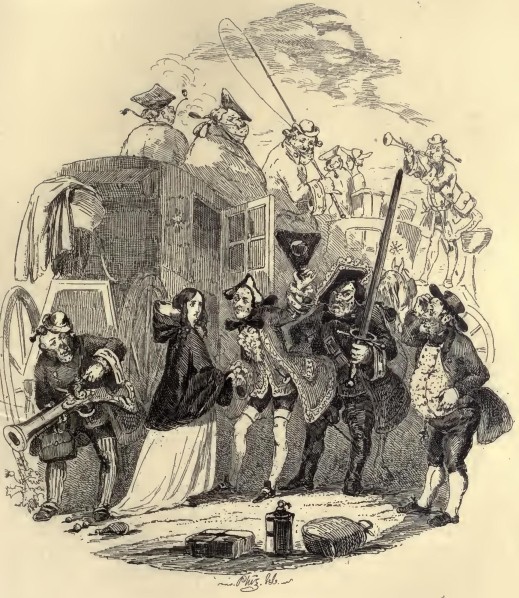

‘“Now, are you going to get in?” said the person who had addressed my uncle before. He was dressed as a mail guard, with a wig on his head and most enormous cuffs to his coat, and had a lantern in one hand, and a huge blunderbuss in the other, which he was going to stow away in his little arm-chest. “are you going to get in, Jack Martin?” said the guard, holding the lantern to my uncle’s face.
‘“Hollo!” said my uncle, falling back a step or two. “That’s familiar!”
‘“It’s so on the way-bill,” said the guard.
‘“Isn’t there a ‘Mister’ before it?” said my uncle. For he felt, gentlemen, that for a guard he didn’t know, to call him Jack Martin, was a liberty which the Post Office wouldn’t have sanctioned if they had known it.
‘“No, there is not,” rejoined the guard coolly.
‘“Is the fare paid?” inquired my uncle.
‘“Of course it is,” rejoined the guard.
‘“It is, is it?” said my uncle. “Then here goes! Which coach?”
‘“This,” said the guard, pointing to an old-fashioned Edinburgh and London mail, which had the steps down and the door open. “Stop! Here are the other passengers. Let them get in first.”
‘As the guard spoke, there all at once appeared, right in front of my uncle, a young gentleman in a powdered wig, and a sky-blue coat trimmed with silver, made very full and broad in the skirts, which were lined with buckram. Tiggin and Welps were in the printed calico and waistcoat piece line, gentlemen, so my uncle knew all the materials at once. He wore knee breeches, and a kind of leggings rolled up over his silk stockings, and shoes with buckles; he had ruffles at his wrists, a three-cornered hat on his head, and a long taper sword by his side. The flaps of his waist-coat came half-way down his thighs, and the ends of his cravat reached to his waist. He stalked gravely to the coach door, pulled off his hat, and held it above his head at arm’s length, cocking his little finger in the air at the same time, as some affected people do, when they take a cup of tea. Then he drew his feet together, and made a low, grave bow, and then put out his left hand. My uncle was just going to step forward, and shake it heartily, when he perceived that these attentions were directed, not towards him, but to a young lady who just then appeared at the foot of the steps, attired in an old-fashioned green velvet dress with a long waist and stomacher. She had no bonnet on her head, gentlemen, which was muffled in a black silk hood, but she looked round for an instant as she prepared to get into the coach, and such a beautiful face as she disclosed, my uncle had never seen—not even in a picture. She got into the coach, holding up her dress with one hand; and as my uncle always said with a round oath, when he told the story, he wouldn’t have believed it possible that legs and feet could have been brought to such a state of perfection unless he had seen them with his own eyes.
‘But, in this one glimpse of the beautiful face, my uncle saw that the young lady cast an imploring look upon him, and that she appeared terrified and distressed. He noticed, too, that the young fellow in the powdered wig, notwithstanding his show of gallantry, which was all very fine and grand, clasped her tight by the wrist when she got in, and followed himself immediately afterwards. An uncommonly ill-looking fellow, in a close brown wig, and a plum-coloured suit, wearing a very large sword, and boots up to his hips, belonged to the party; and when he sat himself down next to the young lady, who shrank into a corner at his approach, my uncle was confirmed in his original impression that something dark and mysterious was going forward, or, as he always said himself, that “there was a screw loose somewhere.” It’s quite surprising how quickly he made up his mind to help the lady at any peril, if she needed any help.
‘“Death and lightning!” exclaimed the young gentleman, laying his hand upon his sword as my uncle entered the coach.
‘“Blood and thunder!” roared the other gentleman. With this, he whipped his sword out, and made a lunge at my uncle without further ceremony. My uncle had no weapon about him, but with great dexterity he snatched the ill-looking gentleman’s three-cornered hat from his head, and, receiving the point of his sword right through the crown, squeezed the sides together, and held it tight.
‘“Pink him behind!” cried the ill-looking gentleman to his companion, as he struggled to regain his sword.
‘“He had better not,” cried my uncle, displaying the heel of one of his shoes, in a threatening manner. “I’ll kick his brains out, if he has any—, or fracture his skull if he hasn’t.” Exerting all his strength, at this moment, my uncle wrenched the ill-looking man’s sword from his grasp, and flung it clean out of the coach window, upon which the younger gentleman vociferated, “Death and lightning!” again, and laid his hand upon the hilt of his sword, in a very fierce manner, but didn’t draw it. Perhaps, gentlemen, as my uncle used to say with a smile, perhaps he was afraid of alarming the lady.
‘“Now, gentlemen,” said my uncle, taking his seat deliberately, “I don’t want to have any death, with or without lightning, in a lady’s presence, and we have had quite blood and thundering enough for one journey; so, if you please, we’ll sit in our places like quiet insides. Here, guard, pick up that gentleman’s carving-knife.”
‘As quickly as my uncle said the words, the guard appeared at the coach window, with the gentleman’s sword in his hand. He held up his lantern, and looked earnestly in my uncle’s face, as he handed it in, when, by its light, my uncle saw, to his great surprise, that an immense crowd of mail-coach guards swarmed round the window, every one of whom had his eyes earnestly fixed upon him too. He had never seen such a sea of white faces, red bodies, and earnest eyes, in all his born days.
‘“This is the strangest sort of thing I ever had anything to do with,” thought my uncle; “allow me to return you your hat, sir.”
‘The ill-looking gentleman received his three-cornered hat in silence, looked at the hole in the middle with an inquiring air, and finally stuck it on the top of his wig with a solemnity the effect of which was a trifle impaired by his sneezing violently at the moment, and jerking it off again.
‘“All right!” cried the guard with the lantern, mounting into his little seat behind. Away they went. My uncle peeped out of the coach window as they emerged from the yard, and observed that the other mails, with coachmen, guards, horses, and passengers, complete, were driving round and round in circles, at a slow trot of about five miles an hour. My uncle burned with indignation, gentlemen. As a commercial man, he felt that the mail-bags were not to be trifled with, and he resolved to memorialise the Post Office on the subject, the very instant he reached London.
‘At present, however, his thoughts were occupied with the young lady who sat in the farthest corner of the coach, with her face muffled closely in her hood; the gentleman with the sky-blue coat sitting opposite to her; the other man in the plum-coloured suit, by her side; and both watching her intently. If she so much as rustled the folds of her hood, he could hear the ill-looking man clap his hand upon his sword, and could tell by the other’s breathing (it was so dark he couldn’t see his face) that he was looking as big as if he were going to devour her at a mouthful. This roused my uncle more and more, and he resolved, come what might, to see the end of it. He had a great admiration for bright eyes, and sweet faces, and pretty legs and feet; in short, he was fond of the whole sex. It runs in our family, gentleman—so am I.
‘Many were the devices which my uncle practised, to attract the lady’s attention, or at all events, to engage the mysterious gentlemen in conversation. They were all in vain; the gentlemen wouldn’t talk, and the lady didn’t dare. He thrust his head out of the coach window at intervals, and bawled out to know why they didn’t go faster. But he called till he was hoarse; nobody paid the least attention to him. He leaned back in the coach, and thought of the beautiful face, and the feet and legs. This answered better; it whiled away the time, and kept him from wondering where he was going, and how it was that he found himself in such an odd situation. Not that this would have worried him much, anyway—he was a mighty free and easy, roving, devil-may-care sort of person, was my uncle, gentlemen.
‘All of a sudden the coach stopped. “Hollo!” said my uncle, “what’s in the wind now?”
‘“Alight here,” said the guard, letting down the steps.
‘“Here!” cried my uncle.
‘“Here,” rejoined the guard.
‘“I’ll do nothing of the sort,” said my uncle.
‘“Very well, then stop where you are,” said the guard.
‘“I will,” said my uncle.
‘“Do,” said the guard.
‘The passengers had regarded this colloquy with great attention, and, finding that my uncle was determined not to alight, the younger man squeezed past him, to hand the lady out. At this moment, the ill-looking man was inspecting the hole in the crown of his three-cornered hat. As the young lady brushed past, she dropped one of her gloves into my uncle’s hand, and softly whispered, with her lips so close to his face that he felt her warm breath on his nose, the single word “Help!” Gentlemen, my uncle leaped out of the coach at once, with such violence that it rocked on the springs again.
‘“Oh! you’ve thought better of it, have you?” said the guard, when he saw my uncle standing on the ground.
‘My uncle looked at the guard for a few seconds, in some doubt whether it wouldn’t be better to wrench his blunderbuss from him, fire it in the face of the man with the big sword, knock the rest of the company over the head with the stock, snatch up the young lady, and go off in the smoke. On second thoughts, however, he abandoned this plan, as being a shade too melodramatic in the execution, and followed the two mysterious men, who, keeping the lady between them, were now entering an old house in front of which the coach had stopped. They turned into the passage, and my uncle followed.
‘Of all the ruinous and desolate places my uncle had ever beheld, this was the most so. It looked as if it had once been a large house of entertainment; but the roof had fallen in, in many places, and the stairs were steep, rugged, and broken. There was a huge fireplace in the room into which they walked, and the chimney was blackened with smoke; but no warm blaze lighted it up now. The white feathery dust of burned wood was still strewed over the hearth, but the stove was cold, and all was dark and gloomy.
‘“Well,” said my uncle, as he looked about him, “a mail travelling at the rate of six miles and a half an hour, and stopping for an indefinite time at such a hole as this, is rather an irregular sort of proceeding, I fancy. This shall be made known. I’ll write to the papers.”
‘My uncle said this in a pretty loud voice, and in an open, unreserved sort of manner, with the view of engaging the two strangers in conversation if he could. But, neither of them took any more notice of him than whispering to each other, and scowling at him as they did so. The lady was at the farther end of the room, and once she ventured to wave her hand, as if beseeching my uncle’s assistance.
‘At length the two strangers advanced a little, and the conversation began in earnest.
‘“You don’t know this is a private room, I suppose, fellow?” said the gentleman in sky-blue.
‘“No, I do not, fellow,” rejoined my uncle. “Only, if this is a private room specially ordered for the occasion, I should think the public room must be a very comfortable one;” with this, my uncle sat himself down in a high-backed chair, and took such an accurate measure of the gentleman, with his eyes, that Tiggin and Welps could have supplied him with printed calico for a suit, and not an inch too much or too little, from that estimate alone.
‘“Quit this room,” said both men together, grasping their swords.
‘“Eh?” said my uncle, not at all appearing to comprehend their meaning.
‘“Quit the room, or you are a dead man,” said the ill-looking fellow with the large sword, drawing it at the same time and flourishing it in the air.
‘“Down with him!” cried the gentleman in sky-blue, drawing his sword also, and falling back two or three yards. “Down with him!” The lady gave a loud scream.
‘Now, my uncle was always remarkable for great boldness, and great presence of mind. All the time that he had appeared so indifferent to what was going on, he had been looking slily about for some missile or weapon of defence, and at the very instant when the swords were drawn, he espied, standing in the chimney-corner, an old basket-hilted rapier in a rusty scabbard. At one bound, my uncle caught it in his hand, drew it, flourished it gallantly above his head, called aloud to the lady to keep out of the way, hurled the chair at the man in sky-blue, and the scabbard at the man in plum-colour, and taking advantage of the confusion, fell upon them both, pell-mell.
‘Gentlemen, there is an old story—none the worse for being true—regarding a fine young Irish gentleman, who being asked if he could play the fiddle, replied he had no doubt he could, but he couldn’t exactly say, for certain, because he had never tried. This is not inapplicable to my uncle and his fencing. He had never had a sword in his hand before, except once when he played Richard the Third at a private theatre, upon which occasion it was arranged with Richmond that he was to be run through, from behind, without showing fight at all. But here he was, cutting and slashing with two experienced swordsman, thrusting, and guarding, and poking, and slicing, and acquitting himself in the most manful and dexterous manner possible, although up to that time he had never been aware that he had the least notion of the science. It only shows how true the old saying is, that a man never knows what he can do till he tries, gentlemen.
‘The noise of the combat was terrific; each of the three combatants swearing like troopers, and their swords clashing with as much noise as if all the knives and steels in Newport market were rattling together, at the same time. When it was at its very height, the lady (to encourage my uncle most probably) withdrew her hood entirely from her face, and disclosed a countenance of such dazzling beauty, that he would have fought against fifty men, to win one smile from it and die. He had done wonders before, but now he began to powder away like a raving mad giant.
‘At this very moment, the gentleman in sky-blue turning round, and seeing the young lady with her face uncovered, vented an exclamation of rage and jealousy, and, turning his weapon against her beautiful bosom, pointed a thrust at her heart, which caused my uncle to utter a cry of apprehension that made the building ring. The lady stepped lightly aside, and snatching the young man’s sword from his hand, before he had recovered his balance, drove him to the wall, and running it through him, and the panelling, up to the very hilt, pinned him there, hard and fast. It was a splendid example. My uncle, with a loud shout of triumph, and a strength that was irresistible, made his adversary retreat in the same direction, and plunging the old rapier into the very centre of a large red flower in the pattern of his waistcoat, nailed him beside his friend; there they both stood, gentlemen, jerking their arms and legs about in agony, like the toy-shop figures that are moved by a piece of pack-thread. My uncle always said, afterwards, that this was one of the surest means he knew of, for disposing of an enemy; but it was liable to one objection on the ground of expense, inasmuch as it involved the loss of a sword for every man disabled.
‘“The mail, the mail!” cried the lady, running up to my uncle and throwing her beautiful arms round his neck; “we may yet escape.”
‘“May!” cried my uncle; “why, my dear, there’s nobody else to kill, is there?” My uncle was rather disappointed, gentlemen, for he thought a little quiet bit of love-making would be agreeable after the slaughtering, if it were only to change the subject.
‘“We have not an instant to lose here,” said the young lady. “He (pointing to the young gentleman in sky-blue) is the only son of the powerful Marquess of Filletoville.”
‘“Well then, my dear, I’m afraid he’ll never come to the title,” said my uncle, looking coolly at the young gentleman as he stood fixed up against the wall, in the cockchafer fashion that I have described. “You have cut off the entail, my love.”
‘“I have been torn from my home and my friends by these villains,” said the young lady, her features glowing with indignation. “That wretch would have married me by violence in another hour.”
‘“Confound his impudence!” said my uncle, bestowing a very contemptuous look on the dying heir of Filletoville.
‘“As you may guess from what you have seen,” said the young lady, “the party were prepared to murder me if I appealed to any one for assistance. If their accomplices find us here, we are lost. Two minutes hence may be too late. The mail!” With these words, overpowered by her feelings, and the exertion of sticking the young Marquess of Filletoville, she sank into my uncle’s arms. My uncle caught her up, and bore her to the house door. There stood the mail, with four long-tailed, flowing-maned, black horses, ready harnessed; but no coachman, no guard, no hostler even, at the horses’ heads.
‘Gentlemen, I hope I do no injustice to my uncle’s memory, when I express my opinion, that although he was a bachelor, he had held some ladies in his arms before this time; I believe, indeed, that he had rather a habit of kissing barmaids; and I know, that in one or two instances, he had been seen by credible witnesses, to hug a landlady in a very perceptible manner. I mention the circumstance, to show what a very uncommon sort of person this beautiful young lady must have been, to have affected my uncle in the way she did; he used to say, that as her long dark hair trailed over his arm, and her beautiful dark eyes fixed themselves upon his face when she recovered, he felt so strange and nervous that his legs trembled beneath him. But who can look in a sweet, soft pair of dark eyes, without feeling queer? I can’t, gentlemen. I am afraid to look at some eyes I know, and that’s the truth of it.
‘“You will never leave me,” murmured the young lady.
‘“Never,” said my uncle. And he meant it too.
‘“My dear preserver!” exclaimed the young lady. “My dear, kind, brave preserver!”
‘“Don’t,” said my uncle, interrupting her.
‘“‘Why?” inquired the young lady.
‘“Because your mouth looks so beautiful when you speak,” rejoined my uncle, “that I’m afraid I shall be rude enough to kiss it.”
‘The young lady put up her hand as if to caution my uncle not to do so, and said—No, she didn’t say anything—she smiled. When you are looking at a pair of the most delicious lips in the world, and see them gently break into a roguish smile—if you are very near them, and nobody else by—you cannot better testify your admiration of their beautiful form and colour than by kissing them at once. My uncle did so, and I honour him for it.
‘“Hark!” cried the young lady, starting. “The noise of wheels, and horses!”
‘“So it is,” said my uncle, listening. He had a good ear for wheels, and the trampling of hoofs; but there appeared to be so many horses and carriages rattling towards them, from a distance, that it was impossible to form a guess at their number. The sound was like that of fifty brakes, with six blood cattle in each.
‘“We are pursued!” cried the young lady, clasping her hands. “We are pursued. I have no hope but in you!”
‘There was such an expression of terror in her beautiful face, that my uncle made up his mind at once. He lifted her into the coach, told her not to be frightened, pressed his lips to hers once more, and then advising her to draw up the window to keep the cold air out, mounted to the box.
‘“Stay, love,” cried the young lady.
‘“What’s the matter?” said my uncle, from the coach-box.
‘“I want to speak to you,” said the young lady; “only a word. Only one word, dearest.”
‘“Must I get down?” inquired my uncle. The lady made no answer, but she smiled again. Such a smile, gentlemen! It beat the other one, all to nothing. My uncle descended from his perch in a twinkling.
‘“What is it, my dear?” said my uncle, looking in at the coach window. The lady happened to bend forward at the same time, and my uncle thought she looked more beautiful than she had done yet. He was very close to her just then, gentlemen, so he really ought to know.
‘“What is it, my dear?” said my uncle.
‘“Will you never love any one but me—never marry any one beside?” said the young lady.
‘My uncle swore a great oath that he never would marry anybody else, and the young lady drew in her head, and pulled up the window. He jumped upon the box, squared his elbows, adjusted the ribands, seized the whip which lay on the roof, gave one flick to the off leader, and away went the four long-tailed, flowing-maned black horses, at fifteen good English miles an hour, with the old mail-coach behind them. Whew! How they tore along!
‘The noise behind grew louder. The faster the old mail went, the faster came the pursuers—men, horses, dogs, were leagued in the pursuit. The noise was frightful, but, above all, rose the voice of the young lady, urging my uncle on, and shrieking, “Faster! Faster!”
‘They whirled past the dark trees, as feathers would be swept before a hurricane. Houses, gates, churches, haystacks, objects of every kind they shot by, with a velocity and noise like roaring waters suddenly let loose. But still the noise of pursuit grew louder, and still my uncle could hear the young lady wildly screaming, “Faster! Faster!”
‘My uncle plied whip and rein, and the horses flew onward till they were white with foam; and yet the noise behind increased; and yet the young lady cried, “Faster! Faster!” My uncle gave a loud stamp on the boot in the energy of the moment, and—found that it was gray morning, and he was sitting in the wheelwright’s yard, on the box of an old Edinburgh mail, shivering with the cold and wet and stamping his feet to warm them! He got down, and looked eagerly inside for the beautiful young lady. Alas! There was neither door nor seat to the coach. It was a mere shell.
‘Of course, my uncle knew very well that there was some mystery in the matter, and that everything had passed exactly as he used to relate it. He remained staunch to the great oath he had sworn to the beautiful young lady, refusing several eligible landladies on her account, and dying a bachelor at last. He always said what a curious thing it was that he should have found out, by such a mere accident as his clambering over the palings, that the ghosts of mail-coaches and horses, guards, coachmen, and passengers, were in the habit of making journeys regularly every night. He used to add, that he believed he was the only living person who had ever been taken as a passenger on one of these excursions. And I think he was right, gentlemen—at least I never heard of any other.’
‘I wonder what these ghosts of mail-coaches carry in their bags,’ said the landlord, who had listened to the whole story with profound attention.
‘The dead letters, of course,’ said the bagman.
‘Oh, ah! To be sure,’ rejoined the landlord. ‘I never thought of that.’
CHAPTER L. HOW MR. PICKWICK SPED UPON HIS MISSION, AND HOW HE WAS REINFORCED IN THE OUTSET BY A MOST UNEXPECTED AUXILIARY
The horses were put to, punctually at a quarter before nine next morning, and Mr. Pickwick and Sam Weller having each taken his seat, the one inside and the other out, the postillion was duly directed to repair in the first instance to Mr. Bob Sawyer’s house, for the purpose of taking up Mr. Benjamin Allen.
It was with feelings of no small astonishment, when the carriage drew up before the door with the red lamp, and the very legible inscription of ‘Sawyer, late Nockemorf,’ that Mr. Pickwick saw, on popping his head out of the coach window, the boy in the gray livery very busily employed in putting up the shutters—the which, being an unusual and an unbusinesslike proceeding at that hour of the morning, at once suggested to his mind two inferences: the one, that some good friend and patient of Mr. Bob Sawyer’s was dead; the other, that Mr. Bob Sawyer himself was bankrupt.
‘What is the matter?’ said Mr. Pickwick to the boy.
‘Nothing’s the matter, Sir,’ replied the boy, expanding his mouth to the whole breadth of his countenance.
‘All right, all right!’ cried Bob Sawyer, suddenly appearing at the door, with a small leathern knapsack, limp and dirty, in one hand, and a rough coat and shawl thrown over the other arm. ‘I’m going, old fellow.’
‘You!’ exclaimed Mr. Pickwick.
‘Yes,’ replied Bob Sawyer, ‘and a regular expedition we’ll make of it. Here, Sam! Look out!’ Thus briefly bespeaking Mr. Weller’s attention, Mr. Bob Sawyer jerked the leathern knapsack into the dickey, where it was immediately stowed away, under the seat, by Sam, who regarded the proceeding with great admiration. This done, Mr. Bob Sawyer, with the assistance of the boy, forcibly worked himself into the rough coat, which was a few sizes too small for him, and then advancing to the coach window, thrust in his head, and laughed boisterously.
‘What a start it is, isn’t it?’ cried Bob, wiping the tears out of his eyes, with one of the cuffs of the rough coat.
‘My dear Sir,’ said Mr. Pickwick, with some embarrassment, ‘I had no idea of your accompanying us.’
‘No, that’s just the very thing,’ replied Bob, seizing Mr. Pickwick by the lappel of his coat. ‘That’s the joke.’
‘Oh, that’s the joke, is it?’ said Mr. Pickwick.
‘Of course,’ replied Bob. ‘It’s the whole point of the thing, you know—that, and leaving the business to take care of itself, as it seems to have made up its mind not to take care of me.’ With this explanation of the phenomenon of the shutters, Mr. Bob Sawyer pointed to the shop, and relapsed into an ecstasy of mirth.
‘Bless me, you are surely not mad enough to think of leaving your patients without anybody to attend them!’ remonstrated Mr. Pickwick in a very serious tone.
‘Why not?’ asked Bob, in reply. ‘I shall save by it, you know. None of them ever pay. Besides,’ said Bob, lowering his voice to a confidential whisper, ‘they will be all the better for it; for, being nearly out of drugs, and not able to increase my account just now, I should have been obliged to give them calomel all round, and it would have been certain to have disagreed with some of them. So it’s all for the best.’
There was a philosophy and a strength of reasoning about this reply, which Mr. Pickwick was not prepared for. He paused a few moments, and added, less firmly than before—
‘But this chaise, my young friend, will only hold two; and I am pledged to Mr. Allen.’
‘Don’t think of me for a minute,’ replied Bob. ‘I’ve arranged it all; Sam and I will share the dickey between us. Look here. This little bill is to be wafered on the shop door: “Sawyer, late Nockemorf. Inquire of Mrs. Cripps over the way.” Mrs. Cripps is my boy’s mother. “Mr. Sawyer’s very sorry,” says Mrs. Cripps, “couldn’t help it—fetched away early this morning to a consultation of the very first surgeons in the country—couldn’t do without him—would have him at any price—tremendous operation.” The fact is,’ said Bob, in conclusion, ‘it’ll do me more good than otherwise, I expect. If it gets into one of the local papers, it will be the making of me. Here’s Ben; now then, jump in!’
With these hurried words, Mr. Bob Sawyer pushed the postboy on one side, jerked his friend into the vehicle, slammed the door, put up the steps, wafered the bill on the street door, locked it, put the key in his pocket, jumped into the dickey, gave the word for starting, and did the whole with such extraordinary precipitation, that before Mr. Pickwick had well begun to consider whether Mr. Bob Sawyer ought to go or not, they were rolling away, with Mr. Bob Sawyer thoroughly established as part and parcel of the equipage.
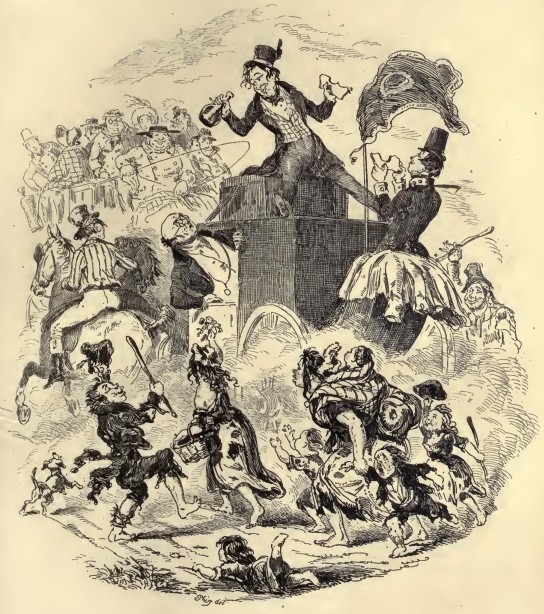
So long as their progress was confined to the streets of Bristol, the facetious Bob kept his professional green spectacles on, and conducted himself with becoming steadiness and gravity of demeanour; merely giving utterance to divers verbal witticisms for the exclusive behoof and entertainment of Mr. Samuel Weller. But when they emerged on the open road, he threw off his green spectacles and his gravity together, and performed a great variety of practical jokes, which were calculated to attract the attention of the passersby, and to render the carriage and those it contained objects of more than ordinary curiosity; the least conspicuous among these feats being a most vociferous imitation of a key-bugle, and the ostentatious display of a crimson silk pocket-handkerchief attached to a walking-stick, which was occasionally waved in the air with various gestures indicative of supremacy and defiance.
‘I wonder,’ said Mr. Pickwick, stopping in the midst of a most sedate conversation with Ben Allen, bearing reference to the numerous good qualities of Mr. Winkle and his sister—‘I wonder what all the people we pass, can see in us to make them stare so.’
‘It’s a neat turn-out,’ replied Ben Allen, with something of pride in his tone. ‘They’re not used to see this sort of thing, every day, I dare say.’
‘Possibly,’ replied Mr. Pickwick. ‘It may be so. Perhaps it is.’
Mr. Pickwick might very probably have reasoned himself into the belief that it really was, had he not, just then happening to look out of the coach window, observed that the looks of the passengers betokened anything but respectful astonishment, and that various telegraphic communications appeared to be passing between them and some persons outside the vehicle, whereupon it occurred to him that these demonstrations might be, in some remote degree, referable to the humorous deportment of Mr. Robert Sawyer.
‘I hope,’ said Mr. Pickwick, ‘that our volatile friend is committing no absurdities in that dickey behind.’
‘Oh dear, no,’ replied Ben Allen. ‘Except when he’s elevated, Bob’s the quietest creature breathing.’
Here a prolonged imitation of a key-bugle broke upon the ear, succeeded by cheers and screams, all of which evidently proceeded from the throat and lungs of the quietest creature breathing, or in plainer designation, of Mr. Bob Sawyer himself.
Mr. Pickwick and Mr. Ben Allen looked expressively at each other, and the former gentleman taking off his hat, and leaning out of the coach window until nearly the whole of his waistcoat was outside it, was at length enabled to catch a glimpse of his facetious friend.
Mr. Bob Sawyer was seated, not in the dickey, but on the roof of the chaise, with his legs as far asunder as they would conveniently go, wearing Mr. Samuel Weller’s hat on one side of his head, and bearing, in one hand, a most enormous sandwich, while, in the other, he supported a goodly-sized case-bottle, to both of which he applied himself with intense relish, varying the monotony of the occupation by an occasional howl, or the interchange of some lively badinage with any passing stranger. The crimson flag was carefully tied in an erect position to the rail of the dickey; and Mr. Samuel Weller, decorated with Bob Sawyer’s hat, was seated in the centre thereof, discussing a twin sandwich, with an animated countenance, the expression of which betokened his entire and perfect approval of the whole arrangement.
This was enough to irritate a gentleman with Mr. Pickwick’s sense of propriety, but it was not the whole extent of the aggravation, for a stage-coach full, inside and out, was meeting them at the moment, and the astonishment of the passengers was very palpably evinced. The congratulations of an Irish family, too, who were keeping up with the chaise, and begging all the time, were of rather a boisterous description, especially those of its male head, who appeared to consider the display as part and parcel of some political or other procession of triumph.
‘Mr. Sawyer!’ cried Mr. Pickwick, in a state of great excitement, ‘Mr. Sawyer, Sir!’
‘Hollo!’ responded that gentleman, looking over the side of the chaise with all the coolness in life.
‘Are you mad, sir?’ demanded Mr. Pickwick.
‘Not a bit of it,’ replied Bob; ‘only cheerful.’
‘Cheerful, sir!’ ejaculated Mr. Pickwick. ‘Take down that scandalous red handkerchief, I beg. I insist, Sir. Sam, take it down.’
Before Sam could interpose, Mr. Bob Sawyer gracefully struck his colours, and having put them in his pocket, nodded in a courteous manner to Mr. Pickwick, wiped the mouth of the case-bottle, and applied it to his own, thereby informing him, without any unnecessary waste of words, that he devoted that draught to wishing him all manner of happiness and prosperity. Having done this, Bob replaced the cork with great care, and looking benignantly down on Mr. Pickwick, took a large bite out of the sandwich, and smiled.
‘Come,’ said Mr. Pickwick, whose momentary anger was not quite proof against Bob’s immovable self-possession, ‘pray let us have no more of this absurdity.’
‘No, no,’ replied Bob, once more exchanging hats with Mr. Weller; ‘I didn’t mean to do it, only I got so enlivened with the ride that I couldn’t help it.’
‘Think of the look of the thing,’ expostulated Mr. Pickwick; ‘have some regard to appearances.’
‘Oh, certainly,’ said Bob, ‘it’s not the sort of thing at all. All over, governor.’
Satisfied with this assurance, Mr. Pickwick once more drew his head into the chaise and pulled up the glass; but he had scarcely resumed the conversation which Mr. Bob Sawyer had interrupted, when he was somewhat startled by the apparition of a small dark body, of an oblong form, on the outside of the window, which gave sundry taps against it, as if impatient of admission.
‘What’s this?’ exclaimed Mr. Pickwick.
‘It looks like a case-bottle;’ remarked Ben Allen, eyeing the object in question through his spectacles with some interest; ‘I rather think it belongs to Bob.’
The impression was perfectly accurate; for Mr. Bob Sawyer, having attached the case-bottle to the end of the walking-stick, was battering the window with it, in token of his wish, that his friends inside would partake of its contents, in all good-fellowship and harmony.
‘What’s to be done?’ said Mr. Pickwick, looking at the bottle. ‘This proceeding is more absurd than the other.’
‘I think it would be best to take it in,’ replied Mr. Ben Allen; ‘it would serve him right to take it in and keep it, wouldn’t it?’
‘It would,’ said Mr. Pickwick; ‘shall I?’
‘I think it the most proper course we could possibly adopt,’ replied Ben.
This advice quite coinciding with his own opinion, Mr. Pickwick gently let down the window and disengaged the bottle from the stick; upon which the latter was drawn up, and Mr. Bob Sawyer was heard to laugh heartily.
‘What a merry dog it is!’ said Mr. Pickwick, looking round at his companion, with the bottle in his hand.
‘He is,’ said Mr. Allen.
‘You cannot possibly be angry with him,’ remarked Mr. Pickwick.
‘Quite out of the question,’ observed Benjamin Allen.
During this short interchange of sentiments, Mr. Pickwick had, in an abstracted mood, uncorked the bottle.
‘What is it?’ inquired Ben Allen carelessly.
‘I don’t know,’ replied Mr. Pickwick, with equal carelessness. ‘It smells, I think, like milk-punch.’
Oh, indeed?’ said Ben.
‘I think so,’ rejoined Mr. Pickwick, very properly guarding himself against the possibility of stating an untruth; ‘mind, I could not undertake to say certainly, without tasting it.’
‘You had better do so,’ said Ben; ‘we may as well know what it is.’
‘Do you think so?’ replied Mr. Pickwick. ‘Well; if you are curious to know, of course I have no objection.’
Ever willing to sacrifice his own feelings to the wishes of his friend, Mr. Pickwick at once took a pretty long taste.
‘What is it?’ inquired Ben Allen, interrupting him with some impatience.
‘Curious,’ said Mr. Pickwick, smacking his lips, ‘I hardly know, now. Oh, yes!’ said Mr. Pickwick, after a second taste. ‘It is punch.’
Mr. Ben Allen looked at Mr. Pickwick; Mr. Pickwick looked at Mr. Ben Allen; Mr. Ben Allen smiled; Mr. Pickwick did not.
‘It would serve him right,’ said the last-named gentleman, with some severity—‘it would serve him right to drink it every drop.’
‘The very thing that occurred to me,’ said Ben Allen.
‘Is it, indeed?’ rejoined Mr. Pickwick. ‘Then here’s his health!’ With these words, that excellent person took a most energetic pull at the bottle, and handed it to Ben Allen, who was not slow to imitate his example. The smiles became mutual, and the milk-punch was gradually and cheerfully disposed of.
‘After all,’ said Mr. Pickwick, as he drained the last drop, ‘his pranks are really very amusing; very entertaining indeed.’
‘You may say that,’ rejoined Mr. Ben Allen. In proof of Bob Sawyer’s being one of the funniest fellows alive, he proceeded to entertain Mr. Pickwick with a long and circumstantial account how that gentleman once drank himself into a fever and got his head shaved; the relation of which pleasant and agreeable history was only stopped by the stoppage of the chaise at the Bell at Berkeley Heath, to change horses.
‘I say! We’re going to dine here, aren’t we?’ said Bob, looking in at the window.
‘Dine!’ said Mr. Pickwick. ‘Why, we have only come nineteen miles, and have eighty-seven and a half to go.’
‘Just the reason why we should take something to enable us to bear up against the fatigue,’ remonstrated Mr. Bob Sawyer.
‘Oh, it’s quite impossible to dine at half-past eleven o’clock in the day,’ replied Mr. Pickwick, looking at his watch.
‘So it is,’ rejoined Bob, ‘lunch is the very thing. Hollo, you sir! Lunch for three, directly; and keep the horses back for a quarter of an hour. Tell them to put everything they have cold, on the table, and some bottled ale, and let us taste your very best Madeira.’ Issuing these orders with monstrous importance and bustle, Mr. Bob Sawyer at once hurried into the house to superintend the arrangements; in less than five minutes he returned and declared them to be excellent.
The quality of the lunch fully justified the eulogium which Bob had pronounced, and very great justice was done to it, not only by that gentleman, but Mr. Ben Allen and Mr. Pickwick also. Under the auspices of the three, the bottled ale and the Madeira were promptly disposed of; and when (the horses being once more put to) they resumed their seats, with the case-bottle full of the best substitute for milk-punch that could be procured on so short a notice, the key-bugle sounded, and the red flag waved, without the slightest opposition on Mr. Pickwick’s part.
At the Hop Pole at Tewkesbury, they stopped to dine; upon which occasion there was more bottled ale, with some more Madeira, and some port besides; and here the case-bottle was replenished for the fourth time. Under the influence of these combined stimulants, Mr. Pickwick and Mr. Ben Allen fell fast asleep for thirty miles, while Bob and Mr. Weller sang duets in the dickey.
It was quite dark when Mr. Pickwick roused himself sufficiently to look out of the window. The straggling cottages by the road-side, the dingy hue of every object visible, the murky atmosphere, the paths of cinders and brick-dust, the deep-red glow of furnace fires in the distance, the volumes of dense smoke issuing heavily forth from high toppling chimneys, blackening and obscuring everything around; the glare of distant lights, the ponderous wagons which toiled along the road, laden with clashing rods of iron, or piled with heavy goods—all betokened their rapid approach to the great working town of Birmingham.
As they rattled through the narrow thoroughfares leading to the heart of the turmoil, the sights and sounds of earnest occupation struck more forcibly on the senses. The streets were thronged with working people. The hum of labour resounded from every house; lights gleamed from the long casement windows in the attic storeys, and the whirl of wheels and noise of machinery shook the trembling walls. The fires, whose lurid, sullen light had been visible for miles, blazed fiercely up, in the great works and factories of the town. The din of hammers, the rushing of steam, and the dead heavy clanking of engines, was the harsh music which arose from every quarter.
The postboy was driving briskly through the open streets, and past the handsome and well-lighted shops that intervene between the outskirts of the town and the Old Royal Hotel, before Mr. Pickwick had begun to consider the very difficult and delicate nature of the commission which had carried him thither.
The delicate nature of this commission, and the difficulty of executing it in a satisfactory manner, were by no means lessened by the voluntary companionship of Mr. Bob Sawyer. Truth to tell, Mr. Pickwick felt that his presence on the occasion, however considerate and gratifying, was by no means an honour he would willingly have sought; in fact, he would cheerfully have given a reasonable sum of money to have had Mr. Bob Sawyer removed to any place at not less than fifty miles’ distance, without delay.
Mr. Pickwick had never held any personal communication with Mr. Winkle, senior, although he had once or twice corresponded with him by letter, and returned satisfactory answers to his inquiries concerning the moral character and behaviour of his son; he felt nervously sensible that to wait upon him, for the first time, attended by Bob Sawyer and Ben Allen, both slightly fuddled, was not the most ingenious and likely means that could have been hit upon to prepossess him in his favour.
‘However,’ said Mr. Pickwick, endeavouring to reassure himself, ‘I must do the best I can. I must see him to-night, for I faithfully promised to do so. If they persist in accompanying me, I must make the interview as brief as possible, and be content that, for their own sakes, they will not expose themselves.’
As he comforted himself with these reflections, the chaise stopped at the door of the Old Royal. Ben Allen having been partially awakened from a stupendous sleep, and dragged out by the collar by Mr. Samuel Weller, Mr. Pickwick was enabled to alight. They were shown to a comfortable apartment, and Mr. Pickwick at once propounded a question to the waiter concerning the whereabout of Mr. Winkle’s residence.
‘Close by, Sir,’ said the waiter, ‘not above five hundred yards, Sir. Mr. Winkle is a wharfinger, Sir, at the canal, sir. Private residence is not—oh dear, no, sir, not five hundred yards, sir.’ Here the waiter blew a candle out, and made a feint of lighting it again, in order to afford Mr. Pickwick an opportunity of asking any further questions, if he felt so disposed.
‘Take anything now, Sir?’ said the waiter, lighting the candle in desperation at Mr. Pickwick’s silence. ‘Tea or coffee, Sir? Dinner, sir?’
‘Nothing now.’
‘Very good, sir. Like to order supper, Sir?’
‘Not just now.’
‘Very good, Sir.’ Here, he walked slowly to the door, and then stopping short, turned round and said, with great suavity—
‘Shall I send the chambermaid, gentlemen?’
‘You may if you please,’ replied Mr. Pickwick.
‘If you please, sir.’
‘And bring some soda-water,’ said Bob Sawyer.
‘Soda-water, Sir! Yes, Sir.’ With his mind apparently relieved from an overwhelming weight, by having at last got an order for something, the waiter imperceptibly melted away. Waiters never walk or run. They have a peculiar and mysterious power of skimming out of rooms, which other mortals possess not.
Some slight symptoms of vitality having been awakened in Mr. Ben Allen by the soda-water, he suffered himself to be prevailed upon to wash his face and hands, and to submit to be brushed by Sam. Mr. Pickwick and Bob Sawyer having also repaired the disorder which the journey had made in their apparel, the three started forth, arm in arm, to Mr. Winkle’s; Bob Sawyer impregnating the atmosphere with tobacco smoke as he walked along.
About a quarter of a mile off, in a quiet, substantial-looking street, stood an old red brick house with three steps before the door, and a brass plate upon it, bearing, in fat Roman capitals, the words, ‘Mr. Winkle.’ The steps were very white, and the bricks were very red, and the house was very clean; and here stood Mr. Pickwick, Mr. Benjamin Allen, and Mr. Bob Sawyer, as the clock struck ten.
A smart servant-girl answered the knock, and started on beholding the three strangers.
‘Is Mr. Winkle at home, my dear?’ inquired Mr. Pickwick.
‘He is just going to supper, Sir,’ replied the girl.
‘Give him that card if you please,’ rejoined Mr. Pickwick. ‘Say I am sorry to trouble him at so late an hour; but I am anxious to see him to-night, and have only just arrived.’
The girl looked timidly at Mr. Bob Sawyer, who was expressing his admiration of her personal charms by a variety of wonderful grimaces; and casting an eye at the hats and greatcoats which hung in the passage, called another girl to mind the door while she went upstairs. The sentinel was speedily relieved; for the girl returned immediately, and begging pardon of the gentlemen for leaving them in the street, ushered them into a floor-clothed back parlour, half office and half dressing room, in which the principal useful and ornamental articles of furniture were a desk, a wash-hand stand and shaving-glass, a boot-rack and boot-jack, a high stool, four chairs, a table, and an old eight-day clock. Over the mantelpiece were the sunken doors of an iron safe, while a couple of hanging shelves for books, an almanac, and several files of dusty papers, decorated the walls.
‘Very sorry to leave you standing at the door, Sir,’ said the girl, lighting a lamp, and addressing Mr. Pickwick with a winning smile, ‘but you was quite strangers to me; and we have such a many trampers that only come to see what they can lay their hands on, that really—’
‘There is not the least occasion for any apology, my dear,’ said Mr. Pickwick good-humouredly.
‘Not the slightest, my love,’ said Bob Sawyer, playfully stretching forth his arms, and skipping from side to side, as if to prevent the young lady’s leaving the room.
The young lady was not at all softened by these allurements, for she at once expressed her opinion, that Mr. Bob Sawyer was an ‘odous creetur;’ and, on his becoming rather more pressing in his attentions, imprinted her fair fingers upon his face, and bounced out of the room with many expressions of aversion and contempt.
Deprived of the young lady’s society, Mr. Bob Sawyer proceeded to divert himself by peeping into the desk, looking into all the table drawers, feigning to pick the lock of the iron safe, turning the almanac with its face to the wall, trying on the boots of Mr. Winkle, senior, over his own, and making several other humorous experiments upon the furniture, all of which afforded Mr. Pickwick unspeakable horror and agony, and yielded Mr. Bob Sawyer proportionate delight.
At length the door opened, and a little old gentleman in a snuff-coloured suit, with a head and face the precise counterpart of those belonging to Mr. Winkle, junior, excepting that he was rather bald, trotted into the room with Mr. Pickwick’s card in one hand, and a silver candlestick in the other.
‘Mr. Pickwick, sir, how do you do?’ said Winkle the elder, putting down the candlestick and proffering his hand. ‘Hope I see you well, sir. Glad to see you. Be seated, Mr. Pickwick, I beg, Sir. This gentleman is—’
‘My friend, Mr. Sawyer,’ interposed Mr. Pickwick, ‘your son’s friend.’
‘Oh,’ said Mr. Winkle the elder, looking rather grimly at Bob. ‘I hope you are well, sir.’
‘Right as a trivet, sir,’ replied Bob Sawyer.
‘This other gentleman,’ cried Mr. Pickwick, ‘is, as you will see when you have read the letter with which I am intrusted, a very near relative, or I should rather say a very particular friend of your son’s. His name is Allen.’
‘That gentleman?’ inquired Mr. Winkle, pointing with the card towards Ben Allen, who had fallen asleep in an attitude which left nothing of him visible but his spine and his coat collar.
Mr. Pickwick was on the point of replying to the question, and reciting Mr. Benjamin Allen’s name and honourable distinctions at full length, when the sprightly Mr. Bob Sawyer, with a view of rousing his friend to a sense of his situation, inflicted a startling pinch upon the fleshly part of his arm, which caused him to jump up with a shriek. Suddenly aware that he was in the presence of a stranger, Mr. Ben Allen advanced and, shaking Mr. Winkle most affectionately by both hands for about five minutes, murmured, in some half-intelligible fragments of sentences, the great delight he felt in seeing him, and a hospitable inquiry whether he felt disposed to take anything after his walk, or would prefer waiting ‘till dinner-time;’ which done, he sat down and gazed about him with a petrified stare, as if he had not the remotest idea where he was, which indeed he had not.
All this was most embarrassing to Mr. Pickwick, the more especially as Mr. Winkle, senior, evinced palpable astonishment at the eccentric—not to say extraordinary—behaviour of his two companions. To bring the matter to an issue at once, he drew a letter from his pocket, and presenting it to Mr. Winkle, senior, said—
‘This letter, Sir, is from your son. You will see, by its contents, that on your favourable and fatherly consideration of it, depend his future happiness and welfare. Will you oblige me by giving it the calmest and coolest perusal, and by discussing the subject afterwards with me, in the tone and spirit in which alone it ought to be discussed? You may judge of the importance of your decision to your son, and his intense anxiety upon the subject, by my waiting upon you, without any previous warning, at so late an hour; and,’ added Mr. Pickwick, glancing slightly at his two companions—‘and under such unfavourable circumstances.’
With this prelude, Mr. Pickwick placed four closely-written sides of extra superfine wire-wove penitence in the hands of the astounded Mr. Winkle, senior. Then reseating himself in his chair, he watched his looks and manner: anxiously, it is true, but with the open front of a gentleman who feels he has taken no part which he need excuse or palliate.
The old wharfinger turned the letter over, looked at the front, back, and sides, made a microscopic examination of the fat little boy on the seal, raised his eyes to Mr. Pickwick’s face, and then, seating himself on the high stool, and drawing the lamp closer to him, broke the wax, unfolded the epistle, and lifting it to the light, prepared to read.
Just at this moment, Mr. Bob Sawyer, whose wit had lain dormant for some minutes, placed his hands on his knees, and made a face after the portraits of the late Mr. Grimaldi, as clown. It so happened that Mr. Winkle, senior, instead of being deeply engaged in reading the letter, as Mr. Bob Sawyer thought, chanced to be looking over the top of it at no less a person than Mr. Bob Sawyer himself; rightly conjecturing that the face aforesaid was made in ridicule and derision of his own person, he fixed his eyes on Bob with such expressive sternness, that the late Mr. Grimaldi’s lineaments gradually resolved themselves into a very fine expression of humility and confusion.
‘Did you speak, Sir?’ inquired Mr. Winkle, senior, after an awful silence.
‘No, sir,’ replied Bob, With no remains of the clown about him, save and except the extreme redness of his cheeks.
‘You are sure you did not, sir?’ said Mr. Winkle, senior.
‘Oh dear, yes, sir, quite,’ replied Bob.
‘I thought you did, Sir,’ replied the old gentleman, with indignant emphasis. ‘Perhaps you looked at me, sir?’
‘Oh, no! sir, not at all,’ replied Bob, with extreme civility.
‘I am very glad to hear it, sir,’ said Mr. Winkle, senior. Having frowned upon the abashed Bob with great magnificence, the old gentleman again brought the letter to the light, and began to read it seriously.
Mr. Pickwick eyed him intently as he turned from the bottom line of the first page to the top line of the second, and from the bottom of the second to the top of the third, and from the bottom of the third to the top of the fourth; but not the slightest alteration of countenance afforded a clue to the feelings with which he received the announcement of his son’s marriage, which Mr. Pickwick knew was in the very first half-dozen lines.
He read the letter to the last word, folded it again with all the carefulness and precision of a man of business, and, just when Mr. Pickwick expected some great outbreak of feeling, dipped a pen in the ink-stand, and said, as quietly as if he were speaking on the most ordinary counting-house topic—
‘What is Nathaniel’s address, Mr. Pickwick?’
‘The George and Vulture, at present,’ replied that gentleman.
‘George and Vulture. Where is that?’
‘George Yard, Lombard Street.’
‘In the city?’
‘Yes.’
The old gentleman methodically indorsed the address on the back of the letter; and then, placing it in the desk, which he locked, said, as he got off the stool and put the bunch of keys in his pocket—
‘I suppose there is nothing else which need detain us, Mr. Pickwick?’
‘Nothing else, my dear Sir!’ observed that warm-hearted person in indignant amazement. ‘Nothing else! Have you no opinion to express on this momentous event in our young friend’s life? No assurance to convey to him, through me, of the continuance of your affection and protection? Nothing to say which will cheer and sustain him, and the anxious girl who looks to him for comfort and support? My dear Sir, consider.’
‘I will consider,’ replied the old gentleman. ‘I have nothing to say just now. I am a man of business, Mr. Pickwick. I never commit myself hastily in any affair, and from what I see of this, I by no means like the appearance of it. A thousand pounds is not much, Mr. Pickwick.’
‘You’re very right, Sir,’ interposed Ben Allen, just awake enough to know that he had spent his thousand pounds without the smallest difficulty. ‘You’re an intelligent man. Bob, he’s a very knowing fellow this.’
‘I am very happy to find that you do me the justice to make the admission, sir,’ said Mr. Winkle, senior, looking contemptuously at Ben Allen, who was shaking his head profoundly. ‘The fact is, Mr. Pickwick, that when I gave my son a roving license for a year or so, to see something of men and manners (which he has done under your auspices), so that he might not enter life a mere boarding-school milk-sop to be gulled by everybody, I never bargained for this. He knows that very well, so if I withdraw my countenance from him on this account, he has no call to be surprised. He shall hear from me, Mr. Pickwick. Good-night, sir.—Margaret, open the door.’
All this time, Bob Sawyer had been nudging Mr. Ben Allen to say something on the right side; Ben accordingly now burst, without the slightest preliminary notice, into a brief but impassioned piece of eloquence.
‘Sir,’ said Mr. Ben Allen, staring at the old gentleman, out of a pair of very dim and languid eyes, and working his right arm vehemently up and down, ‘you—you ought to be ashamed of yourself.’
‘As the lady’s brother, of course you are an excellent judge of the question,’ retorted Mr. Winkle, senior. ‘There; that’s enough. Pray say no more, Mr. Pickwick. Good-night, gentlemen!’
With these words the old gentleman took up the candle-stick and opening the room door, politely motioned towards the passage.
‘You will regret this, Sir,’ said Mr. Pickwick, setting his teeth close together to keep down his choler; for he felt how important the effect might prove to his young friend.
‘I am at present of a different opinion,’ calmly replied Mr. Winkle, senior. ‘Once again, gentlemen, I wish you a good-night.’
Mr. Pickwick walked with angry strides into the street. Mr. Bob Sawyer, completely quelled by the decision of the old gentleman’s manner, took the same course. Mr. Ben Allen’s hat rolled down the steps immediately afterwards, and Mr. Ben Allen’s body followed it directly. The whole party went silent and supperless to bed; and Mr. Pickwick thought, just before he fell asleep, that if he had known Mr. Winkle, senior, had been quite so much of a man of business, it was extremely probable he might never have waited upon him, on such an errand.
- The Posthumous Papers Of The Pickwick Club - Chapter Li. In Which Mr. Pickwick Encounters An Old Acquaintance—to Which Fortunate Circumstance The Reader Is Mainly Indebted For Matter Of Thrilling Interest Herein Set Down, Concerning Two Great Public Men Of Might And Power→
- The Posthumous Papers Of The Pickwick Club - Chapter Xlviii. Relates How Mr. Pickwick, With The Assistance Of Samuel Weller, Essayed To Soften The Heart Of Mr. Benjamin Allen, And To Mollify The Wrath Of Mr. Robert Sawyer←