
CHAPTER XV. IN WHICH IS GIVEN A FAITHFUL PORTRAITURE OF TWO DISTINGUISHED PERSONS; AND AN ACCURATE DESCRIPTION OF A PUBLIC BREAKFAST IN THEIR HOUSE AND GROUNDS: WHICH PUBLIC BREAKFAST LEADS TO THE RECOGNITION OF AN OLD ACQUAINTANCE, AND THE COMMENCEMENT OF ANOTHER CHAPTER
Mr. Pickwick’s conscience had been somewhat reproaching him for his recent neglect of his friends at the Peacock; and he was just on the point of walking forth in quest of them, on the third morning after the election had terminated, when his faithful valet put into his hand a card, on which was engraved the following inscription:—
THE DEN. EATANSWILL.
‘Person’s a-waitin’,’ said Sam, epigrammatically.
‘Does the person want me, Sam?’ inquired Mr. Pickwick.
‘He wants you partickler; and no one else ‘ll do, as the devil’s private secretary said ven he fetched avay Doctor Faustus,’ replied Mr. Weller.
‘He. Is it a gentleman?’ said Mr. Pickwick.
‘A wery good imitation o’ one, if it ain’t,’ replied Mr. Weller.
‘But this is a lady’s card,’ said Mr. Pickwick.
‘Given me by a gen’l’m’n, howsoever,’ replied Sam, ‘and he’s a-waitin’ in the drawing-room—said he’d rather wait all day, than not see you.’
Mr. Pickwick, on hearing this determination, descended to the drawing-room, where sat a grave man, who started up on his entrance, and said, with an air of profound respect:—
‘Mr. Pickwick, I presume?’
‘The same.’
‘Allow me, Sir, the honour of grasping your hand. Permit me, Sir, to shake it,’ said the grave man.
‘Certainly,’ said Mr. Pickwick. The stranger shook the extended hand, and then continued—
‘We have heard of your fame, sir. The noise of your antiquarian discussion has reached the ears of Mrs. Leo Hunter—my wife, sir; I am Mr. Leo Hunter’—the stranger paused, as if he expected that Mr. Pickwick would be overcome by the disclosure; but seeing that he remained perfectly calm, proceeded—
‘My wife, sir—Mrs. Leo Hunter—is proud to number among her acquaintance all those who have rendered themselves celebrated by their works and talents. Permit me, sir, to place in a conspicuous part of the list the name of Mr. Pickwick, and his brother-members of the club that derives its name from him.’
‘I shall be extremely happy to make the acquaintance of such a lady, sir,’ replied Mr. Pickwick.
‘You shall make it, sir,’ said the grave man. ‘To-morrow morning, sir, we give a public breakfast—a fete champetre—to a great number of those who have rendered themselves celebrated by their works and talents. Permit Mrs. Leo Hunter, Sir, to have the gratification of seeing you at the Den.’
‘With great pleasure,’ replied Mr. Pickwick.
‘Mrs. Leo Hunter has many of these breakfasts, Sir,’ resumed the new acquaintance—‘"feasts of reason,” sir, “and flows of soul,” as somebody who wrote a sonnet to Mrs. Leo Hunter on her breakfasts, feelingly and originally observed.’
‘Was he celebrated for his works and talents?’ inquired Mr. Pickwick.
‘He was Sir,’ replied the grave man, ‘all Mrs. Leo Hunter’s acquaintances are; it is her ambition, sir, to have no other acquaintance.’
‘It is a very noble ambition,’ said Mr. Pickwick.
‘When I inform Mrs. Leo Hunter, that that remark fell from your lips, sir, she will indeed be proud,’ said the grave man. ‘You have a gentleman in your train, who has produced some beautiful little poems, I think, sir.’
‘My friend Mr. Snodgrass has a great taste for poetry,’ replied Mr. Pickwick.
‘So has Mrs. Leo Hunter, Sir. She dotes on poetry, sir. She adores it; I may say that her whole soul and mind are wound up, and entwined with it. She has produced some delightful pieces, herself, sir. You may have met with her “Ode to an Expiring Frog,” sir.’
‘I don’t think I have,’ said Mr. Pickwick.
‘You astonish me, Sir,’ said Mr. Leo Hunter. ‘It created an immense sensation. It was signed with an “L” and eight stars, and appeared originally in a lady’s magazine. It commenced—
On thy stomach, without sighing;
Can I unmoved see thee dying
On a log
Expiring frog!”’
‘Beautiful!’ said Mr. Pickwick.
‘Fine,’ said Mr. Leo Hunter; ‘so simple.’
‘Very,’ said Mr. Pickwick.
‘The next verse is still more touching. Shall I repeat it?’
‘If you please,’ said Mr. Pickwick.
‘It runs thus,’ said the grave man, still more gravely.
With wild halloo, and brutal noise,
Hunted thee from marshy joys,
With a dog,
Expiring frog!”’
‘Finely expressed,’ said Mr. Pickwick.
‘All point, Sir,’ said Mr. Leo Hunter; ‘but you shall hear Mrs. Leo Hunter repeat it. She can do justice to it, Sir. She will repeat it, in character, Sir, to-morrow morning.’
‘In character!’
‘As Minerva. But I forgot—it’s a fancy-dress dejeune.’
‘Dear me,’ said Mr. Pickwick, glancing at his own figure—‘I can’t possibly—’
‘Can’t, sir; can’t!’ exclaimed Mr. Leo Hunter. ‘Solomon Lucas, the Jew in the High Street, has thousands of fancy-dresses. Consider, Sir, how many appropriate characters are open for your selection. Plato, Zeno, Epicurus, Pythagoras—all founders of clubs.’
‘I know that,’ said Mr. Pickwick; ‘but as I cannot put myself in competition with those great men, I cannot presume to wear their dresses.’
The grave man considered deeply, for a few seconds, and then said—
‘On reflection, Sir, I don’t know whether it would not afford Mrs. Leo Hunter greater pleasure, if her guests saw a gentleman of your celebrity in his own costume, rather than in an assumed one. I may venture to promise an exception in your case, sir—yes, I am quite certain that, on behalf of Mrs. Leo Hunter, I may venture to do so.’
‘In that case,’ said Mr. Pickwick, ‘I shall have great pleasure in coming.’
‘But I waste your time, Sir,’ said the grave man, as if suddenly recollecting himself. ‘I know its value, sir. I will not detain you. I may tell Mrs. Leo Hunter, then, that she may confidently expect you and your distinguished friends? Good-morning, Sir, I am proud to have beheld so eminent a personage—not a step sir; not a word.’ And without giving Mr. Pickwick time to offer remonstrance or denial, Mr. Leo Hunter stalked gravely away.
Mr. Pickwick took up his hat, and repaired to the Peacock, but Mr. Winkle had conveyed the intelligence of the fancy-ball there, before him.
‘Mrs. Pott’s going,’ were the first words with which he saluted his leader.
‘Is she?’ said Mr. Pickwick.
‘As Apollo,’ replied Winkle. ‘Only Pott objects to the tunic.’
‘He is right. He is quite right,’ said Mr. Pickwick emphatically.
‘Yes; so she’s going to wear a white satin gown with gold spangles.’
‘They’ll hardly know what she’s meant for; will they?’ inquired Mr. Snodgrass.
‘Of course they will,’ replied Mr. Winkle indignantly. ‘They’ll see her lyre, won’t they?’
‘True; I forgot that,’ said Mr. Snodgrass.
‘I shall go as a bandit,’ interposed Mr. Tupman.
‘What!’ said Mr. Pickwick, with a sudden start.
‘As a bandit,’ repeated Mr. Tupman, mildly.
‘You don’t mean to say,’ said Mr. Pickwick, gazing with solemn sternness at his friend—‘you don’t mean to say, Mr. Tupman, that it is your intention to put yourself into a green velvet jacket, with a two-inch tail?’
‘Such is my intention, Sir,’ replied Mr. Tupman warmly. ‘And why not, sir?’
‘Because, Sir,’ said Mr. Pickwick, considerably excited—‘because you are too old, Sir.’
‘Too old!’ exclaimed Mr. Tupman.
‘And if any further ground of objection be wanting,’ continued Mr. Pickwick, ‘you are too fat, sir.’
‘Sir,’ said Mr. Tupman, his face suffused with a crimson glow, ‘this is an insult.’
‘Sir,’ replied Mr. Pickwick, in the same tone, ‘it is not half the insult to you, that your appearance in my presence in a green velvet jacket, with a two-inch tail, would be to me.’
‘Sir,’ said Mr. Tupman, ‘you’re a fellow.’
‘Sir,’ said Mr. Pickwick, ‘you’re another!’
Mr. Tupman advanced a step or two, and glared at Mr. Pickwick. Mr. Pickwick returned the glare, concentrated into a focus by means of his spectacles, and breathed a bold defiance. Mr. Snodgrass and Mr. Winkle looked on, petrified at beholding such a scene between two such men.
‘Sir,’ said Mr. Tupman, after a short pause, speaking in a low, deep voice, ‘you have called me old.’
‘I have,’ said Mr. Pickwick.
‘And fat.’
‘I reiterate the charge.’
‘And a fellow.’
‘So you are!’
There was a fearful pause.
‘My attachment to your person, sir,’ said Mr. Tupman, speaking in a voice tremulous with emotion, and tucking up his wristbands meanwhile, ‘is great—very great—but upon that person, I must take summary vengeance.’
‘Come on, Sir!’ replied Mr. Pickwick. Stimulated by the exciting nature of the dialogue, the heroic man actually threw himself into a paralytic attitude, confidently supposed by the two bystanders to have been intended as a posture of defence.
‘What!’ exclaimed Mr. Snodgrass, suddenly recovering the power of speech, of which intense astonishment had previously bereft him, and rushing between the two, at the imminent hazard of receiving an application on the temple from each—‘what! Mr. Pickwick, with the eyes of the world upon you! Mr. Tupman! who, in common with us all, derives a lustre from his undying name! For shame, gentlemen; for shame.’
The unwonted lines which momentary passion had ruled in Mr. Pickwick’s clear and open brow, gradually melted away, as his young friend spoke, like the marks of a black-lead pencil beneath the softening influence of india-rubber. His countenance had resumed its usual benign expression, ere he concluded.
‘I have been hasty,’ said Mr. Pickwick, ‘very hasty. Tupman; your hand.’
The dark shadow passed from Mr. Tupman’s face, as he warmly grasped the hand of his friend.
‘I have been hasty, too,’ said he.
‘No, no,’ interrupted Mr. Pickwick, ‘the fault was mine. You will wear the green velvet jacket?’
‘No, no,’ replied Mr. Tupman.
‘To oblige me, you will,’ resumed Mr. Pickwick.
‘Well, well, I will,’ said Mr. Tupman.
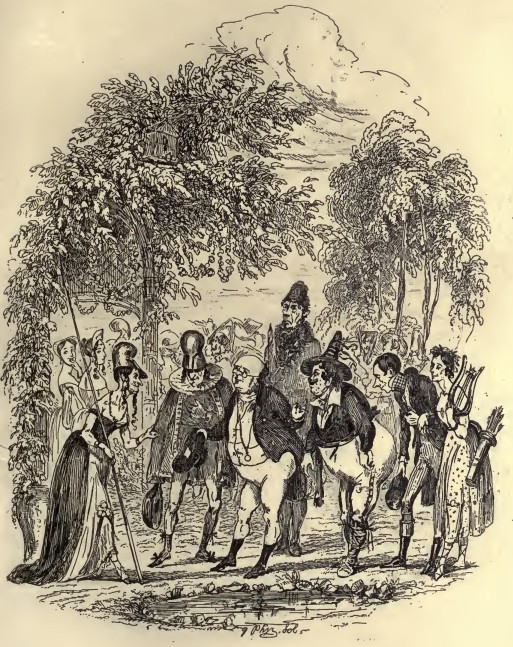

It was accordingly settled that Mr. Tupman, Mr. Winkle, and Mr. Snodgrass, should all wear fancy-dresses. Thus Mr. Pickwick was led by the very warmth of his own good feelings to give his consent to a proceeding from which his better judgment would have recoiled—a more striking illustration of his amiable character could hardly have been conceived, even if the events recorded in these pages had been wholly imaginary.
Mr. Leo Hunter had not exaggerated the resources of Mr. Solomon Lucas. His wardrobe was extensive—very extensive—not strictly classical perhaps, not quite new, nor did it contain any one garment made precisely after the fashion of any age or time, but everything was more or less spangled; and what can be prettier than spangles! It may be objected that they are not adapted to the daylight, but everybody knows that they would glitter if there were lamps; and nothing can be clearer than that if people give fancy-balls in the day-time, and the dresses do not show quite as well as they would by night, the fault lies solely with the people who give the fancy-balls, and is in no wise chargeable on the spangles. Such was the convincing reasoning of Mr. Solomon Lucas; and influenced by such arguments did Mr. Tupman, Mr. Winkle, and Mr. Snodgrass engage to array themselves in costumes which his taste and experience induced him to recommend as admirably suited to the occasion.
A carriage was hired from the Town Arms, for the accommodation of the Pickwickians, and a chariot was ordered from the same repository, for the purpose of conveying Mr. and Mrs. Pott to Mrs. Leo Hunter’s grounds, which Mr. Pott, as a delicate acknowledgment of having received an invitation, had already confidently predicted in the Eatanswill Gazette ‘would present a scene of varied and delicious enchantment—a bewildering coruscation of beauty and talent—a lavish and prodigal display of hospitality—above all, a degree of splendour softened by the most exquisite taste; and adornment refined with perfect harmony and the chastest good keeping—compared with which, the fabled gorgeousness of Eastern fairyland itself would appear to be clothed in as many dark and murky colours, as must be the mind of the splenetic and unmanly being who could presume to taint with the venom of his envy, the preparations made by the virtuous and highly distinguished lady at whose shrine this humble tribute of admiration was offered.’ This last was a piece of biting sarcasm against the Independent, who, in consequence of not having been invited at all, had been, through four numbers, affecting to sneer at the whole affair, in his very largest type, with all the adjectives in capital letters.
The morning came: it was a pleasant sight to behold Mr. Tupman in full brigand’s costume, with a very tight jacket, sitting like a pincushion over his back and shoulders, the upper portion of his legs incased in the velvet shorts, and the lower part thereof swathed in the complicated bandages to which all brigands are peculiarly attached. It was pleasing to see his open and ingenuous countenance, well mustachioed and corked, looking out from an open shirt collar; and to contemplate the sugar-loaf hat, decorated with ribbons of all colours, which he was compelled to carry on his knee, inasmuch as no known conveyance with a top to it, would admit of any man’s carrying it between his head and the roof. Equally humorous and agreeable was the appearance of Mr. Snodgrass in blue satin trunks and cloak, white silk tights and shoes, and Grecian helmet, which everybody knows (and if they do not, Mr. Solomon Lucas did) to have been the regular, authentic, everyday costume of a troubadour, from the earliest ages down to the time of their final disappearance from the face of the earth. All this was pleasant, but this was as nothing compared with the shouting of the populace when the carriage drew up, behind Mr. Pott’s chariot, which chariot itself drew up at Mr. Pott’s door, which door itself opened, and displayed the great Pott accoutred as a Russian officer of justice, with a tremendous knout in his hand—tastefully typical of the stern and mighty power of the Eatanswill Gazette, and the fearful lashings it bestowed on public offenders.
‘Bravo!’ shouted Mr. Tupman and Mr. Snodgrass from the passage, when they beheld the walking allegory.
‘Bravo!’ Mr. Pickwick was heard to exclaim, from the passage.
‘Hoo-roar Pott!’ shouted the populace. Amid these salutations, Mr. Pott, smiling with that kind of bland dignity which sufficiently testified that he felt his power, and knew how to exert it, got into the chariot.
Then there emerged from the house, Mrs. Pott, who would have looked very like Apollo if she hadn’t had a gown on, conducted by Mr. Winkle, who, in his light-red coat could not possibly have been mistaken for anything but a sportsman, if he had not borne an equal resemblance to a general postman. Last of all came Mr. Pickwick, whom the boys applauded as loud as anybody, probably under the impression that his tights and gaiters were some remnants of the dark ages; and then the two vehicles proceeded towards Mrs. Leo Hunter’s; Mr. Weller (who was to assist in waiting) being stationed on the box of that in which his master was seated.
Every one of the men, women, boys, girls, and babies, who were assembled to see the visitors in their fancy-dresses, screamed with delight and ecstasy, when Mr. Pickwick, with the brigand on one arm, and the troubadour on the other, walked solemnly up the entrance. Never were such shouts heard as those which greeted Mr. Tupman’s efforts to fix the sugar-loaf hat on his head, by way of entering the garden in style.
The preparations were on the most delightful scale; fully realising the prophetic Pott’s anticipations about the gorgeousness of Eastern fairyland, and at once affording a sufficient contradiction to the malignant statements of the reptile Independent. The grounds were more than an acre and a quarter in extent, and they were filled with people! Never was such a blaze of beauty, and fashion, and literature. There was the young lady who ‘did’ the poetry in the Eatanswill Gazette, in the garb of a sultana, leaning upon the arm of the young gentleman who ‘did’ the review department, and who was appropriately habited in a field-marshal’s uniform—the boots excepted. There were hosts of these geniuses, and any reasonable person would have thought it honour enough to meet them. But more than these, there were half a dozen lions from London—authors, real authors, who had written whole books, and printed them afterwards—and here you might see ‘em, walking about, like ordinary men, smiling, and talking—aye, and talking pretty considerable nonsense too, no doubt with the benign intention of rendering themselves intelligible to the common people about them. Moreover, there was a band of music in pasteboard caps; four something-ean singers in the costume of their country, and a dozen hired waiters in the costume of their country—and very dirty costume too. And above all, there was Mrs. Leo Hunter in the character of Minerva, receiving the company, and overflowing with pride and gratification at the notion of having called such distinguished individuals together.
‘Mr. Pickwick, ma’am,’ said a servant, as that gentleman approached the presiding goddess, with his hat in his hand, and the brigand and troubadour on either arm.
‘What! Where!’ exclaimed Mrs. Leo Hunter, starting up, in an affected rapture of surprise.
‘Here,’ said Mr. Pickwick.
‘Is it possible that I have really the gratification of beholding Mr. Pickwick himself!’ ejaculated Mrs. Leo Hunter.
‘No other, ma’am,’ replied Mr. Pickwick, bowing very low. ‘Permit me to introduce my friends—Mr. Tupman—Mr. Winkle—Mr. Snodgrass—to the authoress of “The Expiring Frog.”’
Very few people but those who have tried it, know what a difficult process it is to bow in green velvet smalls, and a tight jacket, and high-crowned hat; or in blue satin trunks and white silks, or knee-cords and top-boots that were never made for the wearer, and have been fixed upon him without the remotest reference to the comparative dimensions of himself and the suit. Never were such distortions as Mr. Tupman’s frame underwent in his efforts to appear easy and graceful—never was such ingenious posturing, as his fancy-dressed friends exhibited.
‘Mr. Pickwick,’ said Mrs. Leo Hunter, ‘I must make you promise not to stir from my side the whole day. There are hundreds of people here, that I must positively introduce you to.’
‘You are very kind, ma’am,’ said Mr. Pickwick.
‘In the first place, here are my little girls; I had almost forgotten them,’ said Minerva, carelessly pointing towards a couple of full-grown young ladies, of whom one might be about twenty, and the other a year or two older, and who were dressed in very juvenile costumes—whether to make them look young, or their mamma younger, Mr. Pickwick does not distinctly inform us.
‘They are very beautiful,’ said Mr. Pickwick, as the juveniles turned away, after being presented.
‘They are very like their mamma, Sir,’ said Mr. Pott, majestically.
‘Oh, you naughty man,’ exclaimed Mrs. Leo Hunter, playfully tapping the editor’s arm with her fan (Minerva with a fan!).
‘Why now, my dear Mrs. Hunter,’ said Mr. Pott, who was trumpeter in ordinary at the Den, ‘you know that when your picture was in the exhibition of the Royal Academy, last year, everybody inquired whether it was intended for you, or your youngest daughter; for you were so much alike that there was no telling the difference between you.’
‘Well, and if they did, why need you repeat it, before strangers?’ said Mrs. Leo Hunter, bestowing another tap on the slumbering lion of the Eatanswill Gazette.
‘Count, count,’ screamed Mrs. Leo Hunter to a well-whiskered individual in a foreign uniform, who was passing by.
‘Ah! you want me?’ said the count, turning back.
‘I want to introduce two very clever people to each other,’ said Mrs. Leo Hunter. ‘Mr. Pickwick, I have great pleasure in introducing you to Count Smorltork.’ She added in a hurried whisper to Mr. Pickwick—‘The famous foreigner—gathering materials for his great work on England—hem!—Count Smorltork, Mr. Pickwick.’
Mr. Pickwick saluted the count with all the reverence due to so great a man, and the count drew forth a set of tablets.
‘What you say, Mrs. Hunt?’ inquired the count, smiling graciously on the gratified Mrs. Leo Hunter, ‘Pig Vig or Big Vig—what you call—lawyer—eh? I see—that is it. Big Vig’—and the count was proceeding to enter Mr. Pickwick in his tablets, as a gentleman of the long robe, who derived his name from the profession to which he belonged, when Mrs. Leo Hunter interposed.
‘No, no, count,’ said the lady, ‘Pick-wick.’
‘Ah, ah, I see,’ replied the count. ‘Peek—christian name; Weeks—surname; good, ver good. Peek Weeks. How you do, Weeks?’
‘Quite well, I thank you,’ replied Mr. Pickwick, with all his usual affability. ‘Have you been long in England?’
‘Long—ver long time—fortnight—more.’
‘Do you stay here long?’
‘One week.’
‘You will have enough to do,’ said Mr. Pickwick smiling, ‘to gather all the materials you want in that time.’
‘Eh, they are gathered,’ said the count.
‘Indeed!’ said Mr. Pickwick.
‘They are here,’ added the count, tapping his forehead significantly. ‘Large book at home—full of notes—music, picture, science, potry, poltic; all tings.’
‘The word politics, sir,’ said Mr. Pickwick, ‘comprises in itself, a difficult study of no inconsiderable magnitude.’
‘Ah!’ said the count, drawing out the tablets again, ‘ver good—fine words to begin a chapter. Chapter forty-seven. Poltics. The word poltic surprises by himself—’ And down went Mr. Pickwick’s remark, in Count Smorltork’s tablets, with such variations and additions as the count’s exuberant fancy suggested, or his imperfect knowledge of the language occasioned.
‘Count,’ said Mrs. Leo Hunter.
‘Mrs. Hunt,’ replied the count.
‘This is Mr. Snodgrass, a friend of Mr. Pickwick’s, and a poet.’
‘Stop,’ exclaimed the count, bringing out the tablets once more. ‘Head, potry—chapter, literary friends—name, Snowgrass; ver good. Introduced to Snowgrass—great poet, friend of Peek Weeks—by Mrs. Hunt, which wrote other sweet poem—what is that name?—Fog—Perspiring Fog—ver good—ver good indeed.’ And the count put up his tablets, and with sundry bows and acknowledgments walked away, thoroughly satisfied that he had made the most important and valuable additions to his stock of information.
‘Wonderful man, Count Smorltork,’ said Mrs. Leo Hunter.
‘Sound philosopher,’ said Mr. Pott.
‘Clear-headed, strong-minded person,’ added Mr. Snodgrass.
A chorus of bystanders took up the shout of Count Smorltork’s praise, shook their heads sagely, and unanimously cried, ‘Very!’
As the enthusiasm in Count Smorltork’s favour ran very high, his praises might have been sung until the end of the festivities, if the four something-ean singers had not ranged themselves in front of a small apple-tree, to look picturesque, and commenced singing their national songs, which appeared by no means difficult of execution, inasmuch as the grand secret seemed to be, that three of the something-ean singers should grunt, while the fourth howled. This interesting performance having concluded amidst the loud plaudits of the whole company, a boy forthwith proceeded to entangle himself with the rails of a chair, and to jump over it, and crawl under it, and fall down with it, and do everything but sit upon it, and then to make a cravat of his legs, and tie them round his neck, and then to illustrate the ease with which a human being can be made to look like a magnified toad—all which feats yielded high delight and satisfaction to the assembled spectators. After which, the voice of Mrs. Pott was heard to chirp faintly forth, something which courtesy interpreted into a song, which was all very classical, and strictly in character, because Apollo was himself a composer, and composers can very seldom sing their own music or anybody else’s, either. This was succeeded by Mrs. Leo Hunter’s recitation of her far-famed ‘Ode to an Expiring Frog,’ which was encored once, and would have been encored twice, if the major part of the guests, who thought it was high time to get something to eat, had not said that it was perfectly shameful to take advantage of Mrs. Hunter’s good nature. So although Mrs. Leo Hunter professed her perfect willingness to recite the ode again, her kind and considerate friends wouldn’t hear of it on any account; and the refreshment room being thrown open, all the people who had ever been there before, scrambled in with all possible despatch—Mrs. Leo Hunter’s usual course of proceedings being, to issue cards for a hundred, and breakfast for fifty, or in other words to feed only the very particular lions, and let the smaller animals take care of themselves.
‘Where is Mr. Pott?’ said Mrs. Leo Hunter, as she placed the aforesaid lions around her.
‘Here I am,’ said the editor, from the remotest end of the room; far beyond all hope of food, unless something was done for him by the hostess.
‘Won’t you come up here?’
‘Oh, pray don’t mind him,’ said Mrs. Pott, in the most obliging voice—‘you give yourself a great deal of unnecessary trouble, Mrs. Hunter. You’ll do very well there, won’t you—dear?’
‘Certainly—love,’ replied the unhappy Pott, with a grim smile. Alas for the knout! The nervous arm that wielded it, with such a gigantic force on public characters, was paralysed beneath the glance of the imperious Mrs. Pott.
Mrs. Leo Hunter looked round her in triumph. Count Smorltork was busily engaged in taking notes of the contents of the dishes; Mr. Tupman was doing the honours of the lobster salad to several lionesses, with a degree of grace which no brigand ever exhibited before; Mr. Snodgrass having cut out the young gentleman who cut up the books for the Eatanswill Gazette, was engaged in an impassioned argument with the young lady who did the poetry; and Mr. Pickwick was making himself universally agreeable. Nothing seemed wanting to render the select circle complete, when Mr. Leo Hunter—whose department on these occasions, was to stand about in doorways, and talk to the less important people—suddenly called out—
‘My dear; here’s Mr. Charles Fitz-Marshall.’
‘Oh dear,’ said Mrs. Leo Hunter, ‘how anxiously I have been expecting him. Pray make room, to let Mr. Fitz-Marshall pass. Tell Mr. Fitz-Marshall, my dear, to come up to me directly, to be scolded for coming so late.’
‘Coming, my dear ma’am,’ cried a voice, ‘as quick as I can—crowds of people—full room—hard work—very.’
Mr. Pickwick’s knife and fork fell from his hand. He stared across the table at Mr. Tupman, who had dropped his knife and fork, and was looking as if he were about to sink into the ground without further notice.
‘Ah!’ cried the voice, as its owner pushed his way among the last five-and-twenty Turks, officers, cavaliers, and Charles the Seconds, that remained between him and the table, ‘regular mangle—Baker’s patent—not a crease in my coat, after all this squeezing—might have “got up my linen” as I came along—ha! ha! not a bad idea, that—queer thing to have it mangled when it’s upon one, though—trying process—very.’
With these broken words, a young man dressed as a naval officer made his way up to the table, and presented to the astonished Pickwickians the identical form and features of Mr. Alfred Jingle.
The offender had barely time to take Mrs. Leo Hunter’s proffered hand, when his eyes encountered the indignant orbs of Mr. Pickwick.
‘Hollo!’ said Jingle. ‘Quite forgot—no directions to postillion—give ‘em at once—back in a minute.’
‘The servant, or Mr. Hunter will do it in a moment, Mr. Fitz-Marshall,’ said Mrs. Leo Hunter.
‘No, no—I’ll do it—shan’t be long—back in no time,’ replied Jingle. With these words he disappeared among the crowd.
‘Will you allow me to ask you, ma’am,’ said the excited Mr. Pickwick, rising from his seat, ‘who that young man is, and where he resides?’
‘He is a gentleman of fortune, Mr. Pickwick,’ said Mrs. Leo Hunter, ‘to whom I very much want to introduce you. The count will be delighted with him.’
‘Yes, yes,’ said Mr. Pickwick hastily. ‘His residence—’
‘Is at present at the Angel at Bury.’
‘At Bury?’
‘At Bury St. Edmunds, not many miles from here. But dear me, Mr. Pickwick, you are not going to leave us; surely Mr. Pickwick you cannot think of going so soon?’
But long before Mrs. Leo Hunter had finished speaking, Mr. Pickwick had plunged through the throng, and reached the garden, whither he was shortly afterwards joined by Mr. Tupman, who had followed his friend closely.
‘It’s of no use,’ said Mr. Tupman. ‘He has gone.’
‘I know it,’ said Mr. Pickwick, ‘and I will follow him.’
‘Follow him! Where?’ inquired Mr. Tupman.
‘To the Angel at Bury,’ replied Mr. Pickwick, speaking very quickly. ‘How do we know whom he is deceiving there? He deceived a worthy man once, and we were the innocent cause. He shall not do it again, if I can help it; I’ll expose him! Sam! Where’s my servant?’
‘Here you are, Sir,’ said Mr. Weller, emerging from a sequestered spot, where he had been engaged in discussing a bottle of Madeira, which he had abstracted from the breakfast-table an hour or two before. ‘Here’s your servant, Sir. Proud o’ the title, as the living skellinton said, ven they show’d him.’
‘Follow me instantly,’ said Mr. Pickwick. ‘Tupman, if I stay at Bury, you can join me there, when I write. Till then, good-bye!’
Remonstrances were useless. Mr. Pickwick was roused, and his mind was made up. Mr. Tupman returned to his companions; and in another hour had drowned all present recollection of Mr. Alfred Jingle, or Mr. Charles Fitz-Marshall, in an exhilarating quadrille and a bottle of champagne. By that time, Mr. Pickwick and Sam Weller, perched on the outside of a stage-coach, were every succeeding minute placing a less and less distance between themselves and the good old town of Bury St. Edmunds.
CHAPTER XVI. TOO FULL OF ADVENTURE TO BE BRIEFLY DESCRIBED
There is no month in the whole year in which nature wears a more beautiful appearance than in the month of August. Spring has many beauties, and May is a fresh and blooming month, but the charms of this time of year are enhanced by their contrast with the winter season. August has no such advantage. It comes when we remember nothing but clear skies, green fields, and sweet-smelling flowers—when the recollection of snow, and ice, and bleak winds, has faded from our minds as completely as they have disappeared from the earth—and yet what a pleasant time it is! Orchards and cornfields ring with the hum of labour; trees bend beneath the thick clusters of rich fruit which bow their branches to the ground; and the corn, piled in graceful sheaves, or waving in every light breath that sweeps above it, as if it wooed the sickle, tinges the landscape with a golden hue. A mellow softness appears to hang over the whole earth; the influence of the season seems to extend itself to the very wagon, whose slow motion across the well-reaped field is perceptible only to the eye, but strikes with no harsh sound upon the ear.
As the coach rolls swiftly past the fields and orchards which skirt the road, groups of women and children, piling the fruit in sieves, or gathering the scattered ears of corn, pause for an instant from their labour, and shading the sun-burned face with a still browner hand, gaze upon the passengers with curious eyes, while some stout urchin, too small to work, but too mischievous to be left at home, scrambles over the side of the basket in which he has been deposited for security, and kicks and screams with delight. The reaper stops in his work, and stands with folded arms, looking at the vehicle as it whirls past; and the rough cart-horses bestow a sleepy glance upon the smart coach team, which says as plainly as a horse’s glance can, ‘It’s all very fine to look at, but slow going, over a heavy field, is better than warm work like that, upon a dusty road, after all.’ You cast a look behind you, as you turn a corner of the road. The women and children have resumed their labour; the reaper once more stoops to his work; the cart-horses have moved on; and all are again in motion.
The influence of a scene like this, was not lost upon the well-regulated mind of Mr. Pickwick. Intent upon the resolution he had formed, of exposing the real character of the nefarious Jingle, in any quarter in which he might be pursuing his fraudulent designs, he sat at first taciturn and contemplative, brooding over the means by which his purpose could be best attained. By degrees his attention grew more and more attracted by the objects around him; and at last he derived as much enjoyment from the ride, as if it had been undertaken for the pleasantest reason in the world.
‘Delightful prospect, Sam,’ said Mr. Pickwick.
‘Beats the chimbley-pots, Sir,’ replied Mr. Weller, touching his hat.
‘I suppose you have hardly seen anything but chimney-pots and bricks and mortar all your life, Sam,’ said Mr. Pickwick, smiling.
‘I worn’t always a boots, sir,’ said Mr. Weller, with a shake of the head. ‘I wos a vaginer’s boy, once.’
‘When was that?’ inquired Mr. Pickwick.
‘When I wos first pitched neck and crop into the world, to play at leap-frog with its troubles,’ replied Sam. ‘I wos a carrier’s boy at startin’; then a vaginer’s, then a helper, then a boots. Now I’m a gen’l’m’n’s servant. I shall be a gen’l’m’n myself one of these days, perhaps, with a pipe in my mouth, and a summer-house in the back-garden. Who knows? I shouldn’t be surprised for one.’
‘You are quite a philosopher, Sam,’ said Mr. Pickwick.
‘It runs in the family, I b’lieve, sir,’ replied Mr. Weller. ‘My father’s wery much in that line now. If my mother-in-law blows him up, he whistles. She flies in a passion, and breaks his pipe; he steps out, and gets another. Then she screams wery loud, and falls into ‘sterics; and he smokes wery comfortably till she comes to agin. That’s philosophy, Sir, ain’t it?’
‘A very good substitute for it, at all events,’ replied Mr. Pickwick, laughing. ‘It must have been of great service to you, in the course of your rambling life, Sam.’
‘Service, sir,’ exclaimed Sam. ‘You may say that. Arter I run away from the carrier, and afore I took up with the vaginer, I had unfurnished lodgin’s for a fortnight.’
‘Unfurnished lodgings?’ said Mr. Pickwick.
‘Yes—the dry arches of Waterloo Bridge. Fine sleeping-place—vithin ten minutes’ walk of all the public offices—only if there is any objection to it, it is that the sitivation’s rayther too airy. I see some queer sights there.’
Ah, I suppose you did,’ said Mr. Pickwick, with an air of considerable interest.
‘Sights, sir,’ resumed Mr. Weller, ‘as ‘ud penetrate your benevolent heart, and come out on the other side. You don’t see the reg’lar wagrants there; trust ‘em, they knows better than that. Young beggars, male and female, as hasn’t made a rise in their profession, takes up their quarters there sometimes; but it’s generally the worn-out, starving, houseless creeturs as roll themselves in the dark corners o’ them lonesome places—poor creeturs as ain’t up to the twopenny rope.’
‘And pray, Sam, what is the twopenny rope?’ inquired Mr. Pickwick.
‘The twopenny rope, sir,’ replied Mr. Weller, ‘is just a cheap lodgin’ house, where the beds is twopence a night.’
‘What do they call a bed a rope for?’ said Mr. Pickwick.
‘Bless your innocence, sir, that ain’t it,’ replied Sam. ‘Ven the lady and gen’l’m’n as keeps the hot-el first begun business, they used to make the beds on the floor; but this wouldn’t do at no price, ‘cos instead o’ taking a moderate twopenn’orth o’ sleep, the lodgers used to lie there half the day. So now they has two ropes, ‘bout six foot apart, and three from the floor, which goes right down the room; and the beds are made of slips of coarse sacking, stretched across ‘em.’
‘Well,’ said Mr. Pickwick.
‘Well,’ said Mr. Weller, ‘the adwantage o’ the plan’s hobvious. At six o’clock every mornin’ they let’s go the ropes at one end, and down falls the lodgers. Consequence is, that being thoroughly waked, they get up wery quietly, and walk away!’
‘Beg your pardon, sir,’ said Sam, suddenly breaking off in his loquacious discourse. ‘Is this Bury St. Edmunds?’
‘It is,’ replied Mr. Pickwick.
The coach rattled through the well-paved streets of a handsome little town, of thriving and cleanly appearance, and stopped before a large inn situated in a wide open street, nearly facing the old abbey.
‘And this,’ said Mr. Pickwick, looking up. ‘Is the Angel! We alight here, Sam. But some caution is necessary. Order a private room, and do not mention my name. You understand.’
‘Right as a trivet, sir,’ replied Mr. Weller, with a wink of intelligence; and having dragged Mr. Pickwick’s portmanteau from the hind boot, into which it had been hastily thrown when they joined the coach at Eatanswill, Mr. Weller disappeared on his errand. A private room was speedily engaged; and into it Mr. Pickwick was ushered without delay.
‘Now, Sam,’ said Mr. Pickwick, ‘the first thing to be done is to—’
Order dinner, Sir,’ interposed Mr. Weller. ‘It’s wery late, sir.’
‘Ah, so it is,’ said Mr. Pickwick, looking at his watch. ‘You are right, Sam.’
‘And if I might adwise, Sir,’ added Mr. Weller, ‘I’d just have a good night’s rest arterwards, and not begin inquiring arter this here deep ‘un till the mornin’. There’s nothin’ so refreshen’ as sleep, sir, as the servant girl said afore she drank the egg-cupful of laudanum.’
‘I think you are right, Sam,’ said Mr. Pickwick. ‘But I must first ascertain that he is in the house, and not likely to go away.’
‘Leave that to me, Sir,’ said Sam. ‘Let me order you a snug little dinner, and make my inquiries below while it’s a-getting ready; I could worm ev’ry secret out O’ the boots’s heart, in five minutes, Sir.’
Do so,’ said Mr. Pickwick; and Mr. Weller at once retired.
In half an hour, Mr. Pickwick was seated at a very satisfactory dinner; and in three-quarters Mr. Weller returned with the intelligence that Mr. Charles Fitz-Marshall had ordered his private room to be retained for him, until further notice. He was going to spend the evening at some private house in the neighbourhood, had ordered the boots to sit up until his return, and had taken his servant with him.
‘Now, sir,’ argued Mr. Weller, when he had concluded his report, ‘if I can get a talk with this here servant in the mornin’, he’ll tell me all his master’s concerns.’
‘How do you know that?’ interposed Mr. Pickwick.
‘Bless your heart, sir, servants always do,’ replied Mr. Weller.
‘Oh, ah, I forgot that,’ said Mr. Pickwick. ‘Well.’
‘Then you can arrange what’s best to be done, sir, and we can act accordingly.’
As it appeared that this was the best arrangement that could be made, it was finally agreed upon. Mr. Weller, by his master’s permission, retired to spend the evening in his own way; and was shortly afterwards elected, by the unanimous voice of the assembled company, into the taproom chair, in which honourable post he acquitted himself so much to the satisfaction of the gentlemen-frequenters, that their roars of laughter and approbation penetrated to Mr. Pickwick’s bedroom, and shortened the term of his natural rest by at least three hours.
Early on the ensuing morning, Mr. Weller was dispelling all the feverish remains of the previous evening’s conviviality, through the instrumentality of a halfpenny shower-bath (having induced a young gentleman attached to the stable department, by the offer of that coin, to pump over his head and face, until he was perfectly restored), when he was attracted by the appearance of a young fellow in mulberry-coloured livery, who was sitting on a bench in the yard, reading what appeared to be a hymn-book, with an air of deep abstraction, but who occasionally stole a glance at the individual under the pump, as if he took some interest in his proceedings, nevertheless.
‘You’re a rum ‘un to look at, you are!’ thought Mr. Weller, the first time his eyes encountered the glance of the stranger in the mulberry suit, who had a large, sallow, ugly face, very sunken eyes, and a gigantic head, from which depended a quantity of lank black hair. ‘You’re a rum ‘un!’ thought Mr. Weller; and thinking this, he went on washing himself, and thought no more about him.
Still the man kept glancing from his hymn-book to Sam, and from Sam to his hymn-book, as if he wanted to open a conversation. So at last, Sam, by way of giving him an opportunity, said with a familiar nod—
‘How are you, governor?’
‘I am happy to say, I am pretty well, Sir,’ said the man, speaking with great deliberation, and closing the book. ‘I hope you are the same, Sir?’
‘Why, if I felt less like a walking brandy-bottle I shouldn’t be quite so staggery this mornin’,’ replied Sam. ‘Are you stoppin’ in this house, old ‘un?’
The mulberry man replied in the affirmative.
‘How was it you worn’t one of us, last night?’ inquired Sam, scrubbing his face with the towel. ‘You seem one of the jolly sort—looks as conwivial as a live trout in a lime basket,’ added Mr. Weller, in an undertone.
‘I was out last night with my master,’ replied the stranger.
‘What’s his name?’ inquired Mr. Weller, colouring up very red with sudden excitement, and the friction of the towel combined.
‘Fitz-Marshall,’ said the mulberry man.
‘Give us your hand,’ said Mr. Weller, advancing; ‘I should like to know you. I like your appearance, old fellow.’
‘Well, that is very strange,’ said the mulberry man, with great simplicity of manner. ‘I like yours so much, that I wanted to speak to you, from the very first moment I saw you under the pump.’
Did you though?’
‘Upon my word. Now, isn’t that curious?’
‘Wery sing’ler,’ said Sam, inwardly congratulating himself upon the softness of the stranger. ‘What’s your name, my patriarch?’
‘Job.’
‘And a wery good name it is; only one I know that ain’t got a nickname to it. What’s the other name?’
‘Trotter,’ said the stranger. ‘What is yours?’
Sam bore in mind his master’s caution, and replied—
‘My name’s Walker; my master’s name’s Wilkins. Will you take a drop o’ somethin’ this mornin’, Mr. Trotter?’
Mr. Trotter acquiesced in this agreeable proposal; and having deposited his book in his coat pocket, accompanied Mr. Weller to the tap, where they were soon occupied in discussing an exhilarating compound, formed by mixing together, in a pewter vessel, certain quantities of British Hollands and the fragrant essence of the clove.
‘And what sort of a place have you got?’ inquired Sam, as he filled his companion’s glass, for the second time.
‘Bad,’ said Job, smacking his lips, ‘very bad.’
‘You don’t mean that?’ said Sam.
‘I do, indeed. Worse than that, my master’s going to be married.’
‘No.’
‘Yes; and worse than that, too, he’s going to run away with an immense rich heiress, from boarding-school.’
‘What a dragon!’ said Sam, refilling his companion’s glass. ‘It’s some boarding-school in this town, I suppose, ain’t it?’ Now, although this question was put in the most careless tone imaginable, Mr. Job Trotter plainly showed by gestures that he perceived his new friend’s anxiety to draw forth an answer to it. He emptied his glass, looked mysteriously at his companion, winked both of his small eyes, one after the other, and finally made a motion with his arm, as if he were working an imaginary pump-handle; thereby intimating that he (Mr. Trotter) considered himself as undergoing the process of being pumped by Mr. Samuel Weller.
‘No, no,’ said Mr. Trotter, in conclusion, ‘that’s not to be told to everybody. That is a secret—a great secret, Mr. Walker.’ As the mulberry man said this, he turned his glass upside down, by way of reminding his companion that he had nothing left wherewith to slake his thirst. Sam observed the hint; and feeling the delicate manner in which it was conveyed, ordered the pewter vessel to be refilled, whereat the small eyes of the mulberry man glistened.
‘And so it’s a secret?’ said Sam.
‘I should rather suspect it was,’ said the mulberry man, sipping his liquor, with a complacent face.
‘I suppose your mas’r’s wery rich?’ said Sam.
Mr. Trotter smiled, and holding his glass in his left hand, gave four distinct slaps on the pockets of his mulberry indescribables with his right, as if to intimate that his master might have done the same without alarming anybody much by the chinking of coin.
‘Ah,’ said Sam, ‘that’s the game, is it?’
The mulberry man nodded significantly.
‘Well, and don’t you think, old feller,’ remonstrated Mr. Weller, ‘that if you let your master take in this here young lady, you’re a precious rascal?’
‘I know that,’ said Job Trotter, turning upon his companion a countenance of deep contrition, and groaning slightly, ‘I know that, and that’s what it is that preys upon my mind. But what am I to do?’
‘Do!’ said Sam; ‘di-wulge to the missis, and give up your master.’
‘Who’d believe me?’ replied Job Trotter. ‘The young lady’s considered the very picture of innocence and discretion. She’d deny it, and so would my master. Who’d believe me? I should lose my place, and get indicted for a conspiracy, or some such thing; that’s all I should take by my motion.’
‘There’s somethin’ in that,’ said Sam, ruminating; ‘there’s somethin’ in that.’
‘If I knew any respectable gentleman who would take the matter up,’ continued Mr. Trotter. ‘I might have some hope of preventing the elopement; but there’s the same difficulty, Mr. Walker, just the same. I know no gentleman in this strange place; and ten to one if I did, whether he would believe my story.’
‘Come this way,’ said Sam, suddenly jumping up, and grasping the mulberry man by the arm. ‘My mas’r’s the man you want, I see.’ And after a slight resistance on the part of Job Trotter, Sam led his newly-found friend to the apartment of Mr. Pickwick, to whom he presented him, together with a brief summary of the dialogue we have just repeated.
‘I am very sorry to betray my master, sir,’ said Job Trotter, applying to his eyes a pink checked pocket-handkerchief about six inches square.
‘The feeling does you a great deal of honour,’ replied Mr. Pickwick; ‘but it is your duty, nevertheless.’
‘I know it is my duty, Sir,’ replied Job, with great emotion. ‘We should all try to discharge our duty, Sir, and I humbly endeavour to discharge mine, Sir; but it is a hard trial to betray a master, Sir, whose clothes you wear, and whose bread you eat, even though he is a scoundrel, Sir.’
‘You are a very good fellow,’ said Mr. Pickwick, much affected; ‘an honest fellow.’
‘Come, come,’ interposed Sam, who had witnessed Mr. Trotter’s tears with considerable impatience, ‘blow this ‘ere water-cart bis’ness. It won’t do no good, this won’t.’
‘Sam,’ said Mr. Pickwick reproachfully. ‘I am sorry to find that you have so little respect for this young man’s feelings.’
‘His feelin’s is all wery well, Sir,’ replied Mr. Weller; ‘and as they’re so wery fine, and it’s a pity he should lose ‘em, I think he’d better keep ‘em in his own buzzum, than let ‘em ewaporate in hot water, ‘specially as they do no good. Tears never yet wound up a clock, or worked a steam ingin’. The next time you go out to a smoking party, young fellow, fill your pipe with that ‘ere reflection; and for the present just put that bit of pink gingham into your pocket. ‘Tain’t so handsome that you need keep waving it about, as if you was a tight-rope dancer.’
‘My man is in the right,’ said Mr. Pickwick, accosting Job, ‘although his mode of expressing his opinion is somewhat homely, and occasionally incomprehensible.’
‘He is, sir, very right,’ said Mr. Trotter, ‘and I will give way no longer.’
Very well,’ said Mr. Pickwick. ‘Now, where is this boarding-school?’
‘It is a large, old, red brick house, just outside the town, Sir,’ replied Job Trotter.
‘And when,’ said Mr. Pickwick—‘when is this villainous design to be carried into execution—when is this elopement to take place?’
‘To-night, Sir,’ replied Job.
‘To-night!’ exclaimed Mr. Pickwick.
‘This very night, sir,’ replied Job Trotter. ‘That is what alarms me so much.’
‘Instant measures must be taken,’ said Mr. Pickwick. ‘I will see the lady who keeps the establishment immediately.’
‘I beg your pardon, Sir,’ said Job, ‘but that course of proceeding will never do.’
‘Why not?’ inquired Mr. Pickwick.
‘My master, sir, is a very artful man.’
‘I know he is,’ said Mr. Pickwick.
‘And he has so wound himself round the old lady’s heart, Sir,’ resumed Job, ‘that she would believe nothing to his prejudice, if you went down on your bare knees, and swore it; especially as you have no proof but the word of a servant, who, for anything she knows (and my master would be sure to say so), was discharged for some fault, and does this in revenge.’
‘What had better be done, then?’ said Mr. Pickwick.
‘Nothing but taking him in the very act of eloping, will convince the old lady, sir,’ replied Job.
‘All them old cats will run their heads agin milestones,’ observed Mr. Weller, in a parenthesis.
‘But this taking him in the very act of elopement, would be a very difficult thing to accomplish, I fear,’ said Mr. Pickwick.
‘I don’t know, sir,’ said Mr. Trotter, after a few moments’ reflection. ‘I think it might be very easily done.’
‘How?’ was Mr. Pickwick’s inquiry.
‘Why,’ replied Mr. Trotter, ‘my master and I, being in the confidence of the two servants, will be secreted in the kitchen at ten o’clock. When the family have retired to rest, we shall come out of the kitchen, and the young lady out of her bedroom. A post-chaise will be waiting, and away we go.’
‘Well?’ said Mr. Pickwick.
‘Well, sir, I have been thinking that if you were in waiting in the garden behind, alone—’
‘Alone,’ said Mr. Pickwick. ‘Why alone?’
‘I thought it very natural,’ replied Job, ‘that the old lady wouldn’t like such an unpleasant discovery to be made before more persons than can possibly be helped. The young lady, too, sir—consider her feelings.’
‘You are very right,’ said Mr. Pickwick. ‘The consideration evinces your delicacy of feeling. Go on; you are very right.’
‘Well, sir, I have been thinking that if you were waiting in the back garden alone, and I was to let you in, at the door which opens into it, from the end of the passage, at exactly half-past eleven o’clock, you would be just in the very moment of time to assist me in frustrating the designs of this bad man, by whom I have been unfortunately ensnared.’ Here Mr. Trotter sighed deeply.
‘Don’t distress yourself on that account,’ said Mr. Pickwick; ‘if he had one grain of the delicacy of feeling which distinguishes you, humble as your station is, I should have some hopes of him.’
Job Trotter bowed low; and in spite of Mr. Weller’s previous remonstrance, the tears again rose to his eyes.
‘I never see such a feller,’ said Sam, ‘Blessed if I don’t think he’s got a main in his head as is always turned on.’
‘Sam,’ said Mr. Pickwick, with great severity, ‘hold your tongue.’
‘Wery well, sir,’ replied Mr. Weller.
‘I don’t like this plan,’ said Mr. Pickwick, after deep meditation. ‘Why cannot I communicate with the young lady’s friends?’
‘Because they live one hundred miles from here, sir,’ responded Job Trotter.
‘That’s a clincher,’ said Mr. Weller, aside.
‘Then this garden,’ resumed Mr. Pickwick. ‘How am I to get into it?’
‘The wall is very low, sir, and your servant will give you a leg up.’
My servant will give me a leg up,’ repeated Mr. Pickwick mechanically. ‘You will be sure to be near this door that you speak of?’
‘You cannot mistake it, Sir; it’s the only one that opens into the garden. Tap at it when you hear the clock strike, and I will open it instantly.’
‘I don’t like the plan,’ said Mr. Pickwick; ‘but as I see no other, and as the happiness of this young lady’s whole life is at stake, I adopt it. I shall be sure to be there.’
Thus, for the second time, did Mr. Pickwick’s innate good-feeling involve him in an enterprise from which he would most willingly have stood aloof.
‘What is the name of the house?’ inquired Mr. Pickwick.
‘Westgate House, Sir. You turn a little to the right when you get to the end of the town; it stands by itself, some little distance off the high road, with the name on a brass plate on the gate.’
‘I know it,’ said Mr. Pickwick. ‘I observed it once before, when I was in this town. You may depend upon me.’
Mr. Trotter made another bow, and turned to depart, when Mr. Pickwick thrust a guinea into his hand.
‘You’re a fine fellow,’ said Mr. Pickwick, ‘and I admire your goodness of heart. No thanks. Remember—eleven o’clock.’
‘There is no fear of my forgetting it, sir,’ replied Job Trotter. With these words he left the room, followed by Sam.
‘I say,’ said the latter, ‘not a bad notion that ‘ere crying. I’d cry like a rain-water spout in a shower on such good terms. How do you do it?’
‘It comes from the heart, Mr. Walker,’ replied Job solemnly. ‘Good-morning, sir.’
‘You’re a soft customer, you are; we’ve got it all out o’ you, anyhow,’ thought Mr. Weller, as Job walked away.
We cannot state the precise nature of the thoughts which passed through Mr. Trotter’s mind, because we don’t know what they were.
The day wore on, evening came, and at a little before ten o’clock Sam Weller reported that Mr. Jingle and Job had gone out together, that their luggage was packed up, and that they had ordered a chaise. The plot was evidently in execution, as Mr. Trotter had foretold.
Half-past ten o’clock arrived, and it was time for Mr. Pickwick to issue forth on his delicate errand. Resisting Sam’s tender of his greatcoat, in order that he might have no encumbrance in scaling the wall, he set forth, followed by his attendant.
There was a bright moon, but it was behind the clouds. It was a fine dry night, but it was most uncommonly dark. Paths, hedges, fields, houses, and trees, were enveloped in one deep shade. The atmosphere was hot and sultry, the summer lightning quivered faintly on the verge of the horizon, and was the only sight that varied the dull gloom in which everything was wrapped—sound there was none, except the distant barking of some restless house-dog.
They found the house, read the brass plate, walked round the wall, and stopped at that portion of it which divided them from the bottom of the garden.
‘You will return to the inn, Sam, when you have assisted me over,’ said Mr. Pickwick.
‘Wery well, Sir.’
‘And you will sit up, till I return.’
‘Cert’nly, Sir.’
‘Take hold of my leg; and, when I say “Over,” raise me gently.’
‘All right, sir.’
Having settled these preliminaries, Mr. Pickwick grasped the top of the wall, and gave the word ‘Over,’ which was literally obeyed. Whether his body partook in some degree of the elasticity of his mind, or whether Mr. Weller’s notions of a gentle push were of a somewhat rougher description than Mr. Pickwick’s, the immediate effect of his assistance was to jerk that immortal gentleman completely over the wall on to the bed beneath, where, after crushing three gooseberry-bushes and a rose-tree, he finally alighted at full length.
‘You ha’n’t hurt yourself, I hope, Sir?’ said Sam, in a loud whisper, as soon as he had recovered from the surprise consequent upon the mysterious disappearance of his master.
‘I have not hurt myself, Sam, certainly,’ replied Mr. Pickwick, from the other side of the wall, ‘but I rather think that you have hurt me.’
‘I hope not, Sir,’ said Sam.
‘Never mind,’ said Mr. Pickwick, rising, ‘it’s nothing but a few scratches. Go away, or we shall be overheard.’
‘Good-bye, Sir.’
‘Good-bye.’
With stealthy steps Sam Weller departed, leaving Mr. Pickwick alone in the garden.
Lights occasionally appeared in the different windows of the house, or glanced from the staircases, as if the inmates were retiring to rest. Not caring to go too near the door, until the appointed time, Mr. Pickwick crouched into an angle of the wall, and awaited its arrival.
It was a situation which might well have depressed the spirits of many a man. Mr. Pickwick, however, felt neither depression nor misgiving. He knew that his purpose was in the main a good one, and he placed implicit reliance on the high-minded Job. It was dull, certainly; not to say dreary; but a contemplative man can always employ himself in meditation. Mr. Pickwick had meditated himself into a doze, when he was roused by the chimes of the neighbouring church ringing out the hour—half-past eleven.
- The Posthumous Papers Of The Pickwick Club - Chapter Xvii. Showing That An Attack Of Rheumatism, In Some Cases, Acts As A Quickener To Inventive Genius→
- The Posthumous Papers Of The Pickwick Club - Chapter Xiv. Comprising A Brief Description Of The Company At The Peacock Assembled; And A Tale Told By A Bagman←