
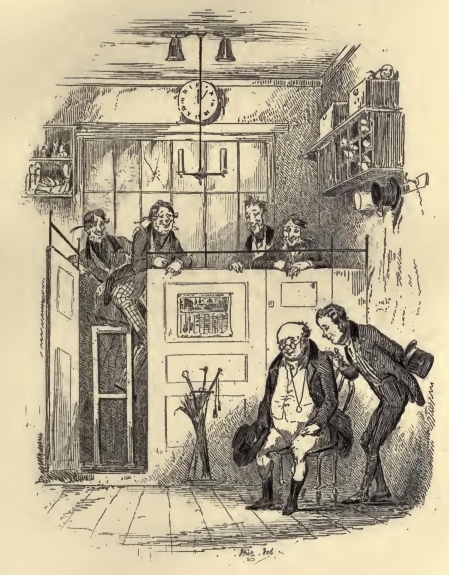

‘Nice men these here, Sir,’ whispered Mr. Weller to his master; ‘wery nice notion of fun they has, Sir.’
Mr. Pickwick nodded assent, and coughed to attract the attention of the young gentlemen behind the partition, who, having now relaxed their minds by a little conversation among themselves, condescended to take some notice of the stranger.
‘I wonder whether Fogg’s disengaged now?’ said Jackson.
‘I’ll see,’ said Wicks, dismounting leisurely from his stool. ‘What name shall I tell Mr. Fogg?’
‘Pickwick,’ replied the illustrious subject of these memoirs.
Mr. Jackson departed upstairs on his errand, and immediately returned with a message that Mr. Fogg would see Mr. Pickwick in five minutes; and having delivered it, returned again to his desk.
‘What did he say his name was?’ whispered Wicks.
‘Pickwick,’ replied Jackson; ‘it’s the defendant in Bardell and Pickwick.’
A sudden scraping of feet, mingled with the sound of suppressed laughter, was heard from behind the partition.
‘They’re a-twiggin’ of you, Sir,’ whispered Mr. Weller.
‘Twigging of me, Sam!’ replied Mr. Pickwick; ‘what do you mean by twigging me?’
Mr. Weller replied by pointing with his thumb over his shoulder, and Mr. Pickwick, on looking up, became sensible of the pleasing fact, that all the four clerks, with countenances expressive of the utmost amusement, and with their heads thrust over the wooden screen, were minutely inspecting the figure and general appearance of the supposed trifler with female hearts, and disturber of female happiness. On his looking up, the row of heads suddenly disappeared, and the sound of pens travelling at a furious rate over paper, immediately succeeded.
A sudden ring at the bell which hung in the office, summoned Mr. Jackson to the apartment of Fogg, from whence he came back to say that he (Fogg) was ready to see Mr. Pickwick if he would step upstairs.
Upstairs Mr. Pickwick did step accordingly, leaving Sam Weller below. The room door of the one-pair back, bore inscribed in legible characters the imposing words, ‘Mr. Fogg’; and, having tapped thereat, and been desired to come in, Jackson ushered Mr. Pickwick into the presence.
‘Is Mr. Dodson in?’ inquired Mr. Fogg.
‘Just come in, Sir,’ replied Jackson.
‘Ask him to step here.’
‘Yes, sir.’ Exit Jackson.
‘Take a seat, sir,’ said Fogg; ‘there is the paper, sir; my partner will be here directly, and we can converse about this matter, sir.’
Mr. Pickwick took a seat and the paper, but, instead of reading the latter, peeped over the top of it, and took a survey of the man of business, who was an elderly, pimply-faced, vegetable-diet sort of man, in a black coat, dark mixture trousers, and small black gaiters; a kind of being who seemed to be an essential part of the desk at which he was writing, and to have as much thought or feeling.
After a few minutes’ silence, Mr. Dodson, a plump, portly, stern-looking man, with a loud voice, appeared; and the conversation commenced.
‘This is Mr. Pickwick,’ said Fogg.
‘Ah! You are the defendant, Sir, in Bardell and Pickwick?’ said Dodson.
‘I am, sir,’ replied Mr. Pickwick.
‘Well, sir,’ said Dodson, ‘and what do you propose?’
‘Ah!’ said Fogg, thrusting his hands into his trousers’ pockets, and throwing himself back in his chair, ‘what do you propose, Mr Pickwick?’
‘Hush, Fogg,’ said Dodson, ‘let me hear what Mr. Pickwick has to say.’
‘I came, gentlemen,’ said Mr. Pickwick, gazing placidly on the two partners, ‘I came here, gentlemen, to express the surprise with which I received your letter of the other day, and to inquire what grounds of action you can have against me.’
‘Grounds of—’ Fogg had ejaculated this much, when he was stopped by Dodson.
‘Mr. Fogg,’ said Dodson, ‘I am going to speak.’
I beg your pardon, Mr. Dodson,’ said Fogg.
‘For the grounds of action, sir,’ continued Dodson, with moral elevation in his air, ‘you will consult your own conscience and your own feelings. We, Sir, we, are guided entirely by the statement of our client. That statement, Sir, may be true, or it may be false; it may be credible, or it may be incredible; but, if it be true, and if it be credible, I do not hesitate to say, Sir, that our grounds of action, Sir, are strong, and not to be shaken. You may be an unfortunate man, Sir, or you may be a designing one; but if I were called upon, as a juryman upon my oath, Sir, to express an opinion of your conduct, Sir, I do not hesitate to assert that I should have but one opinion about it.’ Here Dodson drew himself up, with an air of offended virtue, and looked at Fogg, who thrust his hands farther in his pockets, and nodding his head sagely, said, in a tone of the fullest concurrence, ‘Most certainly.’
‘Well, Sir,’ said Mr. Pickwick, with considerable pain depicted in his countenance, ‘you will permit me to assure you that I am a most unfortunate man, so far as this case is concerned.’
‘I hope you are, Sir,’ replied Dodson; ‘I trust you may be, Sir. If you are really innocent of what is laid to your charge, you are more unfortunate than I had believed any man could possibly be. What do you say, Mr. Fogg?’
‘I say precisely what you say,’ replied Fogg, with a smile of incredulity.
‘The writ, Sir, which commences the action,’ continued Dodson, ‘was issued regularly. Mr. Fogg, where is the Praecipe book?’
‘Here it is,’ said Fogg, handing over a square book, with a parchment cover.
‘Here is the entry,’ resumed Dodson. ‘“Middlesex, Capias MARTHA BARDELL, WIDOW, v. SAMUEL PICKWICK. Damages £1500. Dodson & Fogg for the plaintiff, Aug. 28, 1827.” All regular, Sir; perfectly.’ Dodson coughed and looked at Fogg, who said ‘Perfectly,’ also. And then they both looked at Mr. Pickwick.
‘I am to understand, then,’ said Mr. Pickwick, ‘that it really is your intention to proceed with this action?’
‘Understand, sir!—that you certainly may,’ replied Dodson, with something as near a smile as his importance would allow.
‘And that the damages are actually laid at fifteen hundred pounds?’ said Mr. Pickwick.
‘To which understanding you may add my assurance, that if we could have prevailed upon our client, they would have been laid at treble the amount, sir,’ replied Dodson.
‘I believe Mrs. Bardell specially said, however,’ observed Fogg, glancing at Dodson, ‘that she would not compromise for a farthing less.’
‘Unquestionably,’ replied Dodson sternly. For the action was only just begun; and it wouldn’t have done to let Mr. Pickwick compromise it then, even if he had been so disposed.
‘As you offer no terms, sir,’ said Dodson, displaying a slip of parchment in his right hand, and affectionately pressing a paper copy of it, on Mr. Pickwick with his left, ‘I had better serve you with a copy of this writ, sir. Here is the original, sir.’
‘Very well, gentlemen, very well,’ said Mr. Pickwick, rising in person and wrath at the same time; ‘you shall hear from my solicitor, gentlemen.’
‘We shall be very happy to do so,’ said Fogg, rubbing his hands.
‘Very,’ said Dodson, opening the door.
‘And before I go, gentlemen,’ said the excited Mr. Pickwick, turning round on the landing, ‘permit me to say, that of all the disgraceful and rascally proceedings—’
‘Stay, sir, stay,’ interposed Dodson, with great politeness. ‘Mr. Jackson! Mr. Wicks!’
‘Sir,’ said the two clerks, appearing at the bottom of the stairs.
‘I merely want you to hear what this gentleman says,’ replied Dodson. ‘Pray, go on, sir—disgraceful and rascally proceedings, I think you said?’
‘I did,’ said Mr. Pickwick, thoroughly roused. ‘I said, Sir, that of all the disgraceful and rascally proceedings that ever were attempted, this is the most so. I repeat it, sir.’
‘You hear that, Mr. Wicks,’ said Dodson.
‘You won’t forget these expressions, Mr. Jackson?’ said Fogg.
‘Perhaps you would like to call us swindlers, sir,’ said Dodson. ‘Pray do, Sir, if you feel disposed; now pray do, Sir.’
‘I do,’ said Mr. Pickwick. ‘You are swindlers.’
‘Very good,’ said Dodson. ‘You can hear down there, I hope, Mr. Wicks?’
‘Oh, yes, Sir,’ said Wicks.
‘You had better come up a step or two higher, if you can’t,’ added Mr. Fogg. ‘Go on, Sir; do go on. You had better call us thieves, Sir; or perhaps You would like to assault one of us. Pray do it, Sir, if you would; we will not make the smallest resistance. Pray do it, Sir.’
As Fogg put himself very temptingly within the reach of Mr. Pickwick’s clenched fist, there is little doubt that that gentleman would have complied with his earnest entreaty, but for the interposition of Sam, who, hearing the dispute, emerged from the office, mounted the stairs, and seized his master by the arm.
‘You just come away,’ said Mr. Weller. ‘Battledore and shuttlecock’s a wery good game, vhen you ain’t the shuttlecock and two lawyers the battledores, in which case it gets too excitin’ to be pleasant. Come avay, Sir. If you want to ease your mind by blowing up somebody, come out into the court and blow up me; but it’s rayther too expensive work to be carried on here.’
And without the slightest ceremony, Mr. Weller hauled his master down the stairs, and down the court, and having safely deposited him in Cornhill, fell behind, prepared to follow whithersoever he should lead.
Mr. Pickwick walked on abstractedly, crossed opposite the Mansion House, and bent his steps up Cheapside. Sam began to wonder where they were going, when his master turned round, and said—
‘Sam, I will go immediately to Mr. Perker’s.’
‘That’s just exactly the wery place vere you ought to have gone last night, Sir,’ replied Mr. Weller.
‘I think it is, Sam,’ said Mr. Pickwick.
‘I know it is,’ said Mr. Weller.
‘Well, well, Sam,’ replied Mr. Pickwick, ‘we will go there at once; but first, as I have been rather ruffled, I should like a glass of brandy-and-water warm, Sam. Where can I have it, Sam?’
Mr. Weller’s knowledge of London was extensive and peculiar. He replied, without the slightest consideration—
‘Second court on the right hand side—last house but vun on the same side the vay—take the box as stands in the first fireplace, ‘cos there ain’t no leg in the middle o’ the table, which all the others has, and it’s wery inconvenient.’
Mr. Pickwick observed his valet’s directions implicitly, and bidding Sam follow him, entered the tavern he had pointed out, where the hot brandy-and-water was speedily placed before him; while Mr. Weller, seated at a respectful distance, though at the same table with his master, was accommodated with a pint of porter.
The room was one of a very homely description, and was apparently under the especial patronage of stage-coachmen; for several gentleman, who had all the appearance of belonging to that learned profession, were drinking and smoking in the different boxes. Among the number was one stout, red-faced, elderly man, in particular, seated in an opposite box, who attracted Mr. Pickwick’s attention. The stout man was smoking with great vehemence, but between every half-dozen puffs, he took his pipe from his mouth, and looked first at Mr. Weller and then at Mr. Pickwick. Then, he would bury in a quart pot, as much of his countenance as the dimensions of the quart pot admitted of its receiving, and take another look at Sam and Mr. Pickwick. Then he would take another half-dozen puffs with an air of profound meditation and look at them again. At last the stout man, putting up his legs on the seat, and leaning his back against the wall, began to puff at his pipe without leaving off at all, and to stare through the smoke at the new-comers, as if he had made up his mind to see the most he could of them.
At first the evolutions of the stout man had escaped Mr. Weller’s observation, but by degrees, as he saw Mr. Pickwick’s eyes every now and then turning towards him, he began to gaze in the same direction, at the same time shading his eyes with his hand, as if he partially recognised the object before him, and wished to make quite sure of its identity. His doubts were speedily dispelled, however; for the stout man having blown a thick cloud from his pipe, a hoarse voice, like some strange effort of ventriloquism, emerged from beneath the capacious shawls which muffled his throat and chest, and slowly uttered these sounds—‘Wy, Sammy!’
‘Who’s that, Sam?’ inquired Mr. Pickwick.
‘Why, I wouldn’t ha’ believed it, Sir,’ replied Mr. Weller, with astonished eyes. ‘It’s the old ‘un.’
‘Old one,’ said Mr. Pickwick. ‘What old one?’
‘My father, sir,’ replied Mr. Weller. ‘How are you, my ancient?’ And with this beautiful ebullition of filial affection, Mr. Weller made room on the seat beside him, for the stout man, who advanced pipe in mouth and pot in hand, to greet him.
‘Wy, Sammy,’ said the father, ‘I ha’n’t seen you, for two year and better.’
‘Nor more you have, old codger,’ replied the son. ‘How’s mother-in-law?’
‘Wy, I’ll tell you what, Sammy,’ said Mr. Weller, senior, with much solemnity in his manner; ‘there never was a nicer woman as a widder, than that ‘ere second wentur o’ mine—a sweet creetur she was, Sammy; all I can say on her now, is, that as she was such an uncommon pleasant widder, it’s a great pity she ever changed her condition. She don’t act as a vife, Sammy.’
Don’t she, though?’ inquired Mr. Weller, junior.
The elder Mr. Weller shook his head, as he replied with a sigh, ‘I’ve done it once too often, Sammy; I’ve done it once too often. Take example by your father, my boy, and be wery careful o’ widders all your life, ‘specially if they’ve kept a public-house, Sammy.’ Having delivered this parental advice with great pathos, Mr. Weller, senior, refilled his pipe from a tin box he carried in his pocket; and, lighting his fresh pipe from the ashes of the old One, commenced smoking at a great rate.
‘Beg your pardon, sir,’ he said, renewing the subject, and addressing Mr. Pickwick, after a considerable pause, ‘nothin’ personal, I hope, sir; I hope you ha’n’t got a widder, sir.’
‘Not I,’ replied Mr. Pickwick, laughing; and while Mr. Pickwick laughed, Sam Weller informed his parent in a whisper, of the relation in which he stood towards that gentleman.
‘Beg your pardon, sir,’ said Mr. Weller, senior, taking off his hat, ‘I hope you’ve no fault to find with Sammy, Sir?’
‘None whatever,’ said Mr. Pickwick.
‘Wery glad to hear it, sir,’ replied the old man; ‘I took a good deal o’ pains with his eddication, sir; let him run in the streets when he was wery young, and shift for hisself. It’s the only way to make a boy sharp, sir.’
‘Rather a dangerous process, I should imagine,’ said Mr. Pickwick, with a smile.
‘And not a wery sure one, neither,’ added Mr. Weller; ‘I got reg’larly done the other day.’
‘No!’ said his father.
‘I did,’ said the son; and he proceeded to relate, in as few words as possible, how he had fallen a ready dupe to the stratagems of Job Trotter.
Mr. Weller, senior, listened to the tale with the most profound attention, and, at its termination, said—
‘Worn’t one o’ these chaps slim and tall, with long hair, and the gift o’ the gab wery gallopin’?’
Mr. Pickwick did not quite understand the last item of description, but, comprehending the first, said ‘Yes,’ at a venture.
‘T’ other’s a black-haired chap in mulberry livery, with a wery large head?’
‘Yes, yes, he is,’ said Mr. Pickwick and Sam, with great earnestness.
‘Then I know where they are, and that’s all about it,’ said Mr. Weller; ‘they’re at Ipswich, safe enough, them two.’
‘No!’ said Mr. Pickwick.
‘Fact,’ said Mr. Weller, ‘and I’ll tell you how I know it. I work an Ipswich coach now and then for a friend o’ mine. I worked down the wery day arter the night as you caught the rheumatic, and at the Black Boy at Chelmsford—the wery place they’d come to—I took ‘em up, right through to Ipswich, where the man-servant—him in the mulberries—told me they was a-goin’ to put up for a long time.’
‘I’ll follow him,’ said Mr. Pickwick; ‘we may as well see Ipswich as any other place. I’ll follow him.’
‘You’re quite certain it was them, governor?’ inquired Mr. Weller, junior.
‘Quite, Sammy, quite,’ replied his father, ‘for their appearance is wery sing’ler; besides that ‘ere, I wondered to see the gen’l’m’n so formiliar with his servant; and, more than that, as they sat in the front, right behind the box, I heerd ‘em laughing and saying how they’d done old Fireworks.’
‘Old who?’ said Mr. Pickwick.
‘Old Fireworks, Sir; by which, I’ve no doubt, they meant you, Sir.’
There is nothing positively vile or atrocious in the appellation of ‘old Fireworks,’ but still it is by no means a respectful or flattering designation. The recollection of all the wrongs he had sustained at Jingle’s hands, had crowded on Mr. Pickwick’s mind, the moment Mr. Weller began to speak; it wanted but a feather to turn the scale, and ‘old Fireworks’ did it.
‘I’ll follow him,’ said Mr. Pickwick, with an emphatic blow on the table.
‘I shall work down to Ipswich the day arter to-morrow, Sir,’ said Mr. Weller the elder, ‘from the Bull in Whitechapel; and if you really mean to go, you’d better go with me.’
‘So we had,’ said Mr. Pickwick; ‘very true; I can write to Bury, and tell them to meet me at Ipswich. We will go with you. But don’t hurry away, Mr. Weller; won’t you take anything?’
‘You’re wery good, Sir,’ replied Mr. W., stopping short;—‘perhaps a small glass of brandy to drink your health, and success to Sammy, Sir, wouldn’t be amiss.’
‘Certainly not,’ replied Mr. Pickwick.
‘A glass of brandy here!’ The brandy was brought; and Mr. Weller, after pulling his hair to Mr. Pickwick, and nodding to Sam, jerked it down his capacious throat as if it had been a small thimbleful.
‘Well done, father,’ said Sam, ‘take care, old fellow, or you’ll have a touch of your old complaint, the gout.’
‘I’ve found a sov’rin’ cure for that, Sammy,’ said Mr. Weller, setting down the glass.
‘A sovereign cure for the gout,’ said Mr. Pickwick, hastily producing his note-book—‘what is it?’
‘The gout, Sir,’ replied Mr. Weller, ‘the gout is a complaint as arises from too much ease and comfort. If ever you’re attacked with the gout, sir, jist you marry a widder as has got a good loud woice, with a decent notion of usin’ it, and you’ll never have the gout agin. It’s a capital prescription, sir. I takes it reg’lar, and I can warrant it to drive away any illness as is caused by too much jollity.’ Having imparted this valuable secret, Mr. Weller drained his glass once more, produced a laboured wink, sighed deeply, and slowly retired.
‘Well, what do you think of what your father says, Sam?’ inquired Mr. Pickwick, with a smile.
‘Think, Sir!’ replied Mr. Weller; ‘why, I think he’s the wictim o’ connubiality, as Blue Beard’s domestic chaplain said, vith a tear of pity, ven he buried him.’
There was no replying to this very apposite conclusion, and, therefore, Mr. Pickwick, after settling the reckoning, resumed his walk to Gray’s Inn. By the time he reached its secluded groves, however, eight o’clock had struck, and the unbroken stream of gentlemen in muddy high-lows, soiled white hats, and rusty apparel, who were pouring towards the different avenues of egress, warned him that the majority of the offices had closed for that day.
After climbing two pairs of steep and dirty stairs, he found his anticipations were realised. Mr. Perker’s ‘outer door’ was closed; and the dead silence which followed Mr. Weller’s repeated kicks thereat, announced that the officials had retired from business for the night.
‘This is pleasant, Sam,’ said Mr. Pickwick; ‘I shouldn’t lose an hour in seeing him; I shall not be able to get one wink of sleep to-night, I know, unless I have the satisfaction of reflecting that I have confided this matter to a professional man.’
‘Here’s an old ‘ooman comin’ upstairs, sir,’ replied Mr. Weller; ‘p’raps she knows where we can find somebody. Hollo, old lady, vere’s Mr. Perker’s people?’
‘Mr. Perker’s people,’ said a thin, miserable-looking old woman, stopping to recover breath after the ascent of the staircase—‘Mr. Perker’s people’s gone, and I’m a-goin’ to do the office out.’
Are you Mr. Perker’s servant?’ inquired Mr. Pickwick.
‘I am Mr. Perker’s laundress,’ replied the woman.
‘Ah,’ said Mr. Pickwick, half aside to Sam, ‘it’s a curious circumstance, Sam, that they call the old women in these inns, laundresses. I wonder what’s that for?’
‘’Cos they has a mortal awersion to washing anythin’, I suppose, Sir,’ replied Mr. Weller.
‘I shouldn’t wonder,’ said Mr. Pickwick, looking at the old woman, whose appearance, as well as the condition of the office, which she had by this time opened, indicated a rooted antipathy to the application of soap and water; ‘do you know where I can find Mr. Perker, my good woman?’
‘No, I don’t,’ replied the old woman gruffly; ‘he’s out o’ town now.’
‘That’s unfortunate,’ said Mr. Pickwick; ‘where’s his clerk? Do you know?’
‘Yes, I know where he is, but he won’t thank me for telling you,’ replied the laundress.
‘I have very particular business with him,’ said Mr. Pickwick.
‘Won’t it do in the morning?’ said the woman.
‘Not so well,’ replied Mr. Pickwick.
‘Well,’ said the old woman, ‘if it was anything very particular, I was to say where he was, so I suppose there’s no harm in telling. If you just go to the Magpie and Stump, and ask at the bar for Mr. Lowten, they’ll show you in to him, and he’s Mr. Perker’s clerk.’
With this direction, and having been furthermore informed that the hostelry in question was situated in a court, happy in the double advantage of being in the vicinity of Clare Market, and closely approximating to the back of New Inn, Mr. Pickwick and Sam descended the rickety staircase in safety, and issued forth in quest of the Magpie and Stump.
This favoured tavern, sacred to the evening orgies of Mr. Lowten and his companions, was what ordinary people would designate a public-house. That the landlord was a man of money-making turn was sufficiently testified by the fact of a small bulkhead beneath the tap-room window, in size and shape not unlike a sedan-chair, being underlet to a mender of shoes: and that he was a being of a philanthropic mind was evident from the protection he afforded to a pieman, who vended his delicacies without fear of interruption, on the very door-step. In the lower windows, which were decorated with curtains of a saffron hue, dangled two or three printed cards, bearing reference to Devonshire cider and Dantzic spruce, while a large blackboard, announcing in white letters to an enlightened public, that there were 500,000 barrels of double stout in the cellars of the establishment, left the mind in a state of not unpleasing doubt and uncertainty as to the precise direction in the bowels of the earth, in which this mighty cavern might be supposed to extend. When we add that the weather-beaten signboard bore the half-obliterated semblance of a magpie intently eyeing a crooked streak of brown paint, which the neighbours had been taught from infancy to consider as the ‘stump,’ we have said all that need be said of the exterior of the edifice.
On Mr. Pickwick’s presenting himself at the bar, an elderly female emerged from behind the screen therein, and presented herself before him.
‘Is Mr. Lowten here, ma’am?’ inquired Mr. Pickwick.
‘Yes, he is, Sir,’ replied the landlady. ‘Here, Charley, show the gentleman in to Mr. Lowten.’
‘The gen’l’m’n can’t go in just now,’ said a shambling pot-boy, with a red head, ‘cos’ Mr. Lowten’s a-singin’ a comic song, and he’ll put him out. He’ll be done directly, Sir.’
The red-headed pot-boy had scarcely finished speaking, when a most unanimous hammering of tables, and jingling of glasses, announced that the song had that instant terminated; and Mr. Pickwick, after desiring Sam to solace himself in the tap, suffered himself to be conducted into the presence of Mr. Lowten.
At the announcement of ‘A gentleman to speak to you, Sir,’ a puffy-faced young man, who filled the chair at the head of the table, looked with some surprise in the direction from whence the voice proceeded; and the surprise seemed to be by no means diminished, when his eyes rested on an individual whom he had never seen before.
‘I beg your pardon, Sir,’ said Mr. Pickwick, ‘and I am very sorry to disturb the other gentlemen, too, but I come on very particular business; and if you will suffer me to detain you at this end of the room for five minutes, I shall be very much obliged to you.’
The puffy-faced young man rose, and drawing a chair close to Mr. Pickwick in an obscure corner of the room, listened attentively to his tale of woe.
‘Ah,’ he said, when Mr. Pickwick had concluded, ‘Dodson and Fogg—sharp practice theirs—capital men of business, Dodson and Fogg, sir.’
Mr. Pickwick admitted the sharp practice of Dodson and Fogg, and Lowten resumed.
‘Perker ain’t in town, and he won’t be, neither, before the end of next week; but if you want the action defended, and will leave the copy with me, I can do all that’s needful till he comes back.’
‘That’s exactly what I came here for,’ said Mr. Pickwick, handing over the document. ‘If anything particular occurs, you can write to me at the post-office, Ipswich.’
‘That’s all right,’ replied Mr. Perker’s clerk; and then seeing Mr. Pickwick’s eye wandering curiously towards the table, he added, ‘will you join us, for half an hour or so? We are capital company here to-night. There’s Samkin and Green’s managing-clerk, and Smithers and Price’s chancery, and Pimkin and Thomas’s out o’ doors—sings a capital song, he does—and Jack Bamber, and ever so many more. You’re come out of the country, I suppose. Would you like to join us?’
Mr. Pickwick could not resist so tempting an opportunity of studying human nature. He suffered himself to be led to the table, where, after having been introduced to the company in due form, he was accommodated with a seat near the chairman and called for a glass of his favourite beverage.
A profound silence, quite contrary to Mr. Pickwick’s expectation, succeeded.
‘You don’t find this sort of thing disagreeable, I hope, sir?’ said his right hand neighbour, a gentleman in a checked shirt and Mosaic studs, with a cigar in his mouth.
‘Not in the least,’ replied Mr. Pickwick; ‘I like it very much, although I am no smoker myself.’
‘I should be very sorry to say I wasn’t,’ interposed another gentleman on the opposite side of the table. ‘It’s board and lodgings to me, is smoke.’
Mr. Pickwick glanced at the speaker, and thought that if it were washing too, it would be all the better.
Here there was another pause. Mr. Pickwick was a stranger, and his coming had evidently cast a damp upon the party.
‘Mr. Grundy’s going to oblige the company with a song,’ said the chairman.
‘No, he ain’t,’ said Mr. Grundy.
‘Why not?’ said the chairman.
‘Because he can’t,’ said Mr. Grundy.
‘You had better say he won’t,’ replied the chairman.
‘Well, then, he won’t,’ retorted Mr. Grundy. Mr. Grundy’s positive refusal to gratify the company occasioned another silence.
‘Won’t anybody enliven us?’ said the chairman, despondingly.
‘Why don’t you enliven us yourself, Mr. Chairman?’ said a young man with a whisker, a squint, and an open shirt collar (dirty), from the bottom of the table.
‘Hear! hear!’ said the smoking gentleman, in the Mosaic jewellery.
‘Because I only know one song, and I have sung it already, and it’s a fine of “glasses round” to sing the same song twice in a night,’ replied the chairman.
This was an unanswerable reply, and silence prevailed again.
‘I have been to-night, gentlemen,’ said Mr. Pickwick, hoping to start a subject which all the company could take a part in discussing, ‘I have been to-night, in a place which you all know very well, doubtless, but which I have not been in for some years, and know very little of; I mean Gray’s Inn, gentlemen. Curious little nooks in a great place, like London, these old inns are.’
‘By Jove!’ said the chairman, whispering across the table to Mr. Pickwick, ‘you have hit upon something that one of us, at least, would talk upon for ever. You’ll draw old Jack Bamber out; he was never heard to talk about anything else but the inns, and he has lived alone in them till he’s half crazy.’
The individual to whom Lowten alluded, was a little, yellow, high-shouldered man, whose countenance, from his habit of stooping forward when silent, Mr. Pickwick had not observed before. He wondered, though, when the old man raised his shrivelled face, and bent his gray eye upon him, with a keen inquiring look, that such remarkable features could have escaped his attention for a moment. There was a fixed grim smile perpetually on his countenance; he leaned his chin on a long, skinny hand, with nails of extraordinary length; and as he inclined his head to one side, and looked keenly out from beneath his ragged gray eyebrows, there was a strange, wild slyness in his leer, quite repulsive to behold.
This was the figure that now started forward, and burst into an animated torrent of words. As this chapter has been a long one, however, and as the old man was a remarkable personage, it will be more respectful to him, and more convenient to us, to let him speak for himself in a fresh one.
CHAPTER XXI. IN WHICH THE OLD MAN LAUNCHES FORTH INTO HIS FAVOURITE THEME, AND RELATES A STORY ABOUT A QUEER CLIENT
’ Aha!’ said the old man, a brief description of whose manner and appearance concluded the last chapter, ‘aha! who was talking about the inns?’
‘I was, Sir,’ replied Mr. Pickwick—‘I was observing what singular old places they are.’
‘You!’ said the old man contemptuously. ‘What do you know of the time when young men shut themselves up in those lonely rooms, and read and read, hour after hour, and night after night, till their reason wandered beneath their midnight studies; till their mental powers were exhausted; till morning’s light brought no freshness or health to them; and they sank beneath the unnatural devotion of their youthful energies to their dry old books? Coming down to a later time, and a very different day, what do you know of the gradual sinking beneath consumption, or the quick wasting of fever—the grand results of “life” and dissipation—which men have undergone in these same rooms? How many vain pleaders for mercy, do you think, have turned away heart-sick from the lawyer’s office, to find a resting-place in the Thames, or a refuge in the jail? They are no ordinary houses, those. There is not a panel in the old wainscotting, but what, if it were endowed with the powers of speech and memory, could start from the wall, and tell its tale of horror—the romance of life, Sir, the romance of life! Common-place as they may seem now, I tell you they are strange old places, and I would rather hear many a legend with a terrific-sounding name, than the true history of one old set of chambers.’
There was something so odd in the old man’s sudden energy, and the subject which had called it forth, that Mr. Pickwick was prepared with no observation in reply; and the old man checking his impetuosity, and resuming the leer, which had disappeared during his previous excitement, said—
‘Look at them in another light—their most common-place and least romantic. What fine places of slow torture they are! Think of the needy man who has spent his all, beggared himself, and pinched his friends, to enter the profession, which is destined never to yield him a morsel of bread. The waiting—the hope—the disappointment—the fear—the misery—the poverty—the blight on his hopes, and end to his career—the suicide perhaps, or the shabby, slipshod drunkard. Am I not right about them?’ And the old man rubbed his hands, and leered as if in delight at having found another point of view in which to place his favourite subject.
Mr. Pickwick eyed the old man with great curiosity, and the remainder of the company smiled, and looked on in silence.
‘Talk of your German universities,’ said the little old man. ‘Pooh, pooh! there’s romance enough at home without going half a mile for it; only people never think of it.’
‘I never thought of the romance of this particular subject before, certainly,’ said Mr. Pickwick, laughing.
‘To be sure you didn’t,’ said the little old man; ‘of course not. As a friend of mine used to say to me, “What is there in chambers in particular?” “Queer old places,” said I. “Not at all,” said he. “Lonely,” said I. “Not a bit of it,” said he. He died one morning of apoplexy, as he was going to open his outer door. Fell with his head in his own letter-box, and there he lay for eighteen months. Everybody thought he’d gone out of town.’
‘And how was he found out at last?’ inquired Mr. Pickwick.
‘The benchers determined to have his door broken open, as he hadn’t paid any rent for two years. So they did. Forced the lock; and a very dusty skeleton in a blue coat, black knee-shorts, and silks, fell forward in the arms of the porter who opened the door. Queer, that. Rather, perhaps; rather, eh?’ The little old man put his head more on one side, and rubbed his hands with unspeakable glee.
‘I know another case,’ said the little old man, when his chuckles had in some degree subsided. ‘It occurred in Clifford’s Inn. Tenant of a top set—bad character—shut himself up in his bedroom closet, and took a dose of arsenic. The steward thought he had run away: opened the door, and put a bill up. Another man came, took the chambers, furnished them, and went to live there. Somehow or other he couldn’t sleep—always restless and uncomfortable. “Odd,” says he. “I’ll make the other room my bedchamber, and this my sitting-room.” He made the change, and slept very well at night, but suddenly found that, somehow, he couldn’t read in the evening: he got nervous and uncomfortable, and used to be always snuffing his candles and staring about him. “I can’t make this out,” said he, when he came home from the play one night, and was drinking a glass of cold grog, with his back to the wall, in order that he mightn’t be able to fancy there was any one behind him—“I can’t make it out,” said he; and just then his eyes rested on the little closet that had been always locked up, and a shudder ran through his whole frame from top to toe. “I have felt this strange feeling before,” said he, “I cannot help thinking there’s something wrong about that closet.” He made a strong effort, plucked up his courage, shivered the lock with a blow or two of the poker, opened the door, and there, sure enough, standing bolt upright in the corner, was the last tenant, with a little bottle clasped firmly in his hand, and his face—well!’ As the little old man concluded, he looked round on the attentive faces of his wondering auditory with a smile of grim delight.
‘What strange things these are you tell us of, Sir,’ said Mr. Pickwick, minutely scanning the old man’s countenance, by the aid of his glasses.
‘Strange!’ said the little old man. ‘Nonsense; you think them strange, because you know nothing about it. They are funny, but not uncommon.’
‘Funny!’ exclaimed Mr. Pickwick involuntarily.
‘Yes, funny, are they not?’ replied the little old man, with a diabolical leer; and then, without pausing for an answer, he continued—
‘I knew another man—let me see—forty years ago now—who took an old, damp, rotten set of chambers, in one of the most ancient inns, that had been shut up and empty for years and years before. There were lots of old women’s stories about the place, and it certainly was very far from being a cheerful one; but he was poor, and the rooms were cheap, and that would have been quite a sufficient reason for him, if they had been ten times worse than they really were. He was obliged to take some mouldering fixtures that were on the place, and, among the rest, was a great lumbering wooden press for papers, with large glass doors, and a green curtain inside; a pretty useless thing for him, for he had no papers to put in it; and as to his clothes, he carried them about with him, and that wasn’t very hard work, either. Well, he had moved in all his furniture—it wasn’t quite a truck-full—and had sprinkled it about the room, so as to make the four chairs look as much like a dozen as possible, and was sitting down before the fire at night, drinking the first glass of two gallons of whisky he had ordered on credit, wondering whether it would ever be paid for, and if so, in how many years’ time, when his eyes encountered the glass doors of the wooden press. “Ah,” says he, “if I hadn’t been obliged to take that ugly article at the old broker’s valuation, I might have got something comfortable for the money. I’ll tell you what it is, old fellow,” he said, speaking aloud to the press, having nothing else to speak to, “if it wouldn’t cost more to break up your old carcass, than it would ever be worth afterward, I’d have a fire out of you in less than no time.” He had hardly spoken the words, when a sound resembling a faint groan, appeared to issue from the interior of the case. It startled him at first, but thinking, on a moment’s reflection, that it must be some young fellow in the next chamber, who had been dining out, he put his feet on the fender, and raised the poker to stir the fire. At that moment, the sound was repeated; and one of the glass doors slowly opening, disclosed a pale and emaciated figure in soiled and worn apparel, standing erect in the press. The figure was tall and thin, and the countenance expressive of care and anxiety; but there was something in the hue of the skin, and gaunt and unearthly appearance of the whole form, which no being of this world was ever seen to wear. “Who are you?” said the new tenant, turning very pale; poising the poker in his hand, however, and taking a very decent aim at the countenance of the figure. “Who are you?” “Don’t throw that poker at me,” replied the form; “if you hurled it with ever so sure an aim, it would pass through me, without resistance, and expend its force on the wood behind. I am a spirit.” “And pray, what do you want here?” faltered the tenant. “In this room,” replied the apparition, “my worldly ruin was worked, and I and my children beggared. In this press, the papers in a long, long suit, which accumulated for years, were deposited. In this room, when I had died of grief, and long-deferred hope, two wily harpies divided the wealth for which I had contested during a wretched existence, and of which, at last, not one farthing was left for my unhappy descendants. I terrified them from the spot, and since that day have prowled by night—the only period at which I can revisit the earth—about the scenes of my long-protracted misery. This apartment is mine: leave it to me.” “If you insist upon making your appearance here,” said the tenant, who had had time to collect his presence of mind during this prosy statement of the ghost’s, “I shall give up possession with the greatest pleasure; but I should like to ask you one question, if you will allow me.” “Say on,” said the apparition sternly. “Well,” said the tenant, “I don’t apply the observation personally to you, because it is equally applicable to most of the ghosts I ever heard of; but it does appear to me somewhat inconsistent, that when you have an opportunity of visiting the fairest spots of earth—for I suppose space is nothing to you—you should always return exactly to the very places where you have been most miserable.” “Egad, that’s very true; I never thought of that before,” said the ghost. “You see, Sir,” pursued the tenant, “this is a very uncomfortable room. From the appearance of that press, I should be disposed to say that it is not wholly free from bugs; and I really think you might find much more comfortable quarters: to say nothing of the climate of London, which is extremely disagreeable.” “You are very right, Sir,” said the ghost politely, “it never struck me till now; I’ll try change of air directly”—and, in fact, he began to vanish as he spoke; his legs, indeed, had quite disappeared. “And if, Sir,” said the tenant, calling after him, “if you would have the goodness to suggest to the other ladies and gentlemen who are now engaged in haunting old empty houses, that they might be much more comfortable elsewhere, you will confer a very great benefit on society.” “I will,” replied the ghost; “we must be dull fellows—very dull fellows, indeed; I can’t imagine how we can have been so stupid.” With these words, the spirit disappeared; and what is rather remarkable,’ added the old man, with a shrewd look round the table, ‘he never came back again.’
‘That ain’t bad, if it’s true,’ said the man in the Mosaic studs, lighting a fresh cigar.
‘If!’ exclaimed the old man, with a look of excessive contempt. ‘I suppose,’ he added, turning to Lowten, ‘he’ll say next, that my story about the queer client we had, when I was in an attorney’s office, is not true either—I shouldn’t wonder.’
‘I shan’t venture to say anything at all about it, seeing that I never heard the story,’ observed the owner of the Mosaic decorations.
‘I wish you would repeat it, Sir,’ said Mr. Pickwick.
‘Ah, do,’ said Lowten, ‘nobody has heard it but me, and I have nearly forgotten it.’
The old man looked round the table, and leered more horribly than ever, as if in triumph, at the attention which was depicted in every face. Then rubbing his chin with his hand, and looking up to the ceiling as if to recall the circumstances to his memory, he began as follows:—