
The fat boy pointed to the destination of the pies.
‘Wery good,’ said Sam, ‘stick a bit o’ Christmas in ‘em. T’other dish opposite. There; now we look compact and comfortable, as the father said ven he cut his little boy’s head off, to cure him o’ squintin’.’
As Mr. Weller made the comparison, he fell back a step or two, to give full effect to it, and surveyed the preparations with the utmost satisfaction.
‘Wardle,’ said Mr. Pickwick, almost as soon as they were all seated, ‘a glass of wine in honour of this happy occasion!’
‘I shall be delighted, my boy,’ said Wardle. ‘Joe—damn that boy, he’s gone to sleep.’
No, I ain’t, sir,’ replied the fat boy, starting up from a remote corner, where, like the patron saint of fat boys—the immortal Horner—he had been devouring a Christmas pie, though not with the coolness and deliberation which characterised that young gentleman’s proceedings.
‘Fill Mr. Pickwick’s glass.’
‘Yes, sir.’
The fat boy filled Mr. Pickwick’s glass, and then retired behind his master’s chair, from whence he watched the play of the knives and forks, and the progress of the choice morsels from the dishes to the mouths of the company, with a kind of dark and gloomy joy that was most impressive.
‘God bless you, old fellow!’ said Mr. Pickwick.
‘Same to you, my boy,’ replied Wardle; and they pledged each other, heartily.
‘Mrs. Wardle,’ said Mr. Pickwick, ‘we old folks must have a glass of wine together, in honour of this joyful event.’
The old lady was in a state of great grandeur just then, for she was sitting at the top of the table in the brocaded gown, with her newly-married granddaughter on one side, and Mr. Pickwick on the other, to do the carving. Mr. Pickwick had not spoken in a very loud tone, but she understood him at once, and drank off a full glass of wine to his long life and happiness; after which the worthy old soul launched forth into a minute and particular account of her own wedding, with a dissertation on the fashion of wearing high-heeled shoes, and some particulars concerning the life and adventures of the beautiful Lady Tollimglower, deceased; at all of which the old lady herself laughed very heartily indeed, and so did the young ladies too, for they were wondering among themselves what on earth grandma was talking about. When they laughed, the old lady laughed ten times more heartily, and said that these always had been considered capital stories, which caused them all to laugh again, and put the old lady into the very best of humours. Then the cake was cut, and passed through the ring; the young ladies saved pieces to put under their pillows to dream of their future husbands on; and a great deal of blushing and merriment was thereby occasioned.
‘Mr. Miller,’ said Mr. Pickwick to his old acquaintance, the hard-headed gentleman, ‘a glass of wine?’
‘With great satisfaction, Mr. Pickwick,’ replied the hard-headed gentleman solemnly.
‘You’ll take me in?’ said the benevolent old clergyman.
‘And me,’ interposed his wife.
‘And me, and me,’ said a couple of poor relations at the bottom of the table, who had eaten and drunk very heartily, and laughed at everything.
Mr. Pickwick expressed his heartfelt delight at every additional suggestion; and his eyes beamed with hilarity and cheerfulness.
‘Ladies and gentlemen,’ said Mr. Pickwick, suddenly rising.
‘Hear, hear! Hear, hear! Hear, hear!’ cried Mr. Weller, in the excitement of his feelings.
‘Call in all the servants,’ cried old Wardle, interposing to prevent the public rebuke which Mr. Weller would otherwise most indubitably have received from his master. ‘Give them a glass of wine each to drink the toast in. Now, Pickwick.’
Amidst the silence of the company, the whispering of the women-servants, and the awkward embarrassment of the men, Mr. Pickwick proceeded—
‘Ladies and gentlemen—no, I won’t say ladies and gentlemen, I’ll call you my friends, my dear friends, if the ladies will allow me to take so great a liberty—’
Here Mr. Pickwick was interrupted by immense applause from the ladies, echoed by the gentlemen, during which the owner of the eyes was distinctly heard to state that she could kiss that dear Mr. Pickwick. Whereupon Mr. Winkle gallantly inquired if it couldn’t be done by deputy: to which the young lady with the black eyes replied ‘Go away,’ and accompanied the request with a look which said as plainly as a look could do, ‘if you can.’
‘My dear friends,’ resumed Mr. Pickwick, ‘I am going to propose the health of the bride and bridegroom—God bless ‘em (cheers and tears). My young friend, Trundle, I believe to be a very excellent and manly fellow; and his wife I know to be a very amiable and lovely girl, well qualified to transfer to another sphere of action the happiness which for twenty years she has diffused around her, in her father’s house. (Here, the fat boy burst forth into stentorian blubberings, and was led forth by the coat collar, by Mr. Weller.) I wish,’ added Mr. Pickwick—‘I wish I was young enough to be her sister’s husband (cheers), but, failing that, I am happy to be old enough to be her father; for, being so, I shall not be suspected of any latent designs when I say, that I admire, esteem, and love them both (cheers and sobs). The bride’s father, our good friend there, is a noble person, and I am proud to know him (great uproar). He is a kind, excellent, independent-spirited, fine-hearted, hospitable, liberal man (enthusiastic shouts from the poor relations, at all the adjectives; and especially at the two last). That his daughter may enjoy all the happiness, even he can desire; and that he may derive from the contemplation of her felicity all the gratification of heart and peace of mind which he so well deserves, is, I am persuaded, our united wish. So, let us drink their healths, and wish them prolonged life, and every blessing!’
Mr. Pickwick concluded amidst a whirlwind of applause; and once more were the lungs of the supernumeraries, under Mr. Weller’s command, brought into active and efficient operation. Mr. Wardle proposed Mr. Pickwick; Mr. Pickwick proposed the old lady. Mr. Snodgrass proposed Mr. Wardle; Mr. Wardle proposed Mr. Snodgrass. One of the poor relations proposed Mr. Tupman, and the other poor relation proposed Mr. Winkle; all was happiness and festivity, until the mysterious disappearance of both the poor relations beneath the table, warned the party that it was time to adjourn.
At dinner they met again, after a five-and-twenty mile walk, undertaken by the males at Wardle’s recommendation, to get rid of the effects of the wine at breakfast. The poor relations had kept in bed all day, with the view of attaining the same happy consummation, but, as they had been unsuccessful, they stopped there. Mr. Weller kept the domestics in a state of perpetual hilarity; and the fat boy divided his time into small alternate allotments of eating and sleeping.
The dinner was as hearty an affair as the breakfast, and was quite as noisy, without the tears. Then came the dessert and some more toasts. Then came the tea and coffee; and then, the ball.
The best sitting-room at Manor Farm was a good, long, dark-panelled room with a high chimney-piece, and a capacious chimney, up which you could have driven one of the new patent cabs, wheels and all. At the upper end of the room, seated in a shady bower of holly and evergreens were the two best fiddlers, and the only harp, in all Muggleton. In all sorts of recesses, and on all kinds of brackets, stood massive old silver candlesticks with four branches each. The carpet was up, the candles burned bright, the fire blazed and crackled on the hearth, and merry voices and light-hearted laughter rang through the room. If any of the old English yeomen had turned into fairies when they died, it was just the place in which they would have held their revels.
If anything could have added to the interest of this agreeable scene, it would have been the remarkable fact of Mr. Pickwick’s appearing without his gaiters, for the first time within the memory of his oldest friends.
‘You mean to dance?’ said Wardle.
‘Of course I do,’ replied Mr. Pickwick. ‘Don’t you see I am dressed for the purpose?’ Mr. Pickwick called attention to his speckled silk stockings, and smartly tied pumps.
‘You in silk stockings!’ exclaimed Mr. Tupman jocosely.
‘And why not, sir—why not?’ said Mr. Pickwick, turning warmly upon him.
‘Oh, of course there is no reason why you shouldn’t wear them,’ responded Mr. Tupman.
‘I imagine not, sir—I imagine not,’ said Mr. Pickwick, in a very peremptory tone.
Mr. Tupman had contemplated a laugh, but he found it was a serious matter; so he looked grave, and said they were a pretty pattern.
‘I hope they are,’ said Mr. Pickwick, fixing his eyes upon his friend. ‘You see nothing extraordinary in the stockings, as stockings, I trust, Sir?’
‘Certainly not. Oh, certainly not,’ replied Mr. Tupman. He walked away; and Mr. Pickwick’s countenance resumed its customary benign expression.
‘We are all ready, I believe,’ said Mr. Pickwick, who was stationed with the old lady at the top of the dance, and had already made four false starts, in his excessive anxiety to commence.
‘Then begin at once,’ said Wardle. ‘Now!’
Up struck the two fiddles and the one harp, and off went Mr. Pickwick into hands across, when there was a general clapping of hands, and a cry of ‘Stop, stop!’
‘What’s the matter?’ said Mr. Pickwick, who was only brought to, by the fiddles and harp desisting, and could have been stopped by no other earthly power, if the house had been on fire.
‘Where’s Arabella Allen?’ cried a dozen voices.
‘And Winkle?’ added Mr. Tupman.
‘Here we are!’ exclaimed that gentleman, emerging with his pretty companion from the corner; as he did so, it would have been hard to tell which was the redder in the face, he or the young lady with the black eyes.
‘What an extraordinary thing it is, Winkle,’ said Mr. Pickwick, rather pettishly, ‘that you couldn’t have taken your place before.’
‘Not at all extraordinary,’ said Mr. Winkle.
‘Well,’ said Mr. Pickwick, with a very expressive smile, as his eyes rested on Arabella, ‘well, I don’t know that it was extraordinary, either, after all.’
However, there was no time to think more about the matter, for the fiddles and harp began in real earnest. Away went Mr. Pickwick—hands across—down the middle to the very end of the room, and half-way up the chimney, back again to the door—poussette everywhere—loud stamp on the ground—ready for the next couple—off again—all the figure over once more—another stamp to beat out the time—next couple, and the next, and the next again—never was such going; at last, after they had reached the bottom of the dance, and full fourteen couple after the old lady had retired in an exhausted state, and the clergyman’s wife had been substituted in her stead, did that gentleman, when there was no demand whatever on his exertions, keep perpetually dancing in his place, to keep time to the music, smiling on his partner all the while with a blandness of demeanour which baffles all description.

Long before Mr. Pickwick was weary of dancing, the newly-married couple had retired from the scene. There was a glorious supper downstairs, notwithstanding, and a good long sitting after it; and when Mr. Pickwick awoke, late the next morning, he had a confused recollection of having, severally and confidentially, invited somewhere about five-and-forty people to dine with him at the George and Vulture, the very first time they came to London; which Mr. Pickwick rightly considered a pretty certain indication of his having taken something besides exercise, on the previous night.
‘And so your family has games in the kitchen to-night, my dear, has they?’ inquired Sam of Emma.
‘Yes, Mr. Weller,’ replied Emma; ‘we always have on Christmas Eve. Master wouldn’t neglect to keep it up on any account.’
‘Your master’s a wery pretty notion of keeping anythin’ up, my dear,’ said Mr. Weller; ‘I never see such a sensible sort of man as he is, or such a reg’lar gen’l’m’n.’
Oh, that he is!’ said the fat boy, joining in the conversation; ‘don’t he breed nice pork!’ The fat youth gave a semi-cannibalic leer at Mr. Weller, as he thought of the roast legs and gravy.
‘Oh, you’ve woke up, at last, have you?’ said Sam.
The fat boy nodded.
‘I’ll tell you what it is, young boa-constructer,’ said Mr. Weller impressively; ‘if you don’t sleep a little less, and exercise a little more, wen you comes to be a man you’ll lay yourself open to the same sort of personal inconwenience as was inflicted on the old gen’l’m’n as wore the pigtail.’
‘What did they do to him?’ inquired the fat boy, in a faltering voice.
‘I’m a-going to tell you,’ replied Mr. Weller; ‘he was one o’ the largest patterns as was ever turned out—reg’lar fat man, as hadn’t caught a glimpse of his own shoes for five-and-forty year.’
‘Lor!’ exclaimed Emma.
‘No, that he hadn’t, my dear,’ said Mr. Weller; ‘and if you’d put an exact model of his own legs on the dinin’-table afore him, he wouldn’t ha’ known ‘em. Well, he always walks to his office with a wery handsome gold watch-chain hanging out, about a foot and a quarter, and a gold watch in his fob pocket as was worth—I’m afraid to say how much, but as much as a watch can be—a large, heavy, round manufacter, as stout for a watch, as he was for a man, and with a big face in proportion. “You’d better not carry that ‘ere watch,” says the old gen’l’m’n’s friends, “you’ll be robbed on it,” says they. “Shall I?” says he. “Yes, you will,” says they. “Well,” says he, “I should like to see the thief as could get this here watch out, for I’m blessed if I ever can, it’s such a tight fit,” says he, “and wenever I vants to know what’s o’clock, I’m obliged to stare into the bakers’ shops,” he says. Well, then he laughs as hearty as if he was a-goin’ to pieces, and out he walks agin with his powdered head and pigtail, and rolls down the Strand with the chain hangin’ out furder than ever, and the great round watch almost bustin’ through his gray kersey smalls. There warn’t a pickpocket in all London as didn’t take a pull at that chain, but the chain ‘ud never break, and the watch ‘ud never come out, so they soon got tired of dragging such a heavy old gen’l’m’n along the pavement, and he’d go home and laugh till the pigtail wibrated like the penderlum of a Dutch clock. At last, one day the old gen’l’m’n was a-rollin’ along, and he sees a pickpocket as he know’d by sight, a-coming up, arm in arm with a little boy with a wery large head. “Here’s a game,” says the old gen’l’m’n to himself, “they’re a-goin’ to have another try, but it won’t do!” So he begins a-chucklin’ wery hearty, wen, all of a sudden, the little boy leaves hold of the pickpocket’s arm, and rushes head foremost straight into the old gen’l’m’n’s stomach, and for a moment doubles him right up with the pain. “Murder!” says the old gen’l’m’n. “All right, Sir,” says the pickpocket, a-wisperin’ in his ear. And wen he come straight agin, the watch and chain was gone, and what’s worse than that, the old gen’l’m’n’s digestion was all wrong ever afterwards, to the wery last day of his life; so just you look about you, young feller, and take care you don’t get too fat.’
As Mr. Weller concluded this moral tale, with which the fat boy appeared much affected, they all three repaired to the large kitchen, in which the family were by this time assembled, according to annual custom on Christmas Eve, observed by old Wardle’s forefathers from time immemorial.
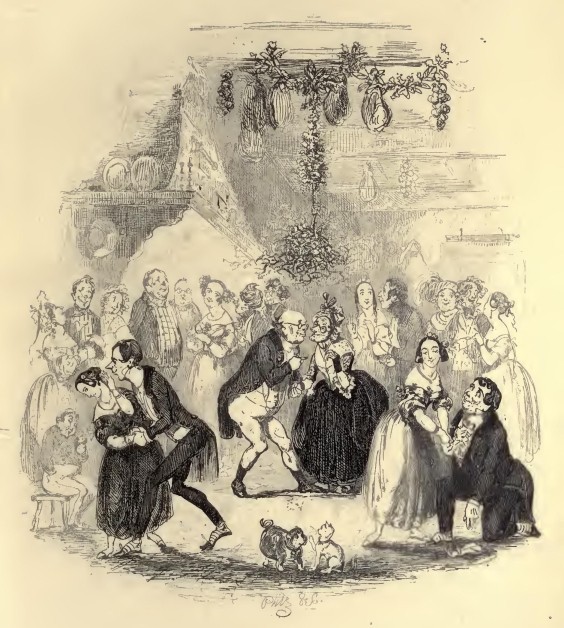
From the centre of the ceiling of this kitchen, old Wardle had just suspended, with his own hands, a huge branch of mistletoe, and this same branch of mistletoe instantaneously gave rise to a scene of general and most delightful struggling and confusion; in the midst of which, Mr. Pickwick, with a gallantry that would have done honour to a descendant of Lady Tollimglower herself, took the old lady by the hand, led her beneath the mystic branch, and saluted her in all courtesy and decorum. The old lady submitted to this piece of practical politeness with all the dignity which befitted so important and serious a solemnity, but the younger ladies, not being so thoroughly imbued with a superstitious veneration for the custom, or imagining that the value of a salute is very much enhanced if it cost a little trouble to obtain it, screamed and struggled, and ran into corners, and threatened and remonstrated, and did everything but leave the room, until some of the less adventurous gentlemen were on the point of desisting, when they all at once found it useless to resist any longer, and submitted to be kissed with a good grace. Mr. Winkle kissed the young lady with the black eyes, and Mr. Snodgrass kissed Emily; and Mr. Weller, not being particular about the form of being under the mistletoe, kissed Emma and the other female servants, just as he caught them. As to the poor relations, they kissed everybody, not even excepting the plainer portions of the young lady visitors, who, in their excessive confusion, ran right under the mistletoe, as soon as it was hung up, without knowing it! Wardle stood with his back to the fire, surveying the whole scene, with the utmost satisfaction; and the fat boy took the opportunity of appropriating to his own use, and summarily devouring, a particularly fine mince-pie, that had been carefully put by, for somebody else.
Now, the screaming had subsided, and faces were in a glow, and curls in a tangle, and Mr. Pickwick, after kissing the old lady as before mentioned, was standing under the mistletoe, looking with a very pleased countenance on all that was passing around him, when the young lady with the black eyes, after a little whispering with the other young ladies, made a sudden dart forward, and, putting her arm round Mr. Pickwick’s neck, saluted him affectionately on the left cheek; and before Mr. Pickwick distinctly knew what was the matter, he was surrounded by the whole body, and kissed by every one of them.
It was a pleasant thing to see Mr. Pickwick in the centre of the group, now pulled this way, and then that, and first kissed on the chin, and then on the nose, and then on the spectacles, and to hear the peals of laughter which were raised on every side; but it was a still more pleasant thing to see Mr. Pickwick, blinded shortly afterwards with a silk handkerchief, falling up against the wall, and scrambling into corners, and going through all the mysteries of blind-man’s buff, with the utmost relish for the game, until at last he caught one of the poor relations, and then had to evade the blind-man himself, which he did with a nimbleness and agility that elicited the admiration and applause of all beholders. The poor relations caught the people who they thought would like it, and, when the game flagged, got caught themselves. When they all tired of blind-man’s buff, there was a great game at snap-dragon, and when fingers enough were burned with that, and all the raisins were gone, they sat down by the huge fire of blazing logs to a substantial supper, and a mighty bowl of wassail, something smaller than an ordinary wash-house copper, in which the hot apples were hissing and bubbling with a rich look, and a jolly sound, that were perfectly irresistible.
‘This,’ said Mr. Pickwick, looking round him, ‘this is, indeed, comfort.’ ‘Our invariable custom,’ replied Mr. Wardle. ‘Everybody sits down with us on Christmas Eve, as you see them now—servants and all; and here we wait, until the clock strikes twelve, to usher Christmas in, and beguile the time with forfeits and old stories. Trundle, my boy, rake up the fire.’
Up flew the bright sparks in myriads as the logs were stirred. The deep red blaze sent forth a rich glow, that penetrated into the farthest corner of the room, and cast its cheerful tint on every face.
‘Come,’ said Wardle, ‘a song—a Christmas song! I’ll give you one, in default of a better.’
‘Bravo!’ said Mr. Pickwick.
‘Fill up,’ cried Wardle. ‘It will be two hours, good, before you see the bottom of the bowl through the deep rich colour of the wassail; fill up all round, and now for the song.’
Thus saying, the merry old gentleman, in a good, round, sturdy voice, commenced without more ado—
‘I care not for Spring; on his fickle wing
Let the blossoms and buds be borne;
He woos them amain with his treacherous rain,
And he scatters them ere the morn.
An inconstant elf, he knows not himself,
Nor his own changing mind an hour,
He’ll smile in your face, and, with wry grimace,
He’ll wither your youngest flower.
‘Let the Summer sun to his bright home run,
He shall never be sought by me;
When he’s dimmed by a cloud I can laugh aloud
And care not how sulky he be!
For his darling child is the madness wild
That sports in fierce fever’s train;
And when love is too strong, it don’t last long,
As many have found to their pain.
‘A mild harvest night, by the tranquil light
Of the modest and gentle moon,
Has a far sweeter sheen for me, I ween,
Than the broad and unblushing noon.
But every leaf awakens my grief,
As it lieth beneath the tree;
So let Autumn air be never so fair,
It by no means agrees with me.
‘But my song I troll out, for Christmas Stout,
The hearty, the true, and the bold;
A bumper I drain, and with might and main
Give three cheers for this Christmas old!
We’ll usher him in with a merry din
That shall gladden his joyous heart,
And we’ll keep him up, while there’s bite or sup,
And in fellowship good, we’ll part.
‘In his fine honest pride, he scorns to hide
One jot of his hard-weather scars;
They’re no disgrace, for there’s much the same trace
On the cheeks of our bravest tars.
Then again I sing till the roof doth ring
And it echoes from wall to wall—
To the stout old wight, fair welcome to-night,
As the King of the Seasons all!’
This song was tumultuously applauded—for friends and dependents make a capital audience—and the poor relations, especially, were in perfect ecstasies of rapture. Again was the fire replenished, and again went the wassail round.
‘How it snows!’ said one of the men, in a low tone.
‘Snows, does it?’ said Wardle.
‘Rough, cold night, Sir,’ replied the man; ‘and there’s a wind got up, that drifts it across the fields, in a thick white cloud.’
‘What does Jem say?’ inquired the old lady. ‘There ain’t anything the matter, is there?’
‘No, no, mother,’ replied Wardle; ‘he says there’s a snowdrift, and a wind that’s piercing cold. I should know that, by the way it rumbles in the chimney.’
‘Ah!’ said the old lady, ‘there was just such a wind, and just such a fall of snow, a good many years back, I recollect—just five years before your poor father died. It was a Christmas Eve, too; and I remember that on that very night he told us the story about the goblins that carried away old Gabriel Grub.’
‘The story about what?’ said Mr. Pickwick.
‘Oh, nothing, nothing,’ replied Wardle. ‘About an old sexton, that the good people down here suppose to have been carried away by goblins.’
‘Suppose!’ ejaculated the old lady. ‘Is there anybody hardy enough to disbelieve it? Suppose! Haven’t you heard ever since you were a child, that he was carried away by the goblins, and don’t you know he was?’
‘Very well, mother, he was, if you like,’ said Wardle laughing. ‘He was carried away by goblins, Pickwick; and there’s an end of the matter.’
‘No, no,’ said Mr. Pickwick, ‘not an end of it, I assure you; for I must hear how, and why, and all about it.’
Wardle smiled, as every head was bent forward to hear, and filling out the wassail with no stinted hand, nodded a health to Mr. Pickwick, and began as follows—
But bless our editorial heart, what a long chapter we have been betrayed into! We had quite forgotten all such petty restrictions as chapters, we solemnly declare. So here goes, to give the goblin a fair start in a new one. A clear stage and no favour for the goblins, ladies and gentlemen, if you please.
CHAPTER XXIX. THE STORY OF THE GOBLINS WHO STOLE A SEXTON
’ In an old abbey town, down in this part of the country, a long, long while ago—so long, that the story must be a true one, because our great-grandfathers implicitly believed it—there officiated as sexton and grave-digger in the churchyard, one Gabriel Grub. It by no means follows that because a man is a sexton, and constantly surrounded by the emblems of mortality, therefore he should be a morose and melancholy man; your undertakers are the merriest fellows in the world; and I once had the honour of being on intimate terms with a mute, who in private life, and off duty, was as comical and jocose a little fellow as ever chirped out a devil-may-care song, without a hitch in his memory, or drained off a good stiff glass without stopping for breath. But notwithstanding these precedents to the contrary, Gabriel Grub was an ill-conditioned, cross-grained, surly fellow—a morose and lonely man, who consorted with nobody but himself, and an old wicker bottle which fitted into his large deep waistcoat pocket—and who eyed each merry face, as it passed him by, with such a deep scowl of malice and ill-humour, as it was difficult to meet without feeling something the worse for.
‘A little before twilight, one Christmas Eve, Gabriel shouldered his spade, lighted his lantern, and betook himself towards the old churchyard; for he had got a grave to finish by next morning, and, feeling very low, he thought it might raise his spirits, perhaps, if he went on with his work at once. As he went his way, up the ancient street, he saw the cheerful light of the blazing fires gleam through the old casements, and heard the loud laugh and the cheerful shouts of those who were assembled around them; he marked the bustling preparations for next day’s cheer, and smelled the numerous savoury odours consequent thereupon, as they steamed up from the kitchen windows in clouds. All this was gall and wormwood to the heart of Gabriel Grub; and when groups of children bounded out of the houses, tripped across the road, and were met, before they could knock at the opposite door, by half a dozen curly-headed little rascals who crowded round them as they flocked upstairs to spend the evening in their Christmas games, Gabriel smiled grimly, and clutched the handle of his spade with a firmer grasp, as he thought of measles, scarlet fever, thrush, whooping-cough, and a good many other sources of consolation besides.
‘In this happy frame of mind, Gabriel strode along, returning a short, sullen growl to the good-humoured greetings of such of his neighbours as now and then passed him, until he turned into the dark lane which led to the churchyard. Now, Gabriel had been looking forward to reaching the dark lane, because it was, generally speaking, a nice, gloomy, mournful place, into which the townspeople did not much care to go, except in broad daylight, and when the sun was shining; consequently, he was not a little indignant to hear a young urchin roaring out some jolly song about a merry Christmas, in this very sanctuary which had been called Coffin Lane ever since the days of the old abbey, and the time of the shaven-headed monks. As Gabriel walked on, and the voice drew nearer, he found it proceeded from a small boy, who was hurrying along, to join one of the little parties in the old street, and who, partly to keep himself company, and partly to prepare himself for the occasion, was shouting out the song at the highest pitch of his lungs. So Gabriel waited until the boy came up, and then dodged him into a corner, and rapped him over the head with his lantern five or six times, just to teach him to modulate his voice. And as the boy hurried away with his hand to his head, singing quite a different sort of tune, Gabriel Grub chuckled very heartily to himself, and entered the churchyard, locking the gate behind him.
‘He took off his coat, set down his lantern, and getting into the unfinished grave, worked at it for an hour or so with right good-will. But the earth was hardened with the frost, and it was no very easy matter to break it up, and shovel it out; and although there was a moon, it was a very young one, and shed little light upon the grave, which was in the shadow of the church. At any other time, these obstacles would have made Gabriel Grub very moody and miserable, but he was so well pleased with having stopped the small boy’s singing, that he took little heed of the scanty progress he had made, and looked down into the grave, when he had finished work for the night, with grim satisfaction, murmuring as he gathered up his things—
A few feet of cold earth, when life is done;
A stone at the head, a stone at the feet,
A rich, juicy meal for the worms to eat;
Rank grass overhead, and damp clay around,
Brave lodgings for one, these, in holy ground!
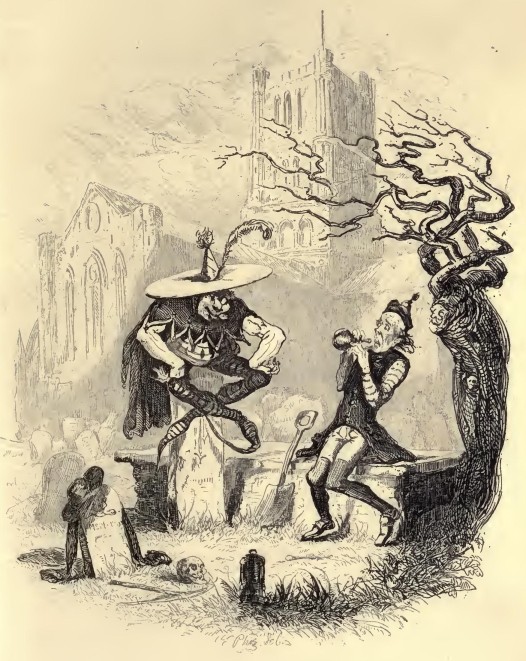
‘“Ho! ho!” laughed Gabriel Grub, as he sat himself down on a flat tombstone which was a favourite resting-place of his, and drew forth his wicker bottle. “A coffin at Christmas! A Christmas box! Ho! ho! ho!”
‘“Ho! ho! ho!” repeated a voice which sounded close behind him.
‘Gabriel paused, in some alarm, in the act of raising the wicker bottle to his lips, and looked round. The bottom of the oldest grave about him was not more still and quiet than the churchyard in the pale moonlight. The cold hoar frost glistened on the tombstones, and sparkled like rows of gems, among the stone carvings of the old church. The snow lay hard and crisp upon the ground; and spread over the thickly-strewn mounds of earth, so white and smooth a cover that it seemed as if corpses lay there, hidden only by their winding sheets. Not the faintest rustle broke the profound tranquillity of the solemn scene. Sound itself appeared to be frozen up, all was so cold and still.
‘“It was the echoes,” said Gabriel Grub, raising the bottle to his lips again.
‘“It was not,” said a deep voice.
‘Gabriel started up, and stood rooted to the spot with astonishment and terror; for his eyes rested on a form that made his blood run cold.
‘Seated on an upright tombstone, close to him, was a strange, unearthly figure, whom Gabriel felt at once, was no being of this world. His long, fantastic legs which might have reached the ground, were cocked up, and crossed after a quaint, fantastic fashion; his sinewy arms were bare; and his hands rested on his knees. On his short, round body, he wore a close covering, ornamented with small slashes; a short cloak dangled at his back; the collar was cut into curious peaks, which served the goblin in lieu of ruff or neckerchief; and his shoes curled up at his toes into long points. On his head, he wore a broad-brimmed sugar-loaf hat, garnished with a single feather. The hat was covered with the white frost; and the goblin looked as if he had sat on the same tombstone very comfortably, for two or three hundred years. He was sitting perfectly still; his tongue was put out, as if in derision; and he was grinning at Gabriel Grub with such a grin as only a goblin could call up.
‘“It was not the echoes,” said the goblin.
‘Gabriel Grub was paralysed, and could make no reply.
‘“What do you do here on Christmas Eve?” said the goblin sternly.
‘“I came to dig a grave, Sir,” stammered Gabriel Grub.
‘“What man wanders among graves and churchyards on such a night as this?” cried the goblin.
‘“Gabriel Grub! Gabriel Grub!” screamed a wild chorus of voices that seemed to fill the churchyard. Gabriel looked fearfully round—nothing was to be seen.
‘“What have you got in that bottle?” said the goblin.
‘“Hollands, sir,” replied the sexton, trembling more than ever; for he had bought it of the smugglers, and he thought that perhaps his questioner might be in the excise department of the goblins.
‘“Who drinks Hollands alone, and in a churchyard, on such a night as this?” said the goblin.
‘“Gabriel Grub! Gabriel Grub!” exclaimed the wild voices again.
‘The goblin leered maliciously at the terrified sexton, and then raising his voice, exclaimed—
‘“And who, then, is our fair and lawful prize?”
‘To this inquiry the invisible chorus replied, in a strain that sounded like the voices of many choristers singing to the mighty swell of the old church organ—a strain that seemed borne to the sexton’s ears upon a wild wind, and to die away as it passed onward; but the burden of the reply was still the same, “Gabriel Grub! Gabriel Grub!”
‘The goblin grinned a broader grin than before, as he said, “Well, Gabriel, what do you say to this?”
‘The sexton gasped for breath.
‘“What do you think of this, Gabriel?” said the goblin, kicking up his feet in the air on either side of the tombstone, and looking at the turned-up points with as much complacency as if he had been contemplating the most fashionable pair of Wellingtons in all Bond Street.
‘“It’s—it’s—very curious, Sir,” replied the sexton, half dead with fright; “very curious, and very pretty, but I think I’ll go back and finish my work, Sir, if you please.”
‘“Work!” said the goblin, “what work?”
‘“The grave, Sir; making the grave,” stammered the sexton.
‘“Oh, the grave, eh?” said the goblin; “who makes graves at a time when all other men are merry, and takes a pleasure in it?”
‘Again the mysterious voices replied, “Gabriel Grub! Gabriel Grub!”
‘“I am afraid my friends want you, Gabriel,” said the goblin, thrusting his tongue farther into his cheek than ever—and a most astonishing tongue it was—“I’m afraid my friends want you, Gabriel,” said the goblin.
‘“Under favour, Sir,” replied the horror-stricken sexton, “I don’t think they can, Sir; they don’t know me, Sir; I don’t think the gentlemen have ever seen me, Sir.”
‘“Oh, yes, they have,” replied the goblin; “we know the man with the sulky face and grim scowl, that came down the street to-night, throwing his evil looks at the children, and grasping his burying-spade the tighter. We know the man who struck the boy in the envious malice of his heart, because the boy could be merry, and he could not. We know him, we know him.”
‘Here, the goblin gave a loud, shrill laugh, which the echoes returned twentyfold; and throwing his legs up in the air, stood upon his head, or rather upon the very point of his sugar-loaf hat, on the narrow edge of the tombstone, whence he threw a Somerset with extraordinary agility, right to the sexton’s feet, at which he planted himself in the attitude in which tailors generally sit upon the shop-board.
‘“I—I—am afraid I must leave you, Sir,” said the sexton, making an effort to move.
‘“Leave us!” said the goblin, “Gabriel Grub going to leave us. Ho! ho! ho!”
‘As the goblin laughed, the sexton observed, for one instant, a brilliant illumination within the windows of the church, as if the whole building were lighted up; it disappeared, the organ pealed forth a lively air, and whole troops of goblins, the very counterpart of the first one, poured into the churchyard, and began playing at leap-frog with the tombstones, never stopping for an instant to take breath, but “overing” the highest among them, one after the other, with the most marvellous dexterity. The first goblin was a most astonishing leaper, and none of the others could come near him; even in the extremity of his terror the sexton could not help observing, that while his friends were content to leap over the common-sized gravestones, the first one took the family vaults, iron railings and all, with as much ease as if they had been so many street-posts.
‘At last the game reached to a most exciting pitch; the organ played quicker and quicker, and the goblins leaped faster and faster, coiling themselves up, rolling head over heels upon the ground, and bounding over the tombstones like footballs. The sexton’s brain whirled round with the rapidity of the motion he beheld, and his legs reeled beneath him, as the spirits flew before his eyes; when the goblin king, suddenly darting towards him, laid his hand upon his collar, and sank with him through the earth.
‘When Gabriel Grub had had time to fetch his breath, which the rapidity of his descent had for the moment taken away, he found himself in what appeared to be a large cavern, surrounded on all sides by crowds of goblins, ugly and grim; in the centre of the room, on an elevated seat, was stationed his friend of the churchyard; and close behind him stood Gabriel Grub himself, without power of motion.
‘“Cold to-night,” said the king of the goblins, “very cold. A glass of something warm here!”
‘At this command, half a dozen officious goblins, with a perpetual smile upon their faces, whom Gabriel Grub imagined to be courtiers, on that account, hastily disappeared, and presently returned with a goblet of liquid fire, which they presented to the king.
‘“Ah!” cried the goblin, whose cheeks and throat were transparent, as he tossed down the flame, “this warms one, indeed! Bring a bumper of the same, for Mr. Grub.”
‘It was in vain for the unfortunate sexton to protest that he was not in the habit of taking anything warm at night; one of the goblins held him while another poured the blazing liquid down his throat; the whole assembly screeched with laughter, as he coughed and choked, and wiped away the tears which gushed plentifully from his eyes, after swallowing the burning draught.
‘“And now,” said the king, fantastically poking the taper corner of his sugar-loaf hat into the sexton’s eye, and thereby occasioning him the most exquisite pain; “and now, show the man of misery and gloom, a few of the pictures from our own great storehouse!”
‘As the goblin said this, a thick cloud which obscured the remoter end of the cavern rolled gradually away, and disclosed, apparently at a great distance, a small and scantily furnished, but neat and clean apartment. A crowd of little children were gathered round a bright fire, clinging to their mother’s gown, and gambolling around her chair. The mother occasionally rose, and drew aside the window-curtain, as if to look for some expected object; a frugal meal was ready spread upon the table; and an elbow chair was placed near the fire. A knock was heard at the door; the mother opened it, and the children crowded round her, and clapped their hands for joy, as their father entered. He was wet and weary, and shook the snow from his garments, as the children crowded round him, and seizing his cloak, hat, stick, and gloves, with busy zeal, ran with them from the room. Then, as he sat down to his meal before the fire, the children climbed about his knee, and the mother sat by his side, and all seemed happiness and comfort.
‘But a change came upon the view, almost imperceptibly. The scene was altered to a small bedroom, where the fairest and youngest child lay dying; the roses had fled from his cheek, and the light from his eye; and even as the sexton looked upon him with an interest he had never felt or known before, he died. His young brothers and sisters crowded round his little bed, and seized his tiny hand, so cold and heavy; but they shrank back from its touch, and looked with awe on his infant face; for calm and tranquil as it was, and sleeping in rest and peace as the beautiful child seemed to be, they saw that he was dead, and they knew that he was an angel looking down upon, and blessing them, from a bright and happy Heaven.
‘Again the light cloud passed across the picture, and again the subject changed. The father and mother were old and helpless now, and the number of those about them was diminished more than half; but content and cheerfulness sat on every face, and beamed in every eye, as they crowded round the fireside, and told and listened to old stories of earlier and bygone days. Slowly and peacefully, the father sank into the grave, and, soon after, the sharer of all his cares and troubles followed him to a place of rest. The few who yet survived them, kneeled by their tomb, and watered the green turf which covered it with their tears; then rose, and turned away, sadly and mournfully, but not with bitter cries, or despairing lamentations, for they knew that they should one day meet again; and once more they mixed with the busy world, and their content and cheerfulness were restored. The cloud settled upon the picture, and concealed it from the sexton’s view.
‘“What do you think of that?” said the goblin, turning his large face towards Gabriel Grub.
‘Gabriel murmured out something about its being very pretty, and looked somewhat ashamed, as the goblin bent his fiery eyes upon him.
‘“You a miserable man!” said the goblin, in a tone of excessive contempt. “You!” He appeared disposed to add more, but indignation choked his utterance, so he lifted up one of his very pliable legs, and, flourishing it above his head a little, to insure his aim, administered a good sound kick to Gabriel Grub; immediately after which, all the goblins in waiting crowded round the wretched sexton, and kicked him without mercy, according to the established and invariable custom of courtiers upon earth, who kick whom royalty kicks, and hug whom royalty hugs.
‘“Show him some more!” said the king of the goblins.
‘At these words, the cloud was dispelled, and a rich and beautiful landscape was disclosed to view—there is just such another, to this day, within half a mile of the old abbey town. The sun shone from out the clear blue sky, the water sparkled beneath his rays, and the trees looked greener, and the flowers more gay, beneath its cheering influence. The water rippled on with a pleasant sound, the trees rustled in the light wind that murmured among their leaves, the birds sang upon the boughs, and the lark carolled on high her welcome to the morning. Yes, it was morning; the bright, balmy morning of summer; the minutest leaf, the smallest blade of grass, was instinct with life. The ant crept forth to her daily toil, the butterfly fluttered and basked in the warm rays of the sun; myriads of insects spread their transparent wings, and revelled in their brief but happy existence. Man walked forth, elated with the scene; and all was brightness and splendour.
‘“You a miserable man!” said the king of the goblins, in a more contemptuous tone than before. And again the king of the goblins gave his leg a flourish; again it descended on the shoulders of the sexton; and again the attendant goblins imitated the example of their chief.
‘Many a time the cloud went and came, and many a lesson it taught to Gabriel Grub, who, although his shoulders smarted with pain from the frequent applications of the goblins’ feet thereunto, looked on with an interest that nothing could diminish. He saw that men who worked hard, and earned their scanty bread with lives of labour, were cheerful and happy; and that to the most ignorant, the sweet face of Nature was a never-failing source of cheerfulness and joy. He saw those who had been delicately nurtured, and tenderly brought up, cheerful under privations, and superior to suffering, that would have crushed many of a rougher grain, because they bore within their own bosoms the materials of happiness, contentment, and peace. He saw that women, the tenderest and most fragile of all God’s creatures, were the oftenest superior to sorrow, adversity, and distress; and he saw that it was because they bore, in their own hearts, an inexhaustible well-spring of affection and devotion. Above all, he saw that men like himself, who snarled at the mirth and cheerfulness of others, were the foulest weeds on the fair surface of the earth; and setting all the good of the world against the evil, he came to the conclusion that it was a very decent and respectable sort of world after all. No sooner had he formed it, than the cloud which had closed over the last picture, seemed to settle on his senses, and lull him to repose. One by one, the goblins faded from his sight; and, as the last one disappeared, he sank to sleep.
‘The day had broken when Gabriel Grub awoke, and found himself lying at full length on the flat gravestone in the churchyard, with the wicker bottle lying empty by his side, and his coat, spade, and lantern, all well whitened by the last night’s frost, scattered on the ground. The stone on which he had first seen the goblin seated, stood bolt upright before him, and the grave at which he had worked, the night before, was not far off. At first, he began to doubt the reality of his adventures, but the acute pain in his shoulders when he attempted to rise, assured him that the kicking of the goblins was certainly not ideal. He was staggered again, by observing no traces of footsteps in the snow on which the goblins had played at leap-frog with the gravestones, but he speedily accounted for this circumstance when he remembered that, being spirits, they would leave no visible impression behind them. So, Gabriel Grub got on his feet as well as he could, for the pain in his back; and, brushing the frost off his coat, put it on, and turned his face towards the town.
‘But he was an altered man, and he could not bear the thought of returning to a place where his repentance would be scoffed at, and his reformation disbelieved. He hesitated for a few moments; and then turned away to wander where he might, and seek his bread elsewhere.
‘The lantern, the spade, and the wicker bottle were found, that day, in the churchyard. There were a great many speculations about the sexton’s fate, at first, but it was speedily determined that he had been carried away by the goblins; and there were not wanting some very credible witnesses who had distinctly seen him whisked through the air on the back of a chestnut horse blind of one eye, with the hind-quarters of a lion, and the tail of a bear. At length all this was devoutly believed; and the new sexton used to exhibit to the curious, for a trifling emolument, a good-sized piece of the church weathercock which had been accidentally kicked off by the aforesaid horse in his aerial flight, and picked up by himself in the churchyard, a year or two afterwards.
‘Unfortunately, these stories were somewhat disturbed by the unlooked-for reappearance of Gabriel Grub himself, some ten years afterwards, a ragged, contented, rheumatic old man. He told his story to the clergyman, and also to the mayor; and in course of time it began to be received as a matter of history, in which form it has continued down to this very day. The believers in the weathercock tale, having misplaced their confidence once, were not easily prevailed upon to part with it again, so they looked as wise as they could, shrugged their shoulders, touched their foreheads, and murmured something about Gabriel Grub having drunk all the Hollands, and then fallen asleep on the flat tombstone; and they affected to explain what he supposed he had witnessed in the goblin’s cavern, by saying that he had seen the world, and grown wiser. But this opinion, which was by no means a popular one at any time, gradually died off; and be the matter how it may, as Gabriel Grub was afflicted with rheumatism to the end of his days, this story has at least one moral, if it teach no better one—and that is, that if a man turn sulky and drink by himself at Christmas time, he may make up his mind to be not a bit the better for it: let the spirits be never so good, or let them be even as many degrees beyond proof, as those which Gabriel Grub saw in the goblin’s cavern.’
- The Posthumous Papers Of The Pickwick Club - Chapter Xxx. How The Pickwickians Made And Cultivated The Acquaintance Of A Couple Of Nice Young Men Belonging To One Of The Liberal Professions; How They Disported Themselves On The Ice; And How Their Visit Came To A Conclusion→
- The Posthumous Papers Of The Pickwick Club - Chapter Xxvi. Which Contains A Brief Account Of The Progress Of The Action Of Bardell Against Pickwick←