
The camera, and more particularly the instantaneous camera, has habituated people to expect in a portrait a momentary expression, and of these momentary expressions the faint smile, as we all know, is an easy first in the matter of popularity. It is no uncommon thing for the painter to be asked in the early stages of his work when he is going to put in the smile, it never being questioned that this is the artist's aim in the matter of expression.
The giving of lifelike expression to a painting is not so simple a matter as it might appear to be. Could one set the real person behind the frame and suddenly fix them for ever with one of those passing expressions on their faces, however natural it might have been at the moment, fixed for ever it is terrible, and most unlifelike. As we have already said, a few lines scribbled on a piece of paper by a consummate artist would give a greater sense of life than this fixed actuality. It is not ultimately by the pursuit of the actual realisation that expression and life are conveyed in a portrait. Every face has expression of a far more interesting and enduring kind than these momentary disturbances of its form occasioned by laughter or some passing thought, &c. And it must never be forgotten that a portrait is a panel painted to remain for centuries without movement. So that a large amount of the quality of repose must enter into its composition. Portraits in which this has not been borne in mind, however entertaining at a picture exhibition, when they are seen for a few moments only, pall on one if constantly seen, and are finally very irritating.
But the real expression in a head is something more enduring than these passing movements: one that belongs to the forms of a head, and the marks left on that form by the life and character of the person. This is of far more interest than those passing expressions, the results of the contraction of certain muscles under the skin, the effect of which is very similar in most people. It is for the portrait painter to find this more enduring expression and give it noble expression in his work.
It is a common idea among sitters that if they are painted in modern clothes the picture will look old-fashioned in a few years. If the sitter's appearance were fixed upon the canvas exactly as they stood before the artist in his studio, without any selection on the part of the painter, this might be the result, and is the result in the case of painters who have no higher aim than this.
But there are qualities in dress that do not belong exclusively to the particular period of their fashion. Qualities that are the same in all ages. And when these are insisted upon, and the frivolities of the moment in dress not troubled about so much, the portrait has a permanent quality, and will never in consequence look old-fashioned in the offensive way that is usually meant. In the first place, the drapery and stuffs of which clothes are made follow laws in the manner in which they fold and drape over the figure, that are the same in all times. If the expression of the figure through the draperies is sought by the painter, a permanent quality will be given in his work, whatever fantastic shapes the cut of the garments may assume.
And further, the artist does not take whatever comes to hand in the appearance of his sitter, but works to a thought-out arrangement of colour and form, to a design. This he selects from the moving and varied appearance of his sitter, trying one thing after another, until he sees a suggestive arrangement, from the impression of which he makes his design. It is true that the extremes of fashion do not always lend themselves so readily as more reasonable modes to the making of a good pictorial pattern. But this is not always so, some extreme fashions giving opportunities of very piquant and interesting portrait designs. So that, however extreme the fashion, if the artist is able to select some aspect of it that will result in a good arrangement for his portrait, the work will never have the offensive old-fashioned look. The principles governing good designs are the same in all times; and if material for such arrangement has been discovered in the most modish of fashions, it has been lifted into a sphere where nothing is ever out of date.
It is only when the painter is concerned with the trivial details of fashion for their own sake, for the making his picture look like the real thing, and has not been concerned with transmuting the appearance of fashionable clothes by selection into the permanent realms of form and colour design, that his work will justify one in saying that it will look stale in a few years.
The fashion of dressing sitters in meaningless, so-called classical draperies is a feeble one, and usually argues a lack of capacity for selecting a good arrangement from the clothes of the period in the artist who adopts it. Modern women's clothes are full of suggestions for new arrangements and designs quite as good as anything that has been done in the past. The range of subtle colours and varieties of texture in materials is amazing, and the subtlety of invention displayed in some of the designs for costumes leads one to wonder whether there is not something in the remark attributed to an eminent sculptor that "designing ladies' fashions is one of the few arts that is thoroughly vital to-day."
XVIII
THE VISUAL MEMORY
The memory is the great storehouse of artistic material, the treasures of which the artist may know little about until a chance association lights up some of its dark recesses. From early years the mind of the young artist has been storing up impressions in these mysterious chambers, collected from nature's aspects, works of art, and anything that comes within the field of vision. It is from this store that the imagination draws its material, however fantastic and remote from natural appearances the forms it may assume.
How much our memory of pictures colours the impressions of nature we receive is probably not suspected by us, but who could say how a scene would appear to him, had he never looked at a picture? So sensitive is the vision to the influence of memory that, after seeing the pictures of some painter whose work has deeply impressed us, we are apt, while the memory of it is still fresh in our minds, to see things as he would paint them. On different occasions after leaving the National Gallery I can remember having seen Trafalgar Square as Paolo Veronese, Turner, or whatever painter may have impressed me in the Gallery, would have painted it, the memory of their work colouring the impression the scene produced.
But, putting aside the memory of pictures, let us consider the place of direct visual memory from nature in our work, pictures being indirect or second-hand impressions.
We have seen in an earlier chapter how certain painters in the nineteenth century, feeling how very second-hand and far removed from nature painting had become, started a movement to discard studio traditions and study nature with a single eye, taking their pictures out of doors, and endeavouring to wrest nature's secrets from her on the spot. The Pre-Raphaelite movement in England and the Impressionist movement in France were the results of this impulse. And it is interesting, by the way, to contrast the different manner in which this desire for more truth to nature affected the French and English temperaments. The intense individualism of the English sought out every detail, every leaf and flower for itself, painting them with a passion and intensity that made their painting a vivid medium for the expression of poetic ideas; while the more synthetic mind of the Frenchman approached this search for visual truth from the opposite point of view of the whole effect, finding in the large, generalised impression a new world of beauty. And his more logical mind led him to inquire into the nature of light, and so to invent a technique founded on scientific principles.
But now the first blush of freshness has worn off the new movement, painters have begun to see that if anything but very ordinary effects are to be attempted, this painting on the spot must give place to more reliance on the memory.
Memory has this great advantage over direct vision: it retains more vividly the essential things, and has a habit of losing what is unessential to the pictorial impression.
But what is the essential in a painting? What is it makes one want to paint at all? Ah! Here we approach very debatable and shadowy ground, and we can do little but ask questions, the answer to which will vary with each individual temperament. What is it that these rays of light striking our retina convey to our brain, and from our brain to whatever is ourselves, in the seat of consciousness above this? What is this mysterious correspondence set up between something within and something without, that at times sends such a clamour of harmony through our whole being? Why do certain combinations of sound in music and of form and colour in art affect us so profoundly? What are the laws governing harmony in the universe, and whence do they come? It is hardly trees and sky, earth, or flesh and blood, as such, that interest the artist; but rather that through these things in memorable moments he is permitted a consciousness of deeper things, and impelled to seek utterance for what is moving him. It is the record of these rare moments in which one apprehends truth in things seen that the artist wishes to convey to others. But these moments, these flashes of inspiration which are at the inception of every vital picture, occur but seldom. What the painter has to do is to fix them vividly in his memory, to snapshot them, as it were, so that they may stand by him during the toilsome procedure of the painting, and guide the work.
This initial inspiration, this initial flash in the mind, need not be the result of a scene in nature, but may of course be purely the work of the imagination; a composition, the sense of which flashes across the mind. But in either case the difficulty is to preserve vividly the sensation of this original artistic impulse. And in the case of its having been derived from nature direct, as is so often the case in modern art, the system of painting continually on the spot is apt to lose touch with it very soon. For in the continual observation of anything you have set your easel before day after day, comes a series of impressions, more and more commonplace, as the eye becomes more and more familiar with the details of the subject. And ere long the original emotion that was the reason of the whole work is lost sight of, and one of those pictures or drawings giving a catalogue of tired objects more or less ingeniously arranged (that we all know so well) is the result—work utterly lacking in the freshness and charm of true inspiration. For however commonplace the subject seen by the artist in one of his "flashes," it is clothed in a newness and surprise that charm us, be it only an orange on a plate.
Now a picture is a thing of paint upon a flat surface, and a drawing is a matter of certain marks upon a paper, and how to translate the intricacies of a visual or imagined impression to the prosaic terms of masses of coloured pigment or lines and tones is the business with which our technique is concerned. The ease, therefore, with which a painter will be able to remember an impression in a form from which he can work, will depend upon his power to analyse vision in this technical sense. The more one knows about what may be called the anatomy of picture-making—how certain forms produce certain effects, certain colours or arrangements other effects, &c.—the easier will it be for him to carry away a visual memory of his subject that will stand by him during the long hours of his labours at the picture. The more he knows of the expressive powers of lines and tones, the more easily will he be able to observe the vital things in nature that convey the impression he wishes to memorise.
It is not enough to drink in and remember the emotional side of the matter, although this must be done fully, but if a memory of the subject is to be carried away that will be of service technically, the scene must be committed to memory in terms of whatever medium you intend to employ for reproducing it—in the case of a drawing, lines and tones. And the impression will have to be analysed into these terms as if you were actually drawing the scene on some imagined piece of paper in your mind. The faculty of doing this is not to be acquired all at once, but it is amazing of how much development it is capable. Just as the faculty of committing to memory long poems or plays can be developed, so can the faculty of remembering visual things. This subject has received little attention in art schools until just recently. But it is not yet so systematically done as it might be. Monsieur Lecoq de Boisbaudran in France experimented with pupils in this memory training, beginning with very simple things like the outline of a nose, and going on to more complex subjects by easy stages, with the most surprising results. And there is no doubt that a great deal more can and should be done in this direction than is at present attempted. What students should do is to form a habit of making every day in their sketch-book a drawing of something they have seen that has interested them, and that they have made some attempt at memorising. Don't be discouraged if the results are poor and disappointing at first—you will find that by persevering your power of memory will develop and be of the greatest service to you in your after work. Try particularly to remember the spirit of the subject, and in this memory-drawing some scribbling and fumbling will necessarily have to be done. You cannot expect to be able to draw definitely and clearly from memory, at least at first, although your aim should always be to draw as frankly and clearly as you can.
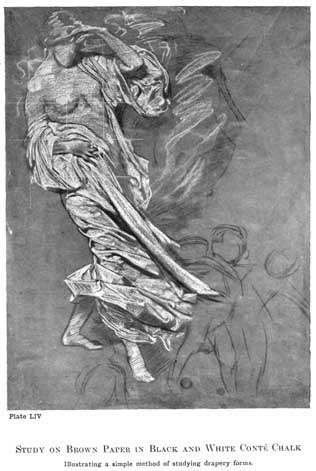
Plate LIV.
STUDY ON BROWN PAPER IN BLACK AND WHITE CONTÉ CHALK
Illustrating a simple method of studying drapery forms.
Let us assume that you have found a subject that moves you and that, being too fleeting to draw on the spot, you wish to commit to memory. Drink a full enjoyment of it, let it soak in, for the recollection of this will be of the utmost use to you afterwards in guiding your memory-drawing. This mental impression is not difficult to recall; it is the visual impression in terms of line and tone that is difficult to remember. Having experienced your full enjoyment of the artistic matter in the subject, you must next consider it from the material side, as a flat, visual impression, as this is the only form in which it can be expressed on a flat sheet of paper. Note the proportions of the main lines, their shapes and disposition, as if you were drawing it, in fact do the whole drawing in your mind, memorising the forms and proportions of the different parts, and fix it in your memory to the smallest detail.
If only the emotional side of the matter has been remembered, when you come to draw it you will be hopelessly at sea, as it is remarkable how little the memory retains of the appearance of things constantly seen, if no attempt has been made to memorise their visual appearance.
The true artist, even when working from nature, works from memory very largely. That is to say, he works to a scheme in tune to some emotional enthusiasm with which the subject has inspired him in the first instance. Nature is always changing, but he does not change the intention of his picture. He always keeps before him the initial impression he sets out to paint, and only selects from nature those things that play up to it. He is a feeble artist, who copies individually the parts of a scene with whatever effect they may have at the moment he is doing them, and then expects the sum total to make a picture. If circumstances permit, it is always as well to make in the first instance a rapid sketch that shall, whatever it may lack, at least contain the main disposition of the masses and lines of your composition seen under the influence of the enthusiasm that has inspired the work. This will be of great value afterwards in freshening your memory when in the labour of the work the original impulse gets dulled. It is seldom that the vitality of this first sketch is surpassed by the completed work, and often, alas! it is far from equalled.
In portrait painting and drawing the memory must be used also. A sitter varies very much in the impression he gives on different days, and the artist must in the early sittings, when his mind is fresh, select the aspect he means to paint and afterwards work largely to the memory of this.
Always work to a scheme on which you have decided, and do not flounder on in the hope of something turning up as you go along. Your faculties are never so active and prone to see something interesting and fine as when the subject is first presented to them. This is the time to decide your scheme; this is the time to take your fill of the impression you mean to convey. This is the time to learn your subject thoroughly and decide on what you wish the picture to be. And having decided this, work straight on, using nature to support your original impression, but don't be led off by a fresh scheme because others strike you as you go along. New schemes will do so, of course, and every new one has a knack of looking better than your original one. But it is not often that this is so; the fact that they are new makes them appear to greater advantage than the original scheme to which you have got accustomed. So that it is not only in working away from nature that the memory is of use, but actually when working directly in front of nature.
To sum up, there are two aspects of a subject, the one luxuriating in the sensuous pleasure of it, with all of spiritual significance it may consciously or unconsciously convey, and the other concerned with the lines, tones, shapes, &c., and their rhythmic ordering, by means of which it is to be expressed—the matter and manner, as they may be called. And, if the artist's memory is to be of use to him in his work, both these aspects must be memorised, and of the two the second will need the most attention. But although there are these two aspects of the subject, and each must receive separate attention when memorising it, they are in reality only two aspects of the same thing, which in the act of painting or drawing must be united if a work of art is to result. When a subject first flashes upon an artist he delights in it as a painted or drawn thing, and feels instinctively the treatment it will require. In good draughtsmanship the thing felt will guide and govern everything, every touch will be instinct with the thrill of that first impression. The craftsman mind, so laboriously built up, should by now have become an instinct, a second nature, at the direction of a higher consciousness. At such times the right strokes, the right tones come naturally and go on the right place, the artist being only conscious of a fierce joy and a feeling that things are in tune and going well for once. It is the thirst for this glorious enthusiasm, this fusing of matter and manner, this act of giving the spirit within outward form, that spurs the artist on at all times, and it is this that is the wonderful thing about art.
XIX
PROCEDURE
In commencing a drawing, don't, as so many students do, start carelessly floundering about with your chalk or charcoal in the hope that something will turn up. It is seldom if ever that an artist puts on paper anything better than he has in his mind before he starts, and usually it is not nearly so good.
Don't spoil the beauty of a clean sheet of paper by a lot of scribble. Try and see in your mind's eye the drawing you mean to do, and then try and make your hand realise it, making the paper more beautiful by every touch you give instead of spoiling it by a slovenly manner of procedure.
To know what you want to do and then to do it is the secret of good style and technique. This sounds very commonplace, but it is surprising how few students make it their aim. You may often observe them come in, pin a piece of paper on their board, draw a line down the middle, make a few measurements, and start blocking in the drawing without having given the subject to be drawn a thought, as if it were all there done before them, and only needed copying, as a clerk would copy a letter already drafted for him.
Now, nothing is being said against the practice of drawing guide lines and taking measurements and blocking in your work. This is very necessary in academic work, if rather fettering to expressive drawing; but even in the most academic drawing the artistic intelligence must be used, although that is not the kind of drawing this chapter is particularly referring to.
Look well at the model first; try and be moved by something in the form that you feel is fine or interesting, and try and see in your mind's eye what sort of drawing you mean to do before touching your paper. In school studies be always unflinchingly honest to the impression the model gives you, but dismiss the camera idea of truth from your mind. Instead of converting yourself into a mechanical instrument for the copying of what is before you, let your drawing be an expression of truth perceived intelligently.
Be extremely careful about the first few strokes you put on your paper: the quality of your drawing is often decided in these early stages. If they are vital and expressive, you have started along lines you can develop, and have some hope of doing a good drawing. If they are feeble and poor, the chances are greatly against your getting anything good built upon them. If your start has been bad, pull yourself together, turn your paper over and start afresh, trying to seize upon the big, significant lines and swings in your subject at once. Remember it is much easier to put down a statement correctly than to correct a wrong one; so out with the whole part if you are convinced it is wrong. Train yourself to make direct, accurate statements in your drawings, and don't waste time trying to manoeuvre a bad drawing into a good one. Stop as soon as you feel you have gone wrong and correct the work in its early stages, instead of rushing on upon a wrong foundation in the vague hope that it will all come right in the end. When out walking, if you find you have taken a wrong road you do not, if you are wise, go on in the hope that the wrong way will lead to the right one, but you turn round and go back to the point at which you left the right road. It is very much the same in drawing and painting. As soon as you become aware that you have got upon the wrong track, stop and rub out your work until an earlier stage that was right is reached, and start along again from this point. As your eye gets trained you will more quickly perceive when you have done a wrong stroke, and be able to correct it before having gone very far along the wrong road.
Do not work too long without giving your eye a little rest; a few moments will be quite sufficient. If things won't come, stop a minute; the eye often gets fatigued very quickly and refuses to see truly, but soon revives if rested a minute or two.
Do not go labouring at a drawing when your mind is not working; you are not doing any good, and probably are spoiling any good you have already done. Pull yourself together, and ask what it is you are trying to express, and having got this idea firmly fixed in your mind, go for your drawing with the determination that it shall express it.
All this will sound very trite to students of any mettle, but there are large numbers who waste no end of time working in a purely mechanical, lifeless way, and with their minds anywhere but concentrated upon the work before them. And if the mind is not working, the work of the hand will be of no account. My own experience is that one has constantly to be making fresh effort during the procedure of the work. The mind is apt to tire and needs rousing continually, otherwise the work will lack the impulse that shall make it vital. Particularly is this so in the final stages of a drawing or painting, when, in adding details and small refinements, it is doubly necessary for the mind to be on fire with the initial impulse, or the main qualities will be obscured and the result enfeebled by these smaller matters.
Do not rub out, if you can possibly help it, in drawings that aim at artistic expression. In academic work, where artistic feeling is less important than the discipline of your faculties, you may, of course, do so, but even here as little as possible. In beautiful drawing of any facility it has a weakening effect, somewhat similar to that produced by a person stopping in the middle of a witty or brilliant remark to correct a word. If a wrong line is made, it is left in by the side of the right one in the drawing of many of the masters. But the great aim of the draughtsman should be to train himself to draw cleanly and fearlessly, hand and eye going together. But this state of things cannot be expected for some time.
Let painstaking accuracy be your aim for a long time. When your eye and hand have acquired the power of seeing and expressing on paper with some degree of accuracy what you see, you will find facility and quickness of execution will come of their own accord. In drawing of any expressive power this quickness and facility of execution are absolutely essential. The waves of emotion, under the influence of which the eye really sees in any artistic sense, do not last long enough to allow of a slow, painstaking manner of execution. There must be no hitch in the machinery of expression when the consciousness is alive to the realisation of something fine. Fluency of hand and accuracy of eye are the things your academic studies should have taught you, and these powers will be needed if you are to catch the expression of any of the finer things in form that constitute good drawing.
Try and express yourself in as simple, not as complicated a manner as possible. Let every touch mean something, and if you don't see what to do next, don't fill in the time by meaningless shading and scribbling until you do. Wait awhile, rest your eye by looking away, and then see if you cannot find something right that needs doing.
Before beginning a drawing, it is not a bad idea to study carefully the work of some master draughtsman whom the subject to be drawn may suggest. If you do this carefully and thoughtfully, and take in a full enjoyment, your eye will unconsciously be led to see in nature some of the qualities of the master's work. And you will see the subject to be drawn as a much finer thing than would have been the case had you come to it with your eye unprepared in any way. Reproductions are now so good and cheap that the best drawings in the world can be had for a few pence, and every student should begin collecting reproductions of the things that interest him.
This is not the place to discuss questions of health, but perhaps it will not be thought grandmotherly to mention the extreme importance of nervous vitality in a fine draughtsman, and how his life should be ordered on such healthy lines that he has at his command the maximum instead of the minimum of this faculty. After a certain point, it is a question of vitality how far an artist is likely to go in art. Given two men of equal ability, the one leading a careless life and the other a healthy one, as far as a healthy one is possible to such a supersensitive creature as an artist, there can be no doubt as to the result. It is because there is still a lingering idea in the minds of many that an artist must lead a dissipated life or he is not really an artist, that one feels it necessary to mention the subject. This idea has evidently arisen from the inability of the average person to associate an unconventional mode of life with anything but riotous dissipation. A conventional life is not the only wholesome form of existence, and is certainly a most unwholesome and deadening form to the artist; and neither is a dissipated life the only unconventional one open to him. It is as well that the young student should know this, and be led early to take great care of that most valuable of studio properties, vigorous health.
XX
MATERIALS
The materials in which the artist works are of the greatest importance in determining what qualities in the infinite complexity of nature he selects for expression. And the good draughtsman will find out the particular ones that belong to whatever medium he selects for his drawing, and be careful never to attempt more than it is capable of doing. Every material he works with possesses certain vital qualities peculiar to itself, and it is his business to find out what these are and use them to the advantage of his drawing. When one is working with, say, pen and ink, the necessity for selecting only certain things is obvious enough. But when a medium with the vast capacity of oil paint is being used, the principle of its governing the nature of the work is more often lost sight of. So near can oil paint approach an actual illusion of natural appearances, that much misdirected effort has been wasted on this object, all enjoyment of the medium being subordinated to a meretricious attempt to deceive the eye. And I believe a popular idea of the art of painting is that it exists chiefly to produce this deception. No vital expression of nature can be achieved without the aid of the particular vitality possessed by the medium with which one is working. If this is lost sight of and the eye is tricked into thinking that it is looking at real nature, it is not a fine picture. Art is not a substitute for nature, but an expression of feeling produced in the consciousness of the artist, and intimately associated with the material through which it is expressed in his work—inspired, it may be, in the first instance, by something seen, and expressed by him in painted symbols as true to nature as he can make them while keeping in tune to the emotional idea that prompted the work; but never regarded by the fine artist as anything but painted symbols nevertheless. Never for one moment does he intend you to forget that it is a painted picture you are looking at, however naturalistic the treatment his theme may demand.
In the earlier history of art it was not so necessary to insist on the limitations imposed by different mediums. With their more limited knowledge of the phenomena of vision, the early masters had not the same opportunities of going astray in this respect. But now that the whole field of vision has been discovered, and that the subtlest effects of light and atmosphere are capable of being represented, it has become necessary to decide how far complete accuracy of representation will help the particular impression you may intend your picture or drawing to create. The danger is that in producing a complete illusion of representation, the particular vitality of your medium, with all the expressive power it is capable of yielding, may be lost.
Perhaps the chief difference between the great masters of the past and many modern painters is the neglect of this principle. They represented nature in terms of whatever medium they worked in, and never overstepped this limitation. Modern artists, particularly in the nineteenth century, often attempted to copy nature, the medium being subordinated to the attempt to make it look like the real thing. In the same way, the drawings of the great masters were drawings. They did not attempt anything with a point that a point was not capable of expressing. The drawings of many modern artists are full of attempts to express tone and colour effects, things entirely outside the true province of drawing. The small but infinitely important part of nature that pure drawing is capable of conveying has been neglected, and line work, until recently, went out of fashion in our schools.
There is something that makes for power in the limitations your materials impose. Many artists whose work in some of the more limited mediums is fine, are utterly feeble when they attempt one with so few restrictions as oil paint. If students could only be induced to impose more restraint upon themselves when they attempt so difficult a medium as paint, it would be greatly to the advantage of their work. Beginning first with monochrome in three tones, as explained in a former chapter, they might then take for figure work ivory black and Venetian red. It is surprising what an amount of colour effect can be got with this simple means, and how much can be learned about the relative positions of the warm and cold colours. Do not attempt the full range of tone at first, but keep the darks rather lighter and the lights darker than nature. Attempt the full scale of tone only when you have acquired sufficient experience with the simpler range, and gradually add more colours as you learn to master a few. But restraints are not so fashionable just now as unbridled licence. Art students start in with a palette full of the most amazing colours, producing results that it were better not to discuss. It is a wise man who can discover his limitations and select a medium the capacities of which just tally with his own. To discover this, it is advisable to try many, and below is a short description of the chief ones used by the draughtsman. But very little can be said about them, and very little idea of their capacities given in a written description; they must be handled by the student, and are no doubt capable of many more qualities than have yet been got out of them.
This well-known medium is one of the most beautiful for pure line work, and its use is an excellent training to the eye and hand in precision of observation. Perhaps this is why it has not been so popular in our art schools lately, when the charms of severe discipline are not so much in favour as they should be. It is the first medium we are given to draw with, and as the handiest and most convenient is unrivalled for sketch-book use.
It is made in a large variety of degrees, from the hardest and greyest to the softest and blackest, and is too well known to need much description. It does not need fixing.
For pure line drawing nothing equals it, except silver point, and great draughtsmen, like Ingres, have always loved it. It does not lend itself so readily to any form of mass drawing. Although it is sometimes used for this purpose, the offensive shine that occurs if dark masses are introduced is against its use in any but very lightly shaded work.
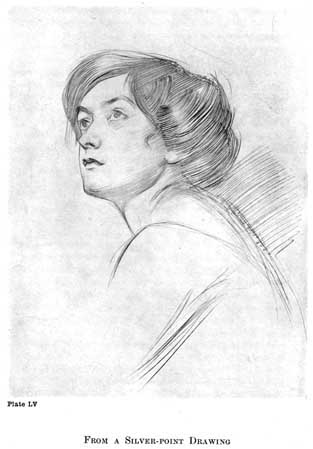
Its charm is the extreme delicacy of its grey-black lines.
Similar to lead pencil, and of even greater delicacy, is silver-point drawing. A more ancient method, it consists in drawing with a silver point on paper the surface of which has been treated with a faint wash of Chinese white. Without this wash the point will not make a mark.
For extreme delicacy and purity of line no medium can surpass this method. And for the expression of a beautiful line, such as a profile, nothing could be more suitable than a silver point. As a training to the eye and hand also, it is of great value, as no rubbing out of any sort is possible, and eye and hand must work together with great exactness. The discipline of silver-point drawing is to be recommended as a corrective to the picturesque vagaries of charcoal work.
A gold point, giving a warmer line, can also be used in the same way as a silver point, the paper first having been treated with Chinese white.
Two extreme points of view from which the rendering of form can be approached have been explained, and it has been suggested that students should study them both separately in the first instance, as they each have different things to teach. Of the mediums that are best suited to a drawing combining both points of view, the first and most popular is charcoal.
Charcoal is made in many different degrees of hardness and softness, the harder varieties being capable of quite a fine point. A chisel-shaped point is the most convenient, as it does not wear away so quickly. And if the broad side of the chisel point is used when a dark mass is wanted, the edge can constantly be kept sharp. With this edge a very fine line can be drawn.
Charcoal works with great freedom, and answers readily when forceful expression is wanted. It is much more like painting than any other form of drawing, a wide piece of charcoal making a wide mark similar to a brush. The delicacy and lightness with which it has to be handled is also much more like the handling of a brush than any other point drawing. When rubbed with the finger, it sheds a soft grey tone over the whole work. With a piece of bread pressed by thumb and finger into a pellet, high lights can be taken out with the precision of white chalk; or rubber can be used. Bread is, perhaps, the best, as it does not smudge the charcoal but lifts it readily off. When rubbed with the finger, the darks, of course, are lightened in tone. It is therefore useful to draw in the general proportions roughly and rub down in this way. You then have a middle tone over the work, with the rough drawing showing through. Now proceed carefully to draw your lights with bread or rubber, and your shadows with charcoal, in much the same manner as you did in the monochrome exercises already described.
All preliminary setting out of your work on canvas is usually done with charcoal, which must of course be fixed with a spray diffuser. For large work, such as a full-length portrait, sticks of charcoal nearly an inch in diameter are made, and a long swinging line can be done without their breaking.
For drawings that are intended as things of beauty in themselves, and are not merely done as a preparatory study for a painting, charcoal is perhaps not so refined a medium as a great many others. It is too much like painting to have the particular beauties of a drawing, and too much like drawing to have the qualities of a painting. However, some beautiful things have been done with it.
It is useful in doing studies where much finish is desired, to fix the work slightly when drawn in and carried some way on. You can work over this again without continually rubbing out with your hand what you have already drawn. If necessary you can rub out with a hard piece of rubber any parts that have already been fixed, or even scrape with a pen-knife. But this is not advisable for anything but an academic study, or working drawings, as it spoils the beauty and freshness of charcoal work. Studies done in this medium can also be finished with Conté chalk.
There is also an artificial charcoal put up in sticks, that is very good for refined work. It has some advantages over natural charcoal, in that there are no knots and it works much more evenly. The best natural charcoal I have used is the French make known as "Fusain Rouget." It is made in three degrees, No. 3 being the softest, and, of course, the blackest. But some of the ordinary Venetian and vine charcoals sold are good. But don't get the cheaper varieties: a bad piece of charcoal is worse than useless.
Charcoal is fixed by means of a solution of white shellac dissolved in spirits of wine, blown on with a spray diffuser. This is sold by the artists' colourmen, or can be easily made by the student. It lightly deposits a thin film of shellac over the work, acting as a varnish and preventing its rubbing off.
Charcoal is not on the whole the medium an artist with a pure love of form selects, but rather that of the painter, who uses it when his brushes and paints are not handy.
A delightful medium that can be used for either pure line work or a mixed method of drawing, is red chalk. This natural red earth is one of the most ancient materials for drawing. It is a lovely Venetian red in colour, and works well in the natural state, if you get a good piece. It is sold by the ounce, and it is advisable to try the pieces as they vary very much, some being hard and gritty and some more soft and smooth. It is also made by Messrs. Conté of Paris in sticks artificially prepared. These work well and are never gritty, but are not so hard as the natural chalk, and consequently wear away quickly and do not make fine lines as well.
Red chalk when rubbed with the finger or a rag spreads evenly on paper, and produces a middle tone on which lights can be drawn with rubber or bread. Sticks of hard, pointed rubber are everywhere sold, which, cut in a chisel shape, work beautifully on red chalk drawings. Bread is also excellent when a softer light is wanted. You can continually correct and redraw in this medium by rubbing it with the finger or a rag, thus destroying the lights and shadows to a large extent, and enabling you to draw them again more carefully. For this reason red chalk is greatly to be recommended for making drawings for a picture where much fumbling may be necessary before you find what you want. Unlike charcoal, it hardly needs fixing, and much more intimate study of the forms can be got into it.
Most of the drawings by the author reproduced in this book are done in this medium. For drawings intended to have a separate existence it is one of the prettiest mediums. In fact, this is the danger to the student while studying: your drawing looks so much at its best that you are apt to be satisfied too soon. But for portrait drawings there is no medium to equal it.
Additional quality of dark is occasionally got by mixing a little of this red chalk in a powdered state with water and a very little gum-arabic. This can be applied with a sable brush as in water-colour painting, and makes a rich velvety dark.
It is necessary to select your paper with some care. The ordinary paper has too much size on it. This is picked up by the chalk, and will prevent its marking. A paper with little size is best, or old paper where the size has perished. I find an O.W. paper, made for printing etchings, as good as any for ordinary work. It is not perfect, but works very well. What one wants is the smoothest paper without a faced and hot-pressed surface, and it is difficult to find.
Occasionally black chalk is used with the red to add strength to it. And some draughtsmen use it with the red in such a manner as to produce almost a full colour effect.
Holbein, who used this medium largely, tinted the paper in most of his portrait drawings, varying the tint very much, and sometimes using zinc white as a wash, which enabled him to supplement his work with a silver-point line here and there, and also got over any difficulty the size in the paper might cause. His aim seems to have been to select the few essential things in a head and draw them with great finality and exactness. In many of the drawings the earlier work has been done with red or black chalk and then rubbed down and the drawing redone with either a brush and some of the chalk rubbed up with water and gum or a silver-point line of great purity, while in others he has tinted the paper with water-colour and rubbed this away to the white paper where he wanted a light, or Chinese white has been used for the same purpose.