
| 'Mistress Mary, quite contrary, |
| How does your garden grow? |
| With silver bells, and cockle shells, |
| And marigolds all in a row.' |
I just remembered it and it made me wonder if there were really flowers like silver bells."
She frowned a little and gave her trowel a rather spiteful dig into the earth.
"I wasn't as contrary as they were."
But Dickon laughed.
"Eh!" he said, and as he crumbled the rich black soil she saw he was sniffing up the scent of it, "there doesn't seem to be no need for no one to be contrary when there's flowers an' such like, an' such lots o' friendly wild things runnin' about makin' homes for themselves, or buildin' nests an' singin' an' whistlin', does there?"
Mary, kneeling by him holding the seeds, looked at him and stopped frowning.
"Dickon," she said. "You are as nice as Martha said you were. I like you, and you make the fifth person. I never thought I should like five people."
Dickon sat up on his heels as Martha did when she was polishing the grate. He did look funny and delightful, Mary thought, with his round blue eyes and red cheeks and happy looking turned-up nose.
"Only five folk as tha' likes?" he said. "Who is th' other four?"
"Your mother and Martha," Mary checked them off on her fingers, "and the robin and Ben Weatherstaff."
Dickon laughed so that he was obliged to stifle the sound by putting his arm over his mouth.
"I know tha' thinks I'm a queer lad," he said, "but I think tha' art th' queerest little lass I ever saw."
Then Mary did a strange thing. She leaned forward and asked him a question she had never dreamed of asking any one before. And she tried to ask it in Yorkshire because that was his language, and in India a native was always pleased if you knew his speech.
"Does tha' like me?" she said.
"Eh!" he answered heartily, "that I does. I likes thee wonderful, an' so does th' robin, I do believe!"
"That's two, then," said Mary. "That's two for me."
And then they began to work harder than ever and more joyfully. Mary was startled and sorry when she heard the big clock in the courtyard strike the hour of her midday dinner.
"I shall have to go," she said mournfully. "And you will have to go too, won't you?"
Dickon grinned.
"My dinner's easy to carry about with me," he said. "Mother always lets me put a bit o' somethin' in my pocket."
He picked up his coat from the grass and brought out of a pocket a lumpy little bundle tied up in a quiet clean, coarse, blue and white handkerchief. It held two thick pieces of bread with a slice of something laid between them.
"It's oftenest naught but bread," he said, "but I've got a fine slice o' fat bacon with it to-day."
Mary thought it looked a queer dinner, but he seemed ready to enjoy it.
"Run on an' get thy victuals," he said. "I'll be done with mine first. I'll get some more work done before I start back home."
He sat down with his back against a tree.
"I'll call th' robin up," he said, "and give him th' rind o' th' bacon to peck at. They likes a bit o' fat wonderful."
Mary could scarcely bear to leave him. Suddenly it seemed as if he might be a sort of wood fairy who might be gone when she came into the garden again. He seemed too good to be true. She went slowly half-way to the door in the wall and then she stopped and went back.
"Whatever happens, you—you never would tell?" she said.
His poppy-colored cheeks were distended with his first big bite of bread and bacon, but he managed to smile encouragingly.
"If tha' was a missel thrush an' showed me where thy nest was, does tha' think I'd tell any one? Not me," he said. "Tha' art as safe as a missel thrush."
And she was quite sure she was.
CHAPTER XII
"MIGHT I HAVE A BIT OF EARTH?"
Mary ran so fast that she was rather out of breath when she reached her room. Her hair was ruffled on her forehead and her cheeks were bright pink. Her dinner was waiting on the table, and Martha was waiting near it.
"Tha's a bit late," she said. "Where has tha' been?"
"I've seen Dickon!" said Mary. "I've seen Dickon!"
"I knew he'd come," said Martha exultantly. "How does tha' like him?"
"I think—I think he's beautiful!" said Mary in a determined voice.
Martha looked rather taken aback but she looked pleased, too.
"Well," she said, "he's th' best lad as ever was born, but us never thought he was handsome. His nose turns up too much."
"I like it to turn up," said Mary.
"An' his eyes is so round," said Martha, a trifle doubtful. "Though they're a nice color."
"I like them round," said Mary. "And they are exactly the color of the sky over the moor."
Martha beamed with satisfaction.
"Mother says he made 'em that color with always lookin' up at th' birds an' th' clouds. But he has got a big mouth, hasn't he, now?"
"I love his big mouth," said Mary obstinately. "I wish mine were just like it."
Martha chuckled delightedly.
"It'd look rare an' funny in thy bit of a face," she said. "But I knowed it would be that way when tha' saw him. How did tha' like th' seeds an' th' garden tools?"
"How did you know he brought them?" asked Mary.
"Eh! I never thought of him not bringin' 'em. He'd be sure to bring 'em if they was in Yorkshire. He's such a trusty lad."
Mary was afraid that she might begin to ask difficult questions, but she did not. She was very much interested in the seeds and gardening tools, and there was only one moment when Mary was frightened. This was when she began to ask where the flowers were to be planted.
"Who did tha' ask about it?" she inquired.
"I haven't asked anybody yet," said Mary, hesitating.
"Well, I wouldn't ask th' head gardener. He's too grand, Mr. Roach is."
"I've never seen him," said Mary. "I've only seen under-gardeners and Ben Weatherstaff."
"If I was you, I'd ask Ben Weatherstaff," advised Martha. "He's not half as bad as he looks, for all he's so crabbed. Mr. Craven lets him do what he likes because he was here when Mrs. Craven was alive, an' he used to make her laugh. She liked him. Perhaps he'd find you a corner somewhere out o' the way."
"If it was out of the way and no one wanted it, no one could mind my having it, could they?" Mary said anxiously.
"There wouldn't be no reason," answered Martha. "You wouldn't do no harm."
Mary ate her dinner as quickly as she could and when she rose from the table she was going to run to her room to put on her hat again, but Martha stopped her.
"I've got somethin' to tell you," she said. "I thought I'd let you eat your dinner first. Mr. Craven came back this mornin' and I think he wants to see you."
Mary turned quite pale.
"Oh!" she said. "Why! Why! He didn't want to see me when I came. I heard Pitcher say he didn't."
"Well," explained Martha, "Mrs. Medlock says it's because o' mother. She was walkin' to Thwaite village an' she met him. She'd never spoke to him before, but Mrs. Craven had been to our cottage two or three times. He'd forgot, but mother hadn't an' she made bold to stop him. I don't know what she said to him about you but she said somethin' as put him in th' mind to see you before he goes away again, to-morrow."
"Oh!" cried Mary, "is he going away to-morrow? I am so glad!"
"He's goin' for a long time. He mayn't come back till autumn or winter. He's goin' to travel in foreign places. He's always doin' it."
"Oh! I'm so glad—so glad!" said Mary thankfully.
If he did not come back until winter, or even autumn, there would be time to watch the secret garden come alive. Even if he found out then and took it away from her she would have had that much at least.
"When do you think he will want to see—"
She did not finish the sentence, because the door opened, and Mrs. Medlock walked in. She had on her best black dress and cap, and her collar was fastened with a large brooch with a picture of a man's face on it. It was a colored photograph of Mr. Medlock who had died years ago, and she always wore it when she was dressed up. She looked nervous and excited.
"Your hair's rough," she said quickly. "Go and brush it. Martha, help her to slip on her best dress. Mr. Craven sent me to bring her to him in his study."
All the pink left Mary's cheeks. Her heart began to thump and she felt herself changing into a stiff, plain, silent child again. She did not even answer Mrs. Medlock, but turned and walked into her bedroom, followed by Martha. She said nothing while her dress was changed, and her hair brushed, and after she was quite tidy she followed Mrs. Medlock down the corridors, in silence. What was there for her to say? She was obliged to go and see Mr. Craven and he would not like her, and she would not like him. She knew what he would think of her.
She was taken to a part of the house she had not been into before. At last Mrs. Medlock knocked at a door, and when some one said, "Come in," they entered the room together. A man was sitting in an armchair before the fire, and Mrs. Medlock spoke to him.
"This is Miss Mary, sir," she said.
"You can go and leave her here. I will ring for you when I want you to take her away," said Mr. Craven.
When she went out and closed the door, Mary could only stand waiting, a plain little thing, twisting her thin hands together. She could see that the man in the chair was not so much a hunchback as a man with high, rather crooked shoulders, and he had black hair streaked with white. He turned his head over his high shoulders and spoke to her.
"Come here!" he said.
Mary went to him.
He was not ugly. His face would have been handsome if it had not been so miserable. He looked as if the sight of her worried and fretted him and as if he did not know what in the world to do with her.
"Are you well?" he asked.
"Yes," answered Mary.
"Do they take good care of you?"
"Yes."
He rubbed his forehead fretfully as he looked her over.
"You are very thin," he said.
"I am getting fatter," Mary answered in what she knew was her stiffest way.
What an unhappy face he had! His black eyes seemed as if they scarcely saw her, as if they were seeing something else, and he could hardly keep his thoughts upon her.
"I forgot you," he said. "How could I remember you? I intended to send you a governess or a nurse, or some one of that sort, but I forgot."
"Please," began Mary. "Please—" and then the lump in her throat choked her.
"What do you want to say?" he inquired.
"I am—I am too big for a nurse," said Mary. "And please—please don't make me have a governess yet."
He rubbed his forehead again and stared at her.
"That was what the Sowerby woman said," he muttered absent-mindedly.
Then Mary gathered a scrap of courage.
"Is she—is she Martha's mother?" she stammered.
"Yes, I think so," he replied.
"She knows about children," said Mary. "She has twelve. She knows."
He seemed to rouse himself.
"What do you want to do?"
"I want to play out of doors," Mary answered, hoping that her voice did not tremble. "I never liked it in India. It makes me hungry here, and I am getting fatter."
He was watching her.
"Mrs. Sowerby said it would do you good. Perhaps it will," he said. "She thought you had better get stronger before you had a governess."
"It makes me feel strong when I play and the wind comes over the moor," argued Mary.
"Where do you play?" he asked next.
"Everywhere," gasped Mary. "Martha's mother sent me a skipping-rope. I skip and run—and I look about to see if things are beginning to stick up out of the earth. I don't do any harm."
"Don't look so frightened," he said in a worried voice. "You could not do any harm, a child like you! You may do what you like."
Mary put her hand up to her throat because she was afraid he might see the excited lump which she felt jump into it. She came a step nearer to him.
"May I?" she said tremulously.
Her anxious little face seemed to worry him more than ever.
"Don't look so frightened," he exclaimed. "Of course you may. I am your guardian, though I am a poor one for any child. I cannot give you time or attention. I am too ill, and wretched and distracted; but I wish you to be happy and comfortable. I don't know anything about children, but Mrs. Medlock is to see that you have all you need. I sent for you to-day because Mrs. Sowerby said I ought to see you. Her daughter had talked about you. She thought you needed fresh air and freedom and running about."
"She knows all about children," Mary said again in spite of herself.
"She ought to," said Mr. Craven. "I thought her rather bold to stop me on the moor, but she said—Mrs. Craven had been kind to her." It seemed hard for him to speak his dead wife's name. "She is a respectable woman. Now I have seen you I think she said sensible things. Play out of doors as much as you like. It's a big place and you may go where you like and amuse yourself as you like. Is there anything you want?" as if a sudden thought had struck him. "Do you want toys, books, dolls?"
"Might I," quavered Mary, "might I have a bit of earth?"
In her eagerness she did not realize how queer the words would sound and that they were not the ones she had meant to say. Mr. Craven looked quite startled.
"Earth!" he repeated. "What do you mean?"
"To plant seeds in—to make things grow—to see them come alive," Mary faltered.
He gazed at her a moment and then passed his hand quickly over his eyes.
"Do you—care about gardens so much," he said slowly.
"I didn't know about them in India," said Mary. "I was always ill and tired and it was too hot. I sometimes made little beds in the sand and stuck flowers in them. But here it is different."
Mr. Craven got up and began to walk slowly across the room.
"A bit of earth," he said to himself, and Mary thought that somehow she must have reminded him of something. When he stopped and spoke to her his dark eyes looked almost soft and kind.
"You can have as much earth as you want," he said. "You remind me of some one else who loved the earth and things that grow. When you see a bit of earth you want," with something like a smile, "take it, child, and make it come alive."
"May I take it from anywhere—if it's not wanted?"
"Anywhere," he answered. "There! You must go now, I am tired." He touched the bell to call Mrs. Medlock. "Good-by. I shall be away all summer."
Mrs. Medlock came so quickly that Mary thought she must have been waiting in the corridor.
"Mrs. Medlock," Mr. Craven said to her, "now I have seen the child I understand what Mrs. Sowerby meant. She must be less delicate before she begins lessons. Give her simple, healthy food. Let her run wild in the garden. Don't look after her too much. She needs liberty and fresh air and romping about. Mrs. Sowerby is to come and see her now and then and she may sometimes go to the cottage."
Mrs. Medlock looked pleased. She was relieved to hear that she need not "look after" Mary too much. She had felt her a tiresome charge and had indeed seen as little of her as she dared. In addition to this she was fond of Martha's mother.
"Thank you, sir," she said. "Susan Sowerby and me went to school together and she's as sensible and good-hearted a woman as you'd find in a day's walk. I never had any children myself and she's had twelve, and there never was healthier or better ones. Miss Mary can get no harm from them. I'd always take Susan Sowerby's advice about children myself. She's what you might call healthy-minded—if you understand me."
"I understand," Mr. Craven answered. "Take Miss Mary away now and send Pitcher to me."
When Mrs. Medlock left her at the end of her own corridor Mary flew back to her room. She found Martha waiting there. Martha had, in fact, hurried back after she had removed the dinner service.
"I can have my garden!" cried Mary. "I may have it where I like! I am not going to have a governess for a long time! Your mother is coming to see me and I may go to your cottage! He says a little girl like me could not do any harm and I may do what I like—anywhere!"
"Eh!" said Martha delightedly, "that was nice of him wasn't it?"
"Martha," said Mary solemnly, "he is really a nice man, only his face is so miserable and his forehead is all drawn together."
She ran as quickly as she could to the garden. She had been away so much longer than she had thought she should and she knew Dickon would have to set out early on his five-mile walk. When she slipped through the door under the ivy, she saw he was not working where she had left him. The gardening tools were laid together under a tree. She ran to them, looking all round the place, but there was no Dickon to be seen. He had gone away and the secret garden was empty—except for the robin who had just flown across the wall and sat on a standard rose-bush watching her.
"He's gone," she said wofully. "Oh! was he—was he—was he only a wood fairy?"
Something white fastened to the standard rose-bush caught her eye. It was a piece of paper—in fact, it was a piece of the letter she had printed for Martha to send to Dickon. It was fastened on the bush with a long thorn, and in a minute she knew Dickon had left it there. There were some roughly printed letters on it and a sort of picture. At first she could not tell what it was. Then she saw it was meant for a nest with a bird sitting on it. Underneath were the printed letters and they said:
CHAPTER XIII
"I AM COLIN"
Mary took the picture back to the house when she went to her supper and she showed it to Martha.
"Eh!" said Martha with great pride. "I never knew our Dickon was as clever as that. That there's a picture of a missel thrush on her nest, as large as life an' twice as natural."
Then Mary knew Dickon had meant the picture to be a message. He had meant that she might be sure he would keep her secret. Her garden was her nest and she was like a missel thrush. Oh, how she did like that queer, common boy!
She hoped he would come back the very next day and she fell asleep looking forward to the morning.
But you never know what the weather will do in Yorkshire, particularly in the springtime. She was awakened in the night by the sound of rain beating with heavy drops against her window. It was pouring down in torrents and the wind was "wuthering" round the corners and in the chimneys of the huge old house. Mary sat up in bed and felt miserable and angry.
"The rain is as contrary as I ever was," she said. "It came because it knew I did not want it."
She threw herself back on her pillow and buried her face. She did not cry, but she lay and hated the sound of the heavily beating rain, she hated the wind and its "wuthering." She could not go to sleep again. The mournful sound kept her awake because she felt mournful herself. If she had felt happy it would probably have lulled her to sleep. How it "wuthered" and how the big rain-drops poured down and beat against the pane!
"It sounds just like a person lost on the moor and wandering on and on crying," she said.
She had been lying awake turning from side to side for about an hour, when suddenly something made her sit up in bed and turn her head toward the door listening. She listened and she listened.
"It isn't the wind now," she said in a loud whisper. "That isn't the wind. It is different. It is that crying I heard before."
The door of her room was ajar and the sound came down the corridor, a far-off faint sound of fretful crying. She listened for a few minutes and each minute she became more and more sure. She felt as if she must find out what it was. It seemed even stranger than the secret garden and the buried key. Perhaps the fact that she was in a rebellious mood made her bold. She put her foot out of bed and stood on the floor.
"I am going to find out what it is," she said. "Everybody is in bed and I don't care about Mrs. Medlock—I don't care!"
There was a candle by her bedside and she took it up and went softly out of the room. The corridor looked very long and dark, but she was too excited to mind that. She thought she remembered the corners she must turn to find the short corridor with the door covered with tapestry—the one Mrs. Medlock had come through the day she lost herself. The sound had come up that passage. So she went on with her dim light, almost feeling her way, her heart beating so loud that she fancied she could hear it. The far-off faint crying went on and led her. Sometimes it stopped for a moment or so and then began again. Was this the right corner to turn? She stopped and thought. Yes it was. Down this passage and then to the left, and then up two broad steps, and then to the right again. Yes, there was the tapestry door.
She pushed it open very gently and closed it behind her, and she stood in the corridor and could hear the crying quite plainly, though it was not loud. It was on the other side of the wall at her left and a few yards farther on there was a door. She could see a glimmer of light coming from beneath it. The Someone was crying in that room, and it was quite a young Someone.
So she walked to the door and pushed it open, and there she was standing in the room!
It was a big room with ancient, handsome furniture in it. There was a low fire glowing faintly on the hearth and a night light burning by the side of a carved four-posted bed hung with brocade, and on the bed was lying a boy, crying fretfully.
Mary wondered if she was in a real place or if she had fallen asleep again and was dreaming without knowing it.
The boy had a sharp, delicate face the color of ivory and he seemed to have eyes too big for it. He had also a lot of hair which tumbled over his forehead in heavy locks and made his thin face seem smaller. He looked like a boy who had been ill, but he was crying more as if he were tired and cross than as if he were in pain.
Mary stood near the door with her candle in her hand, holding her breath. Then she crept across the room, and as she drew nearer the light attracted the boy's attention and he turned his head on his pillow and stared at her, his gray eyes opening so wide that they seemed immense.
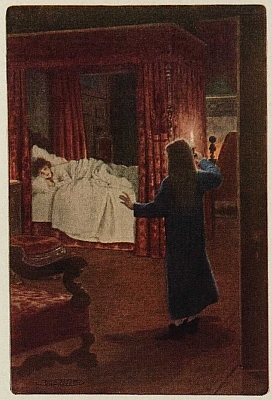 "'WHO ARE YOU?—ARE YOU A GHOST?'"—Page 157
"Who are you?" he said at last in a half-frightened whisper. "Are you a ghost?"
"No, I am not," Mary answered, her own whisper sounding half frightened. "Are you one?"
He stared and stared and stared. Mary could not help noticing what strange eyes he had. They were agate gray and they looked too big for his face because they had black lashes all round them.
"No," he replied after waiting a moment or so. "I am Colin."
"Who is Colin?" she faltered.
"I am Colin Craven. Who are you?"
"I am Mary Lennox. Mr. Craven is my uncle."
"He is my father," said the boy.
"Your father!" gasped Mary. "No one ever told me he had a boy! Why didn't they?"
"Come here," he said, still keeping his strange eyes fixed on her with an anxious expression.
She came close to the bed and he put out his hand and touched her.
"You are real, aren't you?" he said. "I have such real dreams very often. You might be one of them."
Mary had slipped on a woolen wrapper before she left her room and she put a piece of it between his fingers.
"Rub that and see how thick and warm it is," she said. "I will pinch you a little if you like, to show you how real I am. For a minute I thought you might be a dream too."
"Where did you come from?" he asked.
"From my own room. The wind wuthered so I couldn't go to sleep and I heard some one crying and wanted to find out who it was. What were you crying for?"
"Because I couldn't go to sleep either and my head ached. Tell me your name again."
"Mary Lennox. Did no one ever tell you I had come to live here?"
He was still fingering the fold of her wrapper, but he began to look a little more as if he believed in her reality.
"No," he answered. "They daren't."
"Why?" asked Mary.
"Because I should have been afraid you would see me. I won't let people see me and talk me over."
"Why?" Mary asked again, feeling more mystified every moment.
"Because I am like this always, ill and having to lie down. My father won't let people talk me over either. The servants are not allowed to speak about me. If I live I may be a hunchback, but I shan't live. My father hates to think I may be like him."
"Oh, what a queer house this is!" Mary said. "What a queer house! Everything is a kind of secret. Rooms are locked up and gardens are locked up—and you! Have you been locked up?"
"No. I stay in this room because I don't want to be moved out of it. It tires me too much."
"Does your father come and see you?" Mary ventured.
"Sometimes. Generally when I am asleep. He doesn't want to see me."
"Why?" Mary could not help asking again.
A sort of angry shadow passed over the boy's face.
"My mother died when I was born and it makes him wretched to look at me. He thinks I don't know, but I've heard people talking. He almost hates me."
"He hates the garden, because she died," said Mary half speaking to herself.
"What garden?" the boy asked.
"Oh! just—just a garden she used to like," Mary stammered. "Have you been here always?"
"Nearly always. Sometimes I have been taken to places at the seaside, but I won't stay because people stare at me. I used to wear an iron thing to keep my back straight, but a grand doctor came from London to see me and said it was stupid. He told them to take it off and keep me out in the fresh air. I hate fresh air and I don't want to go out."
"I didn't when first I came here," said Mary. "Why do you keep looking at me like that?"
"Because of the dreams that are so real," he answered rather fretfully. "Sometimes when I open my eyes I don't believe I'm awake."
"We're both awake," said Mary. She glanced round the room with its high ceiling and shadowy corners and dim firelight. "It looks quite like a dream, and it's the middle of the night, and everybody in the house is asleep—everybody but us. We are wide awake."
"I don't want it to be a dream," the boy said restlessly.
Mary thought of something all at once.
"If you don't like people to see you," she began, "do you want me to go away?"
He still held the fold of her wrapper and he gave it a little pull.
"No," he said. "I should be sure you were a dream if you went. If you are real, sit down on that big footstool and talk. I want to hear about you."
Mary put down her candle on the table near the bed and sat down on the cushioned stool. She did not want to go away at all. She wanted to stay in the mysterious hidden-away room and talk to the mysterious boy.
"What do you want me to tell you?" she said.
He wanted to know how long she had been at Misselthwaite; he wanted to know which corridor her room was on; he wanted to know what she had been doing; if she disliked the moor as he disliked it; where she had lived before she came to Yorkshire. She answered all these questions and many more and he lay back on his pillow and listened. He made her tell him a great deal about India and about her voyage across the ocean. She found out that because he had been an invalid he had not learned things as other children had. One of his nurses had taught him to read when he was quite little and he was always reading and looking at pictures in splendid books.
Though his father rarely saw him when he was awake, he was given all sorts of wonderful things to amuse himself with. He never seemed to have been amused, however. He could have anything he asked for and was never made to do anything he did not like to do.
"Every one is obliged to do what pleases me," he said indifferently. "It makes me ill to be angry. No one believes I shall live to grow up."
He said it as if he was so accustomed to the idea that it had ceased to matter to him at all. He seemed to like the sound of Mary's voice. As she went on talking he listened in a drowsy, interested way. Once or twice she wondered if he were not gradually falling into a doze. But at last he asked a question which opened up a new subject.
"How old are you?" he asked.
"I am ten," answered Mary, forgetting herself for the moment, "and so are you."
"How do you know that?" he demanded in a surprised voice.
"Because when you were born the garden door was locked and the key was buried. And it has been locked for ten years."
Colin half sat up, turning toward her, leaning on his elbows.
"What garden door was locked? Who did it? Where was the key buried?" he exclaimed as if he were suddenly very much interested.
"It—it was the garden Mr. Craven hates," said Mary nervously. "He locked the door. No one—no one knew where he buried the key."
"What sort of a garden is it?" Colin persisted eagerly.
"No one has been allowed to go into it for ten years," was Mary's careful answer.
But it was too late to be careful. He was too much like herself. He too had had nothing to think about and the idea of a hidden garden attracted him as it had attracted her. He asked question after question. Where was it? Had she never looked for the door? Had she never asked the gardeners?
"They won't talk about it," said Mary. "I think they have been told not to answer questions."
"I would make them," said Colin.
"Could you?" Mary faltered, beginning to feel frightened. If he could make people answer questions, who knew what might happen!
"Every one is obliged to please me. I told you that," he said. "If I were to live, this place would sometime belong to me. They all know that. I would make them tell me."
Mary had not known that she herself had been spoiled, but she could see quite plainly that this mysterious boy had been. He thought that the whole world belonged to him. How peculiar he was and how coolly he spoke of not living.
"Do you think you won't live?" she asked, partly because she was curious and partly in hope of making him forget the garden.
"I don't suppose I shall," he answered as indifferently as he had spoken before. "Ever since I remember anything I have heard people say I shan't. At first they thought I was too little to understand and now they think I don't hear. But I do. My doctor is my father's cousin. He is quite poor and if I die he will have all Misselthwaite when my father is dead. I should think he wouldn't want me to live."
"Do you want to live?" inquired Mary.
"No," he answered, in a cross, tired fashion. "But I don't want to die. When I feel ill I lie here and think about it until I cry and cry."
"I have heard you crying three times," Mary said, "but I did not know who it was. Were you crying about that?" She did so want him to forget the garden.
"I dare say," he answered. "Let us talk about something else. Talk about that garden. Don't you want to see it?"
"Yes," answered Mary, in quite a low voice.
"I do," he went on persistently. "I don't think I ever really wanted to see anything before, but I want to see that garden. I want the key dug up. I want the door unlocked. I would let them take me there in my chair. That would be getting fresh air. I am going to make them open the door."
He had become quite excited and his strange eyes began to shine like stars and looked more immense than ever.
"They have to please me," he said. "I will make them take me there and I will let you go, too."
Mary's hands clutched each other. Everything would be spoiled—everything! Dickon would never come back. She would never again feel like a missel thrush with a safe-hidden nest.
"Oh, don't—don't—don't—don't do that!" she cried out.
He stared as if he thought she had gone crazy!
"Why?" he exclaimed. "You said you wanted to see it."
"I do," she answered almost with a sob in her throat, "but if you make them open the door and take you in like that it will never be a secret again."
He leaned still farther forward.
"A secret," he said. "What do you mean? Tell me."
Mary's words almost tumbled over one another.
"You see—you see," she panted, "if no one knows but ourselves—if there was a door, hidden somewhere under the ivy—if there was—and we could find it; and if we could slip through it together and shut it behind us, and no one knew any one was inside and we called it our garden and pretended that—that we were missel thrushes and it was our nest, and if we played there almost every day and dug and planted seeds and made it all come alive—"
"Is it dead?" he interrupted her.
"It soon will be if no one cares for it," she went on. "The bulbs will live but the roses—"
He stopped her again as excited as she was herself.
"What are bulbs?" he put in quickly.
"They are daffodils and lilies and snowdrops. They are working in the earth now—pushing up pale green points because the spring is coming."
"Is the spring coming?" he said. "What is it like? You don't see it in rooms if you are ill."
"It is the sun shining on the rain and the rain falling on the sunshine, and things pushing up and working under the earth," said Mary. "If the garden was a secret and we could get into it we could watch the things grow bigger every day, and see how many roses are alive. Don't you see? Oh, don't you see how much nicer it would be if it was a secret?"
He dropped back on his pillow and lay there with an odd expression on his face.
"I never had a secret," he said, "except that one about not living to grow up. They don't know I know that, so it is a sort of secret. But I like this kind better."
"If you won't make them take you to the garden," pleaded Mary, "perhaps—I feel almost sure I can find out how to get in sometime. And then—if the doctor wants you to go out in your chair, and if you can always do what you want to do, perhaps—perhaps we might find some boy who would push you, and we could go alone and it would always be a secret garden."
"I should—like—that," he said very slowly, his eyes looking dreamy. "I should like that. I should not mind fresh air in a secret garden."
Mary began to recover her breath and feel safer because the idea of keeping the secret seemed to please him. She felt almost sure that if she kept on talking and could make him see the garden in his mind as she had seen it he would like it so much that he could not bear to think that everybody might tramp into it when they chose.
"I'll tell you what I think it would be like, if we could go into it," she said. "It has been shut up so long things have grown into a tangle perhaps."
He lay quite still and listened while she went on talking about the roses which might have clambered from tree to tree and hung down—about the many birds which might have built their nests there because it was so safe. And then she told him about the robin and Ben Weatherstaff, and there was so much to tell about the robin and it was so easy and safe to talk about it that she ceased to feel afraid. The robin pleased him so much that he smiled until he looked almost beautiful, and at first Mary had thought that he was even plainer than herself, with his big eyes and heavy locks of hair.
"I did not know birds could be like that," he said. "But if you stay in a room you never see things. What a lot of things you know. I feel as if you had been inside that garden."
She did not know what to say, so she did not say anything. He evidently did not expect an answer and the next moment he gave her a surprise.
"I am going to let you look at something," he said. "Do you see that rose-colored silk curtain hanging on the wall over the mantel-piece?"
Mary had not noticed it before, but she looked up and saw it. It was a curtain of soft silk hanging over what seemed to be some picture.
"Yes," she answered.
"There is a cord hanging from it," said Colin. "Go and pull it."
Mary got up, much mystified, and found the cord. When she pulled it the silk curtain ran back on rings and when it ran back it uncovered a picture. It was the picture of a girl with a laughing face. She had bright hair tied up with a blue ribbon and her gay, lovely eyes were exactly like Colin's unhappy ones, agate gray and looking twice as big as they really were because of the black lashes all round them.
"She is my mother," said Colin complainingly. "I don't see why she died. Sometimes I hate her for doing it."
"How queer!" said Mary.
"If she had lived I believe I should not have been ill always," he grumbled. "I dare say I should have lived, too. And my father would not have hated to look at me. I dare say I should have had a strong back. Draw the curtain again."
Mary did as she was told and returned to her footstool.
"She is much prettier than you," she said, "but her eyes are just like yours—at least they are the same shape and color. Why is the curtain drawn over her?"
He moved uncomfortably.
"I made them do it," he said. "Sometimes I don't like to see her looking at me. She smiles too much when I am ill and miserable. Besides, she is mine and I don't want every one to see her."
There were a few moments of silence and then Mary spoke.
"What would Mrs. Medlock do if she found out that I had been here?" she inquired.
"She would do as I told her to do," he answered. "And I should tell her that I wanted you to come here and talk to me every day. I am glad you came."
"So am I," said Mary. "I will come as often as I can, but"—she hesitated—"I shall have to look every day for the garden door."
"Yes, you must," said Colin, "and you can tell me about it afterward."
He lay thinking a few minutes, as he had done before, and then he spoke again.
"I think you shall be a secret, too," he said. "I will not tell them until they find out. I can always send the nurse out of the room and say that I want to be by myself. Do you know Martha?"
"Yes, I know her very well," said Mary. "She waits on me."
He nodded his head toward the outer corridor.
"She is the one who is asleep in the other room. The nurse went away yesterday to stay all night with her sister and she always makes Martha attend to me when she wants to go out. Martha shall tell you when to come here."
Then Mary understood Martha's troubled look when she had asked questions about the crying.
"Martha knew about you all the time?" she said.
"Yes; she often attends to me. The nurse likes to get away from me and then Martha comes."
"I have been here a long time," said Mary. "Shall I go away now? Your eyes look sleepy."
"I wish I could go to sleep before you leave me," he said rather shyly.
"Shut your eyes," said Mary, drawing her footstool closer, "and I will do what my Ayah used to do in India. I will pat your hand and stroke it and sing something quite low."
"I should like that perhaps," he said drowsily.
Somehow she was sorry for him and did not want him to lie awake, so she leaned against the bed and began to stroke and pat his hand and sing a very low little chanting song in Hindustani.
"That is nice," he said more drowsily still, and she went on chanting and stroking, but when she looked at him again his black lashes were lying close against his cheeks, for his eyes were shut and he was fast asleep. So she got up softly, took her candle and crept away without making a sound.
CHAPTER XIV
A YOUNG RAJAH
The moor was hidden in mist when the morning came and the rain had not stopped pouring down. There could be no going out of doors. Martha was so busy that Mary had no opportunity of talking to her, but in the afternoon she asked her to come and sit with her in the nursery. She came bringing the stocking she was always knitting when she was doing nothing else.
"What's the matter with thee?" she asked as soon as they sat down. "Tha' looks as if tha'd somethin' to say."
"I have. I have found out what the crying was," said Mary.
Martha let her knitting drop on her knee and gazed at her with startled eyes.
"Tha' hasn't!" she exclaimed. "Never!"
"I heard it in the night," Mary went on. "And I got up and went to see where it came from. It was Colin. I found him."
Martha's face became red with fright.
"Eh! Miss Mary!" she said half crying. "Tha' shouldn't have done it—tha' shouldn't! Tha'll get me in trouble. I never told thee nothin' about him—but tha'll get me in trouble. I shall lose my place and what'll mother do!"
"You won't lose your place," said Mary. "He was glad I came. We talked and talked and he said he was glad I came."
"Was he?" cried Martha. "Art tha' sure? Tha' doesn't know what he's like when anything vexes him. He's a big lad to cry like a baby, but when he's in a passion he'll fair scream just to frighten us. He knows us daren't call our souls our own."
"He wasn't vexed," said Mary. "I asked him if I should go away and he made me stay. He asked me questions and I sat on a big footstool and talked to him about India and about the robin and gardens. He wouldn't let me go. He let me see his mother's picture. Before I left him I sang him to sleep."
Martha fairly gasped with amazement.
"I can scarcely believe thee!" she protested. "It's as if tha'd walked straight into a lion's den. If he'd been like he is most times he'd have throwed himself into one of his tantrums and roused th' house. He won't let strangers look at him."
"He let me look at him. I looked at him all the time and he looked at me. We stared!" said Mary.
"I don't know what to do!" cried agitated Martha. "If Mrs. Medlock finds out, she'll think I broke orders and told thee and I shall be packed back to mother."
"He is not going to tell Mrs. Medlock anything about it yet. It's to be a sort of secret just at first," said Mary firmly. "And he says everybody is obliged to do as he pleases."
"Aye, that's true enough—th' bad lad!" sighed Martha, wiping her forehead with her apron.
"He says Mrs. Medlock must. And he wants me to come and talk to him every day. And you are to tell me when he wants me."
"Me!" said Martha; " I shall lose my place—I shall for sure!"
"You can't if you are doing what he wants you to do and everybody is ordered to obey him," Mary argued.
"Does tha' mean to say," cried Martha with wide open eyes, "that he was nice to thee!"
"I think he almost liked me," Mary answered.
"Then tha' must have bewitched him!" decided Martha, drawing a long breath.
"Do you mean Magic?" inquired Mary. "I've heard about Magic in India, but I can't make it. I just went into his room and I was so surprised to see him I stood and stared. And then he turned round and stared at me. And he thought I was a ghost or a dream and I thought perhaps he was. And it was so queer being there alone together in the middle of the night and not knowing about each other. And we began to ask each other questions. And when I asked him if I must go away he said I must not."
"Th' world's comin' to a end!" gasped Martha.
"What is the matter with him?" asked Mary.
"Nobody knows for sure and certain," said Martha. "Mr. Craven went off his head like when he was born. Th' doctors thought he'd have to be put in a 'sylum. It was because Mrs. Craven died like I told you. He wouldn't set eyes on th' baby. He just raved and said it'd be another hunchback like him and it'd better die."
"Is Colin a hunchback?" Mary asked. "He didn't look like one."
"He isn't yet," said Martha. "But he began all wrong. Mother said that there was enough trouble and raging in th' house to set any child wrong. They was afraid his back was weak an' they've always been takin' care of it—keepin' him lyin' down and not lettin' him walk. Once they made him wear a brace but he fretted so he was downright ill. Then a big doctor came to see him an' made them take it off. He talked to th' other doctor quite rough—in a polite way. He said there'd been too much medicine and too much lettin' him have his own way."
"I think he's a very spoiled boy," said Mary.
"He's th' worst young nowt as ever was!" said Martha. "I won't say as he hasn't been ill a good bit. He's had coughs an' colds that's nearly killed him two or three times. Once he had rheumatic fever an' once he had typhoid. Eh! Mrs. Medlock did get a fright then. He'd been out of his head an' she was talkin' to th' nurse, thinkin' he didn't know nothin', an' she said, 'He'll die this time sure enough, an' best thing for him an' for everybody.' An' she looked at him an' there he was with his big eyes open, starin' at her as sensible as she was herself. She didn't know what'd happen but he just stared at her an' says, 'You give me some water an' stop talkin'.'"
"Do you think he will die?" asked Mary.
"Mother says there's no reason why any child should live that gets no fresh air an' doesn't do nothin' but lie on his back an' read picture-books an' take medicine. He's weak and hates th' trouble o' bein' taken out o' doors, an' he gets cold so easy he says it makes him ill."
Mary sat and looked at the fire.
"I wonder," she said slowly, "if it would not do him good to go out into a garden and watch things growing. It did me good."
"One of th' worst fits he ever had," said Martha, "was one time they took him out where the roses is by the fountain. He'd been readin' in a paper about people gettin' somethin' he called 'rose cold' an' he began to sneeze an' said he'd got it an' then a new gardener as didn't know th' rules passed by an' looked at him curious. He threw himself into a passion an' he said he'd looked at him because he was going to be a hunchback. He cried himself into a fever an' was ill all night."
"If he ever gets angry at me, I'll never go and see him again," said Mary.
"He'll have thee if he wants thee," said Martha. "Tha' may as well know that at th' start."
Very soon afterward a bell rang and she rolled up her knitting.
"I dare say th' nurse wants me to stay with him a bit," she said. "I hope he's in a good temper."
She was out of the room about ten minutes and then she came back with a puzzled expression.
"Well, tha' has bewitched him," she said. "He's up on his sofa with his picture-books. He's told the nurse to stay away until six o'clock. I'm to wait in the next room. Th' minute she was gone he called me to him an' says, 'I want Mary Lennox to come and talk to me, and remember you're not to tell any one.' You'd better go as quick as you can."
Mary was quite willing to go quickly. She did not want to see Colin as much as she wanted to see Dickon, but she wanted to see him very much.
There was a bright fire on the hearth when she entered his room, and in the daylight she saw it was a very beautiful room indeed. There were rich colors in the rugs and hangings and pictures and books on the walls which made it look glowing and comfortable even in spite of the gray sky and falling rain. Colin looked rather like a picture himself. He was wrapped in a velvet dressing-gown and sat against a big brocaded cushion. He had a red spot on each cheek.
"Come in," he said. "I've been thinking about you all morning."
"I've been thinking about you, too," answered Mary. "You don't know how frightened Martha is. She says Mrs. Medlock will think she told me about you and then she will be sent away."
He frowned.
"Go and tell her to come here," he said. "She is in the next room."
Mary went and brought her back. Poor Martha was shaking in her shoes. Colin was still frowning.
"Have you to do what I please or have you not?" he demanded.
"I have to do what you please, sir," Martha faltered, turning quite red.
"Has Medlock to do what I please?"
"Everybody has, sir," said Martha.
"Well, then, if I order you to bring Miss Mary to me, how can Medlock send you away if she finds it out?"
"Please don't let her, sir," pleaded Martha.
"I'll send her away if she dares to say a word about such a thing," said Master Craven grandly. "She wouldn't like that, I can tell you."
"Thank you, sir," bobbing a curtsy, "I want to do my duty, sir."
"What I want is your duty," said Colin more grandly still. "I'll take care of you. Now go away."
When the door closed behind Martha, Colin found Mistress Mary gazing at him as if he had set her wondering.
"Why do you look at me like that?" he asked her. "What are you thinking about?"
"I am thinking about two things."
"What are they? Sit down and tell me."
"This is the first one," said Mary, seating herself on the big stool. "Once in India I saw a boy who was a Rajah. He had rubies and emeralds and diamonds stuck all over him. He spoke to his people just as you spoke to Martha. Everybody had to do everything he told them—in a minute. I think they would have been killed if they hadn't."
"I shall make you tell me about Rajahs presently," he said, "but first tell me what the second thing was."
"I was thinking," said Mary, "how different you are from Dickon."
"Who is Dickon?" he said. "What a queer name!"
She might as well tell him, she thought. She could talk about Dickon without mentioning the secret garden. She had liked to hear Martha talk about him. Besides, she longed to talk about him. It would seem to bring him nearer.
"He is Martha's brother. He is twelve years old," she explained. "He is not like any one else in the world. He can charm foxes and squirrels and birds just as the natives in India charm snakes. He plays a very soft tune on a pipe and they come and listen."
There were some big books on a table at his side and he dragged one suddenly toward him.
"There is a picture of a snake-charmer in this," he exclaimed. "Come and look at it."
The book was a beautiful one with superb colored illustrations and he turned to one of them.
"Can he do that?" he asked eagerly.
"He played on his pipe and they listened," Mary explained. "But he doesn't call it Magic. He says it's because he lives on the moor so much and he knows their ways. He says he feels sometimes as if he was a bird or a rabbit himself, he likes them so. I think he asked the robin questions. It seemed as if they talked to each other in soft chirps."
Colin lay back on his cushion and his eyes grew larger and larger and the spots on his cheeks burned.
"Tell me some more about him," he said.
"He knows all about eggs and nests," Mary went on. " And he knows where foxes and badgers and otters live. He keeps them secret so that other boys won't find their holes and frighten them. He knows about everything that grows or lives on the moor."
"Does he like the moor?" said Colin. "How can he when it's such a great, bare, dreary place?"
"It's the most beautiful place," protested Mary. "Thousands of lovely things grow on it and there are thousands of little creatures all busy building nests and making holes and burrows and chippering or singing or squeaking to each other. They are so busy and having such fun under the earth or in the trees or heather. It's their world."
"How do you know all that?" said Colin, turning on his elbow to look at her.
"I have never been there once, really," said Mary suddenly remembering. "I only drove over it in the dark. I thought it was hideous. Martha told me about it first and then Dickon. When Dickon talks about it you feel as if you saw things and heard them and as if you were standing in the heather with the sun shining and the gorse smelling like honey—and all full of bees and butterflies."
"You never see anything if you are ill," said Colin restlessly. He looked like a person listening to a new sound in the distance and wondering what it was.
"You can't if you stay in a room," said Mary.
"I couldn't go on the moor," he said in a resentful tone.
Mary was silent for a minute and then she said something bold.
"You might—sometime."
He moved as if he were startled.
"Go on the moor! How could I? I am going to die."
"How do you know?" said Mary unsympathetically. She didn't like the way he had of talking about dying. She did not feel very sympathetic. She felt rather as if he almost boasted about it.
"Oh, I've heard it ever since I remember," he answered crossly. "They are always whispering about it and thinking I don't notice. They wish I would, too."
Mistress Mary felt quite contrary. She pinched her lips together.
"If they wished I would," she said, "I wouldn't. Who wishes you would?"
"The servants—and of course Dr. Craven because he would get Misselthwaite and be rich instead of poor. He daren't say so, but he always looks cheerful when I am worse. When I had typhoid fever his face got quite fat. I think my father wishes it, too."
"I don't believe he does," said Mary quite obstinately.
That made Colin turn and look at her again.
"Don't you?" he said.
And then he lay back on his cushion and was still, as if he were thinking. And there was quite a long silence. Perhaps they were both of them thinking strange things children do not usually think of.
"I like the grand doctor from London, because he made them take the iron thing off," said Mary at last. "Did he say you were going to die?"
"No."
"What did he say?"
"He didn't whisper," Colin answered. "Perhaps he knew I hated whispering. I heard him say one thing quite aloud. He said, 'The lad might live if he would make up his mind to it. Put him in the humor.' It sounded as if he was in a temper."
"I'll tell you who would put you in the humor, perhaps," said Mary reflecting. She felt as if she would like this thing to be settled one way or the other. "I believe Dickon would. He's always talking about live things. He never talks about dead things or things that are ill. He's always looking up in the sky to watch birds flying—or looking down at the earth to see something growing. He has such round blue eyes and they are so wide open with looking about. And he laughs such a big laugh with his wide mouth—and his cheeks are as red—as red as cherries."
She pulled her stool nearer to the sofa and her expression quite changed at the remembrance of the wide curving mouth and wide open eyes.
"See here," she said. "Don't let us talk about dying; I don't like it. Let us talk about living. Let us talk and talk about Dickon. And then we will look at your pictures."
It was the best thing she could have said. To talk about Dickon meant to talk about the moor and about the cottage and the fourteen people who lived in it on sixteen shillings a week—and the children who got fat on the moor grass like the wild ponies. And about Dickon's mother—and the skipping-rope—and the moor with the sun on it—and about pale green points sticking up out of the black sod. And it was all so alive that Mary talked more than she had ever talked before—and Colin both talked and listened as he had never done either before. And they both began to laugh over nothings as children will when they are happy together. And they laughed so that in the end they were making as much noise as if they had been two ordinary healthy natural ten-year-old creatures—instead of a hard, little, unloving girl and a sickly boy who believed that he was going to die.
They enjoyed themselves so much that they forgot the pictures and they forgot about the time. They had been laughing quite loudly over Ben Weatherstaff and his robin and Colin was actually sitting up as if he had forgotten about his weak back when he suddenly remembered something.
"Do you know there is one thing we have never once thought of," he said. "We are cousins."
It seemed so queer that they had talked so much and never remembered this simple thing that they laughed more than ever, because they had got into the humor to laugh at anything. And in the midst of the fun the door opened and in walked Dr. Craven and Mrs. Medlock.
Dr. Craven started in actual alarm and Mrs. Medlock almost fell back because he had accidentally bumped against her.
"Good Lord!" exclaimed poor Mrs. Medlock, with her eyes almost starting out of her head. "Good Lord!"
"What is this?" said Dr. Craven, coming forward. "What does it mean?"
Then Mary was reminded of the boy Rajah again. Colin answered as if neither the doctor's alarm nor Mrs. Medlock's terror were of the slightest consequence. He was as little disturbed or frightened as if an elderly cat and dog had walked into the room.
"This is my cousin, Mary Lennox," he said. "I asked her to come and talk to me. I like her. She must come and talk to me whenever I send for her."
Dr. Craven turned reproachfully to Mrs. Medlock.
"Oh, sir," she panted. "I don't know how it's happened. There's not a servant on the place that'd dare to talk—they all have their orders."
"Nobody told her anything," said Colin, "she heard me crying and found me herself. I am glad she came. Don't be silly, Medlock."
Mary saw that Dr. Craven did not look pleased, but it was quite plain that he dare not oppose his patient. He sat down by Colin and felt his pulse.
"I am afraid there has been too much excitement. Excitement is not good for you, my boy," he said.
"I should be excited if she kept away," answered Colin, his eyes beginning to look dangerously sparkling. "I am better. She makes me better. The nurse must bring up her tea with mine. We will have tea together."
Mrs. Medlock and Dr. Craven looked at each other in a troubled way, but there was evidently nothing to be done.
"He does look rather better, sir," ventured Mrs. Medlock. "But"—thinking the matter over—"he looked better this morning before she came into the room."
"She came into the room last night. She stayed with me a long time. She sang a Hindustani song to me and it made me go to sleep," said Colin. "I was better when I wakened up. I wanted my breakfast. I want my tea now. Tell nurse, Medlock."