
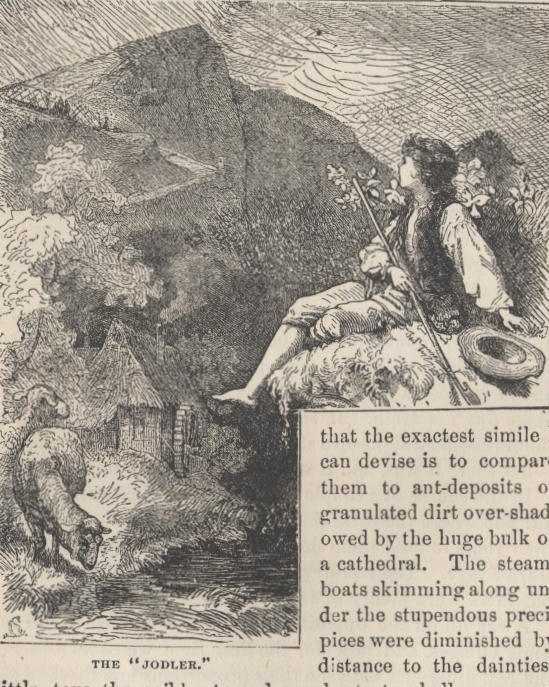
Presently we came upon half a dozen sheep nibbling grass in the spray of a
stream of clear water that sprang from a rock wall a hundred feet high,
and all at once our ears were startled with a melodious “Lul ... l
... l l l llul-lul-LAhee-o-o-o!” pealing joyously from a near but
invisible source, and recognized that we were hearing for the first time
the famous Alpine Jodel in its own native wilds. And we recognized,
also, that it was that sort of quaint commingling of baritone and falsetto
which at home we call “Tyrolese warbling."
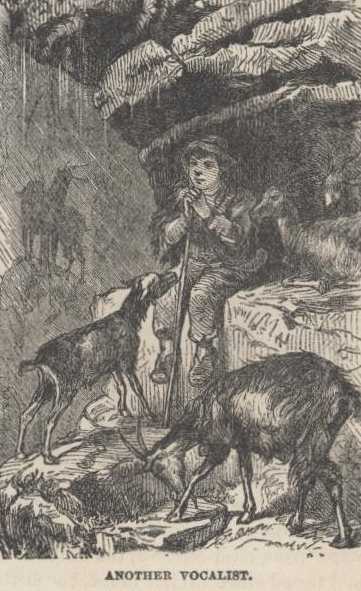
The jodeling (pronounced yOdling—emphasis on the O) continued, and was very pleasant and inspiriting to hear. Now the jodeler appeared—a shepherd boy of sixteen—and in our gladness and gratitude we gave him a franc to jodel some more. So he jodeled and we listened. We moved on, presently, and he generously jodeled us out of sight. After about fifteen minutes we came across another shepherd boy who was jodeling, and gave him half a franc to keep it up. He also jodeled us out of sight. After that, we found a jodeler every ten minutes; we gave the first one eight cents, the second one six cents, the third one four, the fourth one a penny, contributed nothing to Nos. 5, 6, and 7, and during the remainder of the day hired the rest of the jodelers, at a franc apiece, not to jodel any more. There is somewhat too much of the jodeling in the Alps.
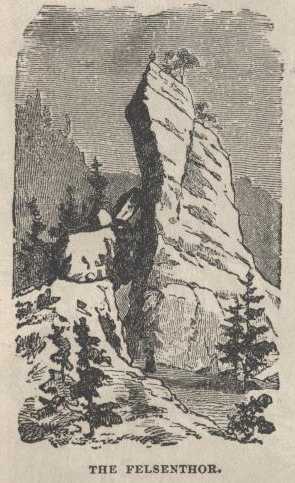
About the middle of the afternoon we passed through a prodigious natural
gateway called the Felsenthor, formed by two enormous upright rocks, with
a third lying across the top. There was a very attractive little hotel
close by, but our energies were not conquered yet, so we went on.
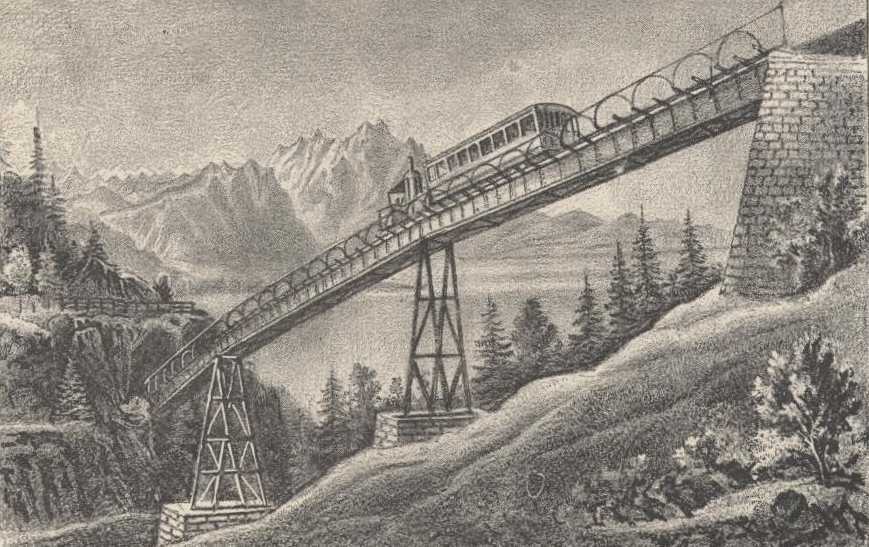
Three hours afterward we came to the railway-track. It was planted straight up the mountain with the slant of a ladder that leans against a house, and it seemed to us that man would need good nerves who proposed to travel up it or down it either.
During the latter part of the afternoon we cooled our roasting interiors with ice-cold water from clear streams, the only really satisfying water we had tasted since we left home, for at the hotels on the continent they merely give you a tumbler of ice to soak your water in, and that only modifies its hotness, doesn’t make it cold. Water can only be made cold enough for summer comfort by being prepared in a refrigerator or a closed ice-pitcher. Europeans say ice-water impairs digestion. How do they know?—they never drink any.
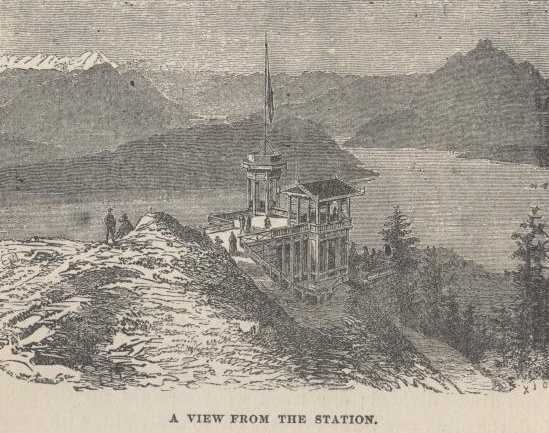
At ten minutes past six we reached the Kaltbad station, where there is a
spacious hotel with great verandas which command a majestic expanse of
lake and mountain scenery. We were pretty well fagged out, now, but as we
did not wish to miss the Alpine sunrise, we got through our dinner as
quickly as possible and hurried off to bed. It was unspeakably comfortable
to stretch our weary limbs between the cool, damp sheets. And how we did
sleep!—for there is no opiate like Alpine pedestrianism.
In the morning we both awoke and leaped out of bed at the same instant and ran and stripped aside the window-curtains; but we suffered a bitter disappointment again: it was already half past three in the afternoon.
We dressed sullenly and in ill spirits, each accusing the other of oversleeping. Harris said if we had brought the courier along, as we ought to have done, we should not have missed these sunrises. I said he knew very well that one of us would have to sit up and wake the courier; and I added that we were having trouble enough to take care of ourselves, on this climb, without having to take care of a courier besides.
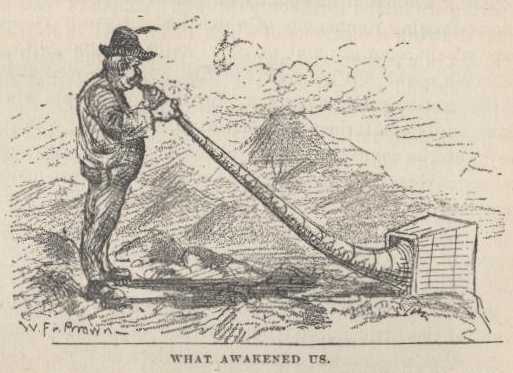
During breakfast our spirits came up a little, since we found by this guide-book that in the hotels on the summit the tourist is not left to trust to luck for his sunrise, but is roused betimes by a man who goes through the halls with a great Alpine horn, blowing blasts that would raise the dead. And there was another consoling thing: the guide-book said that up there on the summit the guests did not wait to dress much, but seized a red bed blanket and sailed out arrayed like an Indian. This was good; this would be romantic; two hundred and fifty people grouped on the windy summit, with their hair flying and their red blankets flapping, in the solemn presence of the coming sun, would be a striking and memorable spectacle. So it was good luck, not ill luck, that we had missed those other sunrises.
We were informed by the guide-book that we were now 3,228 feet above the level of the lake—therefore full two-thirds of our journey had been accomplished. We got away at a quarter past four P.M.; a hundred yards above the hotel the railway divided; one track went straight up the steep hill, the other one turned square off to the right, with a very slight grade. We took the latter, and followed it more than a mile, turned a rocky corner, and came in sight of a handsome new hotel. If we had gone on, we should have arrived at the summit, but Harris preferred to ask a lot of questions—as usual, of a man who didn’t know anything—and he told us to go back and follow the other route. We did so. We could ill afford this loss of time.
We climbed and climbed; and we kept on climbing; we reached about forty
summits, but there was always another one just ahead. It came on to rain,
and it rained in dead earnest. We were soaked through and it was bitter
cold. Next a smoky fog of clouds covered the whole region densely, and we
took to the railway-ties to keep from getting lost. Sometimes we slopped
along in a narrow path on the left-hand side of the track, but by and by
when the fog blew aside a little and we saw that we were treading the
rampart of a precipice and that our left elbows were projecting over a
perfectly boundless and bottomless vacancy, we gasped, and jumped for the
ties again.
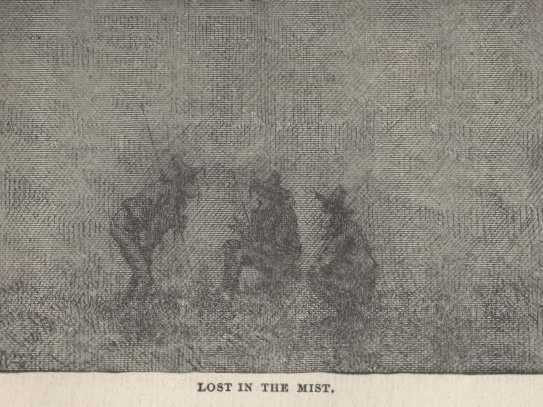
The night shut down, dark and drizzly and cold. About eight in the evening the fog lifted and showed us a well-worn path which led up a very steep rise to the left. We took it, and as soon as we had got far enough from the railway to render the finding it again an impossibility, the fog shut down on us once more.
We were in a bleak, unsheltered place, now, and had to trudge right along, in order to keep warm, though we rather expected to go over a precipice, sooner or later. About nine o’clock we made an important discovery—that we were not in any path. We groped around a while on our hands and knees, but we could not find it; so we sat down in the mud and the wet scant grass to wait.
We were terrified into this by being suddenly confronted with a vast body which showed itself vaguely for an instant and in the next instant was smothered in the fog again. It was really the hotel we were after, monstrously magnified by the fog, but we took it for the face of a precipice, and decided not to try to claw up it.
We sat there an hour, with chattering teeth and quivering bodies, and
quarreled over all sorts of trifles, but gave most of our attention to
abusing each other for the stupidity of deserting the railway-track. We
sat with our backs to the precipice, because what little wind there was
came from that quarter. At some time or other the fog thinned a little; we
did not know when, for we were facing the empty universe and the thinness
could not show; but at last Harris happened to look around, and there
stood a huge, dim, spectral hotel where the precipice had been. One could
faintly discern the windows and chimneys, and a dull blur of lights. Our
first emotion was deep, unutterable gratitude, our next was a foolish
rage, born of the suspicion that possibly the hotel had been visible
three-quarters of an hour while we sat there in those cold puddles
quarreling.
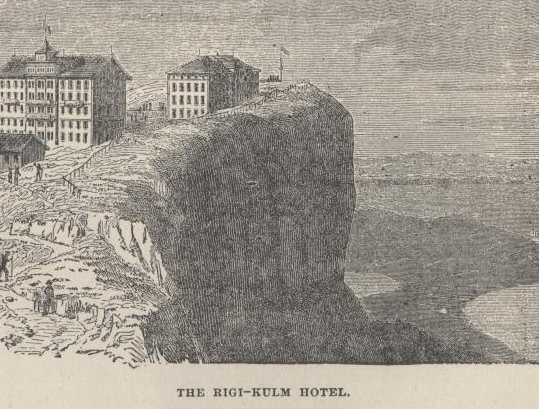
Yes, it was the Rigi-Kulm hotel—the one that occupies the extreme summit, and whose remote little sparkle of lights we had often seen glinting high aloft among the stars from our balcony away down yonder in Lucerne. The crusty portier and the crusty clerks gave us the surly reception which their kind deal out in prosperous times, but by mollifying them with an extra display of obsequiousness and servility we finally got them to show us to the room which our boy had engaged for us.
We got into some dry clothing, and while our supper was preparing we loafed forsakenly through a couple of vast cavernous drawing-rooms, one of which had a stove in it. This stove was in a corner, and densely walled around with people. We could not get near the fire, so we moved at large in the artic spaces, among a multitude of people who sat silent, smileless, forlorn, and shivering—thinking what fools they were to come, perhaps. There were some Americans and some Germans, but one could see that the great majority were English.
We lounged into an apartment where there was a great crowd, to see what was going on. It was a memento-magazine. The tourists were eagerly buying all sorts and styles of paper-cutters, marked “Souvenir of the Rigi,” with handles made of the little curved horn of the ostensible chamois; there were all manner of wooden goblets and such things, similarly marked. I was going to buy a paper-cutter, but I believed I could remember the cold comfort of the Rigi-Kulm without it, so I smothered the impulse.
Supper warmed us, and we went immediately to bed—but first, as Mr. Baedeker requests all tourists to call his attention to any errors which they may find in his guide-books, I dropped him a line to inform him he missed it by just about three days. I had previously informed him of his mistake about the distance from Allerheiligen to Oppenau, and had also informed the Ordnance Depart of the German government of the same error in the imperial maps. I will add, here, that I never got any answer to those letters, or any thanks from either of those sources; and, what is still more discourteous, these corrections have not been made, either in the maps or the guide-books. But I will write again when I get time, for my letters may have miscarried.
We curled up in the clammy beds, and went to sleep without rocking. We
were so sodden with fatigue that we never stirred nor turned over till the
blooming blasts of the Alpine horn aroused us.
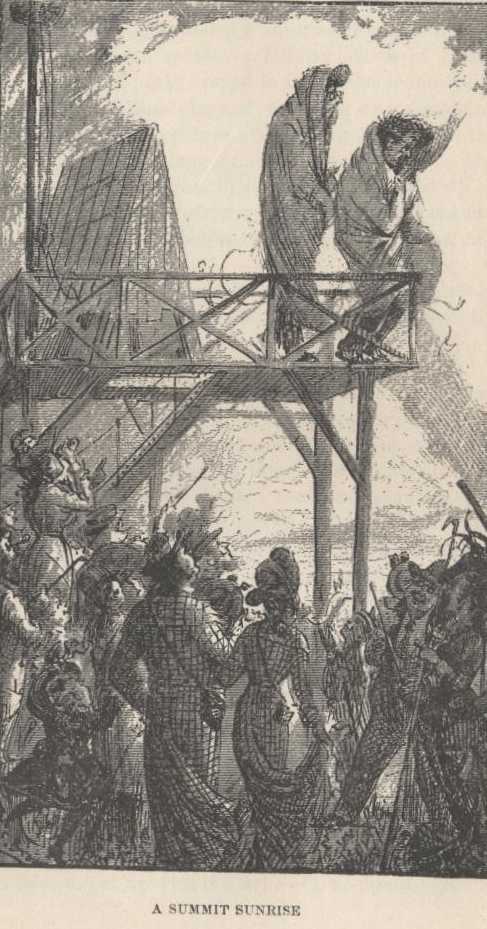
It may well be imagined that we did not lose any time. We snatched on a
few odds and ends of clothing, cocooned ourselves in the proper red
blankets, and plunged along the halls and out into the whistling wind
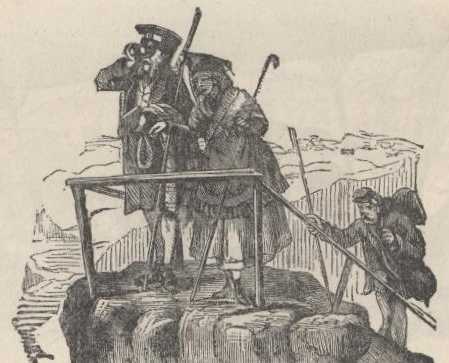
bareheaded. We saw a tall wooden scaffolding on the very peak of the
summit, a hundred yards away, and made for it. We rushed up the stairs to
the top of this scaffolding, and stood there, above the vast outlying
world, with hair flying and ruddy blankets waving and cracking in the
fierce breeze.
“Fifteen minutes too late, at last!” said Harris, in a vexed voice. “The sun is clear above the horizon.”
“No matter,” I said, “it is a most magnificent spectacle, and we will see it do the rest of its rising anyway.”
In a moment we were deeply absorbed in the marvel before us, and dead to everything else. The great cloud-barred disk of the sun stood just above a limitless expanse of tossing white-caps—so to speak—a billowy chaos of massy mountain domes and peaks draped in imperishable snow, and flooded with an opaline glory of changing and dissolving splendors, while through rifts in a black cloud-bank above the sun, radiating lances of diamond dust shot to the zenith. The cloven valleys of the lower world swam in a tinted mist which veiled the ruggedness of their crags and ribs and ragged forests, and turned all the forbidding region into a soft and rich and sensuous paradise.
We could not speak. We could hardly breathe. We could only gaze in drunken ecstasy and drink in it. Presently Harris exclaimed:
“Why—nation, it’s going down!”
Perfectly true. We had missed the morning hornblow, and slept all day. This was stupefying.
Harris said:
“Look here, the sun isn’t the spectacle—it’s us—stacked up here on top of this gallows, in these idiotic blankets, and two hundred and fifty well-dressed men and women down here gawking up at us and not caring a straw whether the sun rises or sets, as long as they’ve got such a ridiculous spectacle as this to set down in their memorandum-books. They seem to be laughing their ribs loose, and there’s one girl there that appears to be going all to pieces. I never saw such a man as you before. I think you are the very last possibility in the way of an ass.”
“What have I done?” I answered, with heat.
“What have you done? You’ve got up at half past seven o’clock in the evening to see the sun rise, that’s what you’ve done.”
“And have you done any better, I’d like to know? I’ve always used to get up with the lark, till I came under the petrifying influence of your turgid intellect.”
“You used to get up with the lark—Oh, no doubt—you’ll get up with the hangman one of these days. But you ought to be ashamed to be jawing here like this, in a red blanket, on a forty-foot scaffold on top of the Alps. And no end of people down here to boot; this isn’t any place for an exhibition of temper.”
And so the customary quarrel went on. When the sun was fairly down, we
slipped back to the hotel in the charitable gloaming, and went to bed
again. We had encountered the horn-blower on the way, and he had tried to
collect compensation, not only for announcing the sunset, which we did
see, but for the sunrise, which we had totally missed; but we said no, we
only took our solar rations on the “European plan”—pay
for what you get. He promised to make us hear his horn in the morning, if
we were alive.
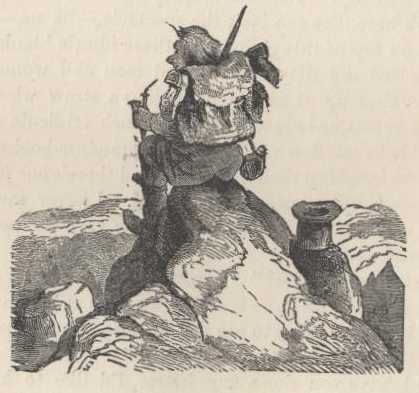
CHAPTER XXIX
[Looking West for Sunrise]
He kept his word. We heard his horn and instantly got up. It was dark and cold and wretched. As I fumbled around for the matches, knocking things down with my quaking hands, I wished the sun would rise in the middle of the day, when it was warm and bright and cheerful, and one wasn’t sleepy. We proceeded to dress by the gloom of a couple sickly candles, but we could hardly button anything, our hands shook so. I thought of how many happy people there were in Europe, Asia, and America, and everywhere, who were sleeping peacefully in their beds, and did not have to get up and see the Rigi sunrise—people who did not appreciate their advantage, as like as not, but would get up in the morning wanting more boons of Providence. While thinking these thoughts I yawned, in a rather ample way, and my upper teeth got hitched on a nail over the door, and while I was mounting a chair to free myself, Harris drew the window-curtain, and said:
“Oh, this is luck! We shan’t have to go out at all—yonder
are the mountains, in full view."
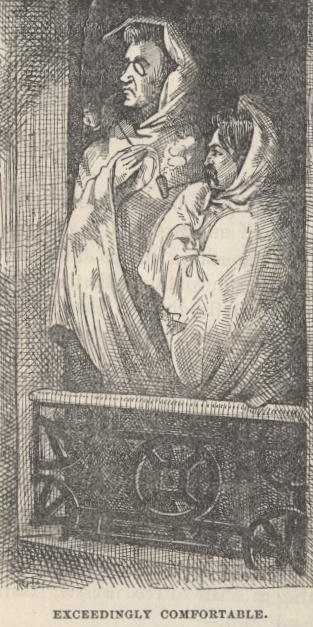
That was glad news, indeed. It made us cheerful right away. One could see the grand Alpine masses dimly outlined against the black firmament, and one or two faint stars blinking through rifts in the night. Fully clothed, and wrapped in blankets, and huddled ourselves up, by the window, with lighted pipes, and fell into chat, while we waited in exceeding comfort to see how an Alpine sunrise was going to look by candlelight. By and by a delicate, spiritual sort of effulgence spread itself by imperceptible degrees over the loftiest altitudes of the snowy wastes—but there the effort seemed to stop. I said, presently:
“There is a hitch about this sunrise somewhere. It doesn’t seem to go. What do you reckon is the matter with it?”
“I don’t know. It appears to hang fire somewhere. I never saw a sunrise act like that before. Can it be that the hotel is playing anything on us?”
“Of course not. The hotel merely has a property interest in the sun, it has nothing to do with the management of it. It is a precarious kind of property, too; a succession of total eclipses would probably ruin this tavern. Now what can be the matter with this sunrise?”
Harris jumped up and said:
“I’ve got it! I know what’s the matter with it! We’ve been looking at the place where the sun set last night!”
“It is perfectly true! Why couldn’t you have thought of that sooner? Now we’ve lost another one! And all through your blundering. It was exactly like you to light a pipe and sit down to wait for the sun to rise in the west.”
“It was exactly like me to find out the mistake, too. You never would have found it out. I find out all the mistakes.”
“You make them all, too, else your most valuable faculty would be wasted on you. But don’t stop to quarrel, now—maybe we are not too late yet.”
But we were. The sun was well up when we got to the exhibition-ground.
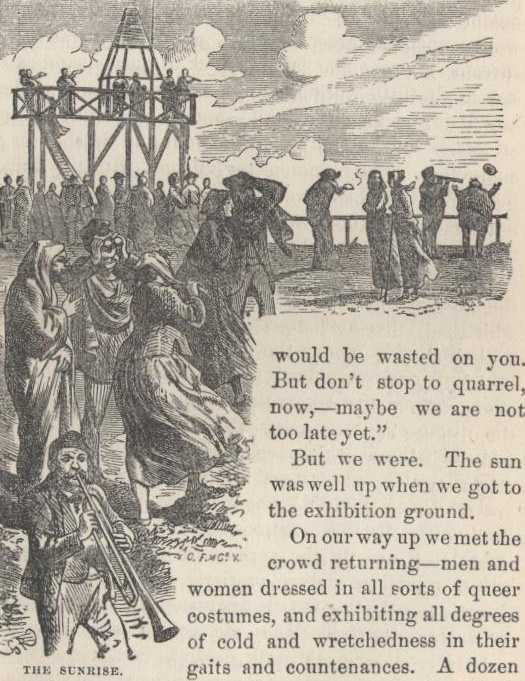
On our way up we met the crowd returning—men and women dressed in all sorts of queer costumes, and exhibiting all degrees of cold and wretchedness in their gaits and countenances. A dozen still remained on the ground when we reached there, huddled together about the scaffold with their backs to the bitter wind. They had their red guide-books open at the diagram of the view, and were painfully picking out the several mountains and trying to impress their names and positions on their memories. It was one of the saddest sights I ever saw.
Two sides of this place were guarded by railings, to keep people from
being blown over the precipices. The view, looking sheer down into the
broad valley, eastward, from this great elevation—almost a
perpendicular mile—was very quaint and curious. Counties, towns,
hilly ribs and ridges, wide stretches of green meadow, great forest
tracts, winding streams, a dozen blue lakes, a block of busy steamboats—we
saw all this little world in unique circumstantiality of detail—saw
it just as the birds see it—and all reduced to the smallest of
scales and as sharply worked out and finished as a steel engraving. The
numerous toy villages, with tiny spires projecting out of them, were just
as the children might have left them when done with play the day before;
the forest tracts were diminished to cushions of moss; one or two big
lakes were dwarfed to ponds, the smaller ones to puddles—though they
did not look like puddles, but like blue teardrops which had fallen and
lodged in slight depressions, conformable to their shapes, among the
moss-beds and the smooth levels of dainty green farm-land; the microscopic
steamboats glided along, as in a city reservoir, taking a mighty time to
cover the distance between ports which seemed only a yard apart; and the
isthmus which separated two lakes looked as if one might stretch out on it
and lie with both elbows in the water, yet we knew invisible wagons were
toiling across it and finding the distance a tedious one. This beautiful
miniature world had exactly the appearance of those “relief maps”
which reproduce nature precisely, with the heights and depressions and
other details graduated to a reduced scale, and with the rocks, trees,
lakes, etc., colored after nature.
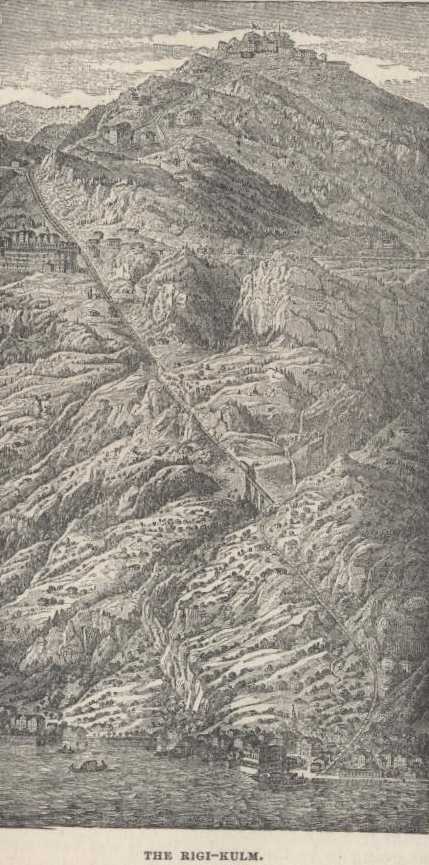
I believed we could walk down to Waeggis or Vitznau in a day, but I knew we could go down by rail in about an hour, so I chose the latter method. I wanted to see what it was like, anyway. The train came along about the middle of the afternoon, and an odd thing it was. The locomotive-boiler stood on end, and it and the whole locomotive were tilted sharply backward. There were two passenger-cars, roofed, but wide open all around. These cars were not tilted back, but the seats were; this enables the passenger to sit level while going down a steep incline.
There are three railway-tracks; the central one is cogged; the “lantern wheel” of the engine grips its way along these cogs, and pulls the train up the hill or retards its motion on the down trip. About the same speed—three miles an hour—is maintained both ways. Whether going up or down, the locomotive is always at the lower end of the train. It pushes in the one case, braces back in the other. The passenger rides backward going up, and faces forward going down.
We got front seats, and while the train moved along about fifty yards on level ground, I was not the least frightened; but now it started abruptly downstairs, and I caught my breath. And I, like my neighbors, unconsciously held back all I could, and threw my weight to the rear, but, of course, that did no particular good. I had slidden down the balusters when I was a boy, and thought nothing of it, but to slide down the balusters in a railway-train is a thing to make one’s flesh creep. Sometimes we had as much as ten yards of almost level ground, and this gave us a few full breaths in comfort; but straightway we would turn a corner and see a long steep line of rails stretching down below us, and the comfort was at an end. One expected to see the locomotive pause, or slack up a little, and approach this plunge cautiously, but it did nothing of the kind; it went calmly on, and went it reached the jumping-off place it made a sudden bow, and went gliding smoothly downstairs, untroubled by the circumstances.
It was wildly exhilarating to slide along the edge of the precipices, after this grisly fashion, and look straight down upon that far-off valley which I was describing a while ago.
There was no level ground at the Kaltbad station; the railbed was as steep as a roof; I was curious to see how the stop was going to be managed. But it was very simple; the train came sliding down, and when it reached the right spot it just stopped—that was all there was “to it”—stopped on the steep incline, and when the exchange of passengers and baggage had been made, it moved off and went sliding down again. The train can be stopped anywhere, at a moment’s notice.
There was one curious effect, which I need not take the trouble to
describe—because I can scissor a description of it out of the
railway company’s advertising pamphlet, and save my ink:
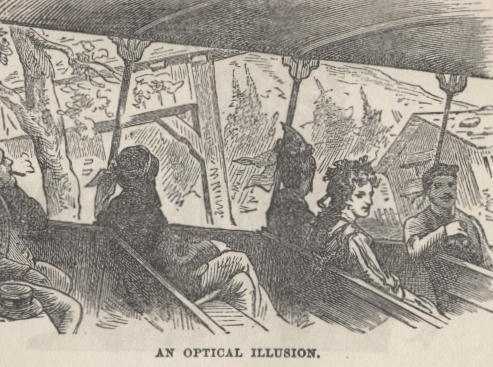
“On the whole tour, particularly at the Descent, we undergo an optical illusion which often seems to be incredible. All the shrubs, fir trees, stables, houses, etc., seem to be bent in a slanting direction, as by an immense pressure of air. They are all standing awry, so much awry that the chalets and cottages of the peasants seem to be tumbling down. It is the consequence of the steep inclination of the line. Those who are seated in the carriage do not observe that they are going down a declivity of twenty to twenty-five degrees (their seats being adapted to this course of proceeding and being bent down at their backs). They mistake their carriage and its horizontal lines for a proper measure of the normal plain, and therefore all the objects outside which really are in a horizontal position must show a disproportion of twenty to twenty-five degrees declivity, in regard to the mountain.”
By the time one reaches Kaltbad, he has acquired confidence in the railway, and he now ceases to try to ease the locomotive by holding back. Thenceforth he smokes his pipe in serenity, and gazes out upon the magnificent picture below and about him with unfettered enjoyment. There is nothing to interrupt the view or the breeze; it is like inspecting the world on the wing. However—to be exact—there is one place where the serenity lapses for a while; this is while one is crossing the Schnurrtobel Bridge, a frail structure which swings its gossamer frame down through the dizzy air, over a gorge, like a vagrant spider-strand.
One has no difficulty in remembering his sins while the train is creeping down this bridge; and he repents of them, too; though he sees, when he gets to Vitznau, that he need not have done it, the bridge was perfectly safe.
So ends the eventual trip which we made to the Rigi-Kulm to see an Alpine
sunrise.
CHAPTER XXX
[Harris Climbs Mountains for Me]
An hour’s sail brought us to Lucerne again. I judged it best to go to bed and rest several days, for I knew that the man who undertakes to make the tour of Europe on foot must take care of himself.
Thinking over my plans, as mapped out, I perceived that they did not take in the Furka Pass, the Rhone Glacier, the Finsteraarhorn, the Wetterhorn, etc. I immediately examined the guide-book to see if these were important, and found they were; in fact, a pedestrian tour of Europe could not be complete without them. Of course that decided me at once to see them, for I never allow myself to do things by halves, or in a slurring, slipshod way.
I called in my agent and instructed him to go without delay and make a careful examination of these noted places, on foot, and bring me back a written report of the result, for insertion in my book. I instructed him to go to Hospenthal as quickly as possible, and make his grand start from there; to extend his foot expedition as far as the Giesbach fall, and return to me from thence by diligence or mule. I told him to take the courier with him.
He objected to the courier, and with some show of reason, since he was about to venture upon new and untried ground; but I thought he might as well learn how to take care of the courier now as later, therefore I enforced my point. I said that the trouble, delay, and inconvenience of traveling with a courier were balanced by the deep respect which a courier’s presence commands, and I must insist that as much style be thrown into my journeys as possible.
So the two assumed complete mountaineering costumes and departed. A week later they returned, pretty well used up, and my agent handed me the following:
Official Report
OF A VISIT TO THE FURKA REGION.
By H. Harris, Agent
About seven o’clock in the morning, with perfectly fine weather, we
started from Hospenthal, and arrived at the maison on the Furka in
a little under quatre hours. The want of variety in the scenery
from Hospenthal made the Kahkahponeeka wearisome; but let none be
discouraged; no one can fail to be completely r’ecompens’ee
for his fatigue, when he sees, for the first time, the monarch of the
Oberland, the tremendous Finsteraarhorn. A moment before all was dullness,
but a pas further has placed us on the summit of the Furka; and
exactly in front of us, at a hopow of only fifteen miles, this
magnificent mountain lifts its snow-wreathed precipices into the deep blue
sky. The inferior mountains on each side of the pass form a sort of frame
for the picture of their dread lord, and close in the view so completely
that no other prominent feature in the Oberland is visible from this bong-a-bong;
nothing withdraws the attention from the solitary grandeur of the
Finsteraarhorn and the dependent spurs which form the abutments of the
central peak.
With the addition of some others, who were also bound for the Grimsel, we
formed a large xhvloj as we descended the steg which winds
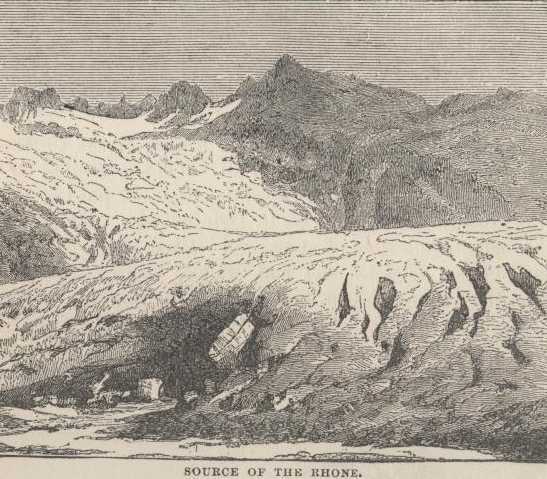
round the shoulder of a mountain toward the Rhone Glacier. We soon left
the path and took to the ice; and after wandering amongst the crevices un
peu, to admire the wonders of these deep blue caverns, and hear the
rushing of waters through their subglacial channels, we struck out a
course toward l’autre cravasse and crossed the glacier
successfully, a little above the cave from which the infant Rhone takes
its first bound from under the grand precipice of ice. Half a mile below
this we began to climb the flowery side of the Meienwand. One of our party
started before the rest, but the hitze was so great, that we found
ihm quite exhausted, and lying at full length in the shade of a
large gestein. We sat down with him for a time, for all felt the
heat exceedingly in the climb up this very steep bolwoggoly, and
then we set out again together, and arrived at last near the Dead Man’s
Lake, at the foot of the Sidelhorn. This lonely spot, once used for an
extempore burying-place, after a sanguinary battue between the
French and Austrians, is the perfection of desolation; there is nothing in
sight to mark the hand of man, except the line of weather-beaten whitened
posts, set up to indicate the direction of the pass in the owdawakk
of winter. Near this point the footpath joins the wider track, which
connects the Grimsel with the head of the Rhone schnawp; this has
been carefully constructed, and leads with a tortuous course among and
over les pierres, down to the bank of the gloomy little swosh-swosh,
which almost washes against the walls of the Grimsel Hospice. We arrived a
little before four o’clock at the end of our day’s journey,
hot enough to justify the step, taking by most of the partie, of
plunging into the crystal water of the snow-fed lake.
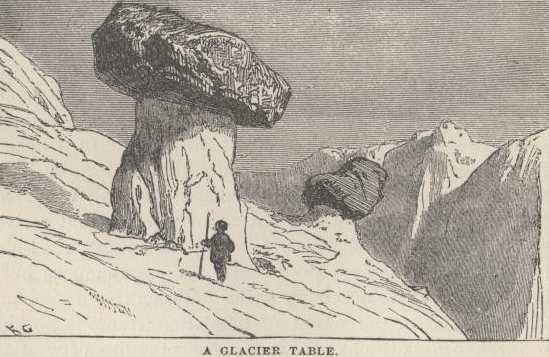
The next afternoon we started for a walk up the Unteraar glacier, with the intention of, at all events, getting as far as the Hutte which is used as a sleeping-place by most of those who cross the Strahleck Pass to Grindelwald. We got over the tedious collection of stones and débris which covers the pied of the gletcher, and had walked nearly three hours from the Grimsel, when, just as we were thinking of crossing over to the right, to climb the cliffs at the foot of the hut, the clouds, which had for some time assumed a threatening appearance, suddenly dropped, and a huge mass of them, driving toward us from the Finsteraarhorn, poured down a deluge of haboolong and hail. Fortunately, we were not far from a very large glacier-table; it was a huge rock balanced on a pedestal of ice high enough to admit of our all creeping under it for gowkarak. A stream of puckittypukk had furrowed a course for itself in the ice at its base, and we were obliged to stand with one fuss on each side of this, and endeavor to keep ourselves chaud by cutting steps in the steep bank of the pedestal, so as to get a higher place for standing on, as the wasser rose rapidly in its trench. A very cold bzzzzzzzzeee accompanied the storm, and made our position far from pleasant; and presently came a flash of blitzen, apparently in the middle of our little party, with an instantaneous clap of yokky, sounding like a large gun fired close to our ears; the effect was startling; but in a few seconds our attention was fixed by the roaring echoes of the thunder against the tremendous mountains which completely surrounded us. This was followed by many more bursts, none of welche, however, was so dangerously near; and after waiting a long demi-hour in our icy prison, we sallied out to talk through a haboolong which, though not so heavy as before, was quite enough to give us a thorough soaking before our arrival at the Hospice.
The Grimsel is certainement a wonderful place; situated at the bottom of a sort of huge crater, the sides of which are utterly savage gebirge, composed of barren rocks which cannot even support a single pine arbre, and afford only scanty food for a herd of gmwkwllolp, it looks as if it must be completely begraben in the winter snows. Enormous avalanches fall against it every spring, sometimes covering everything to the depth of thirty or forty feet; and, in spite of walls four feet thick, and furnished with outside shutters, the two men who stay here when the voyageurs are snugly quartered in their distant homes can tell you that the snow sometimes shakes the house to its foundations.
Next morning the hogglebumgullup still continued bad, but we made up our minds to go on, and make the best of it. Half an hour after we started, the regen thickened unpleasantly, and we attempted to get shelter under a projecting rock, but being far to nass already to make standing at all agréable, we pushed on for the Handeck, consoling ourselves with the reflection that from the furious rushing of the river Aar at our side, we should at all events see the celebrated wasserfall in grande perfection. Nor were we nappersocket in our expectation; the water was roaring down its leap of two hundred and fifty feet in a most magnificent frenzy, while the trees which cling to its rocky sides swayed to and fro in the violence of the hurricane which it brought down with it; even the stream, which falls into the main cascade at right angles, and toutefois forms a beautiful feature in the scene, was now swollen into a raging torrent; and the violence of this “meeting of the waters,” about fifty feet below the frail bridge where we stood, was fearfully grand. While we were looking at it, gléecklicheweise a gleam of sunshine came out, and instantly a beautiful rainbow was formed by the spray, and hung in mid-air suspended over the awful gorge.
On going into the chalet above the fall, we were informed that a bruecke
had broken down near Guttanen, and that it would be impossible to proceed
for some time; accordingly we were kept in our drenched condition for ein
stunde, when some voyageurs arrived from Meiringen, and told us
that there had been a trifling accident, aber that we could now
cross. On arriving at the spot, I was much inclined to suspect that the
whole story was a ruse to make us slowwk and drink the more at the
Handeck Inn, for only a few planks had been carried away, and though there
might perhaps have been some difficulty with mules, the gap was certainly
not larger than a mmbglx might cross with a very slight leap. Near
Guttanen the haboolong happily ceased, and we had time to walk
ourselves tolerably dry before arriving at Reichenback, so we
enjoyed a good dinér at the Hotel des Alps.
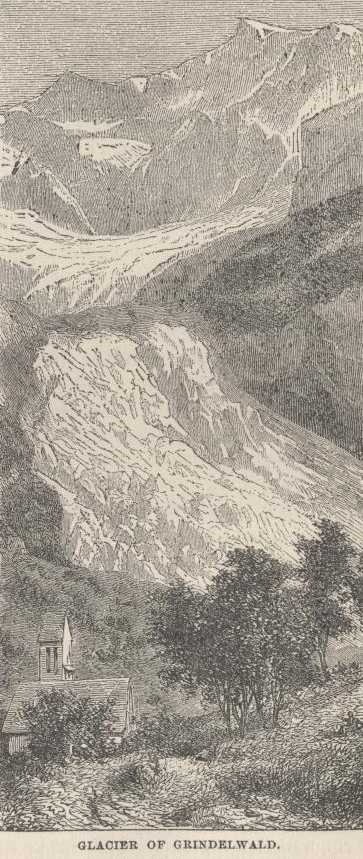
Next morning we walked to Rosenlaui, the beau idéal of Swiss scenery, where we spent the middle of the day in an excursion to the glacier. This was more beautiful than words can describe, for in the constant progress of the ice it has changed the form of its extremity and formed a vast cavern, as blue as the sky above, and rippled like a frozen ocean. A few steps cut in the whoopjamboreehoo enabled us to walk completely under this, and feast our eyes upon one of the loveliest objects in creation. The glacier was all around divided by numberless fissures of the same exquisite color, and the finest wood-erdbeeren were growing in abundance but a few yards from the ice. The inn stands in a charmant spot close to the Coté de la riviére, which, lower down, forms the Reichenbach fall, and embosomed in the richest of pine woods, while the fine form of the Wellhorn looking down upon it completes the enchanting bopple. In the afternoon we walked over the Great Scheideck to Grindelwald, stopping to pay a visit to the Upper glacier by the way; but we were again overtaken by bad hogglebumgullup and arrived at the hotel in a solche a state that the landlord’s wardrobe was in great request.
The clouds by this time seemed to have done their worst, for a lovely day succeeded, which we determined to devote to an ascent of the Faulhorn. We left Grindelwald just as a thunder-storm was dying away, and we hoped to find guten wetter up above; but the rain, which had nearly ceased, began again, and we were struck by the rapidly increasing froid as we ascended. Two-thirds of the way up were completed when the rain was exchanged for gnillic, with which the boden was thickly covered, and before we arrived at the top the gnillic and mist became so thick that we could not see one another at more than twenty poopoo distance, and it became difficult to pick our way over the rough and thickly covered ground. Shivering with cold, we turned into bed with a double allowance of clothes, and slept comfortably while the wind howled autour de la maison; when I awoke, the wall and the window looked equally dark, but in another hour I found I could just see the form of the latter; so I jumped out of bed, and forced it open, though with great difficulty from the frost and the quantities of gnillic heaped up against it.
A row of huge icicles hung down from the edge of the roof, and anything
more wintry than the whole anblick could not well be imagined; but
the sudden appearance of the great mountains in front was so startling
that I felt no inclination to move toward bed again. The snow which had
collected upon la fénetre had increased the finsterniss oder der
dunkelheit, so that when I looked out I was surprised to find that the
daylight was considerable, and that the balragoomah would evidently
rise before long. Only the brightest of les étoiles were still
shining; the sky was cloudless overhead, though small curling mists lay
thousands of feet below us in the valleys, wreathed around the feet of the
mountains, and adding to the splendor of their lofty summits. We were soon
dressed and out of the house, watching the gradual approach of dawn,
thoroughly absorbed in the first near view of the Oberland giants, which
broke upon us unexpectedly after the intense obscurity of the evening
before. “Kabaugwakko songwashee kum wetterhorn snawpo!”
cried some one, as that grand summit gleamed with the first rose of dawn;
and in a few moments the double crest of the Schreckhorn followed its
example; peak after peak seemed warmed with life, the Jungfrau blushed
even more beautifully than her neighbors, and soon, from the Wetterhorn in
the east to the Wildstrubel in the west, a long row of fires glowed upon
mighty altars, truly worthy of the gods.