
The wlgw was very severe; our sleeping-place could hardly be distingueé from the snow around it, which had fallen to a depth of a flirk during the past evening, and we heartily enjoyed a rough scramble en bas to the Giesbach falls, where we soon found a warm climate. At noon the day before Grindelwald the thermometer could not have stood at less than 100 degrees Fahr. in the sun; and in the evening, judging from the icicles formed, and the state of the windows, there must have been at least twelve dingblatter of frost, thus giving a change of 80 degrees during a few hours.
I said:
“You have done well, Harris; this report is concise, compact, well expressed; the language is crisp, the descriptions are vivid and not needlessly elaborated; your report goes straight to the point, attends strictly to business, and doesn’t fool around. It is in many ways an excellent document. But it has a fault—it is too learned, it is much too learned. What is ‘dingblatter’?
“‘Dingblatter’ is a Fiji word meaning ‘degrees.’”
“You knew the English of it, then?”
“Oh, yes.”
“What is ‘gnillic’?
“That is the Eskimo term for ‘snow.’”
“So you knew the English for that, too?”
“Why, certainly.”
“What does ‘mmbglx’ stand for?”
“That is Zulu for ‘pedestrian.’”
“‘While the form of the Wellhorn looking down upon it completes the enchanting bopple.’ What is ‘bopple’?”
“‘Picture.’ It’s Choctaw.”
“What is ‘schnawp’?”
“‘Valley.’ That is Choctaw, also.”
“What is ‘bolwoggoly’?”
“That is Chinese for ‘hill.’”
“‘kahkahponeeka’?”
“‘Ascent.’ Choctaw.”
“‘But we were again overtaken by bad hogglebumgullup.’ What does ‘hogglebumgullup’ mean?”
“That is Chinese for ‘weather.’”
“Is ‘hogglebumgullup’ better than the English word? Is it any more descriptive?”
“No, it means just the same.”
“And ‘dingblatter’ and ‘gnillic,’ and ‘bopple,’ and ‘schnawp’—are they better than the English words?”
“No, they mean just what the English ones do.”
“Then why do you use them? Why have you used all this Chinese and Choctaw and Zulu rubbish?”
“Because I didn’t know any French but two or three words, and I didn’t know any Latin or Greek at all.”
“That is nothing. Why should you want to use foreign words, anyhow?”
“They adorn my page. They all do it.”
“Who is ‘all’?”
“Everybody. Everybody that writes elegantly. Anybody has a right to that wants to.”
“I think you are mistaken.” I then proceeded in the following scathing manner. “When really learned men write books for other learned men to read, they are justified in using as many learned words as they please—their audience will understand them; but a man who writes a book for the general public to read is not justified in disfiguring his pages with untranslated foreign expressions. It is an insolence toward the majority of the purchasers, for it is a very frank and impudent way of saying, ‘Get the translations made yourself if you want them, this book is not written for the ignorant classes.’ There are men who know a foreign language so well and have used it so long in their daily life that they seem to discharge whole volleys of it into their English writings unconsciously, and so they omit to translate, as much as half the time. That is a great cruelty to nine out of ten of the man’s readers. What is the excuse for this? The writer would say he only uses the foreign language where the delicacy of his point cannot be conveyed in English. Very well, then he writes his best things for the tenth man, and he ought to warn the nine other not to buy his book. However, the excuse he offers is at least an excuse; but there is another set of men who are like you; they know a word here and there, of a foreign language, or a few beggarly little three-word phrases, filched from the back of the Dictionary, and these are continually peppering into their literature, with a pretense of knowing that language—what excuse can they offer? The foreign words and phrases which they use have their exact equivalents in a nobler language—English; yet they think they ‘adorn their page’ when they say strasse for street, and bahnhof for railway-station, and so on—flaunting these fluttering rags of poverty in the reader’s face and imagining he will be ass enough to take them for the sign of untold riches held in reserve. I will let your ‘learning’ remain in your report; you have as much right, I suppose, to ‘adorn your page’ with Zulu and Chinese and Choctaw rubbish as others of your sort have to adorn theirs with insolent odds and ends smouched from half a dozen learned tongues whose a-b abs they don’t even know.”
When the musing spider steps upon the red-hot shovel, he first exhibits a
wild surprise, then he shrivels up. Similar was the effect of these
blistering words upon the tranquil and unsuspecting Agent. I can be
dreadfully rough on a person when the mood takes me.
CHAPTER XXXI
[Alp-scaling by Carriage]
We now prepared for a considerable walk—from Lucerne to Interlaken, over the Bruenig Pass. But at the last moment the weather was so good that I changed my mind and hired a four-horse carriage. It was a huge vehicle, roomy, as easy in its motion as a palanquin, and exceedingly comfortable.
We got away pretty early in the morning, after a hot breakfast, and went bowling over a hard, smooth road, through the summer loveliness of Switzerland, with near and distant lakes and mountains before and about us for the entertainment of the eye, and the music of multitudinous birds to charm the ear. Sometimes there was only the width of the road between the imposing precipices on the right and the clear cool water on the left with its shoals of uncatchable fish skimming about through the bars of sun and shadow; and sometimes, in place of the precipices, the grassy land stretched away, in an apparently endless upward slant, and was dotted everywhere with snug little chalets, the peculiarly captivating cottage of Switzerland.
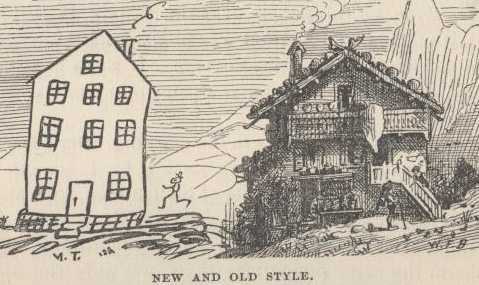
The ordinary chalet turns a broad, honest gable end to the road, and its ample roof hovers over the home in a protecting, caressing way, projecting its sheltering eaves far outward. The quaint windows are filled with little panes, and garnished with white muslin curtains, and brightened with boxes of blooming flowers. Across the front of the house, and up the spreading eaves and along the fanciful railings of the shallow porch, are elaborate carvings—wreaths, fruits, arabesques, verses from Scripture, names, dates, etc. The building is wholly of wood, reddish brown in tint, a very pleasing color. It generally has vines climbing over it. Set such a house against the fresh green of the hillside, and it looks ever so cozy and inviting and picturesque, and is a decidedly graceful addition to the landscape.
One does not find out what a hold the chalet has taken upon him, until he
presently comes upon a new house—a house which is aping the town
fashions of Germany and France, a prim, hideous, straight-up-and-down
thing, plastered all over on the outside to look like stone, and
altogether so stiff, and formal, and ugly, and forbidding, and so out of
tune with the gracious landscape, and so deaf and dumb and dead to the
poetry of its surroundings, that it suggests an undertaker at a picnic, a
corpse at a wedding, a puritan in Paradise.
In the course of the morning we passed the spot where Pontius Pilate is said to have thrown himself into the lake. The legend goes that after the Crucifixion his conscience troubled him, and he fled from Jerusalem and wandered about the earth, weary of life and a prey to tortures of the mind. Eventually, he hid himself away, on the heights of Mount Pilatus, and dwelt alone among the clouds and crags for years; but rest and peace were still denied him, so he finally put an end to his misery by drowning himself.
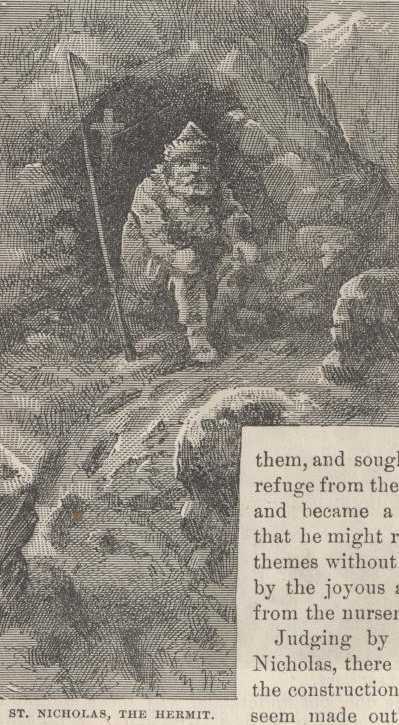
Presently we passed the place where a man of better odor was born. This
was the children’s friend, Santa Claus, or St. Nicholas. There are
some unaccountable reputations in the world. This saint’s is an
instance. He has ranked for ages as the peculiar friend of children, yet
it appears he was not much of a friend to his own. He had ten of them, and
when fifty years old he left them, and sought out as dismal a refuge from
the world as possible, and became a hermit in order that he might reflect
upon pious themes without being disturbed by the joyous and other noises
from the nursery, doubtless.
Judging by Pilate and St. Nicholas, there exists no rule for the
construction of hermits; they seem made out of all kinds of material. But
Pilate attended to the matter of expiating his sin while he was alive,
whereas St. Nicholas will probably have to go on climbing down sooty
chimneys, Christmas eve, forever, and conferring kindness on other people’s
children, to make up for deserting his own. His bones are kept in a church
in a village (Sachseln) which we visited, and are naturally held in great
reverence. His portrait is common in the farmhouses of the region, but is
believed by many to be but an indifferent likeness. During his hermit
life, according to legend, he partook of the bread and wine of the
communion once a month, but all the rest of the month he fasted.
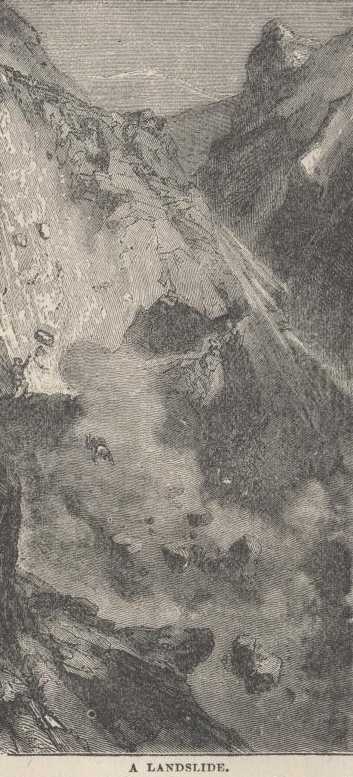
A constant marvel with us, as we sped along the bases of the steep
mountains on this journey, was, not that avalanches occur, but that they
are not occurring all the time. One does not understand why rocks and
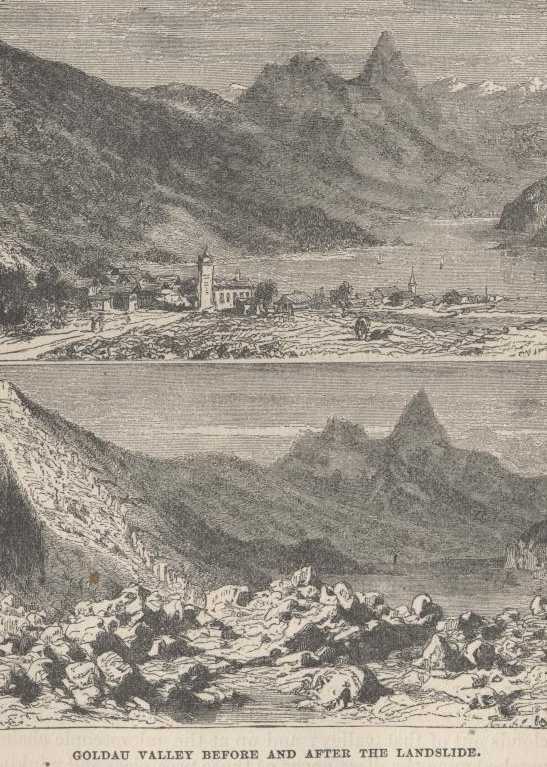
landslides do not plunge down these declivities daily. A landslip occurred
three quarters of a century ago, on the route from Arth to Brunnen, which
was a formidable thing. A mass of conglomerate two miles long, a thousand
feet broad, and a hundred feet thick, broke away from a cliff three
thousand feet high and hurled itself into the valley below, burying four
villages and five hundred people, as in a grave.
We had such a beautiful day, and such endless pictures of limpid lakes, and green hills and valleys, and majestic mountains, and milky cataracts dancing down the steeps and gleaming in the sun, that we could not help feeling sweet toward all the world; so we tried to drink all the milk, and eat all the grapes and apricots and berries, and buy all the bouquets of wild flowers which the little peasant boys and girls offered for sale; but we had to retire from this contract, for it was too heavy.
At short distances—and they were entirely too short—all along the road, were groups of neat and comely children, with their wares nicely and temptingly set forth in the grass under the shade trees, and as soon as we approached they swarmed into the road, holding out their baskets and milk bottles, and ran beside the carriage, barefoot and bareheaded, and importuned us to buy. They seldom desisted early, but continued to run and insist—beside the wagon while they could, and behind it until they lost breath. Then they turned and chased a returning carriage back to their trading-post again. After several hours of this, without any intermission, it becomes almost annoying. I do not know what we should have done without the returning carriages to draw off the pursuit. However, there were plenty of these, loaded with dusty tourists and piled high with luggage. Indeed, from Lucerne to Interlaken we had the spectacle, among other scenery, of an unbroken procession of fruit-peddlers and tourists carriages.
Our talk was mostly anticipatory of what we should see on the down-grade of the Bruenig, by and by, after we should pass the summit. All our friends in Lucerne had said that to look down upon Meiringen, and the rushing blue-gray river Aar, and the broad level green valley; and across at the mighty Alpine precipices that rise straight up to the clouds out of that valley; and up at the microscopic chalets perched upon the dizzy eaves of those precipices and winking dimly and fitfully through the drifting veil of vapor; and still up and up, at the superb Oltschiback and the other beautiful cascades that leap from those rugged heights, robed in powdery spray, ruffled with foam, and girdled with rainbows—to look upon these things, they say, was to look upon the last possibility of the sublime and the enchanting. Therefore, as I say, we talked mainly of these coming wonders; if we were conscious of any impatience, it was to get there in favorable season; if we felt any anxiety, it was that the day might remain perfect, and enable us to see those marvels at their best.
As we approached the Kaiserstuhl, a part of the harness gave way.
We were in distress for a moment, but only a moment. It was the fore-and-aft gear that was broken—the thing that leads aft from the forward part of the horse and is made fast to the thing that pulls the wagon. In America this would have been a heavy leathern strap; but, all over the continent it is nothing but a piece of rope the size of your little finger—clothes-line is what it is. Cabs use it, private carriages, freight-carts and wagons, all sorts of vehicles have it. In Munich I afterward saw it used on a long wagon laden with fifty-four half-barrels of beer; I had before noticed that the cabs in Heidelberg used it—not new rope, but rope that had been in use since Abraham’s time—and I had felt nervous, sometimes, behind it when the cab was tearing down a hill. But I had long been accustomed to it now, and had even become afraid of the leather strap which belonged in its place. Our driver got a fresh piece of clothes-line out of his locker and repaired the break in two minutes.
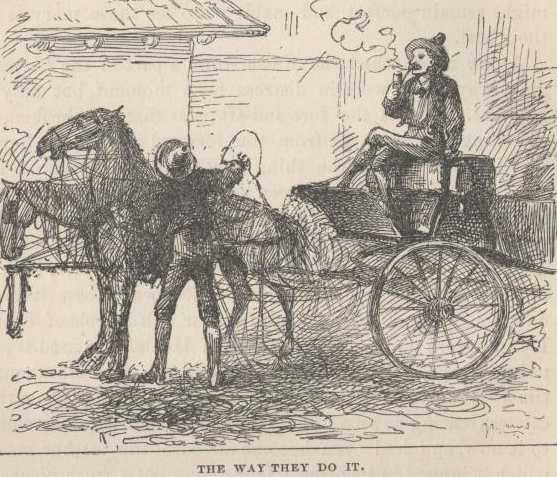
So much for one European fashion. Every country has its own ways. It may
interest the reader to know how they “put horses to” on the
continent. The man stands up the horses on each side of the thing that
projects from the front end of the wagon, and then throws the tangled mess
of gear forward through a ring, and hauls it aft, and passes the other
thing through the other ring and hauls it aft on the other side of the
other horse, opposite to the first one, after crossing them and bringing
the loose end back, and then buckles the other thing underneath the horse,
and takes another thing and wraps it around the thing I spoke of before,
and puts another thing over each horse’s head, with broad flappers
to it to keep the dust out of his eyes, and puts the iron thing in his
mouth for him to grit his teeth on, uphill, and brings the ends of these
things aft over his back, after buckling another one around under his neck
to hold his head up, and hitching another thing on a thing that goes over
his shoulders to keep his head up when he is climbing a hill, and then
takes the slack of the thing which I mentioned a while ago, and fetches it
aft and makes it fast to the thing that pulls the wagon, and hands the
other things up to the driver to steer with. I never have buckled up a
horse myself, but I do not think we do it that way.
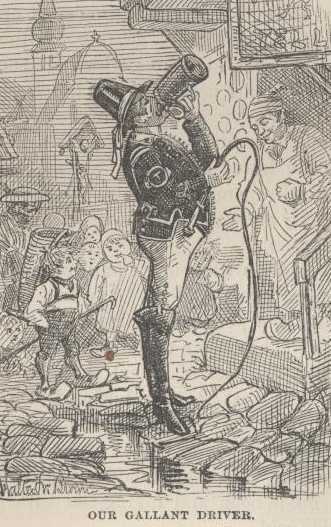
We had four very handsome horses, and the driver was very proud of his turnout. He would bowl along on a reasonable trot, on the highway, but when he entered a village he did it on a furious run, and accompanied it with a frenzy of ceaseless whip-crackings that sounded like volleys of musketry. He tore through the narrow streets and around the sharp curves like a moving earthquake, showering his volleys as he went, and before him swept a continuous tidal wave of scampering children, ducks, cats, and mothers clasping babies which they had snatched out of the way of the coming destruction; and as this living wave washed aside, along the walls, its elements, being safe, forgot their fears and turned their admiring gaze upon that gallant driver till he thundered around the next curve and was lost to sight.
He was a great man to those villagers, with his gaudy clothes and his
terrific ways. Whenever he stopped to have his cattle watered and fed with
loaves of bread, the villagers stood around admiring him while he
swaggered about, the little boys gazed up at his face with humble homage,
and the landlord brought out foaming mugs of beer and conversed proudly
with him while he drank. Then he mounted his lofty box, swung his
explosive whip, and away he went again, like a storm. I had not seen
anything like this before since I was a boy, and the stage used to
flourish the village with the dust flying and the horn tooting.
When we reached the base of the Kaiserstuhl, we took two more horses; we had to toil along with difficulty for an hour and a half or two hours, for the ascent was not very gradual, but when we passed the backbone and approached the station, the driver surpassed all his previous efforts in the way of rush and clatter. He could not have six horses all the time, so he made the most of his chance while he had it.
Up to this point we had been in the heart of the William Tell region. The hero is not forgotten, by any means, or held in doubtful veneration. His wooden image, with his bow drawn, above the doors of taverns, was a frequent feature of the scenery.
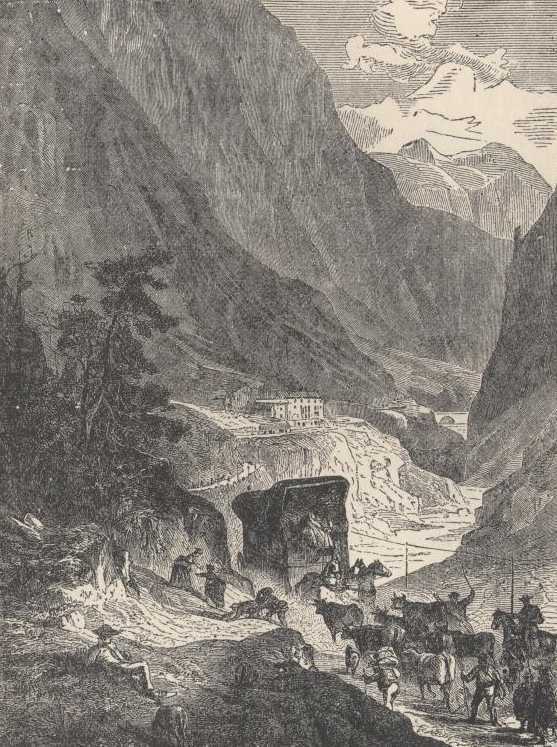
About noon we arrived at the foot of the Bruenig Pass, and made a two-hour
stop at the village hotel, another of those clean, pretty, and thoroughly
well-kept inns which are such an astonishment to people who are accustomed
to hotels of a dismally different pattern in remote country-towns. There
was a lake here, in the lap of the great mountains, the green slopes that
rose toward the lower crags were graced with scattered Swiss cottages
nestling among miniature farms and gardens, and from out a leafy ambuscade
in the upper heights tumbled a brawling cataract.
Carriage after carriage, laden with tourists and trunks, arrived, and the quiet hotel was soon populous. We were early at the table d’hôte and saw the people all come in. There were twenty-five, perhaps. They were of various nationalities, but we were the only Americans. Next to me sat an English bride, and next to her sat her new husband, whom she called “Neddy,” though he was big enough and stalwart enough to be entitled to his full name. They had a pretty little lovers’ quarrel over what wine they should have. Neddy was for obeying the guide-book and taking the wine of the country; but the bride said:
“What, that nahsty stuff!”
“It isn’t nahsty, pet, it’s quite good.”
“It is nahsty.”
“No, it isn’t nahsty.”
“It’s Oful nahsty, Neddy, and I shahn’t drink it.”
Then the question was, what she must have. She said he knew very well that she never drank anything but champagne.
She added:
“You know very well papa always has champagne on his table, and I’ve always been used to it.”
Neddy made a playful pretense of being distressed about the expense, and this amused her so much that she nearly exhausted herself with laughter—and this pleased him so much that he repeated his jest a couple of times, and added new and killing varieties to it. When the bride finally recovered, she gave Neddy a love-box on the arm with her fan, and said with arch severity:
“Well, you would have me—nothing else would do—so
you’ll have to make the best of a bad bargain. Do order the
champagne, I’m Oful dry."
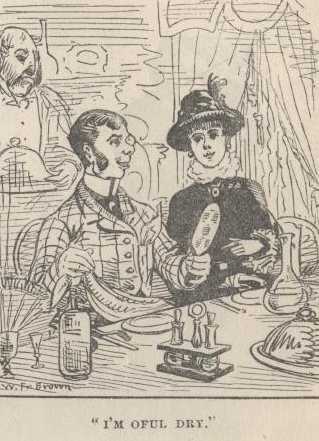
So with a mock groan which made her laugh again, Neddy ordered the champagne.
The fact that this young woman had never moistened the selvedge edge of her soul with a less plebeian tipple than champagne, had a marked and subduing effect on Harris. He believed she belonged to the royal family. But I had my doubts.
We heard two or three different languages spoken by people at the table
and guessed out the nationalities of most of the guests to our
satisfaction, but we failed with an elderly gentleman and his wife and a
young girl who sat opposite us, and with a gentleman of about thirty-five
who sat three seats beyond Harris. We did not hear any of these speak. But
finally the last-named gentleman left while we were not noticing, but we
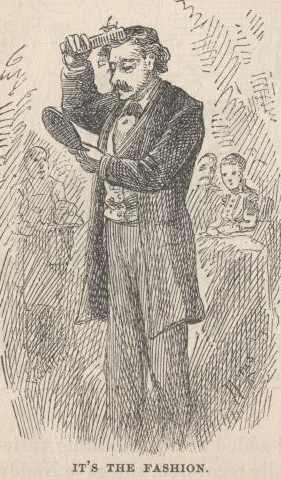
looked up as he reached the far end of the table. He stopped there a
moment, and made his toilet with a pocket comb. So he was a German; or
else he had lived in German hotels long enough to catch the fashion. When
the elderly couple and the young girl rose to leave, they bowed
respectfully to us. So they were Germans, too. This national custom is
worth six of the other one, for export.
After dinner we talked with several Englishmen, and they inflamed our
desire to a hotter degree than ever, to see the sights of Meiringen from
the heights of the Bruenig Pass. They said the view was marvelous, and
that one who had seen it once could never forget it. They also spoke of
the romantic nature of the road over the pass, and how in one place it had
been cut through a flank of the solid rock, in such a way that the
mountain overhung the tourist as he passed by; and they furthermore said
that the sharp turns in the road and the abruptness of the descent would
afford us a thrilling experience, for we should go down in a flying gallop
and seem to be spinning around the rings of a whirlwind, like a drop of
whiskey descending the spirals of a corkscrew.
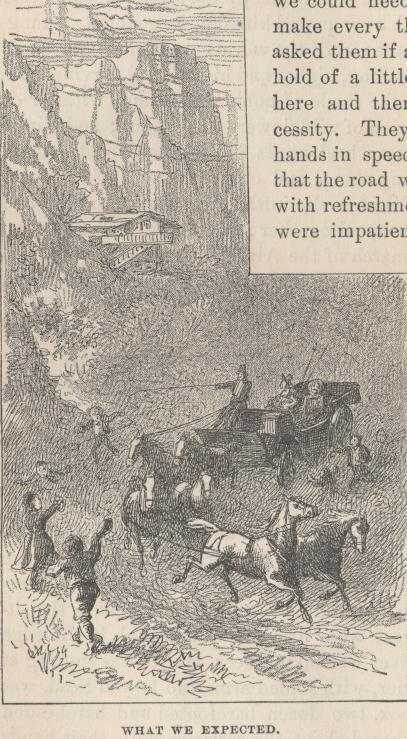
I got all the information out of these gentlemen that we could need; and then, to make everything complete, I asked them if a body could get hold of a little fruit and milk here and there, in case of necessity. They threw up their hands in speechless intimation that the road was simply paved with refreshment-peddlers. We were impatient to get away, now, and the rest of our two-hour stop rather dragged. But finally the set time arrived and we began the ascent. Indeed it was a wonderful road. It was smooth, and compact, and clean, and the side next the precipices was guarded all along by dressed stone posts about three feet high, placed at short distances apart. The road could not have been better built if Napoleon the First had built it. He seems to have been the introducer of the sort of roads which Europe now uses. All literature which describes life as it existed in England, France, and Germany up to the close of the last century, is filled with pictures of coaches and carriages wallowing through these three countries in mud and slush half-wheel deep; but after Napoleon had floundered through a conquered kingdom he generally arranged things so that the rest of the world could follow dry-shod.
We went on climbing, higher and higher, and curving hither and thither, in the shade of noble woods, and with a rich variety and profusion of wild flowers all about us; and glimpses of rounded grassy backbones below us occupied by trim chalets and nibbling sheep, and other glimpses of far lower altitudes, where distance diminished the chalets to toys and obliterated the sheep altogether; and every now and then some ermined monarch of the Alps swung magnificently into view for a moment, then drifted past an intervening spur and disappeared again.
It was an intoxicating trip altogether; the exceeding sense of satisfaction that follows a good dinner added largely to the enjoyment; the having something especial to look forward to and muse about, like the approaching grandeurs of Meiringen, sharpened the zest. Smoking was never so good before, solid comfort was never solider; we lay back against the thick cushions silent, meditative, steeped in felicity.
* * * * * * * *
I rubbed my eyes, opened them, and started. I had been dreaming I was at
sea, and it was a thrilling surprise to wake up and find land all around
me. It took me a couple seconds to “come to,” as you may say;
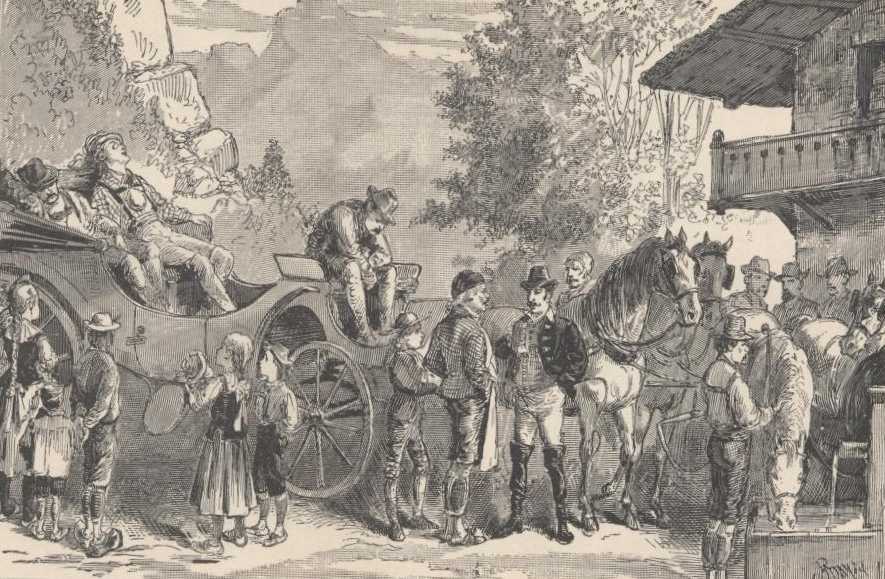
then I took in the situation. The horses were drinking at a trough in the
edge of a town, the driver was taking beer, Harris was snoring at my side,
the courier, with folded arms and bowed head, was sleeping on the box, two
dozen barefooted and bareheaded children were gathered about the carriage,
with their hands crossed behind, gazing up with serious and innocent
admiration at the dozing tourists baking there in the sun. Several small
girls held night-capped babies nearly as big as themselves in their arms,
and even these fat babies seemed to take a sort of sluggish interest in
us.
We had slept an hour and a half and missed all the scenery! I did not need anybody to tell me that. If I had been a girl, I could have cursed for vexation. As it was, I woke up the agent and gave him a piece of my mind. Instead of being humiliated, he only upbraided me for being so wanting in vigilance. He said he had expected to improve his mind by coming to Europe, but a man might travel to the ends of the earth with me and never see anything, for I was manifestly endowed with the very genius of ill luck. He even tried to get up some emotion about that poor courier, who never got a chance to see anything, on account of my heedlessness. But when I thought I had borne about enough of this kind of talk, I threatened to make Harris tramp back to the summit and make a report on that scenery, and this suggestion spiked his battery.
We drove sullenly through Brienz, dead to the seductions of its
bewildering array of Swiss carvings and the clamorous hoo-hooing of
its cuckoo clocks, and had not entirely recovered our spirits when we
rattled across a bridge over the rushing blue river and entered the pretty
town of Interlaken. It was just about sunset, and we had made the trip
from Lucerne in ten hours.
CHAPTER XXXII
[The Jungfrau, the Bride, and the Piano]
We located ourselves at the Jungfrau Hotel, one of those huge establishments which the needs of modern travel have created in every attractive spot on the continent. There was a great gathering at dinner, and, as usual, one heard all sorts of languages.
The table d’hôte was served by waitresses dressed in the quaint and comely costume of the Swiss peasants. This consists of a simple gros de laine, trimmed with ashes of roses, with overskirt of scare bleu ventre saint gris, cut bias on the off-side, with facings of petit polonaise and narrow insertions of pâte de foie gras backstitched to the mise en sce`ne in the form of a jeu d’esprit. It gives to the wearer a singularly piquant and alluring aspect.
One of these waitresses, a woman of forty, had side-whiskers reaching half-way down her jaws. They were two fingers broad, dark in color, pretty thick, and the hairs were an inch long. One sees many women on the continent with quite conspicuous mustaches, but this was the only woman I saw who had reached the dignity of whiskers.
After dinner the guests of both sexes distributed themselves about the front porches and the ornamental grounds belonging to the hotel, to enjoy the cool air; but, as the twilight deepened toward darkness, they gathered themselves together in that saddest and solemnest and most constrained of all places, the great blank drawing-room which is the chief feature of all continental summer hotels. There they grouped themselves about, in couples and threes, and mumbled in bated voices, and looked timid and homeless and forlorn.
There was a small piano in this room, a clattery, wheezy, asthmatic thing, certainly the very worst miscarriage in the way of a piano that the world has seen. In turn, five or six dejected and homesick ladies approached it doubtingly, gave it a single inquiring thump, and retired with the lockjaw. But the boss of that instrument was to come, nevertheless; and from my own country—from Arkansaw.
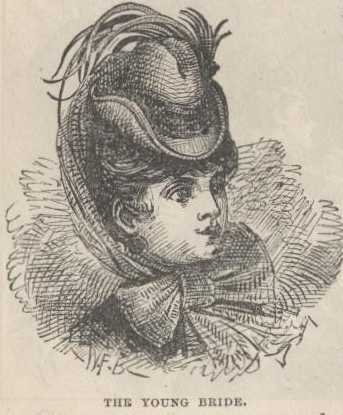
She was a brand-new bride, innocent, girlish, happy in herself and her
grave and worshiping stripling of a husband; she was about eighteen, just
out of school, free from affectations, unconscious of that passionless
multitude around her; and the very first time she smote that old wreck one
recognized that it had met its destiny. Her stripling brought an armful of
aged sheet-music from their room—for this bride went “heeled,”
as you might say—and bent himself lovingly over and got ready to
turn the pages.
The bride fetched a swoop with her fingers from one end of the keyboard to
the other, just to get her bearings, as it were, and you could see the
congregation set their teeth with the agony of it. Then, without any more
preliminaries, she turned on all the horrors of the “Battle of
Prague,” that venerable shivaree, and waded chin-deep in the blood
of the slain. She made a fair and honorable average of two false notes in
every five, but her soul was in arms and she never stopped to correct. The
audience stood it with pretty fair grit for a while, but when the
cannonade waxed hotter and fiercer, and the discord average rose to four
in five, the procession began to move. A few stragglers held their ground
ten minutes longer, but when the girl began to wring the true inwardness
out of the “cries of the wounded,” they struck their colors
and retired in a kind of panic.
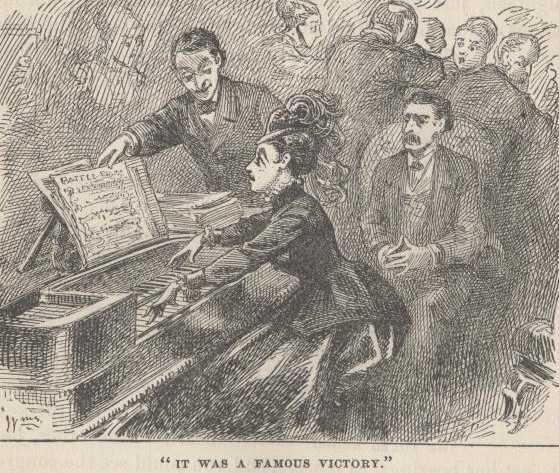
There never was a completer victory; I was the only non-combatant left on the field. I would not have deserted my countrywoman anyhow, but indeed I had no desires in that direction. None of us like mediocrity, but we all reverence perfection. This girl’s music was perfection in its way; it was the worst music that had ever been achieved on our planet by a mere human being.
I moved up close, and never lost a strain. When she got through, I asked
her to play it again. She did it with a pleased alacrity and a heightened
enthusiasm. She made it all discords, this time. She got an amount
of anguish into the cries of the wounded that shed a new light on human
suffering. She was on the war-path all the evening. All the time, crowds
of people gathered on the porches and pressed their noses against the
windows to look and marvel, but the bravest never ventured in. The bride
went off satisfied and happy with her young fellow, when her appetite was
finally gorged, and the tourists swarmed in again.
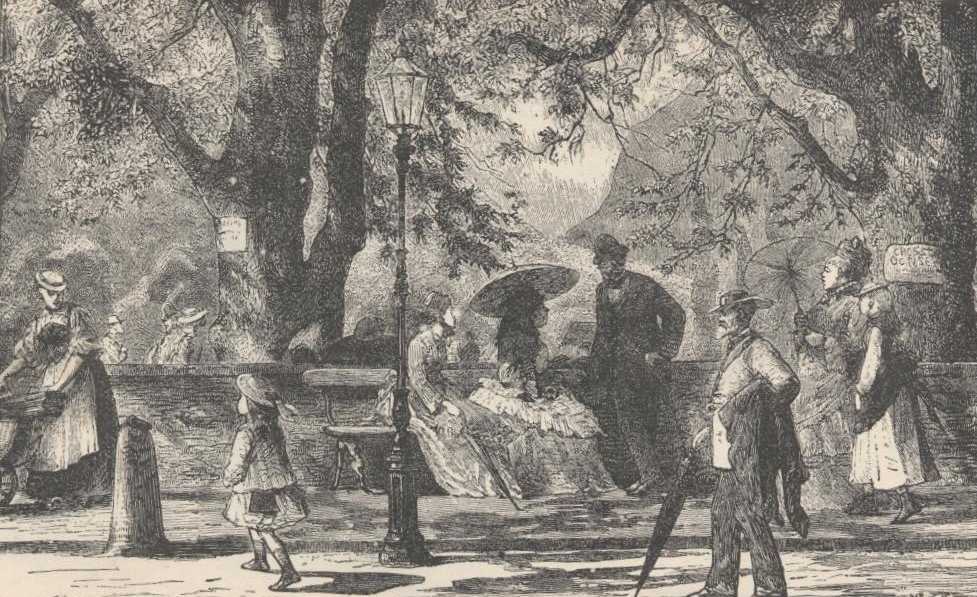
What a change has come over Switzerland, and in fact all Europe, during this century! Seventy or eighty years ago Napoleon was the only man in Europe who could really be called a traveler; he was the only man who had devoted his attention to it and taken a powerful interest in it; he was the only man who had traveled extensively; but now everybody goes everywhere; and Switzerland, and many other regions which were unvisited and unknown remotenesses a hundred years ago, are in our days a buzzing hive of restless strangers every summer. But I digress.
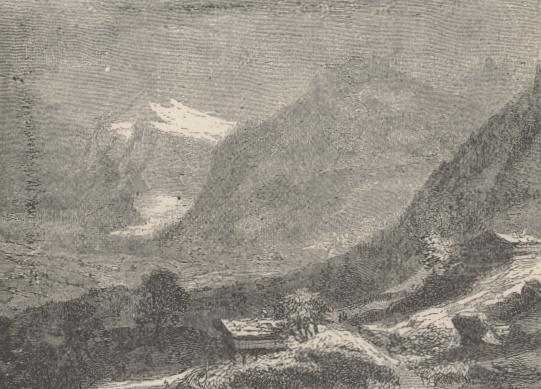
In the morning, when we looked out of our windows, we saw a wonderful sight. Across the valley, and apparently quite neighborly and close at hand, the giant form of the Jungfrau rose cold and white into the clear sky, beyond a gateway in the nearer highlands. It reminded me, somehow, of one of those colossal billows which swells suddenly up beside one’s ship, at sea, sometimes, with its crest and shoulders snowy white, and the rest of its noble proportions streaked downward with creamy foam.
I took out my sketch-book and made a little picture of the Jungfrau, merely to get the shape.
I do not regard this as one of my finished works, in fact I do not rank it
among my Works at all; it is only a study; it is hardly more than what one
might call a sketch. Other artists have done me the grace to admire it;
but I am severe in my judgments of my own pictures, and this one does not
move me.
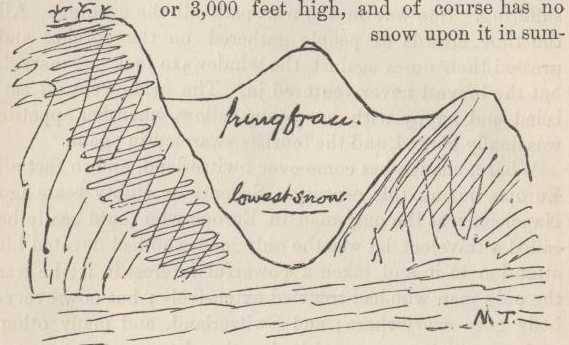
It was hard to believe that that lofty wooded rampart on the left which so
overtops the Jungfrau was not actually the higher of the two, but it was
not, of course. It is only two or three thousand feet high, and of course
has no snow upon it in summer, whereas the Jungfrau is not much shorter of
fourteen thousand feet high and therefore that lowest verge of snow on her
side, which seems nearly down to the valley level, is really about seven
thousand feet higher up in the air than the summit of that wooded rampart.
It is the distance that makes the deception. The wooded height is but four
or five miles removed from us, but the Jungfrau is four or five times that
distance away.
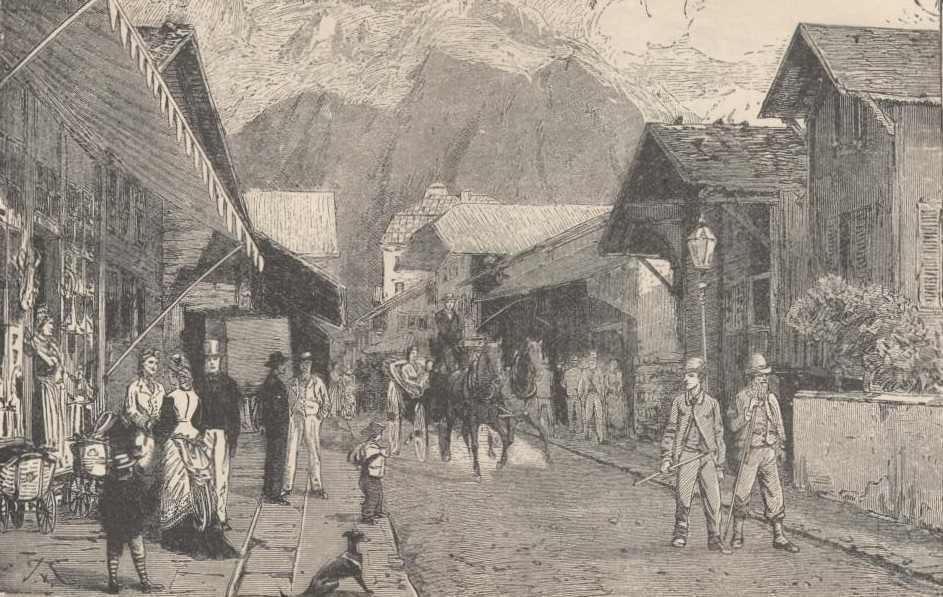
Walking down the street of shops, in the fore-noon, I was attracted by a large picture, carved, frame and all, from a single block of chocolate-colored wood. There are people who know everything. Some of these had told us that continental shopkeepers always raise their prices on English and Americans. Many people had told us it was expensive to buy things through a courier, whereas I had supposed it was just the reverse. When I saw this picture, I conjectured that it was worth more than the friend I proposed to buy it for would like to pay, but still it was worth while to inquire; so I told the courier to step in and ask the price, as if he wanted it for himself; I told him not to speak in English, and above all not to reveal the fact that he was a courier. Then I moved on a few yards, and waited.
The courier came presently and reported the price. I said to myself, “It is a hundred francs too much,” and so dismissed the matter from my mind. But in the afternoon I was passing that place with Harris, and the picture attracted me again. We stepped in, to see how much higher broken German would raise the price. The shopwoman named a figure just a hundred francs lower than the courier had named. This was a pleasant surprise. I said I would take it. After I had given directions as to where it was to be shipped, the shopwoman said, appealingly:
“If you please, do not let your courier know you bought it.”
This was an unexpected remark. I said:
“What makes you think I have a courier?”
“Ah, that is very simple; he told me himself.”
“He was very thoughtful. But tell me—why did you charge him more than you are charging me?”
“That is very simple, also: I do not have to pay you a percentage.”
“Oh, I begin to see. You would have had to pay the courier a percentage.”
“Undoubtedly. The courier always has his percentage. In this case it would have been a hundred francs.”
“Then the tradesman does not pay a part of it—the purchaser pays all of it?”
“There are occasions when the tradesman and the courier agree upon a price which is twice or thrice the value of the article, then the two divide, and both get a percentage.”
“I see. But it seems to me that the purchaser does all the paying, even then.”
“Oh, to be sure! It goes without saying.”
“But I have bought this picture myself; therefore why shouldn’t the courier know it?”
The woman exclaimed, in distress:
“Ah, indeed it would take all my little profit! He would come and demand his hundred francs, and I should have to pay.”
“He has not done the buying. You could refuse.”
“I could not dare to refuse. He would never bring travelers here again. More than that, he would denounce me to the other couriers, they would divert custom from me, and my business would be injured.”
I went away in a thoughtful frame of mind. I began to see why a courier could afford to work for fifty-five dollars a month and his fares. A month or two later I was able to understand why a courier did not have to pay any board and lodging, and why my hotel bills were always larger when I had him with me than when I left him behind, somewhere, for a few days.
Another thing was also explained, now, apparently. In one town I had taken the courier to the bank to do the translating when I drew some money. I had sat in the reading-room till the transaction was finished. Then a clerk had brought the money to me in person, and had been exceedingly polite, even going so far as to precede me to the door and holding it open for me and bow me out as if I had been a distinguished personage. It was a new experience. Exchange had been in my favor ever since I had been in Europe, but just that one time. I got simply the face of my draft, and no extra francs, whereas I had expected to get quite a number of them. This was the first time I had ever used the courier at the bank. I had suspected something then, and as long as he remained with me afterward I managed bank matters by myself.
Still, if I felt that I could afford the tax, I would never travel without
a courier, for a good courier is a convenience whose value cannot be
estimated in dollars and cents. Without him, travel is a bitter
harassment, a purgatory of little exasperating annoyances, a ceaseless and
pitiless punishment—I mean to an irascible man who has no business
capacity and is confused by details.