
CHAPTER XXXV
[Swindling the Coroner]
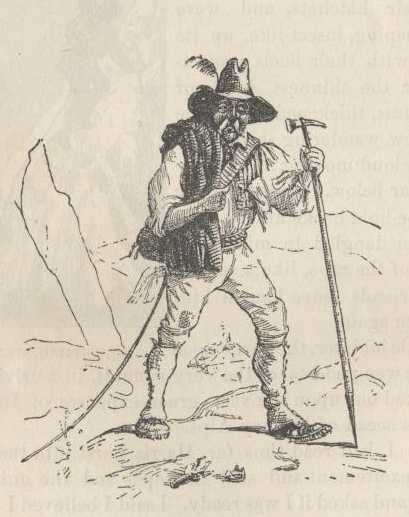
A great and priceless thing is a new interest! How it takes possession of a man! how it clings to him, how it rides him! I strode onward from the Schwarenbach hostelry a changed man, a reorganized personality. I walked into a new world, I saw with new eyes. I had been looking aloft at the giant show-peaks only as things to be worshiped for their grandeur and magnitude, and their unspeakable grace of form; I looked up at them now, as also things to be conquered and climbed. My sense of their grandeur and their noble beauty was neither lost nor impaired; I had gained a new interest in the mountains without losing the old ones. I followed the steep lines up, inch by inch, with my eye, and noted the possibility or impossibility of following them with my feet. When I saw a shining helmet of ice projecting above the clouds, I tried to imagine I saw files of black specks toiling up it roped together with a gossamer thread.
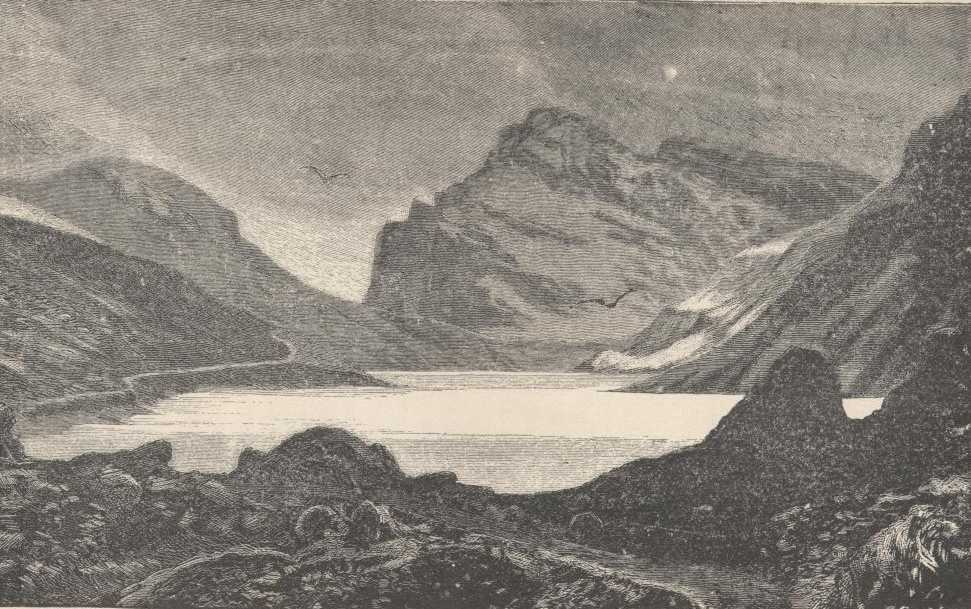
We skirted the lonely little lake called the Daubensee, and presently passed close by a glacier on the right—a thing like a great river frozen solid in its flow and broken square off like a wall at its mouth. I had never been so near a glacier before.
Here we came upon a new board shanty, and found some men engaged in
building a stone house; so the Schwarenbach was soon to have a rival. We
bought a bottle or so of beer here; at any rate they called it beer, but I
knew by the price that it was dissolved jewelry, and I perceived by the
taste that dissolved jewelry is not good stuff to drink.
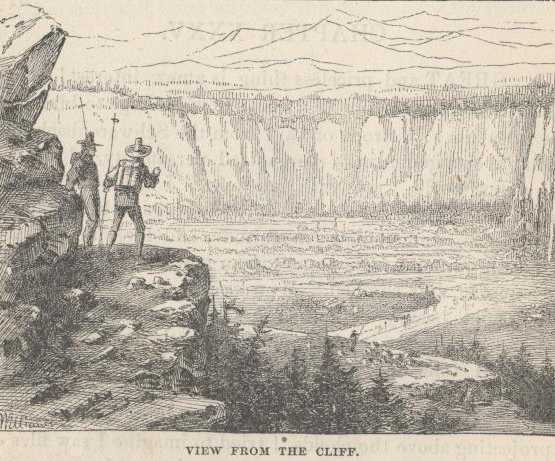
We were surrounded by a hideous desolation. We stepped forward to a sort of jumping-off place, and were confronted by a startling contrast: we seemed to look down into fairyland. Two or three thousand feet below us was a bright green level, with a pretty town in its midst, and a silvery stream winding among the meadows; the charming spot was walled in on all sides by gigantic precipices clothed with pines; and over the pines, out of the softened distances, rose the snowy domes and peaks of the Monte Rosa region. How exquisitely green and beautiful that little valley down there was! The distance was not great enough to obliterate details, it only made them little, and mellow, and dainty, like landscapes and towns seen through the wrong end of a spy-glass.
Right under us a narrow ledge rose up out of the valley, with a green,
slanting, bench-shaped top, and grouped about upon this green-baize bench
were a lot of black and white sheep which looked merely like oversized
worms. The bench seemed lifted well up into our neighborhood, but that was
a deception—it was a long way down to it.
We began our descent, now, by the most remarkable road I have ever seen. It wound its corkscrew curves down the face of the colossal precipice—a narrow way, with always the solid rock wall at one elbow, and perpendicular nothingness at the other. We met an everlasting procession of guides, porters, mules, litters, and tourists climbing up this steep and muddy path, and there was no room to spare when you had to pass a tolerably fat mule. I always took the inside, when I heard or saw the mule coming, and flattened myself against the wall. I preferred the inside, of course, but I should have had to take it anyhow, because the mule prefers the outside. A mule’s preference—on a precipice—is a thing to be respected. Well, his choice is always the outside. His life is mostly devoted to carrying bulky panniers and packages which rest against his body—therefore he is habituated to taking the outside edge of mountain paths, to keep his bundles from rubbing against rocks or banks on the other. When he goes into the passenger business he absurdly clings to his old habit, and keeps one leg of his passenger always dangling over the great deeps of the lower world while that passenger’s heart is in the highlands, so to speak. More than once I saw a mule’s hind foot cave over the outer edge and send earth and rubbish into the bottom abyss; and I noticed that upon these occasions the rider, whether male or female, looked tolerably unwell.
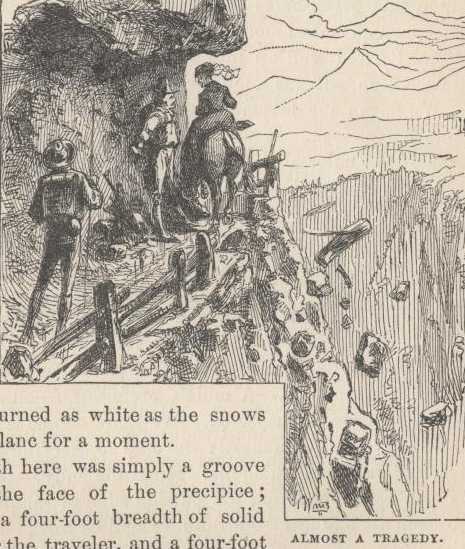
There was one place where an eighteen-inch breadth of light masonry had
been added to the verge of the path, and as there was a very sharp turn
here, a panel of fencing had been set up there at some time, as a
protection. This panel was old and gray and feeble, and the light masonry
had been loosened by recent rains. A young American girl came along on a
mule, and in making the turn the mule’s hind foot caved all the
loose masonry and one of the fence-posts overboard; the mule gave a
violent lurch inboard to save himself, and succeeded in the effort, but
that girl turned as white as the snows of Mont Blanc for a moment.
The path was simply a groove cut into the face of the precipice; there was a four-foot breadth of solid rock under the traveler, and four-foot breadth of solid rock just above his head, like the roof of a narrow porch; he could look out from this gallery and see a sheer summitless and bottomless wall of rock before him, across a gorge or crack a biscuit’s toss in width—but he could not see the bottom of his own precipice unless he lay down and projected his nose over the edge. I did not do this, because I did not wish to soil my clothes.
Every few hundred yards, at particularly bad places, one came across a panel or so of plank fencing; but they were always old and weak, and they generally leaned out over the chasm and did not make any rash promises to hold up people who might need support. There was one of these panels which had only its upper board left; a pedestrianizing English youth came tearing down the path, was seized with an impulse to look over the precipice, and without an instant’s thought he threw his weight upon that crazy board. It bent outward a foot! I never made a gasp before that came so near suffocating me. The English youth’s face simply showed a lively surprise, but nothing more. He went swinging along valleyward again, as if he did not know he had just swindled a coroner by the closest kind of a shave.
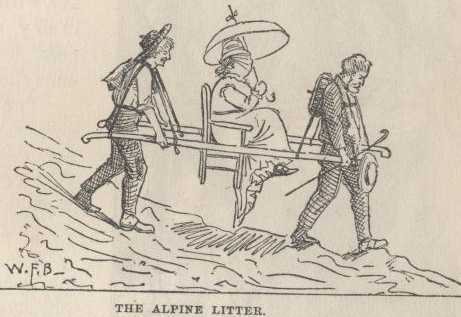
The Alpine litter is sometimes like a cushioned box made fast between the
middles of two long poles, and sometimes it is a chair with a back to it
and a support for the feet. It is carried by relays of strong porters. The
motion is easier than that of any other conveyance. We met a few men and a
great many ladies in litters; it seemed to me that most of the ladies
looked pale and nauseated; their general aspect gave me the idea that they
were patiently enduring a horrible suffering. As a rule, they looked at
their laps, and left the scenery to take care of itself.
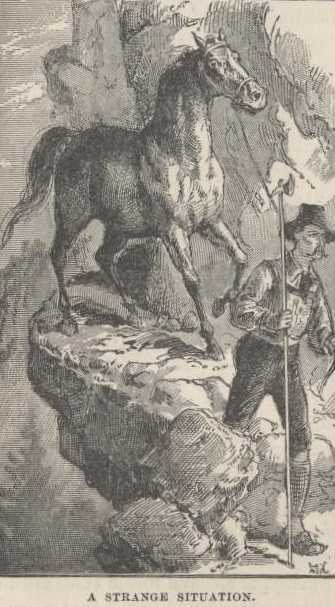
But the most frightened creature I saw, was a led horse that overtook us.
Poor fellow, he had been born and reared in the grassy levels of the
Kandersteg valley and had never seen anything like this hideous place
before. Every few steps he would stop short, glance wildly out from the
dizzy height, and then spread his red nostrils wide and pant as violently
as if he had been running a race; and all the while he quaked from head to
heel as with a palsy. He was a handsome fellow, and he made a fine
statuesque picture of terror, but it was pitiful to see him suffer so.
This dreadful path has had its tragedy. Baedeker, with his customary over terseness, begins and ends the tale thus:
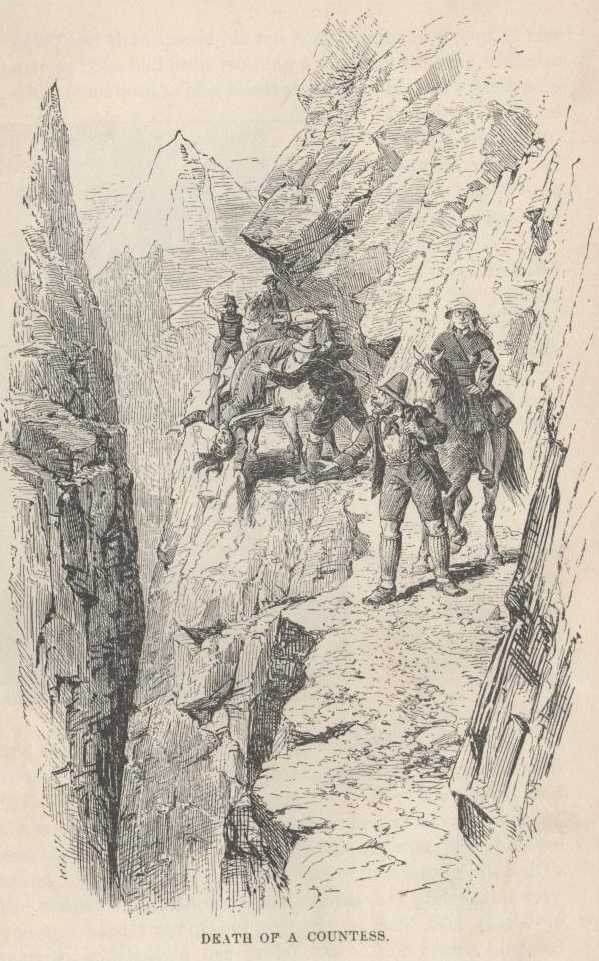
“The descent on horseback should be avoided. In 1861 a Comtesse d’Herlincourt fell from her saddle over the precipice and was killed on the spot.”
We looked over the precipice there, and saw the monument which commemorates the event. It stands in the bottom of the gorge, in a place which has been hollowed out of the rock to protect it from the torrent and the storms. Our old guide never spoke but when spoken to, and then limited himself to a syllable or two, but when we asked him about this tragedy he showed a strong interest in the matter. He said the Countess was very pretty, and very young—hardly out of her girlhood, in fact. She was newly married, and was on her bridal tour. The young husband was riding a little in advance; one guide was leading the husband’s horse, another was leading the bride’s.
The old man continued:
“The guide that was leading the husband’s horse happened to
glance back, and there was that poor young thing sitting up staring out
over the precipice; and her face began to bend downward a little, and she
put up her two hands slowly and met it—so,—and put them flat
against her eyes—so—and then she sank out of the saddle, with
a sharp shriek, and one caught only the flash of a dress, and it was all
over."
Then after a pause:
“Ah, yes, that guide saw these things—yes, he saw them all. He saw them all, just as I have told you.”
After another pause:
“Ah, yes, he saw them all. My God, that was me. I was that guide!”
This had been the one event of the old man’s life; so one may be sure he had forgotten no detail connected with it. We listened to all he had to say about what was done and what happened and what was said after the sorrowful occurrence, and a painful story it was.
When we had wound down toward the valley until we were about on the last spiral of the corkscrew, Harris’s hat blew over the last remaining bit of precipice—a small cliff a hundred or hundred and fifty feet high—and sailed down toward a steep slant composed of rough chips and fragments which the weather had flaked away from the precipices. We went leisurely down there, expecting to find it without any trouble, but we had made a mistake, as to that. We hunted during a couple of hours—not because the old straw hat was valuable, but out of curiosity to find out how such a thing could manage to conceal itself in open ground where there was nothing left for it to hide behind. When one is reading in bed, and lays his paper-knife down, he cannot find it again if it is smaller than a saber; that hat was as stubborn as any paper-knife could have been, and we finally had to give it up; but we found a fragment that had once belonged to an opera-glass, and by digging around and turning over the rocks we gradually collected all the lenses and the cylinders and the various odds and ends that go to making up a complete opera-glass. We afterward had the thing reconstructed, and the owner can have his adventurous lost-property by submitting proofs and paying costs of rehabilitation. We had hopes of finding the owner there, distributed around amongst the rocks, for it would have made an elegant paragraph; but we were disappointed. Still, we were far from being disheartened, for there was a considerable area which we had not thoroughly searched; we were satisfied he was there, somewhere, so we resolved to wait over a day at Leuk and come back and get him.
Then we sat down to polish off the perspiration and arrange about what we would do with him when we got him. Harris was for contributing him to the British Museum; but I was for mailing him to his widow. That is the difference between Harris and me: Harris is all for display, I am all for the simple right, even though I lose money by it. Harris argued in favor of his proposition against mine, I argued in favor of mine and against his. The discussion warmed into a dispute; the dispute warmed into a quarrel. I finally said, very decidedly:
“My mind is made up. He goes to the widow.”
Harris answered sharply:
“And my mind is made up. He goes to the Museum.”
I said, calmly:
“The museum may whistle when it gets him.”
Harris retorted:
“The widow may save herself the trouble of whistling, for I will see that she never gets him.”
After some angry bandying of epithets, I said:
“It seems to me that you are taking on a good many airs about these remains. I don’t quite see what you’ve got to say about them?”
“I? I’ve got all to say about them. They’d never have been thought of if I hadn’t found their opera-glass. The corpse belongs to me, and I’ll do as I please with him.”
I was leader of the Expedition, and all discoveries achieved by it naturally belonged to me. I was entitled to these remains, and could have enforced my right; but rather than have bad blood about the matter, I said we would toss up for them. I threw heads and won, but it was a barren victory, for although we spent all the next day searching, we never found a bone. I cannot imagine what could ever have become of that fellow.
The town in the valley is called Leuk or Leukerbad. We pointed our course toward it, down a verdant slope which was adorned with fringed gentians and other flowers, and presently entered the narrow alleys of the outskirts and waded toward the middle of the town through liquid “fertilizer.” They ought to either pave that village or organize a ferry.
Harris’s body was simply a chamois-pasture; his person was populous with the little hungry pests; his skin, when he stripped, was splotched like a scarlet-fever patient’s; so, when we were about to enter one of the Leukerbad inns, and he noticed its sign, “Chamois Hotel,” he refused to stop there. He said the chamois was plentiful enough, without hunting up hotels where they made a specialty of it. I was indifferent, for the chamois is a creature that will neither bite me nor abide with me; but to calm Harris, we went to the Hôtel des Alpes.
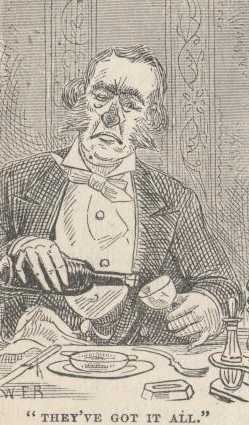
At the table d’hôte, we had this, for an incident. A very grave man—in fact his gravity amounted to solemnity, and almost to austerity—sat opposite us and he was “tight,” but doing his best to appear sober. He took up a corked bottle of wine, tilted it over his glass awhile, then set it out of the way, with a contented look, and went on with his dinner.
Presently he put his glass to his mouth, and of course found it empty. He looked puzzled, and glanced furtively and suspiciously out of the corner of his eye at a benignant and unconscious old lady who sat at his right. Shook his head, as much as to say, “No, she couldn’t have done it.” He tilted the corked bottle over his glass again, meantime searching around with his watery eye to see if anybody was watching him. He ate a few mouthfuls, raised his glass to his lips, and of course it was still empty. He bent an injured and accusing side-glance upon that unconscious old lady, which was a study to see. She went on eating and gave no sign. He took up his glass and his bottle, with a wise private nod of his head, and set them gravely on the left-hand side of his plate—poured himself another imaginary drink—went to work with his knife and fork once more—presently lifted his glass with good confidence, and found it empty, as usual.
This was almost a petrifying surprise. He straightened himself up in his chair and deliberately and sorrowfully inspected the busy old ladies at his elbows, first one and then the other. At last he softly pushed his plate away, set his glass directly in front of him, held on to it with his left hand, and proceeded to pour with his right. This time he observed that nothing came. He turned the bottle clear upside down; still nothing issued from it; a plaintive look came into his face, and he said, as if to himself,
“‘Ic! they’ve got it all!” Then he set the
bottle down, resignedly, and took the rest of his dinner dry.
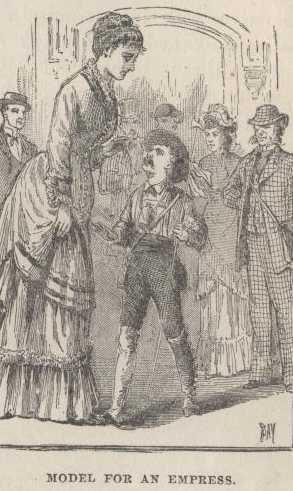
It was at that table d’hôte, too, that I had under inspection the largest lady I have ever seen in private life. She was over seven feet high, and magnificently proportioned. What had first called my attention to her, was my stepping on an outlying flange of her foot, and hearing, from up toward the ceiling, a deep “Pardon, m’sieu, but you encroach!”
That was when we were coming through the hall, and the place was dim, and
I could see her only vaguely. The thing which called my attention to her
the second time was, that at a table beyond ours were two very pretty
girls, and this great lady came in and sat down between them and me and
blotted out my view. She had a handsome face, and she was very finely
formed—perfectly formed, I should say. But she made everybody around
her look trivial and commonplace. Ladies near her looked like children,
and the men about her looked mean. They looked like failures; and they
looked as if they felt so, too. She sat with her back to us. I never saw
such a back in my life. I would have so liked to see the moon rise over
it. The whole congregation waited, under one pretext or another, till she
finished her dinner and went out; they wanted to see her at full altitude,
and they found it worth tarrying for. She filled one’s idea of what
an empress ought to be, when she rose up in her unapproachable grandeur
and moved superbly out of that place.
We were not at Leuk in time to see her at her heaviest weight. She had
suffered from corpulence and had come there to get rid of her extra flesh
in the baths. Five weeks of soaking—five uninterrupted hours of it
every day—had accomplished her purpose and reduced her to the right
proportions.
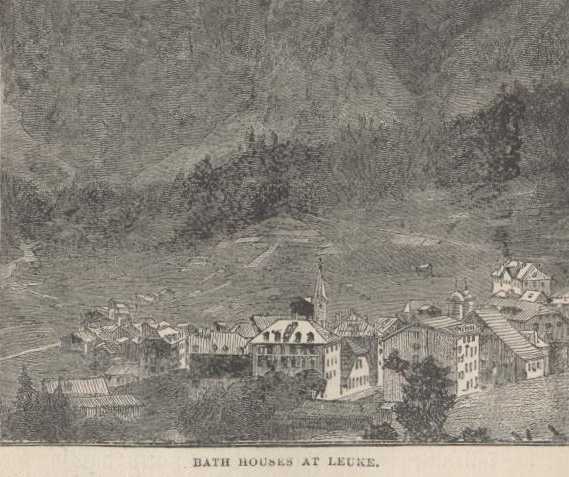
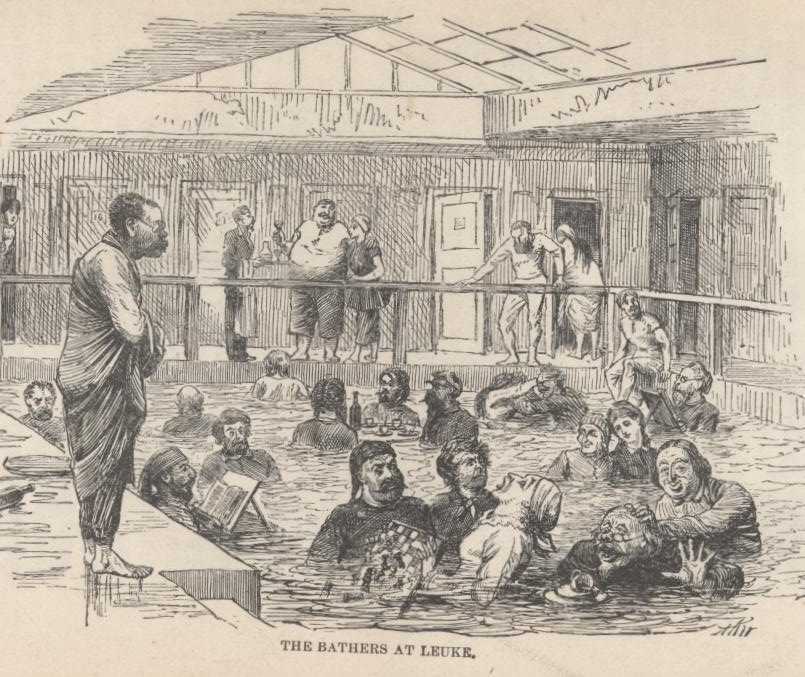
Those baths remove fat, and also skin-diseases. The patients remain in the
great tanks for hours at a time. A dozen gentlemen and ladies occupy a
tank together, and amuse themselves with rompings and various games. They
have floating desks and tables, and they read or lunch or play chess in
water that is breast-deep. The tourist can step in and view this novel
spectacle if he chooses. There’s a poor-box, and he will have to
contribute. There are several of these big bathing-houses, and you can
always tell when you are near one of them by the romping noises and shouts
of laughter that proceed from it. The water is running water, and changes
all the time, else a patient with a ringworm might take the bath with only
a partial success, since, while he was ridding himself of the ringworm, he
might catch the itch.
The next morning we wandered back up the green valley, leisurely, with the curving walls of those bare and stupendous precipices rising into the clouds before us. I had never seen a clean, bare precipice stretching up five thousand feet above me before, and I never shall expect to see another one. They exist, perhaps, but not in places where one can easily get close to them. This pile of stone is peculiar. From its base to the soaring tops of its mighty towers, all its lines and all its details vaguely suggest human architecture. There are rudimentary bow-windows, cornices, chimneys, demarcations of stories, etc. One could sit and stare up there and study the features and exquisite graces of this grand structure, bit by bit, and day after day, and never weary his interest. The termination, toward the town, observed in profile, is the perfection of shape. It comes down out of the clouds in a succession of rounded, colossal, terracelike projections—a stairway for the gods; at its head spring several lofty storm-scarred towers, one after another, with faint films of vapor curling always about them like spectral banners. If there were a king whose realms included the whole world, here would be the place meet and proper for such a monarch. He would only need to hollow it out and put in the electric light. He could give audience to a nation at a time under its roof.
Our search for those remains having failed, we inspected with a glass the dim and distant track of an old-time avalanche that once swept down from some pine-grown summits behind the town and swept away the houses and buried the people; then we struck down the road that leads toward the Rhone, to see the famous Ladders. These perilous things are built against the perpendicular face of a cliff two or three hundred feet high. The peasants, of both sexes, were climbing up and down them, with heavy loads on their backs. I ordered Harris to make the ascent, so I could put the thrill and horror of it in my book, and he accomplished the feat successfully, through a subagent, for three francs, which I paid. It makes me shudder yet when I think of what I felt when I was clinging there between heaven and earth in the person of that proxy. At times the world swam around me, and I could hardly keep from letting go, so dizzying was the appalling danger. Many a person would have given up and descended, but I stuck to my task, and would not yield until I had accomplished it. I felt a just pride in my exploit, but I would not have repeated it for the wealth of the world. I shall break my neck yet with some such foolhardy performance, for warnings never seem to have any lasting effect on me. When the people of the hotel found that I had been climbing those crazy Ladders, it made me an object of considerable attention.
Next morning, early, we drove to the Rhone valley and took the train for Visp. There we shouldered our knapsacks and things, and set out on foot, in a tremendous rain, up the winding gorge, toward Zermatt. Hour after hour we slopped along, by the roaring torrent, and under noble Lesser Alps which were clothed in rich velvety green all the way up and had little atomy Swiss homes perched upon grassy benches along their mist-dimmed heights.
The rain continued to pour and the torrent to boom, and we continued to enjoy both. At the one spot where this torrent tossed its white mane highest, and thundered loudest, and lashed the big boulders fiercest, the canton had done itself the honor to build the flimsiest wooden bridge that exists in the world. While we were walking over it, along with a party of horsemen, I noticed that even the larger raindrops made it shake. I called Harris’s attention to it, and he noticed it, too. It seemed to me that if I owned an elephant that was a keepsake, and I thought a good deal of him, I would think twice before I would ride him over that bridge.
We climbed up to the village of St. Nicholas, about half past four in the
afternoon, waded ankle-deep through the fertilizer-juice, and stopped at a
new and nice hotel close by the little church. We stripped and went to
bed, and sent our clothes down to be baked. And the horde of soaked
tourists did the same. That chaos of clothing got mixed in the kitchen,
and there were consequences.
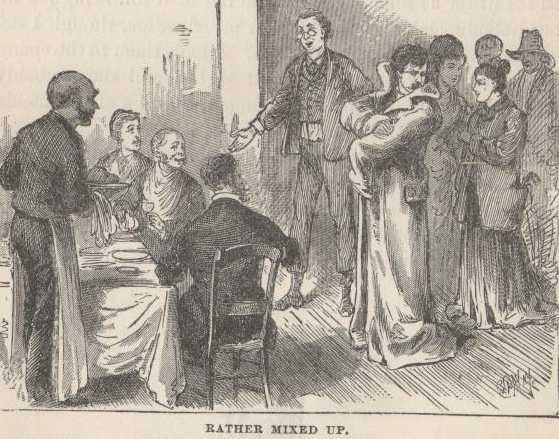
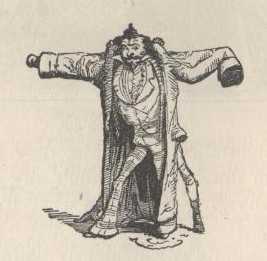
I did not get back the same drawers I sent down, when our things came up at six-fifteen; I got a pair on a new plan. They were merely a pair of white ruffle-cuffed absurdities, hitched together at the top with a narrow band, and they did not come quite down to my knees. They were pretty enough, but they made me feel like two people, and disconnected at that. The man must have been an idiot that got himself up like that, to rough it in the Swiss mountains. The shirt they brought me was shorter than the drawers, and hadn’t any sleeves to it—at least it hadn’t anything more than what Mr. Darwin would call “rudimentary” sleeves; these had “edging” around them, but the bosom was ridiculously plain. The knit silk undershirt they brought me was on a new plan, and was really a sensible thing; it opened behind, and had pockets in it to put your shoulder-blades in; but they did not seem to fit mine, and so I found it a sort of uncomfortable garment. They gave my bobtail coat to somebody else, and sent me an ulster suitable for a giraffe. I had to tie my collar on, because there was no button behind on that foolish little shirt which I described a while ago.
When I was dressed for dinner at six-thirty, I was too loose in some places and too tight in others, and altogether I felt slovenly and ill-conditioned. However, the people at the table d’hôte were no better off than I was; they had everybody’s clothes but their own on. A long stranger recognized his ulster as soon as he saw the tail of it following me in, but nobody claimed my shirt or my drawers, though I described them as well as I was able. I gave them to the chambermaid that night when I went to bed, and she probably found the owner, for my own things were on a chair outside my door in the morning.
There was a lovable English clergyman who did not get to the table d’hôte
at all. His breeches had turned up missing, and without any equivalent. He
said he was not more particular than other people, but he had noticed that
a clergyman at dinner without any breeches was almost sure to excite
remark.
CHAPTER XXXVI
[The Fiendish Fun of Alp-climbing]
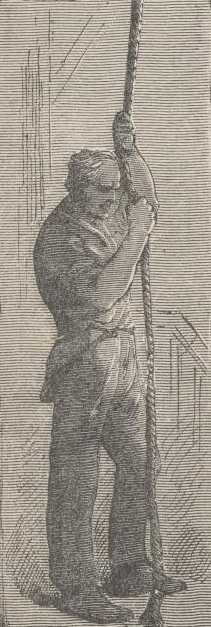
We did not oversleep at St. Nicholas. The church-bell began to ring at
four-thirty in the morning, and from the length of time it continued to
ring I judged that it takes the Swiss sinner a good while to get the
invitation through his head. Most church-bells in the world are of poor
quality, and have a harsh and rasping sound which upsets the temper and
produces much sin, but the St. Nicholas bell is a good deal the worst one
that has been contrived yet, and is peculiarly maddening in its operation.
Still, it may have its right and its excuse to exist, for the community is
poor and not every citizen can afford a clock, perhaps; but there cannot
be any excuse for our church-bells at home, for there is no family in
America without a clock, and consequently there is no fair pretext for the
usual Sunday medley of dreadful sounds that issues from our steeples.
There is much more profanity in America on Sunday than in all in the other
six days of the week put together, and it is of a more bitter and
malignant character than the week-day profanity, too. It is produced by
the cracked-pot clangor of the cheap church-bells.
We build our churches almost without regard to cost; we rear an edifice which is an adornment to the town, and we gild it, and fresco it, and mortgage it, and do everything we can think of to perfect it, and then spoil it all by putting a bell on it which afflicts everybody who hears it, giving some the headache, others St. Vitus’s dance, and the rest the blind staggers.
An American village at ten o’clock on a summer Sunday is the quietest and peacefulest and holiest thing in nature; but it is a pretty different thing half an hour later. Mr. Poe’s poem of the “Bells” stands incomplete to this day; but it is well enough that it is so, for the public reciter or “reader” who goes around trying to imitate the sounds of the various sorts of bells with his voice would find himself “up a stump” when he got to the church-bell—as Joseph Addison would say. The church is always trying to get other people to reform; it might not be a bad idea to reform itself a little, by way of example. It is still clinging to one or two things which were useful once, but which are not useful now, neither are they ornamental. One is the bell-ringing to remind a clock-caked town that it is church-time, and another is the reading from the pulpit of a tedious list of “notices” which everybody who is interested has already read in the newspaper. The clergyman even reads the hymn through—a relic of an ancient time when hymn-books are scarce and costly; but everybody has a hymn-book, now, and so the public reading is no longer necessary. It is not merely unnecessary, it is generally painful; for the average clergyman could not fire into his congregation with a shotgun and hit a worse reader than himself, unless the weapon scattered shamefully. I am not meaning to be flippant and irreverent, I am only meaning to be truthful. The average clergyman, in all countries and of all denominations, is a very bad reader. One would think he would at least learn how to read the Lord’s Prayer, by and by, but it is not so. He races through it as if he thought the quicker he got it in, the sooner it would be answered. A person who does not appreciate the exceeding value of pauses, and does not know how to measure their duration judiciously, cannot render the grand simplicity and dignity of a composition like that effectively.
We took a tolerably early breakfast, and tramped off toward Zermatt through the reeking lanes of the village, glad to get away from that bell. By and by we had a fine spectacle on our right. It was the wall-like butt end of a huge glacier, which looked down on us from an Alpine height which was well up in the blue sky. It was an astonishing amount of ice to be compacted together in one mass. We ciphered upon it and decided that it was not less than several hundred feet from the base of the wall of solid ice to the top of it—Harris believed it was really twice that. We judged that if St. Paul’s, St. Peter’s, the Great Pyramid, the Strasburg Cathedral and the Capitol in Washington were clustered against that wall, a man sitting on its upper edge could not hang his hat on the top of any one of them without reaching down three or four hundred feet—a thing which, of course, no man could do.
To me, that mighty glacier was very beautiful. I did not imagine that anybody could find fault with it; but I was mistaken. Harris had been snarling for several days. He was a rabid Protestant, and he was always saying:
“In the Protestant cantons you never see such poverty and dirt and squalor as you do in this Catholic one; you never see the lanes and alleys flowing with foulness; you never see such wretched little sties of houses; you never see an inverted tin turnip on top of a church for a dome; and as for a church-bell, why, you never hear a church-bell at all.”
All this morning he had been finding fault, straight along. First it was with the mud. He said, “It ain’t muddy in a Protestant canton when it rains.” Then it was with the dogs: “They don’t have those lop-eared dogs in a Protestant canton.” Then it was with the roads: “They don’t leave the roads to make themselves in a Protestant canton, the people make them—and they make a road that is a road, too.” Next it was the goats: “You never see a goat shedding tears in a Protestant canton—a goat, there, is one of the cheerfulest objects in nature.” Next it was the chamois: “You never see a Protestant chamois act like one of these—they take a bite or two and go; but these fellows camp with you and stay.” Then it was the guide-boards: “In a Protestant canton you couldn’t get lost if you wanted to, but you never see a guide-board in a Catholic canton.” Next, “You never see any flower-boxes in the windows, here—never anything but now and then a cat—a torpid one; but you take a Protestant canton: windows perfectly lovely with flowers—and as for cats, there’s just acres of them. These folks in this canton leave a road to make itself, and then fine you three francs if you ‘trot’ over it—as if a horse could trot over such a sarcasm of a road.” Next about the goiter: “They talk about goiter!—I haven’t seen a goiter in this whole canton that I couldn’t put in a hat.”
He had growled at everything, but I judged it would puzzle him to find anything the matter with this majestic glacier. I intimated as much; but he was ready, and said with surly discontent: “You ought to see them in the Protestant cantons.”
This irritated me. But I concealed the feeling, and asked:
“What is the matter with this one?”
“Matter? Why, it ain’t in any kind of condition. They never take any care of a glacier here. The moraine has been spilling gravel around it, and got it all dirty.”
“Why, man, they can’t help that.”
“They? You’re right. That is, they won’t. They could if they wanted to. You never see a speck of dirt on a Protestant glacier. Look at the Rhone glacier. It is fifteen miles long, and seven hundred feet thick. If this was a Protestant glacier you wouldn’t see it looking like this, I can tell you.”
“That is nonsense. What would they do with it?”
“They would whitewash it. They always do.”
I did not believe a word of this, but rather than have trouble I let it go; for it is a waste of breath to argue with a bigot. I even doubted if the Rhone glacier was in a Protestant canton; but I did not know, so I could not make anything by contradicting a man who would probably put me down at once with manufactured evidence.
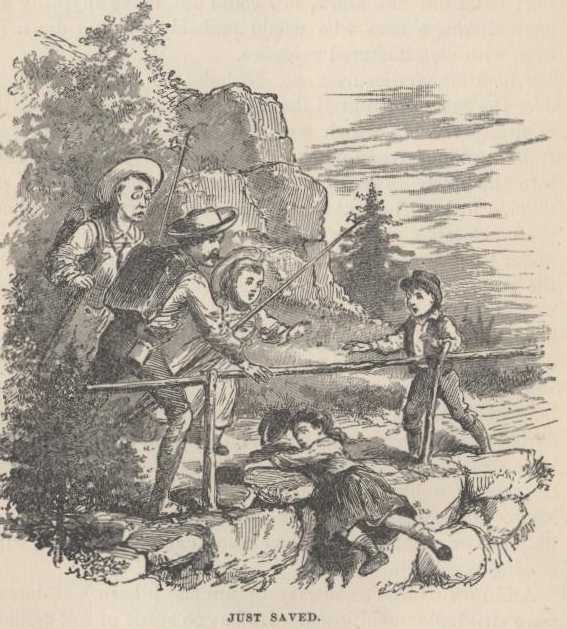
About nine miles from St. Nicholas we crossed a bridge over the raging torrent of the Visp, and came to a log strip of flimsy fencing which was pretending to secure people from tumbling over a perpendicular wall forty feet high and into the river. Three children were approaching; one of them, a little girl, about eight years old, was running; when pretty close to us she stumbled and fell, and her feet shot under the rail of the fence and for a moment projected over the stream. It gave us a sharp shock, for we thought she was gone, sure, for the ground slanted steeply, and to save herself seemed a sheer impossibility; but she managed to scramble up, and ran by us laughing.
We went forward and examined the place and saw the long tracks which her
feet had made in the dirt when they darted over the verge. If she had
finished her trip she would have struck some big rocks in the edge of the
water, and then the torrent would have snatched her downstream among the
half-covered boulders and she would have been pounded to pulp in two
minutes. We had come exceedingly near witnessing her death.
And now Harris’s contrary nature and inborn selfishness were
strikingly manifested. He has no spirit of self-denial. He began straight
off, and continued for an hour, to express his gratitude that the child
was not destroyed. I never saw such a man. That was the kind of person he
was; just so he was gratified, he never cared anything about
anybody else. I had noticed that trait in him, over and over again. Often,
of course, it was mere heedlessness, mere want of reflection. Doubtless
this may have been the case in most instances, but it was not the less
hard to bar on that account—and after all, its bottom, its
groundwork, was selfishness. There is no avoiding that conclusion. In the
instance under consideration, I did think the indecency of running on in
that way might occur to him; but no, the child was saved and he was glad,
that was sufficient—he cared not a straw for my feelings, or
my loss of such a literary plum, snatched from my very mouth at the
instant it was ready to drop into it. His selfishness was sufficient to
place his own gratification in being spared suffering clear before all
concern for me, his friend. Apparently, he did not once reflect upon the
valuable details which would have fallen like a windfall to me: fishing
the child out—witnessing the surprise of the family and the stir the
thing would have made among the peasants—then a Swiss funeral—then
the roadside monument, to be paid for by us and have our names mentioned
in it. And we should have gone into Baedeker and been immortal. I was
silent. I was too much hurt to complain. If he could act so, and be so
heedless and so frivolous at such a time, and actually seem to glory in
it, after all I had done for him, I would have cut my hand off before I
would let him see that I was wounded.
We were approaching Zermatt; consequently, we were approaching the renowned Matterhorn. A month before, this mountain had been only a name to us, but latterly we had been moving through a steadily thickening double row of pictures of it, done in oil, water, chromo, wood, steel, copper, crayon, and photography, and so it had at length become a shape to us—and a very distinct, decided, and familiar one, too. We were expecting to recognize that mountain whenever or wherever we should run across it. We were not deceived. The monarch was far away when we first saw him, but there was no such thing as mistaking him. He has the rare peculiarity of standing by himself; he is peculiarly steep, too, and is also most oddly shaped. He towers into the sky like a colossal wedge, with the upper third of its blade bent a little to the left. The broad base of this monster wedge is planted upon a grand glacier-paved Alpine platform whose elevation is ten thousand feet above sea-level; as the wedge itself is some five thousand feet high, it follows that its apex is about fifteen thousand feet above sea-level. So the whole bulk of this stately piece of rock, this sky-cleaving monolith, is above the line of eternal snow. Yet while all its giant neighbors have the look of being built of solid snow, from their waists up, the Matterhorn stands black and naked and forbidding, the year round, or merely powdered or streaked with white in places, for its sides are so steep that the snow cannot stay there. Its strange form, its august isolation, and its majestic unkinship with its own kind, make it—so to speak—the Napoleon of the mountain world. “Grand, gloomy, and peculiar,” is a phrase which fits it as aptly as it fitted the great captain.
Think of a monument a mile high, standing on a pedestal two miles high! This is what the Matterhorn is—a monument. Its office, henceforth, for all time, will be to keep watch and ward over the secret resting-place of the young Lord Douglas, who, in 1865, was precipitated from the summit over a precipice four thousand feet high, and never seen again. No man ever had such a monument as this before; the most imposing of the world’s other monuments are but atoms compared to it; and they will perish, and their places will pass from memory, but this will remain.
[The accident which cost Lord Douglas his life (see Chapter xii) also cost the lives of three other men. These three fell four-fifths of a mile, and their bodies were afterward found, lying side by side, upon a glacier, whence they were borne to Zermatt and buried in the churchyard.
The remains of Lord Douglas have never been found. The secret of his sepulture, like that of Moses, must remain a mystery always.]
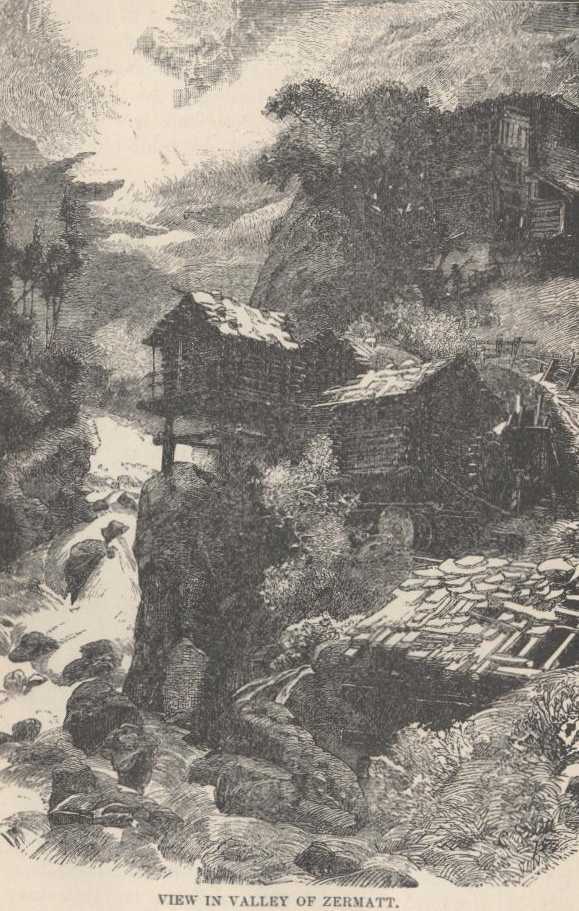
A walk from St. Nicholas to Zermatt is a wonderful experience. Nature is
built on a stupendous plan in that region. One marches continually between
walls that are piled into the skies, with their upper heights broken into
a confusion of sublime shapes that gleam white and cold against the
background of blue; and here and there one sees a big glacier displaying
its grandeurs on the top of a precipice, or a graceful cascade leaping and
flashing down the green declivities. There is nothing tame, or cheap, or
trivial—it is all magnificent. That short valley is a
picture-gallery of a notable kind, for it contains no mediocrities; from
end to end the Creator has hung it with His masterpieces.