
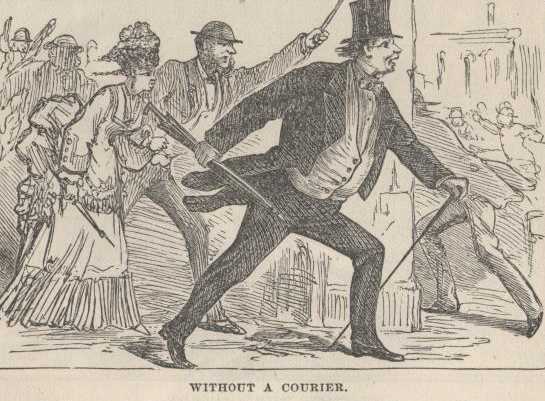
Without a courier, travel hasn’t a ray of pleasure in it, anywhere; but with him it is a continuous and unruffled delight. He is always at hand, never has to be sent for; if your bell is not answered promptly—and it seldom is—you have only to open the door and speak, the courier will hear, and he will have the order attended to or raise an insurrection. You tell him what day you will start, and whither you are going—leave all the rest to him. You need not inquire about trains, or fares, or car changes, or hotels, or anything else. At the proper time he will put you in a cab or an omnibus, and drive you to the train or the boat; he has packed your luggage and transferred it, he has paid all the bills. Other people have preceded you half an hour to scramble for impossible places and lose their tempers, but you can take your time; the courier has secured your seats for you, and you can occupy them at your leisure.
At the station, the crowd mash one another to pulp in the effort to get
the weigher’s attention to their trunks; they dispute hotly with
these tyrants, who are cool and indifferent; they get their baggage
billets, at last, and then have another squeeze and another rage over the
disheartening business of trying to get them recorded and paid for, and
still another over the equally disheartening business of trying to get
near enough to the ticket office to buy a ticket; and now, with their
tempers gone to the dogs, they must stand penned up and packed together,
laden with wraps and satchels and shawl-straps, with the weary wife and
babies, in the waiting-room, till the doors are thrown open—and then
all hands make a grand final rush to the train, find it full, and have to
stand on the platform and fret until some more cars are put on. They are
in a condition to kill somebody by this time. Meantime, you have been
sitting in your car, smoking, and observing all this misery in the
extremest comfort.
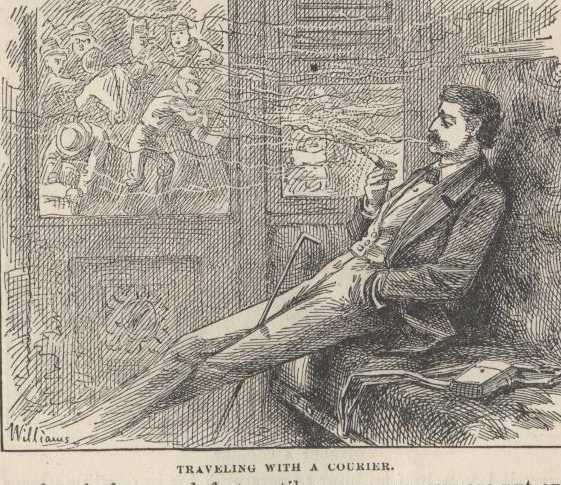
On the journey the guard is polite and watchful—won’t allow anybody to get into your compartment—tells them you are just recovering from the small-pox and do not like to be disturbed. For the courier has made everything right with the guard. At way-stations the courier comes to your compartment to see if you want a glass of water, or a newspaper, or anything; at eating-stations he sends luncheon out to you, while the other people scramble and worry in the dining-rooms. If anything breaks about the car you are in, and a station-master proposes to pack you and your agent into a compartment with strangers, the courier reveals to him confidentially that you are a French duke born deaf and dumb, and the official comes and makes affable signs that he has ordered a choice car to be added to the train for you.
At custom-houses the multitude file tediously through, hot and irritated, and look on while the officers burrow into the trunks and make a mess of everything; but you hand your keys to the courier and sit still. Perhaps you arrive at your destination in a rain-storm at ten at night—you generally do. The multitude spend half an hour verifying their baggage and getting it transferred to the omnibuses; but the courier puts you into a vehicle without a moment’s loss of time, and when you reach your hotel you find your rooms have been secured two or three days in advance, everything is ready, you can go at once to bed. Some of those other people will have to drift around to two or three hotels, in the rain, before they find accommodations.
I have not set down half of the virtues that are vested in a good courier, but I think I have set down a sufficiency of them to show that an irritable man who can afford one and does not employ him is not a wise economist. My courier was the worst one in Europe, yet he was a good deal better than none at all. It could not pay him to be a better one than he was, because I could not afford to buy things through him. He was a good enough courier for the small amount he got out of his service. Yes, to travel with a courier is bliss, to travel without one is the reverse.
I have had dealings with some very bad couriers; but I have also had
dealings with one who might fairly be called perfection. He was a young
Polander, named Joseph N. Verey. He spoke eight languages, and seemed to
be equally at home in all of them; he was shrewd, prompt, posted, and
punctual; he was fertile in resources, and singularly gifted in the matter
of overcoming difficulties; he not only knew how to do everything in his
line, but he knew the best ways and the quickest; he was handy with
children and invalids; all his employer needed to do was to take life easy
and leave everything to the courier. His address is, care of Messrs. Gay
& Son, Strand, London; he was formerly a conductor of Gay’s
tourist parties. Excellent couriers are somewhat rare; if the reader is
about to travel, he will find it to his advantage to make a note of this
one.
CHAPTER XXXIII
[We Climb Far—by Buggy]
The beautiful Giesbach Fall is near Interlaken, on the other side of the lake of Brienz, and is illuminated every night with those gorgeous theatrical fires whose name I cannot call just at this moment. This was said to be a spectacle which the tourist ought by no means to miss. I was strongly tempted, but I could not go there with propriety, because one goes in a boat. The task which I had set myself was to walk over Europe on foot, not skim over it in a boat. I had made a tacit contract with myself; it was my duty to abide by it. I was willing to make boat trips for pleasure, but I could not conscientiously make them in the way of business.
It cost me something of a pang to lose that fine sight, but I lived down the desire, and gained in my self-respect through the triumph. I had a finer and a grander sight, however, where I was. This was the mighty dome of the Jungfrau softly outlined against the sky and faintly silvered by the starlight. There was something subduing in the influence of that silent and solemn and awful presence; one seemed to meet the immutable, the indestructible, the eternal, face to face, and to feel the trivial and fleeting nature of his own existence the more sharply by the contrast. One had the sense of being under the brooding contemplation of a spirit, not an inert mass of rocks and ice—a spirit which had looked down, through the slow drift of the ages, upon a million vanished races of men, and judged them; and would judge a million more—and still be there, watching, unchanged and unchangeable, after all life should be gone and the earth have become a vacant desolation.
While I was feeling these things, I was groping, without knowing it, toward an understanding of what the spell is which people find in the Alps, and in no other mountains—that strange, deep, nameless influence, which, once felt, cannot be forgotten—once felt, leaves always behind it a restless longing to feel it again—a longing which is like homesickness; a grieving, haunting yearning which will plead, implore, and persecute till it has its will. I met dozens of people, imaginative and unimaginative, cultivated and uncultivated, who had come from far countries and roamed through the Swiss Alps year after year—they could not explain why. They had come first, they said, out of idle curiosity, because everybody talked about it; they had come since because they could not help it, and they should keep on coming, while they lived, for the same reason; they had tried to break their chains and stay away, but it was futile; now, they had no desire to break them. Others came nearer formulating what they felt; they said they could find perfect rest and peace nowhere else when they were troubled: all frets and worries and chafings sank to sleep in the presence of the benignant serenity of the Alps; the Great Spirit of the Mountain breathed his own peace upon their hurt minds and sore hearts, and healed them; they could not think base thoughts or do mean and sordid things here, before the visible throne of God.
Down the road a piece was a Kursaal—whatever that may be—and
we joined the human tide to see what sort of enjoyment it might afford. It
was the usual open-air concert, in an ornamental garden, with wines, beer,
milk, whey, grapes, etc.—the whey and the grapes being necessaries
of life to certain invalids whom physicians cannot repair, and who only
continue to exist by the grace of whey or grapes. One of these departed
spirits told me, in a sad and lifeless way, that there is no way for him
to live but by whey, and dearly, dearly loved whey, he didn’t know
whey he did, but he did. After making this pun he died—that is the
whey it served him.
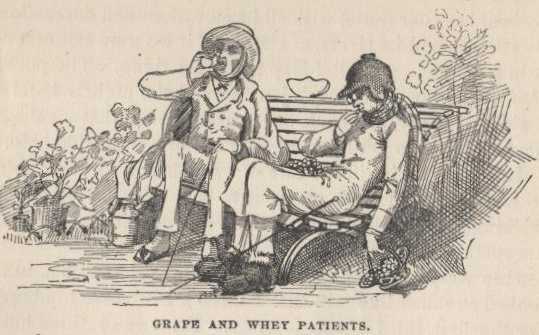
Some other remains, preserved from decomposition by the grape system, told me that the grapes were of a peculiar breed, highly medicinal in their nature, and that they were counted out and administered by the grape-doctors as methodically as if they were pills. The new patient, if very feeble, began with one grape before breakfast, took three during breakfast, a couple between meals, five at luncheon, three in the afternoon, seven at dinner, four for supper, and part of a grape just before going to bed, by way of a general regulator. The quantity was gradually and regularly increased, according to the needs and capacities of the patient, until by and by you would find him disposing of his one grape per second all the day long, and his regular barrel per day.
He said that men cured in this way, and enabled to discard the grape system, never afterward got over the habit of talking as if they were dictating to a slow amanuensis, because they always made a pause between each two words while they sucked the substance out of an imaginary grape. He said these were tedious people to talk with. He said that men who had been cured by the other process were easily distinguished from the rest of mankind because they always tilted their heads back, between every two words, and swallowed a swig of imaginary whey. He said it was an impressive thing to observe two men, who had been cured by the two processes, engaged in conversation—said their pauses and accompanying movements were so continuous and regular that a stranger would think himself in the presence of a couple of automatic machines. One finds out a great many wonderful things, by traveling, if he stumbles upon the right person.
I did not remain long at the Kursaal; the music was good enough, but it seemed rather tame after the cyclone of that Arkansaw expert. Besides, my adventurous spirit had conceived a formidable enterprise—nothing less than a trip from Interlaken, by the Gemmi and Visp, clear to Zermatt, on foot! So it was necessary to plan the details, and get ready for an early start. The courier (this was not the one I have just been speaking of) thought that the portier of the hotel would be able to tell us how to find our way. And so it turned out. He showed us the whole thing, on a relief-map, and we could see our route, with all its elevations and depressions, its villages and its rivers, as clearly as if we were sailing over it in a balloon. A relief-map is a great thing. The portier also wrote down each day’s journey and the nightly hotel on a piece of paper, and made our course so plain that we should never be able to get lost without high-priced outside help.
I put the courier in the care of a gentleman who was going to Lausanne, and then we went to bed, after laying out the walking-costumes and putting them into condition for instant occupation in the morning.
However, when we came down to breakfast at 8 A.M., it looked so much like rain that I hired a two-horse top-buggy for the first third of the journey. For two or three hours we jogged along the level road which skirts the beautiful lake of Thun, with a dim and dreamlike picture of watery expanses and spectral Alpine forms always before us, veiled in a mellowing mist. Then a steady downpour set in, and hid everything but the nearest objects. We kept the rain out of our faces with umbrellas, and away from our bodies with the leather apron of the buggy; but the driver sat unsheltered and placidly soaked the weather in and seemed to like it. We had the road to ourselves, and I never had a pleasanter excursion.
The weather began to clear while we were driving up a valley called the Kienthal, and presently a vast black cloud-bank in front of us dissolved away and uncurtained the grand proportions and the soaring loftiness of the Blumis Alp. It was a sort of breath-taking surprise; for we had not supposed there was anything behind that low-hung blanket of sable cloud but level valley. What we had been mistaking for fleeting glimpses of sky away aloft there, were really patches of the Blumis’s snowy crest caught through shredded rents in the drifting pall of vapor.
We dined in the inn at Frutigen, and our driver ought to have dined there,
too, but he would not have had time to dine and get drunk both, so he gave
his mind to making a masterpiece of the latter, and succeeded. A German
gentleman and his two young-lady daughters had been taking their nooning
at the inn, and when they left, just ahead of us, it was plain that their
driver was as drunk as ours, and as happy and good-natured, too, which was
saying a good deal. These rascals overflowed with attentions and
information for their guests, and with brotherly love for each other. They
tied their reins, and took off their coats and hats, so that they might be
able to give unencumbered attention to conversation and to the gestures
necessary for its illustration.
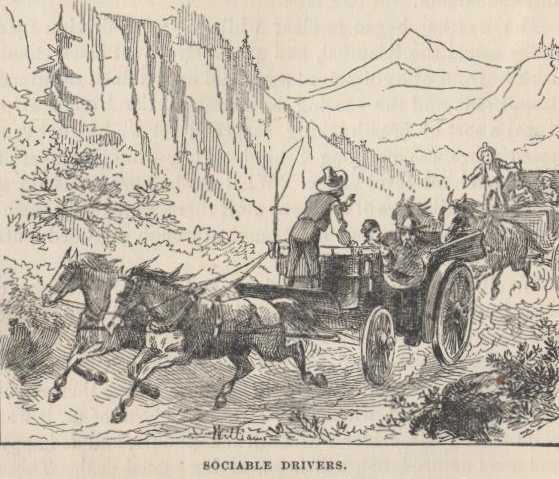
The road was smooth; it led up and over and down a continual succession of hills; but it was narrow, the horses were used to it, and could not well get out of it anyhow; so why shouldn’t the drivers entertain themselves and us? The noses of our horses projected sociably into the rear of the forward carriage, and as we toiled up the long hills our driver stood up and talked to his friend, and his friend stood up and talked back to him, with his rear to the scenery. When the top was reached and we went flying down the other side, there was no change in the program. I carry in my memory yet the picture of that forward driver, on his knees on his high seat, resting his elbows on its back, and beaming down on his passengers, with happy eye, and flying hair, and jolly red face, and offering his card to the old German gentleman while he praised his hack and horses, and both teams were whizzing down a long hill with nobody in a position to tell whether we were bound to destruction or an undeserved safety.
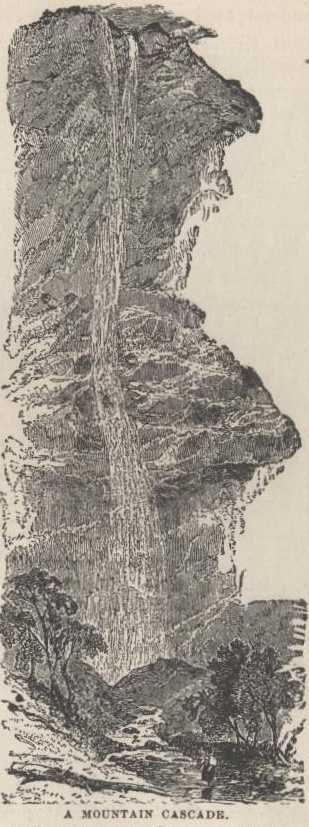
Toward sunset we entered a beautiful green valley dotted with chalets, a
cozy little domain hidden away from the busy world in a cloistered nook
among giant precipices topped with snowy peaks that seemed to float like
islands above the curling surf of the sea of vapor that severed them from
the lower world. Down from vague and vaporous heights, little ruffled
zigzag milky currents came crawling, and found their way to the verge of
one of those tremendous overhanging walls, whence they plunged, a shaft of
silver, shivered to atoms in mid-descent and turned to an air puff of
luminous dust. Here and there, in grooved depressions among the snowy
desolations of the upper altitudes, one glimpsed the extremity of a
glacier, with its sea-green and honeycombed battlements of ice.
Up the valley, under a dizzy precipice, nestled the village of Kandersteg, our halting-place for the night. We were soon there, and housed in the hotel. But the waning day had such an inviting influence that we did not remain housed many moments, but struck out and followed a roaring torrent of ice-water up to its far source in a sort of little grass-carpeted parlor, walled in all around by vast precipices and overlooked by clustering summits of ice. This was the snuggest little croquet-ground imaginable; it was perfectly level, and not more than a mile long by half a mile wide. The walls around it were so gigantic, and everything about it was on so mighty a scale that it was belittled, by contrast, to what I have likened it to—a cozy and carpeted parlor. It was so high above the Kandersteg valley that there was nothing between it and the snowy-peaks. I had never been in such intimate relations with the high altitudes before; the snow-peaks had always been remote and unapproachable grandeurs, hitherto, but now we were hob-a-nob—if one may use such a seemingly irreverent expression about creations so august as these.
We could see the streams which fed the torrent we had followed issuing
from under the greenish ramparts of glaciers; but two or three of these,
instead of flowing over the precipices, sank down into the rock and sprang
in big jets out of holes in the mid-face of the walls.
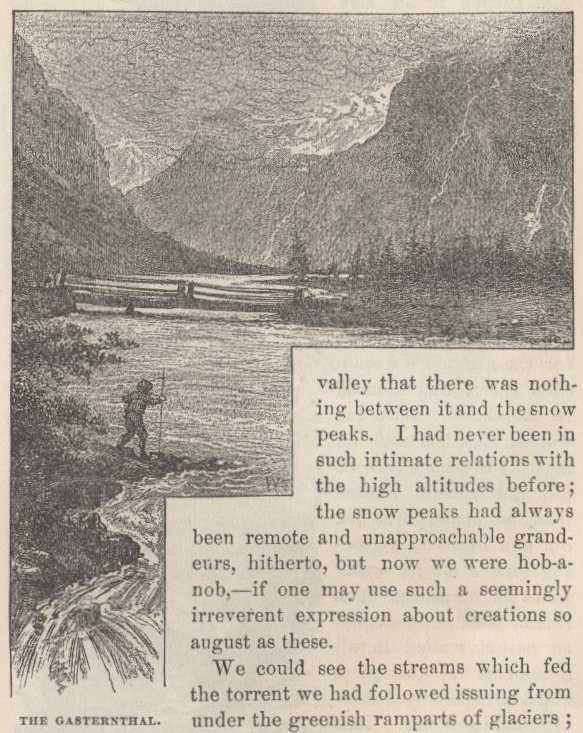
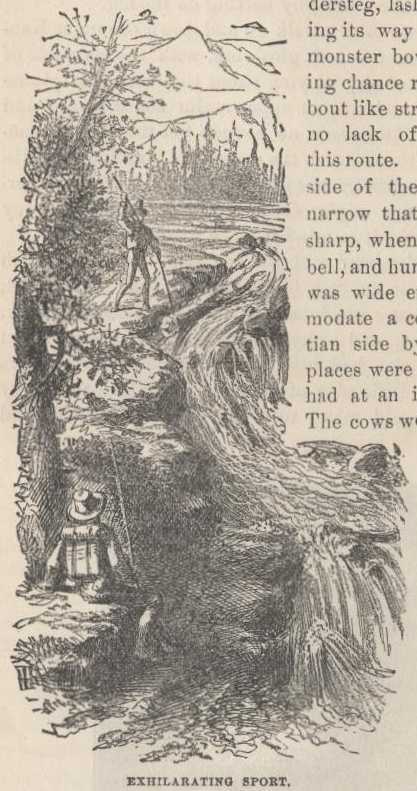
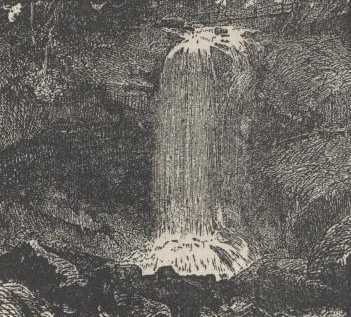
The green nook which I have been describing is called the Gasternthal. The glacier streams gather and flow through it in a broad and rushing brook to a narrow cleft between lofty precipices; here the rushing brook becomes a mad torrent and goes booming and thundering down toward Kandersteg, lashing and thrashing its way over and among monster boulders, and hurling chance roots and logs about like straws. There was no lack of cascades along this route. The path by the side of the torrent was so narrow that one had to look sharp, when he heard a cow-bell, and hunt for a place that was wide enough to accommodate a cow and a Christian side by side, and such places were not always to be had at an instant’s notice. The cows wear church-bells, and that is a good idea in the cows, for where that torrent is, you couldn’t hear an ordinary cow-bell any further than you could hear the ticking of a watch.
I needed exercise, so I employed my agent in setting stranded logs and
dead trees adrift, and I sat on a boulder and watched them go whirling and
leaping head over heels down the boiling torrent. It was a wonderfully
exhilarating spectacle. When I had had enough exercise, I made the agent
take some, by running a race with one of those logs. I made a trifle by
betting on the log.
After dinner we had a walk up and down the Kandersteg valley, in the soft gloaming, with the spectacle of the dying lights of day playing about the crests and pinnacles of the still and solemn upper realm for contrast, and text for talk. There were no sounds but the dulled complaining of the torrent and the occasional tinkling of a distant bell. The spirit of the place was a sense of deep, pervading peace; one might dream his life tranquilly away there, and not miss it or mind it when it was gone.
The summer departed with the sun, and winter came with the stars. It grew
to be a bitter night in that little hotel, backed up against a precipice
that had no visible top to it, but we kept warm, and woke in time in the
morning to find that everybody else had left for Gemmi three hours before—so
our little plan of helping that German family (principally the old man)
over the pass, was a blocked generosity.
CHAPTER XXXIV
[The World’s Highest Pig Farm]
We hired the only guide left, to lead us on our way. He was over seventy, but he could have given me nine-tenths of his strength and still had all his age entitled him to. He shouldered our satchels, overcoats, and alpenstocks, and we set out up the steep path. It was hot work. The old man soon begged us to hand over our coats and waistcoats to him to carry, too, and we did it; one could not refuse so little a thing to a poor old man like that; he should have had them if he had been a hundred and fifty.
When we began that ascent, we could see a microscopic chalet perched away
up against heaven on what seemed to be the highest mountain near us. It
was on our right, across the narrow head of the valley. But when we got up
abreast it on its own level, mountains were towering high above on every
hand, and we saw that its altitude was just about that of the little
Gasternthal which we had visited the evening before. Still it seemed a
long way up in the air, in that waste and lonely wilderness of rocks. It
had an unfenced grass-plot in front of it which seemed about as big as a
billiard-table, and this grass-plot slanted so sharply downward, and was
so brief, and ended so exceedingly soon at the verge of the absolute
precipice, that it was a shuddery thing to think of a person’s
venturing to trust his foot on an incline so situated at all. Suppose a
man stepped on an orange peel in that yard; there would be nothing for him
to seize; nothing could keep him from rolling; five revolutions would
bring him to the edge, and over he would go.
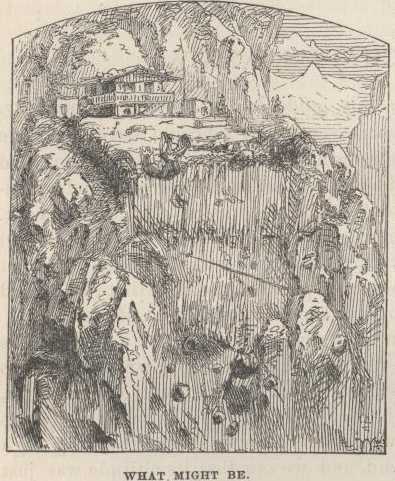
What a frightful distance he would fall!—for there are very few birds that fly as high as his starting-point. He would strike and bounce, two or three times, on his way down, but this would be no advantage to him. I would as soon take an airing on the slant of a rainbow as in such a front yard. I would rather, in fact, for the distance down would be about the same, and it is pleasanter to slide than to bounce. I could not see how the peasants got up to that chalet—the region seemed too steep for anything but a balloon.
As we strolled on, climbing up higher and higher, we were continually bringing neighboring peaks into view and lofty prominence which had been hidden behind lower peaks before; so by and by, while standing before a group of these giants, we looked around for the chalet again; there it was, away down below us, apparently on an inconspicuous ridge in the valley! It was as far below us, now, as it had been above us when we were beginning the ascent.
After a while the path led us along a railed precipice, and we looked over—far beneath us was the snug parlor again, the little Gasternthal, with its water jets spouting from the face of its rock walls. We could have dropped a stone into it. We had been finding the top of the world all along—and always finding a still higher top stealing into view in a disappointing way just ahead; when we looked down into the Gasternthal we felt pretty sure that we had reached the genuine top at last, but it was not so; there were much higher altitudes to be scaled yet. We were still in the pleasant shade of forest trees, we were still in a region which was cushioned with beautiful mosses and aglow with the many-tinted luster of innumerable wild flowers.
We found, indeed, more interest in the wild flowers than in anything else.
We gathered a specimen or two of every kind which we were unacquainted
with; so we had sumptuous bouquets. But one of the chief interests lay in
chasing the seasons of the year up the mountain, and determining them by
the presence of flowers and berries which we were acquainted with. For
instance, it was the end of August at the level of the sea; in the
Kandersteg valley at the base of the pass, we found flowers which would
not be due at the sea-level for two or three weeks; higher up, we entered
October, and gathered fringed gentians. I made no notes, and have
forgotten the details, but the construction of the floral calendar was
very entertaining while it lasted.
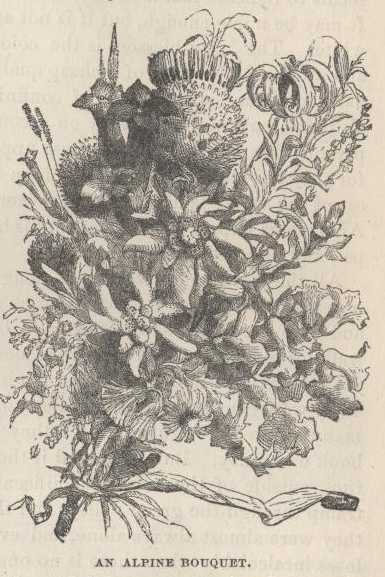
In the high regions we found rich store of the splendid red flower called the Alpine rose, but we did not find any examples of the ugly Swiss favorite called Edelweiss. Its name seems to indicate that it is a noble flower and that it is white. It may be noble enough, but it is not attractive, and it is not white. The fuzzy blossom is the color of bad cigar ashes, and appears to be made of a cheap quality of gray plush. It has a noble and distant way of confining itself to the high altitudes, but that is probably on account of its looks; it apparently has no monopoly of those upper altitudes, however, for they are sometimes intruded upon by some of the loveliest of the valley families of wild flowers. Everybody in the Alps wears a sprig of Edelweiss in his hat. It is the native’s pet, and also the tourist’s.
All the morning, as we loafed along, having a good time, other pedestrians went staving by us with vigorous strides, and with the intent and determined look of men who were walking for a wager. These wore loose knee-breeches, long yarn stockings, and hobnailed high-laced walking-shoes. They were gentlemen who would go home to England or Germany and tell how many miles they had beaten the guide-book every day. But I doubted if they ever had much real fun, outside of the mere magnificent exhilaration of the tramp through the green valleys and the breezy heights; for they were almost always alone, and even the finest scenery loses incalculably when there is no one to enjoy it with.
All the morning an endless double procession of mule-mounted tourists filed past us along the narrow path—the one procession going, the other coming. We had taken a good deal of trouble to teach ourselves the kindly German custom of saluting all strangers with doffed hat, and we resolutely clung to it, that morning, although it kept us bareheaded most of the time and was not always responded to. Still we found an interest in the thing, because we naturally liked to know who were English and Americans among the passers-by. All continental natives responded of course; so did some of the English and Americans, but, as a general thing, these two races gave no sign. Whenever a man or a woman showed us cold neglect, we spoke up confidently in our own tongue and asked for such information as we happened to need, and we always got a reply in the same language. The English and American folk are not less kindly than other races, they are only more reserved, and that comes of habit and education. In one dreary, rocky waste, away above the line of vegetation, we met a procession of twenty-five mounted young men, all from America. We got answering bows enough from these, of course, for they were of an age to learn to do in Rome as Rome does, without much effort.
At one extremity of this patch of desolation, overhung by bare and
forbidding crags which husbanded drifts of everlasting snow in their
shaded cavities, was a small stretch of thin and discouraged grass, and a
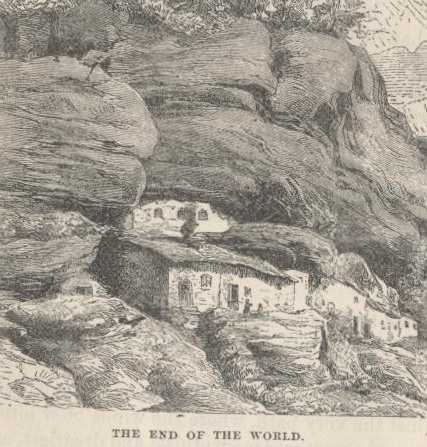
man and a family of pigs were actually living here in some shanties.
Consequently this place could be really reckoned as “property”;
it had a money value, and was doubtless taxed. I think it must have marked
the limit of real estate in this world. It would be hard to set a money
value upon any piece of earth that lies between that spot and the empty
realm of space. That man may claim the distinction of owning the end of
the world, for if there is any definite end to the world he has certainly
found it.
From here forward we moved through a storm-swept and smileless desolation. All about us rose gigantic masses, crags, and ramparts of bare and dreary rock, with not a vestige or semblance of plant or tree or flower anywhere, or glimpse of any creature that had life. The frost and the tempests of unnumbered ages had battered and hacked at these cliffs, with a deathless energy, destroying them piecemeal; so all the region about their bases was a tumbled chaos of great fragments which had been split off and hurled to the ground. Soiled and aged banks of snow lay close about our path. The ghastly desolation of the place was as tremendously complete as if Doré had furnished the working-plans for it. But every now and then, through the stern gateways around us we caught a view of some neighboring majestic dome, sheathed with glittering ice, and displaying its white purity at an elevation compared to which ours was groveling and plebeian, and this spectacle always chained one’s interest and admiration at once, and made him forget there was anything ugly in the world.
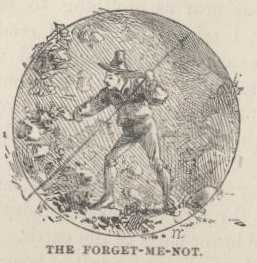
I have just said that there was nothing but death and desolation in these
hideous places, but I forgot. In the most forlorn and arid and dismal one
of all, where the racked and splintered debris was thickest, where the
ancient patches of snow lay against the very path, where the winds blew
bitterest and the general aspect was mournfulest and dreariest, and
furthest from any suggestion of cheer or hope, I found a solitary wee
forget-me-not flourishing away, not a droop about it anywhere, but holding
its bright blue star up with the prettiest and gallantest air in the
world, the only happy spirit, the only smiling thing, in all that grisly
desert. She seemed to say, “Cheer up!—as long as we are here,
let us make the best of it.” I judged she had earned a right to a
more hospitable place; so I plucked her up and sent her to America to a
friend who would respect her for the fight she had made, all by her small
self, to make a whole vast despondent Alpine desolation stop breaking its
heart over the unalterable, and hold up its head and look at the bright
side of things for once.
We stopped for a nooning at a strongly built little inn called the Schwarenbach. It sits in a lonely spot among the peaks, where it is swept by the trailing fringes of the cloud-rack, and is rained on, and snowed on, and pelted and persecuted by the storms, nearly every day of its life. It was the only habitation in the whole Gemmi Pass.
Close at hand, now, was a chance for a blood-curdling Alpine adventure. Close at hand was the snowy mass of the Great Altels cooling its topknot in the sky and daring us to an ascent. I was fired with the idea, and immediately made up my mind to procure the necessary guides, ropes, etc., and undertake it. I instructed Harris to go to the landlord of the inn and set him about our preparations. Meantime, I went diligently to work to read up and find out what this much-talked-of mountain-climbing was like, and how one should go about it—for in these matters I was ignorant. I opened Mr. Hinchliff’s Summer Months Among The Alps (published 1857), and selected his account of his ascent of Monte Rosa.
It began:
“It is very difficult to free the mind from excitement on the evening before a grand expedition—”
I saw that I was too calm; so I walked the room a while and worked myself
into a high excitement; but the book’s next remark—that the
adventurer must get up at two in the morning—came as near as
anything to flatting it all out again. However, I reinforced it, and read
on, about how Mr. Hinchliff dressed by candle-light and was “soon
down among the guides, who were bustling about in the passage, packing
provisions, and making every preparation for the start”; and how he
glanced out into the cold clear night and saw that—
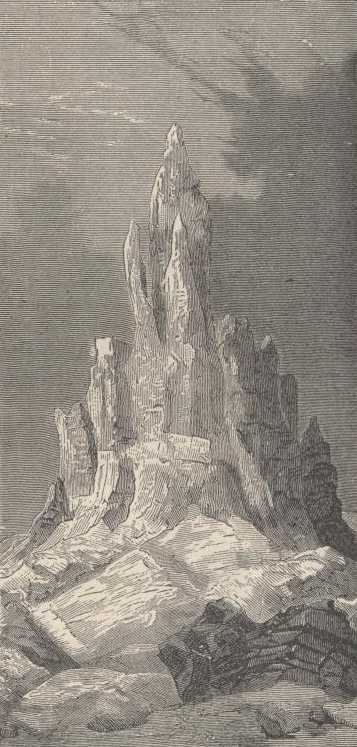
“The whole sky was blazing with stars, larger and brighter than they appear through the dense atmosphere breathed by inhabitants of the lower parts of the earth. They seemed actually suspended from the dark vault of heaven, and their gentle light shed a fairylike gleam over the snow-fields around the foot of the Matterhorn, which raised its stupendous pinnacle on high, penetrating to the heart of the Great Bear, and crowning itself with a diadem of his magnificent stars. Not a sound disturbed the deep tranquillity of the night, except the distant roar of streams which rush from the high plateau of the St. Theodule glacier, and fall headlong over precipitous rocks till they lose themselves in the mazes of the Gorner glacier.”
He took his hot toast and coffee, and then about half past three his caravan of ten men filed away from the Riffel Hotel, and began the steep climb. At half past five he happened to turn around, and “beheld the glorious spectacle of the Matterhorn, just touched by the rosy-fingered morning, and looking like a huge pyramid of fire rising out of the barren ocean of ice and rock around it.” Then the Breithorn and the Dent Blanche caught the radiant glow; but “the intervening mass of Monte Rosa made it necessary for us to climb many long hours before we could hope to see the sun himself, yet the whole air soon grew warmer after the splendid birth of the day.”
He gazed at the lofty crown of Monte Rosa and the wastes of snow that guarded its steep approaches, and the chief guide delivered the opinion that no man could conquer their awful heights and put his foot upon that summit. But the adventurers moved steadily on, nevertheless.
They toiled up, and up, and still up; they passed the Grand Plateau; then
toiled up a steep shoulder of the mountain, clinging like flies to its
rugged face; and now they were confronted by a tremendous wall from which
great blocks of ice and snow were evidently in the habit of falling. They
turned aside to skirt this wall, and gradually ascended until their way
was barred by a “maze of gigantic snow crevices,”—so
they turned aside again, and “began a long climb of sufficient
steepness to make a zigzag course necessary."
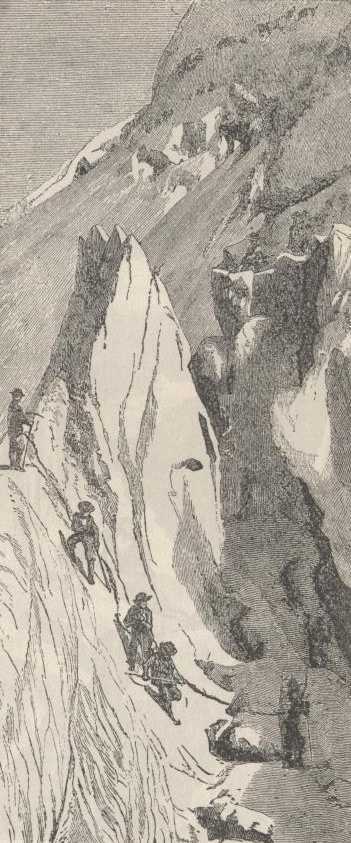
Fatigue compelled them to halt frequently, for a moment or two. At one of these halts somebody called out, “Look at Mont Blanc!” and “we were at once made aware of the very great height we had attained by actually seeing the monarch of the Alps and his attendant satellites right over the top of the Breithorn, itself at least 14,000 feet high!”
These people moved in single file, and were all tied to a strong rope, at
regular distances apart, so that if one of them slipped on those giddy
heights, the others could brace themselves on their alpenstocks and save
him from darting into the valley, thousands of feet below. By and by they
came to an ice-coated ridge which was tilted up at a sharp angle, and had
a precipice on one side of it. They had to climb this, so the guide in the
lead cut steps in the ice with his hatchet, and as fast as he took his
toes out of one of these slight holes, the toes of the man behind him
occupied it.
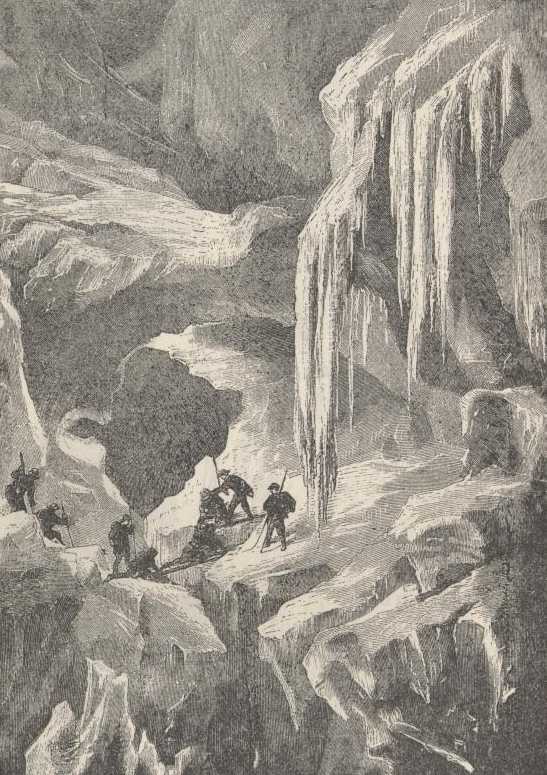
“Slowly and steadily we kept on our way over this dangerous part of the ascent, and I dare say it was fortunate for some of us that attention was distracted from the head by the paramount necessity of looking after the feet; for, while on the left the incline of ice was so steep that it would be impossible for any man to save himself in case of a slip, unless the others could hold him up, on the right we might drop a pebble from the hand over precipices of unknown extent down upon the tremendous glacier below.
“Great caution, therefore, was absolutely necessary, and in this exposed situation we were attacked by all the fury of that grand enemy of aspirants to Monte Rosa—a severe and bitterly cold wind from the north. The fine powdery snow was driven past us in the clouds, penetrating the interstices of our clothes, and the pieces of ice which flew from the blows of Peter’s ax were whisked into the air, and then dashed over the precipice. We had quite enough to do to prevent ourselves from being served in the same ruthless fashion, and now and then, in the more violent gusts of wind, were glad to stick our alpenstocks into the ice and hold on hard.”
Having surmounted this perilous steep, they sat down and took a brief rest with their backs against a sheltering rock and their heels dangling over a bottomless abyss; then they climbed to the base of another ridge—a more difficult and dangerous one still:
“The whole of the ridge was exceedingly narrow, and the fall on each
side desperately steep, but the ice in some of these intervals between the
masses of rock assumed the form of a mere sharp edge, almost like a knife;
these places, though not more than three or four short paces in length,
looked uncommonly awkward; but, like the sword leading true believers to
the gates of Paradise, they must needs be passed before we could attain to
the summit of our ambition. These were in one or two places so narrow,
that in stepping over them with toes well turned out for greater security,
one end of the foot projected over the awful precipice on the right,
while the other was on the beginning of the ice slope on the left, which
was scarcely less steep than the rocks. On these occasions Peter would
take my hand, and each of us stretching as far as we could, he was thus
enabled to get a firm footing two paces or rather more from me, whence a
spring would probably bring him to the rock on the other side; then,
turning around, he called to me to come, and, taking a couple of steps
carefully, I was met at the third by his outstretched hand ready to clasp
mine, and in a moment stood by his side. The others followed in much the
same fashion. Once my right foot slipped on the side toward the precipice,
but I threw out my left arm in a moment so that it caught the icy edge
under my armpit as I fell, and supported me considerably; at the same
instant I cast my eyes down the side on which I had slipped, and contrived
to plant my right foot on a piece of rock as large as a cricket-ball,
which chanced to protrude through the ice, on the very edge of the
precipice. Being thus anchored fore and aft, as it were, I believe I could
easily have recovered myself, even if I had been alone, though it must be
confessed the situation would have been an awful one; as it was, however,
a jerk from Peter settled the matter very soon, and I was on my legs all
right in an instant. The rope is an immense help in places of this kind."
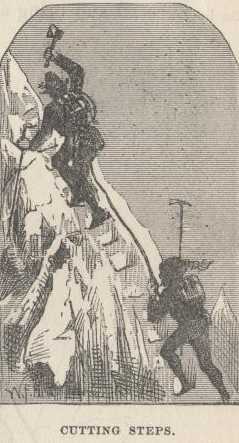
Now they arrived at the base of a great knob or dome veneered with ice and powdered with snow—the utmost, summit, the last bit of solidity between them and the hollow vault of heaven. They set to work with their hatchets, and were soon creeping, insectlike, up its surface, with their heels projecting over the thinnest kind of nothingness, thickened up a little with a few wandering shreds and films of cloud moving in a lazy procession far below. Presently, one man’s toe-hold broke and he fell! There he dangled in mid-air at the end of the rope, like a spider, till his friends above hauled him into place again.
A little bit later, the party stood upon the wee pedestal of the very summit, in a driving wind, and looked out upon the vast green expanses of Italy and a shoreless ocean of billowy Alps.
When I had read thus far, Harris broke into the room in a noble excitement and said the ropes and the guides were secured, and asked if I was ready. I said I believed I wouldn’t ascend the Altels this time. I said Alp-climbing was a different thing from what I had supposed it was, and so I judged we had better study its points a little more before we went definitely into it. But I told him to retain the guides and order them to follow us to Zermatt, because I meant to use them there. I said I could feel the spirit of adventure beginning to stir in me, and was sure that the fell fascination of Alp-climbing would soon be upon me. I said he could make up his mind to it that we would do a deed before we were a week older which would make the hair of the timid curl with fright.
This made Harris happy, and filled him with ambitious anticipations. He
went at once to tell the guides to follow us to Zermatt and bring all
their paraphernalia with them.