
CHAPTER 3.
ContentsTHE ARRIVAL OF THE WIZARD
HE doorway of the glass palace was quite big enough for the horse and buggy to enter, so Zeb drove straight through it and the children found themselves in a lofty hall that was very beautiful. The people at once followed and formed a circle around the sides of the spacious room, leaving the horse and buggy and the man with the star to occupy the center of the hall.
"Come to us, oh, Gwig!" called the man, in a loud voice.
Instantly a cloud of smoke appeared and rolled over the floor; then it slowly spread and ascended into the dome, disclosing a strange personage seated upon a glass throne just before Jim's nose. He was formed just as were the other inhabitants of this land and his clothing only differed from theirs in being bright yellow. But he had no hair at all, and all over his bald head and face and upon the backs of his hands grew sharp thorns like those found on the branches of rose-bushes. There was even a thorn upon the tip of his nose and he looked so funny that Dorothy laughed when she saw him.
The Sorcerer, hearing the laugh, looked toward the little girl with cold, cruel eyes, and his glance made her grow sober in an instant.
"Why have you dared to intrude your unwelcome persons into the secluded Land of the Mangaboos?" he asked, sternly.
"'Cause we couldn't help it," said Dorothy.
"Why did you wickedly and viciously send the Rain of Stones to crack and break our houses?" he continued.
"We didn't," declared the girl.
"Prove it!" cried the Sorcerer.
"We don't have to prove it," answered Dorothy, indignantly. "If you had any sense at all you'd known it was the earthquake."
"We only know that yesterday came a Rain of Stones upon us, which did much damage and injured some of our people. Today came another Rain of Stones, and soon after it you appeared among us."
"By the way," said the man with the star, looking steadily at the Sorcerer, "you told us yesterday that there would not be a second Rain of Stones. Yet one has just occurred that was even worse than the first. What is your sorcery good for if it cannot tell us the truth?"
"My sorcery does tell the truth!" declared the thorn-covered man. "I said there would be but one Rain of Stones. This second one was a Rain of People-and-Horse-and-Buggy. And some stones came with them."
"Will there be any more Rains?" asked the man with the star.
"No, my Prince."
"Neither stones nor people?"
"No, my Prince."
"Are you sure?"
"Quite sure, my Prince. My sorcery tells me so."
Just then a man came running into the hall and addressed the Prince after making a low bow.
"More wonders in the air, my Lord," said he.
Immediately the Prince and all of his people flocked out of the hall into the street, that they might see what was about to happen. Dorothy and Zeb jumped out of the buggy and ran after them, but the Sorcerer remained calmly in his throne.
Far up in the air was an object that looked like a balloon. It was not so high as the glowing star of the six colored suns, but was descending slowly through the air—so slowly that at first it scarcely seemed to move.
The throng stood still and waited. It was all they could do, for to go away and leave that strange sight was impossible; nor could they hurry its fall in any way. The earth children were not noticed, being so near the average size of the Mangaboos, and the horse had remained in the House of the Sorcerer, with Eureka curled up asleep on the seat of the buggy.
Gradually the balloon grew bigger, which was proof that it was settling down upon the Land of the Mangaboos. Dorothy was surprised to find how patient the people were, for her own little heart was beating rapidly with excitement. A balloon meant to her some other arrival from the surface of the earth, and she hoped it would be some one able to assist her and Zeb out of their difficulties.
In an hour the balloon had come near enough for her to see a basket suspended below it; in two hours she could see a head looking over the side of the basket; in three hours the big balloon settled slowly into the great square in which they stood and came to rest on the glass pavement.
Then a little man jumped out of the basket, took off his tall hat, and bowed very gracefully to the crowd of Mangaboos around him. He was quite an old little man, and his head was long and entirely bald.
"Why," cried Dorothy, in amazement, "it's Oz!"
The little man looked toward her and seemed as much surprised as she was. But he smiled and bowed as he answered:
"Yes, my dear; I am Oz, the Great and Terrible. Eh? And you are little Dorothy, from Kansas. I remember you very well."
"Who did you say it was?" whispered Zeb to the girl.
"It's the wonderful Wizard of Oz. Haven't you heard of him?"
Just then the man with the star came and stood before the Wizard.
"Sir," said he, "why are you here, in the Land of the Mangaboos?"
"Didn't know what land it was, my son," returned the other, with a pleasant smile; "and, to be honest, I didn't mean to visit you when I started out. I live on top of the earth, your honor, which is far better than living inside it; but yesterday I went up in a balloon, and when I came down I fell into a big crack in the earth, caused by an earthquake. I had let so much gas out of my balloon that I could not rise again, and in a few minutes the earth closed over my head. So I continued to descend until I reached this place, and if you will show me a way to get out of it, I'll go with pleasure. Sorry to have troubled you; but it couldn't be helped."
The Prince had listened with attention. Said he:
"This child, who is from the crust of the earth, like yourself, called you a Wizard. Is not a Wizard something like a Sorcerer?"
"It's better," replied Oz, promptly. "One Wizard is worth three Sorcerers."
"Ah, you shall prove that," said the Prince. "We Mangaboos have, at the present time, one of the most wonderful Sorcerers that ever was picked from a bush; but he sometimes makes mistakes. Do you ever make mistakes?"
"Never!" declared the Wizard, boldly.
"Oh, Oz!" said Dorothy; "you made a lot of mistakes when you were in the marvelous Land of Oz."
"Nonsense!" said the little man, turning red—although just then a ray of violet sunlight was on his round face.
"Come with me," said the Prince to him. "I wish you to meet our Sorcerer."
The Wizard did not like this invitation, but he could not refuse to accept it. So he followed the Prince into the great domed hall, and Dorothy and Zeb came after them, while the throng of people trooped in also.
There sat the thorny Sorcerer in his chair of state, and when the Wizard saw him he began to laugh, uttering comical little chuckles.
"What an absurd creature!" he exclaimed.
"He may look absurd," said the Prince, in his quiet voice; "but he is an excellent Sorcerer. The only fault I find with him is that he is so often wrong."
"I am never wrong," answered the Sorcerer.
"Only a short time ago you told me there would be no more Rain of Stones or of People," said the Prince.
"Well, what then?"
"Here is another person descended from the air to prove you were wrong."
"One person cannot be called 'people,'" said the Sorcerer. "If two should come out of the sky you might with justice say I was wrong; but unless more than this one appears I will hold that I was right."
"Very clever," said the Wizard, nodding his head as if pleased. "I am delighted to find humbugs inside the earth, just the same as on top of it. Were you ever with a circus, brother?"
"You ought to join one," declared the little man seriously. "I belong to Bailum & Barney's Great Consolidated Shows—three rings in one tent and a menagerie on the side. It's a fine aggregation, I assure you."
"What do you do?" asked the Sorcerer.
"I go up in a balloon, usually, to draw the crowds to the circus. But I've just had the bad luck to come out of the sky, skip the solid earth, and land lower down than I intended. But never mind. It isn't everybody who gets a chance to see your Land of the Gabazoos."
"Mangaboos," said the Sorcerer, correcting him. "If you are a Wizard you ought to be able to call people by their right names."
"Oh, I'm a Wizard; you may be sure of that. Just as good a Wizard as you are a Sorcerer."
"That remains to be seen," said the other.
"If you are able to prove that you are better," said the Prince to the little man, "I will make you the Chief Wizard of this domain. Otherwise—"
"What will happen otherwise?" asked the Wizard.
"I will stop you from living, and forbid you to be planted," returned the Prince.
"That does not sound especially pleasant," said the little man, looking at the one with the star uneasily. "But never mind. I'll beat Old Prickly, all right."
"My name is Gwig," said the Sorcerer, turning his heartless, cruel eyes upon his rival. "Let me see you equal the sorcery I am about to perform."
He waved a thorny hand and at once the tinkling of bells was heard, playing sweet music. Yet, look where she would, Dorothy could discover no bells at all in the great glass hall.
The Mangaboo people listened, but showed no great interest. It was one of the things Gwig usually did to prove he was a sorcerer.
Now was the Wizard's turn, so he smiled upon the assemblage and asked:
"Will somebody kindly loan me a hat?"
No one did, because the Mangaboos did not wear hats, and Zeb had lost his, somehow, in his flight through the air.
"Ahem!" said the Wizard, "will somebody please loan me a handkerchief?"
But they had no handkerchiefs, either.
"Very good," remarked the Wizard. "I'll use my own hat, if you please. Now, good people, observe me carefully. You see, there is nothing up my sleeve and nothing concealed about my person. Also, my hat is quite empty." He took off his hat and held it upside down, shaking it briskly.
"Let me see it," said the Sorcerer.
He took the hat and examined it carefully, returning it afterward to the Wizard.
"Now," said the little man, "I will create something out of nothing."
He placed the hat upon the glass floor, made a pass with his hand, and then removed the hat, displaying a little white piglet no bigger than a mouse, which began to run around here and there and to grunt and squeal in a tiny, shrill voice.
The people watched it intently, for they had never seen a pig before, big or little. The Wizard reached out, caught the wee creature in his hand, and holding its head between one thumb and finger and its tail between the other thumb and finger he pulled it apart, each of the two parts becoming a whole and separate piglet in an instant.
He placed one upon the floor, so that it could run around, and pulled apart the other, making three piglets in all; and then one of these was pulled apart, making four piglets. The Wizard continued this surprising performance until nine tiny piglets were running about at his feet, all squealing and grunting in a very comical way.
"Now," said the Wizard of Oz, "having created something from nothing, I will make something nothing again."
With this he caught up two of the piglets and pushed them together, so that the two were one. Then he caught up another piglet and pushed it into the first, where it disappeared. And so, one by one, the nine tiny piglets were pushed together until but a single one of the creatures remained. This the Wizard placed underneath his hat and made a mystic sign above it. When he removed his hat the last piglet had disappeared entirely.
The little man gave a bow to the silent throng that had watched him, and then the Prince said, in his cold, calm voice:
"You are indeed a wonderful Wizard, and your powers are greater than those of my Sorcerer."
"He will not be a wonderful Wizard long," remarked Gwig.
"Why not?" enquired the Wizard.
"Because I am going to stop your breath," was the reply. "I perceive that you are curiously constructed, and that if you cannot breathe you cannot keep alive."
The little man looked troubled.
"How long will it take you to stop my breath?" he asked.
"About five minutes. I'm going to begin now. Watch me carefully."
He began making queer signs and passes toward the Wizard; but the little man did not watch him long. Instead, he drew a leathern case from his pocket and took from it several sharp knives, which he joined together, one after another, until they made a long sword. By the time he had attached a handle to this sword he was having much trouble to breathe, as the charm of the Sorcerer was beginning to take effect.
So the Wizard lost no more time, but leaping forward he raised the sharp sword, whirled it once or twice around his head, and then gave a mighty stroke that cut the body of the Sorcerer exactly in two.
Dorothy screamed and expected to see a terrible sight; but as the two halves of the Sorcerer fell apart on the floor she saw that he had no bones or blood inside of him at all, and that the place where he was cut looked much like a sliced turnip or potato.
"Why, he's vegetable!" cried the Wizard, astonished.
"Of course," said the Prince. "We are all vegetable, in this country. Are you not vegetable, also?"
"No," answered the Wizard. "People on top of the earth are all meat. Will your Sorcerer die?"
"Certainly, sir. He is really dead now, and will wither very quickly. So we must plant him at once, that other Sorcerers may grow upon his bush," continued the Prince.
"What do you mean by that?" asked the little Wizard, greatly puzzled.
"If you will accompany me to our public gardens," replied the Prince, "I will explain to you much better than I can here the mysteries of our Vegetable Kingdom."
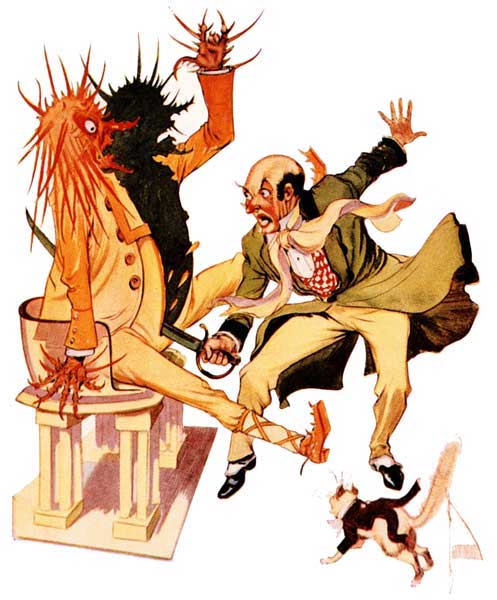 THE WIZARD CUT THE SORCERER EXACTLY IN TWO.
CHAPTER 4.
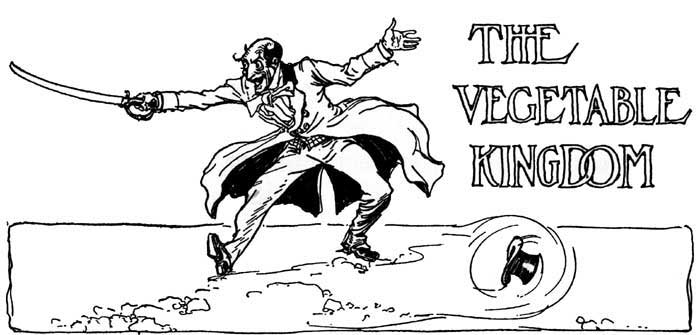
ContentsTHE VEGETABLE KINGDOM
FTER the Wizard had wiped the dampness from his sword and taken it apart and put the pieces into their leathern case again, the man with the star ordered some of his people to carry the two halves of the Sorcerer to the public gardens.
Jim pricked up his ears when he heard they were going to the gardens, and wanted to join the party, thinking he might find something proper to eat; so Zeb put down the top of the buggy and invited the Wizard to ride with them. The seat was amply wide enough for the little man and the two children, and when Jim started to leave the hall the kitten jumped upon his back and sat there quite contentedly.
So the procession moved through the streets, the bearers of the Sorcerer first, the Prince next, then Jim drawing the buggy with the strangers inside of it, and last the crowd of vegetable people who had no hearts and could neither smile nor frown.
The glass city had several fine streets, for a good many people lived there; but when the procession had passed through these it came upon a broad plain covered with gardens and watered by many pretty brooks that flowed through it. There were paths through these gardens, and over some of the brooks were ornamental glass bridges.
Dorothy and Zeb now got out of the buggy and walked beside the Prince, so that they might see and examine the flowers and plants better.
"Who built these lovely bridges?" asked the little girl.
"No one built them," answered the man with the star. "They grow."
"That's queer," said she. "Did the glass houses in your city grow, too?"
"Of course," he replied. "But it took a good many years for them to grow as large and fine as they are now. That is why we are so angry when a Rain of Stones comes to break our towers and crack our roofs."
"Can't you mend them?" she enquired.
"No; but they will grow together again, in time, and we must wait until they do."
They first passed through many beautiful gardens of flowers, which grew nearest the city; but Dorothy could hardly tell what kind of flowers they were, because the colors were constantly changing under the shifting lights of the six suns. A flower would be pink one second, white the next, then blue or yellow; and it was the same way when they came to the plants, which had broad leaves and grew close to the ground.
When they passed over a field of grass Jim immediately stretched down his head and began to nibble.
"A nice country this is," he grumbled, "where a respectable horse has to eat pink grass!"
"It's violet," said the Wizard, who was in the buggy.
"Now it's blue," complained the horse. "As a matter of fact, I'm eating rainbow grass."
"How does it taste?" asked the Wizard.
"Not bad at all," said Jim. "If they give me plenty of it I'll not complain about its color."
By this time the party had reached a freshly plowed field, and the Prince said to Dorothy:
"This is our planting-ground."
Several Mangaboos came forward with glass spades and dug a hole in the ground. Then they put the two halves of the Sorcerer into it and covered him up. After that other people brought water from a brook and sprinkled the earth.
"He will sprout very soon," said the Prince, "and grow into a large bush, from which we shall in time be able to pick several very good sorcerers."
"Do all your people grow on bushes?" asked the boy.
"Certainly," was the reply. "Do not all people grow upon bushes where you came from, on the outside of the earth."
"Not that I ever heard of."
"How strange! But if you will come with me to one of our folk gardens I will show you the way we grow in the Land of the Mangaboos."
It appeared that these odd people, while they were able to walk through the air with ease, usually moved upon the ground in the ordinary way. There were no stairs in their houses, because they did not need them, but on a level surface they generally walked just as we do.
The little party of strangers now followed the Prince across a few more of the glass bridges and along several paths until they came to a garden enclosed by a high hedge. Jim had refused to leave the field of grass, where he was engaged in busily eating; so the Wizard got out of the buggy and joined Zeb and Dorothy, and the kitten followed demurely at their heels.
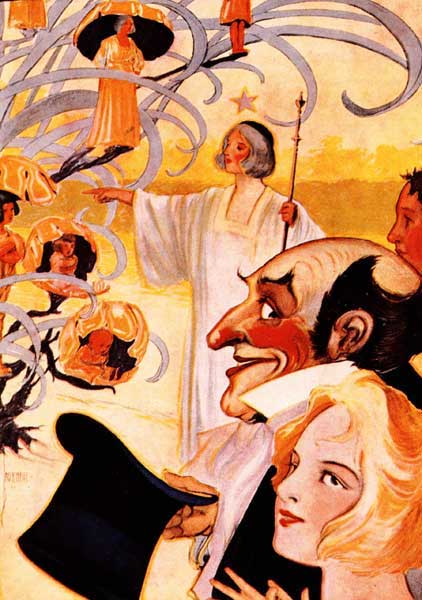
Inside the hedge they came upon row after row of large and handsome plants with broad leaves gracefully curving until their points nearly reached the ground. In the center of each plant grew a daintily dressed Mangaboo, for the clothing of all these creatures grew upon them and was attached to their bodies.
The growing Mangaboos were of all sizes, from the blossom that had just turned into a wee baby to the full-grown and almost ripe man or woman. On some of the bushes might be seen a bud, a blossom, a baby, a half-grown person and a ripe one; but even those ready to pluck were motionless and silent, as if devoid of life. This sight explained to Dorothy why she had seen no children among the Mangaboos, a thing she had until now been unable to account for.
"Our people do not acquire their real life until they leave their bushes," said the Prince. "You will notice they are all attached to the plants by the soles of their feet, and when they are quite ripe they are easily separated from the stems and at once attain the powers of motion and speech. So while they grow they cannot be said to really live, and they must be picked before they can become good citizens."
"How long do you live, after you are picked?" asked Dorothy.
"That depends upon the care we take of ourselves," he replied. "If we keep cool and moist, and meet with no accidents, we often live for five years. I've been picked over six years, but our family is known to be especially long lived."
"Do you eat?" asked the boy.
"Eat! No, indeed. We are quite solid inside our bodies, and have no need to eat, any more than does a potato."
"But the potatoes sometimes sprout," said Zeb.
"And sometimes we do," answered the Prince; "but that is considered a great misfortune, for then we must be planted at once."
"Where did you grow?" asked the Wizard.
"I will show you," was the reply. "Step this way, please."
He led them within another but smaller circle of hedge, where grew one large and beautiful bush.
"This," said he, "is the Royal Bush of the Mangaboos. All of our Princes and Rulers have grown upon this one bush from time immemorial."
They stood before it in silent admiration. On the central stalk stood poised the figure of a girl so exquisitely formed and colored and so lovely in the expression of her delicate features that Dorothy thought she had never seen so sweet and adorable a creature in all her life. The maiden's gown was soft as satin and fell about her in ample folds, while dainty lace-like traceries trimmed the bodice and sleeves. Her flesh was fine and smooth as polished ivory, and her poise expressed both dignity and grace.
"Who is this?" asked the Wizard, curiously.
The Prince had been staring hard at the girl on the bush. Now he answered, with a touch of uneasiness in his cold tones:
"She is the Ruler destined to be my successor, for she is a Royal Princess. When she becomes fully ripe I must abandon the sovereignty of the Mangaboos to her."
"Isn't she ripe now?" asked Dorothy.
He hesitated.
"Not quite," said he, finally. "It will be several days before she needs to be picked, or at least that is my judgment. I am in no hurry to resign my office and be planted, you may be sure."
"Probably not," declared the Wizard, nodding.
"This is one of the most unpleasant things about our vegetable lives," continued the Prince, with a sigh, "that while we are in our full prime we must give way to another, and be covered up in the ground to sprout and grow and give birth to other people."
"I'm sure the Princess is ready to be picked," asserted Dorothy, gazing hard at the beautiful girl on the bush. "She's as perfect as she can be."
"Never mind," answered the Prince, hastily, "she will be all right for a few days longer, and it is best for me to rule until I can dispose of you strangers, who have come to our land uninvited and must be attended to at once."
"What are you going to do with us?" asked Zeb.
"That is a matter I have not quite decided upon," was the reply. "I think I shall keep this Wizard until a new Sorcerer is ready to pick, for he seems quite skillful and may be of use to us. But the rest of you must be destroyed in some way, and you cannot be planted, because I do not wish horses and cats and meat people growing all over our country."
"You needn't worry," said Dorothy. "We wouldn't grow under ground, I'm sure."
"But why destroy my friends?" asked the little Wizard. "Why not let them live?"
"They do not belong here," returned the Prince. "They have no right to be inside the earth at all."
"We didn't ask to come down here; we fell," said Dorothy.
"That is no excuse," declared the Prince, coldly.
The children looked at each other in perplexity, and the Wizard sighed. Eureka rubbed her paw on her face and said in her soft, purring voice:
"He won't need to destroy me, for if I don't get something to eat pretty soon I shall starve to death, and so save him the trouble."
"If he planted you, he might grow some cat-tails," suggested the Wizard.
"Oh, Eureka! perhaps we can find you some milk-weeds to eat," said the boy.
"Phoo!" snarled the kitten; "I wouldn't touch the nasty things!"
"You don't need milk, Eureka," remarked Dorothy; "you are big enough now to eat any kind of food."
"If I can get it," added Eureka.
"I'm hungry myself," said Zeb. "But I noticed some strawberries growing in one of the gardens, and some melons in another place. These people don't eat such things, so perhaps on our way back they will let us get them."
"Never mind your hunger," interrupted the Prince. "I shall order you destroyed in a few minutes, so you will have no need to ruin our pretty melon vines and berry bushes. Follow me, please, to meet your doom."
CHAPTER 5.
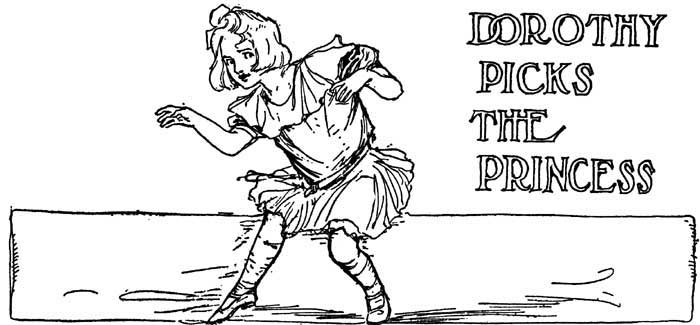
ContentsDOROTHY PICKS THE PRINCESS
HE words of the cold and moist vegetable Prince were not very comforting, and as he spoke them he turned away and left the enclosure. The children, feeling sad and despondent, were about to follow him when the Wizard touched Dorothy softly on her shoulder.
"Wait!" he whispered.
"What for?" asked the girl.
"Suppose we pick the Royal Princess," said the Wizard. "I'm quite sure she's ripe, and as soon as she comes to life she will be the Ruler, and may treat us better than that heartless Prince intends to."
"All right!" exclaimed Dorothy, eagerly. "Let's pick her while we have the chance, before the man with the star comes back."
So together they leaned over the great bush and each of them seized one hand of the lovely Princess.
"Pull!" cried Dorothy, and as they did so the royal lady leaned toward them and the stems snapped and separated from her feet. She was not at all heavy, so the Wizard and Dorothy managed to lift her gently to the ground.
The beautiful creature passed her hands over her eyes an instant, tucked in a stray lock of hair that had become disarranged, and after a look around the garden made those present a gracious bow and said, in a sweet but even toned voice:
"I thank you very much."
"We salute your Royal Highness!" cried the Wizard, kneeling and kissing her hand.
Just then the voice of the Prince was heard calling upon them to hasten, and a moment later he returned to the enclosure, followed by a number of his people.
Instantly the Princess turned and faced him, and when he saw that she was picked the Prince stood still and began to tremble.
"Sir," said the Royal Lady, with much dignity, "you have wronged me greatly, and would have wronged me still more had not these strangers come to my rescue. I have been ready for picking all the past week, but because you were selfish and desired to continue your unlawful rule, you left me to stand silent upon my bush."
"I did not know that you were ripe," answered the Prince, in a low voice.
"Give me the Star of Royalty!" she commanded.
Slowly he took the shining star from his own brow and placed it upon that of the Princess. Then all the people bowed low to her, and the Prince turned and walked away alone. What became of him afterward our friends never knew.
The people of Mangaboo now formed themselves into a procession and marched toward the glass city to escort their new ruler to her palace and to perform those ceremonies proper to the occasion. But while the people in the procession walked upon the ground the Princess walked in the air just above their heads, to show that she was a superior being and more exalted than her subjects.
No one now seemed to pay any attention to the strangers, so Dorothy and Zeb and the Wizard let the train pass on and then wandered by themselves into the vegetable gardens. They did not bother to cross the bridges over the brooks, but when they came to a stream they stepped high and walked in the air to the other side. This was a very interesting experience to them, and Dorothy said:
"I wonder why it is that we can walk so easily in the air."
"Perhaps," answered the Wizard, "it is because we are close to the center of the earth, where the attraction of gravitation is very slight. But I've noticed that many queer things happen in fairy countries."
"Is this a fairy country?" asked the boy.
"Of course it is," returned Dorothy, promptly. "Only a fairy country could have veg'table people; and only in a fairy country could Eureka and Jim talk as we do."
"That's true," said Zeb, thoughtfully.
In the vegetable gardens they found the strawberries and melons, and several other unknown but delicious fruits, of which they ate heartily. But the kitten bothered them constantly by demanding milk or meat, and called the Wizard names because he could not bring her a dish of milk by means of his magical arts.
As they sat upon the grass watching Jim, who was still busily eating, Eureka said:
"I don't believe you are a Wizard at all!"
"No," answered the little man, "you are quite right. In the strict sense of the word I am not a Wizard, but only a humbug."
"The Wizard of Oz has always been a humbug," agreed Dorothy. "I've known him for a long time."
"If that is so," said the boy, "how could he do that wonderful trick with the nine tiny piglets?"
"Don't know," said Dorothy, "but it must have been humbug."
"Very true," declared the Wizard, nodding at her. "It was necessary to deceive that ugly Sorcerer and the Prince, as well as their stupid people; but I don't mind telling you, who are my friends, that the thing was only a trick."
"But I saw the little pigs with my own eyes!" exclaimed Zeb.
"So did I," purred the kitten.
"To be sure," answered the Wizard. "You saw them because they were there. They are in my inside pocket now. But the pulling of them apart and pushing them together again was only a sleight-of-hand trick."
"Let's see the pigs," said Eureka, eagerly.
The little man felt carefully in his pocket and pulled out the tiny piglets, setting them upon the grass one by one, where they ran around and nibbled the tender blades.
"They're hungry, too," he said.
"Oh, what cunning things!" cried Dorothy, catching up one and petting it.
"Be careful!" said the piglet, with a squeal, "you're squeezing me!"
"Dear me!" murmured the Wizard, looking at his pets in astonishment. "They can actually talk!"
"May I eat one of them?" asked the kitten, in a pleading voice. "I'm awfully hungry."
"Why, Eureka," said Dorothy, reproachfully, "what a cruel question! It would be dreadful to eat these dear little things."
"I should say so!" grunted another of the piglets, looking uneasily at the kitten; "cats are cruel things."
"I'm not cruel," replied the kitten, yawning. "I'm just hungry."
"You cannot eat my piglets, even if you are starving," declared the little man, in a stern voice. "They are the only things I have to prove I'm a wizard."
"How did they happen to be so little?" asked Dorothy. "I never saw such small pigs before."
"They are from the Island of Teenty-Weent," said the Wizard, "where everything is small because it's a small island. A sailor brought them to Los Angeles and I gave him nine tickets to the circus for them."
"But what am I going to eat?" wailed the kitten, sitting in front of Dorothy and looking pleadingly into her face. "There are no cows here to give milk; or any mice, or even grasshoppers. And if I can't eat the piglets you may as well plant me at once and raise catsup."
"I have an idea," said the Wizard, "that there are fishes in these brooks. Do you like fish?"
"Fish!" cried the kitten. "Do I like fish? Why, they're better than piglets—or even milk!"
"Then I'll try to catch you some," said he.
"But won't they be veg'table, like everything else here?" asked the kitten.
"I think not. Fishes are not animals, and they are as cold and moist as the vegetables themselves. There is no reason, that I can see, why they may not exist in the waters of this strange country."
Then the Wizard bent a pin for a hook and took a long piece of string from his pocket for a fish-line. The only bait he could find was a bright red blossom from a flower; but he knew fishes are easy to fool if anything bright attracts their attention, so he decided to try the blossom. Having thrown the end of his line in the water of a nearby brook he soon felt a sharp tug that told him a fish had bitten and was caught on the bent pin; so the little man drew in the string and, sure enough, the fish came with it and was landed safely on the shore, where it began to flop around in great excitement.
 IN THE GARDEN OF THE MANGABOOS.
The fish was fat and round, and its scales glistened like beautifully cut jewels set close together; but there was no time to examine it closely, for Eureka made a jump and caught it between her claws, and in a few moments it had entirely disappeared.
"Oh, Eureka!" cried Dorothy, "did you eat the bones?"
"If it had any bones, I ate them," replied the kitten, composedly, as it washed its face after the meal. "But I don't think that fish had any bones, because I didn't feel them scratch my throat."
"You were very greedy," said the girl.
"I was very hungry," replied the kitten.
The little pigs had stood huddled in a group, watching this scene with frightened eyes.
"Cats are dreadful creatures!" said one of them.
"I'm glad we are not fishes!" said another.
"Don't worry," Dorothy murmured, soothingly, "I'll not let the kitten hurt you."
Then she happened to remember that in a corner of her suit-case were one or two crackers that were left over from her luncheon on the train, and she went to the buggy and brought them. Eureka stuck up her nose at such food, but the tiny piglets squealed delightedly at the sight of the crackers and ate them up in a jiffy.
"Now let us go back to the city," suggested the Wizard. "That is, if Jim has had enough of the pink grass."
The cab-horse, who was browsing near, lifted his head with a sigh.
"I've tried to eat a lot while I had the chance," said he, "for it's likely to be a long while between meals in this strange country. But I'm ready to go, now, at any time you wish."
So, after the Wizard had put the piglets back into his inside pocket, where they cuddled up and went to sleep, the three climbed into the buggy and Jim started back to the town.
"Where shall we stay?" asked the girl.
"I think I shall take possession of the House of the Sorcerer," replied the Wizard; "for the Prince said in the presence of his people that he would keep me until they picked another Sorcerer, and the new Princess won't know but that we belong there."
They agreed to this plan, and when they reached the great square Jim drew the buggy into the big door of the domed hall.
"It doesn't look very homelike," said Dorothy, gazing around at the bare room. "But it's a place to stay, anyhow."
"What are those holes up there?" enquired the boy, pointing to some openings that appeared near the top of the dome.
"They look like doorways," said Dorothy; "only there are no stairs to get to them."
"You forget that stairs are unnecessary," observed the Wizard. "Let us walk up, and see where the doors lead to."
With this he began walking in the air toward the high openings, and Dorothy and Zeb followed him. It was the same sort of climb one experiences when walking up a hill, and they were nearly out of breath when they came to the row of openings, which they perceived to be doorways leading into halls in the upper part of the house. Following these halls they discovered many small rooms opening from them, and some were furnished with glass benches, tables and chairs. But there were no beds at all.
"I wonder if these people never sleep," said the girl.
"Why, there seems to be no night at all in this country," Zeb replied. "Those colored suns are exactly in the same place they were when we came, and if there is no sunset there can be no night."
"Very true," agreed the Wizard. "But it is a long time since I have had any sleep, and I'm tired. So I think I shall lie down upon one of these hard glass benches and take a nap."
"I will, too," said Dorothy, and chose a little room at the end of the hall.
Zeb walked down again to unharness Jim, who, when he found himself free, rolled over a few times and then settled down to sleep, with Eureka nestling comfortably beside his big, boney body. Then the boy returned to one of the upper rooms, and in spite of the hardness of the glass bench was soon deep in slumberland.