
I would like to exchange some revenue stamps for postage stamps. Among those I wish to exchange are two varieties of one-dollar stamps and a forty-cent stamp.
Leonard T. Beecher,
Wellsville, Alleghany County, New York.
I take Young People, and I think it is splendid.
I have a great many French, Italian, English, and German postage stamps which I would like to exchange for others.
George B. Donnelly,
P. O. Box 4574, New York City.
I am collecting postage stamps, and would like to exchange. Correspondents will please state the number of stamps in their collection, and send me their list. I have twelve hundred stamps, and I am thirteen years old. I would like to know the age of my correspondents.
Charles S. Petrasch,
13 West Thirty-second Street, New York City.
I would like to exchange postmarks with any boy readers of Young People in the West. I am twelve years old.
Arthur S. Moore,
40 Third Place, Brooklyn, New York.
I would like to exchange postage stamps with any correspondent.
R. L. Preston,
P. O. Box 327, Lynchburg, Virginia.
Louise.—Your question, "Is the mosquito of any use in the great economy of nature?" has often been asked by many older and wiser than you, for it is not generally known that in their larval state mosquitoes form an important branch of nature's army of tiny scavengers. The larvæ live in the water of stagnant pools and marshes, and feed upon particles of decaying matter, and as their number is so very large, the amount they devour is considerable. By thus purifying the water they destroy the miasma which would otherwise arise and pollute the atmosphere to such an extent that no human being could breathe it with safety. The value of the work accomplished in tropical countries by these tiny scavengers is very great. It is estimated that the air of certain marshy regions would be so poisonous that no animal higher than a reptile could breathe it and live, were their purifying influence removed. We do not know that mosquitoes in the winged state have any useful mission beyond that of depositing the eggs which produce the larvæ, but that alone saves them from being "nothing but a nuisance."
F. A. Reilly.—The subscription price for Harper's Young People for 1881 will remain one dollar and fifty cents, the same low figure as for the first volume.
Brian B.—The large green worm that feeds on carrot, caraway, parsley, and some other common garden plants is the caterpillar of the Papilio asterias, a large black butterfly which is seen in great numbers at midsummer, hovering about the flowers in gardens. It is especially fond of the sweet-scented phlox. This butterfly is very handsomely marked with rows of yellow spots near the margin of its wings, and on the hind wings, which are tailed, there is also a row of blue spots, and near the lower angle an orange-colored eye with a black dot in the centre. The wings of this handsome insect expand from three to four inches.
"Thistle."—It is not easy to say why such great numbers of potato-bugs are found crawling on the sea-beaches. These striped cantharides are so numerous in all parts of the country that they are probably blown seaward by the wind, and naturally sail ashore on the tide.
You will find simple directions for pressing flowers and leaves in the Post-office Boxes of Young People Nos. 34 and 46.
F. B. W.—Write again to your correspondent. There are so many possible reasons why he has not answered you that it would not be fair to him to print your notice. Possibly he has misdirected the letter to you.
Favors are acknowledged from Fred P. Herron, Albert C. B., Jessie R. Ellerby, E. N., Richard F. Morgan, Willie C. Chapman, S. B., Frank Davis, S. Donald Newton, Gertrude B. Duffee, Frank Haid, John R. Bancroft, H. S. G.
Correct answers to puzzles are received from Eddie S. Hequembourg, Mary Tiddy, "Chiquot," William H. Dobson, Dana D. Stanton, "Milwaukee," Percy McGeorge, "Nellie Bly," E. D. W. R. Garden, George Volckhausen, James H. Beddow, Howard A. Esterly, "Ivanhoe."
John H. Bartlett, A. O., and J. C. Locher have sent neat specimens of the five-pointed star, which were received too late for acknowledgment with the others.
PUZZLES FROM YOUNG CONTRIBUTORS.
No. 1.
UNITED DIAMONDS.
1. In strawberry. By way of. A fabulous woman. A unit. In huckleberry.
2. In peach. An article very useful to travellers. A color. A jewel. In plum. Centrals of diamonds read across give the name of a common shrub.
Owlet.
No. 2.
WORD SQUARES.
1. First, mountains in Switzerland. Second, mountains in Asia. Third, a river in Hungary. Fourth, a town in Piedmont, once an ancient Roman settlement.
Julia.
2. First, a part of the body. Second, a disease. Third, invalid. Fourth, a hollow.
Chiquot.
No. 3.
CHARADE.
My first is needed to make my second, and should always be in my whole.
Bolus.
No. 4.
NUMERICAL CHARADES.
1. A fanciful character in one of Shakspeare's plays composed of 11 letters.
My 3, 10, 5, 1 is agony to weary fingers.
My 8, 2, 1 is a problem.
My 6, 9, 5, 11 is done by every school-boy.
My 7, 2, 8, 4 is fine powder.
Lonie.
2. An inhabitant of Africa composed of 10 letters.
My 2, 7, 8, 5, 4 is a bird.
My 6, 9, 3, 4 is a piece of money.
My 1, 5, 10, 7 is a beautiful flower.
Fannie.
No. 5.
ENIGMA.
My first is in board, but not in plank.
My second is in hoard, but not in bank.
My third is in sin, but not in good.
My fourth is in tin, but not in wood.
My fifth is in sword, but not in arms.
My sixth is in town, but not in farms.
My whole its forehead proudly rears,
Crowned by two hundred and fifty years.
Arthur Aurie.
ANSWERS TO PUZZLES IN NO. 47.
No. 1.
| B | F | |||||||
| U | R | N | A | R | M | |||
| B | R | E | A | D-F | R | U | I | T |
| N | A | G | M | I | X | |||
| D | T |
No. 2.
Telephone.
No. 3.
1. Hipparchus. 2. Epicharmus. 3. Herodotus.
No. 4.
| F | O | A | M | A | R | G | O | ||
| O | H | I | O | R | E | A | P | ||
| A | I | M | S | G | A | L | A | ||
| M | O | S | S | O | P | A | L |
Charade on page 696—Salt-Petre.
ADVERTISEMENTS.
HARPER'S YOUNG PEOPLE.
Harper's Young People will be issued every Tuesday, and may be had at the following rates—payable in advance, postage free:
| Single Copies | $0.04 |
| One Subscription, one year | 1.50 |
| Five Subscriptions, one year | 7.00 |
Subscriptions may begin with any Number. When no time is specified, it will be understood that the subscriber desires to commence with the Number issued after the receipt of order.
Remittances should be made by POST-OFFICE MONEY ORDER or DRAFT, to avoid risk of loss.
ADVERTISING.
The extent and character of the circulation of Harper's Young People will render it a first-class medium for advertising. A limited number of approved advertisements will be inserted on two inside pages at 75 cents per line.
Address
HARPER & BROTHERS,
Franklin Square, N. Y.
Harper's New and Enlarged Catalogue,
With a COMPLETE ANALYTICAL INDEX, and A VISITORS' GUIDE TO THEIR ESTABLISHMENT,
Sent by mail on receipt of Nine Cents.
HARPER & BROTHERS, Franklin Square, N. Y.
COLUMBIA BICYCLE.

Bicycle riding is the best as well as the healthiest of out-door sports; is easily learned and never forgotten. Send 3c. stamp for 24-page Illustrated Catalogue, containing Price-Lists and full information.
THE POPE MFG. CO.,
79 Summer St., Boston, Mass.
COINS AND STAMPS. My revised catalogue of coins, showing buying prices, just out—price 10c. No. 20, of the St. Louis Philatelist, the best stamp paper in America, is now ready, and will be mailed free for stamp. E. F. GAMBS, Coin and Stamp Dealer, 621 South 5th St., St. Louis, Mo. Established 1872.
ABSORBING STORY
OF A
BOY'S LIFE AMONG PIRATES.
THE ADVENTURES OF REUBEN DAVIDGER; Seventeen Years and Four Months Captive among the Dyaks of Borneo. By James Greenwood. 8vo, Cloth, $1.25; 4to, Paper, 15 cents.
This is a book which will be devoured by youth with much the same engrossing interest that made the perusal of "Robinson Crusoe" so delightful. The author has the power of literally enchaining the attention of the reader, whether of larger or smaller growth.—Brooklyn Times.
Published by HARPER & BROTHERS, New York.
☞ Harper & Brothers will send the above work by mail, postage prepaid, to any part of the United States, on receipt of the price.
CHILDREN'S
PICTURE-BOOKS.
Square 4to, about 300 pages each, beautifully printed on Tinted Paper, embellished with many Illustrations, bound in Cloth, $1.50 per volume.
The Children's Picture-Book of Sagacity of Animals.
With Sixty Illustrations by Harrison Weir.
The Children's Bible Picture-Book.
With Eighty Illustrations, from Designs by Steinle, Overbeck, Veit, Schnorr, &c.
The Children's Picture Fable-Book.
Containing One Hundred and Sixty Fables. With Sixty Illustrations by Harrison Weir.
The Children's Picture-Book of Birds.
With Sixty-one Illustrations by W. Harvey.
The Children's Picture-Book of Quadrupeds and other Mammalia.
With Sixty-one Illustrations by W. Harvey.
Published by HARPER & BROTHERS, New York.
☞ Sent by mail, postage prepaid, to any part of the United States, on receipt of the price.
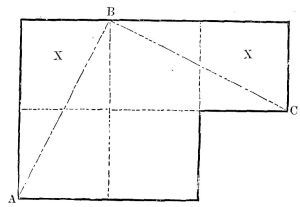
SOLUTION TO MARINER'S PUZZLE.
Divide the piece of plank described in the Mariner's Puzzle, published in No. 47, into five squares, as represented in Fig. 1; then draw a line from A to B, and from B to C. Cut off the two triangular pieces marked X X, and re-arrange them as represented in Fig. 2, and you will have a piece of plank of the shape and size required by the mariner to stop the leak in his ship.
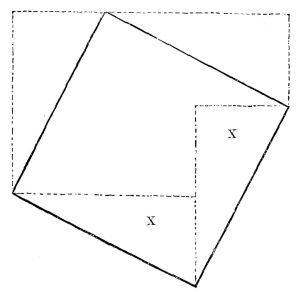 Fig. 2.
IMITATION SCREW-HEADS.
BY F. BELLEW.
 Fig. 1.
Here is a simple little thing of my own invention, from which I have derived a good deal of fun from time to time, and from which the readers of Young People may extract some amusement. It is an imitation of the common screw-head, and is made in this wise: Take a piece of common tin-foil, and mark on it with a pair of compasses or a small thimble a number of circles; then, with a broad pen or small brush and black ink, rule across each a broad line, as represented in Fig. 1. Then, when your ink is dry, cut out the little circular pieces very neatly with a pair of scissors. They resemble so exactly the head of a real screw as to deceive the most acute observer. Once I made a box for conjuring tricks, with a side swung on hinges, and fixed the sides of the box with these screw-heads in such a way as to impress the spectator with the idea that it was a piece of workmanship that could not be trifled with.
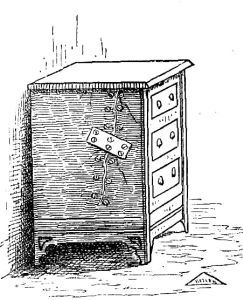 Fig. 2.
On one occasion a much-loved relative of mine had left me alone in her house while she drove over to the station to meet her husband. I did not wish to waste my time while she was away, and having nothing else to do, I cast my eye round for material. At last it lighted on an article of furniture: this was a bureau, highly prized by my much-loved relative. I have attempted, feebly, in the subjoined sketch to convey an idea of it, but am fully conscious that I am far from doing it justice. But this bureau was of solid mahogany, and had belonged to her grandmother—qualities enough to make anything dear to the heart of a true woman. On the side of this solid mahogany bureau I scrawled a ragged line with the sharp corner of a piece of soap, and gummed some of my screw-beads down each side of the mark, as in Fig. 2. Then I waited until my much-loved relative returned.
"Aunt," I said, in solemn tones, "look at the end of your mahogany bureau. It is all my fault, and I am as sorry as I can be. I know how you value it, and realize the extent of the disaster; but I've fixed it up as well as I can, and I guess it won't show much."
My aunt rushed to the bureau, and there she saw the patched and botched wreck.
"Oh dear!" cried she, "to think—just to think—how could you be so— I knew something would come of swinging those vile clubs. I'd rather have given a hundred dollars. It's too bad. And such a mess! Why didn't you wait till I could send for a proper man—a cabinet-maker or something—to mend it?"
Then she ran into the garden, and called to her husband: "Oh, George, do come here, and see what that boy has been doing! My dear mahogany grandmother's bureau all knocked to pieces, and patched together with big screws. Such a sight!"
As soon as my aunt left the room I seized a wet towel, and quickly removed all the appearance of damage, so that when she returned with her husband, and with averted face, bade him look upon the wreck, the mild old gentleman, after putting on his specs, and making a careful examination, reported that he could see nothing the matter.
"For pity's sake!—the man must be getting blind and foolish," cried my aunt. "It's as plain as Charley Meeker's nose on his face."
A discussion of some length here followed between my aunt and her husband, which was terminated by the lady stepping up to the bureau, with an air of triumph, to point out the broken places. Never before was seen such a perplexed woman. She looked and looked, and felt all over the precious piece of furniture with her finger, and, I believe, would have fairly gone demented had I not broken the spell by a roar of laughter. When I explained the trick I had played, she too laughed heartily, and boxed my ears, saying it was just like me, and that I was always up to some prank or another.
And so ended my first practical joke with the screw-heads.
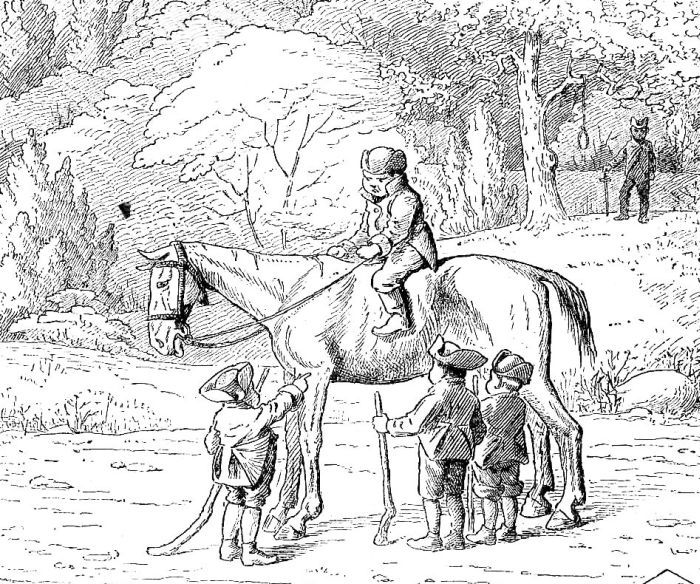 RE-ENACTING HISTORY—A SKETCH AT TARRYTOWN.
Major André. "Look here, fellers, there ain't a-goin' to be no hanging, yer know."
John Paulding. "No hangin'! W'at er yer talkin' 'bout? D'yer s'pose we're a-goin' back onter history and Gineral Washington? Get out! Course yer've got to be hanged; and ef yer don't like it, we'll get some feller as does. That's all there is to it."