
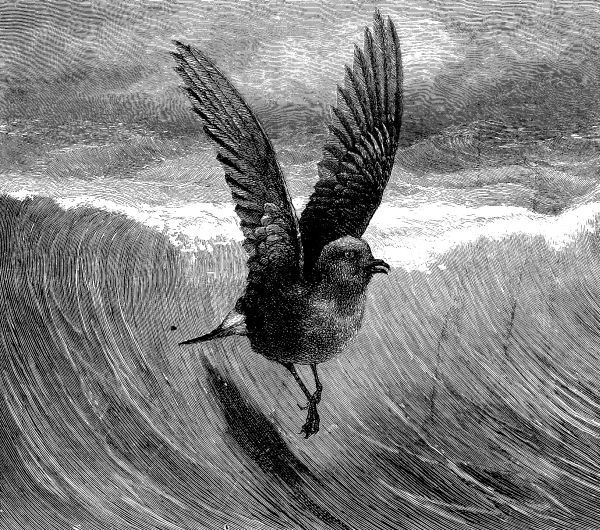
THE STORM-PETREL.
Ages ago this little web-footed fellow was named Petrel, after the Apostle Peter, because he is most often seen walking on the waves—never in them, but just daintily skimming their surface.
To sailors they are "Mother Carey's chickens," and their presence is dreaded, because with them generally come storms and bad weather. They revel in storms, and the fiercer the gale and the higher the waves, the more merry are they. This preference of the petrel is explained by the fact that he is more than half nocturnal in his habits, and greatly dislikes the glare of sunshine. But when black clouds and gloomy mists hang low over the ocean, the semi-darkness just suits him, and through it may he be seen skimming the angry billows many leagues from the nearest land.
The inhabitants of some of the outlying Scotch islands make a peculiar use of the young petrels, which are always as fat as butter, and much more easy to catch than the old birds. The young bird is caught, killed, and a wick is passed through his body until it projects from the bill. When this wick is lighted it gradually draws every drop of oil out of the well-supplied little reservoir, and thus a lamp is formed, very cheaply and easily, that lasts and gives a good light for the whole of a long winter's evening.
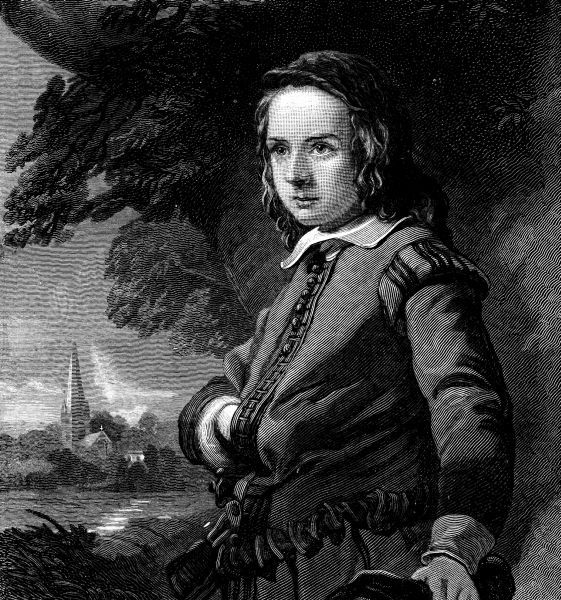
SHAKESPEARE.
William Shakespeare was born at Stratford, on the Avon, April 23, 1564, and was baptized on the 26th. Two months after his birth the plague swept over the pleasant village, carrying off a large part of the inhabitants. The danger that hung over the marvellous infant passed away, and he grew up healthy and strong. His mother, Mary Arden, inherited a large farm at Wilmecote, a mile from Stratford; and his father, John Shakespeare, who held several other pieces of land, was probably an active farmer, raising sheep, and perhaps cattle. The house in which it is said Shakespeare was born is still shown in Henley Street, Stratford—a plain building of timber and plaster, covered with the names of those who have come from every part of the world to visit the dark, narrow room made memorable by the poet's birth.
He had several younger brothers—Gilbert, Richard, Edmund, and a sister Joan—all of whom he aided in his prosperity. The family in Henley Street was a happy one; and the young Shakespeares and their sister probably wandered in the flowery fields around the Avon, or lived on the farm at Wilmecote, saw the cows milked, and the cattle pastured, and all the changes of rural life. Shakespeare lived among the flowers he describes so well; and in the fine park of Fulbroke, not far off, saw the magnificent oaks, the herds of deer, and the gay troops of huntsmen chasing the poor stag along the forest glade. He must have been a precocious boy, seeing everything around him even in childhood. He is described or painted in later life as having a fair, melancholy, sensitive face, his eyes apparently dark, his hair brown and flowing. His disposition was gentle and benevolent; he won the love even of his foes.
As the son of a farmer he probably had little education. He went for several years to the grammar school at Stratford, and was then perhaps employed on his father's farm. Like Virgil, Horace, Burns, and many other poets, he grew up in the country. Nothing is certainly known of his youth. He was fond of rural sports, and amidst his early labors went no doubt to the country fairs, joined in the Christmas games and May-day dances, and probably when the Earl of Leicester gave the magnificent reception to Queen Elizabeth at Kenilworth, described in Scott's novel, Shakespeare was there among the spectators. He was then a boy of twelve. He could enjoy the plays, games, the pomp and glitter, of that famous festival.
He must have read romances and tales early, like Dickens; he may have amused his little brothers and his sister Joan by repeating to them on winter evenings in the low room in Henley Street the story of the wild castle of Elsinore, or of the venerable Lear and the gentle Cordelia. He was all imagination, and precocious in knowledge; he must have studied when his companions played, and read everything that came in his way. At eighteen he fell in love and married Anne Hathaway, a young lady eight years older than himself. Before he was twenty-one he had three children to maintain, and went up to London to find employment. He remained in obscurity for some years; but at last appears, about 1590, the finest poet and dramatist of all ages.
Shakespeare pursued his career in London as author and theatrical manager for nearly twenty-five years. He was very industrious; he was prudent, but generous; he saved money, and grew wealthy. About 1612 or 1613 he returned to Stratford, where he lived in the best house of the little village, called "New Place." Here he gave a home to his father and mother, and provided liberally for his younger brothers. To his sister Joan he gave the house in Henley Street, which remained in the possession of her descendants until 1820. He may have looked forward to a long and honorable old age, but died in 1616, it is said, on the same day of the year on which he was born. His son Hamnet died long before him. He left two daughters.
His writings teach men to be kind and gentle.
MR. MARTIN'S LEG.
BY JIMMY BROWN.
I had a dreadful time after that accident with Mr. Martin's eye. He wrote a letter to father and said that "the conduct of that atrocious young ruffian was such," and that he hoped he would never have a son like me. As soon as father said "My son I want to see you up stairs bring me my new rattan cane," I knew what was going to happen. I will draw some veils over the terrible scene, and will only say that for the next week I did not feel able to hold a pen unless I stood up all the time.
Last week I got a beautiful dog. Father had gone away for a few days and I heard mother say that she wished she had a nice little dog to stay in the house and drive robbers away. The very next day a lovely dog that didn't belong to anybody came into our yard and I made a dog-house for him out of a barrel, and got some beefsteak out of the closet for him, and got a cat for him to chase, and made him comfortable. He is part bull-dog, and his ears and tail are gone and he hasn't but one eye and he's lame in one of his hind-legs and the hair has been scalded off part of him, and he's just lovely. If you saw him after a cat you'd say he was a perfect beauty. Mother won't let me bring him into the house, and says she never saw such a horrid brute, but some women haven't any taste about dogs anyway.
His name is Sitting Bull, though most of the time when he isn't chasing cats he's lying down. He knows pretty near everything. Some dogs know more than folks. Mr. Travers had a dog once that knew Chinese. Every time that dog heard a man speak Chinese he would lie down and howl and then he would get up and bite the man. You might talk English or French or Latin or German to him and he wouldn't pay any attention to it, but just say three words in Chinese and he'd take a piece out of you. Mr. Travers says that once when he was a puppy a Chinaman tried to catch him for a stew; so whenever he heard anybody speak Chinese he remembered that time and went and bit the man to let him know that he didn't approve of the way Chinamen treated puppies. The dog never made a mistake but once. A man came to the house who had lost his pilate and couldn't speak plain, and the dog thought he was speaking Chinese and so he had his regular fit and bit the man worse than he had ever bit anybody before.
Sitting Bull don't know Chinese but Mr. Travers says he's a "specialist in cats," which means that he knows the whole science of cats. The very first night I let him loose he chased a cat up the pear-tree and he sat under that tree and danced around it and howled all night. The neighbors next door threw most all their things at him but they couldn't discourage him. I had to tie him up after breakfast and let the cat get down and run away before I let him loose again, or he'd have barked all summer.
The only trouble with him is that he can't see very well and keeps running against things. If he starts to run out of the gate he is just as likely to run head first into the fence, and when he chases a cat round a corner he will sometimes mistake a stick of wood, or the lawn-mower for the cat and try to shake it to death. This was the way he came to get me into trouble with Mr. Martin.
He hadn't been at our house for so long (Mr. Martin, I mean) that we all thought he never would come again. Father sometimes said that his friend Martin had been driven out of the house because my conduct was such and he expected I would separate him from all his friends. Of course I was sorry that father felt bad about it but if I was his age I would have friends that were made more substantial than Mr. Martin is.
Night before last I was out in the back yard with Sitting Bull looking for a stray cat that sometimes comes around the house after dark and steals the strawberries and takes the apples out of the cellar. At least I suppose it is this particular cat that steals the apples for the cook says a cat does it and we haven't any private cat of our own. After a while I saw the cat coming along by the side of the fence looking wicked enough to steal anything and to tell stories about it afterward. I was sitting on the ground holding Sitting Bull's head in my lap and telling him that I did wish he'd take to rat-hunting like Sam McGinnis's terrier, but no sooner had I seen the cat and whispered to Sitting Bull that she was in sight than he jumped up and went for her.
He chased her along the fence into the front yard where she made a dive under the front piazza. Sitting Bull came round the corner of the house just flying, and I close after him. It happened that Mr. Martin was at that identicular moment going up the steps of the piazza and Sitting Bull mistaking one of his legs for the cat jumped for it and had it in his teeth before I could say a word.
When that dog once gets hold of a thing there is no use in reasoning with him, for he won't listen to anything. Mr. Martin howled and said "Take him off my gracious the dog's mad," and I said "Come here sir. Good dog. Leave him alone" but Sitting Bull hung on to the leg as if he was deaf and Mr. Martin hung on to the railing of the piazza and made twice as much noise as the dog. I didn't know whether I'd better run for the doctor or the police, but after shaking the leg for about a minute Sitting Bull gave it an awful pull and pulled it off just at the knee-joint. When I saw the dog rushing round the yard with the leg in his mouth I ran into the house and told Sue and begged her to cut a hole in the wall and hide me behind the plastering where the police couldn't find me. When she went down to help Mr. Martin she saw him just going out of the yard on a wheelbarrow with a man wheeling him on a broad grin.
If he ever comes to this house again I'm going to run away. It turns out that his leg was made of cork and I suppose the rest of him is either cork or glass. Some day he'll drop apart on our piazza then the whole blame will be put on me.
A MISHAP.
BY JOSEPHINE POLLARD.
A dear little fellow named Noah
Had made up his mind that he'd go a—
Sailing alone
In a boat of his own,
For he was a champion rower.
This dear little fellow named Noah
Hadn't gone very far before—oh! ah!—
His boat was upset,
And he got very wet,
Did this little numskull of a Noah.
CORN-STALK CATTLE.
BY FLORENCE E. TYNG.
Last winter my health gave out, and the doctor said I must go South. What a mourning there was among our little boys at the thought of losing Aunt Kate and her "beautiful stories"!
Just before the train started, little Jamie begged to be held up to the car window to give me a good-by kiss. Poor little fellow! his eyes streamed with tears, and not even the promise of a pound of candy could console him.
I was not going to Florida, where fashionable invalids spend their winters, but to the home of an old friend of mine on an Alabama plantation. How glad I was to find that she too had a little boy! He was not much like the nephews I had left behind, but I soon found him to be a good-hearted, brave little lad.
His mamma and I were sitting one rainy morning with our work before a great wood fire, when Frankie and his bosom companion, Abe, a young darky, came in with an armful of long dry corn stalks, a handful of chicken feathers, and two kitchen knives.
"Now, Frankie, you are going to make a mess, so get some papers and put them down on the floor," said Frankie's mamma. Abe ran to get the papers, and very soon the two boys were down on their knees, peeling the stalks.
I noticed that the stalks were old and brittle, and that the boys preserved the hull. After watching them for some minutes, I began to make inquiries as to what the stalks were for.
"Dese is fur cattle," said Abe, grinning.
I then asked how they made cattle. Frankie did not seem communicative, so Abe again answered my question.
"Wa'al, we jest cuts 'em. If yer waits a minute I'll show yer."
He cut off a piece of the peeled stalk about four inches long, then split the hull into four pieces about a quarter of an inch wide and two inches long. He stuck two of these pieces near one end of the stalk for hind-legs, and the two others at a quarter of an inch from the other end for front ones. He then cut a piece of the stalk about an inch long for the head, a niche for the mouth, two pins for eyes, and narrow bits of hull for horns; another little strip of hull was stuck first into the head and then into the body to form the neck, a chicken feather put in for the tail, and the job was finished.
"Now, den," said Abe, triumphantly, holding it up, "don't yer see dat's a cow?"
I smiled, but Abe was too good-natured to notice it. This animal I found, with slight variations, was made to represent horses, cows, mules, sheep, dogs, and pigs, and even chickens, which, of course, were much smaller, and had only two legs. In the course of the morning Frankie and Abe manufactured a sow with seven little pigs, two cows, a mule, and a horse.
It had stopped raining, so the boys asked if I would not like to go out and see their farms. Under a shed in the yard were these two farms, arranged as nearly as possible like Frankie's father's. Barns, stables, wagon-houses, and pig-pens were made of bricks on a very small scale, and inhabited by corn-stalk cattle.
A wagon made of a chip tied to two spools was hitched up with two corn-stalk oxen, their feather tails standing up in the air.
I thought my little friends would like this new breed of cattle. They struck me as being much easier to manage than those of Noah's ark, for there is hardly a boy who has not had all manner of trouble in making Father Noah's cows and horses stand up. Gather together some corn stalks this autumn, let them dry, and stock a farm for yourself.
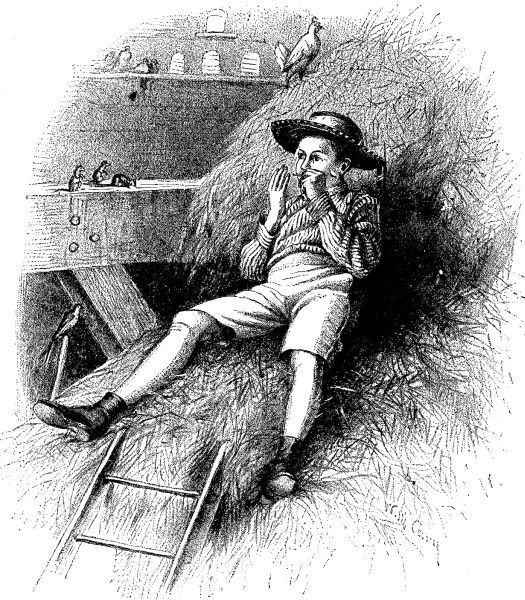 A MODERN ORPHEUS.
SEA-BREEZES.
LETTER NO. 5 FROM BESSIE MAYNARD TO HER DOLL.
Cambridge, September, 1880.
MY DEAREST CLYTIE,—When I sent my last letter from Bar Harbor I thought it would be the very last I should write you for a long time, but I shall not see you for two whole weeks more, and I can not wait till then to tell you all the fine things I am precipitating for next winter.
We left Mount Desert last Monday, and have been with grandma and Auntie Belle here in Cambridge ever since, except when we go flying back and forth from Boston. We are very busy, Clytie, and have heaps of shopping to do; for what do you think?—we are all going to Europe, and are to sail one month from to-day. I am awfully glad, of course, but I don't know how I can live all winter long without you. Don't tell the rest of the dolls, Clytie, but I do a little bit believe that you are going too! Now that is a very great secret, so you will keep it close down in your own little heart, and not let the others even respect a thing about it, because it might make them feel bad that I chose you and left them behind; and one thing I never would do, and that is to let my children think I had a favorite among them. You know I love every one of them dearly, but of course I can not take them all to Europe, and as you are the largest, it is more your place to go.
Now for another piece of news: Cousin Frank and Miss Carleton are engaged! Yes, Clytie, they really are, and they are going to be married this very month, and go to Europe when we do. If this isn't news enough, here is some more: Randolph Peyton has gone home with his mamma, and they are all coming to our house in New York the week before we sail, and go with our party! Won't it be lovely? There will be Mr. and Mrs. Peyton, Randolph and his sister Helen, and Miss Rogers, their governess. I have never seen Helen, but Randolph says she is "awfully jolly, considering she is only a girl," so I guess I shall like her. Then there will be papa and mamma and me (and you, if we take you), Cousin Frank and Miss Carleton, only she won't be Miss Carleton then—she will be Mrs. Howard, and I am to call her Cousin Carrie: indeed, I call her so now, for Cousin Frank asked me to, and I would do anything to please him. I have forgiven him for sending me away one night when they were talking about little pitchers. When I asked him about it afterward, and if it was really deckerativeart they meant, he tried to exclaim to me, but he laughed so hard all the time, I couldn't make out anything at all except that I was the very funniest little pitcher in the whole world! Did you ever know such a comical thing as to call me, a girl ten years old, a pitcher? I'm sure he didn't know what he was talking about.
Mamma says I may give them anything I choose for a wedding present, and I have presided on a silver pitcher. I am going to send it with a card tied on the handle marked, "This is me," and I guess they will wonder what it means. Don't you?
I have told Cousin Carrie so much about you that she seems to love you already, even though she has never seen you, and she says she shall invite you to her wedding. Won't that be fun? She is going to send you her cards, and you will go with me. I shall get home in time to have your dress made. Mine is to be a bomination dress of white cashmere and silk, and I think yours will be of the same kind in rose-color.
I will tell you one more adventure that befell us at Bar Harbor, and then I shall not write any more letters unless you are left at home when I go to Europe. Of course, if you are, I shall write as often as I possibly can, and I shall have so many new and strange appearances in crossing the ocean and in visiting forran lands that the reading of them will make up in some agree for being left at home.
Randolph and I went down to the beach, the evening before we came away, to launch his ship—a beautiful one, with sails all set, "full-rigged," as the sailors say, that his uncle in Philadelphia had sent him that very day.
The Stars and Stripes waved from the prow or stern—I never know which is which—and on the top of one of the masts he fastened a "pennon," as he called it, with the name of the ship in big blue letters. (He printed it himself with his blue pencil, and it looked real cunning blowing round in the wind, and flapping up and down.) What do you suppose the name was? Bessie, to be sure. He says he thinks it is an "awfully jolly" name for a ship, or for a girl either.
Well, the wind blew just the right way for a splendid launch. I held the cord, letting it out as fast as he told me to, and he gave it a push, and off it sailed, straight and lovely as a duck. I was so delighted I couldn't possibly help clapping my hands, and, oh, Clytie! I dropped the cord, and away it went, up and down over the waves as if it was alive. Randolph muttered something that sounded like, "Bother! that's just like a girl!" and scowled awfully at me, and then ran out into the water after it. I screamed as loud as I could, for I was afraid he would drown; and then I remembered how he had saved my life, and I said to myself, He is my friend now, and I will save him, for he saved me when we were emernies. So, as the story-books say, I "dashed into the foaming billows" after him, and just as I caught him by his jacket I thought I heard him say again, "Bother!" and then came a great rushing noise in my ears, my mouth was full of water, and the next thing I knew I was lying in mamma's bed, and she and two or three other people were rubbing me! I was almost drowned, Clytie; and so it was Randolph who saved my life a second time, and I never saved his at all.
When I pulled him by his jacket, a wave broke over us; but he was stronger and bigger than I, and a boy besides (and truly, Clytie, boys do know more than girls about some things), and so he caught me, and sort of pulled and rolled and pushed me out of the water; and just then Cousin Frank and Miss Carleton came round the point in their boat, and Cousin Frank took me in his arms, and ran up to the hotel as fast as he could go.
Poor mamma was most subtracted when she saw me, and Randolph was so scared he forgot all about his lovely new ship, that long before that time had gone sailing out to sea all by itself.
Wasn't it awful, Clytie? If I had minded what Solomon says, "Look before you leap," I should have seen that Randolph had his hand on the ship at the very moment I seized him, and he could have got back safe to the shore without any of my help.
Good-by for a little while. I shall see you and the rest of the dolls week after next.
Your loving mamma,
Bessie Maynard.

Cham, Switzerland.
I am a little boy only six years old, and can not write very well, but I want to say how much I like Young People. My mamma and papa have taken Harper's Weekly and Harper's Monthly more years than I can remember.
I like so much to hear all about the pets of the other children. I have not any, but I have a dear little sister called Myra, and she is my pet.
I liked the story "Across the Ocean" very much, but I think "The Moral Pirates" was the best.
My governess is writing this, but soon I hope to be able to write myself, as I have nearly finished my second copy-book. One year ago I could not speak any English, but now I can read short stories, and I am always so happy when Young People comes.
C. D. P.
Lynchburg, Texas.
I am twelve years old. I have a little colt, but it is not gentle, it is very wild. I also have a roan horse, named Sabine. Whenever horses are gathered I help to herd them. I like to do it very much. We generally have about three hundred head to herd. I have no pets now, for my little dog died.
I visited Captain H——'s plantation last winter, and I had a very nice time. I saw the men gin cotton, and I drove the horses round in the gin.
Charles A. T.
Buffalo, Wyoming Territory.
I have wanted to write to the Post-office Box for a long time for I like Young People so much, but I thought as there were so many children writing perhaps my letter would not be printed.
I live in a very lonely country. There are no little girls here at all, but I have a good many pets. I have two colts, named Nellie and Dollie, and a puppy named Carlo. Then I have a cat and four little kittens, and six pigeons, and lots of little chickens. I am going to get a pair of canaries very soon.
Luella A. M.
Wheatland, New York.
I am eleven years old. I live in the Genesee Valley, which I have heard is the nicest valley in the world. We have not many pets, because there are seven of us children, and mamma thinks those are pets enough for one house.
We have a black dog named Shot, but he is real old. We raised him from a puppy. Once he was in a soap box, with three other puppies, and mamma heard an awful squealing. There was a knot-hole in the box, and the puppy's tail stuck out. My little brother Jim crept up and grabbed hold of it, and was trying to pull the poor puppy through the knot-hole.
We had a yellow cat named Moses. He would let us dress him and put him to bed like a baby, and when my little sister sat down on the floor, he would come and put his paws around her neck. He died last spring, and we had a funeral. My brother Manta made a head-stone for him, and painted it white, and put poor Moses's name and age on it.
Laura M.
Winona, Minnesota.
I have just returned home from Maiden Rock, a little town in Wisconsin. It is a funny name for a town, and I will tell you why it is called so. There was once an Indian maiden who wanted to marry a young brave, but the other Indians were not willing. One day she went to the top of a high rock, as high as the bluffs on the shore of Lake Pepin. The Indians called to her to come down, and they would give her permission to marry her lover; but she knew very well that if she went down they would kill her, so she jumped from the rock and killed herself. I am eleven years old.
Bella M.
Salem, North Carolina.
I got Harper's Young People for a birthday present, and I like to read the Post-office Box.
In August I went on a mountain trip. We slept in tents. The roads over the mountains are very rough, but we thought it splendid fun to ride in the baggage-wagon.
I have a small museum. Last year when my father came home from Europe he brought me some stones from Rome and from the Alps, and also some pressed flowers.
H. E. R.
Canandaigua, New York.
I am nine years old. I have a twin sister Ina, and a little brother Herbert, who is very cunning and full of mischief. We have only two pets besides Herbert—a dog named Dick and a cat named Jack. We have lots of fun. We have a croquet set in the yard, and sometimes we have a tent too. Every time Dick comes into the house Herbert calls out, "Dit, here, Dit."
Papa owns a share in a cabin, and every summer we all go up to the lake, and stay about two weeks. Herbert likes to play in the water, and throw stones in it. One day he crawled right in, and got all wet. He does not like to ride in the boat, because he has to sit still. He wants to be in mischief all the time, and he is a little wide-awake, and will not go to sleep when he can help it. He is nineteen months old.
Ada E.
Lockport, Illinois.
I want to tell you about some fun I had the other day. We have a barrel sunk in the yard with water-lilies in it. There was a lizard in it too. I made a noose and caught it, and put it into mamma's big dish pan, which I filled with water. Then I caught two little toads; one was a little brown fellow about an inch long, and the other a little larger. I put a little piece of board in the water, and fastened it to the end of the string that was round the lizard's neck. Then I put the little toads on the board, and the lizard drew them all around.
Emma H.
Scottsville, New York.
I am five and a half years old. I can not read, but I can write letters, although mamma says nobody can read them, so she is writing this for me. Mamma and sister read me the stories in Young People. I liked "The Moral Pirates" best of all, but I was afraid Jim would get shot when he took the borrowed boat back.
I have a cat that eats milk and everything with its paw. And I have three rabbits.
Yesterday I took mamma and papa over to the depot, a mile away, and drove home all alone.
I go fishing with papa, and have caught a good many fish.
Milton B.
Xenia, Ohio.
I wish to ask a favor of some of the Southern correspondents of the Post-office Box. My sister planted a cotton seed, and the plant that came up bears white blossoms which afterward turn red and drop off. Now I would like very much to know whether it is cotton or not. I would also be glad for all information about the cotton-plant that any correspondent will give.
Roscoe E. E.
I am a little boy seven years old. I live at Ingleton, Alabama, two miles from Dickson. My papa owns a large stone quarry. I have two little brothers and one little sister, and we take Young People. I like Bessie Maynard's letters to her dollie the best of all.
Georgie F.
Buffalo Paper Mill, North Carolina.
Papa takes Harper's Magazine and Weekly, the Bazar for mamma, and Young People for my brothers and sister and myself. I like to read the stories, and the letters in the Post-office Box.
We live right in the woods. Buffalo Creek runs around our house, almost forming an island. I do not go to school. Mamma teaches us at home. We say our lessons every evening.
I have a pet hen. She is black, and so tame that she comes in the house every evening for me to put her to roost. Then we have lots of pigs, goats, calves, chickens, and pigeons, and each of my five brothers has a colt.
Mary T.
Warsaw, Indiana.
I have no father nor mother. I live with my uncle and aunt, who are very good to me. In vacation I work in uncle's printing-office, and when there is school I go.
My uncle takes Harper's Weekly, and my aunt takes the Bazar, and I take Young People. I think it is one of the best papers published.
I have a pet chicken named Mary. She will walk a rope, and swing in a little swing I made for her.
Alfred J. H.
Paxton, Illinois.
I take Young People, and I like to read the letters from the little folks. I am ten years old, and am in the fourth room and "A" class at school.
I had a velocipede, but it is broken. I have a horse and a saddle and bridle, and I ride a good deal.
My little sister is three years old, and I am making a play-house for her. She bit my ear so hard I had to cry. Mamma asked her what made her bite brother's ear. She said, "Brother hurt his ear on my teeth."
Ritchey M. K.
Arrow Rock, Missouri.
In the hot weather we keep our doors open at night, and one night a little opossum got in, and in the morning we found it curled up in papa's hat. I kept it for a few days, but once when I went away it ran off. I am seven years old.
Ridley McL.
Chicago, Illinois.
Young People comes every week, and I assure you it receives a warm welcome.
We have two little pets. Their names are Roly and Poly. Roly is a little Skye terrier, and Poly is a kitten, which travelled here from "down East." They eat, drink, sleep, and, I am sorry to say, cry together, for they are both very sensitive. They object strongly to being shut up at night, and protest against it loudly.
I am thirteen years old, and I wear spectacles.
J. O.
Walla Walla, Washington Territory.
I have taken Young People ever since the first number, and I find it very interesting. I was born in this Territory, but I have been to San Francisco and down the Pacific coast as far as Santa Barbara, where I remained six months with my mother and brother and sister. Sometimes in warm weather we take a trip to the Blue Mountains, and we have picnics and fishing parties. I am eleven years old.
Fannie Minnie B.
Adams, Wisconsin.
I am ten years old. I live in the country, near a beautiful lake called Lake Pleasant. I often have a boat-ride on it. The hills are quite high around the lake.
I live with my grandpa and grandma, and I go to school in an old yellow school-house that has stood for thirty years. We are going to have a nice new brick school-house soon, but I do not like to have the dear old house torn down, as it is the same one my mamma went to school in.
We have two hundred sheep. I have a pet lamb that will leave the flock when I call it. Its name is Dickie.
Nora P.
Randall, New York.
I am eleven years old. I have not any pets now, but I had two. One was a little dog named Fanny. It would draw a little sleigh with a milk-pail on it, and pull me on the ice when I had my skates on. The other was a little kitten that would jump and take a piece of meat out of my hand when I held it over my head.
George W. L.
New Orleans, Louisiana.
I am eleven years old. I like Young People very much. I often go out to the Spanish fort. There is a band of music there every evening, and every Saturday it is there all day. There are two cannon which have been in the fort ever since 1718. I have two pet kittens that follow me everywhere.
Charlie N. W.
I have a collection of stamps, and would gladly exchange with some of the readers of Young People.
Eddie de Lima, care of D. A. de Lima & Co.,
68 William St., New York City.
I would like to exchange postmarks of the United States or Canada with any readers of Young People.
A. W. Russell, P. O. Box 109,
Brookfield, Madison County, New York.
I would be glad to exchange postage stamps with any readers of Young People.
Harry Gustin, Bay City, Michigan.
I have a few foreign coins which I should like to exchange for rare postage stamps. They are small French coins, Swiss, English, Prussian, German, and Italian, copper and nickel. Some of them I do not know. They look like silver, but I think they are only German silver.
Eugene E. Pettee,
11 Prospect Street, Fall River, Massachusetts.
I have a collection of shells, minerals, postmarks, coins, and woods. I have also a collection of about eleven hundred and twenty-five stamps, all different kinds, and I would like to exchange stamps with any of the readers of Young People.
I am twelve years old. I have a canary, and my brother and I had a pair of squirrels, but one died.
Horace C. Foote,
109 East Fifty-seventh Street, New York City.
I have a collection of stamps, and would gladly exchange with any correspondents. I have stamps from Colombia, Venezuela, Germany, England, and other countries.
Elias Desola,
162 East Sixtieth Street, New York City.
I would like to exchange flower seeds with any little girl in California or Florida. I have verbenas, mixed phlox, four-o'clocks, sweet-williams, balsams, alyssum, salvia, mignonette, and red and white petunias.
Ada Belt,
1099 Wilson Avenue, Cleveland, Ohio.
I have a collection of postmarks, and would like to exchange with any correspondents of this nice paper. I am eleven years old.
"Exchange," 939 Main Street,
Buffalo, Erie County, New York.
If any correspondents will send me a list of the stamps they require, and also of those they have to spare, I will like to exchange with them.
John R. Bedford, 5 Spencer Place,
Fourth Street, New York City.