
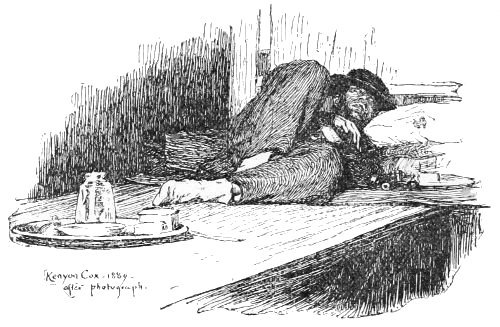
Her tyrant knows well that she will come, and patiently bides his time. When her struggles in the web have ceased at last, he rules no longer with gloved hand. A specimen of celestial logic from the home circle at this period came home to me with a personal application, one evening when I attempted, with a policeman, to stop a Chinaman whom we found beating his white “wife” with a broom-handle in a Mott Street cellar. He was angry at our interference, and declared vehemently that she was “bad.”
“S’ppose your wifee bad, you no lickee her?” he asked, as if there could be no appeal from such a common-sense proposition as that. My assurance that I did not, that such a thing could not occur to me, struck him dumb with amazement. He eyed me a while in stupid silence, poked the linen in his tub, stole another look, and made up his mind. A gleam of intelligence shone in his eye, and pity and contempt struggled in his voice. “Then, I guess, she lickee you,” he said.
No small commotion was caused in Chinatown once upon the occasion of an expedition I undertook, accompanied by a couple of police detectives, to photograph Joss. Some conscienceless wag spread the report, after we were gone, that his picture was wanted for the Rogues’ Gallery at Headquarters. The insult was too gross to be passed over without atonement of some sort. Two roast pigs made matters all right with his offended majesty of Mott Street, and with his attendant priests, who bear a very practical hand in the worship by serving as the divine stomach, as it were. They eat the good things set before their rice-paper master, unless, as once happened, some sacrilegious tramp sneaks in and gets ahead of them. The practical way in which this people combine worship with business is certainly admirable. I was told that the scrawl covering the wall on both sides of the shrine stood for the names of the pillars of the church or club—the Joss House is both—that they might have their reward in this world, no matter what happened to them in the next. There was another inscription overhead that needed no interpreter. In familiar English letters, copied bodily from the trade dollar, was the sentiment: “In God we trust.” The priest pointed to it with undisguised pride and attempted an explanation, from which I gathered that the inscription was intended as a diplomatic courtesy, a delicate international compliment to the “Melican Joss,” the almighty dollar.
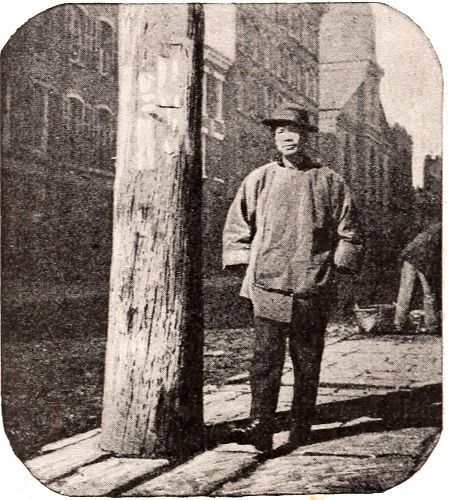
Chinatown has enlisted the telegraph for the dissemination of public intelligence, but it has got hold of the contrivance by the wrong end. As the wires serve us in newspaper-making, so the Chinaman makes use of the pole for the same purpose. The telegraph pole, of which I spoke as the real official organ of Chinatown, stands not far from the Joss House in Mott Street, in full view from Chatham Square. In it centres the real life of the colony, its gambling news. Every day yellow and red notices are posted upon it by unseen hands, announcing that in such and such a cellar a fan tan game will be running that night, or warning the faithful that a raid is intended on this or that game through the machination of a rival interest. A constant stream of plotting and counter-plotting makes up the round of Chinese social and political existence. I do not pretend to understand the exact political structure of the colony, or its internal government. Even discarding as idle the stories of a secret cabal with power over life and death, and authority to enforce its decrees, there is evidence enough that the Chinese consider themselves subject to the laws of the land only when submission is unavoidable, and that they are governed by a code of their own, the very essence of which is rejection of all other authority except under compulsion. If now and then some horrible crime in the Chinese colony, a murder of such hideous ferocity as one I have a very vivid recollection of, where the murderer stabbed his victim (both Chinamen, of course) in the back with a meat-knife, plunging it in to the hilt no less than seventeen times, arouses the popular prejudice to a suspicion that it was “ordered,” only the suspected themselves are to blame, for they appear to rise up as one man to shield the criminal. The difficulty of tracing the motive of the crime and the murderer is extreme, and it is the rarest of all results that the police get on the track of either. The obstacles in the way of hunting down an Italian murderer are as nothing to the opposition encountered in Chinatown. Nor is the failure of the pursuit wholly to be ascribed to the familiar fact that to Caucasian eyes “all Chinamen look alike,” but rather to their acting “alike,” in a body, to defeat discovery at any cost.
Withal the police give the Chinese the name of being the “quietest people down there,” meaning in the notoriously turbulent Sixth Ward; and they are. The one thing they desire above all is to be let alone, a very natural wish perhaps, considering all the circumstances. If it were a laudable, or even an allowable ambition that prompts it, they might be humored with advantage, probably, to both sides. But the facts show too plainly that it is not, and that in their very exclusiveness and reserve they are a constant and terrible menace to society, wholly regardless of their influence upon the industrial problems which their presence confuses. The severest official scrutiny, the harshest repressive measures are justifiable in Chinatown, orderly as it appears on the surface, even more than in the Bend, and the case is infinitely more urgent. To the peril that threatens there all the senses are alert, whereas the poison that proceeds from Mott Street puts mind and body to sleep, to work out its deadly purpose in the corruption of the soul.
This again may be set down as a harsh judgment. I may be accused of inciting persecution of an unoffending people. Far from it. Granted, that the Chinese are in no sense a desirable element of the population, that they serve no useful purpose here, whatever they may have done elsewhere in other days, yet to this it is a sufficient answer that they are here, and that, having let them in, we must make the best of it. This is a time for very plain speaking on this subject. Rather than banish the Chinaman, I would have the door opened wider—for his wife; make it a condition of his coming or staying that he bring his wife with him. Then, at least, he might not be what he now is and remains, a homeless stranger among us. Upon this hinges the real Chinese question, in our city at all events, as I see it. To assert that the victims of his drug and his base passions would go to the bad anyhow, is begging the question. They might and they might not. The chance is the span between life and death. From any other form of dissipation than that for which Chinatown stands there is recovery: for the victims of any other vice, hope. For these there is neither hope nor recovery; nothing but death—moral, mental, and physical death.
CHAPTER X.
JEWTOWN.
The tenements grow taller, and the gaps in their ranks close up rapidly as we cross the Bowery and, leaving Chinatown and the Italians behind, invade the Hebrew quarter. Baxter Street, with its interminable rows of old clothes shops and its brigades of pullers-in—nicknamed “the Bay” in honor, perhaps, of the tars who lay to there after a cruise to stock up their togs, or maybe after the “schooners” of beer plentifully bespoke in that latitude—Bayard Street, with its synagogues and its crowds, gave us a foretaste of it. No need of asking here where we are. The jargon of the street, the signs of the sidewalk, the manner and dress of the people, their unmistakable physiognomy, betray their race at every step. Men with queer skull-caps, venerable beard, and the outlandish long-skirted kaftan of the Russian Jew, elbow the ugliest and the handsomest women in the land. The contrast is startling. The old women are hags; the young, houris. Wives and mothers at sixteen, at thirty they are old. So thoroughly has the chosen people crowded out the Gentiles in the Tenth Ward that, when the great Jewish holidays come around every year, the public schools in the district have practically to close up. Of their thousands of pupils scarce a handful come to school. Nor is there any suspicion that the rest are playing hookey. They stay honestly home to celebrate. There is no mistaking it: we are in Jewtown.
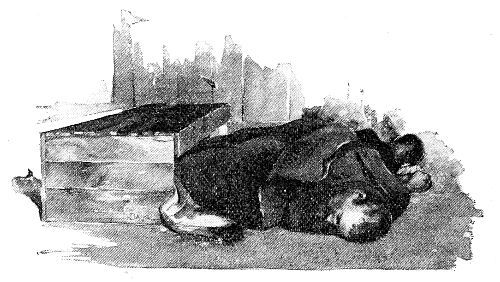
It is said that nowhere in the world are so many people crowded together on a square mile as here. The average five-story tenement adds a story or two to its stature in Ludlow Street and an extra building on the rear lot, and yet the sign “To Let” is the rarest of all there. Here is one seven stories high. The sanitary policeman whose beat this is will tell you that it contains thirty-six families, but the term has a widely different meaning here and on the avenues. In this house, where a case of small-pox was reported, there were fifty-eight babies and thirty-eight children that were over five years of age. In Essex Street two small rooms in a six-story tenement were made to hold a “family” of father and mother, twelve children, and six boarders. The boarder plays as important a part in the domestic economy of Jewtown as the lodger in the Mulberry Street Bend. These are samples of the packing of the population that has run up the record here to the rate of three hundred and thirty thousand per square mile. The densest crowding of Old London, I pointed out before, never got beyond a hundred and seventy-five thousand. Even the alley is crowded out. Through dark hallways and filthy cellars, crowded, as is every foot of the street, with dirty children, the settlements in the rear are reached. Thieves know how to find them when pursued by the police, and the tramps that sneak in on chilly nights to fight for the warm spot in the yard over some baker’s oven. They are out of place in this hive of busy industry, and they know it. It has nothing in common with them or with their philosophy of life, that the world owes the idler a living. Life here means the hardest kind of work almost from the cradle. The world as a debtor has no credit in Jewtown. Its promise to pay wouldn’t buy one of the old hats that are hawked about Hester Street, unless backed by security representing labor done at lowest market rates. But this army of workers must have bread. It is cheap and filling, and bakeries abound. Wherever they are in the tenements the tramp will skulk in, if he can. There is such a tramps’ roost in the rear of a tenement near the lower end of Ludlow Street, that is never without its tenants in winter. By a judicious practice of flopping over on the stone pavement at intervals, and thus warming one side at a time, and with an empty box to put the feet in, it is possible to keep reasonably comfortable there even on a rainy night. In summer the yard is the only one in the neighborhood that does not do duty as a public dormitory.
Thrift is the watchword of Jewtown, as of its people the world over. It is at once its strength and its fatal weakness, its cardinal virtue and its foul disgrace. Become an over-mastering passion with these people who come here in droves from Eastern Europe to escape persecution, from which freedom could be bought only with gold, it has enslaved them in bondage worse than that from which they fled. Money is their God. Life itself is of little value compared with even the leanest bank account. In no other spot does life wear so intensely bald and materialistic an aspect as in Ludlow Street. Over and over again I have met with instances of these Polish or Russian Jews deliberately starving themselves to the point of physical exhaustion, while working night and day at a tremendous pressure to save a little money. An avenging Nemesis pursues this headlong hunt for wealth; there is no worse paid class anywhere. I once put the question to one of their own people, who, being a pawnbroker, and an unusually intelligent and charitable one, certainly enjoyed the advantage of a practical view of the situation: “Whence the many wretchedly poor people in such a colony of workers, where poverty, from a misfortune, has become a reproach, dreaded as the plague?”
“Immigration,” he said, “brings us a lot. In five years it has averaged twenty-five thousand a year, of which more than seventy per cent. have stayed in New York. Half of them require and receive aid from the Hebrew Charities from the very start, lest they starve. That is one explanation. There is another class than the one that cannot get work: those who have had too much of it; who have worked and hoarded and lived, crowded together like pigs, on the scantiest fare and the worst to be got, bound to save whatever their earnings, until, worn out, they could work no longer. Then their hoards were soon exhausted. That is their story.” And I knew that what he said was true.
Penury and poverty are wedded everywhere to dirt and disease, and Jewtown is no exception. It could not well be otherwise in such crowds, considering especially their low intellectual status. The managers of the Eastern Dispensary, which is in the very heart of their district, told the whole story when they said: “The diseases these people suffer from are not due to intemperance or immorality, but to ignorance, want of suitable food, and the foul air in which they live and work.”[12] The homes of the Hebrew quarter are its workshops also. Reference will be made to the economic conditions under which they work in a succeeding chapter. Here we are concerned simply with the fact. You are made fully aware of it before you have travelled the length of a single block in any of these East Side streets, by the whir of a thousand sewing-machines, worked at high pressure from earliest dawn till mind and muscle give out together. Every member of the family, from the youngest to the oldest, bears a hand, shut in the qualmy rooms, where meals are cooked and clothing washed and dried besides, the live-long day. It is not unusual to find a dozen persons—men, women, and children—at work in a single small room. The fact accounts for the contrast that strikes with wonder the observer who comes across from the Bend. Over there the entire population seems possessed of an uncontrollable impulse to get out into the street; here all its energies appear to be bent upon keeping in and away from it. Not that the streets are deserted. The overflow from these tenements is enough to make a crowd anywhere. The children alone would do it. Not old enough to work and no room for play, that is their story. In the home the child’s place is usurped by the lodger, who performs the service of the Irishman’s pig—pays the rent. In the street the army of hucksters crowd him out. Typhus fever and small-pox are bred here, and help solve the question what to do with him. Filth diseases both, they sprout naturally among the hordes that bring the germs with them from across the sea, and whose first instinct is to hide their sick lest the authorities carry them off to the hospital to be slaughtered, as they firmly believe. The health officers are on constant and sharp lookout for hidden fever-nests. Considering that half of the ready-made clothes that are sold in the big stores, if not a good deal more than half, are made in these tenement rooms, this is not excessive caution. It has happened more than once that a child recovering from small-pox, and in the most contagious stage of the disease, has been found crawling among heaps of half-finished clothing that the next day would be offered for sale on the counter of a Broadway store; or that a typhus fever patient has been discovered in a room whence perhaps a hundred coats had been sent home that week, each one with the wearer’s death-warrant, unseen and unsuspected, basted in the lining.
The health officers call the Tenth the typhus ward; in the office where deaths are registered it passes as the “suicide ward,” for reasons not hard to understand; and among the police as the “crooked ward,” on account of the number of “crooks,” petty thieves and their allies, the “fences,” receivers of stolen goods, who find the dense crowds congenial. The nearness of the Bowery, the great “thieves’ highway,” helps to keep up the supply of these, but Jewtown does not support its dives. Its troubles with the police are the characteristic crop of its intense business rivalries. Oppression, persecution, have not shorn the Jew of his native combativeness one whit. He is as ready to fight for his rights, or what he considers his rights, in a business transaction—synonymous generally with his advantage—as if he had not been robbed of them for eighteen hundred years. One strong impression survives with him from his days of bondage: the power of the law. On the slightest provocation he rushes off to invoke it for his protection. Doubtless the sensation is novel to him, and therefore pleasing. The police at the Eldridge Street station are in a constant turmoil over these everlasting fights. Somebody is always denouncing somebody else, and getting his enemy or himself locked up; frequently both, for the prisoner, when brought in, has generally as plausible a story to tell as his accuser, and as hot a charge to make. The day closes on a wild conflict of rival interests. Another dawns with the prisoner in court, but no complainant. Over night the case has been settled on a business basis, and the police dismiss their prisoner in deep disgust.
These quarrels have sometimes a comic aspect. Thus, with the numerous dancing-schools that are scattered among the synagogues, often keeping them company in the same tenement. They are generally kept by some man who works in the daytime at tailoring, cigarmaking, or something else. The young people in Jewtown are inordinately fond of dancing, and after their day’s hard work will flock to these “schools” for a night’s recreation. But even to their fun they carry their business preferences, and it happens that a school adjourns in a body to make a general raid on the rival establishment across the street, without the ceremony of paying the admission fee. Then the dance breaks up in a general fight, in which, likely enough, someone is badly hurt. The police come in, as usual, and ring down the curtain.
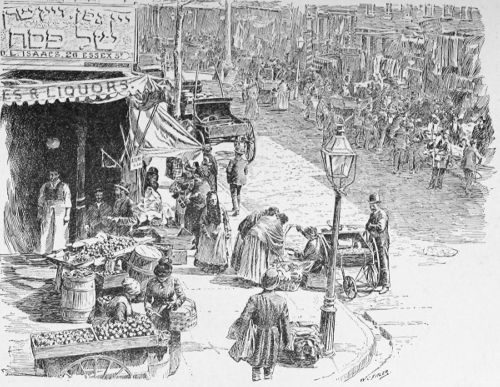
Bitter as are his private feuds, it is not until his religious life is invaded that a real inside view is obtained of this Jew, whom the history of Christian civilization has taught nothing but fear and hatred. There are two or three missions in the district conducting a hopeless propagandism for the Messiah whom the Tenth Ward rejects, and they attract occasional crowds, who come to hear the Christian preacher as the Jews of old gathered to hear the apostles expound the new doctrine. The result is often strikingly similar. “For once,” said a certain well-known minister of an uptown church to me, after such an experience, “I felt justified in comparing myself to Paul preaching salvation to the Jews. They kept still until I spoke of Jesus Christ as the Son of God. Then they got up and fell to arguing among themselves and to threatening me, until it looked as if they meant to take me out in Hester Street and stone me.” As at Jerusalem, the Chief Captain was happily at hand with his centurions, in the person of a sergeant and three policemen, and the preacher was rescued. So, in all matters pertaining to their religious life that tinges all their customs, they stand, these East Side Jews, where the new day that dawned on Calvary left them standing, stubbornly refusing to see the light. A visit to a Jewish house of mourning is like bridging the gap of two thousand years. The inexpressibly sad and sorrowful wail for the dead, as it swells and rises in the hush of all sounds of life, comes back from the ages like a mournful echo of the voice of Rachel “weeping for her children and refusing to be comforted, because they are not.”
Attached to many of the synagogues, which among the poorest Jews frequently consist of a scantily furnished room in a rear tenement, with a few wooden stools or benches for the congregation, are Talmudic schools that absorb a share of the growing youth. The school-master is not rarely a man of some attainments who has been stranded there, his native instinct for money-making having been smothered in the process that has made of him a learned man. It was of such a school in Eldridge Street that the wicked Isaac Iacob, who killed his enemy, his wife, and himself in one day, was janitor. But the majority of the children seek the public schools, where they are received sometimes with some misgivings on the part of the teachers, who find it necessary to inculcate lessons of cleanliness in the worst cases by practical demonstration with wash-bowl and soap. “He took hold of the soap as if it were some animal,” said one of these teachers to me after such an experiment upon a new pupil, “and wiped three fingers across his face. He called that washing.” In the Allen Street public school the experienced principal has embodied among the elementary lessons, to keep constantly before the children the duty that clearly lies next to their hands, a characteristic exercise. The question is asked daily from the teacher’s desk: “What must I do to be healthy?” and the whole school responds:
It seems little less than biting sarcasm to hear them say it, for to not a few of them all these things are known only by name. In their everyday life there is nothing even to suggest any of them. Only the demand of religious custom has power to make their parents clean up at stated intervals, and the young naturally are no better. As scholars, the children of the most ignorant Polish Jew keep fairly abreast of their more favored playmates, until it comes to mental arithmetic, when they leave them behind with a bound. It is surprising to see how strong the instinct of dollars and cents is in them. They can count, and correctly, almost before they can talk.
Within a few years the police captured on the East Side a band of firebugs who made a business of setting fire to tenements for the insurance on their furniture. There has, unfortunately, been some evidence in the past year that another such conspiracy is on foot. The danger to which these fiends expose their fellow-tenants is appalling. A fire-panic at night in a tenement, by no means among the rare experiences in New York, with the surging, half-smothered crowds on stairs and fire-escapes, the frantic mothers and crying children, the wild struggle to save the little that is their all, is a horror that has few parallels in human experience.
I cannot think without a shudder of one such scene in a First Avenue tenement. It was in the middle of the night. The fire had swept up with sudden fury from a restaurant on the street floor, cutting off escape. Men and women threw themselves from the windows, or were carried down senseless by the firemen. Thirteen half-clad, apparently lifeless bodies were laid on the floor of an adjoining coal-office, and the ambulance surgeons worked over them with sleeves rolled up to the elbows. A half-grown girl with a baby in her arms walked about among the dead and dying with a stunned, vacant look, singing in a low, scared voice to the child. One of the doctors took her arm to lead her out, and patted the cheek of the baby soothingly. It was cold. The baby had been smothered with its father and mother; but the girl, her sister, did not know it. Her reason had fled.
Thursday night and Friday morning are bargain days in the “Pig-market.” Then is the time to study the ways of this peculiar people to the best advantage. A common pulse beats in the quarters of the Polish Jews and in the Mulberry Bend, though they have little else in common. Life over yonder in fine weather is a perpetual holiday, here a veritable tread-mill of industry. Friday brings out all the latent color and picturesqueness of the Italians, as of these Semites. The crowds and the common poverty are the bonds of sympathy between them. The Pig-market is in Hester Street, extending either way from Ludlow Street, and up and down the side streets two or three blocks, as the state of trade demands. The name was given to it probably in derision, for pork is the one ware that is not on sale in the Pig-market. There is scarcely anything else that can be hawked from a wagon that is not to be found, and at ridiculously low prices. Bandannas and tin cups at two cents, peaches at a cent a quart, “damaged” eggs for a song, hats for a quarter, and spectacles, warranted to suit the eye, at the optician’s who has opened shop on a Hester Street door-step, for thirty five cents; frowsy-looking chickens and half-plucked geese, hung by the neck and protesting with wildly strutting feet even in death against the outrage, are the great staple of the market. Half or a quarter of a chicken can be bought here by those who cannot afford a whole. It took more than ten years of persistent effort on the part of the sanitary authorities to drive the trade in live fowl from the streets to the fowl-market on Gouverneur Slip, where the killing is now done according to Jewish rite by priests detailed for the purpose by the chief rabbi. Since then they have had a characteristic rumpus, that involved the entire Jewish community, over the fees for killing and the mode of collecting them. Here is a woman churning horse-radish on a machine she has chained and padlocked to a tree on the sidewalk, lest someone steal it. Beside her a butcher’s stand with cuts at prices the avenues never dreamed of. Old coats are hawked for fifty cents, “as good as new,” and “pants”—there are no trousers in Jewtown, only pants—at anything that can be got. There is a knot of half a dozen “pants” pedlars in the middle of the street, twice as many men of their own race fingering their wares and plucking at the seams with the anxious scrutiny of would-be buyers, though none of them has the least idea of investing in a pair. Yes, stop! This baker, fresh from his trough, bare-headed and with bare arms, has made an offer: for this pair thirty cents; a dollar and forty was the price asked. The pedlar shrugs his shoulders, and turns up his hands with a half pitying, wholly indignant air. What does the baker take him for? Such pants—. The baker has turned to go. With a jump like a panther’s, the man with the pants has him by the sleeve. Will he give eighty cents? Sixty? Fifty? So help him, they are dirt cheap at that. Lose, will he, on the trade, lose all the profit of his day’s pedling. The baker goes on unmoved. Forty then? What, not forty? Take them then for thirty, and wreck the life of a poor man. And the baker takes them and goes, well knowing that at least twenty cents of the thirty, two hundred per cent., were clear profit, if indeed the “pants” cost the pedlar anything.
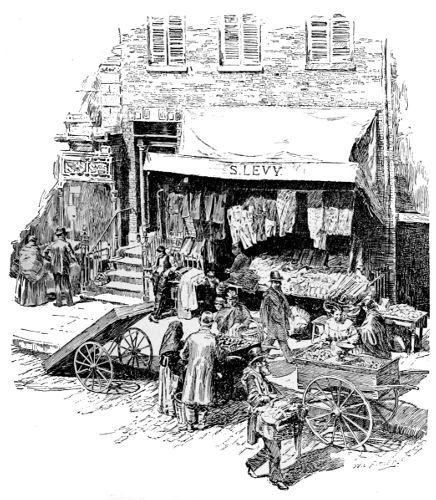
The suspender pedlar is the mystery of the Pig-market, omnipresent and unfathomable. He is met at every step with his wares dangling over his shoulder, down his back, and in front. Millions of suspenders thus perambulate Jewtown all day on a sort of dress parade. Why suspenders, is the puzzle, and where do they all go to? The “pants” of Jewtown hang down with a common accord, as if they had never known the support of suspenders. It appears to be as characteristic a trait of the race as the long beard and the Sabbath silk hat of ancient pedigree. I have asked again and again. No one has ever been able to tell me what becomes of the suspenders of Jewtown. Perhaps they are hung up as bric-à-brac in its homes, or laid away and saved up as the equivalent of cash. I cannot tell. I only know that more suspenders are hawked about the Pig-market every day than would supply the whole of New York for a year, were they all bought and turned to use.
The crowds that jostle each other at the wagons and about the sidewalk shops, where a gutter plank on two ash-barrels does duty for a counter! Pushing, struggling, babbling, and shouting in foreign tongues, a veritable Babel of confusion. An English word falls upon the ear almost with a sense of shock, as something unexpected and strange. In the midst of it all there is a sudden wild scattering, a hustling of things from the street into dark cellars, into back-yards and by-ways, a slamming and locking of doors hidden under the improvised shelves and counters. The health officers’ cart is coming down the street, preceded and followed by stalwart policemen, who shovel up with scant ceremony the eatables—musty bread, decayed fish and stale vegetables—indifferent to the curses that are showered on them from stoops and windows, and carry them off to the dump. In the wake of the wagon, as it makes its way to the East River after the raid, follow a line of despoiled hucksters shouting defiance from a safe distance. Their clamor dies away with the noise of the market. The endless panorama of the tenements, rows upon rows, between stony streets, stretches to the north, to the south, and to the west as far as the eye reaches.
CHAPTER XI.
THE SWEATERS OF JEWTOWN.
Anything like an exhaustive discussion of the economical problem presented by the Tenth Ward[13] is beset by difficulties that increase in precise proportion to the efforts put forth to remove them. I have too vivid a recollection of weary days and nights spent in those stewing tenements, trying to get to the bottom of the vexatious question only to find myself in the end as far from the truth as at the beginning, asking with rising wrath Pilate’s question, “What is truth?” to attempt to weary the reader by dragging him with me over that sterile and unprofitable ground. Nor are these pages the place for such a discussion. In it, let me confess it at once and have done with it, I should be like the blind leading the blind; between the real and apparent poverty, the hidden hoards and the unhesitating mendacity of these people, where they conceive their interests to be concerned in one way or another, the reader and I would fall together into the ditch of doubt and conjecture in which I have found company before.
The facts that lie on the surface indicate the causes as clearly as the nature of the trouble. In effect both have been already stated. A friend of mine who manufactures cloth once boasted to me that nowadays, on cheap clothing, New York “beats the world.” “To what,” I asked, “do you attribute it?” “To the cutter’s long knife[14] and the Polish Jew,” he said. Which of the two has cut deepest into the workman’s wages is not a doubtful question. Practically the Jew has monopolized the business since the battle between East Broadway and Broadway ended in a complete victory for the East Side and cheap labor, and transferred to it the control of the trade in cheap clothing. Yet, not satisfied with having won the field, he strives as hotly with his own for the profit of half a cent as he fought with his Christian competitor for the dollar. If the victory is a barren one, the blame is his own. His price is not what he can get, but the lowest he can live for and underbid his neighbor. Just what that means we shall see. The manufacturer knows it, and is not slow to take advantage of his knowledge. He makes him hungry for work by keeping it from him as long as possible; then drives the closest bargain he can with the sweater.
Many harsh things have been said of the “sweater,” that really apply to the system in which he is a necessary, logical link. It can at least be said of him that he is no worse than the conditions that created him. The sweater is simply the middleman, the sub-contractor, a workman like his fellows, perhaps with the single distinction from the rest that he knows a little English; perhaps not even that, but with the accidental possession of two or three sewing-machines, or of credit enough to hire them, as his capital, who drums up work among the clothing-houses. Of workmen he can always get enough. Every ship-load from German ports brings them to his door in droves, clamoring for work. The sun sets upon the day of the arrival of many a Polish Jew, finding him at work in an East Side tenement, treading the machine and “learning the trade.” Often there are two, sometimes three, sets of sweaters on one job. They work with the rest when they are not drumming up trade, driving their “hands” as they drive their machine, for all they are worth, and making a profit on their work, of course, though in most cases not nearly as extravagant a percentage, probably, as is often supposed. If it resolves itself into a margin of five or six cents, or even less, on a dozen pairs of boys’ trousers, for instance, it is nevertheless enough to make the contractor with his thrifty instincts independent. The workman growls, not at the hard labor, or poor pay, but over the pennies another is coining out of his sweat, and on the first opportunity turns sweater himself, and takes his revenge by driving an even closer bargain than his rival tyrant, thus reducing his profits.
The sweater knows well that the isolation of the workman in his helpless ignorance is his sure foundation, and he has done what he could—with merciless severity where he could—to smother every symptom of awakening intelligence in his slaves. In this effort to perpetuate his despotism he has had the effectual assistance of his own system and the sharp competition that keep the men on starvation wages; of their constitutional greed, that will not permit the sacrifice of temporary advantage, however slight, for permanent good, and above all, of the hungry hordes of immigrants to whom no argument appeals save the cry for bread. Within very recent times he has, however, been forced to partial surrender by the organization of the men to a considerable extent into trades unions, and by experiments in co-operation, under intelligent leadership, that presage the sweater’s doom. But as long as the ignorant crowds continue to come and to herd in these tenements, his grip can never be shaken off. And the supply across the seas is apparently inexhaustible. Every fresh persecution of the Russian or Polish Jew on his native soil starts greater hordes hitherward to confound economical problems, and recruit the sweater’s phalanx. The curse of bigotry and ignorance reaches halfway across the world, to sow its bitter seed in fertile soil in the East Side tenements. If the Jew himself was to blame for the resentment he aroused over there, he is amply punished. He gathers the first-fruits of the harvest here.
The bulk of the sweater’s work is done in the tenements, which the law that regulates factory labor does not reach. To the factories themselves that are taking the place of the rear tenements in rapidly growing numbers, letting in bigger day-crowds than those the health officers banished, the tenement shops serve as a supplement through which the law is successfully evaded. Ten hours is the legal work-day in the factories, and nine o’clock the closing hour at the latest. Forty-five minutes at least must be allowed for dinner, and children under sixteen must not be employed unless they can read and write English; none at all under fourteen. The very fact that such a law should stand on the statute book, shows how desperate the plight of these people. But the tenement has defeated its benevolent purpose. In it the child works unchallenged from the day he is old enough to pull a thread. There is no such thing as a dinner hour; men and women eat while they work, and the “day” is lengthened at both ends far into the night. Factory hands take their work with them at the close of the lawful day to eke out their scanty earnings by working overtime at home. Little chance on this ground for the campaign of education that alone can bring the needed relief; small wonder that there are whole settlements on this East Side where English is practically an unknown tongue, though the people be both willing and anxious to learn. “When shall we find time to learn?” asked one of them of me once. I owe him the answer yet.
Take the Second Avenue Elevated Railroad at Chatham Square and ride up half a mile through the sweaters’ district. Every open window of the big tenements, that stand like a continuous brick wall on both sides of the way, gives you a glimpse of one of these shops as the train speeds by. Men and women bending over their machines, or ironing clothes at the window, half-naked. Proprieties do not count on the East Side; nothing counts that cannot be converted into hard cash. The road is like a big gangway through an endless work-room where vast multitudes are forever laboring. Morning, noon, or night, it makes no difference; the scene is always the same. At Rivington Street let us get off and continue our trip on foot. It is Sunday evening west of the Bowery. Here, under the rule of Mosaic law, the week of work is under full headway, its first day far spent. The hucksters’ wagons are absent or stand idle at the curb; the saloons admit the thirsty crowds through the side-door labelled “Family Entrance;” a tin sign in a store-window announces that a “Sunday School” gathers in stray children of the new dispensation; but beyond these things there is little to suggest the Christian Sabbath. Men stagger along the sidewalk groaning under heavy burdens of unsewn garments, or enormous black bags stuffed full of finished coats and trousers. Let us follow one to his home and see how Sunday passes in a Ludlow Street tenement.
Up two flights of dark stairs, three, four, with new smells of cabbage, of onions, of frying fish, on every landing, whirring sewing machines behind closed doors betraying what goes on within, to the door that opens to admit the bundle and the man. A sweater, this, in a small way. Five men and a woman, two young girls, not fifteen, and a boy who says unasked that he is fifteen, and lies in saying it, are at the machines sewing knickerbockers, “knee-pants” in the Ludlow Street dialect. The floor is littered ankle-deep with half-sewn garments. In the alcove, on a couch of many dozens of “pants” ready for the finisher, a bare-legged baby with pinched face is asleep. A fence of piled-up clothing keeps him from rolling off on the floor. The faces, hands, and arms to the elbows of everyone in the room are black with the color of the cloth on which they are working. The boy and the woman alone look up at our entrance. The girls shoot sidelong glances, but at a warning look from the man with the bundle they tread their machines more energetically than ever. The men do not appear to be aware even of the presence of a stranger.
They are “learners,” all of them, says the woman, who proves to be the wife of the boss, and have “come over” only a few weeks ago. She is disinclined to talk at first, but a few words in her own tongue from our guide[15] set her fears, whatever they are, at rest, and she grows almost talkative. The learners work for week’s wages, she says. How much do they earn? She shrugs her shoulders with an expressive gesture. The workers themselves, asked in their own tongue, say indifferently, as though the question were of no interest: from two to five dollars. The children—there are four of them—are not old enough to work. The oldest is only six. They turn out one hundred and twenty dozen “knee-pants” a week, for which the manufacturer pays seventy cents a dozen. Five cents a dozen is the clear profit, but her own and her husband’s work brings the family earnings up to twenty-five dollars a week, when they have work all the time. But often half the time is put in looking for it. They work no longer than to nine o’clock at night, from daybreak. There are ten machines in the room; six are hired at two dollars a month. For the two shabby, smoke-begrimed rooms, one somewhat larger than ordinary, they pay twenty dollars a month. She does not complain, though “times are not what they were, and it costs a good deal to live.” Eight dollars a week for the family of six and two boarders. How do they do it? She laughs, as she goes over the bill of fare, at the silly question: Bread, fifteen cents a day, of milk two quarts a day at four cents a quart, one pound of meat for dinner at twelve cents, butter one pound a week at “eight cents a quarter of a pound.” Coffee, potatoes, and pickles complete the list. At the least calculation, probably, this sweater’s family hoards up thirty dollars a month, and in a few years will own a tenement somewhere and profit by the example set by their landlord in rent-collecting. It is the way the savings of Jewtown are universally invested, and with the natural talent of its people for commercial speculation the investment is enormously profitable.
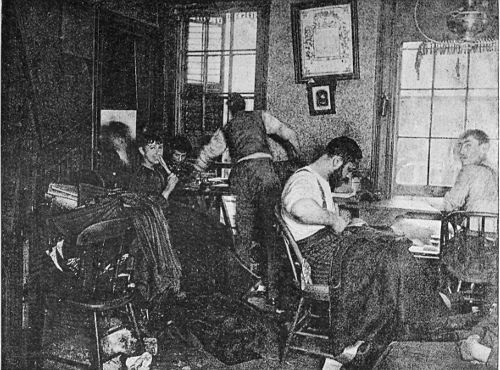
On the next floor, in a dimly lighted room with a big red-hot stove to keep the pressing irons ready for use, is a family of man, wife, three children, and a boarder. “Knee-pants” are made there too, of a still lower grade. Three cents and a half is all he clears, says the man, and lies probably out of at least two cents. The wife makes a dollar and a half finishing, the man about nine dollars at the machine. The boarder pays sixty-five cents a week. He is really only a lodger, getting his meals outside. The rent is two dollars and twenty-five cents a week, cost of living five dollars. Every floor has at least two, sometimes four, such shops. Here is one with a young family for which life is bright with promise. Husband and wife work together; just now the latter, a comely young woman, is eating her dinner of dry bread and green pickles. Pickles are favorite food in Jewtown. They are filling, and keep the children from crying with hunger. Those who have stomachs like ostriches thrive in spite of them and grow strong—plain proof that they are good to eat. The rest? “Well, they die,” says our guide, dryly. No thought of untimely death comes to disturb this family with life all before it. In a few years the man will be a prosperous sweater. Already he employs an old man as ironer at three dollars a week, and a sweet-faced little Italian girl as finisher at a dollar and a half. She is twelve, she says, and can neither read nor write; will probably never learn. How should she? The family clears from ten to eleven dollars a week in brisk times, more than half of which goes into the bank.
A companion picture from across the hall. The man works on the machine for his sweater twelve hours a day, turning out three dozen “knee-pants,” for which he receives forty-two cents a dozen. The finisher who works with him gets ten, and the ironer eight cents a dozen; buttonholes are extra, at eight to ten cents a hundred. This operator has four children at his home in Stanton Street, none old enough to work, and a sick wife. His rent is twelve dollars a month; his wages for a hard week’s work less than eight dollars. Such as he, with their consuming desire for money thus smothered, recruit the ranks of the anarchists, won over by the promise of a general “divide;” and an enlightened public sentiment turns up its nose at the vicious foreigner for whose perverted notions there is no room in this land of plenty.
Turning the corner into Hester Street, we stumble upon a nest of cloak-makers in their busy season. Six months of the year the cloak-maker is idle, or nearly so. Now is his harvest. Seventy-five cents a cloak, all complete, is the price in this shop. The cloak is of cheap plush, and might sell for eight or nine dollars over the store-counter. Seven dollars is the weekly wage of this man with wife and two children, and nine dollars and a half rent to pay per month. A boarder pays about a third of it. There was a time when he made ten dollars a week and thought himself rich. But wages have come down fearfully in the last two years. Think of it: “come down” to this. The other cloak-makers aver that they can make as much as twelve dollars a week, when they are employed, by taking their work home and sewing till midnight. One exhibits his account-book with a Ludlow Street sweater. It shows that he and his partner, working on first-class garments for a Broadway house in the four busiest weeks of the season, made together from $15.15 to $19.20 a week by striving from 6 A.M. to 11 P.M., that is to say, from $7.58 to $9.60 each.[16] The sweater on this work probably made as much as fifty per cent. at least on their labor. Not far away is a factory in a rear yard where the factory inspector reports teams of tailors making men’s coats at an average of twenty-seven cents a coat, all complete except buttons and button-holes.
Turning back, we pass a towering double tenement in Ludlow Street, owned by a well-known Jewish liquor dealer and politician, a triple combination that bodes ill for his tenants. As a matter of fact, the cheapest “apartment,” three rear rooms on the sixth floor, only one of which deserves the name, is rented for $13 a month. Here is a reminder of the Bend, a hallway turned into a shoemaker’s shop. Two hallways side by side in adjoining tenements, would be sinful waste in Jewtown, when one would do as well by knocking a hole in the wall. But this shoemaker knows a trick the Italian’s ingenuity did not suggest. He has his “flat” as well as his shop there. A curtain hung back of his stool in the narrow passage half conceals his bed that fills it entirely from wall to wall. To get into it he has to crawl over the foot-board, and he must come out the same way. Expedients more odd than this are born of the East Side crowding. In one of the houses we left, the coal-bin of a family on the fourth floor was on the roof of the adjoining tenement. A quarter of a ton of coal was being dumped there while we talked with the people.
We have reached Broome Street. The hum of industry in this six-story tenement on the corner leaves no doubt of the aspect Sunday wears within it. One flight up, we knock at the nearest door. The grocer, who keeps the store, lives on the “stoop,” the first floor in East Side parlance. In this room a suspender-maker sleeps and works with his family of wife and four children. For a wonder there are no boarders. His wife and eighteen years old daughter share in the work, but the girl’s eyes are giving out from the strain. Three months in the year, when work is very brisk, the family makes by united efforts as high as fourteen and fifteen dollars a week. The other nine months it averages from three to four dollars. The oldest boy, a young man, earns from four to six dollars in an Orchard Street factory, when he has work. The rent is ten dollars a month for the room and a miserable little coop of a bedroom where the old folks sleep. The girl makes her bed on the lounge in the front room; the big boys and the children sleep on the floor. Coal at ten cents a small pail, meat at twelve cents a pound, one and a half pound of butter a week at thirty-six cents, and a quarter of a pound of tea in the same space of time, are items of their house-keeping account as given by the daughter. Milk at four and five cents a quart, “according to quality.” The sanitary authorities know what that means, know how miserably inadequate is the fine of fifty or a hundred dollars for the murder done in cold blood by the wretches who poison the babes of these tenements with the stuff that is half water, or swill. Their defence is that the demand is for “cheap milk.” Scarcely a wonder that this suspender-maker will hardly be able to save up the dot for his daughter, without which she stands no chance of marrying in Jewtown, even with her face that would be pretty had it a healthier tinge.
Up under the roof three men are making boys’ jackets at twenty cents a piece, of which the sewer takes eight, the ironer three, the finisher five cents, and the button-hole-maker two and a quarter, leaving a cent and three-quarters to pay for the drumming up, the fetching and bringing back of the goods. They bunk together in a room for which they pay eight dollars a month. All three are single here, that is: their wives are on the other side yet, waiting for them to earn enough to send for them. Their breakfast, eaten at the work-bench, consists of a couple of rolls at a cent a piece, and a draught of water, milk when business has been very good, a square meal at noon in a restaurant, and the morning meal over again at night. This square meal, that is the evidence of a very liberal disposition on the part of the consumer, is an affair of more than ordinary note; it may be justly called an institution. I know of a couple of restaurants at the lower end of Orchard Street that are favorite resorts for the Polish Jews, who remember the injunction that the ox that treadeth out the corn shall not be muzzled. Being neighbors, they are rivals of course, and cutting under. When I was last there one gave a dinner of soup, meat-stew, bread, pie, pickles, and a “schooner” of beer for thirteen cents; the other charged fifteen cents for a similar dinner, but with two schooners of beer and a cigar, or a cigarette, as the extra inducement. The two cents had won the day, however, and the thirteen-cent restaurant did such a thriving business that it was about to spread out into the adjoining store to accommodate the crowds of customers. At this rate the lodger of Jewtown can “live like a lord,” as he says himself, for twenty-five cents a day, including the price of his bed, that ranges all the way from thirty to forty and fifty cents a week, and save money, no matter what his earnings. He does it, too, so long as work is to be had at any price, and by the standard he sets up Jewtown must abide.
It has thousands upon thousands of lodgers who help to pay its extortionate rents. At night there is scarce a room in all the district that has not one or more of them, some above half a score, sleeping on cots, or on the floor. It is idle to speak of privacy in these “homes.” The term carries no more meaning with it than would a lecture on social ethics to an audience of Hottentots. The picture is not overdrawn. In fact, in presenting the home life of these people I have been at some pains to avoid the extreme of privation, taking the cases just as they came to hand on the safer middle-ground of average earnings. Yet even the direst apparent poverty in Jewtown, unless dependent on absolute lack of work, would, were the truth known, in nine cases out of ten have a silver lining in the shape of a margin in bank.
These are the economical conditions that enable my manufacturing friend to boast that New York can “beat the world” on cheap clothing. In support of his claim he told me that a single Bowery firm last year sold fifteen thousand suits at $1.95 that averaged in cost $1.12½. With the material at fifteen cents a yard, he said, children’s suits of assorted sizes can be sold at wholesale for seventy-five cents, and boys’ cape overcoats at the same price. They are the same conditions that have perplexed the committee of benevolent Hebrews in charge of Baron de Hirsch’s munificent gift of ten thousand dollars a month for the relief of the Jewish poor in New York. To find proper channels through which to pour this money so that it shall effect its purpose without pauperizing, and without perpetuating the problem it is sought to solve, by attracting still greater swarms, is indeed no easy task. Colonization has not in the past been a success with these people. The great mass of them are too gregarious to take kindly to farming, and their strong commercial instinct hampers the experiment. To herd them in model tenements, though it relieve the physical suffering in a measure, would be to treat a symptom of the disease rather than strike at its root, even if land could be got cheap enough where they gather to build on a sufficiently large scale to make the plan a success. Trade schools for manual training could hardly be made to reach the adults, who in addition would have to be supported for months while learning. For the young this device has proved most excellent under the wise management of the United Hebrew Charities, an organization that gathers to its work the best thought and effort of many of our most public-spirited citizens. One, or all, of these plans may be tried, probably will. I state but the misgivings as to the result of some of the practical minds that have busied themselves with the problem. Its keynote evidently is the ignorance of the immigrants. They must be taught the language of the country they have chosen as their home, as the first and most necessary step. Whatever may follow, that is essential, absolutely vital. That done, it may well be that the case in its new aspect will not be nearly so hard to deal with.
Evening has worn into night as we take up our homeward journey through the streets, now no longer silent. The thousands of lighted windows in the tenements glow like dull red eyes in a huge stone wall. From every door multitudes of tired men and women pour forth for a half-hour’s rest in the open air before sleep closes the eyes weary with incessant working. Crowds of half-naked children tumble in the street and on the sidewalk, or doze fretfully on the stone steps. As we stop in front of a tenement to watch one of these groups, a dirty baby in a single brief garment—yet a sweet, human little baby despite its dirt and tatters—tumbles off the lowest step, rolls over once, clutches my leg with unconscious grip, and goes to sleep on the flagstones, its curly head pillowed on my boot.
CHAPTER XII.
THE BOHEMIANS—TENEMENT-HOUSE CIGARMAKING.
Evil as the part is which the tenement plays in Jewtown as the pretext for circumventing the law that was made to benefit and relieve the tenant, we have not far to go to find it in even a worse rôle. If the tenement is here continually dragged into the eye of public condemnation and scorn, it is because in one way or another it is found directly responsible for, or intimately associated with, three-fourths of the miseries of the poor. In the Bohemian quarter it is made the vehicle for enforcing upon a proud race a slavery as real as any that ever disgraced the South. Not content with simply robbing the tenant, the owner, in the dual capacity of landlord and employer, reduces him to virtual serfdom by making his becoming his tenant, on such terms as he sees fit to make, the condition of employment at wages likewise of his own making. It does not help the case that this landlord employer, almost always a Jew, is frequently of the thrifty Polish race just described.
Perhaps the Bohemian quarter is hardly the proper name to give to the colony, for though it has distinct boundaries it is scattered over a wide area on the East Side, in wedge-like streaks that relieve the monotony of the solid German population by their strong contrasts. The two races mingle no more on this side of the Atlantic than on the rugged slopes of the Bohemian mountains; the echoes of the thirty years’ war ring in New York, after two centuries and a half, with as fierce a hatred as the gigantic combat bred among the vanquished Czechs. A chief reason for this is doubtless the complete isolation of the Bohemian immigrant. Several causes operate to bring this about: his singularly harsh and unattractive language, which he can neither easily himself unlearn nor impart to others, his stubborn pride of race, and a popular prejudice which has forced upon him the unjust stigma of a disturber of the public peace and an enemy of organized labor. I greatly mistrust that the Bohemian on our shores is a much-abused man. To his traducer, who casts up anarchism against him, he replies that the last census (1880) shows his people to have the fewest criminals of all in proportion to numbers. In New York a Bohemian criminal is such a rarity that the case of two firebugs of several years ago is remembered with damaging distinctness. The accusation that he lives like the “rat” he is, cutting down wages by his underpaid labor, he throws back in the teeth of the trades unions with the counter-charge that they are the first cause of his attitude to the labor question.
A little way above Houston Street the first of his colonies is encountered, in Fifth Street and thereabouts. Then for a mile and a half scarce a Bohemian is to be found, until Thirty-eighth Street is reached. Fifty-fourth and Seventy-third Streets in their turn are the centres of populous Bohemian settlements. The location of the cigar factories, upon which he depends for a living, determines his choice of home, though there is less choice about it than with any other class in the community, save perhaps the colored people. Probably more than half of all the Bohemians in this city are cigarmakers, and it is the herding of these in great numbers in the so-called tenement factories, where the cheapest grade of work is done at the lowest wages, that constitutes at once their greatest hardship and the chief grudge of other workmen against them. The manufacturer who owns, say, from three or four, to a dozen or more tenements contiguous to his shop, fills them up with these people, charging them outrageous rents, and demanding often even a preliminary deposit of five dollars “key money;” deals them out tobacco by the week, and devotes the rest of his energies to the paring down of wages to within a peg or two of the point where the tenant rebels in desperation. When he does rebel, he is given the alternative of submission, or eviction with entire loss of employment. His needs determine the issue. Usually he is not in a position to hesitate long. Unlike the Polish Jew, whose example of untiring industry he emulates, he has seldom much laid up against a rainy day. He is fond of a glass of beer, and likes to live as well as his means will permit. The shop triumphs, and fetters more galling than ever are forged for the tenant. In the opposite case, the newspapers have to record the throwing upon the street of a small army of people, with pitiful cases of destitution and family misery.
Men, women and children work together seven days in the week in these cheerless tenements to make a living for the family, from the break of day till far into the night. Often the wife is the original cigarmaker from the old home, the husband having adopted her trade here as a matter of necessity, because, knowing no word of English, he could get no other work. As they state the cause of the bitter hostility of the trades unions, she was the primary bone of contention in the day of the early Bohemian immigration. The unions refused to admit the women, and, as the support of the family depended upon her to a large extent, such terms as were offered had to be accepted. The manufacturer has ever since industriously fanned the antagonism between the unions and his hands, for his own advantage. The victory rests with him, since the Court of Appeals decided that the law, passed a few years ago, to prohibit cigarmaking in tenements was unconstitutional, and thus put an end to the struggle. While it lasted, all sorts of frightful stories were told of the shocking conditions under which people lived and worked in these tenements, from a sanitary point of view especially, and a general impression survives to this day that they are particularly desperate. The Board of Health, after a careful canvass, did not find them so then. I am satisfied from personal inspection, at a much later day, guided in a number of instances by the union cigarmakers themselves to the tenements which they considered the worst, that the accounts were greatly exaggerated. Doubtless the people are poor, in many cases very poor; but they are not uncleanly, rather the reverse; they live much better than the clothing-makers in the Tenth Ward, and in spite of their sallow look, that may be due to the all-pervading smell of tobacco, they do not appear to be less healthy than other in-door workers. I found on my tours of investigation several cases of consumption, of which one at least was said by the doctor to be due to the constant inhalation of tobacco fumes. But an examination of the death records in the Health Department does not support the claim that the Bohemian cigarmakers are peculiarly prone to that disease. On the contrary, the Bohemian percentage of deaths from consumption appears quite low. This, however, is a line of scientific inquiry which I leave others to pursue, along with the more involved problem whether the falling off in the number of children, sometimes quite noticeable in the Bohemian settlements, is, as has been suggested, dependent upon the character of the parents’ work. The sore grievances I found were the miserable wages and the enormous rents exacted for the minimum of accommodation. And surely these stand for enough of suffering.
Take a row of houses in East Tenth Street as an instance. They contained thirty-five families of cigarmakers, with probably not half a dozen persons in the whole lot of them, outside of the children, who could speak a word of English, though many had been in the country half a lifetime. This room with two windows giving on the street, and a rear attachment without windows, called a bedroom by courtesy, is rented at $12.25 a month. In the front room man and wife work at the bench from six in the morning till nine at night. They make a team, stripping the tobacco leaves together; then he makes the filler, and she rolls the wrapper on and finishes the cigar. For a thousand they receive $3.75, and can turn out together three thousand cigars a week. The point has been reached where the rebellion comes in, and the workers in these tenements are just now on a strike, demanding $5.00 and $5.50 for their work. The manufacturer having refused, they are expecting hourly to be served with notice to quit their homes, and the going of a stranger among them excites their resentment, until his errand is explained. While we are in the house, the ultimatum of the “boss” is received. He will give $3.75 a thousand, not another cent. Our host is a man of seeming intelligence, yet he has been nine years in New York and knows neither English nor German. Three bright little children play about the floor.
His neighbor on the same floor has been here fifteen years, but shakes his head when asked if he can speak English. He answers in a few broken syllables when addressed in German. With $11.75 rent to pay for like accommodation, he has the advantage of his oldest boy’s work besides his wife’s at the bench. Three properly make a team, and these three can turn out four thousand cigars a week, at $3.75. This Bohemian has a large family; there are four children, too small to work, to be cared for. A comparison of the domestic bill of fare between Tenth and Ludlow Streets result, in the discovery that this Bohemian’s butcher’s bill for the week, with meat at twelve cents a pound as in Ludlow Street, is from two dollars and a half to three dollars. The Polish Jew fed as big a family on one pound of meat a day. The difference proves to be typical. Here is a suit of three rooms, two dark, three flights up. The ceiling is partly down in one of the rooms. “It is three months since we asked the landlord to fix it,” says the oldest son, a very intelligent lad who has learned English in the evening school. His father has not had that advantage, and has sat at his bench, deaf and dumb to the world about him except his own, for six years. He has improved his time and become an expert at his trade. Father, mother, and son together, a full team, make from fifteen to sixteen dollars a week.
A man with venerable beard and keen eyes answers our questions through an interpreter, in the next house. Very few brighter faces would be met in a day’s walk among American mechanics, yet he has in nine years learned no syllable of English. German he probably does not want to learn. His story supplies the explanation, as did the stories of the others. In all that time he has been at work grubbing to earn bread. Wife and he by constant labor make three thousand cigars a week, earning $11.25 when there is no lack of material; when in winter they receive from the manufacturer tobacco for only two thousand, the rent of $10 for two rooms, practically one with a dark alcove, has nevertheless to be paid in full, and six mouths to be fed. He was a blacksmith in the old country, but cannot work at his trade here because he does not understand “Engliska.” If he could, he says, with a bright look, he could do better work than he sees done here. It would seem happiness to him to knock off at 6 o’clock instead of working, as he now often has to do, till midnight. But how? He knows of no Bohemian blacksmith who can understand him; he should starve. Here, with his wife, he can make a living at least. “Aye,” says she, turning, from listening, to her household duties, “it would be nice for sure to have father work at his trade.” Then what a home she could make for them, and how happy they would be. Here is an unattainable ideal, indeed, of a workman in the most prosperous city in the world! There is genuine, if unspoken, pathos in the soft tap she gives her husband’s hand as she goes about her work with a half-suppressed little sigh.