
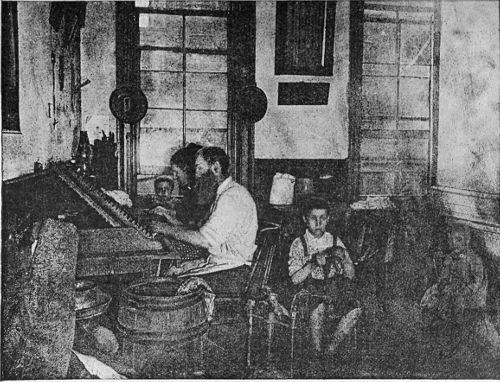
The very ash-barrels that stand in front of the big rows of tenements in Seventy-first and Seventy-third Streets advertise the business that is carried on within. They are filled to the brim with the stems of stripped tobacco leaves. The rank smell that waited for us on the corner of the block follows us into the hallways, penetrates every nook and cranny of the houses. As in the settlement farther down town, every room here has its work-bench with its stumpy knife and queer pouch of bed-tick, worn brown and greasy, fastened in front the whole length of the bench to receive the scraps of waste. This landlord-employer at all events gives three rooms for $12.50, if two be dark, one wholly and the other getting some light from the front room. The mother of the three bare-footed little children we met on the stairs was taken to the hospital the other day when she could no longer work. She will never come out alive. There is no waste in these tenements. Lives, like clothes, are worn through and out before put aside. Her place at the bench is taken already by another who divides with the head of the household his earnings of $15.50 a week. He has just come out successful of a strike that brought the pay of these tenements up to $4.50 per thousand cigars. Notice to quit had already been served on them, when the employer decided to give in, frightened by the prospective loss of rent. Asked how long he works, the man says: “from they can see till bed-time.” Bed-time proves to be eleven o’clock. Seventeen hours a day, seven days in the week, at thirteen cents an hour for the two, six cents and a half for each! Good average earnings for a tenement-house cigarmaker in summer. In winter it is at least one-fourth less. In spite of it all, the rooms are cleanly kept. From the bedroom farthest back the woman brings out a pile of moist tobacco-leaves to be stripped. They are kept there, under cover lest they dry and crack, from Friday to Friday, when an accounting is made and fresh supplies given out. The people sleep there too, but the smell, offensive to the unfamiliar nose, does not bother them. They are used to it.
In a house around the corner that is not a factory-tenement, lives now the cigarmaker I spoke of as suffering from consumption which the doctor said was due to the tobacco-fumes. Perhaps the lack of healthy exercise had as much to do with it. His case is interesting from its own stand-point. He too is one with a—for a Bohemian—large family. Six children sit at his table. By trade a shoemaker, for thirteen years he helped his wife make cigars in the manufacturer’s tenement. She was a very good hand, and until his health gave out two years ago they were able to make from $17 to $25 a week, by lengthening the day at both ends. Now that he can work no more, and the family under the doctor’s orders has moved away from the smell of tobacco, the burden of its support has fallen upon her alone, for none of the children are old enough to help. She has work in the shop at eight dollars a week, and this must go round; it is all there is. Happily, this being a tenement for revenue only, unmixed with cigars, the rent is cheaper: seven dollars for two bright rooms on the top floor. No housekeeping is attempted. A woman in Seventy-second Street supplies their cooking, which the wife and mother fetches in a basket, her husband being too weak. Breakfast of coffee and hard-tack, or black bread, at twenty cents for the whole eight; a good many, the little woman says with a brave, patient smile, and there is seldom anything to spare, but——. The invalid is listening, and the sentence remains unfinished. What of dinner? One of the children brings it from the cook. Oh! it is a good dinner, meat, soup, greens and bread, all for thirty cents. It is the principal family meal. Does she come home for dinner? No; she cannot leave the shop, but gets a bite at her bench. The question: A bite of what? seems as merciless as the surgeon’s knife, and she winces under it as one shrinks from physical pain. Bread, then. But at night they all have supper together—sausage and bread. For ten cents they can eat all they want. Can they not? she says, stroking the hair of the little boy at her knee; his eyes glisten hungrily at the thought, as he nods stoutly in support of his mother. Only, she adds, the week the rent is due, they have to shorten rations to pay the landlord.
But what of his being an Anarchist, this Bohemian—an infidel—I hear somebody say. Almost one might be persuaded by such facts as these—and they are everyday facts, not fancy—to retort: what more natural? With every hand raised against him in the old land and the new, in the land of his hoped-for freedom, what more logical than that his should be turned against society that seems to exist only for his oppression? But the charge is not half true. Naturally the Bohemian loves peace, as he loves music and song. As someone has said: He does not seek war, but when attacked knows better how to die than how to surrender. The Czech is the Irishman of Central Europe, with all his genius and his strong passions, with the same bitter traditions of landlord-robbery, perpetuated here where he thought to forget them; like him ever and on principle in the opposition, “agin the government” wherever he goes. Among such a people, ground by poverty until their songs have died in curses upon their oppressors, hopelessly isolated and ignorant of our language and our laws, it would not be hard for bad men at any time to lead a few astray. And this is what has been done. Yet, even with the occasional noise made by the few, the criminal statistics already alluded to quite dispose of the charge that they incline to turbulence and riot. So it is with the infidel propaganda, the legacy perhaps of the fierce contention through hundreds of years between Catholics and Protestants on Bohemia’s soil, of bad faith and savage persecutions in the name of the Christians’ God that disgrace its history. The Bohemian clergyman, who spoke for his people at the Christian Conference held in Chickering Hall two years ago, took even stronger ground. “They are Roman Catholics by birth, infidels by necessity, and Protestants by history and inclination,” he said. Yet he added his testimony in the same breath to the fact that, though the Freethinkers had started two schools in the immediate neighborhood of his church to counteract its influence, his flock had grown in a few years from a mere handful at the start to proportions far beyond his hopes, gathering in both Anarchists and Freethinkers, and making good church members of them.
Thus the whole matter resolves itself once more into a question of education, all the more urgent because these people are poor, miserably poor almost to a man. “There is not,” said one of them, who knew thoroughly what he was speaking of, “there is not one of them all, who, if he were to sell all he was worth to-morrow, would have money enough to buy a house and lot in the country.”
CHAPTER XIII.
THE COLOR LINE IN NEW YORK.
The color line must be drawn through the tenements to give the picture its proper shading. The landlord does the drawing, does it with an absence of pretence, a frankness of despotism, that is nothing if not brutal. The Czar of all the Russias is not more absolute upon his own soil than the New York landlord in his dealings with colored tenants. Where he permits them to live, they go; where he shuts the door, stay out. By his grace they exist at all in certain localities; his ukase banishes them from others. He accepts the responsibility, when laid at his door, with unruffled complacency. It is business, he will tell you. And it is. He makes the prejudice in which he traffics pay him well, and that, as he thinks it quite superfluous to tell you, is what he is there for.
That his pencil does not make quite as black a mark as it did, that the hand that wields it does not bear down as hard as only a short half dozen years ago, is the hopeful sign of an awakening public conscience under the stress of which the line shows signs of wavering. But for this the landlord deserves no credit. It has come, is coming about despite him. The line may not be wholly effaced while the name of the negro, alone among the world’s races, is spelled with a small n. Natural selection will have more or less to do beyond a doubt in every age with dividing the races; only so, it may be, can they work out together their highest destiny. But with the despotism that deliberately assigns to the defenceless Black the lowest level for the purpose of robbing him there that has nothing to do. Of such slavery, different only in degree from the other kind that held him as a chattel, to be sold or bartered at the will of his master, this century, if signs fail not, will see the end in New York.
Ever since the war New York has been receiving the overflow of colored population from the Southern cities. In the last decade this migration has grown to such proportions that it is estimated that our Blacks have quite doubled in number since the Tenth Census. Whether the exchange has been of advantage to the negro may well be questioned. Trades of which he had practical control in his Southern home are not open to him here. I know that it may be answered that there is no industrial proscription of color; that it is a matter of choice. Perhaps so. At all events he does not choose then. How many colored carpenters or masons has anyone seen at work in New York? In the South there are enough of them and, if the testimony of the most intelligent of their people is worth anything, plenty of them have come here. As a matter of fact the colored man takes in New York, without a struggle, the lower level of menial service for which his past traditions and natural love of ease perhaps as yet fit him best. Even the colored barber is rapidly getting to be a thing of the past. Along shore, at any unskilled labor, he works unmolested; but he does not appear to prefer the job. His sphere thus defined, he naturally takes his stand among the poor, and in the homes of the poor. Until very recent times—the years since a change was wrought can be counted on the fingers of one hand—he was practically restricted in the choice of a home to a narrow section on the West Side, that nevertheless had a social top and bottom to it—the top in the tenements on the line of Seventh Avenue as far north as Thirty-second Street, where he was allowed to occupy the houses of unsavory reputation which the police had cleared and for which decent white tenants could not be found; the bottom in the vile rookeries of Thompson Street and South Fifth Avenue, the old “Africa” that is now fast becoming a modern Italy. To-day there are black colonies in Yorkville and Morrisania. The encroachment of business and the Italian below, and the swelling of the population above, have been the chief agents in working out his second emancipation, a very real one, for with his cutting loose from the old tenements there has come a distinct and gratifying improvement in the tenant, that argues louder than theories or speeches the influence of vile surroundings in debasing the man. The colored citizen whom this year’s census man found in his Ninety-ninth Street “flat” is a very different individual from the “nigger” his predecessor counted in the black-and-tan slums of Thompson and Sullivan Streets. There is no more clean and orderly community in New York than the new settlement of colored people that is growing up on the East Side from Yorkville to Harlem.
Cleanliness is the characteristic of the negro in his new surroundings, as it was his virtue in the old. In this respect he is immensely the superior of the lowest of the whites, the Italians and the Polish Jews, below whom he has been classed in the past in the tenant scale. Nevertheless, he has always had to pay higher rents than even these for the poorest and most stinted rooms. The exceptions I have come across, in which the rents, though high, have seemed more nearly on a level with what was asked for the same number and size of rooms in the average tenement, were in the case of tumble-down rookeries in which no one else would live, and were always coupled with the condition that the landlord should “make no repairs.” It can readily be seen, that his profits were scarcely curtailed by his “humanity.” The reason advanced for this systematic robbery is that white people will not live in the same house with colored tenants, or even in a house recently occupied by negroes, and that consequently its selling value is injured. The prejudice undoubtedly exists, but it is not lessened by the house agents, who have set up the maxim “once a colored house, always a colored house.”
There is method in the maxim, as shown by an inquiry made last year by the Real Estate Record. It proved agents to be practically unanimous in the endorsement of the negro as a clean, orderly, and “profitable” tenant. Here is the testimony of one of the largest real estate firms in the city: “We would rather have negro tenants in our poorest class of tenements than the lower grades of foreign white people. We find the former cleaner than the latter, and they do not destroy the property so much. We also get higher prices. We have a tenement on Nineteenth Street, where we get $10 for two rooms which we could not get more than $7.50 for from white tenants previously. We have a four-story tenement on our books on Thirty-third Street, between Sixth and Seventh Avenues, with four rooms per floor—a parlor, two bedrooms, and a kitchen. We get $20 for the first floor, $24 for the second, $23 for the third and $20 for the fourth, in all $87 or $1,044 per annum. The size of the building is only 21+55.” Another firm declared that in a specified instance they had saved fifteen to twenty per cent. on the gross rentals since they changed their white tenants for colored ones. Still another gave the following case of a front and rear tenement that had formerly been occupied by tenants of a “low European type,” who had been turned out on account of filthy habits and poor pay. The negroes proved cleaner, better, and steadier tenants. Instead, however, of having their rents reduced in consequence, the comparison stood as follows:
| Rents under White Tenants. | Rents under Colored Tenants. | ||||||||
| Per month. | Per month. | ||||||||
| Front— | 1st | floor | (store, etc.) | $21 | Front— | 1st | floor | (store, etc.) | $21 |
| 2d | ” | 13 | 2d | ” | 14 | ||||
| 3d | ” | 13 | 3d | ” | 14 | ||||
| 4th | ” | (and rear) | 21 | 4th | ” | 14 | |||
| Rear— | 2d | ” | 12 | Rear— | 2d | ” | 12 | ||
| 3d | ” | 12 | 3d | ” | 13 | ||||
| 4th | ” | (see front) | — | 4th | ” | 13 | |||
| Rear house— | 1st | ” | 8 | Rear house— | 1st | ” | 10 | ||
| 2d | ” | 10 | 2d | ” | 12 | ||||
| 3d | ” | 9 | 3d | ” | 11 | ||||
| 4th | ” | 8 | 4th | ” | 10 | ||||
| Total | $127 | Total | $144 | ||||||
An increased rental of $17 per month, or $204 a year, and an advance of nearly thirteen and one-half per cent. on the gross rental “in favor” of the colored tenant. Profitable, surely!
I have quoted these cases at length in order to let in light on the quality of this landlord despotism that has purposely confused the public mind, and for its own selfish ends is propping up a waning prejudice. It will be cause for congratulation if indeed its time has come at last. Within a year, I am told by one of the most intelligent and best informed of our colored citizens, there has been evidence, simultaneous with the colored hegira from the low down-town tenements, of a movement toward less exorbitant rents. I cannot pass from this subject without adding a leaf from my own experience that deserves a place in this record, though, for the credit of humanity, I hope as an extreme case. It was last Christmas that I had occasion to visit the home of an old colored woman in Sixteenth Street, as the almoner of generous friends out of town who wished me to buy her a Christmas dinner. The old woman lived in a wretched shanty, occupying two mean, dilapidated rooms at the top of a sort of hen-ladder that went by the name of stairs. For these she paid ten dollars a month out of her hard-earned wages as a scrub-woman. I did not find her in and, being informed that she was “at the agent’s,” went around to hunt her up. The agent’s wife appeared, to report that Ann was out. Being in a hurry it occurred to me that I might save time by making her employer the purveyor of my friend’s bounty, and proposed to entrust the money, two dollars, to her to be expended for Old Ann’s benefit. She fell in with the suggestion at once, and confided to me in the fullness of her heart that she liked the plan, inasmuch as “I generally find her a Christmas dinner myself, and this money—she owes Mr. —— (her husband, the agent) a lot of rent.” Needless to state that there was a change of programme then and there, and that Ann was saved from the sort of Christmas cheer that woman’s charity would have spread before her. When I had the old soul comfortably installed in her own den, with a chicken and “fixin’s” and a bright fire in her stove, I asked her how much she owed of her rent. Her answer was that she did not really owe anything, her month not being quite up, but that the amount yet unpaid was—two dollars!
Poverty, abuse, and injustice alike the negro accepts with imperturbable cheerfulness. His philosophy is of the kind that has no room for repining. Whether lie lives in an Eighth Ward barrack or in a tenement with a brown-stone front and pretensions to the title of “flat,” he looks at the sunny side of life and enjoys it. He loves fine clothes and good living a good deal more than he does a bank account. The proverbial rainy day it would be rank ingratitude, from his point of view, to look for when the sun shines unclouded in a clear sky. His home surroundings, except when he is utterly depraved, reflect his blithesome temper. The poorest negro housekeeper’s room in New York is bright with gaily-colored prints of his beloved “Abe Linkum,” General Grant, President Garfield, Mrs. Cleveland, and other national celebrities, and cheery with flowers and singing birds. In the art of putting the best foot foremost, of disguising his poverty by making a little go a long way, our negro has no equal. When a fair share of prosperity is his, he knows how to make life and home very pleasant to those about him. Pianos and parlor furniture abound in the uptown homes of colored tenants and give them a very prosperous air. But even where the wolf howls at the door, he makes a bold and gorgeous front. The amount of “style” displayed on fine Sundays on Sixth and Seventh Avenues by colored holiday-makers would turn a pessimist black with wrath. The negro’s great ambition is to rise in the social scale to which his color has made him a stranger and an outsider, and he is quite willing to accept the shadow for the substance where that is the best he can get. The claw-hammer coat and white tie of a waiter in a first-class summer hotel, with the chance of taking his ease in six months of winter, are to him the next best thing to mingling with the white quality he serves, on equal terms. His festive gatherings, pre-eminently his cake-walks, at which a sugared and frosted cake is the proud prize of the couple with the most aristocratic step and carriage, are comic mixtures of elaborate ceremonial and the joyous abandon of the natural man. With all his ludicrous incongruities, his sensuality and his lack of moral accountability, his superstition and other faults that are the effect of temperament and of centuries of slavery, he has his eminently good points. He is loyal to the backbone, proud of being an American and of his new-found citizenship. He is at least as easily moulded for good as for evil. His churches are crowded to the doors on Sunday nights when the colored colony turns out to worship. His people own church property in this city upon which they have paid half a million dollars out of the depth of their poverty, with comparatively little assistance from their white brethren. He is both willing and anxious to learn, and his intellectual status is distinctly improving. If his emotions are not very deeply rooted, they are at least sincere while they last, and until the tempter gets the upper hand again.
Of all the temptations that beset him, the one that troubles him and the police most is his passion for gambling. The game of policy is a kind of unlawful penny lottery specially adapted to his means, but patronized extensively by poor white players as well. It is the meanest of swindles, but reaps for its backers rich fortunes wherever colored people congregate. Between the fortune-teller and the policy shop, closely allied frauds always, the wages of many a hard day’s work are wasted by the negro; but the loss causes him few regrets. Penniless, but with undaunted faith in his ultimate “luck,” he looks forward to the time when he shall once more be able to take a hand at “beating policy.” When periodically the negro’s lucky numbers, 4-11-44, come out on the slips of the alleged daily drawings, that are supposed to be held in some far-off Western town, intense excitement reigns in Thompson Street and along the Avenue, where someone is always the winner. An immense impetus is given then to the bogus business that has no existence outside of the cigar stores and candy shops where it hides from the law, save in some cunning Bowery “broker’s” back office, where the slips are printed and the “winnings” apportioned daily with due regard to the backer’s interests.
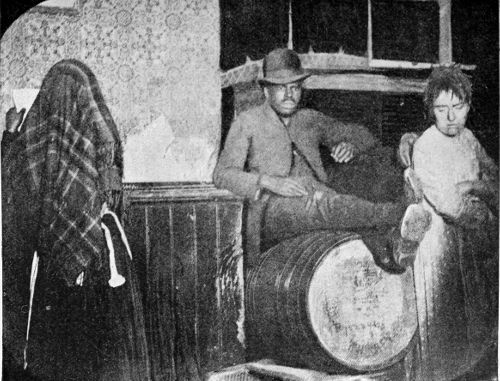
It is a question whether “Africa” has been improved by the advent of the Italian, with the tramp from the Mulberry Street Bend in his train. The moral turpitude of Thompson Street has been notorious for years, and the mingling of the three elements does not seem to have wrought any change for the better. The borderland where the white and black races meet in common debauch, the aptly-named black-and-tan saloon, has never been debatable ground from a moral stand-point. It has always been the worst of the desperately bad. Than this commingling of the utterly depraved of both sexes, white and black, on such ground, there can be no greater abomination. Usually it is some foul cellar dive, perhaps run by the political “leader” of the district, who is “in with” the police. In any event it gathers to itself all the law-breakers and all the human wrecks within reach. When a fight breaks out during the dance a dozen razors are handy in as many boot-legs, and there is always a job for the surgeon and the ambulance. The black “tough” is as handy with the razor in a fight as his peaceably inclined brother is with it in pursuit of his honest trade. As the Chinaman hides his knife in his sleeve and the Italian his stiletto in the bosom, so the negro goes to the ball with a razor in his boot-leg, and on occasion does as much execution with it as both of the others together. More than three-fourths of the business the police have with the colored people in New York arises in the black-and-tan district, now no longer fairly representative of their color.
I have touched briefly upon such facts in the negro’s life as may serve to throw light on the social condition of his people in New York. If, when the account is made up between the races, it shall be claimed that he falls short of the result to be expected from twenty-five years of freedom, it may be well to turn to the other side of the ledger and see how much of the blame is borne by the prejudice and greed that have kept him from rising under a burden of responsibility to which he could hardly be equal. And in this view he may be seen to have advanced much farther and faster than before suspected, and to promise, after all, with fair treatment, quite as well as the rest of us, his white-skinned fellow-citizens, had any right to expect.
CHAPTER XIV.
THE COMMON HERD.
There is another line not always so readily drawn in the tenements, yet the real boundary line of the Other Half: the one that defines the “flat.” The law does not draw it at all, accounting all flats tenements without distinction. The health officer draws it from observation, lumping all those which in his judgment have nothing, or not enough, to give them claim upon the name, with the common herd, and his way is, perhaps, on the whole, the surest and best. The outside of the building gives no valuable clew. Brass and brown-stone go well sometimes with dense crowds and dark and dingy rooms; but the first attempt to enter helps draw the line with tolerable distinctness. A locked door is a strong point in favor of the flat. It argues that the first step has been taken to secure privacy, the absence of which is the chief curse of the tenement. Behind a locked door the hoodlum is not at home, unless there be a jailor in place of a janitor to guard it. Not that the janitor and the door-bell are infallible. There may be a tenement behind a closed door; but never a “flat” without it. The hall that is a highway for all the world by night and by day is the tenement’s proper badge. The Other Half ever receives with open doors.
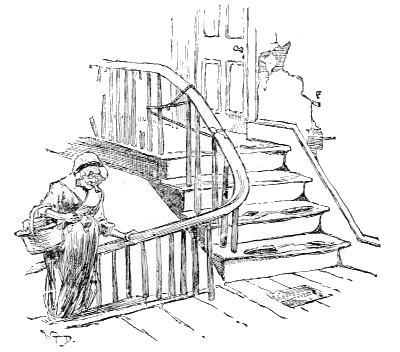
With this introduction we shall not seek it long anywhere in the city. Below Houston Street the door-bell in our age is as extinct as the dodo. East of Second Avenue, and west of Ninth Avenue as far up as the Park, it is practically an unknown institution. The nearer the river and the great workshops the more numerous the tenements. The kind of work carried on in any locality to a large extent determines their character. Skilled and well-paid labor puts its stamp on a tenement even in spite of the open door, and usually soon supplies the missing bell. Gas-houses, slaughter-houses and the docks, that attract the roughest crowds and support the vilest saloons, invariably form slum-centres. The city is full of such above the line of Fourteenth Street, that is erroneously supposed by some to fence off the good from the bad, separate the chaff from the wheat. There is nothing below that line that can outdo in wickedness Hell’s Kitchen, in the region of three-cent whiskey, or its counterpoise at the other end of Thirty-ninth Street, on the East River, the home of the infamous Rag Gang. Cherry Street is not “tougher” than Battle Row in East Sixty-third Street, or “the village” at Twenty-ninth Street and First Avenue, where stores of broken bricks, ammunition for the nightly conflicts with the police, are part of the regulation outfit of every tenement. The Mulberry Street Bend is scarce dirtier than Little Italy in Harlem. Even across the Harlem River, Frog Hollow challenges the admiration of the earlier slums for the boldness and pernicious activity of its home gang. There are enough of these sore spots. We shall yet have occasion to look into the social conditions of some of them; were I to draw a picture of them here as they are, the subject, I fear, would outgrow alike the limits of this book and the reader’s patience.
It is true that they tell only one side of the story; that there is another to tell. A story of thousands of devoted lives, laboring earnestly to make the most of their scant opportunities for good; of heroic men and women striving patiently against fearful odds and by their very courage coming off victors in the battle with the tenement; of womanhood pure and undefiled. That it should blossom in such an atmosphere is one of the unfathomable mysteries of life. And yet it is not an uncommon thing to find sweet and innocent girls, singularly untouched by the evil around them, true wives and faithful mothers, literally “like jewels in a swine’s snout,” in the worst of the infamous barracks. It is the experience of all who have intelligently observed this side of life in a great city, not to be explained—unless on the theory of my friend, the priest in the Mulberry Street Bend, that inherent purity revolts instinctively from the naked brutality of vice as seen in the slums—but to be thankfully accepted as the one gleam of hope in an otherwise hopeless desert.
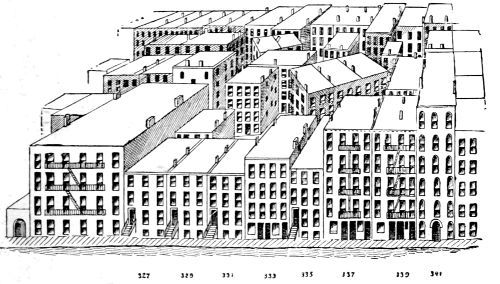
But the relief is not great. In the dull content of life bred on the tenement-house dead level there is little to redeem it, or to calm apprehension for a society that has nothing better to offer its toilers; while the patient efforts of the lives finally attuned to it to render the situation tolerable, and the very success of these efforts, serve only to bring out in stronger contrast the general gloom of the picture by showing how much farther they might have gone with half a chance. Go into any of the “respectable” tenement neighborhoods—the fact that there are not more than two saloons on the corner, nor over three or four in the block will serve as a fair guide—where live the great body of hard-working Irish and German immigrants and their descendants, who accept naturally the conditions of tenement life, because for them there is nothing else in New York; be with and among its people until you understand their ways, their aims, and the quality of their ambitions, and unless you can content yourself with the scriptural promise that the poor we shall have always with us, or with the menagerie view that, if fed, they have no cause of complaint, you shall come away agreeing with me that, humanly speaking, life there does not seem worth the living. Take at random one of these uptown tenement blocks, not of the worst nor yet of the most prosperous kind, within hail of what the newspapers would call a “fine residential section.” These houses were built since the last cholera scare made people willing to listen to reason. The block is not like the one over on the East Side in which I actually lost my way once. There were thirty or forty rear houses in the heart of it, three or four on every lot, set at all sorts of angles, with odd, winding passages, or no passage at all, only “runways” for the thieves and toughs of the neighborhood. These yards are clear. There is air there, and it is about all there is. The view between brick walls outside is that of a stony street; inside, of rows of unpainted board fences, a bewildering maze of clothes-posts and lines; underfoot, a desert of brown, hard-baked soil from which every blade of grass, every stray weed, every speck of green, has been trodden out, as must inevitably be every gentle thought and aspiration above the mere wants of the body in those whose moral natures such home surroundings are to nourish. In self-defence, you know, all life eventually accommodates itself to its environment, and human life is no exception. Within the house there is nothing to supply the want thus left unsatisfied. Tenement-houses have no æsthetic resources. If any are to be brought to bear on them, they must come from the outside. There is the common hall with doors opening softly on every landing as the strange step is heard on the stairs, the air-shaft that seems always so busy letting out foul stenches from below that it has no time to earn its name by bringing down fresh air, the squeaking pumps that hold no water, and the rent that is never less than one week’s wages out of the four, quite as often half of the family earnings.
Why complete the sketch? It is drearily familiar already. Such as it is, it is the frame in which are set days, weeks, months, and years of unceasing toil, just able to fill the mouth and clothe the back. Such as it is, it is the world, and all of it, to which these weary workers return nightly to feed heart and brain after wearing out the body at the bench, or in the shop. To it come the young with their restless yearnings, perhaps to pass on the threshold one of the daughters of sin, driven to the tenement by the police when they raided her den, sallying forth in silks and fine attire after her day of idleness. These in their coarse garments—girls with the love of youth for beautiful things, with this hard life before them—who shall save them from the tempter? Down in the street the saloon, always bright and gay, gathering to itself all the cheer of the block, beckons the boys. In many such blocks the census-taker found two thousand men, women, and children, and over, who called them home.
The picture is faithful enough to stand for its class wherever along both rivers the Irish brogue is heard. As already said, the Celt falls most readily victim to tenement influences since shanty-town and its original free-soilers have become things of the past. If he be thrifty and shrewd his progress thenceforward is along the plane of the tenement, on which he soon assumes to manage without improving things. The German has an advantage over his Celtic neighbor in his strong love for flowers, which not all the tenements on the East Side have power to smother. His garden goes with him wherever he goes. Not that it represents any high moral principle in the man; rather perhaps the capacity for it. He turns his saloon into a shrubbery as soon as his back-yard. But wherever he puts it in a tenement block it does the work of a dozen police clubs. In proportion as it spreads the neighborhood takes on a more orderly character. As the green dies out of the landscape and increases in political importance, the police find more to do. Where it disappears altogether from sight, lapsing into a mere sentiment, police-beats are shortened and the force patrols double at night. Neither the man nor the sentiment is wholly responsible for this. It is the tenement unadorned that is. The changing of Tompkins Square from a sand lot into a beautiful park put an end for good and all to the Bread and Blood riots of which it used to be the scene, and transformed a nest of dangerous agitators into a harmless, beer-craving band of Anarchists. They have scarcely been heard of since. Opponents of the small parks system as a means of relieving the congested population of tenement districts, please take note.
With the first hot nights in June police despatches, that record the killing of men and women by rolling off roofs and window-sills while asleep, announce that the time of greatest suffering among the poor is at hand. It is in hot weather, when life indoors is well-nigh unbearable with cooking, sleeping, and working, all crowded into the small rooms together, that the tenement expands, reckless of all restraint. Then a strange and picturesque life moves upon the flat roofs. In the day and early evening mothers air their babies there, the boys fly their kites from the house-tops, undismayed by police regulations, and the young men and girls court and pass the growler. In the stifling July nights, when the big barracks are like fiery furnaces, their very walls giving out absorbed heat, men and women lie in restless, sweltering rows, panting for air and sleep. Then every truck in the street, every crowded fire-escape, becomes a bedroom, infinitely preferable to any the house affords. A cooling shower on such a night is hailed as a heaven-sent blessing in a hundred thousand homes.
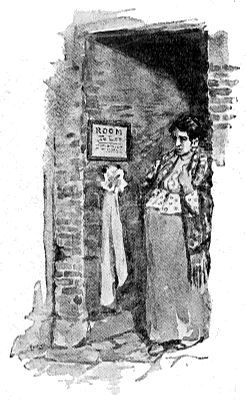
Life in the tenements in July and August spells death to an army of little ones whom the doctor’s skill is powerless to save. When the white badge of mourning flutters from every second door, sleepless mothers walk the streets in the gray of the early dawn, trying to stir a cooling breeze to fan the brow of the sick baby. There is no sadder sight than this patient devotion striving against fearfully hopeless odds. Fifty “summer doctors,” especially trained to this work, are then sent into the tenements by the Board of Health, with free advice and medicine for the poor. Devoted women follow in their track with care and nursing for the sick. Fresh-air excursions run daily out of New York on land and water; but despite all efforts the grave-diggers in Calvary work over-time, and little coffins are stacked mountains high on the deck of the Charity Commissioners’ boat when it makes its semi-weekly trips to the city cemetery.
Under the most favorable circumstances, an epidemic, which the well-to-do can afford to make light of as a thing to be got over or avoided by reasonable care, is excessively fatal among the children of the poor, by reason of the practical impossibility of isolating the patient in a tenement. The measles, ordinarily a harmless disease, furnishes a familiar example. Tread it ever so lightly on the avenues, in the tenements it kills right and left. Such an epidemic ravaged three crowded blocks in Elizabeth Street on the heels of the grippe last winter, and, when it had spent its fury, the death-maps in the Bureau of Vital Statistics looked as if a black hand had been laid across those blocks, over-shadowing in part the contiguous tenements in Mott Street, and with the thumb covering a particularly packed settlement of half a dozen houses in Mulberry Street. The track of the epidemic through these teeming barracks was as clearly defined as the track of a tornado through a forest district. There were houses in which as many as eight little children had died in five months. The records showed that respiratory diseases, the common heritage of the grippe and the measles, had caused death in most cases, discovering the trouble to be, next to the inability to check the contagion in those crowds, in the poverty of the parents and the wretched home conditions that made proper care of the sick impossible. The fact was emphasized by the occurrence here and there of a few isolated deaths from diphtheria and scarlet fever. In the case of these diseases, considered more dangerous to the public health, the health officers exercised summary powers of removal to the hospital where proper treatment could be had, and the result was a low death-rate.
These were tenements of the tall, modern type. A little more than a year ago, when a census was made of the tenements and compared with the mortality tables, no little surprise and congratulation was caused by the discovery that as the buildings grew taller the death-rate fell. The reason is plain, though the reverse had been expected by most people. The biggest tenements have been built in the last ten years of sanitary reform rule, and have been brought, in all but the crowding, under its laws. The old houses that from private dwellings were made into tenements, or were run up to house the biggest crowds in defiance of every moral and physical law, can be improved by no device short of demolition. They will ever remain the worst.
That ignorance plays its part, as well as poverty and bad hygienic surroundings, in the sacrifice of life is of course inevitable. They go usually hand in hand. A message came one day last spring summoning me to a Mott Street tenement in which lay a child dying from some unknown disease. With the “charity doctor” I found the patient on the top floor, stretched upon two chairs in a dreadfully stifling room. She was gasping in the agony of peritonitis that had already written its death-sentence on her wan and pinched face. The whole family, father, mother, and four ragged children, sat around looking on with the stony resignation of helpless despair that had long since given up the fight against fate as useless. A glance around the wretched room left no doubt as to the cause of the child’s condition. “Improper nourishment,” said the doctor, which, translated to suit the place, meant starvation. The father’s hands were crippled from lead poisoning. He had not been able to work for a year. A contagious disease of the eyes, too long neglected, had made the mother and one of the boys nearly blind. The children cried with hunger. They had not broken their fast that day, and it was then near noon. For months the family had subsisted on two dollars a week from the priest, and a few loaves and a piece of corned beef which the sisters sent them on Saturday. The doctor gave direction for the treatment of the child, knowing that it was possible only to alleviate its sufferings until death should end them, and left some money for food for the rest. An hour later, when I returned, I found them feeding the dying child with ginger ale, bought for two cents a bottle at the pedlar’s cart down the street. A pitying neighbor had proposed it as the one thing she could think of as likely to make the child forget its misery. There was enough in the bottle to go round to the rest of the family. In fact, the wake had already begun; before night it was under way in dead earnest.
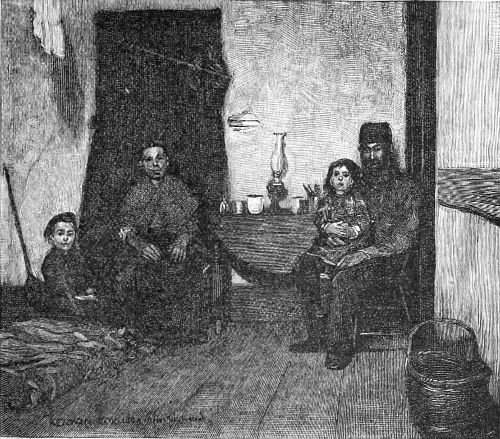
Every once in a while a case of downright starvation gets into the newspapers and makes a sensation. But this is the exception. Were the whole truth known, it would come home to the community with a shock that would rouse it to a more serious effort than the spasmodic undoing of its purse-strings. I am satisfied from my own observation that hundreds of men, women, and children are every day slowly starving to death in the tenements with my medical friend’s complaint of “improper nourishment.” Within a single week I have had this year three cases of insanity, provoked directly by poverty and want. One was that of a mother who in the middle of the night got up to murder her child, who was crying for food; another was the case of an Elizabeth Street truck-driver whom the newspapers never heard of. With a family to provide for, he had been unable to work for many months. There was neither food, nor a scrap of anything upon which money could be raised, left in the house; his mind gave way under the combined physical and mental suffering. In the third case I was just in time with the police to prevent the madman from murdering his whole family. He had the sharpened hatchet in his pocket when we seized him. He was an Irish laborer, and had been working in the sewers until the poisonous gases destroyed his health. Then he was laid off, and scarcely anything had been coming in all winter but the oldest child’s earnings as cash-girl in a store, $2.50 a week. There were seven children to provide for, and the rent of the Mulberry Street attic in which the family lived was $10 a month. They had borrowed as long as anybody had a cent to lend. When at last the man got an odd job that would just buy the children bread, the week’s wages only served to measure the depth of their misery. “It came in so on the tail-end of everything,” said his wife in telling the story, with unconscious eloquence. The outlook worried him through sleepless nights until it destroyed his reason. In his madness he had only one conscious thought: that the town should not take the children. “Better that I take care of them myself,” he repeated to himself as he ground the axe to an edge. Help came in abundance from many almost as poor as they when the desperate straits of the family became known through his arrest. The readiness of the poor to share what little they have with those who have even less is one of the few moral virtues of the tenements. Their enormous crowds touch elbow in a closeness of sympathy that is scarcely to be understood out of them, and has no parallel except among the unfortunate women whom the world scorns as outcasts. There is very little professed sentiment about it to draw a sentimental tear from the eye of romantic philanthropy. The hard fact is that the instinct of self-preservation impels them to make common cause against the common misery.
No doubt intemperance bears a large share of the blame for it; judging from the stand-point of the policeman perhaps the greater share. Two such entries as I read in the police returns on successive days last March, of mothers in West Side tenements, who, in their drunken sleep, lay upon and killed their infants, go far to support such a position. And they are far from uncommon. But my experience has shown me another view of it, a view which the last report of the Society for Improving the Condition of the Poor seems more than half inclined to adopt in allotting to “intemperance the cause of distress, or distress the cause of intemperance,” forty per cent. of the cases it is called upon to deal with. Even if it were all true, I should still load over upon the tenement the heaviest responsibility. A single factor, the scandalous scarcity of water in the hot summer when the thirst of the million tenants must be quenched, if not in that in something else, has in the past years more than all other causes encouraged drunkenness among the poor. But to my mind there is a closer connection between the wages of the tenements and the vices and improvidence of those who dwell in them than, with the guilt of the tenement upon our heads, we are willing to admit even to ourselves. Weak tea with a dry crust is not a diet to nurse moral strength. Yet how much better might the fare be expected to be in the family of this “widow with seven children, very energetic and prudent”—I quote again from the report of the Society for the Improvement of the Condition of the Poor—whose “eldest girl was employed as a learner in a tailor’s shop at small wages, and one boy had a place as ‘cash’ in a store. There were two other little boys who sold papers and sometimes earned one dollar. The mother finishes pantaloons and can do three pairs in a day, thus earning thirty-nine cents. Here is a family of eight persons with rent to pay and an income of less than six dollars a week.”
And yet she was better off in point of pay than this Sixth Street mother, who “had just brought home four pairs of pants to finish, at seven cents a pair. She was required to put the canvas in the bottom, basting and sewing three times around; to put the linings in the waist-bands; to tack three pockets, three corners to each; to put on two stays and eight buttons, and make six button-holes; to put the buckle on the back strap and sew on the ticket, all for seven cents.” Better off than the “church-going mother of six children,” and with a husband sick to death, who to support the family made shirts, averaging an income of one dollar and twenty cents a week, while her oldest girl, aged thirteen, was “employed down-town cutting out Hamburg edgings at one dollar and a half a week—two and a half cents per hour for ten hours of steady labor—making the total income of the family two dollars and seventy cents per week.” Than the Harlem woman, who was “making a brave effort to support a sick husband and two children by taking in washing at thirty-five cents for the lot of fourteen large pieces, finding coal, soap, starch, and bluing herself, rather than depend on charity in any form.” Specimen wages of the tenements these, seemingly inconsistent with the charge of improvidence.
But the connection on second thought is not obscure. There is nothing in the prospect of a sharp, unceasing battle for the bare necessaries of life, to encourage looking ahead, everything to discourage the effort. Improvidence and wastefulness are natural results. The instalment plan secures to the tenant who lives from hand to mouth his few comforts; the evil day of reckoning is put off till a to-morrow that may never come. When it does come, with failure to pay and the loss of hard-earned dollars, it simply adds another hardship to a life measured from the cradle by such incidents. The children soon catch the spirit of this sort of thing. I remember once calling at the home of a poor washer-woman, living in an East Side tenement, and finding the door locked. Some children in the hallway stopped their play and eyed me attentively while I knocked. The biggest girl volunteered the information that Mrs. Smith was out; but while I was thinking of how I was to get a message to her, the child put a question of her own: “Are you the spring man or the clock man?” When I assured her that I was neither one nor the other, but had brought work for her mother, Mrs. Smith, who had been hiding from the instalment collector, speedily appeared.
Perhaps of all the disheartening experiences of those who have devoted lives of unselfish thought and effort, and their number is not so small as often supposed, to the lifting of this great load, the indifference of those they would help is the most puzzling. They will not be helped. Dragged by main force out of their misery, they slip back again on the first opportunity, seemingly content only in the old rut. The explanation was supplied by two women of my acquaintance in an Elizabeth Street tenement, whom the city missionaries had taken from their wretched hovel and provided with work and a decent home somewhere in New Jersey. In three weeks they were back, saying that they preferred their dark rear room to the stumps out in the country. But to me the oldest, the mother, who had struggled along with her daughter making cloaks at half a dollar apiece, twelve long years since the daughter’s husband was killed in a street accident and the city took the children, made the bitter confession: “We do get so kind o’ downhearted living this way, that we have to be where something is going on, or we just can’t stand it.” And there was sadder pathos to me in her words than in the whole long story of their struggle with poverty; for unconsciously she voiced the sufferings of thousands, misjudged by a happier world, deemed vicious because they are human and unfortunate.
It is a popular delusion, encouraged by all sorts of exaggerated stories when nothing more exciting demands public attention, that there are more evictions in the tenements of New York every year “than in all Ireland.” I am not sure that it is doing much for the tenant to upset this fallacy. To my mind, to be put out of a tenement would be the height of good luck. The fact is, however, that evictions are not nearly as common in New York as supposed. The reason is that in the civil courts, the judges of which are elected in their districts, the tenant-voter has solid ground to stand upon at last. The law that takes his side to start with is usually twisted to the utmost to give him time and save him expense. In the busiest East Side court, that has been very appropriately dubbed the “Poor Man’s Court,” fully five thousand dispossess warrants are issued in a year, but probably not fifty evictions take place in the district. The landlord has only one vote, while there may be forty voters hiring his rooms in the house, all of which the judge takes into careful account as elements that have a direct bearing on the case. And so they have—on his case. There are sad cases, just as there are “rounders” who prefer to be moved at the landlord’s expense and save the rent, but the former at least are unusual enough to attract more than their share of attention.