
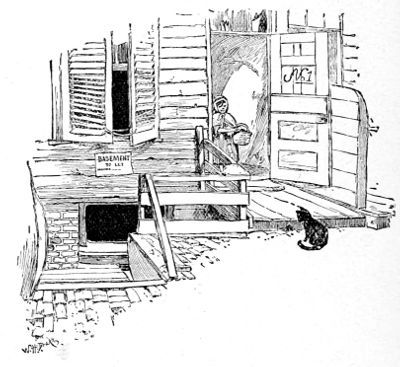
If his very poverty compels the tenant to live at a rate if not in a style that would beggar a Vanderbilt, paying four prices for everything he needs, from his rent and coal down to the smallest item in his housekeeping account, fashion, no less inexorable in the tenements than on the avenue, exacts of him that he must die in a style that is finally and utterly ruinous. The habit of expensive funerals—I know of no better classification for it than along with the opium habit and similar grievous plagues of mankind—is a distinctively Irish inheritance, but it has taken root among all classes of tenement dwellers, curiously enough most firmly among the Italians, who have taken amazingly to the funeral coach, perhaps because it furnishes the one opportunity of their lives for a really grand turn-out with a free ride thrown in. It is not at all uncommon to find the hoards of a whole lifetime of hard work and self denial squandered on the empty show of a ludicrous funeral parade and a display of flowers that ill comports with the humble life it is supposed to exalt. It is easier to understand the wake as a sort of consolation cup for the survivors for whom there is—as one of them, doubtless a heathenish pessimist, put it to me once—“no such luck.” The press and the pulpit have denounced the wasteful practice that often entails bitter want upon the relatives of the one buried with such pomp, but with little or no apparent result. Rather, the undertaker’s business prospers more than ever in the tenements since the genius of politics has seen its way clear to make capital out of the dead voter as well as of the living, by making him the means of a useful “show of strength” and count of noses.
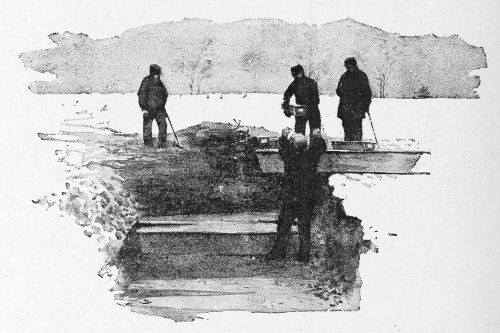
One free excursion awaits young and old whom bitter poverty has denied the poor privilege of the choice of the home in death they were denied in life, the ride up the Sound to the Potter’s Field, charitably styled the City Cemetery. But even there they do not escape their fate. In the common trench of the Poor Burying Ground they lie packed three stories deep, shoulder to shoulder, crowded in death as they were in life, to “save space;” for even on that desert island the ground is not for the exclusive possession of those who cannot afford to pay for it. There is an odd coincidence in this, that year by year the lives that are begun in the gutter, the little nameless waifs whom the police pick up and the city adopts as its wards, are balanced by the even more forlorn lives that are ended in the river. I do not know how or why it happens, or that it is more than a mere coincidence. But there it is. Year by year the balance is struck—a few more, a few less—substantially the same when the record is closed.
CHAPTER XV.
THE PROBLEM OF THE CHILDREN.
The problem of the children becomes, in these swarms, to the last degree perplexing. Their very number make one stand aghast. I have already given instances of the packing of the child population in East Side tenements. They might be continued indefinitely until the array would be enough to startle any community. For, be it remembered, these children with the training they receive—or do not receive—with the instincts they inherit and absorb in their growing up, are to be our future rulers, if our theory of government is worth anything. More than a working majority of our voters now register from the tenements. I counted the other day the little ones, up to ten years or so, in a Bayard Street tenement that for a yard has a triangular space in the centre with sides fourteen or fifteen feet long, just room enough for a row of ill-smelling closets at the base of the triangle and a hydrant at the apex. There was about as much light in this “yard” as in the average cellar. I gave up my self-imposed task in despair when I had counted one hundred and twenty-eight in forty families. Thirteen I had missed, or not found in. Applying the average for the forty to the whole fifty-three, the house contained one hundred and seventy children. It is not the only time I have had to give up such census work. I have in mind an alley—an inlet rather to a row of rear tenements—that is either two or four feet wide according as the wall of the crazy old building that gives on it bulges out or in. I tried to count the children that swarmed there, but could not. Sometimes I have doubted that anybody knows just how many there are about. Bodies of drowned children turn up in the rivers right along in summer whom no one seems to know anything about. When last spring some workmen, while moving a pile of lumber on a North River pier, found under the last plank the body of a little lad crushed to death, no one had missed a boy, though his parents afterward turned up. The truant officer assuredly does not know, though he spends his life trying to find out, somewhat illogically, perhaps, since the department that employs him admits that thousands of poor children are crowded out of the schools year by year for want of room. There was a big tenement in the Sixth Ward, now happily appropriated by the beneficent spirit of business that blots out so many foul spots in New York—it figured not long ago in the official reports as “an out-and-out hog-pen”—that had a record of one hundred and two arrests in four years among its four hundred and seventy-eight tenants, fifty-seven of them for drunken and disorderly conduct. I do not know how many children there were in it, but the inspector reported that he found only seven in the whole house who owned that they went to school. The rest gathered all the instruction they received running for beer for their elders. Some of them claimed the “flat” as their home as a mere matter of form. They slept in the streets at night. The official came upon a little party of four drinking beer out of the cover of a milk-can in the hallway. They were of the seven good boys and proved their claim to the title by offering him some.
The old question, what to do with the boy, assumes a new and serious phase in the tenements. Under the best conditions found there, it is not easily answered. In nine cases out of ten he would make an excellent mechanic, if trained early to work at a trade, for he is neither dull nor slow, but the short-sighted despotism of the trades unions has practically closed that avenue to him. Trade-schools, however excellent, cannot supply the opportunity thus denied him, and at the outset the boy stands condemned by his own to low and ill-paid drudgery, held down by the hand that of all should labor to raise him. Home, the greatest factor of all in the training of the young, means nothing to him but a pigeon-hole in a coop along with so many other human animals. Its influence is scarcely of the elevating kind, if it have any. The very games at which he takes a hand in the street become polluting in its atmosphere. With no steady hand to guide him, the boy takes naturally to idle ways. Caught in the street by the truant officer, or by the agents of the Children’s Societies, peddling, perhaps, or begging, to help out the family resources, he runs the risk of being sent to a reformatory, where contact with vicious boys older than himself soon develop the latent possibilities for evil that lie hidden in him. The city has no Truant Home in which to keep him, and all efforts of the children’s friends to enforce school attendance are paralyzed by this want. The risk of the reformatory is too great. What is done in the end is to let him take chances—with the chances all against him. The result is the rough young savage, familiar from the street. Rough as he is, if any one doubt that this child of common clay have in him the instinct of beauty, of love for the ideal of which his life has no embodiment, let him put the matter to the test. Let him take into a tenement block a handful of flowers from the fields and watch the brightened faces, the sudden abandonment of play and fight that go ever hand in hand where there is no elbow-room, the wild entreaty for “posies,” the eager love with which the little messengers of peace are shielded, once possessed; then let him change his mind. I have seen an armful of daisies keep the peace of a block better than a policeman and his club, seen instincts awaken under their gentle appeal, whose very existence the soil in which they grew made seem a mockery. I have not forgotten the deputation of ragamuffins from a Mulberry Street alley that knocked at my office door one morning on a mysterious expedition for flowers, not for themselves, but for “a lady,” and having obtained what they wanted, trooped off to bestow them, a ragged and dirty little band, with a solemnity that was quite unusual. It was not until an old man called the next day to thank me for the flowers that I found out they had decked the bier of a pauper, in the dark rear room where she lay waiting in her pine-board coffin for the city’s hearse. Yet, as I knew, that dismal alley with its bare brick walls, between which no sun ever rose or set, was the world of those children. It filled their young lives. Probably not one of them had ever been out of the sight of it. They were too dirty, too ragged, and too generally disreputable, too well hidden in their slum besides, to come into line with the Fresh Air summer boarders.
With such human instincts and cravings, forever unsatisfied, turned into a haunting curse; with appetite ground to keenest edge by a hunger that is never fed, the children of the poor grow up in joyless homes to lives of wearisome toil that claims them at an age when the play of their happier fellows has but just begun. Has a yard of turf been laid and a vine been coaxed to grow within their reach, they are banished and barred out from it as from a heaven that is not for such as they. I came upon a couple of youngsters in a Mulberry Street yard a while ago that were chalking on the fence their first lesson in “writin’.” And this is what they wrote: “Keeb of te Grass.” They had it by heart, for there was not, I verily believe, a green sod within a quarter of a mile. Home to them is an empty name. Pleasure? A gentleman once catechized a ragged class in a down-town public school on this point, and recorded the result: Out of forty-eight boys twenty had never seen the Brooklyn Bridge that was scarcely five minutes’ walk away, three only had been in Central Park, fifteen had known the joy of a ride in a horse-car. The street, with its ash-barrels and its dirt, the river that runs foul with mud, are their domain. What training they receive is picked up there. And they are apt pupils. If the mud and the dirt are easily reflected in their lives, what wonder? Scarce half-grown, such lads as these confront the world with the challenge to give them their due, too long withheld, or——. Our jails supply the answer to the alternative.
A little fellow who seemed clad in but a single rag was among the flotsam and jetsam stranded at Police Headquarters one day last summer. No one knew where he came from or where he belonged. The boy himself knew as little about it as anybody, and was the least anxious to have light shed on the subject after he had spent a night in the matron’s nursery. The discovery that beds were provided for boys to sleep in there, and that he could have “a whole egg” and three slices of bread for breakfast put him on the best of terms with the world in general, and he decided that Headquarters was “a bully place.” He sang “McGinty” all through, with Tenth Avenue variations, for the police, and then settled down to the serious business of giving an account of himself. The examination went on after this fashion:
“Where do you go to church, my boy?”
“We don’t have no clothes to go to church.” And indeed his appearance, as he was, in the door of any New York church would have caused a sensation.
“Well, where do you go to school, then?”
“I don’t go to school,” with a snort of contempt.
“Where do you buy your bread?”
“We don’t buy no bread; we buy beer,” said the boy, and it was eventually the saloon that led the police as a landmark to his “home.” It was worthy of the boy. As he had said, his only bed was a heap of dirty straw on the floor, his daily diet a crust in the morning, nothing else.
Into the rooms of the Children’s Aid Society were led two little girls whose father had “busted up the house” and put them on the street after their mother died. Another, who was turned out by her step-mother “because she had five of her own and could not afford to keep her,” could not remember ever having been in church or Sunday-school, and only knew the name of Jesus through hearing people swear by it. She had no idea what they meant. These were specimens of the overflow from the tenements of our home-heathen that are growing up in New York’s streets to-day, while tender-hearted men and women are busying themselves with the socks and the hereafter of well-fed little Hottentots thousands of miles away. According to Canon Taylor, of York, one hundred and nine missionaries in the four fields of Persia, Palestine, Arabia, and Egypt spent one year and sixty thousand dollars in converting one little heathen girl. If there is nothing the matter with those missionaries, they might come to New York with a good deal better prospect of success.
By those who lay flattering unction to their souls in the knowledge that to-day New York has, at all events, no brood of the gutters of tender years that can be homeless long unheeded, let it be remembered well through what effort this judgment has been averted. In thirty-seven years the Children’s Aid Society, that came into existence as an emphatic protest against the tenement corruption of the young, has sheltered quite three hundred thousand outcast, homeless, and orphaned children in its lodging-houses, and has found homes in the West for seventy thousand that had none. Doubtless, as a mere stroke of finance, the five millions and a half thus spent were a wiser investment than to have let them grow up thieves and thugs. In the last fifteen years of this tireless battle for the safety of the State the intervention of the Society for the Prevention of Cruelty to Children has been invoked for 138,891 little ones: it has thrown its protection around more than twenty-five thousand helpless children, and has convicted nearly sixteen thousand wretches of child-beating and abuse. Add to this the standing army of fifteen thousand dependent children in New York’s asylums and institutions, and some idea is gained of the crop that is garnered day by day in the tenements, of the enormous force employed to check their inroads on our social life, and of the cause for apprehension that would exist did their efforts flag for ever so brief a time.
Nothing is now better understood than that the rescue of the children is the key to the problem of city poverty, as presented for our solution to-day: that character may be formed where to reform it would be a hopeless task. The concurrent testimony of all who have to undertake it at a later stage: that the young are naturally neither vicious nor hardened, simply weak and undeveloped, except by the bad influences of the street, makes this duty all the more urgent as well as hopeful. Helping hands are held out on every side. To private charity the municipality leaves the entire care of its proletariat of tender years, lulling its conscience to sleep with liberal appropriations of money to foot the bills. Indeed, it is held by those whose opinions are entitled to weight that it is far too liberal a paymaster for its own best interests and those of its wards. It deals with the evil in the seed to a limited extent in gathering in the outcast babies from the streets. To the ripe fruit the gates of its prisons, its reformatories, and its workhouses are opened wide the year round. What the showing would be at this end of the line were it not for the barriers wise charity has thrown across the broad highway to ruin—is building day by day—may be measured by such results as those quoted above in the span of a single life.
CHAPTER XVI.
WAIFS OF THE CITY’S SLUMS.
First among these barriers is the Foundling Asylum. It stands at the very outset of the waste of life that goes on in a population of nearly two millions of people; powerless to prevent it, though it gather in the outcasts by night and by day. In a score of years an army of twenty-five thousand of these forlorn little waifs have cried out from the streets of New York in arraignment of a Christian civilization under the blessings of which the instinct of motherhood even was smothered by poverty and want. Only the poor abandon their children. The stories of richly-dressed foundlings that are dished up in the newspapers at intervals are pure fiction. Not one instance of even a well-dressed infant having been picked up in the streets is on record. They come in rags, a newspaper often the only wrap, semi-occasionally one in a clean slip with some evidence of loving care; a little slip of paper pinned on, perhaps, with some such message as this I once read, in a woman’s trembling hand: “Take care of Johnny, for God’s sake. I cannot.” But even that is the rarest of all happenings.
The city divides with the Sisters of Charity the task of gathering them in. The real foundlings, the children of the gutter that are picked up by the police, are the city’s wards. In midwinter, when the poor shiver in their homes, and in the dog-days when the fierce heat and foul air of the tenements smother their babies by thousands, they are found, sometimes three and four in a night, in hallways, in areas and on the doorsteps of the rich, with whose comfort in luxurious homes the wretched mother somehow connects her own misery. Perhaps, as the drowning man clutches at a straw, she hopes that these happier hearts may have love to spare even for her little one. In this she is mistaken. Unauthorized babies especially are not popular in the abodes of the wealthy. It never happens outside of the story-books that a baby so deserted finds home and friends at once. Its career, though rather more official, is less romantic, and generally brief. After a night spent at Police Headquarters it travels up to the Infants’ Hospital on Randall’s Island in the morning, fitted out with a number and a bottle, that seldom see much wear before they are laid aside for a fresh recruit. Few outcast babies survive their desertion long. Murder is the true name of the mother’s crime in eight cases out of ten. Of 508 babies received at the Randall’s Island Hospital last year 333 died, 65.55 per cent. But of the 508 only 170 were picked up in the streets, and among these the mortality was much greater, probably nearer ninety per cent., if the truth were told. The rest were born in the hospitals. The high mortality among the foundlings is not to be marvelled at. The wonder is, rather, that any survive. The stormier the night, the more certain is the police nursery to echo with the feeble cries of abandoned babes. Often they come half dead from exposure. One live baby came in a little pine coffin which a policeman found an inhuman wretch trying to bury in an up-town lot. But many do not live to be officially registered as a charge upon the county. Seventy-two dead babies were picked up in the streets last year. Some of them were doubtless put out by very poor parents to save funeral expenses. In hard times the number of dead and live foundlings always increases very noticeably. But whether travelling by way of the Morgue or the Infants’ Hospital, the little army of waifs meets, reunited soon, in the trench in the Potter’s Field where, if no medical student is in need of a subject, they are laid in squads of a dozen.
Most of the foundlings come from the East Side, where they are left by young mothers without wedding-rings or other name than their own to bestow upon the baby, returning from the island hospital to face an unpitying world with the evidence of their shame. Not infrequently they wear the bed-tick regimentals of the Public Charities, and thus their origin is easily enough traced. Oftener no ray of light penetrates the gloom, and no effort is made to probe the mystery of sin and sorrow. This also is the policy pursued in the great Foundling Asylum of the Sisters of Charity in Sixty-eighth Street, known all over the world as Sister Irene’s Asylum. Years ago the crib that now stands just inside the street door, under the great main portal, was placed outside at night; but it filled up too rapidly. The babies took to coming in little squads instead of in single file, and in self-defence the sisters were forced to take the cradle in. Now the mother must bring her child inside and put it in the crib where she is seen by the sister on guard. No effort is made to question her, or discover the child’s antecedents, but she is asked to stay and nurse her own and another baby. If she refuses, she is allowed to depart unhindered. If willing, she enters at once into the great family of the good Sister who in twenty-one years has gathered as many thousand homeless babies into her fold. One was brought in when I was last in the asylum, in the middle of July, that received in its crib the number 20715. The death-rate is of course lowered a good deal where exposure of the child is prevented. Among the eleven hundred infants in the asylum it was something over nineteen per cent. last year; but among those actually received in the twelvemonth nearer twice that figure. Even the nineteen per cent., remarkably low for a Foundling Asylum, was equal to the startling death-rate of Gotham Court in the cholera scourge.
Four hundred and sixty mothers, who could not or would not keep their own babies, did voluntary penance for their sin in the asylum last year by nursing a strange waif besides their own until both should be strong enough to take their chances in life’s battle. An even larger number than the eleven hundred were “pay babies,” put out to be nursed by “mothers” outside the asylum. The money thus earned pays the rent of hundreds of poor families. It is no trifle, quite half of the quarter of a million dollars contributed annually by the city for the support of the asylum. The procession of these nurse-mothers, when they come to the asylum on the first Wednesday of each month to receive their pay and have the babies inspected by the sisters, is one of the sights of the city. The nurses, who are under strict supervision, grow to love their little charges and part from them with tears when, at the age of four or five, they are sent to Western homes to be adopted. The sisters carefully encourage the home-feeling in the child as their strongest ally in seeking its mental and moral elevation, and the toddlers depart happy to join their “papas and mammas” in the far-away, unknown home.
An infinitely more fiendish, if to surface appearances less deliberate, plan of child-murder than desertion has flourished in New York for years under the title of baby-farming. The name, put into plain English, means starving babies to death. The law has fought this most heinous of crimes by compelling the registry of all baby-farms. As well might it require all persons intending murder to register their purpose with time and place of the deed under the penalty of exemplary fines. Murderers do not hang out a shingle. “Baby-farms,” said once Mr. Elbridge T. Gerry, the President of the Society charged with the execution of the law that was passed through his efforts, “are concerns by means of which persons, usually of disreputable character, eke out a living by taking two, or three, or four babies to board. They are the charges of outcasts, or illegitimate children. They feed them on sour milk, and give them paregoric to keep them quiet, until they die, when they get some young medical man without experience to sign a certificate to the Board of Health that the child died of inanition, and so the matter ends. The baby is dead, and there is no one to complain.” A handful of baby-farms have been registered and licensed by the Board of Health with the approval of the Society for the Prevention of Cruelty to Children in the last five years, but none of this kind. The devil keeps the only complete register to be found anywhere. Their trace is found oftenest by the coroner or the police; sometimes they may be discovered hiding in the advertising columns of certain newspapers, under the guise of the scarcely less heartless traffic in helpless children that is dignified with the pretence of adoption—for cash. An idea of how this scheme works was obtained through the disclosures in a celebrated divorce case, a year or two ago. The society has among its records a very recent case[18] of a baby a week old (Baby “Blue Eyes”) that was offered for sale—adoption, the dealer called it—in a newspaper. The agent bought it after some haggling for a dollar, and arrested the woman slave-trader; but the law was powerless to punish her for her crime. Twelve unfortunate women awaiting dishonored motherhood were found in her house.
One gets a glimpse of the frightful depths to which human nature, perverted by avarice bred of ignorance and rasping poverty, can descend, in the mere suggestion of systematic insurance for profit of children’s lives. A woman was put on trial in this city last year for incredible cruelty in her treatment of a step-child. The evidence aroused a strong suspicion that a pitifully small amount of insurance on the child’s life was one of the motives for the woman’s savagery. A little investigation brought out the fact that three companies that were in the business of insuring children’s lives, for sums varying from $17 up, had issued not less than a million such policies! The premiums ranged from five to twenty-five cents a week. What untold horrors this business may conceal was suggested by a formal agreement entered into by some of the companies, “for the purpose of preventing speculation in the insurance of children’s lives.” By the terms of this compact, “no higher premium than ten cents could be accepted on children under six years old.” Barbarism forsooth! Did ever heathen cruelty invent a more fiendish plot than the one written down between the lines of this legal paper?
It is with a sense of glad relief that one turns from this misery to the brighter page of the helping hands stretched forth on every side to save the young and the helpless. New York is, I firmly believe, the most charitable city in the world. Nowhere is there so eager a readiness to help, when it is known that help is worthily wanted; nowhere are such armies of devoted workers, nowhere such abundance of means ready to the hand of those who know the need and how rightly to supply it. Its poverty, its slums, and its suffering are the result of unprecedented growth with the consequent disorder and crowding, and the common penalty of metropolitan greatness. If the structure shows signs of being top-heavy, evidences are not wanting—they are multiplying day by day—that patient toilers are at work among the underpinnings. The Day Nurseries, the numberless Kindergartens and charitable schools in the poor quarters, the Fresh Air Funds, the thousand and one charities that in one way or another reach the homes and the lives of the poor with sweetening touch, are proof that if much is yet to be done, if the need only grows with the effort, hearts and hands will be found to do it in ever-increasing measure. Black as the cloud is it has a silver lining, bright with promise. New York is to-day a hundredfold cleaner, better, purer, city than it was even ten years ago.
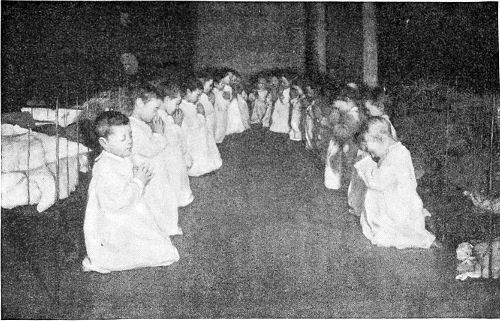
Two powerful agents that were among the pioneers in this work of moral and physical regeneration stand in Paradise Park to-day as milestones on the rocky, uphill road. The handful of noble women, who braved the foul depravity of the Old Brewery to rescue its child victims, rolled away the first and heaviest bowlder, which legislatures and city councils had tackled in vain. The Five Points Mission and the Five Points House of Industry have accomplished what no machinery of government availed to do. Sixty thousand children have been rescued by them from the streets and had their little feet set in the better way. Their work still goes on, increasing and gathering in the waifs, instructing and feeding them, and helping their parents with advice and more substantial aid. Their charity knows not creed or nationality. The House of Industry is an enormous nursery-school with an average of more than four hundred day scholars and constant boarders—“outsiders” and “insiders.” Its influence is felt for many blocks around in that crowded part of the city. It is one of the most touching sights in the world to see a score of babies, rescued from homes of brutality and desolation, where no other blessing than a drunken curse was ever heard, saying their prayers in the nursery at bedtime. Too often their white night-gowns hide tortured little bodies and limbs cruelly bruised by inhuman hands. In the shelter of this fold they are safe, and a happier little group one may seek long and far in vain.
CHAPTER XVII.
THE STREET ARAB.
Not all the barriers erected by society against its nether life, not the labor of unnumbered societies for the rescue and relief of its outcast waifs, can dam the stream of homelessness that issues from a source where the very name of home is a mockery. The Street Arab is as much of an institution in New York as Newspaper Row, to which he gravitates naturally, following his Bohemian instinct. Crowded out of the tenements to shift for himself, and quite ready to do it, he meets there the host of adventurous runaways from every State in the Union and from across the sea, whom New York attracts with a queer fascination, as it attracts the older emigrants from all parts of the world. A census of the population in the Newsboys’ Lodging-house on any night will show such an odd mixture of small humanity as could hardly be got together in any other spot. It is a mistake to think that they are helpless little creatures, to be pitied and cried over because they are alone in the world. The unmerciful “guying” the good man would receive, who went to them with such a programme, would soon convince him that that sort of pity was wasted, and would very likely give him the idea that they were a set of hardened little scoundrels, quite beyond the reach of missionary effort.
But that would only be his second mistake. The Street Arab has all the faults and all the virtues of the lawless life he leads. Vagabond that he is, acknowledging no authority and owing no allegiance to anybody or anything, with his grimy fist raised against society whenever it tries to coerce him, he is as bright and sharp as the weasel, which, among all the predatory beasts, he most resembles. His sturdy independence, love of freedom and absolute self-reliance, together with his rude sense of justice that enables him to govern his little community, not always in accordance with municipal law or city ordinances, but often a good deal closer to the saving line of “doing to others as one would be done by”—these are strong handles by which those who know how can catch the boy and make him useful. Successful bankers, clergymen, and lawyers all over the country, statesmen in some instances of national repute, bear evidence in their lives to the potency of such missionary efforts. There is scarcely a learned profession, or branch of honorable business, that has not in the last twenty years borrowed some of its brightest light from the poverty and gloom of New York’s streets.
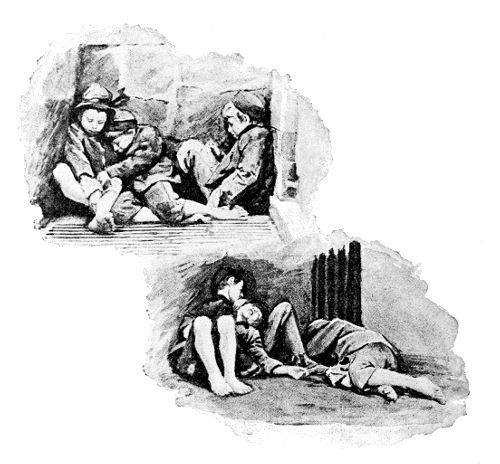
Anyone, whom business or curiosity has taken through Park Row or across Printing House Square in the midnight hour, when the air is filled with the roar of great presses spinning with printers’ ink on endless rolls of white paper the history of the world in the twenty-four hours that have just passed away, has seen little groups of these boys hanging about the newspaper offices; in winter, when snow is on the streets, fighting for warm spots around the grated vent-holes that let out the heat and steam from the underground press-rooms with their noise and clatter, and in summer playing craps and 7-11 on the curb for their hard-earned pennies, with all the absorbing concern of hardened gamblers. This is their beat. Here the agent of the Society for the Prevention of Cruelty to Children finds those he thinks too young for “business,” but does not always capture them. Like rabbits in their burrows, the little ragamuffins sleep with at least one eye open, and every sense alert to the approach of danger: of their enemy, the policeman, whose chief business in life is to move them on, and of the agent bent on robbing them of their cherished freedom. At the first warning shout they scatter and are off. To pursue them would be like chasing the fleet-footed mountain goat in his rocky fastnesses. There is not an open door, a hidden turn or runway which they do not know, with lots of secret passages and short cuts no one else ever found. To steal a march on them is the only way. There is a coal chute from the sidewalk to the boiler-room in the sub-cellar of the Post Office which the Society’s officer found the boys had made into a sort of toboggan slide to a snug berth in wintry weather. They used to slyly raise the cover in the street, slide down in single file, and snuggle up to the warm boiler out of harm’s way, as they thought. It proved a trap, however. The agent slid down himself one cold night—there was no other way of getting there—and, landing right in the midst of the sleeping colony, had it at his mercy. After repeated raids upon their headquarters, the boys forsook it last summer, and were next found herding under the shore-end of one of the East River banana docks, where they had fitted up a regular club-room that was shared by thirty or forty homeless boys and about a million rats.
Newspaper Row is merely their headquarters. They are to be found all over the city, these Street Arabs, where the neighborhood offers a chance of picking up a living in the daytime and of “turning in” at night with a promise of security from surprise. In warm weather a truck in the street, a convenient out-house, or a dug-out in a hay-barge at the wharf make good bunks. Two were found making their nest once in the end of a big iron pipe up by the Harlem Bridge, and an old boiler at the East River served as an elegant flat for another couple, who kept house there with a thief the police had long sought, little suspecting that he was hiding under their very noses for months together. When the Children’s Aid Society first opened its lodging-houses, and with some difficulty persuaded the boys that their charity was no “pious dodge” to trap them into a treasonable “Sunday-school racket,” its managers overheard a laughable discussion among the boys in their unwontedly comfortable beds—perhaps the first some of them had ever slept in—as to the relative merits of the different styles of their everyday berths. Preferences were divided between the steam-grating and a sand-box; but the weight of the evidence was decided to be in favor of the sand-box, because, as its advocate put it, “you could curl all up in it.” The new “find” was voted a good way ahead of any previous experience, however. “My eyes, ain’t it nice!” said one of the lads, tucked in under his blanket up to the chin, and the roomful of boys echoed the sentiment. The compact silently made that night between the Street Arabs and their hosts has never been broken. They have been fast friends ever since.
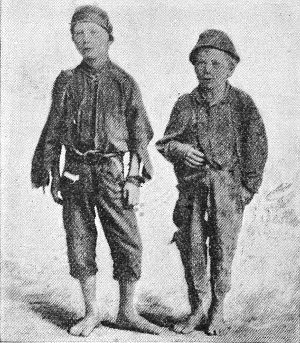
Whence this army of homeless boys? is a question often asked. The answer is supplied by the procession of mothers that go out and in at Police Headquarters the year round, inquiring for missing boys, often not until they have been gone for weeks and months, and then sometimes rather as a matter of decent form than from any real interest in the lad’s fate. The stereotyped promise of the clerks who fail to find his name on the books among the arrests, that he “will come back when he gets hungry,” does not always come true. More likely he went away because he was hungry. Some are orphans, actually or in effect, thrown upon the world when their parents were “sent up” to the island or to Sing Sing, and somehow overlooked by the “Society,” which thenceforth became the enemy to be shunned until growth and dirt and the hardships of the street, that make old early, offer some hope of successfully floating the lie that they are “sixteen.” A drunken father explains the matter in other cases, as in that of John and Willie, aged ten and eight, picked up by the police. They “didn’t live nowhere,” never went to school, could neither read nor write. Their twelve-year-old sister kept house for the father, who turned the boys out to beg, or steal, or starve. Grinding poverty and hard work beyond the years of the lad; blows and curses for breakfast, dinner, and supper; all these are recruiting agents for the homeless army. Sickness in the house, too many mouths to feed:
“We wuz six,” said an urchin of twelve or thirteen I came across in the Newsboys’ Lodging House, “and we ain’t got no father. Some on us had to go.” And so he went, to make a living by blacking boots. The going is easy enough. There is very little to hold the boy who has never known anything but a home in a tenement. Very soon the wild life in the streets holds him fast, and thenceforward by his own effort there is no escape. Left alone to himself, he soon enough finds a place in the police books, and there would be no other answer to the second question: “what becomes of the boy?” than that given by the criminal courts every day in the week.
But he is not left alone. Society in our day has no such suicidal intention. Right here, at the parting of the ways, it has thrown up the strongest of all its defences for itself and for the boy. What the Society for the Prevention of Cruelty to Children is to the baby-waif, the Children’s Aid Society is to the homeless boy at this real turning-point in his career. The good it has done cannot easily be over-estimated. Its lodging-houses, its schools and its homes block every avenue of escape with their offer of shelter upon terms which the boy soon accepts, as on the whole cheap and fair. In the great Duane Street lodging-house for newsboys, they are succinctly stated in a “notice” over the door that reads thus: “Boys who swear and chew tobacco cannot sleep here.” There is another unwritten condition, viz.: that the boy shall be really without a home; but upon this the managers wisely do not insist too obstinately, accepting without too close inquiry his account of himself where that seems advisable, well knowing that many a home that sends forth such lads far less deserves the name than the one they are able to give them.
With these simple preliminaries the outcast boy may enter. Rags do not count; to ignorance the door is only opened wider. Dirt does not survive long, once within the walls of the lodging-house. It is the settled belief of the men who conduct them that soap and water are as powerful moral agents in their particular field as preaching, and they have experience to back them. The boy may come and go as he pleases, so long as he behaves himself. No restraint of any sort is put on his independence. He is as free as any other guest at a hotel, and, like him, he is expected to pay for what he gets. How wisely the men planned who laid the foundation of this great rescue work and yet carry it on, is shown by no single feature of it better than by this. No pauper was ever bred within these houses. Nothing would have been easier with such material, or more fatal. But charity of the kind that pauperizes is furthest from their scheme. Self-help is its very key-note, and it strikes a response in the boy’s sturdiest trait that raises him at once to a level with the effort made in his behalf. Recognized as an independent trader, capable of and bound to take care of himself, he is in a position to ask trust if trade has gone against him and he cannot pay cash for his “grub” and his bed, and to get it without question. He can even have the loan of the small capital required to start him in business with a boot-black’s kit, or an armful of papers, if he is known or vouched for; but every cent is charged to him as carefully as though the transaction involved as many hundreds of dollars, and he is expected to pay back the money as soon as he has made enough to keep him going without it. He very rarely betrays the trust reposed in him. Quite on the contrary, around this sound core of self-help, thus encouraged, habits of thrift and ambitious industry are seen to grow up in a majority of instances. The boy is “growing” a character, and he goes out to the man’s work in life with that which for him is better than if he had found a fortune.
Six cents for his bed, six for his breakfast of bread and coffee, and six for his supper of pork and beans, as much as he can eat, are the rates of the boys’ “hotel” for those who bunk together in the great dormitories that sometimes hold more than a hundred berths, two tiers high, made of iron, clean and neat. For the “upper ten,” the young financiers who early take the lead among their fellows, hire them to work for wages and add a share of their profits to their own, and for the lads who are learning a trade and getting paid by the week, there are ten-cent beds with a locker and with curtains hung about. Night schools and Sunday night meetings are held in the building and are always well attended, in winter especially, when the lodging-houses are crowded. In summer the tow-path and the country attract their share of the bigger boys. The “Sunday-school racket” has ceased to have terror for them. They follow the proceedings with the liveliest interest, quick to detect cant of any sort, should any stray in. No one has any just conception of what congregational singing is until he has witnessed a roomful of these boys roll up their sleeves and start in on “I am a lily of the valley.” The swinging trapeze in the gymnasium on the top floor is scarcely more popular with the boys than this tremendously vocal worship. The Street Arab puts his whole little soul into what interests him for the moment, whether it be pulverizing a rival who has done a mean trick to a smaller boy, or attending at the “gospel shop” on Sundays. This characteristic made necessary some extra supervision when recently the lads in the Duane Street Lodging House “chipped in” and bought a set of boxing gloves. The trapeze suffered a temporary eclipse until this new toy had been tested to the extent of several miniature black eyes upon which soap had no effect, and sundry little scores had been settled that evened things up, as it were, for a fresh start.
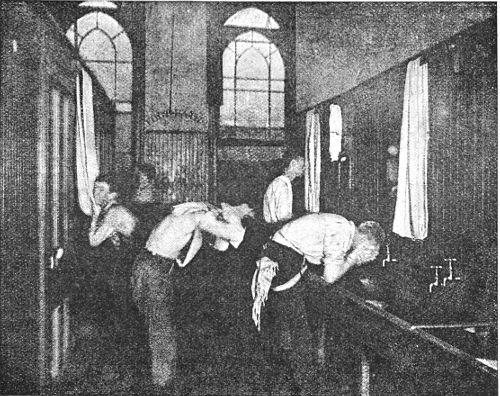
I tried one night, not with the best of success I confess, to photograph the boys in their wash-room, while they were cleaning up for supper. They were quite turbulent, to the disgust of one of their number who assumed, unasked, the office of general manager of the show, and expressed his mortification to me in very polite language. “If they would only behave, sir!” he complained, “you could make a good picture.”
“Yes,” I said, “but it isn’t in them, I suppose.”
“No, b’gosh!” said he, lapsing suddenly from grace under the provocation, “them kids ain’t got no sense, nohow!”
The Society maintains five of these boys’ lodging houses, and one for girls, in the city. The Duane Street Lodging House alone has sheltered since its foundation in 1855 nearly a quarter of a million different boys, at a total expense of a good deal less than half a million dollars. Of this amount, up to the beginning of the present year, the boys and the earnings of the house had contributed no less than $172,776.38. In all of the lodging-houses together, 12,153 boys and girls were sheltered and taught last year. The boys saved up no inconsiderable amount of money in the savings banks provided for them in the houses, a simple system of lock-boxes that are emptied for their benefit once a month. Besides these, the Society has established and operates in the tenement districts twenty-one industrial schools, co-ordinate with the public schools in authority, for the children of the poor who cannot find room in the city’s school-houses, or are too ragged to go there; two free reading-rooms, a dressmaking and typewriting school and a laundry for the instruction of girls; a sick-children’s mission in the city and two on the sea-shore, where poor mothers may take their babies; a cottage by the sea for crippled girls, and a brush factory for crippled boys in Forty-fourth Street. The Italian school in Leonard Street, alone, had an average attendance of over six hundred pupils last year. The daily average attendance at all of them was 4,105, while 11,331 children were registered and taught. When the fact that there were among these 1,132 children of drunken parents, and 416 that had been found begging in the street, is contrasted with the showing of $1,337.21 deposited in the school savings banks by 1,745 pupils, something like an adequate idea is gained of the scope of the Society’s work in the city.
A large share of it, in a sense the largest, certainly that productive of the happiest results, lies outside of the city, however. From the lodging-houses and the schools are drawn the battalions of young emigrants that go every year to homes in the Far West, to grow up self-supporting men and women safe from the temptations and the vice of the city. Their number runs far up in the thousands. The Society never loses sight of them. The records show that the great mass, with this start given them, become useful citizens, an honor to the communities in which their lot is cast. Not a few achieve place and prominence in their new surroundings. Rarely bad reports come of them. Occasionally one comes back, lured by homesickness even for the slums; but the briefest stay generally cures the disease for good. I helped once to see a party off for Michigan, the last sent out by that great friend of the homeless children, Mrs. Astor, before she died. In the party was a boy who had been an “Insider” at the Five Points House of Industry, and brought along as his only baggage a padlocked and iron-bound box that contained all his wealth, two little white mice of the friendliest disposition. They were going with him out to live on the fat of the land in the fertile West, where they would never be wanting for a crust. Alas! for the best-laid plans of mice and men. The Western diet did not agree with either. I saw their owner some months later in the old home at the Five Points. He had come back, walking part of the way, and was now pleading to be sent out once more. He had at last had enough of the city. His face fell when I asked him about the mice. It was a sad story, indeed. “They had so much corn to eat,” he said, “and they couldn’t stand it. They burned all up inside, and then they busted.”
Mrs. Astor set an example during her noble and useful life in gathering every year a company of homeless boys from the streets and sending them to good homes, with decent clothes on their backs—she had sent out no less than thirteen hundred when she died, and left funds to carry on her work—that has been followed by many who, like her, had the means and the heart for such a labor of love. Most of the lodging-houses and school-buildings of the society were built by some one rich man or woman who paid all the bills, and often objected to have even the name of the giver made known to the world. It is one of the pleasant experiences of life that give one hope and courage in the midst of all this misery to find names, that stand to the unthinking mass only for money-getting and grasping, associated with such unheralded benefactions that carry their blessings down to generations yet unborn. It is not so long since I found the carriage of a woman, whose name is synonymous with millions, standing in front of the boys’ lodging-house in Thirty-fifth Street. Its owner was at that moment busy with a surgeon making a census of the crippled lads in the brush-shop, the most miserable of all the Society’s charges, as a preliminary to fitting them out with artificial limbs.
Farther uptown than any reared by the Children’s Aid Society, in Sixty-seventh Street, stands a lodging-house intended for boys of a somewhat larger growth than most of those whom the Society shelters. Unlike the others, too, it was built by the actual labor of the young men it was designed to benefit. In the day when more of the boys from our streets shall find their way to it and to the New York Trade Schools, of which it is a kind of home annex, we shall be in a fair way of solving in the most natural of all ways the question what to do with this boy, in spite of the ignorant opposition of the men whose tyrannical policy is now to blame for the showing that, out of twenty-three millions of dollars paid annually to mechanics in the building trades in this city, less than six millions go to the workman born in New York, while his boy roams the streets with every chance of growing up a vagabond and next to none of becoming an honest artisan. Colonel Auchmuty is a practical philanthropist to whom the growing youth of New York will one day owe a debt of gratitude not easily paid. The progress of the system of trade schools established by him, at which a young man may acquire the theory as well as the practice of a trade in a few months at a merely nominal outlay, has not been nearly as rapid as was to be desired, though the fact that other cities are copying the model, with their master mechanics as the prime movers in the enterprise, testifies to its excellence. But it has at last taken a real start, and with union men and even the officers of unions now sending their sons to the trade schools to be taught,[19] one may perhaps be permitted to hope that an era of better sense is dawning that shall witness a rescue work upon lines which, when the leaven has fairly had time to work, will put an end to the existence of the New York Street Arab, of the native breed at least.
CHAPTER XVIII.
THE REIGN OF RUM.
Where God builds a church the devil builds next door—a saloon, is an old saying that has lost its point in New York. Either the devil was on the ground first, or he has been doing a good deal more in the way of building. I tried once to find out how the account stood, and counted to 111 Protestant churches, chapels, and places of worship of every kind below Fourteenth Street, 4,065 saloons. The worst half of the tenement population lives down there, and it has to this day the worst half of the saloons. Uptown the account stands a little better, but there are easily ten saloons to every church to-day. I am afraid, too, that the congregations are larger by a good deal; certainly the attendance is steadier and the contributions more liberal the week round, Sunday included. Turn and twist it as we may, over against every bulwark for decency and morality which society erects, the saloon projects its colossal shadow, omen of evil wherever it falls into the lives of the poor.
Nowhere is its mark so broad or so black. To their misery it sticketh closer than a brother, persuading them that within its doors only is refuge, relief. It has the best of the argument, too, for it is true, worse pity, that in many a tenement-house block the saloon is the one bright and cheery and humanly decent spot to be found. It is a sorry admission to make, that to bring the rest of the neighborhood up to the level of the saloon would be one way of squelching it; but it is so. Wherever the tenements thicken, it multiplies. Upon the direst poverty of their crowds it grows fat and prosperous, levying upon it a tax heavier than all the rest of its grievous burdens combined. It is not yet two years since the Excise Board made the rule that no three corners of any street-crossing, not already so occupied, should thenceforward be licensed for rum-selling. And the tardy prohibition was intended for the tenement districts. Nowhere else is there need of it. One may walk many miles through the homes of the poor searching vainly for an open reading-room, a cheerful coffee-house, a decent club that is not a cloak for the traffic in rum. The dramshop yawns at every step, the poor man’s club, his forum and his haven of rest when weary and disgusted with the crowding, the quarrelling, and the wretchedness at home. With the poison dealt out there he takes his politics, in quality not far apart. As the source, so the stream. The rumshop turns the political crank in New York. The natural yield is rum politics. Of what that means, successive Boards of Aldermen, composed in a measure, if not of a majority, of dive-keepers, have given New York a taste. The disgrace of the infamous “Boodle Board” will be remembered until some corruption even fouler crops out and throws it into the shade.
What relation the saloon bears to the crowds, let me illustrate by a comparison. Below Fourteenth Street were, when the Health Department took its first accurate census of the tenements a year and a half ago, 13,220 of the 32,390 buildings classed as such in the whole city. Of the eleven hundred thousand tenants, not quite half a million, embracing a host of more than sixty-three thousand children under five years of age, lived below that line. Below it, also, were 234 of the cheap lodging-houses accounted for by the police last year, with a total of four millions and a half of lodgers for the twelvemonth, 59 of the city’s 110 pawnshops, and 4,065 of its 7,884 saloons. The four most densely peopled precincts, the Fourth, Sixth, Tenth, and Eleventh, supported together in round numbers twelve hundred saloons, and their returns showed twenty-seven per cent. of the whole number of arrests for the year. The Eleventh Precinct, that has the greatest and the poorest crowds of all—it is the Tenth Ward—and harbored one-third of the army of homeless lodgers and fourteen per cent. of all the prisoners of the year, kept 485 saloons going in 1889. It is not on record that one of them all failed for want of support. A number of them, on the contrary, had brought their owners wealth and prominence. From their bars these eminent citizens stepped proudly into the councils of the city and the State. The very floor of one of the bar-rooms, in a neighborhood that lately resounded with the cry for bread of starving workmen, is paved with silver dollars!
East Side poverty is not alone in thus rewarding the tyrants that sweeten its cup of bitterness with their treacherous poison. The Fourth Ward points with pride to the honorable record of the conductors of its “Tub of Blood,” and a dozen bar-rooms with less startling titles; the West Side to the wealth and “social” standing of the owners of such resorts as the “Witches’ Broth” and the “Plug Hat” in the region of Hell’s Kitchen three-cent whiskey, names ominous of the concoctions brewed there and of their fatally generous measure. Another ward, that boasts some of the best residences and the bluest blood on Manhattan Island, honors with political leadership in the ruling party the proprietor of one of the most disreputable Black-and-Tan dives and dancing-hells to be found anywhere. Criminals and policemen alike do him homage. The list might be strung out to make texts for sermons with a stronger home flavor than many that are preached in our pulpits on Sunday. But I have not set out to write the political history of New York. Besides, the list would not be complete. Secret dives are skulking in the slums and out of them, that are not labelled respectable by a Board of Excise and support no “family entrance.” Their business, like that of the stale-beer dives, is done through a side-door the week through. No one knows the number of unlicensed saloons in the city. Those who have made the matter a study estimate it at a thousand, more or less. The police make occasional schedules of a few and report them to headquarters. Perhaps there is a farce in the police court, and there the matter ends. Rum and “influence” are synonymous terms. The interests of the one rarely suffer for the want of attention from the other.