
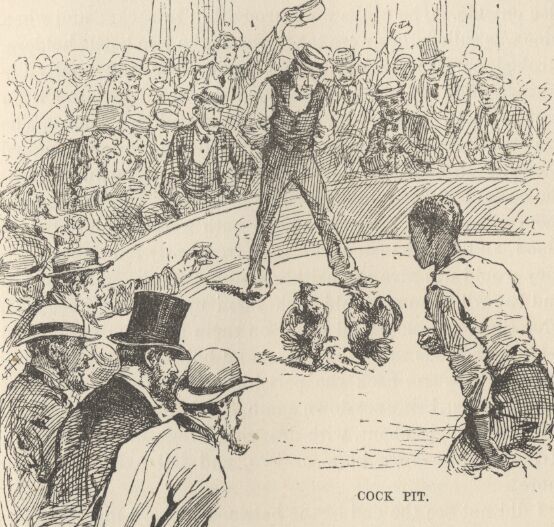
A negro and a white man were in the ring; everybody else outside. The cocks were brought in in sacks; and when time was called, they were taken out by the two bottle-holders, stroked, caressed, poked toward each other, and finally liberated. The big black cock plunged instantly at the little gray one and struck him on the head with his spur. The gray responded with spirit. Then the Babel of many-tongued shoutings broke out, and ceased not thenceforth. When the cocks had been fighting some little time, I was expecting them momently to drop dead, for both were blind, red with blood, and so exhausted that they frequently fell down. Yet they would not give up, neither would they die. The negro and the white man would pick them up every few seconds, wipe them off, blow cold water on them in a fine spray, and take their heads in their mouths and hold them there a moment—to warm back the perishing life perhaps; I do not know. Then, being set down again, the dying creatures would totter gropingly about, with dragging wings, find each other, strike a guesswork blow or two, and fall exhausted once more.
I did not see the end of the battle. I forced myself to endure it as long as I could, but it was too pitiful a sight; so I made frank confession to that effect, and we retired. We heard afterward that the black cock died in the ring, and fighting to the last.
Evidently there is abundant fascination about this 'sport' for such as have had a degree of familiarity with it. I never saw people enjoy anything more than this gathering enjoyed this fight. The case was the same with old gray-heads and with boys of ten. They lost themselves in frenzies of delight. The 'cocking-main' is an inhuman sort of entertainment, there is no question about that; still, it seems a much more respectable and far less cruel sport than fox-hunting—for the cocks like it; they experience, as well as confer enjoyment; which is not the fox's case.
We assisted—in the French sense—at a mule race, one day. I believe I enjoyed this contest more than any other mule there. I enjoyed it more than I remember having enjoyed any other animal race I ever saw. The grand-stand was well filled with the beauty and the chivalry of New Orleans. That phrase is not original with me. It is the Southern reporter's. He has used it for two generations. He uses it twenty times a day, or twenty thousand times a day; or a million times a day—according to the exigencies. He is obliged to use it a million times a day, if he have occasion to speak of respectable men and women that often; for he has no other phrase for such service except that single one. He never tires of it; it always has a fine sound to him. There is a kind of swell medieval bulliness and tinsel about it that pleases his gaudy barbaric soul. If he had been in Palestine in the early times, we should have had no references to 'much people' out of him. No, he would have said 'the beauty and the chivalry of Galilee' assembled to hear the Sermon on the Mount. It is likely that the men and women of the South are sick enough of that phrase by this time, and would like a change, but there is no immediate prospect of their getting it.
The New Orleans editor has a strong, compact, direct, unflowery style; wastes no words, and does not gush. Not so with his average correspondent. In the Appendix I have quoted a good letter, penned by a trained hand; but the average correspondent hurls a style which differs from that. For instance—
The 'Times-Democrat' sent a relief-steamer up one of the bayous, last April. This steamer landed at a village, up there somewhere, and the Captain invited some of the ladies of the village to make a short trip with him. They accepted and came aboard, and the steamboat shoved out up the creek. That was all there was 'to it.' And that is all that the editor of the 'Times-Democrat' would have got out of it. There was nothing in the thing but statistics, and he would have got nothing else out of it. He would probably have even tabulated them, partly to secure perfect clearness of statement, and partly to save space. But his special correspondent knows other methods of handling statistics. He just throws off all restraint and wallows in them—
'On Saturday, early in the morning, the beauty of the place graced our cabin, and proud of her fair freight the gallant little boat glided up the bayou.'
Twenty-two words to say the ladies came aboard and the boat shoved out up the creek, is a clean waste of ten good words, and is also destructive of compactness of statement.
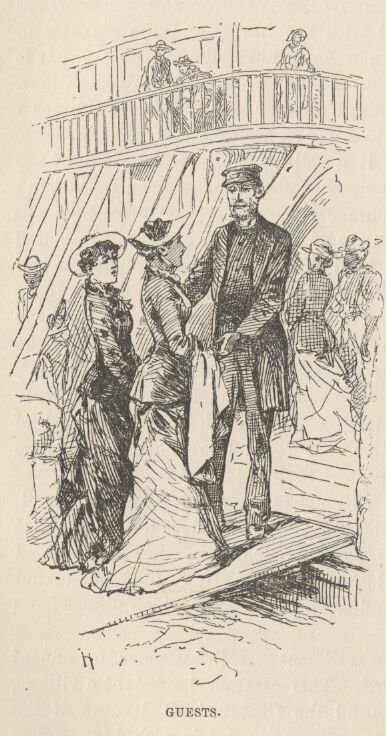
The trouble with the Southern reporter is—Women. They unsettle him; they throw him off his balance. He is plain, and sensible, and satisfactory, until a woman heaves in sight. Then he goes all to pieces; his mind totters, he becomes flowery and idiotic. From reading the above extract, you would imagine that this student of Sir Walter Scott is an apprentice, and knows next to nothing about handling a pen. On the contrary, he furnishes plenty of proofs, in his long letter, that he knows well enough how to handle it when the women are not around to give him the artificial-flower complaint. For instance—
'At 4 o'clock ominous clouds began to gather in the south-east, and presently from the Gulf there came a blow which increased in severity every moment. It was not safe to leave the landing then, and there was a delay. The oaks shook off long tresses of their mossy beards to the tugging of the wind, and the bayou in its ambition put on miniature waves in mocking of much larger bodies of water. A lull permitted a start, and homewards we steamed, an inky sky overhead and a heavy wind blowing. As darkness crept on, there were few on board who did not wish themselves nearer home.'
There is nothing the matter with that. It is good description, compactly put. Yet there was great temptation, there, to drop into lurid writing.
But let us return to the mule. Since I left him, I have rummaged around and found a full report of the race. In it I find confirmation of the theory which I broached just now—namely, that the trouble with the Southern reporter is Women: Women, supplemented by Walter Scott and his knights and beauty and chivalry, and so on. This is an excellent report, as long as the women stay out of it. But when they intrude, we have this frantic result—
'It will be probably a long time before the ladies' stand presents such a sea of foam-like loveliness as it did yesterday. The New Orleans women are always charming, but never so much so as at this time of the year, when in their dainty spring costumes they bring with them a breath of balmy freshness and an odor of sanctity unspeakable. The stand was so crowded with them that, walking at their feet and seeing no possibility of approach, many a man appreciated as he never did before the Peri's feeling at the Gates of Paradise, and wondered what was the priceless boon that would admit him to their sacred presence. Sparkling on their white-robed breasts or shoulders were the colors of their favorite knights, and were it not for the fact that the doughty heroes appeared on unromantic mules, it would have been easy to imagine one of King Arthur's gala-days.'
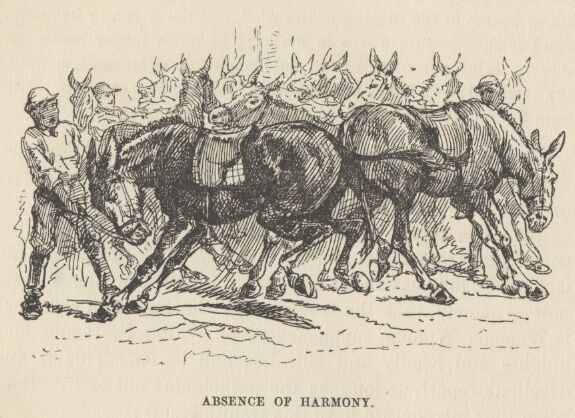
There were thirteen mules in the first heat; all sorts of mules, they were; all sorts of complexions, gaits, dispositions, aspects. Some were handsome creatures, some were not; some were sleek, some hadn't had their fur brushed lately; some were innocently gay and frisky; some were full of malice and all unrighteousness; guessing from looks, some of them thought the matter on hand was war, some thought it was a lark, the rest took it for a religious occasion. And each mule acted according to his convictions. The result was an absence of harmony well compensated by a conspicuous presence of variety—variety of a picturesque and entertaining sort.
All the riders were young gentlemen in fashionable society. If the reader has been wondering why it is that the ladies of New Orleans attend so humble an orgy as a mule-race, the thing is explained now. It is a fashion-freak; all connected with it are people of fashion.
It is great fun, and cordially liked. The mule-race is one of the marked occasions of the year. It has brought some pretty fast mules to the front. One of these had to be ruled out, because he was so fast that he turned the thing into a one-mule contest, and robbed it of one of its best features—variety. But every now and then somebody disguises him with a new name and a new complexion, and rings him in again.
The riders dress in full jockey costumes of bright-colored silks, satins, and velvets.
The thirteen mules got away in a body, after a couple of false starts, and scampered off with prodigious spirit. As each mule and each rider had a distinct opinion of his own as to how the race ought to be run, and which side of the track was best in certain circumstances, and how often the track ought to be crossed, and when a collision ought to be accomplished, and when it ought to be avoided, these twenty-six conflicting opinions created a most fantastic and picturesque confusion, and the resulting spectacle was killingly comical.
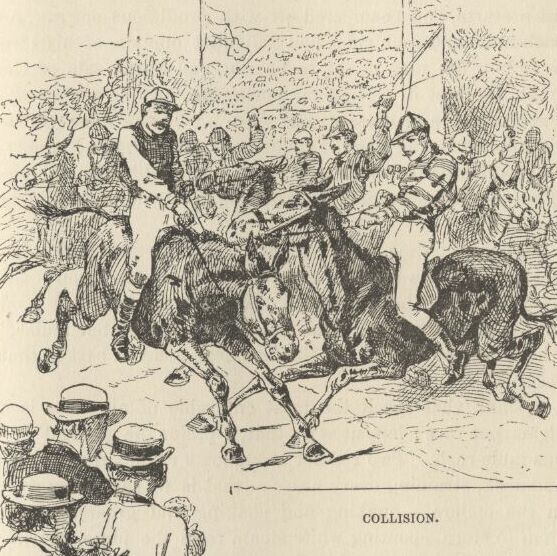
Mile heat; time 2:22. Eight of the thirteen mules distanced. I had a bet on a mule which would have won if the procession had been reversed. The second heat was good fun; and so was the 'consolation race for beaten mules,' which followed later; but the first heat was the best in that respect.
I think that much the most enjoyable of all races is a steamboat race; but, next to that, I prefer the gay and joyous mule-rush. Two red-hot steamboats raging along, neck-and-neck, straining every nerve—that is to say, every rivet in the boilers—quaking and shaking and groaning from stem to stern, spouting white steam from the pipes, pouring black smoke from the chimneys, raining down sparks, parting the river into long breaks of hissing foam—this is sport that makes a body's very liver curl with enjoyment. A horse-race is pretty tame and colorless in comparison. Still, a horse-race might be well enough, in its way, perhaps, if it were not for the tiresome false starts. But then, nobody is ever killed. At least, nobody was ever killed when I was at a horse-race. They have been crippled, it is true; but this is little to the purpose.
Chapter 46
Enchantments and Enchanters
THE largest annual event in New Orleans is a something which we arrived too late to sample—the Mardi-Gras festivities. I saw the procession of the Mystic Crew of Comus there, twenty-four years ago—with knights and nobles and so on, clothed in silken and golden Paris-made gorgeousnesses, planned and bought for that single night's use; and in their train all manner of giants, dwarfs, monstrosities, and other diverting grotesquerie—a startling and wonderful sort of show, as it filed solemnly and silently down the street in the light of its smoking and flickering torches; but it is said that in these latter days the spectacle is mightily augmented, as to cost, splendor, and variety. There is a chief personage—'Rex;' and if I remember rightly, neither this king nor any of his great following of subordinates is known to any outsider. All these people are gentlemen of position and consequence; and it is a proud thing to belong to the organization; so the mystery in which they hide their personality is merely for romance's sake, and not on account of the police.
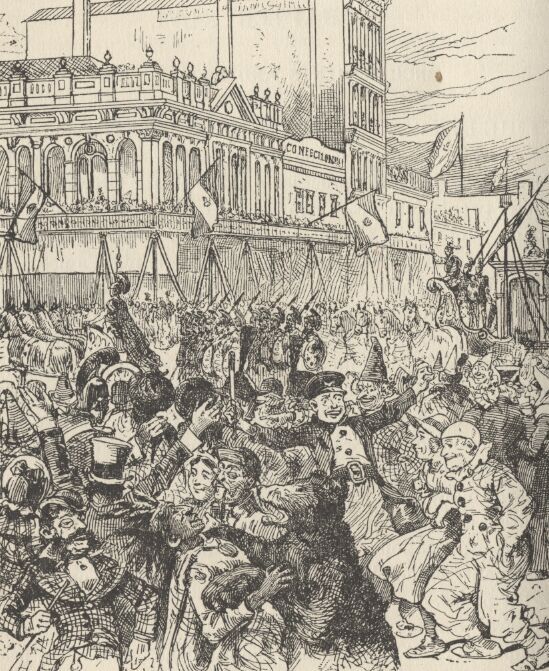
Mardi-Gras is of course a relic of the French and Spanish occupation; but I judge that the religious feature has been pretty well knocked out of it now. Sir Walter has got the advantage of the gentlemen of the cowl and rosary, and he will stay. His medieval business, supplemented by the monsters and the oddities, and the pleasant creatures from fairy-land, is finer to look at than the poor fantastic inventions and performances of the reveling rabble of the priest's day, and serves quite as well, perhaps, to emphasize the day and admonish men that the grace-line between the worldly season and the holy one is reached.
This Mardi-Gras pageant was the exclusive possession of New Orleans until recently. But now it has spread to Memphis and St. Louis and Baltimore. It has probably reached its limit. It is a thing which could hardly exist in the practical North; would certainly last but a very brief time; as brief a time as it would last in London. For the soul of it is the romantic, not the funny and the grotesque. Take away the romantic mysteries, the kings and knights and big-sounding titles, and Mardi-Gras would die, down there in the South. The very feature that keeps it alive in the South—girly-girly romance—would kill it in the North or in London. Puck and Punch, and the press universal, would fall upon it and make merciless fun of it, and its first exhibition would be also its last.
Against the crimes of the French Revolution and of Bonaparte may be set two compensating benefactions: the Revolution broke the chains of the ancien regime and of the Church, and made of a nation of abject slaves a nation of freemen; and Bonaparte instituted the setting of merit above birth, and also so completely stripped the divinity from royalty, that whereas crowned heads in Europe were gods before, they are only men, since, and can never be gods again, but only figureheads, and answerable for their acts like common clay. Such benefactions as these compensate the temporary harm which Bonaparte and the Revolution did, and leave the world in debt to them for these great and permanent services to liberty, humanity, and progress.
Then comes Sir Walter Scott with his enchantments, and by his single might checks this wave of progress, and even turns it back; sets the world in love with dreams and phantoms; with decayed and swinish forms of religion; with decayed and degraded systems of government; with the sillinesses and emptinesses, sham grandeurs, sham gauds, and sham chivalries of a brainless and worthless long-vanished society. He did measureless harm; more real and lasting harm, perhaps, than any other individual that ever wrote. Most of the world has now outlived good part of these harms, though by no means all of them; but in our South they flourish pretty forcefully still. Not so forcefully as half a generation ago, perhaps, but still forcefully. There, the genuine and wholesome civilization of the nineteenth century is curiously confused and commingled with the Walter Scott Middle-Age sham civilization; and so you have practical, common-sense, progressive ideas, and progressive works; mixed up with the duel, the inflated speech, and the jejune romanticism of an absurd past that is dead, and out of charity ought to be buried. But for the Sir Walter disease, the character of the Southerner—or Southron, according to Sir Walter's starchier way of phrasing it—would be wholly modern, in place of modern and medieval mixed, and the South would be fully a generation further advanced than it is. It was Sir Walter that made every gentleman in the South a Major or a Colonel, or a General or a Judge, before the war; and it was he, also, that made these gentlemen value these bogus decorations. For it was he that created rank and caste down there, and also reverence for rank and caste, and pride and pleasure in them. Enough is laid on slavery, without fathering upon it these creations and contributions of Sir Walter.
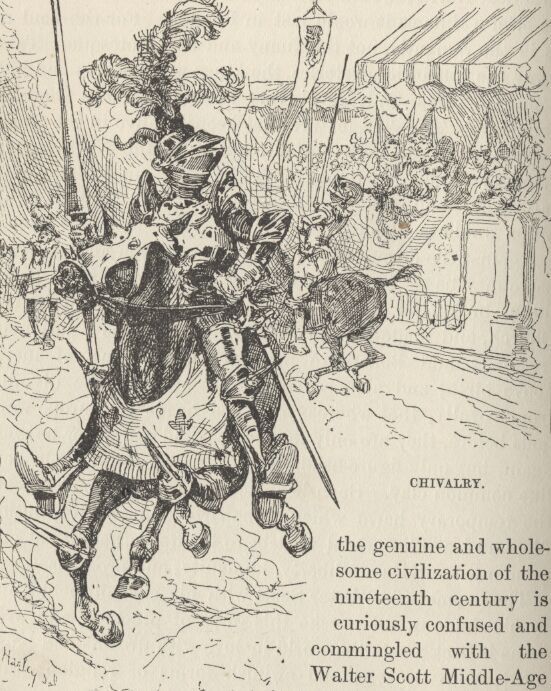
Sir Walter had so large a hand in making Southern character, as it existed before the war, that he is in great measure responsible for the war. It seems a little harsh toward a dead man to say that we never should have had any war but for Sir Walter; and yet something of a plausible argument might, perhaps, be made in support of that wild proposition. The Southerner of the American Revolution owned slaves; so did the Southerner of the Civil War: but the former resembles the latter as an Englishman resembles a Frenchman. The change of character can be traced rather more easily to Sir Walter's influence than to that of any other thing or person.
One may observe, by one or two signs, how deeply that influence penetrated, and how strongly it holds. If one take up a Northern or Southern literary periodical of forty or fifty years ago, he will find it filled with wordy, windy, flowery 'eloquence,' romanticism, sentimentality—all imitated from Sir Walter, and sufficiently badly done, too—innocent travesties of his style and methods, in fact. This sort of literature being the fashion in both sections of the country, there was opportunity for the fairest competition; and as a consequence, the South was able to show as many well-known literary names, proportioned to population, as the North could.
But a change has come, and there is no opportunity now for a fair competition between North and South. For the North has thrown out that old inflated style, whereas the Southern writer still clings to it—clings to it and has a restricted market for his wares, as a consequence. There is as much literary talent in the South, now, as ever there was, of course; but its work can gain but slight currency under present conditions; the authors write for the past, not the present; they use obsolete forms, and a dead language. But when a Southerner of genius writes modern English, his book goes upon crutches no longer, but upon wings; and they carry it swiftly all about America and England, and through the great English reprint publishing houses of Germany—as witness the experience of Mr. Cable and Uncle Remus, two of the very few Southern authors who do not write in the Southern style. Instead of three or four widely-known literary names, the South ought to have a dozen or two—and will have them when Sir Walter's time is out.
A curious exemplification of the power of a single book for good or harm is shown in the effects wrought by 'Don Quixote' and those wrought by 'Ivanhoe.' The first swept the world's admiration for the medieval chivalry-silliness out of existence; and the other restored it. As far as our South is concerned, the good work done by Cervantes is pretty nearly a dead letter, so effectually has Scott's pernicious work undermined it.
Chapter 47
Uncle Remus and Mr. Cable
MR. JOEL CHANDLER HARRIS ('Uncle Remus') was to arrive from Atlanta at seven o'clock Sunday morning; so we got up and received him. We were able to detect him among the crowd of arrivals at the hotel-counter by his correspondence with a description of him which had been furnished us from a trustworthy source. He was said to be undersized, red-haired, and somewhat freckled. He was the only man in the party whose outside tallied with this bill of particulars. He was said to be very shy. He is a shy man. Of this there is no doubt. It may not show on the surface, but the shyness is there. After days of intimacy one wonders to see that it is still in about as strong force as ever. There is a fine and beautiful nature hidden behind it, as all know who have read the Uncle Remus book; and a fine genius, too, as all know by the same sign. I seem to be talking quite freely about this neighbor; but in talking to the public I am but talking to his personal friends, and these things are permissible among friends.
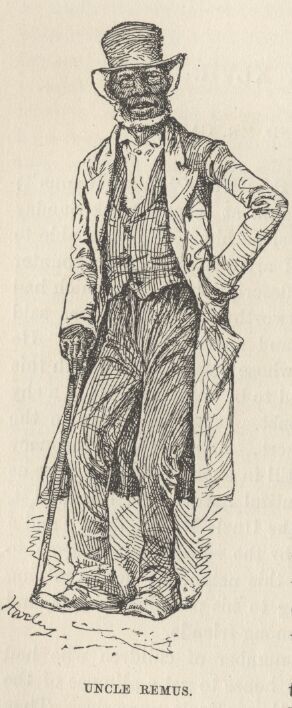
He deeply disappointed a number of children who had flocked eagerly to Mr. Cable's house to get a glimpse of the illustrious sage and oracle of the nation's nurseries. They said—
'Why, he 's white!'
They were grieved about it. So, to console them, the book was brought, that they might hear Uncle Remus's Tar-Baby story from the lips of Uncle Remus himself—or what, in their outraged eyes, was left of him. But it turned out that he had never read aloud to people, and was too shy to venture the attempt now. Mr. Cable and I read from books of ours, to show him what an easy trick it was; but his immortal shyness was proof against even this sagacious strategy, so we had to read about Brer Rabbit ourselves.
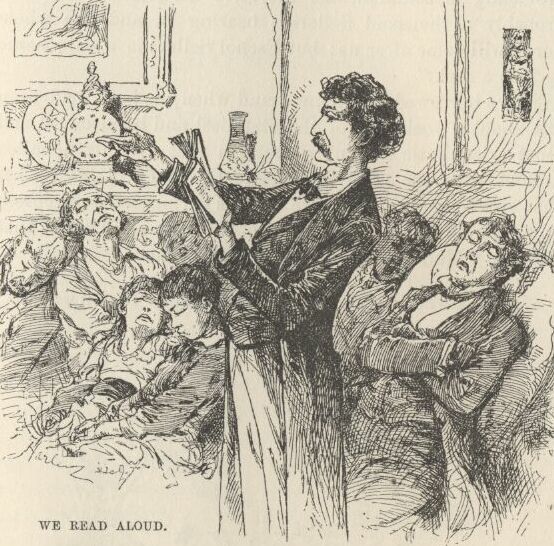
Mr. Harris ought to be able to read the negro dialect better than anybody else, for in the matter of writing it he is the only master the country has produced. Mr. Cable is the only master in the writing of French dialects that the country has produced; and he reads them in perfection. It was a great treat to hear him read about Jean-ah Poquelin, and about Innerarity and his famous 'pigshoo' representing 'Louisihanna rif-fusing to Hanter the Union,' along with passages of nicely-shaded German dialect from a novel which was still in manuscript.
It came out in conversation, that in two different instances Mr. Cable got into grotesque trouble by using, in his books, next-to-impossible French names which nevertheless happened to be borne by living and sensitive citizens of New Orleans. His names were either inventions or were borrowed from the ancient and obsolete past, I do not now remember which; but at any rate living bearers of them turned up, and were a good deal hurt at having attention directed to themselves and their affairs in so excessively public a manner.
Mr. Warner and I had an experience of the same sort when we wrote the book called 'The Gilded Age.' There is a character in it called 'Sellers.' I do not remember what his first name was, in the beginning; but anyway, Mr. Warner did not like it, and wanted it improved. He asked me if I was able to imagine a person named 'Eschol Sellers.' Of course I said I could not, without stimulants. He said that away out West, once, he had met, and contemplated, and actually shaken hands with a man bearing that impossible name—'Eschol Sellers.' He added—
'It was twenty years ago; his name has probably carried him off before this; and if it hasn't, he will never see the book anyhow. We will confiscate his name. The name you are using is common, and therefore dangerous; there are probably a thousand Sellerses bearing it, and the whole horde will come after us; but Eschol Sellers is a safe name—it is a rock.'
So we borrowed that name; and when the book had been out about a week, one of the stateliest and handsomest and most aristocratic looking white men that ever lived, called around, with the most formidable libel suit in his pocket that ever—well, in brief, we got his permission to suppress an edition of ten million {footnote [Figures taken from memory, and probably incorrect. Think it was more.]} copies of the book and change that name to 'Mulberry Sellers' in future editions.
Chapter 48
Sugar and Postage
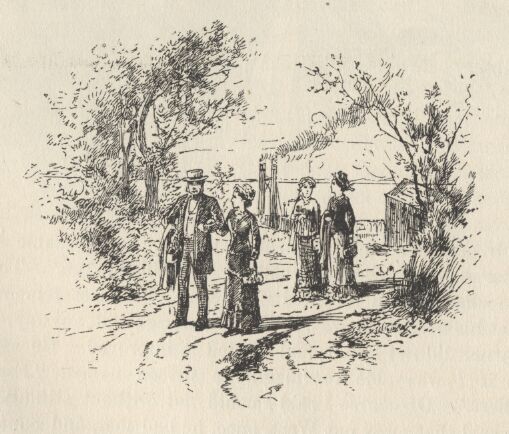
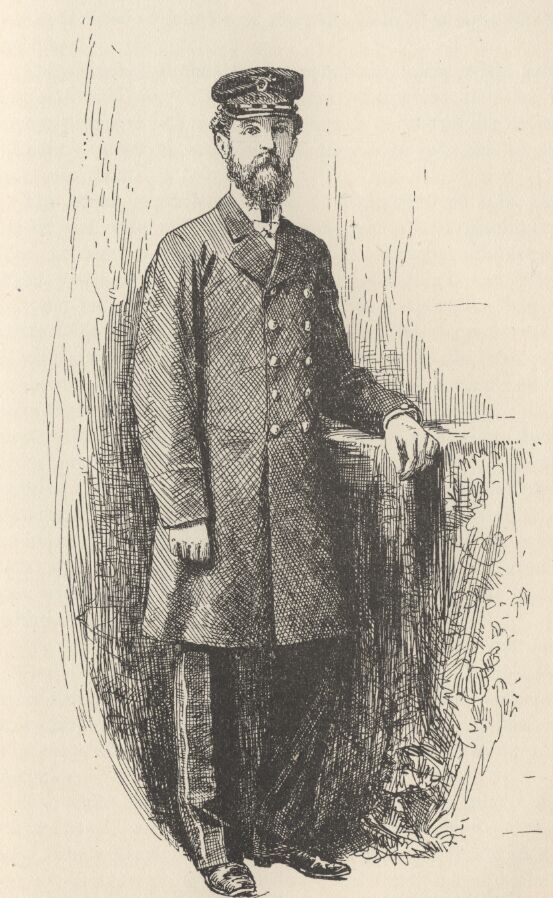
ONE day, on the street, I encountered the man whom, of all men, I most wished to see—Horace Bixby; formerly pilot under me—or rather, over me—now captain of the great steamer 'City of Baton Rouge,' the latest and swiftest addition to the Anchor Line. The same slender figure, the same tight curls, the same springy step, the same alertness, the same decision of eye and answering decision of hand, the same erect military bearing; not an inch gained or lost in girth, not an ounce gained or lost in weight, not a hair turned. It is a curious thing, to leave a man thirty-five years old, and come back at the end of twenty-one years and find him still only thirty-five. I have not had an experience of this kind before, I believe. There were some crow's-feet, but they counted for next to nothing, since they were inconspicuous.
His boat was just in. I had been waiting several days for her, purposing to return to St. Louis in her. The captain and I joined a party of ladies and gentlemen, guests of Major Wood, and went down the river fifty-four miles, in a swift tug, to ex-Governor Warmouth's sugar plantation. Strung along below the city, were a number of decayed, ram-shackly, superannuated old steamboats, not one of which had I ever seen before. They had all been built, and worn out, and thrown aside, since I was here last. This gives one a realizing sense of the frailness of a Mississippi boat and the briefness of its life.
Six miles below town a fat and battered brick chimney, sticking above the magnolias and live-oaks, was pointed out as the monument erected by an appreciative nation to celebrate the battle of New Orleans—Jackson's victory over the British, January 8, 1815. The war had ended, the two nations were at peace, but the news had not yet reached New Orleans. If we had had the cable telegraph in those days, this blood would not have been spilt, those lives would not have been wasted; and better still, Jackson would probably never have been president. We have gotten over the harms done us by the war of 1812, but not over some of those done us by Jackson's presidency.
The Warmouth plantation covers a vast deal of ground, and the hospitality of the Warmouth mansion is graduated to the same large scale. We saw steam-plows at work, here, for the first time. The traction engine travels about on its own wheels, till it reaches the required spot; then it stands still and by means of a wire rope pulls the huge plow toward itself two or three hundred yards across the field, between the rows of cane. The thing cuts down into the black mold a foot and a half deep. The plow looks like a fore-and-aft brace of a Hudson river steamer, inverted. When the negro steersman sits on one end of it, that end tilts down near the ground, while the other sticks up high in air. This great see-saw goes rolling and pitching like a ship at sea, and it is not every circus rider that could stay on it.
The plantation contains two thousand six hundred acres; six hundred and fifty are in cane; and there is a fruitful orange grove of five thousand trees. The cane is cultivated after a modern and intricate scientific fashion, too elaborate and complex for me to attempt to describe; but it lost $40,000 last year. I forget the other details. However, this year's crop will reach ten or twelve hundred tons of sugar, consequently last year's loss will not matter. These troublesome and expensive scientific methods achieve a yield of a ton and a half and from that to two tons, to the acre; which is three or four times what the yield of an acre was in my time.
The drainage-ditches were everywhere alive with little crabs—'fiddlers.' One saw them scampering sidewise in every direction whenever they heard a disturbing noise. Expensive pests, these crabs; for they bore into the levees, and ruin them.
The great sugar-house was a wilderness of tubs and tanks and vats and filters, pumps, pipes, and machinery. The process of making sugar is exceedingly interesting. First, you heave your cane into the centrifugals and grind out the juice; then run it through the evaporating pan to extract the fiber; then through the bone-filter to remove the alcohol; then through the clarifying tanks to discharge the molasses; then through the granulating pipe to condense it; then through the vacuum pan to extract the vacuum. It is now ready for market. I have jotted these particulars down from memory. The thing looks simple and easy. Do not deceive yourself. To make sugar is really one of the most difficult things in the world. And to make it right, is next to impossible. If you will examine your own supply every now and then for a term of years, and tabulate the result, you will find that not two men in twenty can make sugar without getting sand into it.
We could have gone down to the mouth of the river and visited Captain Eads' great work, the 'jetties,' where the river has been compressed between walls, and thus deepened to twenty-six feet; but it was voted useless to go, since at this stage of the water everything would be covered up and invisible.
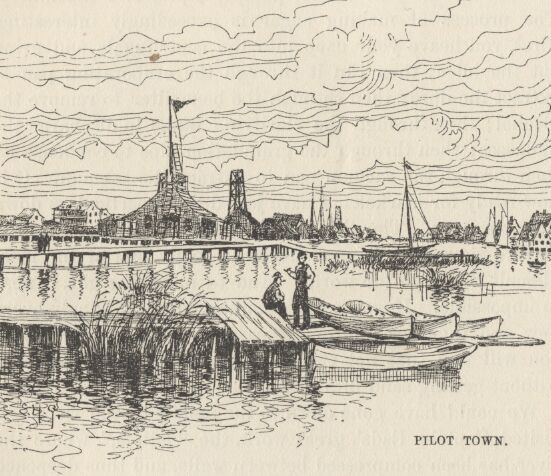
We could have visited that ancient and singular burg, 'Pilot-town,' which stands on stilts in the water—so they say; where nearly all communication is by skiff and canoe, even to the attending of weddings and funerals; and where the littlest boys and girls are as handy with the oar as unamphibious children are with the velocipede.
We could have done a number of other things; but on account of limited time, we went back home. The sail up the breezy and sparkling river was a charming experience, and would have been satisfyingly sentimental and romantic but for the interruptions of the tug's pet parrot, whose tireless comments upon the scenery and the guests were always this-worldly, and often profane. He had also a superabundance of the discordant, ear-splitting, metallic laugh common to his breed—a machine-made laugh, a Frankenstein laugh, with the soul left out of it. He applied it to every sentimental remark, and to every pathetic song. He cackled it out with hideous energy after 'Home again, home again from a foreign shore,' and said he 'wouldn't give a damn for a tug-load of such rot.' Romance and sentiment cannot long survive this sort of discouragement; so the singing and talking presently ceased; which so delighted the parrot that he cursed himself hoarse for joy.
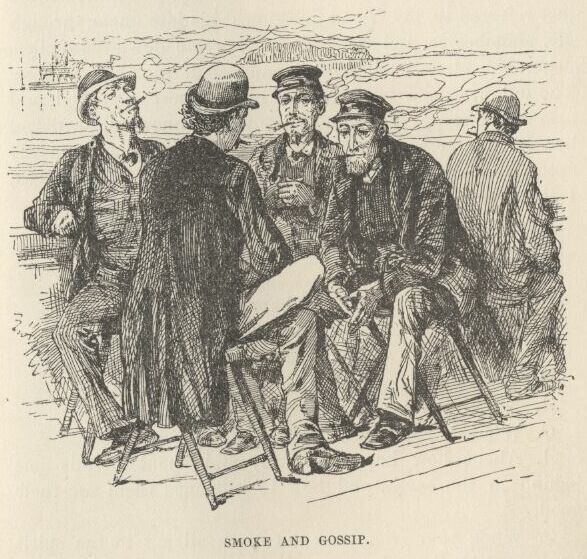
Then the male members of the party moved to the forecastle, to smoke and gossip. There were several old steamboatmen along, and I learned from them a great deal of what had been happening to my former river friends during my long absence. I learned that a pilot whom I used to steer for is become a spiritualist, and for more than fifteen years has been receiving a letter every week from a deceased relative, through a New York spiritualist medium named Manchester—postage graduated by distance: from the local post-office in Paradise to New York, five dollars; from New York to St. Louis, three cents. I remember Mr. Manchester very well. I called on him once, ten years ago, with a couple of friends, one of whom wished to inquire after a deceased uncle. This uncle had lost his life in a peculiarly violent and unusual way, half a dozen years before: a cyclone blew him some three miles and knocked a tree down with him which was four feet through at the butt and sixty-five feet high. He did not survive this triumph. At the seance just referred to, my friend questioned his late uncle, through Mr. Manchester, and the late uncle wrote down his replies, using Mr. Manchester's hand and pencil for that purpose. The following is a fair example of the questions asked, and also of the sloppy twaddle in the way of answers, furnished by Manchester under the pretense that it came from the specter. If this man is not the paltriest fraud that lives, I owe him an apology—
QUESTION. Where are you?
ANSWER. In the spirit world.
Q. Are you happy?
A. Very happy. Perfectly happy.
Q. How do you amuse yourself?
A. Conversation with friends, and other spirits.
Q. What else?
A. Nothing else. Nothing else is necessary.
Q. What do you talk about?
A. About how happy we are; and about friends left behind in the earth, and how to influence them for their good.
Q. When your friends in the earth all get to the spirit land, what shall you have to talk about then?—nothing but about how happy you all are?
No reply. It is explained that spirits will not answer frivolous questions.
Q. How is it that spirits that are content to spend an eternity in frivolous employments, and accept it as happiness, are so fastidious about frivolous questions upon the subject?
No reply.
Q. Would you like to come back?
A. No.
Q. Would you say that under oath?
A. Yes.
Q. What do you eat there?
A. We do not eat.
Q. What do you drink?
A. We do not drink.
Q. What do you smoke?
A. We do not smoke.
Q. What do you read?
A. We do not read.
Q. Do all the good people go to your place?
A. Yes.
Q. You know my present way of life. Can you suggest any additions to it, in the way of crime, that will reasonably insure my going to some other place.
A. No reply.
Q. When did you die?
A. I did not die, I passed away.
Q. Very well, then, when did you pass away? How long have you been in the spirit land?
A. We have no measurements of time here.
Q. Though you may be indifferent and uncertain as to dates and times in your present condition and environment, this has nothing to do with your former condition. You had dates then. One of these is what I ask for. You departed on a certain day in a certain year. Is not this true?
A. Yes.
Q. Then name the day of the month.
(Much fumbling with pencil, on the part of the medium, accompanied by violent spasmodic jerkings of his head and body, for some little time. Finally, explanation to the effect that spirits often forget dates, such things being without importance to them.)
Q. Then this one has actually forgotten the date of its translation to the spirit land?
This was granted to be the case.
Q. This is very curious. Well, then, what year was it?
(More fumbling, jerking, idiotic spasms, on the part of the medium. Finally, explanation to the effect that the spirit has forgotten the year.)
Q. This is indeed stupendous. Let me put one more question, one last question, to you, before we part to meet no more;—for even if I fail to avoid your asylum, a meeting there will go for nothing as a meeting, since by that time you will easily have forgotten me and my name: did you die a natural death, or were you cut off by a catastrophe?
A. (After long hesitation and many throes and spasms.) Natural death.
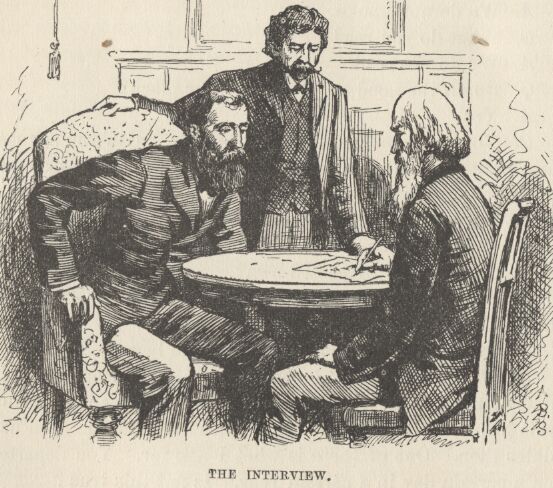
This ended the interview. My friend told the medium that when his relative was in this poor world, he was endowed with an extraordinary intellect and an absolutely defectless memory, and it seemed a great pity that he had not been allowed to keep some shred of these for his amusement in the realms of everlasting contentment, and for the amazement and admiration of the rest of the population there.
This man had plenty of clients—has plenty yet. He receives letters from spirits located in every part of the spirit world, and delivers them all over this country through the United States mail. These letters are filled with advice—advice from 'spirits' who don't know as much as a tadpole—and this advice is religiously followed by the receivers. One of these clients was a man whom the spirits (if one may thus plurally describe the ingenious Manchester) were teaching how to contrive an improved railway car-wheel. It is coarse employment for a spirit, but it is higher and wholesomer activity than talking for ever about 'how happy we are.'
Chapter 49
Episodes in Pilot Life
IN the course of the tug-boat gossip, it came out that out of every five of my former friends who had quitted the river, four had chosen farming as an occupation. Of course this was not because they were peculiarly gifted, agriculturally, and thus more likely to succeed as farmers than in other industries: the reason for their choice must be traced to some other source. Doubtless they chose farming because that life is private and secluded from irruptions of undesirable strangers—like the pilot-house hermitage. And doubtless they also chose it because on a thousand nights of black storm and danger they had noted the twinkling lights of solitary farm-houses, as the boat swung by, and pictured to themselves the serenity and security and coziness of such refuges at such times, and so had by-and-bye come to dream of that retired and peaceful life as the one desirable thing to long for, anticipate, earn, and at last enjoy.
But I did not learn that any of these pilot-farmers had astonished anybody with their successes. Their farms do not support them: they support their farms. The pilot-farmer disappears from the river annually, about the breaking of spring, and is seen no more till next frost. Then he appears again, in damaged homespun, combs the hayseed out of his hair, and takes a pilot-house berth for the winter. In this way he pays the debts which his farming has achieved during the agricultural season. So his river bondage is but half broken; he is still the river's slave the hardest half of the year.
One of these men bought a farm, but did not retire to it. He knew a trick worth two of that. He did not propose to pauperize his farm by applying his personal ignorance to working it. No, he put the farm into the hands of an agricultural expert to be worked on shares—out of every three loads of corn the expert to have two and the pilot the third. But at the end of the season the pilot received no corn. The expert explained that his share was not reached. The farm produced only two loads.
Some of the pilots whom I had known had had adventures—the outcome fortunate, sometimes, but not in all cases. Captain Montgomery, whom I had steered for when he was a pilot, commanded the Confederate fleet in the great battle before Memphis; when his vessel went down, he swam ashore, fought his way through a squad of soldiers, and made a gallant and narrow escape. He was always a cool man; nothing could disturb his serenity. Once when he was captain of the 'Crescent City,' I was bringing the boat into port at New Orleans, and momently expecting orders from the hurricane deck, but received none. I had stopped the wheels, and there my authority and responsibility ceased. It was evening—dim twilight—the captain's hat was perched upon the big bell, and I supposed the intellectual end of the captain was in it, but such was not the case. The captain was very strict; therefore I knew better than to touch a bell without orders. My duty was to hold the boat steadily on her calamitous course, and leave the consequences to take care of themselves—which I did. So we went plowing past the sterns of steamboats and getting closer and closer—the crash was bound to come very soon—and still that hat never budged; for alas, the captain was napping in the texas.... Things were becoming exceedingly nervous and uncomfortable. It seemed to me that the captain was not going to appear in time to see the entertainment. But he did. Just as we were walking into the stern of a steamboat, he stepped out on deck, and said, with heavenly serenity, 'Set her back on both'—which I did; but a trifle late, however, for the next moment we went smashing through that other boat's flimsy outer works with a most prodigious racket. The captain never said a word to me about the matter afterwards, except to remark that I had done right, and that he hoped I would not hesitate to act in the same way again in like circumstances.
One of the pilots whom I had known when I was on the river had died a very honorable death. His boat caught fire, and he remained at the wheel until he got her safe to land. Then he went out over the breast-board with his clothing in flames, and was the last person to get ashore. He died from his injuries in the course of two or three hours, and his was the only life lost.