
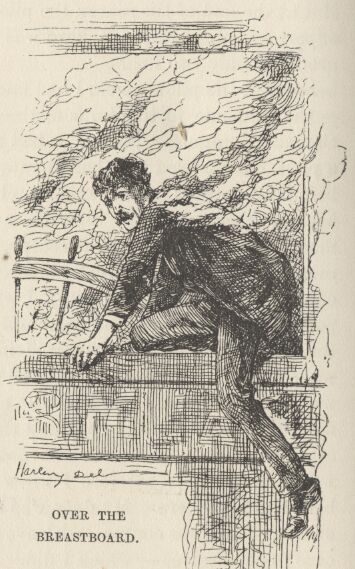
The history of Mississippi piloting affords six or seven instances of this sort of martyrdom, and half a hundred instances of escapes from a like fate which came within a second or two of being fatally too late; but there is no instance of a pilot deserting his post to save his life while by remaining and sacrificing it he might secure other lives from destruction. It is well worth while to set down this noble fact, and well worth while to put it in italics, too.
The 'cub' pilot is early admonished to despise all perils connected with a pilot's calling, and to prefer any sort of death to the deep dishonor of deserting his post while there is any possibility of his being useful in it. And so effectively are these admonitions inculcated, that even young and but half-tried pilots can be depended upon to stick to the wheel, and die there when occasion requires. In a Memphis graveyard is buried a young fellow who perished at the wheel a great many years ago, in White River, to save the lives of other men. He said to the captain that if the fire would give him time to reach a sand bar, some distance away, all could be saved, but that to land against the bluff bank of the river would be to insure the loss of many lives. He reached the bar and grounded the boat in shallow water; but by that time the flames had closed around him, and in escaping through them he was fatally burned. He had been urged to fly sooner, but had replied as became a pilot to reply—
'I will not go. If I go, nobody will be saved; if I stay, no one will be lost but me. I will stay.'
There were two hundred persons on board, and no life was lost but the pilot's. There used to be a monument to this young fellow, in that Memphis graveyard. While we tarried in Memphis on our down trip, I started out to look for it, but our time was so brief that I was obliged to turn back before my object was accomplished.
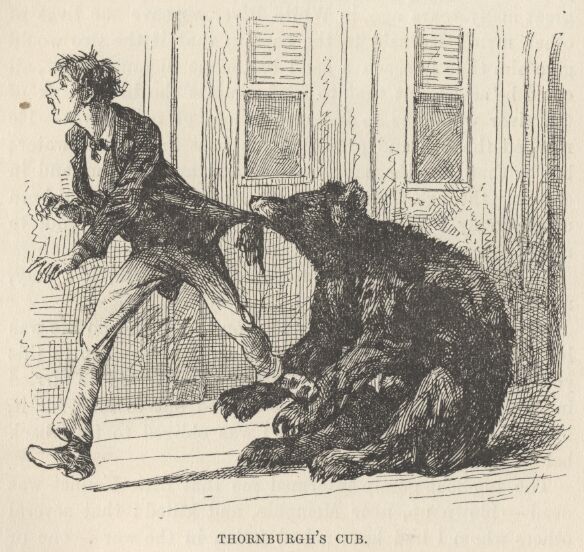
The tug-boat gossip informed me that Dick Kennet was dead—blown up, near Memphis, and killed; that several others whom I had known had fallen in the war—one or two of them shot down at the wheel; that another and very particular friend, whom I had steered many trips for, had stepped out of his house in New Orleans, one night years ago, to collect some money in a remote part of the city, and had never been seen again—was murdered and thrown into the river, it was thought; that Ben Thornburgh was dead long ago; also his wild 'cub' whom I used to quarrel with, all through every daylight watch. A heedless, reckless creature he was, and always in hot water, always in mischief. An Arkansas passenger brought an enormous bear aboard, one day, and chained him to a life-boat on the hurricane deck. Thornburgh's 'cub' could not rest till he had gone there and unchained the bear, to 'see what he would do.' He was promptly gratified. The bear chased him around and around the deck, for miles and miles, with two hundred eager faces grinning through the railings for audience, and finally snatched off the lad's coat-tail and went into the texas to chew it. The off-watch turned out with alacrity, and left the bear in sole possession. He presently grew lonesome, and started out for recreation. He ranged the whole boat—visited every part of it, with an advance guard of fleeing people in front of him and a voiceless vacancy behind him; and when his owner captured him at last, those two were the only visible beings anywhere; everybody else was in hiding, and the boat was a solitude.
I was told that one of my pilot friends fell dead at the wheel, from heart disease, in 1869. The captain was on the roof at the time. He saw the boat breaking for the shore; shouted, and got no answer; ran up, and found the pilot lying dead on the floor.
Mr. Bixby had been blown up, in Madrid bend; was not injured, but the other pilot was lost.
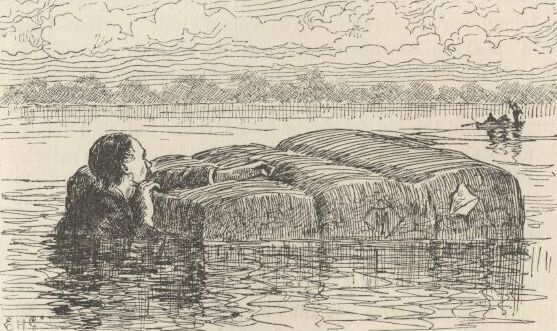
George Ritchie had been blown up near Memphis—blown into the river from the wheel, and disabled. The water was very cold; he clung to a cotton bale—mainly with his teeth—and floated until nearly exhausted, when he was rescued by some deck hands who were on a piece of the wreck. They tore open the bale and packed him in the cotton, and warmed the life back into him, and got him safe to Memphis. He is one of Bixby's pilots on the 'Baton Rouge' now.
Into the life of a steamboat clerk, now dead, had dropped a bit of romance—somewhat grotesque romance, but romance nevertheless. When I knew him he was a shiftless young spendthrift, boisterous, goodhearted, full of careless generosities, and pretty conspicuously promising to fool his possibilities away early, and come to nothing. In a Western city lived a rich and childless old foreigner and his wife; and in their family was a comely young girl—sort of friend, sort of servant. The young clerk of whom I have been speaking—whose name was not George Johnson, but who shall be called George Johnson for the purposes of this narrative—got acquainted with this young girl, and they sinned; and the old foreigner found them out, and rebuked them. Being ashamed, they lied, and said they were married; that they had been privately married. Then the old foreigner's hurt was healed, and he forgave and blessed them. After that, they were able to continue their sin without concealment. By-and-bye the foreigner's wife died; and presently he followed after her. Friends of the family assembled to mourn; and among the mourners sat the two young sinners. The will was opened and solemnly read. It bequeathed every penny of that old man's great wealth to Mrs. George Johnson!
And there was no such person. The young sinners fled forth then, and did a very foolish thing: married themselves before an obscure Justice of the Peace, and got him to antedate the thing. That did no sort of good. The distant relatives flocked in and exposed the fraudful date with extreme suddenness and surprising ease, and carried off the fortune, leaving the Johnsons very legitimately, and legally, and irrevocably chained together in honorable marriage, but with not so much as a penny to bless themselves withal. Such are the actual facts; and not all novels have for a base so telling a situation.
Chapter 50
The 'Original Jacobs'
WE had some talk about Captain Isaiah Sellers, now many years dead. He was a fine man, a high-minded man, and greatly respected both ashore and on the river. He was very tall, well built, and handsome; and in his old age—as I remember him—his hair was as black as an Indian's, and his eye and hand were as strong and steady and his nerve and judgment as firm and clear as anybody's, young or old, among the fraternity of pilots. He was the patriarch of the craft; he had been a keelboat pilot before the day of steamboats; and a steamboat pilot before any other steamboat pilot, still surviving at the time I speak of, had ever turned a wheel. Consequently his brethren held him in the sort of awe in which illustrious survivors of a bygone age are always held by their associates. He knew how he was regarded, and perhaps this fact added some trifle of stiffening to his natural dignity, which had been sufficiently stiff in its original state.
He left a diary behind him; but apparently it did not date back to his first steamboat trip, which was said to be 1811, the year the first steamboat disturbed the waters of the Mississippi. At the time of his death a correspondent of the 'St. Louis Republican' culled the following items from the diary—
'In February, 1825, he shipped on board the steamer “Rambler,” at Florence, Ala., and made during that year three trips to New Orleans and back—this on the “Gen. Carrol,” between Nashville and New Orleans. It was during his stay on this boat that Captain Sellers introduced the tap of the bell as a signal to heave the lead, previous to which time it was the custom for the pilot to speak to the men below when soundings were wanted. The proximity of the forecastle to the pilot-house, no doubt, rendered this an easy matter; but how different on one of our palaces of the present day.
'In 1827 we find him on board the “President,” a boat of two hundred and eighty-five tons burden, and plying between Smithland and New Orleans. Thence he joined the “Jubilee” in 1828, and on this boat he did his first piloting in the St. Louis trade; his first watch extending from Herculaneum to St. Genevieve. On May 26, 1836, he completed and left Pittsburgh in charge of the steamer “Prairie,” a boat of four hundred tons, and the first steamer with a State-Room cabin ever seen at St. Louis. In 1857 he introduced the signal for meeting boats, and which has, with some slight change, been the universal custom of this day; in fact, is rendered obligatory by act of Congress.
'As general items of river history, we quote the following marginal notes from his general log—
'In March, 1825, Gen. Lafayette left New Orleans for St. Louis on the low-pressure steamer “Natchez.”
'In January, 1828, twenty-one steamers left the New Orleans wharf to celebrate the occasion of Gen. Jackson's visit to that city.
'In 1830 the “North American” made the run from New Orleans to Memphis in six days—best time on record to that date. It has since been made in two days and ten hours.
'In 1831 the Red River cut-off formed.
'In 1832 steamer “Hudson” made the run from White River to Helena, a distance of seventy-five miles, in twelve hours. This was the source of much talk and speculation among parties directly interested.
'In 1839 Great Horseshoe cut-off formed.
'Up to the present time, a term of thirty-five years, we ascertain, by reference to the diary, he has made four hundred and sixty round trips to New Orleans, which gives a distance of one million one hundred and four thousand miles, or an average of eighty-six miles a day.'
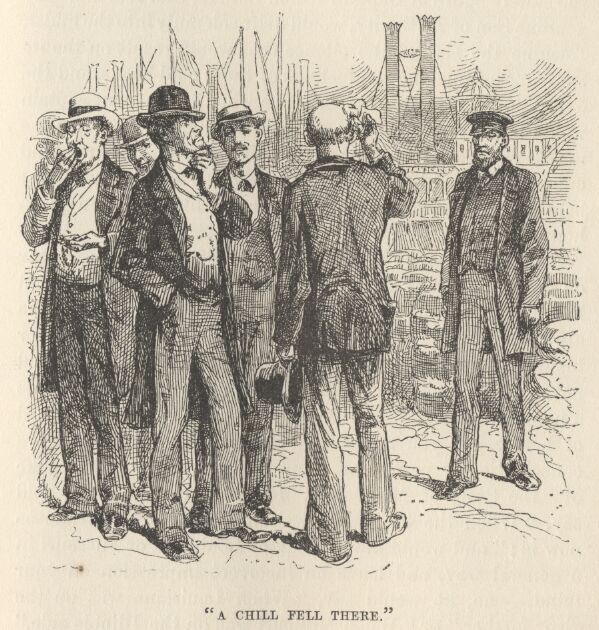
Whenever Captain Sellers approached a body of gossiping pilots, a chill fell there, and talking ceased. For this reason: whenever six pilots were gathered together, there would always be one or two newly fledged ones in the lot, and the elder ones would be always 'showing off' before these poor fellows; making them sorrowfully feel how callow they were, how recent their nobility, and how humble their degree, by talking largely and vaporously of old-time experiences on the river; always making it a point to date everything back as far as they could, so as to make the new men feel their newness to the sharpest degree possible, and envy the old stagers in the like degree. And how these complacent baldheads would swell, and brag, and lie, and date back—ten, fifteen, twenty years,—and how they did enjoy the effect produced upon the marveling and envying youngsters!
And perhaps just at this happy stage of the proceedings, the stately figure of Captain Isaiah Sellers, that real and only genuine Son of Antiquity, would drift solemnly into the midst. Imagine the size of the silence that would result on the instant. And imagine the feelings of those bald-heads, and the exultation of their recent audience when the ancient captain would begin to drop casual and indifferent remarks of a reminiscent nature—about islands that had disappeared, and cutoffs that had been made, a generation before the oldest bald-head in the company had ever set his foot in a pilot-house!
Many and many a time did this ancient mariner appear on the scene in the above fashion, and spread disaster and humiliation around him. If one might believe the pilots, he always dated his islands back to the misty dawn of river history; and he never used the same island twice; and never did he employ an island that still existed, or give one a name which anybody present was old enough to have heard of before. If you might believe the pilots, he was always conscientiously particular about little details; never spoke of 'the State of Mississippi,' for instance—no, he would say, 'When the State of Mississippi was where Arkansas now is,' and would never speak of Louisiana or Missouri in a general way, and leave an incorrect impression on your mind—no, he would say, 'When Louisiana was up the river farther,' or 'When Missouri was on the Illinois side.'
The old gentleman was not of literary turn or capacity, but he used to jot down brief paragraphs of plain practical information about the river, and sign them 'Mark Twain,' and give them to the 'New Orleans Picayune.' They related to the stage and condition of the river, and were accurate and valuable; and thus far, they contained no poison. But in speaking of the stage of the river to-day, at a given point, the captain was pretty apt to drop in a little remark about this being the first time he had seen the water so high or so low at that particular point for forty-nine years; and now and then he would mention Island So-and-so, and follow it, in parentheses, with some such observation as 'disappeared in 1807, if I remember rightly.' In these antique interjections lay poison and bitterness for the other old pilots, and they used to chaff the 'Mark Twain' paragraphs with unsparing mockery.
It so chanced that one of these paragraphs—{footnote [The original MS. of it, in the captain's own hand, has been sent to me from New Orleans. It reads as follows—
VICKSBURG May 4, 1859.
'My opinion for the benefit of the citizens of New Orleans: The water is higher this far up than it has been since 8. My opinion is that the water will be feet deep in Canal street before the first of next June. Mrs. Turner's plantation at the head of Big Black Island is all under water, and it has not been since 1815.
'I. Sellers.']}
became the text for my first newspaper article. I burlesqued it broadly, very broadly, stringing my fantastics out to the extent of eight hundred or a thousand words. I was a 'cub' at the time. I showed my performance to some pilots, and they eagerly rushed it into print in the 'New Orleans True Delta.' It was a great pity; for it did nobody any worthy service, and it sent a pang deep into a good man's heart. There was no malice in my rubbish; but it laughed at the captain. It laughed at a man to whom such a thing was new and strange and dreadful. I did not know then, though I do now, that there is no suffering comparable with that which a private person feels when he is for the first time pilloried in print.
Captain Sellers did me the honor to profoundly detest me from that day forth. When I say he did me the honor, I am not using empty words. It was a very real honor to be in the thoughts of so great a man as Captain Sellers, and I had wit enough to appreciate it and be proud of it. It was distinction to be loved by such a man; but it was a much greater distinction to be hated by him, because he loved scores of people; but he didn't sit up nights to hate anybody but me.
He never printed another paragraph while he lived, and he never again signed 'Mark Twain' to anything. At the time that the telegraph brought the news of his death, I was on the Pacific coast. I was a fresh new journalist, and needed a nom de guerre; so I confiscated the ancient mariner's discarded one, and have done my best to make it remain what it was in his hands—a sign and symbol and warrant that whatever is found in its company may be gambled on as being the petrified truth; how I have succeeded, it would not be modest in me to say.
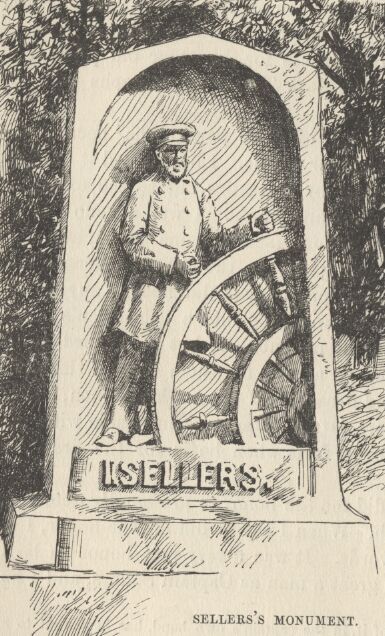
The captain had an honorable pride in his profession and an abiding love for it. He ordered his monument before he died, and kept it near him until he did die. It stands over his grave now, in Bellefontaine cemetery, St. Louis. It is his image, in marble, standing on duty at the pilot wheel; and worthy to stand and confront criticism, for it represents a man who in life would have stayed there till he burned to a cinder, if duty required it.
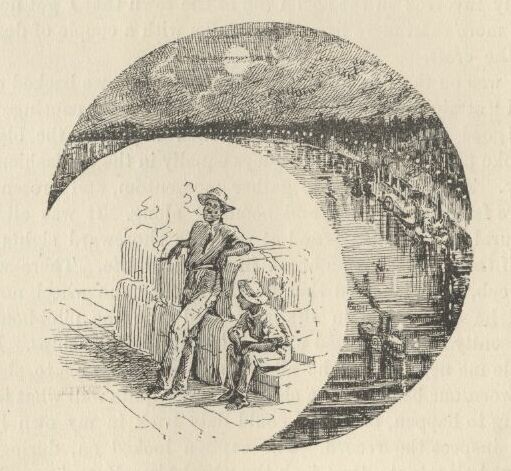
The finest thing we saw on our whole Mississippi trip, we saw as we approached New Orleans in the steam-tug. This was the curving frontage of the crescent city lit up with the white glare of five miles of electric lights. It was a wonderful sight, and very beautiful.
Chapter 51
Reminiscences
WE left for St. Louis in the 'City of Baton Rouge,' on a delightfully hot day, but with the main purpose of my visit but lamely accomplished. I had hoped to hunt up and talk with a hundred steamboatmen, but got so pleasantly involved in the social life of the town that I got nothing more than mere five-minute talks with a couple of dozen of the craft.
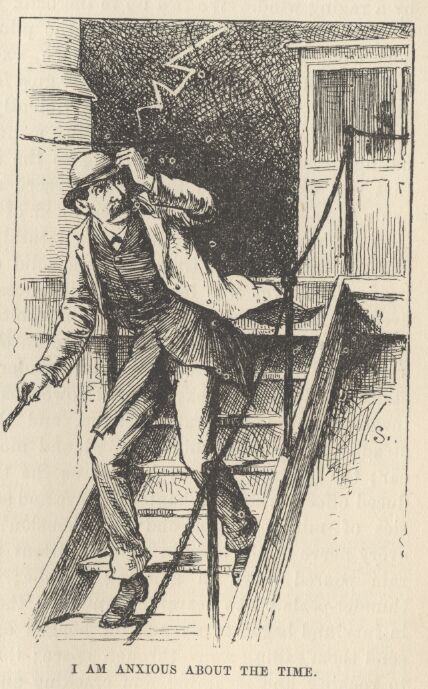
I was on the bench of the pilot-house when we backed out and 'straightened up' for the start—the boat pausing for a 'good ready,' in the old-fashioned way, and the black smoke piling out of the chimneys equally in the old-fashioned way. Then we began to gather momentum, and presently were fairly under way and booming along. It was all as natural and familiar—and so were the shoreward sights—as if there had been no break in my river life. There was a 'cub,' and I judged that he would take the wheel now; and he did. Captain Bixby stepped into the pilot-house. Presently the cub closed up on the rank of steamships. He made me nervous, for he allowed too much water to show between our boat and the ships. I knew quite well what was going to happen, because I could date back in my own life and inspect the record. The captain looked on, during a silent half-minute, then took the wheel himself, and crowded the boat in, till she went scraping along within a hand-breadth of the ships. It was exactly the favor which he had done me, about a quarter of a century before, in that same spot, the first time I ever steamed out of the port of New Orleans. It was a very great and sincere pleasure to me to see the thing repeated—with somebody else as victim.
We made Natchez (three hundred miles) in twenty-two hours and a half— much the swiftest passage I have ever made over that piece of water.
The next morning I came on with the four o'clock watch, and saw Ritchie successfully run half a dozen crossings in a fog, using for his guidance the marked chart devised and patented by Bixby and himself. This sufficiently evidenced the great value of the chart.
By and by, when the fog began to clear off, I noticed that the reflection of a tree in the smooth water of an overflowed bank, six hundred yards away, was stronger and blacker than the ghostly tree itself. The faint spectral trees, dimly glimpsed through the shredding fog, were very pretty things to see.
We had a heavy thunder-storm at Natchez, another at Vicksburg, and still another about fifty miles below Memphis. They had an old-fashioned energy which had long been unfamiliar to me. This third storm was accompanied by a raging wind. We tied up to the bank when we saw the tempest coming, and everybody left the pilot-house but me. The wind bent the young trees down, exposing the pale underside of the leaves; and gust after gust followed, in quick succession, thrashing the branches violently up and down, and to this side and that, and creating swift waves of alternating green and white according to the side of the leaf that was exposed, and these waves raced after each other as do their kind over a wind-tossed field of oats. No color that was visible anywhere was quite natural—all tints were charged with a leaden tinge from the solid cloud-bank overhead. The river was leaden; all distances the same; and even the far-reaching ranks of combing white-caps were dully shaded by the dark, rich atmosphere through which their swarming legions marched. The thunder-peals were constant and deafening; explosion followed explosion with but inconsequential intervals between, and the reports grew steadily sharper and higher-keyed, and more trying to the ear; the lightning was as diligent as the thunder, and produced effects which enchanted the eye and sent electric ecstasies of mixed delight and apprehension shivering along every nerve in the body in unintermittent procession. The rain poured down in amazing volume; the ear-splitting thunder-peals broke nearer and nearer; the wind increased in fury and began to wrench off boughs and tree-tops and send them sailing away through space; the pilot-house fell to rocking and straining and cracking and surging, and I went down in the hold to see what time it was.
People boast a good deal about Alpine thunderstorms; but the storms which I have had the luck to see in the Alps were not the equals of some which I have seen in the Mississippi Valley. I may not have seen the Alps do their best, of course, and if they can beat the Mississippi, I don't wish to.
On this up trip I saw a little towhead (infant island) half a mile long, which had been formed during the past nineteen years. Since there was so much time to spare that nineteen years of it could be devoted to the construction of a mere towhead, where was the use, originally, in rushing this whole globe through in six days? It is likely that if more time had been taken, in the first place, the world would have been made right, and this ceaseless improving and repairing would not be necessary now. But if you hurry a world or a house, you are nearly sure to find out by and by that you have left out a towhead, or a broom-closet, or some other little convenience, here and there, which has got to be supplied, no matter how much expense and vexation it may cost.
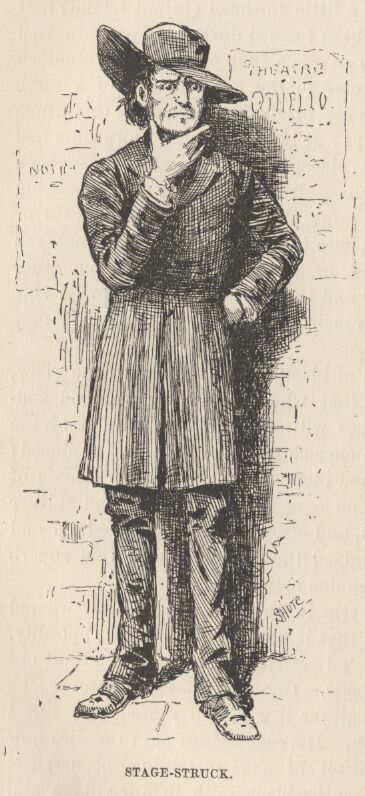
We had a succession of black nights, going up the river, and it was observable that whenever we landed, and suddenly inundated the trees with the intense sunburst of the electric light, a certain curious effect was always produced: hundreds of birds flocked instantly out from the masses of shining green foliage, and went careering hither and thither through the white rays, and often a song-bird tuned up and fell to singing. We judged that they mistook this superb artificial day for the genuine article. We had a delightful trip in that thoroughly well-ordered steamer, and regretted that it was accomplished so speedily. By means of diligence and activity, we managed to hunt out nearly all the old friends. One was missing, however; he went to his reward, whatever it was, two years ago. But I found out all about him. His case helped me to realize how lasting can be the effect of a very trifling occurrence. When he was an apprentice-blacksmith in our village, and I a schoolboy, a couple of young Englishmen came to the town and sojourned a while; and one day they got themselves up in cheap royal finery and did the Richard III swordfight with maniac energy and prodigious powwow, in the presence of the village boys. This blacksmith cub was there, and the histrionic poison entered his bones. This vast, lumbering, ignorant, dull-witted lout was stage-struck, and irrecoverably. He disappeared, and presently turned up in St. Louis. I ran across him there, by and by. He was standing musing on a street corner, with his left hand on his hip, the thumb of his right supporting his chin, face bowed and frowning, slouch hat pulled down over his forehead—imagining himself to be Othello or some such character, and imagining that the passing crowd marked his tragic bearing and were awestruck.
I joined him, and tried to get him down out of the clouds, but did not succeed. However, he casually informed me, presently, that he was a member of the Walnut Street theater company—and he tried to say it with indifference, but the indifference was thin, and a mighty exultation showed through it. He said he was cast for a part in Julius Caesar, for that night, and if I should come I would see him. If I should come! I said I wouldn't miss it if I were dead.
I went away stupefied with astonishment, and saying to myself, 'How strange it is! We always thought this fellow a fool; yet the moment he comes to a great city, where intelligence and appreciation abound, the talent concealed in this shabby napkin is at once discovered, and promptly welcomed and honored.'
But I came away from the theater that night disappointed and offended; for I had had no glimpse of my hero, and his name was not in the bills. I met him on the street the next morning, and before I could speak, he asked—
'Did you see me?'
'No, you weren't there.'
He looked surprised and disappointed. He said—
'Yes, I was. Indeed I was. I was a Roman soldier.'
'Which one?'
'Why didn't you see them Roman soldiers that stood back there in a rank, and sometimes marched in procession around the stage?'
'Do you mean the Roman army?—those six sandaled roustabouts in nightshirts, with tin shields and helmets, that marched around treading on each other's heels, in charge of a spider-legged consumptive dressed like themselves?'
'That's it! that's it! I was one of them Roman soldiers. I was the next to the last one. A half a year ago I used to always be the last one; but I've been promoted.'
Well, they told me that that poor fellow remained a Roman soldier to the last—a matter of thirty-four years. Sometimes they cast him for a 'speaking part,' but not an elaborate one. He could be trusted to go and say, 'My lord, the carriage waits,' but if they ventured to add a sentence or two to this, his memory felt the strain and he was likely to miss fire. Yet, poor devil, he had been patiently studying the part of Hamlet for more than thirty years, and he lived and died in the belief that some day he would be invited to play it!
And this is what came of that fleeting visit of those young Englishmen to our village such ages and ages ago! What noble horseshoes this man might have made, but for those Englishmen; and what an inadequate Roman soldier he did make!
A day or two after we reached St. Louis, I was walking along Fourth Street when a grizzly-headed man gave a sort of start as he passed me, then stopped, came back, inspected me narrowly, with a clouding brow, and finally said with deep asperity—
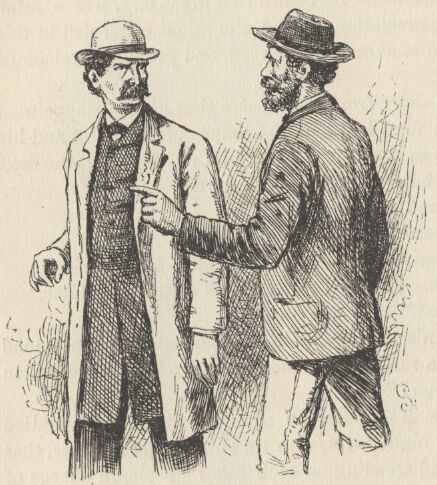
'Look here, have you got that drink yet?'
A maniac, I judged, at first. But all in a flash I recognized him. I made an effort to blush that strained every muscle in me, and answered as sweetly and winningly as ever I knew how—
'Been a little slow, but am just this minute closing in on the place where they keep it. Come in and help.'
He softened, and said make it a bottle of champagne and he was agreeable. He said he had seen my name in the papers, and had put all his affairs aside and turned out, resolved to find me or die; and make me answer that question satisfactorily, or kill me; though the most of his late asperity had been rather counterfeit than otherwise.
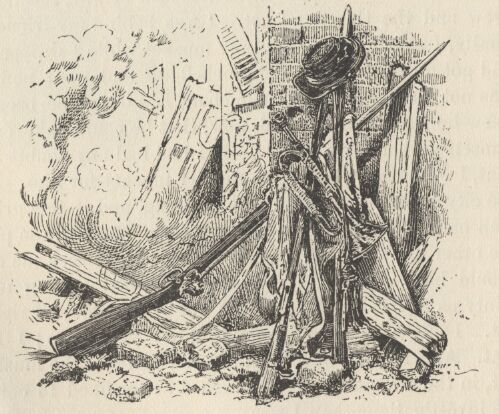
This meeting brought back to me the St. Louis riots of about thirty years ago. I spent a week there, at that time, in a boarding-house, and had this young fellow for a neighbor across the hall. We saw some of the fightings and killings; and by and by we went one night to an armory where two hundred young men had met, upon call, to be armed and go forth against the rioters, under command of a military man. We drilled till about ten o'clock at night; then news came that the mob were in great force in the lower end of the town, and were sweeping everything before them. Our column moved at once. It was a very hot night, and my musket was very heavy. We marched and marched; and the nearer we approached the seat of war, the hotter I grew and the thirstier I got. I was behind my friend; so, finally, I asked him to hold my musket while I dropped out and got a drink. Then I branched off and went home. I was not feeling any solicitude about him of course, because I knew he was so well armed, now, that he could take care of himself without any trouble. If I had had any doubts about that, I would have borrowed another musket for him. I left the city pretty early the next morning, and if this grizzled man had not happened to encounter my name in the papers the other day in St. Louis, and felt moved to seek me out, I should have carried to my grave a heart-torturing uncertainty as to whether he ever got out of the riots all right or not. I ought to have inquired, thirty years ago; I know that. And I would have inquired, if I had had the muskets; but, in the circumstances, he seemed better fixed to conduct the investigations than I was.
One Monday, near the time of our visit to St. Louis, the 'Globe-Democrat' came out with a couple of pages of Sunday statistics, whereby it appeared that 119,448 St. Louis people attended the morning and evening church services the day before, and 23,102 children attended Sunday-school. Thus 142,550 persons, out of the city's total of 400,000 population, respected the day religious-wise. I found these statistics, in a condensed form, in a telegram of the Associated Press, and preserved them. They made it apparent that St. Louis was in a higher state of grace than she could have claimed to be in my time. But now that I canvass the figures narrowly, I suspect that the telegraph mutilated them. It cannot be that there are more than 150,000 Catholics in the town; the other 250,000 must be classified as Protestants. Out of these 250,000, according to this questionable telegram, only 26,362 attended church and Sunday-school, while out of the 150,000 Catholics, 116,188 went to church and Sunday-school.
Chapter 52
A Burning Brand
All at once the thought came into my mind, 'I have not sought out Mr. Brown.'
Upon that text I desire to depart from the direct line of my subject, and make a little excursion. I wish to reveal a secret which I have carried with me nine years, and which has become burdensome.
Upon a certain occasion, nine years ago, I had said, with strong feeling, 'If ever I see St. Louis again, I will seek out Mr. Brown, the great grain merchant, and ask of him the privilege of shaking him by the hand.'
The occasion and the circumstances were as follows. A friend of mine, a clergyman, came one evening and said—
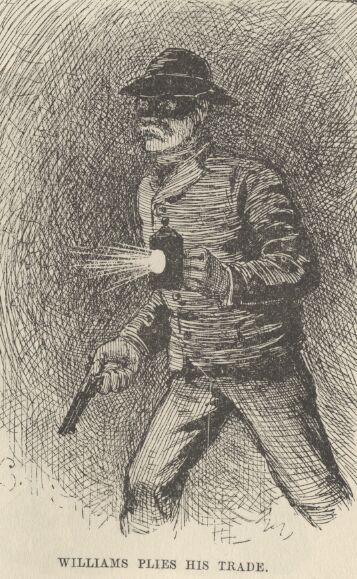
'I have a most remarkable letter here, which I want to read to you, if I can do it without breaking down. I must preface it with some explanations, however. The letter is written by an ex-thief and ex-vagabond of the lowest origin and basest rearing, a man all stained with crime and steeped in ignorance; but, thank God, with a mine of pure gold hidden away in him, as you shall see. His letter is written to a burglar named Williams, who is serving a nine-year term in a certain State prison, for burglary. Williams was a particularly daring burglar, and plied that trade during a number of years; but he was caught at last and jailed, to await trial in a town where he had broken into a house at night, pistol in hand, and forced the owner to hand over to him $8,000 in government bonds. Williams was not a common sort of person, by any means; he was a graduate of Harvard College, and came of good New England stock. His father was a clergyman. While lying in jail, his health began to fail, and he was threatened with consumption. This fact, together with the opportunity for reflection afforded by solitary confinement, had its effect—its natural effect. He fell into serious thought; his early training asserted itself with power, and wrought with strong influence upon his mind and heart. He put his old life behind him, and became an earnest Christian. Some ladies in the town heard of this, visited him, and by their encouraging words supported him in his good resolutions and strengthened him to continue in his new life. The trial ended in his conviction and sentence to the State prison for the term of nine years, as I have before said. In the prison he became acquainted with the poor wretch referred to in the beginning of my talk, Jack Hunt, the writer of the letter which I am going to read. You will see that the acquaintanceship bore fruit for Hunt. When Hunt's time was out, he wandered to St. Louis; and from that place he wrote his letter to Williams. The letter got no further than the office of the prison warden, of course; prisoners are not often allowed to receive letters from outside. The prison authorities read this letter, but did not destroy it. They had not the heart to do it. They read it to several persons, and eventually it fell into the hands of those ladies of whom I spoke a while ago. The other day I came across an old friend of mine—a clergyman—who had seen this letter, and was full of it. The mere remembrance of it so moved him that he could not talk of it without his voice breaking. He promised to get a copy of it for me; and here it is—an exact copy, with all the imperfections of the original preserved. It has many slang expressions in it—thieves' argot—but their meaning has been interlined, in parentheses, by the prison authorities'—
St. Louis, June 9th 1872.
Mr. W—— friend Charlie if i may call you so: i no you are surprised to get a letter from me, but i hope you won't be mad at my writing to you. i want to tell you my thanks for the way you talked to me when i was in prison—it has led me to try and be a better man; i guess you thought i did not cair for what you said, & at the first go off I didn't, but i noed you was a man who had don big work with good men & want no sucker, nor want gasing & all the boys knod it.
I used to think at nite what you said, & for it i nocked off swearing months before my time was up, for i saw it want no good, nohow—the day my time was up you told me if i would shake the cross (quit stealing) & live on the square for months, it would be the best job i ever done in my life. The state agent give me a ticket to here, & on the car i thought more of what you said to me, but didn't make up my mind. When we got to Chicago on the cars from there to here, I pulled off an old woman's leather;
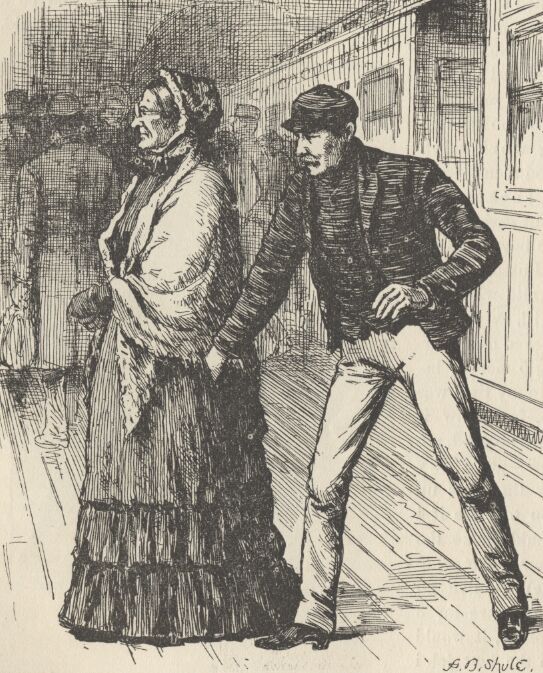
(Robbed her of her pocketbook) i hadn't no more than got it off when i wished i hadn't done it, for awhile before that i made up my mind to be a square bloke, for months on your word, but forgot it when i saw the leather was a grip (easy to get)—but i kept clos to her & when she got out of the cars at a way place i said, marm have you lost anything. & she tumbled (discovered) her leather was off (gone)—is this it says i, giving it to her—well if you aint honest, says she, but i hadn't got cheak enough to stand that sort of talk, so i left her in a hurry. When i got here i had $1 and 25 cents left & i didn't get no work for 3 days as i aint strong enough for roust about on a steam bote (for a deck hand)—The afternoon of the 3rd day I spent my last 10 cts for moons (large, round sea-biscuit) & cheese & i felt pretty rough & was thinking i would have to go on the dipe (picking pockets) again, when i thought of what you once said about a fellows calling on the Lord when he was in hard luck, & i thought i would try it once anyhow, but when i tryed it i got stuck on the start, & all i could get off wos, Lord give a poor fellow a chance to square it for 3 months for Christ's sake, amen; & i kept a thinking, of it over and over as i went along—about an hour after that i was in 4th St. & this is what happened & is the cause of my being where i am now & about which i will tell you before i get done writing. As i was walking along herd a big noise & saw a horse running away with a carriage with 2 children in it, & I grabed up a peace of box cover from the side walk & run in the middle of the street, & when the horse came up i smashed him over the head as hard as i could drive—the bord split to peces & the horse checked up a little & I grabbed the reigns & pulled his head down until he stopped—the gentleman what owned him came running up & soon as he saw the children were all rite, he shook hands with me and gave me a $50 green back, & my asking the Lord to help me come into my head, & i was so thunderstruck i couldn't drop the reigns nor say nothing—he saw something was up, &
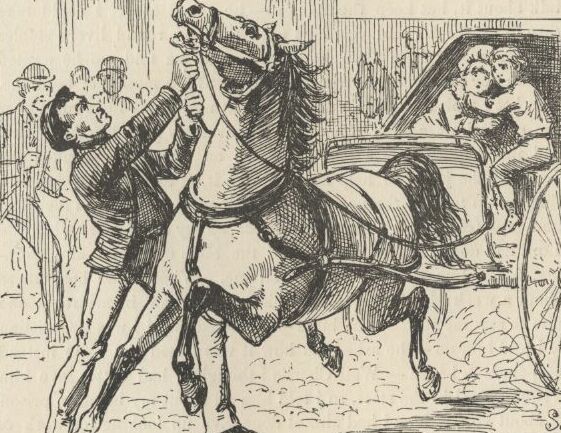
coming back to me said, my boy are you hurt? & the thought come into my head just then to ask him for work; & i asked him to take back the bill and give me a job—says he, jump in here & lets talk about it, but keep the money—he asked me if i could take care of horses & i said yes, for i used to hang round livery stables & often would help clean & drive horses, he told me he wanted a man for that work, & would give me $16 a month & bord me. You bet i took that chance at once. that nite in my little room over the stable i sat a long time thinking over my past life & of what had just happened & i just got down on my nees & thanked the Lord for the job & to help me to square it, & to bless you for putting me up to it, & the next morning i done it again & got me some new togs (clothes) & a bible for i made up my mind after what the Lord had done for me i would read the bible every nite and morning, & ask him to keep an eye on me. When I had been there about a week Mr. Brown (that's his name) came in my room one nite and saw me reading the bible—he asked me if i was a Christian & i told him no—he asked me how it was i read the bible instead of papers & books—Well Charlie i thought i had better give him a square deal in the start, so i told him all about my being in prison & about you, & how i had almost done give up looking for work & how the Lord got me the job when I asked him; & the only way i had to pay him back was to read the bible & square it, & i asked him to give me a chance for 3 months—he talked to me like a father for a long time, & told me i could stay & then i felt better than ever i had done in my life, for i had given Mr. Brown a fair start with me & now i didn't fear no one giving me a back cap (exposing his past life) & running me off the job—the next morning he called me into the library & gave me another square talk, & advised me to study some every day, & he would help me one or 2 hours every nite, & he gave me a Arithmetic, a spelling book, a Geography & a writing book, & he hers me every nite—he lets me come into the house to prayers every morning, & got me put in a bible class in the Sunday School which i likes very much for it helps me to understand my bible better.
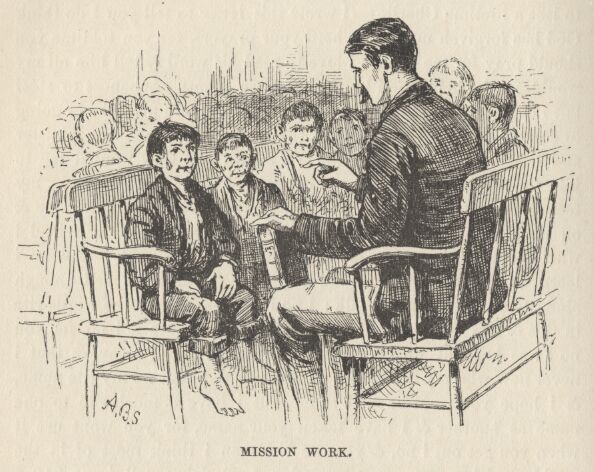
Now, Charlie the 3 months on the square are up 2 months ago, & as you said, it is the best job i ever did in my life, & i commenced another of the same sort right away, only it is to God helping me to last a lifetime Charlie—i wrote this letter to tell you I do think God has forgiven my sins & herd your prayers, for you told me you should pray for me—i no i love to read his word & tell him all my troubles & he helps me i know for i have plenty of chances to steal but i don't feel to as i once did & now i take more pleasure in going to church than to the theater & that wasnt so once—our minister and others often talk with me & a month ago they wanted me to join the church, but I said no, not now, i may be mistaken in my feelings, i will wait awhile, but now i feel that God has called me & on the first Sunday in July i will join the church—dear friend i wish i could write to you as i feel, but i cant do it yet—you no i learned to read and write while prisons & i aint got well enough along to write as i would talk; i no i aint spelled all the words rite in this & lots of other mistakes but you will excuse it i no, for you no i was brought up in a poor house until i run away, & that i never new who my father and mother was & i dont no my right name, & i hope you wont be mad at me, but i have as much rite to one name as another & i have taken your name, for you wont use it when you get out i no, & you are the man i think most of in the world; so i hope you wont be mad—I am doing well, i put $10 a month in bank with $25 of the $50— if you ever want any or all of it let me know, & it is yours. i wish you would let me send you some now. I send you with this a receipt for a year of Littles Living Age, i didn't know what you would like & i told Mr. Brown & he said he thought you would like it—i wish i was nere you so i could send you chuck (refreshments) on holidays; it would spoil this weather from here, but i will send you a box next thanksgiving any way—next week Mr. Brown takes me into his store as lite porter & will advance me as soon as i know a little more—he keeps a big granary store, wholesale—i forgot to tell you of my mission school, sunday school class—the school is in the sunday afternoon, i went out two sunday afternoons, and picked up seven kids (little boys) & got them to come in. two of them new as much as i did & i had them put in a class where they could learn something. i dont no much myself, but as these kids cant read i get on nicely with them. i make sure of them by going after them every Sunday hour before school time, I also got 4 girls to come. tell Mack and Harry about me, if they will come out here when their time is up i will get them jobs at once. i hope you will excuse this long letter & all mistakes, i wish i could see you for i cant write as i would talk—i hope the warm weather is doing your lungs good—i was afraid when you was bleeding you would die—give my respects to all the boys and tell them how i am doing—i am doing well and every one here treats me as kind as they can—Mr. Brown is going to write to you sometime—i hope some day you will write to me, this letter is from your very true friend
C—— W——
who you know as Jack Hunt.
I send you Mr. Brown's card. Send my letter to him.
Here was true eloquence; irresistible eloquence; and without a single grace or ornament to help it out. I have seldom been so deeply stirred by any piece of writing. The reader of it halted, all the way through, on a lame and broken voice; yet he had tried to fortify his feelings by several private readings of the letter before venturing into company with it. He was practising upon me to see if there was any hope of his being able to read the document to his prayer-meeting with anything like a decent command over his feelings. The result was not promising. However, he determined to risk it; and did. He got through tolerably well; but his audience broke down early, and stayed in that condition to the end.
The fame of the letter spread through the town. A brother minister came and borrowed the manuscript, put it bodily into a sermon, preached the sermon to twelve hundred people on a Sunday morning, and the letter drowned them in their own tears. Then my friend put it into a sermon and went before his Sunday morning congregation with it. It scored another triumph. The house wept as one individual.
My friend went on summer vacation up into the fishing regions of our northern British neighbors, and carried this sermon with him, since he might possibly chance to need a sermon. He was asked to preach, one day. The little church was full. Among the people present were the late Dr. J. G. Holland, the late Mr. Seymour of the 'New York Times,' Mr. Page, the philanthropist and temperance advocate, and, I think, Senator Frye, of Maine. The marvelous letter did its wonted work; all the people were moved, all the people wept; the tears flowed in a steady stream down Dr. Holland's cheeks, and nearly the same can be said with regard to all who were there. Mr. Page was so full of enthusiasm over the letter that he said he would not rest until he made pilgrimage to that prison, and had speech with the man who had been able to inspire a fellow-unfortunate to write so priceless a tract.
Ah, that unlucky Page!—and another man. If they had only been in Jericho, that letter would have rung through the world and stirred all the hearts of all the nations for a thousand years to come, and nobody might ever have found out that it was the confoundedest, brazenest, ingeniousest piece of fraud and humbuggery that was ever concocted to fool poor confiding mortals with!
The letter was a pure swindle, and that is the truth. And take it by and large, it was without a compeer among swindles. It was perfect, it was rounded, symmetrical, complete, colossal!