Notes on the Woodcuts.


THE History of the Legend of the Holy Cross which is here reproduced, is somewhat fuller than the Golden Legend of Caxton, there being particulars about Moses, David, and Solomon not to be found therein; but they may be found in other versions of the Legend, some in the Latin of Jacobus de Voragine, others in two MSS. in the British Museum.[M]
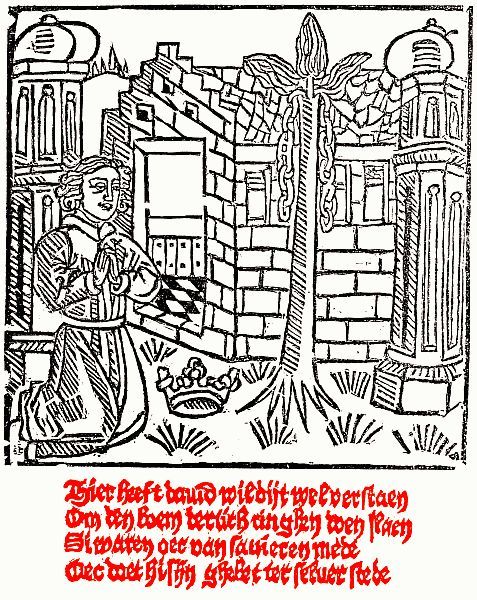
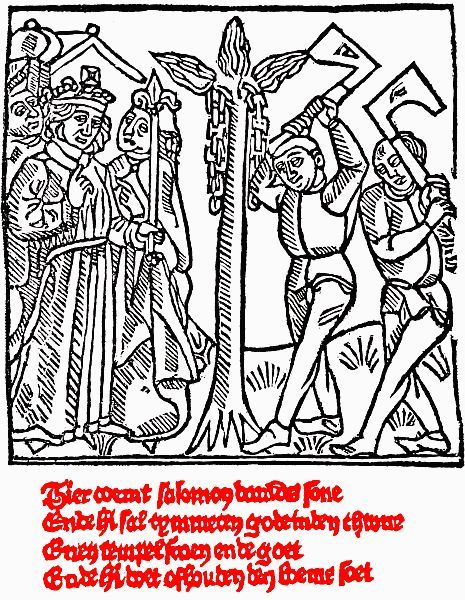
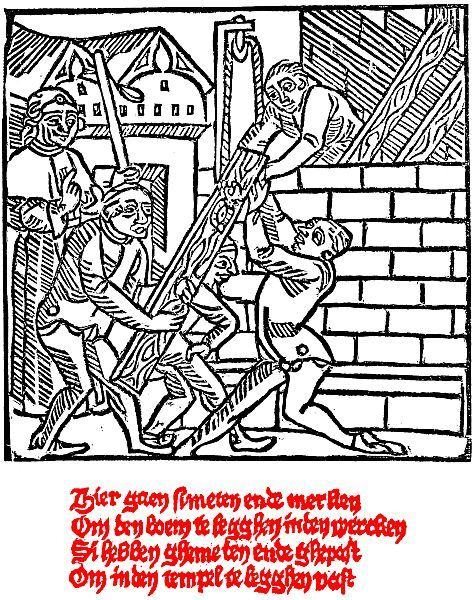
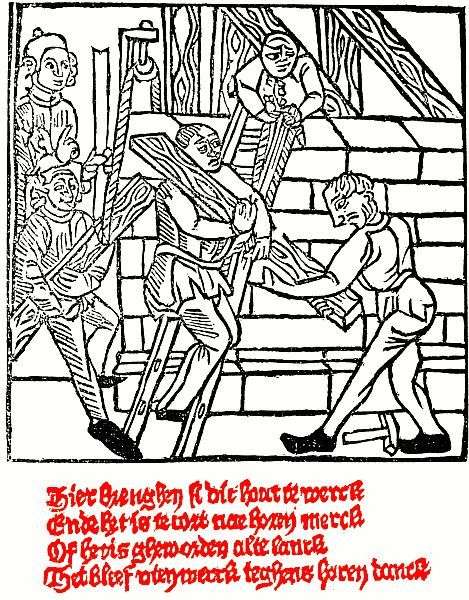
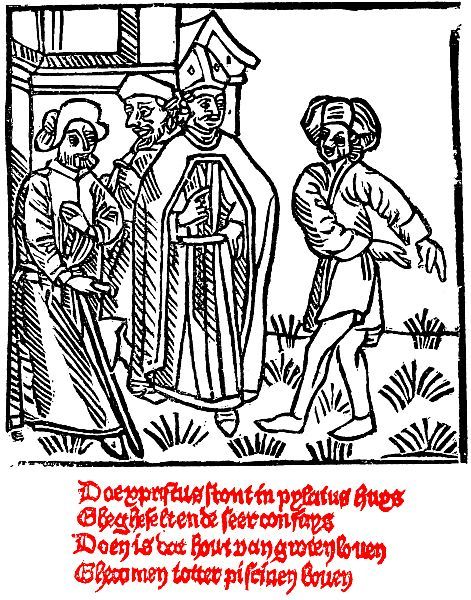
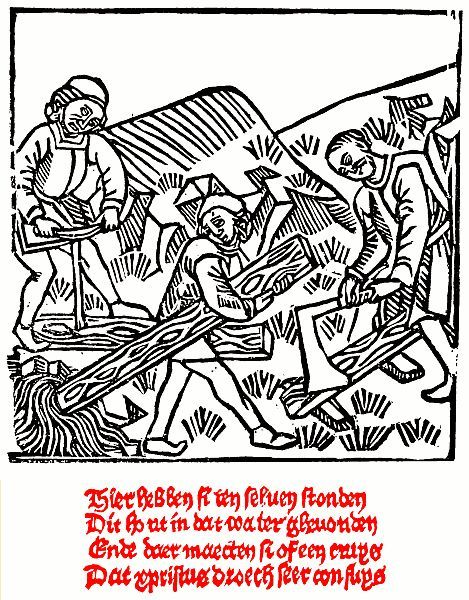
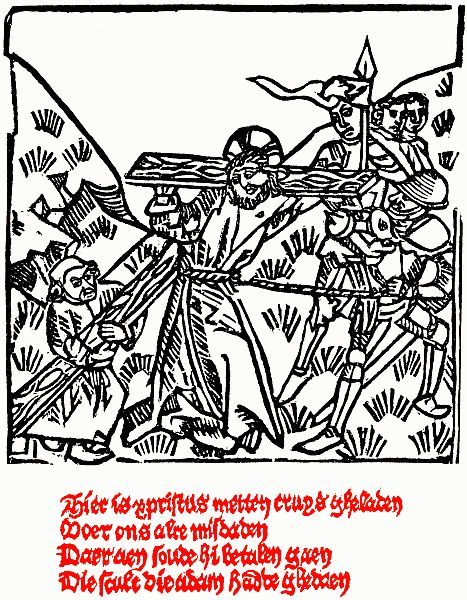
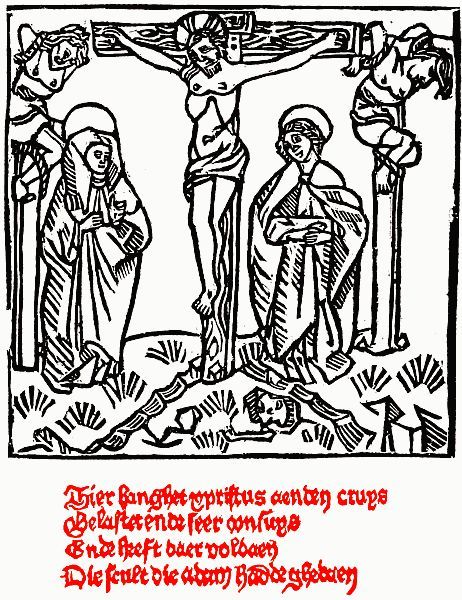
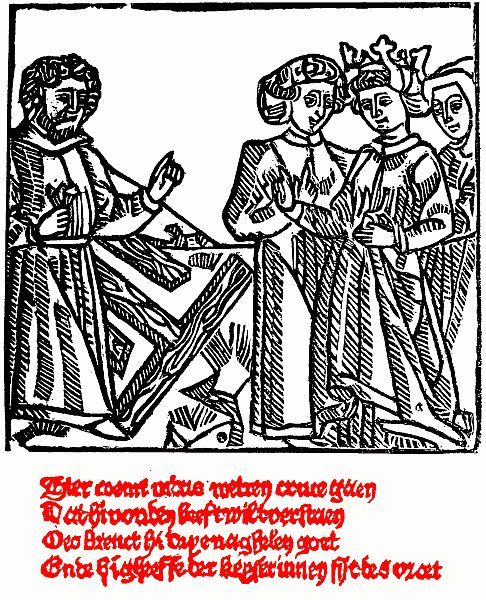
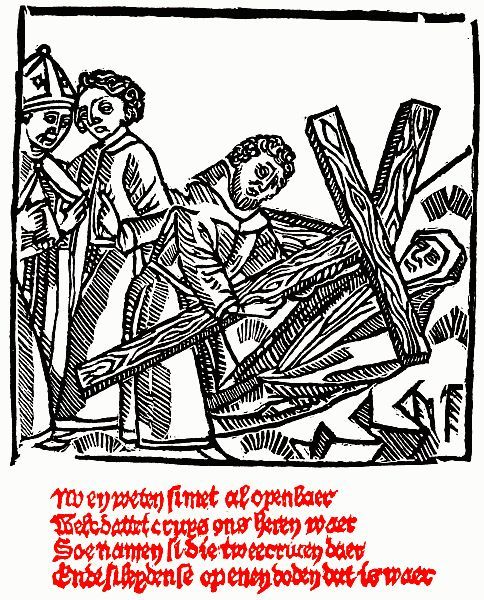
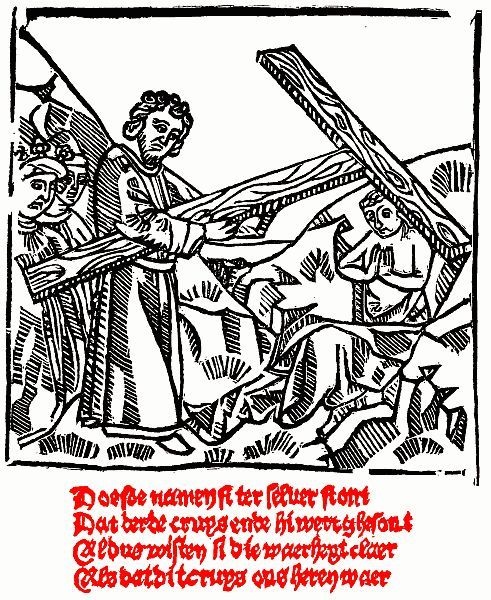
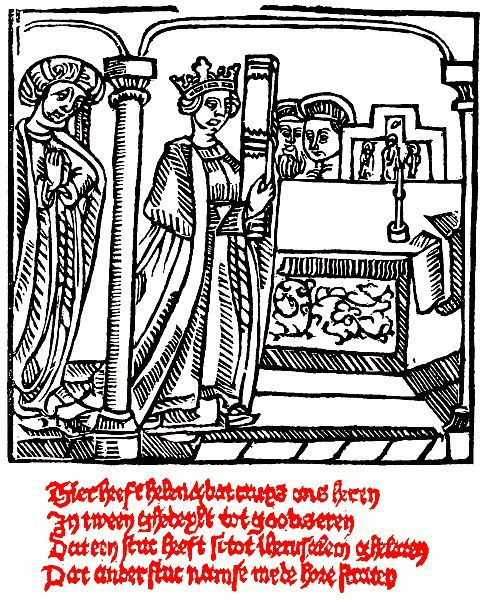
The engravings are taken from a very rare book, of which, as far as is known, there are but three copies in existence: one is in the Royal Library at Brussels, another at the Hague, in the collection of Mr. Schinkel, and the third is in the possession of Lord Spencer at Althorp. It is from this book that these fac-similes (made by M. J. Ph. Berjeau) were taken. The book itself has one woodcut on each page, with a verse in Dutch, at the bottom, explanatory of each engraving. It is called indifferently Historia Sanctæ Crucis or Boec van den houte (Book of the wood or tree).
It was printed at Kuilenburg on March 6th, 1483, by John Veldener,[N] who had just removed from Louvain. These sixty-four engravings were originally on thirty-two blocks,[O] and evidently belonged to some much older block book, now lost. These, Veldener cut in half, as he had already treated a Speculum, and brought them out as a fresh book.
The Legend as told by these engravings is as follows:—
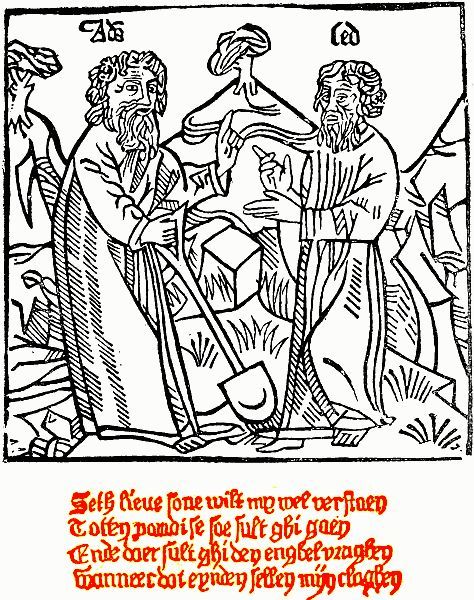
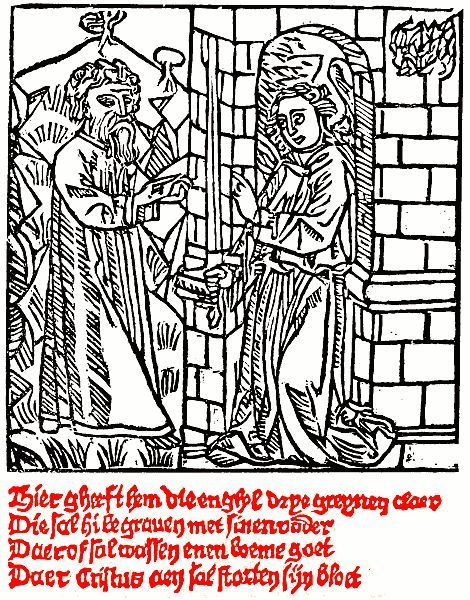
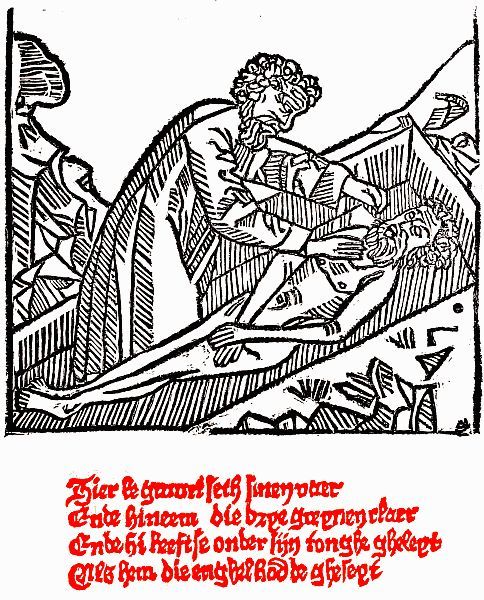
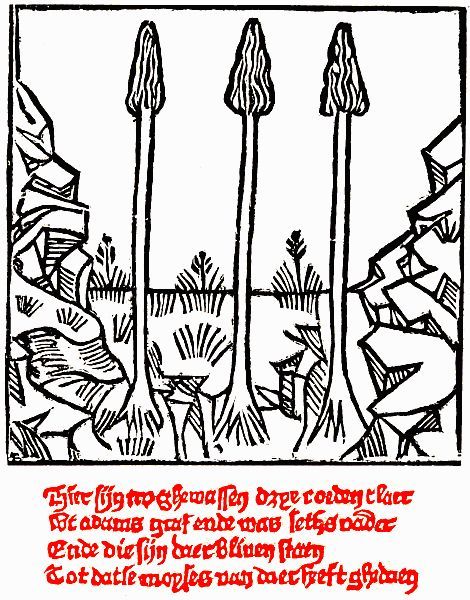
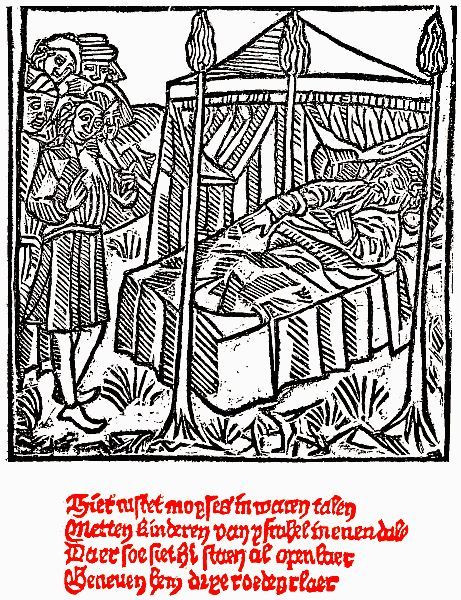
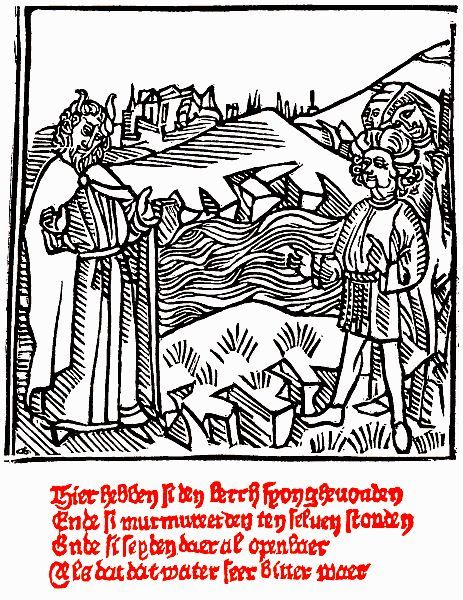
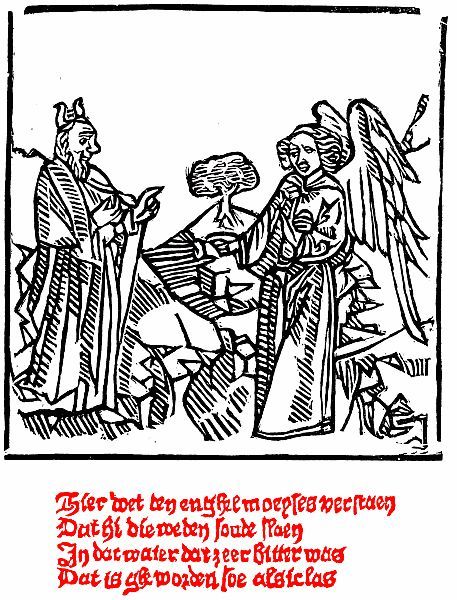
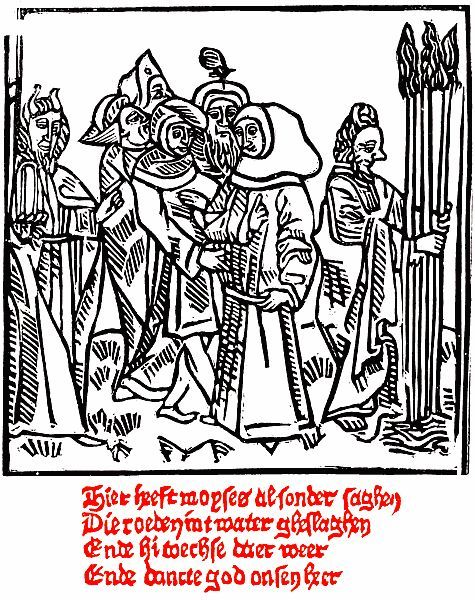
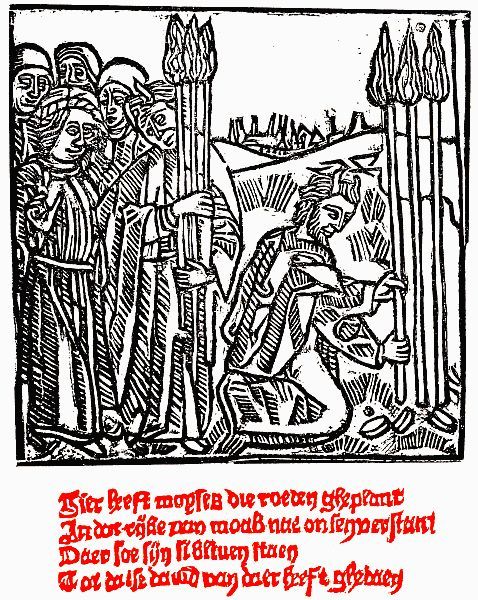
Adam, feeling himself about to die, sent Seth to Paradise to beg for some of the oil of mercy,1 which, however, the Archangel Michael refused to give him, but, instead, presented him with three seeds of the tree of life.2 On his return, he found Adam dead, and, being unable to administer these seeds to his father in any other manner, he put them under his tongue, and then buried him.3 Presently these seeds germinated and shot through the ground, and are traditionally said to have been a cedar, a cypress, and a pine.4 They grew until Moses had led the Israelites out of Egypt, when he found them in the Valley of Hebron, and he recognized them as typifying the Trinity. He removed them, and they were his constant companions.5 With them he smote the rock, and the waters gushed out,6 and the bitter waters of Marah became sweet.7, 8
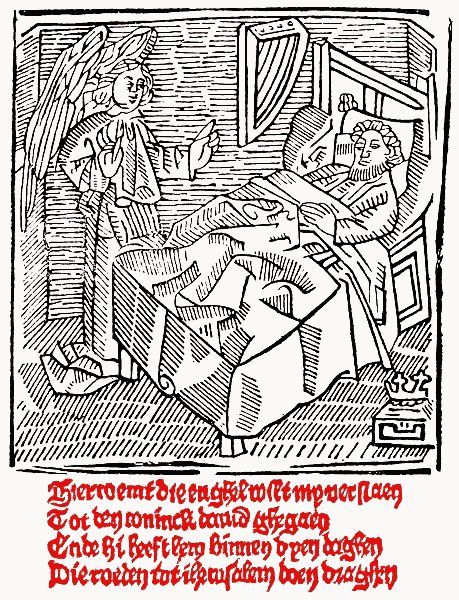
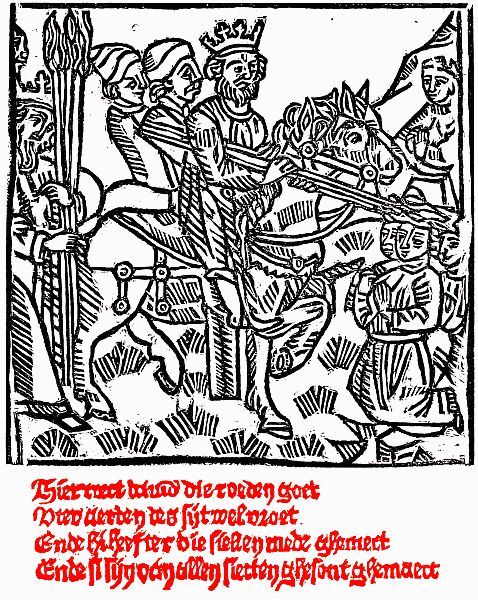
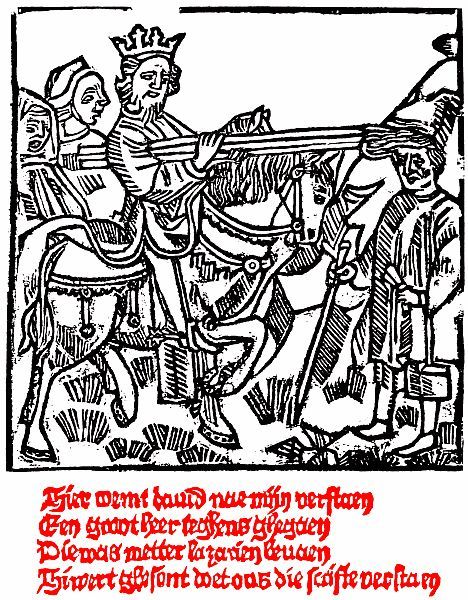
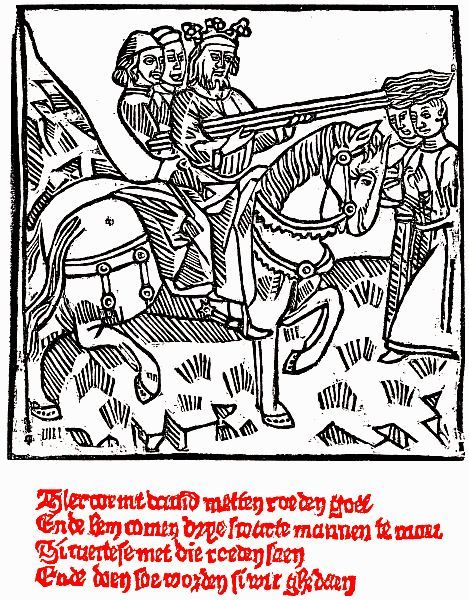
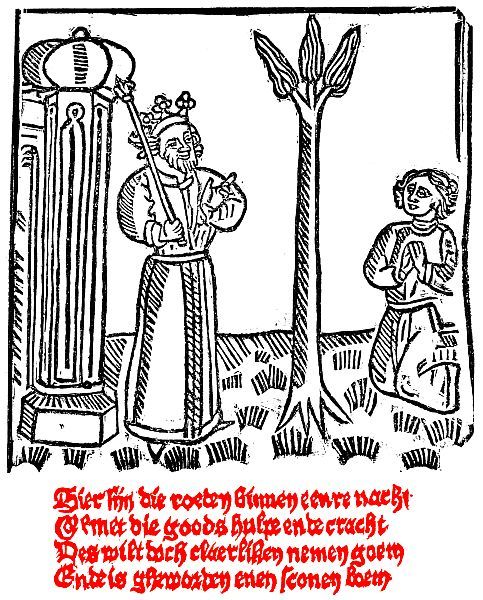
He then planted them in the land of Moab,9 and there they remained, until an angelic vision appeared unto David, and commanded him to go, and take them up, and bring them to Jerusalem.10 On his return the three rods worked miracles, healing the sick,11 and the leprous, with a touch;12 nay, more, on being applied to three black men, they instantly became white.13
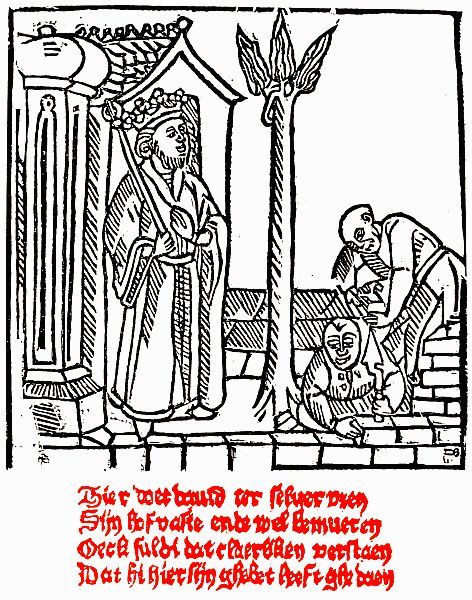
Arrived at Jerusalem, they wished to plant them, but for the night they left them in a cistern, by the Tower of David,14 and lo! during the night, they struck root, and, entwining themselves, became but one stem,15 which, when David saw, he had a wall built round it.16 And the tree grew for thirty years, David ornamenting it with rings of sapphire and other precious stones, adding one for every year, and under this tree he composed the Psalms, and praised God exceedingly.17
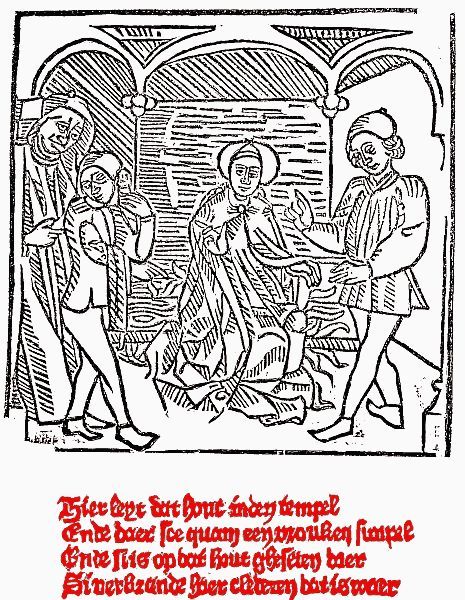
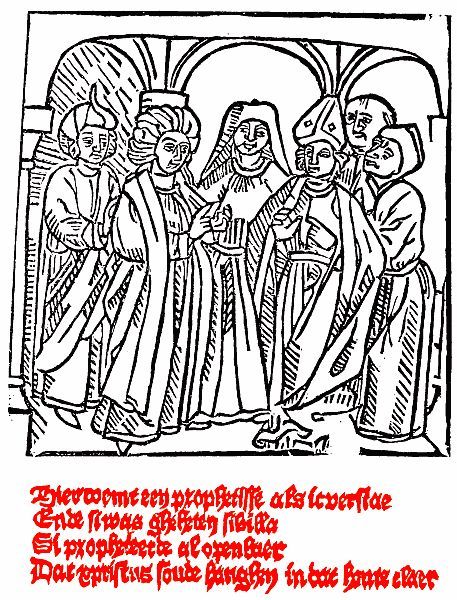
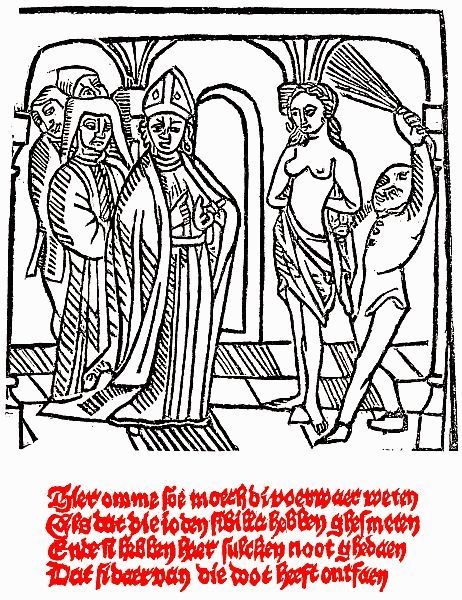
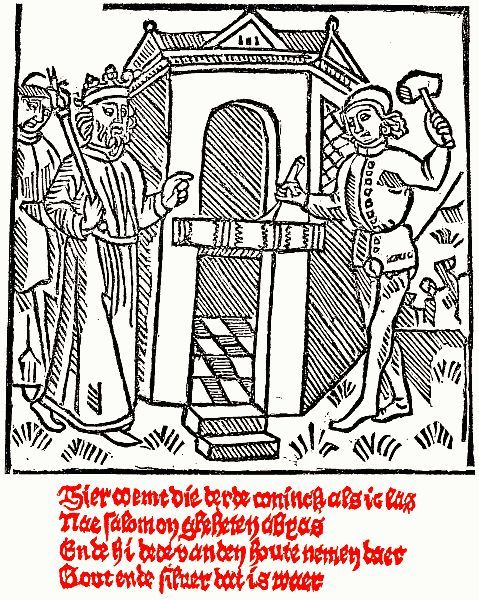
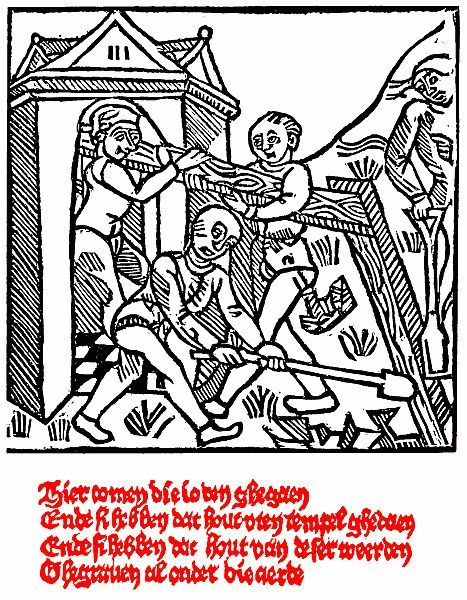
But Solomon, who must needs have all that was rare and costly to adorn his temple, cast his eyes upon this precious tree, and ordered it to be cut down.18 It was duly felled, and squared, and trimmed, and it measured thirty cubits in length.19 But when the carpenters came to put it into a place of that length, it was a cubit too short, and when it was fitted into a place of twenty-nine cubits, lo! it measured thirty, and the carpenters marvelled much, and were greatly astonished, and so, being useless, it was laid aside.20 Yet the people came to see this wonderful tree, and amongst them was a maid named Maximilla, who sat down upon it, and instantly her clothes were in a blaze.21 Then she began to lift up her voice, and prophesy, crying, “My God, and my Lord Jesu Christ.”22 Then the Jews took her, and scourged her to death.23
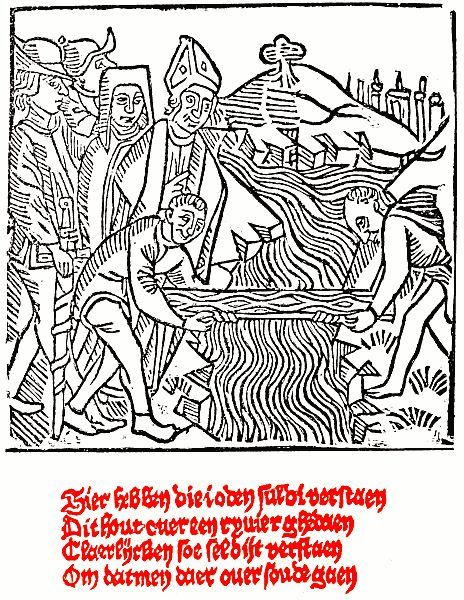
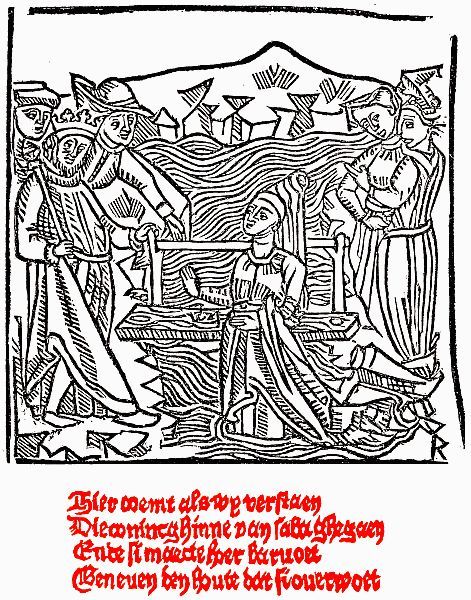
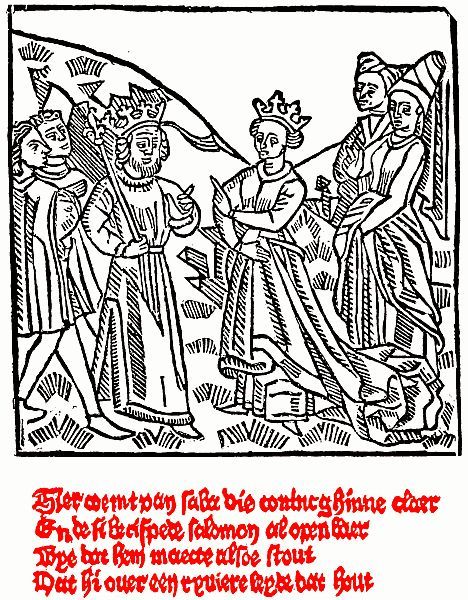
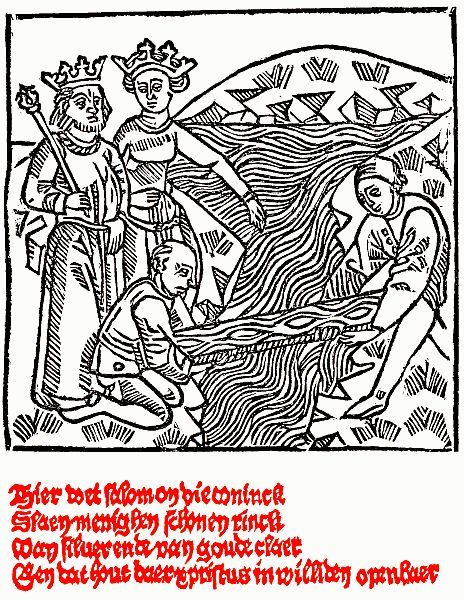
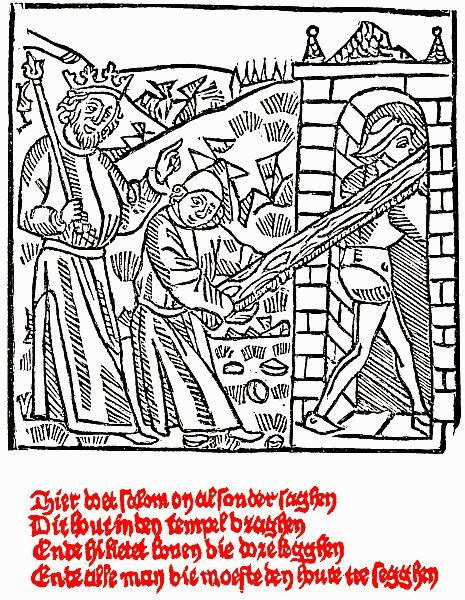
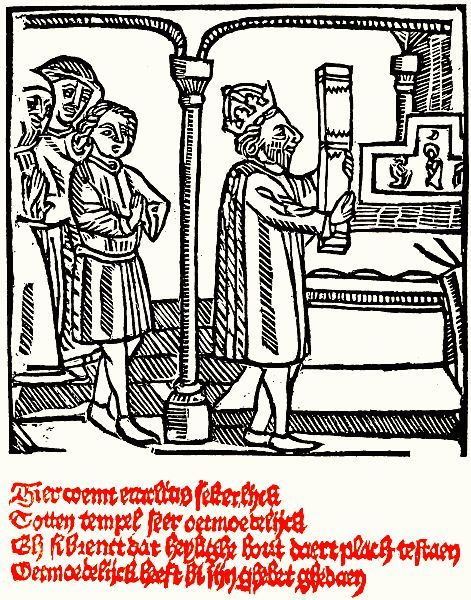
The Jews, not knowing what to do with this miraculous tree, laid it across a brook,24 and, when the Queen of Sheba came to visit Solomon, she recognized the virtue of the wood; and, refusing to defile it with her feet, she dismounted, and adored it, and waded through the brook.25 Then, when she met Solomon, she reproved him, and told him that on that tree would the Saviour of the world suffer death.26 And Solomon commanded the holy wood to be taken up,27 and caused it to be carried into the Temple, there to be placed over the door, so that all men might bless, and adore it, and he coated it over with gold and silver.28 There it remained until Abias stripped it of its costly coverings,29 and the Jews buried it deep in the earth.30
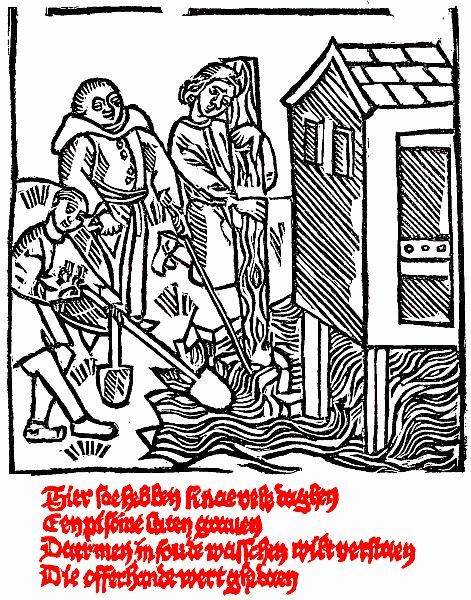
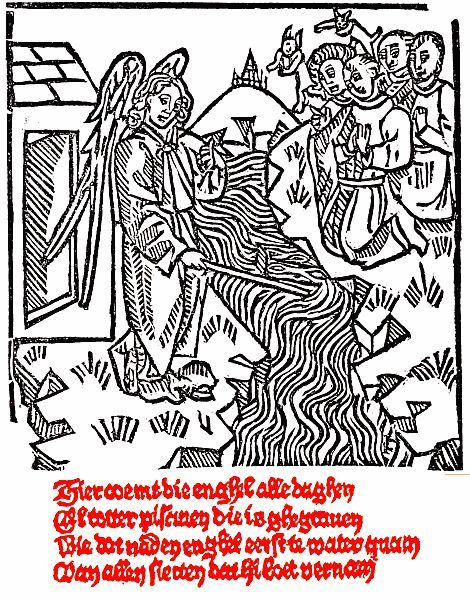
There it remained for many years, until the Jews wished to make a pool, where the priests might wash the beasts, to purify them, previous to sacrificing them, and, unknowingly, they dug over the burial-place of the Holy Cross.31 This imparted such a virtue to the water of that pool, which was called Bethesda, that the sick were healed thereat, and an angel at times descended from heaven, and stirred the waters, and then whoever could get first into the waters was straightway healed of any infirmity he might have.32
We now come to the Crucifixion, and there was a lack of wood to make Christ’s cross—when, suddenly, from the depths of Bethesda, leaped up the tree of the Cross, and floated gently to land. One ran to the High Priest,33 and told him of the timely find of suitable wood, and he at once gave orders for it to be fashioned into a Cross.34 Then comes the mournful procession to Calvary, with our Saviour fainting under the weight of the Cross, and Simon the Cyrenean is pressed into the service to help Jesus.35 And then the Crucifixion.36
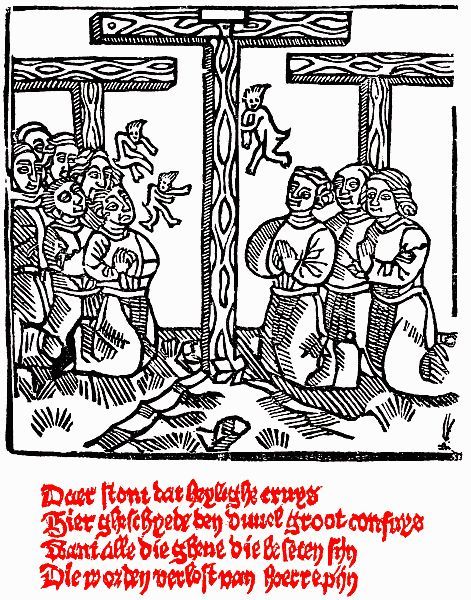
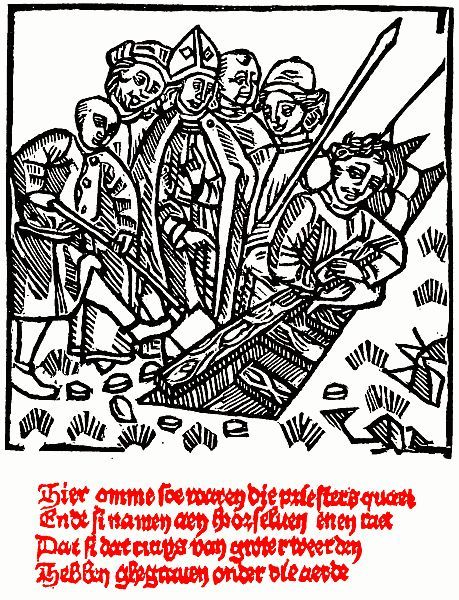
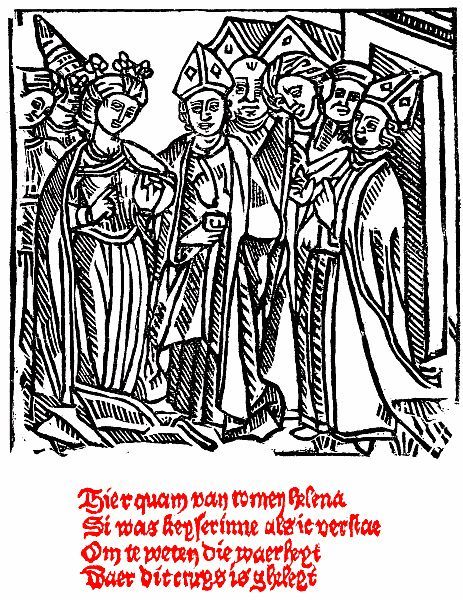
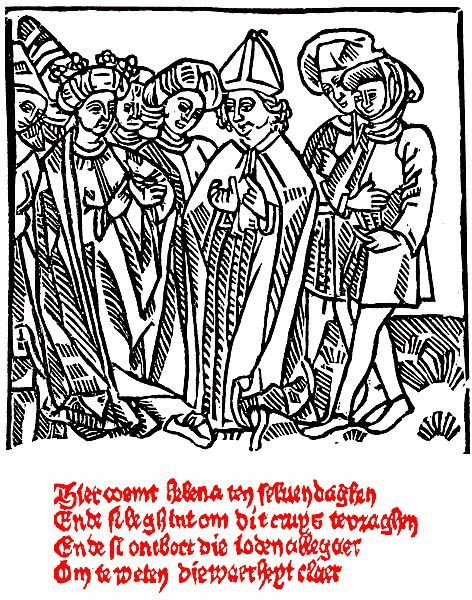
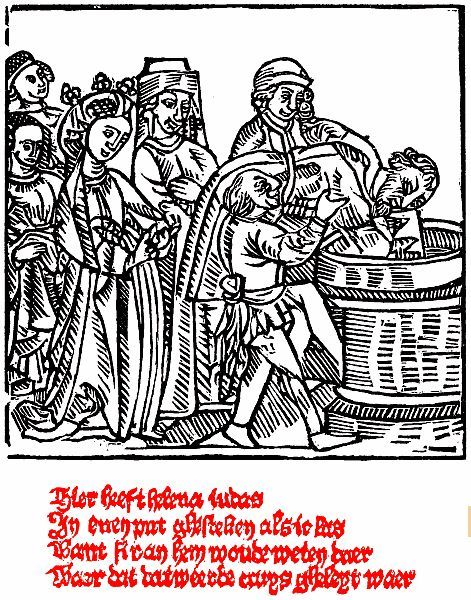
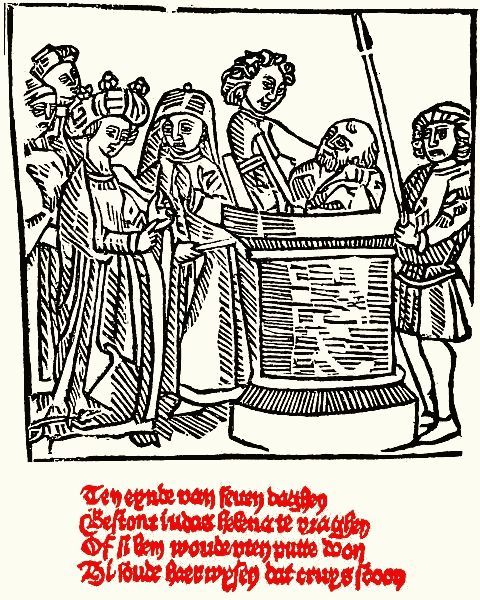
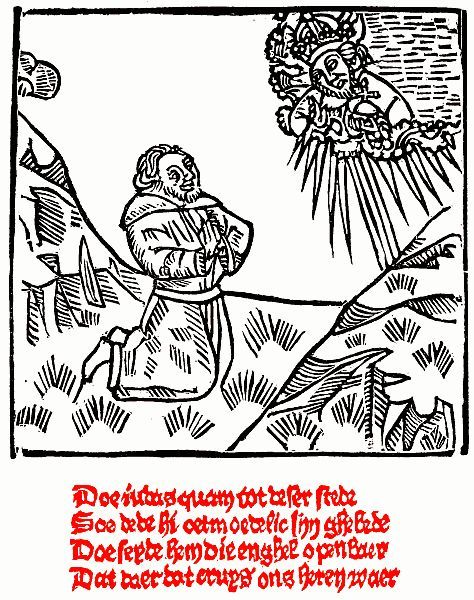
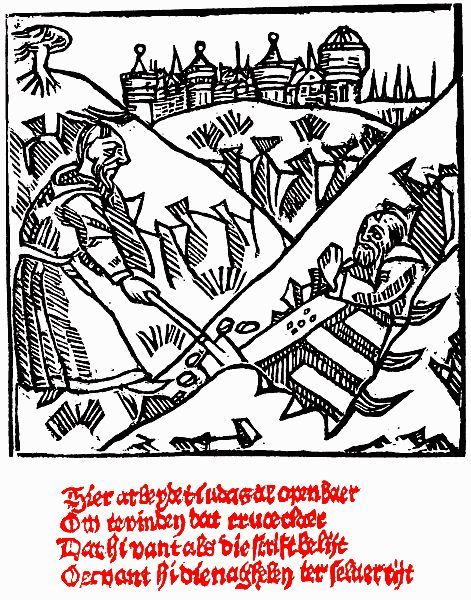
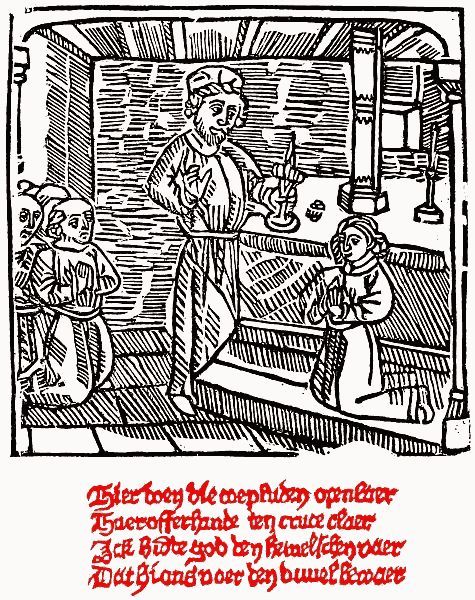
And whilst the crosses were still standing, the disciples came to them and prayed, and many were healed of their infirmities, and many devils were cast out.37 This so angered the Jews that they took the crosses down, and buried them,38 and there they remained until their invention by St. Helena, A.D. 326. On her arrival at Jerusalem,39 she convened a meeting of the principal Jews, and they denied all knowledge of it, but, on threat of being burnt, they said that one of their number, named Judas, knew where the crosses were buried.40 Judas, however, refused to tell, and, to compel him to impart his knowledge, St. Helena had him lowered into a dry well, “and there tormented hym by hongre and evyl reste.”41 Seven days of this treatment made him submissive, and at the end of that time he capitulated. He was then drawn up,42 and prayed to God to direct him to the right spot.43 His prayer was heard, and after some digging, the crosses were discovered.44
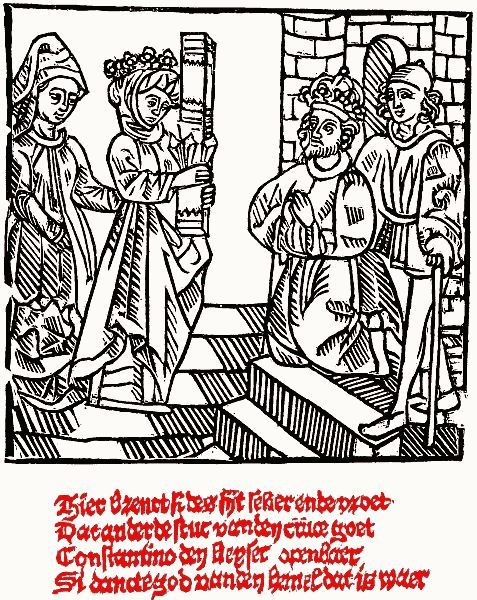
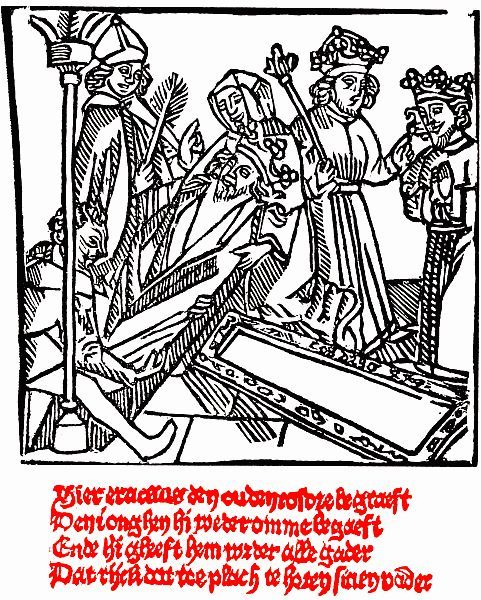
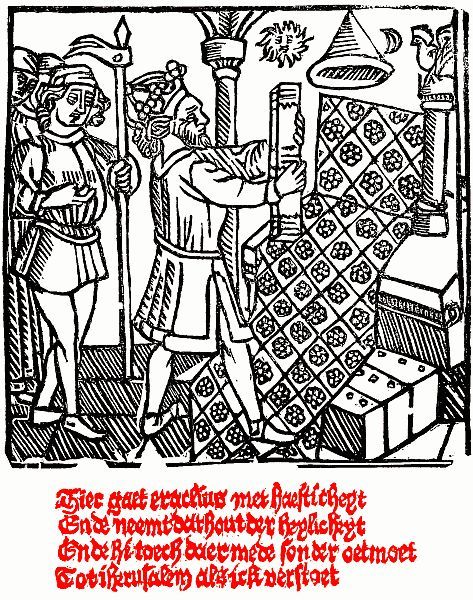
The news was brought to St. Helena, who visited the spot,45 but although there were certainly three crosses, no one knew which was the one upon which Jesus suffered. A test, however, was applied, which proved to be satisfactory. The body of a maid was being borne on a bier for burial, but the funeral procession was stopped, and the body was touched by the different crosses. The two first produced no effect,46 but when the third touched the dead maiden, she was at once restored to life.47 Here, then, was proof positive; this was the very Cross; and St. Helena, mindful of her son Constantine, divided the sacred wood; part she enclosed in a case of precious metal, and kept at Jerusalem;48 and part she sent to her son, at Byzantium, who received it with due reverence,49 and deposited it in the church, with great ceremony.50
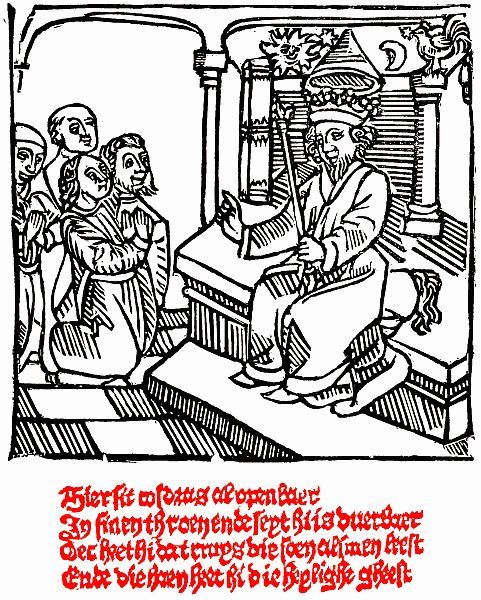
Here it remained, until it was taken away, with other spoil, by Chosroes, the King of Persia, who, aware of the sanctity of the relic, had it placed on the right hand of his throne. He was so puffed up with pride, that he ordered himself to be adored. His people, hitherto, had worshipped the sun, but now he ordained that henceforth he was to be considered the principal Person in the Trinity (the Father), and that the relic of the Cross was to be looked upon as the Son, whilst a golden cock which he had made was to represent the Holy Ghost.51
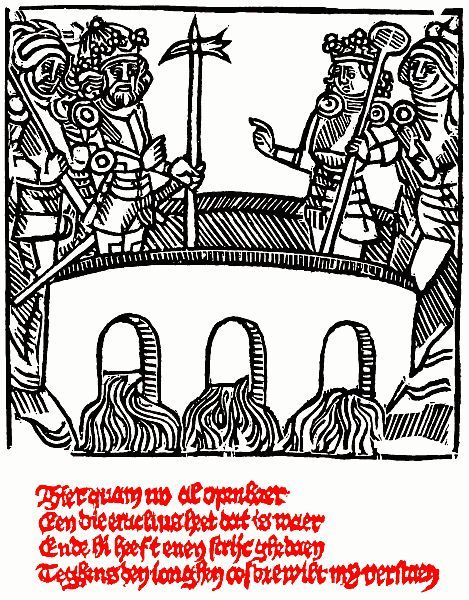
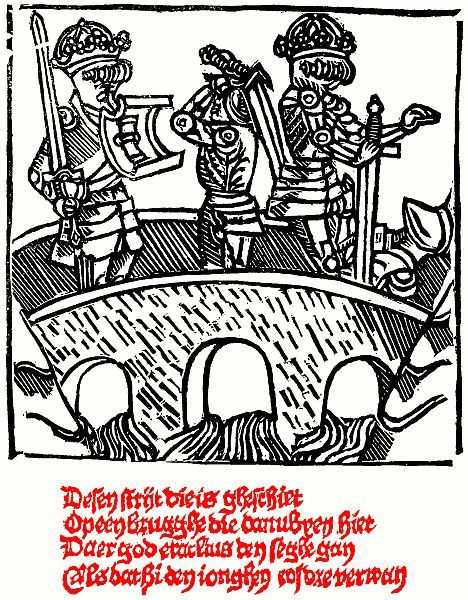
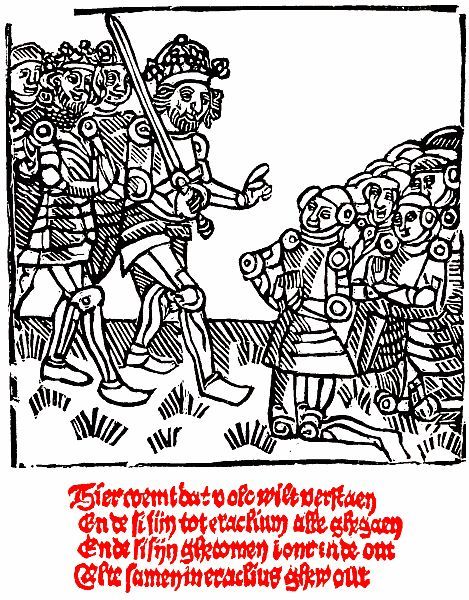
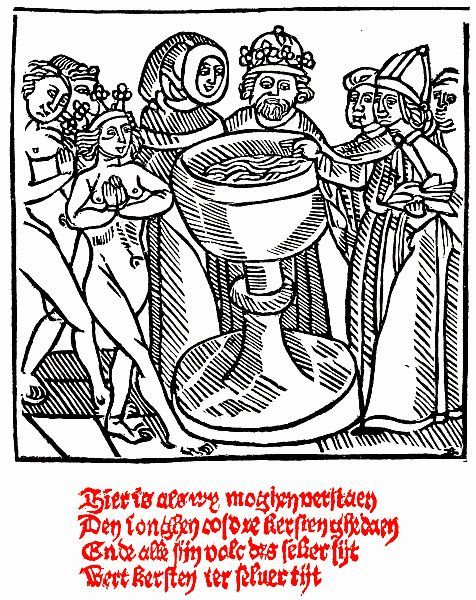
Then Heraclius made war against Chosroes, and meeting with a Persian army under one of the sons of that monarch, it was agreed that, in order to prevent a useless effusion of blood, the two commanders should fight it out between them, and whoever was vanquished should submit.52 The duel was fought on a bridge over the Danube, and Heraclius vanquished and killed the son of Chosroes.53 The Persian army then made their submission,54 and the penance imposed upon them by the conqueror was that they should all be baptized, which was duly done.
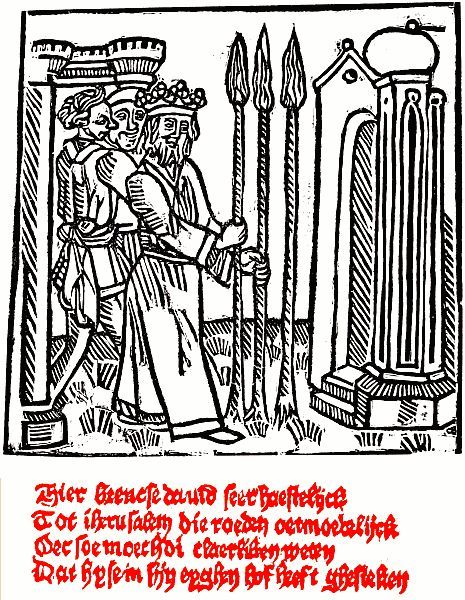
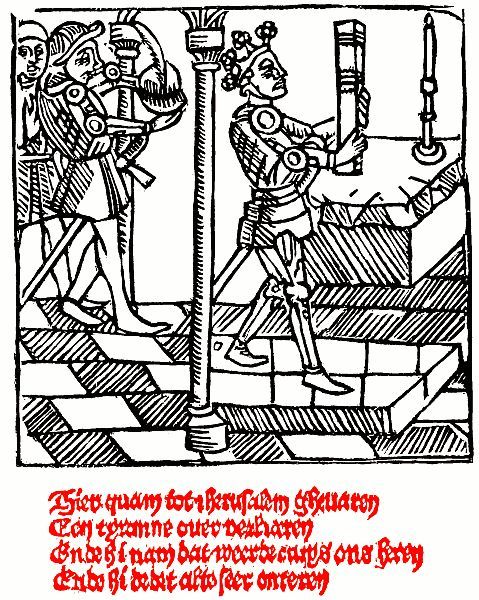
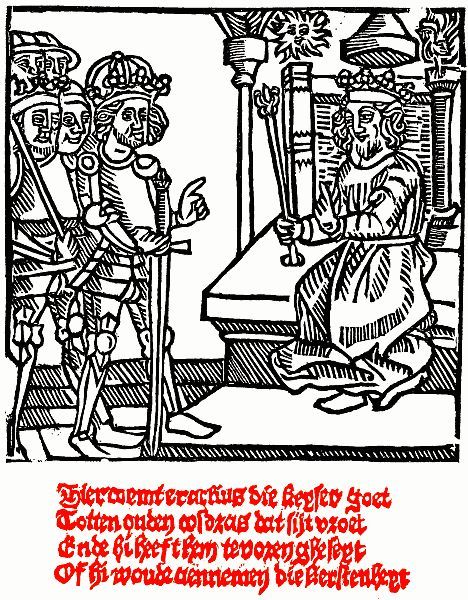
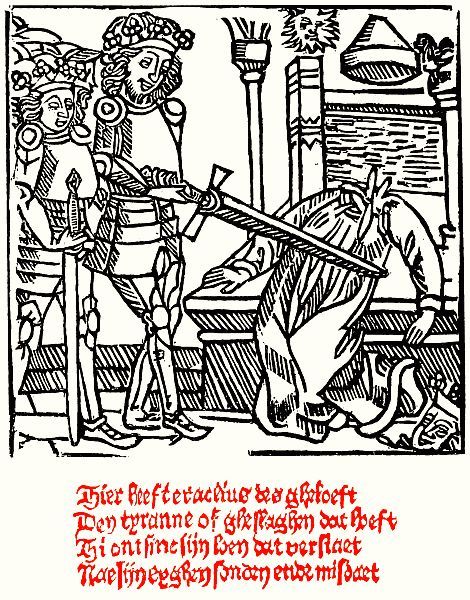
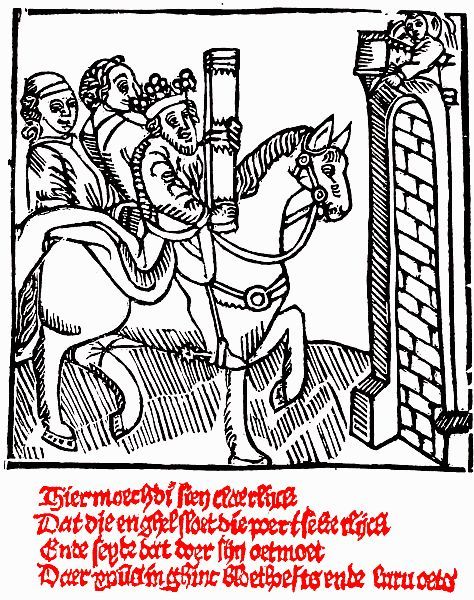
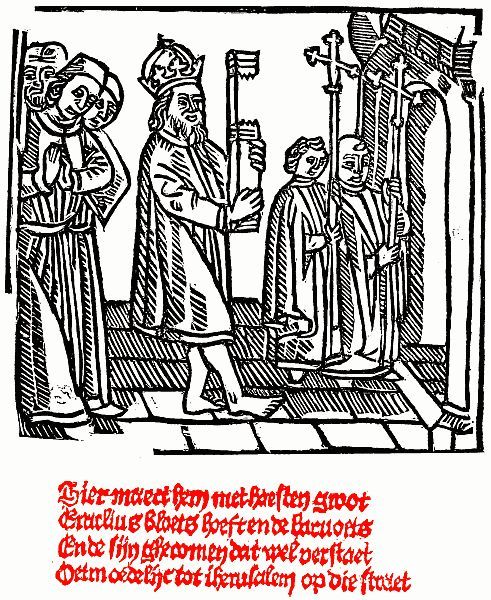
Heraclius then went to Chosroes, and told him what he had done, offering him his life if he too would embrace Christianity,55 but the Persian monarch refused, and Heraclius smote off his head.56 He then crowned a son of Chosroes, and caused him to be baptized,57 himself standing sponsor, and buried the slain king with befitting honours.58 Then, taking possession of the holy relic,59 he set out with it for Jerusalem. But, as he was bearing it in great state, he came to that gate of the City through which Jesus went to His passion, worn, buffeted, scorned, and weary, carrying the heavy burden of His cross. And suddenly the gateway became solid masonry, so that he could not pass through, and an angel appeared in the heavens, and reproved him for his ostentatious display in a place which his Saviour had previously trodden in such deep humility.60 Heraclius dismounted from his horse, and, stripping himself of all the trappings of royalty, barefoot, and in his shirt,61 he meekly bore the Cross to its appointed place,62 the masonry disappearing as soon as he had humbled himself.
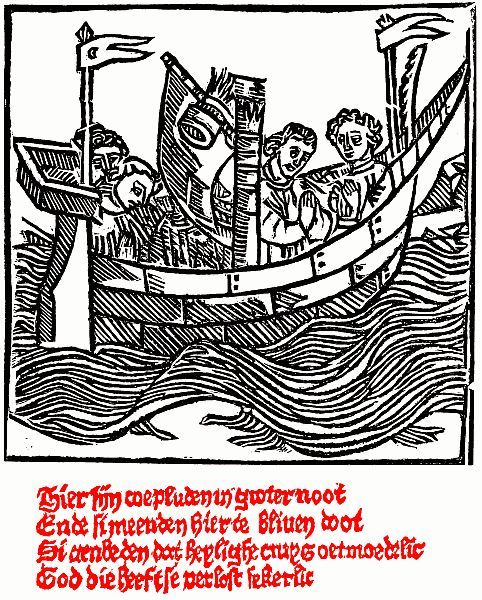
A piece of the Cross was afterwards sent to Rome, where it duly arrived after a very stormy voyage,63 and it was there preserved for the adoration of the faithful.64
JOHN ASHTON.
FOOTNOTES:
[A]“And for as moche as this sayd worke was grete & over chargeable to me taccomplisshe, I feryd me in the begynnynge of the translacion to have contynued it / bycause of the longe tyme of the translacion / & also in thenpryntyng of ye same and in maner halfe desperate to have accomplissd it / was in purpose to have lefte it / after that I had begonne to translate it / & to have layed it aparte ne had it be(en) at thynstance & requeste of the puyssant noble & vertuous erle my lord wyllyam erle of arondel / whych desyred me to procede & contynue the said werke / & promysed me to take a resonable quantyte of them when they were acheyeued & accomplisshed / and sente to me a worshypful gentylman a servaunt of his named John Stanney which solycyted me in my Lordes name that I shold in no wyse leve it but accomplisshe it promysyng that my sayd lord shold duringe my lyf geve & graunt to me a yerely fee / that is to wete a bucke in sommer / & a doo in Wynter / with whiche fee I holde me wel contente,” &c.
[B]This apparently long life of Adam is admitted on all hands, even in the Revised Version of the Bible. The Talmud says that God promised him one thousand years of life, and it is recorded that he begat Seth when he was a hundred and thirty years old. On this the Talmud (Eruvin, fol. 18, col. 2) has the following comment: “Rav Yirmyah ben Elazer said: All those years, which Adam spent in alienation from God, he begat evil spirits, demons, and fairies; for it is said, ‘And Adam was an hundred and thirty years, and begat a son in his own likeness, after his image’; consequently, before that time, he begat after another image.”
This term of one hundred and thirty years seems to have been a period in Adam’s existence, for we again find (Eruvin, fol. 18 b.): “Adam was a Chasid, or great saint, when he observed that the decree of death was occasioned by him; he fasted a hundred and thirty years, and all this time he abstained from intercourse with his wife.”
There is a Talmudical tradition that God showed the future to Adam (Avoth d’Rab. Nathan, chap. 31): “The Holy One—blessed be He!—shewed unto Adam each generation, and its preachers, its guardians, its leaders, its prophets, its heroes, its sinners, and its saints, saying, ‘In such and such a generation such and such a King shall reign, in such and such a generation such and such a wife man shall teach.’” This is amplified in Midrash Yalkut (fol. 12), where it is said that God showed Adam all future generations of men, with their leaders, learned and literary men, and there he observed that David was credited with only three hours of life, and he said, “Lord and Creator of the world, is this unalterable?” “Such was my first intention,” was the reply. “How many years have I to live?” asked Adam. “One thousand.” Then Adam said, “I will lend him some of my years.” And a document was drawn up whereby Adam transferred seventy years of his life to David.
S. Baring-Gould, in his legends of Old Testament Characters, vol i. p. 77, referring to a Mussulman legend, says: “Finally, when Adam reached his nine hundred and thirtieth year, the Angel of Death appeared under the form of a goat, and ran between his legs.
“Adam recoiled with horror, and exclaimed, ‘God has given me one thousand years; wherefore comest thou now?’
“‘What!’ exclaimed the Angel of Death, ‘hast thou not given seventy years of thy life to the prophet David?’
“Adam stoutly denied that he had done so. Then the Angel of Death drew the document of transfer from out of his beard, and presented it to Adam, who could no longer refuse to go.”
[C] The Festival of the Invention, or finding of the Cross, is kept in the Roman and English Churches on May 3.
[D] Piscina, a fish-pond: Lat. In this instance it is supposed to be the Pool of Bethesda.
[E] Nicodemus, chap. 14:—
But when the first man our father Adam heard these things, that Jesus was baptized in Jordan, he called out to his son Seth, and said,
Declare to your sons, the patriarchs and prophets, all those things which thou didst hear from Michael the Archangel, when I sent thee to the gates of Paradise to entreat God that he would anoint my head when I was sick.
Then Seth, coming near to the patriarchs and prophets, said: I, Seth, when I was praying to God at the gates of Paradise, beheld the angel of the Lord, Michael, appear unto me, saying, I am sent unto thee from the Lord; I am appointed to preside over human bodies.
I tell thee, Seth, do not pray to God in tears, and entreat him for the oil of the tree of mercy, wherewith to anoint thy father Adam for his headach;
Because thou canst not by any means obtain it till the last day and times, namely, till five thousand and five hundred years be past.
Then will Christ, the most merciful Son of God, come on earth to raise again the human body of Adam, and at the same time to raise the bodies of the dead, and when he cometh he will be baptized in Jordan;
Then with the oil of his mercy he will anoint all those that believe on him; and the oil of his mercy will continue to future generations, for those who shall be born of the water and the Holy Ghost unto eternal life.
And when at that time the most merciful Son of God, Christ Jesus, shall come down on earth, he will introduce our father Adam into Paradise, to the tree of mercy.
When all the patriarchs and prophets heard all these things from Seth, they rejoiced more.
[F] Alban Butler, in The Lives of the Fathers, Martyrs, and other Principal Saints, denies that St. Helena was an Innholder (Stabularia) in Bithynia, when Constantius married her, and says: “We are assured by the unanimous tradition of our English historians that this holy empress was a native of our island. William of Malmesbury, the principal historian of the ancient state of our country after Bede, and before him, the Saxon author of the life of St. Helen, in 970, quoted by Usher, expressly say that Constantine was a Briton by birth.” Leland, in his Commentarii de Scriptoribus Britannicis, says that St. Helena was the only daughter of King Coilus, the King Cöol who first built walls round Colchester, and the English Church has generally recognised her British origin. Her festival is kept on August 18.
When her husband, Constantine Chlorus, entered into an arrangement with Diocletian, by which he had the countries this side the Alps, namely, Gaul and Britain, he was obliged, as part of the bargain, to divorce St. Helena, and marry Theodora, the daughter-in-law of Maximinianus. According to Eusebius, she was not converted to Christianity at the same time as her son Constantine, who, when he came to the throne, paid her the greatest deference, and gave her the title of Augusta, or empress. After the Council of Nice, in 325, he wrote to Macarius, Bishop of Jerusalem, concerning the building of a splendid church upon Mount Calvary, and St. Helena, although she was then 79 years of age, undertook to see it carried out.
It was then that the reputed Invention of the Cross, together with the nails, took place, and she soon afterwards died, but the exact year is uncertain, some authorities giving A.D. 326, others 328.
[G] Other accounts say the Crosses were found by Macarius, then Bishop of Jerusalem.
[H] The book of the office of Mithras or Mithra, the Sun, worshipped by the Persians.
[I] Heraclius, Emperor of the East, who from A.D. 622 to 627 fought Chosroes II., defeated him, and concluded peace.
[J] St. Equitius was a hermit, and looked after the welfare of other hermits and monks. He took a special interest in a convent of young virgins; died about A.D. 540.
[K] I quote from the translation by Steven Withers, 1561.
[L] From this book I have taken the head and tail piece here given.—J. A.
[M] Arundel, No. 507, and Add. MSS. 6524.
[N] His life and labours may be read in Mr. Hottrop’s Monuments Typographiques des Pays-bas—.
[O] See The Woodcutters of the Netherlands in the 15th Century, by W. M. Conway, and an article by him in the Bibliographer of May, 1883, p. 32.