The Legendary
History of the Cross.

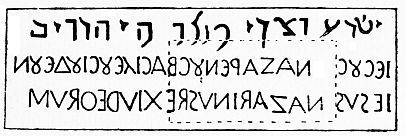
THE Cross on which our Lord and Saviour suffered, would, naturally, if properly authenticated, be an object of the deepest veneration to all Christian men, be their creed, or shade of opinion what it might; but, for over 300 years it could not be found, and it was reserved for the Empress Helena in her old age (for she was 79 years old) to discover its place of concealment.1 That this Invention, or finding of the Cross was believed in, at the time, there can be no manner of doubt, for it is alluded to by St. Cyril, Patriarch of Jerusalem (A.D. 350 to 386), and by St. Ambrose. Rufinus of Aquila, a friend of St. Jerome, in his Ecclesiastical History, gives an account of its finding, in the following words: “About the same time, Helena, the mother of Constantine, a woman of incomparable faith, whose sincere piety was equalled by her rare munificence, warned by celestial visions, went to Jerusalem, and inquired of the inhabitants where was the place where the Divine Body had been affixed and hung on a gibbet. This place was difficult to find, for the persecutors of old had raised a statue to Venus,2 in order that the Christians who might wish to adore Christ in that place, should appear to address their homage to the goddess; and thus it was little frequented, and almost forgotten. After clearing away the profane objects which defiled it, and the rubbish that was there heaped up, she found three crosses placed in confusion. But the joy which this discovery caused her was tempered by the impossibility of distinguishing to whom each of them had belonged. There, also, was found the title written by Pilate in Greek, Latin, and Hebrew characters; but still there was nothing to indicate sufficiently clearly the Cross of our Lord. This uncertainty of man was settled by the testimony of heaven.” And then follows the story of the dead woman being raised to life.
Not only did Rufinus write thus, but Socrates, Theodoret, and Sozomen, all of whom lived within a century after the Invention, tell the same story, so that it must have been of current belief.
The punishment of the Cross was a very ordinary one, and of far wider extent than many are aware. It was common among the Scythians, the Greeks, the Carthaginians, the Germans, and the Romans, who, however, principally applied it to their slaves, and rarely crucified free men, unless they were robbers or assassins.
Alexander the Great, after taking the city of Tyre, caused two thousand inhabitants to be crucified.
Flavius Josephus relates, in his Antiquities of the Jews, that Alexander, the King of the Jews, on the capture of the town of Betoma, ordered eight hundred of the inhabitants to suffer the death of the Cross, and their wives and children to be massacred before their eyes, whilst they were still alive.
Augustus, after the Sicilian War, crucified six thousand slaves who had not been claimed by their masters.
Tiberius crucified the priests of Isis, and destroyed their temple.
Titus, during the siege of Jerusalem, crucified all those unfortunates who, to the number of five or six hundred daily, fled from the city to escape the famine; and so numerous were these executions, that crosses were wanting, and the land all about seemed like a hideous forest.
These instances are sufficient to show that death by crucifixion was a common punishment; but, singularly enough, the shape of the Cross has never been satisfactorily settled; practically, the question lies between the Crux capitata, or immissa, which is the ordinary form of the Latin Cross, and the Crux ansata, or commissa, frequently called the Tau Cross, from the Greek letter T. The Tau-shaped Cross is, undoubtedly, to be met with most frequently in the older representations; and the more ancient authorities, such as Tertullian, St. Jerome, St. Paulinus, Sozomen, and Rufinus, are of opinion that this was the shape of the Cross. After the fifteenth century, our Lord is rarely depicted on the Crux commissa, it being reserved for the two thieves.
M. Adolphe Napoleon Didron, in his Iconographie Chretienne, gives a few illustrations of the antiquity of the Tau Cross: “The Cross is our crucified Lord in person; ‘Where the Cross is, there is the martyr,’ says St. Paulinus. Consequently it works miracles, as does Jesus Himself: and the list of wonders operated by its power is in truth immense. By the simple sign of the Cross traced upon the forehead or the breast, men have been delivered from the most imminent danger. It has constantly put demons to flight, protected the virginity of women, and the faith of believers; it has restored men to life, or health, inspired them with hope or resignation.
“Such is the virtue of the Cross, that a mere allusion to that sacred sign, made even in the Old Testament, and long before the existence of the Cross, saved the youthful Isaac from death, redeemed from destruction an entire people whose houses were marked by that symbol, healed the envenomed bites of those who looked at the serpent raised in the form of a Tau upon a pole. It called back the soul into the dead body of the son of that poor widow who had given bread to the prophet.
“A beautiful painted window, belonging to the thirteenth century, in the Cathedral of Bourges, has a representation of Isaac bearing on his shoulders the wood that was to be used in his sacrifice, arranged in the form of a Cross; the Hebrews, too, marked the lintel of their dwellings with the blood of the Paschal lamb, in the form of a Tau or Cross without a summit. The widow of Sarepta picked up and held crosswise two pieces of wood, with which she intended to bake her bread. These figures, to which others also may be added, serve to exalt the triumph of the Cross, and seem to flow from a grand central picture which forms their source, and exhibits Jesus expiring on the Cross. It is from that real Cross indeed, bearing the Saviour, that these subjects from the Old Testament derive all their virtue.”
The wood of which it was made is as unsettled as its shape. The Venerable Bede says that our Lord’s Cross was made of four kinds of wood: the inscription of box, the upright beam of cypress, the transverse of cedar, and the lower part of pine. John Cantacuméne avers that only three woods were employed: the upright, cedar; the transverse, pine; and the head in cypress. Others say that the upright was cypress, the transverse in palm, and the head in olive; or cedar, cypress, and olive. Most authorities seem to concur that it was made of several woods, but there is a legend that it was made from the aspen tree, whose leaves still tremble at the awful use the tree was put to; whilst that veritable traveller, Sir John Maundeville, says: “And also in Iherusalem toward the Weast is a fayre church where the tree grew of the which the Crosse was made.” Lipsius says that it was made of but one wood, and that was oak; but M. Rohault de Fleury (to whose wonderful and comprehensive work, Mémoire sur les Instruments de la Passion de notre Sauveur Jesus Christ, I am deeply indebted, says, “M. Decaisne, member of the Institut, and M. Pietro Savi, professor at the University of Pisa, have shewn me by the microscope that the pieces in the Church of the Holy Cross of Jerusalem at Rome, in the Cathedral at Pisa, in the Duomo at Florence, and in Notre Dame at Paris, were of pine.” And he adds, in a footnote, “Independently of the experiments which M. Savi kindly made in my presence, he wrote me the results of other observations, which tended to confirm.”
Starting with the Invention of the Holy Cross, the loving, but fervid, imaginations of the faithful soon wove round it a covering of imagery, as we have just seen in the case of the several woods of the Cross, and the sacred tree became the subject of a legend (for so it always was only meant to be), which was incorporated in the Legenda Aurea Sanctorum, or Golden Legend of the Saints, of Jacobus de Voragine, a collection of legends connected with the services of the Church. This book was exceedingly popular, and, when Caxton set up his printing-press at Westminster, he produced a translation, the history of which he quaintly tells us in a preface.[A]
As this Golden Legend is the standard authority on the subject, and as it will much assist the intelligent appreciation of the wood-blocks, I reproduce it, premising that I have used throughout the first edition, 20 Nov., 1483:—
3 But alle the dayes of adam lyvynge
here in erthe amounte to the somme of
 [B] yere / And in thende of his lyf
whan he shold dye / it is said but of none
auctoryte / that he sente Seth his sone in
to paradys for to fetch the oyle of mercy
/ where he receyuyde certayn graynes of
the fruyt of the tree of mercy by an
angel / And whan he come agayn / he
fonde his fader adam yet alyve and told
hym what he had don. And thenne
Adam lawhed4 first / and then deyed /
and thenne he leyed the greynes or
kernellis under his faders tonge and
buryed hym / in the vale of ebron / and
out of his mouth grewe thre trees of the
thre graynes / of which the crosse that
our lord suffred his passion on / was made
by vertue of which he gate5 very mercy
and was brought out of darknes in to
veray light of heven / to the whiche he
brynge us that lyveth and regneth god
world with oute ende.
[B] yere / And in thende of his lyf
whan he shold dye / it is said but of none
auctoryte / that he sente Seth his sone in
to paradys for to fetch the oyle of mercy
/ where he receyuyde certayn graynes of
the fruyt of the tree of mercy by an
angel / And whan he come agayn / he
fonde his fader adam yet alyve and told
hym what he had don. And thenne
Adam lawhed4 first / and then deyed /
and thenne he leyed the greynes or
kernellis under his faders tonge and
buryed hym / in the vale of ebron / and
out of his mouth grewe thre trees of the
thre graynes / of which the crosse that
our lord suffred his passion on / was made
by vertue of which he gate5 very mercy
and was brought out of darknes in to
veray light of heven / to the whiche he
brynge us that lyveth and regneth god
world with oute ende.
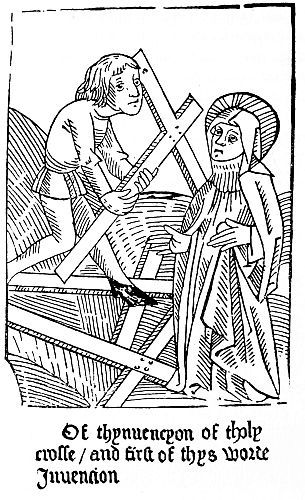

THE6 Invencion[C] of the holy crosse is said bycause that this day the holy crosse was founden / for to fore7 it was founden of seth in paradyse terestre / lyke as hit shal be sayd here after / and also it was founden of salamon in the mounte of lybane and of the quene of saba / in the temple of salamon / And of the Iewes in the water of pyscyne[D] / And on thys day it was founden of Helayne in the mounte of Calvarye/.
Of the Holy Crosse.
THE holy crosse was founden two
hondred yere after the resurrexyon
of our lord / It is redde in the gospel of
nychodemus[E] / that whan adam wexyd
seck / Seth hys sone wente to the gate of
paradyse terestre, for to gete the oyle of
mercy for to enoynte wythal hys faders
body / Thenne apperyd to hym saynt
mychel thaungel and sayd to hym /
travayle not the in vayne / for thys oyle
/ for thou mayst not have it till fyve
thousand and fyve hondred yere been
passed / how be it that fro Adam unto
the passyon of our lord were but fyve
 and
and  yere / In another place
it is redde that the aungel broughte hym
a braunche / and commaunded hym to
plante it in the mounte of lybanye Yet
fynde we in another place / that he gafe
to hym of the tree that Adam ete of /
And sayd to hym that whan that bare
fruyte he should be guarisshed8 and alle
hoole9 /. whan seth came ageyn he founde
his fader deed / and planted this tree
upon his grave / And it endured there
un to the tyme of Salomon / and bycause
he sawe that it was fayre, he dyd10 doo
hewe it doun / and sette it in his hows
named saltus / and whan the quene of
saba came to vysyte Salamon / She worshypped
this tre bycause she sayd the
savyour of alle the world shold be hanged
there on / by whome the royame11 of the
Iewes that be defaced and seace.12 Salomon
for this cause made hit to be taken up /
& dolven13 depe in the grounde. Now it
happed after that they of Ierusalem (dyd
do make a grete pytte for a pyscyne14 /
where at the mynysters of the temple
sholde wesshe theyre bestys / that they
shold sacrefyse / and there founde thys
tre / and thys pyscyne had suche vertue,
that the aungels descended and mevyd
the water / and the first seke man that
descendyd in to the water after the
mevyng / was made hole of what somever
sekenesse he was seek of. And whan
the tyme approched of the passyon of
our lord / thys tree aroos out of the
water and floted above the water / And
of this pyece of tymbre made the Iewes
the crosse of our lord / Thenne after
this hystorye / the crosse by which we
been saved / came of the tree by whiche
we were dampned. And the water of
that pyscyne had not his vertue onely of
the aungel / but of the tre/. With this
tre wherof the crosse was maad / there
was a tree that went over thwarte / on
whiche the armes of our lord were
nayled/. And another pyece above which
was the table / wherin the tytle was
wryten / and another pyece wherein the
sokette or mortys was maad that the
body of the crosse stood in soo that
there were foure manere of trees / That
is of palme of cypres / of cedre and of
olyve. So eche of thyse foure pyeces was
of one of those trees/. This blessed
crosse was put in the erthe and hyd by
the space of on hondred yere and more /
But the moder of themperour which
was named helayne[F] which founde it in thys
manere / For Constantyn came wyth a
grete multytude of barbaryns nygh unto
the ryver of the dunoe / whyche wold
have goon over for to have destroyed alle
the contree / And whan constantyn had
assembled his hoost / He went and sette
them ageynst that other partye / But as
sone as he began to passe the ryver / he
was moche aferde / by cause he shold
on the morne have batayle / and in the
nyght as he slepte in his bedde / an
aungel awoke hym / and shewed to hym
the sygne of the crosse in heven / and
sayd to hym / Beholde on hye on heven/.
Thanne sawe he the crosse made of
ryght clere lyght / & was wryten there
upon wyth lettres of golde / In this
sygne thou shalte over come the batayle/
Thenne was he alle comforted of thys
vysion / And on the morne / he put
in his banere the Crosse15 / and made it
to be borne tofore hym and his hoost /
And after smote in the hoost of his
enemyes / and slewe and chaced grete
plente / After thys he dyd doo16 calle the
bysshoppes of the ydolles / and demaunded
them to what god the sygne of the crosse
apperteyned. And whan they coude not
answere / some cristen men that were
there tolde to hym the mysterye of the
crosse / and enformed hym in the faythe
of the trynyte / Thenne anone he bylevyd
parfytly (in) god / and dyd do baptyse
hym / and after, it happed that constantyn
his sone remembred the vyctorye of
his fader / Sente to helayn his modre
for to fynde the holy crosse / Thenne
helayne wente in to Iherusalem / and
dyd doo assemble all the wyse men of
the contre / and whan they were assembled
/ they wold fayn knowe wherfore
they were called / Thenne one Iudas
sayd to them / I wote17 wel that she wyl
knowe of us where the crosse of Ihesu
criste was leyed / but beware you al
that none of you tell hyr / for I wote
wel then shall our lawe be destroyed /
For zacheus my olde18 fader sayde to
symon my fader / And my fader sayde
to me at his dethe / be wel ware / that
for no tormente that ye may suffre / telle
not where the crosse of Ihesu criste was
leyde / for after that hit shal be founden
/ the Iewes shal reygne no mour / But
the cristen men that worshypped the
crosse shal then reygne / And verayly
this Ihesus was the sone of god.
yere / In another place
it is redde that the aungel broughte hym
a braunche / and commaunded hym to
plante it in the mounte of lybanye Yet
fynde we in another place / that he gafe
to hym of the tree that Adam ete of /
And sayd to hym that whan that bare
fruyte he should be guarisshed8 and alle
hoole9 /. whan seth came ageyn he founde
his fader deed / and planted this tree
upon his grave / And it endured there
un to the tyme of Salomon / and bycause
he sawe that it was fayre, he dyd10 doo
hewe it doun / and sette it in his hows
named saltus / and whan the quene of
saba came to vysyte Salamon / She worshypped
this tre bycause she sayd the
savyour of alle the world shold be hanged
there on / by whome the royame11 of the
Iewes that be defaced and seace.12 Salomon
for this cause made hit to be taken up /
& dolven13 depe in the grounde. Now it
happed after that they of Ierusalem (dyd
do make a grete pytte for a pyscyne14 /
where at the mynysters of the temple
sholde wesshe theyre bestys / that they
shold sacrefyse / and there founde thys
tre / and thys pyscyne had suche vertue,
that the aungels descended and mevyd
the water / and the first seke man that
descendyd in to the water after the
mevyng / was made hole of what somever
sekenesse he was seek of. And whan
the tyme approched of the passyon of
our lord / thys tree aroos out of the
water and floted above the water / And
of this pyece of tymbre made the Iewes
the crosse of our lord / Thenne after
this hystorye / the crosse by which we
been saved / came of the tree by whiche
we were dampned. And the water of
that pyscyne had not his vertue onely of
the aungel / but of the tre/. With this
tre wherof the crosse was maad / there
was a tree that went over thwarte / on
whiche the armes of our lord were
nayled/. And another pyece above which
was the table / wherin the tytle was
wryten / and another pyece wherein the
sokette or mortys was maad that the
body of the crosse stood in soo that
there were foure manere of trees / That
is of palme of cypres / of cedre and of
olyve. So eche of thyse foure pyeces was
of one of those trees/. This blessed
crosse was put in the erthe and hyd by
the space of on hondred yere and more /
But the moder of themperour which
was named helayne[F] which founde it in thys
manere / For Constantyn came wyth a
grete multytude of barbaryns nygh unto
the ryver of the dunoe / whyche wold
have goon over for to have destroyed alle
the contree / And whan constantyn had
assembled his hoost / He went and sette
them ageynst that other partye / But as
sone as he began to passe the ryver / he
was moche aferde / by cause he shold
on the morne have batayle / and in the
nyght as he slepte in his bedde / an
aungel awoke hym / and shewed to hym
the sygne of the crosse in heven / and
sayd to hym / Beholde on hye on heven/.
Thanne sawe he the crosse made of
ryght clere lyght / & was wryten there
upon wyth lettres of golde / In this
sygne thou shalte over come the batayle/
Thenne was he alle comforted of thys
vysion / And on the morne / he put
in his banere the Crosse15 / and made it
to be borne tofore hym and his hoost /
And after smote in the hoost of his
enemyes / and slewe and chaced grete
plente / After thys he dyd doo16 calle the
bysshoppes of the ydolles / and demaunded
them to what god the sygne of the crosse
apperteyned. And whan they coude not
answere / some cristen men that were
there tolde to hym the mysterye of the
crosse / and enformed hym in the faythe
of the trynyte / Thenne anone he bylevyd
parfytly (in) god / and dyd do baptyse
hym / and after, it happed that constantyn
his sone remembred the vyctorye of
his fader / Sente to helayn his modre
for to fynde the holy crosse / Thenne
helayne wente in to Iherusalem / and
dyd doo assemble all the wyse men of
the contre / and whan they were assembled
/ they wold fayn knowe wherfore
they were called / Thenne one Iudas
sayd to them / I wote17 wel that she wyl
knowe of us where the crosse of Ihesu
criste was leyed / but beware you al
that none of you tell hyr / for I wote
wel then shall our lawe be destroyed /
For zacheus my olde18 fader sayde to
symon my fader / And my fader sayde
to me at his dethe / be wel ware / that
for no tormente that ye may suffre / telle
not where the crosse of Ihesu criste was
leyde / for after that hit shal be founden
/ the Iewes shal reygne no mour / But
the cristen men that worshypped the
crosse shal then reygne / And verayly
this Ihesus was the sone of god.
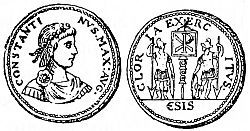
Then demaunded I my fader / wherfore had they hanged hym on the crosse sythe it was knowen that he was the sone of god / thenne he sayd to me fayre sone I never accorded thereto / But gayn said it alwaye / But the Pharisees dyd it bycause he repreyvd theyr vyces / but he aroos on the thyrd day / and his dysciples seeing / he ascended in to heven / Thenne by cause that Stephen thy broder belevyd in him / the Iewes stoned hym to dethe.
Then when Iudas had sayd theyse wordes to his selawes / they answerd we never herde of suche thynges / never the lesse kepe the wel if the quene demaunde the therof / that thou say no thynge to hyr / Whan the quene had called them / and demaunded them the place where our lord Ihesu criste had been crucefyed/ they wold never tell her nor ensygne19 her /. Then commaunded she to brenne20 them alle/. But then they doubted and were aferde / & delyvered Iudas to hyr and sayd / lady thys man is the sone of a prophete and of a juste man / and knoweth right wel the lawe / & can telle to you al thynge that ye shal demaunde hym/.
Thenne the quene lete al the other goo, and reteyned Iudas without moo21/. Thenne she shewed to hym his life & dethe & bade hym chese whyche he wold. Shewe to me sayd she the place named golgota where our lord was crucefyed / by cause and to the end that we may fynde the crosse/. Thenne sayd Iudas, it is two hondred yere passed & more / & I was not thenne yet borne. Thenne sayd to hym the lady / by him that was crucyfyed / I shal make the perisse for hungre/ yf thou telle not to me the trouthe.
Thenne made she hym to be caste into a drye pytte / and there tormented hym by hungre / and evyl reste / whan he had been seuen dayes in that pytte / thenne sayd he yf I myght be drawen out / he shold say the trouthe / Thenne he was drawen out / and whan he came to the place / anone the erthe moevyd and a fume of grete swettnesse was felte in suche wyse that Iudas smote his hondes togyder for ioye / and sayd / in trouthe Ihesu criste thou art the savyour of the worlde.
It was so that adryan the Emperour
had doo make in the same place where
the crosse laye a temple of a goddesse by
cause that all they that come in that
place shold adoure that goddesse/. But
the quene did doo destroy the temple /
Thenne Iudas made hym redy and began
to dygge / and whan he came to  paas22 depe / he fonde three crosses and
broughte them to the quene / And
bycause he knewe not whiche was the
crosse of our lord / he leyed them in the
myddel of the cyte / and abode the
demonstraunce of god / and aboute the
houre of none / there was the corps of
a yonge man brought to be buryed /
Iudas reteyned the byere / and layed
upon hit one of the crosses / and after
the second / and whan he leyed on hit
the third / anone the body that was dede
came ageyn to lyf/.
paas22 depe / he fonde three crosses and
broughte them to the quene / And
bycause he knewe not whiche was the
crosse of our lord / he leyed them in the
myddel of the cyte / and abode the
demonstraunce of god / and aboute the
houre of none / there was the corps of
a yonge man brought to be buryed /
Iudas reteyned the byere / and layed
upon hit one of the crosses / and after
the second / and whan he leyed on hit
the third / anone the body that was dede
came ageyn to lyf/.
Thenne cryed the devyll in the eyre Iudas what hast thou doon / thou hast doon the contrarye that thother Iudas dyd/. For by hym I have wonne many sowles / and by the I shal lose many / by hym I reygned on the peple / And by the I have lost my royame / never the lesse I shal yelde to the this bountee/. For I shal send one that shal punysshe the / and that was accomplysshed by Iulian the apostata / which tormented hym afterward whan he was bysshop of Iherusalem / and whan Iudas herde hym he cursed the devyl and sayd to hym / Ihesu cryste dampne the in fyre pardurable23/. After this Iudas was baptyzed and was named quyryache[G]/. And after was made bysshop of Iherusalem/. Whan helayn had the crosse of Ihesu criste / and saw she had not the nayles / Thenne he dyd dygge in therthe so longe / that he founde them shynyng as golde/. thenne bare he them to the quene / and anone as she sawe them she worshypped them wyth grete reverence/.
Thenne gafe saynt helayn a part of the crosse to hir sone / And that other parte she lefte in Iherusalem closyd in golde / sylver and precious stones/.
And hyr sone bare the nayles to themperour / And the emperour dyd do sette them in hys brydel and in hys helme whan he wente to batayle/. This referreth Eusebe whiche was bysshop of Cezayr24/ how be it that other say otherwyse/. Now it happed that Iulyan the appostate dyd doo25 slee quyriache that was bysshop of Iherusalem / by cause he had founde the crosse / for he hated hit soo mooche / that where somever he founde the crosse / he dyd hit to be destroyed / For whan he wente in batayle ageynste them of perse / he sente and commaunded quyriache to make sacrefyse to thydolles / and whan he wold not doo hit / he dyd do smyte of his right honde / and sayd wyth this honde hast thou wryten many letters / by whyche thou repellyd moche folke fro doynge sacrefyse to our goddes/.
Quyriache sayd thou wood hounde26 thou hist doon to me grete prouffyte / For thou hast cut of the hande / wyth whiche I have many tymes wreton to the synagoges that they shold not byleve in Ihesu criste / and now sythe27 I am cristen / thou hast taken from me that whiche noyed me / thenne dyd Iulyan do melte leed, and caste it in his mowthe / and after dyd doo brynge a bedde of yron / and made quyriache to be layed and stratched theron / and after leyed under brennyng cooles / and threwe therein grece and salte / for to torment hym the more / and whan quyriache moved not / Iulyan themperour said to hym / outher thou shalt sacrefyse (to) our goddes / or thou shalt say at the leste thou art not cristen/. And whan he sawe he wolde not do never neyther / he dyd doo make a depe pytte ful of serpentes and venemous bestys / and caste hym therein / & whan he entred / anone the serpentes were al deed/. Thenne Iulyan put hym in a cawdron ful of boylyng oyle / and whan he shold entre in to hit / he blessyd it & sayd / Fayre lord torne thys bane28 to baptysm of marterdom / Thenne was Iulyan moche angry / and commaunded that he should be ryven thorough his herte with a swerde / and in this manere he fynysshed his lyff.
The vertue of the crosse is declared to us by many miracles / For it happed on a tyme that one enchantour had dysceyved a notarye / and brought hym to a place / where he had assembled a grete companye of devylles / and promysed to hym to have muche rychesse / and whan he came there / he saw one persone blacke syttynge on a grete chayer / And all aboute hym al ful of horyble people and blacke whiche had speres and swerdes / Thenne demaunded thys grete devyll of the enchantour / who was that clerke / thenchantour sayd to hym / Syr he is oures / thenne sayd the devyl to hym yf thou wylte worshyp me and be my servaunte / and denye Ihesu cryste / thou shalt sytte on my right syde / The clerke anone blessyd hym wyth the sygne of the crosse / and sayd that he was the servaunte of Ihesu criste / his savyour / And anone as he had made the crosse / that grete multitude of devylles vanysshed aweye. It happed that this notarye after this on a tyme entryd with hys lord in the chyrche of saynt sophye / & knelyd doun on his knees to fore the ymage of the crucyfyxe / the which crucifyxe as it semed loked moche openly and sharpelye on hym/. Thenne his lord made hym to go aparte on another syde / and alleweye the crucifixe torned his eyen toward hym/. Thenne he made hym goo on the lefte syde / and yet the crucifixe loked on hym / Thenne was the lord moche admerveyled / and charged hym & commaunded hym that he shold telle hym wherof he had so deserved that the crucifyxe so behelde and loked on hym / Thenne sayde the notarye that he coude not remembre hym of no good thynge that he had doon / saufe that one tyme he wold not renye nor forsake the crucifixe tofore the devyl/.
Thenne late us so blesse us with the sygne of the blessyd crosse that we may therby be kepte fro the power of our ghoostly and dedely enemye the devyl / and by the glorious passyon that our saveour Ihesu cryst suffred on the crosse after this lyf we may come to his everlastyng blysse amen/.
Thus endeth thynvencion of the holy crosse.

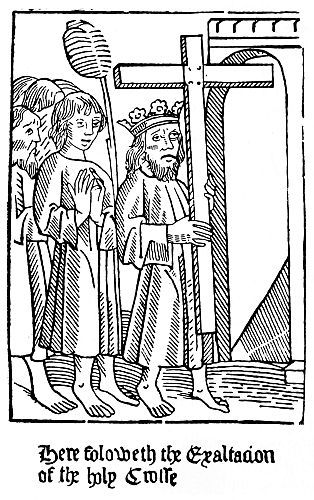
Exaltation of the holy Crosse29 is sayd / bycause that on this daye the hooly crosse & faythe were gretely enhaunced/. And it is to be understonden that tofore the passion of our lord Ihesu cryste / the tree of the crosse was a tree of fylthe / For the crosses were made of vyle trees, & of trees without fruyte / For al that was planted on the Mount of Calvarye bare no fruyt. It was a fowle place / for hit was the place of torment of thevys / It was derke / for it was in a derke place and without any beaute / It was the tree of deth / for men were put there to dethe / It was also the tree of stenche / for it was planted amonge the caroynes30 / & after the passyon the Crosse was moche enhaunced / For the Vylte31 was transported into preciousyte / Of the whiche the blessyd saynt Andrewe sayth / O precious holy Crosse god save the / his bareynes was torned into fruyte / as it is sayd in the Cantyques / I shall ascende up in to a palme tree / et cetera / His ignobylyte or unworthynes was tourned into sublymyte and heyght / The Crosse that was tormente of thevys is now born in the front of themperours / his derkenes is torned into lyght and clerenesse/ wherof Chrysostom sayth the Crosse and the Woundes shall be more shynyng than the rayes of the Sonne at the jugement / his deth is converted into perdurabylyte of lyf / whereof it is sayd in the preface / that fro hens the lyf resourded32 / and the stenche is torned into swetenes / canticorum /. This exaltacion of the hooly crosse is solempnysed and halowed solempnly of the Chirche / For the faythe is in hit moche enhaunced /.
For the yere of oure lord five honderd
&  / our lord suffred his people moche
to be tormentyd by the cruelte of the
paynyms / And Cosdroe33 Kynge of the
Perceens subdued to his empyre all the
Royaumes of the world / And he cam
into Iherusalem and was aferd and a
dred of the sepulcre of our lord &
retorned / but he bare with hym the parte
of the hooly Crosse / that saynte Helene
had left ther. And then he wold be
worshiped of alle the peple / as a god /
& dyd do make a tour of gold and of
sylver wherein precious stones shone /
and made therein the ymages of the
sonne and of the mone and of the sterres
/ and made that by subtyle conduytes
water to be hydde / and to come doune
in the maner of rayne / And in the laste
stage he made horses to draw charyotes
round aboute lyke as they had mevyd
the toure / and made it to seme as
it had thondred / and delyvered his
Royaume to his sone. And thus this
cursyd man abode in this Temple / and
dyd doo sette the crosse of our lord by
hym and commaunded that he shold be
callyd god of alle the peple / And as it is
redde in libro de mitrali[H] officio the said
Cosdroe resydent in his trone as a fader /
sette the tree of the Crosse on his ryght
syde in stede of the sonne / and a cock
in the lyft syde in stede of the hooly
ghoost / & commaunded / that he shold
be called fader /. And then Heracle[I]
themperour assembled a grete hoost /
and cam for to fyght wyth the sonne of
Cosdroe by the ryver of danubie / &
thenne hit pleasyd to eyther prynce /
that eche of them shold fyght one
ageynste that other upon the brydge /
& he that shold vaynquysshe & overcome
his adversarye sholde be prynce of
thempyre withoute hurtyng eyther of
bothe hostes / & so hit was ordeyned &
sworn / & that who somever shold helpe
his prynce shold have forthwith his
legges & armes cut of / & to be plonged
/ & cast in to the Ryver.
/ our lord suffred his people moche
to be tormentyd by the cruelte of the
paynyms / And Cosdroe33 Kynge of the
Perceens subdued to his empyre all the
Royaumes of the world / And he cam
into Iherusalem and was aferd and a
dred of the sepulcre of our lord &
retorned / but he bare with hym the parte
of the hooly Crosse / that saynte Helene
had left ther. And then he wold be
worshiped of alle the peple / as a god /
& dyd do make a tour of gold and of
sylver wherein precious stones shone /
and made therein the ymages of the
sonne and of the mone and of the sterres
/ and made that by subtyle conduytes
water to be hydde / and to come doune
in the maner of rayne / And in the laste
stage he made horses to draw charyotes
round aboute lyke as they had mevyd
the toure / and made it to seme as
it had thondred / and delyvered his
Royaume to his sone. And thus this
cursyd man abode in this Temple / and
dyd doo sette the crosse of our lord by
hym and commaunded that he shold be
callyd god of alle the peple / And as it is
redde in libro de mitrali[H] officio the said
Cosdroe resydent in his trone as a fader /
sette the tree of the Crosse on his ryght
syde in stede of the sonne / and a cock
in the lyft syde in stede of the hooly
ghoost / & commaunded / that he shold
be called fader /. And then Heracle[I]
themperour assembled a grete hoost /
and cam for to fyght wyth the sonne of
Cosdroe by the ryver of danubie / &
thenne hit pleasyd to eyther prynce /
that eche of them shold fyght one
ageynste that other upon the brydge /
& he that shold vaynquysshe & overcome
his adversarye sholde be prynce of
thempyre withoute hurtyng eyther of
bothe hostes / & so hit was ordeyned &
sworn / & that who somever shold helpe
his prynce shold have forthwith his
legges & armes cut of / & to be plonged
/ & cast in to the Ryver.
And then Heracle commaunded hym
all to god and to the hooly crosse wyth
all the devocion that he myght. And
thenne they fought longe / And at the
last our lord gaf the vyctory to Heracle
and subdued hym to his empyre / The
hoost that was contrary / and alle the
peple of Cosdroe obeyed them to the
Crysten faythe / and receyved the hooly
baptysme / And Cosdroe knew not the
end of the batayll / For he was adoured
and worshiped of alle the peple as a god
/ so that no man durst say nay to him /
And thenne Heracle came to hym / and
fonde hym syttinge in his syege34 of
golde / and sayd to hym / For as moche
as after the manere thou hast honoured
the Tree of the Crosse / yf thou wyld
receyve baptym and the faythe of Ihesu
Cryst / I shal gete it to the / and yet shalt
thow holde thy crowne and Royamme
with lytel hostages / And I shall lete the
have thy lyf / and yf thou wylt not / I
shall flee the wyth my swerde / and
shalle smyte of thyne heed / and whanne
he wold not accorde therto / he did anon
do smyte of his hede / and commaunded
that he shold be buryed / by cause he
had be(en) a Kynge /. And he fonde
with hym one his sone of the age of ten
yere / whome he dyd doo baptyse and
lyft hym fro the fonte / and left to hym
the Royaume of his fader / and then he
dyd doo breke that Toure / And gaf the
sylver to them of his hooste / and gaf
the gold and precious stones for to repayre
the chirches that the tyraunt had
destroyed / and tooke the hoole crosse /
and brought it ageyne to Ierusalem / and
as he descended from the mount of
Olyvete / and wold have entryd by the
gate by whiche our savyour wente to his
passyon on horsbacke adourned as a Kynge
/ sodenly the stones of the gates descended
/ and ioyned them togyder in
the gate like a wall & all the peple was
abashed35 / and thenne the Aungel of
oure lord appyeryd upon the gate holdyng
the signe of the signe (sic) of the
Crosse in his honde / and sayd / Whanne
the Kynge of heven went to his passion
by this gate / he was not arayed like a
Kynge / ne on horsbake / but cam
humbly upon an asse / in shewynge
thexample of humylite which he left to
them that honoure hym. And when
this was sayd / he departed and vanysshed
aweye / Thenne th’emperour took of his
hosen and shone36 himself in wepynge /
and despollyed hymselfe of alle his clothes
in to his sherte / and tooke the crosse of
oure lord / and bare it moche humbly
into the gate / and anone the hardnes of
the stones felte the celestyalle commaundement
/ and remeved anone / and opened
and gaf entree unto them that entred /
Thenne the sweete odour that was felt
that day whanne the hooly Crosse was
taken fro the Toure of Cosdroe / and
was brought ageyne to Iherusalem fro so
ferre countre / and so grete space of
londe retourned in to Iherusalem in that
moment / and replenysshed it with al
swetnes / Thenne the ryght devoute
Kyng beganne to saye the praysynges of
the Crosse in this wyse / O Crux splendydior
/ et cetera / O Crosse more
shynynge than alle the Sterres / honoured
of the world / right holy / and moche
amyable to alle men / whiche only were
worthy to bere the raunson of the world
Swete tree / Swete nayles / Swete yron /
Swete spere berynge the swete burthens
/ Save thou this present company / that
is this daye assembled in thy lawe and
praysynges /. And thus was the precious
tree of the Crosse re establysshed in
his place / and the auncient myracles
renewed /. For a dede man was reysed
to lyf / and foure men taken with the
palsey were cured and heled /  lepres
were made clene / and fyften blynde
receyved theyr syghte ageyn / Devylles
were put out of men / and moche peple
/ and many / were delyvered of dyverse
sekenes and maladyes /. Thenne themperour
dyd doo repayre the Chirches /
and gaf to them grete geftes / And after
retorned home to his Empyre / And hit
is said in the Cronycles that this was
done otherwise / For they say that
whanne Cosdroe hadde taken many
Royammes / he took Iherusalem / and
Zacharye the patriarke / and bare aweye
the tree of the Crosse / And as Heracle
wold make pees with hym / the Kyng
Cosdroe swore a grete othe / that he wold
never make pees with Crysten men and
Romayns / yf they denyed not hym that
was crucyfyed / and adoured the sonne /.
And thenne Heracle / whiche was armed
wythe faythe / brought his hooste ageynst
hym / and destroyed and wasted the
Persyens with many batayles that he
made to them / and made Cosdroe to
flee unto the Cyte of thelyfonte /. And
atte the laste Cosdroe hadde the flyxe in
his bely / And wolde therefore crowne
his sone Kynge / which was named
Mendasa /. And whenne Syroys his
oldest sone herde thereof he made alyance
with Heracle / And pursewed his fader
with his noble peple / and set hym in
bondes / And susteyned him with breede
of trybulacion / and with water of
anguysshe / And atte last he made to
shote arowes at him bycause he wold not
bileve in god & so deyde / & after this
thynge he sente to Heracle the patriarke
the tree of the Crosse and all the prysoners
/ And Heracle bare into Iherusalem
the precious tree of the Crosse /.
And thus it is redde in many Cronycles
also/. Sybyle sayth thus of the tre of the
Crosse / that the blessyd tree of the
Crosse was thre tymes with the paynyms
/ as it is sayd in thystorie trypertyte O
thryse blessyd tree on whiche god was
stratched / This peradventure is sayd for
the lyf of Nature / of grace / and of
glorye / which cam of the crosse /. At
Constantynople a Iewe entyred in to the
chirche of seynt sophye / and consydered
that he was there allone / and sawe an
ymage of Ihesu cryste / and tooke his
swerde and smote thymage in the throte
/ and anone the bloode guysshed oute /
and sprange in the face and on the hide
of the Iewe / And he thenne was aferd
and took thymage / and cast it into a
pytte / and anone fledde awey /. And it
happed that a Crysten man mett hym /
and sawe hym al blody / and sayd to
hym / fro whens comest thou / thou
hast slayne soume man / And he sayd I
have not / the crysten man sayd Veryly
thou has commysed somme homycyde /
for thou art all besprongen37 with the
blood. And the Jewe said / Veryly the
god of Crysten men is grete and the
faythe of hym is ferme and approved in
all thynges / I have smyten no man /
but I have smyten thymage of Ihesu
Cryste / and anone yssued blood of his
throte /. And thenne the Jewe brought
the Crysten man to the pytte / and then
they drewe oute that hooly ymage /.
And yet is sene on this daye the wounde
in the throte of thymage / And the Iewe
anone bycam a good Crysten man, &
was baptysed / In Syre in the cyte of
baruth there was a cristen man / which
had hyred an hous for a yere / & he had
set thymage of the crucifixe by his bedde
to whiche he made dayly his prayers and
said his devocions / & at the yeres ende
he remeved and tooke another hous / &
forgate & lefte thymage behynde hym /
and it happed that a Iewe hyred that
same hows / & on a daye he had another
Iewe one of his neyghbours to dyne / &
as they were at mete it happed hym that
was boden38 in lookyng on the walle to
espye this ymage whiche was fyxed to
the walle and beganne to grenne at it
for despyte / and ageynst hym that bad
hym / & also thretned & menaced hym
bycause he durst kepe in his hous
thymage of Ihesu of nazareth / & that
other Iewe sware as moche as he myght /
that he had never sene it / ne knewe
not that it was there / & thenne the
Iewe fayned as he had been peasyd39. /
& after went strayt to the prynce of the
Iewes / & accused that Iewe of that
whiche he hadde sene in his hous /
thenne the Iewes assembleden & cam to
the hous of hym / & sawe thymage of
Ihesu Cryst / and they took that Iewe
and bete hym / & did to hym many
iniuryes / & caste hym out half dede of
their synagoge / & anone they defowled
thymage with their feet / & renewed in
it all the tormentes of the passion of oure
lorde / & and when they perced his syde
with the spere / blood and water yssued
haboundauntly / in so moche that they
fylled a vessel / whiche they set therunder
/ And thenne the Iewes were
abasshhed & bare this blood in to theyr
synagoge & and alle the seke men and
malades that were enoynted therwyth /
were anone guarysshed & made hool /
& thenne the Iewes told & recounted al
this thynge by ordre to the bishop of
the countre / & alle they with one wyll
receyved baptysm in the faythe of Ihesu
Cryst / & the bisshop putt the blood in
ampulles40 of Crystalle & of glas for to
be kepte / & thenne he called / the
Crysten man that had lefte it in the hows
/ & enquyred of hym / who had made
so fayr an ymage / & he said that Nychodemus
had made it / And when he
deyde / he lefte it to gamalyel / And
Gamalyel to Zachee and Zachee to
Iaques / and Iaques to Symon / and
hadde ben thus in Ierusalem unto the
destruction of the Cyte / and fro thennes
hit was borne in to the Royamme of
Agryppe of Crysten men / and fro
thennes hit was brought ageyne into my
countreye / & it was left to me by my
parentes by rightful herytage / & this
was done in ye yere of our lord seven
honderd and fifty / and thenne alle the
Iewes halowed41 their synagogues in to
chirches and therof cometh the custoume
that Chirches ben hallowed / For tofore
that tyme the aultres were but halowed
only / and for this myracle the chirche
hath ordeyned / that the fyfte Kalendar
of december / or as it is redde in another
place / the fyfthe ydus of Novembre
shold be the memorye of the passyon of
oure lord / wherfor at Rome the chirche
is halowed in thonoure of our savyour
whereas is kepte an ampulla with the
same blood / And there a solempne feste
is kepte and done / and there is proved
the ryght grete vertue of the crosse unto
the paynyms and to the mysbylevyd men
in alle thynges /.
lepres
were made clene / and fyften blynde
receyved theyr syghte ageyn / Devylles
were put out of men / and moche peple
/ and many / were delyvered of dyverse
sekenes and maladyes /. Thenne themperour
dyd doo repayre the Chirches /
and gaf to them grete geftes / And after
retorned home to his Empyre / And hit
is said in the Cronycles that this was
done otherwise / For they say that
whanne Cosdroe hadde taken many
Royammes / he took Iherusalem / and
Zacharye the patriarke / and bare aweye
the tree of the Crosse / And as Heracle
wold make pees with hym / the Kyng
Cosdroe swore a grete othe / that he wold
never make pees with Crysten men and
Romayns / yf they denyed not hym that
was crucyfyed / and adoured the sonne /.
And thenne Heracle / whiche was armed
wythe faythe / brought his hooste ageynst
hym / and destroyed and wasted the
Persyens with many batayles that he
made to them / and made Cosdroe to
flee unto the Cyte of thelyfonte /. And
atte the laste Cosdroe hadde the flyxe in
his bely / And wolde therefore crowne
his sone Kynge / which was named
Mendasa /. And whenne Syroys his
oldest sone herde thereof he made alyance
with Heracle / And pursewed his fader
with his noble peple / and set hym in
bondes / And susteyned him with breede
of trybulacion / and with water of
anguysshe / And atte last he made to
shote arowes at him bycause he wold not
bileve in god & so deyde / & after this
thynge he sente to Heracle the patriarke
the tree of the Crosse and all the prysoners
/ And Heracle bare into Iherusalem
the precious tree of the Crosse /.
And thus it is redde in many Cronycles
also/. Sybyle sayth thus of the tre of the
Crosse / that the blessyd tree of the
Crosse was thre tymes with the paynyms
/ as it is sayd in thystorie trypertyte O
thryse blessyd tree on whiche god was
stratched / This peradventure is sayd for
the lyf of Nature / of grace / and of
glorye / which cam of the crosse /. At
Constantynople a Iewe entyred in to the
chirche of seynt sophye / and consydered
that he was there allone / and sawe an
ymage of Ihesu cryste / and tooke his
swerde and smote thymage in the throte
/ and anone the bloode guysshed oute /
and sprange in the face and on the hide
of the Iewe / And he thenne was aferd
and took thymage / and cast it into a
pytte / and anone fledde awey /. And it
happed that a Crysten man mett hym /
and sawe hym al blody / and sayd to
hym / fro whens comest thou / thou
hast slayne soume man / And he sayd I
have not / the crysten man sayd Veryly
thou has commysed somme homycyde /
for thou art all besprongen37 with the
blood. And the Jewe said / Veryly the
god of Crysten men is grete and the
faythe of hym is ferme and approved in
all thynges / I have smyten no man /
but I have smyten thymage of Ihesu
Cryste / and anone yssued blood of his
throte /. And thenne the Jewe brought
the Crysten man to the pytte / and then
they drewe oute that hooly ymage /.
And yet is sene on this daye the wounde
in the throte of thymage / And the Iewe
anone bycam a good Crysten man, &
was baptysed / In Syre in the cyte of
baruth there was a cristen man / which
had hyred an hous for a yere / & he had
set thymage of the crucifixe by his bedde
to whiche he made dayly his prayers and
said his devocions / & at the yeres ende
he remeved and tooke another hous / &
forgate & lefte thymage behynde hym /
and it happed that a Iewe hyred that
same hows / & on a daye he had another
Iewe one of his neyghbours to dyne / &
as they were at mete it happed hym that
was boden38 in lookyng on the walle to
espye this ymage whiche was fyxed to
the walle and beganne to grenne at it
for despyte / and ageynst hym that bad
hym / & also thretned & menaced hym
bycause he durst kepe in his hous
thymage of Ihesu of nazareth / & that
other Iewe sware as moche as he myght /
that he had never sene it / ne knewe
not that it was there / & thenne the
Iewe fayned as he had been peasyd39. /
& after went strayt to the prynce of the
Iewes / & accused that Iewe of that
whiche he hadde sene in his hous /
thenne the Iewes assembleden & cam to
the hous of hym / & sawe thymage of
Ihesu Cryst / and they took that Iewe
and bete hym / & did to hym many
iniuryes / & caste hym out half dede of
their synagoge / & anone they defowled
thymage with their feet / & renewed in
it all the tormentes of the passion of oure
lorde / & and when they perced his syde
with the spere / blood and water yssued
haboundauntly / in so moche that they
fylled a vessel / whiche they set therunder
/ And thenne the Iewes were
abasshhed & bare this blood in to theyr
synagoge & and alle the seke men and
malades that were enoynted therwyth /
were anone guarysshed & made hool /
& thenne the Iewes told & recounted al
this thynge by ordre to the bishop of
the countre / & alle they with one wyll
receyved baptysm in the faythe of Ihesu
Cryst / & the bisshop putt the blood in
ampulles40 of Crystalle & of glas for to
be kepte / & thenne he called / the
Crysten man that had lefte it in the hows
/ & enquyred of hym / who had made
so fayr an ymage / & he said that Nychodemus
had made it / And when he
deyde / he lefte it to gamalyel / And
Gamalyel to Zachee and Zachee to
Iaques / and Iaques to Symon / and
hadde ben thus in Ierusalem unto the
destruction of the Cyte / and fro thennes
hit was borne in to the Royamme of
Agryppe of Crysten men / and fro
thennes hit was brought ageyne into my
countreye / & it was left to me by my
parentes by rightful herytage / & this
was done in ye yere of our lord seven
honderd and fifty / and thenne alle the
Iewes halowed41 their synagogues in to
chirches and therof cometh the custoume
that Chirches ben hallowed / For tofore
that tyme the aultres were but halowed
only / and for this myracle the chirche
hath ordeyned / that the fyfte Kalendar
of december / or as it is redde in another
place / the fyfthe ydus of Novembre
shold be the memorye of the passyon of
oure lord / wherfor at Rome the chirche
is halowed in thonoure of our savyour
whereas is kepte an ampulla with the
same blood / And there a solempne feste
is kepte and done / and there is proved
the ryght grete vertue of the crosse unto
the paynyms and to the mysbylevyd men
in alle thynges /.
And saynt Gregory recordeth in the
thirdde booke of his dyalogues / that
whanne andrewe Bisshop of the Cyte of
Fundane suffred an holy noune to dwelle
with him / the fende42 thenemy beganne
temprynte in his herte the beaulte of her
/ in such wise / that he thought in hys
bedde wycked and cursyd thynges / and
on a daye a Iewe cam to Rome / and
whanne he sawe / that the day fayled /
and myghte fynde no lodgynge / he
wente that nyght / and abode in the
Temple of appolyn /. And bycause he
doubted of the sacrylege of the place /
how be hit / that he hadde no faythe in
the Crosse / yet he markyd and garnysshed
hym wyth the signe of the
Crosse / then at mydnyght whan he
awoke / he sawe a companye of evylle
sprytes / whiche went to fore one / like
as he hadde somme auctoryte puysiance43
above thother by subiection / and thenne
he sawe hym sytte in the myddes among
the others / and beganne to enquyre the
causes and dedes of everyche44 of these
evylle sprytes / whyche obeyed hym /
and he wold knowe / what evylle
everyche had doo / But Gregory passyth
the maner of this vysyon / bycause of
shortnes / But we fynde semblable in the
lyf of faders / That as a man entryd in a
Temple of thydolles / he sawe the devylle
syttynge / and all his meyny45 aboute
hym. And one of these wycked / sprytes
cam / and adouryd hym / and he demaunded
of hym / Fro whens comest
thow / and he sayd / I have ben in such
a provynce / and have moeved grete
warres / and made many trybulacions
and have shedde moche blood / and am
come to telle it to the / and Sathan sayd
to hym / in what tyme hath thow done
this / and he sayd in thyrtty dayes and
Sathan sayd / why hast thow be soo
longe there aboutes / and sayd to them
that stode by hym / goo ye and bete hym
/ and all to lasshe hym / Thenne cam
the second and worsshiped hym / & sayde
Syre I have ben in the see / and have
moeved grete wyndes and tormentes /
& drowned many shippes / & slayn many
men / and Sathan sayde how longe hast
thow ben aboute thys / & he sayd  dayes / & Sathan sayd hast thou done no
more in this tyme / & commanded that
he shold be beten / and the third cam /
& said / I have ben in a Cyte & have
mevyd stryves and debate in a weddynge
/ and have shed moche blood / & have
slayne the hosbond / & am come to telle
the / & sathan sayd / in what time hast
thou done this / & he said in ten dayes /
& he sayd hast thou done no more in
that time / & commanded them that
were aboute hym to bete hym also /
Thenne cam the fourth & sayd / I have
ben in the wylderness fourty yere / and
have laboured aboute a monke / &
unnethe at the laste I have throwen &
made hym falle in the synne of the
flesshe / & when satan herd that / he
aroos fro his sete / & kyssed hym / &
tooke hys crowne of his hede / & set it
on his hede / & made hym to sytte with
hym / & sayde / thou hast done a grete
thynge / & hast laboured more / than
all thother / and this may be the maner
of the vysyon / that saynt gregorye leveth
/ whan eche had sayd / one sterte up in
the myddle of them alle / & seyd he
hadde mevid Andrewe ageynste the
name / & had mevyd the fourth part of
his fleshe agenst her in temptacion / &
therto / yt yesterday he drough46 so moche
his mynde on her / that in the hour of
evensonge he gaf to her in Iapping47 a
busse48 / & seid pleynly yt she must here
it that he wold synne with her / thenne
the mayster commanded hym that he
shold perform yt he had begonne / &
for to make hym to synne he shold have
a syngular Vyctory and reward among
alle the other /. And thenne commaunded
he that they shold goo loke who that
was that laye in the Temple / And they
wente / & loked / And anone they were
ware / that he was marked with the
signe of the crosse / And they levynge
aferd escaped / and sayd / veryly this is
an empty vessel / alas / alas / he is
marked /. And with49 thus wys alle the
company of the wykked sprytes vanysshed
awaye / And thenne the Iewe al
amoevyd cam to the bisshop / and told
to hym all by ordere what was happend /
And whan the bisshoppe herd this / he
wept strongly / and made to voyde all
the wymmen oute of his hows / And
thenne he baptysed the Iewe.
dayes / & Sathan sayd hast thou done no
more in this tyme / & commanded that
he shold be beten / and the third cam /
& said / I have ben in a Cyte & have
mevyd stryves and debate in a weddynge
/ and have shed moche blood / & have
slayne the hosbond / & am come to telle
the / & sathan sayd / in what time hast
thou done this / & he said in ten dayes /
& he sayd hast thou done no more in
that time / & commanded them that
were aboute hym to bete hym also /
Thenne cam the fourth & sayd / I have
ben in the wylderness fourty yere / and
have laboured aboute a monke / &
unnethe at the laste I have throwen &
made hym falle in the synne of the
flesshe / & when satan herd that / he
aroos fro his sete / & kyssed hym / &
tooke hys crowne of his hede / & set it
on his hede / & made hym to sytte with
hym / & sayde / thou hast done a grete
thynge / & hast laboured more / than
all thother / and this may be the maner
of the vysyon / that saynt gregorye leveth
/ whan eche had sayd / one sterte up in
the myddle of them alle / & seyd he
hadde mevid Andrewe ageynste the
name / & had mevyd the fourth part of
his fleshe agenst her in temptacion / &
therto / yt yesterday he drough46 so moche
his mynde on her / that in the hour of
evensonge he gaf to her in Iapping47 a
busse48 / & seid pleynly yt she must here
it that he wold synne with her / thenne
the mayster commanded hym that he
shold perform yt he had begonne / &
for to make hym to synne he shold have
a syngular Vyctory and reward among
alle the other /. And thenne commaunded
he that they shold goo loke who that
was that laye in the Temple / And they
wente / & loked / And anone they were
ware / that he was marked with the
signe of the crosse / And they levynge
aferd escaped / and sayd / veryly this is
an empty vessel / alas / alas / he is
marked /. And with49 thus wys alle the
company of the wykked sprytes vanysshed
awaye / And thenne the Iewe al
amoevyd cam to the bisshop / and told
to hym all by ordere what was happend /
And whan the bisshoppe herd this / he
wept strongly / and made to voyde all
the wymmen oute of his hows / And
thenne he baptysed the Iewe.
Seynt Gregory reherceth in his dyalogues that a nonne entryd into a gardyne / and sawe a letuse / and coveyted that / and forgate to make the signe of the Crosse / and bote50 it glotonously / And anone fylle doune and was ravysshed of a devylle / And ther cam to her saint Equycyon[J] / And the devylle beganne to crye and to saye / What have I doo / I satte uppon a lettuse / and she cam / and bote me / and anone the devylle yssued oute by the commaundement of the holy man of god /. It is redde in thystorye Scolastyke / that the paynyms had peynted on a walle the armes of Serapis / And Theodosyen dide doo putt them oute / and made to be paynted in the same place the signe of the Crosse / And when the paynims & priestes of thydolles sawe that / anone they dyde them to be baptysed / sayenge / that it was gyven them to understonde of their olders / that those armes shold endure tyll / that suche a signe were made then / in whiche were lyf / And they have a lettre / of whiche they use / yt they calle holy / & had a forme that they said it exposed and signyfyed lyf perdurable.
Thus endeth the exaltacion of the holy Crosse.
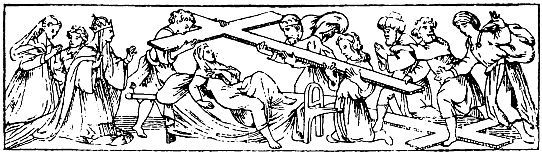
Having read these extracts from the Golden Legend, we shall be able to understand the accompanying illustrations, which represent some frescos of the fifteenth century, which formerly adorned the walls of the / Chapel of the Gild of the Holy Cross, at Stratford-upon-Avon; which stands close by New Place, Shakespeare’s house. These frescos, alas! no longer exist, for, in 1804, the Chapel underwent considerable repair, during which, under the whitewash, were discovered traces of paint, and these, being scraped, a series illustrating the legend of the Cross was found in the chancel, which was built in 1450. In other parts of the Chapel were found representations of the Ressurection, and the day of Judgment, St. George and the Dragon, and the death of St. Thomas a Becket, besides others.
Luckily, a gentleman from London, a Mr. Fisher, was then staying at Stratford-on-Avon, and he drew, and painted them—afterwards, in 1807, publishing them—and it is from his sketches that these illustrations are taken. The barbarians of Stratford hacked the plaster on which the Holy Cross series was painted to bits, and whitewashed all the other paintings. It is presumed they still exist, for, when the Chapel was thoroughly restored in 1835, traces of the other pictures were visible under the whitewash.
These pictures of the Invention, and Exaltation, of the Holy Cross are especially interesting, not only on account of their age and artistic merit, but from the fact that they are of English work, and show the English idea of treating the subject. I have reproduced them all but two; one, the fight on the bridge over the Danube between Heraclius and the son of Chosroes, and the other representing Heraclius smiting off Chosroes’ head.
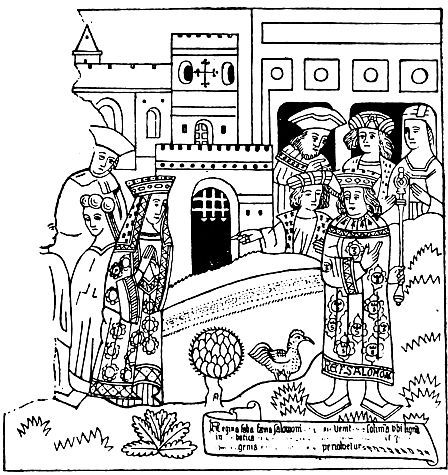
Plate A represents the visit of the Queen of Sheba to Solomon. Her name was Balkis, and, in her legendary history, it is reported that Solomon, having heard of her riches and power, sent her a peremptory message to submit herself to his rule. She, dreading war with so potent a sovereign, sent an embassy to try and find out whether Solomon was as wise as he was represented to be. With this object she dressed five hundred boys as girls, and a like number of girls as boys, and, among other presents, sent a pearl, a diamond cut through in zigzags, and a crystal box; and she should be able to judge of his wisdom and power, if he could tell the boys from the girls, pierce the pearl, thread the diamond, and fill the goblet with water that came neither from the earth nor the sky.
Needless to say, Solomon passed through the ordeal triumphantly. He ordered silver basins to be brought, so that the ambassadors’ suite might wash their hands after their long journey, and the boys were easily distinguished from the girls, for they dipped their hands only in the water, whilst the girls tucked up their sleeves and washed their arms as well as their hands. Then he opened the box containing the pearl, diamond, and goblet, and, taking out the pearl, he applied his magic stone, Samur, or Schamir, which a raven had brought him, and which had the power of cleaving anything, and lo! the pearl was pierced; then he examined the diamond, which was so pierced that no thread could be passed through it; so he took a worm, and having placed a piece of silk in its mouth, it wriggled through, and the diamond was threaded. The next task was to fill the goblet, which he gave to a negro slave, and bade him mount a wild horse and gallop it till it streamed with sweat, and then to fill the goblet with it, thus fulfilling the imposed conditions. He then gave back these presents to the ambassadors, who speedily returned to Queen Balkis. She at once saw that it would be useless to oppose the powerful will of Solomon, and immediately set out on her journey to that monarch.
It is here that her connection with the holy Cross comes in, for its wood, which Solomon had cut down in order to incorporate it into his Temple, and which had the inconvenient property of fitting in nowhere, being either too long or too short for any purpose, was in consequence thrown aside, and ultimately was used as a foot-bridge across a brook. Across this plank the Queen had to pass, but she, recognising its holy virtue, refused to walk across it, preferring to wade the brook, which, having done, she expounded its value to Solomon, and prophesied that out of it should be made the Cross on which Jesus should suffer.
She afterwards became one of Solomon’s wives, and bore him a son, and then returned to her own land, and from this son are descended the kings of Abyssynia.
The legend on the label is, as far as is legible, Regina Saba fama Salomonis (adduct) a venit (Iero)soluma ubi lignum in . . . abatica . . . it . . . genis . . . persolvetur.
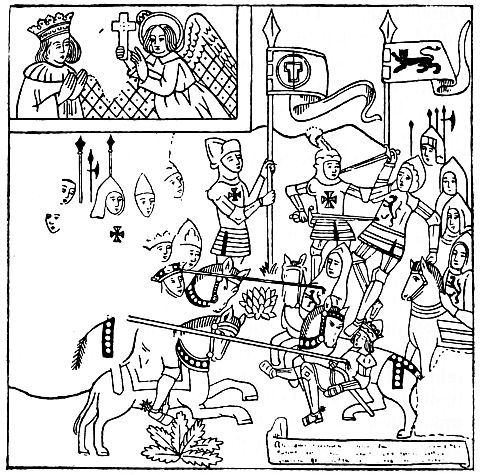
Plate B is, virtually, two; one showing the angel appearing to Constantine when, early in the fourth century, he was advancing towards Rome against Maxentius; but the legend of the miraculous inscription which appeared in the sky, “In hoc signo vinces,” does not appear. The other, and larger portion, represents his victory over Maxentius, and he is represented as spearing and killing that monarch; but this is not historically correct, for, after his defeat, as Maxentius fled towards Rome, essaying to cross the Tiber over a rotten bridge, it gave way, and he was drowned. It is noticeable that the Christian flag bears the Tau Cross.
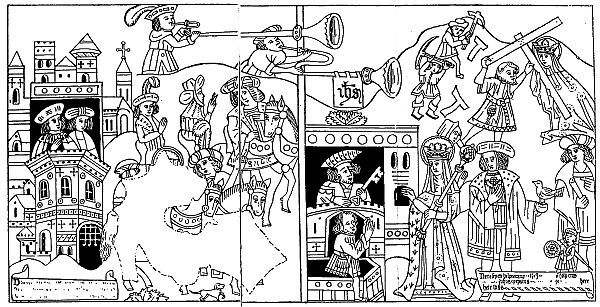
The Plates C and D run into each other, although they portray different subjects, C being the departure of St. Helena for Jerusalem on her quest of the holy Cross. The label in this fresco is utterly illegible.
Plate D shows Judas (called Julius in the label) Cyryacus (the Quyryache of the Golden Legend) being released, after having been forced, through imprisonment and starvation, into confessing where the holy Cross lay buried. In the upper part St. Helena is receiving the holy Cross, whilst labourers are uncovering the Tau Crosses of the two thieves.
The legend is mutilated, but enough remains to make its meaning clear: “Here Seynte helyne examy(neth) the I(ews for) ye Holy cros . . . . Iulius cyryacus (saith that he knew w)here hete was.”
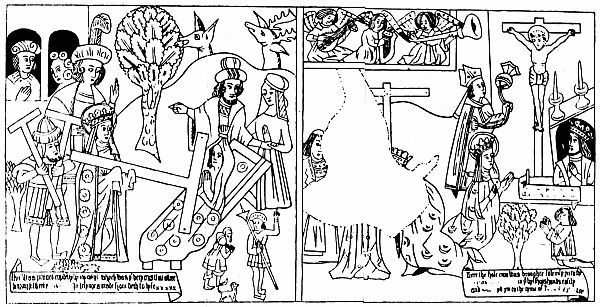
The legend in Plate E is nearly perfect, and accurately describes the painting, “Hyt was proved evidently by myrakel which was ye very cros that oure Savyour suffyred . . . . In resynge a made from deth to lyfe.”
Here all the Crosses are of the Tau type, and the scene is laid in a forest, where an old labourer, and a bill-man, and the deer nibbling the trees, give a rural aspect, instead of in the City of Jerusalem, as saith the Golden Legend.
Plate F evidently consists of two separate paintings—one, where St. Helena is reverently carrying the Cross into Jerusalem, whilst the angels in heaven are discoursing celestial music; and the other, its reception either in Jerusalem or Byzantium, whither St. Helena sent a portion as a present to her son. And this latter seems the more probable, if we imagine the King, who, with St. Helena, is adoring the Crucifix, to be the emperor Constantine, a fact which might have been settled had the label been legible.
The legend at the bottom is unfortunately mutilated, but that evidently relates to that portion of the Cross which remained at Jerusalem, because it speaks of Chosroes: “Here the hole cros was broughte solemly yn to the . . . in ye bysshops hands easily and (remaynyd) un to the tyme of (King Codsd)roe.
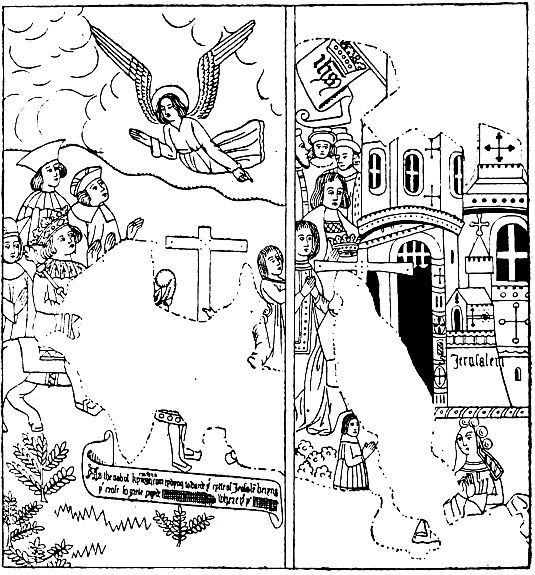
Plates G and H represent the story told in the Golden Legend, of Heraclius bearing the Cross into Jerusalem, how the gate miraculously closed, and an angel appeared in the heavens and reproved Heraclius for riding in state on the very spot where Jesus had gone in all meekness, and lowliness, to His passion. The legend is erased in parts, the unmutilated portion reading, “As the nobul kynge eraclyus com rydyng towarde ye cytte of Ierusalem beryng ye crosse so grete pryde . . . where ye . . . .”
Naturally, the possession of a piece of the true Cross would be esteemed as a most precious property. No matter how small, it would be reverentially enclosed in crystal and gold, and was more than a present fit for an emperor or king, and we cannot marvel that small pieces were distributed all over Christendom. Possibly some of the relics shown as pieces of the very Cross might not have been what they were supposed to be, but it is hard to believe what John Calvin[K] wrote about it:—
“And fyrst of all let us begynne to speake of his crosse, whereupon he was hanged. I know that it is holden for a certaintie that it was founde of Heline the mother of Constantine the Romaine Emperour. I knowe also what certaine Doctours have written touching the approbation hereof, for to certifie that the crosse which she found was without doute the selfe same on the whiche Iesus Christ was hanged. Touchynge all this I reporte me to the thynge it selfe, so much is there that it was but a folish curiositie of her, or at the least a folishe and unconsidered devotion. But yet put the case it had ben a worke worthy of prayse to her, for to have taken paynes to fynde the trewe crosse, and that our lord had then declared by myracle that it was his crosse which she found; Yet let us onely consider that which is of our time. Every one doeth holde that this crosse which Helene founde is yet at Ierusalem, and none doeth doute thereof. Although the Ecclesiasticall history against sayeth the same notablye. For it is ther recited that Helene toke one part thereof to send to the Emperour her sonne, who put the same at Constantinople upon a fyne pyller of Marble in the myddest of the market. Of the other part, it is sayde that she did locke the same in a copher of silver, and gave it to the Bishop of Ierusalem to kepe. So then eyther we shall augment the historie of a lie or els that which is holden at this daye of the true Crosse, is but a vayne and triflyng opinion.
“Let us consider on the other part howe many peeces there are thereof throug out the worlde. Yf I would onely recite that whiche I coulde say there woulde be a register sufficient to fyl a whole boke. There is not so little a town where there is not some peece thereof, and that not onelye in cathedrall churches, but also in some parishes. Likewise ther is not so wicked an abbey where there is not of it to be shewed. And in some places ther are good great shydes:51 as at the holye chappell of Paris, and at Poitiers & at Rome, where there is a great crucifix made thereof as men saye. To be short, yf a man woulde gather together all that hath bene founde of this crosse, there would be inough to fraighte a great ship. The Gospell testifieth that the crosse myght be caried of one man. What audacitie then was this to fyll the earth with pieces of wod in suche quantitie, that thre hundred men can not cary them,” &c.
Calvin was full of zeal, and could not stoop to particularise. Witness his assertion that the Cross would freight a ship, and yet that three hundred men could carry it. M. Rohault de Fleury has gone very minutely into this matter. Knowing, from microscopical examination, that several of the relics of the Cross were of pine, he accepts this wood as his basis, and, from its probable size, he deduces a weight of 100 kilogrammes, equal to about 240 English lbs.; and, taking the average density of pine, he estimates that this would give 178 millions of cubic millimetres. He then describes all the known pieces in Europe, Jerusalem, and Mount Athos, with their measurements, and he puts the outcome at 3,941,975 cubic millimetres; thus, according to his shewing, there is but a very small portion of the Holy Cross in existence. I subjoin his list of the places in which pieces of the Cross are known to exist, as it is most interesting, showing the comparative bulk of the pieces, in cubic millimetres:—
According to this table we are credited in England with 30,516 cubic millimetres of the holy Cross, and it is interesting to know where they are situated. M. Rohault de Fleury, writing in 1870, says there were pieces at Isleworth; St. Gregory, Downside, near Bath; in the possession of Lord Petre; at Bergholt East, in Suffolk; at Plowden; at the convent of St. Mary, York; at West Grinstead; at St. George’s, Southwark; and Slindon, Sussex.
These pieces of the holy Cross are not large, as the following table, in cubic millimetres, shows:—
| At Isleworth | 1,000 |
| ” College of St. Gregory | 6,120 |
| Lord Petre (two relics) | 8,287 |
| At St. Mary, Bergholt East | 1,008 |
| ” Plowden Hall, Salop | 262 |
| ” St. Mary, York (two relics) | 5,600 |
| ” West Grinstead ” | 38 |
| ” St. George’s, Southwark (four relics) | 63 |
| ” St. Richard, Slindon | 8,100 |
| Total | 30,516 |
One relic at St. Mary’s Convent, York, is very fine; it is ornamented with scroll-work of the tenth century, and bears three impressions of the seal of the Vicar Capitular of the diocese of Saint Omer, 1657 to 1662. It is a pectoral cross that is supposed to have belonged to the patriarch Arnulph, who was with Robert, Duke of Normandy.
The other is supposed to have been attached to the above, and to have belonged equally to Arnulph, patriarch of Jerusalem. This is kept in a silver reliquary, which also contains relics of SS. Ignatius Loyola and François Xavier.
We see by the Golden Legend, that St. Helena, after finding the Cross, feeling certain that the nails were not far off, prosecuted a further search for them, and they were discovered “shynyng as gold.” As with the fashion of the Cross, whether it was immissa or commissa, there is, and was, a controversy with regard to the nails, whether three or four.
Bosius in his learned and exhaustive book, Crux Triumphans et Gloriosa,[L] gives several authorities for three nails only—foremost, Gregory Nazianzen; but he does not give the passage where it may be found; the quotation, however, is
Γυμνὸν τρισήλῳ κείμενον ξύλῳ λαϐών
“having taken from the three-nailed wood the dead (or hanging) body.” Thus clearly showing the number of nails he considered right.
Bosius then goes on to quote Apollinaris Laodicenus, who, in his tragedy entitled Christus patiens, called the holy Cross by the same words, τσισηλον ξυλω, “three-nailed wood”; and he also quotes from the Meditat. vitæ Christi of Bonaventura, “Illi tres clavi sustinent totius corporis pondus.” Nonnus, the Greek poet, writing in the fifth century, also says that our Lord’s feet overlapped each other, and were fastened by only one large nail. So that there is a very fair amount of antiquity in favour of three nails.
Against this theory may be quoted the authority of St. Cyprian, St. Augustine, St. Gregory of Tours, Pope Innocent III., Rufinus, Theodoret, and others, who say four nails were used in the Crucifixion of our Saviour. The battle waged pictorially; but perhaps the earliest known representation of the Crucifixion, that found in the Cemetery of St. Julian, Pope, or of St. Valentine in Via Flaminia at Rome, ought to bear most weight. Our Saviour is represented as being clothed in a long sleeveless robe, which reaches to His ankles; the feet are separate, and are each nailed. It is said that Cimabue was the first to paint the feet overlapping, and one nail. His example, however, was much followed, and hence the controversy.
Of these nails, universal tradition says that St. Helena sent two to her son Constantine, and, as the Golden Legend has it, “the emperour dyd do sette them in hys brydel and in hys helme when he wente to batayle.” One can understand one of these sacred nails being worn in the Emperour’s helmet as a presage of victory and as a safeguard against danger, but the utility of incorporating one of such priceless relics in a horse’s bridle is not so easy to comprehend; but the fathers of the Church, St. Cyril of Alexandria, St. Ambrose, Theodoret, and St. Gregory of Tours, recognise in it the fulfilment of the prophecy of Zecharius, chap. xiv. 20: “In that day shall be upon the bridles of the horses, Holiness unto the Lord.”
This bridle, or rather bit, is now said to be in existence in France at Carpentras, department of Vaucluse. How it got there is not clearly known, but probably it was taken at the time of the Crusades—as leaden seals on which it is engraved exist, attached to parchments of the dates 1226 and 1250, and it was mentioned in an inventory of relics in the year 1322.
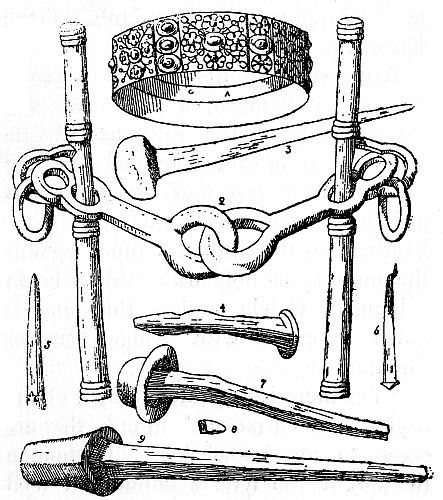
I have reproduced it, as well as the Iron Crown of Lombardy and the nails, from M. Rohault de Fleury’s work, and, as will be seen, it is undoubtedly of great antiquity, closely resembling the bits of the Romans.
According to Bosius, who quotes Gregory Nazianzen, a third nail was thrown by St. Helena into the Adriatic Sea, in order to calm a tempest; and the same authority says that the fourth was deposited in the head of a statue of Constantine, but this militates much against the number of holy nails said to be in existence. Calvin notices this, and is down upon it with sledge-hammer force:—
“Yet there is a greater combat of the nayles. I wyll recite them only that are come to my knowledge. Thereupon there is not so lytle a childe but wyll judge that the Devyll hath to much deluded the worlde in takyng from it both understandyng and reason, that it coulde discerne nothynge in this matter. If the auncient writers saye trewe, and namely Theodorite Historiographer of the auncient churche, Helene caused one to be nayled on her sonne’s helmet, the other two she put in his horse bitte. How be it Sainct Ambrose sayeth not fully so. For he sayeth that one was put in Constantine’s crowne, of the other his horsebit was made, and the thirde Helene kept. Wee se yt already more than twelve hundred yeres agone this hath bene in controversie, to wit, what was become of the nayles. What certentie can be had of them then at this present time?
“Now at Millan they boste that thei have y nayle that was put in Constantine’s horse bitte. To the whiche the towne of Carpentras opposeth herselfe, sayinge that it is she that hath it. Nowe S. Ambrose doth not saye that the nayle was knit to the bitte, but that the bitte was made thereof. Whiche thynge can in no wyse be made to agre eyther wt their saying of Milan or wt theirs of Carpentras.
“Moreover there is one in Rome at Sainct Helenes; another also at Sene, another at Venise. In Germany two: at Collyne one, at the three Maries: another at Triers, one in Fraunce at the holy chappell of Paris, another at ye Carmes, one also at Sainct Denis in France: one at Burges: one at Tenaill, one at Draguine.
“Beholde here fourteene, whereof account is made; in every place they alledge good approbation for themselves, as they suppose. And so it is that everye one hath as good right as aunother. Wherefor there is no better way then to make them all passe under one fidelium. That is to saye, to repute all that they saye hereof to be but lyes, seying that otherwise a man shoulde never come to an ende.”
What would Calvin have said if he had seen the formidable list of holy nails enumerated by Guisto (or Justus) Fontanini, Archbishop of Ancyra? which is as follows:—
- 1. Aix la Chapelle.
- 2. Ancona, in the Cathedral.
- 3. Bamberg.
- 4. In Bavaria, Convent of Audechsen.
- 5. Carpentras. The Holy Bit.
- 6. Catania, Sicily.
- 7. Colle, in Tuscany.
- 8. Cologne.
- 9. The Escurial in Spain.
- 10. Milan.
- 11. Monza. The Iron Crown.
- 12. Naples. Monastery of S. Patricius.
- 13. Nuremberg. Church of the Holy Virgin.
- 14. Paris.
- 15. Rome. Two Nails. Church of the Holy Cross of Jerusalem; Church of Santa Maria in Campitelli.
- 16. Sienna. Hospital Sainte Marie de de l’Echelle.
- 17. Spoleto.
- 18. Torcello, near Venice. Church of S. Anthony.
- 19. Torno, on the Lake of Como.
- 20. Toul.
- 21. Trèves.
- 22. Venice. Three nails.
- 23. Vienna.
But this list is further supplemented by M. Rohault de Fleury, who gives six more:—
- 1. Arras, according to M. le Chev. de Linas.
- 2. Compiègne. A point.
- 3. Cracow, in Poland, according to M. Gosselin.
- 4. Florence.
- 5. Lagney.
- 6. Troyes.
So that no less than twenty-nine towns claim the possession of thirty-two nails, all differing in form, the number of which can only be accounted for by the supposition that only a portion of the holy nails has been incorporated into each of them.
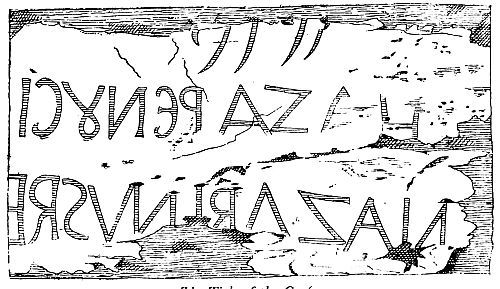
One of the most interesting relics in connection with the holy nails is the Iron Crown of Lombardy. This, as may be seen by reference to the illustration (Fig. 1), is a circlet of gold, ornamented with precious stones, and it is indebted for its name of “Iron” to a thin band (A) of that metal, which is inside the gold circlet. The Crown itself is of very antique form, being even devoid of rays, and is too small to go on the head. Charlemagne was crowned with it in 774, and Napoleon did not think himself King of Italy until he had placed this precious diadem on his head, in 1805. It is kept at Monza, nine miles from Milan, in the Cathedral, which is of great antiquity. There it reposes in a huge cross placed over the altar.
Of the relics of the Cross there now remains but two specks of the title or inscription thereon, and here, again, I am indebted to M. Rohault de Fleury for the illustration on page xciv., as it seems to me to be the best yet published.
The Evangelists, although agreeing in the spirit of the inscription, vary as to the letter.
| Says | St. Matthew: “This is Jesus the King of the Jews.” |
| “ | St. Mark: ”The King of the Jews.“ |
| ” | St. Luke: “This is the King of the Jews.” |
| “ | St. John: ”Jesus of Nazareth the King of the Jews.“ |
Neither St. Matthew nor St. Mark note the tri-lingual character, and SS. Luke and John vary as to the order of the different languages; the former saying it was in Greek, Latin, and Hebrew—the latter that it was in Hebrew, Greek, and Latin. The latter is the generally accepted form, and the reason given is, that Hebrew, being the common language, it would naturally come first, as we should do in an English notice, first in English, then, say in French and German, for the benefit of foreigners, as were the Greeks and Romans in Jerusalem.
The tradition is that, along with the Cross, St. Helena found the inscription, and that she sent it, together with a piece of the Holy Cross and a number of other sacred relics, to Rome, where it was deposited in the basilica of Santa Croce. Here it remained until Valentinian, fearing that it might fall into the hands of the Goths and Huns, hid it in the wall of the building, until it was found in 1492.
Valentinian died A.D. 375, and Antoninus Martyr, in his De Locis Sanctis (sec. 20), written about A.D. 570, says he saw the inscription which had been placed on the Cross, and that the words were, “Iesus Nazarenus Rex Iudæorum.” He says that he held it in his hand, and kissed it, in the Church of Constantine at Jerusalem. Hence it is evident that either tradition is incorrect, or that Antoninus did not tell the truth.
But the claim is that it is, and always has been, in Rome, and Bosius, in his Crux Triumphans (p. 60), gives an account of its re-discovery. He says that in February, 1492, Monseigneur Pedro Gonsalvo de Mendoza, Cardinal Sanctæ Crucis, was repairing and cleansing his church, and on the first day of that month, when the workmen reached the top of the arch which was in the middle of the basilica, and near the roof, they saw two small columns; and finding a space, they discovered a niche in which they found a leaden box, well closed, and on its lid was a tablet of marble, on which were engraved these words: Hic est Titvlvs Veræ Crucis. In this box was found a little board, about a hand’s breadth and a half, much corroded on one side by time, and bearing, in grooved, engraved characters, which were coloured red, the following inscription: Iesvs Nazarenvs Rex Ivdæorvm. But the word Ivdæorvm was not entire, the last two letters vm having crumbled to pieces by reason of old age. The first line was written in Latin characters, the second in Greek, and the third in Hebrew.
All the city went to see it; and three days afterwards, Pope Innocent went also, and ordered the relic to be preserved in its box, and covered with a sheet of glass. Every one was convinced that they had before their eyes the inscription which Pilate placed upon the Cross over our Saviour’s head, and which Saint Helena had deposited in the church at the time of its building.
The relic, as now seen, is very worm-eaten, but the letters are still visible, and have been cut with a small gouge. They read from right to left, as Hebrew does, thus lending great plausibility to the idea that it was done by some Jewish artificers; and it seems to be of some close-grained wood. Taking the piece now at Santa Croce, the whole inscription, if restored, would be thus: