
BOOK III
THE DAWN OF HISTORY
XV
THE ARYAN-SPEAKING PEOPLES IN PREHISTORIC TIMES
§ 1. The Spreading of the Aryan-Speakers. § 2. Primitive Aryan Life. § 3. Early Aryan Daily Life.
§ 1
WE have spoken of the Aryan language as probably arising in the region of the Danube and South Russia and spreading from that region of origin. We say “probably,” because it is by no means certainly proved that that was the centre; there have been vast discussions upon this point and wide divergences of opinion. We give the prevalent view. As it spread widely, Aryan began to differentiate into a number of subordinate languages. To the west and south it encountered the Basque language, which was then widely spread in Spain, and also possibly various Hamitic Mediterranean languages.
The Neolithic Mediterranean race, the Iberian race, was distributed over Great Britain, Ireland, France, Spain, north Africa, south Italy, and, in a more civilized state, Greece and Asia Minor. It was probably closely related to the Egyptian. To judge by its European vestiges it was a rather small human type, generally with an oval face and a long head. It buried its chiefs and important people in megalithic chambers—i.e. made of big stones—covered over by great mounds of earth; and these mounds of earth, being much longer than they are broad, are spoken of as the long barrows. These people sheltered at times in caves, and also buried some of their dead therein; and from the traces of charred, broken, and cut human bones, including the bones of children, it is inferred that they were cannibals. These short dark Iberian tribes (and the Basques also if they were a different race) were thrust back westward, and conquered and enslaved by slowly advancing waves of a taller and fairer Aryan-speaking people, coming southward and westward through central Europe, who are spoken of as the Kelts. Only the Basque resisted the conquering Aryan speech. Gradually these Keltic-speakers made their way to the Atlantic, and all that now remains of the Iberians is mixed into the Keltic population. How far the Keltic invasion affected the Irish population is a matter of debate at the present time; the Kelts may have been a mere caste of conquerors who imposed their language on a larger subject population. It is even doubtful if the north of England is more Aryan than pre-Keltic in blood. There is a sort of short dark Welshman, and certain types of Irishmen, who are Iberians by race. The modern Portuguese are also largely of Iberian blood.
The Kelts spoke a language, Keltic,[88] which was also in its turn to differentiate into the language of Gaul, Welsh, Breton, Scotch and Irish Gaelic, and other tongues. They buried the ashes of their chiefs and important people in round barrows. While these Nordic Kelts were spreading westward, other Nordic Aryan peoples were pressing down upon the dark white Mediterranean race in the Italian and Greek peninsulas, and developing the Latin and Greek groups of tongues. Certain other Aryan tribes were drifting towards the Baltic and across into Scandinavia, speaking varieties of the Aryan which became ancient Norse—the parent of Swedish, Danish, Norwegian, and Icelandic—Gothic, and Low and High German.
While the primitive Aryan speech was thus spreading and breaking up into daughter languages to the west, it was also spreading and breaking up to the east. North of the Carpathians and the Black Sea, Aryan-speaking tribes were increasing and spreading and using a distinctive dialect called Slavonian, from which came Russian, Serbian, Polish, Bulgarian, and other tongues; other variations of Aryan distributed over Asia Minor and Persia were also being individualized as Armenian and Indo-Iranian, the parent of Sanscrit and Persian. In this book we have used the word Aryan for all this family of languages, but the term Indo-European is sometimes used for the entire family, and “Aryan” itself restricted in a narrower sense to the Indo-Iranian speech.[89] This Indo-Iranian speech was destined to split later into a number of languages, including Persian and Sanscrit, the latter being the language of certain tribes of fair-complexioned Aryan speakers who pushed eastward into India somewhen between 3000 and 1000 B.C. and conquered dark Dravidian peoples who were then in possession of that land.
§ 2
What sort of life did these prehistoric Aryans lead, these Nordic Aryans who were the chief ancestors of most Europeans and most white Americans and European colonists of to-day, as well as of the Armenians,[90] Persians, and high-caste Hindus?
In answering that question we are able to resort to a new source of knowledge in addition to the dug-up remains and vestiges upon which we have had to rely in the case of Palæolithic man. We have language. By careful study of the Aryan languages it has been found possible to deduce a number of conclusions about the life of these Aryan peoples 5000 or 4000 years ago. All these languages have a common resemblance, as each, as we have already explained, rings the changes upon a number of common roots. When we find the same root word running through all or most of these tongues, it seems reasonable to conclude that the thing that root word signifies must have been known to the common ancestors. Of course, if they have exactly the same word in their languages, this may not be the case; it may be the new name of a new thing or of a new idea that has spread over the world quite recently. “Gas,” for instance is a word that was made by Van Helmont, a Dutch chemist, about 1625, and has spread into most civilized tongues, and “tobacco” again is an American-Indian word which followed the introduction of smoking almost everywhere. But if the same word turns up in a number of languages, and if it follows the characteristic modifications of each language, we may feel sure that it has been in that language, and a part of that language, since the beginning, suffering the same changes with the rest of it. We know, for example, that the words for waggon and wheel run in this fashion through the Aryan tongues, and so we are able to conclude that the primitive Aryans, the more purely Nordic Aryans, had waggons, though it would seem from the absence of any common roots for spokes, rim, or axle that their wheels were not wheelwright’s wheels with spokes, but made of the trunks of trees shaped out with an axe between the ends.
These primitive waggons were drawn by oxen. The early Aryans did not ride or drive horses; they had very little to do with horses. The Reindeer men were a horse-people, but the Neolithic Aryans were a cow-people. They ate beef, not horse; and after many ages they began this use of draught cattle. They reckoned wealth by cows. They wandered, following pasture, and “trekking” their goods, as the South African Boers do, in ox-waggons, though of course their waggons were much clumsier than any to be found in the world to-day. They probably ranged over very wide areas. They were migratory, but not in the strict sense of the word “nomadic”; they moved in a slower, clumsier fashion than did the later, more specialized nomadic peoples. They were forest and parkland people without horses. They were developing a migratory life out of the more settled “forest clearing” life of the earlier Neolithic period. Changes of climate which were replacing forest by pasture, and the accidental burning of forests by fire may have assisted this development.
When these early “Aryans” came to big rivers or open water, they built boats, at first hollow tree trunks and then skin-covered frameworks of lighter wood. Before history began there was already some Aryan canoe-traffic across the English Channel and in the Baltic, and also among the Greek islands. But the Aryans, as we shall see later, were probably not the first peoples to take to the sea.
We have already described the sort of home the primitive Aryan occupied and his household life, so far as the remains of the Swiss pile-dwellings enable us to describe these things. Mostly his houses were of too flimsy a sort, probably of wattle and mud, to have survived, and possibly he left them and trekked on for very slight reasons. The Aryan peoples burnt their dead, a custom they still preserve in India, but their predecessors, the long-barrow people, the Iberians, buried their dead in a sitting position. In some ancient Aryan burial mounds (round barrows) the urns containing the ashes of the departed are shaped like houses, and these represent rounded huts with thatched roofs. See Fig. p. 57.
The grazing of the primitive Aryan was far more important to him than his agriculture. At first he cultivated with a rough wooden hoe; then, after he had found out the use of cattle for draught purposes, he began real ploughing with oxen, using at first a suitably bent tree bough as his plough. His first cultivation before that came about must have been rather in the form of garden patches near the house buildings than of fields. Most of the land his tribe occupied was common land on which the cattle grazed together.
He never used stone for building house walls until upon the very verge of history. He used stone for hearths (e.g. at Glastonbury) and sometimes stone sub-structures. He did, however, make a sort of stone house in the centre of the great mounds in which he buried his illustrious dead. He may have learnt this custom from his Iberian neighbours and predecessors. It was these dark whites of the heliolithic culture, and not the primitive Aryans, who were responsible for such primitive temples as Stonehenge or Carnac in Brittany.
His social life was growing. Man was now living in clans and tribal communities. These clans and communities clashed; they took each other’s grazing land, they sought to rob each other; there began a new thing in human life, war. For war is not a primeval thing; it has not been in this world for more than 20,000 years. To this day very primitive peoples, such as the Australian black-fellows, do not understand war. The Palæolithic Age was an age of fights and murder, no doubt, but not of the organized collective fighting of numbers of men.[91] But now men could talk together and group themselves under leaders, and they found a need of centres where they could come together with their cattle in time of raids and danger. They began to make camps with walls of earth and palisades, many of which are still to be traced in the history-worn contours of the European scenery. The leaders under whom men fought in war were often the same men as the sacrificial purifiers who were their early priests.
The knowledge of bronze spread late in Europe. Neolithic man had been making his slow advances age by age for 7000 or 8000 years before the metals came. By that time his social life had developed so that there were men of various occupations and men and women of different ranks in the community. There were men who worked wood and leather, potters and carvers. The women span and wove and embroidered. There were chiefs and families that were distinguished as leaderly and noble; and man varied the monotony of his herding and wandering, he consecrated undertakings and celebrated triumphs, held funeral assemblies, and distinguished the traditional seasons of the year, by feasts. His meats we have already glanced at; but somewhen between 10,000 B.C. and the broadening separation of the Aryan peoples towards 2000 or 1000 B.C., mankind discovered fermentation, and began to brew intoxicating drinks. He made these of honey, of barley, and, as the Aryan tribes spread southward, of the grape. And he got merry and drunken. Whether he first used yeast to make his bread light or to ferment his drink we do not know.
At his feasts there were individuals with a gift for “playing the fool,” who did so no doubt to win the laughter of their friends,[92] but there was also another sort of men, of great importance in their time, and still more important to the historian, certain singers of songs and stories, the bards or rhapsodists. These bards existed among all the Aryan-speaking peoples; they were a consequence of and a further factor in that development of spoken language which was the chief of all the human advances made in Neolithic times. They chanted or recited stories of the past, or stories of the living chief and his people; they told other stories that they invented; they memorized jokes and catches. They found and seized upon and improved the rhythms, rhymes, alliterations, and such-like possibilities latent in language; they probably did much to elaborate and fix grammatical forms. They were the first great artists of the ear, as the later Aurignacian rock painters were the first great artists of the eye and hand. No doubt they used much gesture; probably they learnt appropriate gestures when they learnt their songs; but the order and sweetness and power of language was their primary concern.
And they mark a new step forward in the power and range of the human mind. They sustained and developed in men’s minds a sense of a greater something than themselves, the tribe, and of a life that extended back into the past. They not only recalled old hatreds and battles, they recalled old alliances and a common inheritance. The feats of dead heroes lived again. A new thought came into men’s minds, the desire to be remembered. Men began to live in thought before they were born and after they were dead.
Like most human things, this bardic tradition grew first slowly and then more rapidly. By the time bronze was coming into Europe there was not an Aryan people that had not a profession and training of bards. In their hands language became as beautiful as it is ever likely to be. These bards were living books, man-histories, guardians and makers of a new and more powerful tradition in human life. Every Aryan people had its long poetical records thus handed down, its sagas (Teutonic), its epics (Greek), its vedas (Old Sanscrit). The earliest Aryan people were essentially a people of the voice. The recitation seems to have predominated even in those ceremonial and dramatic dances and that “dressing-up” which among most human races have also served for the transmission of tradition.[93]
At that time there was no writing, and when first the art of writing crept into Europe, as we shall tell later, it must have seemed far too slow, clumsy, and lifeless a method of record for men to trouble very much about writing down these glowing and beautiful treasures of the memory. Writing was at first kept for accounts and matters of fact. The bards and rhapsodists flourished for long after the introduction of writing. They survived, indeed, in Europe as the minstrels into the Middle Ages.
Unhappily their tradition had not the fixity of a written record. They amended and reconstructed, they had their fashions and their phases of negligence. Accordingly we have now only the very much altered and revised vestiges of that spoken literature of prehistoric times. One of the most interesting and informing of these prehistoric compositions of the Aryans survives in the Greek Iliad. An early form of Iliad was probably recited by 1000 B.C., but it was not written down until perhaps 700 or 600 B.C. Many men must have had to do with it as authors and improvers, but later Greek tradition attributed it to a blind bard named Homer, to whom also is ascribed the Odyssey, a composition of a very different spirit and outlook. To be a bard was naturally a blind man’s occupation.[94] The Slavs called all bards sliepac, which was also their word for a blind man. The original recited version of the Iliad was older than that of the Odyssey. “The Iliad as a complete poem is older than the Odyssey, though the material of the Odyssey, being largely undatable folk-lore, is older than any of the historical material in the Iliad.”[95] Both epics were probably written over and rewritten by some poet of a later date, in much the same manner that Lord Tennyson, the poet laureate of Queen Victoria, in his Idylls of the King, wrote over the Morte d’Arthur (which was itself a writing over by Sir Thomas Malory, circ. 1450, of pre-existing legends), making the speeches and sentiments and the characters more in accordance with those of his own time. But the events of the Iliad and the Odyssey, the way of living they describe, the spirit of the acts recorded, belong to the closing centuries of the prehistoric age. These sagas, epics, and vedas do supply, in addition to archæology and philology, a third source of information about those vanished times.
Here, for example, is the concluding passage of the Iliad, describing very exactly the making of a prehistoric barrow. (We have taken here Chapman’s rhymed translation, correcting certain words with the help of the prose version of Lang, Leaf, and Myers.)
Went forth, and an unmeasur’d pile of sylvan matter cut;
Nine days employ’d in carriage, but when the tenth morn shin’d
On wretched mortals, then they brought the bravest of his kind
Forth to be burned. Troy swam in tears. Upon the pile’s most height
They laid the body, and gave fire. All day it burn’d, all night.
But when th’ eleventh morn let on earth her rosy fingers shine,
The people flock’d about the pile, and first with gleaming wine
Quench’d all the flames. His brothers then, and friends, the snowy bones,
Gather’d into an urn of gold, still pouring out their moans.
Then wrapt they in soft purple veils the rich urn, digg’d a pit,
Grav’d it, built up the grave with stones, and quickly piled on it
A barrow....
... The barrow heap’d once, all the town
In Jove-nurs’d Priam’s Court partook a sumptuous fun’ral feast,
And so horse-taming Hector’s rites gave up his soul to rest.”
There remains also an old English saga, Beowulf, made long before the English had crossed from Germany into England, which winds up with a similar burial. The preparation of a pyre is first described. It is hung round with shields and coats of mail. The body is brought and the pyre fired, and then for ten days the warriors built a mighty mound to be seen afar by the traveller on sea or land. Beowulf, which is at least a thousand years later than the Iliad, is also interesting because one of the main adventures in it is the looting of the treasures of a barrow already ancient in those days.
§ 3
The Greek epics reveal the early Greeks with no knowledge of iron, without writing, and before any Greek-founded cities existed in the land into which they had evidently come quite recently as conquerors. They were spreading southward from the Aryan region of origin. They seem to have been a fair people, newcomers in Greece, newcomers to a land that had been held hitherto by a darker people, people who are now supposed to have belonged to a dark white “aboriginal” race, a “Mediterranean” people allied to those Iberians whom the Kelts pressed westward, and to the Hamitic white people of North Africa.

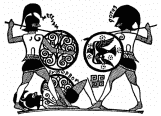
Combat between Menelaus & Hector (in the Iliad)
From a platter ascribed to the end of the seventh century in the British Museum. This is probably the earliest known vase bearing a Greek inscription. Greek writing was just beginning. Note the Swastika.
Let us, at the risk of a slight repetition, be perfectly clear upon one point. The Iliad does not give us the primitive neolithic life of that Aryan region of origin; it gives us that life already well on the move towards a new state of affairs. The primitive neolithic way of living, with its tame and domesticated animals, its pottery and cooking, and its patches of rude cultivation, we have sketched in Chapter XI. We have already discussed in § 4 of Chapter XIII the probability of a widespread heliolithic culture, a sort of sub-civilization, very like the Polynesian and Indonesian life of a hundred years ago, an elaboration of the earlier Neolithic stage. Between 15,000 and 6000 B.C. the neolithic way of living had spread with the forests and abundant vegetation of the Pluvial Period, over the greater part of the old world, from the Niger to the Hwang-ho and from Ireland to the south of India. Now, as the climate of great portions of the earth was swinging towards drier and more open conditions again, the primitive neolithic life was developing along two divergent directions. One was leading to a more wandering life, towards at last a constantly migratory life between summer and winter pasture, which is called Nomadism; the other, in certain sunlit river valleys, was towards a water-treasuring life of irrigation, in which men gathered into the first towns and made the first Civilization. The nature and development of civilization we shall consider more fully in the next chapter, but here we have to note that the Greeks, as the Iliad presents them, are neither simple neolithic nomads, innocent of civilization, nor are they civilized men. They are primitive nomads in an excited state, because they have just come upon civilization, and regard it as an opportunity for war and loot.[96] So far they are exceptional and not representative. But our interest in them in this chapter is not in their distinctively Greek and predatory aspect, but in what they reveal of the ordinary northward life from which they are coming.
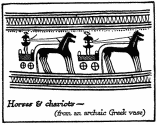
These early Greeks of the Iliad are sturdy fighters, but without discipline—their battles are a confusion of single combats. They have horses, but no cavalry; they use the horse, which is a comparatively recent addition to Aryan resources, to drag a rude fighting chariot into battle. The horse is still novel enough to be something of a terror in itself. For ordinary draught purposes, as in the quotation from the Iliad we have just made, oxen were employed.
The only priests of these Aryans are the keepers of shrines and sacred places. There are chiefs, who are heads of families and who also perform sacrifices, but there does not seem to be much mystery or sacramental feeling in their religion. When the Greeks go to war, these heads and elders meet in council and appoint a king, whose powers are very loosely defined. There are no laws, but only customs; and no exact standards of conduct.
The social life of the early Greeks centred about the households of these leading men. There were no doubt huts for herds and the like, and outlying farm buildings; but the hall of the chief was a comprehensive centre, to which everyone went to feast, to hear the bards, to take part in games and exercises. The primitive craftsmen were gathered there. About it were cowsheds and stabling and such-like offices. Unimportant people slept about anywhere as retainers did in the mediæval castles and as people still do in Indian households. Except for quite personal possessions, there was still an air of patriarchal communism about the tribe. The tribe, or the chief as the head of the tribe, owned the grazing lands; forest and rivers were the wild.
The Aryan civilization seems, and indeed all early communities seem, to have been without the little separate households that make up the mass of the population in western Europe or America to-day. The tribe was a big family; the nation a group of tribal families; a household often contained hundreds of people. Human society began, just as herds and droves begin among animals, by the family delaying its breaking up. Nowadays the lions in East Africa are apparently becoming social animals in this way, by the young keeping with the mother after they are fully grown, and hunting in a group. Hitherto the lion has been much more of a solitary beast. If men and women do not cling to their families nowadays as much as they did, it is because the state and the community now supply safety and help and facilities that were once only possible in the family group.
In the Hindu community of to-day these great households of the earlier stages of human society are still to be found. Mr. Bhupendranath Basu has recently described a typical Hindu household.[97] It is an Aryan household refined and made gentle by thousands of years of civilization, but its social structure is the same as that of the households of which the Aryan epics tell.
“The joint family system,” he said, “has descended to us from time immemorial, the Aryan patriarchal system of old still holding sway in India. The structure, though ancient, remains full of life. The joint family is a co-operative corporation, in which men and women have a well-defined place. At the head of the corporation is the senior member of the family, generally the eldest male member, but in his absence the senior female member often assumes control.” (Cp. Penelope in the Odyssey.)
“All able-bodied members must contribute their labour and earnings, whether of personal skill or agriculture and trade, to the common stock; weaker members, widows, orphans, and destitute relations, all must be maintained and supported; sons, nephews, brothers, cousins, all must be treated equally, for any undue preference is apt to break up the family. We have no word for cousins—they are either brothers or sisters, and we do not know what are cousins two degrees removed. The children of a first cousin are your nephews and nieces, just the same as the children of your brothers and sisters. A man can no more marry a cousin, however removed, than he can marry his own sister, except in certain parts of Madras, where a man may marry his maternal uncle’s daughter. The family affections, the family ties, are always very strong, and therefore the maintenance of an equal standard among so many members is not so difficult as it may appear at first sight. Moreover, life is very simple. Until recently shoes were not in general use at home, but sandals without any leather fastenings. I have known of a well-to-do middle-class family of several brothers and cousins who had two or three pairs of leather shoes between them, these shoes being only used when they had occasion to go out, and the same practice is still followed in the case of the more expensive garments, like shawls, which last for generations, and with their age are treated with loving care, as having been used by ancestors of revered memory.
“The joint family remains together sometimes for several generations, until it becomes too unwieldy, when it breaks up into smaller families, and you thus see whole villages peopled by members of the same clan. I have said that the family is a co-operative society, and it may be likened to a small state, and is kept in its place by strong discipline based on love and obedience. You see nearly every day the younger members coming to the head of the family and taking the dust of his feet as a token of benediction; whenever they go on an enterprise, they take his leave and carry his blessing.... There are many bonds which bind the family together—the bonds of sympathy, of common pleasures, of common sorrows; when a death occurs, all the members go into mourning; when there is a birth or a wedding, the whole family rejoices. Then above all is the family deity, some image of Vishnu, the preserver; his place is in a separate room, generally known as the room of God, or in well-to-do families in a temple attached to the house, where the family performs its daily worship. There is a sense of personal attachment between this image of the deity and the family, for the image generally comes down from past generations, often miraculously acquired by a pious ancestor at some remote time.... With the household gods is intimately associated the family priest.... The Hindu priest is a part of the family life of his flock, between whom and himself the tie has existed for many generations. The priest is not generally a man of much learning; he knows, however, the traditions of his faith.... He is not a very heavy burden, for he is satisfied with little—a few handfuls of rice, a few home-grown bananas or vegetables, a little unrefined sugar made in the village, and sometimes a few pieces of copper are all that is needed.... A picture of our family life would be incomplete without the household servants. A female servant is known as the ‘jhi,’ or daughter, in Bengal—she is like the daughter of the house; she calls the master and the mistress father and mother, and the young men and women of the family brothers and sisters. She participates in the life of the family; she goes to the holy places along with her mistress, for she could not go alone, and generally she spends her life with the family of her adoption; her children are looked after by the family. The treatment of men servants is very similar. These servants, men and women, are generally people of the humbler castes, but a sense of personal attachment grows up between them and the members of the family, and as they get on in years they are affectionately called by the younger members elder brothers, uncles, aunts, etc.... In a well-to-do house there is always a resident teacher, who instructs the children of the family as well as other boys of the village; there is no expensive school building, but room is found in some veranda or shed in the courtyard for the children and their teacher, and into this school low-caste boys are freely admitted. These indigenous schools were not of a very high order, but they supplied an agency of instruction for the masses which was probably not available in many other countries....
“With Hindu life is bound up its traditional duty of hospitality. It is the duty of a householder to offer a meal to any stranger who may come before midday and ask for one; the mistress of the house does not sit down to her meal until every member is fed, and, as sometimes her food is all that is left, she does not take her meal until well after midday lest a hungry stranger should come and claim one.” ...
We have been tempted to quote Mr. Basu at some length, because here we do get to something like a living understanding of the type of household which has prevailed in human communities since Neolithic days, which still prevails to-day in India, China, and the Far East, but which in the west is rapidly giving ground before a state and municipal organization of education and a large-scale industrialism within which an amount of individual detachment and freedom is possible, such as these great households never knew....
But let us return now to the history preserved for us in the Aryan epics.
The Sanscrit epics tell a very similar story to that underlying the Iliad, the story of a fair, beef-eating people—only later did they become vegetarians—coming down from Persia into the plain of North India and conquering their way slowly towards the Indus. From the Indus they spread over India, but as they spread they acquired much from the dark Dravidians they conquered, and they seem to have lost their bardic tradition. The vedas, says Mr. Basu, were transmitted chiefly in the households by the women....
The oral literature of the Keltic peoples who pressed westward has not been preserved so completely as that of the Greeks or Indians; it was written down many centuries later, and so, like the barbaric, primitive English Beowulf, has lost any clear evidence of a period of migration into the lands of an antecedent people. If the pre-Aryans figure in it at all, it is as the fairy folk of the Irish stories. Ireland, most cut off of all the Keltic-speaking communities, retained to the latest date its primitive life; and the Táin, the Irish Iliad, describes a cattle-keeping life in which war chariots are still used, and war dogs also, and the heads of the slain are carried off slung round the horses’ necks. The Táin is the story of a cattle raid. Here too the same social order appears as in the Iliad; the chiefs sit and feast in great halls, they build halls for themselves, there is singing and story-telling by the bards and drinking and intoxication.[98] Priests are not very much in evidence, but there is a sort of medicine man who deals in spells and prophecy.
XVI
THE FIRST CIVILIZATIONS
§ 1. Early Cities and Early Nomads. § 2A. The Riddle of the Sumerians. § 2B. The Empire of Sargon the First. § 2C. The Empire of Hammurabi. § 2D. The Assyrians and their Empire. § 2E. The Chaldean Empire. § 3. The Early History of Egypt. § 4. The Early Civilization of India. § 5. The Early History of China. § 6. While the Civilizations were Growing.
§ 1
WHEN the Aryan way of speech and life was beginning to spread to the east and west of the region in which it began, and breaking up as it spread into a number of languages and nations, considerable communities of much more civilized men were already in existence in Egypt and in Mesopotamia, and probably also in China and in (still purely Dravidian) India. Our story has overshot itself in its account of the Aryans and of their slow progress from early Neolithic conditions to the heroic barbarism of the Bronze Age. We must now go back. Such a pre-Keltic gathering as we sketched at Avebury would have happened about 2000 B.C., and the building of the barrow for Hector as the Iliad describes it, 1300 B.C. or even later. It is perhaps natural for a European writer writing primarily for English-reading students to overrun his subject in this way. No great harm is done if the student does clearly grasp that there has been an overlap.
Here then we take up the main thread of human history again. We must hark back to 6000 B.C. or even earlier. But although we shall go back so far, the people we shall describe are people already in some respects beyond the Neolithic Aryans of three thousand years later, more particularly in their social organization and their material welfare. While in Central Europe and Central Asia the primitive Neolithic way of life was becoming more migratory and developing into nomadism, in the great river valleys it is becoming more settled and localized. It is still doubtful whether we are to consider Mesopotamia or Egypt the earlier scene of the two parallel beginnings of settled communities living in towns. By 4000 B.C., in both these regions of the earth, such communities existed, and had been going on for a very considerable time. The excavations of the American expedition[99] at Nippur have unearthed evidence of a city community existing there at least as early as 5000 B.C., and probably as early as 6000 B.C., an earlier date than anything we know of in Egypt. De Candolle asserts that it is only in the Euphrates-Tigris district that wheat has ever been found growing wild.[100] It may be that from Mesopotamia as a centre the cultivation of wheat spread over the entire eastern hemisphere. Or it may be that wheat grew wild in some regions now submerged. There may have been a wild wheat region in what is now the sea bottom of the eastern Mediterranean. But cultivation is not civilization; the growing of wheat had spread from the Atlantic to the Pacific with the distribution of the Neolithic culture by perhaps 10,000 or 9000 B.C., before the beginnings of civilization. Civilization is something more than the occasional seasonal growing of wheat. It is the settlement of men upon an area continuously cultivated and possessed, who live in buildings continuously inhabited with a common rule and a common city or citadel. For a long time civilization may quite possibly have developed in Mesopotamia without any relations with the parallel beginnings in Egypt. The two settlements may have been quite independent, arising separately out of the widely diffused Heliolithic Neolithic culture. Or they may have had a common origin in the region of the Mediterranean, the Red Sea, and southern Arabia.
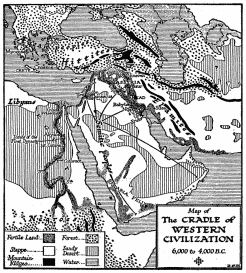
The first condition necessary to a real settling down of Neolithic men, as distinguished from a mere temporary settlement among abundant food, was of course a trustworthy all-the-year-round supply of water, fodder for the animals, food for themselves, and building material for their homes. There had to be everything they could need at any season, and no want that would tempt them to wander further. This was a possible state of affairs, no doubt, in many European and Asiatic valleys; and in many such valleys, as in the case of the Swiss lake-dwellings, men settled from a very early date indeed; but nowhere, of any countries now known to us, were these favourable conditions found upon such a scale, and nowhere did they hold good so surely year in and year out as in Egypt and in the country between the upper waters of the Euphrates and Tigris and the Persian Gulf.[101] Here was a constant water supply under enduring sunlight; trustworthy harvests year by year; in Mesopotamia wheat yielded, says Herodotus, two hundredfold to the sower; Pliny says that it was cut twice and afterwards yielded good fodder for sheep; there were abundant palms and many sorts of fruits; and as for building material, in Egypt there was clay and easily worked stone, and in Mesopotamia a clay that becomes a brick in the sunshine. In such countries men would cease to wander and settle down almost unawares; they would multiply and discover themselves numerous and by their numbers safe from any casual assailant. They multiplied, producing a denser human population than the earth had ever known before; their houses became more substantial, wild beasts were exterminated over great areas, the security of life increased so that ordinary men went about in the towns and fields without encumbering themselves with weapons, and, among themselves at least, they became peaceful peoples. Men took root as man had never taken root before.
But in the less fertile and more seasonal lands outside these favoured areas, there developed on the other hand a thinner, more active population of peoples, the primitive nomadic peoples. In contrast with the settled folk, the agriculturists, these nomads lived freely and dangerously. They were in comparison lean and hungry men. Their herding was still blended with hunting; they fought constantly for their pastures against hostile families. The discoveries in the elaboration of implements and the use of metals made by the settled peoples spread to them and improved their weapons. They followed the settled folk from Neolithic phase to Bronze phase. It is possible that, in the case of iron, the first users were nomadic. They became more warlike with better arms, and more capable of rapid movements with the improvement of their transport. One must not think of a nomadic stage as a predecessor of a settled stage in human affairs. To begin with, man was a slow drifter, following food. Then one sort of men began to settle down, and another sort became more distinctly nomadic. The settled sort began to rely more and more upon grain for food; the nomad began to make a greater use of milk for food. He bred his cows for milk. The two ways of life specialized in opposite directions. It was inevitable that nomad folk and the settled folk should clash, that the nomads should seem hard barbarians to the settled peoples, and the settled peoples soft and effeminate and very good plunder to the nomad peoples. Along the fringes of the developing civilizations there must have been a constant raiding and bickering between hardy nomad tribes and mountain tribes and the more numerous and less warlike peoples in the towns and villages.
For the most part this was a mere raiding of the borders. The settled folk had the weight of numbers on their side; the herdsmen might raid and loot, but they could not stay. That sort of mutual friction might go on for many generations. But ever and again we find some leader or some tribe amidst the disorder of free and independent nomads, powerful enough to force a sort of unity upon its kindred tribes, and then woe betide the nearest civilization. Down pour the united nomads on the unwarlike, unarmed plains, and there ensues a war of conquest. Instead of carrying off the booty, the conquerors settle down on the conquered land, which becomes all booty for them; the villagers and townsmen are reduced to servitude and tribute-paying, they become hewers of wood and drawers of water, and the leaders of the nomads become kings and princes, masters and aristocrats. They too settle down, they learn many of the arts and refinements of the conquered, they cease to be lean and hungry, but for many generations they retain traces of their old nomadic habits, they hunt and indulge in open-air sports, they drive and race chariots, they regard work, especially agricultural work, as the lot of an inferior race and class.
This in a thousand variations has been one of the main stories in history for the last seventy centuries or more. In the first history that we can clearly decipher we find already in all the civilized regions a distinction between a non-working ruler class and the working mass of the population. And we find too that after some generations, the aristocrat, having settled down, begins to respect the arts and refinements and law-abidingness of settlement, and to lose something of his original hardihood. He intermarries, he patches up a sort of toleration between conqueror and conquered; he exchanges religious ideas and learns the lessons upon which soil and climate insist. He becomes a part of the civilization he has captured. And as he does so, events gather towards a fresh invasion by the free adventurers of the outer world.[102]
§ 2A
This alternation of settlement, conquest, refinement, fresh conquest, refinement, is particularly to be noted in the region of the Euphrates and Tigris, which lay open in every direction to great areas which are not arid enough to be complete deserts, but which were not fertile enough to support civilized populations. Perhaps the earliest people to form real cities in this part of the world, or indeed in any part of the world, were a people of mysterious origin called the Sumerians. They were neither Semites nor Aryans, and whence they came we do not know. Whether they were dark whites of Iberian or Dravidian affinities is less certainly to be denied.[103] They used a kind of writing which they scratched upon clay, and their language has been deciphered.[104] It was a language more like the unclassified Caucasic language groups than any others that now exist. These languages may be connected with Basque, and may represent what was once a widespread group extending from Spain and western Europe to eastern India, and reaching southwards to Central Africa. These people shaved their heads and wore simple tunic-like garments of wool. They settled first on the lower courses of the great river and not very far from the Persian Gulf, which in those days ran up for a hundred and thirty miles[105] and more beyond its present head. They fertilized their fields by letting water run through irrigation trenches, and they gradually became very skilful hydraulic engineers; they had cattle, asses, sheep, and goats, but no horses; their collections of mud huts grew into towns, and their religion raised up towerlike temple buildings.
Clay, dried in the sun, was a very great fact in the lives of these people. This lower country of the Euphrates-Tigris valleys had little or no stone. They built of brick, they made pottery and earthenware images, and they drew and presently wrote upon thin tile-like cakes of clay. They do not seem to have had paper or to have used parchment. Their books and memoranda, even their letters, were potsherds.
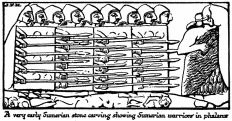
At Nippur they built a great tower of brick to their chief god, El-lil (Enlil), the memory of which is supposed to be preserved in the story of the Tower of Babel. They seem to have been divided up into city states, which warred among themselves and maintained for many centuries their military capacity. Their soldiers carried long spears and shields, and fought in close formation. Sumerians conquered Sumerians. Sumeria remained unconquered by any stranger race for a very long period of time indeed. They developed their civilization, their writing, and their shipping, through a period that may be twice as long as the whole period from the Christian era to the present time.
The first of all known empires was that founded by the high priest of the god of the Sumerian city of Erech. It reached, says an inscription at Nippur, from the Lower (Persian Gulf) to the Upper (Mediterranean or Red?) Sea. Among the mud heaps of the Euphrates-Tigris valley the record of that vast period of history, that first half of the Age of Cultivation, is buried. There flourished the first temples and the first priest-rulers that we know of among mankind.
§ 2B
Upon the western edge of this country appeared nomadic tribes of Semitic-speaking peoples who traded, raided, and fought with the Sumerians for many generations. Then arose at last a great leader among these Semites, Sargon (2750 B.C.),[106] who united them, and not only conquered the Sumerians, but extended his rule from beyond the Persian Gulf on the east to the Mediterranean on the west. His own people were called the Akkadians and his empire is called the Sumerian Akkadian Empire. It endured for over two hundred years.
But though the Semites conquered and gave a king to the Sumerian cities, it was the Sumerian civilization which prevailed over the simpler Semitic culture. The newcomers learnt the Sumerian writing (the “cuneiform” writing) and the Sumerian language; they set up no Semitic writing of their own. The Sumerian language became for these barbarians the language of knowledge and power, as Latin was the language of knowledge and power among the barbaric peoples of the middle ages in Europe. This Sumerian learning had a very great vitality. It was destined to survive through a long series of conquests and changes that now began in the valley of the two rivers.
§ 2C
As the people of the Sumerian Akkadian Empire lost their political and military vigour, fresh inundations of a warlike people began from the east, the Elamites,[107] while from the west came the Semitic Amorites, pinching the Sumerian Akkadian Empire between them. The Amorites settled in what was at first a small up-river town, named Babylon; and after a hundred years of warfare became masters of all Mesopotamia under a great king, Hammurabi (2100 B.C.), who founded the first Babylonian Empire.
Again came peace and security and a decline in aggressive prowess, and in another hundred years fresh nomads from the east were invading Babylonia, bringing with them the horse and the war chariot, and setting up their own king in Babylon....
§2D
Higher up the Tigris, above the clay lands and with easy supplies of workable stone, a Semitic people, the Assyrians, while the Sumerians were still unconquered by the Semites, were settling about a number of cities of which Assur and Nineveh were the chief. Their peculiar physiognomy, the long nose and thick lips, was very like that of the commoner type of Polish Jew to-day. They wore great beards and ringletted long hair, tall caps and long robes. They were constantly engaged in mutual raiding with the Hittites to the west; they were conquered by Sargon I and became free again; a certain Tushratta, King of Mitanni, to the north-west, captured and held their capital, Nineveh, for a time; they intrigued with Egypt against Babylon and were in the pay of Egypt; they developed the military art to a very high pitch, and became mighty raiders and exacters of tribute; and at last, adopting the horse and the war chariot, they settled accounts for a time with the Hittites, and then, under Tiglath Pileser I, conquered Babylon for themselves (about 1100 B.C.[108]). But their hold on the lower, older, and more civilized land was not secure, and Nineveh, the stone city, as distinguished from Babylon, the brick city, remained their capital. For many centuries power swayed between Nineveh and Babylon, and sometimes it was an Assyrian and sometimes a Babylonian who claimed to be “king of the world.”
For four centuries Assyria was restrained from expansion towards Egypt by a fresh northward thrust and settlement of another group of Semitic peoples, the Arameans, whose chief city was Damascus, and whose descendants are the Syrians of to-day. (There is, we may note, no connection whatever between the words Assyrian and Syrian. It is an accidental similarity.) Across these Syrians the Assyrian kings fought for power and expansion south-westward. In 745 B.C. arose another Tiglath Pileser, Tiglath Pileser III, the Tiglath Pileser of the Bible.[109] He not only directed the transfer of the Israelites to Media (the “Lost Ten Tribes” whose ultimate fate has exercised so many curious minds), but he conquered and ruled Babylon, so founding what historians know as the New Assyrian Empire. His son, Shalmaneser IV,[110] died during the siege of Samaria, and was succeeded by a usurper, who, no doubt to flatter Babylonian susceptibilities, took the ancient Akkadian Sumerian name of Sargon, Sargon II. He seems to have armed the Assyrian forces for the first time with iron weapons. It was probably Sargon II who actually carried out the deportation of the Ten Tribes.
Such shiftings about of population became a very distinctive part of the political methods of the Assyrian new empire. Whole nations who were difficult to control in their native country would be shifted en masse to unaccustomed regions and amidst strange neighbours, where their only hope of survival would lie in obedience to the supreme power.