
§ 1. A New Age of Light. § 2. Tradition Comes into the World. § 3. An Age of Brain Growth. § 4. The World Grows Hard Again. § 5. Chronology of the Ice Age.
§ 1
THE third great division of the geological record, the Cainozoic, opens with a world already physically very like the world we live in to-day. Probably the day was at first still perceptibly shorter, but the scenery had become very modern in its character. Climate was, of course, undergoing, age by age, its incessant and irregular variations; lands that are temperate to-day have passed, since the Cainozoic age began, through phases of great warmth, intense cold, and extreme dryness; but the landscape, if it altered, altered to nothing that cannot still be paralleled to-day in some part of the world or other. In the place of the cycads, sequoias, and strange conifers of the Mesozoic, the plant names that now appear in the lists of fossils include birch, beech, holly, tulip trees, ivy, sweet gum, bread-fruit trees. Flowers had developed concurrently with bees and butterflies. Palms were now very important. Such plants had already been in evidence in the later levels of the (American Cretaceous) Mesozoic, but now they dominated the scene altogether. Grass was becoming a great fact in the world. Certain grasses, too, had appeared in the later Mesozoic, but only with the Cainozoic period came grass plains and turf spreading wide over a world that was once barren stone.
The period opened with a long phase of considerable warmth; then the world cooled. And in the opening of this third part of the record, this Cainozoic period, a gigantic crumpling of the earth’s crust and an upheaval of mountain ranges was in progress. The Alps, the Andes, the Himalayas, are all Cainozoic mountain ranges; the background of an early Cainozoic scene, to be typical, should display an active volcano or so. It must have been an age of great earthquakes.
Geologists make certain main divisions of the Cainozoic period, and it will be convenient to name them here and to indicate their climate. First comes the Eocene (dawn of recent life), an age of exceptional warmth in the world’s history, subdivided into an older and newer Eocene; then the Oligocene (but little of recent life), in which the climate was still equable. The Miocene (with living species still in a minority) was the great age of mountain building, and the general temperature was falling. In the Pliocene (more living than extinct species), climate was very much at its present phase; but with the Pleistocene (a great majority of living species) there set in a long period of extreme conditions—it was the Great Ice Age. Glaciers spread from the poles towards the equator, until England to the Thames was covered in ice. Thereafter to our own time came a period of partial recovery.
§ 2
In the forests and following the grass over the Eocene plains there appeared for the first time a variety and abundance of mammals. Before we proceed to any description of these mammals, it may be well to note in general terms what a mammal is.

From the appearance of the vertebrated animals in the Lower Palæozoic Age, when the fish first swarmed out into the sea, there has been a steady progressive development of vertebrated creatures. A fish is a vertebrated animal that breathes by gills and can live only in water. An amphibian may be described as a fish that has added to its gill-breathing the power of breathing air with its swimming-bladder in adult life, and that has also developed limbs with five toes to them in place of the fins of a fish. A tadpole is for a time a fish; it becomes a land creature as it develops. A reptile is a further stage in this detachment from water; it is an amphibian that is no longer amphibious; it passes through its tadpole stage—its fish stage, that is—in an egg. From the beginning it must breathe in air; it can never breathe under water as a tadpole can do. Now, a modern mammal is really a sort of reptile that has developed a peculiarly effective protective covering, hair; and that also retains its eggs in the body until they hatch so that it brings forth living young (viviparous), and even after birth it cares for them and feeds them by its mammæ for a longer or shorter period. Some reptiles, some vipers for example, are viviparous, but none stand by their young as the real mammals do. Both the birds and the mammals, which escaped whatever destructive forces made an end to the Mesozoic reptiles, and which survived to dominate the Cainozoic world, have these two things in common: first, a far more effective protection against changes of temperature than any other variation of the reptile type ever produced; and, secondly, a peculiar care for their eggs, the bird by incubation and the mammal by retention, and a disposition to look after the young for a certain period after hatching or birth. There is by comparison the greatest carelessness about offspring in the reptile.
Hair was evidently the earliest distinction of the mammals from the rest of the reptiles. It is doubtful if the particular Theriodont reptiles who were developing hair in the early Mesozoic were viviparous. Two mammals survive to this day which not only do not suckle their young,[17] but which lay eggs, the Ornithorhynchus and the Echidna, and in the Eocene there were a number of allied forms. They are the survivors of what was probably a much larger number and variety of small egg-laying hairy creatures, hairy reptiles, hoppers, climbers, and runners, which included the Mesozoic ancestors of all existing mammals up to and including man.
Now we may put the essential facts about mammalian reproduction in another way. The mammal is a family animal. And the family habit involved the possibility of a new sort of continuity of experience in the world. Compare the completely closed-in life of an individual lizard with the life of even a quite lowly mammal of almost any kind. The former has no mental continuity with anything beyond itself; it is a little self-contained globe of experience that serves its purpose and ends; but the latter “picks up” from its mother, and “hands on” to its offspring. All the mammals, except for the two genera we have named, had already before the lower Eocene age arrived at this stage of pre-adult dependence and imitation. They were all more or less imitative in youth and capable of a certain modicum of education; they all, as a part of their development, received a certain amount of care and example and even direction from their mother. This is as true of the hyæna and rhinoceros as it is of the dog or man; the difference of educability is enormous, but the fact of protection and educability in the young stage is undeniable. So far as the vertebrated animals go, these new mammals, with their viviparous, young-protecting disposition, and these new birds, with their incubating, young-protecting disposition, introduce at the opening of the Cainozoic period a fresh thing into the expanding story of life, namely, social association, the addition to hard and inflexible instinct of tradition, and the nervous organization necessary to receive tradition.
All the innovations that come into the history of life begin very humbly. The supply of blood-vessels in the swimming-bladder of the mudfish in the lower Palæozoic torrent-river, that enabled it to pull through a season of drought, would have seemed at that time to that bodiless visitant to our planet we have already imagined, a very unimportant side fact in that ancient world of great sharks and plated fishes, sea-scorpions, and coral reefs and seaweed; but it opened the narrow way by which the land vertebrates arose to predominance. The mudfish would have seemed then a poor refugee from the too crowded and aggressive life of the sea. But once lungs were launched into the world, every line of descent that had lungs went on improving them. So, too, in the upper Palæozoic, the fact that some of the Amphibia were losing their “amphibiousness” by a retardation of hatching of their eggs, would have appeared a mere response to the distressful dangers that threatened the young tadpole. Yet that prepared the conquest of the dry land for the triumphant multitude of the Mesozoic reptiles. It opened a new direction towards a free and vigorous land-life along which all the reptilian animals moved. And this viviparous, young-tending training that the ancestral mammalia underwent during that age of inferiority and hardship for them, set going in the world a new continuity of perception, of which even man to-day only begins to appreciate the significance.
§ 3
A number of types of mammal already appear in the Eocene. Some are differentiating in one direction, and some in another, some are perfecting themselves as herbivorous quadrupeds, some leap and climb among the trees, some turn back to the water to swim, but all types are unconsciously exploiting and developing the brain which is the instrument of this new power of acquisition and educability. In the Eocene rocks are found small early predecessors of the horse (Eohippus), tiny camels, pigs, early tapirs, early hedgehogs, monkeys and lemurs, opossums and carnivores. Now, all these were more or less ancestral to living forms, and all have brains relatively much smaller than their living representatives. There is, for instance, an early rhinoceros, Titanotherium, with a brain not one tenth the size of that of the existing rhinoceros. The latter is by no means a perfect type of the attentive and submissive student, but even so it is ten times more observant and teachable than its predecessor. This sort of thing is true of all the orders and families that survive until to-day. All the Cainozoic mammals were doing this one thing in common under the urgency of a common necessity; they were all growing brain. It was a parallel advance. In the same order or family to-day, the brain is usually from six to ten times what it was in the Eocene ancestor.
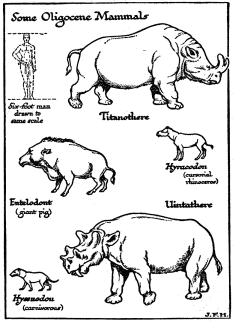
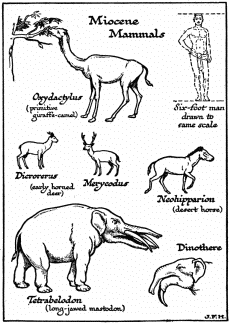
Grass was now spreading over the world, and with this extension arose some huge graminivorous brutes of which no representative survives to-day. Such were the Uintatheres and the Titanotheres. And in pursuit of such beasts came great swarms of primitive dogs, some as big as bears, and the first cats, one in particular (Smilodon), a small fierce-looking creature with big knife-like canines, the first sabre-toothed tiger, which was to develop into greater things. American deposits in the Miocene display a great variety of camels, giraffe camels with long necks, gazelle camels, llamas, and true camels. North America, throughout most of the Cainozoic period, appears to have been in open and easy continuation with Asia, and when at last the glaciers of the Great Ice Age, and then the Bering Strait, came to separate the two great continental regions, the last camels were left in the old world and the llamas in the new.
In the Eocene the first ancestors of the elephants appear in northern Africa as snouted creatures; the elephant’s trunk dawned on the world in the Miocene.
One group of creatures is of peculiar interest in a history that is mainly to be the story of mankind. We find fossils in the Eocene of monkeys and lemurs, but of one particular creature we have as yet not a single bone. It was half ape, half monkey; it clambered about the trees and ran, and probably ran well, on its hind legs upon the ground. It was small-brained by our present standards, but it had clever hands with which it handled fruits and beat nuts upon the rocks and perhaps caught up sticks and stones to smite its fellows. It was our ancestor.
§ 4
Through millions of simian generations the spinning world circled about the sun; slowly its orbit, which may have been nearly circular during the equable days of the early Eocene, was drawn by the attraction of the circling outer planets into a more elliptical form. Its axis of rotation, which had always heeled over to the plane of its orbit, as the mast of a yacht under sail heels over to the level of the water, heeled over by imperceptible degrees a little more and a little more. And each year its summer point shifted a little further from perihelion round its path. These were small changes to happen to a one-inch ball, circling at a distance of 330 yards from a flaming sun nine feet across, in the course of a few million years. They were changes an immortal astronomer in Neptune, watching the earth from age to age, would have found almost imperceptible. But from the point of view of the surviving mammalian life of the Miocene, they mattered profoundly. Age by age the winters grew on the whole colder and harder and a few hours longer relatively to the summers in a thousand years; age by age the summers grew briefer. On an average the winter snow lay a little later in the spring in each century, and the glaciers in the northern mountains gained an inch this year, receded half an inch next, came on again a few inches....
The Record of the Rocks tells of the increasing chill. The Pliocene was a temperate time, and many of the warmth-loving plants and animals had gone. Then, rather less deliberately, some feet or some inches every year, the ice came on.
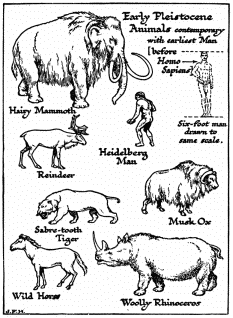
An arctic fauna, musk ox, woolly mammoth, woolly rhinoceros, lemming, ushers in the Pleistocene. Over North America, and Europe and Asia alike, the ice advanced. For thousands of years it advanced, and then for thousands of years it receded, to advance again. Europe down to the Baltic shores, Britain down to the Thames, North America down to New England, and more centrally as far south as Ohio, lay for ages under the glaciers. Enormous volumes of water were withdrawn from the ocean and locked up in those stupendous ice caps so as to cause a world-wide change in the relative levels of land and sea. Vast areas were exposed that are now again sea bottom.
The world to-day is still coming slowly out of the last of four great waves of cold. It is not growing warmer steadily. There have been fluctuations. Remains of bog oaks, for example, which grew two or three thousand years ago, are found in Scotland at latitudes in which not even a stunted oak will grow at the present time. And it is amidst this crescendo and diminuendo of frost and snow that we first recognize forms that are like the forms of men. The Age of Mammals culminated in ice and hardship and man.
§ 5
Guesses about the duration of the great age of cold are still vague, but in the Time diagram on page 60 we follow H. F. Osborn in accepting as our guides the estimates of Albrecht Penck[18] and C. A. Reeds.[19]
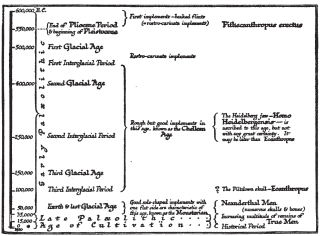
Time Diagram of the Glacial Ages.
The reader should compare this diagram carefully with our first time
diagram, Chapter II, § 2, p. 14. That diagram, if it were on the same
scale as this one, would be between 41 and 410 feet long. The position
of the Eoanthropus is very uncertain: it may be as early as the
Pliocene
BOOK II
THE MAKING OF MEN
VIII
THE ANCESTRY OF MAN[20]
§ 1. Man Descended from a Walking Ape. § 2. First Traces of Man-like Creatures. § 3. The Heidelberg Sub-man. § 4. The Piltdown Sub-man. § 5. The Riddle of the Piltdown Remains.
§ 1
THE origin of man is still very obscure. It is commonly asserted that he is “descended” from some man-like ape such as the chimpanzee, the orang-utang, or the gorilla, but that of course is as reasonable as saying that I am “descended” from some Hottentot or Esquimaux as young or younger than myself. Others, alive to this objection, say that man is descended from the common ancestor of the chimpanzee, the orang-utang, and the gorilla. Some “anthropologists” have even indulged in a speculation whether mankind may not have a double or treble origin; the negro being descended from a gorilla-like ancestor, the Chinese from a chimpanzee-like ancestor, and so on. These are very fanciful ideas, to be mentioned only to be dismissed. It was formerly assumed that the human ancestor was “probably arboreal,” but the current idea among those who are qualified to form an opinion seems to be that he was a “ground ape,” and that the existing apes have developed in the arboreal direction.
Of course, if one puts the skeleton of a man and the skeleton of a gorilla side by side, their general resemblance is so great that it is easy to jump to the conclusion that the former is derived from such a type as the latter by a process of brain growth and general refinement. But if one examines closely into one or two differences, the gap widens. Particular stress has recently been laid upon the tread of the foot. Man walks on his toe and his heel; his great toe is his chief lever in walking, as the reader may see for himself if he examines his own footprints on the bathroom floor and notes where the pressure falls as the footprints become fainter. His great toe is the king of his toes.
Among all the apes and monkeys, the only group that have their great toes developed on anything like the same fashion as man are some of the lemurs. The baboon walks on a flat foot and all his toes, using his middle toe as his chief throw off, much as the bear does. And the three great apes all walk on the outer side of the foot in a very different manner from the walking of man.
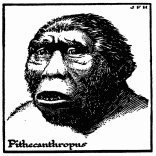
Possible Appearance of the Sub-man Pithecanthropus. The face, jaws, and teeth are mere guess work (see text). The creature may have been much less human looking than this.
The great apes are forest dwellers; their walking even now is incidental; they are at their happiest among trees. They have very distinctive methods of climbing; they swing by the arms much more than the monkeys do, and do not, like the latter, take off with a spring from the feet. They have a specially developed climbing style of their own. But man walks so well and runs so swiftly as to suggest a very long ancestry upon the ground. Also, he does not climb well now; he climbs with caution and hesitation. His ancestors may have been running creatures for long ages. Moreover, it is to be noted that he does not swim naturally; he has to learn to swim, and that seems to point to a long-standing separation from rivers and lakes and the sea. Almost certainly that ancestor was a smaller and slighter creature than its human descendants. Conceivably the human ancestor at the opening of the Cainozoic period was a running ape, living chiefly on the ground, hiding among rocks rather than trees. It could still climb trees well and hold things between its great toe and its second toe (as the Japanese can to this day), but it was already coming down to the ground again from a still remoter, a Mesozoic arboreal ancestry. It is quite understandable that such a creature would very rarely die in water in such circumstances as to leave bones to become fossilized.
It must always be borne in mind that among its many other imperfections the Geological Record necessarily contains abundant traces only of water or marsh creatures or of creatures easily and frequently drowned. The same reasons that make any traces of the ancestors of the mammals rare and relatively unprocurable in the Mesozoic rocks, probably make the traces of possible human ancestors rare and relatively unprocurable in the Cainozoic rocks. Such knowledge as we have of the earliest men, for example, is almost entirely got from a few caves, into which they went and in which they left their traces. Until the hard Pleistocene times they lived and died in the open, and their bodies were consumed or decayed altogether.
But it is well to bear in mind also that the Record of the Rocks has still to be thoroughly examined. It has been studied only for a few generations, and by only a few men in each generation. Most men have been too busy making war, making profits out of their neighbours, toiling at work that machinery could do for them in a tenth of the time, or simply playing about, to give any attention to these more interesting things. There may be, there probably are, thousands of deposits still untouched containing countless fragments and vestiges of man and his progenitors. In Asia particularly, in India or the East Indies, there may be hidden the most illuminating clues. What we know to-day of early men is the merest scrap of what will presently be known.
The apes and monkeys already appear to have been differentiated at the beginning of the Cainozoic Age, and there are a number of Oligocene and Miocene apes whose relations to one another and to the human line have still to be made out. Among these we may mention Dryopithecus of the Miocene Age, with a very human-looking jaw. In the Siwalik Hills of northern India remains of some very interesting apes have been found, of which Sivapithecus and Palæopithecus were possibly related closely to the human ancestor. Possibly these animals already used implements. Charles Darwin represents baboons as opening nuts by breaking them with stones, using stakes to prize up rocks in the hunt for insects, and striking blows with sticks and stones.[21] The chimpanzee makes itself a sort of tree hut by intertwining branches. Stones apparently chipped for use have been found in strata of Oligocene Age at Boncelles in Belgium. Possibly the implement-using disposition was already present in the Mesozoic ancestry from which we are descended.[22]
§ 2
Among the earliest evidences of some creature, either human or at least more man-like than any living ape upon earth, are a number of flints and stones very roughly chipped and shaped so as to be held in the hand. These were probably used as hand-axes. These early implements (“Eoliths”) are often so crude and simple that there was for a long time a controversy whether they were to be regarded as natural or artificial productions.[23] The date of the earliest of them is put by geologists as Pliocene—that is to say, before the First Glacial Age. They occur also throughout the First Interglacial period. We know of no bones or other remains in Europe or America of the quasi-human beings of half a million years ago, who made and used these implements. They used them to hammer with, perhaps they used them to fight with, and perhaps they used bits of wood for similar purposes.[24]
But at Trinil, in Java, in strata which are said to correspond either to the later Pliocene or to the American and European First Ice Age, there have been found some scattered bones of a creature, such as the makers of these early implements may have been. The top of a skull, some teeth, and a thigh-bone have been found. The skull shows a brain-case about half-way in size between that of the chimpanzee and man, but the thigh-bone is that of a creature as well adapted to standing and running as a man, and as free, therefore, to use its hands. The creature was not a man, nor was it an arboreal ape like the chimpanzee. It was a walking ape. It has been named by naturalists Pithecanthropus erectus (the walking ape-man). We cannot say that it is a direct human ancestor, but we may guess that the creatures who scattered these first stone tools over the world must have been closely similar and kindred, and that our ancestor was a beast of like kind. This little trayful of bony fragments from Trinil is, at present, apart from stone implements, the oldest relic of early humanity, or of the close blood relations of early humanity, that is known.
While these early men or “sub-men” were running about Europe four or five hundred thousand years ago, there were mammoths, rhinoceroses, a huge hippopotamus, a giant beaver, and a bison and wild cattle in their world. There were also wild horses, and the sabre-toothed tiger still abounded. There are no traces of lions or true tigers at that time in Europe, but there were bears, otters, wolves, and a wild boar. It may be that the early sub-man sometimes played jackal to the sabre-toothed tiger, and finished up the bodies on which the latter had gorged itself.[25]
§ 3
After this first glimpse of something at least sub-human in the record of geology, there is not another fragment of human or man-like bone yet known from that record for an interval of hundreds of thousands of years. It is not until we reach deposits which are stated to be of the Second Interglacial period, 200,000 years later, 200,000 or 250,000 years ago, that another little scrap of bone comes to hand. Then we find a jaw-bone.
This jaw-bone was found in a sandpit near Heidelberg, at a depth of eighty feet from the surface,[26] and it is not the jaw-bone of a man as we understand man, but it is man-like in every respect, except that it has absolutely no trace of a chin; it is more massive than a man’s, and its narrowness behind could not, it is thought, have given the tongue sufficient play for articulate speech. It is not an ape’s jaw-bone; the teeth are human. The owner of this jaw-bone has been variously named Homo Heidelbergensis and Palæoanthropus Heidelbergensis, according to the estimate formed of its humanity or sub-humanity by various authorities. He lived in a world not remotely unlike the world of the still earlier sub-man of the first implements; the deposits in which it is found show that there were elephants, horses, rhinoceroses, bison, a moose, and so forth with it in the world, but the sabre-toothed tiger was declining and the lion was spreading over Europe. The implements of this period (known as the Chellean period) are a very considerable advance upon those of the Pliocene Age. They are well made but very much bigger than any truly human implements. The Heidelberg man may have had a very big body and large forelimbs. He may have been a woolly strange-looking creature.
§ 4
We must turn over the Record for, it may be, another 100,000 years for the next remains of anything human or sub-human. Then in a deposit ascribed to the Third Interglacial period, which may have begun 100,000 years ago and lasted 50,000 years,[27] the smashed pieces of a whole skull turn up. The deposit is a gravel which may have been derived from the washing out of still earlier gravel strata and this skull fragment may be in reality as old as the First Glacial period. The bony remains discovered at Piltdown in Sussex display a creature still ascending only very gradually from the sub-human.
The first scraps of this skull were found in an excavation for road gravel in Sussex. Bit by bit other fragments of this skull were hunted out from the quarry heaps until most of it could be pieced together. It is a thick skull, thicker than that of any living race of men, and it has a brain capacity intermediate between that of Pithecanthropus and man. This creature has been named Eoanthropus, the dawn man. In the same gravel-pits were found teeth of rhinoceros, hippopotamus, and the leg-bone of a deer with marks upon it that may be cuts. A curious bat-shaped instrument of elephant bone has also been found.[28]
There was, moreover, a jaw-bone among these scattered remains, which was at first assumed naturally enough to belong to Eoanthropus, but which it was afterwards suggested was probably that of a chimpanzee. It is extraordinarily like that of a chimpanzee, but Dr. Keith, one of the greatest authorities in these questions, assigns it, after an exhaustive analysis in his Antiquity of Man (1915), to the skull with which it is found. It is, as a jaw-bone, far less human in character than the jaw of the much more ancient Homo Heidelbergensis, but the teeth are in some respects more like those of living men.
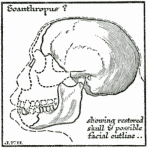
Diagram to Illustrate the Riddle of The Piltdown Sub-man.
Dr. Keith, swayed by the jaw-bone, does not think that Eoanthropus, in spite of its name, is a creature in the direct ancestry of man. Much less is it an intermediate form between the Heidelberg man and the Neanderthal man we shall presently describe. It was only related to the true ancestor of man as the orang is related to the chimpanzee. It was one of a number of sub-human running apes of more than ape-like intelligence, and if it was not on the line royal, it was at any rate a very close collateral.
After this glimpse of a skull, the Record for very many centuries gives nothing but flint implements, which improve steadily in quality. A very characteristic form is shaped like a sole, with one flat side stricken off at one blow and the other side worked. The archæologists, as the Record continues, are presently able to distinguish scrapers, borers, knives, darts, throwing stones, and the like. Progress is now more rapid; in a few centuries the shape of the hand-axe shows distinct and recognizable improvements. And then comes quite a number of remains. The Fourth Glacial Age is rising towards its maximum. Man is taking to caves and leaving vestiges there; at Krapina in Croatia, at Neanderthal near Düsseldorf, at Spy, human remains have been found, skulls and bones of a creature that is certainly a man. Somewhere about 50,000 years ago, if not earlier, appeared Homo Neanderthalensis (also called Homo antiquus and Homo primigenius), a quite passable human being. His thumb was not quite equal in flexibility and usefulness to a human thumb, he stooped forward, and could not hold his head erect, as all living men do, he was chinless and perhaps incapable of speech, there were curious differences about the enamel and the roots of his teeth from those of all living men, he was very thick-set, he was, indeed, not quite of the human species; but there is no dispute about his attribution to the genus Homo. He was certainly not descended from Eoanthropus, but his jaw-bone is so like the Heidelberg jaw-bone as to make it possible that the clumsier and heavier Homo Heidelbergensis, a thousand centuries before him, was of his blood and race.
§ 5
Upon this question of the Piltdown jaw-bone, it may be of interest to quote here a letter to the writer from Sir Ray Lankester, discussing the question in a familiar and luminous manner. It will enable the reader to gauge the extent and quality of the evidence that we possess at present upon the nature of these early human and sub-human animals. Upon these fragile Piltdown fragments alone more than a hundred books, pamphlets, and papers have been written. These scraps of bone are guarded more carefully from theft and wilful damage than the most precious jewels, and in the museum cases one sees only carefully executed fac-similes.
“As to the Piltdown jaw-bone, the best study of it is that by Smith Woodward, who first described it and the canine found later. The jaw is imperfect in front, but has the broad, flat symphysis of the Apes. G. S. Miller, an American anthropologist, has made a very good comparison of it with a chimpanzee’s jaw, and concludes that it is a chimpanzee’s. (His monograph is in the Am. Jour. of Phys. Anthrop., vol. i, no. 1.) The one point in the Piltdown jaw itself against chimpanzee identification is the smooth, flat, worn surface of the molars. This is a human character, and is due to lateral movement of the jaw, and hence rubbing down of the tubercles of the molars. This is not worth much. But the serious question is, are we to associate this jaw with the cranium found close by it? If so, it is certainly not chimpanzee nor close to the Apes, but decidedly hominid. Two other small fragments of crania and a few more teeth have been found in the gravel two miles from Piltdown, which agree with the Piltdown cranium in having superciliary ridges fairly strong for a human skull, but not anything like the great superciliary ridges of Apes. The fact one has to face is this; here you have an imperfect cranium, very thick-walled and of small cubical contents (1100 or so), but much larger in that respect than any ape’s. A few yards distant from it in the same layer of gravel is found a jaw-bone having rather large pointed canines, a flat, broad symphysis, and other points about the inner face of the ramus and ridges which resemble those of the chimpanzee. Which is the more likely: (a) that these two novel fragments tending apewards from man were parts of the same individual; or (b), that the sweeping of the Wealden valley has brought there together a half-jaw and a broken cranium both more ape-like in character than any known human corresponding bits, and yet derived from two separate anthropoid beasts, one (the jaw) more simian, and the other (the cranium) much less so? As to the probabilities, we must remember that this patch of gravel at Piltdown, clearly and definitely, is a wash-up of remains of various later tertiary and post-tertiary deposits. It contains fragments of Miocene mastodon and rhinoceros teeth. These latter differ entirely in mineral character from the Eoanthropus jaw and the cranium. But (and this needs re-examination and chemical analysis) the Piltdown jaw and the Piltdown cranium do not seem to me to be quite alike in their mineral condition. The jaw is more deeply iron-stained, and I should say (but not confidently), harder than the cranium. Now, it is easy to attribute too much importance to that difference, since in a patch of iron-stained gravel, such as that at Piltdown, the soaking of water and iron salts into bones embedded may be much greater in one spot than in another only a yard off, or a few inches deeper!
“So I think we are stumped and baffled! The most prudent way is to keep the jaw and the cranium apart in all argument about them. On the other hand, on the principle that hypotheses are not to be multiplied beyond necessity, there is a case for regarding the two—jaw and cranium—as having been parts of one beast—or man.”
To which Sir H. H. Johnston adds: “Against the chimpanzee hypothesis it must be borne in mind that so far no living chimpanzee or fossil chimpanzee-like remains have been found nearer England than north equatorial Africa or North-west India, and no remains of great apes at all nearer than Southern France and the upper Rhine—and those widely different from the Eoanthropus jaw.”
IX
THE NEANDERTHAL MEN, AN EXTINCT RACE
(The Early Palæolithic Age[29])
§ 1. The World 50,000 Years Ago. § 2. The Daily Life of the First Men. § 3. The Last Palæolithic Men.
§ 1
IN the time of the Third Interglacial period the outline of Europe and western Asia was very different from what it is to-day. Vast areas to the west and northwest which are now under the Atlantic waters were then dry land; the Irish Sea and the North Sea were river valleys. Over these northern areas there spread and receded and spread again a great ice cap such as covers central Greenland to-day (see Map, on page 77). This vast ice cap, which covered both polar regions of the earth, withdrew huge masses of water from the ocean, and the sea-level consequently fell, exposing great areas of land that are now submerged again. The Mediterranean area was probably a great valley below the general sea-level, containing two inland seas cut off from the general ocean. The climate of this Mediterranean basin was perhaps cold temperate, and the region of the Sahara to the south was not then a desert of baked rock and blown sand, but a well-watered and fertile country. Between the ice sheets to the north and the Alps and Mediterranean valley to the south stretched a bleak wilderness whose climate changed from harshness to a mild kindliness and then hardened again for the Fourth Glacial Age.
Across this wilderness, which is now the great plain of Europe, wandered a various fauna. At first there were hippopotami, rhinoceroses, mammoths, and elephants. The sabre-toothed tiger was diminishing towards extinction. Then, as the air chilled, the hippopotamus, and then other warmth-loving creatures, ceased to come so far north, and the sabre-toothed tiger disappeared altogether. The woolly mammoth, the woolly rhinoceros, the musk ox, the bison, the aurochs, and the reindeer became prevalent, and the temperate vegetation gave place to plants of a more arctic type. The glaciers spread southward to the maximum of the Fourth Glacial Age (about 50,000 years ago), and then receded again. In the earlier phase, the Third Interglacial period, a certain number of small family groups of men (Homo Neanderthalensis) and probably of sub-men (Eoanthropus) wandered over the land, leaving nothing but their flint implements to witness to their presence. They probably used a multitude and variety of wooden implements also; they had probably learnt much about the shapes of objects and the use of different shapes from wood, knowledge which they afterwards applied to stone; but none of this wooden material has survived; we can only speculate about its forms and uses. As the weather hardened to its maximum of severity, the Neanderthal men, already it would seem acquainted with the use of fire, began to seek shelter under rock ledges and in caves—and so leave remains behind them. Hitherto they had been accustomed to squat in the open about the fire, and near their water supply. But they were sufficiently intelligent to adapt themselves to the new and harder conditions. (As for the sub-men, they seem to have succumbed to the stresses of this Fourth Glacial Age altogether. At any rate, the rudest type of Palæolithic implements presently disappears.)
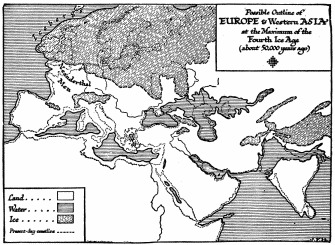
This Map Represents the Present State of Our Knowledge of
the Geography of Europe And Western Asia at a Period which We Guess to
be about 50,000 Years Ago, the Neanderthaler Age.
Much of this map is of course speculative, but its broad outlines must
be fairly like those of the world in which men first became men.
Not merely man was taking to the caves. This period also had a cave lion, a cave bear, and a cave hyæna. These creatures had to be driven out of the caves and kept out of the caves in which these early men wanted to squat and hide; and no doubt fire was an effective method of eviction and protection. Probably early men did not go deeply into the caves, because they had no means of lighting their recesses. They got in far enough to be out of the weather, and stored wood and food in odd corners. Perhaps they barricaded the cave mouths. Their only available light for going deeply into the caverns would be torches.