
Manifestly the Vandals came in as a positive relief to such a system.[271] They exterminated the great landowners, wiped out all debts to Roman money-lenders, and abolished the last vestiges of military service. The cultivators found themselves better off; the minor officials kept their places; it was not so much a conquest as a liberation from an intolerable deadlock.
It was while the Vandals were still in Africa that a great leader, Attila, arose among the Huns. The seat of his government was in the plains east of the Danube. For a time he swayed a considerable empire of Hunnish and Germanic tribes, and his rule stretched from the Rhine into Central Asia. He negotiated on equal terms with the Chinese emperor. He bullied Ravenna and Constantinople for ten years. Honoria, the grand-daughter of Theodosius II, Emperor of the Eastern empire, one of those passionate young ladies who cause so much trouble in the world, having been put under restraint because of a love affair with a court chamberlain, sent her ring to Attila and called upon him to be her husband and deliverer. He was also urged to attack the Eastern empire by Genseric the Vandal, who was faced by an alliance of the Western and Eastern emperors. He raided southward to the very walls of Constantinople, completely destroying, says Gibbon, seventy cities in his progress, and forcing upon the emperor an onerous peace, which apparently did not involve the liberation of Honoria to her hero.
At this distance of time we are unable to guess at the motives for this omission. Attila continued to speak of her as his affianced bride, and to use the relationship as a pretext for aggressions. In the subsequent negotiations a certain Priscus accompanied an embassy to the camp of the Hunnish monarch, and the fragments that still survive of the narrative he wrote give us a glimpse of the camp and way of living of the great conqueror.
The embassy was itself a curiously constituted body. Its head was Maximin, an honest diplomatist who went in good faith, Quite unknown to him and, at the time, to Priscus, Vigilius, the interpreter of the expedition, had also a secret mission from the court of Theodosius which was to secure by bribery the assassination of Attila. The little expedition went by way of Nish; it crossed the Danube in canoes, dug out of a single tree, and it was fed by contributions from the villages on the route. Differences in dietary soon attracted the attention of the envoys. Priscus mentions mead in the place of wine, millet for corn, and a drink either distilled[272] or brewed from barley. The journey through Hungary will remind the reader in many of its incidents of the journeys of travellers in Central Africa during the Victorian period. The travellers were politely offered temporary wives.
Attila’s capital was rather a vast camp and village than a town. There was only one building of stone, a bath constructed on the Roman model. The mass of the people were in huts and tents; Attila and his leading men lived in timber palaces in great stockaded enclosures with their numerous wives and ministers about them. There was a vast display of loot, but Attila himself affected a nomadic simplicity; he was served in wooden cups and platters, and never touched bread. He worked hard, kept open court before the gate of his palace, and was commonly in the saddle. The primitive custom of both Aryans and Mongols of holding great feasts in halls still held good, and there was much hard drinking. Priscus describes how bards chanted before Attila. They “recited the verses which they had composed, to celebrate his valour and his victories. A profound silence prevailed in the hall, and the attention of the guests was captivated by the vocal harmony, which revived and perpetuated the memory of their own exploits; a martial ardour flashed from the eyes of the warriors, who were impatient for battle; and the tears of the old men expressed their generous despair, that they could no longer partake the danger and glory of the field. This entertainment, which might be considered as a school of military virtue, was succeeded by a farce that debased the dignity of human nature. A Moorish and Scythian buffoon successively excited the mirth of the rude spectators by their deformed figures, ridiculous dress, antic gestures, absurd speeches, and the strange, unintelligible confusion of the Latin, the Gothic, and the Hunnish languages, and the hall resounded with loud and licentious peals of laughter. In the midst of this intemperate riot, Attila alone, without change of countenance, maintained his steadfast and inflexible gravity.”[273]
Although Attila was aware, through the confession of the proposed assassin, of the secret work of Vigilius, he allowed this embassy to return in safety, with presents of numerous horses and the like, to Constantinople. Then he despatched an ambassador to Theodosius II to give that monarch, as people say, a piece of his mind. “Theodosius,” said the envoy, “is the son of an illustrious and respectable parent; Attila, likewise, is descended from a noble race; and he has supported, by his actions, the dignity which he inherited from his father Munzuk. But Theodosius has forfeited his parental honours, and, by consenting to pay tribute, has degraded himself to the condition of a slave. It is therefore just that he should reverence the man whom fortune and merit have placed above him; instead of attempting, like a wicked slave, clandestinely to conspire against his master.”
This straightforward bullying was met by abject submission. The emperor sued for pardon, and paid a great ransom.
In 451 Attila declared war on the western empire. He invaded Gaul. So far as the imperial forces were concerned, he had things all his own way, and he sacked most of the towns of France as far south as Orleans. Then the Franks and Visigoths and the imperial forces united against him, and a great and obstinate battle at Troyes (451), in which over 150,000 men were killed on both sides, ended in his repulse and saved Europe from a Mongolian overlord. This disaster by no means exhausted Attila’s resources. He turned his attention southward, and overran North Italy. He burnt Aquileia and Padua, and looted Milan, but he made peace at the entreaty of Pope Leo I. He died in 453....
Hereafter the Huns, so far as that name goes in Europe, the Huns of Attila, disappeared out of history. They dissolved into the surrounding populations. They were probably already much mixed, and rather Aryan than Mongolian. They did not become, as one might suppose, the inhabitants of Hungary, though they have probably left many descendants there. About a hundred years after came another Hunnish or mixed people, the Avars, out of the east into Hungary, but these were driven out eastward again by Charlemagne in 791-5. The Magyars, the modern Hungarians, came westward later. They were a Turko-Finnish people. The Magyar is a language belonging to the Finno-Ugrian division of the Ural-Altaic tongues. The Magyars were on the Volga about 550. They settled in Hungary about 900.... But we are getting too far on in our story, and we must return to Rome.
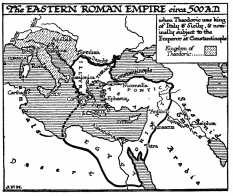
In 493 Theodoric, a Goth, became King of Rome, but already for seventeen years there had been no Roman emperor. So it was in utter social decay and collapse that the great slave-holding “world-ascendancy” of the God-Cæsars and the rich men of Rome came to an end.
§ 6
But though throughout the whole of Western Europe and North Africa the Roman imperial system had collapsed, though credit had vanished, luxury production had ceased, and money was hidden, though creditors were going unpaid and slaves masterless, the tradition of the Cæsars was still being carried on in Constantinople. We have already had occasion to mention as two outstanding figures among the late Cæsars, Diocletian (284) and Constantine the Great (312), and it was to the latter of these that the world owes the setting up of a fresh imperial centre at Constantinople. Very early during the imperial period the unsuitability of the position of Rome as a world capital, due to the Roman failure to use the sea, was felt. The destruction of Carthage and Corinth had killed the shipping of the main Mediterranean sea-routes. For a people who did not use the sea properly, having the administrative centre at Rome meant that every legion, every draft of officials, every order, had to travel northward for half the length of Italy before it could turn east or west. Consequently nearly all the more capable emperors set up their headquarters at some subordinate centre in a more convenient position. Sirmium (on the River Save), Milan, Lyons, and Nicomedia (in Bithynia) were among such supplementary capitals. For a time under Diocletian, Durazzo was the imperial capital. Ravenna, near the head of the Adriatic, was the capital of the last Roman emperors in the time of Alaric and Stilicho.

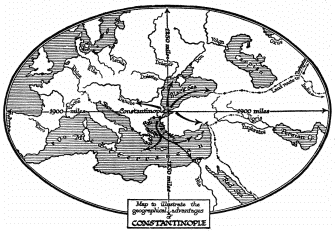
It was Constantine the Great who determined upon the permanent transfer of the centre of imperial power to the Bosphorus. We have already noted the existence of the city of Byzantium, which Constantine chose to develop into his new capital. It played a part in the story of the intricate Histiæus (chap. xxii, § 4); it repulsed Philip of Macedon (chap. xxiv, § 3). If the reader will examine its position, he will see that in the hands of a line of capable emperors, and as the centre of a people with some solidarity and spirit and seacraft (neither of which things were vouchsafed to it), it was extraordinarily well placed. Its galleys could have penetrated up the rivers to the heart of Russia and outflanked every barbarian advance. It commanded practicable trade routes to the east, and it was within a reasonable striking distance of Mesopotamia, Egypt, Greece, and all the more prosperous and civilized regions of the world at that period. And even under the rule of a series of inept monarchs and under demoralized social conditions, the remains of the Roman Empire centring at Constantinople held out for nearly a thousand years.
It was the manifest intention of Constantine the Great that Constantinople should be the centre of an undivided empire. But having regard to the methods of travel and transport available at the time, the geographical conditions of Europe and Western Asia do not point to any one necessary centre of government. If Rome faced westward instead of eastward, and so failed to reach out beyond the Euphrates, Constantinople on the other hand was hopelessly remote from Gaul. The enfeebled Mediterranean civilization, after a certain struggle for Italy, did in fact let go of the west altogether and concentrated upon what were practically the central vestiges, the stump, of the empire of Alexander. The Greek language resumed its sway, which had never been very seriously undermined by the official use of Latin. This “Eastern” or Byzantine empire is generally spoken of as if it were a continuation of the Roman tradition. It is really far more like a resumption of Alexander’s.
The Latin language had not the intellectual vigour behind it, it had not the literature and the science, to make it a necessity to intelligent men and so to maintain an ascendancy over the Greek. For no language, whatever officialdom may do, can impose itself in competition with another that can offer the advantages of a great literature or encyclopædic information. Aggressive languages must bring gifts, and the gifts of Greek were incomparably greater than the gifts of Latin. The Eastern empire was from the beginnings of its separation Greek-speaking, and a continuation, though a degenerate continuation, of the Hellenic tradition. Its intellectual centre was no longer in Greece, but Alexandria. Its mentality was no longer the mentality of free-minded plain-speaking citizens, of the Stagirite Aristotle and the Greek Plato; its mentality was the mentality of the pedants and of men politically impotent; its philosophy was a pompous evasion of real things, and its scientific impulse was dead. Nevertheless, it was Hellenic. The Roman had come, and he had gone again. Indeed he had gone very extensively from the west also. By the sixth century A.D. the populations of Europe and North Africa had been stirred up like sediment. When presently in the seventh and eighth centuries the sediment begins to settle down again and populations begin to take on a definite localized character, the Roman is only to be found by name in the region about Rome. Over large parts of his Western empire we find changed and changing modifications of his Latin speech; in Gaul, where the Frank is learning a Gallic form of Latin and evolving French in the process; in Italy, where, under the influence of Teutonic invaders, the Lombards and Goths, Latin is being modified into various Italian dialects; in Spain and Portugal, where it is becoming Spanish and Portuguese. The fundamental Latinity of the languages in these regions serves to remind us of the numerical unimportance of the various Frankish, Vandal, Avar, Gothic, and the like German-speaking invaders, and serves to justify our statement that what happened to the Western empire was not so much conquest and the replacement of one population by another as a political and social revolution. The district of Valais in South Switzerland also retained a fundamentally Latin speech and so did the Canton Grisons; and, what is more curious and interesting, is that in Dacia and Mœsia Inferior, large parts of which to the north of the Danube became the modern Roumania (= Romania), although these regions were added late to the empire and lost soon, the Latin speech also remained.
In Britain Latin was practically wiped out by the conquering Anglo-Saxons, from among whose various dialects the root stock of English presently grew.
But while the smashing of the Roman social and political structure was thus complete, while in the east it was thrown off by the older and stronger Hellenic tradition, and while in the west it was broken up into fragments that began to take on a new and separate life of their own, there was one thing that did not perish, but grew, and that was the tradition of the world empire of Rome and of the supremacy of the Cæsars. When the reality was destroyed, the legend had freedom to expand. Removed from the possibility of verification, the idea of a serene and splendid Roman world-supremacy grew up in the imagination of mankind, and still holds it to this day.
Ever since the time of Alexander, human thought has been haunted by the possible political unity of the race. All the sturdy chiefs and leaders and kings of the barbarians, who raided through the prostrate but vast disorder of the decayed empire, were capable of conceiving of some mighty king of kings greater than themselves and giving a real law for all men, and they were ready to believe that elsewhere in space and time and capable of returning presently to resume his supremacy, Cæsar had been such a king of kings. Far above their own titles, therefore, they esteemed and envied the title of Cæsar. The international history of Europe from this time henceforth is largely the story of kings and adventurers setting up to be Cæsar and Imperator (Emperor). We shall tell of some of them in their places. So universal did this “Cæsaring” become, that the Great War of 1914-18 mowed down no fewer than four Cæsars, the German Kaiser (= Cæsar), the Austrian Kaiser, the Tsar (= Cæsar) of Russia, and that fantastic figure, the Tsar of Bulgaria. The French “Imperator” (Napoleon III) had already fallen in 1871. There is now (1920) no one left in the world to carry on the Imperial title or the tradition of Divus Cæsar except the Turkish Sultan and the British monarch. The former commemorates his lordship over Constantinople as Kaisar-i-Roum[274]; the latter is called the Cæsar of India (a country no real Cæsar ever looked upon), Kaisar-i-Hind.
BOOK VI
CHRISTIANITY AND ISLAM
XXX
THE BEGINNINGS, THE RISE, AND THE DIVISIONS OF CHRISTIANITY
§ 1. Judea at the Christian Era. § 2. The Teachings of Jesus of Nazareth. § 3. The New Universal Religions. § 4. The Crucifixion of Jesus of Nazareth. § 5. Doctrines added to the Teachings of Jesus. § 6. The Struggles and Persecutions of Christianity. § 7. Constantine the Great. § 8. The Establishment of Official Christianity. § 9. The Map of Europe, A.D. 500. § 10. The Salvation of Learning by Christianity.
§ 1
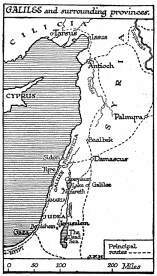
BEFORE we can understand the qualities of Christianity, which must now play a large part in our history, and which opened men’s eyes to fresh aspects of the possibility of a unified world, we must go back some centuries and tell of the condition of affairs in Palestine and Syria, in which countries Christianity arose. We have already told in Chapter XXI the main facts about the origin of the Jewish nation and tradition, about the Diaspora, about the fundamentally scattered nature of Jewry even from the beginning, and the gradual development of the idea of one just God ruling the earth and bound by a special promise to preserve and bring to honour the Jewish people. The Jewish idea was and is a curious combination of theological breadth and an intense racial patriotism. The Jews looked for a special saviour, a Messiah, who was to redeem mankind by the agreeable process of restoring the fabulous glories of David and Solomon, and bringing the whole world at last under the benevolent but firm Jewish heel. As the political power of the Semitic peoples declined, as Carthage followed Tyre into the darkness and Spain became a Roman province, this dream grew and spread. There can be little doubt that the scattered Phœnicians in Spain and Africa and throughout the Mediterranean, speaking as they did a language closely akin to Hebrew and being deprived of their authentic political rights, became proselytes to Judaism. For phases of vigorous proselytism alternated with phases of exclusive jealousy in Jewish history. On one occasion the Idumeans, being conquered, were all forcibly made Jews.[275] There were Arab tribes who were Jews in the time of Muhammad, and a Turkish people who were mainly Jews in South Russia in the ninth century. Judaism is indeed the reconstructed political ideal of many shattered peoples—mainly Semitic. It is to the Phœnician contingent and to Aramean accessions in Babylon that the financial and commercial tradition of the Jews is to be ascribed. But as a result of these coalescences and assimilations, almost everywhere in the towns throughout the Roman Empire, and far beyond it in the east, Jewish communities traded and flourished, and were kept in touch through the Bible and through a religious and educational organization. The main part of Jewry never was in Judea and had never come out of Judea.
Manifestly this intercommunicating series of Judaized communities had very great financial and political facilities. They could assemble resources, they could stir up, they could allay. They were neither so abundant nor so civilized as the still more widely diffused Greeks, but they had a tradition of greater solidarity. Greek was hostile to Greek; Jew stood by Jew. Wherever a Jew went, he found men of like mind and like tradition with himself. He could get shelter, food, loans, and legal help. And by reason of this solidarity rulers had everywhere to take account of this people as a help, as a source of loans, or as a source of trouble. So it is that the Jews have persisted as a people while Hellenism has become a universal light for mankind.
We cannot tell here in any detail the history of that smaller part of Jewry that lived in Judea. These Jews had returned to their old position of danger; again they were seeking peace in, so to speak, the middle of a highway. In the old time they had been between Syria and Assyria to the north and Egypt to the south; now they had the Seleucids to the north and the Ptolemys to the south, and when the Seleucids went, then down came the Roman power upon them. The independence of Judea was always a qualified and precarious thing. The reader must go to the Antiquities and the Wars of the Jews of Flavius Josephus, a copious, tedious, and maddeningly patriotic writer, to learn of the succession of their rulers, of their high-priest monarchs, and of the Maccabæans, the Herods, and the like. These rulers were for the most part of the ordinary eastern type, cunning, treacherous, and blood-stained. Thrice Jerusalem was taken and twice the temple was destroyed. It was the support of the far more powerful Diaspora that prevented the little country from being wiped out altogether, until 70 A.D., when Titus, the adopted son and successor of the Emperor Vespasian, after a siege that ranks in bitterness and horror with that of Tyre and Carthage, took Jerusalem and destroyed city and temple altogether. He did this in an attempt to destroy Jewry, but indeed he made Jewry stronger by destroying its one sensitive and vulnerable point.
Throughout a history of five centuries of war and civil commotion between the return from captivity and the destruction of Jerusalem, certain constant features of the Jew persisted. He remained obstinately monotheistic; he would have none other gods but the one true God. In Rome, as in Jerusalem, he stood out manfully against the worship of any god-Cæsar. And to the best of his ability he held to his covenants with his God. No graven images could enter Jerusalem; even the Roman standards with their eagles had to stay outside.
Two divergent lines of thought are traceable in Jewish affairs during these five hundred years. On the right, so to speak, are the high and narrow Jews, the Pharisees, very orthodox, very punctilious upon even the minutest details of the law, intensely patriotic and exclusive. Jerusalem on one occasion fell to the Seleucid monarch Antiochus IV because the Jews would not defend it on the Sabbath day, when it is forbidden to work; and it was because the Jews made no effort to destroy his siege train on the Sabbath that Pompey the Great was able to take Jerusalem. But against these narrow Jews were pitted the broad Jews, the Jews of the left, who were Hellenizers, among whom are to be ranked the Sadducees, who did not believe in immortality. These latter Jews, the broad Jews, were all more or less disposed to mingle with and assimilate themselves to the Greeks and Hellenized peoples about them. They were ready to accept proselytes, and so to share God and his promise with all mankind. But what they gained in generosity they lost in rectitude. They were the worldlings of Judea. We have already noted how the Hellenized Jews of Egypt lost their Hebrew, and had to have their Bible translated into Greek.
In the reign of Tiberius Cæsar a great teacher arose out of Judea who was to liberate the intense realization of the righteousness and unchallengeable oneness of God, and of man’s moral obligation to God, which was the strength of orthodox Judaism, from that greedy and exclusive narrowness with which it was so extraordinarily intermingled in the Jewish mind. This was Jesus of Nazareth, the seed rather than the founder of Christianity.
§ 2
The audience to which this book will first be presented will be largely an audience of Christians, with perhaps a sprinkling of Jewish readers, and the former at least will regard Jesus of Nazareth as being much more than a human teacher, and his appearance in the world not as a natural event in history, but as something of a supernatural sort interrupting and changing that steady development of life towards a common consciousness and a common will, which we have hitherto been tracing in this book. But these persuasions, dominant as they are in Europe and America, are nevertheless not the persuasions of all men or of the great majority of mankind, and we are writing this outline of the story of life with as complete an avoidance of controversial matter as may be. We are trying to write as if this book was to be read as much by Hindus or Moslems or Buddhists as by Americans and Western Europeans. We shall therefore hold closely to the apparent facts, and avoid, without any disputation or denial, the theological interpretations that have been imposed upon them. We shall tell what men have believed about Jesus of Nazareth, but him we shall treat as being what he appeared to be, a man, just as a painter must needs paint him as a man. The documents that testify to his acts and teachings we shall treat as ordinary human documents. If the light of divinity shine through our recital, we will neither help nor hinder it. This is what we have already done in the case of Buddha, and what we shall do later with Muhammad. About Jesus we have to write not theology but history, and our concern is not with the spiritual and theological significance of his life, but with its effects upon the political and everyday life of men.
Almost our only sources of information about the personality of Jesus are derived from the four gospels, all of which were certainly in existence a few decades after his death, and from allusions to his life in the letters (epistles) of the early Christian propagandists. The first three gospels, the gospels of Matthew, Mark, and Luke, many suppose to be derived from some earlier documents; the gospel of St. John has more idiosyncrasy and is coloured by theology of a strongly Hellenic type. Critics are disposed to regard the gospel of St. Mark as being the most trustworthy account of the personality and actual words of Jesus.[276] But all four agree in giving us a picture of a very definite personality; they carry the same conviction of reality that the early accounts of Buddha do. In spite of miraculous and incredible additions, one is obliged to say, “Here was a man. This part of the tale could not have been invented.”
But just as the personality of Gautama Buddha has been distorted and obscured by the stiff squatting figure, the gilded idol of later Buddhism, so one feels that the lean and strenuous personality of Jesus is much wronged by the unreality and conventionality that a mistaken reverence has imposed upon his figure in modern Christian art. Jesus was a penniless teacher, who wandered about the dusty sun-lit country of Judea, living upon casual gifts of food; yet he is always represented clean, combed, and sleek, in spotless raiment, erect, and with something motionless about him as though he was gliding through the air. This alone has made him unreal and incredible to many people who cannot distinguish the core of the story from the ornamental and unwise additions of the unintelligently devout.
And it may be that the early parts of the gospels are accretions of the same nature. The miraculous circumstances of the birth of Jesus, the great star that brought wise men from the east to worship at his manger cradle, the massacre of the male infant children in the region of Bethlehem by Herod as a consequence of these portents, and the flight into Egypt, are all supposed to be such accretionary matter by many authorities. At the best they are events unnecessary to the teaching, and they rob it of much of the strength and power it possesses when we strip it of such accompaniment. So, too, do the discrepant genealogies given by Matthew and Luke, in which there is an endeavour to trace the direct descent of Joseph, his father, from King David, as though it was any honour to Jesus or to anyone to have such a man as an ancestor. The insertion of these genealogies is the more peculiar and unreasonable, because, according to the legend, Jesus was not the son of Joseph at all, but miraculously conceived.
We are left, if we do strip this record of these difficult accessories, with the figure of a being, very human, very earnest and passionate, capable of swift anger, and teaching a new and simple and profound doctrine—namely, the universal loving Fatherhood of God and the coming of the Kingdom of Heaven. He was clearly a person—to use a common phrase—of intense personal magnetism. He attracted followers and filled them with love and courage. Weak and ailing people were heartened and healed by his presence. Yet he was probably of a delicate physique, because of the swiftness with which he died under the pains of crucifixion. There is a tradition that he fainted when, according to the custom, he was made to bear his cross to the place of execution. When he first appeared as a teacher he was a man of about thirty. He went about the country for three years spreading his doctrine, and then he came to Jerusalem and was accused of trying to set up a strange kingdom in Judea; he was tried upon this charge, and crucified together with two thieves. Long before they were dead, his sufferings were over.
Now it is a matter of fact that in the gospels all that body of theological assertion which constitutes Christianity finds little support. There is, as the reader may see for himself, no clear and emphatic assertion in these books of the doctrines which Christian teachers of all denominations find generally necessary to salvation. It is difficult to get any words that actually came from Jesus in which he claimed to be the Jewish Messiah (rendered in Greek by “the Christ”) or to be a part of the godhead, or in which he explained the doctrine of the Atonement or urged any sacrifices or sacraments (that is to say, priestly offices) upon his followers. We shall see presently how later on all Christendom was torn by disputes about the Trinity. There is no evidence that the apostles of Jesus ever heard of the Trinity—at any rate from him. The observance of the Jewish Sabbath, again, transferred to the Mithraic Sun-day, is an important feature of many Christian cults; but Jesus deliberately broke the Sabbath, and said that it was made for man and not man for the Sabbath. Nor did he say a word about the worship of his mother Mary, in the guise of Isis, the Queen of Heaven. All that is most characteristically Christian in worship and usage, he ignored. Sceptical writers have had the temerity to deny that Jesus can be called a Christian at all. For light upon these extraordinary gaps in his teaching, each reader must go to his own religious guides. Here we are bound to mention these gaps on account of the difficulties and controversies that arose out of them, and we are equally bound not to enlarge upon them.
As remarkable is the enormous prominence given by Jesus to the teaching of what he called the Kingdom of Heaven, and its comparative insignificance in the procedure and teaching of most of the Christian churches.
This doctrine of the Kingdom of Heaven, which was the main teaching of Jesus, and which plays so small a part in the Christian creeds, is certainly one of the most revolutionary doctrines that ever stirred and changed human thought. It is small wonder if the world of that time failed to grasp its full significance, and recoiled in dismay from even a half apprehension of its tremendous challenges to the established habits and institutions of mankind. It is small wonder if the hesitating convert and disciple presently went back to the old familiar ideas of temple and altar, of fierce deity and propitiatory observance, of consecrated priest and magic blessing, and—these things being attended to—reverted then to the dear old habitual life of hates and profits and competition and pride. For the doctrine of the Kingdom of Heaven, as Jesus seems to have preached it, was no less than a bold and uncompromising demand for a complete change and cleansing of the life of our struggling race, an utter cleansing, without and within. To the gospels the reader must go for all that is preserved of this tremendous teaching; here we are only concerned with the jar of its impact upon established ideas.
The Jews were persuaded that God, the one God of the whole world, was a righteous god, but they also thought of him as a trading god who had made a bargain with their Father Abraham about them, a very good bargain indeed for them, to bring them at last to predominance in the earth. With dismay and anger they heard Jesus sweeping away their dear securities. God, he taught, was no bargainer; there were no chosen people and no favourites in the Kingdom of Heaven. God was the loving father of all life, as incapable of showing favour as the universal sun. And all men were brothers—sinners alike and beloved sons alike of this divine father. In the parable of the Good Samaritan Jesus cast scorn upon that natural tendency we all obey, to glorify our own people and to minimize the righteousness of other creeds and other races. In the parable of the labourers he thrust aside the obstinate claim of the Jews to have a sort of first mortgage upon God. All whom God takes into the kingdom, he taught, God serves alike; there is no distinction in his treatment, because there is no measure to his bounty. From all, moreover, as the parable of the buried talent witnesses, and as the incident of the widow’s mite enforces, he demands the utmost. There are no privileges, no rebates, and no excuses in the Kingdom of Heaven.
But it was not only the intense tribal patriotism of the Jews that Jesus outraged. They were a people of intense family loyalty, and he would have swept away all the narrow and restrictive family affections in the great flood of the love of God. The whole Kingdom of Heaven was to be the family of his followers. We are told that, “While he yet talked to the people, behold, his mother and his brethren stood without, desiring to speak with him. Then one said unto him, Behold, thy mother and thy brethren stand without, desiring to speak with thee. But he answered and said unto him that told him, Who is my mother? and who are my brethren? And he stretched forth his hand towards his disciples, and said, Behold my mother and my brethren! For whosoever shall do the will of my Father which is in heaven, the same is my brother, and sister, and mother.”[277]
And not only did Jesus strike at patriotism and the bonds of family loyalty in the name of God’s universal fatherhood and the brotherhood of all mankind, but it is clear that his teaching condemned all the gradations of the economic system, all private wealth, and personal advantages. All men belonged to the kingdom; all their possessions belonged to the kingdom; the righteous life for all men, the only righteous life, was the service of God’s will with all that we had, with all that we were. Again and again he denounced private riches and the reservation of any private life.
“And when he was gone forth into the way, there came one running, and kneeled to him, and asked him, Good Master, what shall I do that I may inherit eternal life? And Jesus said unto him, Why callest thou me good? there is none good but one, that is, God. Thou knowest the commandments, Do not commit adultery, Do not kill, Do not steal, Do not bear false witness, Defraud not, Honour thy father and mother. And he answered and said unto him, Master, all these things have I observed from my youth. Then Jesus beholding him loved him, and said unto him, One thing thou lackest: go thy way, sell whatsoever thou hast, and give to the poor, and thou shalt have treasure in heaven: and come, take up the cross, and follow me. And he was sad at that saying, and went away grieved: for he had great possessions.
“And Jesus looked round about, and saith unto his disciples, How hardly shall they that have riches enter into the kingdom of God! And the disciples were astonished at his words. But Jesus answered again, and saith unto them, Children, how hard is it for them that trust in riches to enter into the kingdom of God! It is easier for a camel to go through the eye of a needle, than for a rich man to enter into the kingdom of God.”[278]
Moreover, in his tremendous prophecy of this kingdom which was to make all men one together in God, Jesus had small patience for the bargaining righteousness of formal religion. Another large part of his recorded utterances is aimed against the meticulous observance of the rules of the pious career. “Then came together unto him the Pharisees, and certain of the scribes, which came from Jerusalem. And when they saw some of his disciples eat bread with defiled, that is to say, with unwashen, hands, they found fault. For the Pharisees, and all the Jews, except they wash their hands oft, eat not, holding the tradition of the elders. And when they come from the market, except they wash, they eat not. And many other things there be, which they have received to hold, as the washing of cups, and pots, brazen vessels, and of tables. Then the Pharisees and scribes asked him, Why walk not thy disciples according to the tradition of the elders, but eat bread with unwashen hands? He answered and said unto them, Well hath Isaiah prophesied of you hypocrites, as it is written,
“This people honoureth me with their lips,
“But their heart is far from me.
“Howbeit in vain do they worship me,
“Teaching for doctrines the commandments of men.
“For laying aside the commandment of God, ye hold the tradition of men, as the washing of pots and cups: and many other such things ye do. And he said unto them, Full well ye reject the commandment of God, that ye may keep your own tradition.”[279]
So, too, we may note a score of places in which he flouted that darling virtue of the formalist, the observance of the Sabbath.
It was not merely a moral and a social revolution that Jesus proclaimed; it is clear from a score of indications that his teaching had a political bent of the plainest sort. It is true that he said his kingdom was not of this world, that it was in the hearts of men and not upon a throne; but it is equally clear that wherever and in what measure his kingdom was set up in the hearts of men, the outer world would be in that measure revolutionized and made new.
Whatever else the deafness and blindness of his hearers may have missed in his utterances, it is plain that they did not miss his resolve to revolutionize the world. Some of the questions that were brought to Jesus and the answers he gave enable us to guess at the drift of much of his unrecorded teaching. The directness of his political attack is manifest by such an incident as that of the coin—
“And they send unto him certain of the Pharisees and of the Herodians, to catch him in his words. And when they were come, they say unto him, Master, we know that thou art true, and carest for no man: for thou regardest not the person of men, but teachest the way of God in truth: Is it lawful to give tribute to Cæsar, or not? Shall we give, or shall we not give? But he, knowing their hypocrisy, said unto them, Why tempt ye me? bring me a penny, that I may see it. And they brought it. And he saith unto them, Whose is this image and superscription? And they said unto him, Cæsar’s. And Jesus answering said unto them, Render to Cæsar the things that are Cæsar’s, and to God the things that are God’s”[280]—which in view of all else that he had taught, left very little of a man or his possessions for Cæsar.
The whole tenor of the opposition to him and the circumstances of his trial and execution show clearly that to his contemporaries he seemed to propose plainly, and did propose plainly to change and fuse and enlarge all human life. But even his disciples did not grasp the profound and comprehensive significance of that proposal. They were ridden by the old Jewish dream of a king, a Messiah to overthrow the Hellenized Herods and the Roman overlord, and restore the fabled glories of David. They disregarded the substance of his teaching, plain and direct though it was; evidently they thought it was merely his mysterious and singular way of setting about the adventure that would at last put him on the throne of Jerusalem. They thought he was just another king among the endless succession of kings, but of a quasi-magic kind, and making quasi-magic professions of an impossible virtue.
“And James and John, the sons of Zebedee, come unto him, saying Master, we would that thou shouldest do for us whatsoever we shall desire. And he said unto them, What would ye that I should do for you? They said unto him, Grant unto us that we may sit, one on thy right hand, and the other on thy left hand, in thy glory. But Jesus said unto them, Ye know not what ye ask: can ye drink of the cup that I drink of? and be baptized with the baptism that I am baptized with? And they said unto him, We can. And Jesus said unto them, Ye shall indeed drink of the cup that I drink of; and with the baptism that I am baptized withal shall ye be baptized: but to sit on my right hand and on my left hand is not mine to give; but it shall be given to them for whom it is prepared. And when the ten heard it, they began to be much displeased with James and John. But Jesus called them to him, and saith unto them, Ye know that they which are accounted to rule over the Gentiles exercise lordship over them; and their great ones exercise authority upon them. But so shall it not be among you: but whosoever will be great among you, shall be your minister: and whosoever of you will be the chiefest, shall be servant of all. For even the Son of Man came not to be ministered unto, but to minister, and to give his life a ransom for many.”[281]
This was cold comfort for those who looked for a due reward for their services and hardships in his train. They could not believe this hard doctrine of a kingdom of service which was its own exceeding great reward. Even after his death upon the cross, they could still, after their first dismay, revert to the belief that he was nevertheless in the vein of the ancient world of pomps and privileges, that presently by some amazing miracle he would become undead again and return, and set up his throne with much splendour and graciousness in Jerusalem. They thought his life was a stratagem and his death a trick.
He was too great for his disciples. And in view of what he plainly said, is it any wonder that all who were rich and prosperous felt a horror of strange things, a swimming of their world at his teaching? Perhaps the priests and the rulers and the rich men understood him better than his followers. He was dragging out all the little private reservations they had made from social service into the light of a universal religious life. He was like some terrible moral huntsman digging mankind out of the snug burrows in which they had lived hitherto. In the white blaze of this kingdom of his there was to be no property, no privilege, no pride and precedence; no motive indeed and no reward but love. Is it any wonder that men were dazzled and blinded and cried out against him? Even his disciples cried out when he would not spare them the light. Is it any wonder that the priests realized that between this man and themselves there was no choice but that he or priestcraft should perish? Is it any wonder that the Roman soldiers, confronted and amazed by something soaring over their comprehension and threatening all their disciplines, should take refuge in wild laughter, and crown him with thorns and robe him in purple and make a mock Cæsar of him? For to take him seriously was to enter upon a strange and alarming life, to abandon habits, to control instincts and impulses, to essay an incredible happiness....
Is it any wonder that to this day this Galilean is too much for our small hearts?[282]
§ 3
Yet be it noted that while there was much in the real teachings of Jesus that a rich man or a priest or a trader or an imperial official or any ordinary respectable citizen could not accept without the most revolutionary changes in his way of living, yet there was nothing that a follower of the actual teaching of Gautama Sakya might not receive very readily, nothing to prevent a primitive Buddhist from being also a Nazarene, and nothing to prevent a personal disciple of Jesus from accepting all the recorded teachings of Buddha.
Again consider the tone of this extract from the writings of a Chinaman, Mo Ti, who lived somewhere in the fourth century B.C., when the doctrines of Confucius and Lao Tse prevailed in China, before the advent of Buddhism to that country, and note how “Nazarene” it is.
“The mutual attacks of state on state; the mutual usurpations of family on family; the mutual robberies of man on man; the want of kindness on the part of the sovereign and of loyalty on the part of the minister; the want of tenderness and filial duty between father and son—these, and such as these, are the things injurious to the empire. All this has arisen from want of mutual love. If but that one virtue could be made universal, the princes loving one another would have no battle-fields; the chiefs of families would attempt no usurpations; men would commit no robberies; rulers and ministers would be gracious and loyal; fathers and sons would be kind and filial; brothers would be harmonious and easily reconciled. Men in general loving one another, the strong would not make prey of the weak; the many would not plunder the few, the rich would not insult the poor, the noble would not be insolent to the mean; and the deceitful would not impose upon the simple.”[283]
This is extraordinarily like the teaching of Jesus of Nazareth cast into political terms. The thoughts of Mo Ti came close to the Kingdom of Heaven.
This essential identity is the most important historical aspect of these great world religions. They were in their beginnings quite unlike the priest, altar and temple cults, those cults for the worship of definite finite gods that played so great and so essential a part in the earlier stages of man’s development between 15000 B.C. and 600 B.C. These new world religions, from 600 B.C. onward, were essentially religions of the heart and of the universal sky. They swept away all those various and limited gods that had served the turn of human needs since the first communities were welded together by fear and hope. And presently when we come to Islam we shall find that for a third time the same fundamental new doctrine of the need of a universal devotion of all men to one Will reappears. Islam indeed is marred, as Judaism is marred, by a streak of primitive exclusiveness; its founder was manifestly of a commoner clay than either Jesus or Gautama, and he had to tack on to his assertion of the supremacy of God an assertion that Muhammad was in especial his prophet, a queer little lapse into proprietorship, a touchingly baseless claim for the copyright of an idea which, as a matter of fact, he had picked up from the Jews and Christians about him. Yet, warned by the experiences of Christianity, Muhammad was very emphatic in insisting that he himself was merely a man. And the broad idea of human brotherhood under God that he preached, and the spirit in which his followers have carried it among black and fallen races, puts his essential teaching little lower than that of its two greater but far more abundantly corrupted and misrepresented rivals.
We speak of these great religions of mankind which arose between the Persian conquest of Babylon and the break-up of the Roman empire as rivals; but it is their defects, their accumulations and excrescences, their differences of language and phrase, that cause the rivalry; and it is not to one overcoming the other or to any new variant replacing them that we must look, but to the white truth in each being burnt free from its dross, and becoming manifestly the same truth—namely, that the hearts of men, and therewith all the lives and institutions of men, must be subdued to one common Will, ruling them all.[284]
And though much has been written foolishly about the antagonism of science and religion, there is indeed no such antagonism. What all these world religions declare by inspiration and insight, history as it grows clearer and science as its range extends display, as a reasonable and demonstrable fact, that men form one universal brotherhood, that they spring from one common origin, that their individual lives, their nations and races, interbreed and blend and go on to merge again at last in one common human destiny upon this little planet amidst the stars. And the psychologist can now stand beside the preacher and assure us that there is no reasoned peace of heart, no balance and no safety in the soul, until a man in losing his life has found it, and has schooled and disciplined his interests and will beyond greeds, rivalries, fears, instincts, and narrow affections. The history of our race and personal religious experience run so closely parallel as to seem to a modern observer almost the same thing; both tell of a being at first scattered and blind and utterly confused, feeling its way slowly to the serenity and salvation of an ordered and coherent purpose. That, in the simplest, is the outline of history; whether one have a religious purpose or disavow a religious purpose altogether, the lines of the outline remain the same.
§ 4
In the year 30 A.D.,[285] while Tiberius, the second emperor, was Emperor of Rome and Pontius Pilate was procurator of Judea, a little while before the Feast of the Passover, Jesus of Nazareth came into Jerusalem. Probably he came then for the first time. Hitherto he had been preaching chiefly in Galilee, and for the most part round and about the town of Capernaum. In Capernaum he had preached in the synagogue.
His entry into Jerusalem was a pacific triumph. He had gathered a great following in Galilee—he had sometimes to preach from a boat upon the Lake of Galilee, because of the pressure of the crowd upon the shore—and his fame had spread before him to the capital. Great crowds came out to greet him. It is clear they did not understand the drift of his teaching, and that they shared the general persuasion that by some magic of righteousness he was going to overthrow the established order. He rode into the city upon the foal of an ass that had been borrowed by his disciples. The crowd accompanied him with cries of triumph and shouts of “Hosanna,” a word of rejoicing.
He went to the temple. Its outer courts were cumbered with the tables of money-changers and with the stalls of those who sold doves to be liberated by pious visitors to the temple. These traders upon religion he and his followers cast out, overturning the tables. It was almost his only act of positive rule.
Then for a week he taught in Jerusalem, surrounded by a crowd of followers who made his arrest by the authorities difficult. Then officialdom gathered itself together against this astonishing intruder. One of his disciples, Judas, dismayed and disappointed at the apparent ineffectiveness of this capture of Jerusalem, went to the Jewish priests to give them his advice and help in the arrest of Jesus. For this service he was rewarded with thirty pieces of silver. The high priest and the Jews generally had many reasons for dismay at this gentle insurrection that was filling the streets with excited crowds; for example, the Romans might misunderstand it or use it as an occasion to do some mischief to the whole Jewish people. Accordingly the high priest Caiaphas, in his anxiety to show his loyalty to the Roman overlord, was the leader in the proceedings against this unarmed Messiah, and the priests and the orthodox mob of Jerusalem the chief accusers of Jesus.
How he was arrested in the garden of Gethsemane, how he was tried and sentenced by Pontius Pilate, the Roman procurator, how he was scourged and mocked by the Roman soldiers and crucified upon the hill called Golgotha, is told with unsurpassable simplicity and dignity in the gospels.
The revolution collapsed utterly. The disciples of Jesus with one accord deserted him, and Peter, being taxed as one of them, said, “I know not the man.” This was not the end they had anticipated in their great coming to Jerusalem. His last hours of aching pain and thirst upon the cross were watched only by a few women and near friends. Towards the end of the long day of suffering this abandoned leader roused himself to one supreme effort, cried out with a loud voice, “My God! my God! why hast thou forsaken me?” and, leaving these words to echo down the ages, a perpetual riddle to the faithful, died.
It was inevitable that simple believers should have tried to enhance the stark terrors of this tragedy by foolish stories of physical disturbances similar to those which had been invented to emphasize the conversion of Gautama. We are told that a great darkness fell upon the earth, and that the veil of the temple was rent in twain; but if indeed these things occurred, they produced not the slightest effect upon the minds of people in Jerusalem at that time. It is difficult to believe nowadays that the order of nature indulged in any such meaningless comments. Far more tremendous is it to suppose a world apparently indifferent to those three crosses in the red evening twilight, and to the little group of perplexed and desolated watchers. The darkness closed upon the hill; the distant city set about its preparations for the Passover; scarcely anyone but that knot of mourners on the way to their homes troubled whether Jesus of Nazareth was still dying or already dead....
The souls of the disciples were plunged for a time into utter darkness. Then presently came a whisper among them and stories, rather discrepant stories, that the body of Jesus was not in the tomb in which it had been placed, and that first one and then another had seen him alive. Soon they were consoling themselves with the conviction that he had risen from the dead, that he had shown himself to many, and had ascended visibly into heaven. Witnesses were found to declare that they had positively seen him go up, visibly in his body. He had gone through the blue—to God. Soon they had convinced themselves that he would presently come again, in power and glory, to judge all mankind. In a little while, they said, he would come back to them; and in these bright revivals of their old-time dream of an assertive and temporal splendour they forgot the greater measure, the giant measure, he had given them of the Kingdom of God.
§ 5[286]
The story of the early beginnings of Christianity is the story of the struggle between the real teachings and spirit of Jesus of Nazareth and the limitations, amplifications, and misunderstandings of the very inferior men who had loved and followed him from Galilee, and who were now the bearers and custodians of his message to mankind. The gospels and the Acts of the Apostles present a patched and uneven record, but there can be little question that on the whole it is a quite honest record of those early days.
The early Nazarenes, as the followers of Jesus were called, present from the first a spectacle of a great confusion between these two strands, his teaching on the one hand, and the glosses and interpretations of the disciples on the other. They continued for a time his disciplines of the complete subjugation of self; they had their goods in common, they had no bond but love. Nevertheless, they built their faith upon the stories that were told of his resurrection and magical ascension, and the promised return. Few of them understood that the renunciation of self is its own reward, that it is itself the Kingdom of Heaven; they regarded it as a sacrifice that entitled them to the compensation of power and dominion when presently the second coming occurred. They had now all identified Jesus with the promised Christ, the Messiah so long expected by the Jewish people. They found out prophecies of the crucifixion in the prophets—the Gospel of Matthew is particularly insistent upon these prophecies. Revived by these hopes, enforced by the sweet and pure lives of many of the believers, the Nazarene doctrine began to spread very rapidly in Judea and Syria.
And presently there arose a second great teacher, whom many modern authorities regard as the real founder of Christianity, Saul of Tarsus, or Paul. Saul apparently was his Jewish and Paul his Roman name; he was a Roman citizen, and a man of much wider education and a much narrower intellectuality than Jesus seems to have been. By birth he was probably a Jew, though some Jewish writers deny this; he had certainly studied under Jewish teachers. But he was well versed in the Hellenic theologies of Alexandria, and his language was Greek. Some classical scholars profess to find his Greek unsatisfactory; he did not use the Greek of Athens, but the Greek of Alexandria; but he used it with power and freedom.[287] He was a religious theorist and teacher long before he heard of Jesus of Nazareth, and he appears in the New Testament narrative at first as the bitter critic and antagonist of the Nazarenes.
The present writer has been unable to find any discussion of the religious ideas of Paul before he became a follower of Jesus. There must have been a basis, if only a basis of departure, for his new views, and their phraseology certainly supplied the colour of his new doctrines. We are almost equally in the dark as to the teachings of Gamaliel, who is named as the Jewish teacher at whose feet he sat. Nor do we know what Gentile teachings had reached him. It is highly probable that he had been influenced by Mithraism. He uses phrases curiously like Mithraistic phrases. What will be clear to anyone who reads his various Epistles, side by side with the Gospels, is that his mind was saturated by an idea which does not appear at all prominently in the reported sayings and teaching of Jesus, the idea of a sacrificial person, who is offered up to God as an atonement for sin. What Jesus preached was a new birth of the human soul; what Paul preached was the ancient religion of priest and altar and propitiatory bloodshed. Jesus was to him the Easter lamb, that traditional human victim without spot or blemish who haunts all the religions of the dark white peoples. Paul came to the Nazarenes with overwhelming force because he came to them with this completely satisfactory explanation of the disaster of the crucifixion. It was a brilliant elucidation of what had been utterly perplexing.
Paul had never seen Jesus. His knowledge of Jesus and his teaching must have been derived from the hearsay of the original disciples. It is clear that he apprehended much of the spirit of Jesus and his doctrine of a new birth, but he built this into a theological system, a very subtle and ingenious system, whose appeal to this day is chiefly intellectual. And it is clear that the faith of the Nazarenes, which he found as a doctrine of motive and a way of living, he made into a doctrine of belief. He found the Nazarenes with a spirit and hope, and he left them Christians with the beginning of a creed.
But we must refer the reader to the Acts of the Apostles and the Pauline Epistles for an account of Paul’s mission and teaching. He was a man of enormous energy, and he taught at Jerusalem, Antioch, Athens, Corinth, Ephesus, and Rome.
Possibly he went into Spain. The manner of his death is not certainly known, but it is said that he was killed in Rome during the reign of Nero. A great fire had burnt a large part of Rome, and the new sect was accused of causing this. The rapid spread of Christian teaching certainly owes more to Paul than to any other single man. Within two decades of the crucifixion this new religion was already attracting the attention of the Roman rulers in several provinces. If it had acquired a theology in the hands of Saint Paul, it still retained much of the revolutionary and elementary quality of the teachings of Jesus. It had become somewhat more tolerant of private property; it would accept wealthy adherents without insisting upon the communization of their riches, and Saint Paul has condoned the institution of slavery (“Slaves, be obedient to your masters”),[288] but it still set its face like flint against certain fundamental institutions of the Roman world. It would not tolerate the godhead of Cæsar; not even by a mute gesture at the altar would the Christians consent to worship the Emperor, though their lives were at stake in the matter. It denounced the gladiatorial shows. Unarmed, but possessing enormous powers of passive resistance, Christianity thus appeared at the outset plainly as rebellion, striking at the political if not at the economic essentials of the imperial system. The first evidences of Christianity in non-Christian literature we find when perplexed Roman officials began to write to one another and exchange views upon the strange problem presented by this infectious rebellion of otherwise harmless people.
Much of the history of the Christians in the first two centuries of the Christian era is very obscure. They spread far and wide throughout the world, but we know very little of their ideas or their ceremonies and methods during that time. As yet they had no settled creeds, and there can be little doubt that there were wide local variations in their beliefs and disciplines during this formless period. But whatever their local differences, everywhere they seem to have carried much of the spirit of Jesus; and though everywhere they aroused bitter enmity and active counter-propaganda, the very charges made against them witness to the general goodness of their lives.
During this indefinite time a considerable amount of a sort of theocrasia seems to have gone on between the Christian cult and the almost equally popular and widely diffused Mithraic cult, and the cult of Serapis[289]-Isis-Horus. From the former it would seem the Christians adopted Sun-day as their chief day of worship instead of the Jewish Sabbath, the abundant use of candles in religious ceremonies, the legend of the adoration by the shepherds, and probably also those ideas and phrases, so distinctive of certain sects to this day, about being “washed in the blood” of Christ, and of Christ being a blood sacrifice. For we have to remember that a death by crucifixion is hardly a more bloody death than hanging; to speak of Jesus shedding his blood for mankind is really a most inaccurate expression. But Mithraism centred upon some now forgotten mysteries about Mithras sacrificing a sacred and benevolent bull; all the Mithraic shrines seem to have contained a figure of Mithras killing this bull, which bleeds copiously, and from this blood a new life sprang. The Mithraist votary actually bathed in the blood of the sacrificial bull, and was “born again” thereby. At his initiation he went beneath a scaffolding on which the bull was killed, and the blood ran down on him.[290]
The contributions of the Alexandrine cult to Christian thought and practices were even more considerable. In the personality of Horus, who was at once the son of Serapis and identical with Serapis, it was natural for the Christians to find an illuminating analogue in their struggles with the Pauline mysteries. From that to the identification of Mary with Isis, and her elevation to a rank quasi-divine—in spite of the saying of Jesus about his mother and his brothers that we have already quoted—was also a very natural step. Natural, too, was it for Christianity to adopt, almost insensibly, the practical methods of the popular religions of the time. Its priests took on the head-shaving and the characteristic garments of the Egyptian priests, because that sort of thing seemed to be the right way of distinguishing a priest. One accretion followed another. Almost insensibly the originally revolutionary teaching was buried under these customary acquisitions. We have already tried to imagine Gautama Buddha returning to Tibet, and his amazement at the worship of his own image in Lhassa. We will but suggest the parallel amazement of some earnest Nazarene who had known and followed his dusty and travel-worn Master through the dry sunlight of Galilee, restored suddenly to this world and visiting, let us say, a mass in St. Peter’s at Rome, at learning that the consecrated wafer upon the altar was none other than his crucified teacher.[291]
Religion in a world community is not many things but one thing, and it was inevitable that all the living religious faiths in the world at the time, and all the philosophy and religious thought that came into contact with Christianity, should come to an account with Christianity and exchange phrases and ideas. The hopes of the early Nazarenes had identified Jesus with the Christ; the brilliant mind of Paul had surrounded his career with mystical significance. Jesus had called men and women to a giant undertaking, to the renunciation of self, to the new birth into the kingdom of love. The line of least resistance for the flagging convert was to intellectualize himself away from this plain doctrine, this stark proposition, into complicated theories and ceremonies—that would leave his essential self alone. How much easier is it to sprinkle oneself with blood than to purge oneself from malice and competition; to eat bread and drink wine and pretend one had absorbed divinity, to give candles rather than the heart, to shave the head and retain the scheming privacy of the brain inside it! The world was full of such evasive philosophy and theological stuff in the opening centuries of the Christian era. It is not for us here to enlarge upon the distinctive features of Neoplatonism, Gnosticism, Philonism, and the like teachings which abounded in the Alexandrian world. But it was all one world with that in which the early Christians were living. The writings of such men as Origen, Plotinus, and Augustine witness to the inevitable give and take of the time.
Jesus called himself the Son of God and also the Son of Man; but he laid little stress on who he was or what he was, and much upon the teachings of the Kingdom. In declaring that he was more than a man and divine, Paul and his other followers, whether they were right or wrong, opened up a vast field of argument. Was Jesus God? Or had God created him? Was he identical with God or separate from God? It is not the function of the historian to answer such questions, but he is bound to note them, and to note how unavoidable they were, because of the immense influence they have had upon the whole subsequent life of western mankind. By the fourth century of the Christian Era we find all the Christian communities so agitated and exasperated by tortuous and elusive arguments about the nature of God as to be largely negligent of the simpler teachings of charity, service, and brotherhood that Jesus had inculcated.
The chief views that the historian notices are those of the Arians, the Sabellians, and the Trinitarians. The Arians followed Arius, who taught that Christ was less than God; the Sabellians taught that he was a mode or aspect of God; God was Creator, Saviour, and Comforter just as one man may be father, trustee, and guest; the Trinitarians, of whom Athanasius was the great leader, taught that the Father, the Son, and the Holy Ghost were three distinct Persons, but one God. The reader is referred to the Athanasian Creed[292] for the exact expression of the latter mystery, and for the alarming consequences to him of any failure to grasp and believe it. To Gibbon he must go for a derisive statement of these controversies. The present writer can deal with them neither with awe nor derision; they seem to him, he must confess, a disastrous ebullition of the human mind entirely inconsistent with the plain account of Jesus preserved for us in the gospels. Orthodoxy became a test not only for Christian office, but for Christian trade and help. A small point of doctrine might mean affluence or beggary to a man. It is difficult to read the surviving literature of the time without a strong sense of the dogmatism, the spites, rivalries, and pedantries of the men who tore Christianity to pieces for the sake of these theological refinements. Most of the Trinitarian disputants—for it is chiefly Trinitarian documents that survive—accuse their antagonists, probably with truth, of mean and secondary motives, but they do so in a manner that betrays their own base spirit very clearly. Arius, for example, is accused of heretical opposition because he was not appointed Bishop of Alexandria. Riots and excommunications and banishments punctuated these controversies, and finally came official persecutions. These fine differences about the constitution of the Deity interwove with politics and international disputes. Men who quarrelled over business affairs, wives who wished to annoy their husbands, developed antagonistic views upon this exalted theme. Most of the barbarian invaders of the empire were Arians; probably because their simple minds found the Trinitarian position incomprehensible.