
The history of India during these seven centuries we are now reviewing is punctuated by these two invasions of the Yueh-Chi, the Indo-Scythians who, as we have said, wiped out the last traces of Hellenic rule, and the Ephthalites. Before the former of these, the Indo-Scythians, a wave of uprooted populations, the Sakas, had been pushed; so that altogether India experienced three waves of barbaric invasion, about A.D. 100, about A.D. 120, and about A.D. 470. But only the second of these invasions was a permanent conquest and settlement. The Indo-Scythians made their headquarters on the Northwest Frontier and set up a dynasty, the Kushan dynasty, which ruled most of North India as far east as Benares.
The chief among these Kushan monarchs was Kanishka (date unknown), who added to North India Kashgar, Yarkand, and Khotan. Like Asoka, he was a great and vigorous promoter of Buddhism, and these conquests, this great empire of the Northwest Frontier, must have brought India into close and frequent relations with China and Tibet.
We will not trouble to record here the divisions and coalescences of power in India, nor the dynasties that followed the Kushans, because these things signify very little to us from our present point of view. Sometimes all India was a patchwork quilt of states; sometimes such empires as that of the Guptas prevailed over great areas. These things made little difference in the ideas, the religion, and the ordinary way of life of the Indian peoples. Brahminism held its own against Buddhism, and the two religions prospered side by side. The mass of the population was living then very much as it lives to-day; dressing, cultivating, and building its houses in much the same fashion.

J.F.H
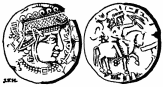
An Ephthalite Coin....
The irruption of the Ephthalites is memorable not so much because of its permanent effects as because of the atrocities perpetrated by the invaders. These Ephthalites very closely resembled the Huns of Attila in their barbarism; they merely raided, they produced no such dynasty as the Kushan monarchy; and their chiefs retained their headquarters in Western Turkestan. Mihiragula, their most capable leader, has been called the Attila of India. One of his favourite amusements, we are told, was the expensive one of rolling elephants down precipitous places in order to watch their sufferings. His abominations roused his Indian tributary princes to revolt, and he was overthrown (528). But the final ending of the Ephthalite raids into India was effected not by Indians, but by the destruction of the central establishment of the Ephthalites on the Oxus (565) by the growing power of the Turks, working in alliance with the Persians. After this break-up, the Ephthalites dissolved very rapidly and completely into the surrounding populations, much as the European Huns did after the death of Attila a hundred years earlier. Nomads without central grazing lands must disperse; nothing else is possible. Some of the chief Rajput clans of to-day in Rajputana in North India are descended, it is said, from these White Huns.[310]
§ 7[311]
These seven centuries which saw the beginning and the end of the emperors in Rome and the complete breakdown and recasting of the social, economic, political, and religious life of Western Europe, saw also very profound changes in the Chinese world. It is too commonly assumed by both Chinese, Japanese, and European historians, that the Han dynasty, under which we find China at the beginning of this period, and the Tang dynasty, with which it closed, were analogous ascendancies controlling a practically similar empire, and that the four centuries of division that elapsed between the end of the Han dynasty (220) and the beginning of the Tang period (619) were centuries of disturbance rather than essential change. The divisions of China are supposed to be merely political and territorial; and, deceived by the fact that at the close as at the commencement of these four centuries, China occupied much the same wide extent of Asia, and was still recognizably China, still with a common culture, a common script, and a common body of ideas, they ignore the very fundamental breaking down and reconstruction that went on, and the many parallelisms to the European experience that China displayed.
It is true that the social collapse was never so complete in the Chinese as in the European world. There remained throughout the whole period considerable areas in which the elaboration of the arts of life could go on. There was no such complete deterioration in cleanliness, decoration, artistic and literary production as we have to record in the West, and no such abandonment of any search for grace and pleasure. We note, for instance, that “tea” appeared in the world, and its use spread throughout China. China began to drink tea in the sixth century A.D. And there were Chinese poets to write delightfully about the effects of the first cup and the second cup and the third cup, and so on. China continued to produce beautiful paintings long after the fall of the Han rule. In the second, third, and fourth centuries some of the most lovely landscapes were painted that have ever been done by men. A considerable production of beautiful vases and carvings also continued. Fine building and decoration went on. Printing from wood blocks began about the same time as tea-drinking, and with the seventh century came a remarkable revival of poetry.
Certain differences between the great empires of the East and West were all in favour of the stability of the former. China had no general coinage. The cash and credit system of the Western world, at once efficient and dangerous, had not strained her economic life. Not that the monetary idea was unknown. For small transactions the various provinces were using perforated zinc and brass “cash,” but for larger there was nothing but stamped ingots of silver. This great empire was still carrying on most of its business on a basis of barter like that which prevailed in Babylon in the days of the Aramean merchants. And so it continued to do to the dawn of the twentieth century.
We have seen how under the Roman republic economic and social order was destroyed by the too great fluidity of property that money brought about. Money became abstract, and lost touch with the real values it was supposed to represent. Individuals and communities got preposterously into debt, and the world was saddled by a class of rich men who were creditors, men who did not handle and administer any real wealth, but who had the power to call up money. No such development of “finance” occurred in China. Wealth in China remained real and visible. And China had no need for any Licinian law, nor for a Tiberius Gracchus. The idea of property in China did not extend far beyond tangible things. There was no “labour” slavery, no gang servitude.[312] The occupier and user of the land was in most instances practically the owner of it, subject to a land tax. There was a certain amount of small scale landlordism, but no great estates. Landless men worked for wages paid mostly in kind—as they were in ancient Babylon.
These things made for stability and the geographical form of China for unity; nevertheless, the vigour of the Han dynasty declined, and when at last at the close of the second century A.D. the world catastrophe of the great pestilence struck the system, the same pestilence that inaugurated a century of confusion in the Roman empire, the dynasty fell like a rotten tree before a gale. And the same tendency to break up into a number of warring states, and the same eruption of barbaric rulers, was displayed in East and West alike. In China, as in the Western empire, faith had decayed. Mr. Fu ascribes much of the political nervelessness of China in this period to Epicureanism, arising, he thinks, out of the sceptical individualism of Lao Tse. This phase of division is known as the “Three Kingdom Period.” The fourth century saw a dynasty of more or less civilized Huns established as rulers in the province of Shen-si. This Hunnish kingdom included not merely the north of China, but great areas of Siberia; its dynasty absorbed the Chinese civilization, and its influence carried Chinese trade and knowledge to the Arctic circle. Mr. Fu compares this Siberian monarchy to the empire of Charlemagne in Europe; it was the barbarian becoming “Chinized” as Charlemagne was a barbarian becoming Romanized. Out of a fusion of these Siberian with native north Chinese elements arose the Suy dynasty, which conquered the south. This Suy dynasty marks the beginning of a renascence of China. Under a Suy monarch the Lu-chu isles were annexed to China, and there was a phase of great literary activity. The number of volumes at this time in the imperial library was increased, we are told, to 54,000. The dawn of the seventh century saw the beginning of the great Tang dynasty, which was to endure for three centuries.
The renascence of China that began with Suy and culminated in Tang was, Mr. Fu insists, a real new birth. “The spirit,” he writes, “was a new one; it marked the Tang civilization with entirely distinctive features. Four main factors had been brought together and fused: (1) Chinese liberal culture; (2) Chinese classicism; (3) Indian Buddhism; and (4) Northern bravery. A new China had come into being. The provincial system, the central administration and the military organization of the Tang dynasty, were quite different from those of their predecessors. The arts had been much influenced and revivified by Indian and Central Asiatic influences. The literature was no mere continuation of the old; it was a new production. The religious and philosophical schools of Buddhism were fresh features. It was a period of substantial change.
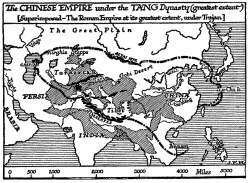
“It may be interesting to compare this making of China with the fate of the Roman Empire in her later days. As the Roman world was divided into the eastern and western halves, so was the Chinese world into the southern and the northern. The barbarians in the case of Rome and in the case of China made similar invasions. They established dominions of a similar sort. Charlemagne’s empire corresponded to that of the Siberian dynasty (Later Wei), the temporary recovery of the Western empire by Justinian corresponded to the temporary recovery of the north by Liu Yu. The Byzantine line corresponded to the southern dynasties. But from this point the two worlds diverged. China recovered her unity; Europe has still to do so.”
The dominions of the emperor Tai-tsung (627), the second Tang monarch, extended southward into Annam and westward to the Caspian Sea. His southern frontier in that direction marched with that of Persia. His northern ran along the Altai from the Kirghis steppe, north of the desert of Gobi. But it did not include Korea, which was conquered and made tributary by his son. This Tang dynasty civilized and incorporated into the Chinese race the whole of the southward population, and just as the Chinese of the north call themselves the “men of Han,” so the Chinese of the south call themselves the “men of Tang.” The law was codified, the literary examination system was revised, and a complete and accurate edition of all the Chinese classics was produced. To the court of Tai-tsung came an embassy from Byzantium, and, what is more significant, from Persia came a company of Nestorian missionaries (631). These latter Tai-tsung received with great respect; he heard them state the chief articles of their creed, and ordered the Christian scriptures to be translated into Chinese for his further examination. In 638 he announced that he found the new religion entirely satisfactory, and that it might be preached within the empire. He also allowed the building of a church and the foundation of a monastery.
A still more remarkable embassy also came to the court of Tai-tsung in the year 628, three years earlier than the Nestorians. This was a party of Arabs, who came by sea to Canton in a trading vessel from Yanbu, the port of Medina in Arabia. (Incidentally it is interesting to know that there were such vessels engaged in an east and west trade at this time.) These Arabs had been sent by that Muhammad we have already mentioned, who styled himself “The Prophet of God,” and the message they brought to Tai-tsung was probably identical with the summons which was sent in the same year to the Byzantine emperor Heraclius and to Kavadh in Ctesiphon. But the Chinese monarch neither neglected the message as Heraclius did, nor insulted the envoys after the fashion of the parricide Kavadh. He received them well, expressed great interest in their theological views, and assisted them, it is said, to build a mosque for the Arab traders in Canton—a mosque which survives to this day. It is one of the oldest mosques in the world.
§ 8
The urbanity, the culture, and the power of China under the early Tang rulers are in so vivid a contrast with the decay, disorder, and divisions of the Western world, as at once to raise some of the most interesting questions in the history of civilization. Why did not China keep this great lead she had won by her rapid return to unity and order? Why does she not to this day dominate the world culturally and politically?
For a long time she certainly did keep ahead. It is only a thousand years later, in the sixteenth and seventeenth centuries, with the discovery of America, the spread of printed books and education in the West, and the dawn of modern scientific discovery, that we can say with confidence that the Western world began to pull ahead of China. Under the Tang rule, her greatest period, and then again under the artistic but rather decadent Sung dynasty (960-1279), and again during the period of the cultured Mings (1358-1644), China presented a spectacle of prosperity, happiness, and artistic activity far in front of any contemporary state. And seeing that she achieved so much, why did she not achieve more? Chinese shipping was upon the seas, and there was a considerable overseas trade during that time.[313] Why did the Chinese never discover America or Australia? There was much isolated observation, ingenuity, and invention. The Chinese knew of gunpowder in the sixth century,[314] they used coal and gas heating centuries before these things were used in Europe; their bridge-building, their hydraulic engineering was admirable; the knowledge of materials shown in their enamel and lacquer ware is very great. Why did they never organize the system of record and co-operation in inquiry that has given the world modern science? And why, in spite of their general training in good manners and self-restraint, did intellectual education never soak down into the general mass of the population? Why are the masses of China to-day, and why have they always been, in spite of an exceptionally high level of natural intelligence, illiterate?
It is customary to meet such questions with rather platitudinous answers. We are told that the Chinaman is the most conservative of human beings, that, in contrast with the European races, his mind is twisted round towards the past, that he is the willing slave of etiquette and precedent to a degree inconceivable to Western minds. He is represented as having a mentality so distinct that one might almost expect to find a difference in brain structure to explain it. The appeals of Confucius to the wisdom of the ancients are always quoted to clinch this suggestion.
If, however, we examine this generalization more closely, it dissolves into thin air. The superior intellectual initiative, the liberal enterprise, the experimental disposition that is supposed to characterize the Western mind, is manifest in the history of that mind only during certain phases and under exceptional circumstances. For the rest, the Western world displays itself as traditional and conservative as China. And, on the other hand, the Chinese mind has, under conditions of stimulus, shown itself quite as inventive and versatile as the European, and the very kindred Japanese mind even more so. For, take the case of the Greeks, the whole swing of their mental vigour falls into the period between the sixth century B.C. and the decay of the Alexandrian Museum under the later Ptolemies in the second century B.C. There were Greeks before that time and Greeks since, but a history of a thousand years of the Byzantine empire showed the Hellenic world at least as intellectually stagnant as China. Then we have already drawn attention to the comparative sterility of the Italian mind during the Roman period and its abundant fertility since the Renaissance of learning. The English mind again had a phase of brightness in the seventh and eighth centuries, and it did not shine again until the fifteenth. Again, the mind of the Arabs, as we shall presently tell, blazed out like a star for half a dozen generations after the appearance of Islam, having never achieved anything of importance before or since. On the other hand, there was always a great deal of scattered inventiveness in China, and the progress of Chinese art witnesses to new movements and vigorous innovations. We exaggerate the reverence of the Chinese for their fathers; parricide was a far commoner crime among the Chinese emperors than it was even among the rulers of Persia. Moreover, there have been several liberalizing movements in China, several recorded struggles against the “ancient ways.”
It has already been suggested that phases of real intellectual progress in any community seem to be connected with the existence of a detached class of men, sufficiently free not to be obliged to toil or worry exhaustively about mundane needs, and not rich and powerful enough to be tempted into extravagances of lust, display, or cruelty. They must have a sense of security, but not a conceit of superiority. This class, we have further insinuated, must be able to talk freely and communicate easily. It must not be watched for heresy or persecuted for any ideas it may express. Such a happy state of affairs certainly prevailed in Greece during its best days. A class of intelligent, free gentlefolk is indeed evident in history whenever there is a record of bold philosophy or effective scientific advances.
In the days of Tang and Sung and Ming there must have been an abundance of pleasantly circumstanced people in China of just the class that supplied most of the young men of the Academy at Athens, or the bright intelligences of Renaissance Italy, or the members of the London Royal Society, that mother society of modern science; and yet China did not produce in these periods of opportunity any such large beginnings of recorded and analyzed fact.
If we reject the idea that there is some profound racial difference between China and the West which makes the Chinese by nature conservative and the West by nature progressive, then we are forced to look for the operating cause of this difference in progressiveness in some other direction. Many people are disposed to find that operating cause which has, in spite of her original advantages, retarded China so greatly during the last four or five centuries, in the imprisonment of the Chinese mind in a script and in an idiom of thought so elaborate and so difficult that the mental energy of the country has been largely consumed in acquiring it. This view deserves examination.
We have already given an account in chap. xviii. of the peculiarities of Chinese writing and of the Chinese language. The Japanese writing is derived from the Chinese, and consists of a more rapidly written system of forms. A great number of these forms are ideograms taken over from the Chinese and used exactly as the Chinese ideograms are used, but also a number of signs are used to express syllables; there is a Japanese syllabary after the fashion of the Sumerian syllabary we have described in chap. xviii. The Japanese writing remains a clumsy system, as clumsy as cuneiform, though not so clumsy as Chinese; and there has been a movement in Japan to adopt a Western alphabet. Korea long ago went a step farther and developed a true alphabet from the same Chinese origins. With these exceptions all the great writing systems now in use in the world are based on the Mediterranean alphabets, and are beyond comparison more easily learnt and mastered than the Chinese. This means that while other peoples learn merely a comparatively simple and straightforward method of setting down the language with which they are familiar, the Chinaman has to master a great multitude of complex word signs and word groups. He must not simply learn the signs, but the established grouping of those signs to represent various meanings. He must familiarize himself, therefore, with a number of exemplary classical works. Consequently in China, while you will find great numbers of people who know the significance of certain frequent and familiar characters, you discover only a few whose knowledge is sufficiently extensive to grasp the meaning of a newspaper paragraph, and still fewer who can read any subtlety of intention or fine shades of meaning. In a lesser degree this is true also of Japan. No doubt European readers, especially of such word-rich languages as English or Russian, vary greatly among themselves in regard to the extent of books they can understand and how far they understand them; their power varies according to their vocabularies; but the corresponding levels of understanding among the Chinese represent a far greater expenditure of time and labour upon their attainment. A mandarin’s education in China is, mainly, learning to read.
And it may be that the consequent preoccupation of the educated class during its most susceptible years upon the Chinese classics gave it a bias in favour of this traditional learning upon which it had spent so much time and energy. Few men who have toiled to build up any system of knowledge in their minds will willingly scrap it in favour of something strange and new; this disposition is as characteristic of the West as of the East; it is shown as markedly by the scholars of the British and American universities as by any Chinese mandarins, and the British at the present time, in spite of the great and manifest advantages in popular education and national propaganda the change would give them, refuse to make any move from their present barbaric orthography towards a phonetic alphabet and spelling. The peculiarities of the Chinese script, and the educational system arising out of that script, must have acted age after age as an invincible filter that favoured the plastic and scholarly mind as against the restive and originating type, and kept the latter out of positions of influence and authority. There is much that is plausible in this explanation.
There have been several attempts to simplify the Chinese writing and to adopt an alphabetical system. In the early days of Buddhism in China, when there was a considerable amount of translation from Sanskrit, Indian influences came near to achieving this end; two Chinese alphabets were indeed invented, and each had some little use. But what hindered the general adoption of these, and what stands in the way of any phonetic system of Chinese writing to-day, is this, that while the literary script and phraseology is the same from one end of China to the other, the spoken language of the common people, both in pronunciation and in its familiar idioms, varies so widely that men from one province may be incomprehensible to men from another. There is, however, a “standard Chinese,” a rather bookish spoken idiom, which is generally understood by educated people; and it is upon the possibility of applying an alphabetical system of writing to this standard Chinese that the hopes of modern educational reformers in China are based at the present time. For fresh attempts are now being made to release the Chinese mind from this ancient entanglement.
A Chinese alphabet has been formed; it is taught in the common schools, and newspapers and pamphlets are issued in it. And the rigid examination system that killed all intellectual initiatives has been destroyed.
The very success and early prosperity and general contentment of China in the past must have worked to justify in that land all the natural self-complacency and conservatism of mankind. No animal will change when its conditions are “good enough” for present survival. And in this matter man is still an animal. Until the nineteenth century, for more than two thousand years, there was little in the history of China that could cause any serious doubts in the mind of a Chinaman of the general superiority of his own civilization to that of the rest of the world, and there was no reason apparent therefore for any alteration. China produced a profusion of beautiful art, some delightful poetry, astonishing cookery, and thousands of millions of glowingly pleasant lives generation after generation. Her ships followed her marvellous inland waterways, and put to sea but rarely, and then only to India or Borneo as their utmost adventure. (Until the sixteenth century we must remember European seamen never sailed out into the Atlantic Ocean. The Norse discovery of America, the Phœnician circumnavigation of Africa, were exceptional feats.) And these things were attained without any such general boredom, servitude, indignity, and misery as underlay the rule of the rich in the Roman Empire. There was much poverty, much discontent, but it was not massed poverty, it was not a necessary popular discontent. For a thousand years the Chinese system, though it creaked and swayed at times, seemed proof against decay. Dynastic changes there were, rebellions, phases of disorder, famines, pestilences; two great invasions that set foreign dynasties upon the throne of the Son of Heaven, but no such shock as to revolutionize the order of the daily round. The emperors and dynasties might come and go; the mandarins, the examinations, the classics, and the traditions and habitual life remained. China’s civilization had already reached its culmination in the seventh century A.D., its crowning period was the Tang period; and though it continued to spread slowly and steadily into Annam, into Cambodia, into Siam, into Tibet, into Nepal, Korea, Mongolia, and Manchuria, there is henceforth little more than such geographical progress to record of it in this history for a thousand years.[315]
§ 9[316]
In the year 629, the year after the arrival of Muhammad’s envoys at Canton and thirty odd years after the landing of Pope Gregory’s missionaries in England, a certain learned and devout Buddhist named Yuan Chwang started out from Singan, Tai-tsung’s capital, upon a great journey to India. He was away sixteen years, he returned in 645, and he wrote an account of his travels which is treasured as a Chinese classic. One or two points about his experiences are to be noted here because they contribute to our general review of the state of the world in the seventh century A.D.
Yuan Chwang was as eager for marvels and as credulous as Herodotus, and without the latter writer’s fine sense of history; he could never pass a monument or ruin without learning some fabulous story about it; Chinese ideas of the dignity of literature perhaps prevented him from telling us much detail of how he travelled, who were his attendants, how he was lodged, or what he ate and how he paid his expenses—details precious to the historian; nevertheless, he gives us a series of illuminating flashes upon China, Central Asia, and India in the period now under consideration.
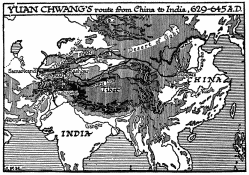
His journey was an enormous one. He went and came back by way of the Pamirs. He went by the northern route, crossing the desert of Gobi, passing along the southern slopes of the Thien Shan, skirting the great deep blue lake of Issik Kul, and so to Tashkend and Samarkand, and then more or less in the footsteps of Alexander the Great southward to the Khyber Pass and Peshawur. He returned by the southern route, crossing the Pamirs from Afghanistan to Kashgar, and so along the line of retreat the Yueh Chi had followed in the reverse direction seven centuries before, and by Yarkand, along the slopes of the Kuen Lun to rejoin his former route near the desert end of the Great Wall. Each route involved some hard mountaineering. His journeyings in India are untraceable; he was there fourteen years, and he went all over the peninsula from Nepal to Ceylon.
At that time there was an imperial edict forbidding foreign travel, so that Yuan Chwang started from Singan like an escaping criminal. There was a pursuit to prevent him carrying out his project. How he bought a lean red-coloured horse that knew the desert paths from a strange grey-beard, how he dodged a frontier guard-house with the help of a “foreign person” who made him a bridge of brushwood lower down the river, how he crossed the desert guided by the bones of men and cattle, how he saw a mirage, and how twice he narrowly escaped being shot by arrows when he was getting water near the watch-towers on the desert track, the reader will find in the Life. He lost his way in the desert of Gobi, and for four nights and five days he had no water; when he was in the mountains among the glaciers, twelve of his party were frozen to death. All this is in the Life; he tells little of it in his own account of his travels.
He shows us the Turks, this new development of the Hun tradition, in possession not only of what is now Turkestan, but all along the northern route. He mentions many cities and considerable cultivation. He is entertained by various rulers, allies of or more or less nominally tributaries to China, and among others by the Khan of the Turks, a magnificent person in green satin, with his long hair tied with silk.
“The gold embroidery of this grand tent shone with a dazzling splendour; the ministers of the presence in attendance sat on mats in long rows on either side all dressed in magnificent brocade robes, while the rest of the retinue on duty stood behind. You saw that although it was a case of a frontier ruler, yet there was an air of distinction and elegance. The Khan came out from his tent about thirty paces to meet Yuan Chwang, who, after a courteous greeting, entered the tent.... After a short interval envoys from China and Kao-chang were admitted and presented their despatches and credentials, which the Khan perused. He was much elated, and caused the envoys to be seated; then he ordered wine and music for himself and them and grape-syrup for the pilgrim. Hereupon all pledged each other, and the filling and draining of the winecups made a din and bustle, while the mingled music of various instruments rose loud: although the airs were the popular strains of foreigners, yet they pleased the senses and exhilarated the mental faculties. After a little, piles of roasted beef and mutton were served for the others, and lawful food, such as cakes, milk, candy, honey, and grapes, for the pilgrim. After the entertainment, grape-syrup was again served, and the Khan invited Yuan Chwang to improve the occasion, whereupon the pilgrim expounded the doctrines of the ‘ten virtues,’ compassion for animal life, and the paramitas and emancipation. The Khan, raising his hands, bowed, and gladly believed and accepted the teaching.”
Yuan Chwang’s account of Samarkand[317] is of a large and prosperous city, “a great commercial entrepôt, the country about it very fertile, abounding in trees and flowers and yielding many fine horses. Its inhabitants were skilful craftsmen, smart and energetic.” At that time we must remember there was hardly such a thing as a town in Anglo-Saxon England.
As his narrative approached his experiences in India, however, the pious and learned pilgrim in Yuan Chwang got the better of the traveller, and the book becomes congested with monstrous stories of incredible miracles.[318] Nevertheless, we get an impression of houses, clothing, and the like, closely resembling those of the India of to-day. Then, as now, the kaleidoscopic variety of an Indian crowd contrasted with the blue uniformity of the multitude in China. In the time of Buddha it is doubtful if there were reading and writing in India; now reading and writing were quite common accomplishments. Yuan Chwang gives an interesting account of a great Buddhist university at Nalanda, where ruins have quite recently been discovered and excavated. Nalanda and Taxilla seem to have been considerable educational centres as early as the opening of the schools of Athens. The caste system Yuan Chwang found fully established in spite of Buddha, and the Brahmins were now altogether in the ascendant. He names the four main castes we have mentioned in chap. xx., § 4 (q.v.), but his account of their functions is rather different. The Sudras, he says, were the tillers of the soil. Indian writers say that their function was to wait upon the three “twice born” castes above them.
But, as we have already intimated, Yuan Chwang’s account of Indian realities is swamped by his accumulation of legends and pious inventions. For these he had come, and in these he rejoiced. The rest, as we shall see, was a task that had been set him. The faith of Buddha which in the days of Asoka, and even so late as Kanishka, was still pure enough to be a noble inspiration, we now discover absolutely lost in a wilderness of preposterous rubbish, a philosophy of endless Buddhas, tales of manifestations and marvels like a Christmas pantomime, immaculate conceptions by six-tusked elephants, charitable princes giving themselves up to be eaten by starving tigresses, temples built over a sacred nail-paring, and the like. We cannot give such stories here; if the reader likes that sort of thing, he must go to the publications of the Royal Asiatic Society or the India Society, where he will find a delirium of such imaginations. And in competition with this Buddhism, intellectually undermined as it now was and smothered in gilded decoration, Brahminism was everywhere gaining ground again, as Yuan Chwang notes with regret.
Side by side with these evidences of a vast intellectual decay in India we may note the repeated appearance in Yuan Chwang’s narrative of ruined and deserted cities. Much of the country was still suffering from the ravages of the Ephthalites and the consequent disorders. Again and again we find such passages as this: “he went north-east through a great forest, the road being a narrow, dangerous path, with wild buffalo and wild elephants, and robbers and hunters always in wait to kill travellers, and emerging from the forest he reached the country of Kou-shih-na-ka-lo (Kúsinagara). The city walls were in ruins, and the towns and villages were deserted. The brick foundations of the ‘old city’ (that is, the city which had been the capital) were above ten li in circuit; there were very few inhabitants, the interior of the city being a wild waste.” This ruin was, however, by no means universal; there is at least as much mention of crowded cities and villages and busy cultivations.
The Life tells of many hardships upon the return journey: he fell among robbers; the great elephant that was carrying the bulk of his possessions was drowned; he had much difficulty in getting fresh transport. Here we cannot deal with these adventures.
The return of Yuan Chwang to Singan, the Chinese capital, was, we gather, a triumph. Advance couriers must have told of his coming. There was a public holiday; the streets were decorated by gay banners and made glad with music. He was escorted into the city with great pomp and ceremony. Twenty horses were needed to carry the spoils of his travels; he had brought with him hundreds of Buddhist books written in Sanskrit, and made of trimmed leaves of palm and birch bark strung together in layers; he had many images great and small of Buddha, in gold, silver, crystal, and sandalwood; he had holy pictures, and no fewer than one hundred and fifty well authenticated true relics of Buddha. Yuan Chwang was presented to the emperor, who treated him as a personal friend, took him into the palace, and questioned him day by day about the wonders of these strange lands in which he had stayed so long. But while the emperor asked about India, the pilgrim was disposed only to talk about Buddhism.
Buddhist writers thought very highly of Tai-tsung because of his reception of Yuan Chwang (645). But so did the Moslem historians, because of that mosque at Canton, and so did the Christian writers, because of the Nestorian envoys (631).
The subsequent history of Yuan Chwang contains two incidents that throw light upon the mental workings of this great monarch, Tai-tsung, who was probably quite as much a Moslem as he was a Christian or a Buddhist. The trouble about all religious specialists is that they know too much about their own religion and how it differs from others; the advantage, or disadvantage, of such creative statesmen as Tai-tsung and Constantine the Great is that they know comparatively little of such matters. Evidently the fundamental good of all these religions seemed to Tai-tsung to be much the same fundamental good. So it was natural to him to propose that Yuan Chwang should now give up the religious life and come into his foreign office, a proposal that Yuan Chwang would not entertain for a moment. The emperor then insisted at least upon a written account of the travels, and so got this classic we treasure. And finally Tai-tsung proposed to this highly saturated Buddhist that he should now use his knowledge of Sanskrit in translating the works of the great Chinese teacher, Lao Tse, so as to make them available for Indian readers. It seemed, no doubt, to the emperor a fair return and a useful service to the fundamental good that lies beneath all religions. On the whole, he thought Lao Tse might very well rank with or even a little above Buddha, and therefore that if his work was put before the Brahmins, they would receive it gladly. In much the same spirit Constantine the Great had done his utmost to make Arius and Athanasius settle down amicably together. But naturally enough this suggestion was repulsed by Yuan Chwang. He retired to a monastery and spent the rest of his years translating as much as he could of the Buddhist literature he had brought with him into elegant Chinese writing.
Printed in the United States of America.
THE OUTLINE OF HISTORY
| ¶ Mr. WELLS has also written the following novels: | |
| LOVE AND MR. LEWISHAM KIPPS MR. POLLY THE WHEELS OF CHANCE THE NEW MACHIAVELLI ANN VERONICA TONO BUNGAY MARRIAGE BEALBY THE PASSIONATE FRIENDS THE WIFE OF SIR ISAAC HARMAN THE RESEARCH MAGNIFICENT MR. BRITLING SEES IT THROUGH THE SOUL OF A BISHOP JOAN AND PETER THE UNDYING FIRE | |
| ¶ The following fantastic and imaginative romances: | |
| THE WAR OF THE WORLDS THE TIME MACHINE THE WONDERFUL VISIT THE ISLAND OF DR. MOREAU THE SEA LADY THE SLEEPER AWAKES THE FOOD OF THE GODS THE WAR IN THE AIR THE FIRST MEN IN THE MOON IN THE DAYS OF THE COMET THE WORLD SET FREE | |
| And numerous Short Stories now collected in One Volume under the title of | |
| THE COUNTRY OF THE BLIND | |
| ¶ A Series of books on Social, Religious, and Political questions: | |
| ANTICIPATIONS (1900) MANKIND IN THE MAKING FIRST AND LAST THINGS NEW WORLDS FOR OLD A MODERN UTOPIA THE FUTURE IN AMERICA AN ENGLISHMAN LOOKS AT THE WORLD WHAT IS COMING? WAR AND THE FUTURE IN THE FOURTH YEAR GOD THE INVISIBLE KING | |
| ¶ And two little books about children’s play, called | |
| FLOOR GAMES and LITTLE WARS | |
THE OUTLINE OF
HISTORY
Being a Plain History of Life and Mankind
BY
H. G. WELLS
WRITTEN WITH THE ADVICE AND EDITORIAL HELP OF
MR. ERNEST BARKER,
SIR H. H. JOHNSTON, SIR E. RAY LANKESTER
AND PROFESSOR GILBERT MURRAY
AND ILLUSTRATED BY
J. F. HORRABIN
VOLUME II
New York
THE MACMILLAN COMPANY
1920
All rights reserved
Copyright, 1920,
By THE MACMILLAN COMPANY.
By H. G. WELLS.
Set up and electrotyped. Published November, 1920.
NORWOOD PRESS
J. S. Cushing Co.—Berwick & Smith Co.
Norwood, Mass., U.S.A.
SCHEME OF CONTENTS
| BOOK VI (Continued) | ||
|---|---|---|
| PAGE | ||
| Chapter XXXII. Muhammad and Arab Islam | ||
| § 1. | Arabia before Muhammad | 1 |
| § 2. | Life of Muhammad to the Hegira | 4 |
| § 3. | Muhammad becomes a fighting prophet | 8 |
| § 4. | The teachings of Islam | 14 |
| § 5. | The caliphs Abu Bekr and Omar | 16 |
| § 6. | The great days of the Omayyads | 22 |
| § 7. | The decay of Islam under the Abbasids | 31 |
| § 8. | The intellectual life of Arab Islam | 34 |
| Chapter XXXIII. Christendom and the Crusades | ||
| § 1. | The Western world at its lowest ebb | 40 |
| § 2. | The feudal system | 42 |
| § 3. | The Frankish kingdom of the Merovingians | 46 |
| § 4. | The Christianization of the western barbarians | 48 |
| § 5. | Charlemagne becomes emperor of the West | 54 |
| § 6. | The personality of Charlemagne | 59 |
| § 7. | The French and the Germans become distinct | 61 |
| § 8. | The Normans, the Saracens, the Hungarians, and the Seljuk Turks | 64 |
| § 9. | How Constantinople appealed to Rome | 72 |
| § 10. | The Crusades | 76 |
| § 11. | The Crusades a test of Christianity | 84 |
| § 12. | The Emperor Frederick II | 86 |
| § 13. | Defects and limitations of the papacy | 90 |
| § 14. | A list of leading Popes | 96 |
|
BOOK VII THE GREAT MONGOL EMPIRES OF THE LAND WAYS AND THE NEW EMPIRES OF THE SEA WAYS | ||
| Chapter XXXIV. The Great Empire of Jengis Khan and his Successors | ||
| § 1. | Asia at the end of the twelfth century | 105 |
| § 2. | The rise and victories of the Mongols | 108 |
| § 3. | The travels of Marco Polo | 114 |
| § 4. | The Ottoman Turks, the Turkish Caliph, and Constantinople | 120 |
| § 5. | Why the Mongols were not Christianized | 126 |
| § 5A. | Kublai Khan founds the Yuan Dynasty | 127 |
| § 5B. | The Mongols revert to tribalism | 128 |
| § 5C. | The Kipchak empire and the Tsar of Muscovy | 128 |
| § 5D. | Timurlane | 130 |
| § 5E. | The Mongol empire of India | 133 |
| § 5F. | The Mongols and the Gipsies | 137 |
| Chapter XXXV. The Renascence of Western Civilization | ||
| § 1. | Christianity and popular education | 139 |
| § 2. | Europe begins to think for itself | 148 |
| § 3. | The Great Plague and the dawn of communism | 153 |
| § 4. | How paper liberated the human mind | 158 |
| § 5. | Protestantism of the princes and Protestantism of the peoples | 160 |
| § 6. | The reawakening of science | 167 |
| § 7. | The new growth of European towns | 177 |
| § 8. | America comes into history | 184 |
| § 9. | What Machiavelli thought of the world | 194 |
| § 10. | The republic of Switzerland | 198 |
| § 11A. | The life of the Emperor Charles V | 199 |
| § 11B. | Protestants if the prince wills it | 210 |
| § 11C. | The intellectual under-tow | 210 |
| BOOK VIII THE AGE OF THE GREAT POWERS | ||
| Chapter XXXVI. Princes, Parliaments, and Powers | ||
| § 1. | Princes and foreign policy | 213 |
| § 2. | The English republic | 218 |
| § 3. | The Dutch republic | 228 |
| § 4. | The break-up and disorder of Germany | 232 |
| § 5. | The splendours of Grand Monarchy in Europe | 236 |
| § 6. | The growth of the idea of Great Powers | 243 |
| § 7. | The crowned republic of Poland and its fate | 248 |
| § 8. | The first scramble for empire overseas | 251 |
| § 9. | Britain dominates India | 254 |
| § 10. | Russia’s ride to the Pacific | 259 |
| § 11. | What Gibbon thought of the world in 1780 | 262 |
| § 12. | The social truce draws to an end | 269 |
| Chapter XXXVII. The New Democratic Republics of America and France | ||
| § 1. | Inconveniences of the Great Power system | 278 |
| § 2. | The thirteen colonies before their revolt | 280 |
| § 3. | Civil war is forced upon the colonies | 286 |
| § 4. | The War of Independence | 291 |
| § 5. | The constitution of the United States | 294 |
| § 6. | Primitive features of the United States constitution | 301 |
| § 7. | Revolutionary ideas in France | 307 |
| § 8. | The Revolution of the year 1789 | 311 |
| § 9. | The French “crowned republic” of ’89-’91 | 313 |
| § 10. | The Revolution of the Jacobins | 321 |
| § 11. | The Jacobin republic, 1792-4 | 331 |
| § 12. | The Directory | 337 |
| § 13. | The pause in reconstruction and the dawn of modern Socialism | 339 |
| Chapter XXXVIII. The Career of Napoleon Bonaparte | ||
| § 1. | The Buonaparte family in Corsica | 348 |
| § 2. | Bonaparte as a republican general | 349 |
| § 3. | Napoleon First Consul, 1799-1804 | 354 |
| § 4. | Napoleon I Emperor, 1804-1814 | 360 |
| § 5. | The Hundred Days | 368 |
| § 6. | The cult of the Napoleonic | 373 |
| § 7. | The map of Europe in 1815 | 377 |
| Chapter XXXIX. The Realities and Imagination of the Nineteenth Century. The Increase of Knowledge and Clear Thinking. The Nationalist Phase | ||
| § 1. | The mechanical revolution | 384 |
| § 2. | Relation of the mechanical to the industrial revolution | 393 |
| § 3. | The fermentation of ideas, 1848 | 399 |
| § 4. | The development of the idea of Socialism | 401 |
| § 5. | Shortcomings of Socialism as a scheme of human society | 411 |
| § 6. | How Darwinism affected religious and political ideas | 416 |
| § 7. | Mr. Gladstone and the idea of Nationalism | 426 |
| § 8. | Europe between 1848 and 1878 | 436 |
| § 9. | The (second) scramble for overseas empires | 449 |
| § 10. | The Indian precedent in Asia | 461 |
| § 11. | The history of Japan | 464 |
| § 12. | Close of the period of overseas expansion | 469 |
| § 13. | The British Empire in 1914 | 470 |
| Chapter XL. The International Catastrophe of 1914 and the Close of the Great Power Period | ||
| § 1. | The armed peace before the Great War | 475 |
| § 2. | Imperial Germany | 477 |
| § 3. | The spirit of Imperialism in Britain and Ireland | 486 |
| § 4. | Imperialism in France, Italy, and the Balkans | 499 |
| § 5. | Russia still a Grand Monarchy in 1914 | 502 |
| § 6. | The United States and the Imperial idea | 503 |
| § 7. | The immediate causes of the Great War | 508 |
| § 8. | A summary of the Great War up to 1917 | 513 |
| § 9. | The Great War from the Russian collapse to the armistice | 524 |
| § 10. | The political, economic, and social disorganization caused by the Great War | 532 |
| § 11. | President Wilson and the problems of Versailles | 543 |
| § 12. | Summary of the first Covenant of the League of Nations | 558 |
| § 13. | A general outline of the treaties of 1919 and 1920 | 562 |
| § 14. | A forecast of the “next war” | 567 |
| § 15. | The state of men’s minds in 1920 | 572 |
| BOOK IX THE NEXT STAGE IN HISTORY | ||
| Chapter XLI. Man’s Coming of Age. The Probable Struggle for the Unification of the World into one Community of Knowledge and Will | ||
| § 1. | The possible unification of men’s wills in political matters | 579 |
| § 2. | How a Federal World Government may come about | 583 |
| § 3. | Some fundamental characteristics of a modern world state | 586 |
| § 4. | What this world might be like, were men united in a common peace and justice | 588 |
| § 5. | The stages beyond? | 594 |
| Five Time Charts of the World’s Affairs from B.C. 1000 to A.D. 1920 | 599 | |
| A Chronological Table from 800 B.C. to A.D. 1920 | 605 | |
| Index: A, B, C, D, E, F, G, H, I, J, K, L, M, N, O, P, Q, R, S, T, U, V, W, X, Y, Z | 625 | |