
LIST OF MAPS AND ILLUSTRATIONS
| PAGE | |
| Life in the Early Palæozoic | 11 |
| Time-chart from Earliest Life to 40,000,000 Years Ago | 14 |
| Life in the Later Palæozoic Age | 19 |
| Australian Lung Fish | 26 |
| Some Reptiles of the Late Palæozoic Age | 27 |
| Astronomical Variations Affecting Climate | 33 |
| Some Mesozoic Reptiles | 40 |
| Later Mesozoic Reptiles | 42 |
| Pterodactyls and Archæopteryx | 45 |
| Hesperornis | 48 |
| Some Oligocene Mammals | 53 |
| Miocene Mammals | 58 |
| Time-diagram of the Glacial Ages | 60 |
| Early Pleistocene Animals, Contemporary with Earliest Man | 64 |
| The Sub-Man Pithecanthropus | 65 |
| The Riddle of the Piltdown Sub-Man | 71 |
| Map of Europe 50,000 Years Ago | 77 |
| Neanderthal Man | 78 |
| Early Stone Implements | 81 |
| Australia and the Western Pacific in the Glacial Age | 82 |
| Cro-magnon Man | 87 |
| Europe and Western Asia in the Later Palæolithic Age | 89 |
| Reindeer Age Articles | 90 |
| A Reindeer Age Masterpiece | 93 |
| Reindeer Age Engravings and Carvings | 94 |
| Diagram of the Estimated Duration of the True Human Periods | 97 |
| Neolithic Implements | 107 |
| Restoration of a Lake Dwelling | 111 |
| Pottery from Lake Dwellings | 112 |
| Hut Urns | 115 |
| A Menhir of the Neolithic Period | 128 |
| Bronze Age Implements | 132 |
| Diagram Showing the Duration of the Neolithic Period | 133 |
| Heads of Australoid Types | 139 |
| Bushwoman | 141 |
| Negro Types | 142 |
| Mongolian Types | 143 |
| Caucasian Types | 144 |
| Map of Europe, Asia, Africa 15,000 Years Ago | 145 |
| The Swastika | 147 |
| Relationship of Human Races (Diagrammatic Summary) | 149 |
| Possible Development of Languages | 155 |
| Racial Types (after Champollion) | 163 |
| Combat between Menelaus and Hector | 176 |
| Archaic Horses and Chariots | 178 |
| The Cradle of Western Civilization | 185 |
| Sumerian Warriors in Phalanx | 189 |
| Assyrian Warrior (temp. Sargon II) | 193 |
| Time-chart 6000 B.C. to A.D. | 196 |
| The Cradle of Chinese Civilization (Map) | 202 |
| Boats on Nile about 2500 B.C. | 211 |
| Egyptian Ship on Red Sea, 1250 B.C. | 212 |
| Ægean Civilization (Map) | 214 |
| A Votary of the Snake Goddess | 215 |
| American Indian Picture-Writing | 225 |
| Egyptian Gods—Set, Anubis, Typhon, Bes | 236 |
| Egyptian Gods—Thoth-lunus, Hathor, Chnemu | 239 |
| An Assyrian King and His Chief Minister | 243 |
| Pharaoh Chephren | 248 |
| Pharaoh Rameses III as Osiris (Sarcophagus relief) | 249 |
| Pharaoh Akhnaton | 251 |
| Egyptian Peasants (Pyramid Age) | 257 |
| Brawl among Egyptian Boatmen (Pyramid Age) | 260 |
| Egyptian Social Types (From Tombs) | 261 |
| The Land of the Hebrews | 280 |
| Aryan-speaking Peoples 1000-500 B.C. (Map) | 301 |
| Hellenic Races 1000-800 B.C. (Map) | 302 |
| Greek Sea Fight, 550 B.C. | 303 |
| Rowers in an Athenian Warship, 400 B.C. | 306 |
| Scythian Types | 319 |
| Median and Second Babylonian Empires (in Nebuchadnezzar’s Reign) | 321 |
| The Empire of Darius | 329 |
| Wars of the Greeks and Persians (Map) | 333 |
| Athenian Foot-soldier | 334 |
| Persian Body-guard (from Frieze at Susa) | 338 |
| The World According to Herodotus | 341 |
| Athene of the Parthenon | 348 |
| Philip of Macedon | 368 |
| Growth of Macedonia under Philip | 371 |
| Macedonian Warrior (bas-relief from Pella) | 373 |
| Campaigns of Alexander the Great | 381 |
| Alexander the Great | 389 |
| Break-up of Alexander’s Empire | 393 |
| Seleucus I | 395 |
| Later State of Alexander’s Empire | 398 |
| The World According to Eratosthenes, 200 B.C. | 405 |
| The Known World, about 250 B.C. | 406 |
| Isis and Horus | 413 |
| Serapis | 414 |
| The Rise of Buddhism | 419 |
| Hariti | 428 |
| Chinese Image of Kuan-yin | 429 |
| The Spread of Buddhism | 432 |
| Indian Gods—Vishnu, Brahma, Siva | 437 |
| Indian Gods—Krishna, Kali, Ganesa | 439 |
| The Western Mediterranean, 800-600 B.C. | 446 |
| Early Latium | 447 |
| Burning the Dead: Etruscan Ceremony | 449 |
| Statuette of a Gaul | 450 |
| Roman Power after the Samnite Wars | 451 |
| Samnite Warriors | 452 |
| Italy after 275 B.C. | 453 |
| Roman Coin Celebrating the Victory over Pyrrhus | 455 |
| Mercury | 457 |
| Carthaginian Coins | 468 |
| Roman As | 471 |
| Rome and its Alliances, 150 B.C. | 481 |
| Gladiators | 489 |
| Roman Power, 50 B.C. | 506 |
| Julius Cæsar | 512 |
| Roman Empire at Death of Augustus | 518 |
| Roman Empire in Time of Trajan | 524 |
| Asia and Europe: Life of the Period (Map) | 544 |
| Central Asia, 200-100 B.C. | 547 |
| Tracks of Migrating and Raiding Peoples, 1-700 A.D. | 555 |
| Eastern Roman Empire | 561 |
| Constantinople (Maps to show value of its position) | 563 |
| Galilee | 571 |
| Map of Europe, 500 A.D. | 608 |
| The Eastern Empire and the Sassanids | 620 |
| Asia Minor, Syria, and Mesopotamia | 622 |
| Ephthalite Coin | 629 |
| Chinese Empire, Tang Dynasty | 633 |
| Yuan Chwang’s Route from China to India | 643 |
BOOK I
THE MAKING OF OUR WORLD
THE OUTLINE OF HISTORY
I
THE EARTH IN SPACE AND TIME
THE earth on which we live is a spinning globe. Vast though it seems to us, it is a mere speck of matter in the greater vastness of space.
Space is, for the most part, emptiness. At great intervals there are in this emptiness flaring centres of heat and light, the “fixed stars.” They are all moving about in space, notwithstanding that they are called fixed stars, but for a long time men did not realize their motion. They are so vast and at such tremendous distances that their motion is not perceived. Only in the course of many thousands of years is it appreciable. These fixed stars are so far off that, for all their immensity, they seem to be, even when we look at them through the most powerful telescopes, mere points of light, brighter or less bright. A few, however, when we turn a telescope upon them, are seen to be whirls and clouds of shining vapour which we call nebulæ. They are so far off that a movement of millions of miles would be imperceptible.
One star, however, is so near to us that it is like a great ball of flame. This one is the sun. The sun is itself in its nature like a fixed star, but it differs from the other fixed stars in appearance because it is beyond comparison nearer than they are; and because it is nearer men have been able to learn something of its nature. Its mean distance from the earth is ninety-three million miles. It is a mass of flaming matter, having a diameter of 866,000 miles. Its bulk is a million and a quarter times the bulk of our earth.
These are difficult figures for the imagination. If a bullet fired from a Maxim gun at the sun kept its muzzle velocity unimpaired, it would take seven years to reach the sun. And yet we say the sun is near, measured by the scale of the stars. If the earth were a small ball, one inch in diameter, the sun would be a globe of nine feet diameter; it would fill a small bedroom. It is spinning round on its axis, but since it is an incandescent fluid, its polar regions do not travel with the same velocity as its equator, the surface of which rotates in about twenty-five days. The surface visible to us consists of clouds of incandescent metallic vapour. At what lies below we can only guess. So hot is the sun’s atmosphere that iron, nickel, copper, and tin are present in it in a gaseous state. About it at great distances circle not only our earth, but certain kindred bodies called the planets. These shine in the sky because they reflect the light of the sun; they are near enough for us to note their movements quite easily. Night by night their positions change with regard to the fixed stars.
It is well to understand how empty space is. If, as we have said, the sun were a ball nine feet across, our earth would, in proportion, be the size of a one-inch ball, and at a distance of 323 yards from the sun. The moon would be a speck the size of a small pea, thirty inches from the earth. Nearer to the sun than the earth would be two other very similar specks, the planets Mercury and Venus, at a distance of 125 and 250 yards respectively. Beyond the earth would come the planets Mars, Jupiter, Saturn, Uranus, and Neptune, at distances of 500, 1806, 3000, 6000, and 9500 yards respectively. There would also be a certain number of very much smaller specks, flying about amongst these planets, more particularly a number called the asteroids circling between Mars and Jupiter, and occasionally a little puff of more or less luminous vapour and dust would drift into the system from the almost limitless emptiness beyond. Such a puff is what we call a comet. All the rest of the space about us and around us and for unfathomable distances beyond is cold, lifeless, and void. The nearest fixed star to us, on this minute scale, be it remembered,—the earth as a one-inch ball, and the moon a little pea—would be over 40,000 miles away.
The science that tells of these things and how men have come to know about them is Astronomy, and to books of astronomy the reader must go to learn more about the sun and stars. The science and description of the world on which we live are called respectively Geology and Geography.
The diameter of our world is a little under 8000 miles. Its surface is rough; the more projecting parts of the roughness are mountains, and in the hollows of its surface there is a film of water, the oceans and seas. This film of water is about five miles thick at its deepest part—that is to say, the deepest oceans have a depth of five miles. This is very little in comparison with the bulk of the world.
About this sphere is a thin covering of air, the atmosphere. As we ascend in a balloon or go up a mountain from the level of the sea-shore the air is continually less dense, until at last it becomes so thin that it cannot support life. At a height of twenty miles there is scarcely any air at all—not one hundredth part of the density of air at the surface of the sea. The highest point to which a bird can fly is about four miles up—the condor, it is said, can struggle up to that; but most small birds and insects which are carried up by aeroplanes or balloons drop off insensible at a much lower level, and the greatest height to which any mountaineer has ever climbed is under five miles. Men have flown in aeroplanes to a height of over four miles, and balloons with men in them have reached very nearly seven miles, but at the cost of considerable physical suffering. Small experimental balloons, containing not men, but recording instruments, have gone as high as twenty-two miles.
It is in the upper few hundred feet of the crust of the earth, in the sea, and in the lower levels of the air below four miles that life is found. We do not know of any life at all except in these films of air and water upon our planet. So far as we know, all the rest of space is as yet without life. Scientific men have discussed the possibility of life, or of some process of a similar kind, occurring upon such kindred bodies as the planets Venus and Mars. But they point merely to questionable possibilities.
Astronomers and geologists and those who study physics have been able to tell us something of the origin and history of the earth. They consider that, vast ages ago, the sun was a spinning, flaring mass of matter, not yet concentrated into a compact centre of heat and light, considerably larger than it is now, and spinning very much faster, and that as it whirled, a series of fragments detached themselves from it, which became the planets. Our earth is one of these planets. The flaring mass that was the material of the earth broke as it spun into two masses, a larger, the earth itself, and a smaller, which is now the dead, still moon. Astronomers give us convincing reasons for supposing that sun and earth and moon and all that system were then whirling about at a speed much greater than the speed at which they are moving to-day, and that at first our earth was a flaming thing upon which no life could live. The way in which they have reached these conclusions is by a very beautiful and interesting series of observations and reasoning, too long and elaborate for us to deal with here. But they oblige us to believe that the sun, incandescent though it is, is now much cooler than it was, and that it spins more slowly now than it did, and that it continues to cool and slow down. And they also show that the rate at which the earth spins is diminishing and continues to diminish—that is to say, that our day is growing longer and longer, and that the heat at the centre of the earth wastes slowly. There was a time when the day was not a half and not a third of what it is to-day; when a blazing hot sun, much greater than it is now, must have moved visibly—had there been an eye to mark it—from its rise to its setting across the skies. There will be a time when the day will be as long as a year is now, and the cooling sun, shorn of its beams, will hang motionless in the heavens.
It must have been in days of a much hotter sun, a far swifter day and night, high tides, great heat, tremendous storms and earthquakes, that life, of which we are a part, began upon the world. The moon also was nearer and brighter in those days and had a changing face.[3]
II
THE RECORD OF THE ROCKS
§ 1. The First Living Things. § 2. How Old Is the World?
§ 1
WE do not know how life began upon the earth.[4]
Biologists, that is to say, students of life, have made guesses about these beginnings, but we will not discuss them here. Let us only note that they all agree that life began where the tides of those swift days spread and receded over the steaming beaches of mud and sand.
The atmosphere was much denser then, usually great cloud masses obscured the sun, frequent storms darkened the heavens. The land of those days, upheaved by violent volcanic forces, was a barren land, without vegetation, without soil. The almost incessant rain-storms swept down upon it, and rivers and torrents carried great loads of sediment out to sea, to become muds that hardened later into slates and shales, and sands that became sandstones. The geologists have studied the whole accumulation of these sediments as it remains to-day, from those of the earliest ages to the most recent. Of course the oldest deposits are the most distorted and changed and worn, and in them there is now no certain trace to be found of life at all. Probably the earliest forms of life were small and soft, leaving no evidence of their existence behind them. It was only when some of these living things developed skeletons and shells of lime and such-like hard material that they left fossil vestiges after they died, and so put themselves on record for examination.
The literature of geology is very largely an account of the fossils that are found in the rocks, and of the order in which layers after layers of rocks lie one on another. The very oldest rocks must have been formed before there was any sea at all, when the earth was too hot for a sea to exist, and when the water that is now sea was an atmosphere of steam mixed with the air. Its higher levels were dense with clouds, from which a hot rain fell towards the rocks below, to be converted again into steam long before it reached their incandescence. Below this steam atmosphere the molten world-stuff solidified as the first rocks. These first rocks must have solidified as a cake over glowing liquid material beneath, much as cooling lava does. They must have appeared first as crusts and clinkers. They must have been constantly remelted and recrystallized before any thickness of them became permanently solid. The name of Fundamental Gneiss is given to a great underlying system of crystalline rocks which probably formed age by age as this hot youth of the world drew to its close. The scenery of the world in the days when the Fundamental Gneiss was formed must have been more like the interior of a furnace than anything else to be found upon earth at the present time.
After long ages the steam in the atmosphere began also to condense and fall right down to earth, pouring at last over these warm primordial rocks in rivulets of hot water and gathering in depressions as pools and lakes and the first seas. Into those seas the streams that poured over the rocks brought with them dust and particles to form a sediment, and this sediment accumulated in layers, or as geologists call them, strata, and formed the first Sedimentary Rocks. Those earliest sedimentary rocks sank into depressions and were covered by others; they were bent, tilted up, and torn by great volcanic disturbances and by tidal strains that swept through the rocky crust of the earth. We find these first sedimentary rocks still coming to the surface of the land here and there, either not covered by later strata or exposed after vast ages of concealment by the wearing off of the rock that covered them later—there are great surfaces of them in Canada especially; they are cleft and bent, partially remelted, recrystallized, hardened and compressed, but recognizable for what they are. And they contain no single certain trace of life at all. They are frequently called Azoic (lifeless) Rocks. But since in some of these earliest sedimentary rocks a substance called graphite (black lead) occurs, and also red and black oxide of iron, and since it is asserted that these substances need the activity of living things for their production, which may or may not be the case, some geologists prefer to call these earliest sedimentary rocks Archæozoic (primordial life). They suppose that the first life was soft living matter that had no shells or skeletons or any such structure that could remain as a recognizable fossil after its death, and that its chemical influence caused the deposition of graphite and iron oxide. This is pure guessing, of course, and there is at least an equal probability that in the time of formation of the Azoic Rocks, life had not yet begun.
Long ago there were found in certain of these ancient first-formed rocks in Canada, curious striped masses, and thin layers of white and green mineral substance which Sir William Dawson considered were fossil vestiges, the walls or coverings of some very simple sort of living thing which has now vanished from the earth. He called these markings Eozoon Canadense (the Canadian dawn-animal). There has been much discussion and controversy over this Eozoon, but to-day it is agreed that Eozoon is nothing more than a crystalline marking. Mixed minerals will often intercrystallize in blobs or branching shapes that are very suggestive of simple plant or animal forms. Any one who has made a lead tree in his schooldays, or lit those queer indoor fireworks known as serpents’ eggs, which unfold like a long snake, or who has seen the curious markings often found in quartz crystals, or noted the tree-like pattern on old stone-ware beer mugs, will realize how closely non-living matter can sometimes mock the shapes of living things.
Overlying or overlapping these Azoic or Archæozoic rocks come others, manifestly also very ancient and worn, which do contain traces of life. These first remains are of the simplest description; they are the vestiges of simple plants, called algæ, or marks like the tracks made by worms in the sea mud. There are also the skeletons of the microscopic creatures called Radiolaria. This second series of rocks is called the Proterozoic (beginning of life) series, and marks a long age in the world’s history. Lying over and above the Proterozoic rocks is a third series, which is found to contain a considerable number and variety of traces of living things. First comes the evidence of a diversity of shellfish, crabs, and such-like crawling things, worms, seaweeds, and the like; then of a multitude of fishes and of the beginnings of land plants and land creatures. These rocks are called the Palæozoic (ancient life) rocks. They mark a vast era, during which life was slowly spreading, increasing, and developing in the seas of our world. Through long ages, through the earliest Palæozoic time, it was no more than a proliferation of such swimming and creeping things in the water. There were creatures called trilobites; they were crawling things like big sea woodlice that were probably related to the American king-crab of to-day. There were also sea-scorpions, the prefects of that early world. The individuals of certain species of these were nine feet long. These were the very highest sorts of life. There were abundant different sorts of an order of shellfish called brachiopods. There were plant animals, rooted and joined together like plants, and loose weeds that waved in the waters.
It was not a display of life to excite our imaginations. There was nothing that ran or flew or even swam swiftly or skilfully. Except for the size of some of the creatures, it was not very different from, and rather less various than, the kind of life a student would gather from any summer-time ditch nowadays for microscopic examination. Such was the life of the shallow seas through a hundred million years or more in the early Palæozoic period. The land during that time was apparently absolutely barren. We find no trace nor hint of land life. Everything that lived in those days lived under water for most or all of its life.

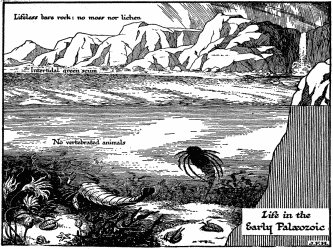
Life in the Early Palæozoic
Note its general resemblance, except for size, to the microscopic summer
ditch-water life of to-day.
Between the formation of these Lower Palæozoic rocks in which the sea scorpion and trilobite ruled, and our own time, there have intervened almost immeasurable ages, represented by layers and masses of sedimentary rocks. There are first the Upper Palæozoic Rocks, and above these the geologists distinguish two great divisions. Next above the Palæozoic come the Mesozoic (middle life) rocks, a second vast system of fossil-bearing rocks, representing perhaps a hundred millions of swift years, and containing a wonderful array of fossil remains, bones of giant reptiles and the like, which we will presently describe; and above these again are the Cainozoic (recent life) rocks, a third great volume in the history of life, an unfinished volume of which the sand and mud that was carried out to sea yesterday by the rivers of the world, to bury the bones and scales and bodies and tracks that will become at last fossils of the things of to-day, constitute the last written leaf.
(It is, we may note, the practice of many geologists to make a break between the rest of the Cainozoic system of rocks and those which contain traces of humanity, which latter are cut off as a separate system under the name of Quaternary. But that, as we shall see, is rather like taking the last page of a book, which is really the conclusion of the last chapter, and making a separate chapter of it and calling it the last chapter.)
These markings and fossils in the rocks and the rocks themselves are our first historical documents. The history of life that men have puzzled out and are still puzzling out from them is called the Record of the Rocks. By studying this record men are slowly piecing together a story of life’s beginnings, and of the beginnings of our kind, of which our ancestors a century or so ago had no suspicion. But when we call these rocks and the fossils a record and a history, it must not be supposed that there is any sign of an orderly keeping of a record. It is merely that whatever happens leaves some trace, if only we are intelligent enough to detect the meaning of that trace. Nor are the rocks of the world in orderly layers one above the other, convenient for men to read. They are not like the books and pages of a library. They are torn, disrupted, interrupted, flung about, defaced, like a carelessly arranged office after it has experienced in succession a bombardment, a hostile military occupation, looting, an earthquake, riots, and a fire. And so it is that for countless generations this Record of the Rocks lay unsuspected beneath the feet of men. Fossils were known to the Ionian Greeks in the sixth century B.C.,[5] they were discussed at Alexandria by Eratosthenes and others in the third century B.C., a discussion which is summarized in Strabo’s Geography (?20-10 B.C.). They were known to the Latin poet Ovid, but he did not understand their nature. He thought they were the first rude efforts of creative power. They were noted by Arabic writers in the tenth century. Leonardo da Vinci, who lived so recently as the opening of the sixteenth century (1452-1519), was one of the first Europeans to grasp the real significance of fossils,[6] and it has been only within the last century and a half that man has begun the serious and sustained deciphering of these long-neglected early pages of his world’s history.
§ 2
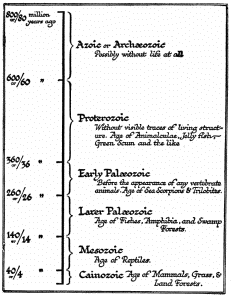
Speculations about geological time vary enormously.[7] Estimates of the age of the oldest rocks by geologists and astronomers starting from different standpoints have varied between 1,600,000,000, and 25,000,000. The lowest estimate was made by Lord Kelvin in 1867. Professor Huxley guessed at 400,000,000 years. There is a summary of views and the grounds upon which the estimates have been made in Osborn’s Origin and Evolution of Life; he inclines to the moderate total of 100,000,000. It must be clearly understood by the reader how sketchy and provisional all these time estimates are. They rest nearly always upon theoretical assumptions of the slenderest kind. That the period of time has been vast, that it is to be counted by scores and possibly by hundreds of millions of years, is the utmost that can be said with certainty in the matter. It is quite open to the reader to divide every number in the appended time diagram by ten or multiply it by two; no one can gainsay him. Of the relative amount of time as between one age and another we have, however, stronger evidence; if the reader cuts down the 800,000,000 we have given here to 400,000,000, then he must reduce the 40,000,000 of the Cainozoic to 20,000,000. And be it noted that whatever the total sum may be, most geologists are in agreement that half or more than half of the whole of geological time had passed before life had developed to the Later Palæozoic level. The reader reading quickly through these opening chapters may be apt to think of them as a mere swift prelude of preparation to the apparently much longer history that follows, but in reality that subsequent history is longer only because it is more detailed and more interesting to us. It looms larger in perspective. For ages that stagger the imagination this earth spun hot and lifeless, and again for ages of equal vastness it held no life above the level of the animalculæ in a drop of ditch-water.
Not only is Space from the point of view of life and humanity empty, but Time is empty also. Life is like a little glow, scarcely kindled yet, in these void immensities.
III
NATURAL SELECTION AND THE CHANGES OF SPECIES
NOW here it will be well to put plainly certain general facts about this new thing, life, that was creeping in the shallow waters and intertidal muds of the early Palæozoic period, and which is perhaps confined to our planet alone in all the immensity of space.
Life differs from all things whatever that are without life in certain general aspects. There are the most wonderful differences among living things to-day, but all living things past and present agree in possessing a certain power of growth, all living things take nourishment, all living things move about as they feed and grow, though the movement may be no more than the spread of roots through the soil, or of branches in the air. Moreover, living things reproduce; they give rise to other living things, either by growing and then dividing or by means of seeds or spores or eggs or other ways of producing young. Reproduction is a characteristic of life.
No living thing goes on living forever. There seems to be a limit of growth for every kind of living thing. Among very small and simple living things, such as that microscopic blob of living matter the Amæba, an individual may grow and then divide completely into two new individuals, which again may divide in their turn. Many other microscopic creatures live actively for a time, grow, and then become quiet and inactive, enclose themselves in an outer covering and break up wholly into a number of still smaller things, spores, which are released and scattered and again grow into the likeness of their parent. Among more complex creatures the reproduction is not usually such simple division, though division does occur even in the case of many creatures big enough to be visible to the unassisted eye. But the rule with almost all larger beings is that the individual grows up to a certain limit of size. Then, before it becomes unwieldy, its growth declines and stops. As it reaches its full size it matures, it begins to produce young, which are either born alive or hatched from eggs. But all of its body does not produce young. Only a special part does that. After the individual has lived and produced offspring for some time, it ages and dies. It does so by a sort of necessity. There is a practical limit to its life as well as to its growth. These things are as true of plants as they are of animals. And they are not true of things that do not live. Non-living things, such as crystals, grow, but they have no set limits of growth or size, they do not move of their own accord and there is no stir within them. Crystals once formed may last unchanged for millions of years. There is no reproduction for any non-living thing.
This growth and dying and reproduction of living things leads to some very wonderful consequences. The young which a living thing produces are either directly, or after some intermediate stages and changes (such as the changes of a caterpillar and butterfly), like the parent living thing. But they are never exactly like it or like each other. There is always a slight difference, which we speak of as individuality. A thousand butterflies this year may produce two or three thousand next year; these latter will look to us almost exactly like their predecessors, but each one will have just that slight difference. It is hard for us to see individuality in butterflies because we do not observe them very closely, but it is easy for us to see it in men. All the men and women in the world now are descended from the men and women of A.D. 1800, but not one of us now is exactly the same as one of that vanished generation. And what is true of men and butterflies is true of every sort of living thing, of plants as of animals. Every species changes all its individualities in each generation. That is as true of all the minute creatures that swarmed and reproduced and died in the Archæozoic and Proterozoic seas, as it is of men to-day.
Every species of living things is continually dying and being born again, as a multitude of fresh individuals.
Consider, then, what must happen to a new-born generation of living things of any species. Some of the individuals will be stronger or sturdier or better suited to succeed in life in some way than the rest, many individuals will be weaker or less suited. In particular single cases any sort of luck or accident may occur, but on the whole the better equipped individuals will live and grow up and reproduce themselves and the weaker will as a rule go under. The latter will be less able to get food, to fight their enemies and pull through. So that in each generation there is as it were a picking over of a species, a picking out of most of the weak or unsuitable and a preference for the strong and suitable. This process is called Natural Selection or the Survival of the Fittest.[8]
It follows, therefore, from the fact that living things grow and breed and die, that every species, so long as the conditions under which it lives remain the same, becomes more and more perfectly fitted to those conditions in every generation.
But now suppose those conditions change, then the sort of individual that used to succeed may now fail to succeed and a sort of individual that could not get on at all under the old conditions may now find its opportunity. These species will change, therefore, generation by generation; the old sort of individual that used to prosper and dominate will fail and die out and the new sort of individual will become the rule,—until the general character of the species changes.
Suppose, for example, there is some little furry whitey-brown animal living in a bitterly cold land which is usually under snow. Such individuals as have the thickest, whitest fur will be least hurt by the cold, less seen by their enemies, and less conspicuous as they seek their prey. The fur of this species will thicken and its whiteness increase with every generation, until there is no advantage in carrying any more fur.
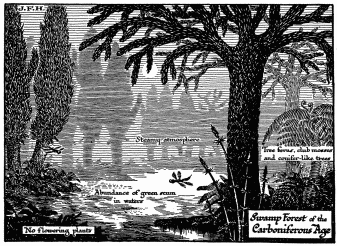
Diagram of Life in the Later Palæozoic Age.
Life is creeping out of the water. An insect like a dragon fly is shown.
There were amphibia like gigantic newts and salamanders, and even
primitive reptiles in these swamps.
Imagine now a change of climate that brings warmth into the land, sweeps away the snows, makes white creatures glaringly visible during the greater part of the year and thick fur an encumbrance. Then every individual with a touch of brown in its colouring and a thinner fur will find itself at an advantage, and very white and heavy fur will be a handicap. There will be a weeding out of the white in favour of the brown in each generation. If this change of climate come about too quickly, it may of course exterminate the species altogether; but if it come about gradually, the species, although it may have a hard time, may yet be able to change itself and adapt itself generation by generation. This change and adaptation is called the Modification of Species.
Perhaps this change of climate does not occur all over the lands inhabited by the species; maybe it occurs only on one side of some great arm of the sea or some great mountain range or such-like divide, and not on the other. A warm ocean current like the Gulf Stream may be deflected, and flow so as to warm one side of the barrier, leaving the other still cold. Then on the cold side this species will still be going on to its utmost possible furriness and whiteness and on the other side it will be modifying towards brownness and a thinner coat. At the same time there will probably be other changes going on; a difference in the paws perhaps, because one half of the species will be frequently scratching through snow for its food, while the other will be scampering over brown earth. Probably also the difference of climate will mean differences in the sort of food available, and that may produce differences in the teeth and the digestive organs. And there may be changes in the sweat and oil glands of the skin due to the changes in the fur, and these will affect the excretory organs and all the internal chemistry of the body. And so through all the structure of the creature. A time will come when the two separated varieties of this formerly single species will become so unlike each other as to be recognizably different species. Such a splitting up of a species in the course of generations into two or more species is called the Differentiation of Species.
And it should be clear to the reader that given these elemental facts of life, given growth and death and reproduction with individual variation in a world that changes, life must change in this way, modification and differentiation must occur, old species must disappear, and new ones appear. We have chosen for our instance here a familiar sort of animal, but what is true of furry beasts in snow and ice is true of all life, and equally true of the soft jellies and simple beginnings that flowed and crawled for hundreds of millions of years between the tidal levels and in the shallow, warm waters of the Proterozoic seas.
The early life of the early world, when the blazing sun rose and set in only a quarter of the time it now takes, when the warm seas poured in great tides over the sandy and muddy shores of the rocky lands and the air was full of clouds and steam, must have been modified and varied and species must have developed at a great pace. Life was probably as swift and short as the days and years; the generations, which natural selection picked over, followed one another in rapid succession.
Natural selection is a slower process with man than with any other creature. It takes twenty years or more before an ordinary human being in western Europe grows up and reproduces. In the case of most animals the new generation is on trial in a year or less. With such simple and lowly beings, however, as first appeared in the primordial seas, growth and reproduction was probably a matter of a few brief hours or even of a few brief minutes. Modification and differentiation of species must accordingly have been extremely rapid, and life had already developed a very great variety of widely contrasted forms before it began to leave traces in the rocks. The Record of the Rocks does not begin, therefore, with any group of closely related forms from which all subsequent and existing creatures are descended. It begins in the midst of the game, with nearly every main division of the animal kingdom already represented.[9] Plants are already plants, and animals animals. The curtain rises on a drama in the sea that has already begun, and has been going on for some time. The brachiopods are discovered already in their shells, accepting and consuming much the same sort of food that oysters and mussels do now; the great water scorpions crawl among the seaweeds, the trilobites roll up into balls and unroll and scuttle away. In that ancient mud and among those early weeds there was probably as rich and abundant and active a life of infusoria and the like as one finds in a drop of ditch-water to-day. In the ocean waters, too, down to the utmost downward limit to which light could filter, then as now, there was an abundance of minute and translucent, and in many cases phosphorescent, beings.
But though the ocean and intertidal waters already swarmed with life, the land above the high-tide line was still, so far as we can guess, a stony wilderness without a trace of life.