
§ 1. Life and Water. § 2. The Earliest Animals.
§ 1
WHEREVER the shore line ran there was life, and that life went on in and by and with water as its home, its medium, and its fundamental necessity.
The first jelly-like beginnings of life must have perished whenever they got out of the water, as jelly-fish dry up and perish on our beaches to-day. Drying up was the fatal thing for life in those days, against which at first it had no protection. But in a world of rain-pools and shallow seas and tides, any variation that enabled a living thing to hold out and keep its moisture during hours of low tide of drought met with every encouragement in the circumstances of the time. There must have been a constant risk of stranding. And, on the other hand, life had to keep rather near the shore and beaches in the shallows because it had need of air (dissolved of course in the water) and light.
No creature can breathe, no creature can digest its food, without water. We talk of breathing air, but what all living things really do is to breathe oxygen dissolved in water. The air we ourselves breathe must first be dissolved in the moisture in our lungs; and all our food must be liquefied before it can be assimilated. Water-living creatures which are always under water, wave the freely exposed gills by which they breathe in that water, and extract the air dissolved in it. But a creature that is to be exposed for any time out of the water, must have its body and its breathing apparatus protected from drying up. Before the seaweeds could creep up out of the Early Palæozoic seas into the intertidal line of the beach, they had to develop a tougher outer skin to hold their moisture. Before the ancestor of the sea scorpion could survive being left by the tide it had to develop its casing and armour. The trilobites probably developed their tough covering and rolled up into balls, far less as a protection against each other and any other enemies they may have possessed, than as a precaution against drying. And when presently, as we ascend the Palæozoic rocks, the fish appear, first of all the backboned or vertebrated animals, it is evident that a number of them are already adapted by the protection of their gills with gill covers and by a sort of primitive lung swimming-bladder, to face the same risk of temporary stranding.
Now the weeds and plants that were adapting themselves to intertidal conditions were also bringing themselves into a region of brighter light, and light is very necessary and precious to all plants. Any development of structure that would stiffen them and hold them up to the light, so that instead of crumpling and flopping when the waters receded, they would stand up outspread, was a great advantage. And so we find them developing fibre and support, and the beginning of woody fibre in them. The early plants reproduced by soft spores, or half-animal “gametes,” that were released in water, were distributed by water and could only germinate under water. The early plants were tied, and most lowly plants to-day are tied, by the conditions of their life cycle, to water. But here again there was a great advantage to be got by the development of some protection of the spores from drought that would enable reproduction to occur without submergence. So soon as a species could do that, it could live and reproduce and spread above the high-water mark, bathed in light and out of reach of the beating and distress of the waves. The main classificatory divisions of the larger plants mark stages in the release of plant life from the necessity of submergence by the development of woody support and of a method of reproduction that is more and more defiant of drying up. The lower plants are still the prisoner attendants of water. The lower mosses must live in damp, and even the development of the spore of the ferns demands at certain stages extreme wetness. The highest plants have carried freedom from water so far that they can live and reproduce if only there is some moisture in the soil below them. They have solved their problem of living out of water altogether.
The essentials of that problem were worked out through the vast æons of the Proterozoic Age and the early Palæozoic Age by nature’s method of experiment and trial. Then slowly, but in great abundance, a variety of new plants began to swarm away from the sea and over the lower lands, still keeping to swamp and lagoon and watercourse as they spread.
§ 2
And after the plants came the animal life.
There is no sort of land animal in the world, as there is no sort of land plant, whose structure is not primarily that of a water-inhabiting being which has been adapted through the modification and differentiation of species to life out of the water. This adaptation is attained in various ways. In the case of the land scorpion the gill-plates of the primitive sea scorpion are sunken into the body so as to make the lung-books secure from rapid evaporation. The gills of crustaceans, such as the crabs which run about in the air, are protected by the gill-cover extensions of the back shell or carapace. The ancestors of the insects developed a system of air pouches and air tubes, the tracheal tubes, which carry the air all over the body before it is dissolved. In the case of the vertebrated land animals, the gills of the ancestral fish were first supplemented and then replaced by a bag-like growth from the throat, the primitive lung swimming-bladder. To this day there survive certain mudfish which enable us to understand very clearly the method by which the vertebrated land animals worked their way out of the water. These creatures (e.g. the African lung fish) are found in tropical regions in which there is a rainy full season and a dry season, during which the rivers become mere ditches of baked mud. During the rainy season these fish swim about and breathe by gills like any other fish. As the waters of the river evaporate, these fish bury themselves in the mud, their gills go out of action, and the creature keeps itself alive until the waters return by swallowing air, which passes into its swimming-bladder. The Australian lung fish, when it is caught by the drying up of the river in stagnant pools, and the water has become deaerated and foul, rises to the surface and gulps air. A newt in a pond does exactly the same thing. These creatures still remain at the transition stage, the stage at which the ancestors of the higher vertebrated animals were released from their restriction to an under-water life.
The amphibia (frogs, newts, tritons, etc.) still show in their life history all the stages in the process of this liberation. They are still dependent on water for their reproduction; their eggs must be laid in sunlit water, and there they must develop. The young tadpole has branching external gills that wave in the water; then a gill cover grows back over them and forms a gill chamber. Then, as the creature’s legs appear and its tail is absorbed, it begins to use its lungs, and its gills dwindle and vanish. The adult frog can live all the rest of its days in the air, but it can be drowned if it is kept steadfastly below water. When we come to the reptile, however, we find an egg which is protected from evaporation by a tough egg case, and this egg produces young which breathe by lungs from the very moment of hatching. The reptile is on all fours with the seeding plant in its freedom from the necessity to pass any stage of its life cycle in water.

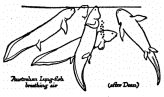
Australian Lung fish breathing air
The later Palæozoic Rocks of the northern hemisphere give us the materials for a series of pictures of this slow spreading of life over the land. Geographically, all round the northern half of the world it was an age of lagoons and shallow seas very favourable to this invasion. The new plants, now that they had acquired the power to live this new aerial life, developed with an extraordinary richness and variety.
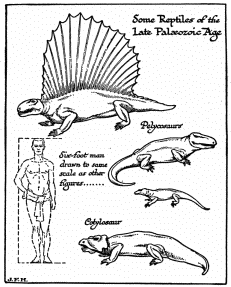
Some Reptiles of the Late Palæozoic Age
There were as yet no true flowering plants,[10] no grasses nor trees that shed their leaves in winter;[11] the first “flora” consisted of great tree ferns, gigantic equisetums, cycad ferns, and kindred vegetation. Many of these plants took the form of huge-stemmed trees, of which great multitudes of trunks survive fossilized to this day. Some of these trees were over a hundred feet high, of orders and classes now vanished from the world. They stood with their stems in the water, in which no doubt there was a thick tangle of soft mosses and green slime and fungoid growths that left few plain vestiges behind them. The abundant remains of these first swamp forests constitute the main coal-measures of the world to-day.
Amidst this luxuriant primitive vegetation crawled and glided and flew the first insects. They were rigid-winged, four-winged creatures, often very big, some of them having wings measuring a foot in length. There were numerous dragon flies—one found in the Belgian coal-measures had a wing span of twenty-nine inches! There were also a great variety of flying cockroaches. Scorpions abounded, and a number of early spiders, which, however, had no spinnerets for web making.[12] Land snails appeared. So too did the first-known step of our own ancestry upon land, the amphibia. As we ascend the higher levels of the Later Palæozoic record, we find the process of air adaptation has gone as far as the appearance of true reptiles amidst the abundant and various amphibia.
The land life of the Upper Palæozoic Age was the life of a green swamp forest without flowers or birds or the noises of modern insects. There were no big land beasts at all; wallowing amphibia and primitive reptiles were the very highest creatures that life had so far produced. Whatever land lay away from the water or high above the water was still altogether barren and lifeless. But steadfastly, generation by generation, life was creeping away from the shallow sea-water of its beginning.
V
CHANGES IN THE WORLD’S CLIMATE
§ 1. Why Life Must Change Continually. § 2. The Sun a Steadfast Star. § 3. Changes from Within the Earth. § 4. Life May Control Change.
§ 1
THE Record of the Rocks is like a great book that has been carelessly misused. All its pages are torn, worn, and defaced, and many are altogether missing. The outline of the story that we sketch here has been pieced together slowly and painfully in an investigation that is still incomplete and still in progress. The Carboniferous Rocks, the “coal-measures,” give us a vision of the first great expansion of life over the wet lowlands. Then come the torn pages known as the Permian Rocks (which count as the last of the Palæozoic), that preserve very little for us of the land vestiges of their age. Only after a long interval of time does the history spread out generously again.
It must be borne in mind that great changes of climate have always been in progress, that have sometimes stimulated and sometimes checked life. Every species of living thing is always adapting itself more and more closely to its conditions. And conditions are always changing. There is no finality in adaptation. There is a continuing urgency towards fresh change.
About these changes of climate some explanations are necessary here. They are not regular changes; they are slow fluctuations between heat and cold. The reader must not think that because the sun and earth were once incandescent, the climatic history of the world is a simple story of cooling down. The centre of the earth is certainly very hot to this day, but we feel nothing of that internal heat at the surface; the internal heat, except for volcanoes and hot springs, has not been perceptible at the surface since first the rocks grew solid. Even in the Azoic or Archæozoic Age there are traces in ice-worn rocks and the like of periods of intense cold. Such cold waves have always been going on everywhere, alternately with warmer conditions. And there have been periods of great wetness and periods of great dryness throughout the earth.
A complete account of the causes of these great climatic fluctuations has still to be worked out, but we may perhaps point out some of the chief of them.[13] Prominent among them is the fact that the earth does not spin in a perfect circle round the sun. Its path or orbit is like a hoop that is distorted; it is, roughly speaking, elliptical (ovo-elliptical), and the sun is nearer to one end of the ellipse than the other. It is at a point which is a focus of the ellipse. And the shape of this orbit never remains the same. It is slowly distorted by the attractions of the other planets, for ages it may be nearly circular, for ages it is more or less elliptical. As the ellipse becomes most nearly circular, then the focus becomes most nearly the centre. When the orbit becomes most elliptical, then the position of the sun becomes most remote from the middle or, to use the astronomer’s phrase, most eccentric. When the orbit is most nearly circular, then it must be manifest that all the year round the earth must be getting much the same amount of heat from the sun; when the orbit is most distorted, then there will be a season in each year when the earth is nearest the sun (this phase is called Perihelion) and getting a great deal of heat comparatively, and a season when it will be at its farthest from the sun (Aphelion) and getting very little warmth. A planet at aphelion is travelling its slowest, and its fastest at perihelion; so that the hot part of its year will last for a much less time than the cold part of its year. (Sir Robert Ball calculated that the greatest difference possible between the seasons was thirty-three days.) During ages when the orbit is most nearly circular there will therefore be least extremes of climate, and when the orbit is at its greatest eccentricity, there will be an age of cold with great extremes of seasonal temperature. These changes in the orbit of the earth are due to the varying pull of all the planets, and Sir Robert Ball declared himself unable to calculate any regular cycle of orbital change, but Professor G. H. Darwin maintained that it is possible to make out a kind of cycle between greatest and least eccentricity of about 200,000 years.
But this change in the shape of the orbit is only one cause of the change of the world’s climate. There are many others that have to be considered with it. As most people know, the change in the seasons is due to the fact that the equator of the earth is inclined at an angle to the plane of its orbit. If the earth stood up straight in its orbit, so that its equator was in the plane of its orbit, there would be no change in the seasons at all. The sun would always be overhead at the equator, and the day and night would each be exactly twelve hours long throughout the year everywhere. It is this inclination which causes the difference in the seasons and the unequal length of the day in summer and winter. There is, according to Laplace, a possible variation of nearly three degrees (from 22° 6’ to 24° 50’) in this inclination of the equator to the orbit, and when this is at a maximum, the difference between summer and winter is at its greatest. Great importance has been attached to this variation in the inclination of the equator to the orbit by Dr. Croll in his book Climate and Time. At present the angle is 23° 27’. Manifestly when the angle is at its least, the world’s climate, other things being equal, will be most equable.
And as a third important factor there is what is called the precession of the equinoxes. This is a slow wabble of the pole of the spinning earth that takes 25,000 odd years. Any one who watches a spinning top as it “sleeps,” will see its axis making a slow circular movement, exactly after the fashion of this circling movement of the earth’s axis. The north pole, therefore, does not always point to the same north point among the stars; its pointing traces out a circle in the heavens every 25,000 years.
Now, there will be times when the earth is at its extreme of aphelion or of perihelion, when one hemisphere will be most turned to the sun in its midsummer position and the other most turned away at its midwinter position. And as the precession of the equinoxes goes on, a time will come when the summer-winter position will come not at aphelion and perihelion, but at the half-way points between them. When the summer of one hemisphere happens at perihelion and the winter at aphelion, it will be clear that the summer of the other hemisphere will happen at aphelion and its winter at perihelion. One hemisphere will have a short hot summer and a very cold winter, and the other a long cold summer and a briefer warmish winter. But when the summer-winter positions come at the half-way point of the orbit, and it is the spring of one hemisphere and the autumn of the other that is at aphelion or perihelion, there will not be the same wide difference between the climate of the two hemispheres.
Here are three wavering systems of change all going on independently of each other; the precession of the equinoxes, the change in the obliquity of the equator to the orbit, and the changes in the eccentricity of the orbit. Each system tends by itself to produce periods of equability and periods of greater climatic contrast. And all these systems of change interplay with each other. When it happens that at the same time the orbit is most nearly circular, the equator is at its least inclination from the plane of the earth’s orbit, and the spring and autumn are at perihelion and aphelion, then all these causes will be conspiring to make climate warm and uniform; there will be least difference of summer and winter. When, on the other hand, the orbit is in its most eccentric stage of deformation, when also the equator is most tilted up and when further the summer and winter are at aphelion and perihelion, then climates will be at their extremest and winter at its bitterest. There will be great accumulations of ice and snow in winter; the heat of the brief hot summer will be partly reflected back into space by the white snow, and it will be unequal to the task of melting all the winter’s ice before the earth spins away once more towards its chilly aphelion. The earth will accumulate cold so long as this conspiracy of extreme conditions continues.
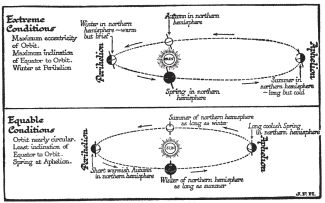
Diagram To Illustrate One Set of Causes, the Astronomical
Variations, Which Make the Climate of the World Change Slowly but
Continuously.
It does not change in regular periods. It fluctuates through vast ages.
As the world’s climate changes, life must change too or perish.
So our earth’s climate changes and wavers perpetually as these three systems of influence come together with a common tendency towards warmth or severity, or as they contradict and cancel each other.
We can trace in the Record of the Rocks an irregular series of changes due to the interplay of these influences; there have been great ages when the separate rhythms of these three systems kept them out of agreement and the atmosphere was temperate, ages of world-wide warmth, and other ages when they seemed to concentrate bitterly to their utmost extremity, to freeze out and inflict the utmost stresses and hardship upon life.
And in accordance we find from the record in the rocks that there have been long periods of expansion and multiplication when life flowed and abounded and varied, and harsh ages when there was a great weeding out and disappearance of species, genera, and classes, and the learning of stern lessons by all that survived. Such a propitious conjunction it must have been that gave the age of luxuriant low-grade growth of the coal-measures; such an adverse series of circumstances that chilled the closing æons of the Palæozoic time.
It is probable that the warm spells have been long relatively to the cold ages. Our world to-day seems to be emerging with fluctuations from a prolonged phase of adversity and extreme conditions. Half a million years ahead it may be a winterless world with trees and vegetation even in the polar circles. At present we have no certainty in such a forecast, but later on, as knowledge increases, it may be possible to reckon with more precision, so that our race will make its plans thousands of years ahead to meet the coming changes.
§ 2
Another entirely different cause of changes in the general climate of the earth may be due to variations in the heat of the sun. We do not yet understand what causes the heat of the sun or what sustains that undying fire. It is possible that in the past there have been periods of greater and lesser intensity. About that we know nothing; human experience has been too short; and so far we have been able to find no evidence on this matter in the geological record. On the whole, scientific men are inclined to believe that the sun has blazed with a general steadfastness throughout geological time. It may have been cooling slowly, but, speaking upon the scale of things astronomical, it has certainly not cooled very much.
§ 3
A third great group of causes influencing climate are to be found in the forces within the world itself. Throughout the long history of the earth there has been a continuous wearing down of the hills and mountains by frost and rain and a carrying out of their material to become sedimentary rocks under the seas. There has been a continuous process of wearing down the land and filling up the seas, by which the seas, as they became shallower, must have spread more and more over the land. The reverse process, a process of crumpling and upheaval, has also been in progress, but less regularly. The forces of upheaval have been spasmodic; the forces of wearing down continuous. For long ages there has been comparatively little volcanic upheaval, and then have come periods in which vast mountain chains have been thrust up and the whole outline of land and sea changed. Such a time was the opening stage of the Cainozoic period, in which the Alps, the Himalayas, and the Andes were all thrust up from the sea-level to far beyond their present elevations, and the main outlines of the existing geography of the world were drawn.
Now, a time of high mountains and deep seas would mean a larger dry land surface for the world, and a more restricted sea surface, and a time of low lands would mean a time of wider and shallower seas. High mountains precipitate moisture from the atmosphere and hold it out of circulation as snow and glaciers, while smaller oceans mean a lesser area for surface evaporation. Other things being equal, lowland stages of the world’s history would be ages of more general atmospheric moisture than periods of relatively greater height of the mountains and greater depth of the seas. But even small increases in the amount of moisture in the air have a powerful influence upon the transmission of radiant heat through that air. The sun’s heat will pass much more freely through dry air than through moist air, and so a greater amount of heat would reach the land surfaces of the globe under the conditions of extremes of elevation and depth, than during the periods of relative lowness and shallowness. Dry phases in the history of the earth mean, therefore, hot days. But they also mean cold nights, because for the same reason that the heat comes abundantly to the earth, it will be abundantly radiated away. Moist phases mean, on the other hand, cooler days and warmer nights. The same principle applies to the seasons, and so a phase of great elevations and depressions of the surface would also be another contributory factor on the side of extreme climatic conditions.
And a stage of greater elevation and depression would intensify its extreme conditions by the gradual accumulation of ice caps upon the polar regions and upon the more elevated mountain masses. This accumulation would be at the expense of the sea, whose surface would thus be further shrunken in comparison with the land.
Here, then, is another set of varying influences that will play in with and help or check the influence of the astronomical variations stated in § 1 and § 2. There are other more localized forces at work into which we cannot go in any detail here, but which will be familiar to the student of the elements of physical geography; the influence of great ocean currents in carrying warmth from equatorial to more temperate latitudes; the interference of mountain chains with the moisture borne by prevalent winds and the like. As in the slow processes of nature these currents are deflected or the mountain chains worn down or displaced by fresh upheavals, the climate over great areas will be changed and all the conditions of life changed with it. Under the incessant slow variations of these astronomical, telluric, and geographical influences life has no rest. As its conditions change it must change or perish.
§ 4
And while we are enumerating the forces that change climate and the conditions of terrestrial life, we may perhaps look ahead a little and add a fourth set of influences, at first unimportant in the history of the world so far as the land surface is concerned, but becoming more important after the age of Reptiles, to which we shall proceed in our next chapter. These are the effects produced upon climate by life itself. Particularly great is the influence of vegetation, and especially that of forests. Every tree is continually transpiring water vapour into the air; the amount of water evaporated in summer by a lake surface is far less than the amount evaporated by the same area of beech forest. As in the later Mesozoic and the Cainozoic Age, great forests spread over the world, their action in keeping the air moist and mitigating and stabilizing climate by keeping the summer cool and the winter mild must have become more and more important. Moreover, forests accumulate and protect soil and so prepare the possibility of agricultural life.
Water-weeds again may accumulate to choke and deflect rivers, flood and convert great areas into marshes, and so lead to the destruction of forests or the replacement of grass-lands by boggy wildernesses.
Finally, with the appearance of human communities, came what is perhaps the most powerful of all living influences upon climate. By fire and plough and axe man alters his world. By destroying forests and by irrigation man has already affected the climate of great regions of the world’s surface. The destruction of forests makes the seasons more extreme; this has happened, for instance, in the northeastern states of the United States of America. Moreover, the soil is no longer protected from the scour of rain, and is washed away, leaving only barren rock beneath. This has happened in Spain and Dalmatia and, some thousands of years earlier, in South Arabia. By irrigation, on the other hand, man restores the desert to life and mitigates climate. This process is going on in Northwest India and Australia. In the future, by making such operations worldwide and systematic, man may be able to control climate to an extent at which as yet we can only guess.
VI
THE AGE OF REPTILES
§ 1. The Age of Lowland Life. § 2. Flying Dragons. § 3. The First Birds. § 4. An Age of Hardship and Death. § 5. The First Appearance of Fur and Feathers.
§ 1
WE know that for hundreds of thousands of years the wetness and warmth, the shallow lagoon conditions that made possible the vast accumulations of vegetable matter which, compressed and mummified,[14] are now coal, prevailed over most of the world. There were some cold intervals, it is true; but they did not last long enough to destroy the growths. Then that long age of luxuriant low-grade vegetation drew to its end, and for a time life on the earth seems to have undergone a period of world-wide bleakness.
When the story resumes again, we find life entering upon a fresh phase of richness and expansion. Vegetation has made great advances in the art of living out of water. While the Palæozoic plants of the coal-measures probably grew with swamp water flowing over their roots, the Mesozoic flora from its very outset included palm-like cycads and low-ground conifers that were distinctly land plants growing on soil above the water level. The lower levels of the Mesozoic land were no doubt covered by great fern brakes and shrubby bush and a kind of jungle growth of trees. But there existed as yet no grass, no small flowering plants, no turf nor greensward. Probably the Mesozoic was not an age of very brightly coloured vegetation. It must have had a flora green in the wet season and brown and purple in the dry. There were no gay flowers, no bright autumn tints before the fall of the leaf, because there was as yet no fall of the leaf. And beyond the lower levels the world was still barren, still unclothed, still exposed without any mitigation to the wear and tear of the wind and rain.
When one speaks of conifers in the Mesozoic the reader must not think of the pines and firs that clothe the high mountain slopes of our time. He must think of low-growing evergreens. The mountains were still as bare and lifeless as ever. The only colour effects among the mountains were the colour effects of naked rock, such colours as make the landscape of Colorado so marvellous to-day.
Amidst this spreading vegetation of the lower plains the reptiles were increasing mightily in multitude and variety. They were now in many cases absolutely land animals. There are numerous anatomical points of distinction between a reptile and an amphibian; they held good between such reptiles and amphibians as prevailed in the carboniferous time of the Upper Palæozoic; but the fundamental difference between reptiles and amphibia which matters in this history is that the amphibian must go back to the water to lay its eggs, and that in the early stages of its life it must live in and under water. The reptile, on the other hand, has cut out all the tadpole stages from its life cycle, or, to be more exact, its tadpole stages are got through before the young leave the egg case. The reptile has come out of the water altogether. Some had gone back to it again, just as the hippopotamus and the otter among mammals have gone back, but that is a further extension of the story to which we cannot give much attention in this Outline.
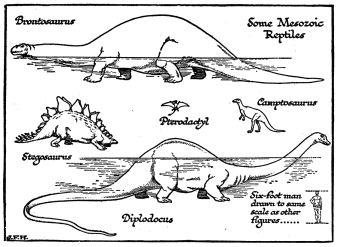
In the Palæozoic period, as we have said, life had not spread beyond the swampy river valleys and the borders of sea lagoons and the like; but in the Mesozoic, life was growing ever more accustomed to the thinner medium of the air, was sweeping boldly up over the plains and towards the hillsides. It is well for the student of human history and the human future to note that. If a disembodied intelligence with no knowledge of the future had come to earth and studied life during the early Palæozoic age, he might very reasonably have concluded that life was absolutely confined to the water, and that it could never spread over the land. It found a way. In the Later Palæozoic Period that visitant might have been equally sure that life could not go beyond the edge of a swamp. The Mesozoic Period would still have found him setting bounds to life far more limited than the bounds that are set to-day. And so to-day, though we mark how life and man are still limited to five miles of air and a depth of perhaps a mile or so of sea, we must not conclude from that present limitation that life, through man, may not presently spread out and up and down to a range of living as yet inconceivable.
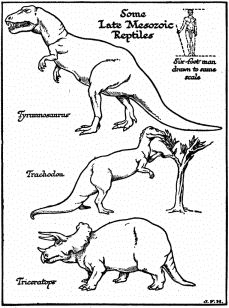
The earliest known reptiles were beasts with great bellies and not very powerful legs, very like their kindred amphibia, wallowing as the crocodile wallows to this day; but in the Mesozoic they soon began to stand up and go stoutly on all fours, and several great sections of them began to balance themselves on tail and hind legs, rather as the kangaroos do now, in order to release the fore limbs for grasping food. The bones of one notable division of reptiles which retained a quadrupedal habit, a division of which many remains have been found in South African and Russian Early Mesozoic deposits, display a number of characters which approach those of the mammalian skeleton, and because of this resemblance to the mammals (beasts) this division is called the Theriomorpha (beastlike). Another division was the crocodile branch, and another developed towards the tortoises and turtles. The Plesiosaurs and Ichthyosaurs were two groups which have left no living representatives; they were huge reptiles returning to a whale-like life in the sea. Pliosaurus, one of the largest plesiosaurs, measured thirty feet from snout to tail tip—of which half was neck. The Mosasaurs were a third group of great porpoise-like marine lizards. But the largest and most diversified group of these Mesozoic reptiles was the group we have spoken of as kangaroo-like, the Dinosaurs, many of which attained enormous proportions. In bigness these greater Dinosaurs have never been exceeded, although the sea can still show in the whales creatures as great. Some of these, and the largest among them, were herbivorous animals; they browsed on the rushy vegetation and among the ferns and bushes, or they stood up and grasped trees with their fore legs while they devoured the foliage. Among the browsers, for example, were the Diplodocus carnegii, which measured eighty=four feet in length, and the Atlantosaurus. The Gigantosaurus, disinterred by a German expedition in 1912 from rocks in East Africa, was still more colossal. It measured well over a hundred feet! These greater monsters had legs, and they are usually figured as standing up on them; but it is very doubtful if they could have supported their weight in this way, out of water. Buoyed up by water or mud, they may have got along. Another noteworthy type we have figured is the Triceratops. There were also a number of great flesh-eaters who preyed upon these herbivores. Of these, Tyrannosaurus seems almost the last word in “frightfulness” among living things. Some species of this genus measured forty feet from snout to tail. Apparently it carried this vast body kangaroo fashion on its tail and hind legs. Probably it reared itself up. Some authorities even suppose that it leapt through the air. If so, it possessed muscles of a quite miraculous quality. A leaping elephant would be a far less astounding idea. Much more probably it waded half submerged in pursuit of the herbivorous river saurians.
§ 2
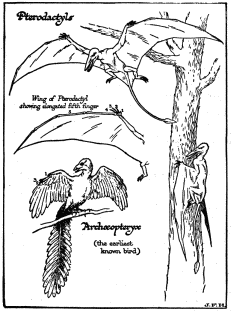
One special development of the dinosaurian type of reptile was a light, hopping, climbing group of creatures which developed a bat-like web between the fifth finger and the side of the body, which was used in gliding from tree to tree after the fashion of the flying squirrels. These bat-lizards were the Pterodactyls. They are often described as flying reptiles, and pictures are drawn of Mesozoic scenery in which they are seen soaring and swooping about. But their breastbone has no keel such as the breastbone of a bird has for the attachment of muscles strong enough for long-sustained flying. They must have flitted about like bats. They must have had a grotesque resemblance to heraldic dragons, and they played the part of bat-like birds in the Mesozoic jungles. But bird-like though they were, they were not birds nor the ancestors of birds. The structure of their wings was altogether different from that of birds. The structure of their wings was that of a hand with one long finger and a web; the wing of a bird is like an arm with feathers projecting from its hind edge. And these Pterodactyls had no feathers.
§ 3
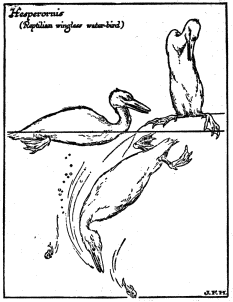
Far less prevalent at this time were certain other truly birdlike creatures, of which the earlier sorts also hopped and clambered and the later sorts skimmed and flew. These were at first—by all the standards of classification—Reptiles. They developed into true birds as they developed wings and as their reptilian scales became long and complicated, fronds rather than scales, and so at last, by much spreading and splitting, feathers. Feathers are the distinctive covering of birds, and they give a power of resisting heat and cold far greater than that of any other integumentary covering except perhaps the thickest fur. At a very early stage this novel covering of feathers, this new heatproof contrivance that life had chanced upon, enabled many species of birds to invade a province for which the pterodactyl was ill equipped. They took to sea fishing—if indeed they did not begin with it—and spread to the north and south polewards beyond the temperature limits set to the true reptiles. The earliest birds seem to have been carnivorous divers and water birds. To this day some of the most primitive bird forms are found among the sea birds of the Arctic and Antarctic seas, and it is among these sea birds that zoologists still find lingering traces of teeth, which have otherwise vanished completely from the beak of the bird.
The earliest known bird (the Archæopteryx) had no beak; it had a row of teeth in a jaw like a reptile’s. It had three claws at the forward corner of its wing. Its tail too was peculiar. All modern birds have their tail feathers set in a short compact bony rump; the Archæopteryx had a long bony tail with a row of feathers along each side.
§ 4
This great period of Mesozoic life, this second volume of the book of life, is indeed an amazing story of reptilian life proliferating and developing. But the most striking thing of all the story remains to be told. Right up to the latest Mesozoic Rocks we find all these reptilian orders we have enumerated still flourishing unchallenged. There is no hint of an enemy or competitor to them in the relics we find of their world. Then the record is broken. We do not know how long a time the break represents; many pages may be missing here, pages that may represent some great cataclysmal climatic change. When next we find abundant traces of the land plants and the land animals of the earth, this great multitude of reptile species had gone. For the most part they have left no descendants. They have been “wiped out.” The pterodactyls have gone absolutely; of the plesiosaurs and ichthyosaurs none is alive; the mosasaurs have gone; of the lizards a few remain, the monitor of the Dutch East Indies is the largest; all the multitude and diversity of the dinosaurs have vanished. Only the crocodiles and the turtles and tortoises carry on in any quantity into Cainozoic times. The place of all these types in the picture that the Cainozoic fossils presently unfold to us is taken by other animals not closely related to the Mesozoic reptiles and certainly not descended from any of their ruling types. A new kind of life is in possession of the world.
This apparently abrupt ending up of the reptiles is, beyond all question, the most striking revolution in the whole history of the earth before the coming of mankind. It is probably connected with the close of a vast period of equable warm conditions and the onset of a new austerer age, in which the winters were bitterer and the summers brief but hot. The Mesozoic life, animal and vegetable alike, was adapted to warm conditions and capable of little resistance to cold. The new life, on the other hand, was before all things capable of resisting great changes of temperature.
Whatever it was that led to the extinction of the Mesozoic reptiles, it was probably some very far-reaching change indeed, for the life of the seas did at the same time undergo a similar catastrophic alteration. The crescendo and ending of the Reptiles on land was paralleled by the crescendo and ending of the Ammonites, a division of creatures like squids with coiled shells which swarmed in those ancient seas. All through the rocky record of this Mesozoic period there is a vast multitude and variety of these coiled shells; there are hundreds of species, and towards the end of the Mesozoic period they increased in diversity and produced exaggerated types. When the record resumes, these too have gone. So far as the reptiles are concerned, people may perhaps be inclined to argue that they were exterminated because the Mammals that replaced them competed with them, and were more fitted to survive; but nothing of the sort can be true of the Ammonites, because to this day their place has not been taken. Simply they are gone. Unknown conditions made it possible for them to live in the Mesozoic seas, and then some unknown change made life impossible for them. No genus of Ammonite survives to-day of all that vast variety, but there still exists one isolated genus very closely related to the Ammonites, the Pearly Nautilus. It is found, it is to be noted, in the warm waters of the Indian and Pacific oceans.[15]
And as for the Mammals competing with and ousting the less fit reptiles, a struggle of which people talk at times, there is not a scrap of evidence of any such direct competition. To judge by the Record of the Rocks as we know it to-day, there is much more reason for believing that first the reptiles in some inexplicable way perished, and then that later on, after a very hard time for all life upon the earth, the mammals, as conditions became more genial again, developed and spread to fill the vacant world.
§ 5
Were there mammals in the Mesozoic period?
This is a question not yet to be answered precisely. Patiently and steadily the geologists gather fresh evidence and reason out completer conclusions. At any time some new deposit may reveal fossils that will illuminate this question. Certainly either mammals, or the ancestors of the mammals, must have lived throughout the Mesozoic period. In the very opening chapter of the Mesozoic volume of the Record there were those Theriomorphous Reptiles to which we have already alluded, and in the later Mesozoic a number of small jaw-bones are found, entirely mammalian in character. But there is not a scrap, not a bone, to suggest that there lived any Mesozoic Mammal which could look a dinosaur in the face. The Mesozoic mammals or mammal-like reptiles—for we do not know clearly which they were—seem to have been all obscure little beasts of the size of mice and rats, more like a down-trodden order of reptiles than a distinct class; probably they still laid eggs and were developing only slowly their distinctive covering of hair. They lived away from big waters, and perhaps in the desolate uplands, as marmots do now; probably they lived there beyond the pursuit of the carnivorous dinosaurs. Some perhaps went on all fours, some chiefly went on their hind legs and clambered with their fore limbs. They became fossils only so occasionally that chance has not yet revealed a single complete skeleton in the whole vast record of the Mesozoic rocks by which to check these guesses.
These little Theriomorphs, these ancestral mammals, developed hair. Hairs, like feathers, are long and elaborately specialized scales. Hair is perhaps the clue to the salvation of the early mammals. Leading lives upon the margin of existence, away from the marshes and the warmth, they developed an outer covering only second in its warmth-holding (or heat-resisting) powers to the down and feathers of the Arctic sea-birds. And so they held out through the age of hardship between the Mesozoic and Cainozoic ages, to which most of the true reptiles succumbed.
All the main characteristics of this flora and sea and land fauna that came to an end with the end of the Mesozoic age were such as were adapted to an equable climate and to shallow and swampy regions. But in the case of their Cainozoic successors, both hair and feathers gave a power of resistance to variable temperatures such as no reptile possessed, and with it they gave a range far greater than any animal had hitherto attained.
The range of life of the Lower Palæozoic Period was confined to warm water.
The range of life of the Upper Palæozoic Period was confined to warm water or to warm swamps and wet ground.
The range of life of the Mesozoic Period as we know it was confined to water and fairly low-lying valley regions under equable conditions.
Meanwhile in each of these periods there were types involuntarily extending the range of life beyond the limits prevailing in that period; and when ages of extreme conditions prevailed, it was these marginal types which survived to inherit the depopulated world.
That perhaps is the most general statement we can make about the story of the geological record; it is a story of widening range. Classes, genera, and species of animals appear and disappear, but the range widens. It widens always. Life has never had so great a range as it has to-day. Life to-day, in the form of man, goes higher in the air than it has ever done before; man’s geographical range is from pole to pole, he goes under the water in submarines, he sounds the cold, lifeless darkness of the deepest seas, he burrows into virgin levels of the rocks, and in thought and knowledge he pierces to the centre of the earth and reaches out to the uttermost star. Yet in all the relics of the Mesozoic time we find no certain memorials of his ancestry. His ancestors, like the ancestors of all the kindred mammals, must have been creatures so rare, so obscure, and so remote that they have left scarcely a trace amidst the abundant vestiges of the monsters that wallowed rejoicing in the steamy air and lush vegetation of the Mesozoic lagoons, or crawled or hopped or fluttered over the great river plains of that time.[16]