
None of the great unifying religious initiators of the world hitherto seems to have been accompanied by any understanding of the vast educational task, the vast work of lucid and varied exposition and intellectual organization involved in its propositions. They all present the same history of a rapid spreading, like a little water poured over a great area, and then of superficiality and corruption.
In a little while we hear stories of an Omayyad Caliph, Walid II (743-744), who mocked at the Koran, ate pork, drank wine, and did not pray. Those stories may have been true or they may have been circulated for political reasons. There began a puritan reaction in Mecca and Medina against the levity and luxury of Damascus. Another great Arab family, the Abbas family, the Abbasids, a thoroughly wicked line, had long been scheming for power, and was making capital out of the general discontent. The feud of the Omayyads and the Abbasids was older than Islam; it had been going on before Muhammad was born. These Abbasids took up the tradition of the Shiite “martyrs,” Ali and his sons Hasan and Husein, and identified themselves with it. The banner of the Omayyads was white; the Abbasid adopted a black banner, black in mourning for Hasan and Husein, black because black is more impressive than any colour; moreover, the Abbasids declared that all the Caliphs after Ali were usurpers. In 749 they accomplished a carefully prepared revolution, and the last of the Omayyad Caliphs was hunted down and slain in Egypt. Abul Abbas was the first of the Abbasid Caliphs, and he began his reign by collecting into one prison every living male of the Omayyad line upon whom he could lay hands and causing them all to be massacred. Their bodies were heaped together, a leathern carpet was spread over them, and on this gruesome table Abul Abbas and his councillors feasted.[330] Moreover, the tombs of the Omayyad Caliphs were rifled, and their bones burnt and scattered to the four winds of heaven. So the grievances of Ali were avenged at last, and the Omayyad line passed out of history.
There was, it is interesting to note, a rising on behalf of the Omayyads in Khorasan which was assisted by the Chinese emperor.
§ 7
But the descendants of Ali were not destined to share in this triumph for long. The Abbasids were adventurers and rulers of an older school than Islam. Now that the tradition of Ali had served its purpose, the next proceeding of the new Caliph was to hunt down and slaughter the surviving members of his family, the descendants of Ali and Fatima.
Clearly the old traditions of Sassanid Persia and of Persia before the Greeks were returning to the world. With the accession of the Abbasids the control of the sea departed from the Caliph, and with it went Spain and North Africa, in which, under an Omayyad survivor in the former case, independent Moslem states now arose. The centre of gravity of Islam shifted across the desert from Damascus to Mesopotamia. Mansur, the successor of Abul Abbas, built himself a new capital at Bagdad near the ruins of Ctesiphon, the former Sassanid capital. Turks and Persians as well as Arabs became Emirs, and the army was reorganized upon Sassanid lines. Medina and Mecca were now only of importance as pilgrimage centres, to which the faithful turned to pray. But because it was a fine language, and because it was the language of the Koran, Arabic continued to spread until presently it had replaced Greek and become the language of educated men throughout the whole Moslem world.
Of the Abbasid monarchs after Abul Abbas we need tell little here. A bickering war went on year by year in Asia Minor in which neither Byzantium nor Bagdad made any permanent gains, though once or twice the Moslems raided as far as the Bosphorus. A false prophet, Mokanna, who said he was God, had a brief but troublesome career. There were plots, there were insurrections; they lie flat and colourless now in the histories like dead flowers in an old book. One other Abbasid Caliph only need be named, and that quite as much for his legendary as for his real importance, Haroun-al-Raschid[331] (786-809). He was not only the Caliph of an outwardly prosperous empire in the world of reality, but he was also the Caliph of an undying empire in the deathless world of fiction, he was the Haroun-al-Raschid of the Arabian Nights.
Sir Mark Sykes[332] gives an account of the reality of his empire from which we will quote certain passages. He says: “The Imperial Court was polished, luxurious, and unlimitedly wealthy; the capital, Bagdad, a gigantic mercantile city surrounding a huge administrative fortress, wherein every department of state had a properly regulated and well-ordered public office; where schools and colleges abounded; whither philosophers, students, doctors, poets, and theologians flocked from all parts of the civilized globe.... The provincial capitals were embellished with vast public buildings, and linked together by an effective and rapid service of posts and caravans; the frontiers were secure and well garrisoned, the army loyal, efficient, and brave; the governors and ministers honest and forbearing. The empire stretched with equal strength and unimpaired control from the Cilician gates to Aden, and from Egypt to Central Asia. Christians, Pagans, Jews, as well as Moslems, were employed in the government service. Usurpers, rebellious generals, and false prophets seemed to have vanished from the Moslem dominions. Traffic and wealth had taken the place of revolution and famine.... Pestilence and disease were met by Imperial hospitals and government physicians.... In government business the rough-and-ready methods of Arabian administration had given place to a complicated system of Divans, initiated partly from the Roman, but chiefly taken from the Persian system of government. Posts, Finance, Privy Seal, Crown Lands, Justice, and Military affairs were each administered by separate bureaux in the hands of ministers and officials; an army of clerks, scribes, writers, and accountants swarmed into these offices and gradually swept the whole power of the government into their own hands by separating the Commander of the Faithful from any direct intercourse with his subjects. The Imperial Palace and the entourage were equally based on Roman and Persian precedents. Eunuchs, closely veiled ‘harems’ of women, guards, spies, go-betweens, jesters, poets, and dwarfs clustered around the person of the Commander of the Faithful, each, in his degree, endeavouring to gain the royal favour and indirectly distracting the royal mind from affairs of business and state. Meanwhile the mercantile trade of the East poured gold into Bagdad, and supplemented the other enormous stream of money derived from the contributions of plunder and loot despatched to the capital by the commanders of the victorious raiding forces which harried Asia Minor, India, and Turkestan. The seemingly unending supply of Turkish slaves and Byzantine specie added to the richness of the revenues of Irak, and, combined with the vast commercial traffic of which Bagdad was the centre, produced a large and powerful moneyed class, composed of the sons of generals, officials, landed proprietors, royal favourites, merchants, and the like, who encouraged the arts, literature, philosophy, and poetry as the mood took them, building palaces for themselves, vying with each other in the luxury of their entertainments, suborning poets to sound their praises, dabbling in philosophy, supporting various schools of thought, endowing charities, and, in fact, behaving as the wealthy have always behaved in all ages.
“I have said that the Abbasid Empire in the days of Haroun-al-Raschid was weak and feeble to a degree, and perhaps the reader will consider this a foolish proposition when he takes into consideration that I have described the Empire as orderly, the administration definite and settled, the army efficient, and wealth abundant. The reason I make the suggestion is that the Abbasid Empire had lost touch with everything original and vital in Islam, and was constructed entirely by the reunion of the fragments of the empires Islam had destroyed. There was nothing in the empire which appealed to the higher instincts of the leaders of the people; the holy war had degenerated into a systematic acquisition of plunder. The Caliph had become a luxurious Emperor or King of Kings; the administration had changed from a patriarchal system to a bureaucracy. The wealthier classes were rapidly losing all faith in the religion of the state; speculative philosophy and high living were taking the place of Koranic orthodoxy and Arabian simplicity. The solitary bond which could have held the empire together, the sternness and plainness of the Moslem faith, was completely neglected by both the Caliph and his advisers.... Haroun-al-Raschid himself was a wine-bibber, and his palace was decorated with graven images of birds and beasts and men....
“For a moment we stand amazed at the greatness of the Abbasid dominion; then suddenly we realize that it is but as a fair husk enclosing the dust and ashes of dead civilizations.”
Haroun-al-Raschid died in 809. At his death his great empire fell immediately into civil war and confusion, and the next great event of unusual importance in this region of the world comes two hundred years later when the Turks, under the chiefs of the great family of the Seljuks, poured southward out of Turkestan, and not only conquered the empire of Bagdad, but Asia Minor also. Coming from the northeast as they did, they were able to outflank the great barrier of the Taurus Mountains, which had hitherto held back the Moslems. They were still much the same people as those of whom Yuan Chwang gave us a glimpse four hundred years earlier, but now they were Moslems, and Moslems of the primitive type, men whom Abu Bekr would have welcomed to Islam. They caused a great revival of vigour in Islam, and they turned the minds of the Moslem world once more in the direction of a religious war against Christendom. For there had been a sort of truce between these two great religions after the cessation of the Moslem advance and the decline of the Omayyads. Such warfare as had gone on between Christianity and Islam had been rather border-bickering than sustained war. It became only a bitter fanatical struggle again in the eleventh century.
§ 8
But before we go on to tell of the Turks and the Crusaders, the great wars that began between Christendom and Islam, and which have left a quite insane intolerance between these great systems right down to the present time, it is necessary to give a little more attention to the intellectual life of the Arabic-speaking world which was now spreading more and more widely over the regions which Hellenism had once dominated. For some generations before Muhammad, the Arab mind had been, as it were, smouldering, it had been producing poetry and much religious discussion; under the stimulus of the national and racial successes it presently blazed out with a brilliance second only to that of the Greeks during their best period. From a new angle and with a fresh vigour it took up that systematic development of positive knowledge which the Greeks had begun and relinquished. It revived the human pursuit of science. If the Greek was the father, then the Arab was the foster-father of the scientific method of dealing with reality, that is to say, by absolute frankness, the utmost simplicity of statement and explanation, exact record, and exhaustive criticism. Through the Arabs it was and not by the Latin route that the modern world received that gift of light and power.
Their conquests brought the Arabs into contact with the Greek literary tradition, not at first directly, but through the Syrian translations of the Greek writers. The Nestorian Christians, the Christians to the east of orthodoxy, seem to have been much more intelligent and active-minded than the court theologians of Byzantium, and at a much higher level of general education than the Latin-speaking Christians of the west. They had been tolerated during the latter days of the Sassanids, and they were tolerated by Islam until the ascendancy of the Turks in the eleventh century. They had preserved much of the Hellenic medical science, and had even added to it. In the Omayyad times most of the physicians in the Caliph’s dominions were Nestorians, and no doubt many learned Nestorians professed Islam without any serious compunction or any great change in their work and thoughts. They had preserved much of Aristotle both in Greek and in Syrian translations. They had a considerable mathematical literature. Their equipment makes the contemporary resources of Saint Benedict or Cassiodorus seem very pitiful. To these Nestorian teachers came the fresh Arab mind out of the desert, keen and curious, and learnt much and improved upon its teaching.
But the Nestorians were not the only teachers available for the Arabs. Throughout all the rich cities of the east the kindred Jews were scattered with their own distinctive literature and tradition, and the Arab and the Jewish mind reacted upon one another to a common benefit. The Arab was informed and the Jew sharpened to a keener edge. The Jews have never been pedants in the matter of their language; we have already noted that a thousand years before Islam they spoke Greek in Hellenized Alexandria, and now all over this new Moslem world they were speaking and writing Arabic. Some of the greatest of Jewish literature was written in Arabic, the religious writings of Maimonides, for example. Indeed, it is difficult to say in the case of this Arabic culture where the Jew ends and the Arab begins, so important and essential were its Jewish factors.
Moreover, there was a third source of inspiration, more particularly in mathematical science, to which at present it is difficult to do justice—India. There can be little doubt that the Arab mind during its best period was in effective contact with Sanskrit literature and with Indian ideas, and that it derived much from this source.
The distinctive activities of the Arab mind were already manifest under the Omayyads, though it was during the Abbasid time that it made its best display. History is the beginning and core of all sound philosophy and all great literature, and the first Arab writers of distinction were historians, biographers, and quasi-historical poets. Romantic fiction and the short story followed as a reading public developed, willing to be amused. And as reading ceased to be a special accomplishment, and became necessary to every man of affairs and to every youth of breeding, came the systematic growth of an educational system and an educational literature. By the ninth and tenth centuries there are not only grammars, but great lexicons, and a mass of philological learning in Islam.
And a century or so in advance of the west, there grew up in the Moslem world at a number of centres, at Basra, at Kufa, at Bagdad and Cairo, and at Cordoba, out of what were at first religious schools dependent upon mosques, a series of great universities. The light of these universities shone far beyond the Moslem world, and drew students to them from east and west. At Cordoba in particular there were great numbers of Christian students, and the influence of Arab philosophy coming by way of Spain upon the universities of Paris, Oxford, and North Italy and upon Western European thought generally, was very considerable indeed. The name of Averroes (Ibn-rushd) of Cordoba (1126-1198), stands out as that of the culminating influence of Arab philosophy upon European thought. He developed the teachings of Aristotle upon lines that made a sharp division between religious and scientific truth, and so prepared the way for the liberation of scientific research from the theological dogmatism that restrained it both under Christianity and under Islam. Another great name is that of Avicenna (Ibnsinā), the Prince of Physicians (980-1037), who was born at the other end of the Arabic world at Bokhara, and who travelled in Khorasan.... The book-copying industry flourished at Alexandria, Damascus, Cairo, and Bagdad, and about the year 970 there were twenty-seven free schools open in Cordoba for the education of the poor.
“In mathematics,” say Thatcher and Schwill,[333] “the Arabs built on the foundations of the Greek mathematicians. The origin of the so-called Arabic numerals is obscure. Under Theodoric the Great, Boethius made use of certain signs which were in part very like the nine digits which we now use. One of the pupils of Gerbert also used signs which were still more like ours, but the zero was unknown till the twelfth century, when it was invented by an Arab mathematician named Muhammad-Ibn-Musa, who also was the first to use the decimal notation, and who gave the digits the value of position. In geometry the Arabs did not add much to Euclid, but algebra is practically their creation; also they developed spherical trigonometry, inventing the sine, tangent, and cotangent. In physics they invented the pendulum, and produced work on optics. They made progress in the science of astronomy. They built several observatories, and constructed many astronomical instruments which are still in use. They calculated the angle of the ecliptic and the precession of the equinoxes. Their knowledge of astronomy was undoubtedly considerable.
“In medicine they made great advances over the work of the Greeks. They studied physiology and hygiene, and their materia medica was practically the same as ours to-day. Many of their methods of treatment are still in use among us. Their surgeons understood the use of anæsthetics, and performed some of the most difficult operations known. At the time when in Europe the practice of medicine was forbidden by the Church, which expected cures to be effected by religious rites performed by the clergy, the Arabs had a real science of medicine. In chemistry they made a good beginning. They discovered many new substances, such as alcohol,[334] potash, nitrate of silver, corrosive sublimate, and nitric and sulphuric acid.... In manufactures they outdid the world in variety and beauty of design and perfection of workmanship. They worked in all the metals—gold, silver, copper, bronze, iron, and steel. In textile fabrics they have never been surpassed. They made glass and pottery of the finest quality. They knew the secrets of dyeing, and they manufactured paper. They had many processes of dressing leather; and their work was famous throughout Europe. They made tinctures, essences, and syrups. They made sugar from the cane, and grew many fine kinds of wine. They practised farming in a scientific way, and had good systems of irrigation. They knew the value of fertilizers, and adapted their crops to the quality of the ground. They excelled in horticulture, knowing how to graft and how to produce new varieties of fruit and flowers. They introduced into the west many trees and plants from the east, and wrote scientific treatises on farming.”
One item in this account must be underlined here because of its importance in the intellectual life of mankind, the manufacture of paper. This the Arabs seem to have learnt from the Chinese by way of Central Asia. The Europeans acquired it from the Arabs. Until that time books had to be written upon parchment or papyrus, and after the Arab conquest of Egypt Europe was cut off from the papyrus supply. Until paper became abundant, the art of printing was of little use, and newspapers and popular education by means of books was impossible. This was probably a much more important factor in the relative backwardness of Europe during the dark ages than historians seem disposed to admit....
And all this mental life went on in the Moslem world in spite of a very considerable amount of political disorder. From first to last the Arabs never grappled with the problem, the still unsolved problem, of the stable progressive state; everywhere their form of government was absolutist and subject to the convulsions, changes, intrigues, and murders that have always characterized the extremer forms of monarchy. But for some centuries, beneath the crimes and rivalries of courts and camps, the spirit of Islam did preserve a certain general decency and restraint in life; the Byzantine Empire was impotent to shatter this civilization, and the Turkish danger in the north-east gathered strength only very slowly. Until the Turk fell upon it, the intellectual life of Islam continued. Perhaps it secretly flattered itself that it would always be able to go on in spite of the thread of violence and unreason in its political direction. Hitherto in all countries that has been the characteristic attitude of science and literature. The intellectual man has been loath to come to grips with the forcible man. He has generally been something of a courtier and time server. Possibly he has never yet been quite sure of himself. Hitherto men of reason and knowledge have never had the assurance and courage of the religious fanatic. But there can be little doubt that they have accumulated settled convictions and gathered confidence during the last few centuries; they have slowly found a means to power through the development of popular education and popular literature, and to-day they are far more disposed to say things plainly and to claim a dominating voice in the organization of human affairs than they have ever been before in the world’s history.
XXXIII
CHRISTENDOM AND THE CRUSADES
§ 1. The Western World at its Lowest Ebb. § 2. The Feudal System. § 3. The Frankish Kingdom of the Merovingians. § 4. The Christianization of the Western Barbarians. § 5. Charlemagne becomes Emperor of the West. § 6. The Personality of Charlemagne. § 7. The French and the Germans become Distinct. § 8. The Normans, the Saracens, the Hungarians, and the Seljuk Turks. § 9. How Constantinople Appealed to Rome. § 10. The Crusades. § 11. The Crusades a Test of Christianity. § 12. The Emperor Frederick II. § 13. Defects and Limitations of the Papacy. § 14. A List of Leading Popes.
§ 1
LET us turn again now from this intellectual renascence in the cradle of the ancient civilizations to the affairs of the Western world. We have described the complete economic, social, and political break up of the Roman imperial system in the west, the confusion and darkness that followed in the sixth and seventh centuries, and the struggles of such men as Cassiodorus to keep alight the flame of human learning amidst these windy confusions. For a time it would be idle to write of states and rulers. Smaller or greater adventurers seized a castle or a countryside and ruled an uncertain area. The British Islands, for instance, were split up amidst a multitude of rulers; numerous Keltic chiefs in Ireland and Scotland and Wales and Cornwall fought and prevailed over and succumbed to each other; the English invaders were also divided into a number of fluctuating “kingdoms,” Kent, Wessex, Essex, Sussex, Mercia, Northumbria, and East Anglia, which were constantly at war with one another. So it was over most of the Western world. Here a bishop would be the monarch, as Gregory the Great was in Rome; here a town or a group of towns would be under the rule of the duke or prince of this or that. Amidst the vast ruins of the city of Rome half-independent families of quasi-noble adventurers and their retainers maintained themselves. The Pope kept a sort of general predominance there, but he was sometimes more than balanced by a “Duke of Rome.” The great arena of the Colosseum had been made into a privately-owned castle, and so too had the vast circular tomb of the Emperor Hadrian; and the adventurers who had possession of these strongholds and their partisans waylaid each other and fought and bickered in the ruinous streets of the once imperial city. The tomb of Hadrian was known after the days of Gregory the Great as the Castle of St. Angelo, the Castle of the Holy Angel, because when he was crossing the bridge over the Tiber on his way to St. Peter’s to pray against the great pestilence which was devastating the city, he had had a vision of a great angel standing over the dark mass of the mausoleum and sheathing a sword, and he had known then that his prayers would be answered. This Castle of St. Angelo played a very important part in Roman affairs during this age of disorder.
Spain was in much the same state of political fragmentation as Italy or France or Britain; and in Spain the old feud of Carthaginian and Roman was still continued in the bitter hostility of their descendants and heirs, the Jew and the Christian. So that when the power of the Caliph had swept along the North African coast to the Straits of Gibraltar, it found in the Spanish Jews ready helpers in its invasion of Europe. A Moslem army of Arabs and of Berbers, the nomadic Hamitic people of the African desert and mountain hinterland who had been converted to Islam, crossed and defeated the West Goths in a great battle in 711. In a few years the whole country was in their possession.
In 720 Islam had reached the Pyrenees, and had pushed round their eastern end into France; and for a time it seemed that the faith was likely to subjugate Gaul as easily as it had subjugated the Spanish peninsula. But presently it struck against something hard, a new kingdom of the Franks, which had been consolidating itself for some two centuries in the Rhineland and North France.
Of this Frankish kingdom, the precursor of France and Germany, which formed the western bulwark of Europe against the faith of Muhammad, as the Byzantine Empire behind the Taurus Mountains formed the eastern, we shall now have much to tell; but first we must give some account of the new system of social groupings out of which it arose.
§ 2
It is necessary that the reader should have a definite idea of the social condition of western Europe in the eighth century. It was not a barbarism. Eastern Europe was still barbaric and savage; things had progressed but little beyond the state of affairs described by Gibbon in his account of the mission of Priscus to Attila (see vol. i, p. 557). But western Europe was a shattered civilization, without law, without administration, with roads destroyed and education disorganized, but still with great numbers of people with civilized ideas and habits and traditions. It was a time of confusion, of brigandage, of crimes unpunished and universal insecurity. It is very interesting to trace how out of the universal mêlée, the beginnings of a new order appeared. In a modern breakdown there would probably be the formation of local vigilance societies, which would combine and restore a police administration and a roughly democratic rule. But in the broken-down western empire of the sixth, seventh, and eighth centuries, men’s ideas turned rather to leaders than to committees, and the centres about which affairs crystallized were here barbaric chiefs, here a vigorous bishop or some surviving claimant to a Roman official position, here a long-recognized landowner or man of ancient family, and here again some vigorous usurper of power. No solitary man was safe. So men were forced to link themselves with others, preferably people stronger than themselves. The lonely man chose the most powerful and active person in his district and became his man. The freeman or the weak lordling of a petty territory linked himself to some more powerful lord. The protection of that lord (or the danger of his hostility) became more considerable with every such accession. So very rapidly there went on a process of political crystallization in the confused and lawless sea into which the Western Empire had liquefied. These natural associations and alliances of protector and subordinates grew very rapidly into a system, the feudal system, traces of which are still to be found in the social structure of every European community west of Russia.
This process speedily took on technical forms and laws of its own. In such a country as Gaul it was already well in progress in the days of insecurity before the barbarian tribes broke into the empire as conquerors. The Franks when they came into Gaul brought with them an institution, which we have already noted in the case of the Macedonians, and which was probably of very wide distribution among the Nordic people, the gathering about the chief or war king of a body of young men of good family, the companions or comitatus, his counts or captains. It was natural in the case of invading peoples that the relations of a weak lord to a strong lord should take on the relations of a count to his king, and that a conquering chief should divide seized and confiscated estates among his companions. From the side of the decaying empire there came to feudalism the idea of the grouping for mutual protection of men and estates; from the Teutonic side came the notions of knightly association, devotion, and personal service. The former was the economic side of the institution, the latter the chivalrous.
The analogy of the aggregation of feudal groupings with crystallization is a very close one. As the historian watches the whirling and eddying confusion of the fourth and fifth century in Western Europe, he begins to perceive the appearance of these pyramidal growths of heads and subordinates and sub-subordinates, which jostle against one another, branch, dissolve again, or coalesce. “We use the term ‘feudal system’ for convenience’ sake, but with a degree of impropriety if it conveys the meaning ‘systematic.’ Feudalism in its most flourishing age was anything but systematic. It was confusion roughly organized. Great diversity prevailed everywhere, and we should not be surprised to find some different fact or custom in every lordship. Anglo-Norman feudalism attained in the eleventh and twelfth centuries, a logical completeness and a uniformity of practice which, in the feudal age proper, can hardly be found elsewhere through so large a territory....

“The foundation of the feudal relationship proper was the fief, which was usually land, but might be any desirable thing, as an office, a revenue in money or kind, the right to collect a toll, or operate a mill. In return for the fief, the man became the vassal of his lord; he knelt before him, and, with his hands between his lord’s hands, promised him fealty and service.... The faithful performance of all the duties he had assumed in homage constituted the vassal’s right and title to his fief. So long as they were fulfilled, he, and his heir after him, held the fief as his property, practically and in relation to all under-tenants as if he were the owner. In the ceremony of homage and investiture, which is the creative contract of feudalism, the obligations assumed by the two parties were, as a rule, not specified in exact terms. They were determined by local custom.... In many points of detail the vassal’s services differed widely in different parts of the feudal world. We may say, however, that they fall into two classes, general and specific. The general included all that might come under the idea of loyalty, seeking the lord’s interests, keeping his secrets, betraying the plans of his enemies, protecting his family, etc. The specific services are capable of more definite statement, and they usually received exact definition in custom and sometimes in written documents. The most characteristic of these was the military service, which included appearance in the field on summons with a certain force, often armed in a specified way, and remaining a specified length of time. It often included also the duty of guarding the lord’s castle, and of holding one’s own castle subject to the plans of the lord for the defence of his fief....
“Theoretically regarded, feudalism covered Europe with a network of these fiefs, rising in graded ranks one above the other from the smallest, the knight’s fee, at the bottom, to the king at the top, who was the supreme landowner, or who held the kingdom from God....”[335]
But this was the theory that was superimposed upon the established facts. The reality of feudalism was its voluntary co-operation.
“The feudal state was one in which, it has been said, private law had usurped the place of public law.” But rather is it truer that public law had failed and vanished and private law had come in to fill the vacuum. Public duty had become private obligation.
§ 3
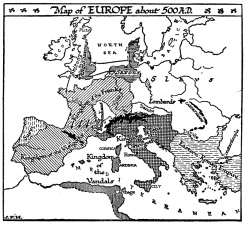
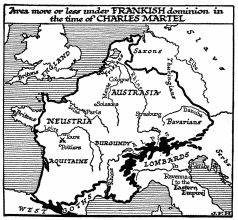
We have already mentioned various kingdoms of the barbarian tribes who set up a more or less flimsy dominion over this or that area amidst the débris of the empire, the kingdoms of the Suevi and West Goths in Spain, the East-Gothic kingdom in Italy, and the Italian Lombard kingdom which succeeded the Goths after Justinian had expelled the latter and after the great pestilence had devastated Italy. The Frankish kingdom was another such barbarian power which arose first in what is now Belgium, and which spread southward to the Loire, but it developed far more strength and solidarity than any of the others. It was the first real state to emerge from the universal wreckage. It became at last a wide and vigorous political reality, and from it are derived two great powers of modern Europe, France and the German Empire. Its founder was Clovis (481-511), who began as a small king in Belgium and ended with his southern frontiers nearly at the Pyrenees. He divided his kingdom among his four sons, but the Franks retained a tradition of unity in spite of this division, and for a time fraternal wars for a single control united rather than divided them. A more serious split arose, however, through the Latinization of the Western Franks, who occupied Romanized Gaul and who learnt to speak the corrupt Latin of the subject population, while the Franks of the Rhineland retained their Low German speech. At a low level of civilization, differences in language cause very powerful political strains. For a hundred and fifty years the Frankish world was split in two, Neustria, the nucleus of France, speaking a Latinish speech, which became at last the French language we know, and Austrasia, the Rhineland, which remained German.[336]
We will not tell here of the decay of the dynasty, the Merovingian dynasty, founded by Clovis; nor how in Austrasia a certain court official, the Mayor of the Palace, gradually became the king de facto and used the real king as a puppet. The position of Mayor of the Palace also became hereditary in the seventh century, and in 687 a certain Pepin of Heristhal, the Austrasian Mayor of the Palace, had conquered Neustria and reunited all the Franks. He was followed in 714 by his son, Charles Martel, who also bore no higher title than mayor of the palace. (His poor little Merovingian kings do not matter in the slightest degree to us here.) It was this Charles Martel who stopped the Moslems. They had pushed as far as Tours when he met them, and in a great battle between that place and Poitiers (732) utterly defeated them and broke their spirit. Thereafter the Pyrenees remained their utmost boundary; they came no further into Western Europe.
Charles Martel divided his power between two sons, but one resigned and went into a monastery, leaving his brother Pepin sole ruler. This Pepin it was who finally extinguished the descendants of Clovis. He sent to the Pope to ask who was the true king of the Franks, the man who held the power or the man who wore the crown; and the Pope, who was in need of a supporter, decided in favour of the Mayor of the Palace. So Pepin was chosen king at a gathering of the Frankish nobles in the Merovingian capital Soissons, and anointed and crowned. That was in 751. The Franco-Germany he united was consolidated by his son Charlemagne. It held together until the death of his grandson Louis (840), and then France and Germany broke away again—to the great injury of mankind. It was not a difference of race or temperament, it was a difference of language and tradition that split these Frankish peoples asunder.
That old separation of Neustria and Austrasia still works out in bitter consequences. In 1916 the ancient conflict of Neustria and Austrasia had broken out into war once more. In the August of that year the present writer visited Soissons, and crossed the temporary wooden bridge that had been built by the English after the Battle of the Aisne from the main part of the town to the suburb of Saint Médard. Canvas screens protected passengers upon the bridge from the observation of the German sharpshooters who were sniping from their trenches down the curve of the river. He went with his guides across a field and along by the wall of an orchard in which a German shell exploded as he passed. So he reached the battered buildings that stand upon the site of the ancient abbey of Saint Médard, in which the last Merovingian was deposed and Pepin the Short was crowned in his stead. Beneath these ancient buildings there were great crypts, very useful as dug-outs—for the German advanced lines were not more than a couple of hundred yards away. The sturdy French soldier lads were cooking and resting in these shelters, and lying down to sleep among the stone coffins that had held the bones of their Merovingian kings.
§ 4
The populations over which Charles Martel and King Pepin ruled were at very different levels of civilization in different districts. To the west and south the bulk of the people consisted of Latinized and Christian Kelts; in the central regions these rulers had to deal with such more or less Christianized Germans as the Franks and Burgundians and Alemanni; to the northeast were still pagan Frisians and Saxons; to the east were the Bavarians, recently Christianized through the activities of St. Boniface; and to the east of them again pagan Slavs and Avars. The “Paganism” of the Germans and Slavs was very similar to the primitive religion of the Greeks; it was a manly religion in which temple, priest, and sacrifices played a small part, and its gods were like men, a kind of “school prefects” of more powerful beings who interfered impulsively and irregularly in human affairs. The Germans had a Jupiter in Odin, a Mars in Thor, a Venus in Freya, and so on. Throughout the seventh and eighth centuries a steady process of conversion to Christianity went on amidst these German and Slavonic tribes.
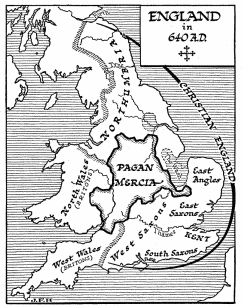
It will be interesting to English-speaking readers to note that the most zealous and successful missionaries among the Saxons and Frisians came from England. Christianity was twice planted in the British Isles. It was already there while Britain was a part of the Roman Empire; a martyr, St. Alban, gave his name to the town of St. Albans, and nearly every visitor to Canterbury has also visited little Old St. Martin’s church, which was used during the Roman times. From Britain, as we have already said, Christianity spread beyond the imperial boundaries into Ireland—the chief missionary was St. Patrick—and there was a vigorous monastic movement with which are connected the names of St. Columba and the religious settlements of Iona. Then in the fifth and sixth centuries came the fierce and pagan English, and they cut off the early Church of Ireland from the main body of Christianity. In the seventh century Christian missionaries were converting the English, both in the north from Ireland and in the south from Rome. The Rome mission was sent by Pope Gregory the Great just at the close of the sixth century. The story goes that he saw English boys for sale in the Roman slave market, though it is a little difficult to understand how they got there. They were very fair and good-looking. In answer to his inquiries, he was told that they were Angles. “Not Angles, but Angels,” said he, “had they but the gospel.”
The mission worked through the seventh century. Before that century was over, most of the English were Christians; though Mercia, the central English kingdom, held out stoutly against the priests and for the ancient faith and ways. And there was a swift progress in learning upon the part of these new converts. The monasteries of the kingdom of Northumbria in the north of England became a centre of light and learning. Theodore of Tarsus was one of the earliest archbishops of Canterbury (669-690). “While Greek was utterly unknown in the west of Europe, it was mastered by some of the pupils of Theodore. The monasteries contained many monks who were excellent scholars. Most famous of all was Bede, known as the Venerable Bede (673-735), a monk of Jarrow (on Tyne). He had for his pupils the six hundred monks of that monastery, besides the many strangers who came to hear him. He gradually mastered all the learning of his day, and left at his death forty-five volumes of his writings, the most important of which are ‘The Ecclesiastical History of the English’ and his translation of the Gospel of John into English. His writings were widely known and used throughout Europe. He reckoned all dates from the birth of Christ, and through his works the use of Christian chronology became common in Europe. Owing to the large number of monasteries and monks in Northumbria, that part of England was for a time far in advance of the south in civilization.”[337]
In the seventh and eighth centuries we find the English missionaries active upon the eastern frontiers of the Frankish kingdom. Chief among these was St. Boniface (680-755), who was born at Crediton, in Devonshire, who converted the Frisians, Thuringians, and Hessians, and who was martyred in Holland.
Both in England and on the Continent the ascendant rulers seized upon Christianity as a unifying force to cement their conquests. Christianity became a banner for aggressive chiefs—as it did in Uganda in Africa in the bloody days before that country was annexed to the British Empire. After Pepin, who died in 768, came two sons, Charles and another, who divided his kingdom; but the brother of Charles died in 771, and Charles then became sole king (771-814) of the growing realm of the Franks. This Charles is known in history as Charles the Great, or Charlemagne. As in the case of Alexander the Great and Julius Cæsar, posterity has enormously exaggerated his memory. He made his wars of aggression definitely religious wars. All the world of north-western Europe, which is now Great Britain, France, Germany, Denmark, and Norway and Sweden, was in the ninth century an arena of bitter conflict between the old faith and the new. Whole nations were converted to Christianity by the sword just as Islam in Arabia, Central Asia, and Africa had converted whole nations a century or so before.
With fire and sword Charlemagne preached the Gospel of the Cross to the Saxons, Bohemians, and as far as the Danube into what is now Hungary; he carried the same teaching down the Adriatic Coast through what is now Dalmatia, and drove the Moslems back from the Pyrenees as far as Barcelona.
Moreover, he it was who sheltered Egbert, an exile from Wessex in England, and assisted him presently to establish himself as King in Wessex (802). Egbert subdued the Britons in Cornwall, as Charlemagne conquered the Britons of Brittany, and, by a series of wars, which he continued after the death of his Frankish patron, made himself at last the first King of all England (828).
But the attacks of Charlemagne upon the last strongholds of paganism provoked a vigorous reaction on the part of the unconverted. The Christianized English had retained very little of the seamanship that had brought them from the mainland, and the Franks had not yet become seamen. As the Christian propaganda of Charlemagne swept towards the shores of the North and Baltic seas, the pagans were driven to the sea. They retaliated for the Christian persecutions with plundering raids and expeditions against the northern coasts of France and against Christian England. These pagan Saxons and English of the mainland and their kindred from Denmark and Norway are the Danes and Northmen of our national histories. They were also called Vikings,[338] which means “inlet-men,” because they came from the deep inlets of the Scandinavian coast. They came in long black galleys, making little use of sails. Most of our information about these wars and invasions of the pagan Vikings is derived from Christian sources, and so we have abundant information of the massacres and atrocities of their raids and very little about the cruelties inflicted upon their pagan brethren, the Saxons, at the hands of Charlemagne. Their animus against the cross and against monks and nuns was extreme. They delighted in the burning of monasteries and nunneries and the slaughter of their inmates.
Throughout the period between the fifth and the ninth centuries these Vikings or Northmen were learning seamanship, becoming bolder, and ranging further. They braved the northern seas until the icy shores of Greenland were a familiar haunt, and by the ninth century they had settlements (of which Europe in general knew nothing) in America. In the tenth and eleventh centuries many of their sagas began to be written down in Iceland. They saw the world in terms of valiant adventure. They assailed the walrus, the bear, and the whale. In their imaginations a great and rich city to the south, a sort of confusion of Rome and Byzantium, loomed large. They called it “Miklagård” (Michael’s court) or Micklegarth. The magnetism of Micklegarth was to draw the descendants of these Northmen down into the Mediterranean by two routes, by the west and also across Russia from the Baltic, as we shall tell later. By the Russian route went also the kindred Swedes.
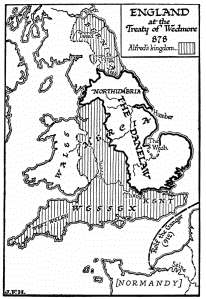
So long as Charlemagne and Egbert lived, the Vikings were no more than raiders; but as the ninth century wore on, these raids developed into organized invasions. In several districts of England the hold of Christianity was by no means firm as yet. In Mercia in particular the pagan Northmen found sympathy and help. By 886 the Danes had conquered a fair part of England and the English king, Alfred the Great, had recognized their rule over their conquests, the Dane-law, in the pact he made with Guthrum their leader. A little later, in 912, another expedition under Rolf the Ganger established itself upon the coast of France in the region that was known henceforth as Normandy (= Northman-dy). But of how there was presently a fresh conquest of England by the Danes and how finally the Duke of Normandy became King of England, we cannot tell at any length. There were very small racial and social differences between Angle, Saxon, Jute, Dane, or Norman; and though these changes loom large in the imaginations of the English, they are seen to be very slight rufflings indeed of the stream of history when we measure them by the standards of a greater world. The issue between Christianity and paganism vanished presently from the struggle. By the Treaty of Wedmore the Danes agreed to be baptized if they were assured of their conquests; and the descendants of Rolf in Normandy were not merely Christianized, but they learnt to speak French from the more civilized people about them, forgetting their own Norse tongue. Of much greater significance in the history of mankind are the relations of Charlemagne with his neighbours to the south and east, and to the imperial tradition.
§ 5
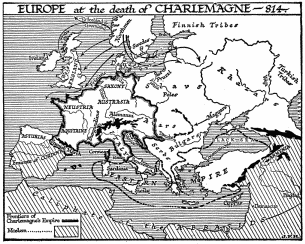
Through Charlemagne the tradition of the Roman Cæsar was revived in Europe.[339] The Roman Empire was dead and decaying; the Byzantine Empire was far gone in decay; but the education and mentality of Europe had sunken to a level at which new creative political ideas were probably impossible. In all Europe there survived not a tithe of the speculative vigour that we find in the Athenian literature of the fifth century B.C. There was no power to postulate a new occasion or to conceive and organize a novel political method. Official Christianity had long overlaid and accustomed itself to ignore those strange teachings of Jesus of Nazareth from which it had arisen. The Roman Church, clinging tenaciously to its possession of the title of pontifex maximus, had long since abandoned its appointed task of achieving the Kingdom of Heaven. It was preoccupied with the revival of Roman ascendancy on earth, which it conceived of as its inheritance. It had become a political body, using the faith and needs of simple men to forward its schemes. Europe drifted towards a dreary imitation and revival of the misconceived failures of the past. For eleven centuries from Charlemagne onwards, “Emperors” and “Cæsars” of this line and that come and go in the history of Europe like fancies in a disordered mind. We shall have to tell of a great process of mental growth in Europe, of enlarged horizons and accumulating power, but it was a process that went on independently of, and in spite of, the political forms of the time, until at last it shattered those forms altogether. Europe during those eleven centuries of the imitation Cæsars which began with Charlemagne, and which closed only in the monstrous bloodshed of 1914-1918, has been like a busy factory owned by a somnambulist, who is sometimes quite unimportant and sometimes disastrously in the way. Or rather than a somnambulist, let us say by a corpse that magically simulates a kind of life. The Roman Empire staggers, sprawls, is thrust off the stage, and reappears, and—if we may carry the image one step further—it is the Church of Rome which plays the part of the magician and keeps this corpse alive.
And throughout the whole period there is always a struggle going on for the control of the corpse between the spiritual and various temporal powers. We have already noted the spirit of St. Augustine’s City of God. It was a book which we know Charlemagne read, or had read to him—for his literary accomplishments are rather questionable. He conceived of this Christian Empire as being ruled and maintained in its orthodoxy by some such great Cæsar as himself. He was to rule even the Pope. But at Rome the view taken of the revived empire differed a little from that. There the view taken was that the Christian Cæsar must be anointed and guided by the Pope—who would even have the power to excommunicate and depose him. Even in the time of Charlemagne this divergence of view was apparent. In the following centuries it became acute.
The idea of the empire dawned only very gradually upon the mind of Charlemagne. At first he was simply the ruler of his father’s kingdom of the Franks, and his powers were fully occupied in struggles with the Saxons and Bavarians, and with the Slavs to the east of them, with the Moslem in Spain, and with various insurrections in his own dominions. And as the result of a quarrel with the King of Lombardy, his father-in-law, he conquered Lombardy and North Italy. We have noted the establishment of the Lombards in North Italy about 570 after the great pestilence, and after the overthrow of the East Gothic kings by Justinian. These Lombards had always been a danger and a fear to the Popes, and there had been an alliance between Pope and Frankish King against them in the time of Pepin. Now Charlemagne completely subjugated Lombardy (774), sent his father-in-law to a monastery, and carried his conquests beyond the present north-eastern boundaries of Italy into Dalmatia in 776. In 781 he caused one of his sons, Pepin, who did not outlive him, to be crowned King of Italy in Rome.
There was a new Pope, Leo III, in 795, who seems from the first to have resolved to make Charlemagne emperor. Hitherto the court at Byzantium had possessed a certain indefinite authority over the Pope. Strong emperors like Justinian had bullied the Popes and obliged them to come to Constantinople; weak emperors had annoyed them ineffectively. The idea of a breach, both secular and religious, with Constantinople had long been entertained at the Lateran,[340] and in the Frankish power there seemed to be just the support that was necessary if Constantinople was to be defied. So at his accession Leo III sent the keys of the tomb of St. Peter and a banner to Charlemagne as the symbols of his sovereignty in Rome as King of Italy. Very soon the Pope had to appeal to the protection he had chosen. He was unpopular in Rome; he was attacked and ill-treated in the streets during a procession, and obliged to fly to Germany (799). Eginhard says his eyes were gouged out and his tongue cut off; he seems, however, to have had both eyes and tongue again a year later. Charlemagne brought him back and reinstated him (800).
Then occurred a very important scene. On Christmas Day, in the year 800, as Charles was rising from prayer in the Church of St. Peter, the Pope, who had everything in readiness, clapped a crown upon his head and hailed him Cæsar and Augustus. There was great popular applause. But Eginhard, the friend and biographer of Charlemagne, says that the new emperor was by no means pleased by this coup of Pope Leo’s. If he had known this was to happen, he said, “he would not have entered the church, great festival though it was.” No doubt he had been thinking and talking of making himself emperor, but he had evidently not intended that the Pope should make him emperor. He had had some idea of marrying the Empress Irene, who at that time reigned in Constantinople, and so becoming monarch of both Eastern and Western Empires. He was now obliged to accept the title in the manner that Leo III had adopted as a gift from the Pope, and in a way that estranged Constantinople and secured the separation of Rome from the Byzantine Church.
At first Byzantium was unwilling to recognize the imperial title of Charlemagne. But in 810 a great disaster fell upon the Byzantine Empire. The pagan Bulgarians, under their Prince Krum (802-814), defeated and destroyed the armies of the Emperor Nicephorus, whose skull became a drinking-cup for Krum. The greater part of the Balkan peninsula was conquered by these people. (The Bulgarian and the English nations thus became established as political unities almost simultaneously.) After this misfortune Byzantium was in no position to dispute this revival of the empire in the West, and in 812 Charlemagne was formally recognized by Byzantine envoys as Emperor and Augustus.
So the Empire of Rome, which had died at the hands of Odoacer in 476, rose again in 800 as the “Holy Roman Empire.” While its physical strength lay north of the Alps, the centre of its idea was Rome. It was therefore from the beginning a divided thing of uncertain power, a claim and an argument rather than a necessary reality. The German sword was always clattering over the Alps into Italy, and missions and legates toiling over in the reverse direction. But the Germans could never hold Italy permanently, because they could not stand the malaria that the ruined, neglected, undrained country fostered. And in Rome, as well as in several other of the cities of Italy, there smouldered a more ancient tradition, the tradition of the aristocratic republic, hostile to both Emperor and Pope.
§ 6
In spite of the fact that we have a life of him written by his contemporary, Eginhard,[341] the character and personality of Charlemagne are difficult to visualize. Eginhard lacks vividness; he tells many particulars, but not the particulars that make a man live again in the record. Charlemagne, he says, was a tall man, with a rather feeble voice; and he had bright eyes and a long nose. “The top of his head was round,” whatever that may mean, and his hair was “white.” He had a thick, rather short neck, and “his belly too prominent.” He wore a tunic with a silver border, and gartered hose. He had a blue cloak, and was always girt with his sword, hilt and belt being of gold and silver. He was evidently a man of great activity, one imagines him moving quickly, and his numerous love affairs did not interfere at all with his incessant military and political labours. He had numerous wives and mistresses. He took much exercise, was fond of pomp and religious ceremonies, and gave generously. He was a man of very miscellaneous activity and great intellectual enterprise, and with a self-confidence that is rather suggestive of William II, the ex-German Emperor, the last, perhaps for ever, of this series of imitation Cæsars in Europe which Charlemagne began.
The mental life that Eginhard records of him is interesting, because it not only gives glimpses of a curious character, but serves as a sample of the intellectuality of the time. He could read probably; at meals he “listened to music or reading,” but we are told that he had not acquired the art of writing; “he used to keep his writing-book and tablets under his pillow, that when he had leisure he might practise his hand in forming letters, but he made little progress in an art begun too late in life.” He had, however, a real respect for learning and a real desire for knowledge, and he did his utmost to attract men of learning to his court. Among others who came was Alcuin, a learned Englishman. All those learned men were, of course, clergymen, there being no other learned men, and naturally they gave a strongly clerical tinge to the information they imparted to their master. At his court, which was usually at Aix-la-Chapelle or Mayence, he maintained in the winter months a curious institution called his “school,” in which he and his erudite associates affected to lay aside all thoughts of worldly position, assumed names taken from the classical writers or from Holy Writ, and discoursed upon theology and literature. Charlemagne himself was “David.” He developed a considerable knowledge of theology, and it is to him that we must ascribe the addition of the words filioque to the Nicene Creed (see chap, xxx, § 8), an addition that finally split the Latin and Greek Churches asunder. But it is more than doubtful if he had any such separation in mind. He wanted to add a word or so to the creed, just as the Emperor William II wanted to write operas and paint pictures,[342] and he took up what was originally a Spanish innovation.
Of his organization of his empire there is little to be said here. He was far too restless and busy to consider the quality of his successor or the condition of political stability, and the most noteworthy thing in this relationship is that he particularly schooled his son and successor, Louis the Pious (814-840), to take the crown from the altar and crown himself. But Louis the Pious was too pious to adhere to those instructions when the Pope made an objection.
The legislation of Charlemagne was greatly coloured by Bible reading; he knew his Bible well, as the times went; and it is characteristic of him that after he had been crowned emperor he required every male subject above the age of twelve to renew his oath of allegiance, and to undertake to be not simply a good subject, but a good Christian. To refuse baptism or to retract after baptism was a crime punishable by death. He did much to encourage architecture, and imported many Italian architects, chiefly from Ravenna, to whom we owe that pleasant Byzantine style that still at Worms and Cologne and elsewhere delights the tourist in the Rhineland.[343] He founded a number of cathedrals and monastic schools, did much to encourage the study of classical Latin, and was a distinguished amateur of church music. The possibility of his talking Latin and understanding Greek is open to discussion; probably he talked French-Latin. Frankish, however, was his habitual tongue. He made a collection of old German songs and tales, but these were destroyed by his successor Louis the Pious on account of their paganism.
He corresponded with Haroun-al-Raschid, the Abbasid Caliph at Bagdad, who was not perhaps the less friendly to him on account of his vigorous handling of the Omayyad Arabs in Spain. Gibbon supposes that this “public correspondence was founded on vanity,” and that “their remote situation left no room for a competition of interest.” But with the Byzantine Empire between them in the East, and the independent caliphate of Spain in the West, and a common danger in the Turks of the great plains, they had three very excellent reasons for cordiality. Haroun-al-Raschid, says Gibbon, sent Charlemagne by his ambassadors a splendid tent, a water clock, an elephant, and the keys of the Holy Sepulchre. The last item suggests that Charlemagne was to some extent regarded by the Saracen monarch as the protector of the Christians and Christian properties in his dominions. Some historians declare explicitly that there was a treaty to that effect.[344]
§ 7
The Empire of Charlemagne did not outlive his son and successor, Louis the Pious. It fell apart into its main constituents. The Latinized Keltic and Frankish population of Gaul begins now to be recognizable as France, though this France was broken up into a number of dukedoms and principalities, often with no more than a nominal unity; the German-speaking peoples between the Rhine and the Slavs to the east similarly begin to develop an even more fragmentary intimation of Germany. When at length a real emperor reappears in Western Europe (962), he is not a Frank, but a Saxon; the conquered in Germany have become the masters.
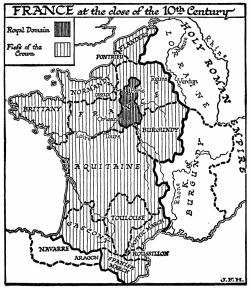
It is impossible here to trace the events of the ninth and tenth centuries in any detail, the alliances, the treacheries, the claims and acquisitions. Everywhere there was lawlessness, war, and a struggle for power. In 987 the nominal kingdom of France passed from the hands of the Carlovingians, the last descendants of Charlemagne, into the hands of Hugh Capet, who founded a new dynasty. Most of his alleged subordinates were in fact independent, and willing to make war on the king at the slightest provocation. The dominions of the Duke of Normandy, for example, were more extensive and more powerful than the patrimony of Hugh Capet. Almost the only unity of this France over which the king exercised a nominal authority lay in the common resolution of its great provinces to resist incorporation in any empire dominated either by a German ruler or by the Pope. Apart from the simple organization dictated by that common will, France was a mosaic of practically independent nobles. It was an era of castle-building and fortification, and what was called “private war” throughout all Europe.
The state of Rome in the tenth century is almost indescribable. The decay of the Empire of Charlemagne left the Pope without a protector, threatened by Byzantium and the Saracens (who had taken Sicily), and face to face with the unruly nobles of Rome. Among the most powerful of these were two women, Theodora and Marozia, mother and daughter,[345] who in succession held the Castle of St. Angelo (§ 1), which Theophylact, the patrician husband of Theodora, had seized with most of the temporal power of the Pope; these two women were as bold, unscrupulous, and dissolute as any male prince of the time could have been, and they are abused by historians as though they were ten times worse. Marozia seized and imprisoned Pope John X (928), who speedily died under her care. She subsequently made her illegitimate son pope, under the title of John XI. After him her grandson, John XII, filled the chair of St. Peter. Gibbon’s account of the manners and morals of John XII takes refuge at last beneath a veil of Latin footnotes. This Pope, John XII, was finally degraded by the new German Emperor Otto, who came over the Alps and down into Italy to be crowned in 962.[346]
This new line of Saxon emperors, which thus comes into prominence, sprang from a certain Henry the Fowler, who was elected King of Germany by an assembly of German nobles, princes, and prelates in 919. In 936 he was succeeded as King by his son, Otto I, surnamed the Great, who was also elected to be his successor at Aix-la-Chapelle, and who finally descended upon Rome at the invitation of John XII, to be crowned emperor in 962. His subsequent degradation of John was forced upon him by that Pope’s treachery. With his assumption of the imperial dignity, Otto I did not so much overcome Rome as restore the ancient tussle of Pope and Emperor for ascendancy to something like decency and dignity again. Otto I was followed by Otto II (973-983), and he again by a third Otto (983-1002).[347]
The struggle between the Emperor and the Pope for ascendancy over the Holy Roman Empire plays a large part in the history of the early Middle Ages, and we shall have presently to sketch its chief phases. Though the Church never sank quite to the level of John XII again, nevertheless the story fluctuates through phases of great violence, confusion, and intrigue. Yet the outer history of Christendom is not the whole history of Christendom. That the Lateran was as cunning, foolish, and criminal as most other contemporary courts has to be recorded; but, if we are to keep due proportions in this history, it must not be unduly emphasized. We must remember that through all those ages, leaving profound consequences, but leaving no conspicuous records upon the historian’s page, countless men and women were touched by that Spirit of Jesus which still lived and lives still at the core of Christianity, that they led lives that were on the whole gracious and helpful, and that they did unselfish and devoted deeds. Through those ages such lives cleared the air and made a better world possible. Just as in the Moslem world the Spirit of Islam generation by generation produced its crop of courage, integrity, and kindliness.
§ 8
While the Holy Roman Empire and the kingdoms of France and England were thus appearing amidst the extreme political fragmentation of the civilization of Western Europe, both that civilization and the Byzantine Empire were being subjected to a threefold attack: from the Saracen powers, from the Northmen, and, more slowly developed and most formidable of all, from a new westward thrust of the Turkish peoples through South Russia, and also by way of Armenia and the Empire of Bagdad from Central Asia.
After the overthrow of the Omayyads by the Abbasid dynasty, the strength of the Saracenic impulse against Europe diminished. Islam was no longer united. Spain was under a separate Omayyad Caliph, North Africa, though nominally subject to the Abbasids, was really independent, and presently (969) Egypt became a separate power with a Shiite Caliph of its own, a pretender claiming descent from Ali and Fatima (the Fatimite Caliphate). These Egyptian Fatimites, the green flag Moslems, were fanatics in comparison with the Abbasids, and did much to embitter the genial relations of Islam and Christianity. They took Jerusalem, and interfered with the Christian access to the Holy Sepulchre. On the other side of the shrunken Abbasid domain there was also a Shiite kingdom in Persia. The chief Saracen conquest in the ninth century was Sicily; but this was not overrun in the grand old style in a year or so, but subjugated tediously through a long century, and with many set-backs. The Spanish Saracens disputed in Sicily with the Saracens from Africa. In Spain the Saracens were giving ground before a renascent Christian effort. Nevertheless, the Byzantine Empire and Western Christendom were still so weak upon the Mediterranean Sea that the Saracen raiders and pirates from North Africa were able to raid almost unchallenged in South Italy and the Greek Islands.
But now a new force was appearing in the Mediterranean. We have already remarked that the Roman Empire never extended itself to the shores of the Baltic Sea, nor had ever the vigour to push itself into Denmark. The Nordic Aryan peoples of these neglected regions learnt much from the empire that was unable to subdue them; as we have already noted in § 4, they developed the art of shipbuilding and became bold seamen; they spread across the North Sea to the west, and across the Baltic and up the Russian rivers into the very heart of what is now Russia. One of their earliest settlements in Russia was Novgorod the Great. There is the same trouble and confusion for the student of history with these northern tribes as there is with the Scythians of classical times, and with the Hunnish Turkish peoples of Eastern and Central Asia. They appear under a great variety of names, they change and intermingle. In the case of Britain, for example, the Angles, the Saxons, and Jutes conquered most of what is now England in the fifth and sixth centuries; the Danes, a second wave of practically the same people, followed in the eighth and ninth; and in 1013 a Danish King, Canute, reigned in England, and not only over England, but over Denmark and Norway. For a time, under Canute and his sons, it seemed possible that a great confederation of the Northmen might have established itself. Then in 1066 a third wave of the same people flowed over England from the “Norman” state in France, where the Northmen had been settled since the days of Rolf the Ganger (912), and where they had learnt to speak French. William, Duke of Normandy, became the William the Conqueror (1066) of English history. Practically, from the standpoint of universal history, all these peoples were the same people, waves of one Nordic stock. These waves were not only flowing westward, but eastward. Already we have noted (chap, xxix, § 4), a very interesting earlier movement of the same peoples under the name of Goths from the Baltic to the Black Sea. We have traced the splitting of these Goths into the Ostrogoths and the Visigoths, and the adventurous wanderings that ended at last in the Ostrogoth kingdom in Italy and the Visigoth states in Spain. In the ninth century a second movement of the Northmen across Russia was going on at the same time that their establishments in England and their dukedom of Normandy were coming into existence. The populations of South Scotland, England, East Ireland, Flanders, Normandy, and the Russias have more elements in common than we are accustomed to recognize. All are fundamentally Gothic and Nordic peoples. These “Russian” Norsemen travelled in the summer-time, using the river routes that abounded in Russia; they carried their ships by portages from the northward-running rivers to those flowing southward. They appeared as pirates, raiders, and traders both upon the Caspian and the Black Sea. The Arabic chroniclers note their apparition upon the Caspian, and give them the name of Russians. They raided Persia, and threatened Constantinople with a great fleet of small craft (in 865, 904, 941, and 1043).[348] One of these Northmen, Rurik (circa 850), established himself as the ruler of Novgorod and Kief, and laid the foundations of modern Russia. The fighting qualities of the Russian Vikings were speedily appreciated at Constantinople; the Greeks called them Varangians, and an Imperial Varangian bodyguard was formed. After the conquest of England by the Normans (1066), a number of Danes and English were driven into exile and joined these Russian Varangians, apparently finding few obstacles to intercourse in their speech and habits.