
LIST OF ILLUSTRATIONS
| PAGE | |
| Arabia and Adjacent Countries | 2 |
| The Beginnings of Moslem Power | 19 |
| The Growth of Moslem Power in 25 Years | 23 |
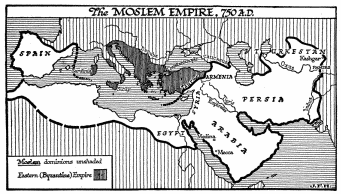
| The Moslem Empire | 25 |
| Europe, 500 A.D. | 44 |
| Frankish Dominions in the Time of Charles Martel | 45 |
| England, 640 A.D. | 49 |
| England, 878 A.D. | 52 |
| Europe at the Death of Charlemagne | 55 |
| France at the Close of the 10th Century | 65 |
| Empire of Otto the Great | 68 |
| The Coming of the Seljuks (Map) | 70 |
| The First Crusade (Map) | 77 |
| Europe and Asia, 1200 | 107 |
| Empire of Jengis Khan, 1227 | 111 |
| Travels of Marco Polo | 115 |
| Ottoman Empire before 1453 | 123 |
| Ottoman Empire, 1566 | 125 |
| Empire of Timurlane | 131 |
| Europe at the Fall of Constantinople | 141 |
| “We have the payne....” John Bull’s Speech | 155 |
| Ignatius of Loyola | 164 |
| European Trade Routes in the 14th Century | 183 |
| The Chief Voyages of Exploration up to 1522 | 191 |
| Mexico and Peru | 192 |
| Switzerland | 198 |
| Europe in the Time of Charles V | 201 |
| Martin Luther | 203 |
| Francis I | 204 |
| Henry VIII | 206 |
| Charles V | 207 |
| Central Europe, 1648 | 233 |
| Louis XIV | 237 |
| The Partitions of Poland | 250 |
| Britain, France, and Spain in America, 1750 | 255 |
| Chief Foreign Settlements in India, 17th Century | 256 |
| India in 1750 | 260 |
| American Colonies, 1760 | 283 |
| Boston in 1775 | 292 |
| The United States in 1790 | 295 |
| The United States Showing Dates of the Chief Territorial Extensions | 299 |
| Benjamin Franklin | 303 |
| George Washington | 304 |
| The Flight to Varennes (Map) | 322 |
| North Eastern Frontier of France, 1792 | 330 |
| Napoleon’s Egyptian Campaign | 352 |
| Napoleon as Emperor | 360 |
| Tsar Alexander I | 362 |
| Napoleon’s Empire, 1810 | 365 |
| The Trail of Napoleon | 369 |
| Europe after the Congress of Vienna | 379 |
| The Natural Political Map of Europe | 383 |
| Mr. Gladstone | 427 |
| Tribal Gods of the 19th Century | 434 |
| Map of Europe, 1848-1871 | 439 |
| Italy, 1861 | 441 |
| Bismarck | 443 |
| The Balkans, 1878 | 448 |
| Comparative Maps of Asia under Different Projections | 450 |
| The British Empire in 1815 | 452 |
| Africa in the Middle of 19th Century | 458 |
| Africa, 1914 | 459 |
| Japan and the East Coast of Asia | 468 |
| Overseas Empires of European Powers, 1914 | 474 |
| Emperor William II | 482 |
| Ireland | 491 |
| The Balkan States, 1913 | 501 |
| The Original German Plan, 1914 | 514 |
| The Western Front, 1915-18 | 517 |
| Time Chart of the Great War, 1914-18 | 528-29 |
| President Wilson | 551 |
| M. Clemenceau | 552 |
| Mr. Lloyd George | 553 |
| Germany after the Peace Treaty, 1919 | 561 |
| The Turkish Treaty, 1920 | 563 |
| The Break-up of Austria-Hungary | 565 |
| Time-chart 1000 B.C.-300 B.C. | 599 |
| Time-chart 400 B.C.-A.D. 300 | 600 |
| Time-chart A.D. 200-A.D. 900 | 601 |
| Time-chart A.D. 800-A.D. 1500 | 602 |
| Time-chart A.D. 1220-A.D. 1920 | 603 |
BOOK VI (Continued)
CHRISTIANITY AND ISLAM (Continued)
THE OUTLINE OF HISTORY
XXXII
MUHAMMAD AND ISLAM[319]
§ 1. Arabia before Muhammad. § 2. Life of Muhammad to the Hegira. § 3. Muhammad becomes a Fighting Prophet. § 4. The Teachings of Islam. § 5. The Caliphs Abu Bekr and Omar. § 6. The Great Days of the Omayyads. § 7. The Decay of Islam under the Abbasids. § 8. The Intellectual Life of Arab Islam.
§ 1
WE have already described how in A.D. 628 the courts of Heraclius, of Kavadh, and of Tai-tsung were visited by Arab envoys sent from a certain Muhammad, “The Prophet of God,” at the small trading town of Medina in Arabia. We must tell now who this prophet was who had arisen among the nomads and traders of the Arabian desert.
From time immemorial Arabia, except for the fertile strip of the Yemen to the south, had been a land of nomads, the headquarters and land of origin of the Semitic peoples. From Arabia at various times waves of these nomads had drifted north, east, and west into the early civilizations of Egypt, the Mediterranean coast, and Mesopotamia. We have noted in this history how the Sumerians were swamped and overcome by such Semitic waves, how the Semitic Phœnicians and Canaanites established themselves along the eastern shores of the Mediterranean, how the Babylonians and Assyrians were settled Semitic peoples, how the Hyksos conquered Egypt, how the Arameans established themselves in Syria with Damascus as their capital, and how the Hebrews partially conquered their “Promised Land.” At some unknown date the Chaldeans drifted in from Eastern Arabia and settled in the old southern Sumerian lands. With each invasion first this and then that section of the Semitic peoples comes into history. But each of such swarmings still leaves a tribal nucleus behind to supply fresh invasions in the future.

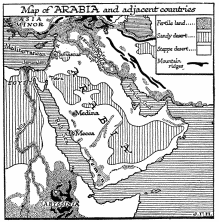
The history of the more highly organized empires of the horse and iron period, the empires of roads and writing, shows Arabia thrust like a wedge between Egypt, Palestine, and the Euphrates-Tigris country, and still a reservoir of nomadic tribes who raid and trade and exact tribute for the immunity and protection of caravans. There are temporary and flimsy subjugations. Egypt, Persia, Macedonia, Rome, Syria, Constantinople, and again Persia claim some unreal suzerainty in turn over Arabia, profess some unsubstantial protection. Under Trajan there was a Roman province of “Arabia,” which included the then fertile region of the Hauran and extended as far as Petra. Now and then some Arab chief and his trading city rises to temporary splendour. Such was that Odenathus of Palmyra, whose brief career we have noted in chap. xxxi, § 2, and another such transitory desert city whose ruins still astonish the traveller was Baalbek.
After the destruction of Palmyra, the desert Arabs began to be spoken of in the Roman and Persian records as Saracens.
In the time of Chosroes II., Persia claimed a certain ascendancy over Arabia, and maintained officials and tax collectors in the Yemen. Before that time the Yemen had been under the rule of the Abyssinian Christians for some years, and before that for seven centuries it had had native princes professing, be it noted, the Jewish faith.
Until the opening of the seventh century A.D. there were no signs of any unwonted or dangerous energy in the Arabian deserts. The life of the country was going on as it had gone on for long generations. Wherever there were fertile patches, wherever, that is, there was a spring or a well, a scanty agricultural population subsisted, living in walled towns because of the Bedouin who wandered with their sheep, cattle, and horses over the desert. Upon the main caravan routes the chief towns rose to a certain second-rate prosperity, and foremost among them were Medina and Mecca.[320] In the beginning of the seventh century Medina was a town of about 15,000 inhabitants all told; Mecca may have had twenty or twenty-five thousand. Medina was a comparatively well-watered town, and possessed abundant date groves; its inhabitants were Yemenites, from the fertile land to the south. Mecca was a town of a different character, built about a spring of water with a bitter taste, and inhabited by recently settled Bedouin.
Mecca was not merely nor primarily a trading centre; it was a place of pilgrimage. Among the Arab tribes there had long existed a sort of Amphictyony (see chap. xxii, § 1) centring upon Mecca and certain other sanctuaries; there were months of truce to war and blood feuds, and customs of protection and hospitality for the pilgrim. In addition there had grown up an Olympic element in these gatherings; the Arabs were discovering possibilities of beauty in their language, and there were recitations of war poetry and love songs. The sheiks of the tribes, under a “king of the poets,” sat in judgment and awarded prizes; the prize songs were sung through all Arabia.
The Kaaba, the sanctuary at Mecca, was of very ancient date. It was a small square temple of black stones, which had for its corner-stone a meteorite. This meteorite was regarded as a god, and all the little tribal gods of Arabia were under his protection. The permanent inhabitants of Mecca were a tribe of Bedouin who had seized this temple and constituted themselves its guardians. To them there came in the months of truce a great incourse of people, who marched about the Kaaba ceremonially, bowed themselves, and kissed the stone, and also engaged in trade and poetical recitations. The Meccans profited much from these visitors.
All of this is very reminiscent of the religious and political state of affairs in Greece fourteen centuries earlier. But the paganism of these more primitive Arabs was already being assailed from several directions. There had been a great proselytizing of Arabs during the period of the Maccabeans and Herods in Judea; and, as we have already noted, the Yemen had been in succession under the rule of Jews (Arab proselytes to Judaism, i.e.), Christians, and Zoroastrians. It is evident that there must have been plenty of religious discussion during the pilgrimage fairs at Mecca and the like centres. Naturally enough Mecca was a stronghold of the old pagan cult which gave it its importance and prosperity; Medina, on the other hand, had Jewish proclivities, and there were Jewish settlements near by. It was inevitable that Mecca and Medina should be in a state of rivalry and bickering feud.
§ 2
It was in Mecca about the year A.D. 570 that Muhammad, the founder of Islam, was born. He was born in considerable poverty, and even by the standards of the desert he was uneducated; it is doubtful if he ever learnt to write. He was for some years a shepherd’s boy; then he became the servant of a certain Kadija, the widow of a rich merchant. Probably he had to look after her camels or help in her trading operations; and he is said to have travelled with caravans to the Yemen and to Syria. He does not seem to have been a very useful trader, but he had the good fortune to find favour in the lady’s eyes, and she married him, to the great annoyance of her family. He was then only twenty-five years old. It is uncertain if his wife was much older, though tradition declares she was forty. After the marriage he probably made no more long journeys. There were several children, one of whom was named Abd Manif—that is to say, the servant of the Meccan god Manif, which demonstrates that at that time Muhammad had made no religious discoveries.
Until he was forty he did indeed live a particularly undistinguished life in Mecca, as the husband of a prosperous wife. There may be some ground for the supposition that he became partner in a business in agricultural produce. To anyone visiting Mecca about A.D. 600 he would probably have seemed something of a loafer, a rather shy, good-looking individual, sitting about and listening to talk, a poor poet, and an altogether second-rate man.
About his internal life we can only speculate. Imaginative writers have supposed that he had great spiritual struggles, that he went out into the desert in agonies of doubt and divine desire. “In the silence of the desert night, in the bright heat of noontide desert day, he, as do all men, had known and felt himself alone yet not in solitude, for the desert is of God, and in the desert no man may deny Him.”[321] Maybe that was so, but there is no evidence of any such desert trips. Yet he was certainly thinking deeply of the things about him. Possibly he had seen Christian churches in Syria; almost certainly he knew much of the Jews and their religion, and he heard their scorn for this black stone of the Kaaba that ruled over the three hundred odd tribal gods of Arabia. He saw the pilgrimage crowds, and noted the threads of insincerity and superstition in the paganism of the town. It oppressed his mind. The Jews had perhaps converted him to a belief in the One True God, without his knowing what had happened to him.
At last he could keep these feelings to himself no longer. When he was forty he began to talk about the reality of God, at first apparently only to his wife and a few intimates. He produced certain verses, which he declared had been revealed to him by an angel. They involved an assertion of the unity of God and some acceptable generalizations about righteousness. He also insisted upon a future life, the fear of hell for the negligent and evil, and the reservation of paradise for the believer in the One God. Except for his claim to be a new prophet, there does not seem to have been anything very new about these doctrines at the time, but this was seditious teaching for Mecca, which partly subsisted upon its polytheistic cult, and which was therefore holding on to idols when all the rest of the world was giving them up. Like Mani, Muhammad claimed that the prophets before him, and especially Jesus and Abraham, had been divine teachers, but that he crowned and completed their teaching. Buddhism, however, he did not name, probably because he had never heard of Buddha. Desert Arabia was in a theological backwater.
For some years the new religion was the secret of a small group of simple people, Kadija, the prophet’s wife, Ali, an adopted son, Zeid, a slave, and Abu Bekr, a friend and admirer. For some years it was an obscure sect in a few households of Mecca, a mere scowl and muttering at idolatry, so obscure and unimportant that the leading men of the town did not trouble about it in the least. Then it gathered strength. Muhammad began to preach more openly, to teach the doctrine of a future life, and to threaten idolaters and unbelievers with hell fire. He seems to have preached with considerable effect. It appeared to many that he was aiming at a sort of dictatorship in Mecca, and drawing many susceptible and discontented people to his side; and an attempt was made to discourage and suppress the new movement.
Mecca was a place of pilgrimage and a sanctuary; no blood could be shed within its walls; nevertheless, things were made extremely disagreeable for the followers of the new teacher. Boycott and confiscation were used against them. Some were driven to take refuge in Christian Abyssinia. But the Prophet himself went unscathed because he was well connected, and his opponents did not want to begin a blood feud. We cannot follow the fluctuations of the struggle here, but it is necessary to note one perplexing incident in the new prophet’s career, which, says Sir Mark Sykes, “proves him to have been an Arab of the Arabs.” After all his insistence upon the oneness of God, he wavered. He came into the courtyard of the Kaaba, and declared that the gods and goddesses of Mecca might, after all, be real, might be a species of saints with a power of intercession.
His recantation was received with enthusiasm, but he had no sooner made it than he repented, and his repentance shows that he had indeed the fear of God in him. His lapse from honesty proves him honest. He did all he could to repair the evil he had done. He said that the devil had possessed his tongue, and denounced idolatry again with renewed vigour. The struggle against the antiquated deities, after a brief interval of peace, was renewed again more grimly, and with no further hope of reconciliation.
For a time the old interests had the upper hand. At the end of ten years of prophesying, Muhammad found himself a man of fifty, and altogether unsuccessful in Mecca. Kadija, his first wife, was dead, and several of his chief supporters had also recently died. He sought a refuge at the neighbouring town of Tayf, but Tayf drove him out with stones and abuse. Then, when the world looked darkest to him, opportunity opened before him. He found he had been weighed and approved in an unexpected quarter. The city of Medina was much torn by internal dissension, and many of its people, during the time of pilgrimage to Mecca, had been attracted by Muhammad’s teaching. Probably the numerous Jews in Medina had shaken the ancient idolatry of the people. An invitation was sent to him to come and rule in the name of his God in Medina.
He did not go at once. He parleyed for two years, sending a disciple to preach in Medina and destroy the idols there. Then he began sending such followers as he had in Mecca to Medina to await his coming there; he did not want to trust himself to unknown adherents in a strange city. This exodus of the faithful continued, until at last only he and Abu Bekr remained.
In spite of the character of Mecca as a sanctuary, he was very nearly murdered there. The elders of the town evidently knew of what was going on in Medina, and they realized the danger to them if this seditious prophet presently found himself master of a town on their main caravan route to Syria. Custom must bow to imperative necessity, they thought; and they decided that, blood feud or no blood feud, Muhammad must die. They arranged that he should be murdered in his bed; and in order to share the guilt of this breach of sanctuary they appointed a committee to do this, representing every family in the city except Muhammad’s own. But Muhammad had already prepared his flight; and when in the night they rushed into his room, they found Ali, his adopted son, sleeping, or feigning sleep, on his bed.
The flight (the Hegira[322]) was an adventurous one, the pursuit being pressed hard. Expert desert trackers sought for the spoor to the north of the town, but Muhammad and Abu Bekr had gone south to certain caves where camels and provisions were hidden, and thence he made a great detour to Medina. There he and his faithful companion arrived, and were received with great enthusiasm on September 20, 622. It was the end of his probation and the beginning of his power.[323]
§ 3
Until the Hegira, until he was fifty-one, the character of the founder of Islam is a matter of speculation and dispute. Thereafter he is in the light. We discover a man of great imaginative power but tortuous in the Arab fashion, and with most of the virtues and defects of the Bedouin.
The opening of his reign was “very Bedouin.” The rule of the One God of all the earth, as it was interpreted by Muhammad, began with a series of raids—which for more than a year were invariably unsuccessful—upon the caravans of Mecca. Then came a grave scandal, the breaking of the ancient customary truce of the Arab Amphictyony in the sacred month of Rahab. A party of Moslems, in this season of profound peace, treacherously attacked a small caravan and killed a man. It was their only success, and they did it by the order of the Prophet.
Presently came a battle. A force of seven hundred men had come out from Mecca to convoy home another caravan, and they encountered a large raiding party of three hundred. There was a fight, the battle of Badr, and the Meccans got the worst of it. They lost about fifty or sixty killed and as many wounded. Muhammad returned in triumph to Medina, and was inspired by Allah and this success to order the assassination of a number of his opponents among the Jews in the town who had treated his prophetic claims with a disagreeable levity.
But Mecca resolved to avenge Badr, and at the battle of Uhud, near Medina, inflicted an indecisive defeat upon the Prophet’s followers. Muhammad was knocked down and nearly killed, and there was much running away among his followers. The Meccans, however, did not push their advantage and enter Medina.
For some time all the energies of the Prophet were concentrated upon rallying his followers, who were evidently much dispirited. The Koran records the chastened feelings of those days. “The suras of the Koran,” says Sir Mark Sykes, “which are attributed to this period, excel nearly all the others in their majesty and sublime confidence.” Here, for the judgment of the reader, is an example of these majestic utterances, from the recent orthodox translation by the Maulvi Muhammad Ali.[324]
“Oh, you who believe! If you obey those who disbelieve, they will turn you back upon your heels, so you will turn back losers.
“Nay! Allah is your Patron, and He is the best of the helpers.
“We will cast terror into the hearts of those who disbelieve, because they set up with Allah that for which He has sent down no authority, and their abode is the fire; and evil is the abode of the unjust.
“And certainly Allah made good to you His promise, when you slew them by His permission, until when you became weak-hearted and disputed about the affair and disobeyed after He had shown you that which you loved; of you were some who desired this world, and of you were some who desired the hereafter; then He turned you away from them that He might try you; and He has certainly pardoned you, and Allah is Gracious to the believers.
“When you ran off precipitately, and did not wait for anyone, and the Apostle was calling you from your rear, so He gave you another sorrow instead of your sorrow, so that you might not grieve at what had escaped you, nor at what befell you; and Allah is aware of what you do.
“Then after sorrow he sent down security upon you, a calm coming upon a party of you, and there was another party whom their own souls had rendered anxious; they entertained about Allah thoughts of ignorance quite unjustly, saying: We have no hand in this affair. Say, surely the affair is wholly in the hands of Allah. They conceal within their souls what they would not reveal to you. They say: Had we any hand in the affair, we would not have been slain here. Say: had you remained in your houses, those for whom slaughter was ordained would certainly have gone forth to the places where they would be slain, and that Allah might test what was in your breasts and that He might purge what was in your hearts; and Allah knows what is in the breasts.
“As for those of you who turned back on the day when the two armies met, only the devil sought to cause them to make a slip on account of some deeds they had done, and certainly Allah has pardoned them; surely Allah is Forgiving, Forbearing.”
Inconclusive hostilities continued for some years, and at last Mecca made a crowning effort to stamp out for good and all the growing power of Medina. A mixed force of no fewer than 10,000 men was scraped together, an enormous force for the time and country. It was, of course, an entirely undisciplined force of footmen, horsemen, and camel riders, and it was prepared for nothing but the usual desert scrimmage. Bows, spears, and swords were its only weapons. When at last it arrived amid a vast cloud of dust in sight of the hovels and houses of Medina, instead of a smaller force of the same kind drawn up for battle as it had expected, it found a new and entirely disconcerting phenomenon, a trench and a wall. Assisted by a Persian convert, Muhammad had entrenched himself in Medina!
This trench struck the Bedouin miscellany as one of the most unsportsmanlike things that had ever been known in the history of the world. They rode about the place. They shouted their opinion of the whole business to the besieged. They discharged a few arrows, and at last encamped to argue about this amazing outrage. They could arrive at no decision. Muhammad would not come out; the rains began to fall, the tents of the allies got wet, and the cooking difficult, views became divergent and tempers gave way, and at last this great host dwindled again into its constituent parts without ever having given battle (627). The bands dispersed north, east, and south, became clouds of dust, and ceased to matter. Near Medina was a castle of Jews, against whom Muhammad was already incensed because of their disrespect for his theology. They had shown a disposition to side with the probable victor in this last struggle, and Muhammad now fell upon them, slew all the men, nine hundred of them, and enslaved the women and children. Possibly many of their late allies were among the bidders for these slaves. Never again after this quaint failure did Mecca make an effective rally against Muhammad, and one by one its leading men came over to his side.
We need not follow the windings of the truce and the treaty that finally extended the rule of the Prophet to Mecca. The gist of the agreement was that the faithful should turn towards Mecca when they prayed instead of turning towards Jerusalem, as they had hitherto done, and that Mecca should be the pilgrimage centre of the new faith. So long as the pilgrimage continued, the men of Mecca, it would seem, did not care very much whether the crowd assembled in the name of one god or many. Muhammad was getting more and more hopeless of any extensive conversion of the Jews and Christians, and he was ceasing to press his idea that all these faiths really worshipped the same One God. Allah was becoming more and more his own special God, tethered now by this treaty to the meteoric stone of the Kaaba, and less and less the father of all mankind. Already the Prophet had betrayed a disposition to make a deal with Mecca, and at last it was effected. The lordship of Mecca was well worth the concession. Of comings and goings and a final conflict we need not tell. In 629 Muhammad came to the town as its master. The image of Manif, the god after whom he had once named his son, was smashed under his feet as he entered the Kaaba.
Thereafter his power extended, there were battles, treacheries, massacres; but on the whole he prevailed, until he was master of all Arabia; and when he was master of all Arabia in 632, at the age of sixty-two, he died.
Throughout the concluding eleven years of his life after the Hegira, there is little to distinguish the general conduct of Muhammad from that of any other welder of peoples into a monarchy. The chief difference is his use of a religion of his own creation as his cement. He was diplomatic, treacherous, ruthless, or compromising as the occasion required and as any other Arab king might have been in his place; and there was singularly little spirituality in his kingship. Nor was his domestic life during his time of power and freedom one of exceptional edification. Until the death of Kadija, when he was fifty, he seems to have been the honest husband of one wife; but then, as many men do in their declining years, he developed a disagreeably strong interest in women.
He married two wives after the death of Kadija, one being the young Ayesha, who became and remained his favourite and most influential partner; and subsequently a number of other women, wives and concubines, were added to his establishment. This led to much trouble and confusion, and in spite of many special and very helpful revelations on the part of Allah, these complications still require much explanation and argument from the faithful. There was, for example, a scandal about Ayesha; she was left behind on one occasion when the howdah and the camel went on, while she was looking for her necklace among the bushes; and so Allah had to intervene with some heat and denounce her slanderers. Allah also had to speak very plainly about the general craving among this household of women for “this world’s life and its ornature” and for “finery.” Then there was much discussion because the Prophet first married his young cousin Zainib to his adopted son Zaid, and afterwards, “when Zaid had accomplished his want of her,” the Prophet took her and married her—but, as the inspired book makes clear, only in order to show the difference between an adopted and a real son. “We gave her to you as a wife, so that there should be no difficulty for the believers in respect of the wives of their adopted sons, when they have accomplished their want of them, and Allah’s command shall be performed.” Yet surely a simple statement in the Koran should have sufficed without this excessively practical demonstration. There was, moreover, a mutiny in the harem on account of the undue favours shown by the Prophet to an Egyptian concubine who had borne him a boy, a boy for whom he had a great affection, since none of Kadija’s sons had survived. These domestic troubles mingle inextricably with our impression of the Prophet’s personality. One of his wives was a Jewess, Safiyya, whom he had married on the evening of the battle in which her husband had been captured and executed. He viewed the captured women at the end of the day, and she found favour in his eyes and was taken to his tent.
These are salient facts in these last eleven years of Muhammad’s career. Because he too founded a great religion, there are those who write of this evidently lustful and rather shifty leader as though he were a man to put beside Jesus of Nazareth or Gautama or Mani. But it is surely manifest that he was a being of a commoner clay; he was vain, egotistical, tyrannous, and a self-deceiver; and it would throw all our history out of proportion if, out of an insincere deference to the possible Moslem reader, we were to present him in any other light.
Yet, unless we balance it, this insistence upon his vanity, egotism, self-deception, and hot desire does not complete the justice of the case. We must not swing across from the repudiation of the extravagant pretensions of the faithful to an equally extravagant condemnation. Can a man who has no good qualities hold a friend? Because those who knew Muhammad best believed in him most. Kadija for all her days believed in him—but she may have been a fond woman. Abu Bekr is a better witness, and he never wavered in his devotion. Abu Bekr believed in the Prophet, and it is very hard for anyone who reads the history of these times not to believe in Abu Bekr. Ali again risked his life for the Prophet in his darkest days. Muhammad was no impostor, at any rate, though at times his vanity made him behave as though Allah was at his beck and call, and as if his thoughts were necessarily God’s thoughts. And if his bloodstained passion with Safiyya amazes and disgusts our modern minds, his love for little Ibrahim, the son of Mary the Egyptian, and his passionate grief when the child died, reinstate him in the fellowship of all those who have known love and loss.
He smoothed the earth over the little grave with his own hands. “This eases the afflicted heart,” he said. “Though it neither profits nor injures the dead, yet it is a comfort to the living.”
§ 4
But the personal quality of Muhammad is one thing and the quality of Islam, the religion he founded, is quite another. Muhammad was not pitted against Jesus or Mani, and his relative stature is only a very secondary question for us; it is Islam which was pitted against the corrupted Christianity of the seventh century and against the decaying tradition of the Zoroastrian Magi with which the historian has the greater concern. And whether it was through its Prophet, or whether it was in spite of its Prophet, and through certain accidents in its origin and certain qualities of the desert from which it sprang, there can be no denying that Islam possesses many fine and noble attributes. It is not always through sublime persons that great things come into human life. It is the folly of the simple disciple which demands miraculous frippery on the majesty of truth and immaculate conceptions for righteousness.
A year before his death, at the end of the tenth year of the Hegira, Muhammad made his last pilgrimage from Medina to Mecca. He made then a great sermon to his people of which the tradition is as follows. There are, of course, disputes as to the authenticity of the words, but there can be no dispute that the world of Islam, a world still of three hundred million people, receives them to this day as its rule of life, and to a great extent observes it. The reader will note that the first paragraph sweeps away all plunder and blood feuds among the followers of Islam. The last makes the believing Negro the equal of the Caliph. They may not be sublime words, as certain utterances of Jesus of Nazareth are sublime; but they established in the world a great tradition of dignified fair dealing, they breathe a spirit of generosity, and they are human and workable. They created a society more free from widespread cruelty and social oppression than any society had ever been in the world before.
“Ye people: Hearken to my words; for I know not whether, after this year, I shall ever be amongst you here again. Your lives and property are sacred and inviolable amongst one another until the end of time.
“The Lord hath ordained to every man the share of his inheritance; a testament is not lawful to the prejudice of heirs.
“The child belongeth to the parent; and the violator of wedlock shall be stoned.
“Whoever claimeth falsely another for his father, or another for his master, the curse of God and the angels and of all mankind shall rest upon him.
“Ye people! Ye have rights demandable of your wives, and they have rights demandable of you. Upon them it is incumbent not to violate their conjugal faith nor commit any act of open impropriety; which things if they do, ye have authority to shut them up in separate apartments and to beat them with stripes, yet not severely. But if they refrain therefrom, clothe them and feed them suitably. And treat your women well, for they are with you as captives and prisoners; they have not power over anything as regards themselves. And ye have verily taken them on the security of God, and have made their persons lawful unto you by the words of God.
“And your slaves, see that ye feed them with such food as ye eat yourselves, and clothe them with the stuff ye wear. And if they commit a fault which ye are not inclined to forgive, then sell them, for they are the servants of the Lord, and are not to be tormented.
“Ye people! hearken to my speech and comprehend the same. Know that every Moslem is the brother of every other Moslem. All of you are on the same equality.”
This insistence upon kindliness and consideration in the daily life is one of the main virtues of Islam, but it is not the only one. Equally important is the uncompromising monotheism, void of any Jewish exclusiveness, which is sustained by the Koran. Islam from the outset was fairly proof against the theological elaborations that have perplexed and divided Christianity and smothered the spirit of Jesus. And its third source of strength has been in the meticulous prescription of methods of prayer and worship, and its clear statement of the limited and conventional significance of the importance ascribed to Mecca. All sacrifice was barred to the faithful; no loophole was left for the sacrificial priest of the old dispensation to come back into the new faith. It was not simply a new faith, a purely prophetic religion, as the religion of Jesus was in the time of Jesus, or the religion of Gautama in the lifetime of Gautama, but it was so stated as to remain so. Islam to this day has learned doctors, teachers, and preachers; but it has no priests.
It was full of the spirit of kindliness, generosity, and brotherhood; it was a simple and understandable religion; it was instinct with the chivalrous sentiment of the desert; and it made its appeal straight to the commonest instincts in the composition of ordinary men. Against it were pitted Judaism, which had made a racial hoard of God; Christianity talking and preaching endlessly now of trinities, doctrines, and heresies no ordinary man could make head or tail of; and Mazdaism, the cult of the Zoroastrian Magi, who had inspired the crucifixion of Mani. The bulk of the people to whom the challenge of Islam came did not trouble very much whether Muhammad was lustful or not, or whether he had done some shifty and questionable things; what appealed to them was that this God, Allah, he preached, was by the test of the conscience in their hearts a God of righteousness, and that the honest acceptance of his doctrine and method opened the door wide in a world of uncertainty, treachery, and intolerable divisions to a great and increasing brotherhood of trustworthy men on earth, and to a paradise not of perpetual exercises in praise and worship, in which saints, priests, and anointed kings were still to have the upper places, but of equal fellowship and simple and understandable delights such as their souls craved for. Without any ambiguous symbolism, without any darkening of altars or chanting of priests, Muhammad had brought home those attractive doctrines to the hearts of mankind.
§ 5
The true embodiment of the spirit of Islam was not Muhammad, but his close friend and supporter Abu Bekr. There can be little doubt that if Muhammad was the mind and imagination of primitive Islam, Abu Bekr was its conscience and its will. Throughout their life together it was Muhammad who said the thing, but it was Abu Bekr who believed the thing. When Muhammad wavered, Abu Bekr sustained him. Abu Bekr was a man without doubts, his beliefs cut down to acts cleanly as a sharp knife cuts. We may feel sure that Abu Bekr would never have temporized about the minor gods of Mecca, or needed inspirations from Allah to explain his private life. When in the eleventh year of the Hegira (632) the Prophet sickened of a fever and died, it was Abu Bekr who succeeded him as Caliph and leader of the people (Kalifa = Successor), and it was the unflinching confidence of Abu Bekr in the righteousness of Allah which prevented a split between Medina and Mecca, which stamped down a widespread insurrection of the Bedouin against taxation for the common cause, and carried out a great plundering raid into Syria that the dead Prophet had projected. And then Abu Bekr, with that faith which moves mountains, set himself simply and sanely to organize the subjugation of the whole world to Allah—with little armies of 3000 or 4000 Arabs—according to those letters the Prophet had written from Medina in 628 to all the monarchs of the world.
And the attempt came near to succeeding. Had there been in Islam a score of men, younger men to carry on his work, of Abu Bekr’s quality, it would certainly have succeeded. It came near to succeeding because Arabia was now a centre of faith and will, and because nowhere else in the world until China was reached, unless it was upon the steppes of Russia or Turkestan, was there another community of free-spirited men with any power of belief in their rulers and leaders. The head of the Byzantine Empire, Heraclius, the conqueror of Chosroes II, was past his prime and suffering from dropsy, and his empire was exhausted by the long Persian War. Nor had he at any time displayed such exceptional ability as the new occasion demanded. The motley of people under his rule knew little of him and cared less. Persia was at the lowest depths of monarchist degradation, the parricide Kavadh II had died after a reign of a few months, and a series of dynastic intrigues and romantic murders enlivened the palace but weakened the country. The war between Persia and the Byzantine Empire was only formally concluded about the time of the beginning of Abu Bekr’s rule. Both sides had made great use of Arab auxiliaries; over Syria a number of towns and settlements of Christianized Arabs were scattered who professed a baseless loyalty to Constantinople; the Persian marches between Mesopotamia and the desert were under the control of an Arab tributary prince, whose capital was at Hira. Arab influence was strong in such cities as Damascus, where Christian Arab gentlemen would read and recite the latest poetry from the desert competitors. There was thus a great amount of easily assimilable material ready at hand for Islam.
And the military campaigns that now began were among the most brilliant in the world’s history. Arabia had suddenly become a garden of fine men. The name of Khalid stands out as the brightest star in a constellation of able and devoted Moslem generals. Whenever he commanded he was victorious, and when the jealousy of the second Caliph, Omar, degraded him unjustly and inexcusably,[325] he made no ado, but served Allah cheerfully and well as a subordinate to those over whom he had ruled. We cannot trace the story of this warfare here; the Arab armies struck simultaneously at Byzantine Syria and the Persian frontier city of Hira, and everywhere they offered a choice of three alternatives: either pay tribute, or confess the true God and join us, or die. They encountered armies, large and disciplined but spiritless armies, and defeated them. And nowhere was there such a thing as a popular resistance. The people of the populous irrigation lands of Mesopotamia cared not a jot whether they paid taxes to Byzantium or Persepolis or to Medina; and of the two, Arabs or Persian court, the Arabs, the Arabs of the great years, were manifestly the cleaner people, more just and more merciful. The Christian Arabs joined the invaders very readily and so did many Jews. Just as in the west, so now in the east, an invasion became a social revolution. But here it was also a religious revolution with a new and distinctive mental vitality.
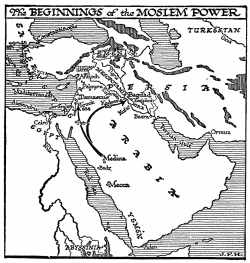
It was Khalid who fought the decisive battle (634) with the army of Heraclius upon the banks of the Yarmuk, a tributary of the Jordan. The legions, as ever, were without proper cavalry; for seven centuries the ghost of old Crassus had haunted the east in vain; the imperial armies relied upon Christian Arab auxiliaries, and these deserted to the Moslems as the armies joined issue. A great parade of priests, sacred banners, pictures, and holy relics was made by the Byzantine host, and it was further sustained by the chanting of monks. But there was no magic in the relics and little conviction about the chanting. On the Arab side the Emirs and sheiks harangued the troops, and after the ancient Arab fashion the shrill voices of women in the rear encouraged their men. The Moslem ranks were full of believers before whom shone victory or paradise. The battle was never in doubt after the defection of the irregular cavalry. An attempt to retreat dissolved into a rout and became a massacre. The Byzantine army had fought with its back to the river, which was presently choked with its dead.
Thereafter Heraclius slowly relinquished all Syria, which he had so lately won back from the Persians, to his new antagonists. Damascus soon fell, and a year later the Moslems entered Antioch. For a time they had to abandon it again to a last effort from Constantinople, but they re-entered it for good under Khalid.
Meanwhile on the eastern front, after a swift initial success which gave them Hira, the Persian resistance stiffened. The dynastic struggle had ended at last in the coming of a king of kings, and a general of ability had been found in Rustam. He gave battle at Kadessia (637). His army was just such another composite host as Darius had led into Thrace or Alexander defeated at Issus; it was a medley of levies. He had thirty-three war elephants, and he sat on a golden throne upon a raised platform behind the Persian ranks, surveying the battle, which throne will remind the reader of Herodotus, the Hellespont, and Salamis more than a thousand years before. The battle lasted three days; each day the Arabs attacked and the Persian host held its ground until nightfall called a truce. On the third day the Arabs received reinforcements, and towards the evening the Persians attempted to bring the struggle to an end by a charge of elephants. At first the huge beasts carried all before them; then one was wounded painfully and became uncontrollable, rushing up and down between the armies. Its panic affected the others, and for a time both armies remained dumbfounded in the red light of sunset, watching the frantic efforts of these grey, squealing monsters to escape from the tormenting masses of armed men that hemmed them in. It was by the merest chance that at last they broke through the Persian and not through the Arab array, and that it was the Arabs who were able to charge home upon the resulting confusion. The twilight darkened to night, but this time the armies did not separate. All through the night the Arabs smote in the name of Allah, and pressed upon the shattered and retreating Persians. Dawn broke upon the vestiges of Rustam’s army in flight far beyond the litter of the battlefield. Its path was marked by scattered weapons and war material, abandoned transport, and the dead and dying. The platform and the golden throne were broken down, and Rustam lay dead among a heap of dead men....
Already in 634 Abu Bekr had died and given place to Omar, the Prophet’s brother-in-law, as Caliph; and it was under Omar (634-643) that the main conquests of the Moslems occurred. The Byzantine Empire was pushed out of Syria altogether. But at the Taurus Mountains the Moslem thrust was held. Armenia was overrun, all Mesopotamia was conquered and Persia beyond the rivers. Egypt passed almost passively from Greek to Arab; in a few years the Semitic race, in the name of God and His Prophet, had recovered nearly all the dominions it had lost to the Aryan Persians a thousand years before. Jerusalem fell early, making a treaty without standing siege, and so the True Cross which had been carried off by the Persians a dozen years before, and elaborately restored by Heraclius, passed once more out of the rule of Christians. But it was still in Christian hands; the Christians were to be tolerated, paying only a poll tax; and all the churches and all the relics were left in their possession.
Jerusalem made a peculiar condition for its surrender. The city would give itself only to the Caliph Omar in person. Hitherto he had been in Medina organizing armies and controlling the general campaign. He came to Jerusalem (638), and the manner of his coming shows how swiftly the vigour and simplicity of the first Moslem onset was being sapped by success. He came the six-hundred-mile journey with only one attendant; he was mounted on a camel, and a bag of barley, another of dates, a waterskin, and a wooden platter were his provision for the journey. He was met outside the city by his chief captains, robed splendidly in silks and with richly caparisoned horses. At this amazing sight the old man was overcome with rage. He slipped down from his saddle, scrabbled up dirt and stones with his hands, and pelted these fine gentlemen, shouting abuse. What was this insult? What did this finery mean? Where were his warriors? Where were the desert men? He would not let these popinjays escort him. He went on with his attendant, and the smart Emirs rode afar off—well out of range of his stones. He met the Patriarch of Jerusalem, who had apparently taken over the city from its Byzantine rulers, alone. With the Patriarch he got on very well. They went round the Holy Places together, and Omar, now a little appeased, made sly jokes at the expense of his too magnificent followers.
Equally indicative of the tendencies of the time is Omar’s letter ordering one of his governors who had built himself a palace at Kufa, to demolish it again.
“They tell me,” he wrote, “you would imitate the palace of Chosroes,[326] and that you would even use the gates that once were his. Will you also have guards and porters at those gates, as Chosroes had? Will you keep the faithful afar off and deny audience to the poor? Would you depart from the custom of our Prophet, and be as magnificent as those Persian emperors, and descend to hell even as they have done?”[327]
§ 6
Abu Bekr and Omar I are the two master figures in the history of Islam. It is not within our scope here to describe the wars by which in a hundred and twenty-five years Islam spread itself from the Indus to the Atlantic and Spain, and from Kashgar on the borders of China to Upper Egypt. Two maps must suffice to show the limits to which the vigorous impulse of the new faith carried the Arab idea and the Arabic scriptures, before worldliness, the old trading and plundering spirit, and the glamour of the silk robe had completely recovered their paralyzing sway over the Arab intelligence and will. The reader will note how the great tide swept over the footsteps of Yuan Chwang, and how easily in Africa the easy conquests of the Vandals were repeated in the reverse direction. And if the reader entertains any delusions about a fine civilization, either Persian, Roman, Hellenic, or Egyptian, being submerged by this flood, the sooner he dismisses such ideas the better. Islam prevailed because it was the best social and political order the times could offer. It prevailed because everywhere it found politically apathetic peoples, robbed, oppressed, bullied, uneducated, and unorganized, and it found selfish and unsound governments out of touch with any people at all. It was the broadest, freshest, and cleanest political idea that had yet come into actual activity in the world, and it offered better terms than any other to the mass of mankind. The capitalistic and slave-holding system of the Roman Empire and the literature and culture and social tradition of Europe had altogether decayed and broken down before Islam arose; it was only when mankind lost faith in the sincerity of its representatives that Islam too began to decay.
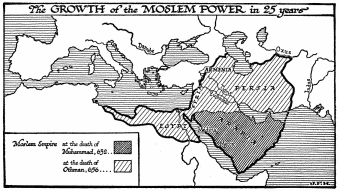
The larger part of its energy spent itself in conquering and assimilating Persia and Turkestan; its most vigorous thrusts were northwardly from Persia and westwardly through Egypt. Had it concentrated its first vigour upon the Byzantine Empire, there can be little doubt that by the eighth century it would have taken Constantinople and come through into Europe as easily as it reached the Pamirs. The Caliph Moawiya, it is true, besieged the capital for seven years (672 to 678), and Suleiman in 717 and 718; but the pressure was not sustained, and for three or four centuries longer the Byzantine Empire remained the crazy bulwark of Europe. In the newly Christianized or still pagan Avars, Bulgars, Serbs, Slavs, and Saxons, Islam would certainly have found as ready converts as it did in the Turks of Central Asia. And though, instead of insisting upon Constantinople, it first came round into Europe by the circuitous route of Africa and Spain, it was only in France, at the end of a vast line of communications from Arabia, that it encountered a power sufficiently vigorous to arrest its advance.
From the outset the Bedouin aristocrats of Mecca dominated the new empire. Abu Bekr, the first Caliph, was in an informal shouting way elected at Medina, and so were Omar I and Othman, the third Caliph, but all three were Meccans of good family. They were not men of Medina. And though Abu Bekr and Omar were men of stark simplicity and righteousness Othman was of a baser quality, a man quite in the vein of those silk robes, to whom conquest was not conquest for Allah but for Arabia, and especially for Mecca in Arabia, and more particularly for himself and for the Meccans and for his family, the Omayyads. He was a worthy man, who stood out for his country and his town and his “people.” He was no early convert as his two predecessors had been; he had joined the Prophet for reasons of policy in fair give and take. With his accession the Caliph ceases to be a strange man of fire and wonder, and becomes an Oriental monarch like many Oriental monarchs before and since, a fairly good monarch by Eastern standards as yet, but nothing more.
The rule and death of Othman brought out the consequences of Muhammad’s weaknesses as clearly as the lives of Abu Bekr and Omar had witnessed to the divine fire in his teaching. Muhammad had been politic at times when Abu Bekr would have been firm, and the new element of aristocratic greediness that came in with Othman was one fruit of those politic moments. And the legacy of that carelessly compiled harem of the Prophet, the family complications and jealousies which had lurked in the background of Moslem affairs during the rule of the first two Caliphs, was now coming out into the light of day. Ali, who was the nephew, the adopted son, and the son-in-law of the Prophet—he was the husband of the Prophet’s daughter Fatima—he had considered himself the rightful Caliph. His claims formed an undertow to the resentment of Medina and of the rival families of Mecca against the advancement of the Omayyads. But Ayesha, the favourite wife of the Prophet, had always been jealous of Fatima and hostile to Ali. She supported Othman.... The splendid opening of the story of Islam collapses suddenly into this squalid dispute and bickering of heirs and widows.
In 656 Othman, an old man of eighty, was stoned in the streets of Medina by a mob, chased to his house, and murdered; and Ali became at last Caliph, only to be murdered in his turn (661). In one of the battles in this civil war, Ayesha, now a gallant, mischievous old lady, distinguished herself by leading a charge, mounted on a camel. She was taken prisoner and treated well.
While the armies of Islam were advancing triumphantly to the conquest of the world, this sickness of civil war smote at its head. What was the rule of Allah in the world to Ayesha when she could score off the detested Fatima, and what heed were the Omayyads and the partisans of Ali likely to take of the unity of mankind when they had a good hot feud of this sort to entertain them, with the caliphate as a prize? The world of Islam was rent in twain by the spites, greeds, and partisan silliness of a handful of men and women in Medina. That quarrel still lives. To this day one main division of the Moslems, the Shiites, maintain the hereditary right of Ali to be Caliph as an article of faith! They prevail in Persia and India. But an equally important section, the Sunnites, with whom it is difficult for a disinterested observer not to agree, deny this peculiar addendum to Muhammad’s simple creed. So far as we can gather at this length of time, Ali was an entirely commonplace individual.
To watch this schism creeping across the brave beginnings of Islam is like watching a case of softening of the brain. To the copious literature of the subject we must refer the reader who wishes to learn how Hasan, the son of Ali, was poisoned by his wife, and how Husein, his brother, was killed. We do but name them here because they still afford a large section of mankind scope for sentimental partisanship and mutual annoyance. They are the two chief Shiite martyrs. Amidst the coming and going of their conflicts the old Kaaba at Mecca was burnt down, and naturally there began endless disputation whether it should be rebuilt in exactly its ancient form or on a much larger scale.
In this and the preceding sections we have seen once more the inevitable struggle of this newest and latest unifying impulse in the world’s affairs against the everyday worldliness of mankind, and we have seen also how from the first the complicated household of Muhammad was like an evil legacy to the new faith. But as this history now degenerates into the normal crimes and intrigues of an Oriental dynasty, the student of history will realize a third fundamental weakness in the world reforms of Muhammad. He was an illiterate Arab, ignorant of history, totally ignorant of all the political experiences of Rome and Greece, and almost as ignorant of the real history of Judea; and he left his followers with no scheme for a stable government embodying and concentrating the general will of the faithful, and no effective form to express the very real spirit of democracy (using the word in its modern sense) that pervades the essential teaching of Islam. His own rule was unlimited autocracy, and autocratic Islam has remained. Politically Islam was not an advance, but a retrogression from the traditional freedoms and customary laws of the desert. The breach of the pilgrims’ trace that led to the battle of Badr is the blackest mark against early Islam. Nominally Allah is its chief ruler—but practically its master has always been whatever man was vigorous and unscrupulous enough to snatch and hold the Caliphate—and, subject to revolts and assassinations, its final law has been that man’s will.
For a time, after the death of Ali, the Omayyad family was in the ascendant, and for nearly a century they gave rulers to Islam.
The Arab historians are so occupied with the dynastic squabbles and crimes of the time, that it is difficult to trace the external history of the period. We find Moslem shipping upon the seas defeating the Byzantine fleet in a great sea fight off the coast of Lycia (A.D. 655), but how the Moslems acquired this victorious fleet thus early we do not clearly know. It was probably chiefly Egyptian. For some years Islam certainly controlled the eastern Mediterranean, and in 662 and again in 672, during the reign of Muawiya (662-680), the first great Omayyad Caliph, made two sea attacks upon Constantinople. They had to be sea attacks because Islam, so long as it was under Arab rule, never surmounted the barrier of the Taurus Mountains. During the same period the Moslems were also pressing their conquests further and further into Central Asia. While Islam was already decaying at its centre, it was yet making great hosts of new adherents and awakening a new spirit among the hitherto divided and aimless Turkish peoples. Medina was no longer a possible centre for its vast enterprises in Asia, Africa, and the Mediterranean, and so Damascus became the usual capital of the Omayyad Caliphs.
Chief among these, as for a time the clouds of dynastic intrigue clear, are Abdal Malik (685-705) and Walid I (705-715), under whom the Omayyad line rose to the climax of its successes. The western boundary was carried to the Pyrenees, while to the east the domains of the Caliph marched with China. The son of Walid, Suleiman (715), carried out a second series of Moslem attacks upon Constantinople which his father had planned and proposed. As with the Caliph Muawiya half a century before, the approach was by sea—for Asia Minor, as we have just noted, was still unconquered—and the shipping was drawn chiefly from Egypt. The emperor, a usurper, Leo the Isaurian, displayed extraordinary skill and obstinacy in the defence; he burnt most of the Moslem shipping in a brilliant sortie, cut up the troops they had landed upon the Asiatic side of the Bosphorus, and after a campaign in Europe of two years (717-718), a winter of unexampled severity completed their defeat.
From this point onward the glory of the Omayyad line decays. The first tremendous impulse of Islam was now spent. There was no further expansion and a manifest decline in religious zeal. Islam had made millions of converts, and had digested those millions very imperfectly. Cities, nations, whole sects and races, Arab pagans, Jews, Christians, Manichæans, Zoroastrians, Turanian pagans, had been swallowed up into this new vast empire of Muhammad’s successors. It has hitherto been the common characteristic of all the great unifying religious initiators of the world, the common oversight, that they have accepted the moral and theological ideals to which the first appeal was made, as though they were universal ideals. Muhammad’s appeal, for example, was to the traditional chivalry and underlying monotheistic feelings of the intelligent Arabs of his time. These things were latent in the mind and conscience of Mecca and Medina; he did but call them forth. Then, as the new teaching spread and stereotyped itself, it had to work on a continually more uncongenial basis, it had to grow in soil that distorted and perverted it. Its sole textbook was the Koran. To minds untuned to the melodies of Arabic, this book seemed to be, as it seems to many European minds to-day, a mixture of fine-spirited rhetoric with—to put it plainly—formless and unintelligent gabble. Countless converts missed the real thing in it altogether. To that we must ascribe the readiness of the Persian and Indian sections of the faith to join the Shiite schism upon a quarrel that they could at least understand and feel. And to the same attempt to square the new stuff with old prepossessions was due such extravagant theology as presently disputed whether the Koran was and always had been co-existent with God.[328] We should be stupefied by the preposterousness of this idea if we did not recognize in it at once the well-meaning attempt of some learned Christian convert to Islamize his belief that “In the beginning was the Word, and the Word was with God, and the Word was God.”[329]